Android Application Testing
TANJINA ISLAM
linkedin.com/in/tanjinaislam
Agenda/Outline/Overview
 Testing Approach
 Android testing framework
 Android The Testing API
 Android testing tools
 Different automated testing frameworks
Testing Approach
 UNIT TESTING
 INTEGRATION TESTING
 MANUAL TESTING
 AUTOMATED TESTING
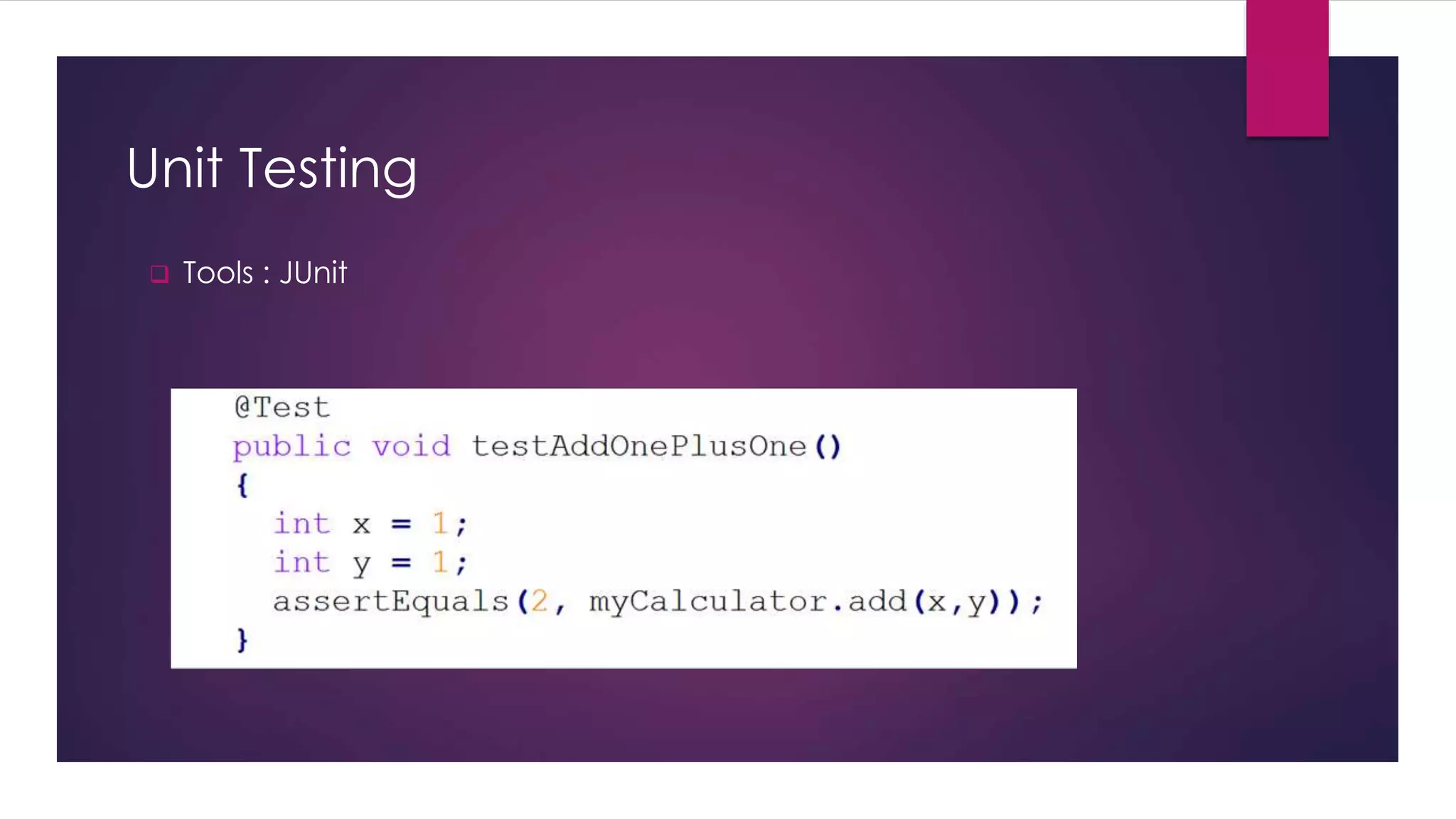
Unit Testing
 tests only the functionality of a certain component such as a method
(function) in a class, with all dependencies mocked up
 tests tend to be simpler and faster than integration tests
 also known as local tests
 run on a local JVM on the development machine instead of the
Android Runtime
 the execution speed of the unit test is very fast compared to tests
which require the Android system
 unit tests are executed against a modified version of the android.jar
which allows you to mocking libraries, like Mockito
Unit Testing
 Tools : JUnit
Integration Testing
 tests more than one component and how different pieces of the
system work together
 requires resources like database instances and hardware to be
allocated for them
 test many methods and may interact with dependencies like
Databases or Web Services
Unit Testing Vs. Integration Testing
 Let's, for example, assume a button in an Android activity is used to
start another activity. A unit test would determine if the corresponding
intent was issued, not if the second activity was started.
 An integration test would also check if the activity was correctly
started.
Manual Testing
 Requires Human interaction
 Tool : Human being
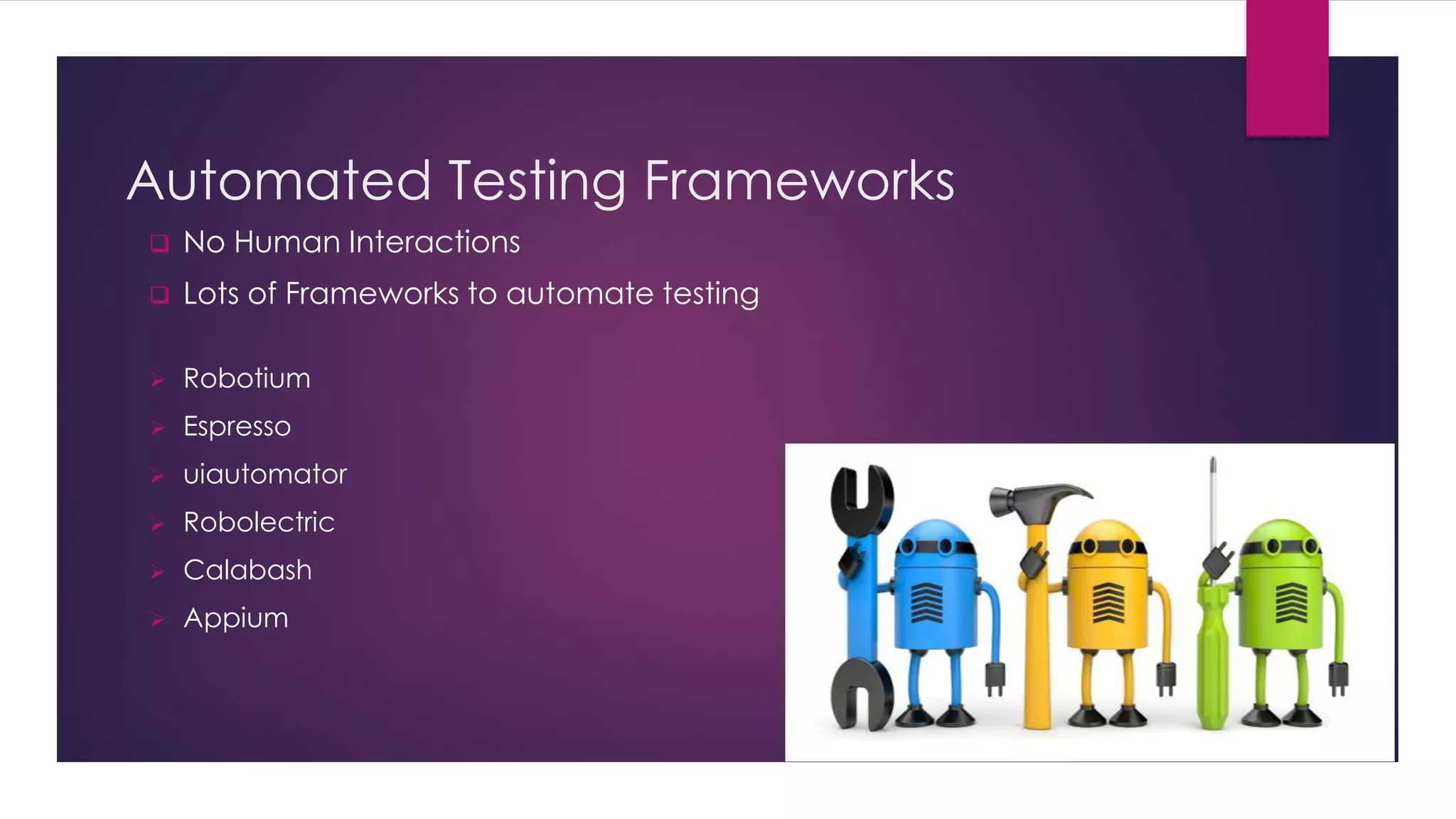
Automated Testing Frameworks
 Robotium
 Espresso
 uiautomator
 Robolectric
 Calabash
 Appium
 No Human Interactions
 Lots of Frameworks to automate testing
Automated Testing Frameworks
 most popular approaches used for automated Android testing:
 Google’s Android Testing Framework- This is the framework included as part of
the platform
 Robotium - Black box integration testing for Android
 Robolectric - Unit tests that run outside the emulator making the tests very fast
Android Testing Framework
 An Integral part of the development environment
 Assist on testing every aspect of application from unit testing to framework
Categories of Android Tests
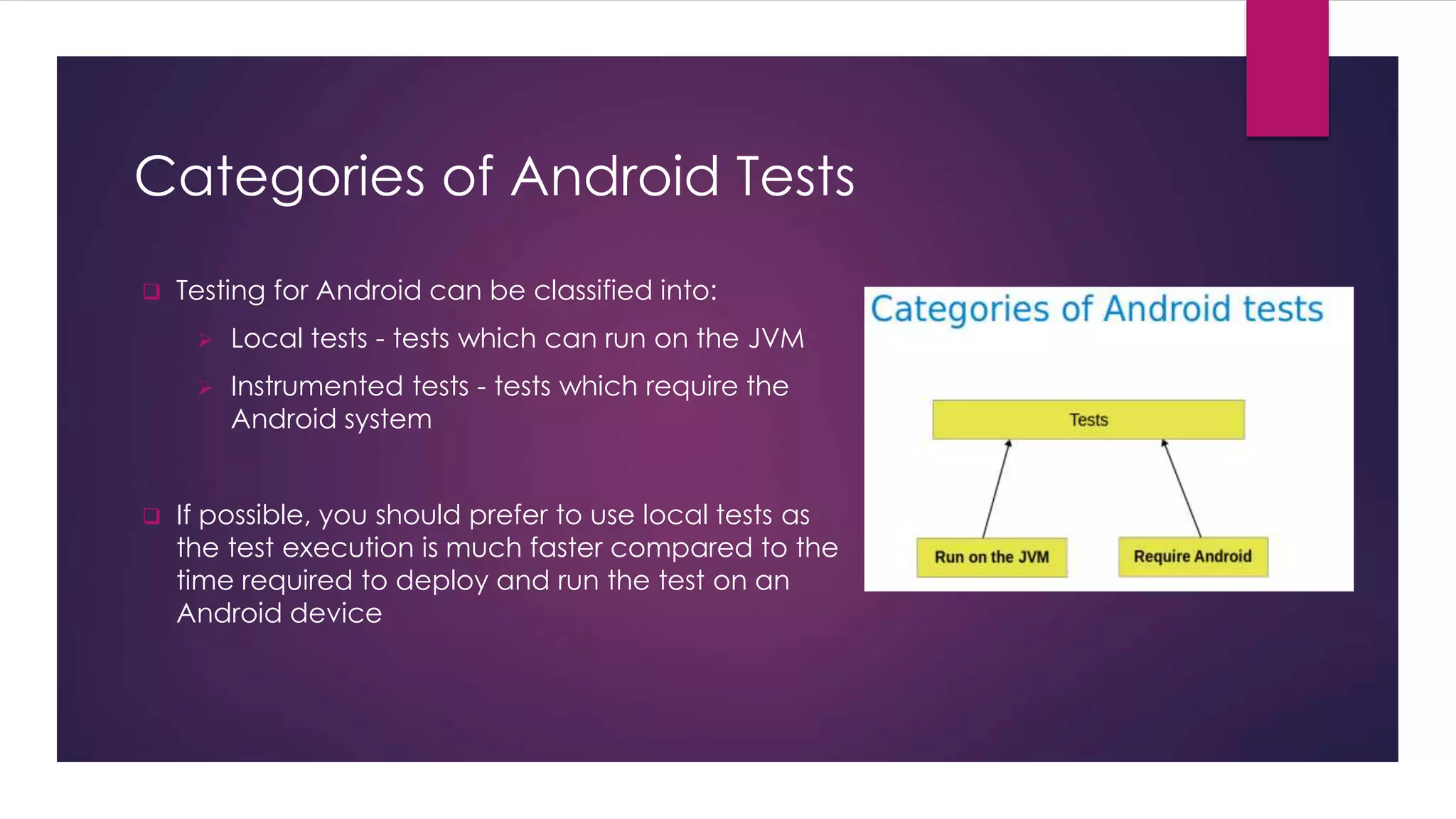
 Testing for Android can be classified into:
 Local tests - tests which can run on the JVM
 Instrumented tests - tests which require the
Android system
 If possible, you should prefer to use local tests as
the test execution is much faster compared to the
time required to deploy and run the test on an
Android device
Android The Testing API
 The Android testing API is based on the JUnit API and extended with a
instrumentation framework and Android-specific testing classes.
 Junit
 Instrumentation
 TestCase Classes
 AndroidTestCase
 Component-specific test cases
 ApplicationTestCase
 InstrumentationTestCase
 Assertion classes
 Mock object classes
 Contexts for testing
Android Testing Framework
 Key Features of Testing Framework
 test suites are based on Junit
 test suites are contained in test packages similar to main application packages
 The SDK also provides
 monkeyrunner, an API for testing devices with Python programs
 UI/Application Exerciser Monkey, a command-line tool for stress-testing UIs
by sending pseudo-random events to a device
 use plain JUnit to test a class that doesn't call the Android API
 use Android's JUnit extensions to test Android components
Android Testing Tools
 Testing Support Library
 This library provides a set of APIs that helps to build and run test code for app
 The Android Testing Support Library includes the following test automation tools:
 AndroidJUnitRunner: JUnit 4-compatible test runner for Android
 Espresso: UI testing framework; suitable for functional UI testing within an app
 UI Automator: UI testing framework; suitable for cross-app functional UI testing
across system and installed apps
Android Testing Tools
 Testing Support Library
 Monkey
 is a command-line tool
 a program that runs on emulator or device
 generates pseudo-random streams of user events (such as clicks, touches, or
gestures, as well as a number of system-level events) and sends them into system
 acts as a stress test on the application, in a random yet repeatable manner
 watches the system under test
Android Testing Tools
 Testing Support Library
 monkeyrunner
 provides an API for writing programs that control an Android device or emulator
from outside of Android code
 monkeyrunner tool provides these unique features for Android testing: Multiple
device control, Functional testing, Regression testing, Extensible automation
 The monkeyrunner tool uses Jython
 Jython allows the monkeyrunner API to interact easily with the Android framework
Android Testing Tools
 Testing Support Library
 monkeyrunner
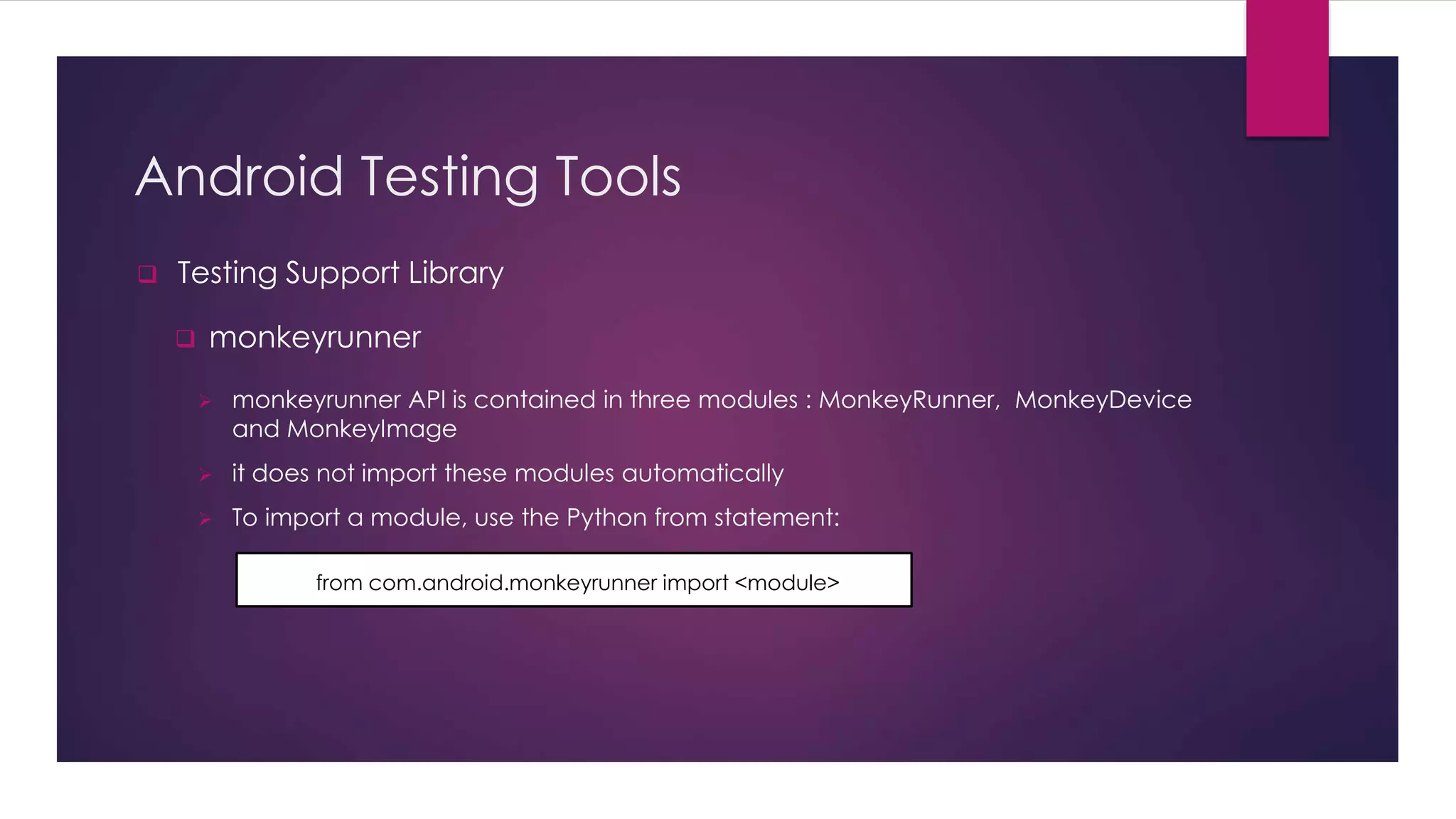
 monkeyrunner API is contained in three modules : MonkeyRunner, MonkeyDevice
and MonkeyImage
 it does not import these modules automatically
 To import a module, use the Python from statement:
from com.android.monkeyrunner import <module>
How does Android Test Framework
works
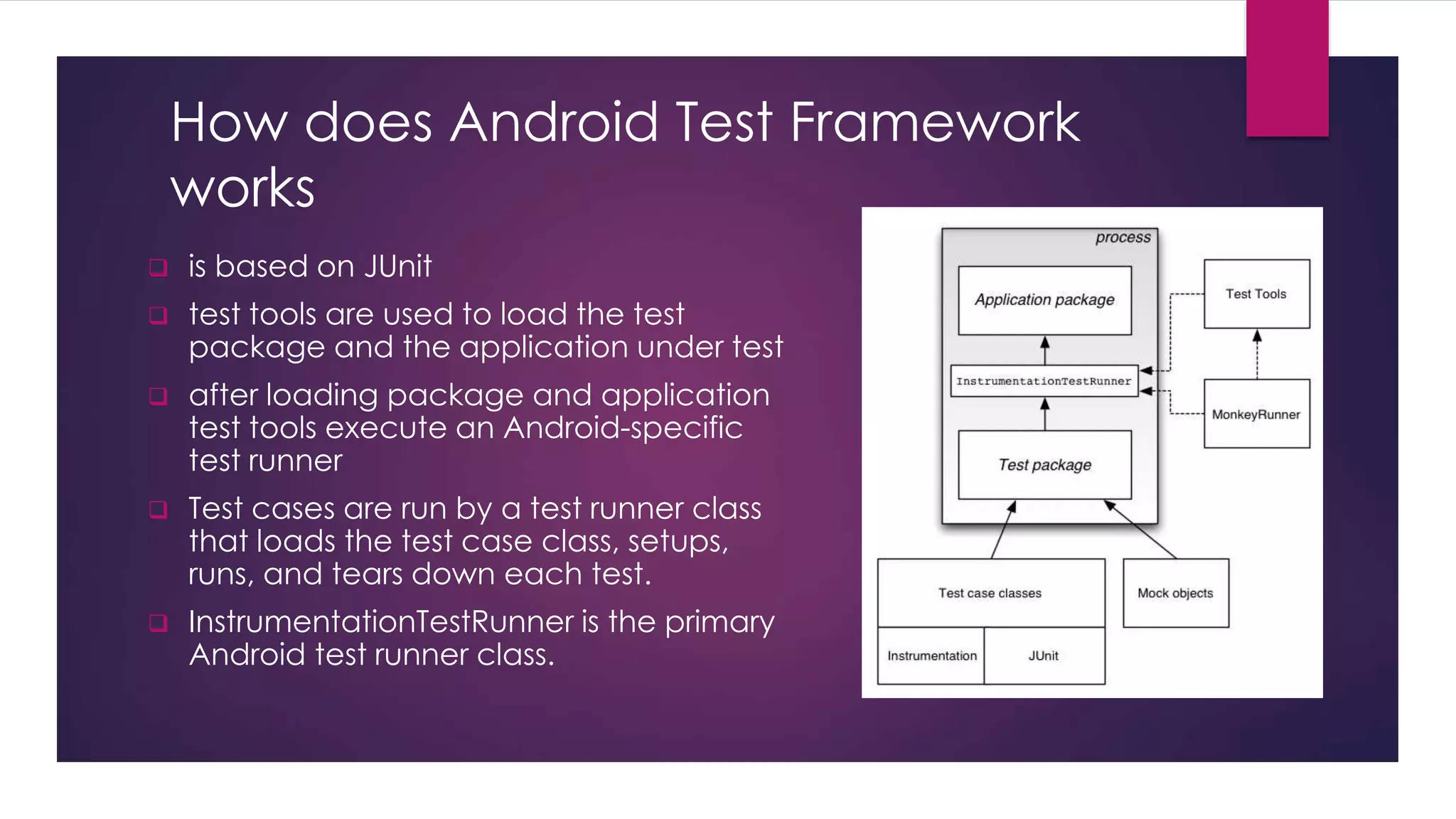
 is based on JUnit
 test tools are used to load the test
package and the application under test
 after loading package and application
test tools execute an Android-specific
test runner
 Test cases are run by a test runner class
that loads the test case class, setups,
runs, and tears down each test.
 InstrumentationTestRunner is the primary
Android test runner class.
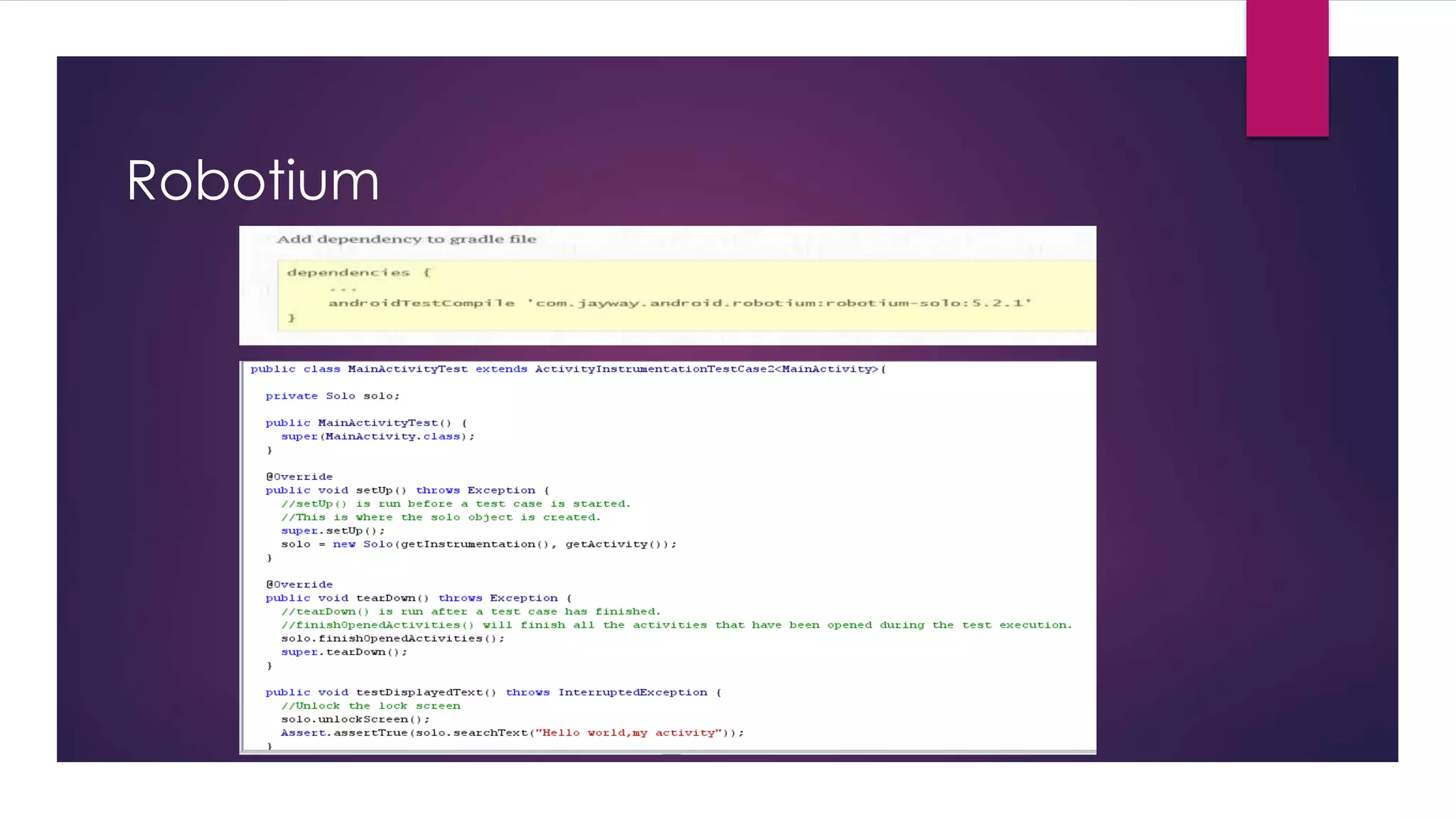
Robotium
 is an open source library extending JUnit with plenty
of useful methods for Android UI testing
 require the application to be running on
emulator/device
 provides powerful and robust automatic black-box
test cases for Android apps (native and hybrid)
 Inherit from extension of Android class:
ActivityInstrumentationTestCase2
 Uses “Solo” class to interact with your UI
 Robotium Recorder for capturing test output and
screenshots
Robotium
 The framework handles multiple Android activities automatically.
 Minimal time needed to write solid test cases.
 Readability of test cases is greatly improved, compared to standard
instrumentation tests.
 Test cases are more robust due to the run-time binding to UI
components.
 Integrates smoothly with Maven, Gradle or Ant to run tests as part of
continuous integration.
 Relatively slow
Robotium
Espresso
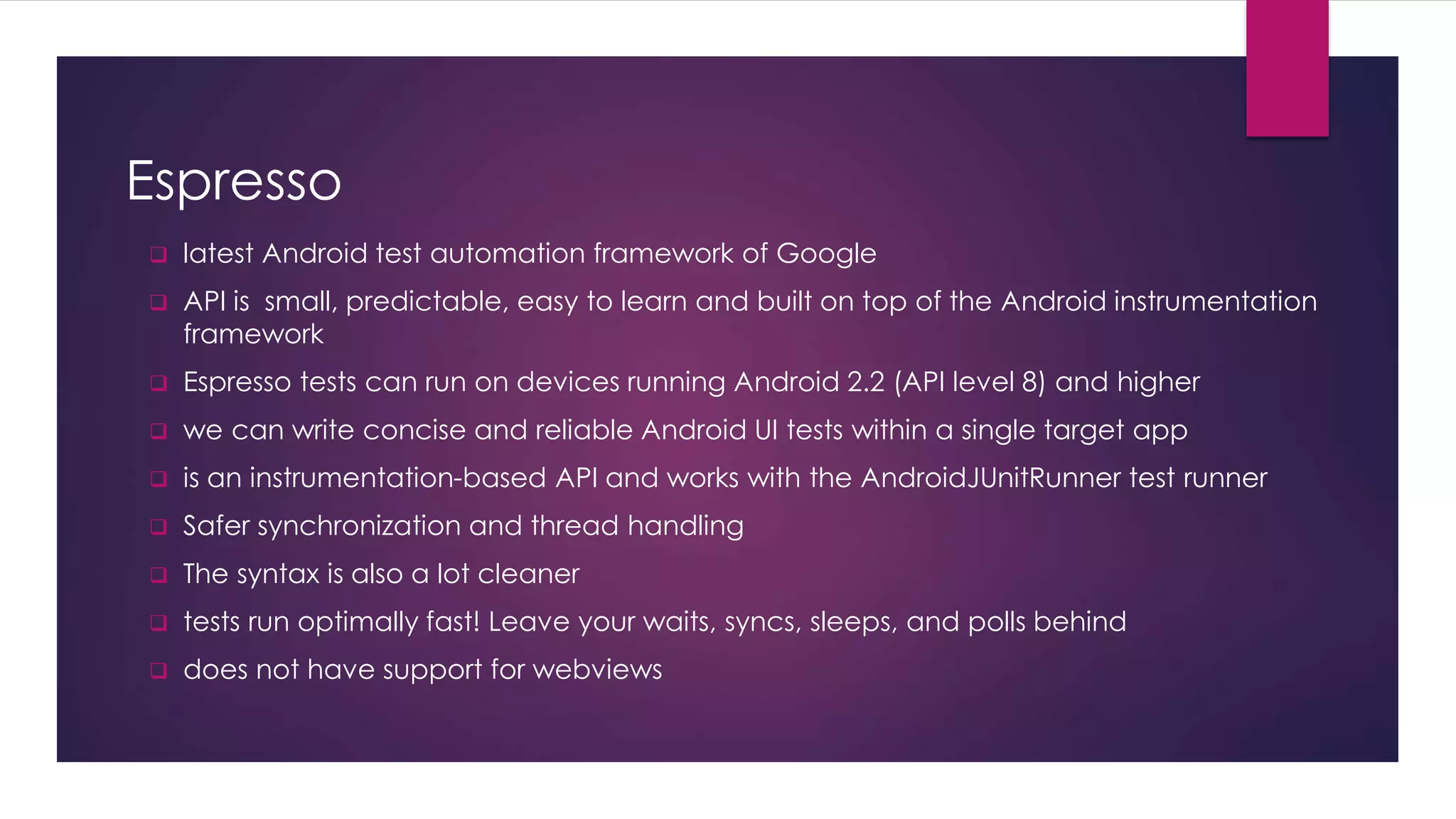
 latest Android test automation framework of Google
 API is small, predictable, easy to learn and built on top of the Android instrumentation
framework
 Espresso tests can run on devices running Android 2.2 (API level 8) and higher
 we can write concise and reliable Android UI tests within a single target app
 is an instrumentation-based API and works with the AndroidJUnitRunner test runner
 Safer synchronization and thread handling
 The syntax is also a lot cleaner
 tests run optimally fast! Leave your waits, syncs, sleeps, and polls behind
 does not have support for webviews
Espresso
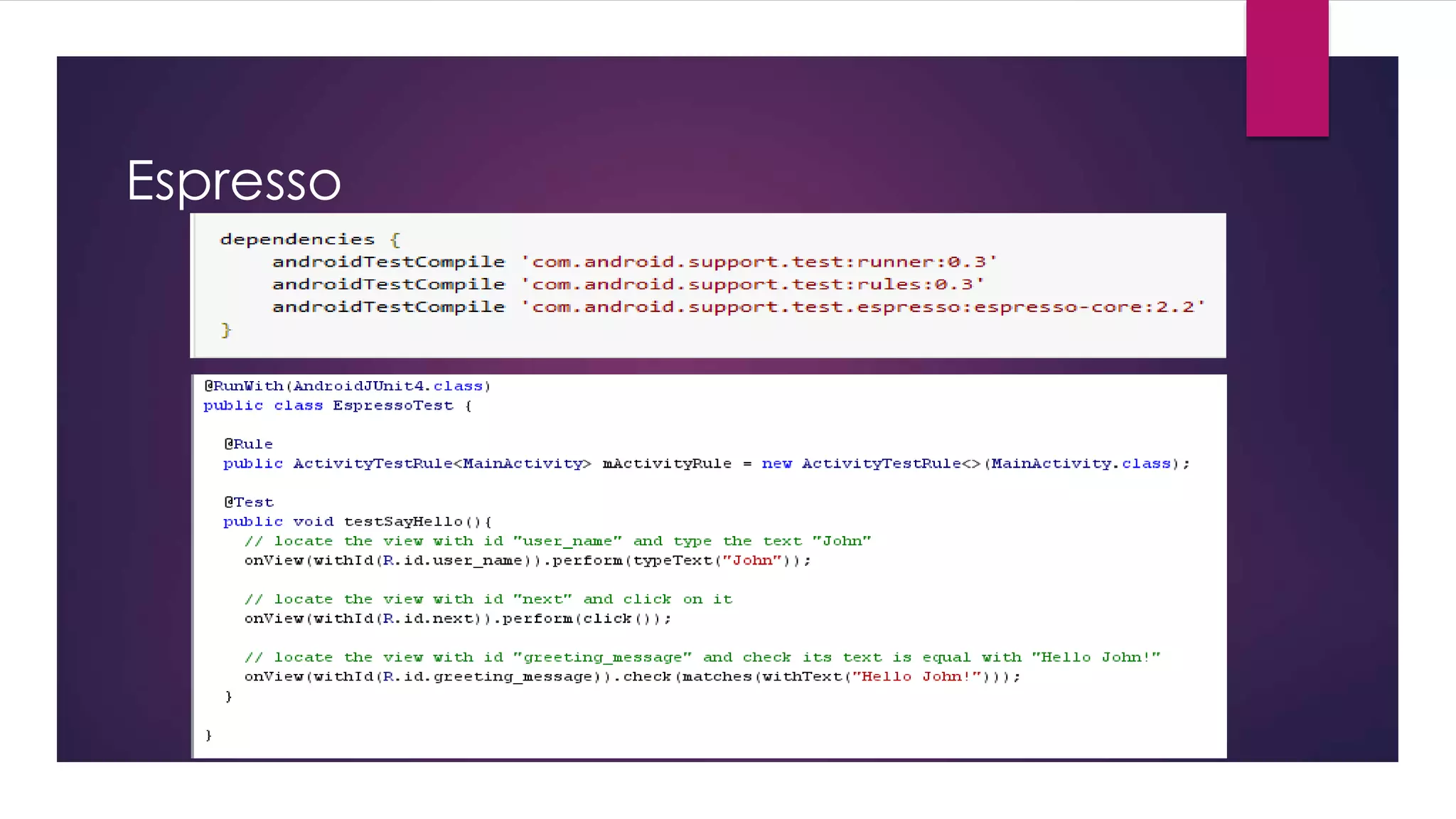
 Espresso is built up from 3 major components :
 ViewMatchers – allows you to locate a view in
the current view hierarchy [“find something“]
 ViewActions – allows you to interact with views
[“do something“]
 ViewAssertions – allows you to assert the state of
a view [“check something“]
 To avoid flakiness Turn off animations on testing
device
Espresso
Robotium Vs. Espresso
 The major advances in Espresso over Robotium:
1. Synchronization.
2. API.
3. Clear failure information.
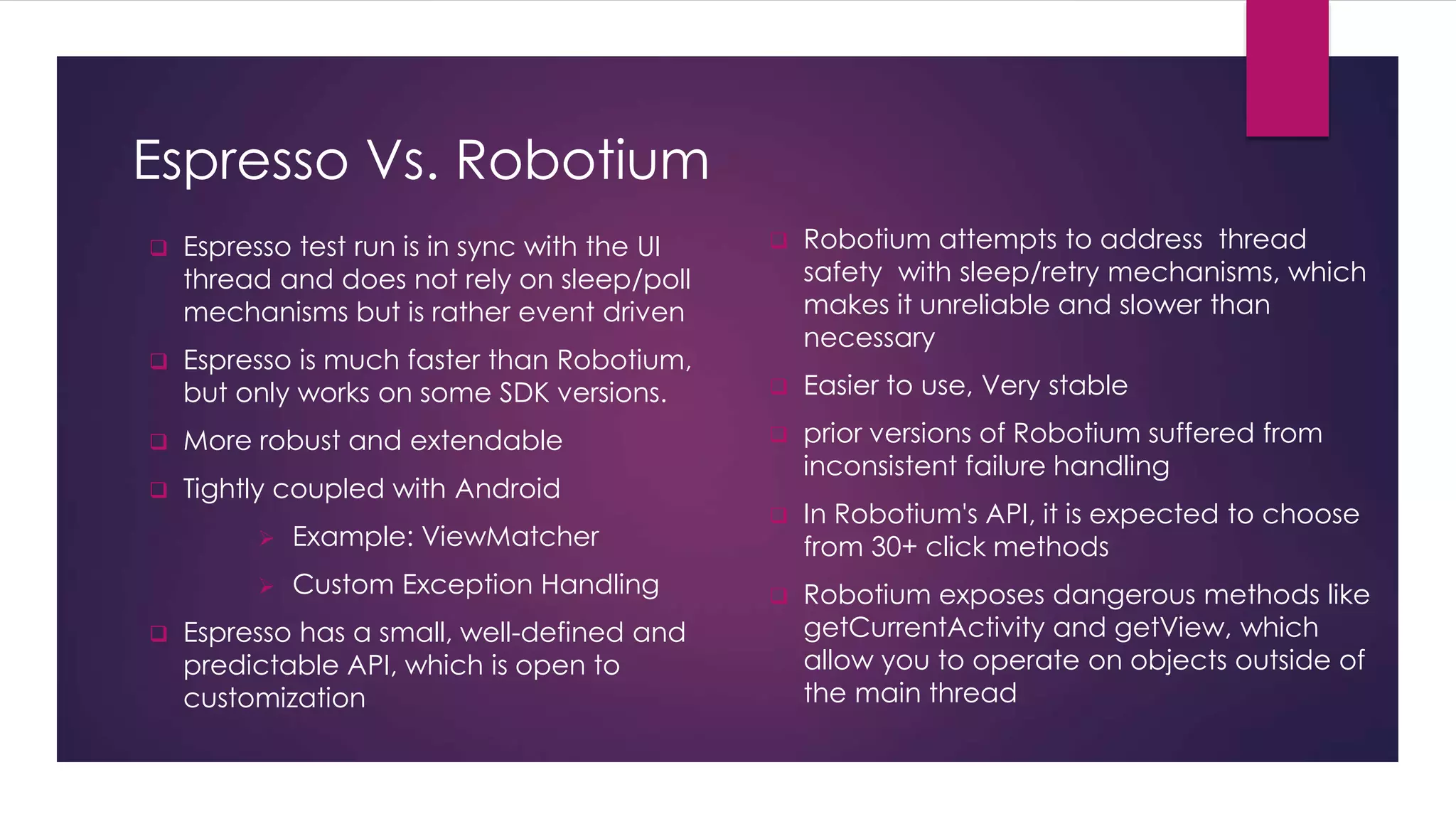
Espresso Vs. Robotium
 Espresso test run is in sync with the UI
thread and does not rely on sleep/poll
mechanisms but is rather event driven
 Espresso is much faster than Robotium,
but only works on some SDK versions.
 More robust and extendable
 Tightly coupled with Android
 Example: ViewMatcher
 Custom Exception Handling
 Espresso has a small, well-defined and
predictable API, which is open to
customization
 Robotium attempts to address thread
safety with sleep/retry mechanisms, which
makes it unreliable and slower than
necessary
 Easier to use, Very stable
 prior versions of Robotium suffered from
inconsistent failure handling
 In Robotium's API, it is expected to choose
from 30+ click methods
 Robotium exposes dangerous methods like
getCurrentActivity and getView, which
allow you to operate on objects outside of
the main thread
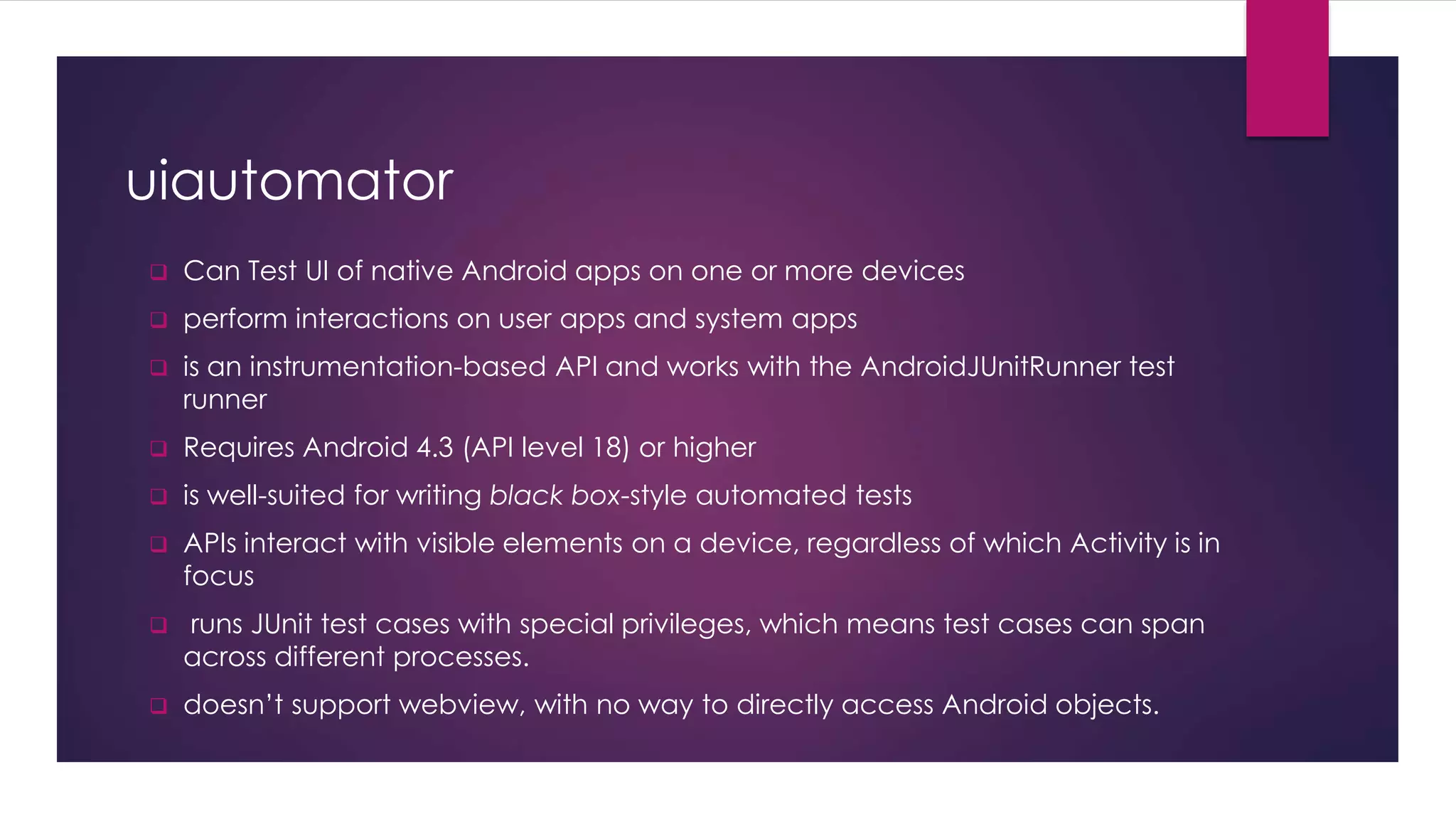
uiautomator
 Can Test UI of native Android apps on one or more devices
 perform interactions on user apps and system apps
 is an instrumentation-based API and works with the AndroidJUnitRunner test
runner
 Requires Android 4.3 (API level 18) or higher
 is well-suited for writing black box-style automated tests
 APIs interact with visible elements on a device, regardless of which Activity is in
focus
 runs JUnit test cases with special privileges, which means test cases can span
across different processes.
 doesn’t support webview, with no way to directly access Android objects.
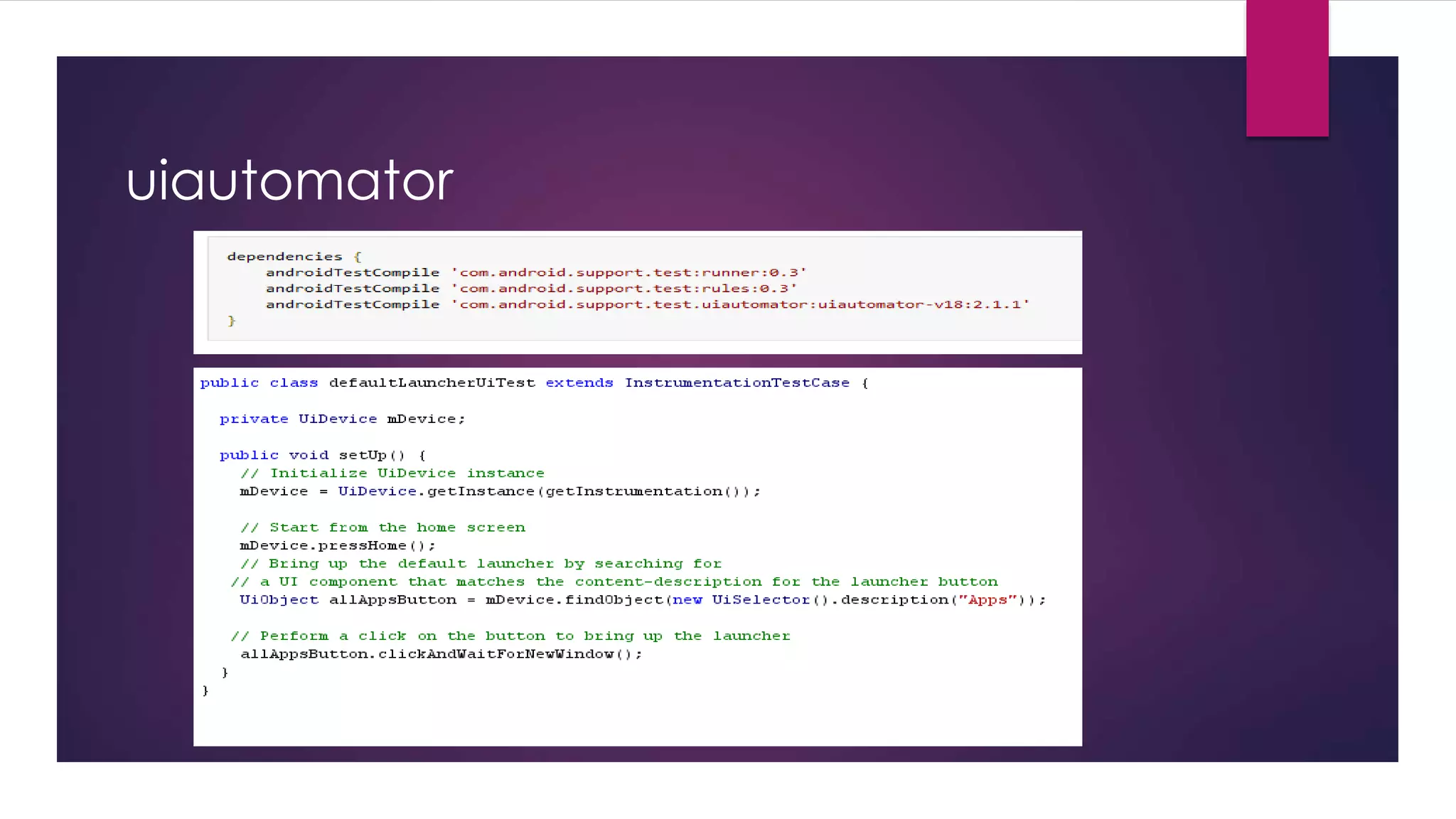
uiautomator
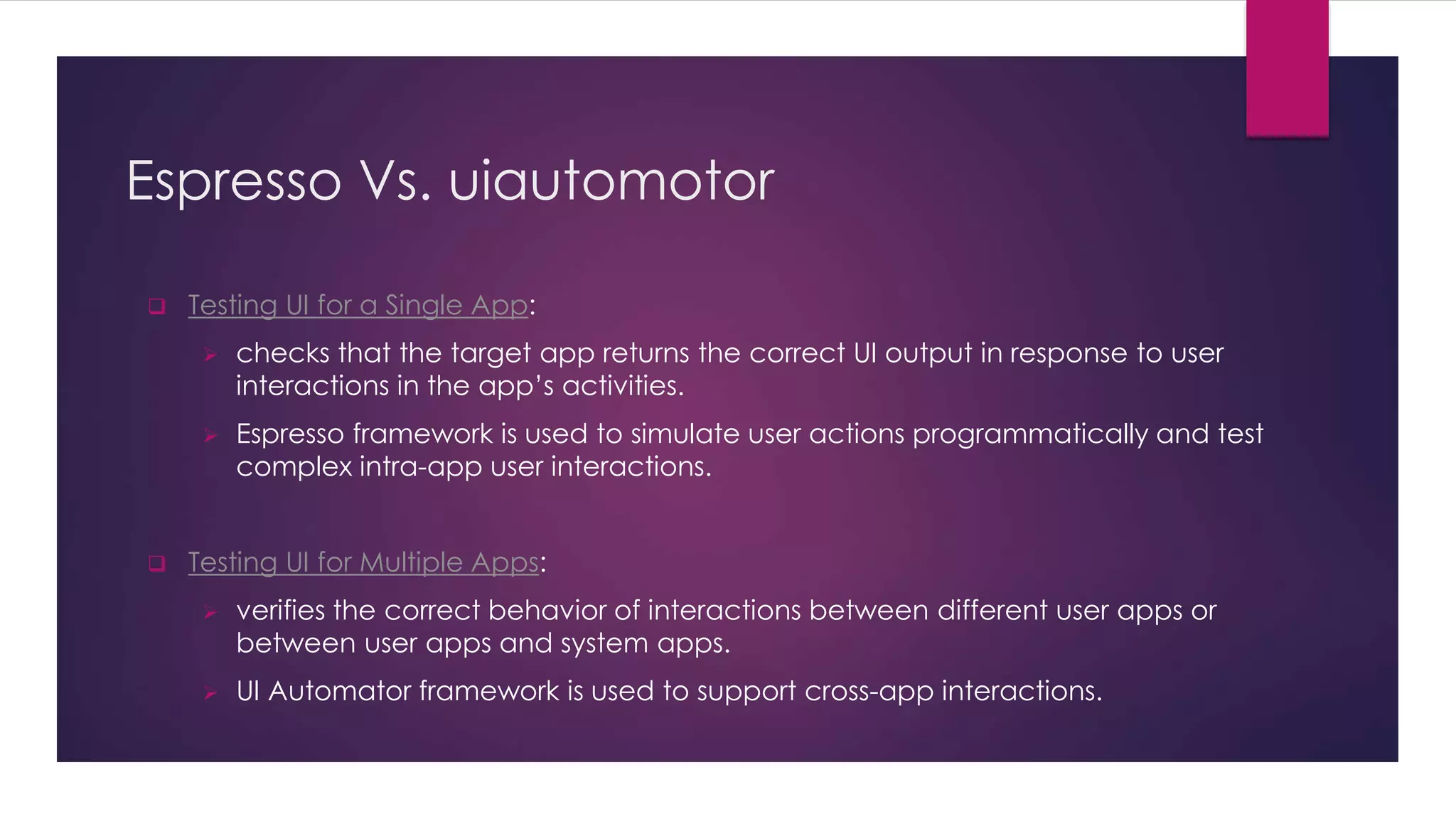
Espresso Vs. uiautomotor
 Testing UI for a Single App:
 checks that the target app returns the correct UI output in response to user
interactions in the app’s activities.
 Espresso framework is used to simulate user actions programmatically and test
complex intra-app user interactions.
 Testing UI for Multiple Apps:
 verifies the correct behavior of interactions between different user apps or
between user apps and system apps.
 UI Automator framework is used to support cross-app interactions.
Robolectric
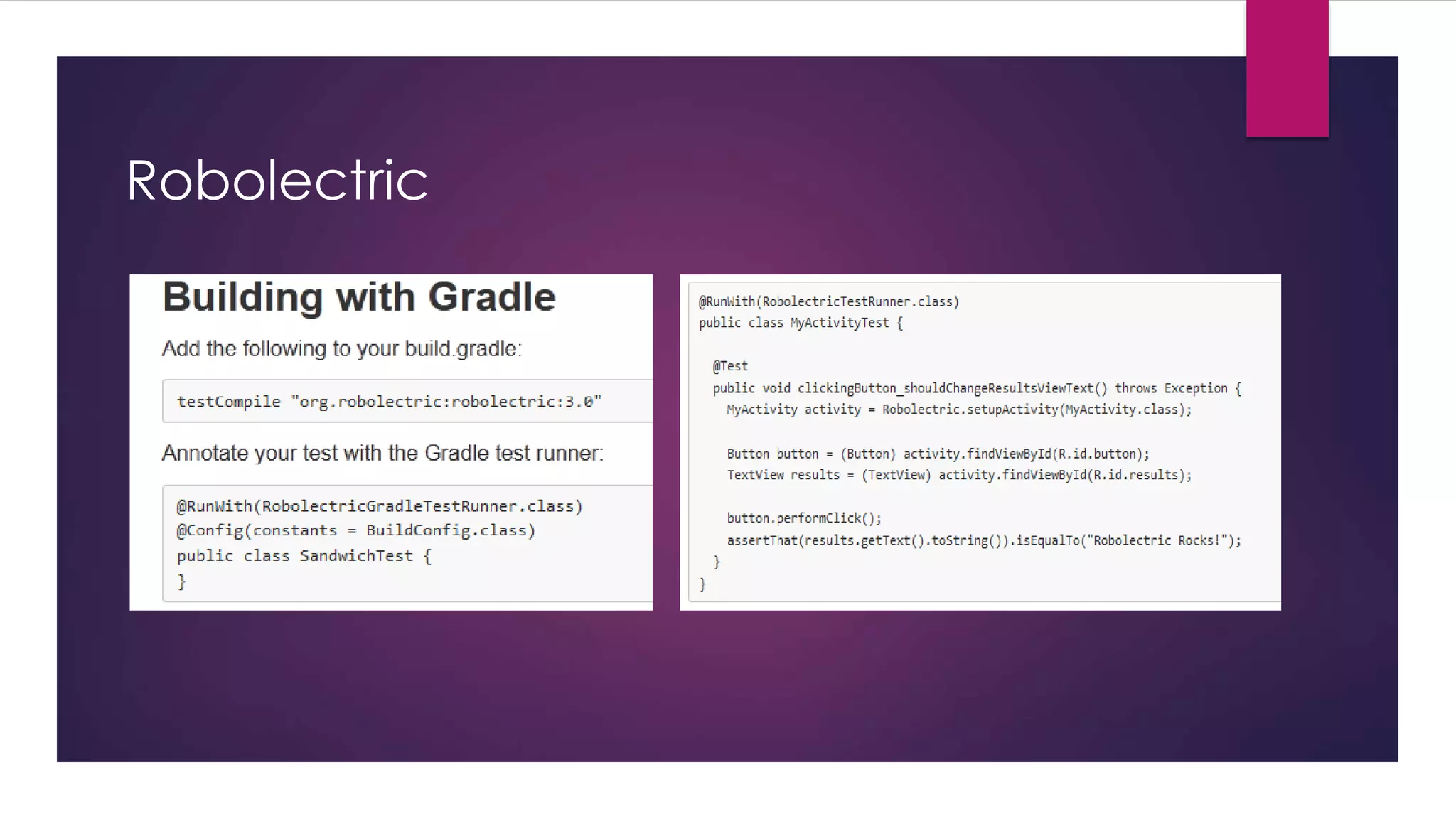
 Robolectric is a unit test framework
 lets you run your tests inside the JVM
 Doesn’t require emulator/Device to run test
 Fastest testing suite; reduces test cycles from minutes to seconds
 No Mocking Framework is needed
 does not work for every case and only supports unit tests
 When tests fall outside its scope then we need to rely on Robotium for
complete integration testing
Robolectric
Other 3rd Party Frameworks
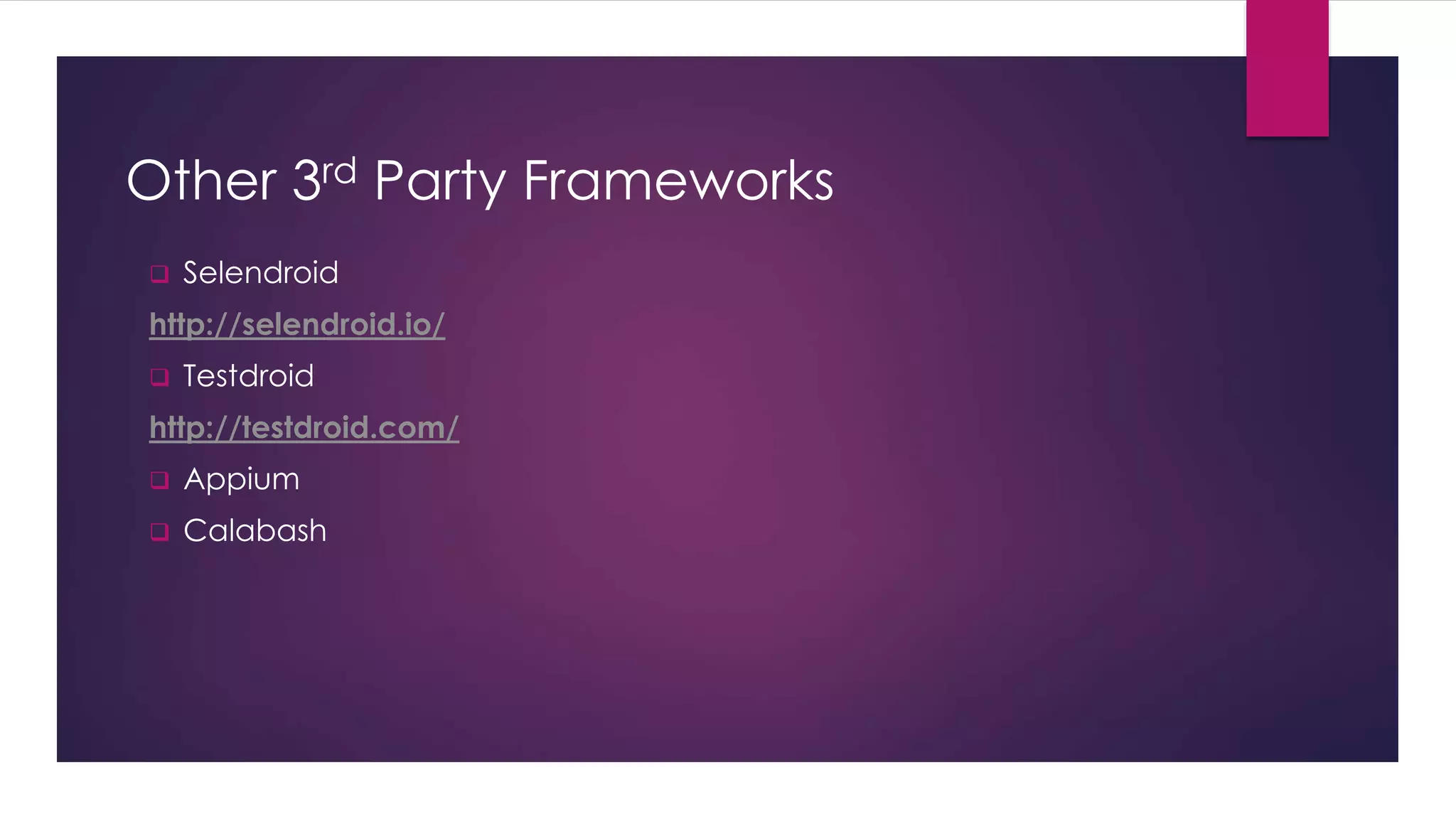
 Selendroid
http://selendroid.io/
 Testdroid
http://testdroid.com/
 Appium
 Calabash
References
http://developer.android.com/tools/testing/testing_android.html
https://code.google.com/p/robotium/
http://robolectric.org/
https://github.com/codepath/android_guides/wiki/Android-Unit-and-Integration-testing
http://developer.android.com/training/testing/ui-testing/espresso-testing.html
https://code.google.com/p/android-test-kit/wiki/Espresso
http://developer.android.com/tools/testing-support-library/index.html#UIAutomator
http://testdroid.com/tech/top-5-android-testing-frameworks-with-examples
https://www.youtube.com/watch?v=TGU0B4qRlHY
https://androidresearch.wordpress.com/2015/04/04/an-introduction-to-espresso/
http://www.vogella.com/tutorials/AndroidTestingEspresso/article.html
http://www.vogella.com/tutorials/AndroidTesting/article.html

Android testing

  • 1.
    Android Application Testing TANJINAISLAM linkedin.com/in/tanjinaislam
  • 2.
    Agenda/Outline/Overview  Testing Approach Android testing framework  Android The Testing API  Android testing tools  Different automated testing frameworks
  • 3.
    Testing Approach  UNITTESTING  INTEGRATION TESTING  MANUAL TESTING  AUTOMATED TESTING
  • 4.
    Unit Testing  testsonly the functionality of a certain component such as a method (function) in a class, with all dependencies mocked up  tests tend to be simpler and faster than integration tests  also known as local tests  run on a local JVM on the development machine instead of the Android Runtime  the execution speed of the unit test is very fast compared to tests which require the Android system  unit tests are executed against a modified version of the android.jar which allows you to mocking libraries, like Mockito
  • 5.
  • 6.
    Integration Testing  testsmore than one component and how different pieces of the system work together  requires resources like database instances and hardware to be allocated for them  test many methods and may interact with dependencies like Databases or Web Services
  • 7.
    Unit Testing Vs.Integration Testing  Let's, for example, assume a button in an Android activity is used to start another activity. A unit test would determine if the corresponding intent was issued, not if the second activity was started.  An integration test would also check if the activity was correctly started.
  • 8.
    Manual Testing  RequiresHuman interaction  Tool : Human being
  • 9.
    Automated Testing Frameworks Robotium  Espresso  uiautomator  Robolectric  Calabash  Appium  No Human Interactions  Lots of Frameworks to automate testing
  • 10.
    Automated Testing Frameworks most popular approaches used for automated Android testing:  Google’s Android Testing Framework- This is the framework included as part of the platform  Robotium - Black box integration testing for Android  Robolectric - Unit tests that run outside the emulator making the tests very fast
  • 11.
    Android Testing Framework An Integral part of the development environment  Assist on testing every aspect of application from unit testing to framework
  • 12.
    Categories of AndroidTests  Testing for Android can be classified into:  Local tests - tests which can run on the JVM  Instrumented tests - tests which require the Android system  If possible, you should prefer to use local tests as the test execution is much faster compared to the time required to deploy and run the test on an Android device
  • 13.
    Android The TestingAPI  The Android testing API is based on the JUnit API and extended with a instrumentation framework and Android-specific testing classes.  Junit  Instrumentation  TestCase Classes  AndroidTestCase  Component-specific test cases  ApplicationTestCase  InstrumentationTestCase  Assertion classes  Mock object classes  Contexts for testing
  • 14.
    Android Testing Framework Key Features of Testing Framework  test suites are based on Junit  test suites are contained in test packages similar to main application packages  The SDK also provides  monkeyrunner, an API for testing devices with Python programs  UI/Application Exerciser Monkey, a command-line tool for stress-testing UIs by sending pseudo-random events to a device  use plain JUnit to test a class that doesn't call the Android API  use Android's JUnit extensions to test Android components
  • 15.
    Android Testing Tools Testing Support Library  This library provides a set of APIs that helps to build and run test code for app  The Android Testing Support Library includes the following test automation tools:  AndroidJUnitRunner: JUnit 4-compatible test runner for Android  Espresso: UI testing framework; suitable for functional UI testing within an app  UI Automator: UI testing framework; suitable for cross-app functional UI testing across system and installed apps
  • 16.
    Android Testing Tools Testing Support Library  Monkey  is a command-line tool  a program that runs on emulator or device  generates pseudo-random streams of user events (such as clicks, touches, or gestures, as well as a number of system-level events) and sends them into system  acts as a stress test on the application, in a random yet repeatable manner  watches the system under test
  • 17.
    Android Testing Tools Testing Support Library  monkeyrunner  provides an API for writing programs that control an Android device or emulator from outside of Android code  monkeyrunner tool provides these unique features for Android testing: Multiple device control, Functional testing, Regression testing, Extensible automation  The monkeyrunner tool uses Jython  Jython allows the monkeyrunner API to interact easily with the Android framework
  • 18.
    Android Testing Tools Testing Support Library  monkeyrunner  monkeyrunner API is contained in three modules : MonkeyRunner, MonkeyDevice and MonkeyImage  it does not import these modules automatically  To import a module, use the Python from statement: from com.android.monkeyrunner import <module>
  • 19.
    How does AndroidTest Framework works  is based on JUnit  test tools are used to load the test package and the application under test  after loading package and application test tools execute an Android-specific test runner  Test cases are run by a test runner class that loads the test case class, setups, runs, and tears down each test.  InstrumentationTestRunner is the primary Android test runner class.
  • 20.
    Robotium  is anopen source library extending JUnit with plenty of useful methods for Android UI testing  require the application to be running on emulator/device  provides powerful and robust automatic black-box test cases for Android apps (native and hybrid)  Inherit from extension of Android class: ActivityInstrumentationTestCase2  Uses “Solo” class to interact with your UI  Robotium Recorder for capturing test output and screenshots
  • 21.
    Robotium  The frameworkhandles multiple Android activities automatically.  Minimal time needed to write solid test cases.  Readability of test cases is greatly improved, compared to standard instrumentation tests.  Test cases are more robust due to the run-time binding to UI components.  Integrates smoothly with Maven, Gradle or Ant to run tests as part of continuous integration.  Relatively slow
  • 22.
  • 23.
    Espresso  latest Androidtest automation framework of Google  API is small, predictable, easy to learn and built on top of the Android instrumentation framework  Espresso tests can run on devices running Android 2.2 (API level 8) and higher  we can write concise and reliable Android UI tests within a single target app  is an instrumentation-based API and works with the AndroidJUnitRunner test runner  Safer synchronization and thread handling  The syntax is also a lot cleaner  tests run optimally fast! Leave your waits, syncs, sleeps, and polls behind  does not have support for webviews
  • 24.
    Espresso  Espresso isbuilt up from 3 major components :  ViewMatchers – allows you to locate a view in the current view hierarchy [“find something“]  ViewActions – allows you to interact with views [“do something“]  ViewAssertions – allows you to assert the state of a view [“check something“]  To avoid flakiness Turn off animations on testing device
  • 25.
  • 26.
    Robotium Vs. Espresso The major advances in Espresso over Robotium: 1. Synchronization. 2. API. 3. Clear failure information.
  • 27.
    Espresso Vs. Robotium Espresso test run is in sync with the UI thread and does not rely on sleep/poll mechanisms but is rather event driven  Espresso is much faster than Robotium, but only works on some SDK versions.  More robust and extendable  Tightly coupled with Android  Example: ViewMatcher  Custom Exception Handling  Espresso has a small, well-defined and predictable API, which is open to customization  Robotium attempts to address thread safety with sleep/retry mechanisms, which makes it unreliable and slower than necessary  Easier to use, Very stable  prior versions of Robotium suffered from inconsistent failure handling  In Robotium's API, it is expected to choose from 30+ click methods  Robotium exposes dangerous methods like getCurrentActivity and getView, which allow you to operate on objects outside of the main thread
  • 28.
    uiautomator  Can TestUI of native Android apps on one or more devices  perform interactions on user apps and system apps  is an instrumentation-based API and works with the AndroidJUnitRunner test runner  Requires Android 4.3 (API level 18) or higher  is well-suited for writing black box-style automated tests  APIs interact with visible elements on a device, regardless of which Activity is in focus  runs JUnit test cases with special privileges, which means test cases can span across different processes.  doesn’t support webview, with no way to directly access Android objects.
  • 29.
  • 30.
    Espresso Vs. uiautomotor Testing UI for a Single App:  checks that the target app returns the correct UI output in response to user interactions in the app’s activities.  Espresso framework is used to simulate user actions programmatically and test complex intra-app user interactions.  Testing UI for Multiple Apps:  verifies the correct behavior of interactions between different user apps or between user apps and system apps.  UI Automator framework is used to support cross-app interactions.
  • 31.
    Robolectric  Robolectric isa unit test framework  lets you run your tests inside the JVM  Doesn’t require emulator/Device to run test  Fastest testing suite; reduces test cycles from minutes to seconds  No Mocking Framework is needed  does not work for every case and only supports unit tests  When tests fall outside its scope then we need to rely on Robotium for complete integration testing
  • 32.
  • 33.
    Other 3rd PartyFrameworks  Selendroid http://selendroid.io/  Testdroid http://testdroid.com/  Appium  Calabash
  • 34.