Create More Value
                         Than You Capture
                              Tim O’Reilly

                            O’Reilly Media, Inc.
                              www.oreilly.com


                            Twitter Boot Camp
                               June 15, 2009


Tuesday, June 16, 2009
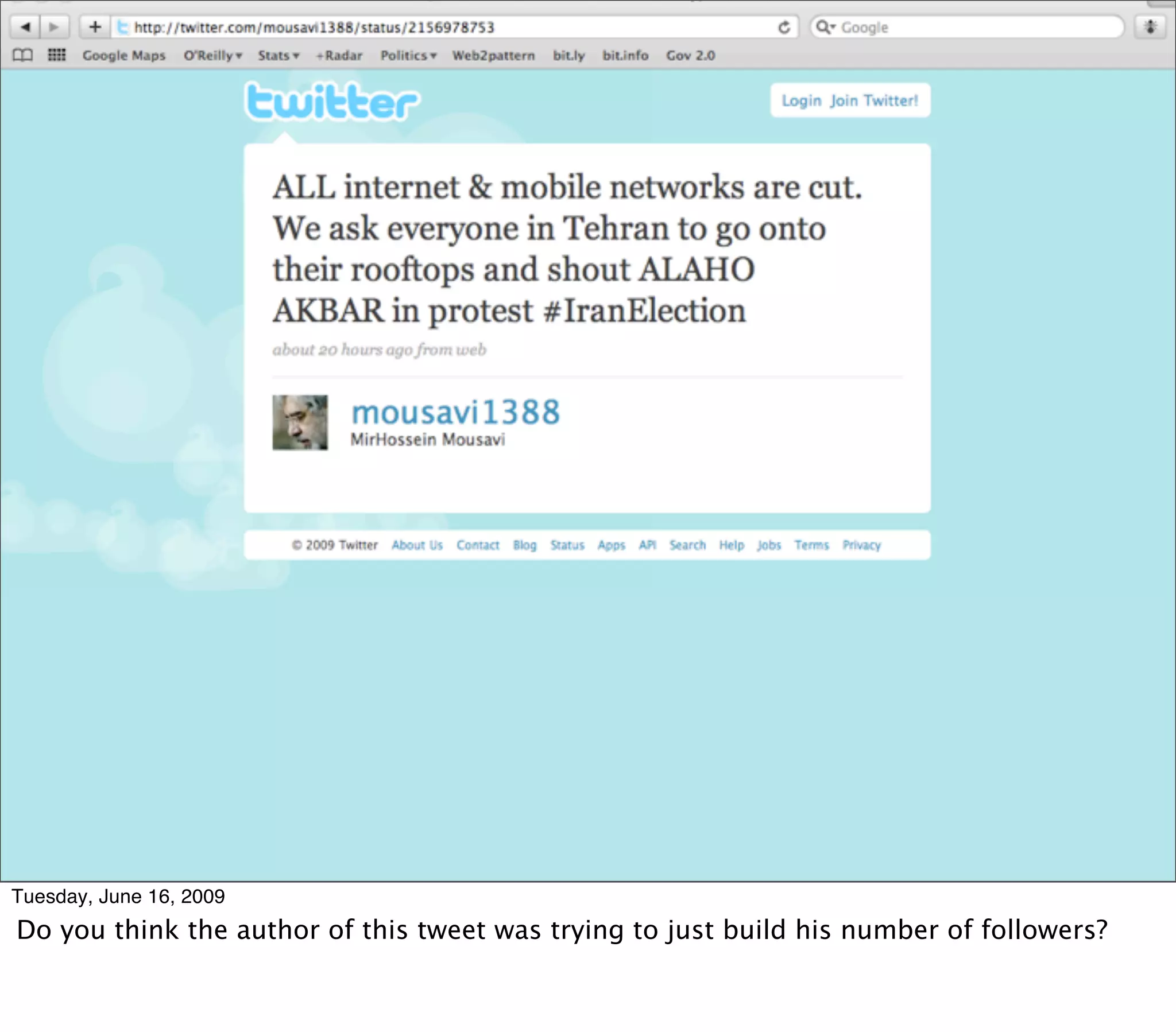
Do you think the author of this tweet was trying to just build his number of followers?
Tuesday, June 16, 2009
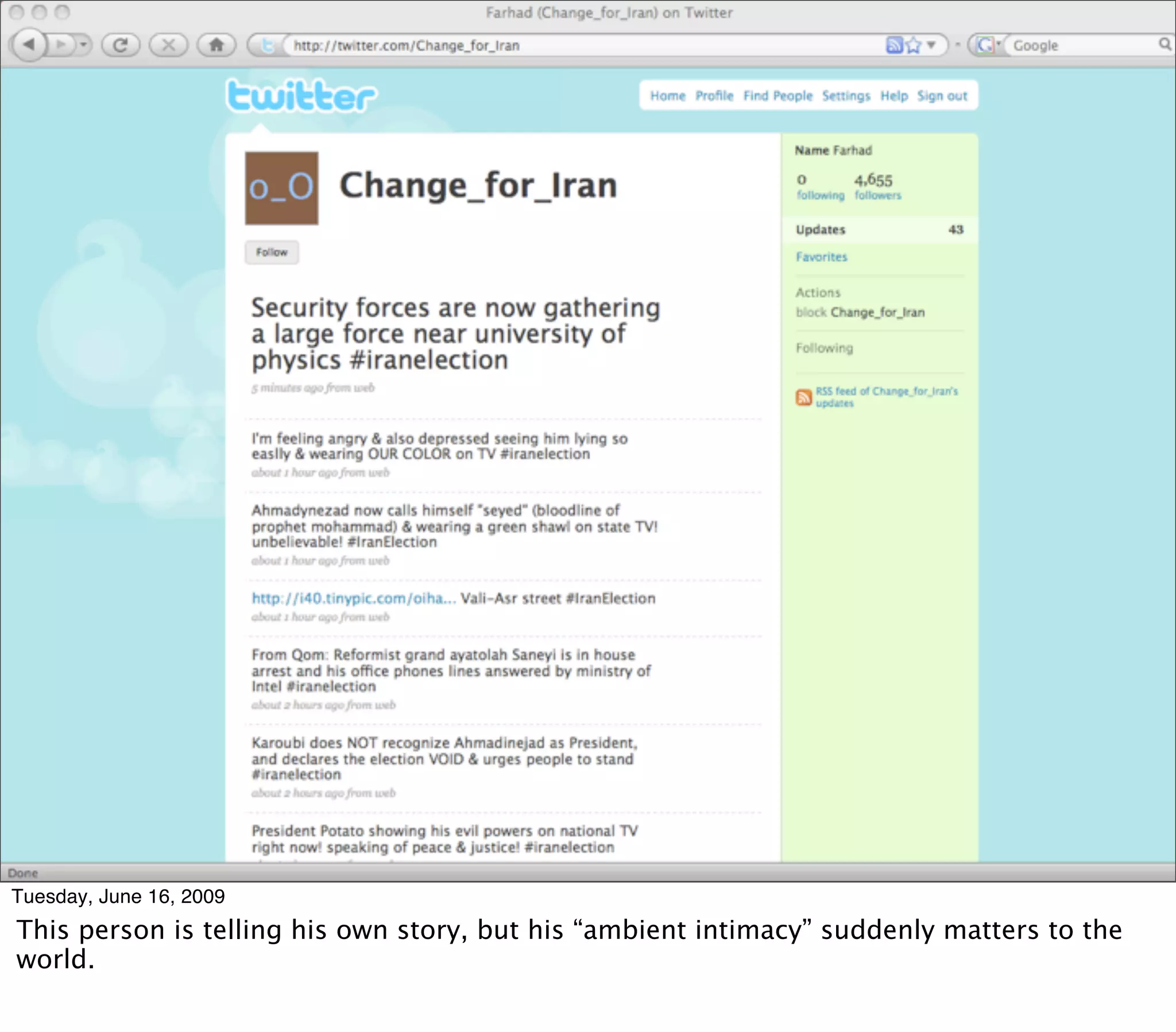
This person is telling his own story, but his “ambient intimacy” suddenly matters to the
world.
The secret of social media is that it's not
                         about you, your product, or your story. It's
                         about how you can add value to the
                         communities that happen to include you. If
                         you want to make a positive impact, forget
                         about what you can get out of social media,
                         and start thinking about what you can
                         contribute. Not surprisingly, the more value

                         you create for your community, the more
                         value they will create for you.


Tuesday, June 16, 2009
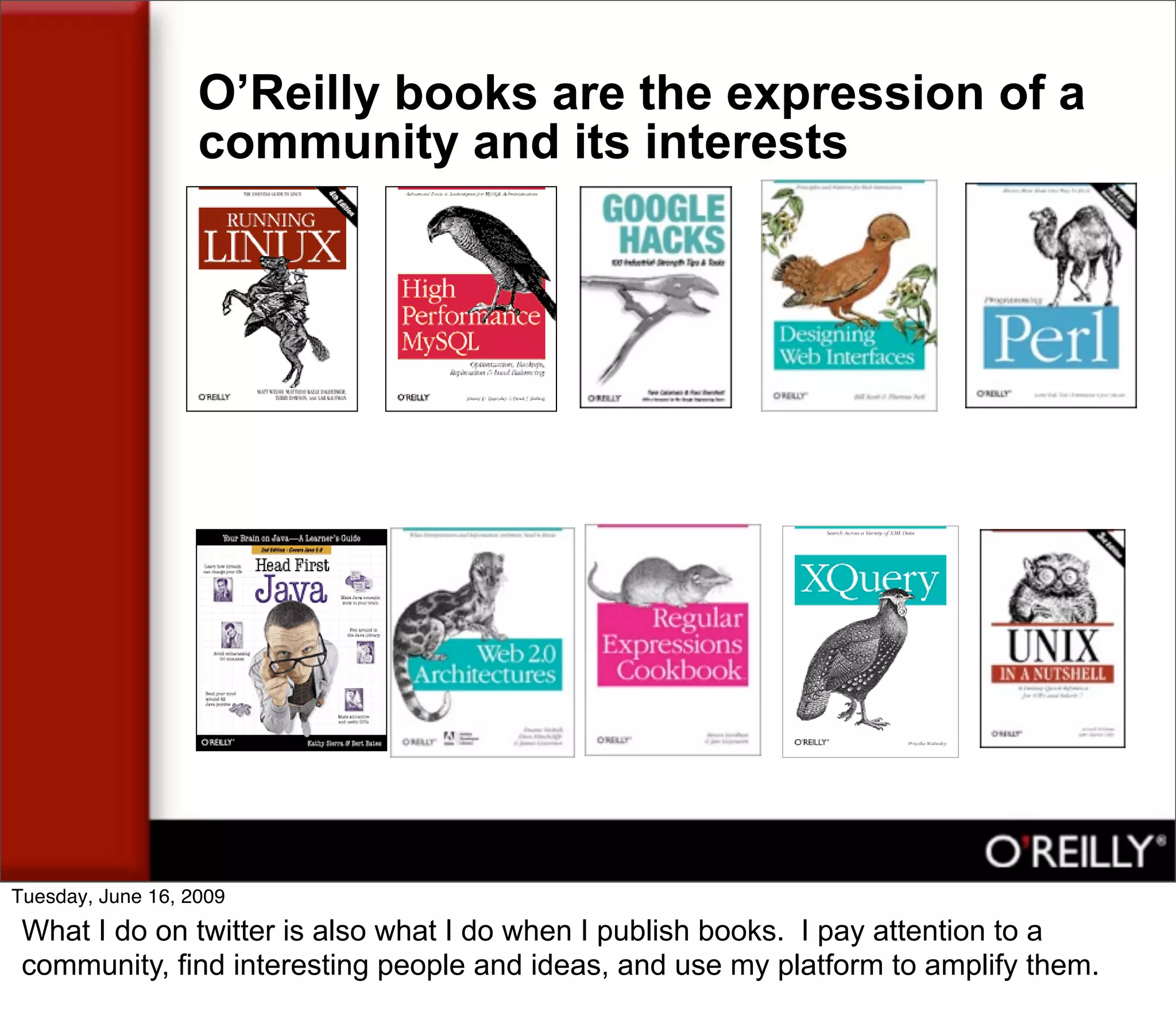
O’Reilly books are the expression of a
                   community and its interests


Tuesday, June 16, 2009
 What I do on twitter is also what I do when I publish books. I pay attention to a
 community, find interesting people and ideas, and use my platform to amplify them.
Tuesday, June 16, 2009
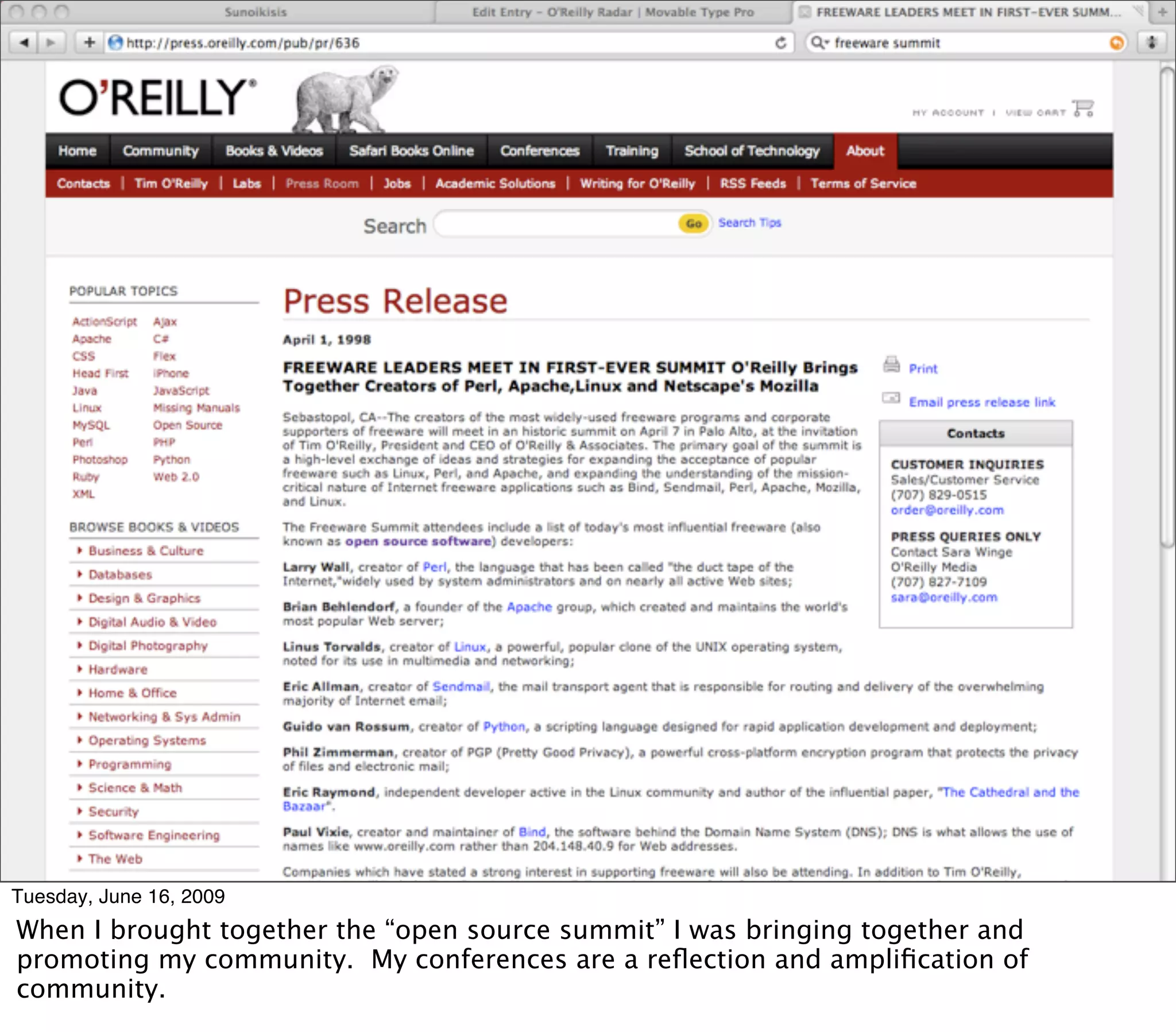
When I brought together the “open source summit” I was bringing together and
promoting my community. My conferences are a reflection and amplification of
community.
Tuesday, June 16, 2009
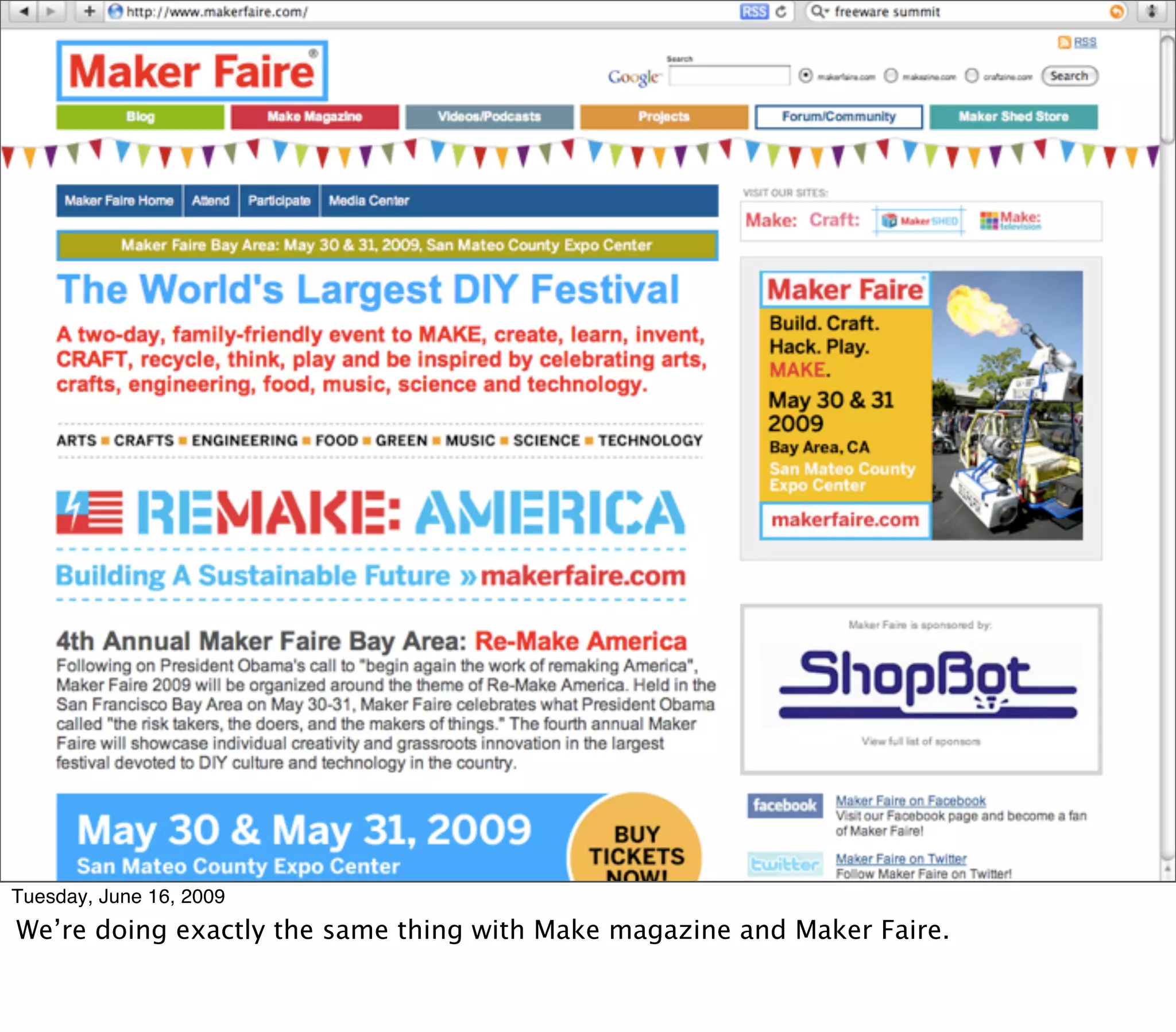
We’re doing exactly the same thing with Make magazine and Maker Faire.
Tuesday, June 16, 2009
 And with our Web 2.0
 events.
The network as platform means that
                         competitive advantage goes to systems
                         that harness network effects to get
                         better the more people use them.


Tuesday, June 16, 2009
What Web 2.0 really means.
In each case, we’ve told a big story by
                         amplifying the voices of a community
                         of early adopters.

                         In each case, we’ve built our business
                         by creating even more value for others.


Tuesday, June 16, 2009
Questions you should ask yourself

                     • What assets do you have that increase in
                       value through participation?
                         – Knowledge about your customers?
                         – Knowledge from your customers?
                         – Your brand as it is spread by others?
                         – Your accumulated history?
                     • What assets do you have that benefit from
                       the real time nature of online information?
                     • How do you involve your customers in
                       increasing the value to them of what you do?

   11
Tuesday, June 16, 2009
Implications of Web 2.0 for marketers
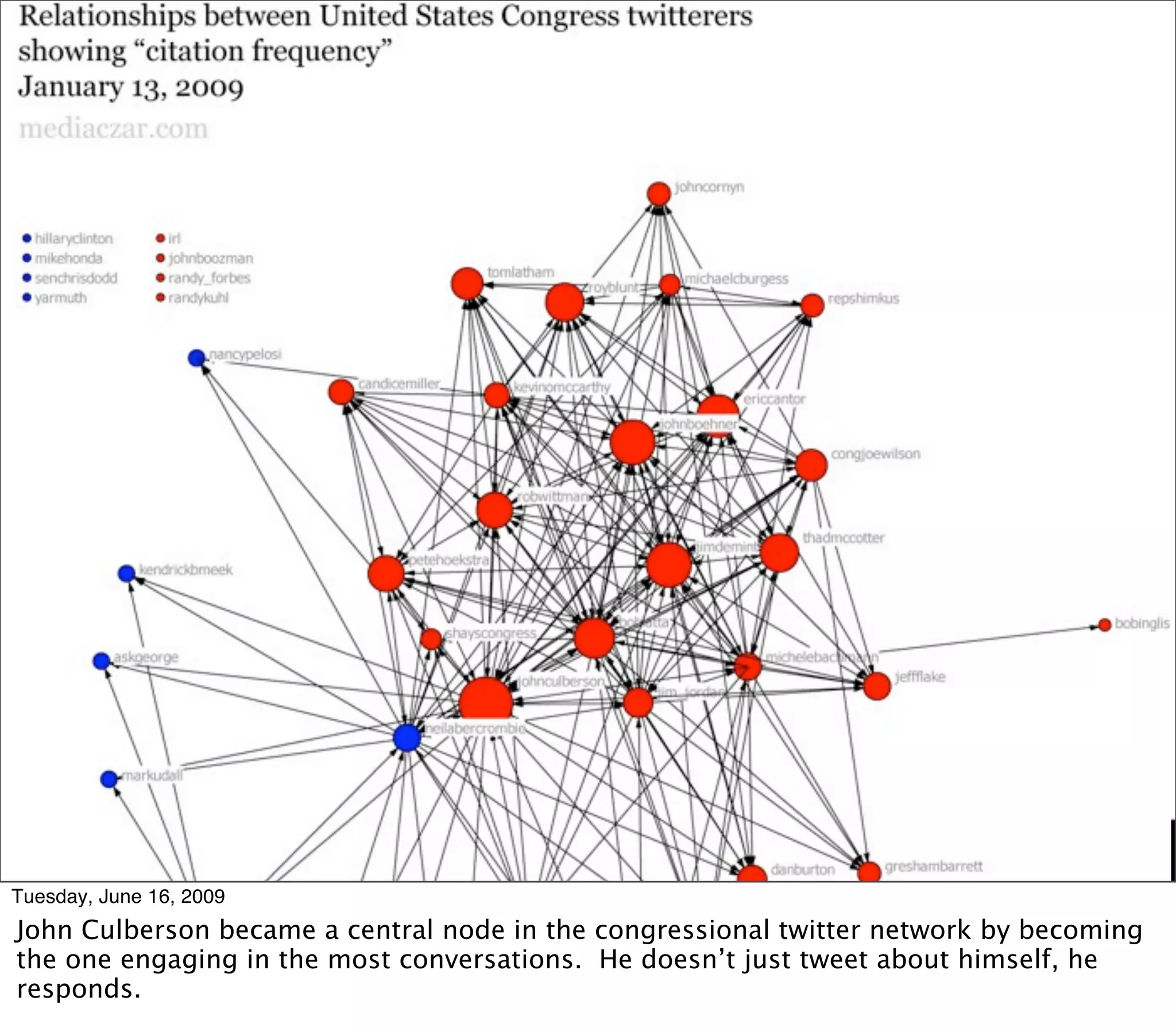
social network graph of
                     congressional twitterers


Tuesday, June 16, 2009
John Culberson became a central node in the congressional twitter network by becoming
the one engaging in the most conversations. He doesn’t just tweet about himself, he
responds.
my twitter input feed


Tuesday, June 16, 2009
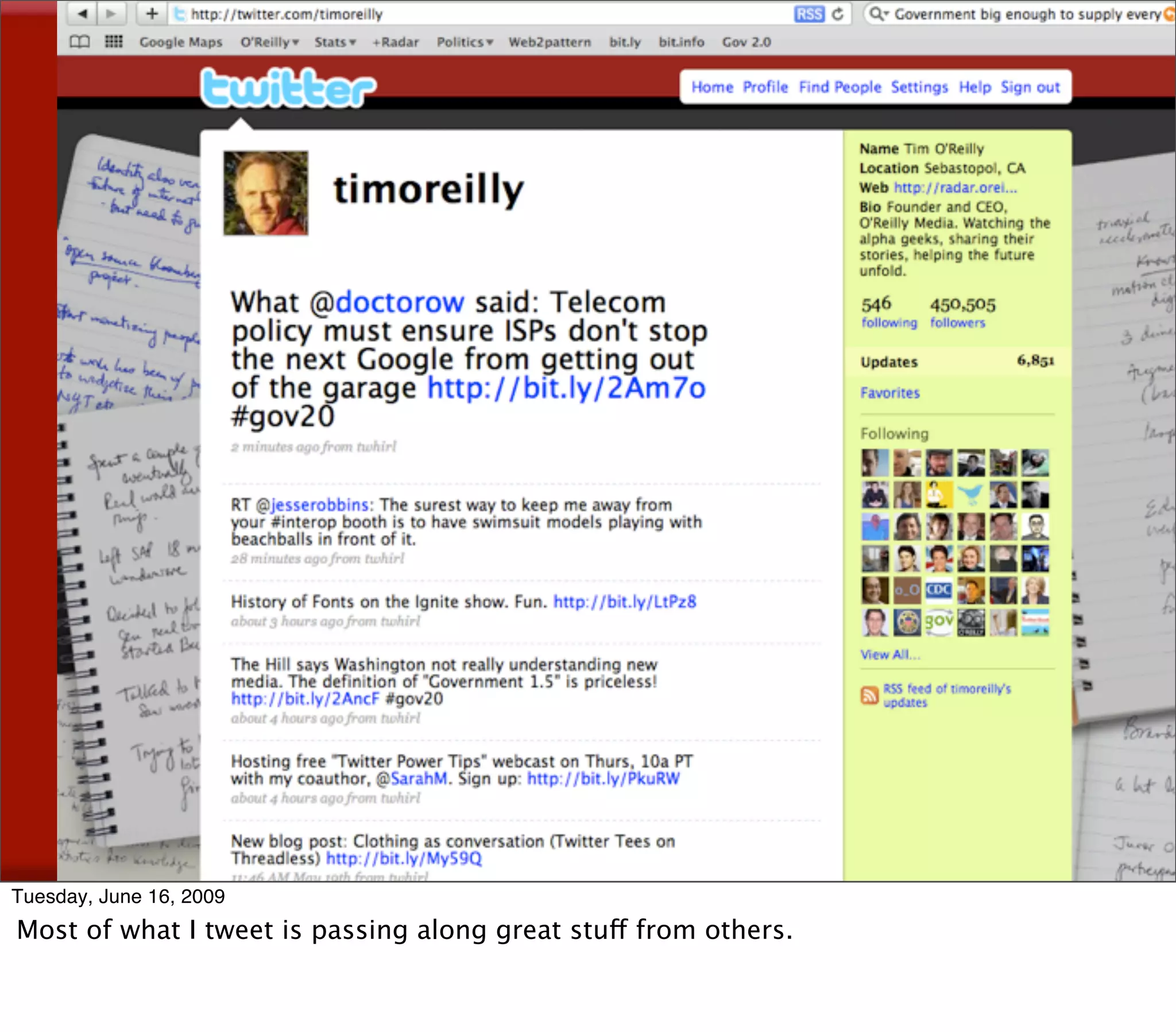
Most of what I tweet is passing along great stuff from others.
retweetradar


Tuesday, June 16, 2009
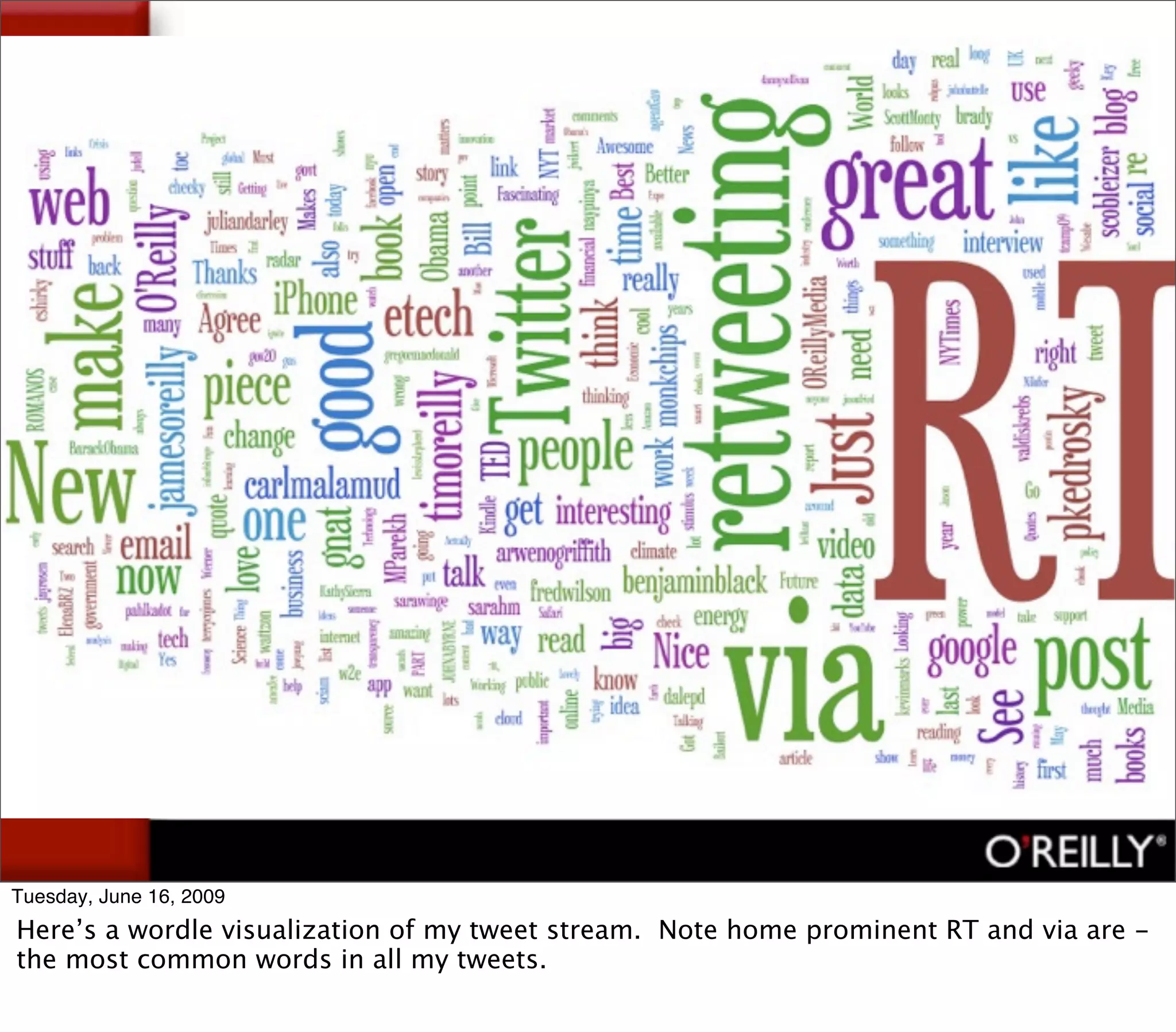
Here’s a wordle visualization of my tweet stream. Note home prominent RT and via are -
the most common words in all my tweets.
Tuesday, June 16, 2009
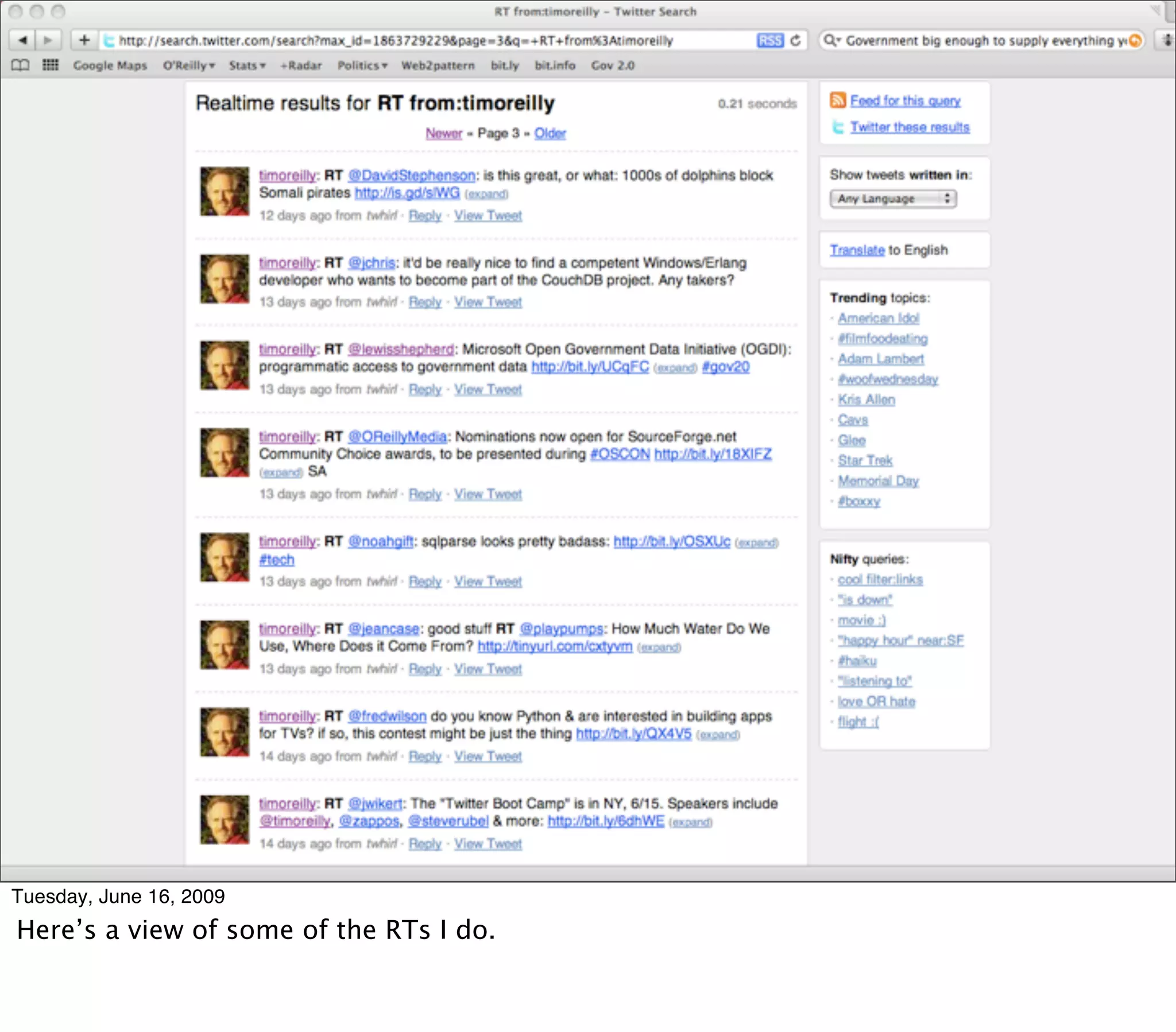
Here’s a view of some of the RTs I do.
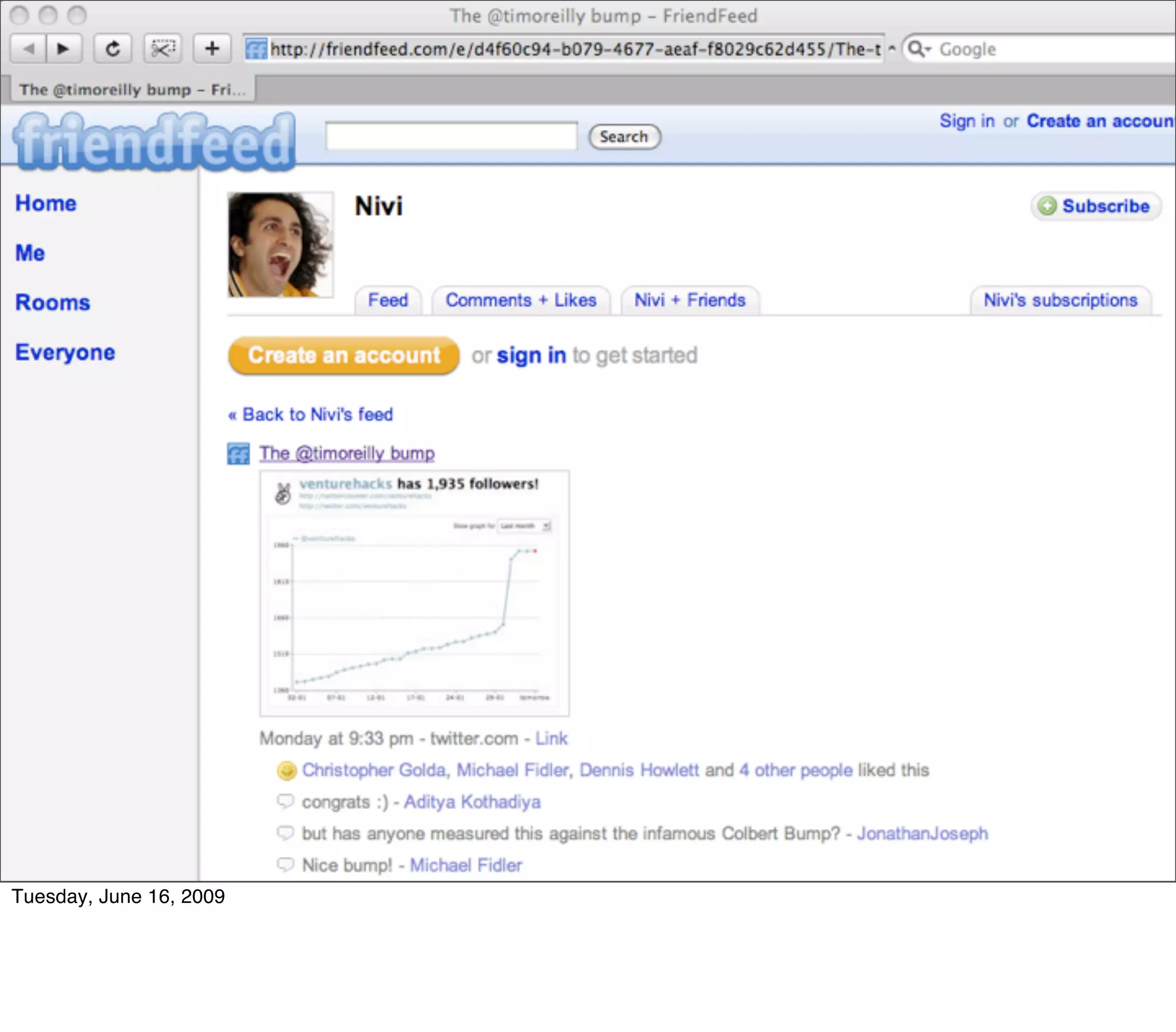
nivi and the @timoreilly bump


Tuesday, June 16, 2009
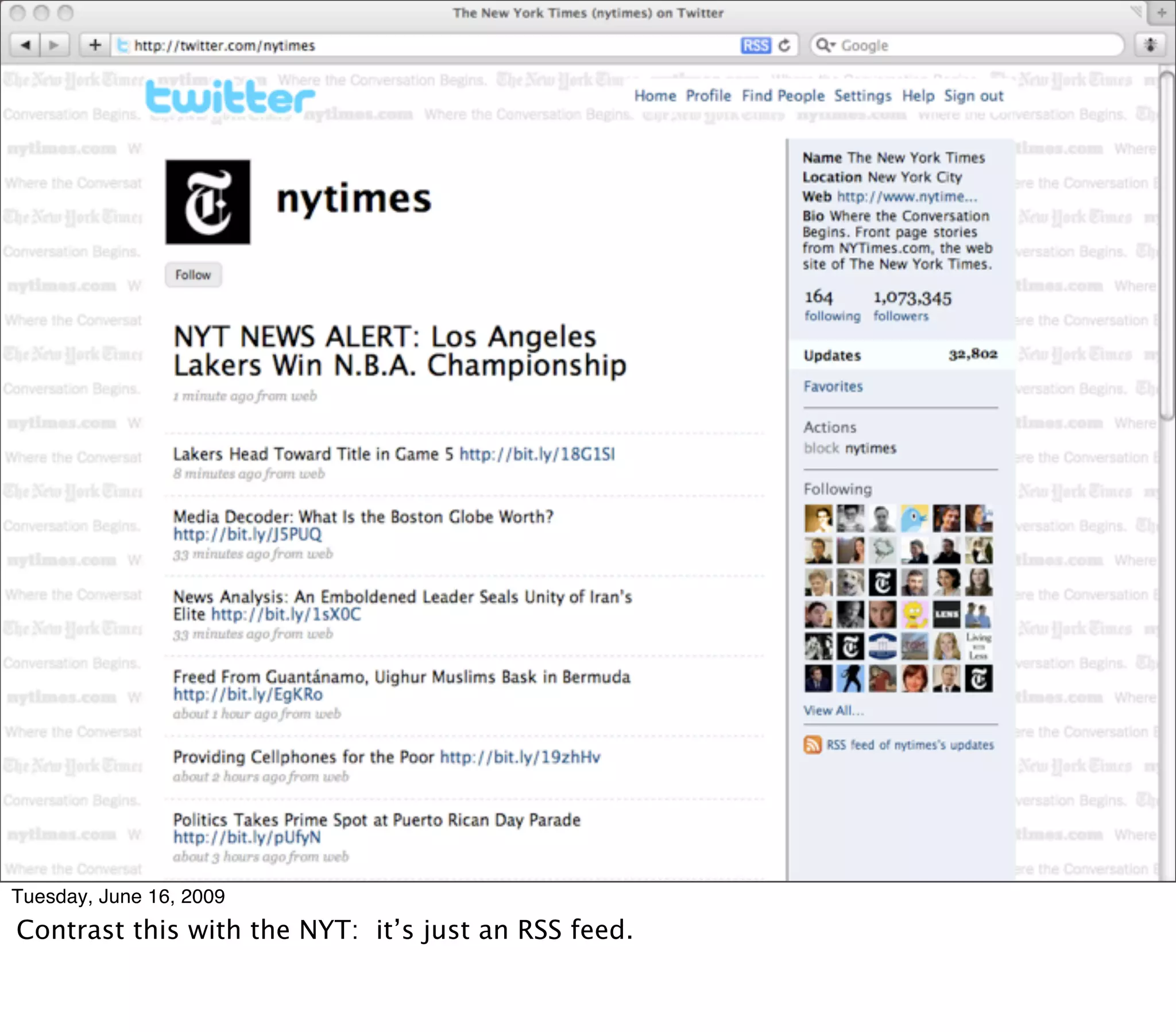
NyTimes twitter feed for contrast


Tuesday, June 16, 2009
Contrast this with the NYT: it’s just an RSS feed.
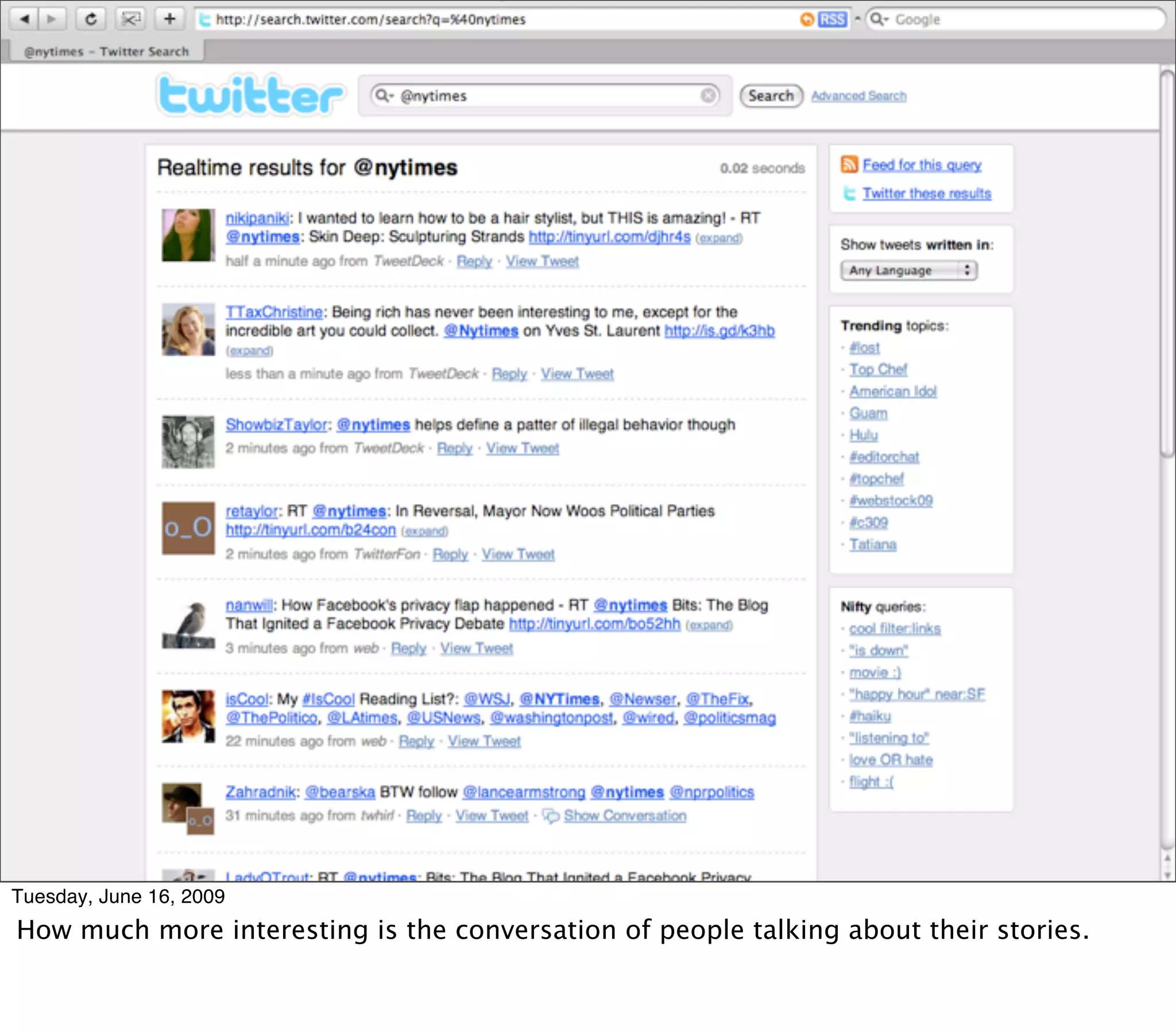
twitter search for @nytimes


Tuesday, June 16, 2009
How much more interesting is the conversation of people talking about their stories.
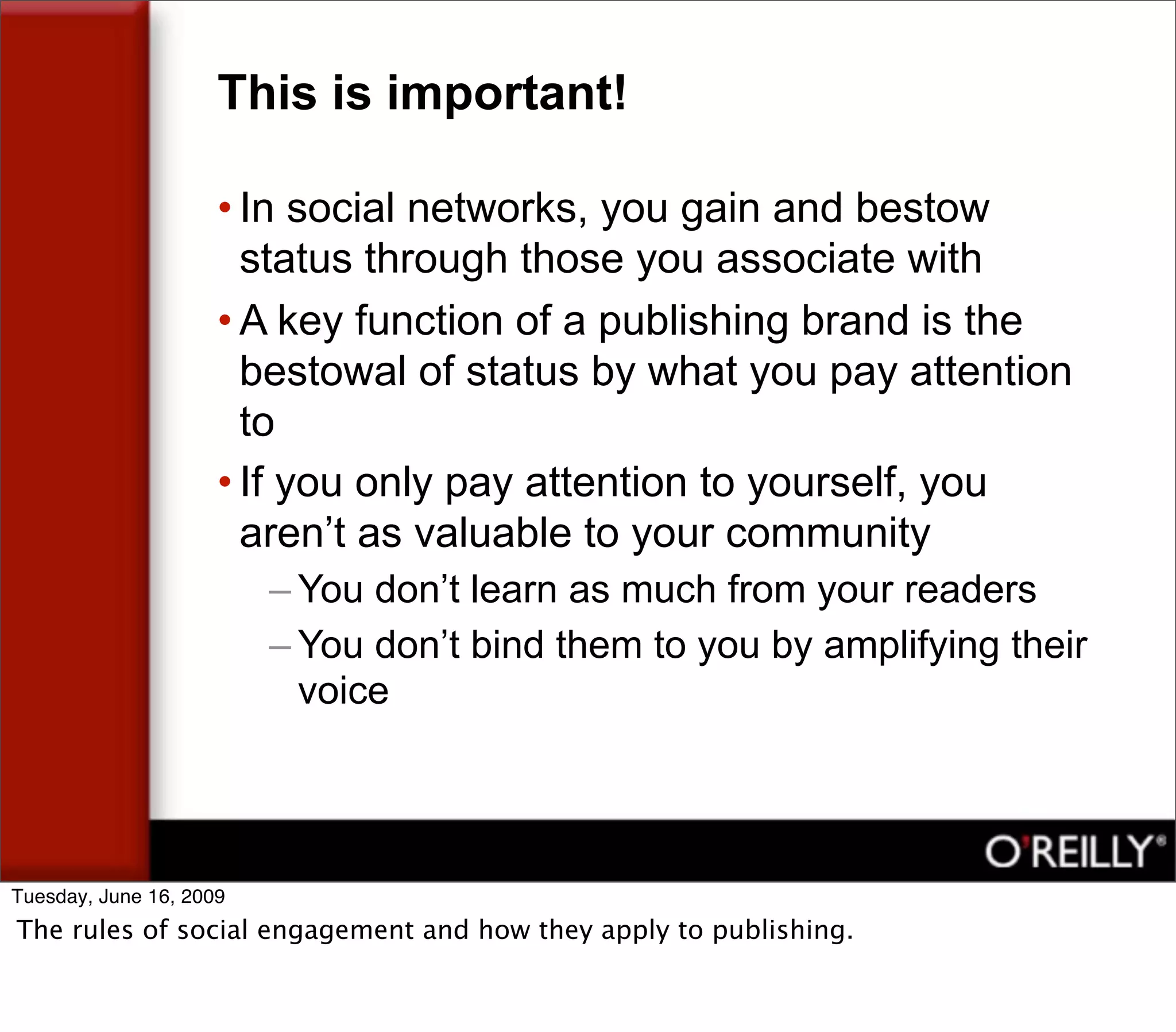
This is important!

                     • In social networks, you gain and bestow
                       status through those you associate with
                     • A key function of a publishing brand is the
                       bestowal of status by what you pay attention
                       to
                     • If you only pay attention to yourself, you
                       aren’t as valuable to your community
                         – You don’t learn as much from your readers
                         – You don’t bind them to you by amplifying their
                           voice


Tuesday, June 16, 2009
The rules of social engagement and how they apply to publishing.
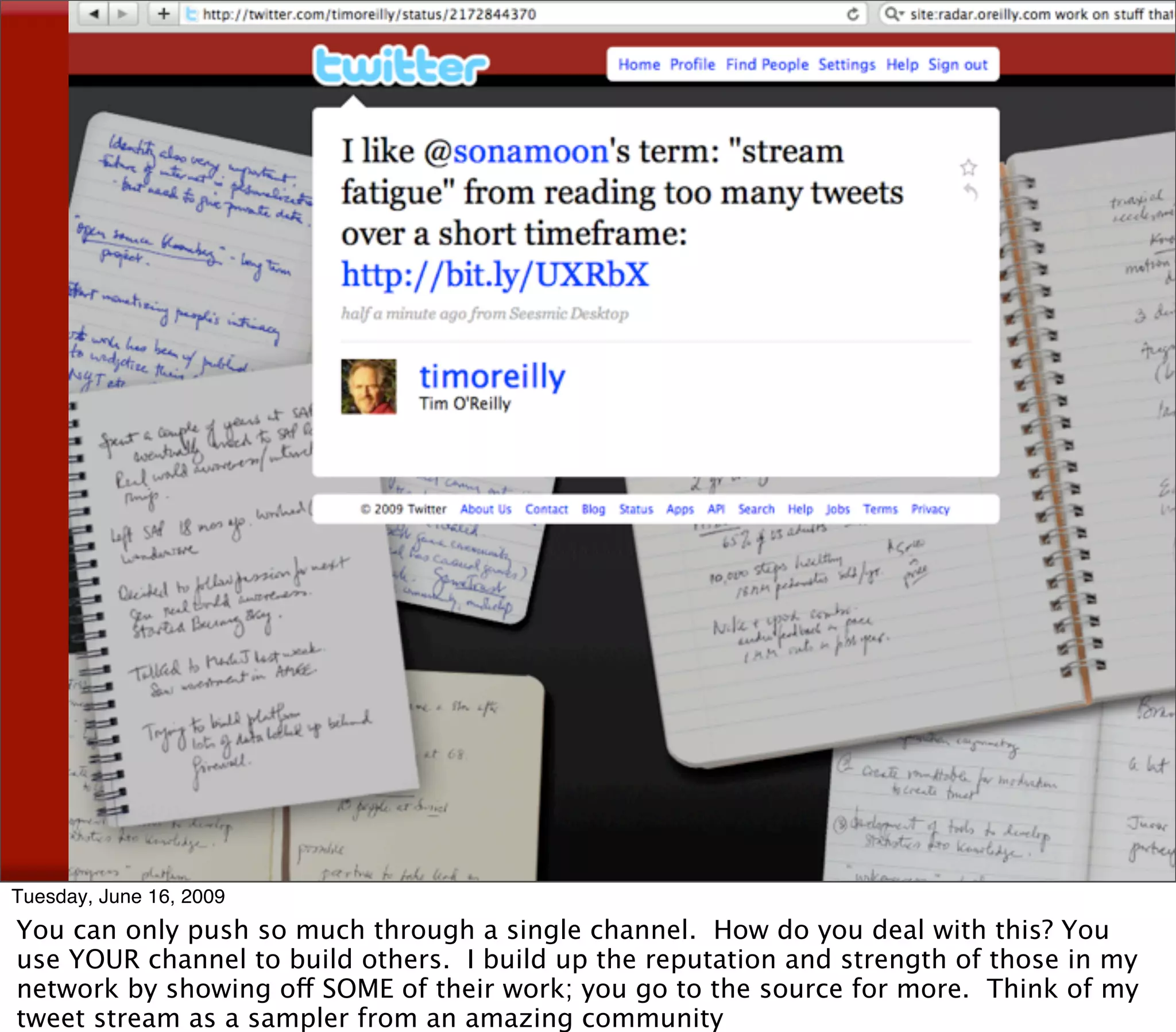
Tweet Fatigue


Tuesday, June 16, 2009
You can only push so much through a single channel. How do you deal with this? You
use YOUR channel to build others. I build up the reputation and strength of those in my
network by showing off SOME of their work; you go to the source for more. Think of my
tweet stream as a sampler from an amazing community
A few tips and tricks


Tuesday, June 16, 2009
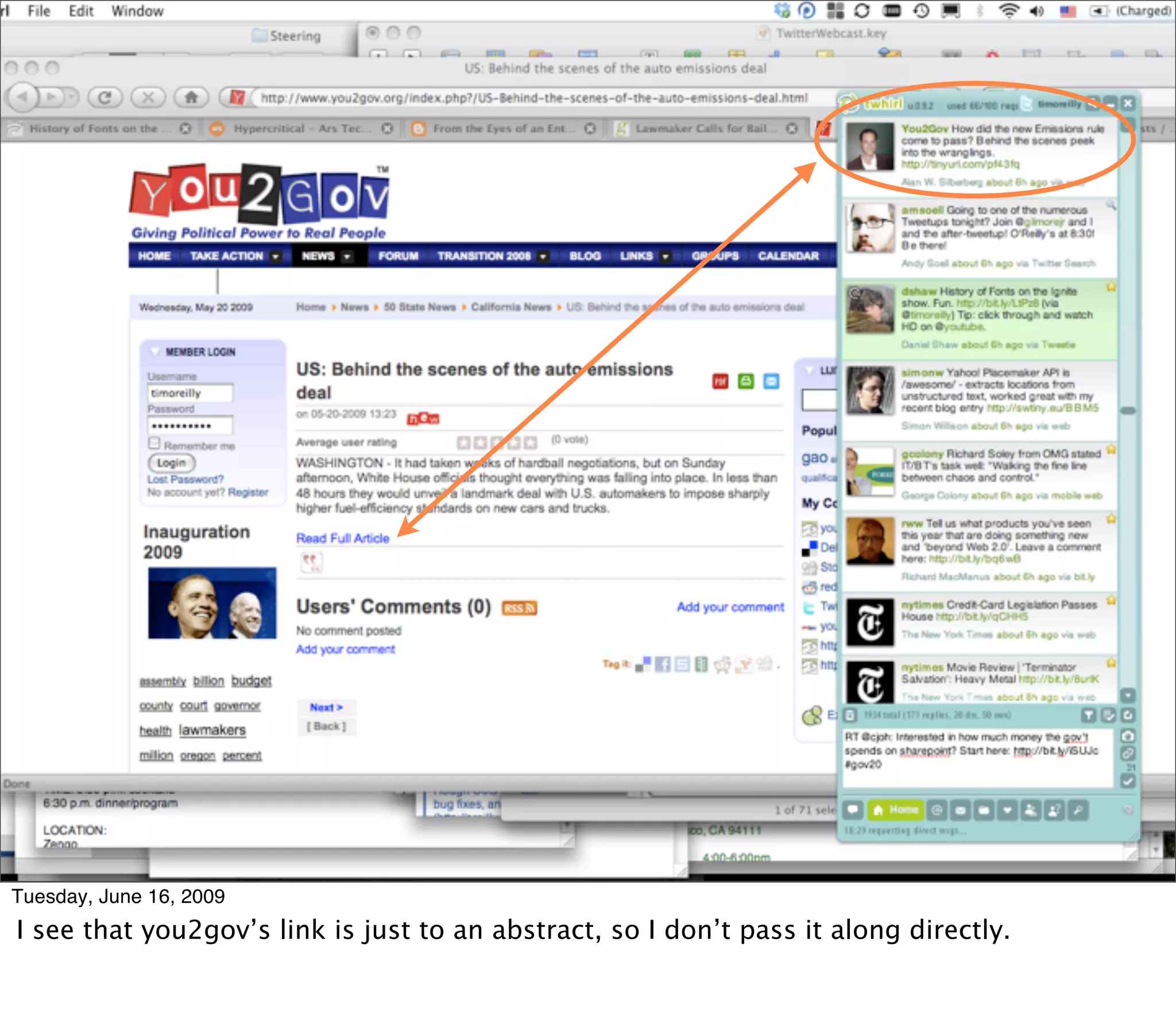
I see that you2gov’s link is just to an abstract, so I don’t pass it along directly.
Tuesday, June 16, 2009
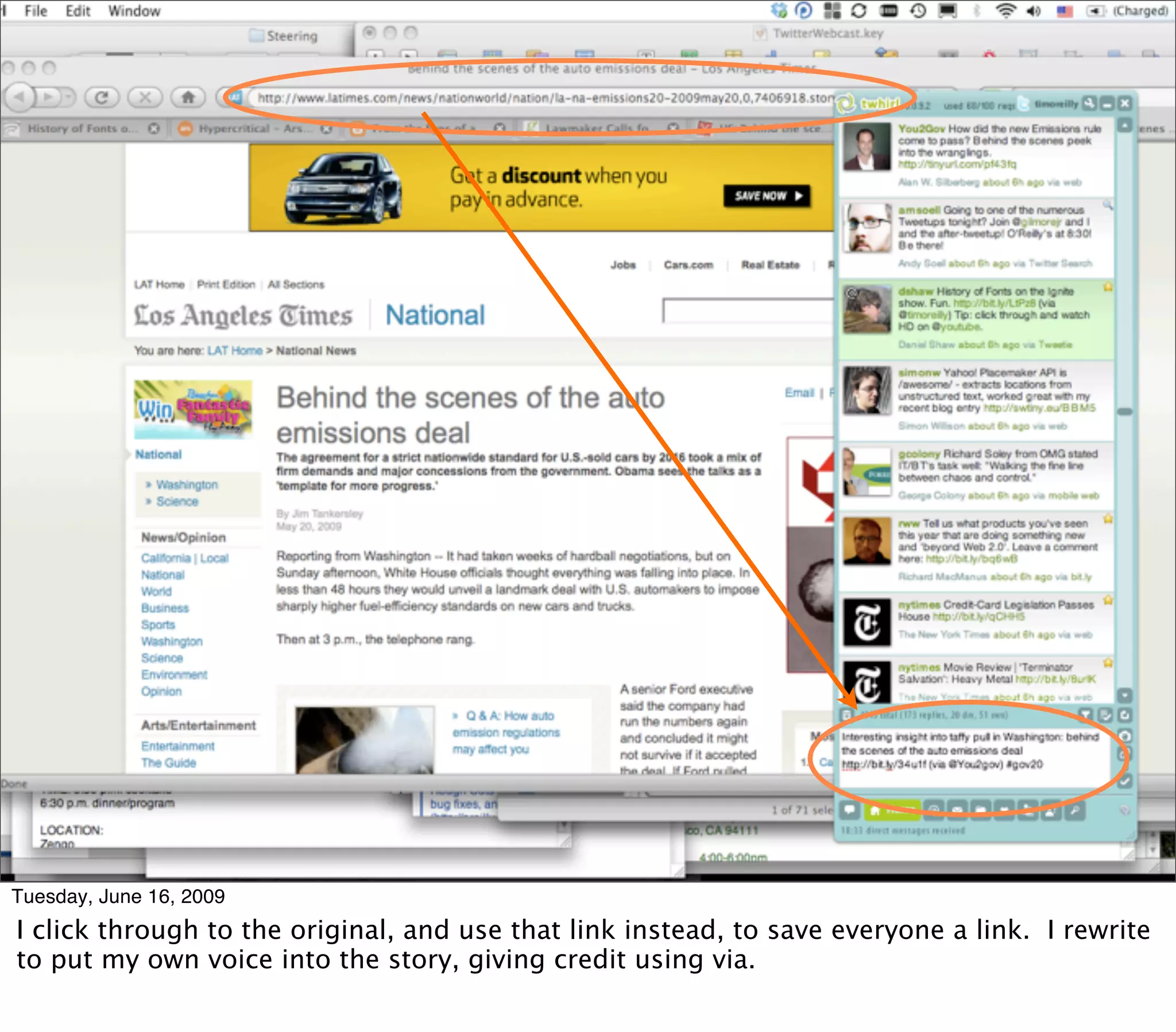
I click through to the original, and use that link instead, to save everyone a link. I rewrite
to put my own voice into the story, giving credit using via.
Tuesday, June 16, 2009
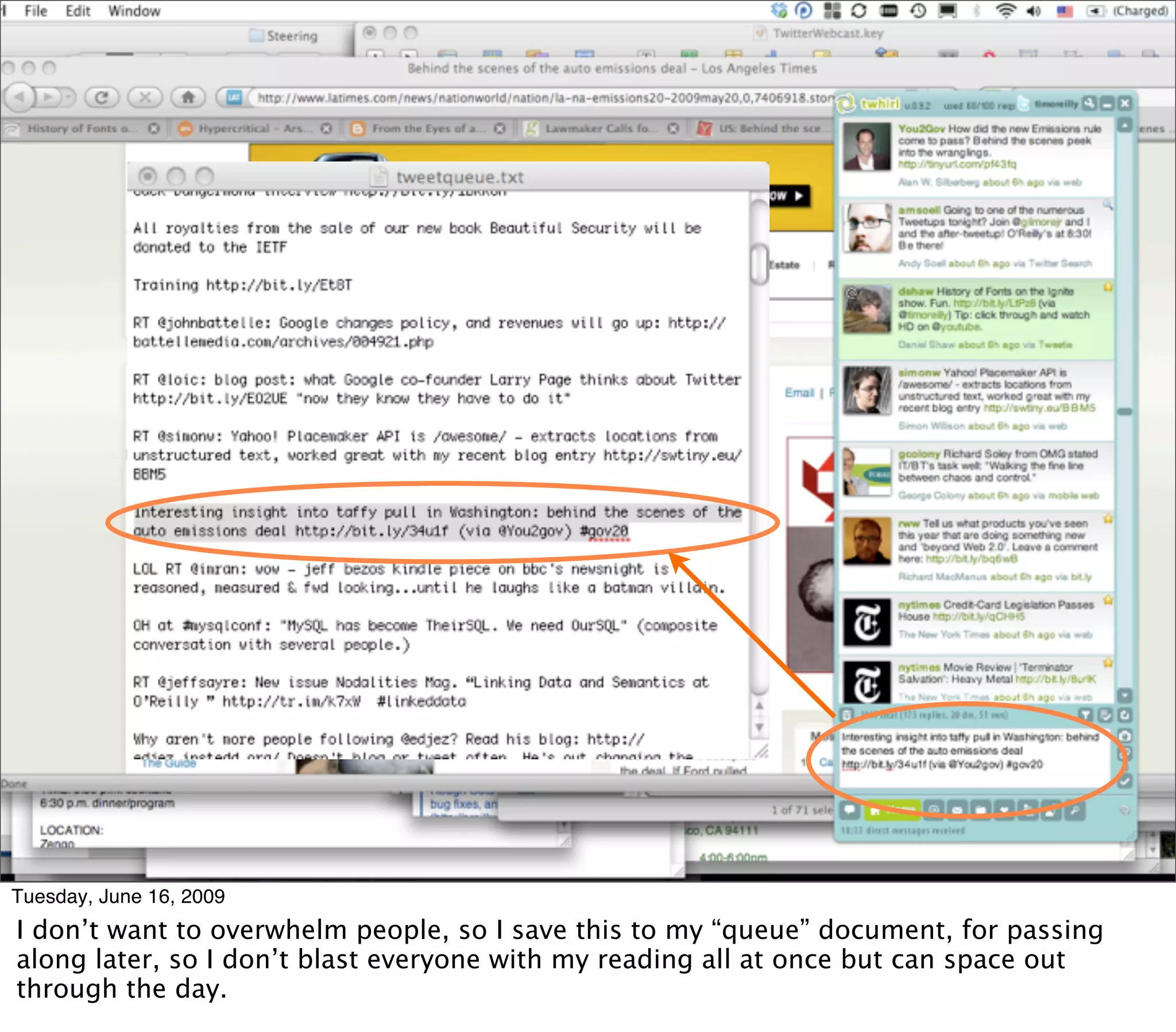
I don’t want to overwhelm people, so I save this to my “queue” document, for passing
along later, so I don’t blast everyone with my reading all at once but can space out
through the day.
Tuesday, June 16, 2009
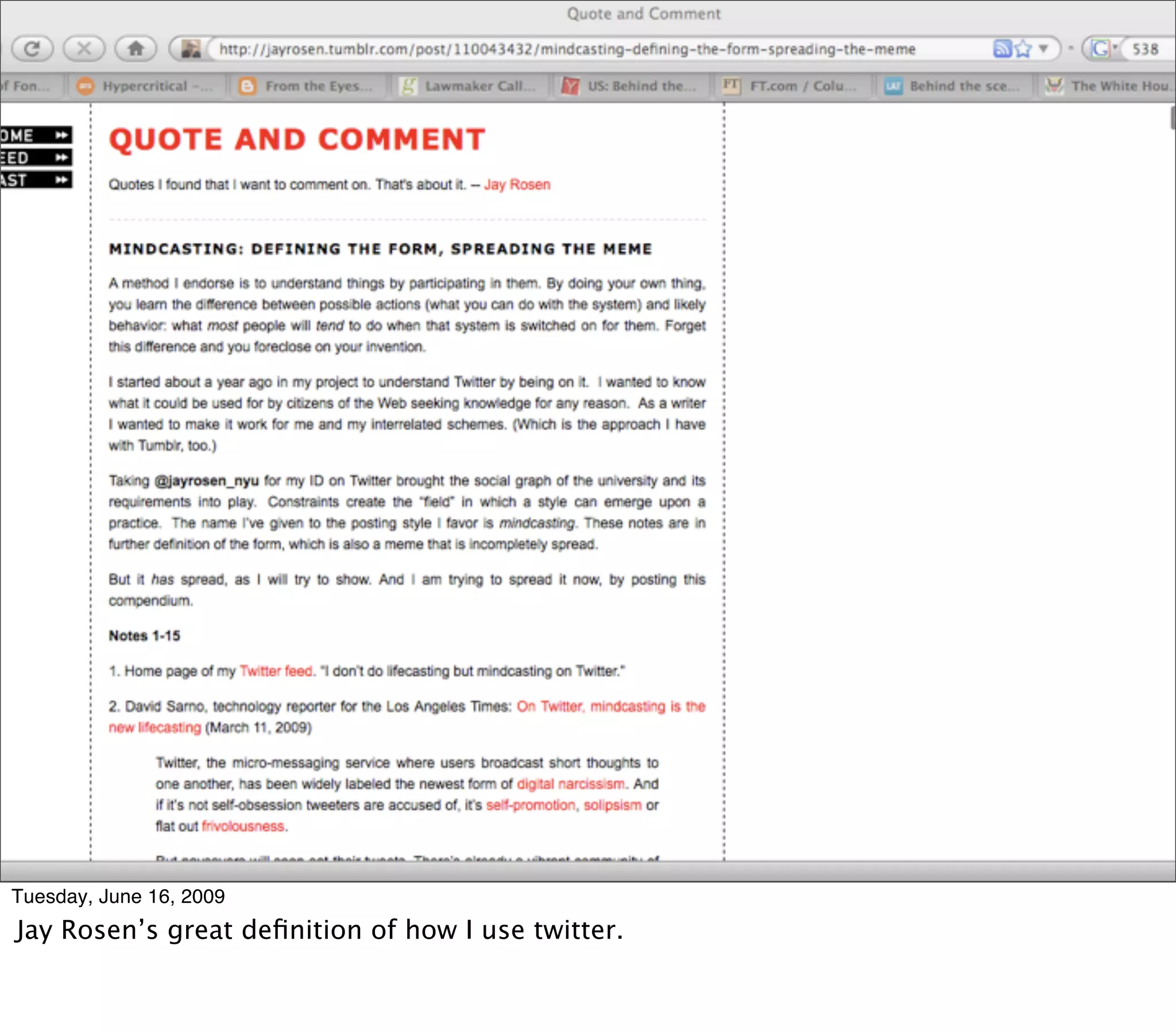
Jay Rosen’s great definition of how I use twitter.
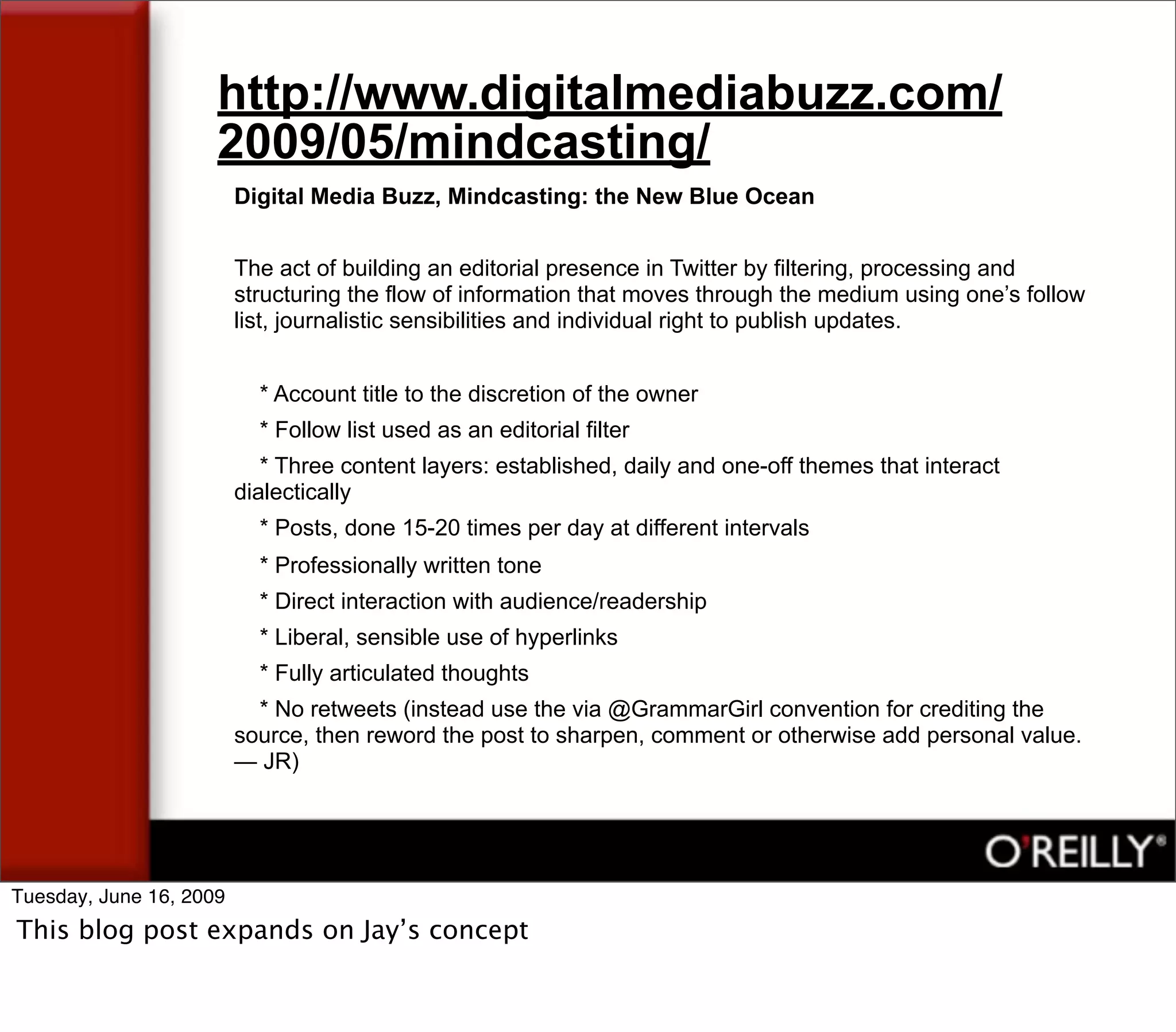
http://www.digitalmediabuzz.com/
                     2009/05/mindcasting/
                         Digital Media Buzz, Mindcasting: the New Blue Ocean


                         The act of building an editorial presence in Twitter by filtering, processing and
                         structuring the flow of information that moves through the medium using one’s follow
                         list, journalistic sensibilities and individual right to publish updates.


                           * Account title to the discretion of the owner
                           * Follow list used as an editorial filter
                            * Three content layers: established, daily and one-off themes that interact
                         dialectically
                           * Posts, done 15-20 times per day at different intervals
                           * Professionally written tone
                           * Direct interaction with audience/readership
                           * Liberal, sensible use of hyperlinks
                           * Fully articulated thoughts
                           * No retweets (instead use the via @GrammarGirl convention for crediting the
                         source, then reword the post to sharpen, comment or otherwise add personal value.
                         — JR)


Tuesday, June 16, 2009
This blog post expands on Jay’s concept
Tuesday, June 16, 2009
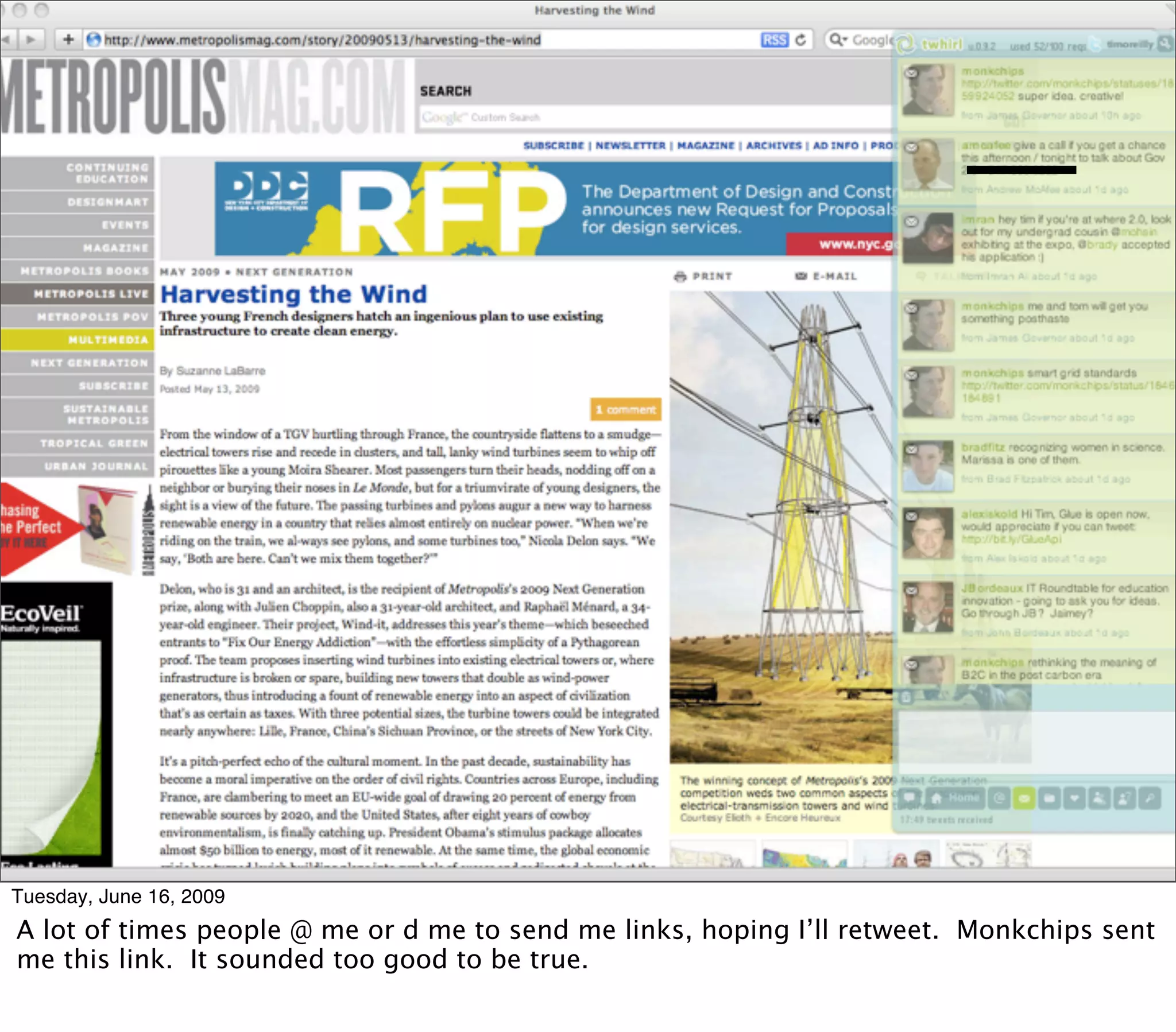
A lot of times people @ me or d me to send me links, hoping I’ll retweet. Monkchips sent
me this link. It sounded too good to be true.
Tuesday, June 16, 2009
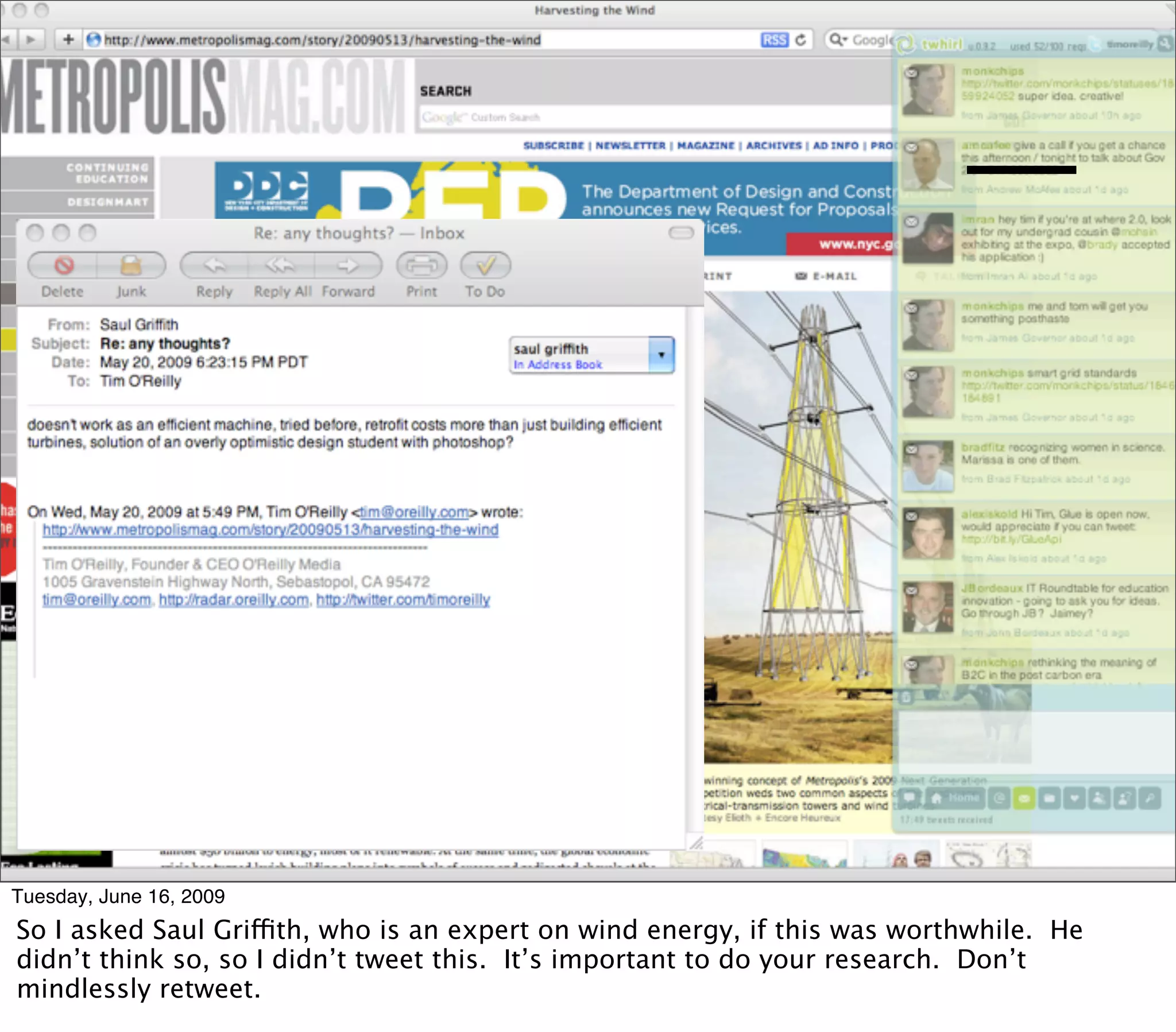
So I asked Saul Griffith, who is an expert on wind energy, if this was worthwhile. He
didn’t think so, so I didn’t tweet this. It’s important to do your research. Don’t
mindlessly retweet.
bit.ly as a twitter client
                     • How about offering this kind of thing from the NYT?


Tuesday, June 16, 2009
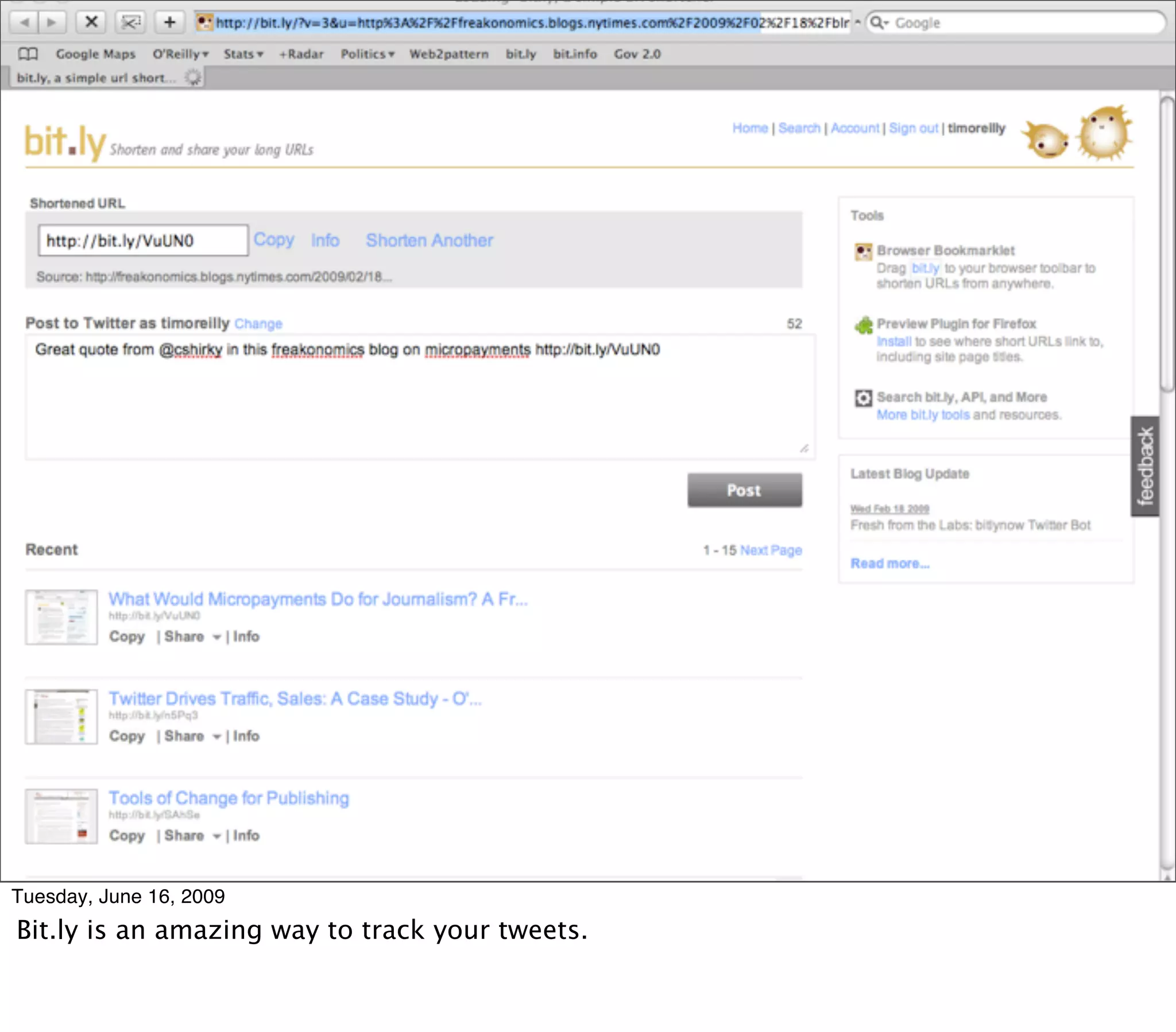
Bit.ly is an amazing way to track your tweets.
bit.ly and the power of instant
                     tracking


Tuesday, June 16, 2009
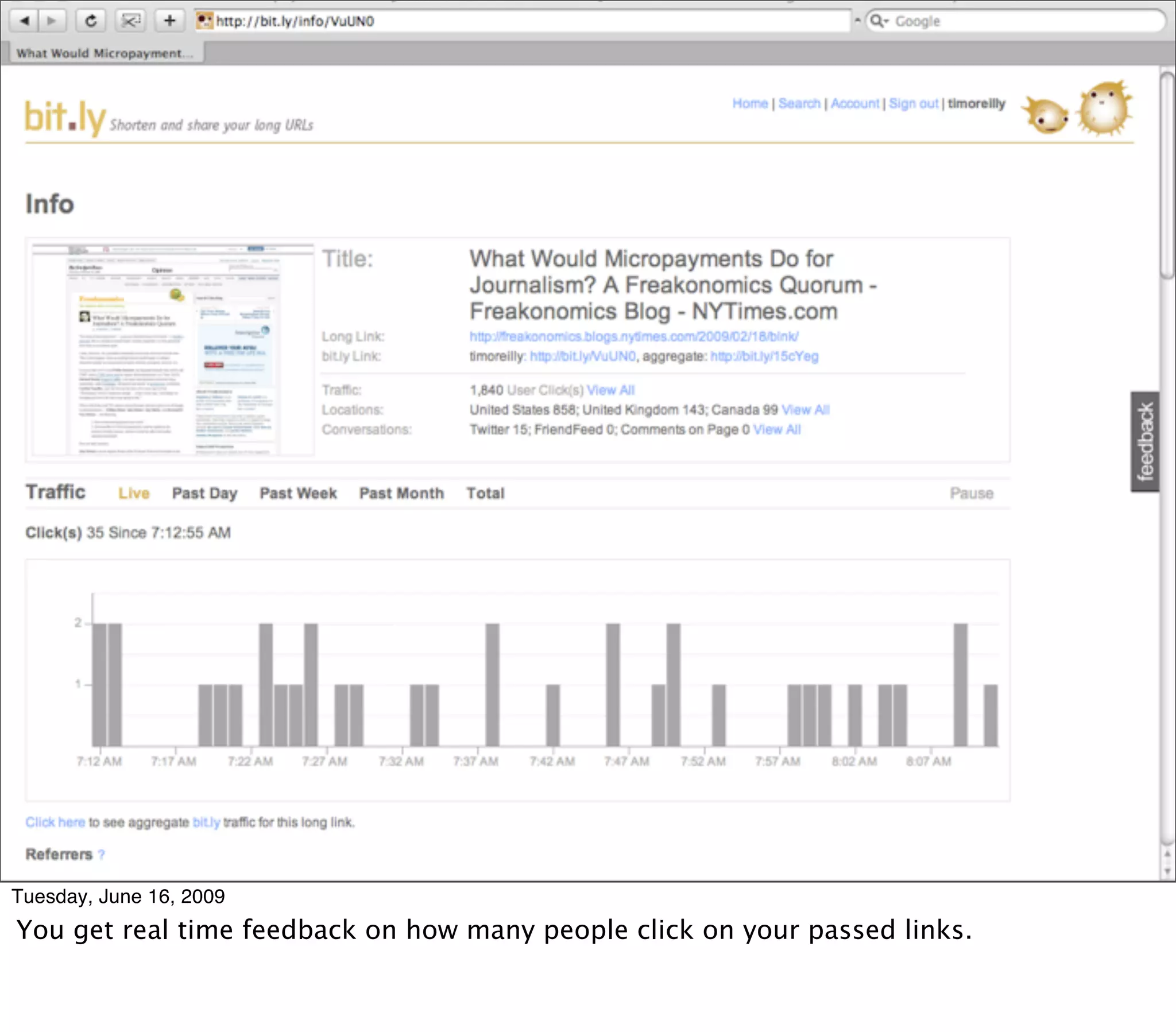
You get real time feedback on how many people click on your passed links.
Let people see who you are


Tuesday, June 16, 2009
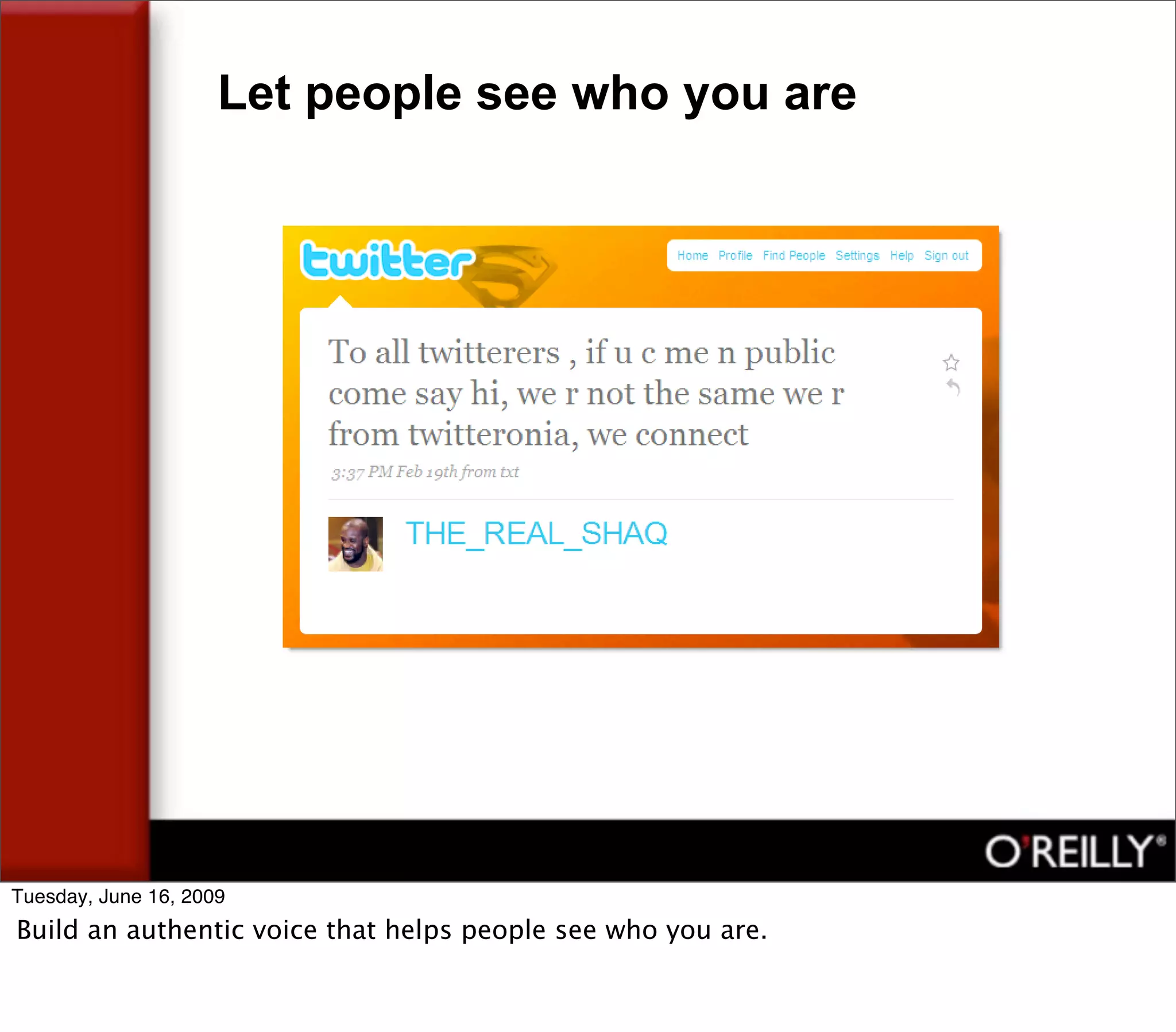
Build an authentic voice that helps people see who you are.
Some tweet of mine that’s personal


Tuesday, June 16, 2009
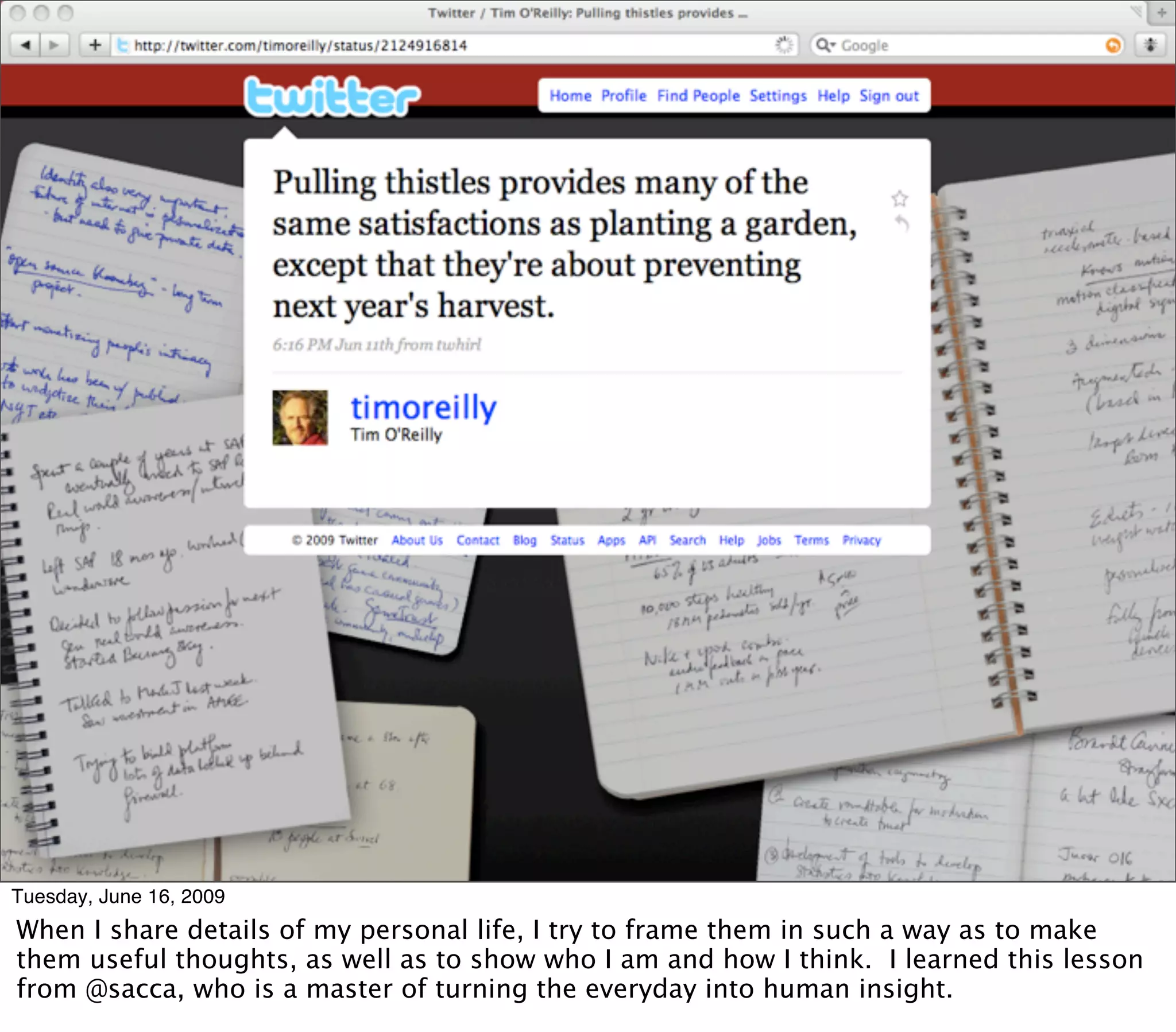
When I share details of my personal life, I try to frame them in such a way as to make
them useful thoughts, as well as to show who I am and how I think. I learned this lesson
from @sacca, who is a master of turning the everyday into human insight.
Tuesday, June 16, 2009
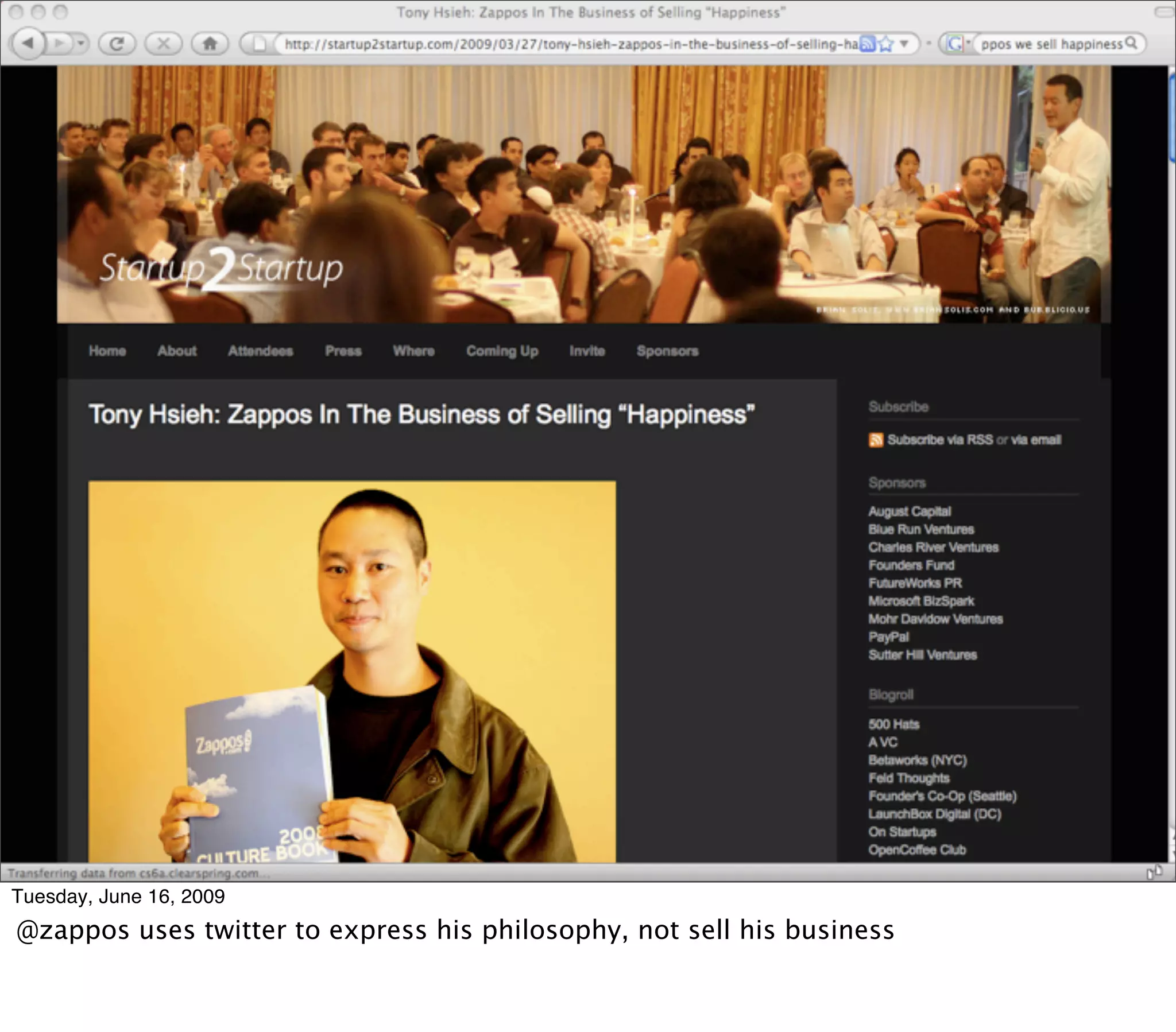
@zappos uses twitter to express his philosophy, not sell his business
Tuesday, June 16, 2009
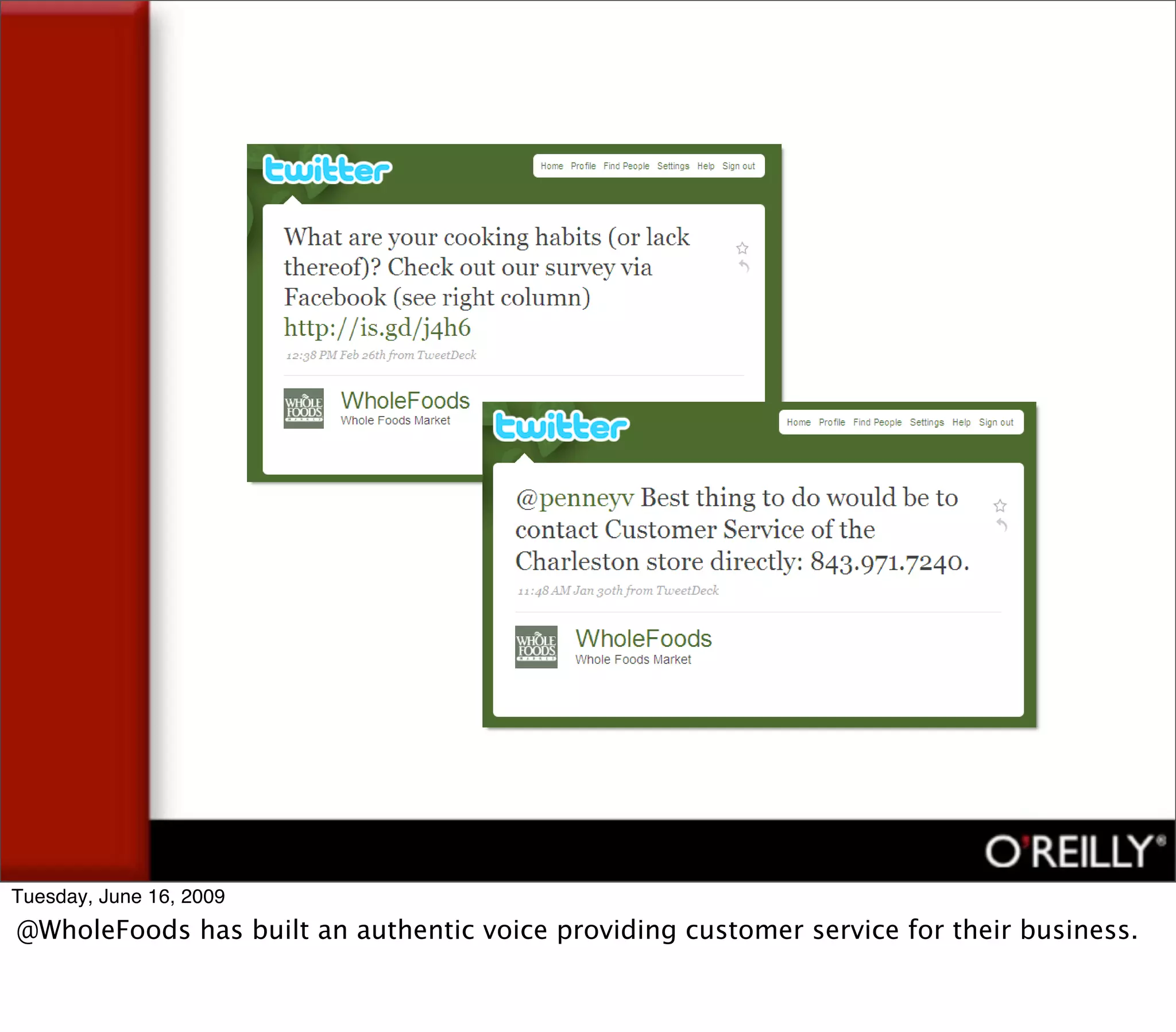
@WholeFoods has built an authentic voice providing customer service for their business.
Tuesday, June 16, 2009
A lot of people hold these guys up as heroes because they made a lot of money. I think
they are heroes because they created a lot of value.
Tuesday, June 16, 2009
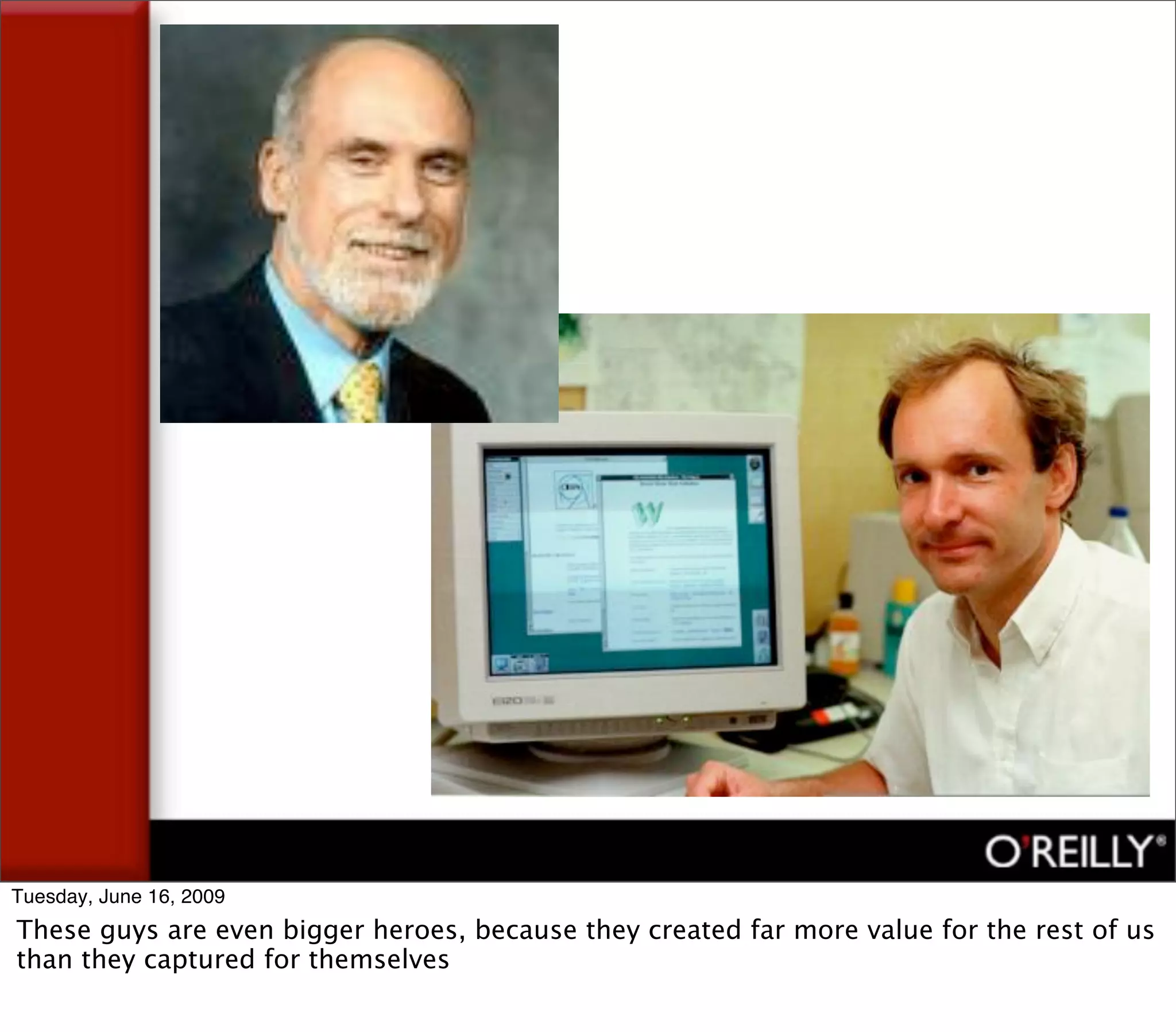
These guys are even bigger heroes, because they created far more value for the rest of us
than they captured for themselves
Create more value than you capture


Tuesday, June 16, 2009
For More Information


                     • What is Web 2.0?
                     http://www.oreillynet.com/go/web2
                     • http://tim.oreilly.com
                     • http://radar.oreilly.com
                     • http://twitter.com/timoreilly


   38
Tuesday, June 16, 2009

Create More Value Than You Capture

  • 1.
    Create More Value Than You Capture Tim O’Reilly O’Reilly Media, Inc. www.oreilly.com Twitter Boot Camp June 15, 2009 Tuesday, June 16, 2009
  • 2.
    Tuesday, June 16,2009 Do you think the author of this tweet was trying to just build his number of followers?
  • 3.
    Tuesday, June 16,2009 This person is telling his own story, but his “ambient intimacy” suddenly matters to the world.
  • 4.
    The secret ofsocial media is that it's not about you, your product, or your story. It's about how you can add value to the communities that happen to include you. If you want to make a positive impact, forget about what you can get out of social media, and start thinking about what you can contribute. Not surprisingly, the more value you create for your community, the more value they will create for you. Tuesday, June 16, 2009
  • 5.
    O’Reilly books arethe expression of a community and its interests Tuesday, June 16, 2009 What I do on twitter is also what I do when I publish books. I pay attention to a community, find interesting people and ideas, and use my platform to amplify them.
  • 6.
    Tuesday, June 16,2009 When I brought together the “open source summit” I was bringing together and promoting my community. My conferences are a reflection and amplification of community.
  • 7.
    Tuesday, June 16,2009 We’re doing exactly the same thing with Make magazine and Maker Faire.
  • 8.
    Tuesday, June 16,2009 And with our Web 2.0 events.
  • 9.
    The network asplatform means that competitive advantage goes to systems that harness network effects to get better the more people use them. Tuesday, June 16, 2009 What Web 2.0 really means.
  • 10.
    In each case,we’ve told a big story by amplifying the voices of a community of early adopters. In each case, we’ve built our business by creating even more value for others. Tuesday, June 16, 2009
  • 11.
    Questions you shouldask yourself • What assets do you have that increase in value through participation? – Knowledge about your customers? – Knowledge from your customers? – Your brand as it is spread by others? – Your accumulated history? • What assets do you have that benefit from the real time nature of online information? • How do you involve your customers in increasing the value to them of what you do? 11 Tuesday, June 16, 2009 Implications of Web 2.0 for marketers
  • 12.
    social network graphof congressional twitterers Tuesday, June 16, 2009 John Culberson became a central node in the congressional twitter network by becoming the one engaging in the most conversations. He doesn’t just tweet about himself, he responds.
  • 13.
    my twitter inputfeed Tuesday, June 16, 2009 Most of what I tweet is passing along great stuff from others.
  • 14.
    retweetradar Tuesday, June 16,2009 Here’s a wordle visualization of my tweet stream. Note home prominent RT and via are - the most common words in all my tweets.
  • 15.
    Tuesday, June 16,2009 Here’s a view of some of the RTs I do.
  • 16.
    nivi and the@timoreilly bump Tuesday, June 16, 2009
  • 17.
    NyTimes twitter feedfor contrast Tuesday, June 16, 2009 Contrast this with the NYT: it’s just an RSS feed.
  • 18.
    twitter search for@nytimes Tuesday, June 16, 2009 How much more interesting is the conversation of people talking about their stories.
  • 19.
    This is important! • In social networks, you gain and bestow status through those you associate with • A key function of a publishing brand is the bestowal of status by what you pay attention to • If you only pay attention to yourself, you aren’t as valuable to your community – You don’t learn as much from your readers – You don’t bind them to you by amplifying their voice Tuesday, June 16, 2009 The rules of social engagement and how they apply to publishing.
  • 20.
    Tweet Fatigue Tuesday, June16, 2009 You can only push so much through a single channel. How do you deal with this? You use YOUR channel to build others. I build up the reputation and strength of those in my network by showing off SOME of their work; you go to the source for more. Think of my tweet stream as a sampler from an amazing community
  • 21.
    A few tipsand tricks Tuesday, June 16, 2009
  • 22.
    Tuesday, June 16,2009 I see that you2gov’s link is just to an abstract, so I don’t pass it along directly.
  • 23.
    Tuesday, June 16,2009 I click through to the original, and use that link instead, to save everyone a link. I rewrite to put my own voice into the story, giving credit using via.
  • 24.
    Tuesday, June 16,2009 I don’t want to overwhelm people, so I save this to my “queue” document, for passing along later, so I don’t blast everyone with my reading all at once but can space out through the day.
  • 25.
    Tuesday, June 16,2009 Jay Rosen’s great definition of how I use twitter.
  • 26.
    http://www.digitalmediabuzz.com/ 2009/05/mindcasting/ Digital Media Buzz, Mindcasting: the New Blue Ocean The act of building an editorial presence in Twitter by filtering, processing and structuring the flow of information that moves through the medium using one’s follow list, journalistic sensibilities and individual right to publish updates. * Account title to the discretion of the owner * Follow list used as an editorial filter * Three content layers: established, daily and one-off themes that interact dialectically * Posts, done 15-20 times per day at different intervals * Professionally written tone * Direct interaction with audience/readership * Liberal, sensible use of hyperlinks * Fully articulated thoughts * No retweets (instead use the via @GrammarGirl convention for crediting the source, then reword the post to sharpen, comment or otherwise add personal value. — JR) Tuesday, June 16, 2009 This blog post expands on Jay’s concept
  • 27.
    Tuesday, June 16,2009 A lot of times people @ me or d me to send me links, hoping I’ll retweet. Monkchips sent me this link. It sounded too good to be true.
  • 28.
    Tuesday, June 16,2009 So I asked Saul Griffith, who is an expert on wind energy, if this was worthwhile. He didn’t think so, so I didn’t tweet this. It’s important to do your research. Don’t mindlessly retweet.
  • 29.
    bit.ly as atwitter client • How about offering this kind of thing from the NYT? Tuesday, June 16, 2009 Bit.ly is an amazing way to track your tweets.
  • 30.
    bit.ly and thepower of instant tracking Tuesday, June 16, 2009 You get real time feedback on how many people click on your passed links.
  • 31.
    Let people seewho you are Tuesday, June 16, 2009 Build an authentic voice that helps people see who you are.
  • 32.
    Some tweet ofmine that’s personal Tuesday, June 16, 2009 When I share details of my personal life, I try to frame them in such a way as to make them useful thoughts, as well as to show who I am and how I think. I learned this lesson from @sacca, who is a master of turning the everyday into human insight.
  • 33.
    Tuesday, June 16,2009 @zappos uses twitter to express his philosophy, not sell his business
  • 34.
    Tuesday, June 16,2009 @WholeFoods has built an authentic voice providing customer service for their business.
  • 35.
    Tuesday, June 16,2009 A lot of people hold these guys up as heroes because they made a lot of money. I think they are heroes because they created a lot of value.
  • 36.
    Tuesday, June 16,2009 These guys are even bigger heroes, because they created far more value for the rest of us than they captured for themselves
  • 37.
    Create more valuethan you capture Tuesday, June 16, 2009
  • 38.
    For More Information • What is Web 2.0? http://www.oreillynet.com/go/web2 • http://tim.oreilly.com • http://radar.oreilly.com • http://twitter.com/timoreilly 38 Tuesday, June 16, 2009