Permutations
Case 4: Ordered Sets of n Objects, Arranged in a Circle
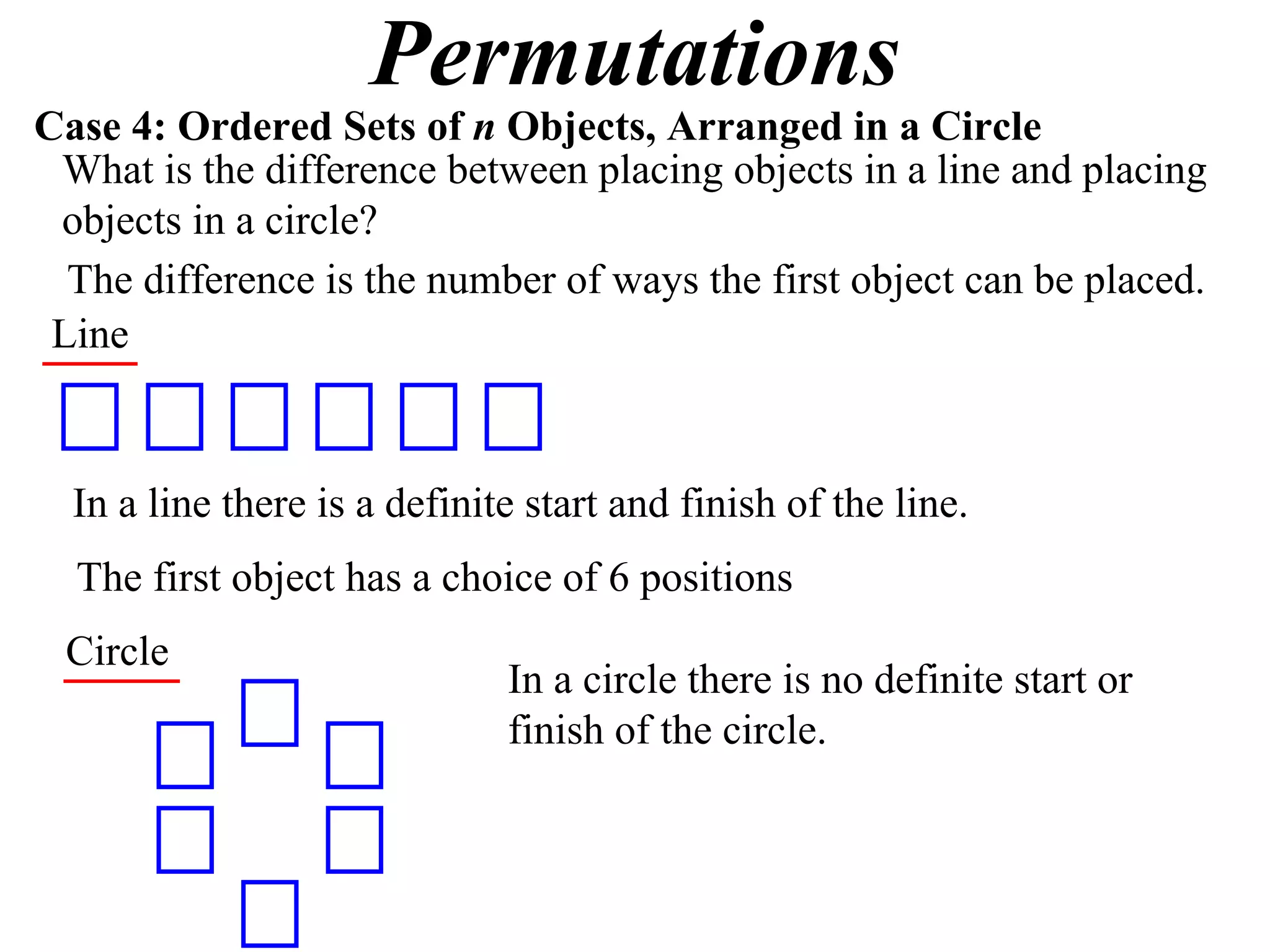
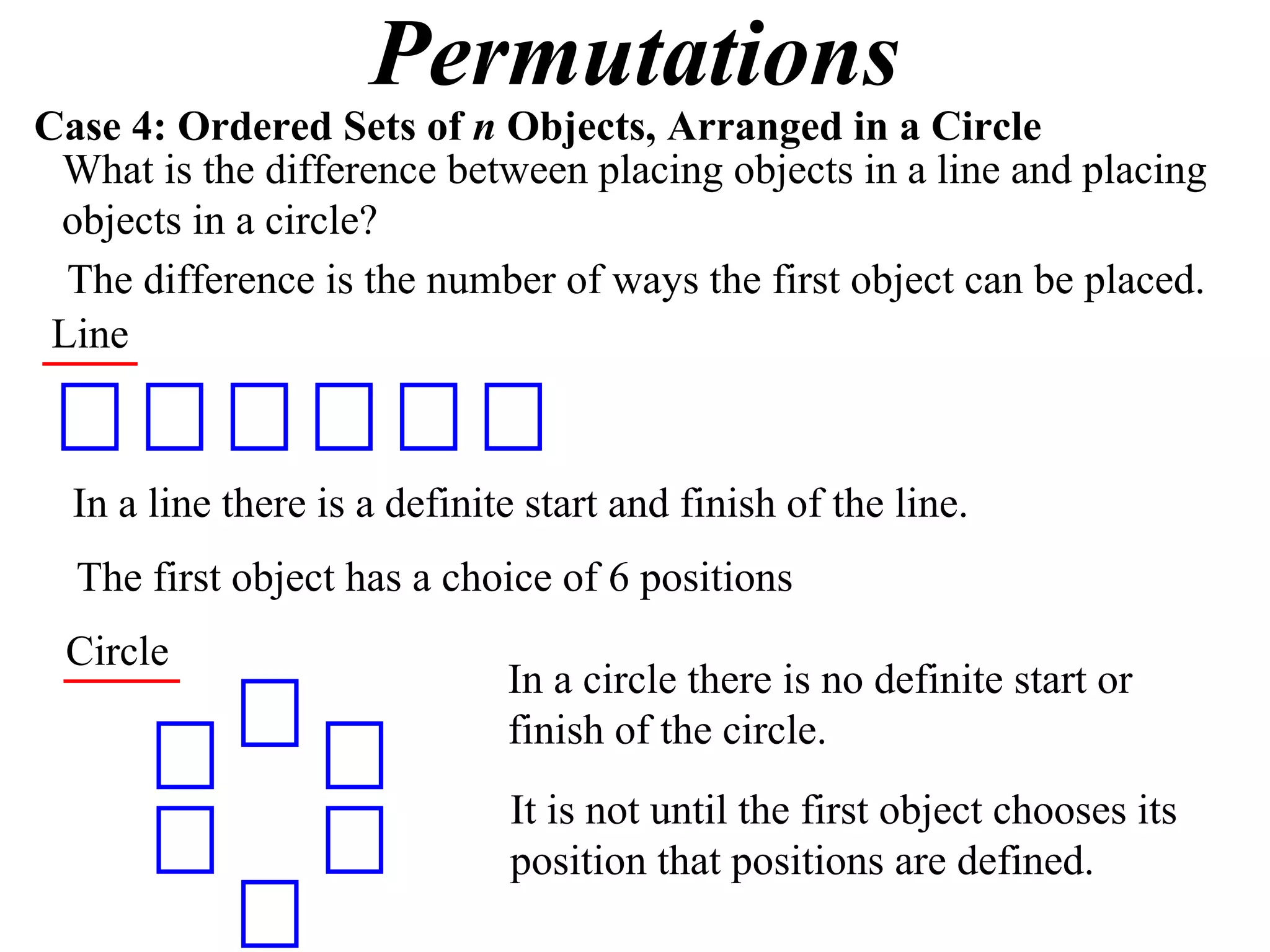
 What is the difference between placing objects in a line and placing
 objects in a circle?
Permutations
Case 4: Ordered Sets of n Objects, Arranged in a Circle
 What is the difference between placing objects in a line and placing
 objects in a circle?
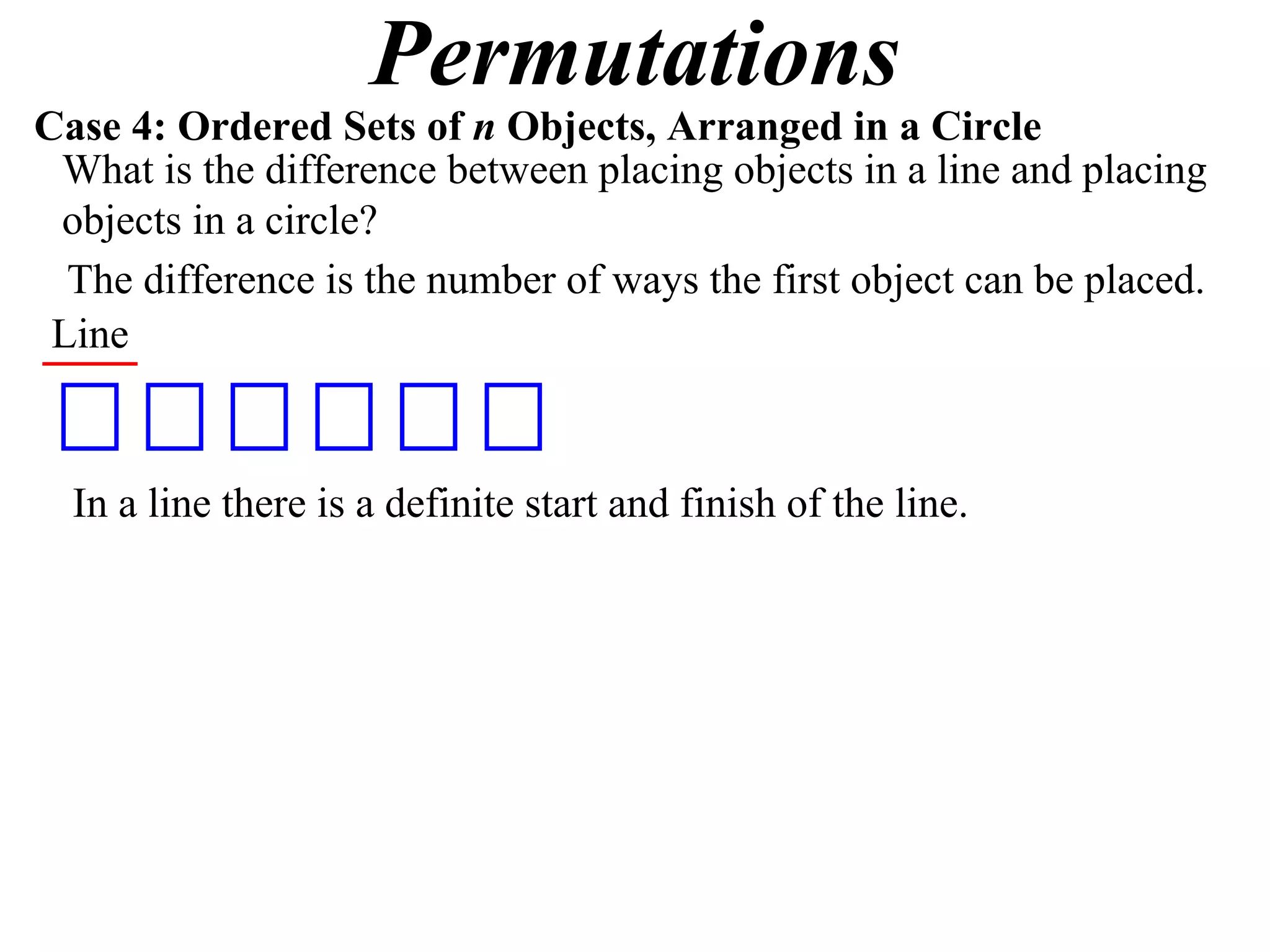
 The difference is the number of ways the first object can be placed.
Permutations
Case 4: Ordered Sets of n Objects, Arranged in a Circle
 What is the difference between placing objects in a line and placing
 objects in a circle?
  The difference is the number of ways the first object can be placed.
 Line
Permutations
Case 4: Ordered Sets of n Objects, Arranged in a Circle
 What is the difference between placing objects in a line and placing
 objects in a circle?
  The difference is the number of ways the first object can be placed.
 Line
Permutations
Case 4: Ordered Sets of n Objects, Arranged in a Circle
 What is the difference between placing objects in a line and placing
 objects in a circle?
  The difference is the number of ways the first object can be placed.
 Line


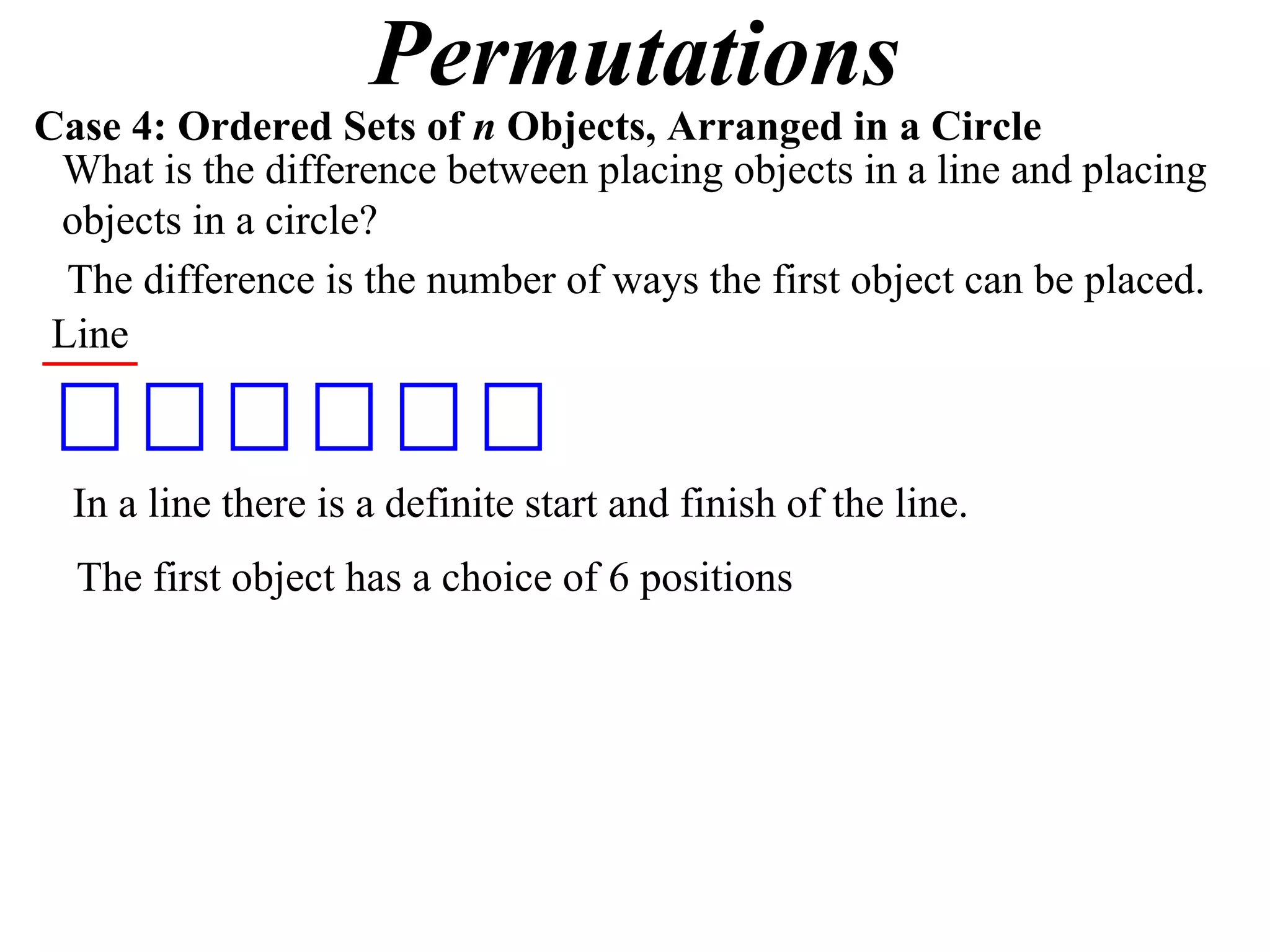
  In a line there is a definite start and finish of the line.
Permutations
Case 4: Ordered Sets of n Objects, Arranged in a Circle
 What is the difference between placing objects in a line and placing
 objects in a circle?
  The difference is the number of ways the first object can be placed.
 Line


  In a line there is a definite start and finish of the line.
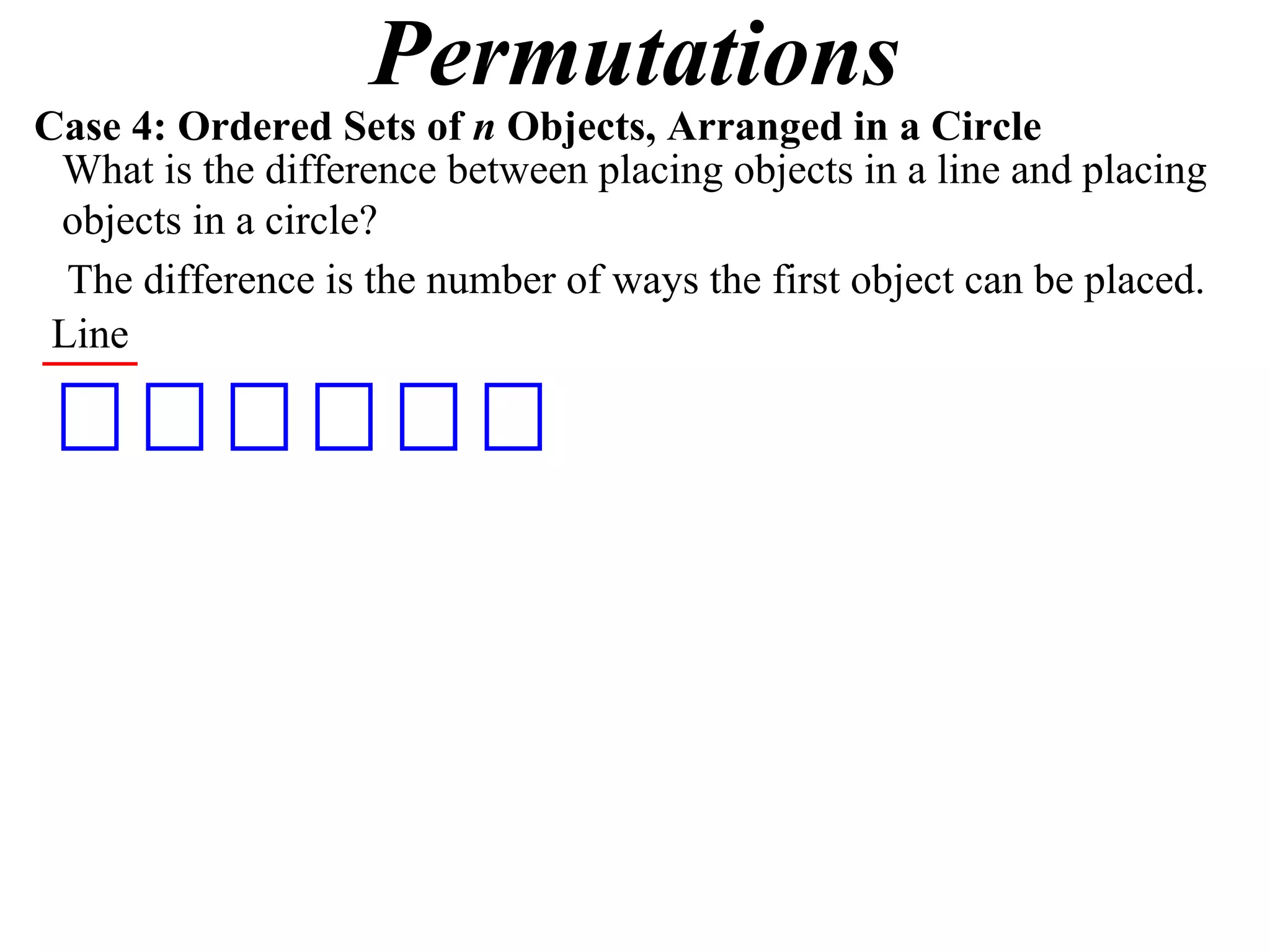
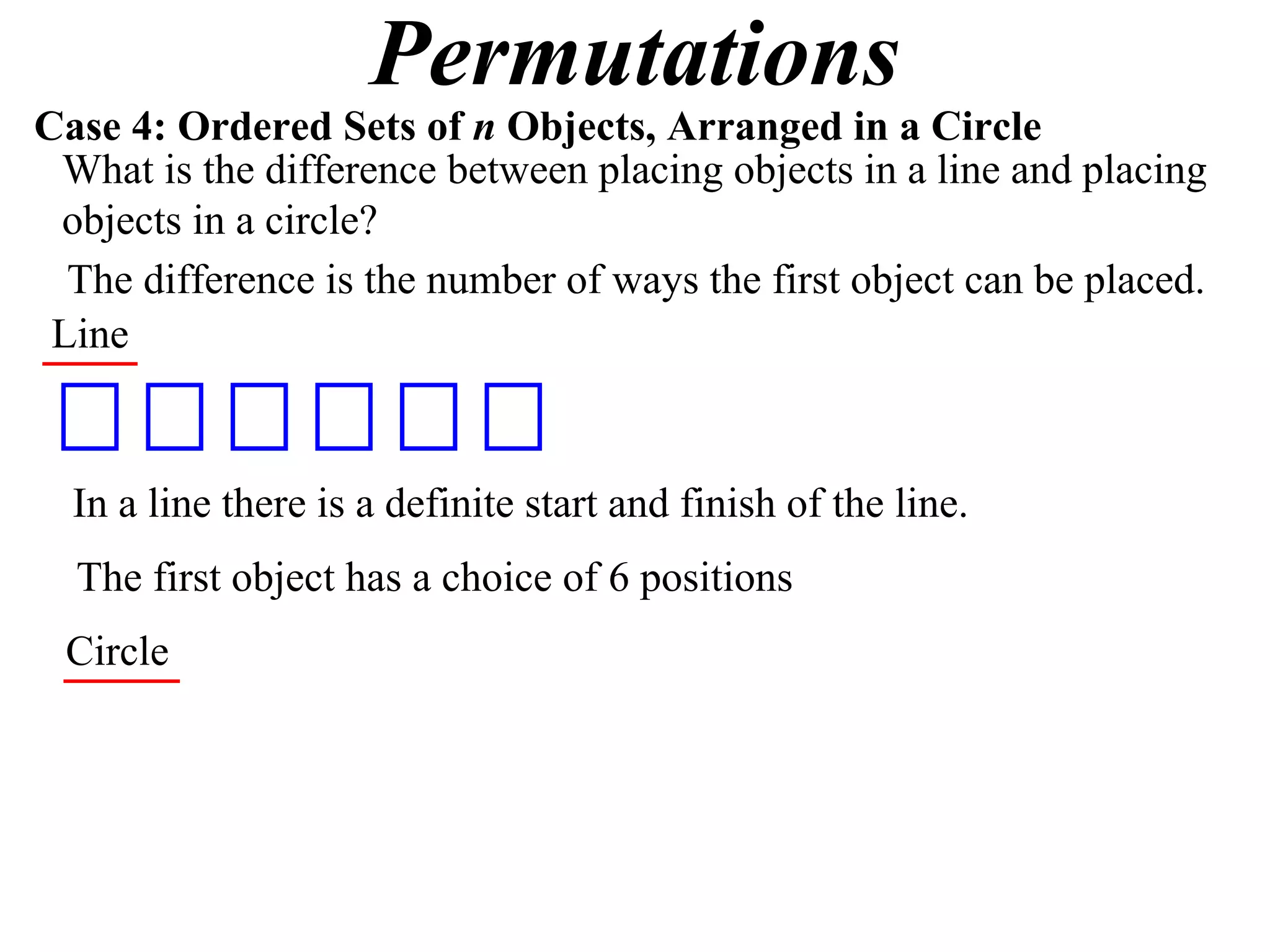
  The first object has a choice of 6 positions
Permutations
Case 4: Ordered Sets of n Objects, Arranged in a Circle
 What is the difference between placing objects in a line and placing
 objects in a circle?
  The difference is the number of ways the first object can be placed.
 Line


  In a line there is a definite start and finish of the line.
  The first object has a choice of 6 positions
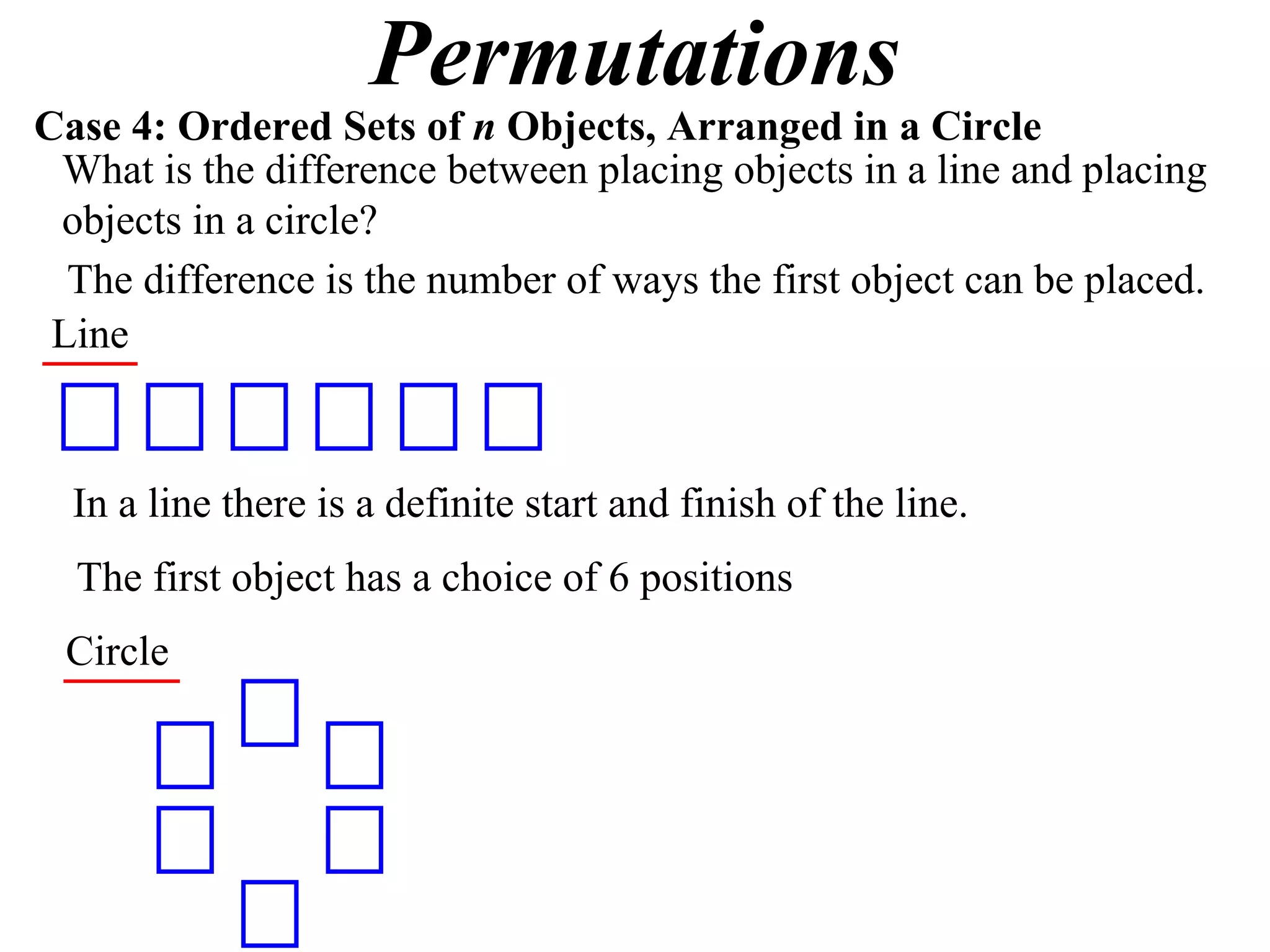
 Circle
Permutations
Case 4: Ordered Sets of n Objects, Arranged in a Circle
 What is the difference between placing objects in a line and placing
 objects in a circle?
  The difference is the number of ways the first object can be placed.
 Line


  In a line there is a definite start and finish of the line.
  The first object has a choice of 6 positions
 Circle
Permutations
Case 4: Ordered Sets of n Objects, Arranged in a Circle
 What is the difference between placing objects in a line and placing
 objects in a circle?
  The difference is the number of ways the first object can be placed.
 Line


  In a line there is a definite start and finish of the line.
  The first object has a choice of 6 positions
 Circle
                              In a circle there is no definite start or
                              finish of the circle.
Permutations
Case 4: Ordered Sets of n Objects, Arranged in a Circle
 What is the difference between placing objects in a line and placing
 objects in a circle?
  The difference is the number of ways the first object can be placed.
 Line


  In a line there is a definite start and finish of the line.
  The first object has a choice of 6 positions
 Circle
                              In a circle there is no definite start or
                              finish of the circle.
                              It is not until the first object chooses its
                              position that positions are defined.
Line


Circle
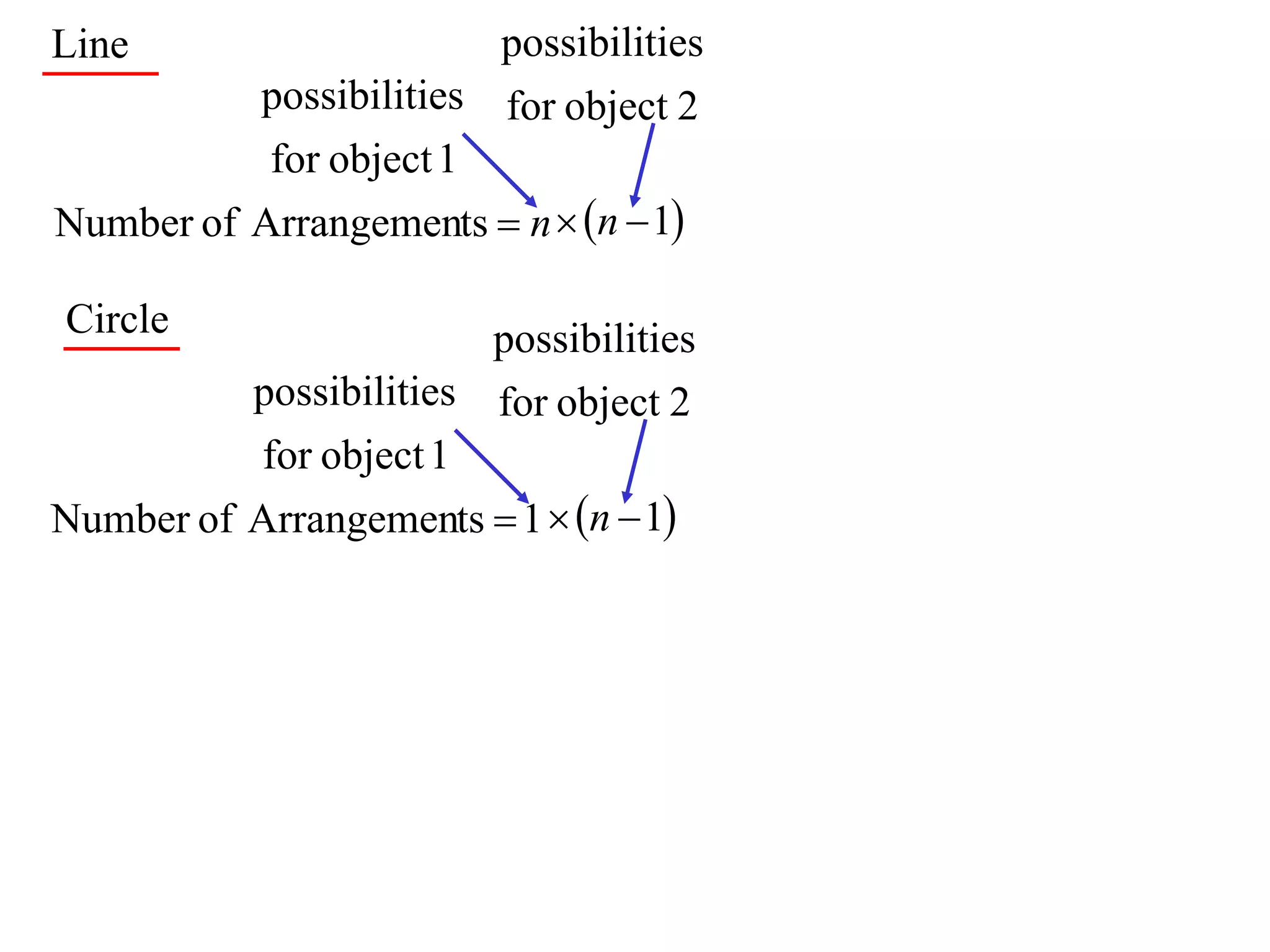
Line
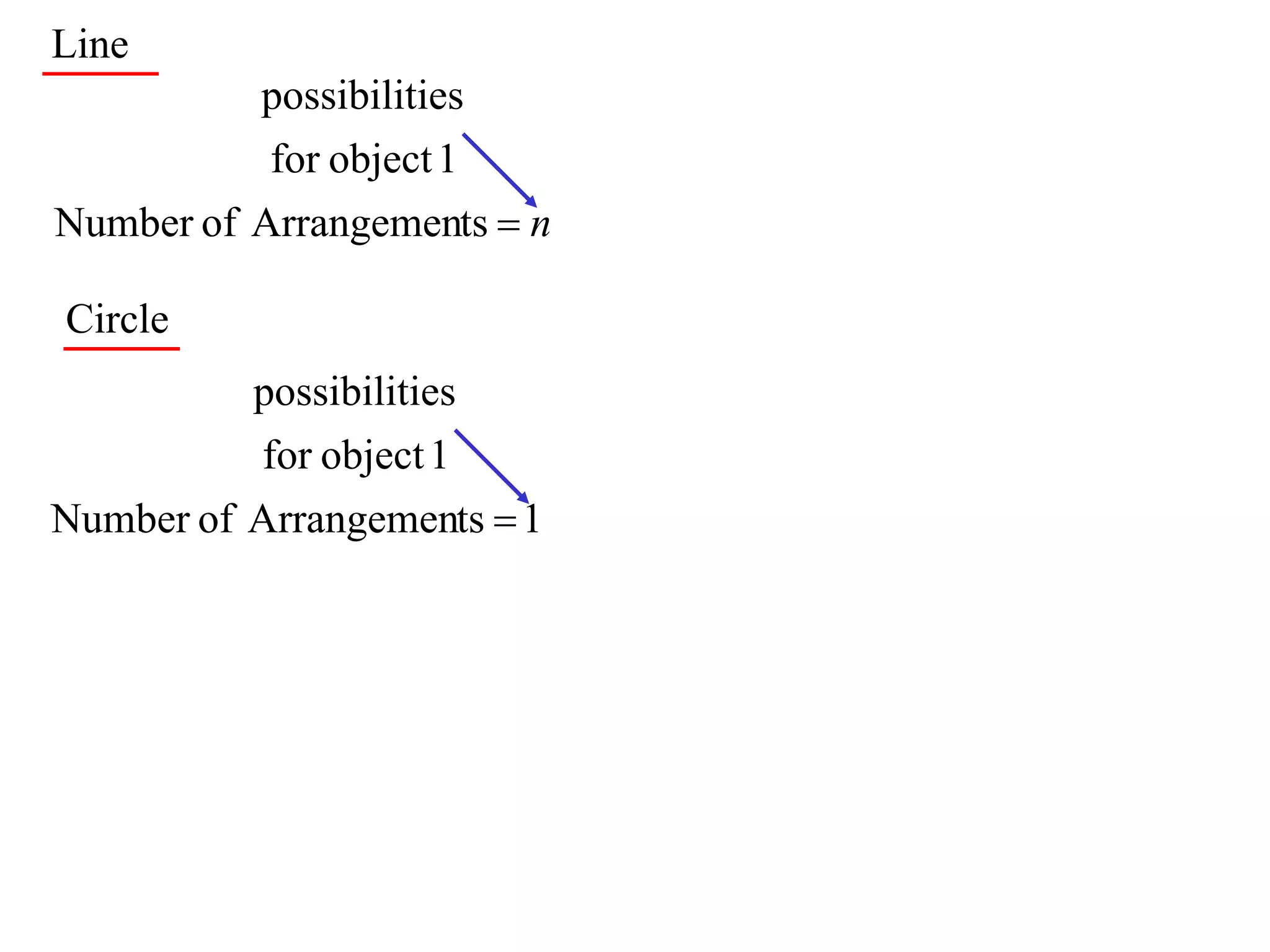
           possibilities
           for object 1
Number of Arrangements  n

Circle
          possibilities
           for object 1
Number of Arrangements  1
Line                     possibilities
          possibilities for object 2
           for object 1
Number of Arrangements  n  n  1

Circle                  possibilities
          possibilities for object 2
          for object 1
Number of Arrangements  1  n  1
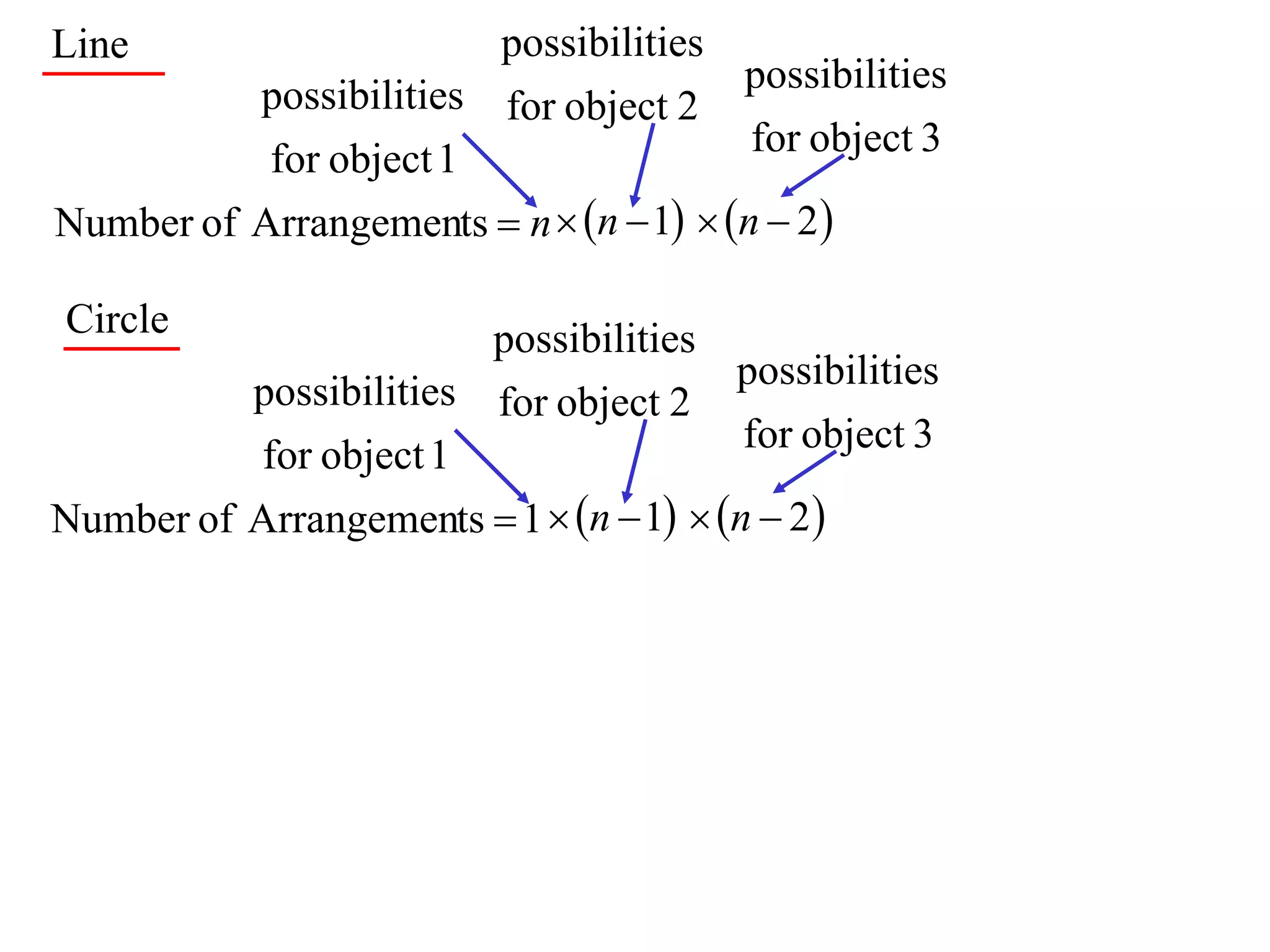
Line                      possibilities
          possibilities for object 2 possibilities
           for object 1                  for object 3

Number of Arrangements  n  n  1  n  2 

Circle                    possibilities
          possibilities for object 2 possibilities
          for object 1                   for object 3

Number of Arrangements  1  n  1  n  2 
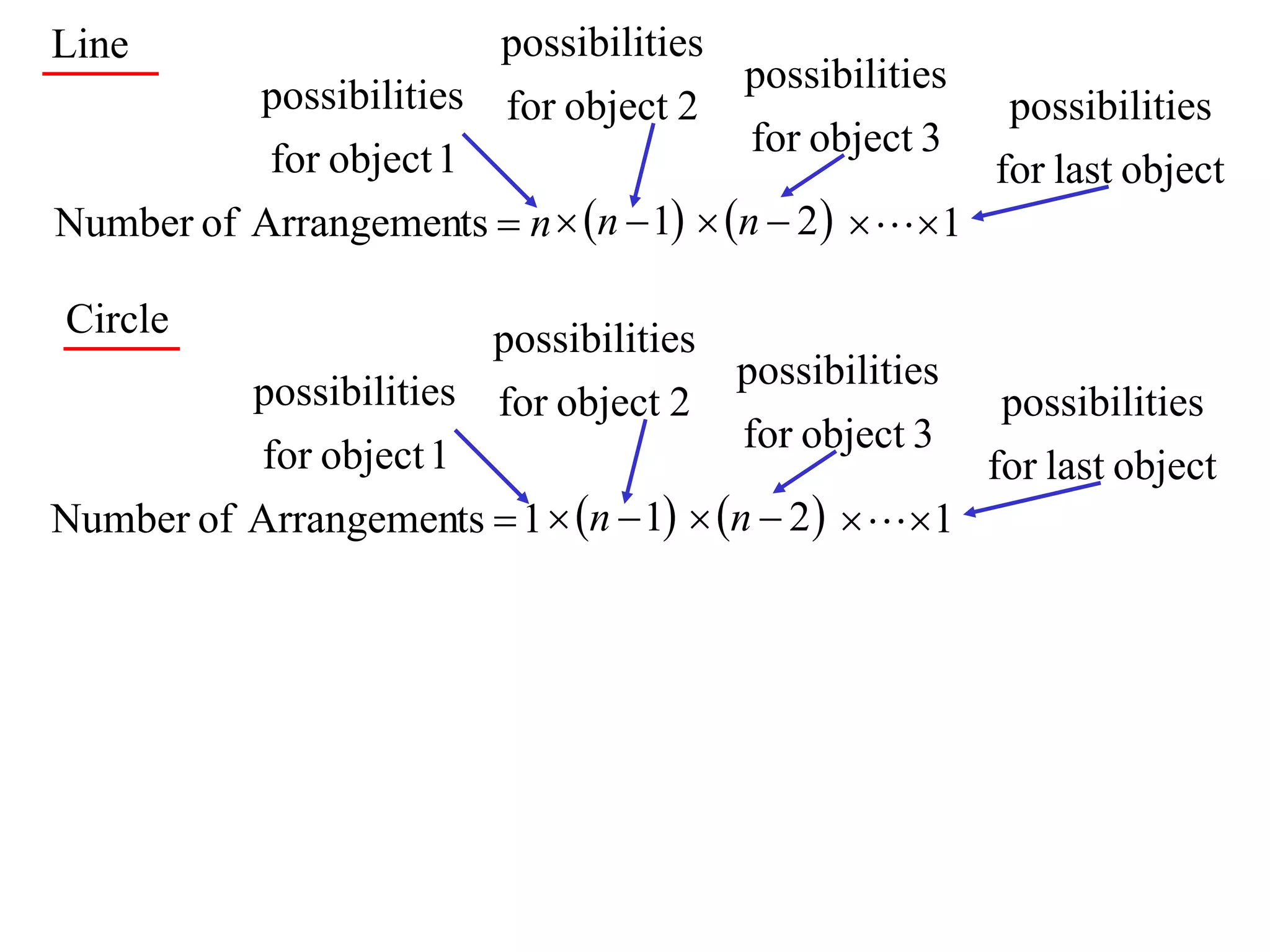
Line                       possibilities
          possibilities for object 2 possibilities possibilities
           for object 1                  for object 3
                                                       for last object
Number of Arrangements  n  n  1  n  2    1

Circle                    possibilities
          possibilities for object 2 possibilities possibilities
          for object 1                   for object 3
                                                       for last object
Number of Arrangements  1  n  1  n  2    1
Line                       possibilities
          possibilities for object 2 possibilities possibilities
           for object 1                  for object 3
                                                       for last object
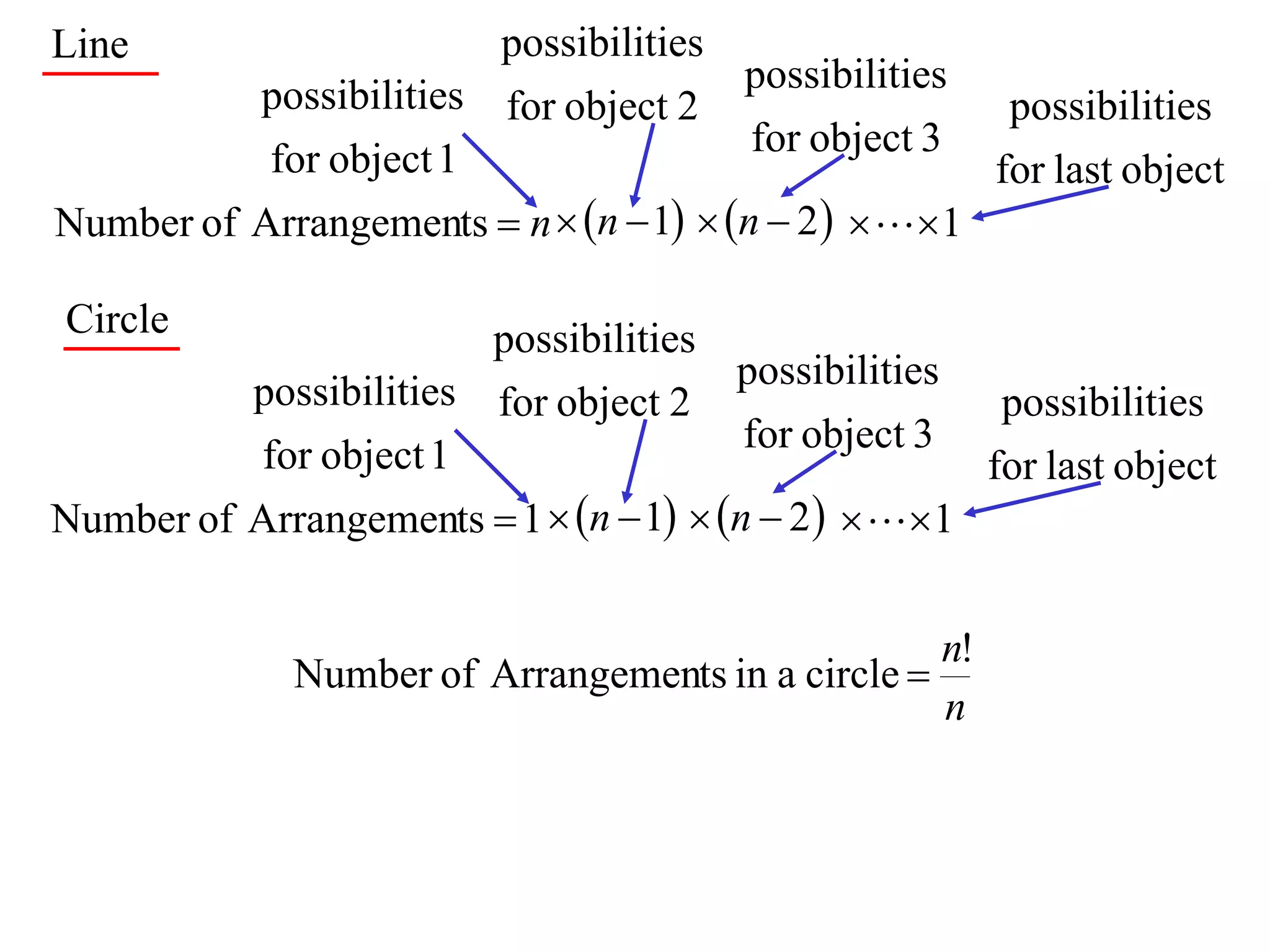
Number of Arrangements  n  n  1  n  2    1

Circle                    possibilities
          possibilities for object 2 possibilities possibilities
          for object 1                   for object 3
                                                       for last object
Number of Arrangements  1  n  1  n  2    1


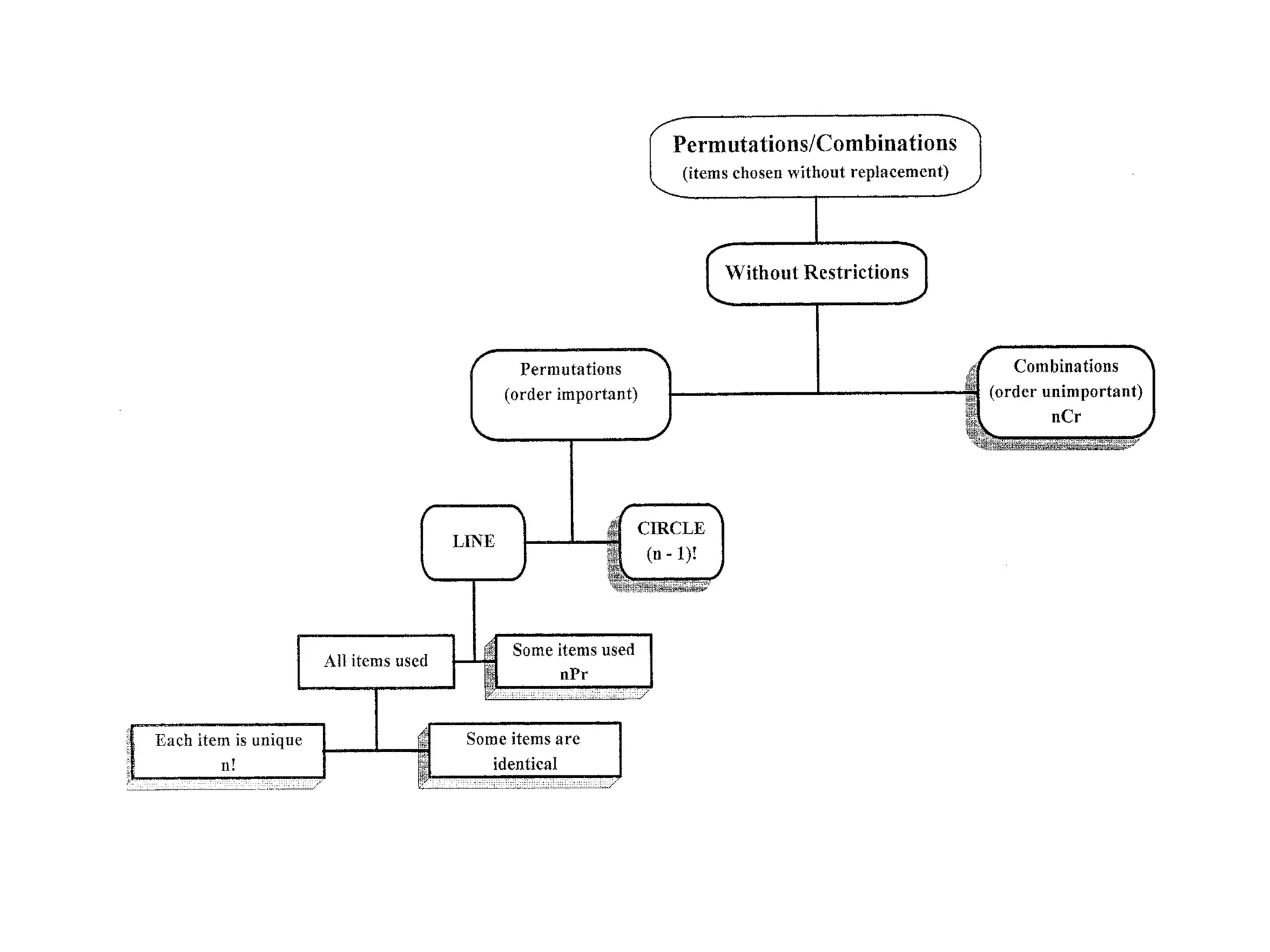
                                                   n!
              Number of Arrangements in a circle 
                                                   n
Line                       possibilities
          possibilities for object 2 possibilities possibilities
           for object 1                  for object 3
                                                       for last object
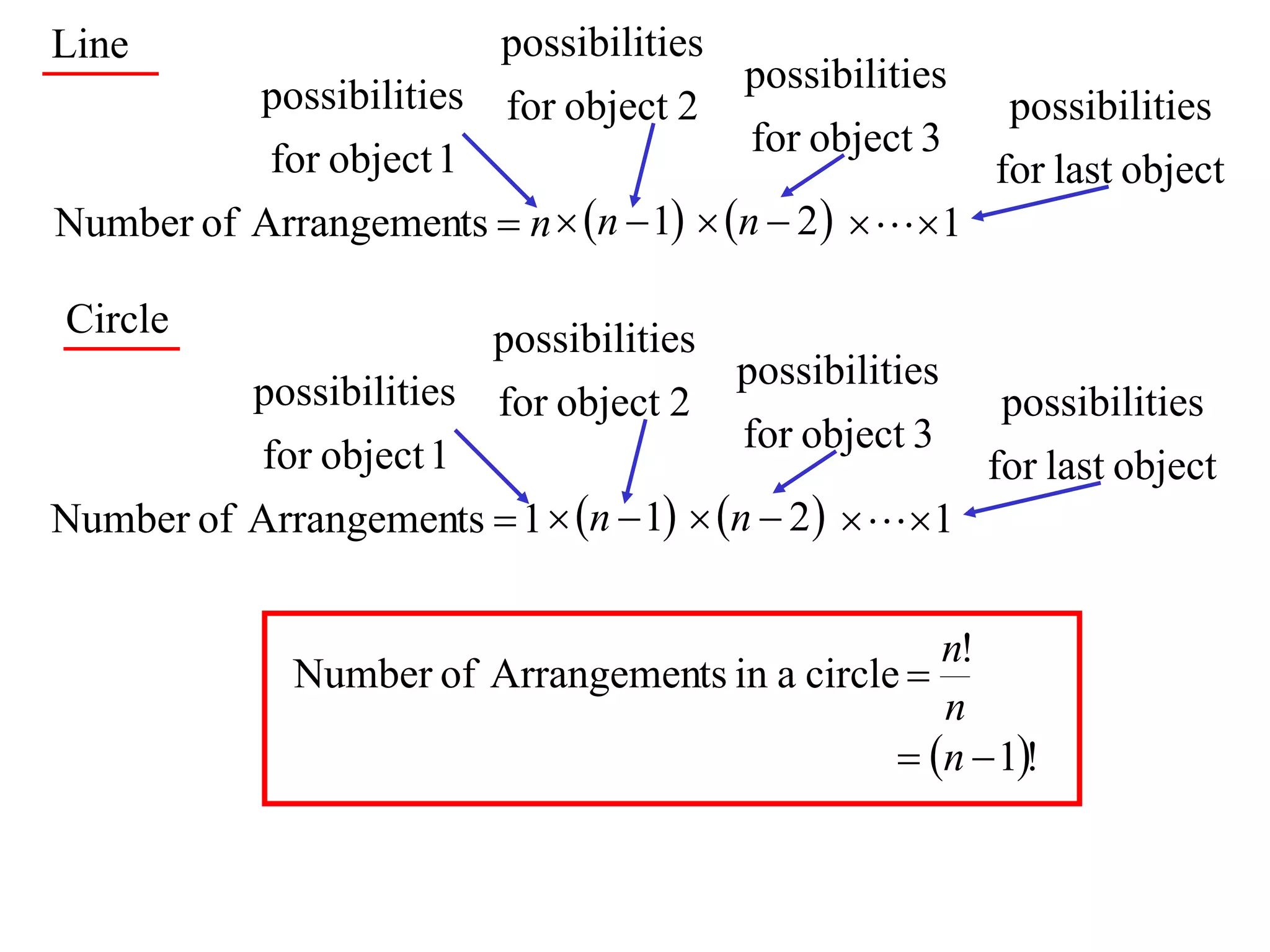
Number of Arrangements  n  n  1  n  2    1

Circle                    possibilities
          possibilities for object 2 possibilities possibilities
          for object 1                   for object 3
                                                       for last object
Number of Arrangements  1  n  1  n  2    1


                                                   n!
              Number of Arrangements in a circle 
                                                   n
                                                 n  1!
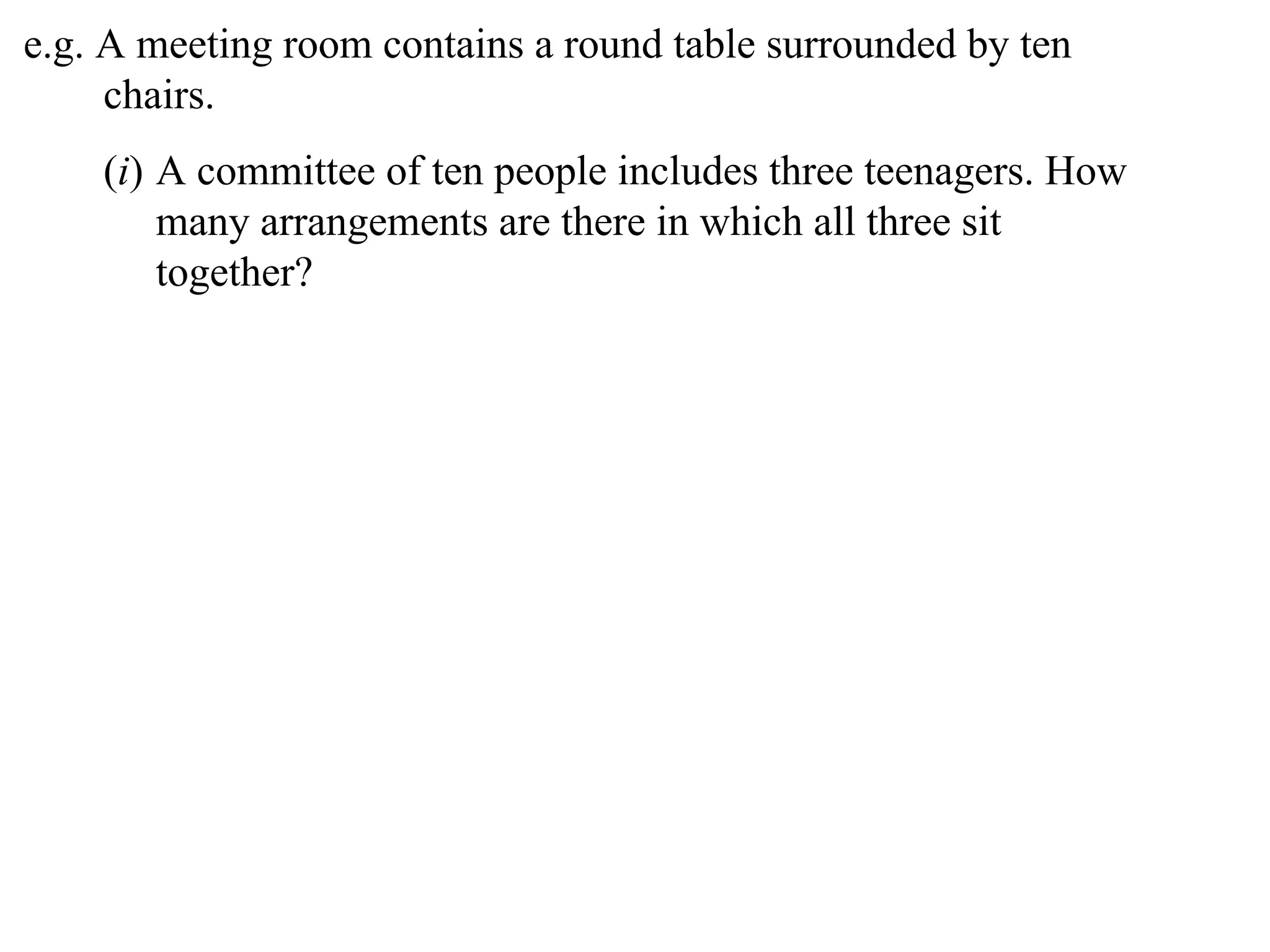
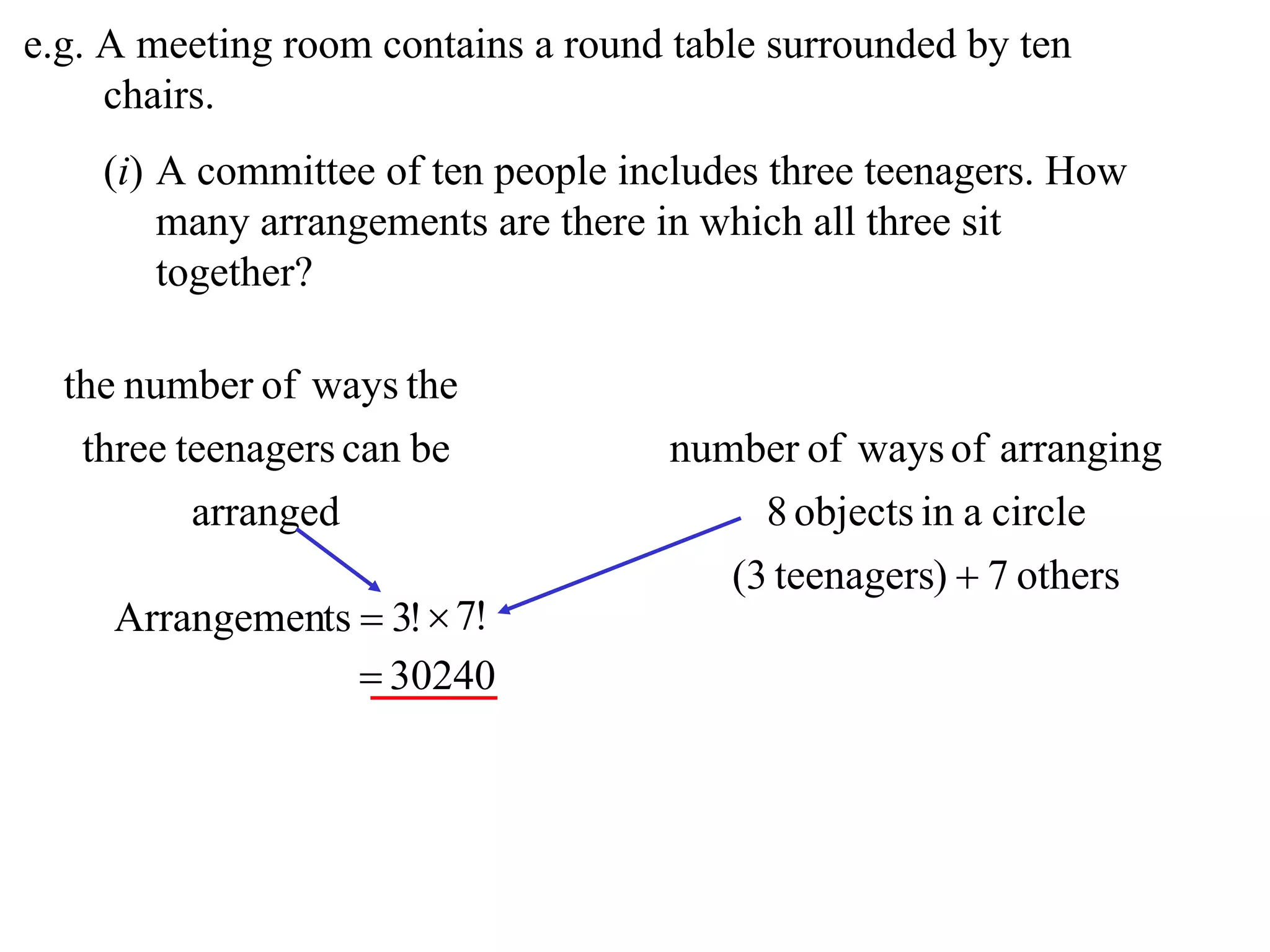
e.g. A meeting room contains a round table surrounded by ten
     chairs.
    (i) A committee of ten people includes three teenagers. How
        many arrangements are there in which all three sit
        together?
e.g. A meeting room contains a round table surrounded by ten
     chairs.
    (i) A committee of ten people includes three teenagers. How
        many arrangements are there in which all three sit
        together?

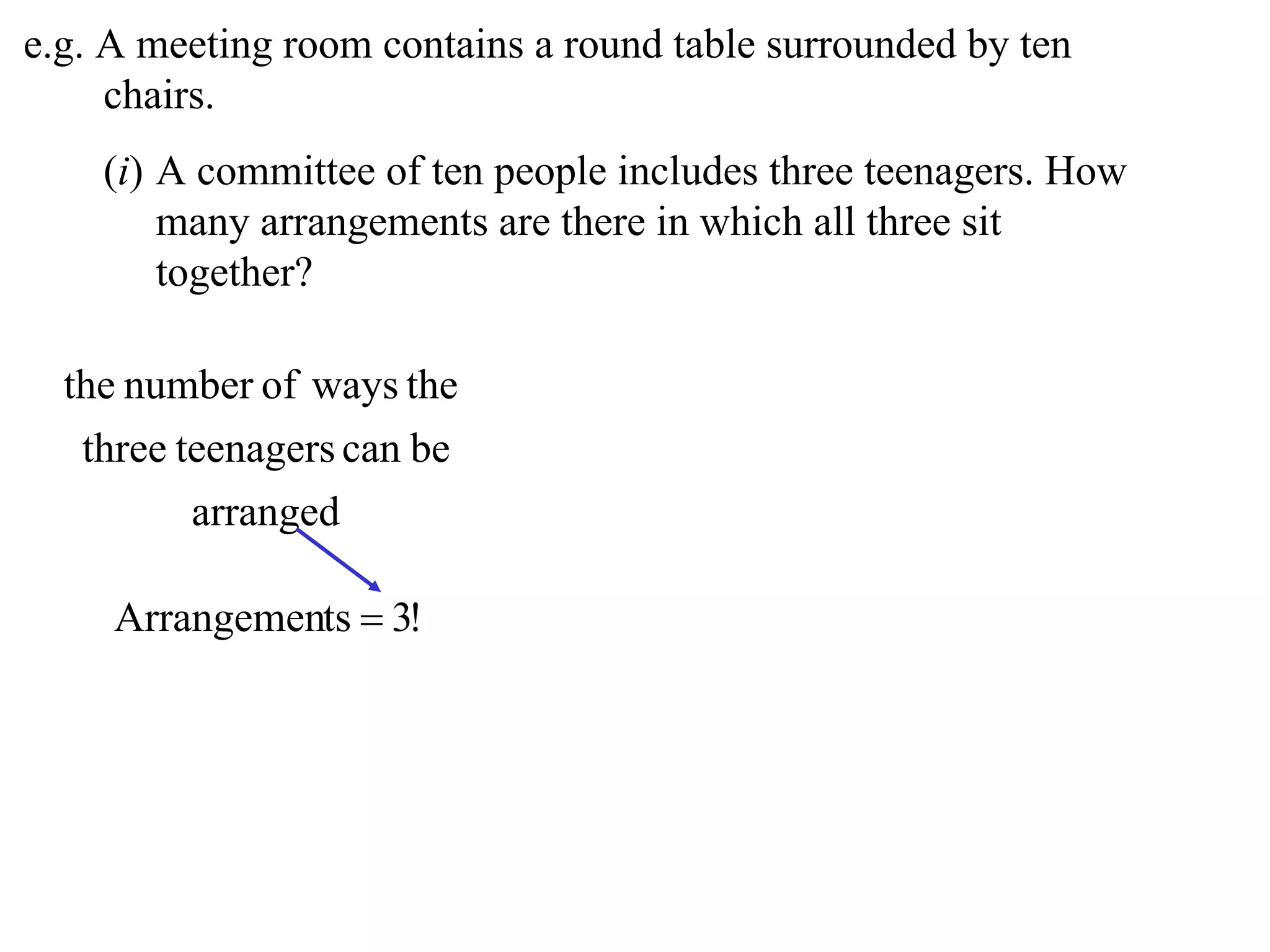
  the number of ways the
   three teenagers can be
          arranged

     Arrangements  3!
e.g. A meeting room contains a round table surrounded by ten
     chairs.
    (i) A committee of ten people includes three teenagers. How
        many arrangements are there in which all three sit
        together?

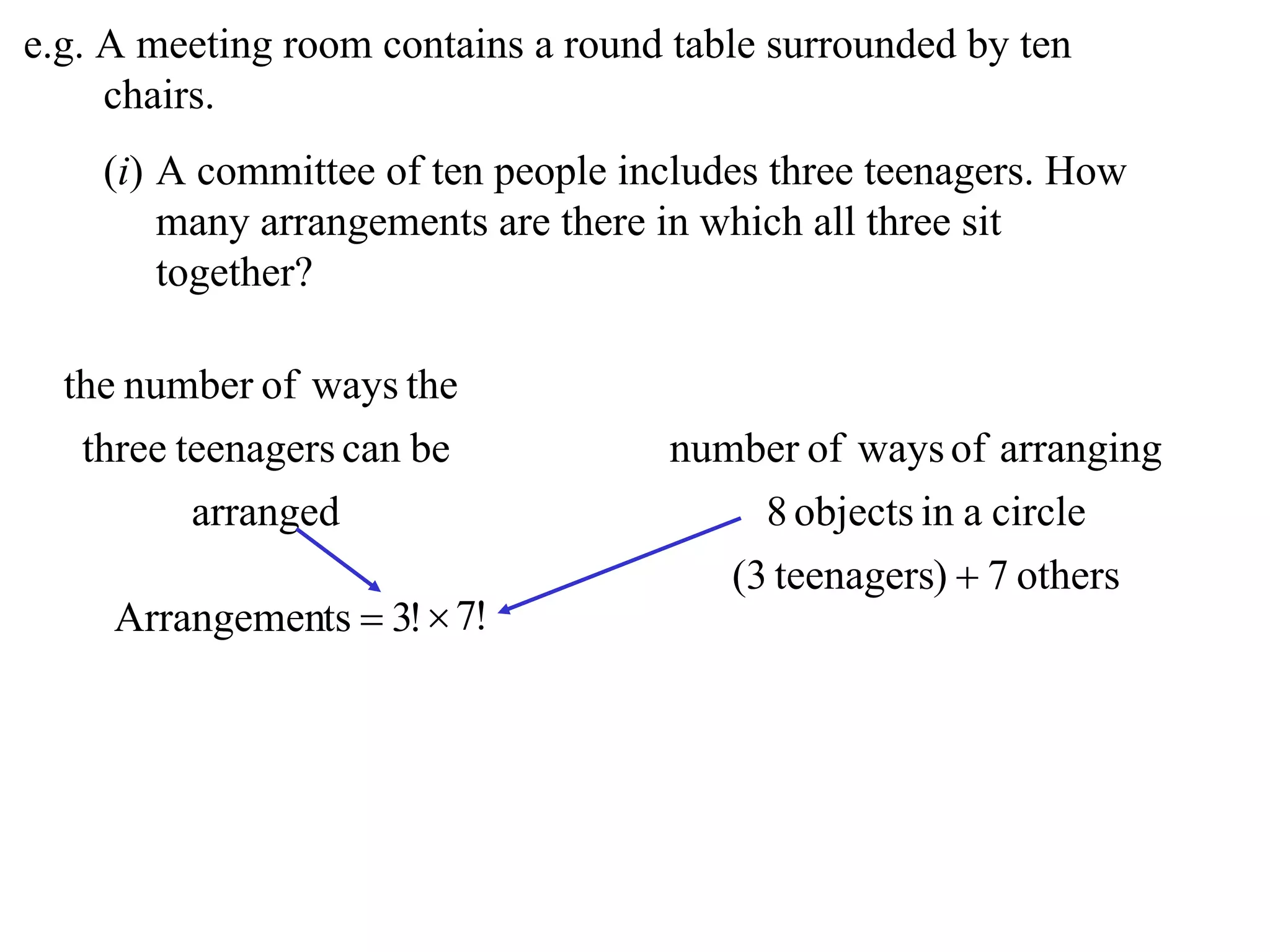
  the number of ways the
   three teenagers can be           number of ways of arranging
          arranged                       8 objects in a circle
                                       (3 teenagers)  7 others
     Arrangements  3!  7!
e.g. A meeting room contains a round table surrounded by ten
     chairs.
    (i) A committee of ten people includes three teenagers. How
        many arrangements are there in which all three sit
        together?

  the number of ways the
   three teenagers can be           number of ways of arranging
          arranged                       8 objects in a circle
                                       (3 teenagers)  7 others
     Arrangements  3!  7!
                   30240
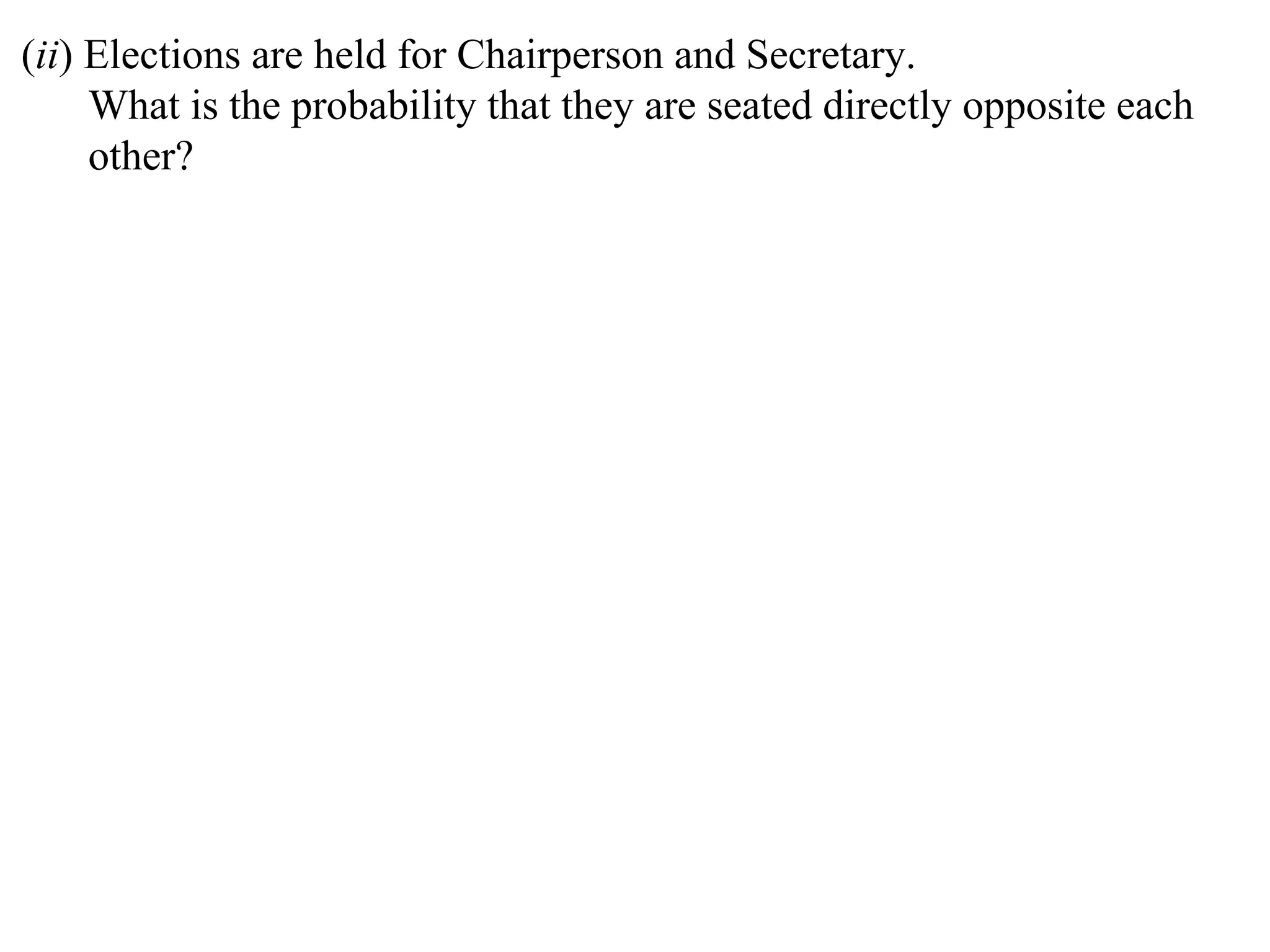
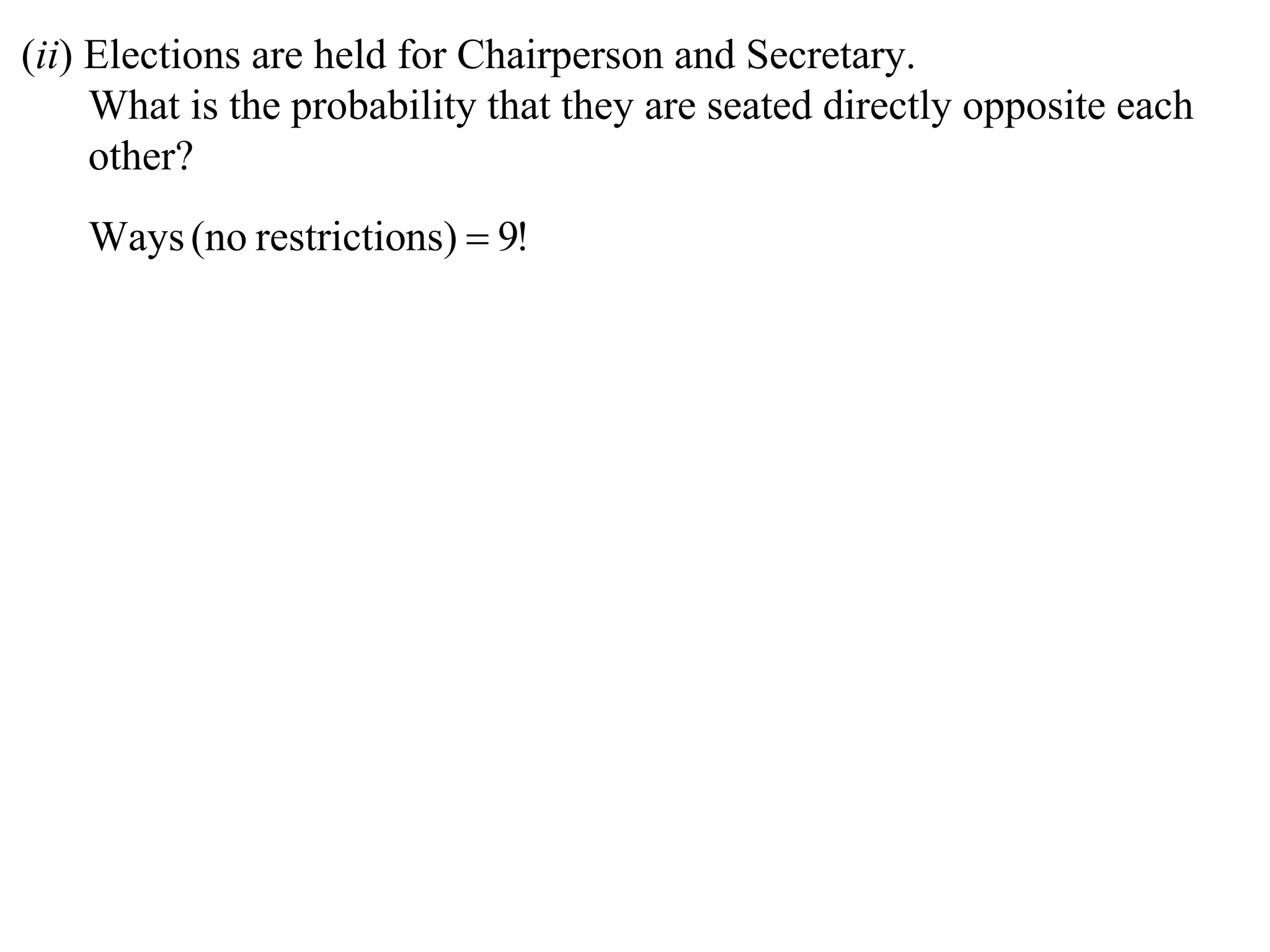
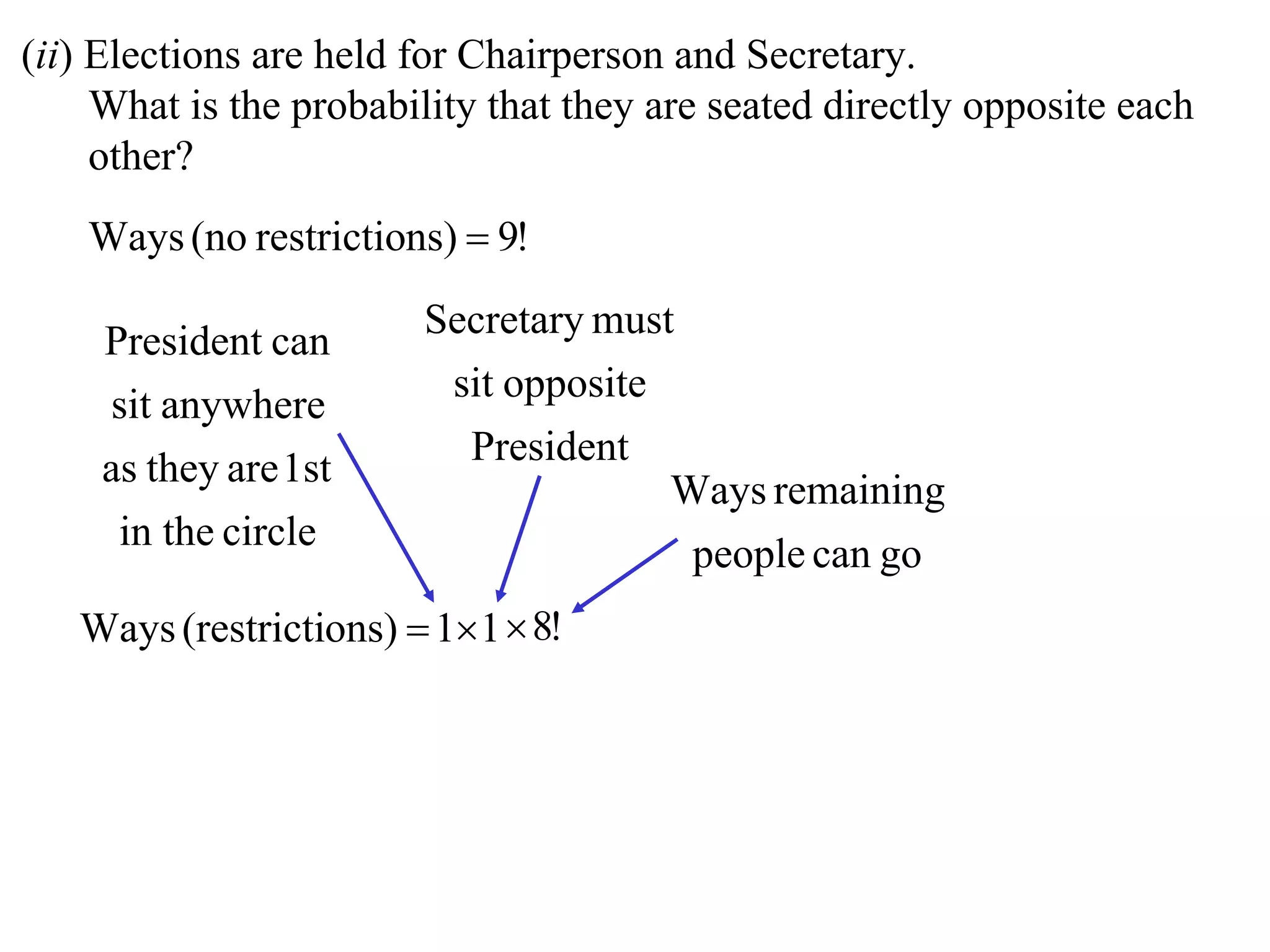
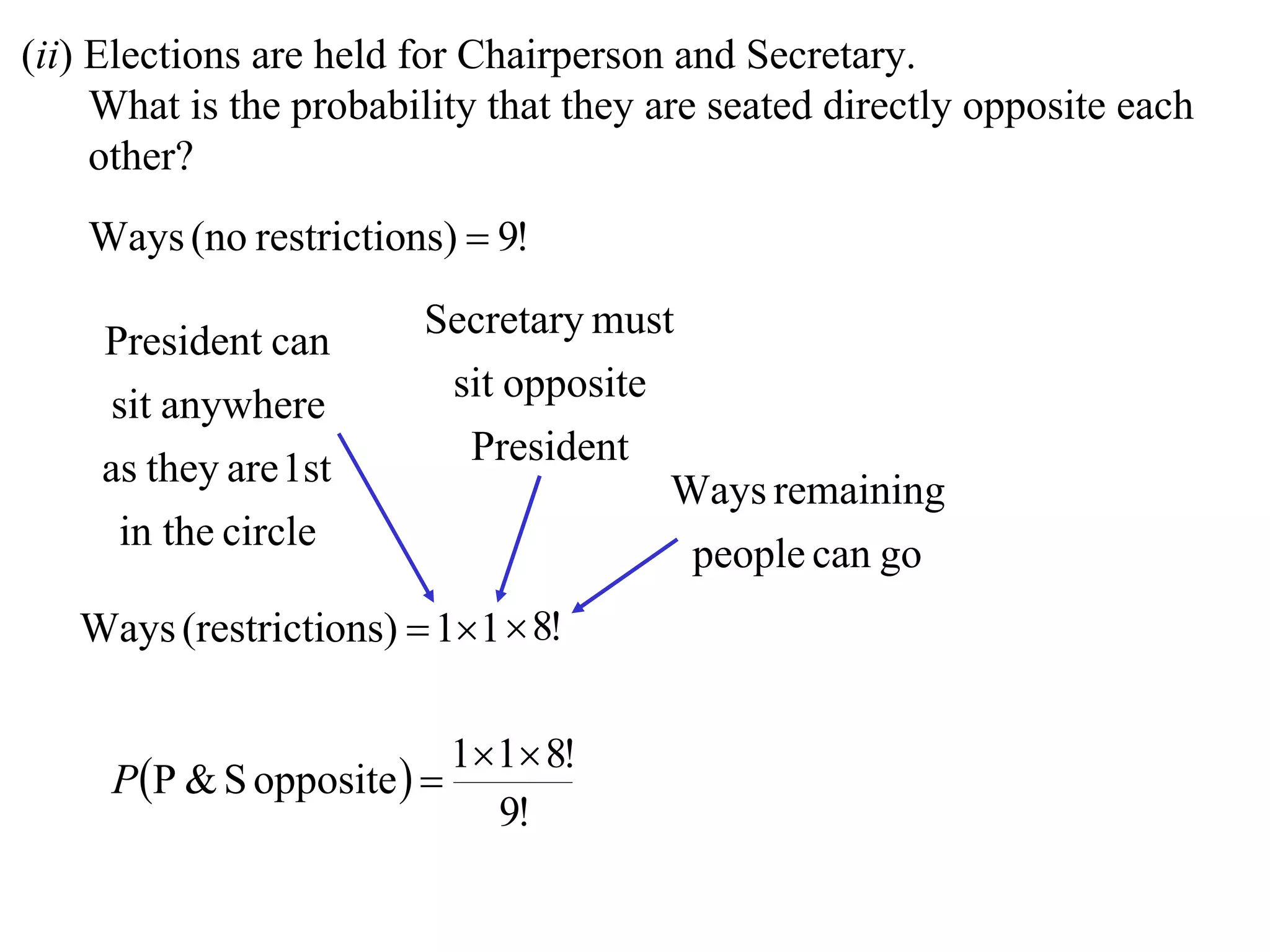
(ii) Elections are held for Chairperson and Secretary.
     What is the probability that they are seated directly opposite each
     other?
(ii) Elections are held for Chairperson and Secretary.
     What is the probability that they are seated directly opposite each
     other?
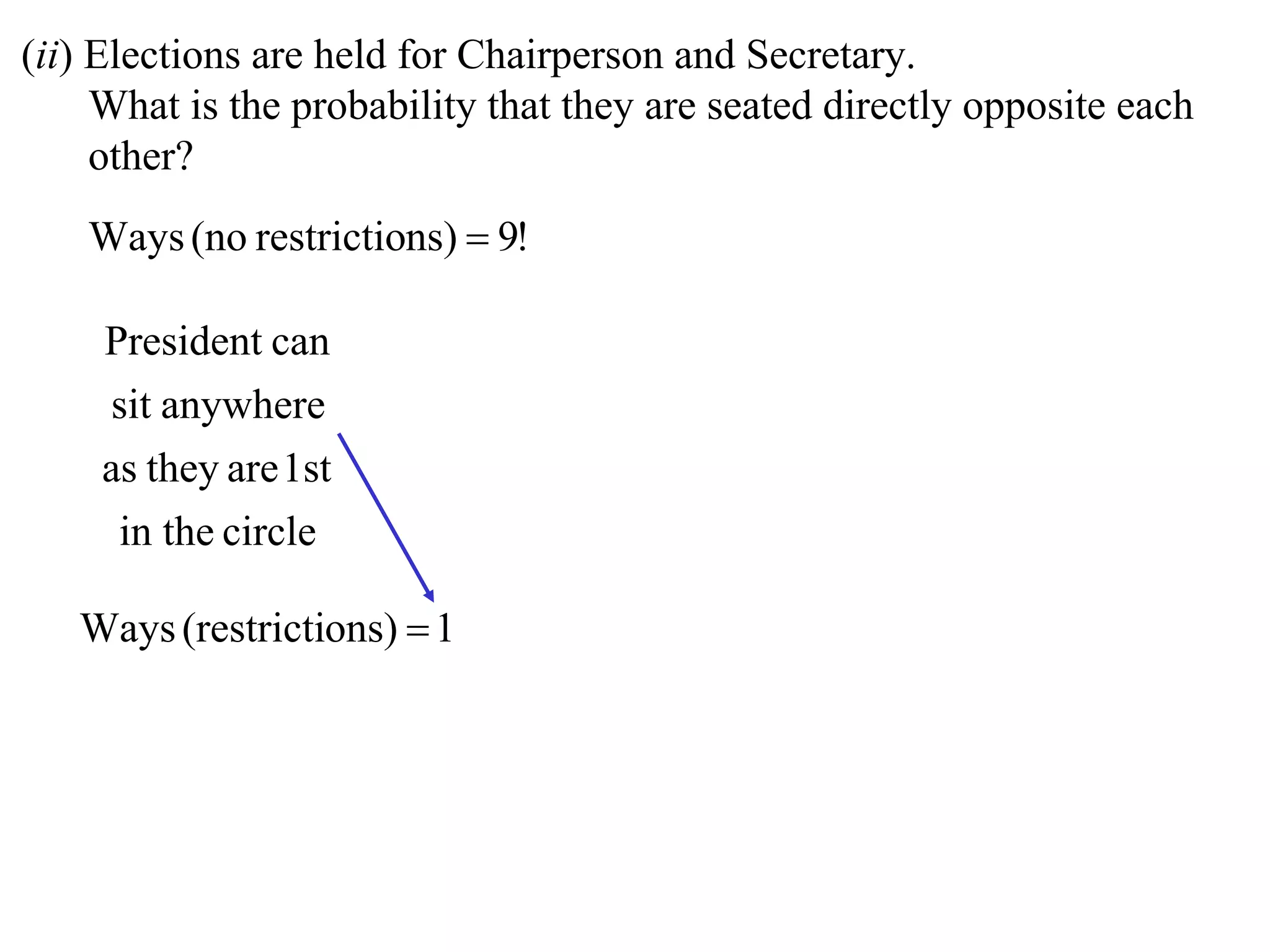
    Ways (no restrictions)  9!
(ii) Elections are held for Chairperson and Secretary.
     What is the probability that they are seated directly opposite each
     other?
    Ways (no restrictions)  9!

    President can
    sit anywhere
    as they are 1st
     in the circle

   Ways (restrictions)  1
(ii) Elections are held for Chairperson and Secretary.
     What is the probability that they are seated directly opposite each
     other?
    Ways (no restrictions)  9!
                        Secretary must
    President can
                         sit opposite
    sit anywhere
                          President
    as they are 1st
     in the circle

   Ways (restrictions)  1 1
(ii) Elections are held for Chairperson and Secretary.
     What is the probability that they are seated directly opposite each
     other?
    Ways (no restrictions)  9!
                         Secretary must
    President can
                          sit opposite
    sit anywhere
                           President
    as they are 1st
                                       Ways remaining
      in the circle
                                         people can go
   Ways (restrictions)  1 1  8!
(ii) Elections are held for Chairperson and Secretary.
     What is the probability that they are seated directly opposite each
     other?
    Ways (no restrictions)  9!
                         Secretary must
    President can
                          sit opposite
    sit anywhere
                           President
    as they are 1st
                                       Ways remaining
      in the circle
                                         people can go
   Ways (restrictions)  1 1  8!

                          11 8!
     PP & S opposite  
                            9!
(ii) Elections are held for Chairperson and Secretary.
     What is the probability that they are seated directly opposite each
     other?
    Ways (no restrictions)  9!
                         Secretary must
    President can
                          sit opposite
    sit anywhere
                           President
    as they are 1st
                                       Ways remaining
      in the circle
                                         people can go
   Ways (restrictions)  1 1  8!

                          11 8!
     PP & S opposite  
                            9!
                          1
                       
                          9
(ii) Elections are held for Chairperson and Secretary.
     What is the probability that they are seated directly opposite each
     other?
    Ways (no restrictions)  9!
                         Secretary must
    President can
                          sit opposite
    sit anywhere
                           President
    as they are 1st
                                       Ways remaining
      in the circle
                                         people can go
                                                   Note: of 9 seats only
   Ways (restrictions)  1 1  8!
                                                     1 is opposite the
                                                         President
                          11 8!                    Popposite  
                                                                     1
     PP & S opposite  
                            9!                                       9
                          1                          Sometimes simple
                                                   logic is quicker!!!!
                          9
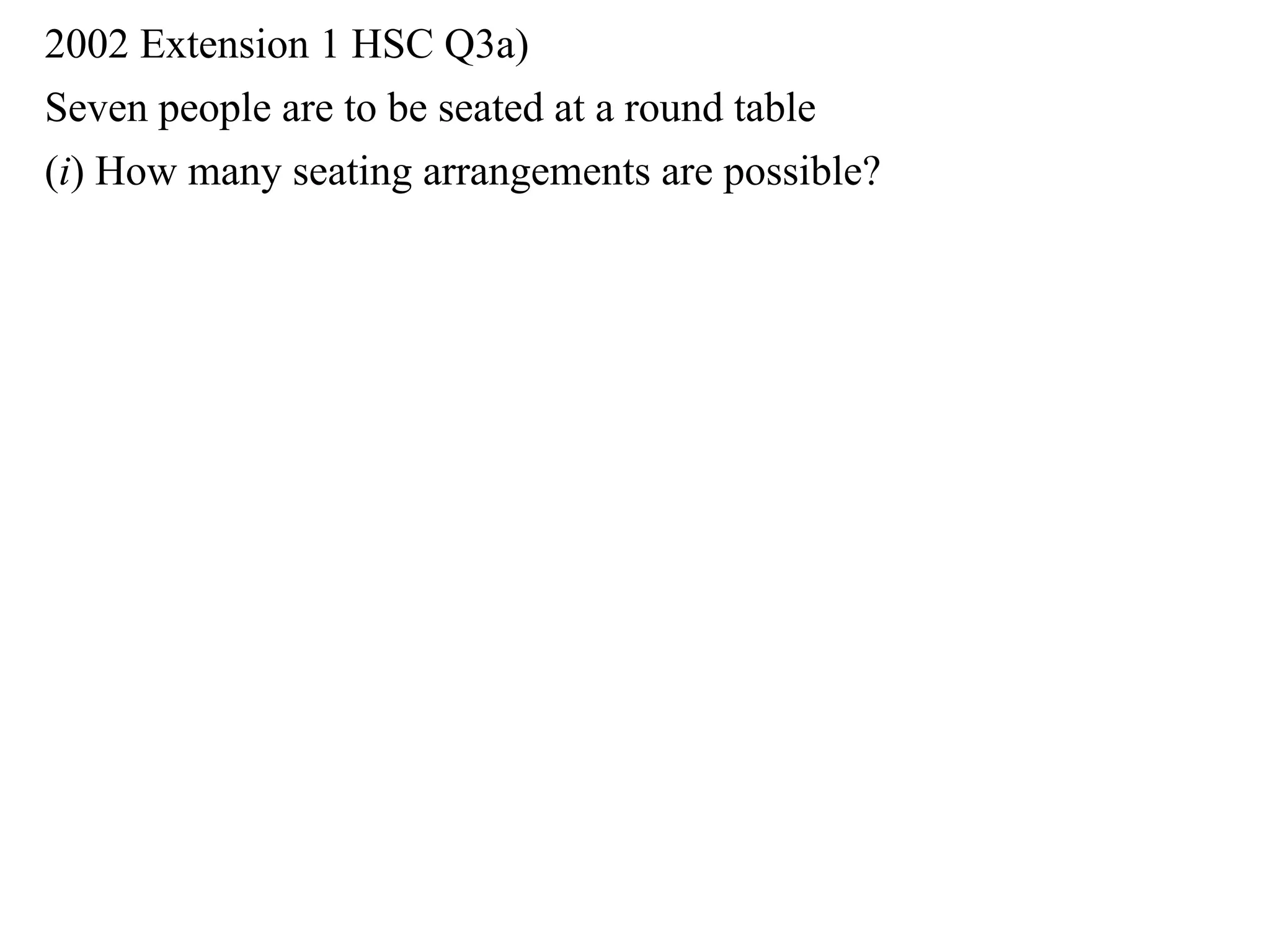
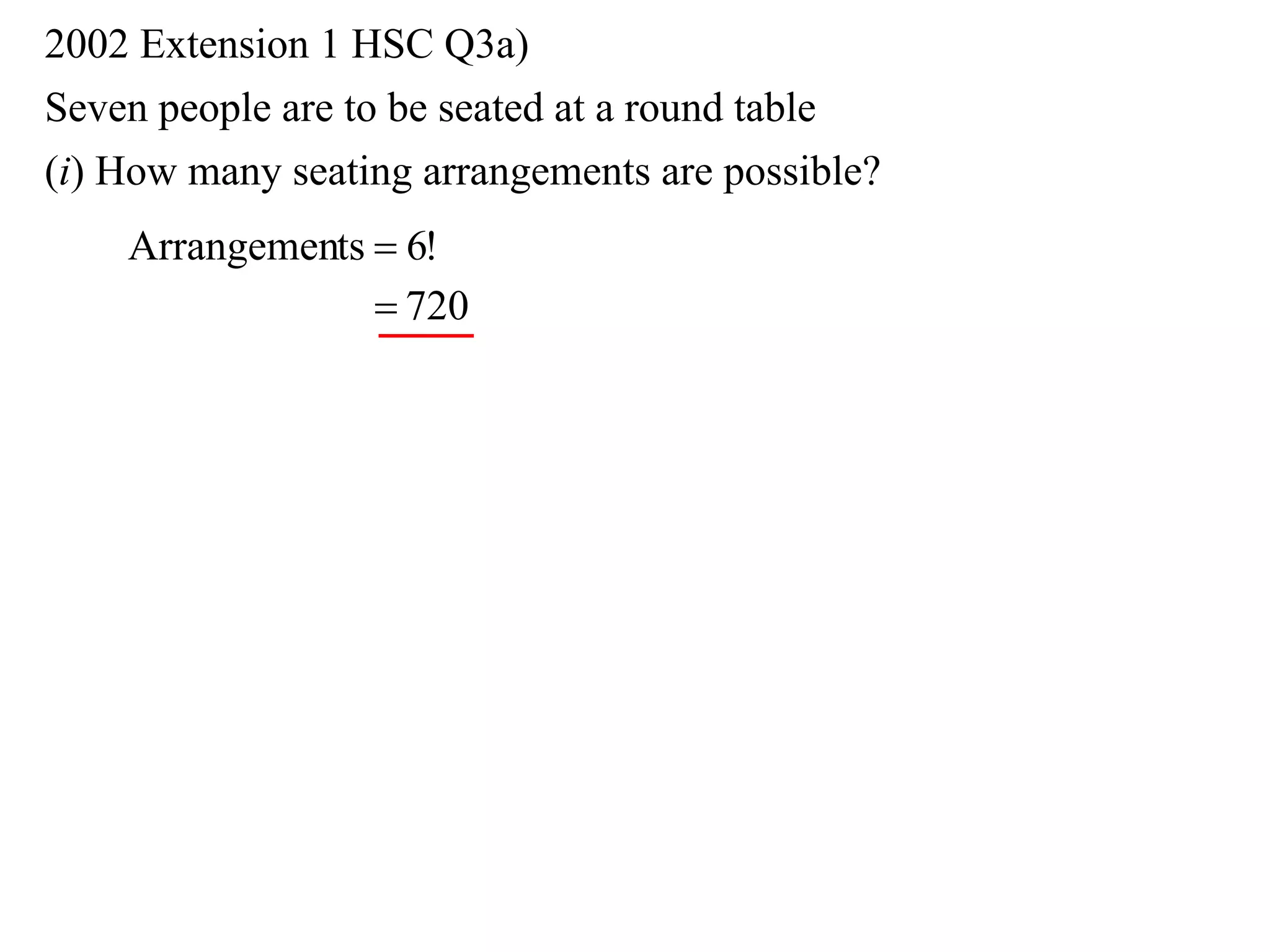
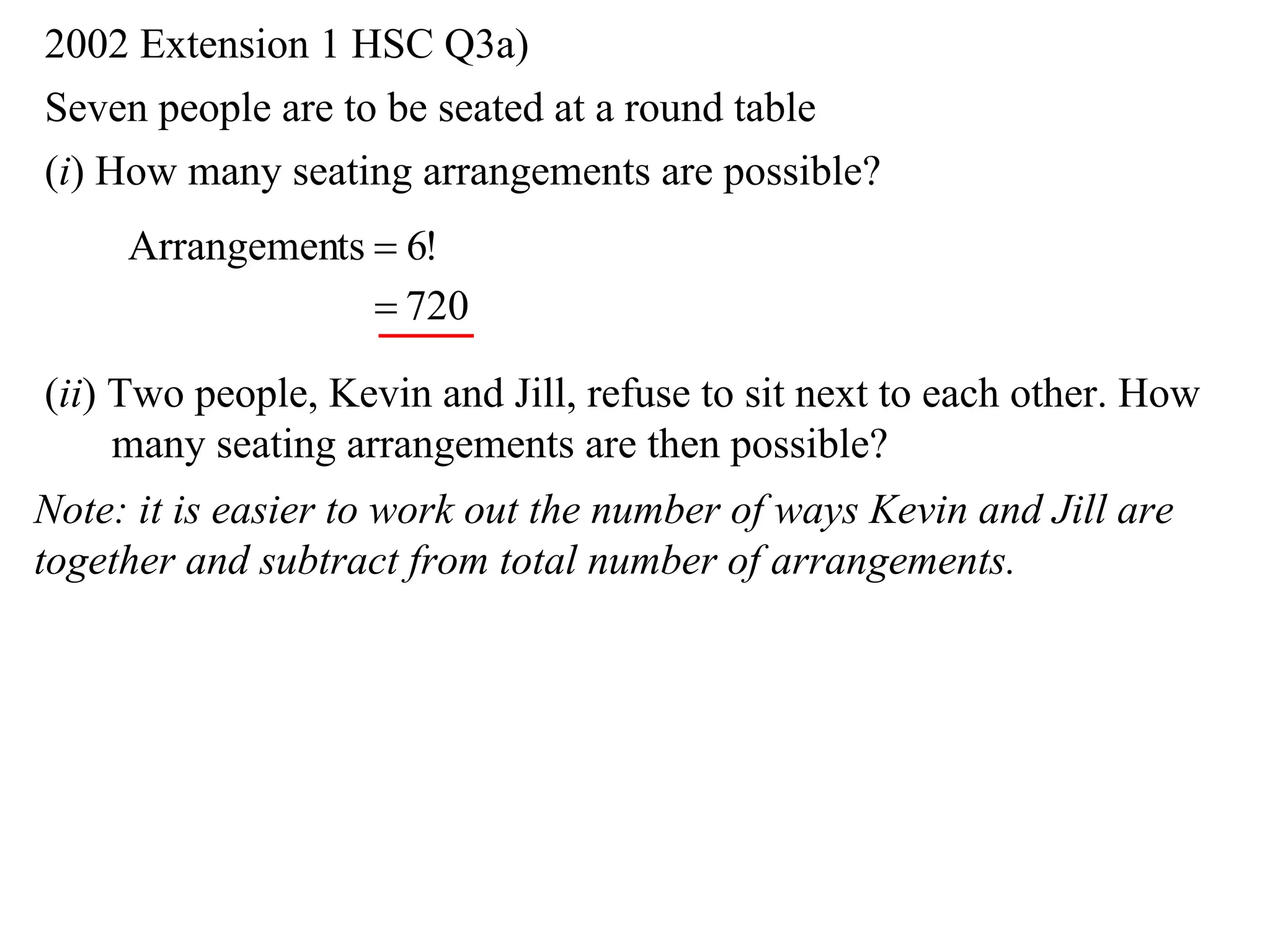
2002 Extension 1 HSC Q3a)
Seven people are to be seated at a round table
(i) How many seating arrangements are possible?
2002 Extension 1 HSC Q3a)
Seven people are to be seated at a round table
(i) How many seating arrangements are possible?
    Arrangements  6!
2002 Extension 1 HSC Q3a)
Seven people are to be seated at a round table
(i) How many seating arrangements are possible?
    Arrangements  6!
                  720
2002 Extension 1 HSC Q3a)
Seven people are to be seated at a round table
(i) How many seating arrangements are possible?
     Arrangements  6!
                   720

(ii) Two people, Kevin and Jill, refuse to sit next to each other. How
     many seating arrangements are then possible?
2002 Extension 1 HSC Q3a)
Seven people are to be seated at a round table
(i) How many seating arrangements are possible?
     Arrangements  6!
                   720

(ii) Two people, Kevin and Jill, refuse to sit next to each other. How
     many seating arrangements are then possible?
Note: it is easier to work out the number of ways Kevin and Jill are
together and subtract from total number of arrangements.
2002 Extension 1 HSC Q3a)
 Seven people are to be seated at a round table
 (i) How many seating arrangements are possible?
      Arrangements  6!
                    720

 (ii) Two people, Kevin and Jill, refuse to sit next to each other. How
      many seating arrangements are then possible?
Note: it is easier to work out the number of ways Kevin and Jill are
together and subtract from total number of arrangements.
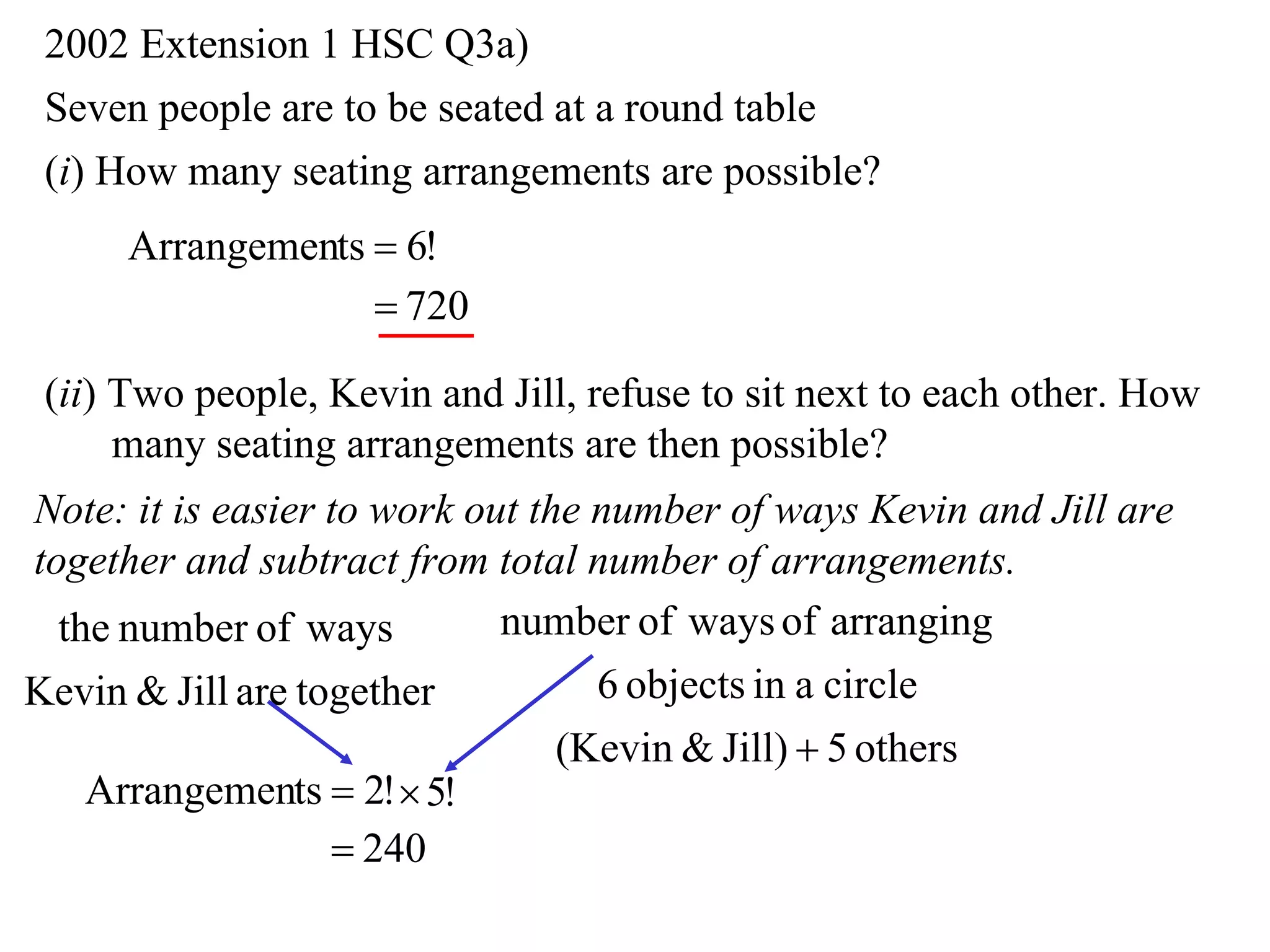
  the number of ways
Kevin & Jill are together

   Arrangements  2!
2002 Extension 1 HSC Q3a)
 Seven people are to be seated at a round table
 (i) How many seating arrangements are possible?
      Arrangements  6!
                    720

 (ii) Two people, Kevin and Jill, refuse to sit next to each other. How
      many seating arrangements are then possible?
Note: it is easier to work out the number of ways Kevin and Jill are
together and subtract from total number of arrangements.
  the number of ways         number of ways of arranging
Kevin & Jill are together          6 objects in a circle
                                 (Kevin & Jill)  5 others
    Arrangements  2!  5!
2002 Extension 1 HSC Q3a)
 Seven people are to be seated at a round table
 (i) How many seating arrangements are possible?
      Arrangements  6!
                    720

 (ii) Two people, Kevin and Jill, refuse to sit next to each other. How
      many seating arrangements are then possible?
Note: it is easier to work out the number of ways Kevin and Jill are
together and subtract from total number of arrangements.
  the number of ways         number of ways of arranging
Kevin & Jill are together          6 objects in a circle
                                 (Kevin & Jill)  5 others
    Arrangements  2!  5!
                    240
2002 Extension 1 HSC Q3a)
 Seven people are to be seated at a round table
 (i) How many seating arrangements are possible?
      Arrangements  6!
                    720

 (ii) Two people, Kevin and Jill, refuse to sit next to each other. How
      many seating arrangements are then possible?
Note: it is easier to work out the number of ways Kevin and Jill are
together and subtract from total number of arrangements.
  the number of ways         number of ways of arranging
Kevin & Jill are together          6 objects in a circle
                                 (Kevin & Jill)  5 others
    Arrangements  2!  5!
                    240           Arrangements  720  240
                                                    480
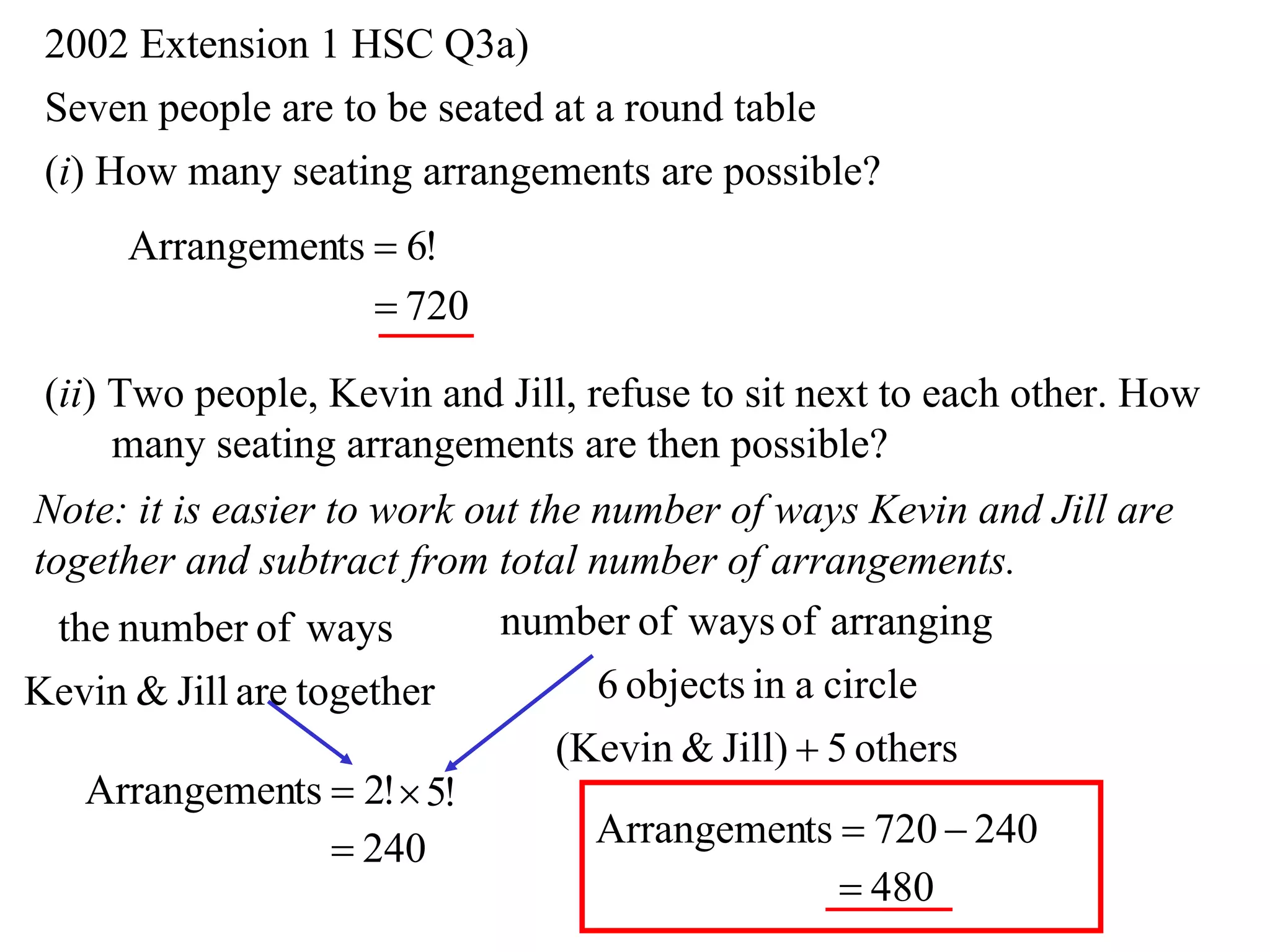
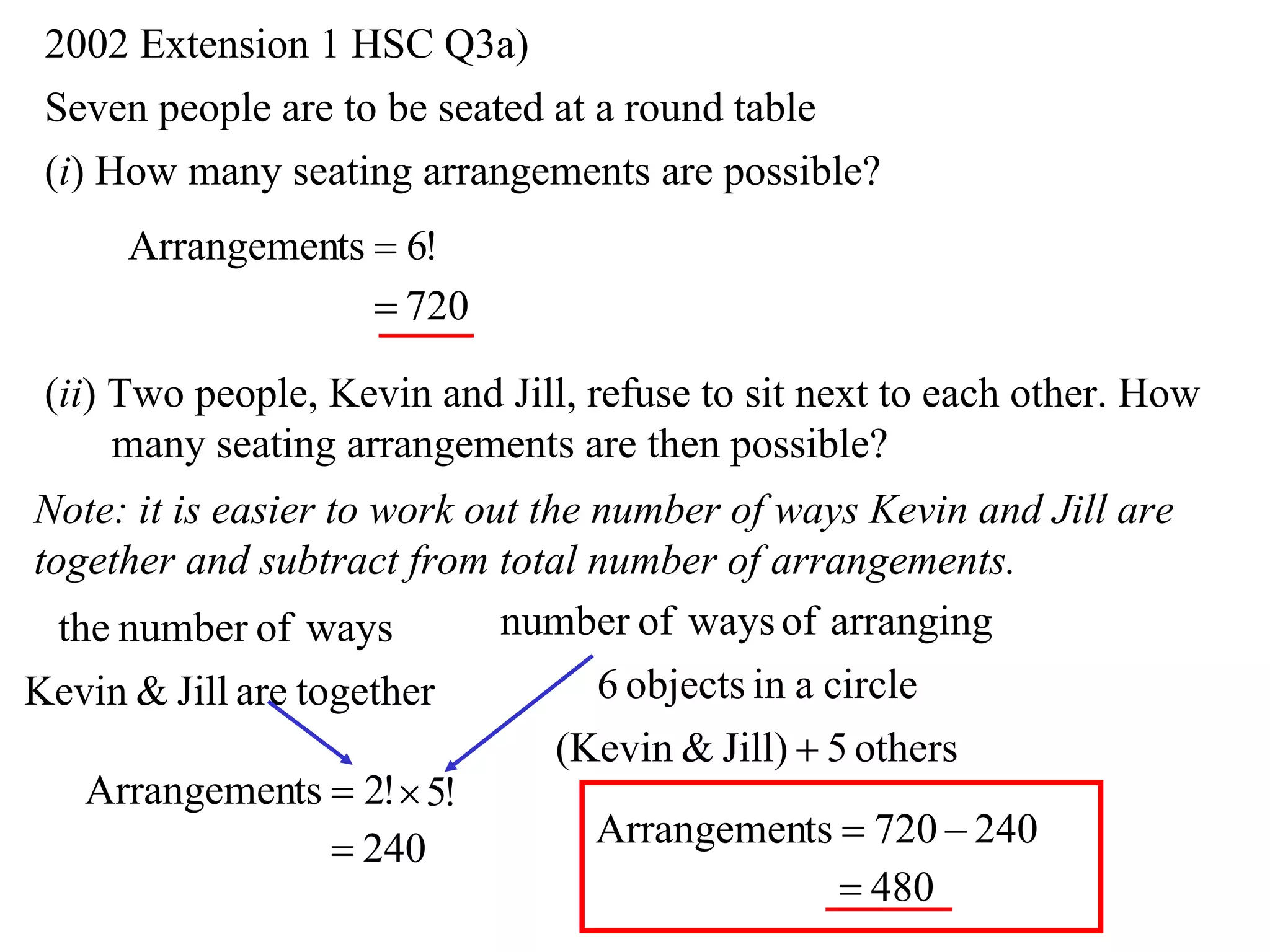
2002 Extension 1 HSC Q3a)
 Seven people are to be seated at a round table
 (i) How many seating arrangements are possible?
      Arrangements  6!
                    720

 (ii) Two people, Kevin and Jill, refuse to sit next to each other. How
      many seating arrangements are then possible?
Note: it is easier to work out the number of ways Kevin and Jill are
together and subtract from total number of arrangements.
  the number of ways         number of ways of arranging
Kevin & Jill are together          6 objects in a circle
                                 (Kevin & Jill)  5 others
    Arrangements  2!  5!
                    240           Arrangements  720  240
                                                    480
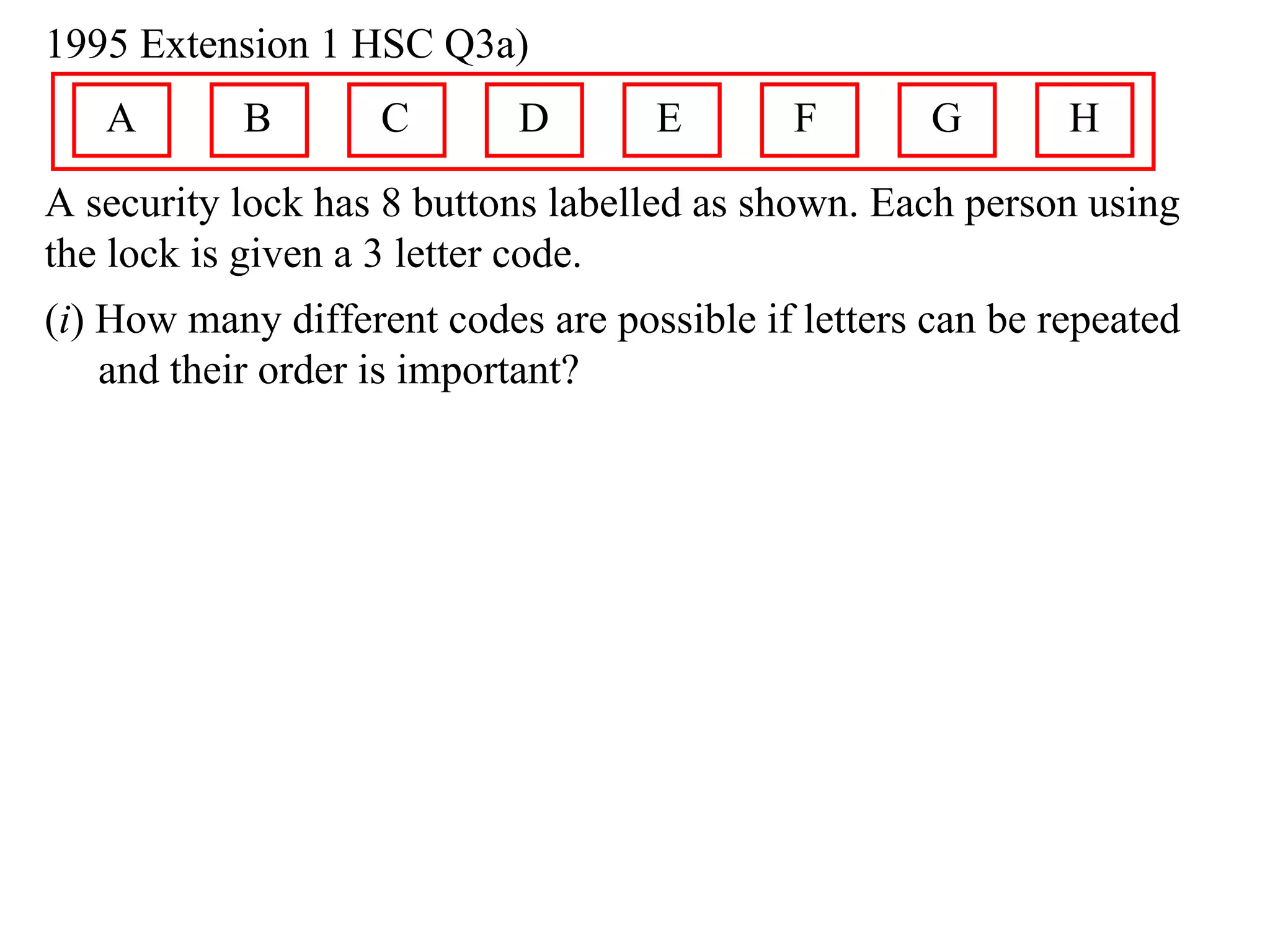
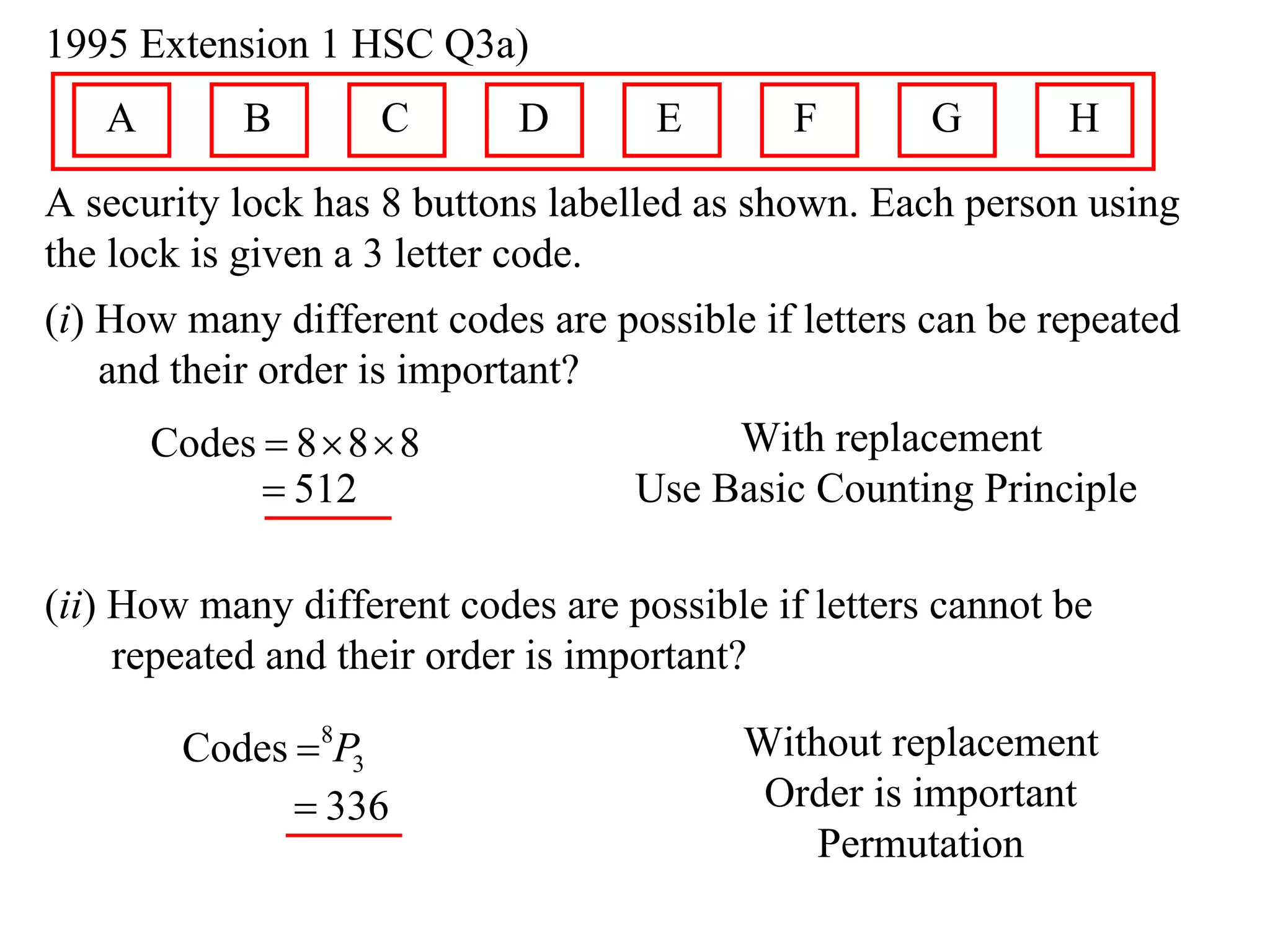
1995 Extension 1 HSC Q3a)
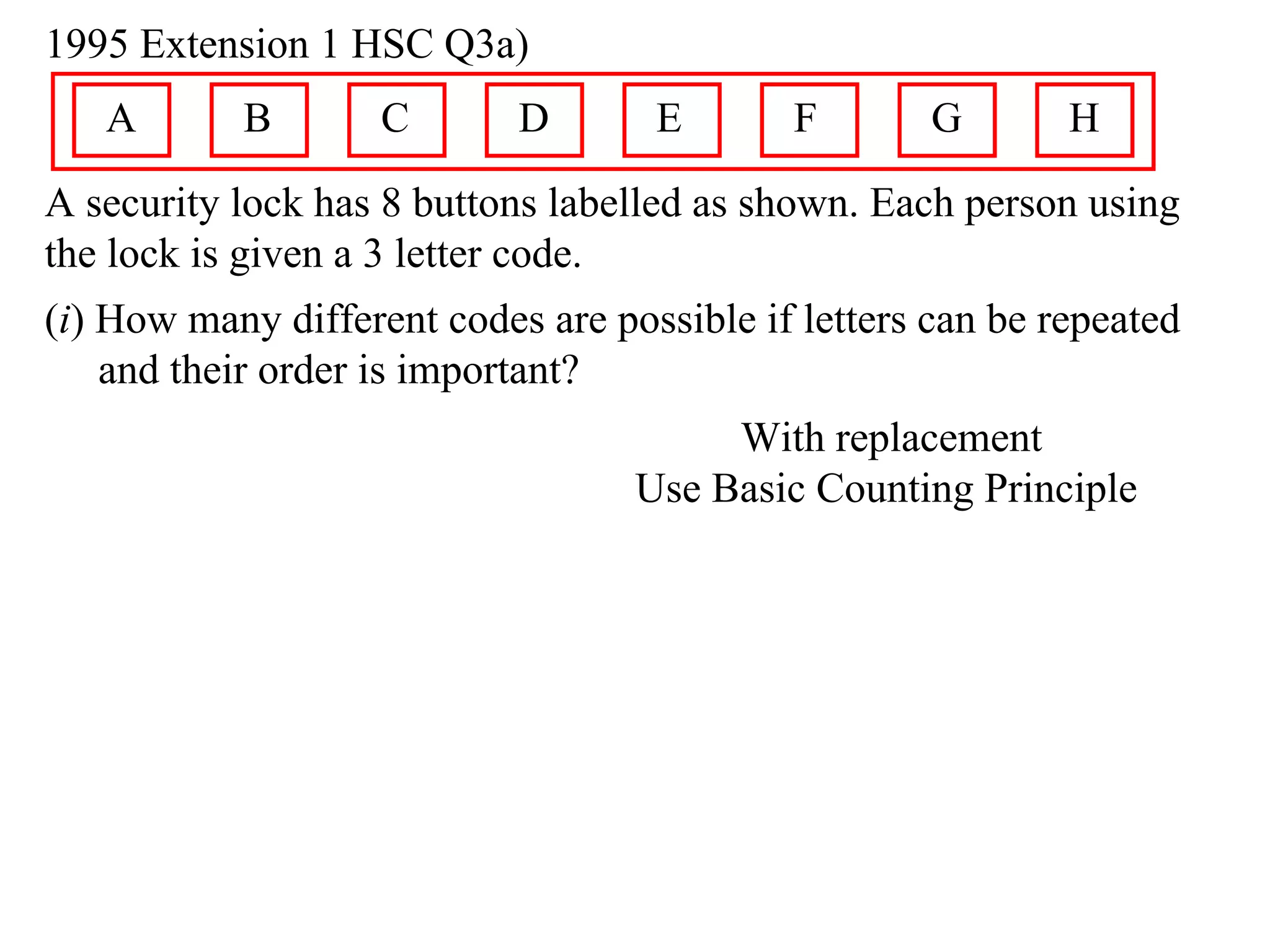
   A       B        C       D       E       F        G       H
A security lock has 8 buttons labelled as shown. Each person using
the lock is given a 3 letter code.
(i) How many different codes are possible if letters can be repeated
    and their order is important?
1995 Extension 1 HSC Q3a)
   A       B        C       D       E       F        G       H
A security lock has 8 buttons labelled as shown. Each person using
the lock is given a 3 letter code.
(i) How many different codes are possible if letters can be repeated
    and their order is important?
                                        With replacement
                                   Use Basic Counting Principle
1995 Extension 1 HSC Q3a)
   A        B        C      D       E       F        G       H
A security lock has 8 buttons labelled as shown. Each person using
the lock is given a 3 letter code.
(i) How many different codes are possible if letters can be repeated
    and their order is important?
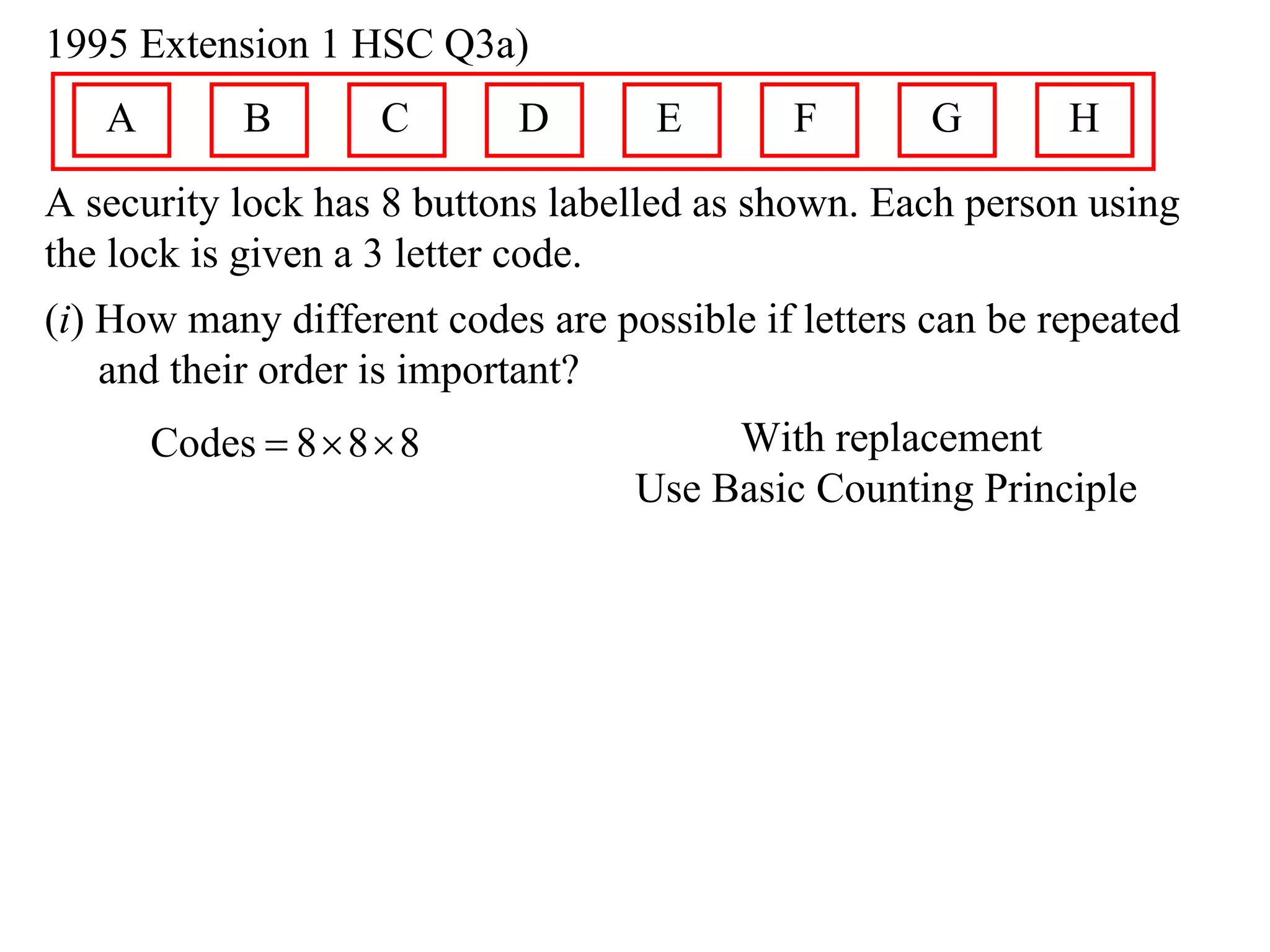
       Codes  8  8  8                With replacement
                                   Use Basic Counting Principle
1995 Extension 1 HSC Q3a)
   A        B        C      D       E       F        G       H
A security lock has 8 buttons labelled as shown. Each person using
the lock is given a 3 letter code.
(i) How many different codes are possible if letters can be repeated
    and their order is important?
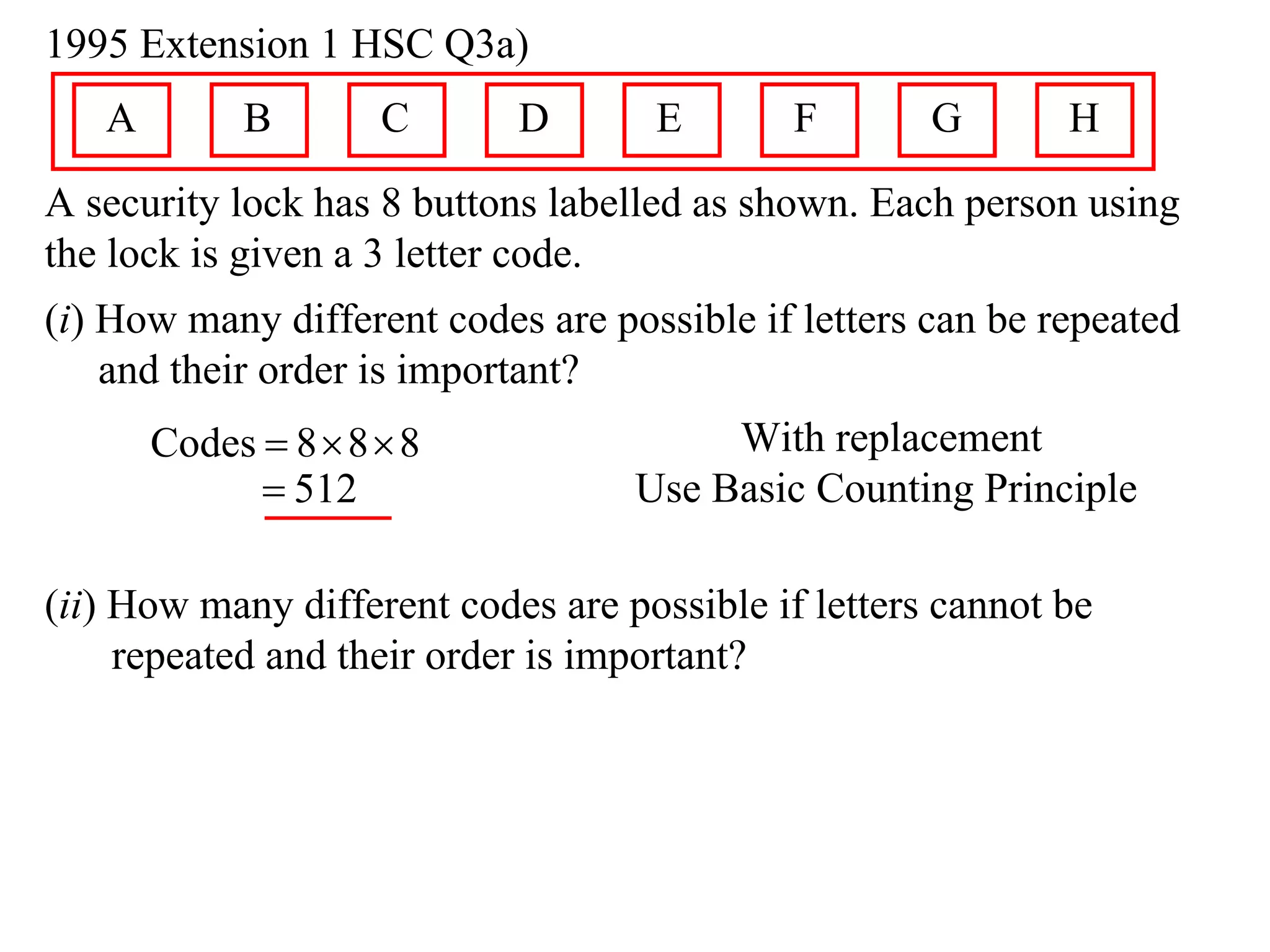
       Codes  8  8  8                With replacement
              512                 Use Basic Counting Principle
1995 Extension 1 HSC Q3a)
   A        B        C      D       E        F       G       H
A security lock has 8 buttons labelled as shown. Each person using
the lock is given a 3 letter code.
(i) How many different codes are possible if letters can be repeated
    and their order is important?
       Codes  8  8  8                With replacement
              512                 Use Basic Counting Principle

(ii) How many different codes are possible if letters cannot be
     repeated and their order is important?
1995 Extension 1 HSC Q3a)
   A        B        C      D       E        F       G       H
A security lock has 8 buttons labelled as shown. Each person using
the lock is given a 3 letter code.
(i) How many different codes are possible if letters can be repeated
    and their order is important?
       Codes  8  8  8                With replacement
              512                 Use Basic Counting Principle

(ii) How many different codes are possible if letters cannot be
     repeated and their order is important?

                                         Without replacement
                                          Order is important
                                             Permutation
1995 Extension 1 HSC Q3a)
   A        B        C      D       E        F       G       H
A security lock has 8 buttons labelled as shown. Each person using
the lock is given a 3 letter code.
(i) How many different codes are possible if letters can be repeated
    and their order is important?
       Codes  8  8  8                With replacement
              512                 Use Basic Counting Principle

(ii) How many different codes are possible if letters cannot be
     repeated and their order is important?

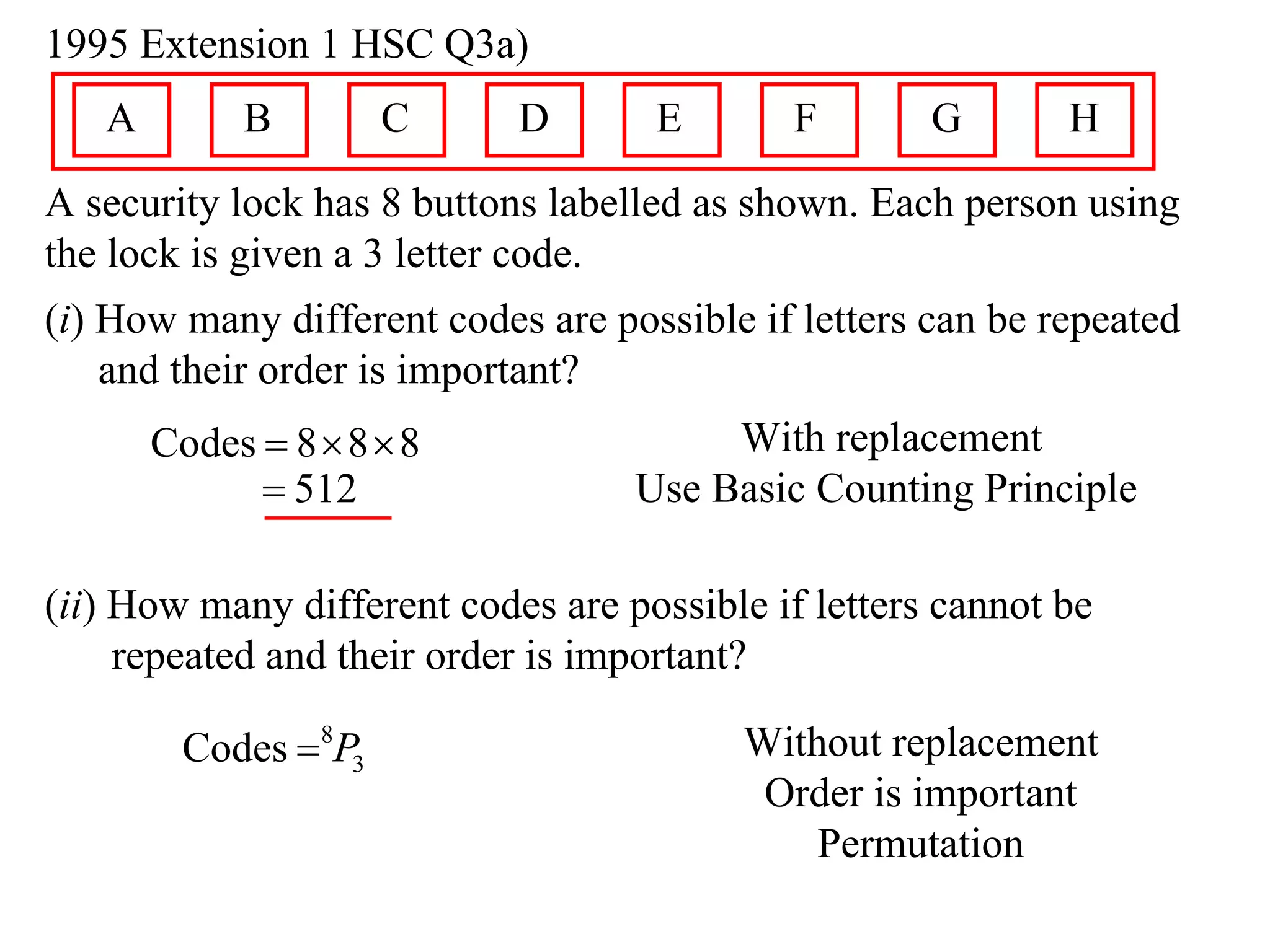
        Codes 8P3                       Without replacement
                                          Order is important
                                             Permutation
1995 Extension 1 HSC Q3a)
   A        B        C      D       E        F       G       H
A security lock has 8 buttons labelled as shown. Each person using
the lock is given a 3 letter code.
(i) How many different codes are possible if letters can be repeated
    and their order is important?
       Codes  8  8  8                With replacement
              512                 Use Basic Counting Principle

(ii) How many different codes are possible if letters cannot be
     repeated and their order is important?

        Codes 8P3                       Without replacement
               336                       Order is important
                                             Permutation
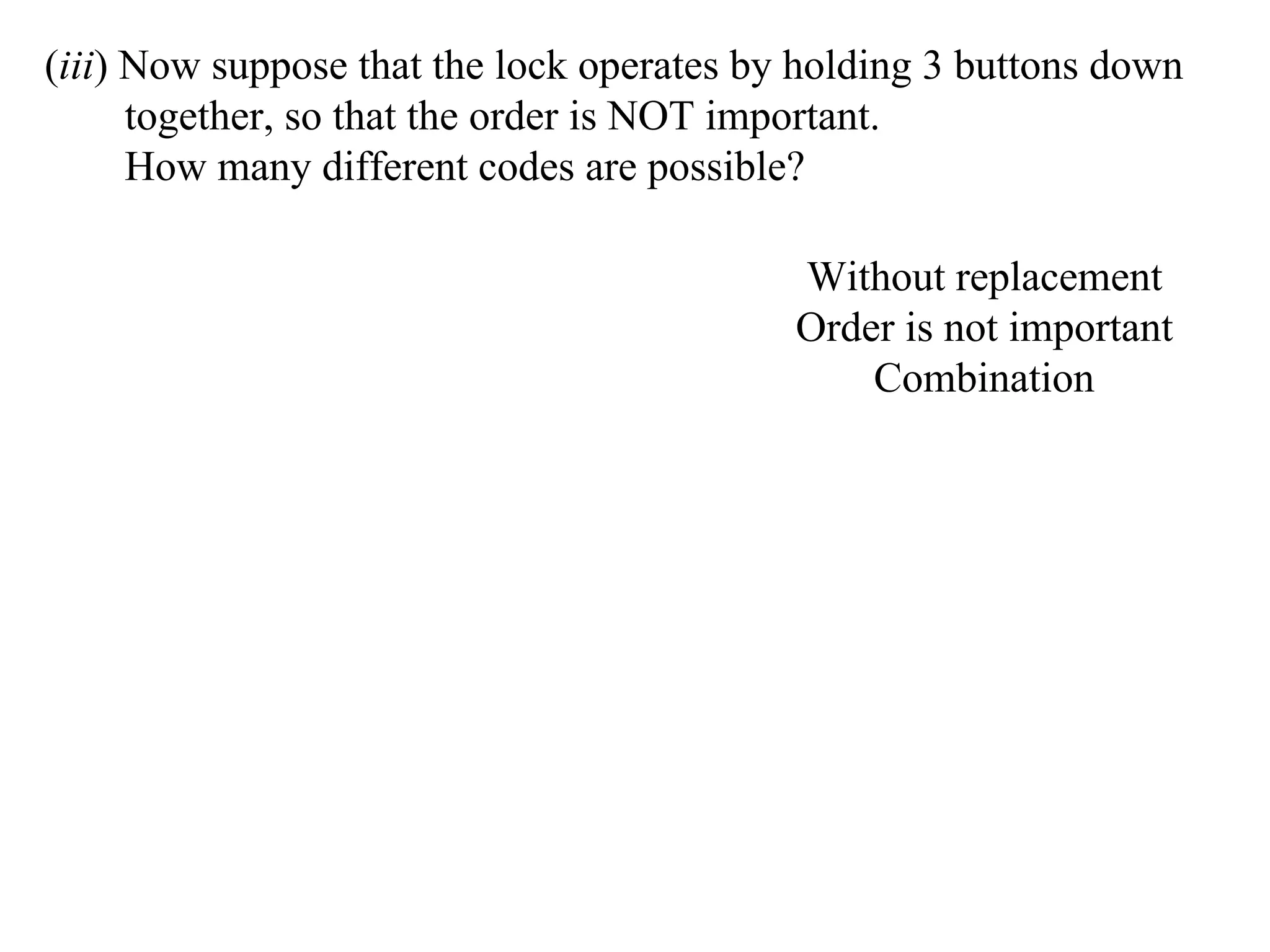
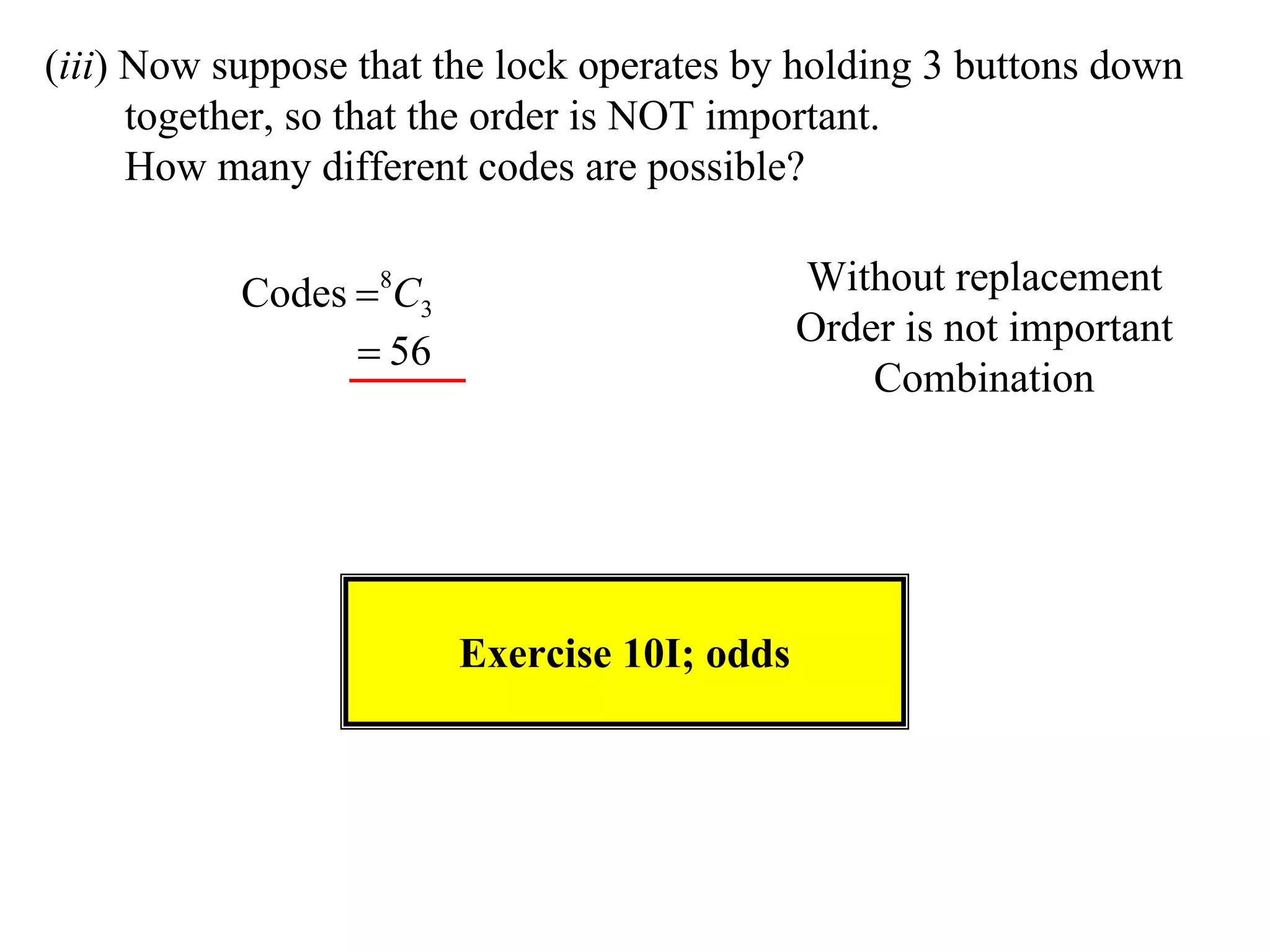
(iii) Now suppose that the lock operates by holding 3 buttons down
      together, so that the order is NOT important.
      How many different codes are possible?
(iii) Now suppose that the lock operates by holding 3 buttons down
      together, so that the order is NOT important.
      How many different codes are possible?

                                           Without replacement
                                           Order is not important
                                               Combination
(iii) Now suppose that the lock operates by holding 3 buttons down
      together, so that the order is NOT important.
      How many different codes are possible?

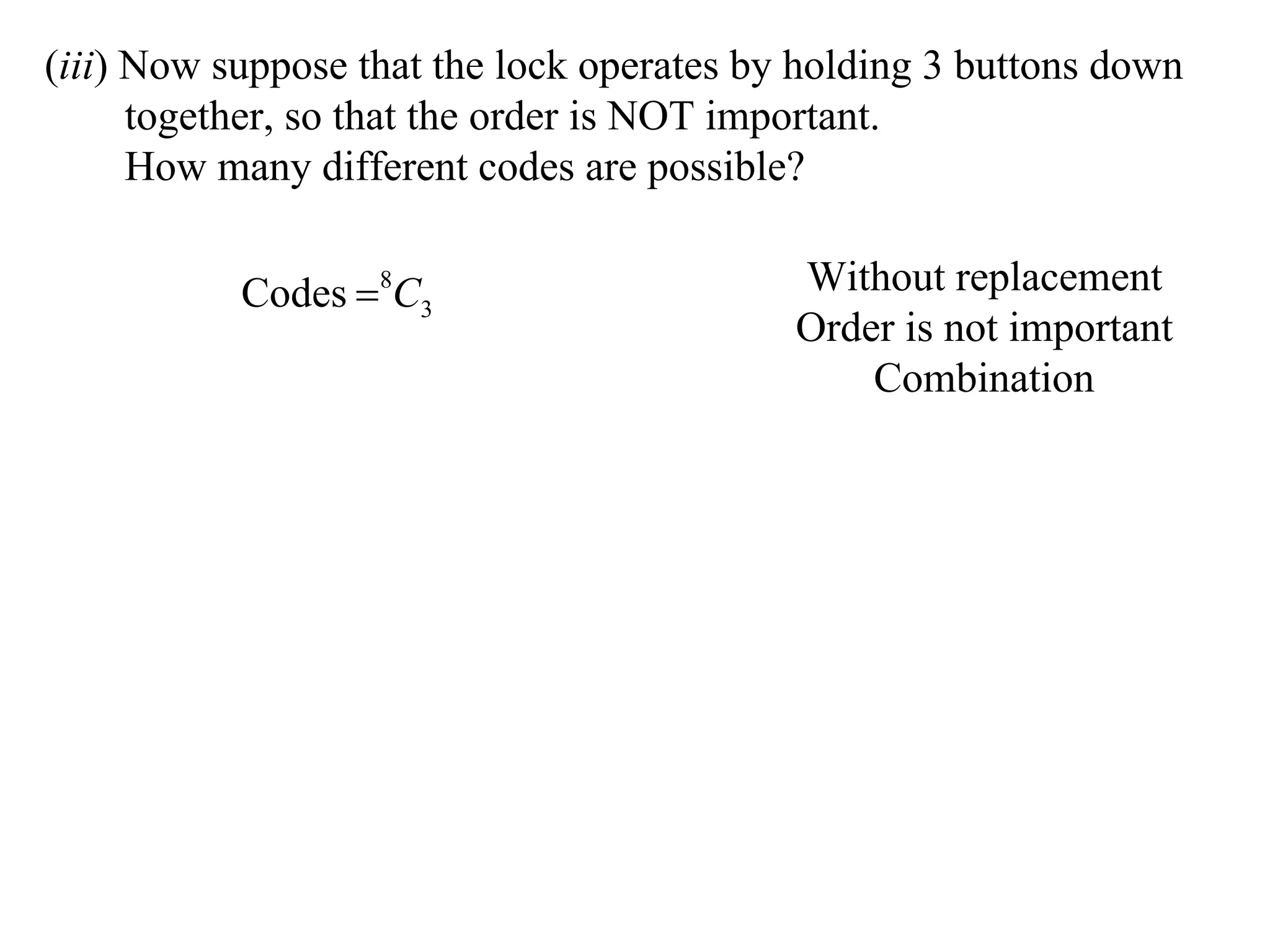
           Codes 8C3                      Without replacement
                                           Order is not important
                                               Combination
(iii) Now suppose that the lock operates by holding 3 buttons down
      together, so that the order is NOT important.
      How many different codes are possible?

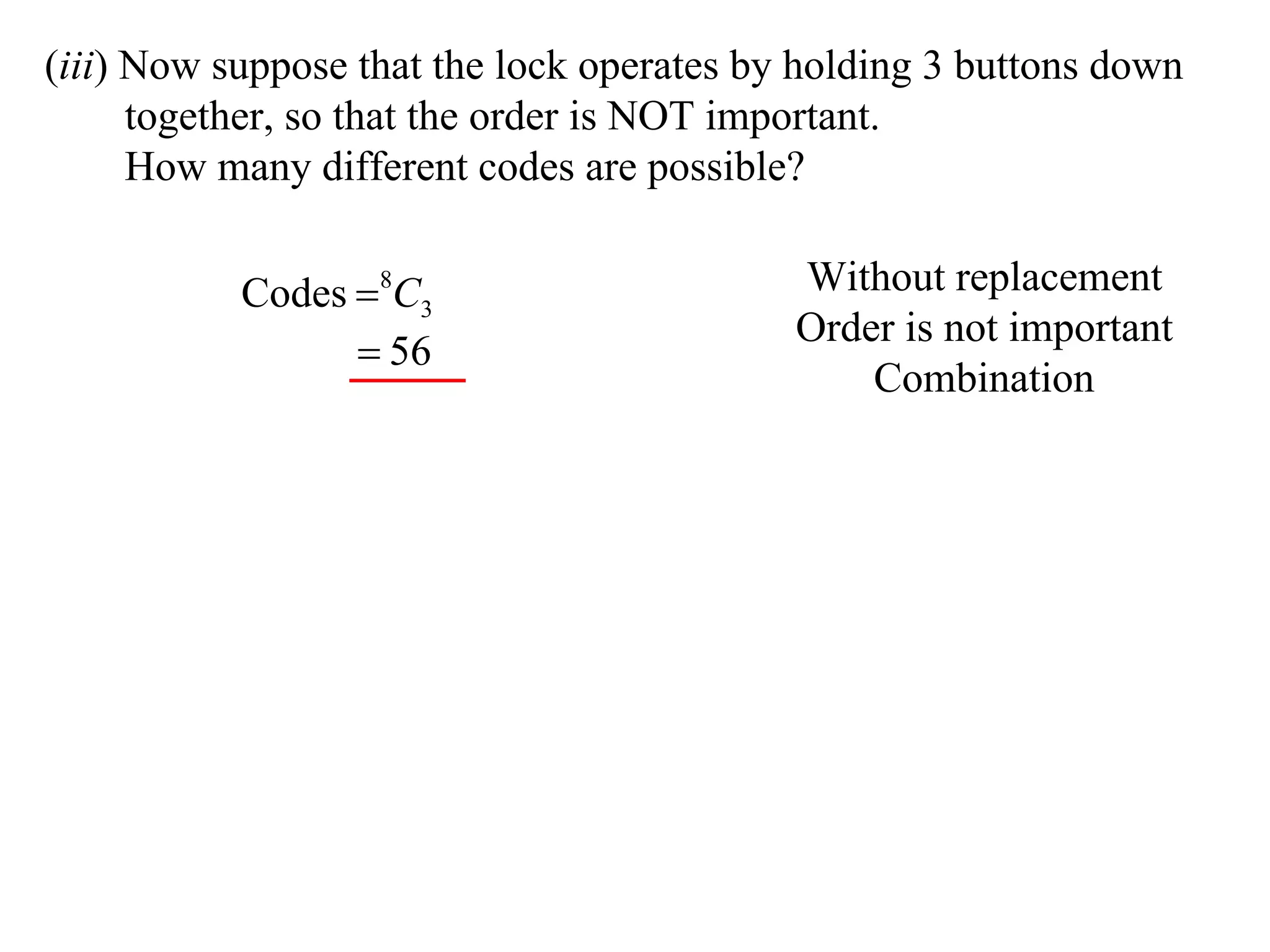
           Codes 8C3                      Without replacement
                                           Order is not important
                  56
                                               Combination
(iii) Now suppose that the lock operates by holding 3 buttons down
      together, so that the order is NOT important.
      How many different codes are possible?

           Codes 8C3                        Without replacement
                                             Order is not important
                  56
                                                 Combination


                        Exercise 10I; odds

11 x1 t05 05 arrangements in a circle (2013)

  • 1.
    Permutations Case 4: OrderedSets of n Objects, Arranged in a Circle What is the difference between placing objects in a line and placing objects in a circle?
  • 2.
    Permutations Case 4: OrderedSets of n Objects, Arranged in a Circle What is the difference between placing objects in a line and placing objects in a circle? The difference is the number of ways the first object can be placed.
  • 3.
    Permutations Case 4: OrderedSets of n Objects, Arranged in a Circle What is the difference between placing objects in a line and placing objects in a circle? The difference is the number of ways the first object can be placed. Line
  • 4.
    Permutations Case 4: OrderedSets of n Objects, Arranged in a Circle What is the difference between placing objects in a line and placing objects in a circle? The difference is the number of ways the first object can be placed. Line
  • 5.
    Permutations Case 4: OrderedSets of n Objects, Arranged in a Circle What is the difference between placing objects in a line and placing objects in a circle? The difference is the number of ways the first object can be placed. Line In a line there is a definite start and finish of the line.
  • 6.
    Permutations Case 4: OrderedSets of n Objects, Arranged in a Circle What is the difference between placing objects in a line and placing objects in a circle? The difference is the number of ways the first object can be placed. Line In a line there is a definite start and finish of the line. The first object has a choice of 6 positions
  • 7.
    Permutations Case 4: OrderedSets of n Objects, Arranged in a Circle What is the difference between placing objects in a line and placing objects in a circle? The difference is the number of ways the first object can be placed. Line In a line there is a definite start and finish of the line. The first object has a choice of 6 positions Circle
  • 8.
    Permutations Case 4: OrderedSets of n Objects, Arranged in a Circle What is the difference between placing objects in a line and placing objects in a circle? The difference is the number of ways the first object can be placed. Line In a line there is a definite start and finish of the line. The first object has a choice of 6 positions Circle
  • 9.
    Permutations Case 4: OrderedSets of n Objects, Arranged in a Circle What is the difference between placing objects in a line and placing objects in a circle? The difference is the number of ways the first object can be placed. Line In a line there is a definite start and finish of the line. The first object has a choice of 6 positions Circle In a circle there is no definite start or finish of the circle.
  • 10.
    Permutations Case 4: OrderedSets of n Objects, Arranged in a Circle What is the difference between placing objects in a line and placing objects in a circle? The difference is the number of ways the first object can be placed. Line In a line there is a definite start and finish of the line. The first object has a choice of 6 positions Circle In a circle there is no definite start or finish of the circle. It is not until the first object chooses its position that positions are defined.
  • 11.
  • 12.
    Line possibilities for object 1 Number of Arrangements  n Circle possibilities for object 1 Number of Arrangements  1
  • 13.
    Line possibilities possibilities for object 2 for object 1 Number of Arrangements  n  n  1 Circle possibilities possibilities for object 2 for object 1 Number of Arrangements  1  n  1
  • 14.
    Line possibilities possibilities for object 2 possibilities for object 1 for object 3 Number of Arrangements  n  n  1  n  2  Circle possibilities possibilities for object 2 possibilities for object 1 for object 3 Number of Arrangements  1  n  1  n  2 
  • 15.
    Line possibilities possibilities for object 2 possibilities possibilities for object 1 for object 3 for last object Number of Arrangements  n  n  1  n  2    1 Circle possibilities possibilities for object 2 possibilities possibilities for object 1 for object 3 for last object Number of Arrangements  1  n  1  n  2    1
  • 16.
    Line possibilities possibilities for object 2 possibilities possibilities for object 1 for object 3 for last object Number of Arrangements  n  n  1  n  2    1 Circle possibilities possibilities for object 2 possibilities possibilities for object 1 for object 3 for last object Number of Arrangements  1  n  1  n  2    1 n! Number of Arrangements in a circle  n
  • 17.
    Line possibilities possibilities for object 2 possibilities possibilities for object 1 for object 3 for last object Number of Arrangements  n  n  1  n  2    1 Circle possibilities possibilities for object 2 possibilities possibilities for object 1 for object 3 for last object Number of Arrangements  1  n  1  n  2    1 n! Number of Arrangements in a circle  n  n  1!
  • 18.
    e.g. A meetingroom contains a round table surrounded by ten chairs. (i) A committee of ten people includes three teenagers. How many arrangements are there in which all three sit together?
  • 19.
    e.g. A meetingroom contains a round table surrounded by ten chairs. (i) A committee of ten people includes three teenagers. How many arrangements are there in which all three sit together? the number of ways the three teenagers can be arranged Arrangements  3!
  • 20.
    e.g. A meetingroom contains a round table surrounded by ten chairs. (i) A committee of ten people includes three teenagers. How many arrangements are there in which all three sit together? the number of ways the three teenagers can be number of ways of arranging arranged 8 objects in a circle (3 teenagers)  7 others Arrangements  3!  7!
  • 21.
    e.g. A meetingroom contains a round table surrounded by ten chairs. (i) A committee of ten people includes three teenagers. How many arrangements are there in which all three sit together? the number of ways the three teenagers can be number of ways of arranging arranged 8 objects in a circle (3 teenagers)  7 others Arrangements  3!  7!  30240
  • 22.
    (ii) Elections areheld for Chairperson and Secretary. What is the probability that they are seated directly opposite each other?
  • 23.
    (ii) Elections areheld for Chairperson and Secretary. What is the probability that they are seated directly opposite each other? Ways (no restrictions)  9!
  • 24.
    (ii) Elections areheld for Chairperson and Secretary. What is the probability that they are seated directly opposite each other? Ways (no restrictions)  9! President can sit anywhere as they are 1st in the circle Ways (restrictions)  1
  • 25.
    (ii) Elections areheld for Chairperson and Secretary. What is the probability that they are seated directly opposite each other? Ways (no restrictions)  9! Secretary must President can sit opposite sit anywhere President as they are 1st in the circle Ways (restrictions)  1 1
  • 26.
    (ii) Elections areheld for Chairperson and Secretary. What is the probability that they are seated directly opposite each other? Ways (no restrictions)  9! Secretary must President can sit opposite sit anywhere President as they are 1st Ways remaining in the circle people can go Ways (restrictions)  1 1  8!
  • 27.
    (ii) Elections areheld for Chairperson and Secretary. What is the probability that they are seated directly opposite each other? Ways (no restrictions)  9! Secretary must President can sit opposite sit anywhere President as they are 1st Ways remaining in the circle people can go Ways (restrictions)  1 1  8! 11 8! PP & S opposite   9!
  • 28.
    (ii) Elections areheld for Chairperson and Secretary. What is the probability that they are seated directly opposite each other? Ways (no restrictions)  9! Secretary must President can sit opposite sit anywhere President as they are 1st Ways remaining in the circle people can go Ways (restrictions)  1 1  8! 11 8! PP & S opposite   9! 1  9
  • 29.
    (ii) Elections areheld for Chairperson and Secretary. What is the probability that they are seated directly opposite each other? Ways (no restrictions)  9! Secretary must President can sit opposite sit anywhere President as they are 1st Ways remaining in the circle people can go Note: of 9 seats only Ways (restrictions)  1 1  8! 1 is opposite the President 11 8!  Popposite   1 PP & S opposite   9! 9 1 Sometimes simple  logic is quicker!!!! 9
  • 30.
    2002 Extension 1HSC Q3a) Seven people are to be seated at a round table (i) How many seating arrangements are possible?
  • 31.
    2002 Extension 1HSC Q3a) Seven people are to be seated at a round table (i) How many seating arrangements are possible? Arrangements  6!
  • 32.
    2002 Extension 1HSC Q3a) Seven people are to be seated at a round table (i) How many seating arrangements are possible? Arrangements  6!  720
  • 33.
    2002 Extension 1HSC Q3a) Seven people are to be seated at a round table (i) How many seating arrangements are possible? Arrangements  6!  720 (ii) Two people, Kevin and Jill, refuse to sit next to each other. How many seating arrangements are then possible?
  • 34.
    2002 Extension 1HSC Q3a) Seven people are to be seated at a round table (i) How many seating arrangements are possible? Arrangements  6!  720 (ii) Two people, Kevin and Jill, refuse to sit next to each other. How many seating arrangements are then possible? Note: it is easier to work out the number of ways Kevin and Jill are together and subtract from total number of arrangements.
  • 35.
    2002 Extension 1HSC Q3a) Seven people are to be seated at a round table (i) How many seating arrangements are possible? Arrangements  6!  720 (ii) Two people, Kevin and Jill, refuse to sit next to each other. How many seating arrangements are then possible? Note: it is easier to work out the number of ways Kevin and Jill are together and subtract from total number of arrangements. the number of ways Kevin & Jill are together Arrangements  2!
  • 36.
    2002 Extension 1HSC Q3a) Seven people are to be seated at a round table (i) How many seating arrangements are possible? Arrangements  6!  720 (ii) Two people, Kevin and Jill, refuse to sit next to each other. How many seating arrangements are then possible? Note: it is easier to work out the number of ways Kevin and Jill are together and subtract from total number of arrangements. the number of ways number of ways of arranging Kevin & Jill are together 6 objects in a circle (Kevin & Jill)  5 others Arrangements  2!  5!
  • 37.
    2002 Extension 1HSC Q3a) Seven people are to be seated at a round table (i) How many seating arrangements are possible? Arrangements  6!  720 (ii) Two people, Kevin and Jill, refuse to sit next to each other. How many seating arrangements are then possible? Note: it is easier to work out the number of ways Kevin and Jill are together and subtract from total number of arrangements. the number of ways number of ways of arranging Kevin & Jill are together 6 objects in a circle (Kevin & Jill)  5 others Arrangements  2!  5!  240
  • 38.
    2002 Extension 1HSC Q3a) Seven people are to be seated at a round table (i) How many seating arrangements are possible? Arrangements  6!  720 (ii) Two people, Kevin and Jill, refuse to sit next to each other. How many seating arrangements are then possible? Note: it is easier to work out the number of ways Kevin and Jill are together and subtract from total number of arrangements. the number of ways number of ways of arranging Kevin & Jill are together 6 objects in a circle (Kevin & Jill)  5 others Arrangements  2!  5!  240 Arrangements  720  240  480
  • 39.
    2002 Extension 1HSC Q3a) Seven people are to be seated at a round table (i) How many seating arrangements are possible? Arrangements  6!  720 (ii) Two people, Kevin and Jill, refuse to sit next to each other. How many seating arrangements are then possible? Note: it is easier to work out the number of ways Kevin and Jill are together and subtract from total number of arrangements. the number of ways number of ways of arranging Kevin & Jill are together 6 objects in a circle (Kevin & Jill)  5 others Arrangements  2!  5!  240 Arrangements  720  240  480
  • 41.
    1995 Extension 1HSC Q3a) A B C D E F G H A security lock has 8 buttons labelled as shown. Each person using the lock is given a 3 letter code. (i) How many different codes are possible if letters can be repeated and their order is important?
  • 42.
    1995 Extension 1HSC Q3a) A B C D E F G H A security lock has 8 buttons labelled as shown. Each person using the lock is given a 3 letter code. (i) How many different codes are possible if letters can be repeated and their order is important? With replacement Use Basic Counting Principle
  • 43.
    1995 Extension 1HSC Q3a) A B C D E F G H A security lock has 8 buttons labelled as shown. Each person using the lock is given a 3 letter code. (i) How many different codes are possible if letters can be repeated and their order is important? Codes  8  8  8 With replacement Use Basic Counting Principle
  • 44.
    1995 Extension 1HSC Q3a) A B C D E F G H A security lock has 8 buttons labelled as shown. Each person using the lock is given a 3 letter code. (i) How many different codes are possible if letters can be repeated and their order is important? Codes  8  8  8 With replacement  512 Use Basic Counting Principle
  • 45.
    1995 Extension 1HSC Q3a) A B C D E F G H A security lock has 8 buttons labelled as shown. Each person using the lock is given a 3 letter code. (i) How many different codes are possible if letters can be repeated and their order is important? Codes  8  8  8 With replacement  512 Use Basic Counting Principle (ii) How many different codes are possible if letters cannot be repeated and their order is important?
  • 46.
    1995 Extension 1HSC Q3a) A B C D E F G H A security lock has 8 buttons labelled as shown. Each person using the lock is given a 3 letter code. (i) How many different codes are possible if letters can be repeated and their order is important? Codes  8  8  8 With replacement  512 Use Basic Counting Principle (ii) How many different codes are possible if letters cannot be repeated and their order is important? Without replacement Order is important Permutation
  • 47.
    1995 Extension 1HSC Q3a) A B C D E F G H A security lock has 8 buttons labelled as shown. Each person using the lock is given a 3 letter code. (i) How many different codes are possible if letters can be repeated and their order is important? Codes  8  8  8 With replacement  512 Use Basic Counting Principle (ii) How many different codes are possible if letters cannot be repeated and their order is important? Codes 8P3 Without replacement Order is important Permutation
  • 48.
    1995 Extension 1HSC Q3a) A B C D E F G H A security lock has 8 buttons labelled as shown. Each person using the lock is given a 3 letter code. (i) How many different codes are possible if letters can be repeated and their order is important? Codes  8  8  8 With replacement  512 Use Basic Counting Principle (ii) How many different codes are possible if letters cannot be repeated and their order is important? Codes 8P3 Without replacement  336 Order is important Permutation
  • 49.
    (iii) Now supposethat the lock operates by holding 3 buttons down together, so that the order is NOT important. How many different codes are possible?
  • 50.
    (iii) Now supposethat the lock operates by holding 3 buttons down together, so that the order is NOT important. How many different codes are possible? Without replacement Order is not important Combination
  • 51.
    (iii) Now supposethat the lock operates by holding 3 buttons down together, so that the order is NOT important. How many different codes are possible? Codes 8C3 Without replacement Order is not important Combination
  • 52.
    (iii) Now supposethat the lock operates by holding 3 buttons down together, so that the order is NOT important. How many different codes are possible? Codes 8C3 Without replacement Order is not important  56 Combination
  • 53.
    (iii) Now supposethat the lock operates by holding 3 buttons down together, so that the order is NOT important. How many different codes are possible? Codes 8C3 Without replacement Order is not important  56 Combination Exercise 10I; odds