1
Pluto Orbiter Mission
Direct Fusion Drive
Stephanie Thomas, PSS
Michael Paluszek, PSS
Dr. Samuel Cohen, PPPL
2015
2
Pluto Orbital Mission
10/7/13
!  Enter Pluto orbit 4 years after Earth departure
!  Carry a lander
-  Deliver power to the lander from the orbiter
!  While at Pluto change orbits to cover the entire
planet
!  High power available onboard allows advanced
science and communications
-  Provide high bandwidth laser communications back to
Earth
!  Advance space propulsion and space and
terrestrial power
8/4/15
DFD Reactor Design
KEi
Nozzle
4
PFRC Experiments at PPPL
8/4/15
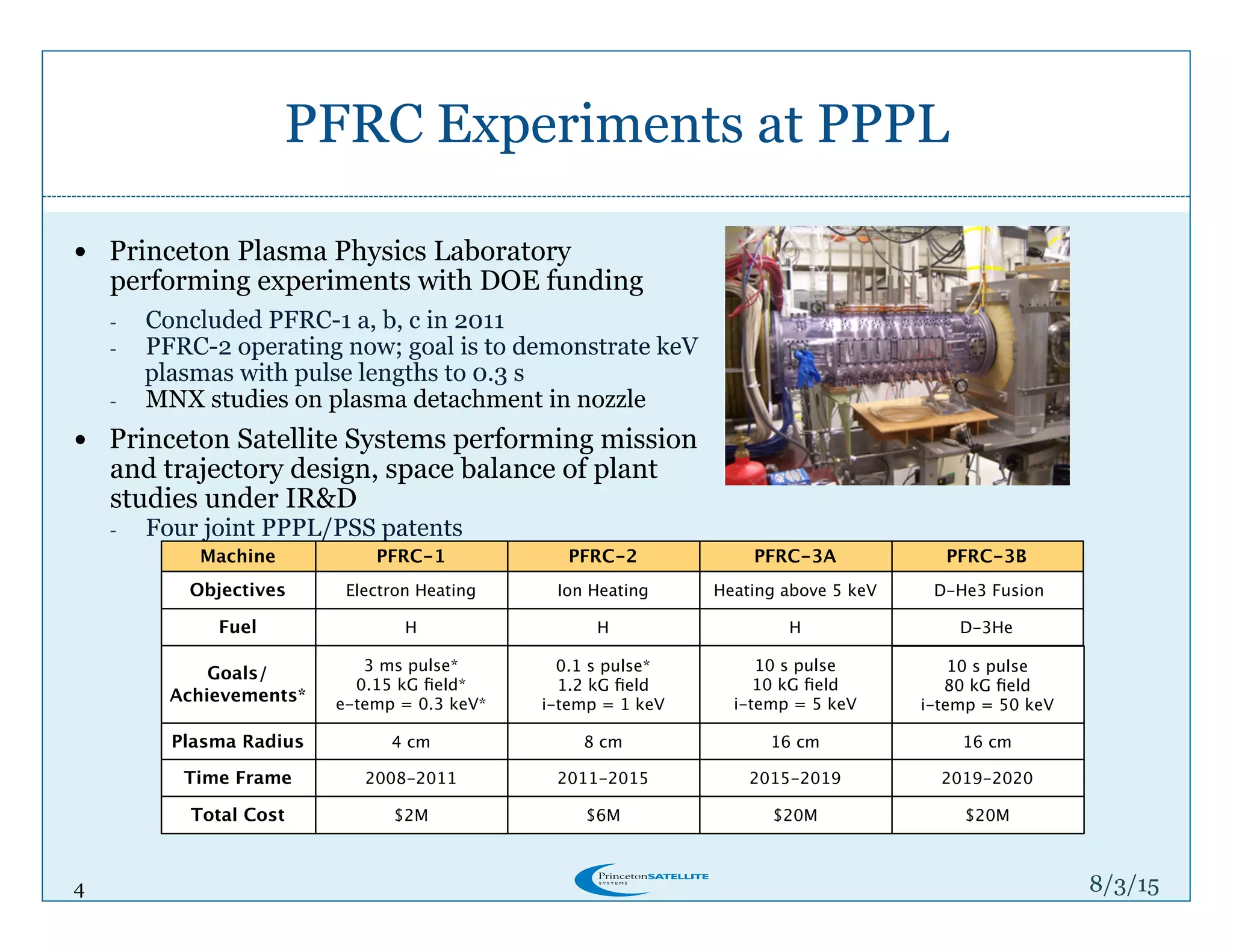
!  Princeton Plasma Physics Laboratory
performing experiments with DOE funding
-  Concluded PFRC-1 a, b, c in 2011
-  PFRC-2 operating now; goal is to demonstrate keV
plasmas with pulse lengths to 0.3 s
-  MNX studies on plasma detachment in nozzle
!  Princeton Satellite Systems performing mission
and trajectory design, space balance of plant
studies under IR&D
-  Four joint PPPL/PSS patents
3 ms pulse*
0.15 kG field*
e-temp = 0.3 keV*
Machine
Objectives
Goals/
Achievements*
Plasma Radius
PFRC-1 PFRC-2 PFRC-3B
Electron Heating Ion Heating D-He3 Fusion
4 cm
0.1 s pulse*
1.2 kG field
i-temp = 1 keV
10 s pulse
80 kG field
i-temp = 50 keV
8 cm 16 cm
Time Frame 2008-2011 2011-2015 2019-2020
Total Cost $2M $6M $20M
PFRC-3A
Heating above 5 keV
10 s pulse
10 kG field
i-temp = 5 keV
16 cm
2015-2019
$20M
Fuel H H D-3HeH
5
DFD Components
8/4/15
Heat Engine
Shielding
Radiator
Plasma
RF
Generator
SynchBremss
n
Spacecraft
Power Bus
Radiator
HTS Coil Blanket
Coil
Refrigerator
SpaceRF
GeneratorHelium Coolant
Magnetic Nozzle
Auxiliary
Power UnitD
3He
O
2
Electrolysis
D
2
O
Power Recycling
Restart
Gas
Box
3He
Injector
D
Injector
6
Thrust Augmentation
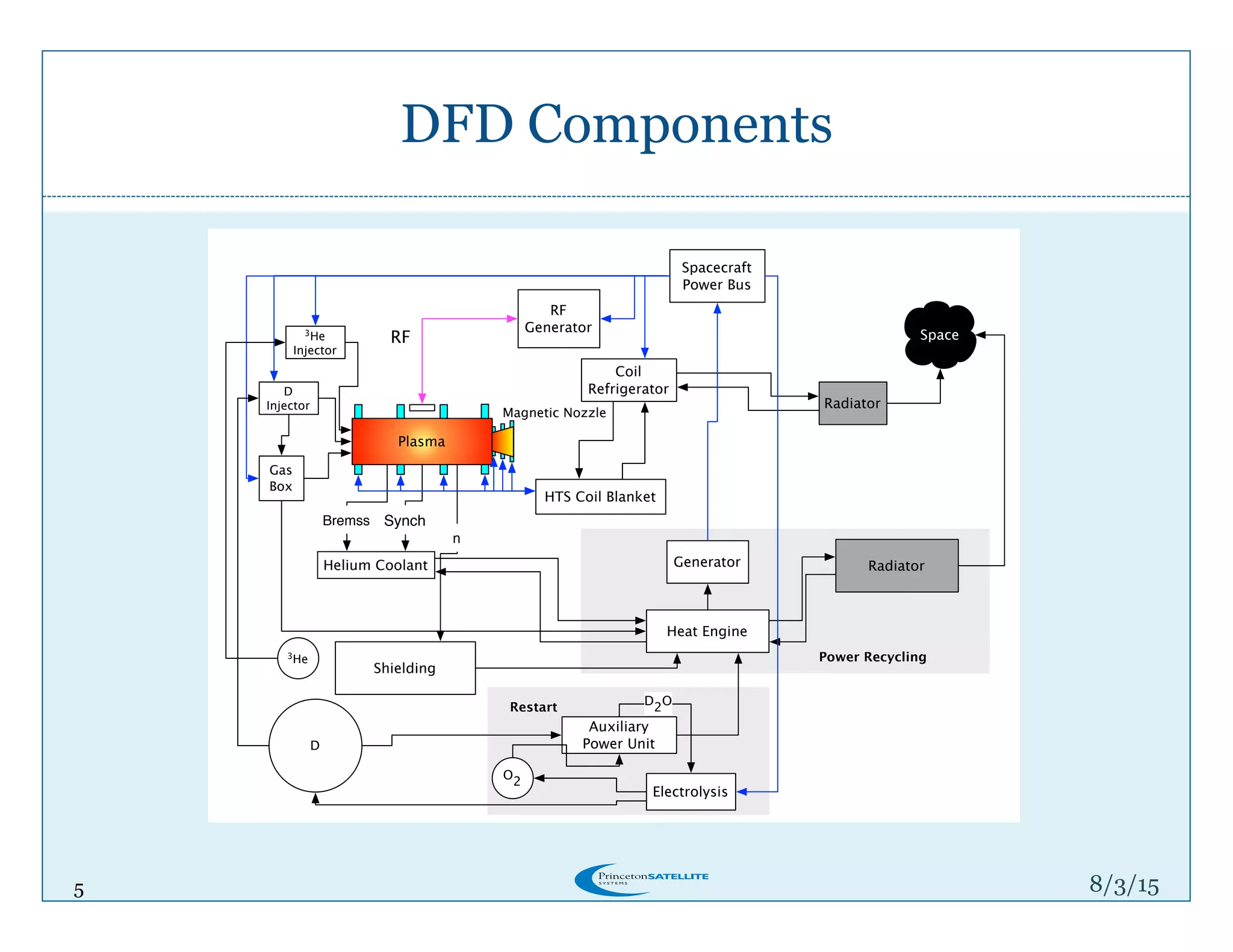
•  H or D is used as a propellant- it flows along the magnetic field lines outside of the separatrix;
scrape-off layer (SOL) e- are heated by the fusion products that are ejected into the SOL;
e- energy transferred to ions in plume expansion
•  This reduces the exhaust velocity of the fusion products from 25,000 km/s to ~50 km/s and
increases thrust to >20 N
•  Thrust/Isp is adjustable based on rate that gas is injected into the gas box
•  The exhaust plume is directed by a magnetic nozzle, consisting of a throat coil and nozzle coils to
accelerate the flow.
7
Princeton Field Reversed Configuration (PFRC)
8/4/15
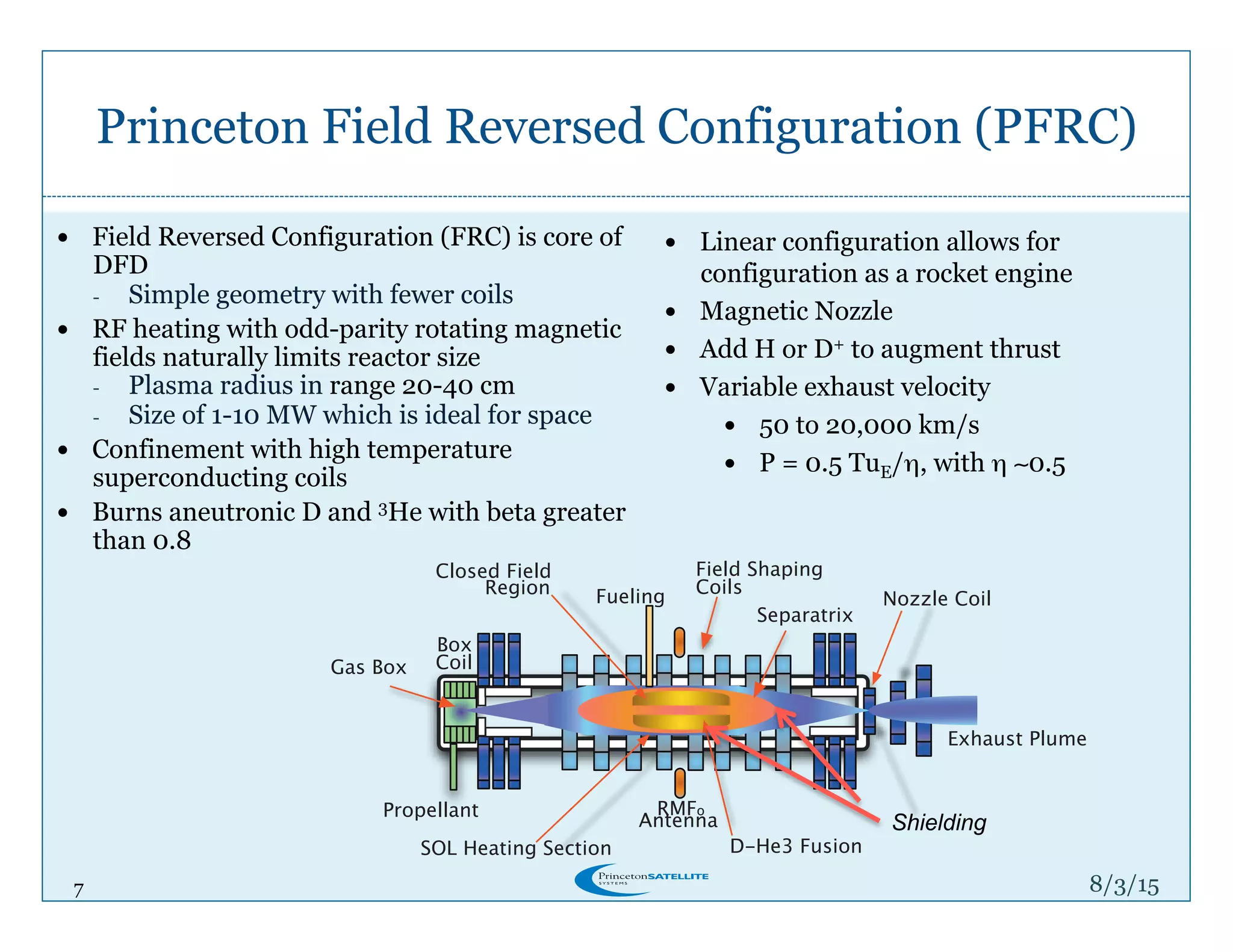
!  Field Reversed Configuration (FRC) is core of
DFD
-  Simple geometry with fewer coils
!  RF heating with odd-parity rotating magnetic
fields naturally limits reactor size
-  Plasma radius in range 20-40 cm
-  Size of 1-10 MW which is ideal for space
!  Confinement with high temperature
superconducting coils
!  Burns aneutronic D and 3He with beta greater
than 0.8
!  Linear configuration allows for
configuration as a rocket engine
!  Magnetic Nozzle
!  Add H or D+ to augment thrust
!  Variable exhaust velocity
!  50 to 20,000 km/s
!  P = 0.5 TuE/η, with η ∼0.5
Gas Box
Exhaust Plume
SOL Heating Section
Field Shaping
Box
Separatrix
Closed Field
Nozzle Coil
Propellant
D-He3 Fusion
Coils
Coil
Fueling
RMFo
Antenna
Region
Shielding
8
Steerable Magnetic Nozzle
8/4/15
!  Plume needs to be steered for momentum
management
-  1-2 degrees of deflection needed
!  Seek magnetic methods as alternative to mechanical
gimbals for entire engine
-  Expensive and heavy
!  Steering coils downstream of nozzle throat, or
perhaps a tiltable plate to direct the flow
9
Heat Engine
8/4/15
!  Brayton cycle shown
-  Ericsson cycle would have multi-stage
compressors and turbines
!  Helium working fluid
!  Mass is sum of heat engine
components and radiators
-  Brayton efficiency of 63% possible
-  Ericsson 74%
!  Generator
-  28 V DC Generators used on aircraft
"  Should be the same voltage as
required by the RF generator
8/4/15
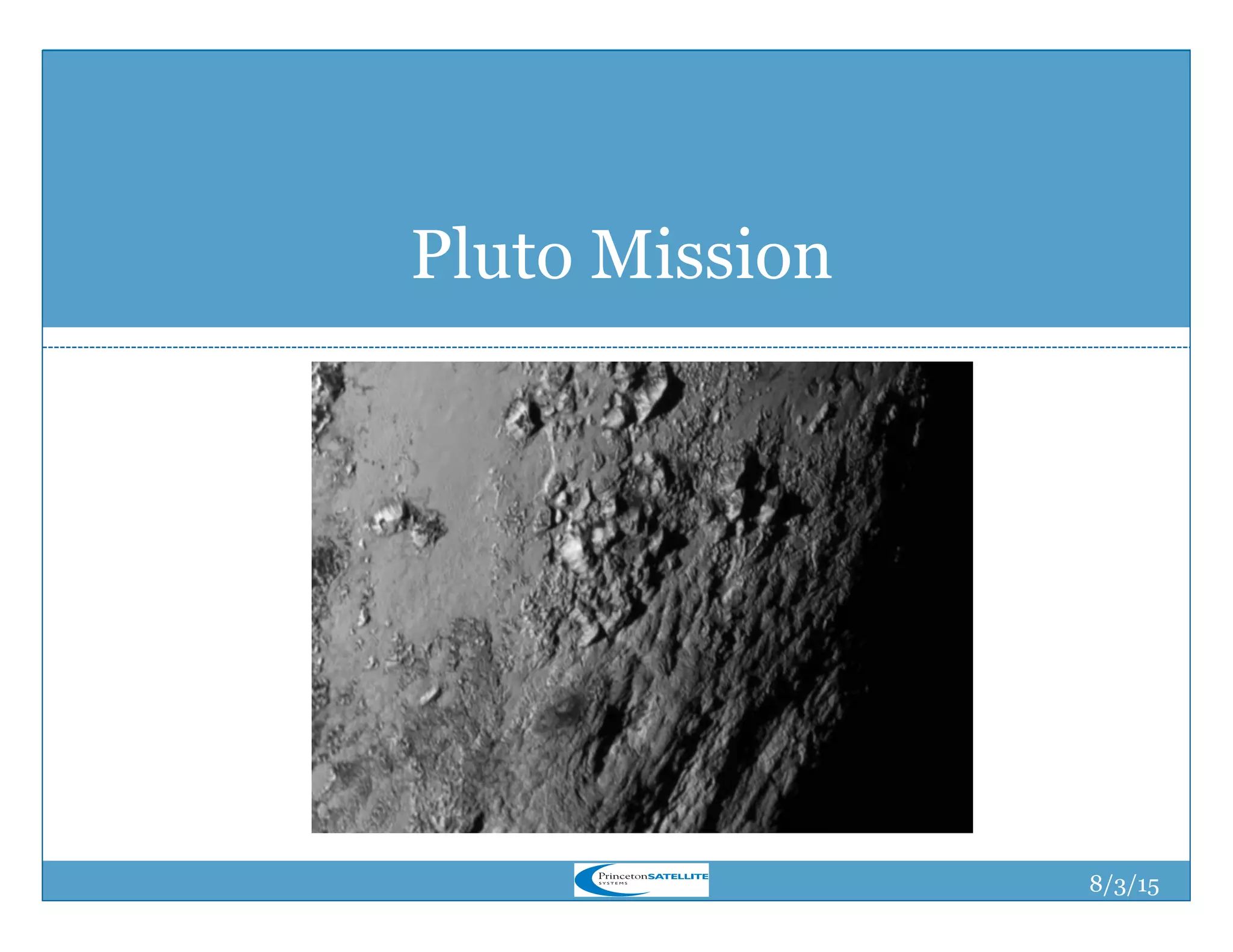
Pluto Mission
11
Mission Plan
8/4/15
!  Direct insertion into interplanetary orbit by a Delta IV Heavy
or other launch vehicle
!  20 N thrust to change the velocity by 55 km/s
!  Coast
!  20 N thrust to decelerate to intercept Pluto
!  Spiral into polar Pluto orbit
!  Map surface with altimeter
!  Lander detaches and lands on surface
-  Powered by laser from the orbiter
-  Navigation uses maps generated during mapping phase
!  Orbiter changes orbit as needed to survey the entire planet
!  Possibly departs Pluto for the Kuiper belt
12
Spacecraft
8/4/15
!  Fits within Delta IV
Heavy fairing
!  Within the mass
allowance for the Delta
IV
!  Dual radiators
!  Dual JPL Deep-Space
Optical Communication
System (DSOC) units
!  Lander mounted on the
front
13
Trajectory to Pluto
8/4/15
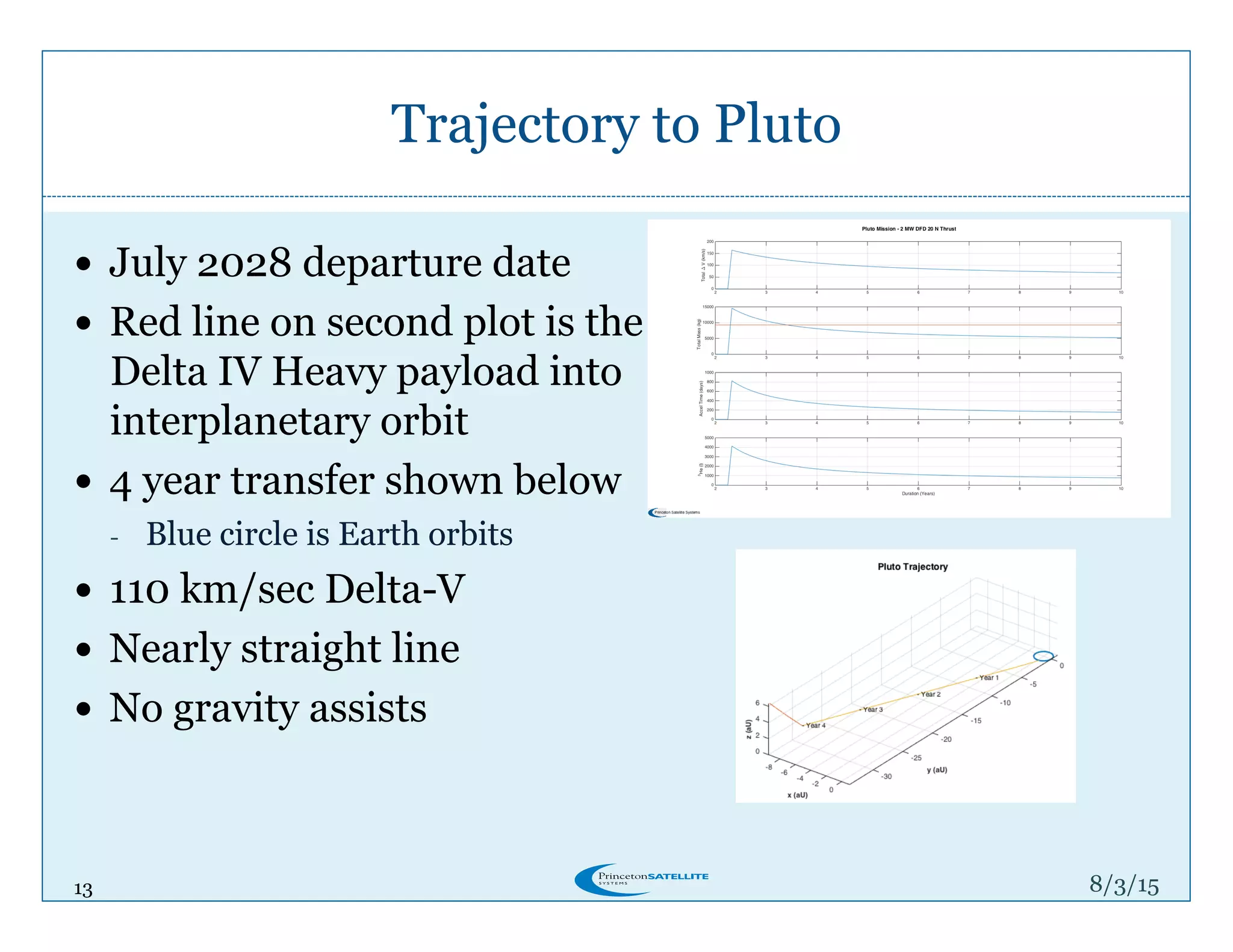
!  July 2028 departure date
!  Red line on second plot is the
Delta IV Heavy payload into
interplanetary orbit
!  4 year transfer shown below
-  Blue circle is Earth orbits
!  110 km/sec Delta-V
!  Nearly straight line
!  No gravity assists
14
GN&C
8/4/15
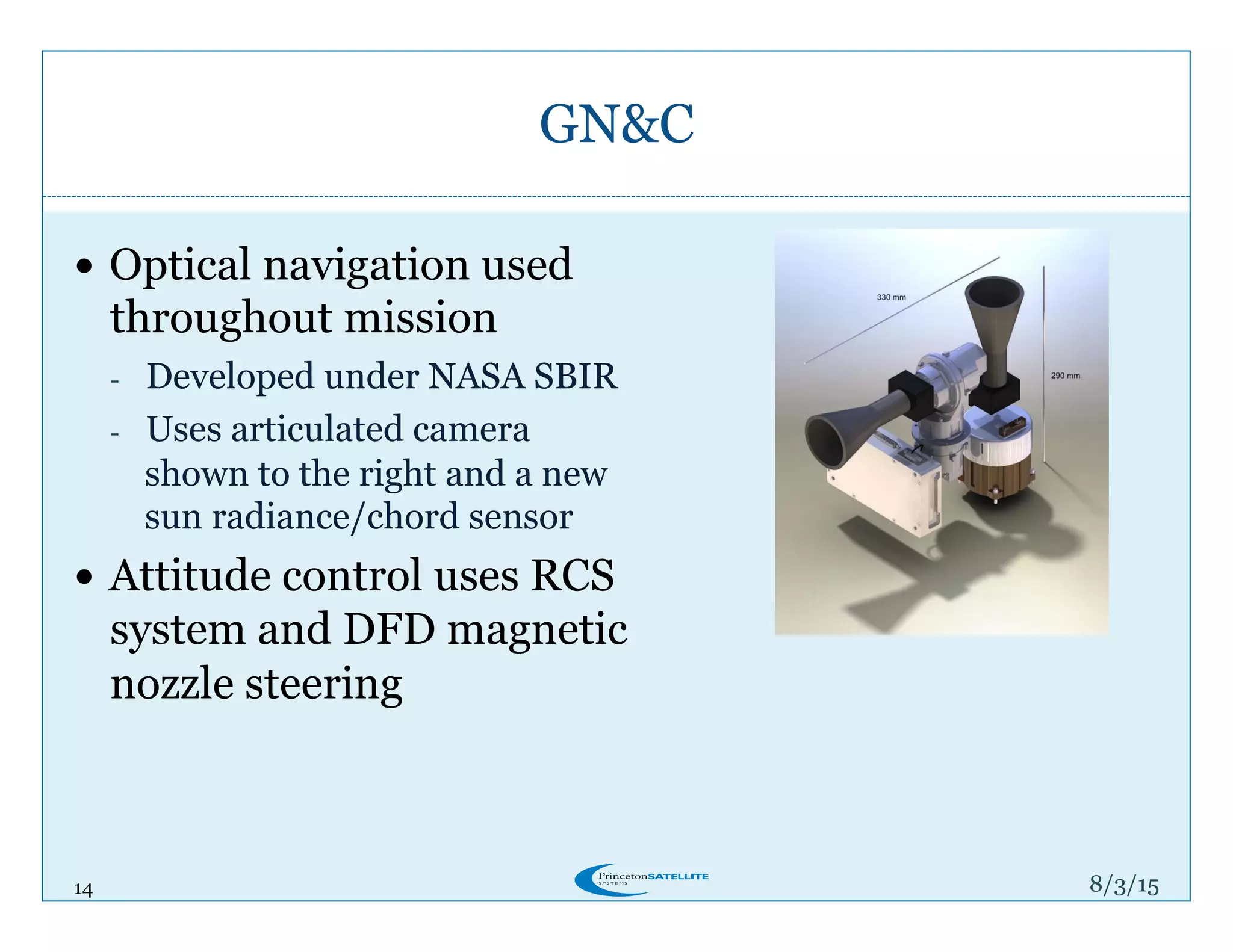
!  Optical navigation used
throughout mission
-  Developed under NASA SBIR
-  Uses articulated camera
shown to the right and a new
sun radiance/chord sensor
!  Attitude control uses RCS
system and DFD magnetic
nozzle steering
15
GN&C
8/4/15
16
Lander
8/4/15
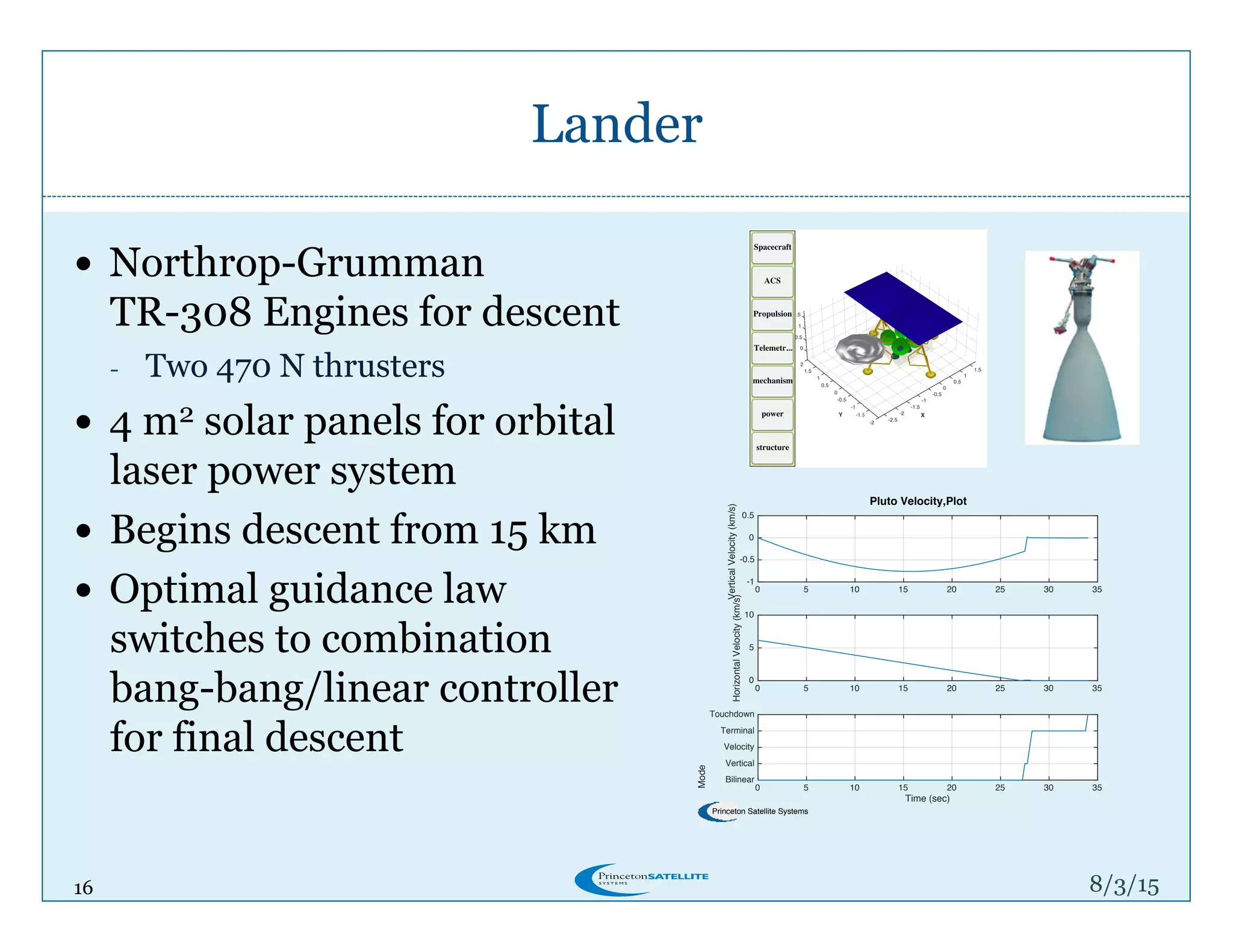
!  ECAPS 220 N engine
!  4 m2 solar panels for
orbital laser power
system
!  Begins descent from 15
km
!  Optimal guidance law
switches to combination
bang-bang/linear
controller for final
descent
17
Laser Lander Power System
8/4/15
!  Beam power by fiber laser
at 1080 nm
-  Same as Navy LaWS
!  Standard solar cells to
receive the power
-  30 kW transmitted power
-  0.4 m mirror
-  4 m2 solar cells on lander
-  2 DOF steerable array
!  31.9 Wh per pass
-  Store in batteries
Princeton Satellite Systems
Power Per Pass = 31.9 Wh Wavelength 1080.0 nM
0 5 10 15 20 25
Power(kW/m
2
)
0
5
10
15
20
25
Time (min)
0 5 10 15 20 25
Distance(km)
0
500
1000
1500
2000
2500
3000
18
High Power Communications with Earth
8/4/15
!  JPL Deep Space Optical Communications System
(DSOC)
!  Compatible with the laser power system
!  135 Mbps from Pluto with 30 kW
19
Work Plan
8/4/15
!  Ion heating experiment at
PPPL (DOE Funding)
!  Magnetic nozzle research at
PPPL (DOE Funding)
-  Magnetic nozzle steering
!  Mission analysis for the Pluto
mission
-  Optimize power, thrust and
exhaust velocity for different
launchers
-  Optimize trajectory
-  Science payloads
!  Spacecraft design
-  System design
-  Detailed designs
"  Fuel tanks
"  DFD engine design
"  Radiator system
"  GN&C
"  Communications
!  Lander Design
-  GN&C
-  Propulsion
-  Power
-  Science payloads
20
Conclusions
8/4/15
!  The Pluto Orbital Mission would be a new class of
exploration missions
-  Cannot be achieved with any other technology
!  Would expand on the knowledge gained by the New
Horizons mission
!  The propulsion and power system would be applicable to
a wide range of missions and applications
-  Human missions to Mars
-  Robotic missions to the gas giants
-  Interstellar missions
-  Space and terrestrial power generation
21
For More Information
8/4/15
Stephanie Thomas
sjthomas@psatellite.com
Michael Paluszek
map@psatellite.com
Dr. Samuel Cohen
scohen@pppl.gov
Princeton Satellite Systems
6 Market St. Suite 926
Plainsboro, NJ 08536
(609) 275-9606
http://www.psatellite.com
21
22
References
8/4/15
Papers/Conferences
!  Y. Razin et al., A direct fusion drive for rocket propulsion, Acta Astronautica, Vol. 105, Issue 1, December
2014, pp. 145-155
!  M. Paluszek et al, Direct Fusion Drive for a Human Mars Orbital Mission , 65th INTERNATIONAL
ASTRONAUTICAL CONGRESS, Sept. 29-Oct. 3, 2014
!  Joseph B. Mueller et al, Direct Fusion Drive Rocket for Asteroid Deflection, 33rd International Electric
Propulsion Conference, October 6–10, 2013
!  G. Pajer, Y. Razin, M. Paluszek, A. H. Glasser, S. Cohn, Modular Aneutronic Fusion Engine, Space
Propulsion 2012, May 2012
!  Modular Aneutronic Fusion Engine for an Alpha Centauri Mission, M. Paluszek, S, Hurley, G. Pajer, S.
Thomas, J. Mueller, S. Cohen, D. Welch, DARPA 100 Year Starship Conference, September 2011.
Patents
!  M. Buttolph, D. Stotler and S. Cohen, “Fueling Method for Small, Steady-State, Aneutronic FRC Fusion
Reactors,” 61/873,651, filed September 4, 2013
!  M. Paluszek, E. Ham, S. Cohen and Y. Razin, “In Space Startup Method for Nuclear Fusion Rocket Engines,”
61/868,629, filed August 22, 2013.
!  S. Cohen, G. Pajer, M. Paluszek and Y. Razin, “Method to Produce High Specific Impulse and Moderate Thrust
From a Fusion-Powered Rocket Engine,” PCT/US2013/40520, filed May 10, 2013.
!  S. Cohen, G. Pajer, M. Paluszek and Y. Razin, “Method to Reduce Neutron Production in Small Clean Fusion
Reactors,” PCT/US13/33767, filed March 25, 2013.

Pluto 2015

  • 1.
    1 Pluto Orbiter Mission DirectFusion Drive Stephanie Thomas, PSS Michael Paluszek, PSS Dr. Samuel Cohen, PPPL 2015
  • 2.
    2 Pluto Orbital Mission 10/7/13 ! Enter Pluto orbit 4 years after Earth departure !  Carry a lander -  Deliver power to the lander from the orbiter !  While at Pluto change orbits to cover the entire planet !  High power available onboard allows advanced science and communications -  Provide high bandwidth laser communications back to Earth !  Advance space propulsion and space and terrestrial power
  • 3.
  • 4.
    4 PFRC Experiments atPPPL 8/4/15 !  Princeton Plasma Physics Laboratory performing experiments with DOE funding -  Concluded PFRC-1 a, b, c in 2011 -  PFRC-2 operating now; goal is to demonstrate keV plasmas with pulse lengths to 0.3 s -  MNX studies on plasma detachment in nozzle !  Princeton Satellite Systems performing mission and trajectory design, space balance of plant studies under IR&D -  Four joint PPPL/PSS patents 3 ms pulse* 0.15 kG field* e-temp = 0.3 keV* Machine Objectives Goals/ Achievements* Plasma Radius PFRC-1 PFRC-2 PFRC-3B Electron Heating Ion Heating D-He3 Fusion 4 cm 0.1 s pulse* 1.2 kG field i-temp = 1 keV 10 s pulse 80 kG field i-temp = 50 keV 8 cm 16 cm Time Frame 2008-2011 2011-2015 2019-2020 Total Cost $2M $6M $20M PFRC-3A Heating above 5 keV 10 s pulse 10 kG field i-temp = 5 keV 16 cm 2015-2019 $20M Fuel H H D-3HeH
  • 5.
    5 DFD Components 8/4/15 Heat Engine Shielding Radiator Plasma RF Generator SynchBremss n Spacecraft PowerBus Radiator HTS Coil Blanket Coil Refrigerator SpaceRF GeneratorHelium Coolant Magnetic Nozzle Auxiliary Power UnitD 3He O 2 Electrolysis D 2 O Power Recycling Restart Gas Box 3He Injector D Injector
  • 6.
    6 Thrust Augmentation •  Hor D is used as a propellant- it flows along the magnetic field lines outside of the separatrix; scrape-off layer (SOL) e- are heated by the fusion products that are ejected into the SOL; e- energy transferred to ions in plume expansion •  This reduces the exhaust velocity of the fusion products from 25,000 km/s to ~50 km/s and increases thrust to >20 N •  Thrust/Isp is adjustable based on rate that gas is injected into the gas box •  The exhaust plume is directed by a magnetic nozzle, consisting of a throat coil and nozzle coils to accelerate the flow.
  • 7.
    7 Princeton Field ReversedConfiguration (PFRC) 8/4/15 !  Field Reversed Configuration (FRC) is core of DFD -  Simple geometry with fewer coils !  RF heating with odd-parity rotating magnetic fields naturally limits reactor size -  Plasma radius in range 20-40 cm -  Size of 1-10 MW which is ideal for space !  Confinement with high temperature superconducting coils !  Burns aneutronic D and 3He with beta greater than 0.8 !  Linear configuration allows for configuration as a rocket engine !  Magnetic Nozzle !  Add H or D+ to augment thrust !  Variable exhaust velocity !  50 to 20,000 km/s !  P = 0.5 TuE/η, with η ∼0.5 Gas Box Exhaust Plume SOL Heating Section Field Shaping Box Separatrix Closed Field Nozzle Coil Propellant D-He3 Fusion Coils Coil Fueling RMFo Antenna Region Shielding
  • 8.
    8 Steerable Magnetic Nozzle 8/4/15 ! Plume needs to be steered for momentum management -  1-2 degrees of deflection needed !  Seek magnetic methods as alternative to mechanical gimbals for entire engine -  Expensive and heavy !  Steering coils downstream of nozzle throat, or perhaps a tiltable plate to direct the flow
  • 9.
    9 Heat Engine 8/4/15 !  Braytoncycle shown -  Ericsson cycle would have multi-stage compressors and turbines !  Helium working fluid !  Mass is sum of heat engine components and radiators -  Brayton efficiency of 63% possible -  Ericsson 74% !  Generator -  28 V DC Generators used on aircraft "  Should be the same voltage as required by the RF generator
  • 10.
  • 11.
    11 Mission Plan 8/4/15 !  Directinsertion into interplanetary orbit by a Delta IV Heavy or other launch vehicle !  20 N thrust to change the velocity by 55 km/s !  Coast !  20 N thrust to decelerate to intercept Pluto !  Spiral into polar Pluto orbit !  Map surface with altimeter !  Lander detaches and lands on surface -  Powered by laser from the orbiter -  Navigation uses maps generated during mapping phase !  Orbiter changes orbit as needed to survey the entire planet !  Possibly departs Pluto for the Kuiper belt
  • 12.
    12 Spacecraft 8/4/15 !  Fits withinDelta IV Heavy fairing !  Within the mass allowance for the Delta IV !  Dual radiators !  Dual JPL Deep-Space Optical Communication System (DSOC) units !  Lander mounted on the front
  • 13.
    13 Trajectory to Pluto 8/4/15 ! July 2028 departure date !  Red line on second plot is the Delta IV Heavy payload into interplanetary orbit !  4 year transfer shown below -  Blue circle is Earth orbits !  110 km/sec Delta-V !  Nearly straight line !  No gravity assists
  • 14.
    14 GN&C 8/4/15 !  Optical navigationused throughout mission -  Developed under NASA SBIR -  Uses articulated camera shown to the right and a new sun radiance/chord sensor !  Attitude control uses RCS system and DFD magnetic nozzle steering
  • 15.
  • 16.
    16 Lander 8/4/15 !  ECAPS 220N engine !  4 m2 solar panels for orbital laser power system !  Begins descent from 15 km !  Optimal guidance law switches to combination bang-bang/linear controller for final descent
  • 17.
    17 Laser Lander PowerSystem 8/4/15 !  Beam power by fiber laser at 1080 nm -  Same as Navy LaWS !  Standard solar cells to receive the power -  30 kW transmitted power -  0.4 m mirror -  4 m2 solar cells on lander -  2 DOF steerable array !  31.9 Wh per pass -  Store in batteries Princeton Satellite Systems Power Per Pass = 31.9 Wh Wavelength 1080.0 nM 0 5 10 15 20 25 Power(kW/m 2 ) 0 5 10 15 20 25 Time (min) 0 5 10 15 20 25 Distance(km) 0 500 1000 1500 2000 2500 3000
  • 18.
    18 High Power Communicationswith Earth 8/4/15 !  JPL Deep Space Optical Communications System (DSOC) !  Compatible with the laser power system !  135 Mbps from Pluto with 30 kW
  • 19.
    19 Work Plan 8/4/15 !  Ionheating experiment at PPPL (DOE Funding) !  Magnetic nozzle research at PPPL (DOE Funding) -  Magnetic nozzle steering !  Mission analysis for the Pluto mission -  Optimize power, thrust and exhaust velocity for different launchers -  Optimize trajectory -  Science payloads !  Spacecraft design -  System design -  Detailed designs "  Fuel tanks "  DFD engine design "  Radiator system "  GN&C "  Communications !  Lander Design -  GN&C -  Propulsion -  Power -  Science payloads
  • 20.
    20 Conclusions 8/4/15 !  The PlutoOrbital Mission would be a new class of exploration missions -  Cannot be achieved with any other technology !  Would expand on the knowledge gained by the New Horizons mission !  The propulsion and power system would be applicable to a wide range of missions and applications -  Human missions to Mars -  Robotic missions to the gas giants -  Interstellar missions -  Space and terrestrial power generation
  • 21.
    21 For More Information 8/4/15 StephanieThomas sjthomas@psatellite.com Michael Paluszek map@psatellite.com Dr. Samuel Cohen scohen@pppl.gov Princeton Satellite Systems 6 Market St. Suite 926 Plainsboro, NJ 08536 (609) 275-9606 http://www.psatellite.com 21
  • 22.
    22 References 8/4/15 Papers/Conferences !  Y. Razinet al., A direct fusion drive for rocket propulsion, Acta Astronautica, Vol. 105, Issue 1, December 2014, pp. 145-155 !  M. Paluszek et al, Direct Fusion Drive for a Human Mars Orbital Mission , 65th INTERNATIONAL ASTRONAUTICAL CONGRESS, Sept. 29-Oct. 3, 2014 !  Joseph B. Mueller et al, Direct Fusion Drive Rocket for Asteroid Deflection, 33rd International Electric Propulsion Conference, October 6–10, 2013 !  G. Pajer, Y. Razin, M. Paluszek, A. H. Glasser, S. Cohn, Modular Aneutronic Fusion Engine, Space Propulsion 2012, May 2012 !  Modular Aneutronic Fusion Engine for an Alpha Centauri Mission, M. Paluszek, S, Hurley, G. Pajer, S. Thomas, J. Mueller, S. Cohen, D. Welch, DARPA 100 Year Starship Conference, September 2011. Patents !  M. Buttolph, D. Stotler and S. Cohen, “Fueling Method for Small, Steady-State, Aneutronic FRC Fusion Reactors,” 61/873,651, filed September 4, 2013 !  M. Paluszek, E. Ham, S. Cohen and Y. Razin, “In Space Startup Method for Nuclear Fusion Rocket Engines,” 61/868,629, filed August 22, 2013. !  S. Cohen, G. Pajer, M. Paluszek and Y. Razin, “Method to Produce High Specific Impulse and Moderate Thrust From a Fusion-Powered Rocket Engine,” PCT/US2013/40520, filed May 10, 2013. !  S. Cohen, G. Pajer, M. Paluszek and Y. Razin, “Method to Reduce Neutron Production in Small Clean Fusion Reactors,” PCT/US13/33767, filed March 25, 2013.