Literary
       Elements
A literary element (or element of literature) is
 an individual aspect or characteristic of a
            whole work of literature.
Alliteration
• The repetition of initial consonant sounds in words.
       • Example: Sally sells sea shells by the sea shore.


Allusion
• A brief, usually indirect reference to a person, place, or
  event--real or fictional
  • Example: Chapter 1, page 1 of The Outsiders when Ponyboy
    references the actor Paul Newman.
Assonance
 • The repetition of vowel sounds in the first syllable of
   words, though they may not rhyme
   • Example: (peach, tree)


 Consonance
• The repetition of consonant sounds in the first syllable
  of words, though they may not rhyme.
      • Example: (fast, lost)
Hyperbole
•   An exaggeration or overstatement.
         • Example: “I’ve told you a million times”


Idiom
• An expression of two or more words, which mean something
  other than the literal meanings of the individual words.
    • Example: bull in a china shop, bite off more than you can chew
Imagery
• Words or phrases that appeal to one or more of the five senses
  (sight, touch, taste, hearing, smell) and help to create a vivid
  description for the reader.
      • Example: Visual -
        The sun was shining on the sea,
        Shining with all his might:
        He did his very best to make
        The billows smooth and bright -
        And this was odd, because it was
        The middle of the night.
         (Lewis Carroll)


Metaphor
• A comparison between two seemingly unlike things
  without using the words “like”, “as”, “than”, or
  “resembles.”
       • Example: America is a melting pot, Her home was a prison
Onomatopoeia
• Words or phrases that sound like the things they are
  describing.
       • Example: (hiss, zoom, bow-wow)


Personification
• Giving human qualities or characteristics to non-human objects
  • Example: The flowers begged for water, Lightning danced across the sky.
Repetition
• Repetition occurs when a word or phrase used more
  than once. Repetition can create a pattern.
      • Example: "What lies behind us and what lies before us are tiny compared
        to what lies within us.” - Ralph Waldo Emerson


Rhyme
• Repetition of the same or similar sounds at the end of
  words or lines
      • Example:
      Hickory, dickory, dock.
      The mouse ran up the clock.
The clock struck one,
And down
      he run,
Hickory, dickory, dock.
Rhythm
• The arrangement of stressed and unstressed syllables into
  a pattern.
  • Example: The rhythm pattern in a Limerick Poem
       1. There was an old man from Peru, (A)
       da DUM da da DUM da da DUM (3 DUMS)  Rhythm
       2. who dreamed he was eating his shoe. (A)
       da DUM da da DUM da da DUM (3 DUMS)             Rhythm
       3. He awoke in the night (B)
       da DUM da da DUM (2 DUMS)           Rhythm
       4. with a terrible fright, (B)
       da da DUM da da DUM (2 DUMS)        Rhythm
       5. and found out that it was quite true. (A)
       da DUM da da DUM da da DUM (3 DUMS)             Rhythm
Ms Moran’s Limerick
There once was a kid in the class
who tried to give Ms Moran sass.
She spoke with a frown,
And sent him right down,
To the office where his detention would pass.
Simile
• A comparison of one thing to another, using the words "like,"
  "as," or "as though.”
  • Example:
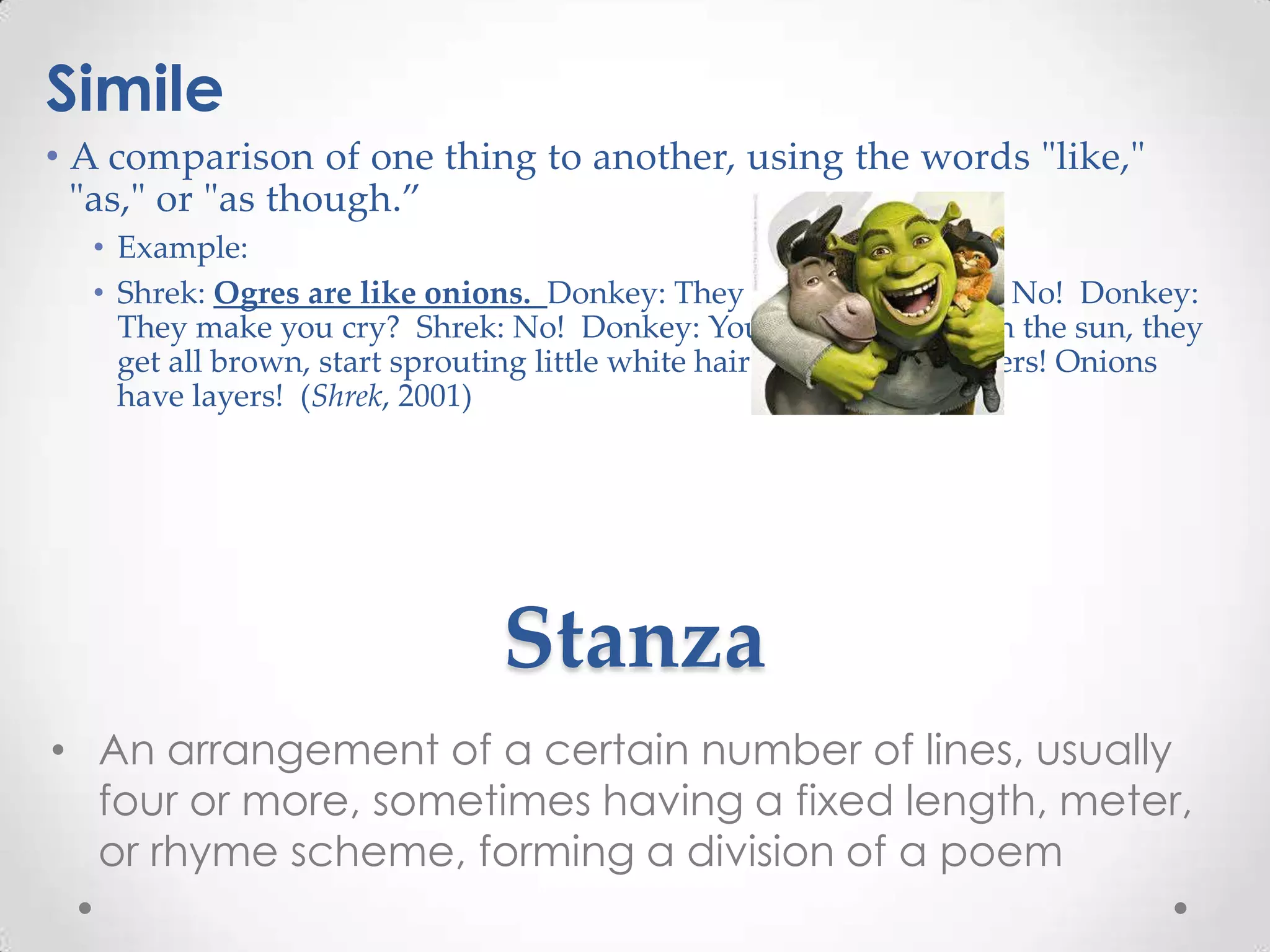
  • Shrek: Ogres are like onions.
Donkey: They stink?
Shrek: Yes. No!
Donkey:
    They make you cry?
Shrek: No!
Donkey: You leave them out in the sun, they
    get all brown, start sprouting little white hairs.
Shrek: No! Layers! Onions
    have layers!
(Shrek, 2001)


                              Stanza
• An arrangement of a certain number of lines, usually
  four or more, sometimes having a fixed length, meter,
  or rhyme scheme, forming a division of a poem

Literary elements Class Notes

  • 1.
    Literary Elements A literary element (or element of literature) is an individual aspect or characteristic of a whole work of literature.
  • 2.
    Alliteration • The repetitionof initial consonant sounds in words. • Example: Sally sells sea shells by the sea shore. Allusion • A brief, usually indirect reference to a person, place, or event--real or fictional • Example: Chapter 1, page 1 of The Outsiders when Ponyboy references the actor Paul Newman.
  • 3.
    Assonance • Therepetition of vowel sounds in the first syllable of words, though they may not rhyme • Example: (peach, tree) Consonance • The repetition of consonant sounds in the first syllable of words, though they may not rhyme. • Example: (fast, lost)
  • 4.
    Hyperbole • An exaggeration or overstatement. • Example: “I’ve told you a million times” Idiom • An expression of two or more words, which mean something other than the literal meanings of the individual words. • Example: bull in a china shop, bite off more than you can chew
  • 5.
    Imagery • Words orphrases that appeal to one or more of the five senses (sight, touch, taste, hearing, smell) and help to create a vivid description for the reader. • Example: Visual - The sun was shining on the sea, Shining with all his might: He did his very best to make The billows smooth and bright - And this was odd, because it was The middle of the night. (Lewis Carroll) Metaphor • A comparison between two seemingly unlike things without using the words “like”, “as”, “than”, or “resembles.” • Example: America is a melting pot, Her home was a prison
  • 6.
    Onomatopoeia • Words orphrases that sound like the things they are describing. • Example: (hiss, zoom, bow-wow) Personification • Giving human qualities or characteristics to non-human objects • Example: The flowers begged for water, Lightning danced across the sky.
  • 7.
    Repetition • Repetition occurswhen a word or phrase used more than once. Repetition can create a pattern. • Example: "What lies behind us and what lies before us are tiny compared to what lies within us.” - Ralph Waldo Emerson Rhyme • Repetition of the same or similar sounds at the end of words or lines • Example: Hickory, dickory, dock. The mouse ran up the clock.
The clock struck one,
And down he run,
Hickory, dickory, dock.
  • 8.
    Rhythm • The arrangementof stressed and unstressed syllables into a pattern. • Example: The rhythm pattern in a Limerick Poem 1. There was an old man from Peru, (A) da DUM da da DUM da da DUM (3 DUMS)  Rhythm 2. who dreamed he was eating his shoe. (A) da DUM da da DUM da da DUM (3 DUMS)  Rhythm 3. He awoke in the night (B) da DUM da da DUM (2 DUMS)  Rhythm 4. with a terrible fright, (B) da da DUM da da DUM (2 DUMS)  Rhythm 5. and found out that it was quite true. (A) da DUM da da DUM da da DUM (3 DUMS)  Rhythm
  • 9.
    Ms Moran’s Limerick Thereonce was a kid in the class who tried to give Ms Moran sass. She spoke with a frown, And sent him right down, To the office where his detention would pass.
  • 10.
    Simile • A comparisonof one thing to another, using the words "like," "as," or "as though.” • Example: • Shrek: Ogres are like onions.
Donkey: They stink?
Shrek: Yes. No!
Donkey: They make you cry?
Shrek: No!
Donkey: You leave them out in the sun, they get all brown, start sprouting little white hairs.
Shrek: No! Layers! Onions have layers!
(Shrek, 2001) Stanza • An arrangement of a certain number of lines, usually four or more, sometimes having a fixed length, meter, or rhyme scheme, forming a division of a poem