
Iranian (Persian) Architecture
•Download as PPT, PDF•
38 likes•22,302 views

Iranian (Persian) Architecture

Recommended
More Related Content
What's hot
What's hot (20)
Viewers also liked
Viewers also liked (20)
Similar to Iranian (Persian) Architecture
Similar to Iranian (Persian) Architecture (20)
More from Majid H. Mohajerani
More from Majid H. Mohajerani (12)
Recently uploaded
Recently uploaded (20)
Iranian (Persian) Architecture
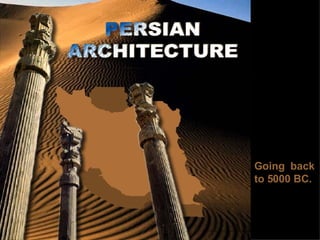
- 1. Going back to 5000 BC.
- 2. Persian architecture can be considered through the age-old history of the land. It goes back to the late 6th and early 5th millennia BC Persian architecture has been a comprehensive embodiment of Iranian psychology and characteristics in different historical periods. . PersianArchitecture
- 3. In studying Persian architecture four distinct, protracted, but continuous periods are distinguished, as follows: -Persian prehistoric architecture till the formation of the first national government by the Medes. Before 700BC. -Persian architecture from the Medes period till the end of Sassanians. 700BC - 600AC. -Contemporary and present-day Persian architecture -Islamic period architecture till the end of Safavi period. Until 600A - 1500AC PrehistoricArchitecture
- 4. One of the most important structures remaining from Eilamites is Choga Zanbil (1250 BC). Choga Zanbil consists of the ruins of three concentric walls, within which are palaces, temples and a central Ziggurat (temple tower), measuring 105 X 105 meters. EilamitesArchitecture
- 5. -Beautifully decorated with glazed baked bricks, gypsum, ornaments of faience and glass. -Built mainly of mud-bricks. EilamitesArchitecture
- 6. Formation of the Achaemenid dynasty (560-330 BC) marks one of the brilliant ages in Persian architecture. Among the best architectural monuments of the period, one might mention mausoleums, fire-temples, and palaces. A striking feature of Achaemenid architecture were great dimensions of the halls. AchaemenidArchitecture
- 7. Pasargad complex, the political capital of Cyrous the great, might be considered a complete manifestation of Persian architecture. Pasargad is now largely in ruins, but one can see that how imposing it must have been in many respects. Persepolis was a sacred national shrine, potent sensing for the spring festival, Now Ruz. The festival was celebrated on the first day of spring, among certain formalities. AchaemenidArchitecture
- 10. In perspolos, the Achaemenid architects have managed to combine beauty and magnificence. Standing on its rock-cut podium, the great hall of Persepolis contained thirty-six columns (in six rows), 18.5m high. AchaemenidArchitecture
- 12. The walls were of mud brick and ornamented with painted and floral designs. Ivory, gold, and precious stones were among materials used in the mosaic works of the hall. AchaemenidArchitecture
- 14. In many ways the Sassanid dynastic period (224-651 CE) witnessed the highest achievement of Persian civilization, and constituted the last great Persian Empire before the Muslim conquest. Iranian architecture reached a peak in its development during the Sassanid era. SassanidArchitecture
- 15. Until the end of this period, the most important styles of Iranian architecture and inherited by the later periods can be summarized as follows: - Foundation (Saffe) - Dome (Gonbad) - Vault (Taq) - Iwan The buildings were constructed on a level higher than earth surface to avoid the instability of the earth surface. A rectangular yard closed in three of its sides. SassanidArchitecture
- 16. The important elements of Persian Architecture and civilization developped for hot climates are: -Gardens -Qanats (Kariz) -Wind Towers (Badgir) ArchitecturalElements
- 17. The Persian Garden refers to a tradition and style of garden design which originated in Persia and which influenced the design of gardens throughout the larger region. The origin of Persian gardens may date back as far as 4000 BCE; The decorated pottery of that time displays the typical cross plan of the Persian garden. PersianGardens
- 18. The outline of Cyrus the Great’ garden, built around 500 BCE, is still viewable today. The Taj Mahal is one of the largest Persian gardens of the world. PersianGardens
- 19. A qanat is a water management system used to provide a reliable supply of water to human settlements or for irrigation in hot, arid and semi-arid climates. The tchnology allows water to be transported long distances in hot dry climates without losing a large proportion of the source water to seepage and evaporation. PersianQanats
- 20. Qanats are constructed as a series of well-like vertical shafts, connected by gently sloping tunnels. PersianQanats
- 21. A wind tower is a chimney-like structure positioned above the house to catch the prevailing wind. The tower catches the wind, driving a hot, dry breeze into the house; the flow of the incoming air is then directed across the vertical shaft from the qanat. PersianWindTower
- 22. PersianWindTower
- 23. The period of Persian architecture from the 15th through 17th Centuries to be the most brilliant of the post-Islamic era. Various structures such as mosques, mausoleums, bazaars, bridges, and different palaces have mainly survived from this period. SafavidArchitecture
- 24. Iranian domes are distinguished for their height, proportion of elements, beauty of form, and roundness of the dome stem. The outer surfaces of the domes are mostly mosaic faced, and create a magical view. SafavidArchitecture
- 31. Safavi tried to achieve grandeur in scale. Isfahan's Naghsh-i Jahan’s square is the 6th largest square worldwide. This proves their knowledge about building tall buildings with vast inner space SafavidArchitecture