





A cutting-edge digital learning strategy
Education and the Digital World:
Promise, Progress and Pain
Professor Mark Brown
Director, National Institute for Digital Learning
e-Learning Summer School
Friday 27th June 2014
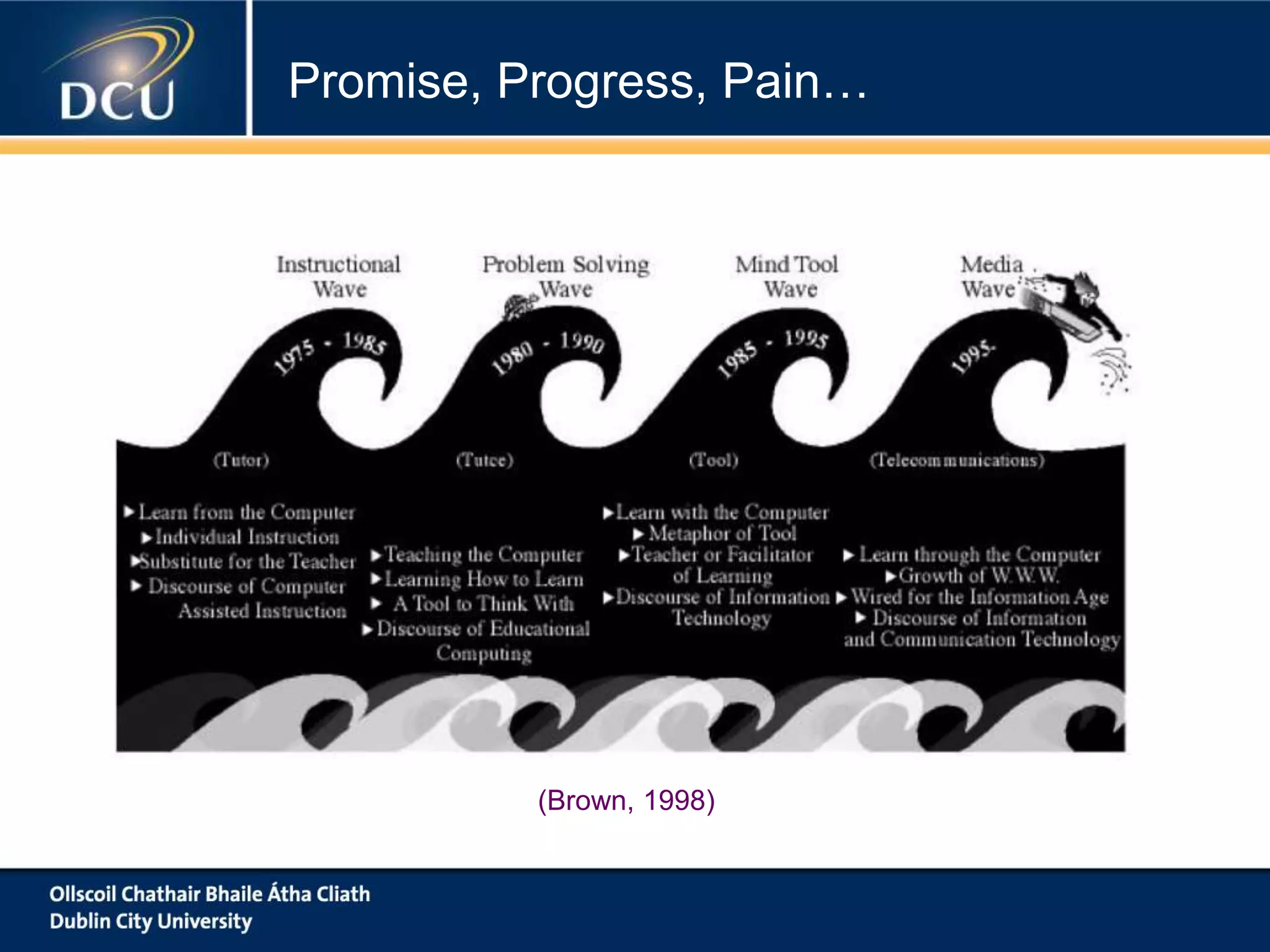
Promise, Progress, Pain…
(Brown, 1998)
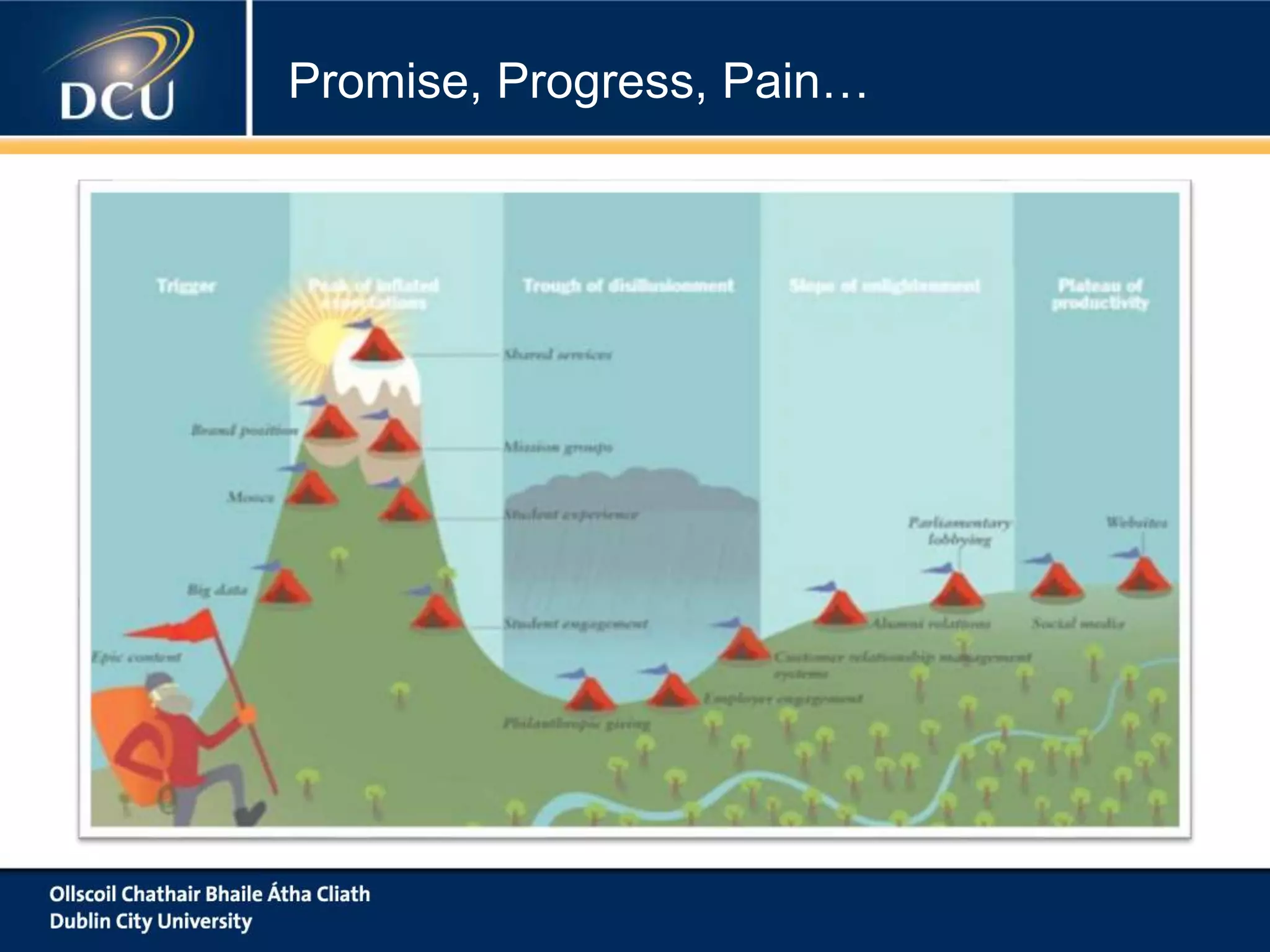
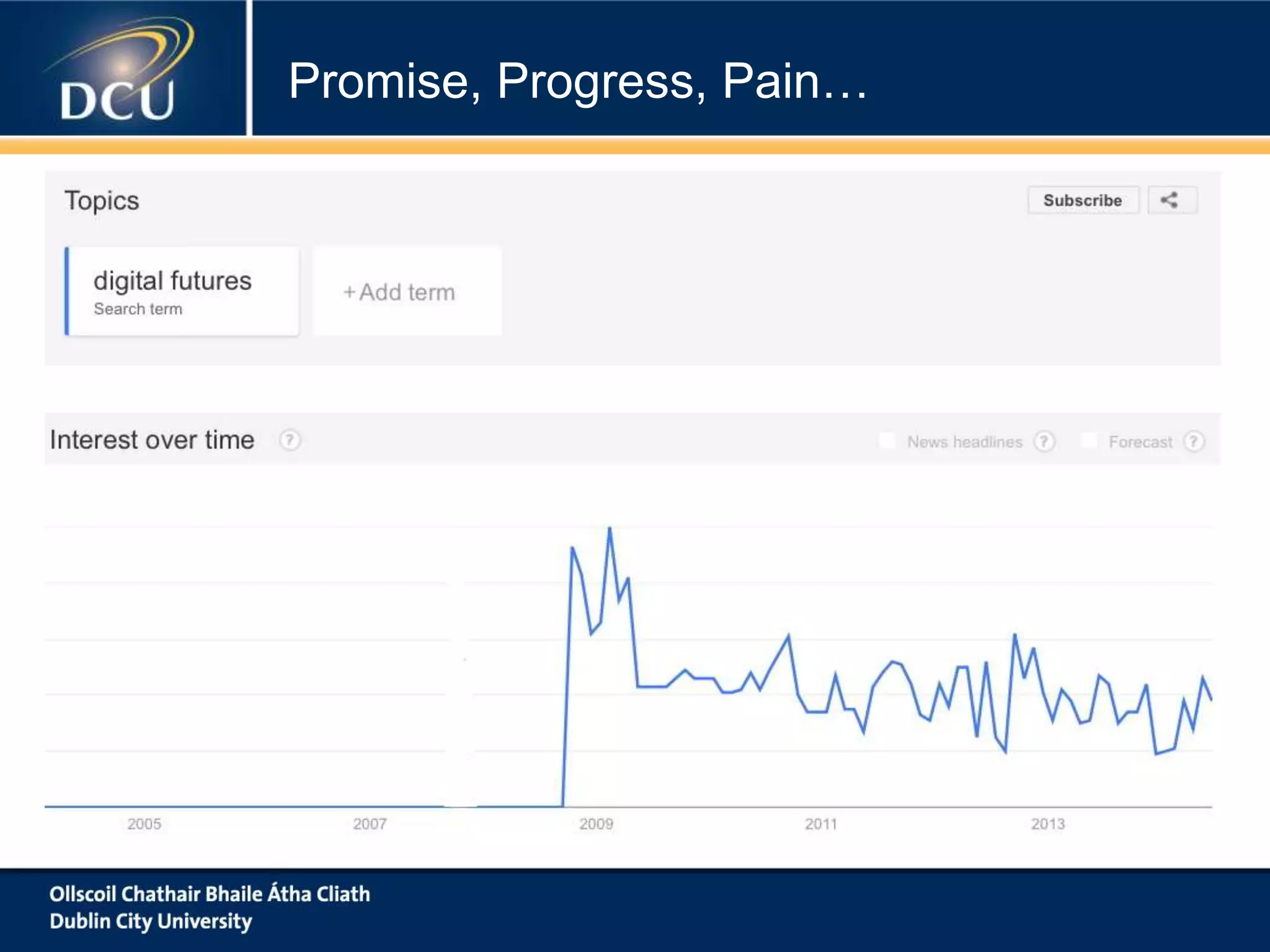
Promise, Progress, Pain…
1. The contested terrain
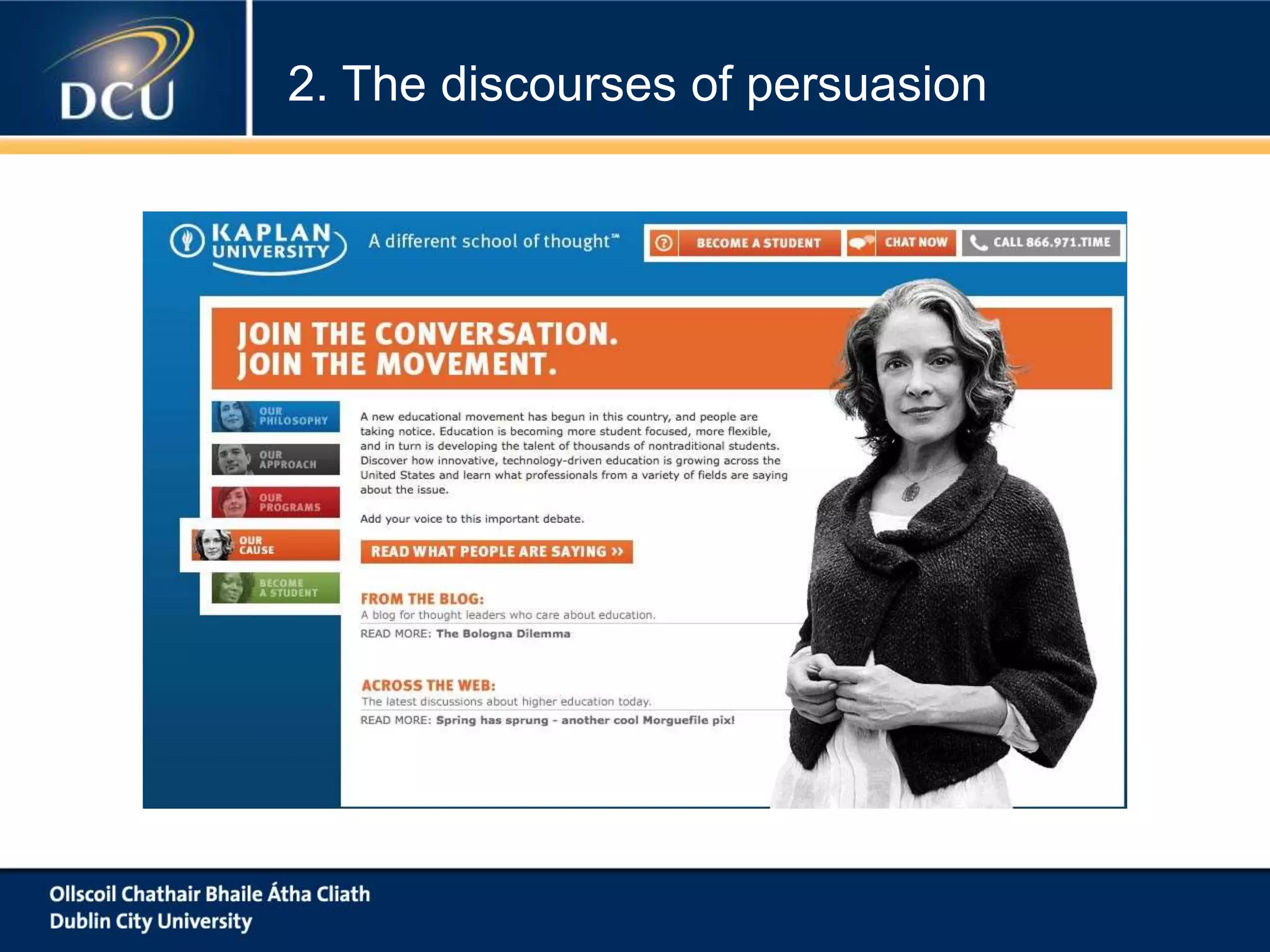
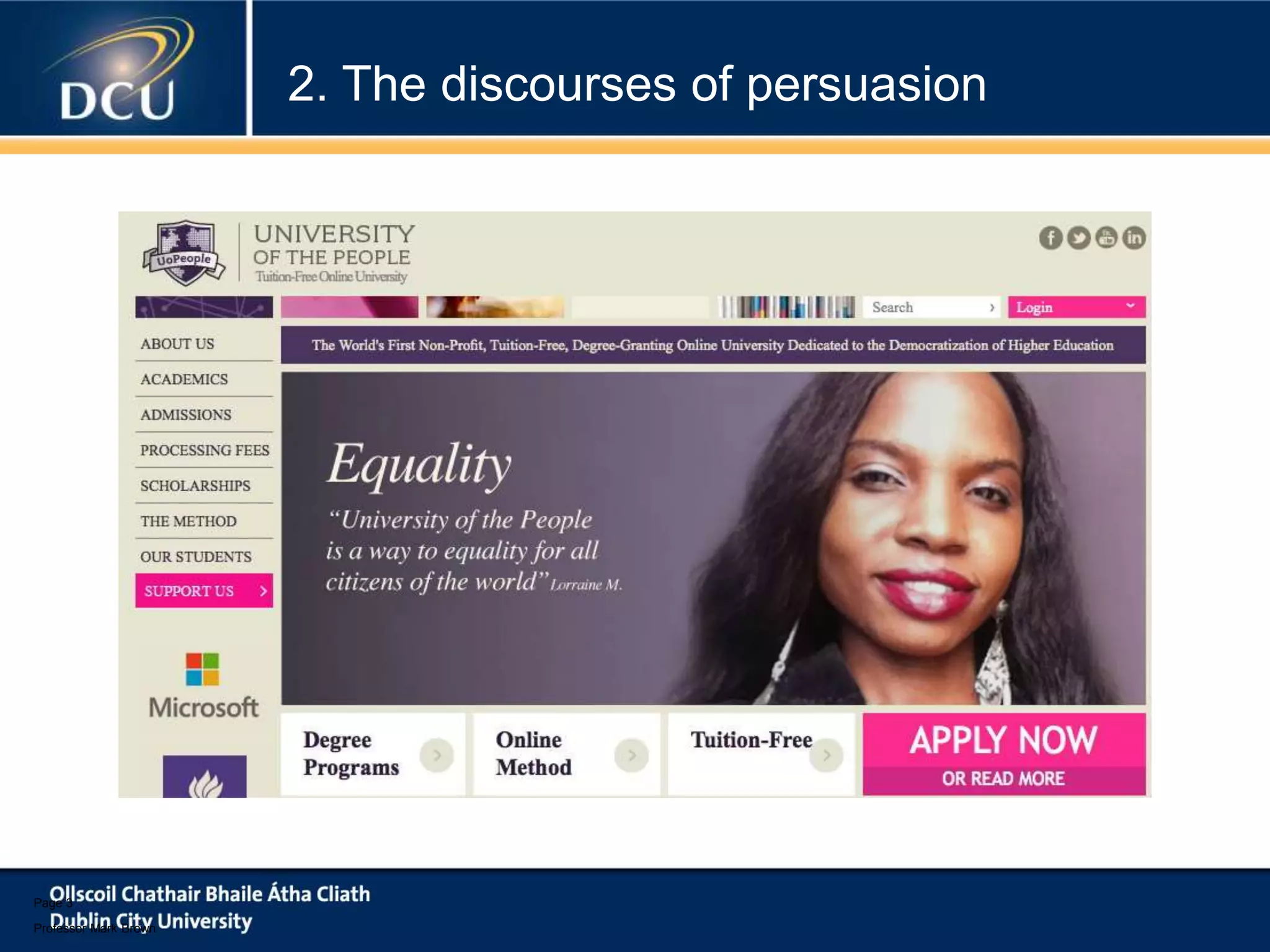
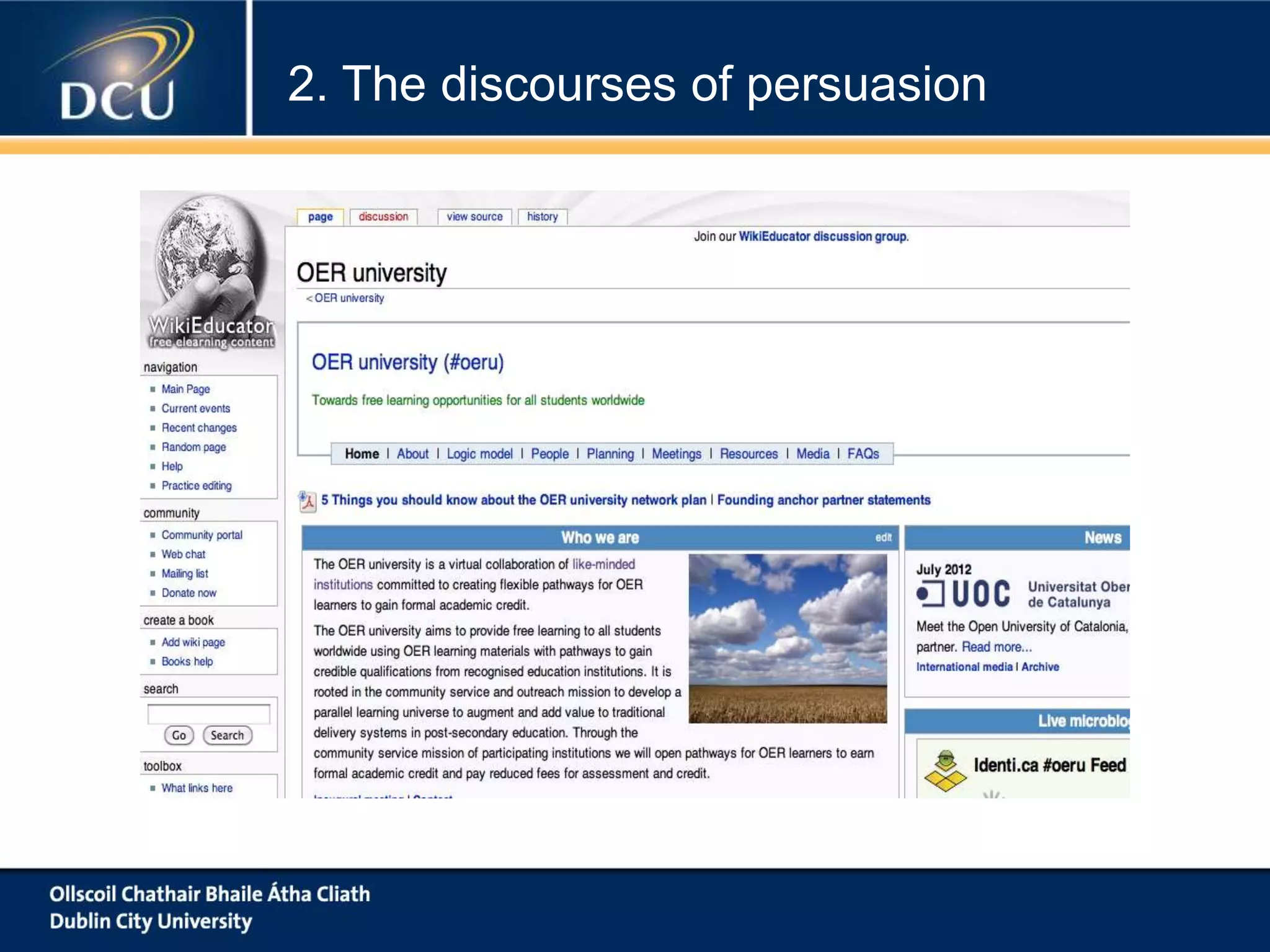
2. The discourses of persuasion
3. Leading for change in painful times
Education and the Digital World
Outline
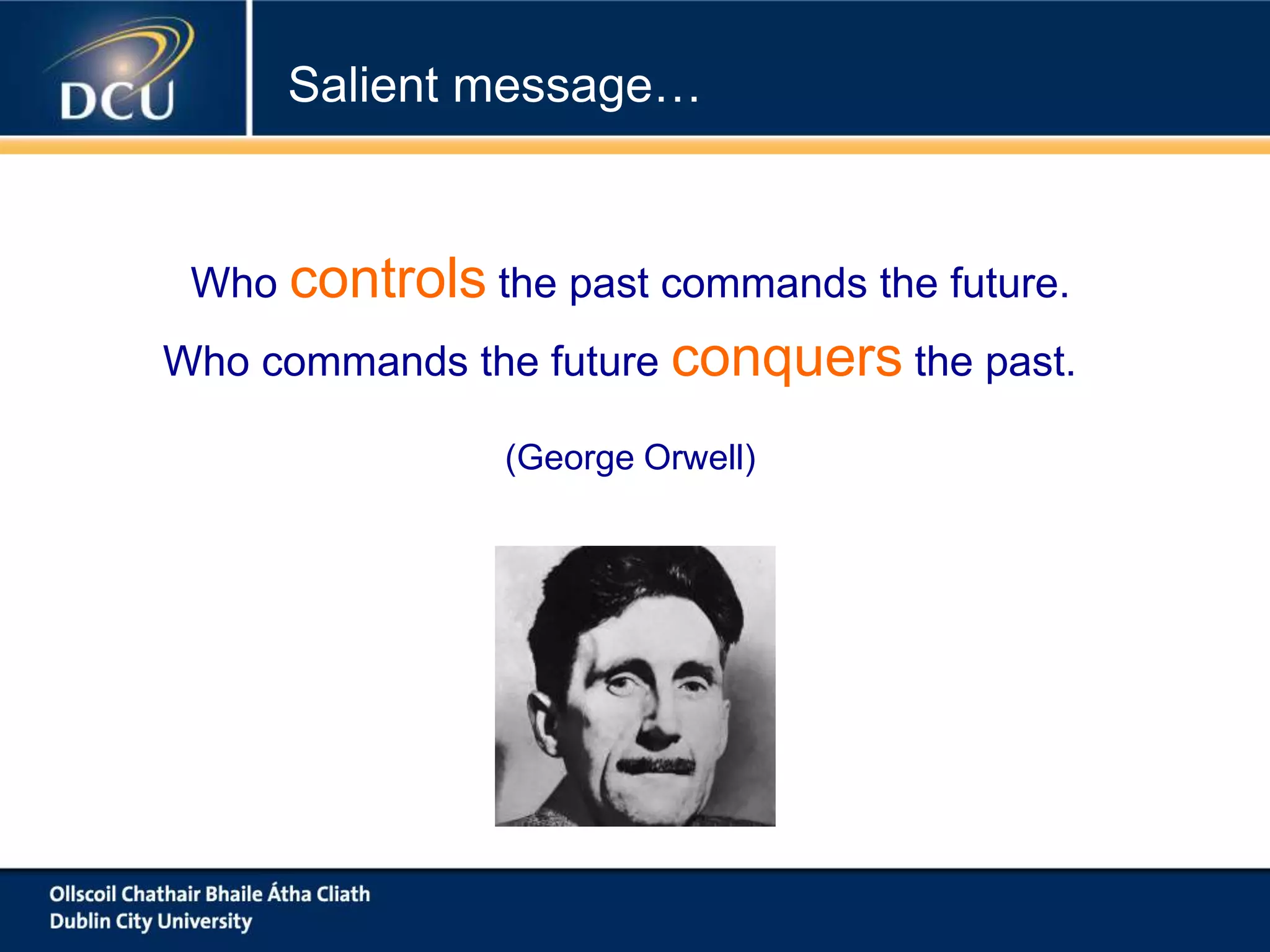
Who controls the past commands the future.
Who commands the future conquers the past.
(George Orwell)
Salient message…
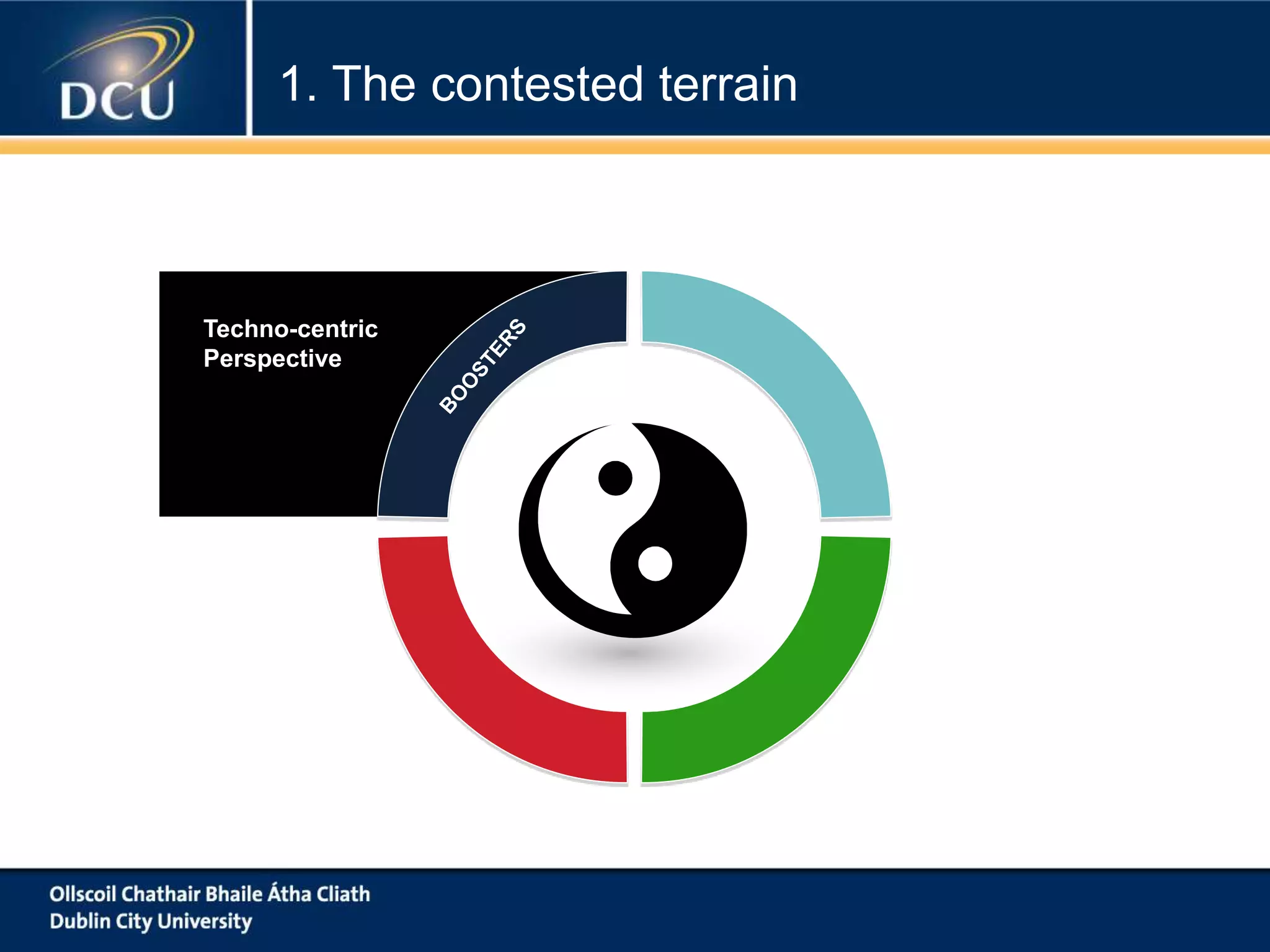
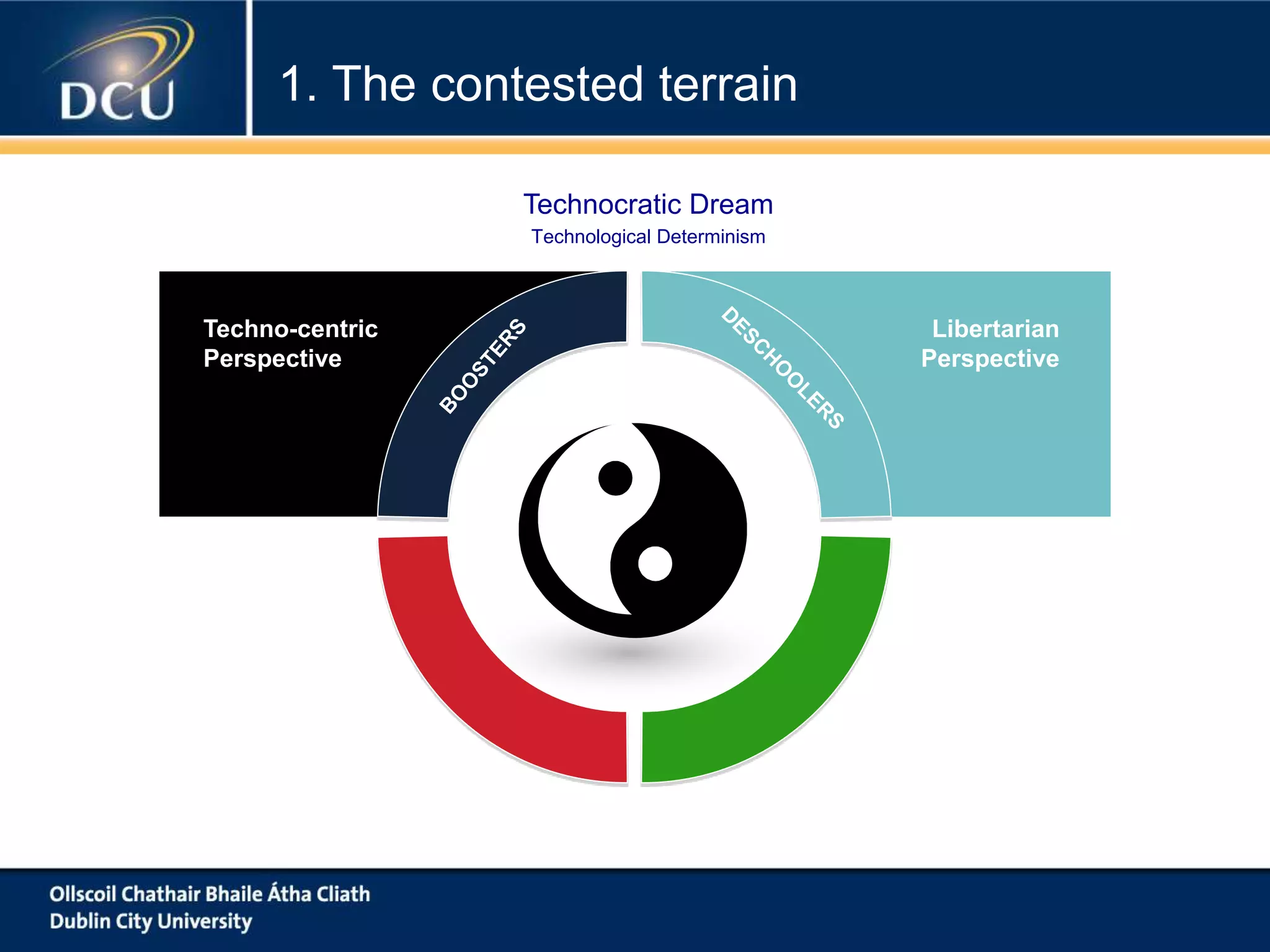
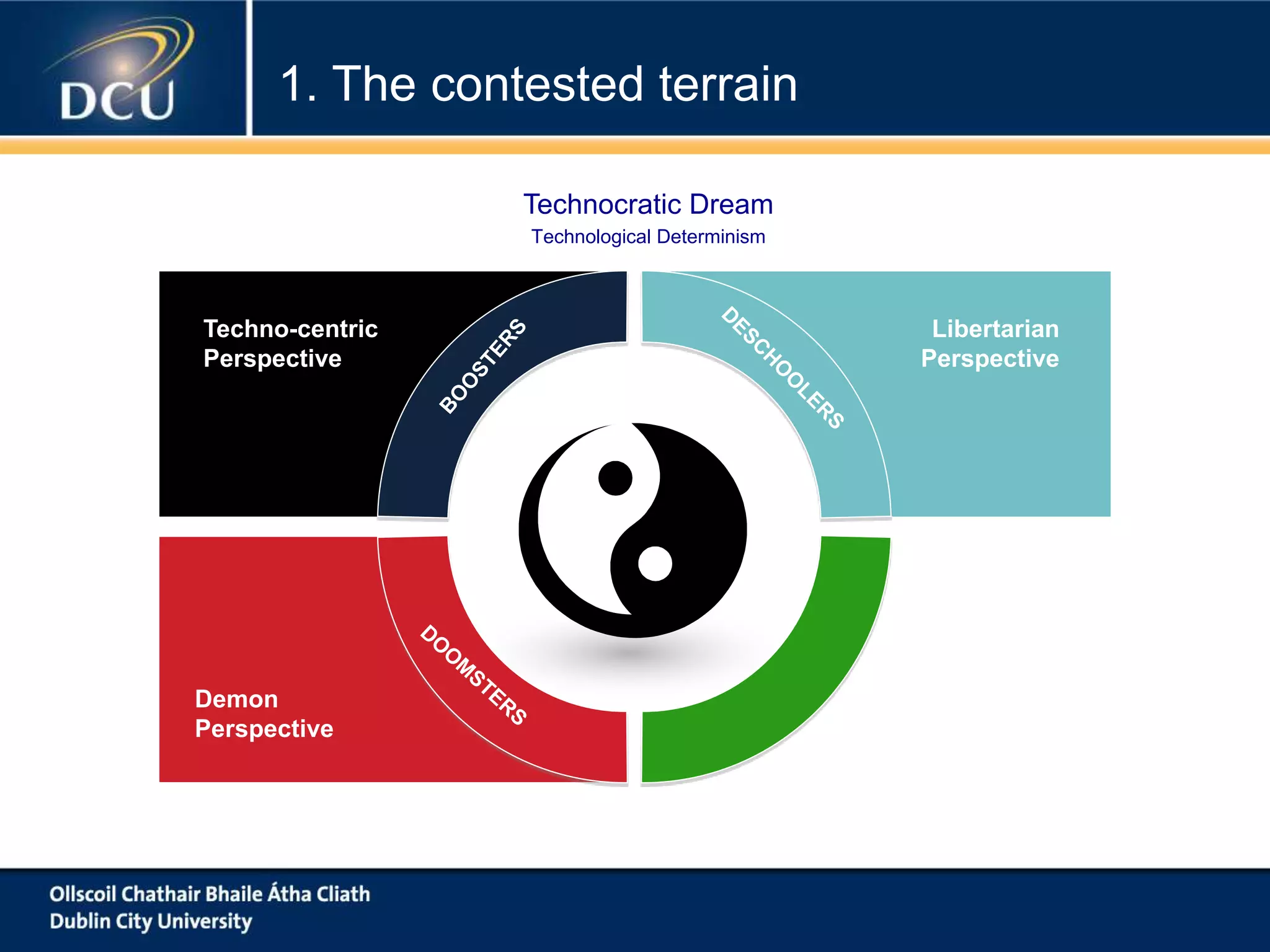
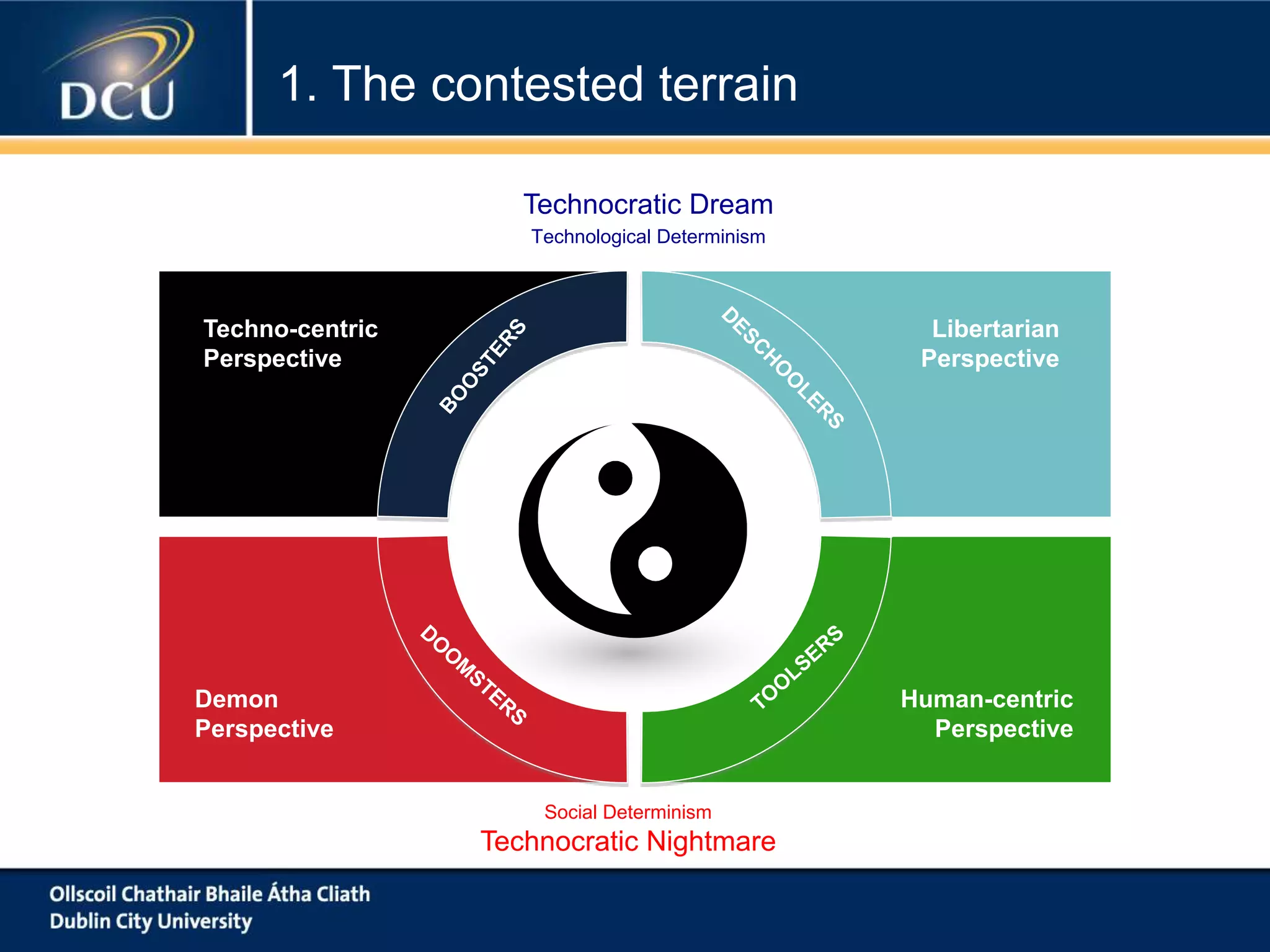
1. The contested terrain
Liberalism
Perspective
Techno-centric
Perspective
Human-centric
Perspective
Demon
Perspective
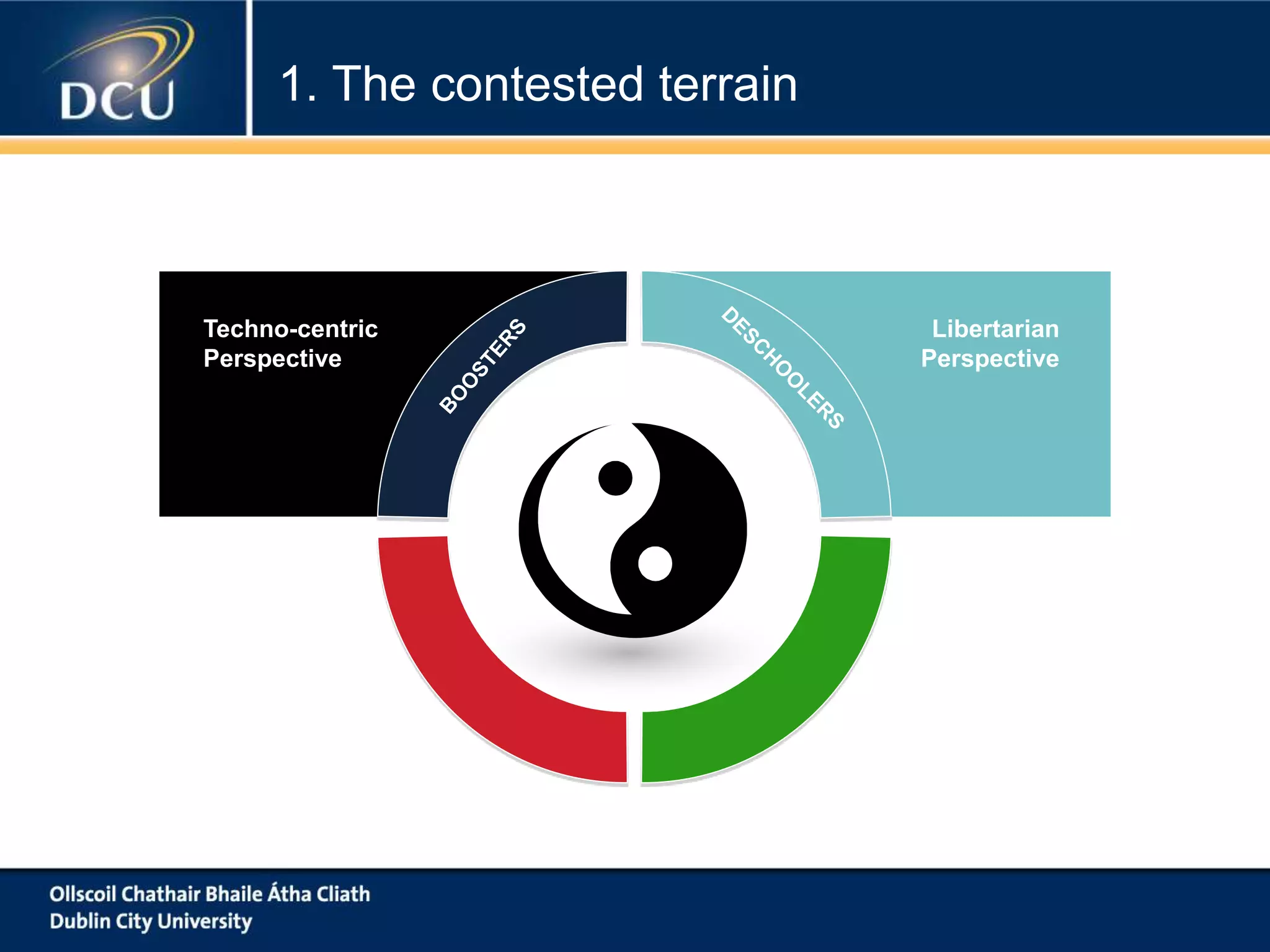
1. The contested terrain
Libertarian
Perspective
Techno-centric
Perspective
Human-centric
Perspective
Demon
Perspective
1. The contested terrain
Libertarian
Perspective
Techno-centric
Perspective
Human-centric
Perspective
Demon
Perspective
Technocratic Dream
Technological Determinism
1. The contested terrain
Techno-centric
Perspective
Human-centric
Perspective
Demon
Perspective
Technocratic Dream
Technological Determinism
Libertarian
Perspective
1. The contested terrain
Techno-centric
Perspective
Human-centric
Perspective
Demon
Perspective
Technocratic Dream
Technological Determinism
Libertarian
Perspective
1. The contested terrain
Social Determinism
Technocratic Nightmare
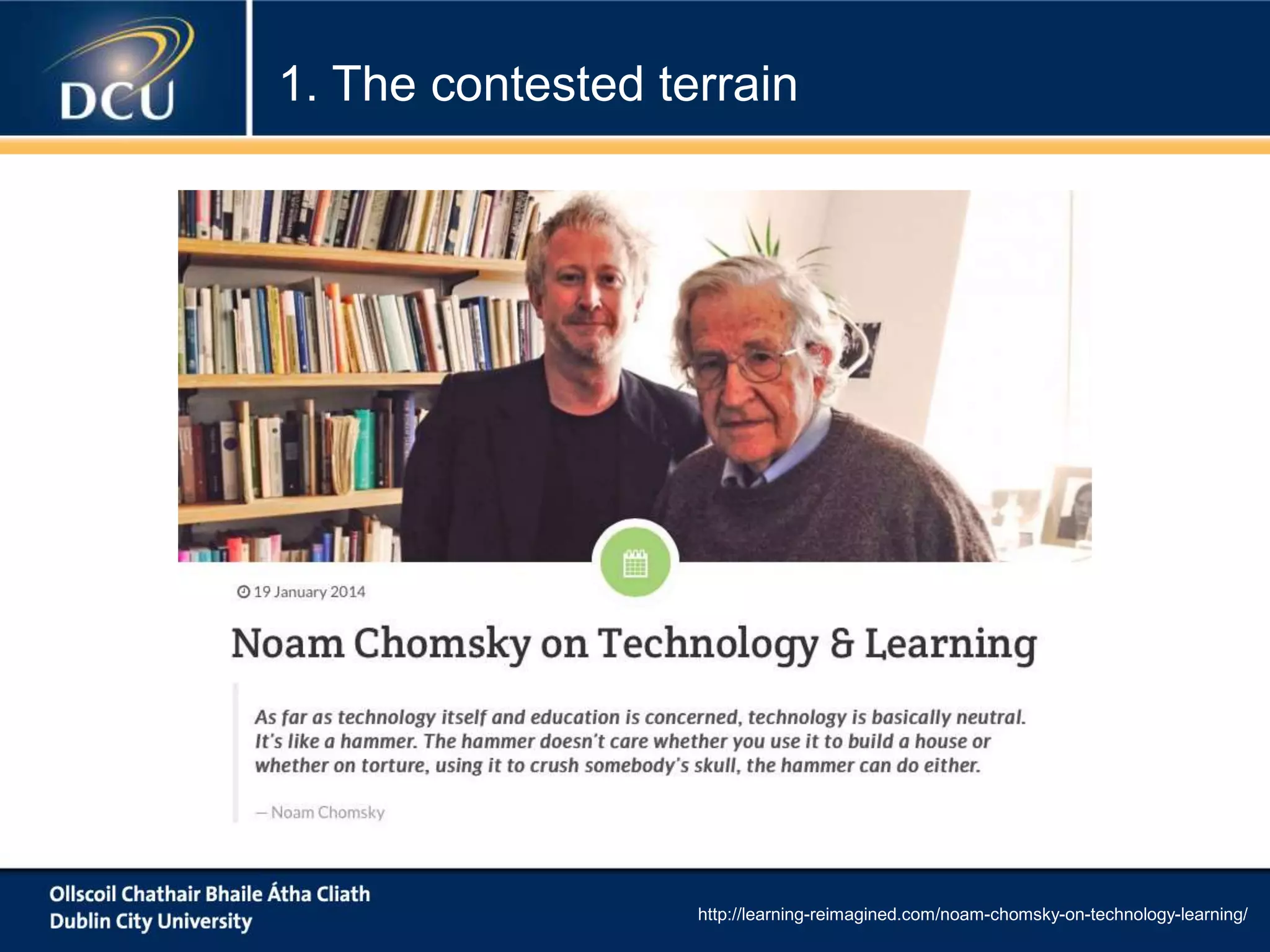
1. The contested terrain
http://learning-reimagined.com/noam-chomsky-on-technology-learning/
1. The contested terrain
(Burbles & Callister, 2000, p.6).
1. The contested terrain
“Tools do not only help us accomplish (given) purposes; they
may create new purposes, new ends, that were never
considered before the tools made them possible. In these and
other ways tools change the user: sometimes quite concretely,
as when the shape of stone tools became a factor in the evolution
of the human hand (…).
Tools may have certain intended uses and purposes, but they
frequently acquire new, unexpected uses and have new,
unexpected effects. What this suggests is that we never simply
use tools, without the tools also “using” us”
(Burbles & Callister, 2000, p.6).
1. The contested terrain
“Tools do not only help us accomplish (given) purposes; they
may create new purposes, new ends, that were never
considered before the tools made them possible. In these and
other ways tools change the user: sometimes quite concretely,
as when the shape of stone tools became a factor in the evolution
of the human hand (…).
“Cyberspace is not politically neutral. It favors the
political ideals of libertarian, free-market
Republicans: a highly decentralized,
deregulated society with little common discourse
and minimal public infrastructure”
(Shenk; cited in Burbules & Callister, 2000, p.169).
1. The contested terrain
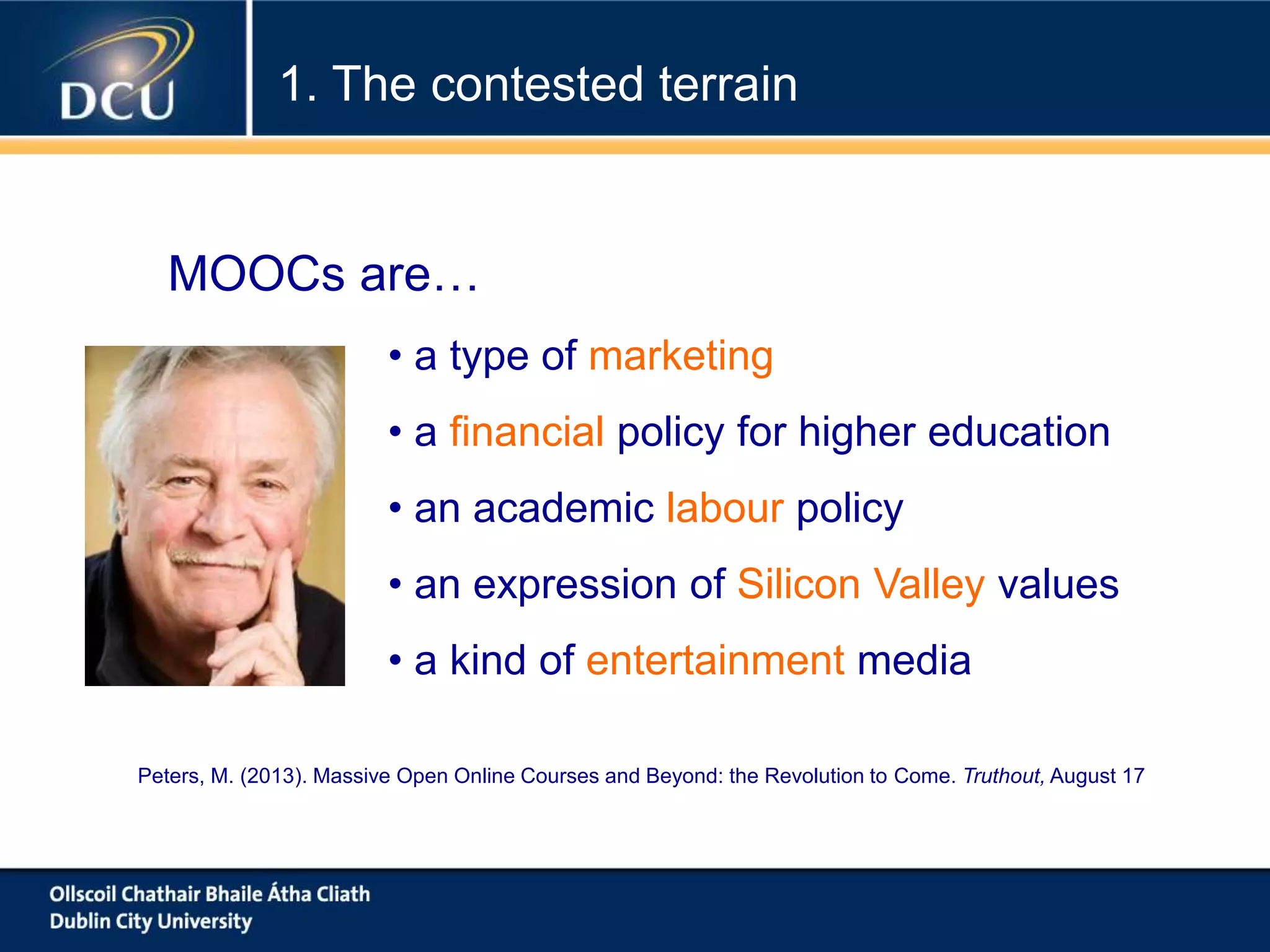
• a type of marketing
• a financial policy for higher education
• an academic labour policy
• an expression of Silicon Valley values
• a kind of entertainment media
MOOCs are…
Peters, M. (2013). Massive Open Online Courses and Beyond: the Revolution to Come. Truthout, August 17
1. The contested terrain
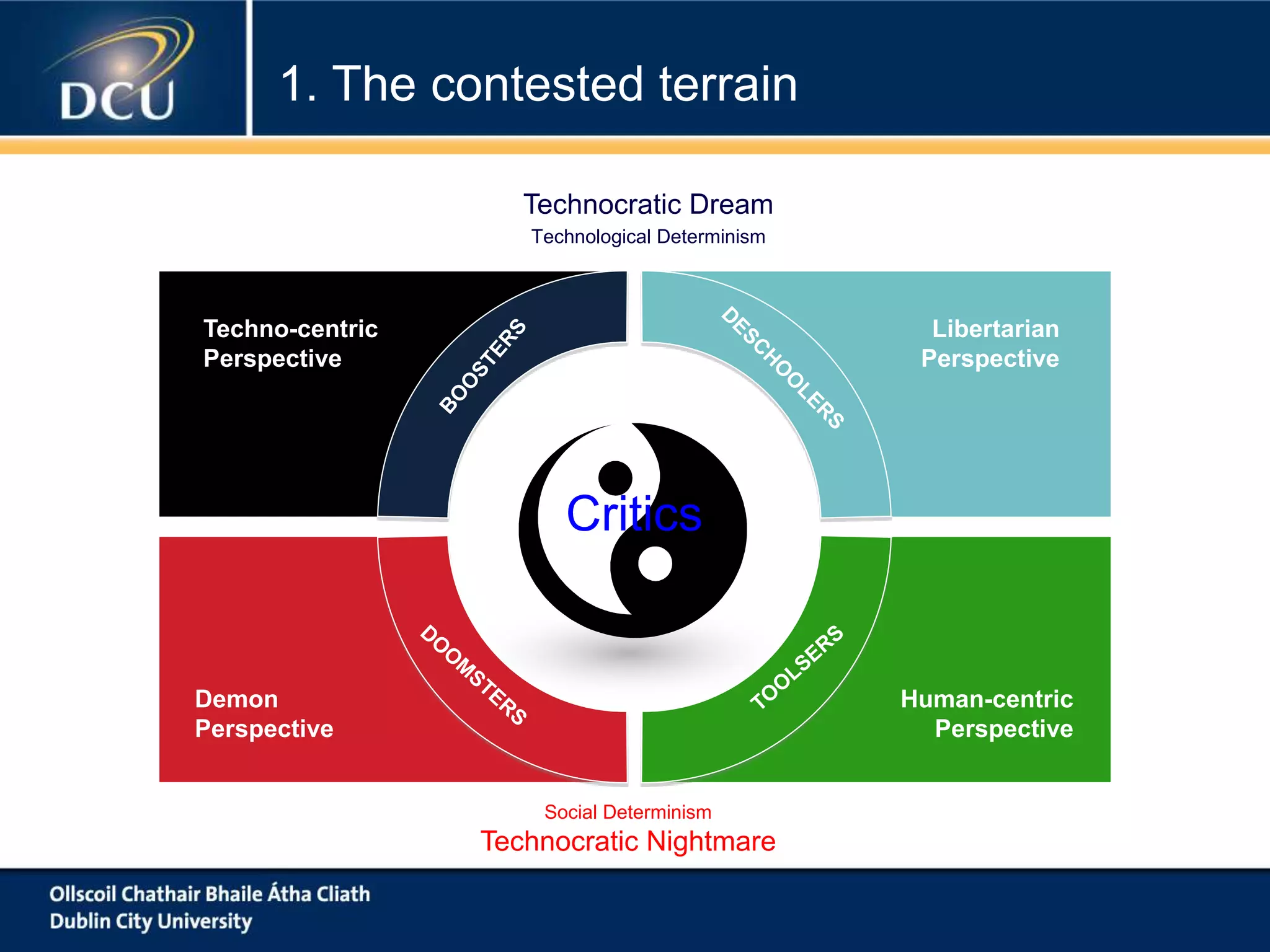
Libertarian
Perspective
Techno-centric
Perspective
Human-centric
Perspective
Demon
Perspective
Technocratic Dream
Technological Determinism
Social Determinism
Technocratic Nightmare
Critics
1. The contested terrain
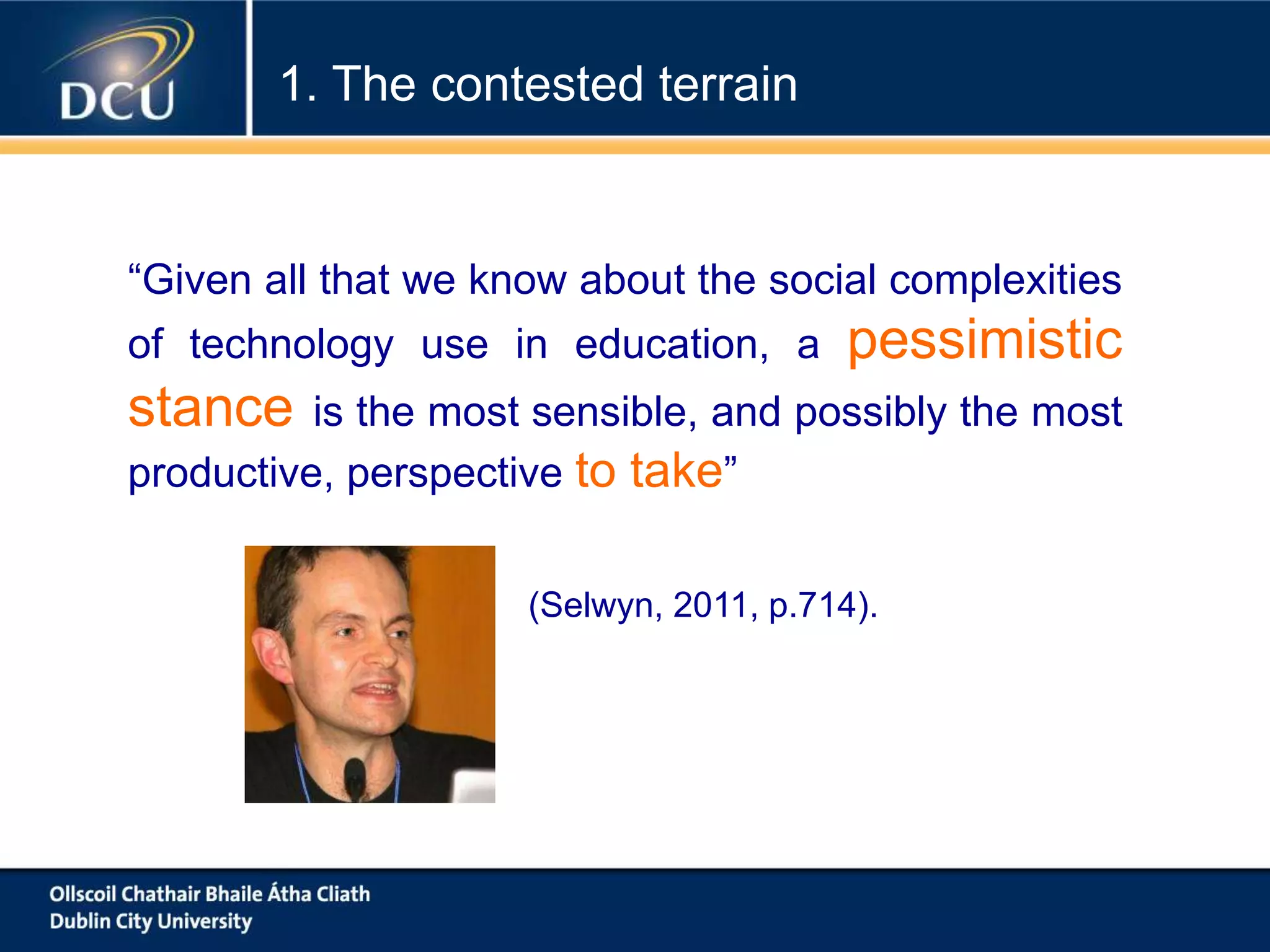
“Given all that we know about the social complexities
of technology use in education, a pessimistic
stance is the most sensible, and possibly the most
productive, perspective to take”
(Selwyn, 2011, p.714).
1. The contested terrain
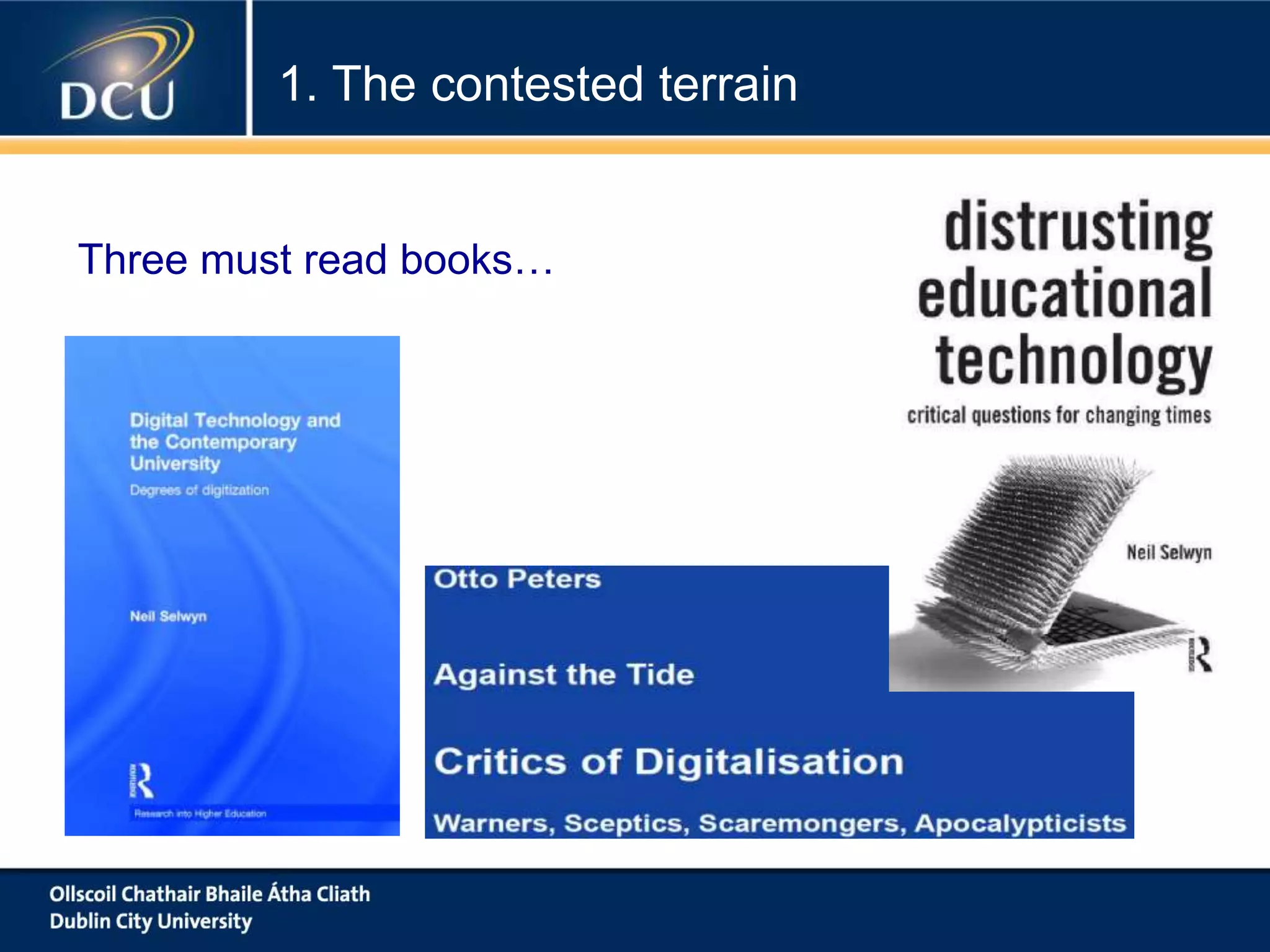
Three must read books…
1. The contested terrain
2. The discourses of persuasion
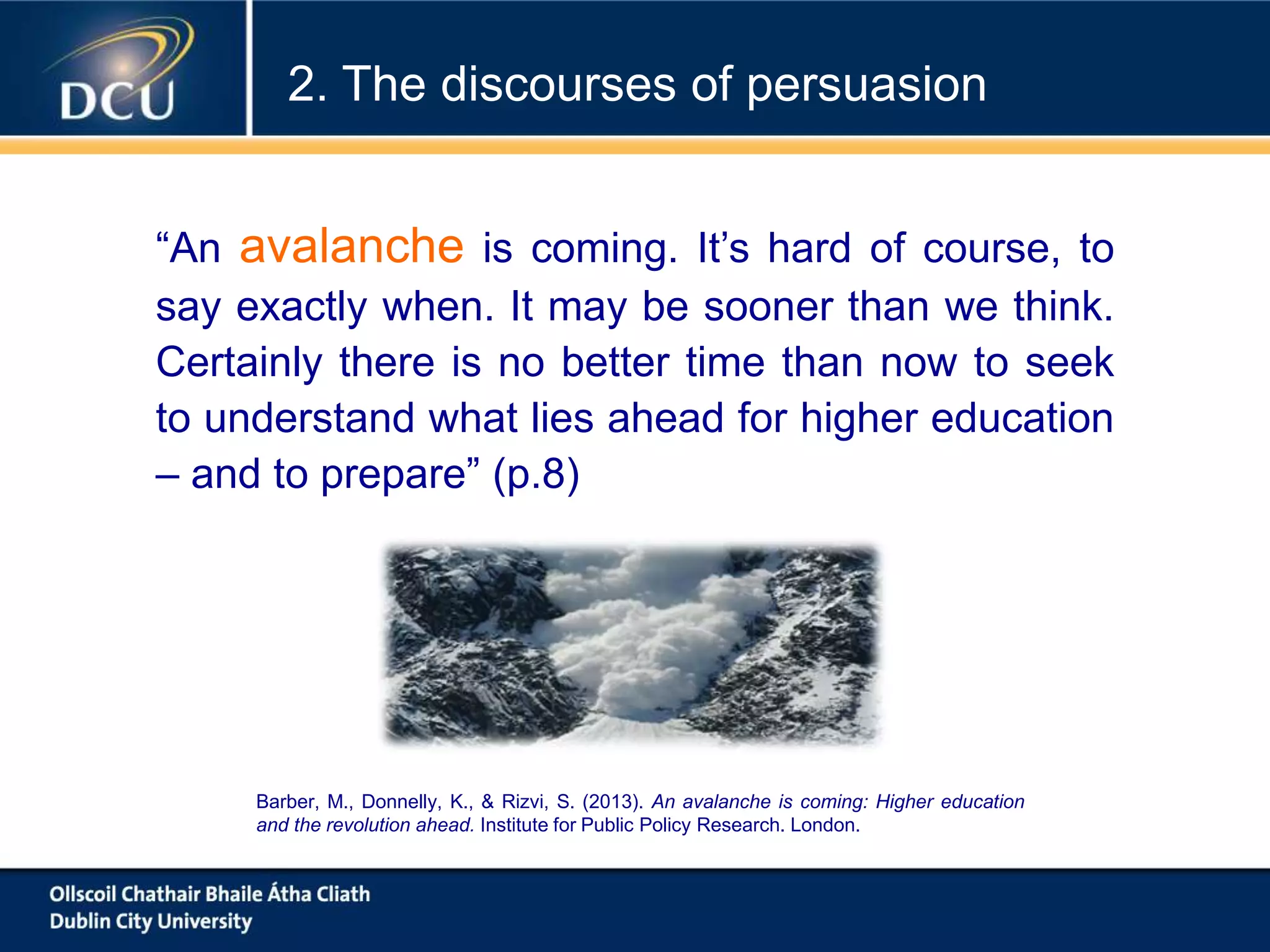
“An avalanche is coming. It’s hard of course, to
say exactly when. It may be sooner than we think.
Certainly there is no better time than now to seek
to understand what lies ahead for higher education
– and to prepare” (p.8)
Barber, M., Donnelly, K., & Rizvi, S. (2013). An avalanche is coming: Higher education
and the revolution ahead. Institute for Public Policy Research. London.
2. The discourses of persuasion
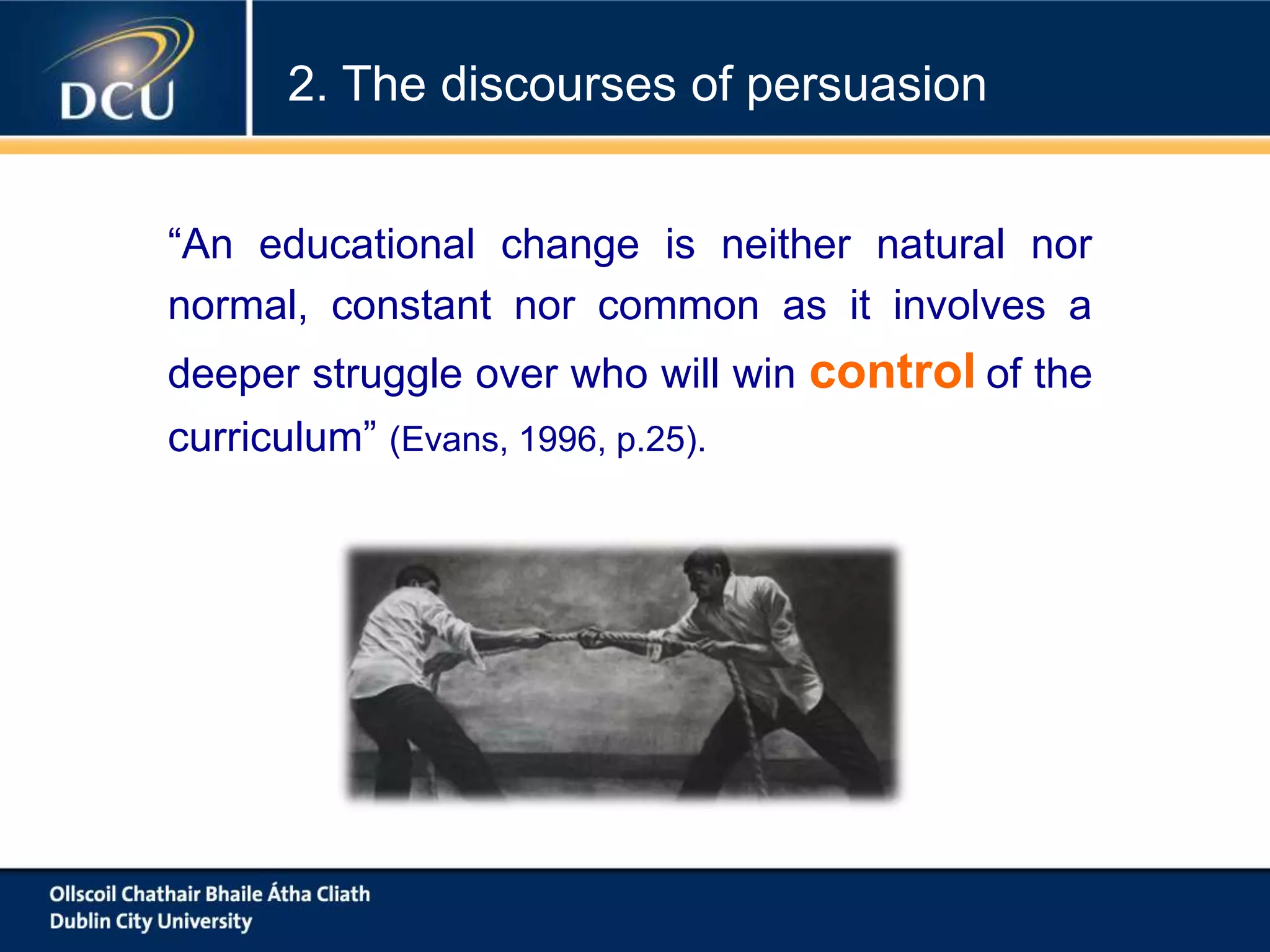
“An educational change is neither natural nor
normal, constant nor common as it involves a
deeper struggle over who will win control of the
curriculum” (Evans, 1996, p.25).
2. The discourses of persuasion
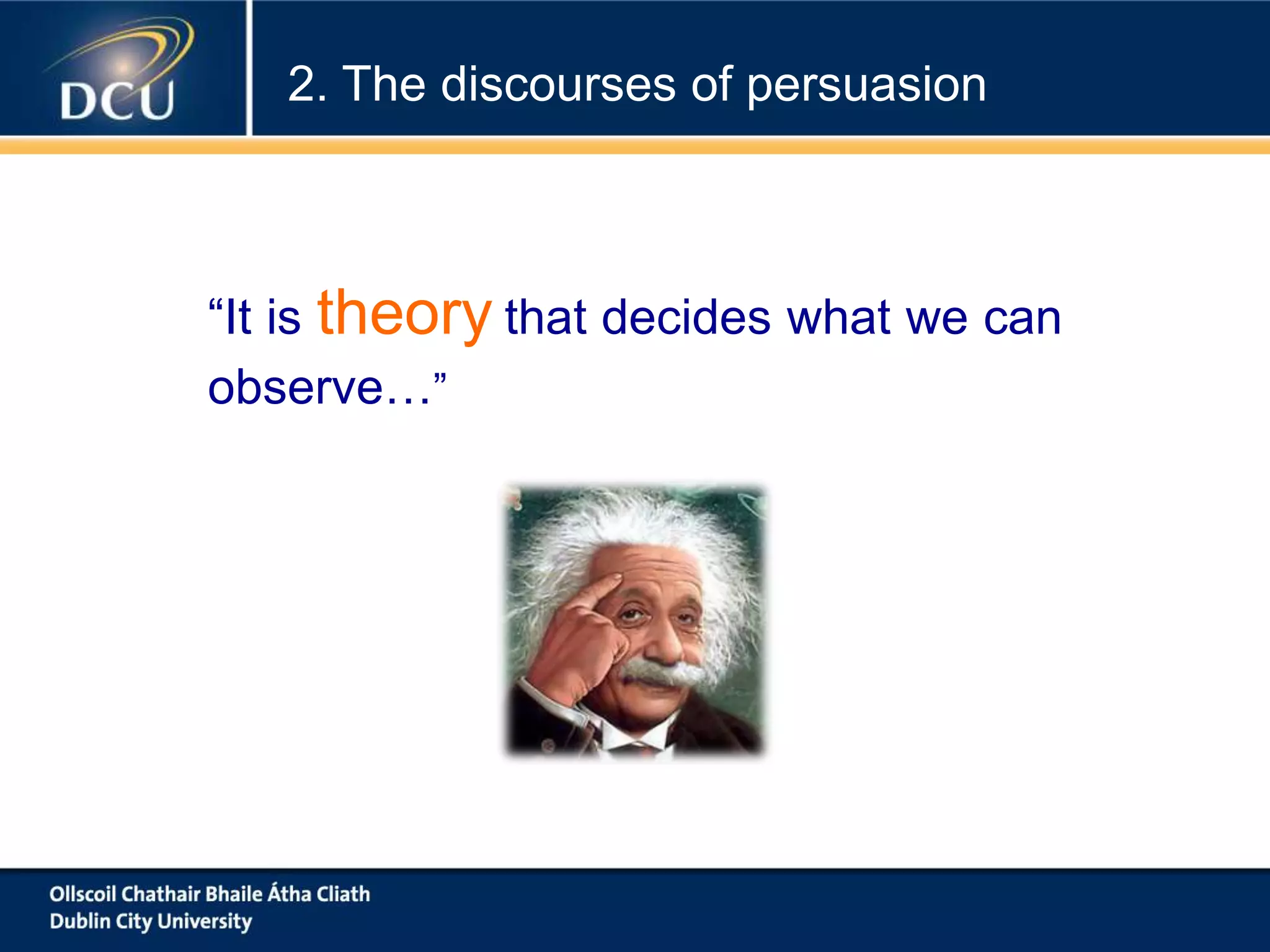
“It is theory that decides what we can
observe…”
Albert Einstein
2. The discourses of persuasion
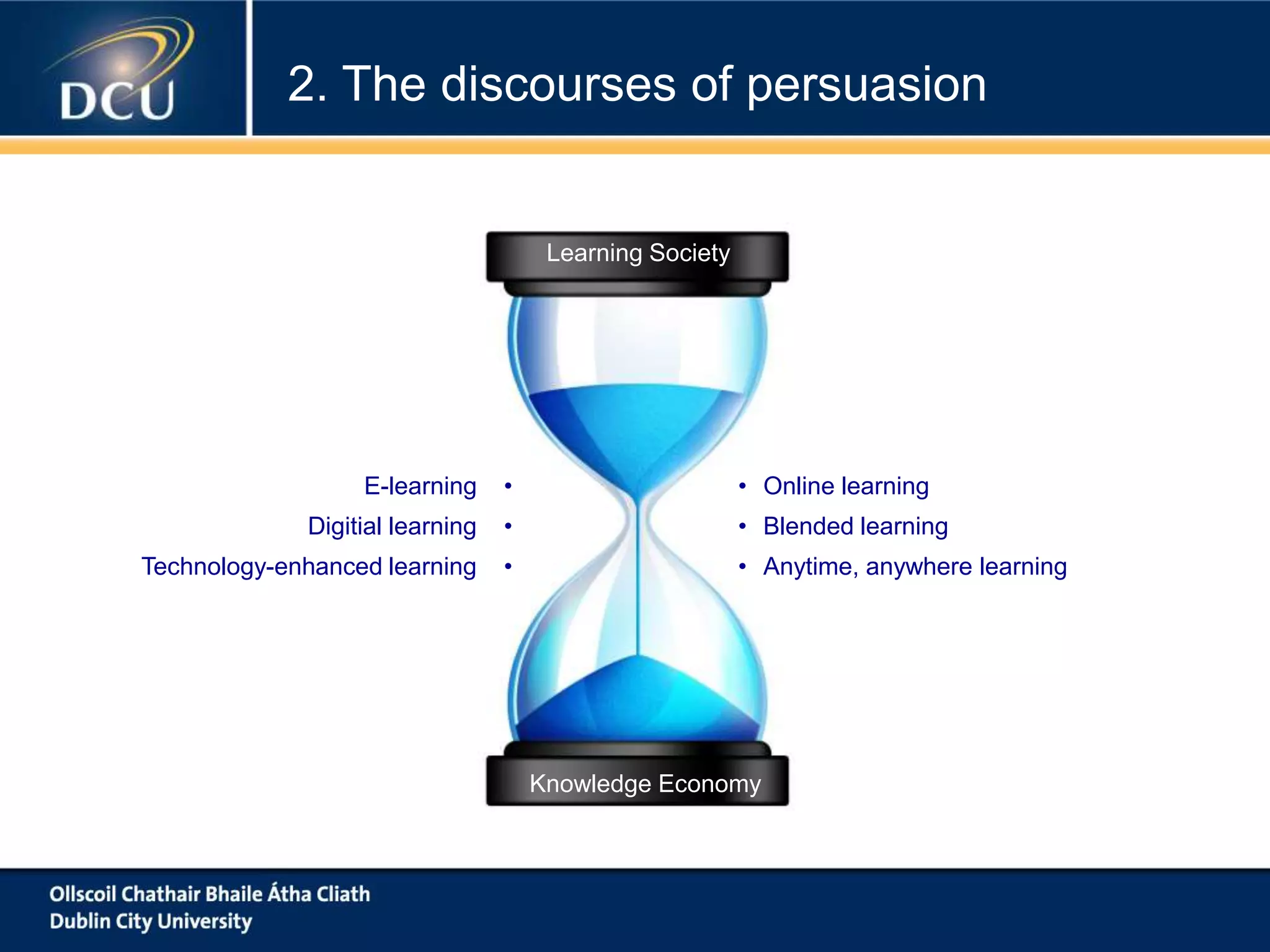
Learning Society
Knowledge Economy
• Online learning
• Blended learning
• Anytime, anywhere learning
E-learning •
Digitial learning •
Technology-enhanced learning •
2. The discourses of persuasion
“Frankly, all the computers and software and Internet
connections in the world won’t do much good if young people
don’t understand that access to new technology means…
access to the new economy”
(President Bill Clinton; cited in Cuban, 2001, p.18).
2. The discourses of persuasion
“The Digital Learning Festival will bring together these digital
learning trailblazers from Ireland and abroad to… chart the way
forward for the future of technology in education thus ensuring
a solid base from which to launch the next phase of Ireland’s
economic growth.”
(EXCITED Digital Learning Festival, 2014).
“Frankly, all the computers and software and Internet
connections in the world won’t do much good if young people
don’t understand that access to new technology means…
access to the new economy”
(President Bill Clinton; cited in Cuban, 2001, p.18).
2. The discourses of persuasion
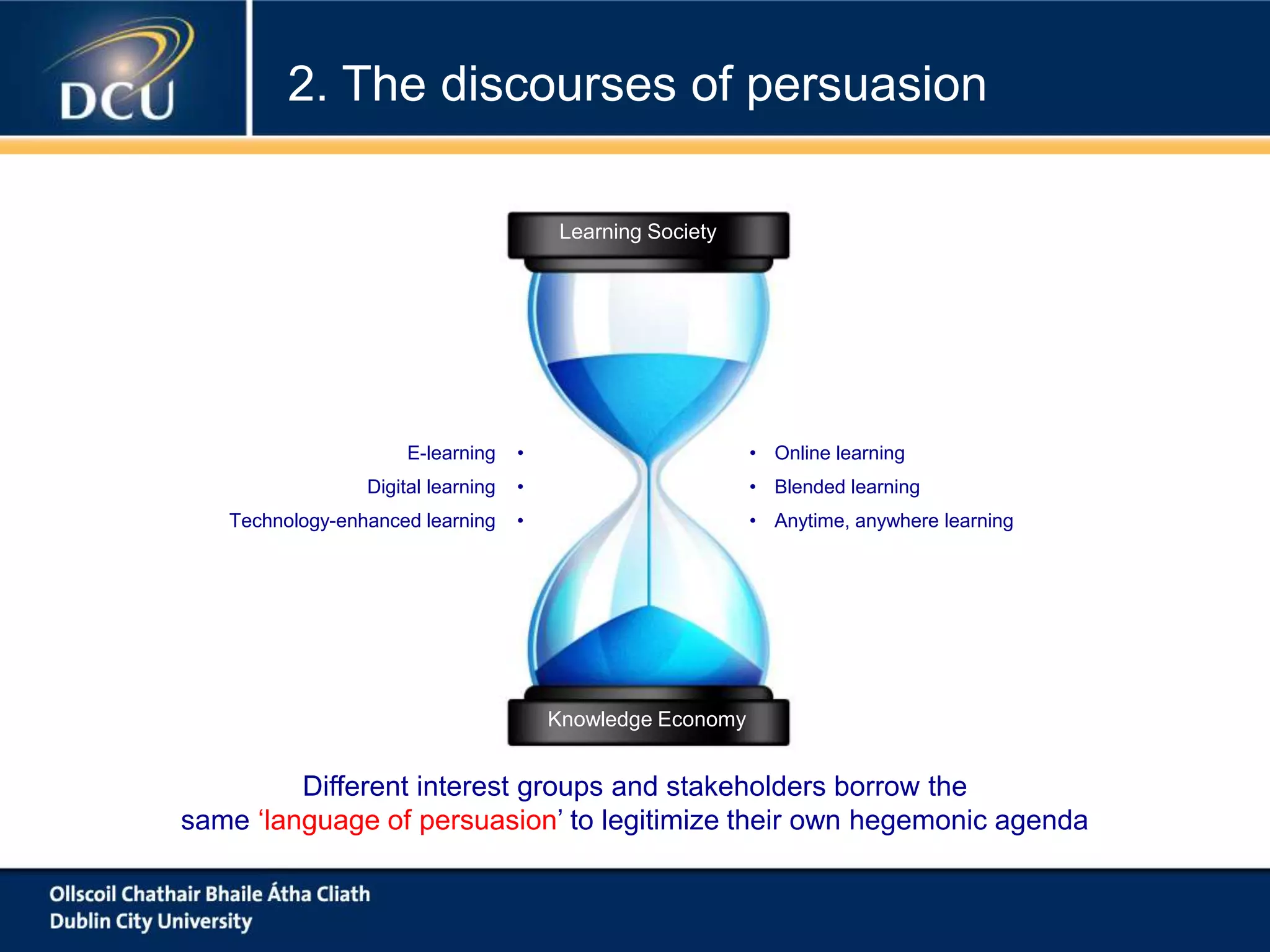
Learning Society
Knowledge Economy
• Online learning
• Blended learning
• Anytime, anywhere learning
E-learning •
Digital learning •
Technology-enhanced learning •
Different interest groups and stakeholders borrow the
same ‘language of persuasion’ to legitimize their own hegemonic agenda
2. The discourses of persuasion
The concept of hegemony—in which dominant
groups in society seek to establish the common
sense, define what counts as legitimate areas of
agreement and disagreement, and shape the
political agendas made public and discussed as
possible—is central to peeling away the forces
shaping the digital future.
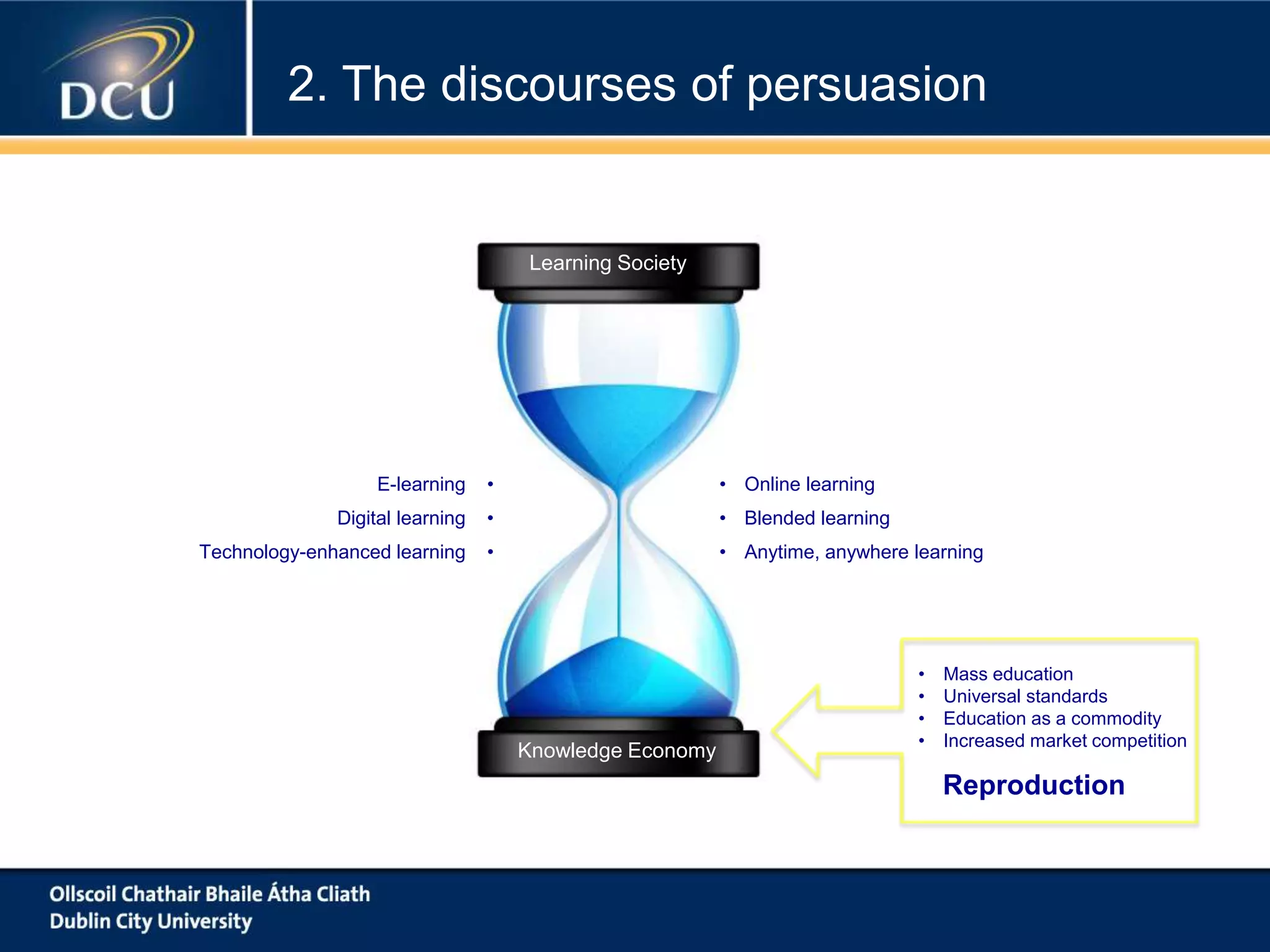
2. The discourses of persuasion
Learning Society
Knowledge Economy
Reproduction
• Mass education
• Universal standards
• Education as a commodity
• Increased market competition
• Online learning
• Blended learning
• Anytime, anywhere learning
E-learning •
Digital learning •
Technology-enhanced learning •
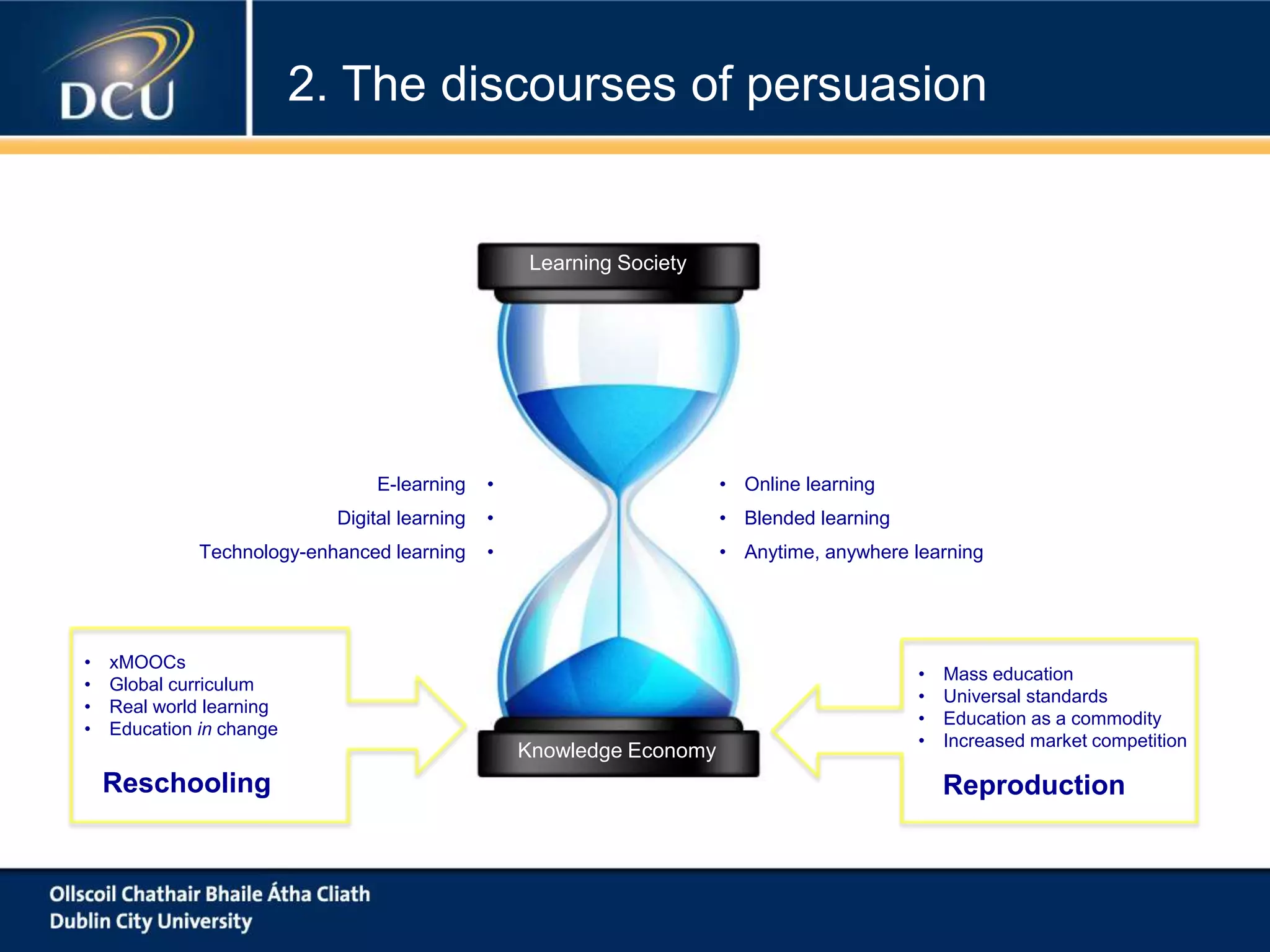
2. The discourses of persuasion
Learning Society
Knowledge Economy
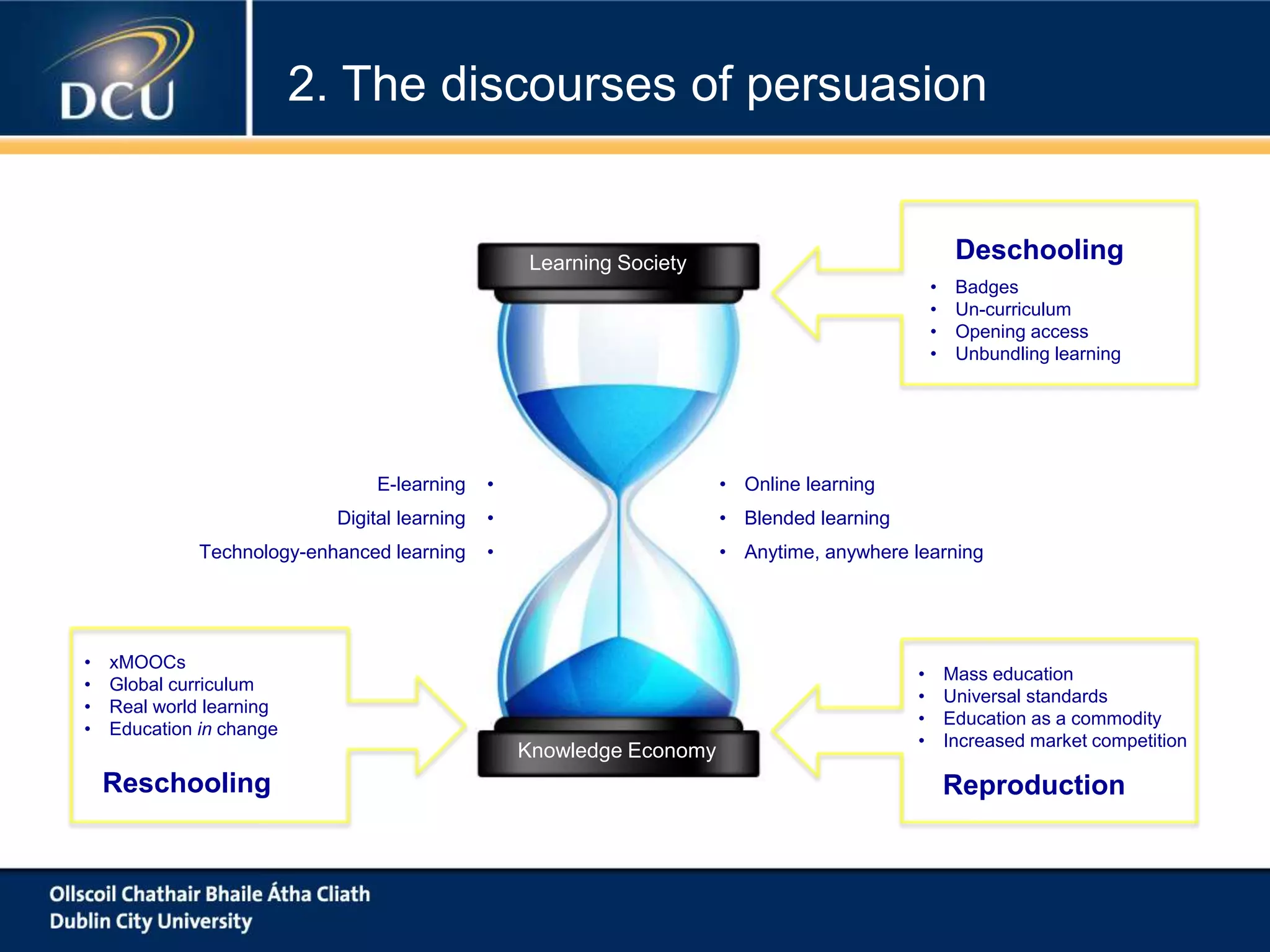
Reschooling Reproduction
• xMOOCs
• Global curriculum
• Real world learning
• Education in change
• Mass education
• Universal standards
• Education as a commodity
• Increased market competition
• Online learning
• Blended learning
• Anytime, anywhere learning
E-learning •
Digital learning •
Technology-enhanced learning •
2. The discourses of persuasion
Learning Society
Knowledge Economy
Deschooling
Reschooling Reproduction
• xMOOCs
• Global curriculum
• Real world learning
• Education in change
• Mass education
• Universal standards
• Education as a commodity
• Increased market competition
• Online learning
• Blended learning
• Anytime, anywhere learning
E-learning •
Digital learning •
Technology-enhanced learning •
• Badges
• Un-curriculum
• Opening access
• Unbundling learning
2. The discourses of persuasion
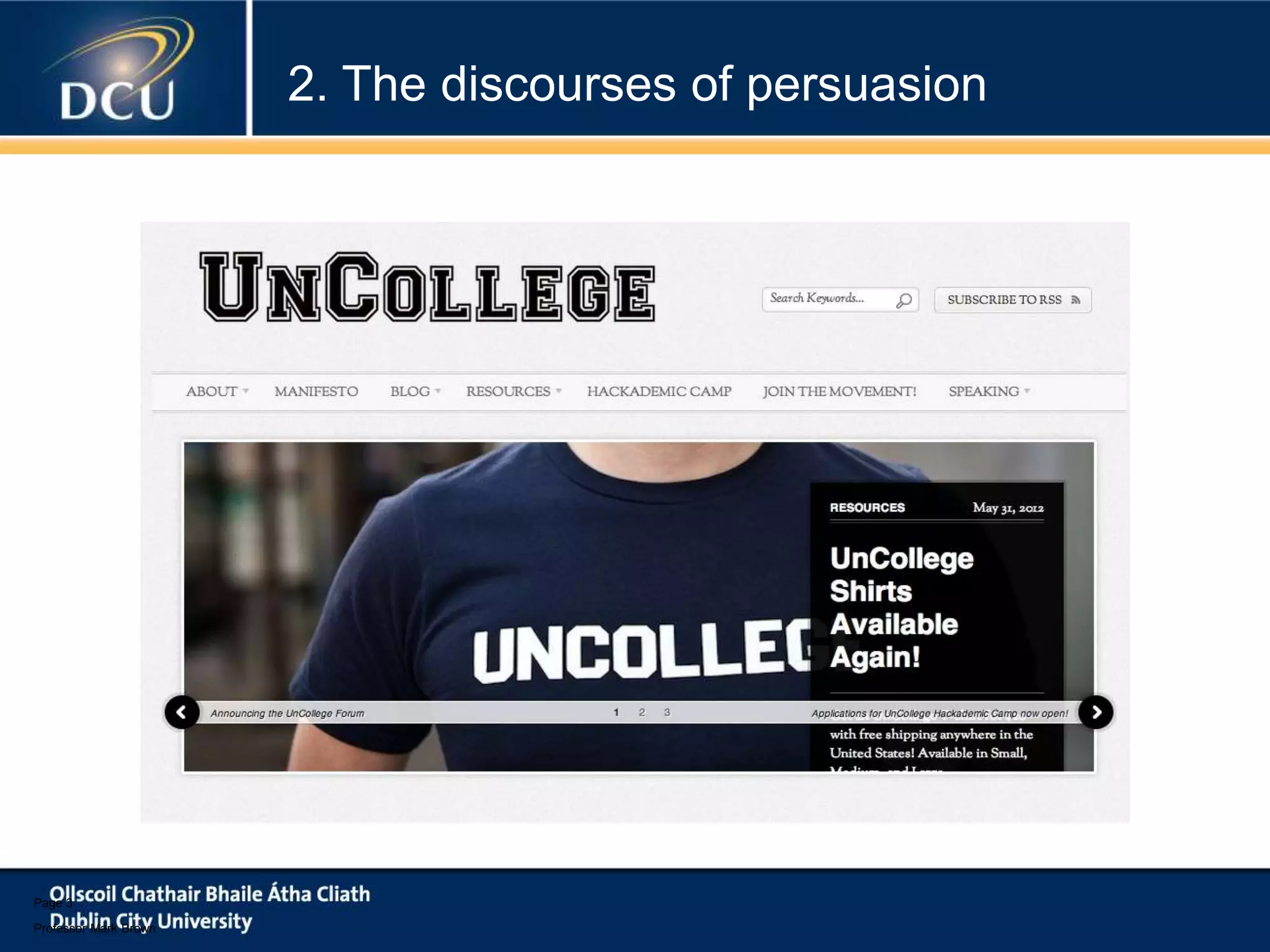
Page 3
Professor Mark Brown
2. The discourses of persuasion
Page 3
Professor Mark Brown
2. The discourses of persuasion
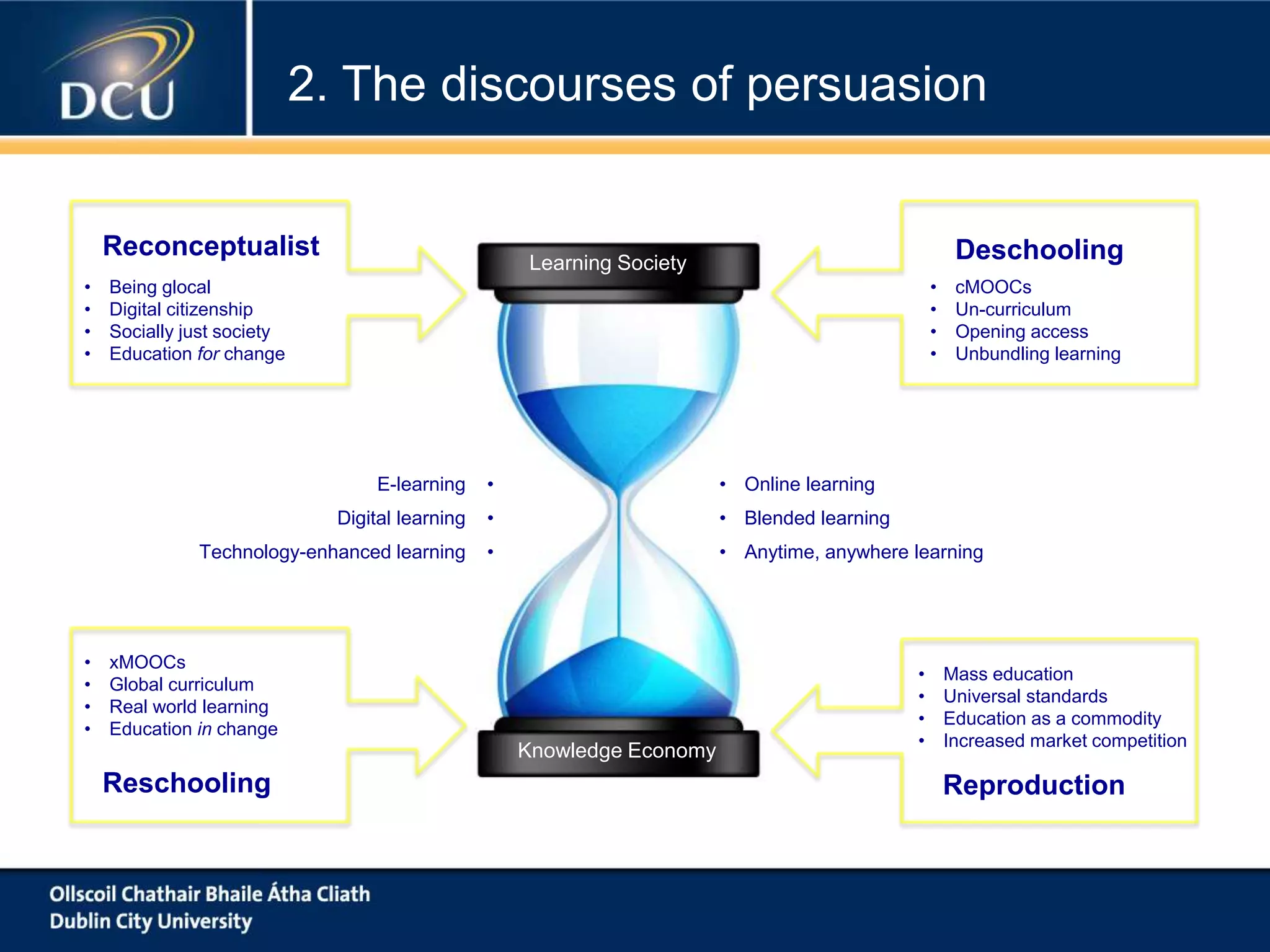
Reconceptualist
Learning Society
Knowledge Economy
Deschooling
Reschooling Reproduction
• Being glocal
• Digital citizenship
• Socially just society
• Education for change
• xMOOCs
• Global curriculum
• Real world learning
• Education in change
• Mass education
• Universal standards
• Education as a commodity
• Increased market competition
• Online learning
• Blended learning
• Anytime, anywhere learning
E-learning •
Digital learning •
Technology-enhanced learning •
• cMOOCs
• Un-curriculum
• Opening access
• Unbundling learning
2. The discourses of persuasion
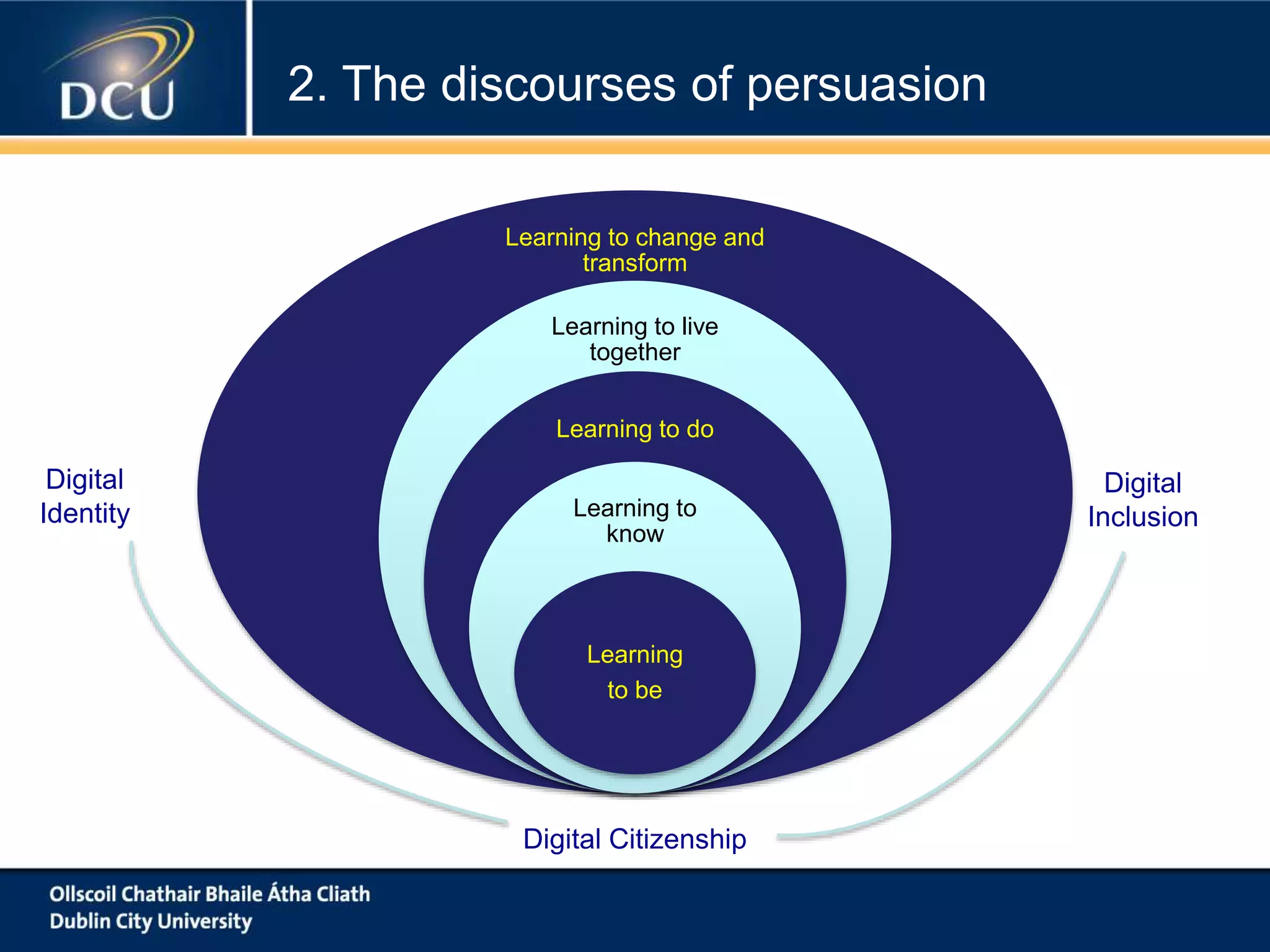
Learning to change and
transform
Learning to live
together
Learning to do
Learning to
know
Learning
to be
Digital
Inclusion
Digital Citizenship
Digital
Identity
2. The discourses of persuasion
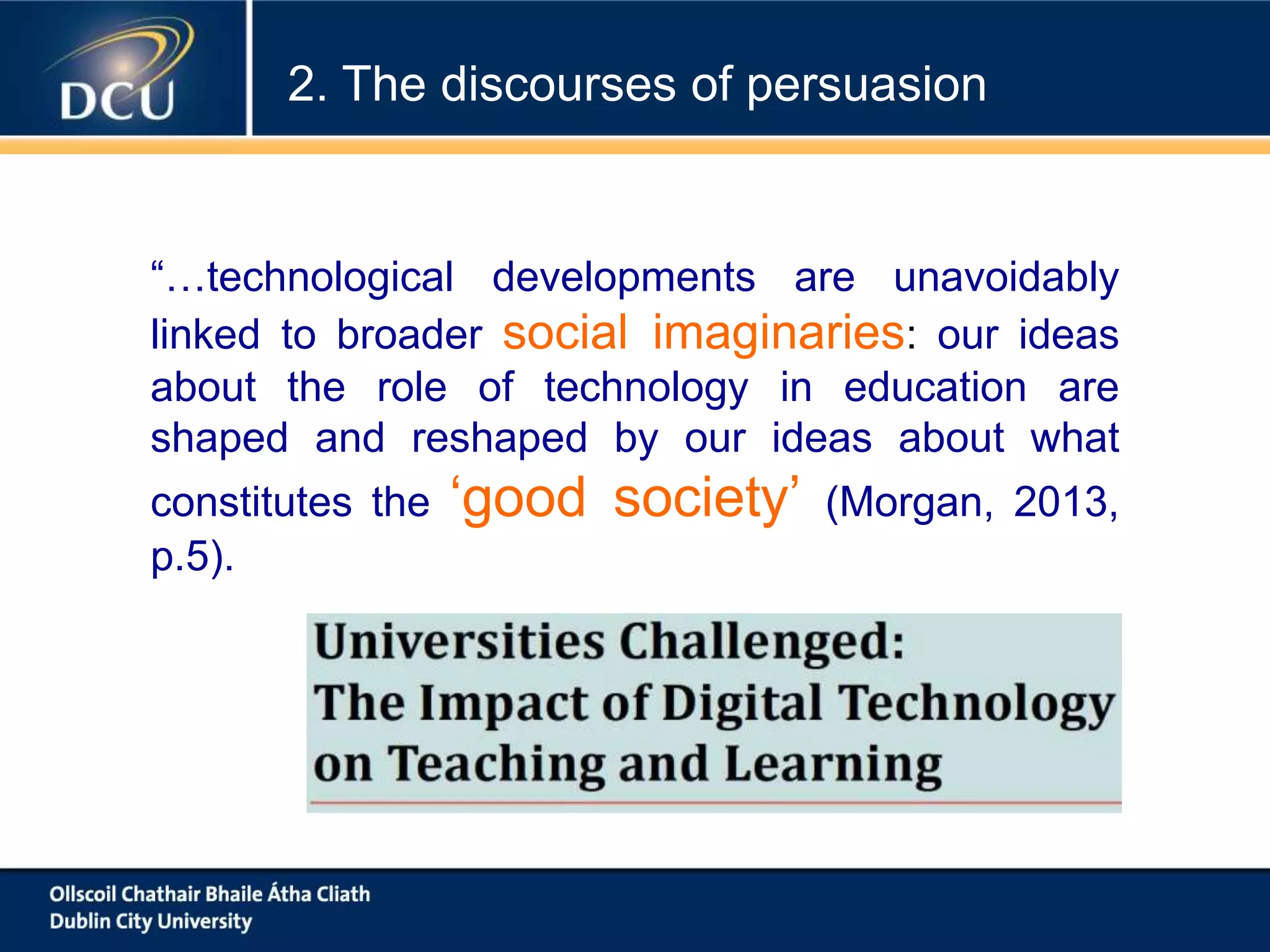
“…technological developments are unavoidably
linked to broader social imaginaries: our ideas
about the role of technology in education are
shaped and reshaped by our ideas about what
constitutes the ‘good society’ (Morgan, 2013,
p.5).
2. The discourses of persuasion
Page 3
Professor Mark Brown
• Who is telling the story?
• What is the story they are
telling?
• What story isn’t being
told?
• What’s missing from the
story?
Key questions…
2. The discourses of persuasion
Page 3
Professor Mark Brown
3. Leading for change in painful times
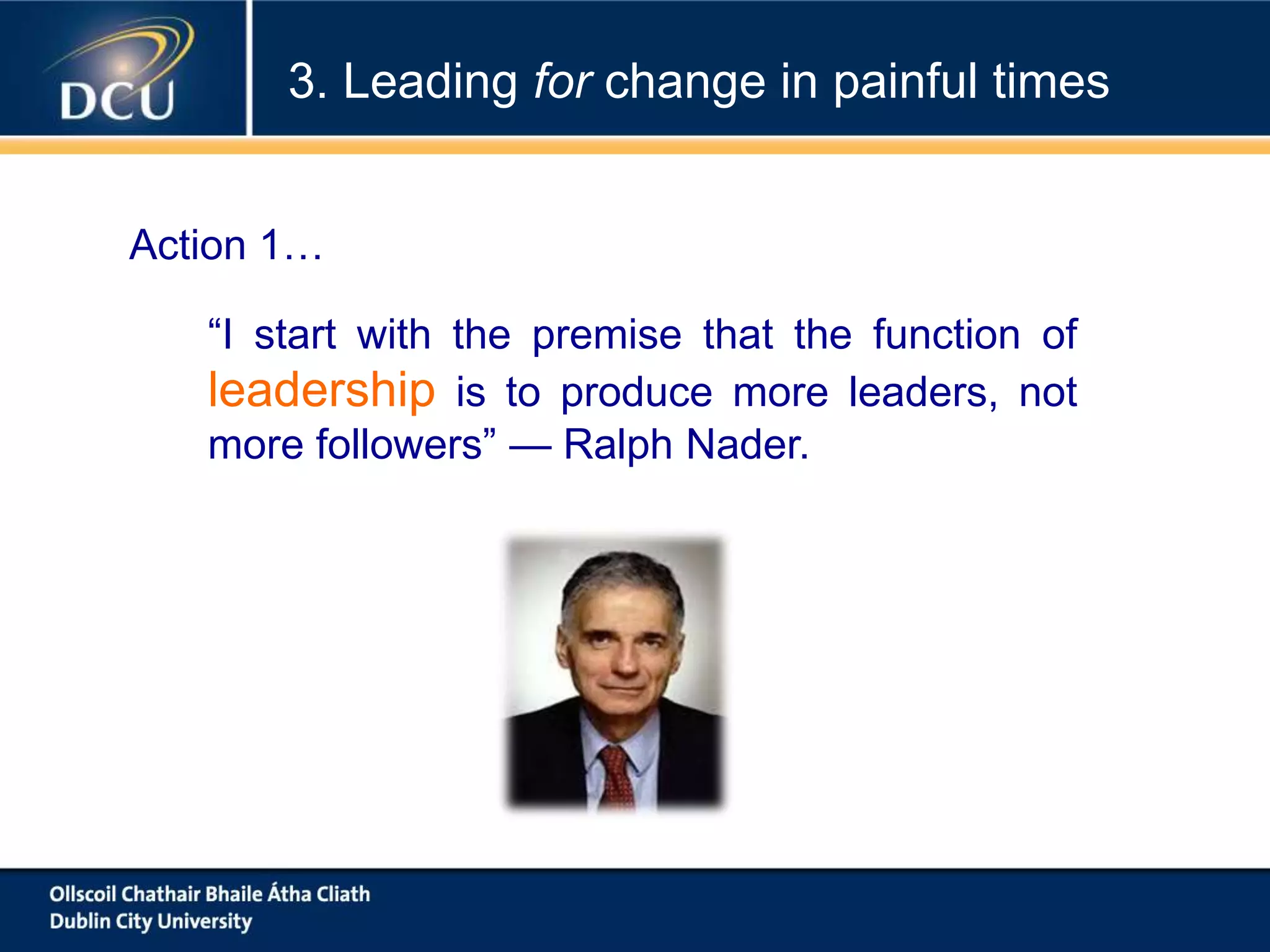
“I start with the premise that the function of
leadership is to produce more leaders, not
more followers” — Ralph Nader.
Action 1…
3. Leading for change in painful times
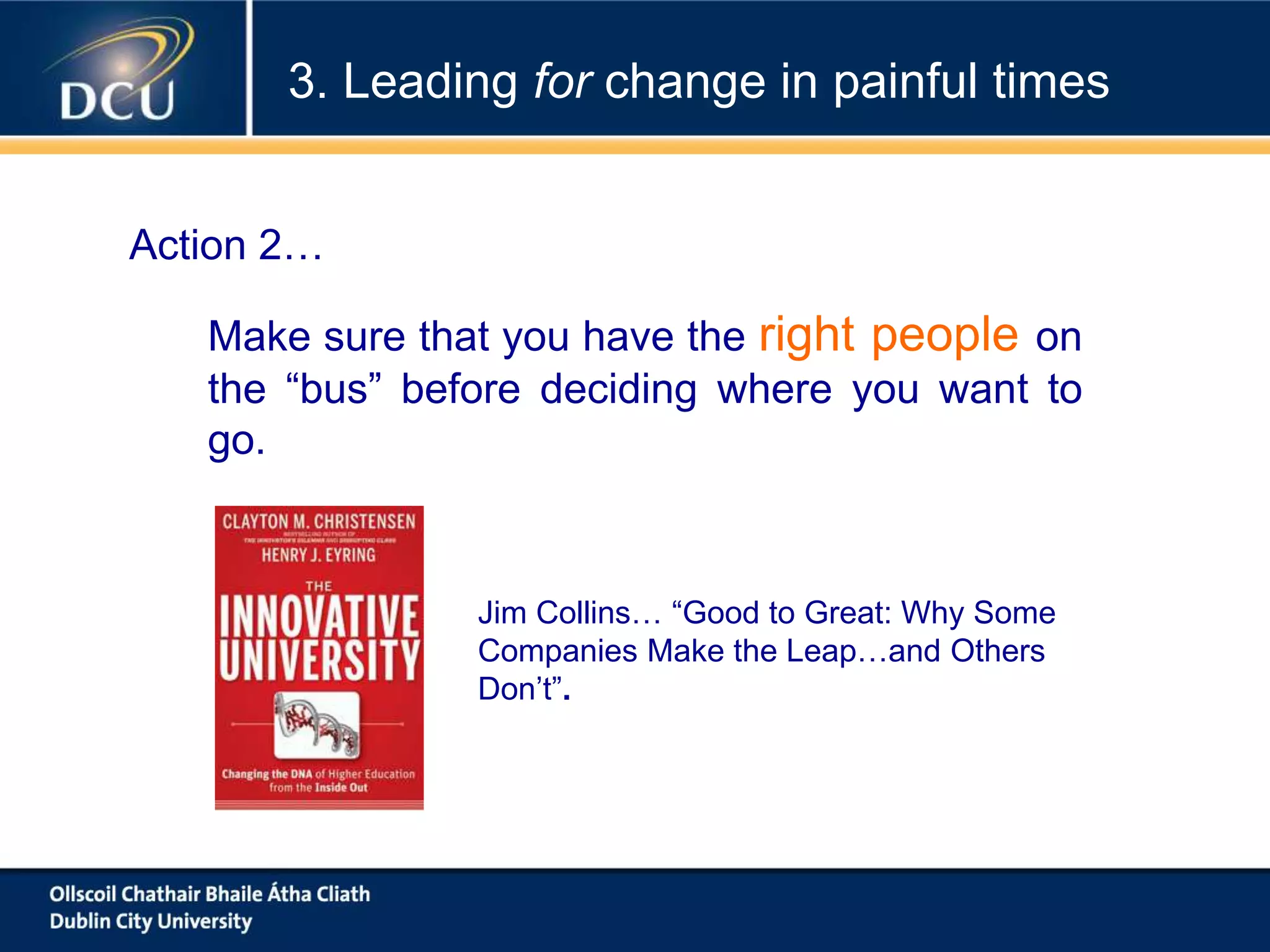
Make sure that you have the right people on
the “bus” before deciding where you want to
go.
Jim Collins… “Good to Great: Why Some
Companies Make the Leap…and Others
Don’t”.
Action 2…
3. Leading for change in painful times
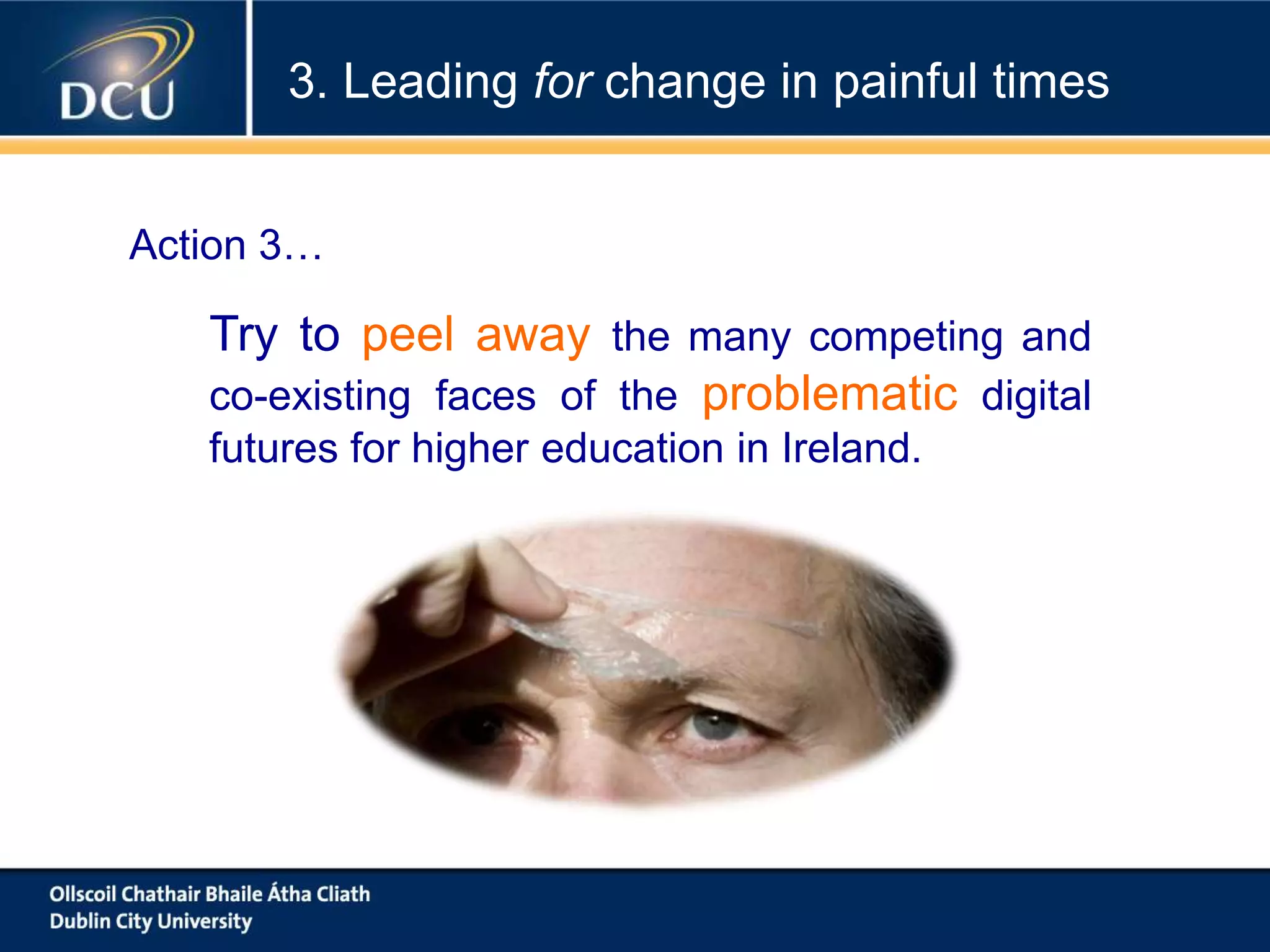
Try to peel away the many competing and
co-existing faces of the problematic digital
futures for higher education in Ireland.
3. Leading for change in painful times
Action 3…
Page 3
Professor Mark Brown
3. Leading for change in painful times
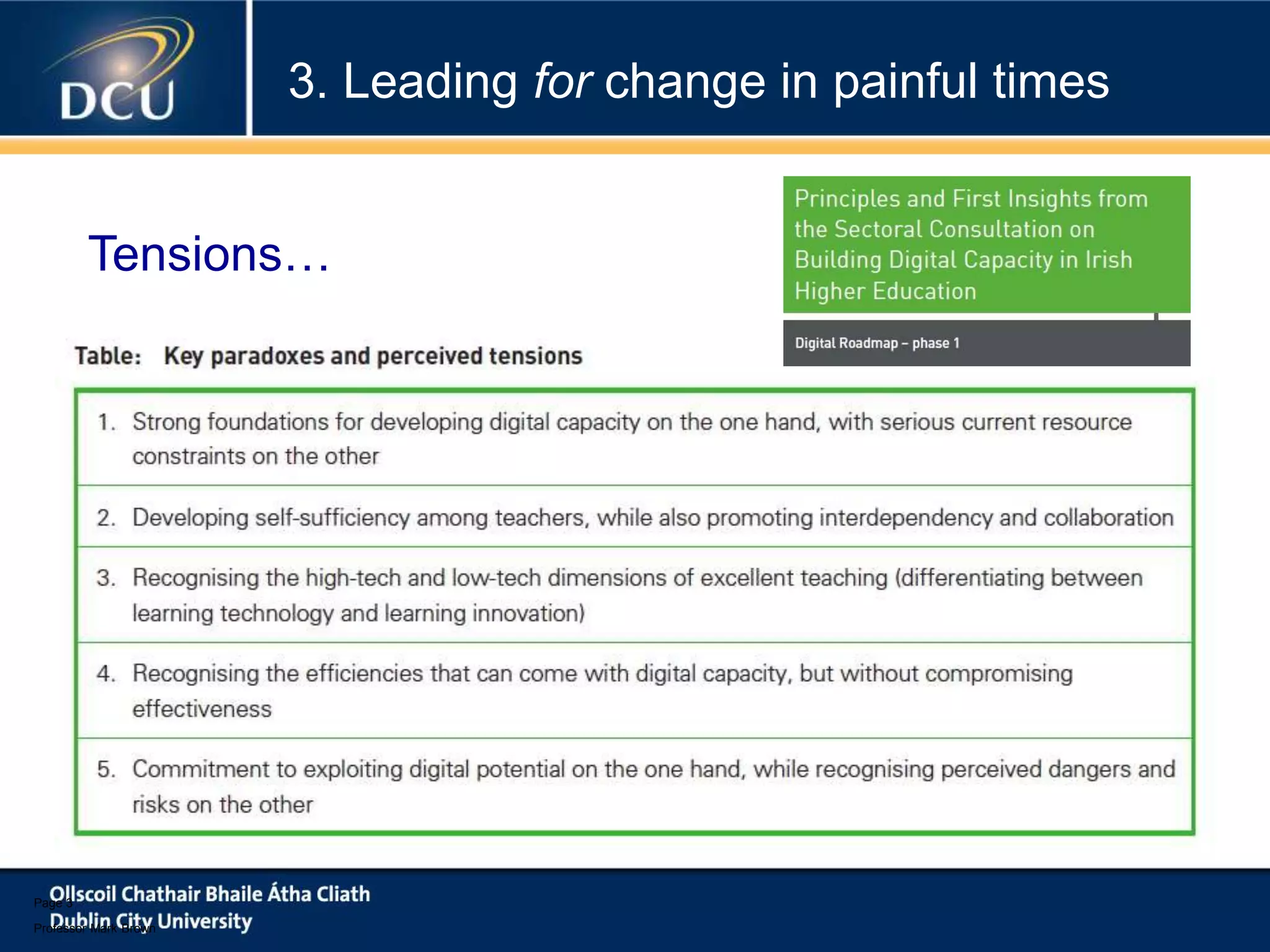
Tensions…
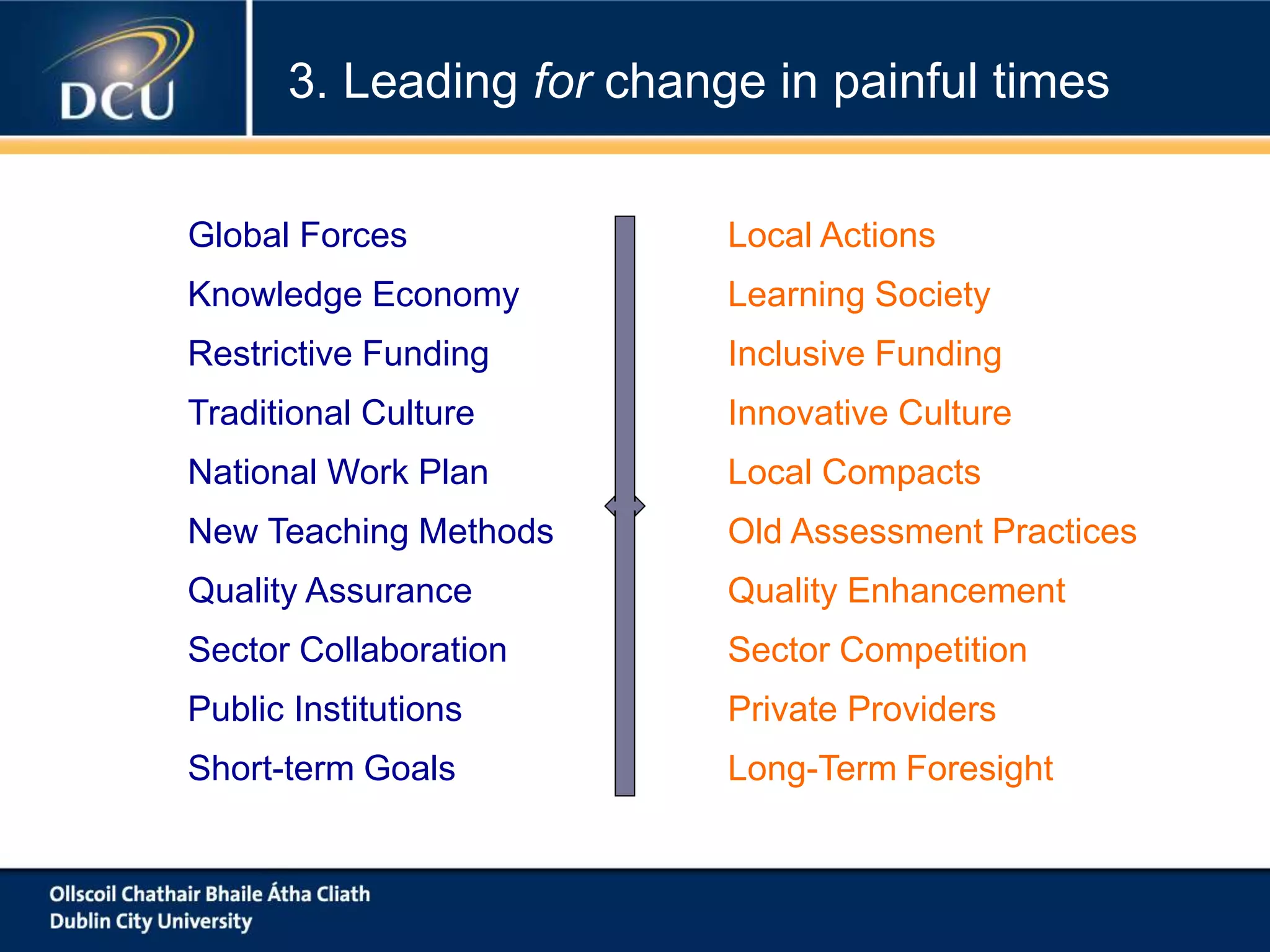
Global Forces
Knowledge Economy
Restrictive Funding
Traditional Culture
National Work Plan
New Teaching Methods
Quality Assurance
Sector Collaboration
Public Institutions
Short-term Goals
Local Actions
Learning Society
Inclusive Funding
Innovative Culture
Local Compacts
Old Assessment Practices
Quality Enhancement
Sector Competition
Private Providers
Long-Term Foresight
3. Leading for change in painful times
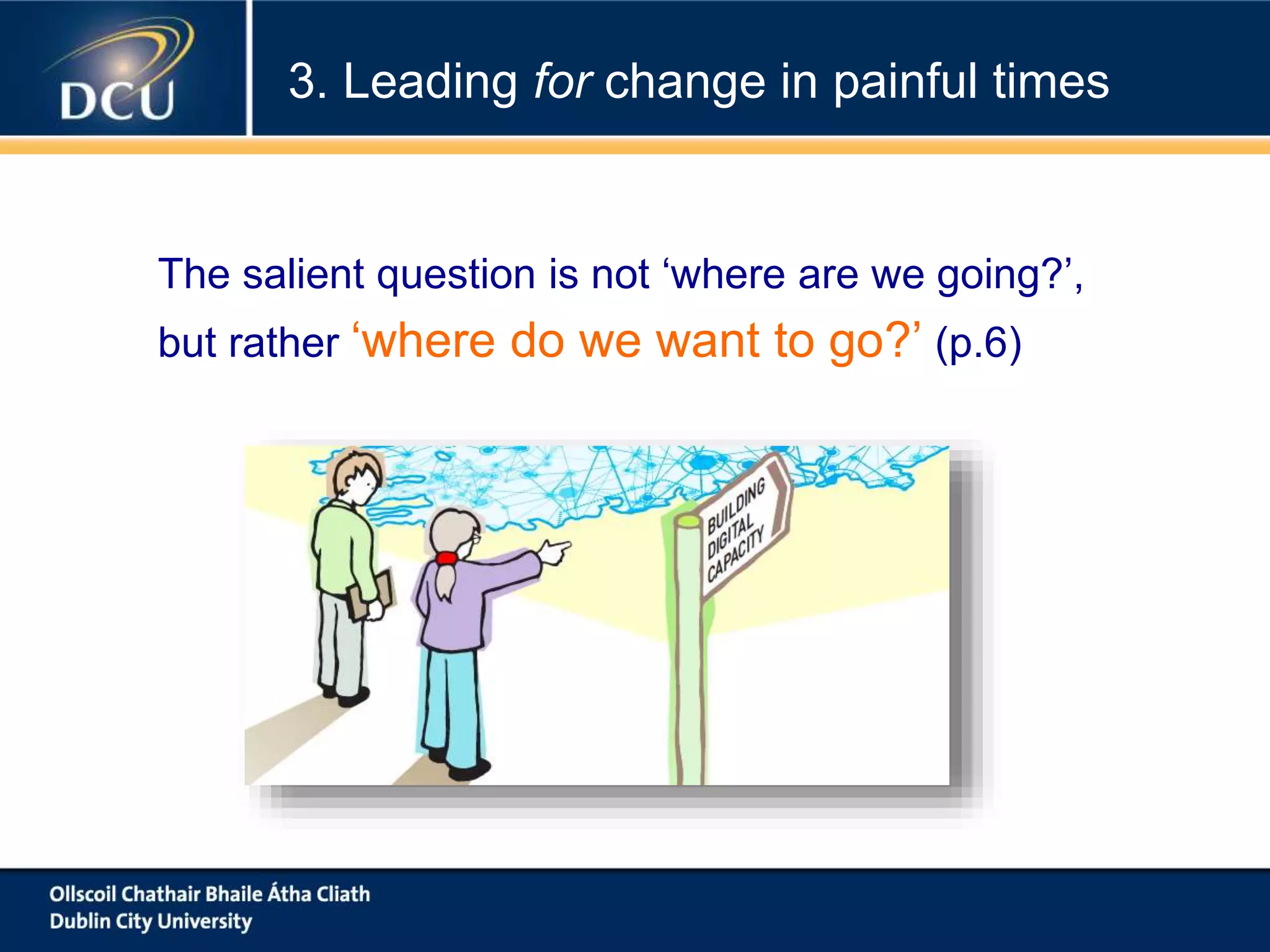
The salient question is not ‘where are we going?’,
but rather ‘where do we want to go?’ (p.6)
3. Leading for change in painful times
Conclusion
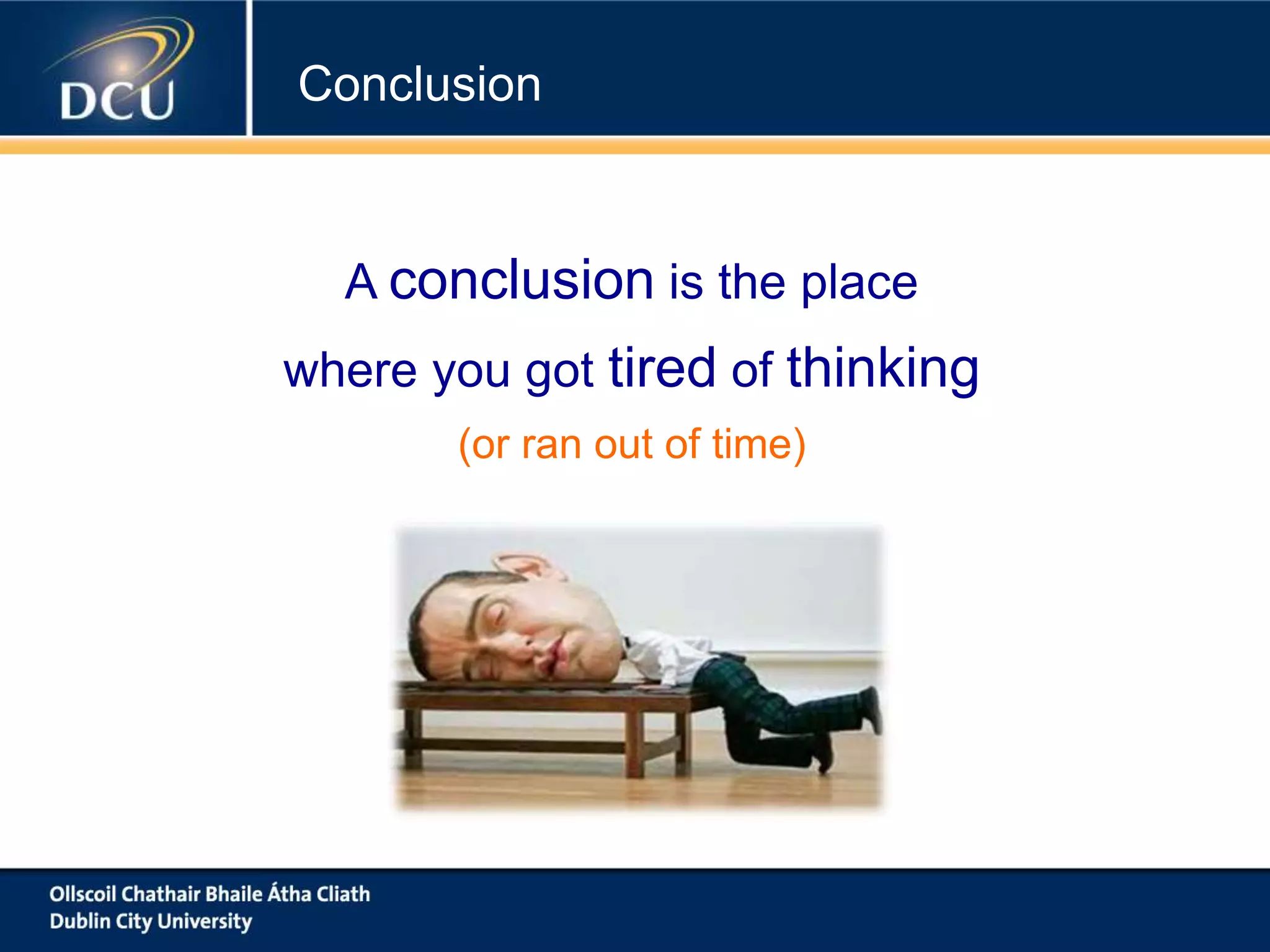
A conclusion is the place
where you got tired of thinking
(or ran out of time)
Conclusion
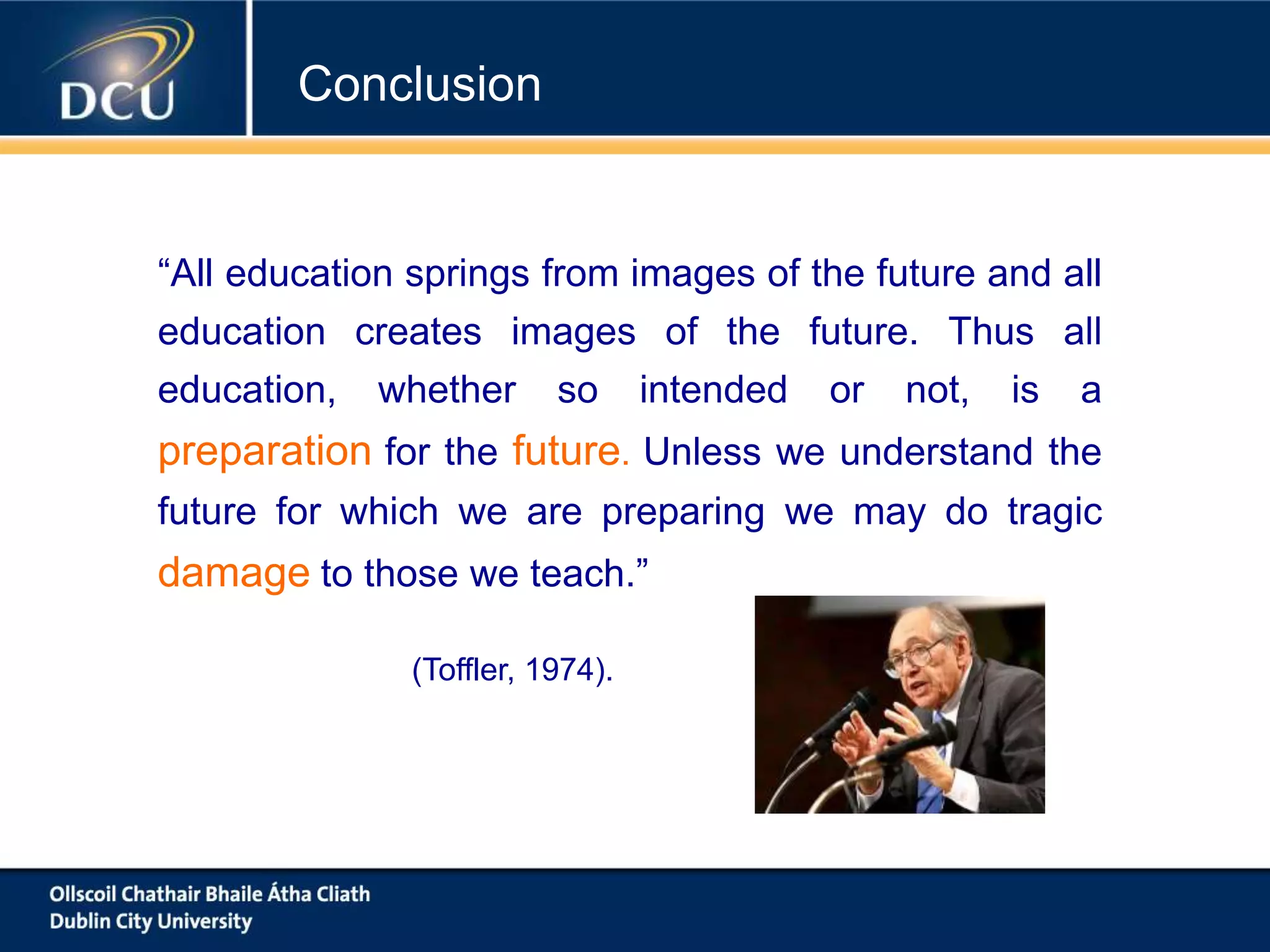
“All education springs from images of the future and all
education creates images of the future. Thus all
education, whether so intended or not, is a
preparation for the future. Unless we understand the
future for which we are preparing we may do tragic
damage to those we teach.”
(Toffler, 1974).
Conclusion
Contact details…
Professor Mark Brown
Director, National Institute for Digital Learning
mark.brown@dcu.ie
@mbrownz
http://www.slideshare.net/mbrownz
http://www.dcu.ie/nidl

Education and the Digital World: Promise, Progress and Pain

  • 1.
    A cutting-edge digitallearning strategy Education and the Digital World: Promise, Progress and Pain Professor Mark Brown Director, National Institute for Digital Learning e-Learning Summer School Friday 27th June 2014
  • 2.
  • 3.
  • 4.
  • 5.
  • 6.
    1. The contestedterrain 2. The discourses of persuasion 3. Leading for change in painful times Education and the Digital World Outline
  • 7.
    Who controls thepast commands the future. Who commands the future conquers the past. (George Orwell) Salient message…
  • 8.
  • 9.
  • 10.
  • 11.
  • 12.
  • 13.
  • 14.
  • 15.
  • 16.
    (Burbles & Callister,2000, p.6). 1. The contested terrain “Tools do not only help us accomplish (given) purposes; they may create new purposes, new ends, that were never considered before the tools made them possible. In these and other ways tools change the user: sometimes quite concretely, as when the shape of stone tools became a factor in the evolution of the human hand (…).
  • 17.
    Tools may havecertain intended uses and purposes, but they frequently acquire new, unexpected uses and have new, unexpected effects. What this suggests is that we never simply use tools, without the tools also “using” us” (Burbles & Callister, 2000, p.6). 1. The contested terrain “Tools do not only help us accomplish (given) purposes; they may create new purposes, new ends, that were never considered before the tools made them possible. In these and other ways tools change the user: sometimes quite concretely, as when the shape of stone tools became a factor in the evolution of the human hand (…).
  • 18.
    “Cyberspace is notpolitically neutral. It favors the political ideals of libertarian, free-market Republicans: a highly decentralized, deregulated society with little common discourse and minimal public infrastructure” (Shenk; cited in Burbules & Callister, 2000, p.169). 1. The contested terrain
  • 19.
    • a typeof marketing • a financial policy for higher education • an academic labour policy • an expression of Silicon Valley values • a kind of entertainment media MOOCs are… Peters, M. (2013). Massive Open Online Courses and Beyond: the Revolution to Come. Truthout, August 17 1. The contested terrain
  • 20.
  • 21.
    “Given all thatwe know about the social complexities of technology use in education, a pessimistic stance is the most sensible, and possibly the most productive, perspective to take” (Selwyn, 2011, p.714). 1. The contested terrain
  • 22.
    Three must readbooks… 1. The contested terrain
  • 23.
    2. The discoursesof persuasion
  • 24.
    “An avalanche iscoming. It’s hard of course, to say exactly when. It may be sooner than we think. Certainly there is no better time than now to seek to understand what lies ahead for higher education – and to prepare” (p.8) Barber, M., Donnelly, K., & Rizvi, S. (2013). An avalanche is coming: Higher education and the revolution ahead. Institute for Public Policy Research. London. 2. The discourses of persuasion
  • 25.
    “An educational changeis neither natural nor normal, constant nor common as it involves a deeper struggle over who will win control of the curriculum” (Evans, 1996, p.25). 2. The discourses of persuasion
  • 26.
    “It is theorythat decides what we can observe…” Albert Einstein 2. The discourses of persuasion
  • 27.
    Learning Society Knowledge Economy •Online learning • Blended learning • Anytime, anywhere learning E-learning • Digitial learning • Technology-enhanced learning • 2. The discourses of persuasion
  • 28.
    “Frankly, all thecomputers and software and Internet connections in the world won’t do much good if young people don’t understand that access to new technology means… access to the new economy” (President Bill Clinton; cited in Cuban, 2001, p.18). 2. The discourses of persuasion
  • 29.
    “The Digital LearningFestival will bring together these digital learning trailblazers from Ireland and abroad to… chart the way forward for the future of technology in education thus ensuring a solid base from which to launch the next phase of Ireland’s economic growth.” (EXCITED Digital Learning Festival, 2014). “Frankly, all the computers and software and Internet connections in the world won’t do much good if young people don’t understand that access to new technology means… access to the new economy” (President Bill Clinton; cited in Cuban, 2001, p.18). 2. The discourses of persuasion
  • 30.
    Learning Society Knowledge Economy •Online learning • Blended learning • Anytime, anywhere learning E-learning • Digital learning • Technology-enhanced learning • Different interest groups and stakeholders borrow the same ‘language of persuasion’ to legitimize their own hegemonic agenda 2. The discourses of persuasion
  • 31.
    The concept ofhegemony—in which dominant groups in society seek to establish the common sense, define what counts as legitimate areas of agreement and disagreement, and shape the political agendas made public and discussed as possible—is central to peeling away the forces shaping the digital future. 2. The discourses of persuasion
  • 32.
    Learning Society Knowledge Economy Reproduction •Mass education • Universal standards • Education as a commodity • Increased market competition • Online learning • Blended learning • Anytime, anywhere learning E-learning • Digital learning • Technology-enhanced learning • 2. The discourses of persuasion
  • 33.
    2. The discoursesof persuasion
  • 34.
    Learning Society Knowledge Economy ReschoolingReproduction • xMOOCs • Global curriculum • Real world learning • Education in change • Mass education • Universal standards • Education as a commodity • Increased market competition • Online learning • Blended learning • Anytime, anywhere learning E-learning • Digital learning • Technology-enhanced learning • 2. The discourses of persuasion
  • 35.
    2. The discoursesof persuasion
  • 36.
    2. The discoursesof persuasion
  • 37.
    2. The discoursesof persuasion
  • 38.
    2. The discoursesof persuasion
  • 39.
    Learning Society Knowledge Economy Deschooling ReschoolingReproduction • xMOOCs • Global curriculum • Real world learning • Education in change • Mass education • Universal standards • Education as a commodity • Increased market competition • Online learning • Blended learning • Anytime, anywhere learning E-learning • Digital learning • Technology-enhanced learning • • Badges • Un-curriculum • Opening access • Unbundling learning 2. The discourses of persuasion
  • 40.
    Page 3 Professor MarkBrown 2. The discourses of persuasion
  • 41.
    2. The discoursesof persuasion
  • 42.
    Page 3 Professor MarkBrown 2. The discourses of persuasion
  • 43.
    Reconceptualist Learning Society Knowledge Economy Deschooling ReschoolingReproduction • Being glocal • Digital citizenship • Socially just society • Education for change • xMOOCs • Global curriculum • Real world learning • Education in change • Mass education • Universal standards • Education as a commodity • Increased market competition • Online learning • Blended learning • Anytime, anywhere learning E-learning • Digital learning • Technology-enhanced learning • • cMOOCs • Un-curriculum • Opening access • Unbundling learning 2. The discourses of persuasion
  • 44.
    Learning to changeand transform Learning to live together Learning to do Learning to know Learning to be Digital Inclusion Digital Citizenship Digital Identity 2. The discourses of persuasion
  • 45.
    “…technological developments areunavoidably linked to broader social imaginaries: our ideas about the role of technology in education are shaped and reshaped by our ideas about what constitutes the ‘good society’ (Morgan, 2013, p.5). 2. The discourses of persuasion
  • 46.
    Page 3 Professor MarkBrown • Who is telling the story? • What is the story they are telling? • What story isn’t being told? • What’s missing from the story? Key questions… 2. The discourses of persuasion
  • 47.
    Page 3 Professor MarkBrown 3. Leading for change in painful times
  • 48.
    “I start withthe premise that the function of leadership is to produce more leaders, not more followers” — Ralph Nader. Action 1… 3. Leading for change in painful times
  • 49.
    Make sure thatyou have the right people on the “bus” before deciding where you want to go. Jim Collins… “Good to Great: Why Some Companies Make the Leap…and Others Don’t”. Action 2… 3. Leading for change in painful times
  • 50.
    Try to peelaway the many competing and co-existing faces of the problematic digital futures for higher education in Ireland. 3. Leading for change in painful times Action 3…
  • 51.
    Page 3 Professor MarkBrown 3. Leading for change in painful times Tensions…
  • 52.
    Global Forces Knowledge Economy RestrictiveFunding Traditional Culture National Work Plan New Teaching Methods Quality Assurance Sector Collaboration Public Institutions Short-term Goals Local Actions Learning Society Inclusive Funding Innovative Culture Local Compacts Old Assessment Practices Quality Enhancement Sector Competition Private Providers Long-Term Foresight 3. Leading for change in painful times
  • 53.
    The salient questionis not ‘where are we going?’, but rather ‘where do we want to go?’ (p.6) 3. Leading for change in painful times
  • 54.
  • 55.
    A conclusion isthe place where you got tired of thinking (or ran out of time) Conclusion
  • 56.
    “All education springsfrom images of the future and all education creates images of the future. Thus all education, whether so intended or not, is a preparation for the future. Unless we understand the future for which we are preparing we may do tragic damage to those we teach.” (Toffler, 1974). Conclusion
  • 57.
    Contact details… Professor MarkBrown Director, National Institute for Digital Learning mark.brown@dcu.ie @mbrownz http://www.slideshare.net/mbrownz http://www.dcu.ie/nidl