ZAKAT IN ISLAM AN OVERVIEW OF ZAKAT SYSTEM IN MALAYSIA
Presentation outline Various types of zakat Illustration to calculate zakat Comparison between zakat and  taxation
ZAKAT ZAKAT ZAKAT FITRAH ZAKAT ON WEALTH
Types of Zakat 1. Zakat fitrah ( al-fitr)  a  flat fee  or  levy imposed  on each person. due from the starting of Ramadhan and ends before the eid’ fitr prayer. 2. Zakat from earnings ( al-mal)  – a religious levy on wealth. Traditional types of wealth  subject to zakat Agricultural produce, reared animals, business, gold and silver. New types of wealth  subject to zakat Various forms of wealth based on the consensus of Islamic scholars and jurists e.g. employment income, professional income
Zakat Al Fitr / Zakat Fitrah To contribute a certain amount of  staple food  or pay an equivalent monetary amount in the month of Ramadan before the Muslim festive celebration or  Eid al Fitr  (Ariff, 1991).  The  zakat al-fitr  flat fee is one  sa` –  a little more than two kilograms of wheat, barley, dates, or rice – or the monetary equivalent (Al Qardawi, 1997).
Compulsory on every Muslim Not subjected to nisab or haul The rate between RM4 - RM5 per person Payable from the first day of Ramadhan until before the Aidil Fitri prayer. The best is on the eve of Shawal Zakat Al Fitr / Zakat Fitrah / Zakat on Self
ZAKAT FITRAH - Example Can be paid in the form of staple food; rice, or in the form of money. For example:  1430H/2009 , the rates were: 2.268 kg (nisab / kadar) RM2.84 (according to the value of  fragrant rice) RM1.93 (according to the value of Thai rice) Zakat bagi negeri-negeri di Malaysia bagi tahun  2009  (kecuali Kelantan), mengikut tahap kehidupan setiap negeri: Selangor, Wilayah Persekutuan, Pahang, Perak, Kedah  dan Pulau Pinang  – RM7 Terengganu  – RM5, RM7 dan RM8 Johor  – RM5 dan RM7.50 Sabah  – RM6.60 Negeri Sembilan  – RM6.50 Melaka  – RM6.30 Sarawak dan Perlis  – RM6 *Kadar zakat ditentukan oleh Majlis Agama Negeri
Income   refers to earnings from salary, dividends or other receivables income from services or consultation.  Salary  include annual, deferred (tunggakan), allowance, commission, bonuses, consultation fees. Zakat on Wealth / Al- Mal
ZAKAT ON WEALTH / Al- Mal Depends on the amount of wealth that you have and  how long (haul)  you had it for. Your wealth has to reached  it’s  nisab  (the minimum amount upon which  Zakat  is payable) and reached  it’s  haul  (one lunar year) Zakat al-mal  or zakat from earnings   is levied only on Muslims whose wealth exceeds a threshold called  nisab  (Kahf, 2005).
Zakat Rate The minimum threshold ( nisab)  of  zakat  on savings or investments is 85 grams of gold / worth. The rate of  zakat  is 2.5%; as for livestock, both the minimum threshold and the rate depend on the type and the number of animals.
Ways to calculate zakat Method 1 2.5 % on the total annual gross income ( if the total income is more than the nisab rate). Example :  The total annual gross income is RM33,800.00.  The zakat is RM33,800.00 x 2.5 % =  RM845.00 Method 2 Zakat is paid after deducting all allowable basic expenses.  Method  3   Zakat is paid after deducting all the liabilities.
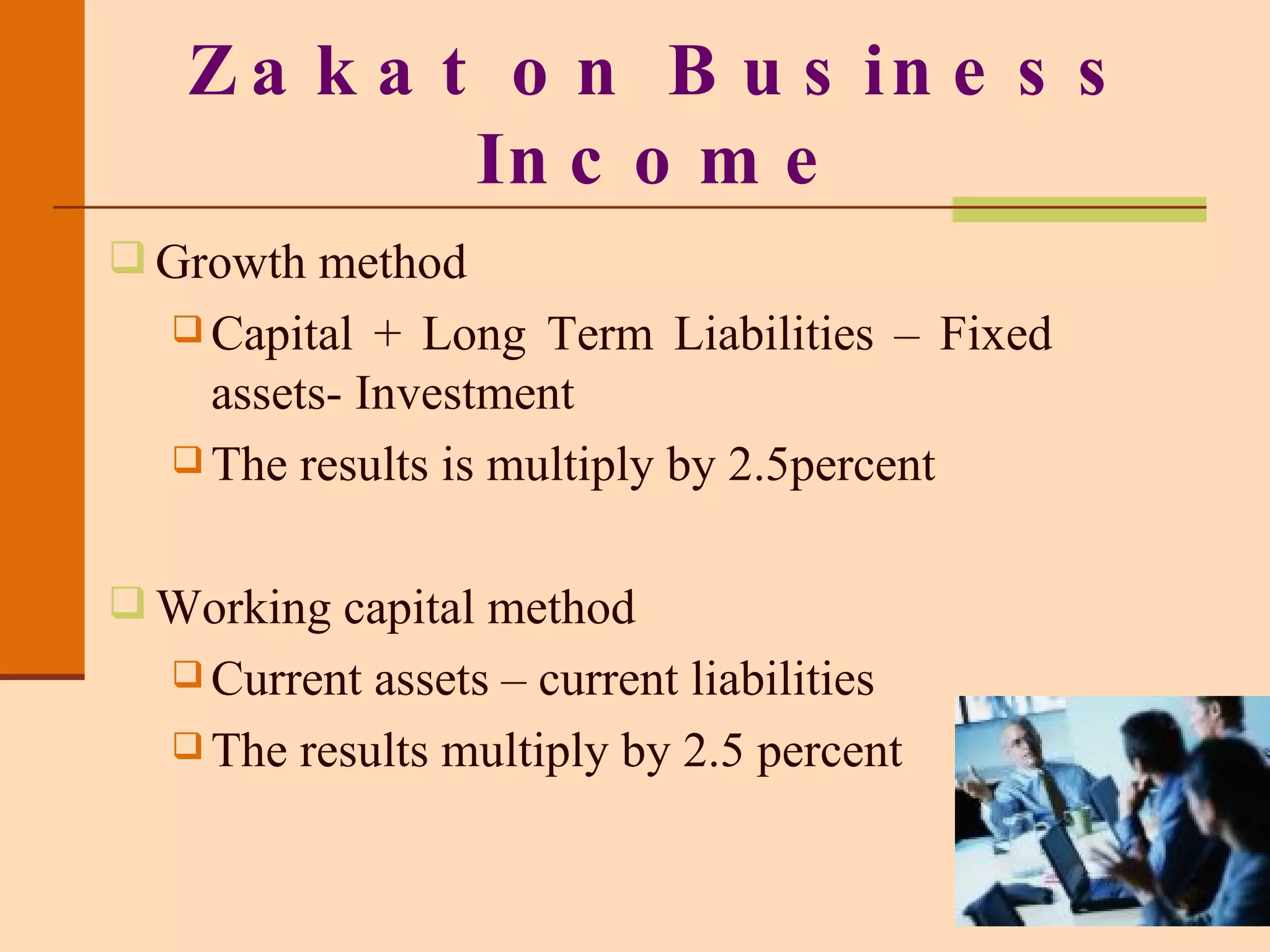
Calculation of zakat 1. Urfiiyah Method ( Capital Growth ) Current capital = Owner’s  Equity + Debt Financial Capital + Profit – Fixed Asset – Other Non Current Assets. 2.Syar’iiyah Method ( Working capital) Net Current Asset = Current Asset (full ownership) – Current Operating Liability only.
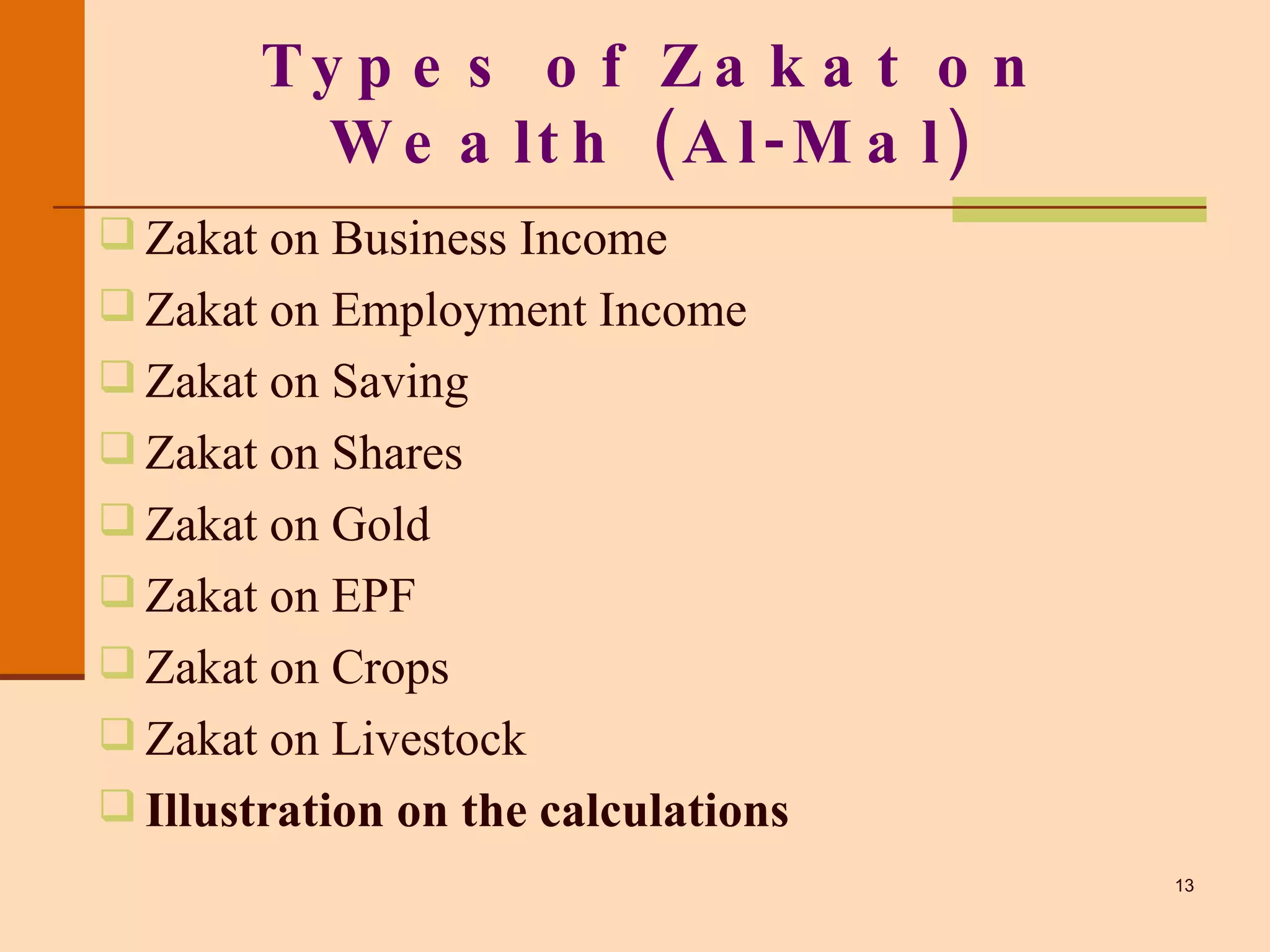
Zakat on Business Income Zakat on Employment Income Zakat on Saving Zakat on Shares Zakat on Gold Zakat on EPF Zakat on Crops Zakat on Livestock Illustration on the calculations Types of Zakat on Wealth (Al-Mal)
Growth method Capital + Long Term Liabilities – Fixed assets- Investment The results is multiply by 2.5percent Working capital method Current assets – current liabilities The results multiply by 2.5 percent Zakat on Business Income
Zakat in business  Hadith from Rasulullah s.a.w as narrated by Abu Daud: “ … indeed, Rasulullah s.a.w asked us to  pay zakat  from the property that we prepare to sell” All kind of businesses  owned by Muslims are subject to  zakat.
Conditions  to fulfill to pay zakat on business  The conditions that  must be fulfilled  to be subject to zakat :- Muslim A  freedom  person The wealth must be from  halal sources Those activities prohibited against Islam cannot be included in zakat calculation
Continue……...   Conditions  to fulfill to pay zakat on business  Meet the  nisab  at the end of haul. The nisab is 2.5% or equivalent to 85 grams of gold Meet the  haul. Must be from  productive property E.g cash, shares, bond, ending inventory, fixed assets (movable or immovable), net trade receivable  Full ownership
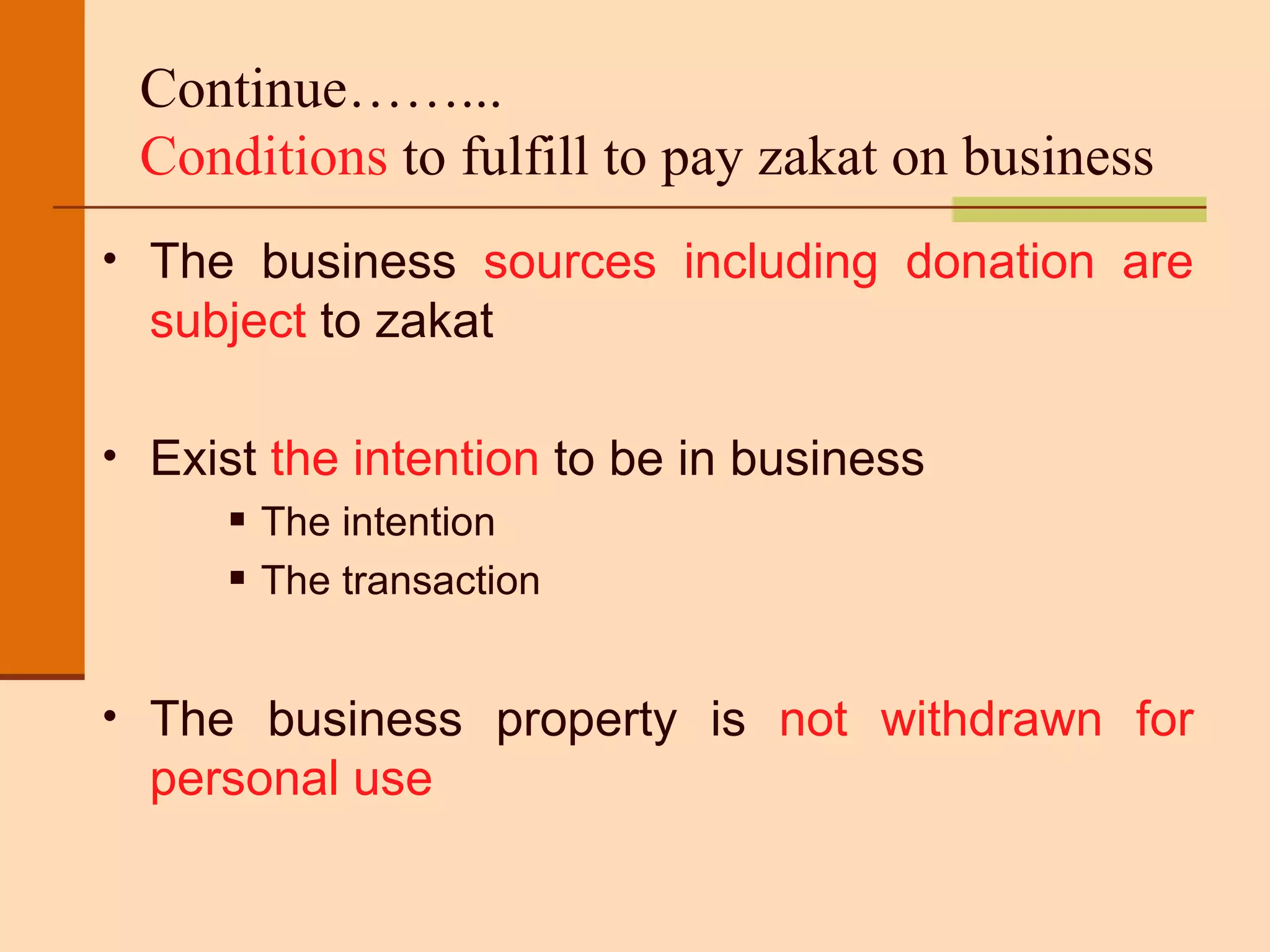
Continue……...   Conditions  to fulfill to pay zakat on business  The business  sources including donation are subject  to zakat Exist  the intention  to be in business The intention The transaction The business property is  not withdrawn for personal use
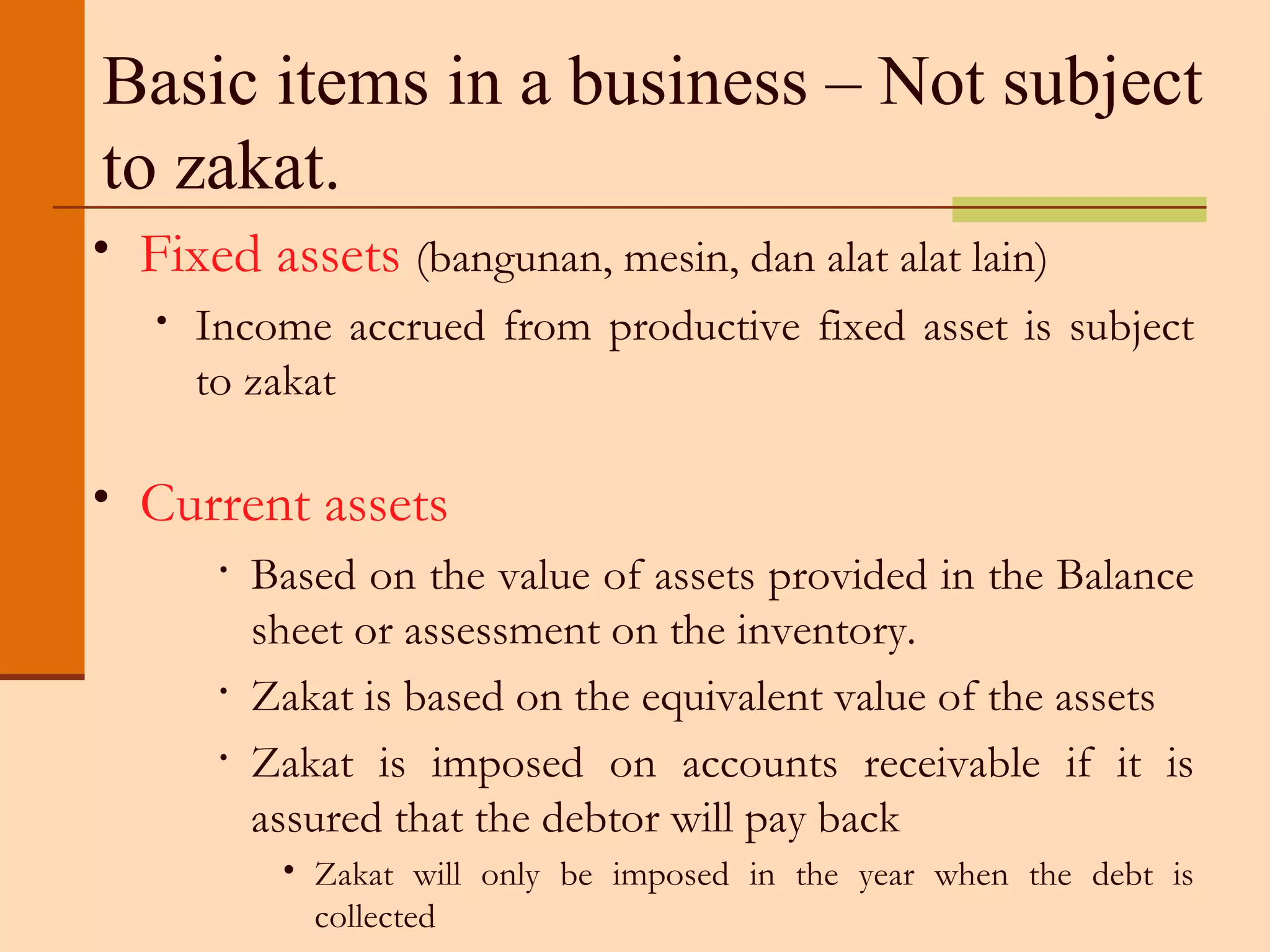
Basic items in a business – Not subject to zakat. Fixed assets  (bangunan, mesin, dan alat alat lain) Income accrued from productive fixed asset is subject to zakat Current assets  Based on the value of assets provided in the Balance sheet or assessment on the inventory. Zakat is based on the equivalent value of the assets Zakat is imposed on accounts receivable if it is assured that the debtor will pay back Zakat will only be imposed in the year when the debt is collected
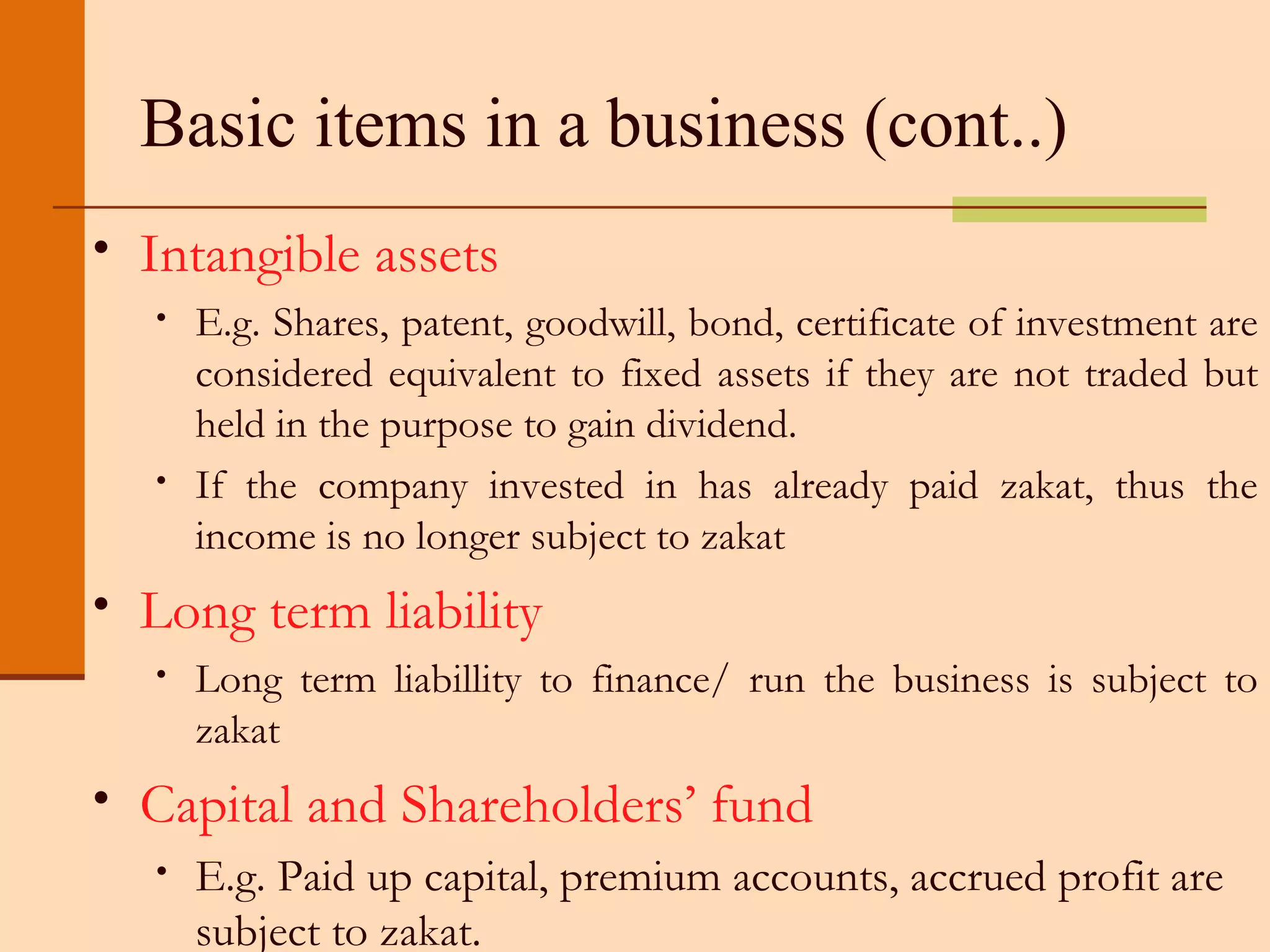
Basic items in a business (cont..) Intangible assets E.g. Shares, patent, goodwill, bond, certificate of investment are considered equivalent to fixed assets if they are not traded but held in the purpose to gain dividend. If the company invested in has already paid zakat, thus the income is no longer subject to zakat Long term liability Long term liabillity to finance/ run the business is subject to zakat Capital and Shareholders’ fund E.g. Paid up capital, premium accounts, accrued profit are subject to zakat.
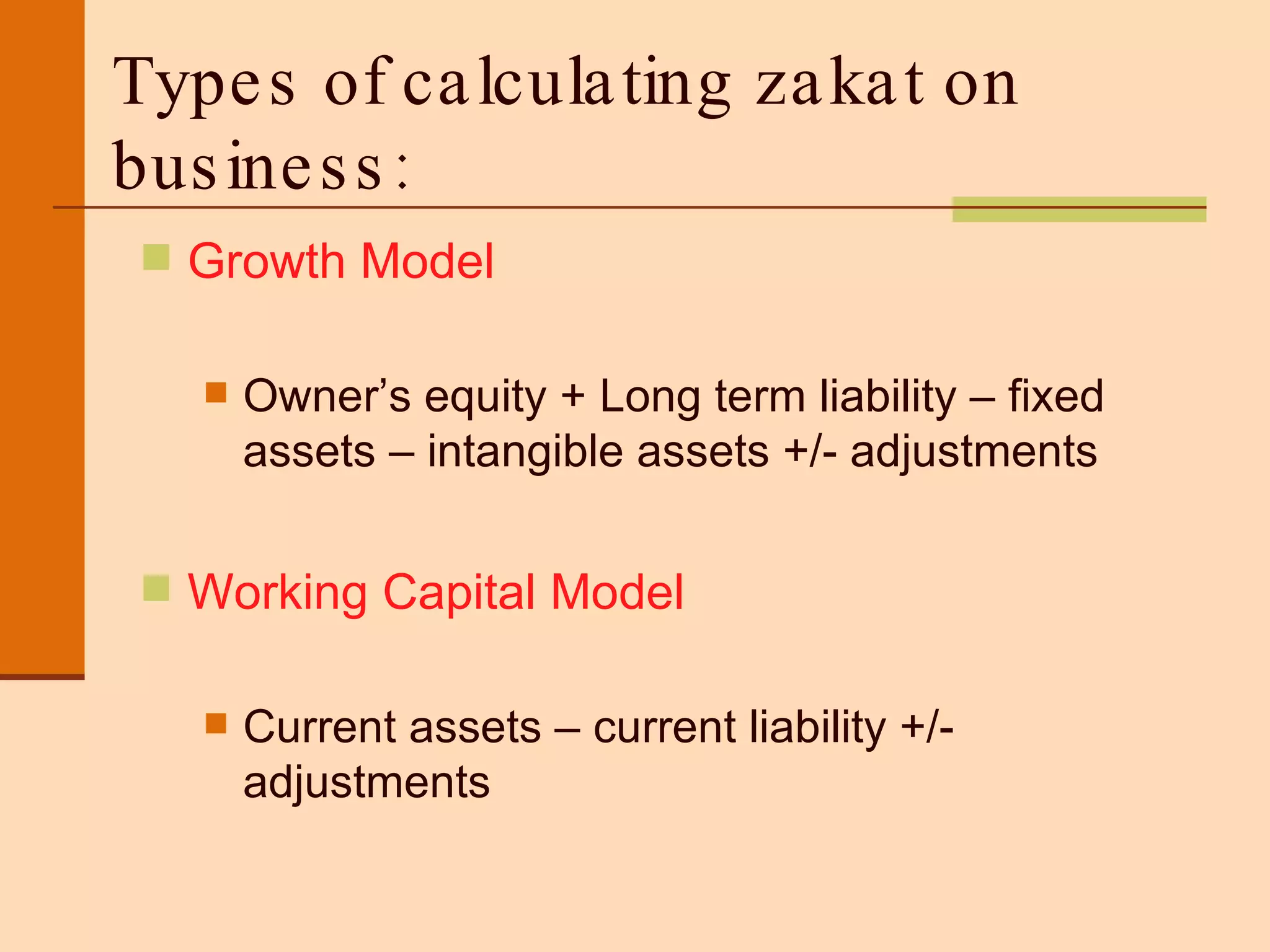
Types of calculating zakat on business: Growth Model Owner’s equity + Long term liability – fixed assets – intangible assets +/- adjustments  Working Capital Model Current assets – current liability +/- adjustments
Adjustments  to be made to the calculation of zakat  DEDUCTION  income  which are not subject to zakat such as  prohibited sources amount are  not wholly owned  such as deposits for utilities Creditors  Sources that zakat  has already been paid Current assets  must be productive , thus bad debts, obselete stock, depreciation are deducted
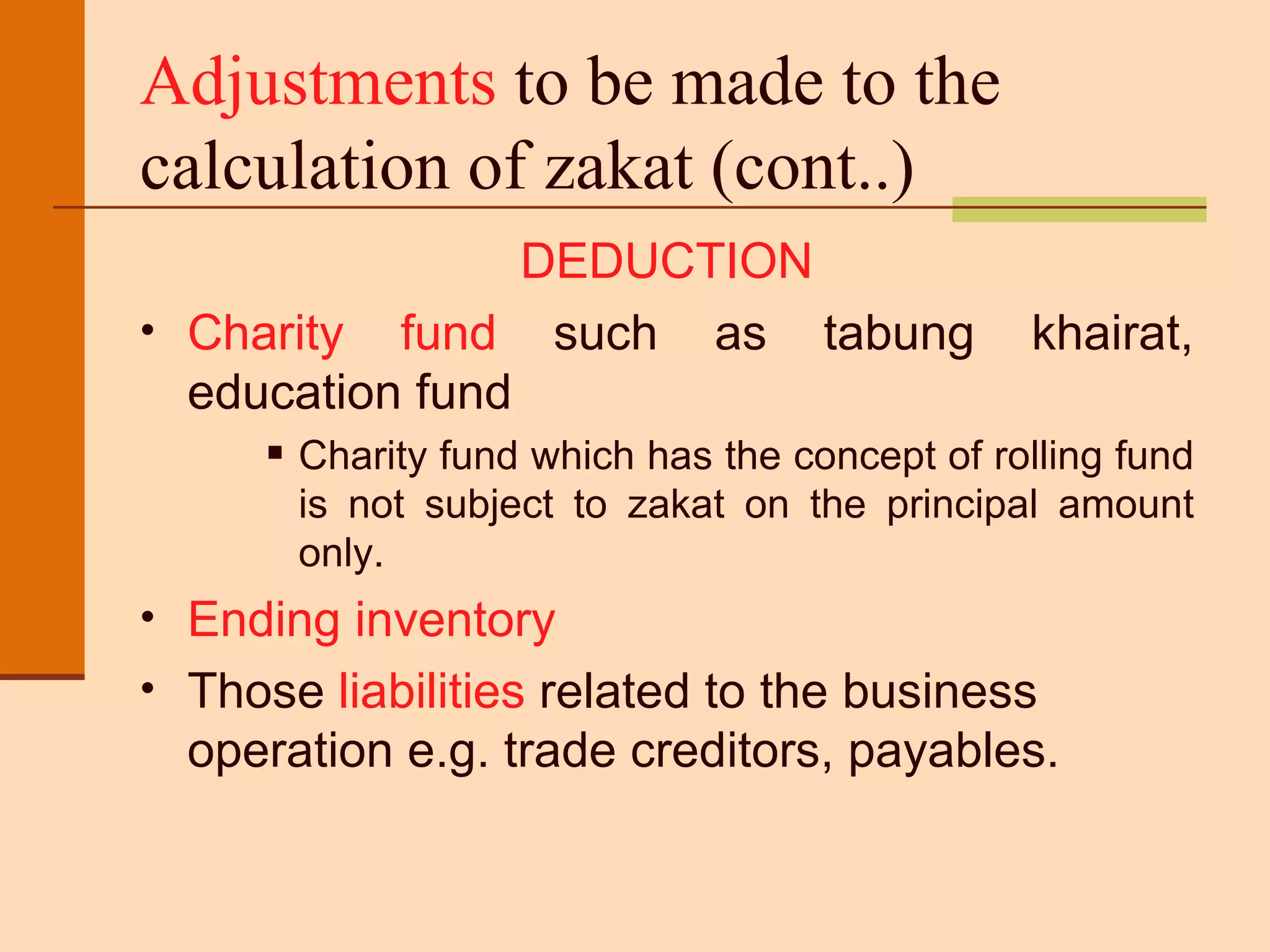
Adjustments  to be made to the calculation of zakat (cont..) DEDUCTION Charity fund  such as tabung khairat, education fund  Charity fund which has the concept of rolling fund is not subject to zakat on the principal amount only. Ending inventory  Those  liabilities  related to the business operation e.g. trade creditors, payables.
Adjustments to be made to the calculation of zakat (cont..) Add to current assets All gift, donations paid by the company Add to current liability Not related to business operation e.g. restructuring of debt Dividend payable Overdraft Financial lease
Zakat on Employment Income Based on gross income 2.5 percent from the total net employment income Based on net income Deduction allowed for personal expenses RM8000 for wife RM3000 per person for children RM1000 per person Gift/ allowances to parents- actual amount KWSP -11percent per annum Contribution to organisation that pay zakat – Tabung Haji,  Takaful
Zakat on Saving It is calculated based on  the lowest balance  in the saving accounts In case of more than one saving account, the  total amount of the lowest balance  need to be accounted Zakat is payable only if the balance is more than RM6200 Saving accounts in Tabung Haji is excluded
A) Zakat from saving deposit. Cash d eposit in bank is zakatable. The nisab for cash money is based on the nisab for gold i.e. 20  mithqal  (85 gram) or silver (595 gram). The minimum amount payable for 1410H/2009 is  $6,200.00 , upon which  2.5%  of  Zakat  is taxable  Islamic calendar ( 354 Days )=  2.5% Normal calendar ( 365 Days ) =  2.577% Changes according to price of 21K gold in the market Zakat on Saving
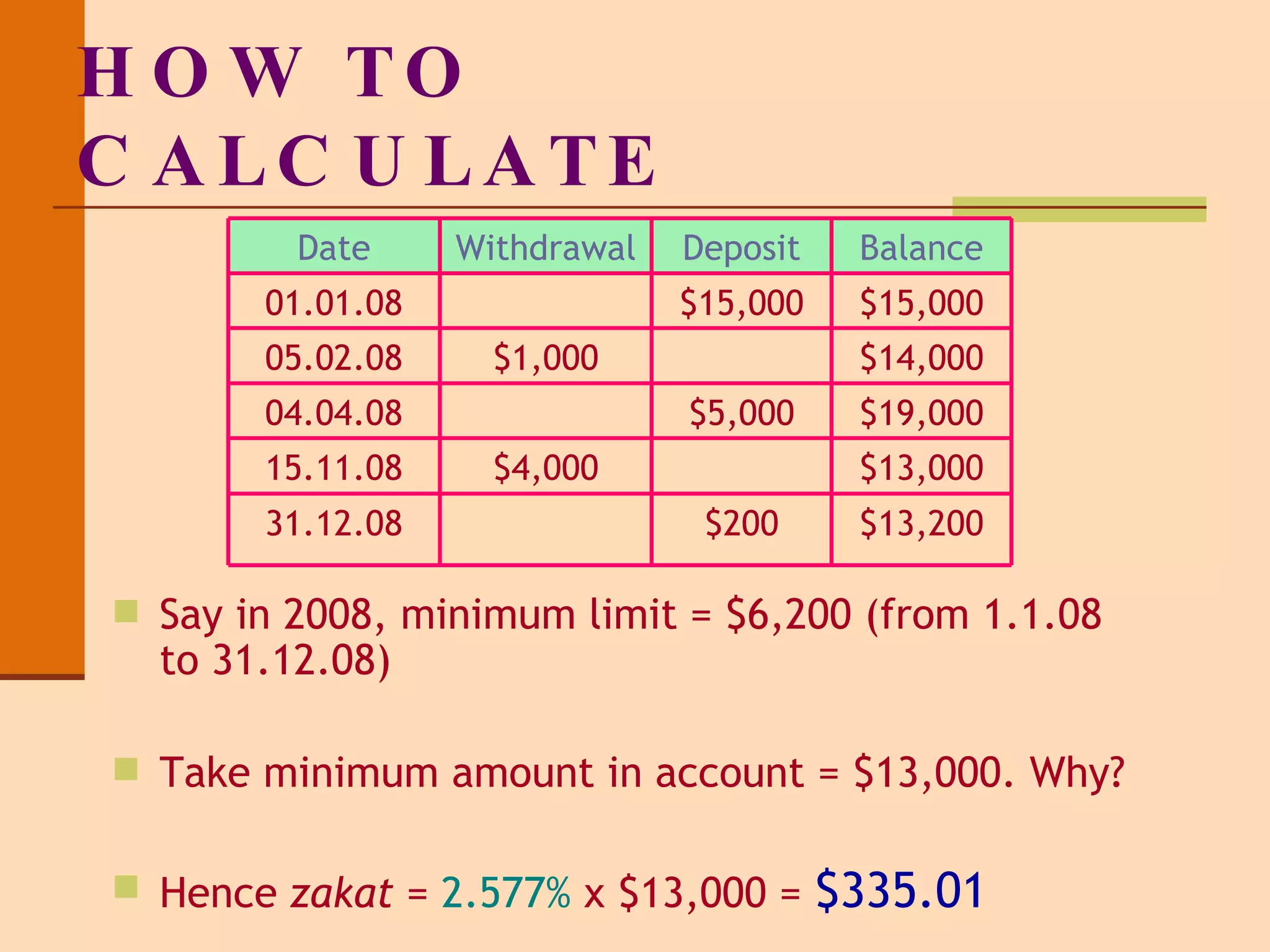
HOW TO CALCULATE Say in 2008, minimum limit = $6,200 (from 1.1.08 to 31.12.08) Take minimum amount in account = $13,000. Why? Hence  zakat  =  2.577%  x $13,000 =  $335.01  Date Withdrawal  Deposit Balance 01.01.08 $15,000 $15,000 05.02.08 $1,000 $14,000 04.04.08 $5,000 $19,000 15.11.08 $4,000 $13,000 31.12.08 $200 $13,200
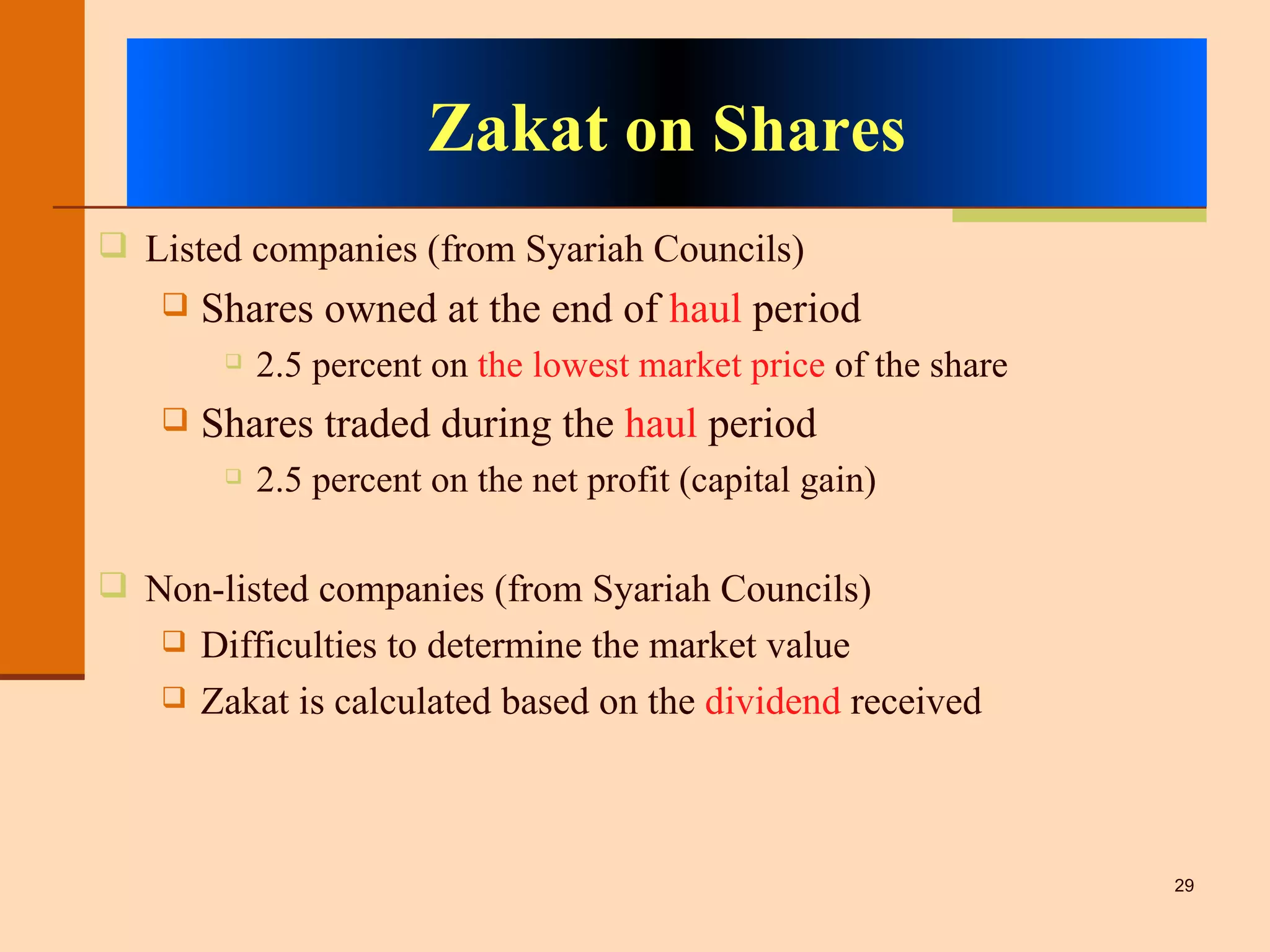
Zakat  on Shares Listed companies (from Syariah Councils) Shares owned at the end of  haul  period  2.5 percent on  the lowest market price  of the share Shares traded during the  haul  period 2.5 percent on the net profit (capital gain) Non-listed companies (from Syariah Councils) Difficulties to determine the market value Zakat is calculated based on the  dividend  received
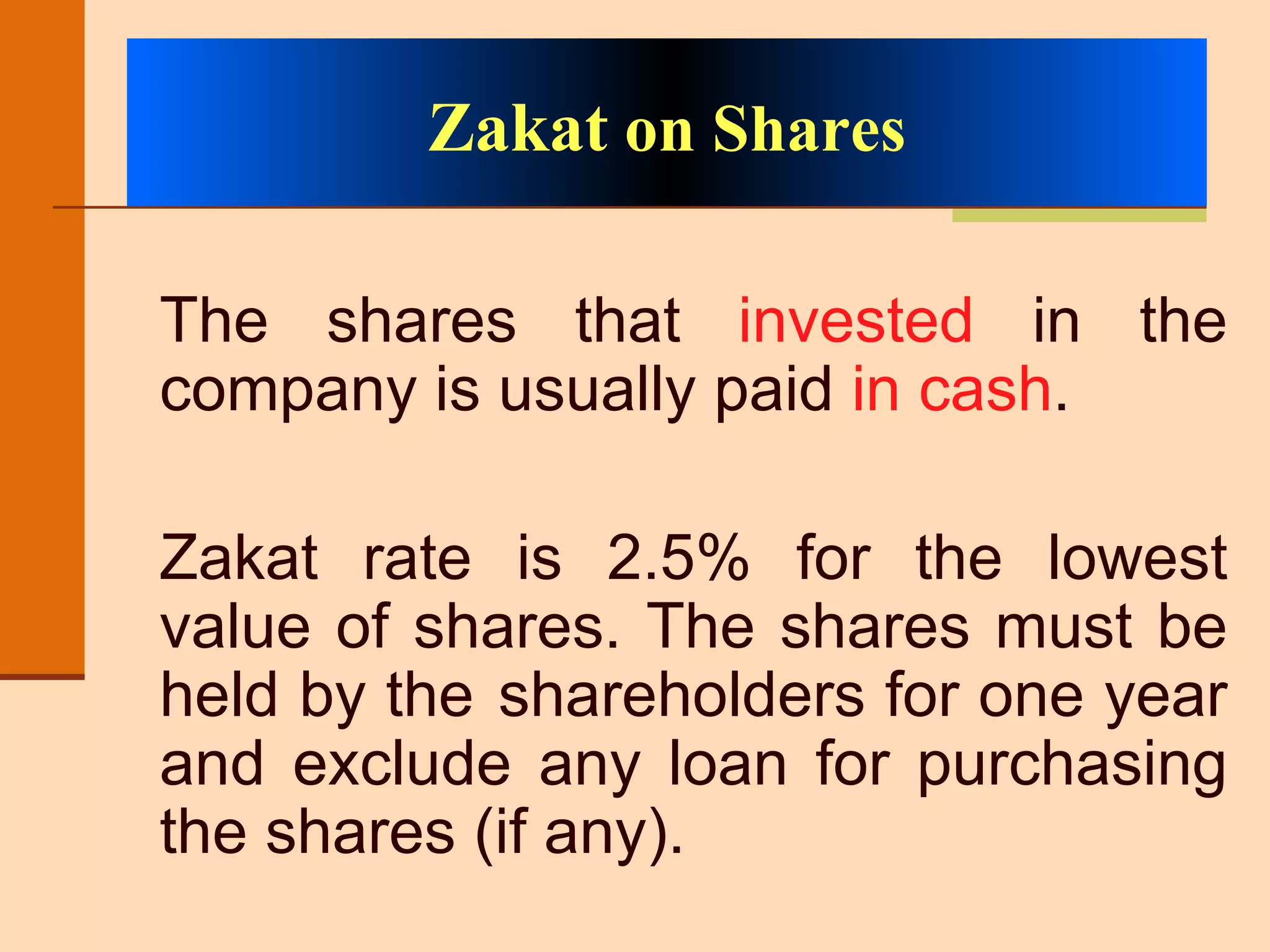
The shares that  invested  in the company is usually paid  in cash . Zakat rate is 2.5% for the lowest value of shares. The shares must be held by the  shareholders for one year and exclude any loan for purchasing the shares (if any). Zakat  on Shares
THE CALCULATIONS Example 1 :   Shares   owned  at the end of one full year. Zakat rate  is 2.5 % on the lowest cost and the market value. 200,000 units of shares in (Halal stocks listed in Syariah Index) x RM 1.00 (the lowest price) = RM 200,000 The zakat is: RM 200,000 x 2.5% = RM5,000.    Example 2 :  Shares purchases  within a year. The zakat is calculated based on 2.5 % on the value of shares after  deducting  the cost of purchasing new shares. The value of shares – the cost of purchasing new shares RM500,000 - RM400,000 = RM100,000  The zakat is: RM100,000 x 2.5 % =   RM2,500
Zakat on Gold and Silver (Jewellery) Zakat from gold and silver The gold and silver are zakatable if they fulfill the nisab rate and one year ownership ( haul ). Unused gold Satisfied  haul  and  nisab  of 85 gram Value of gold as at 20/3/07 is RM71.34/gram The rate is 2.5 percent Used by the owner Not subject to zakat
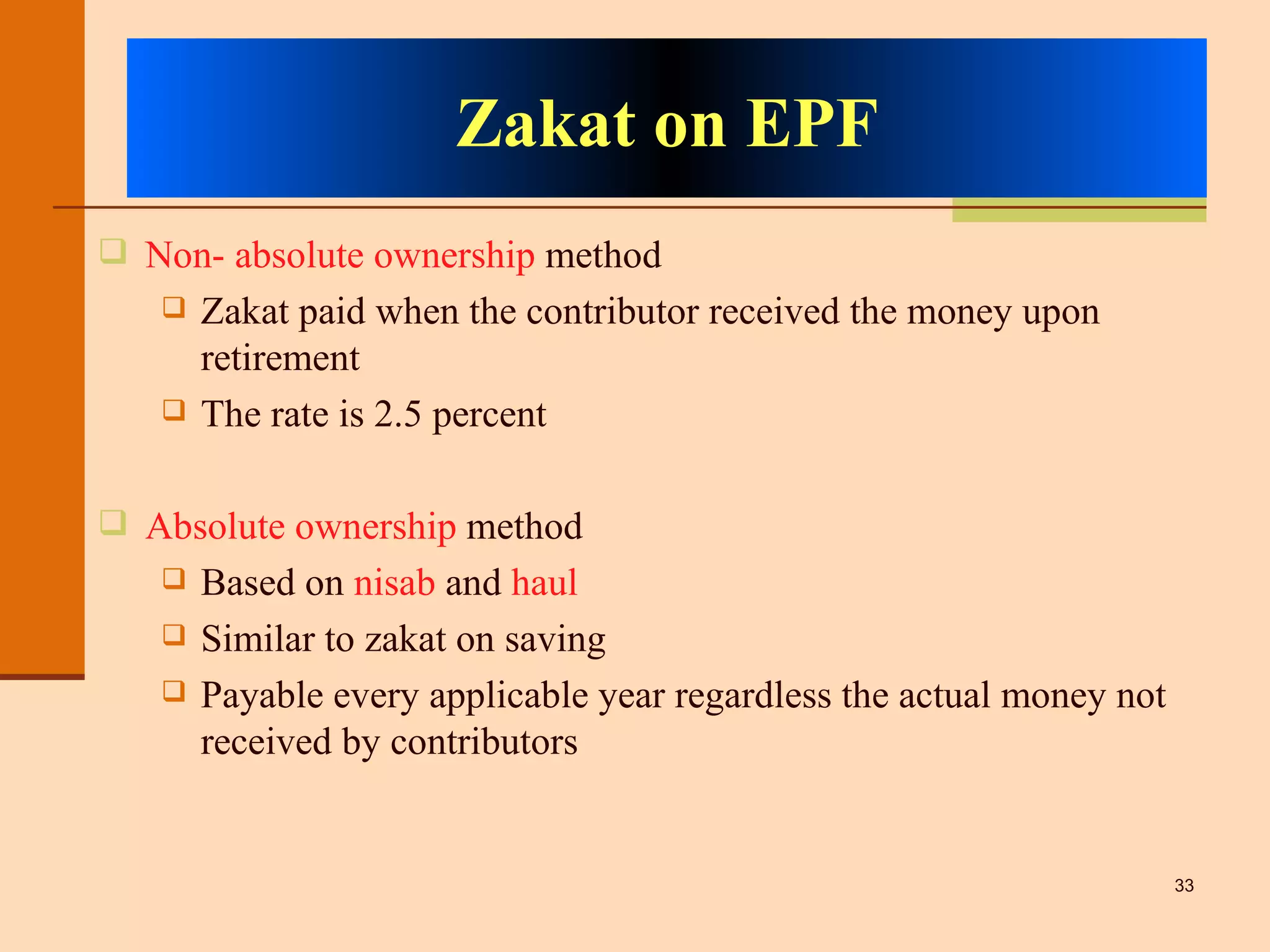
Zakat on EPF Non- absolute ownership  method Zakat paid when the contributor received the money upon retirement The rate is 2.5 percent Absolute ownership  method Based on  nisab  and  haul Similar to zakat on saving Payable every applicable year regardless the actual money not received by contributors
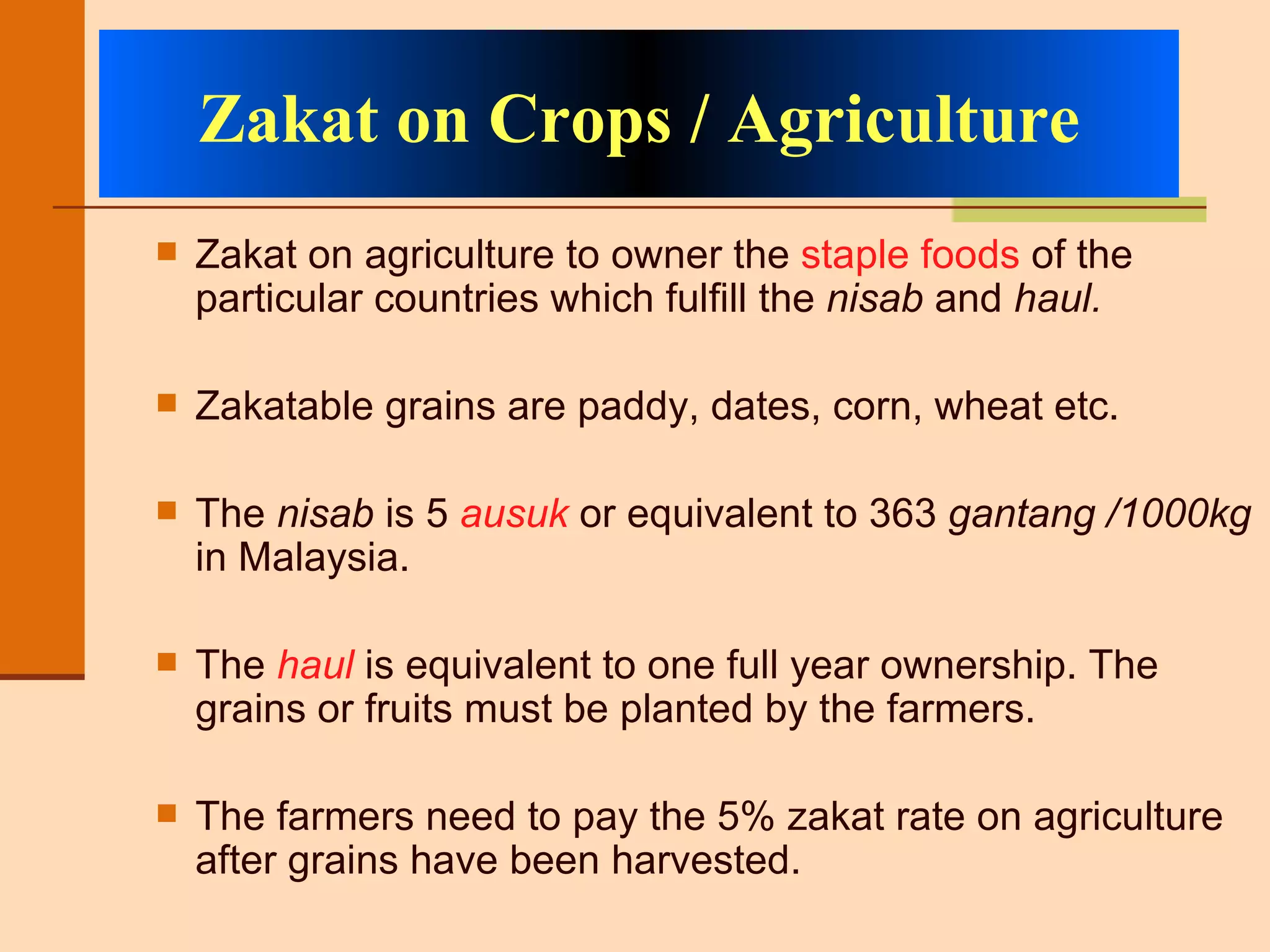
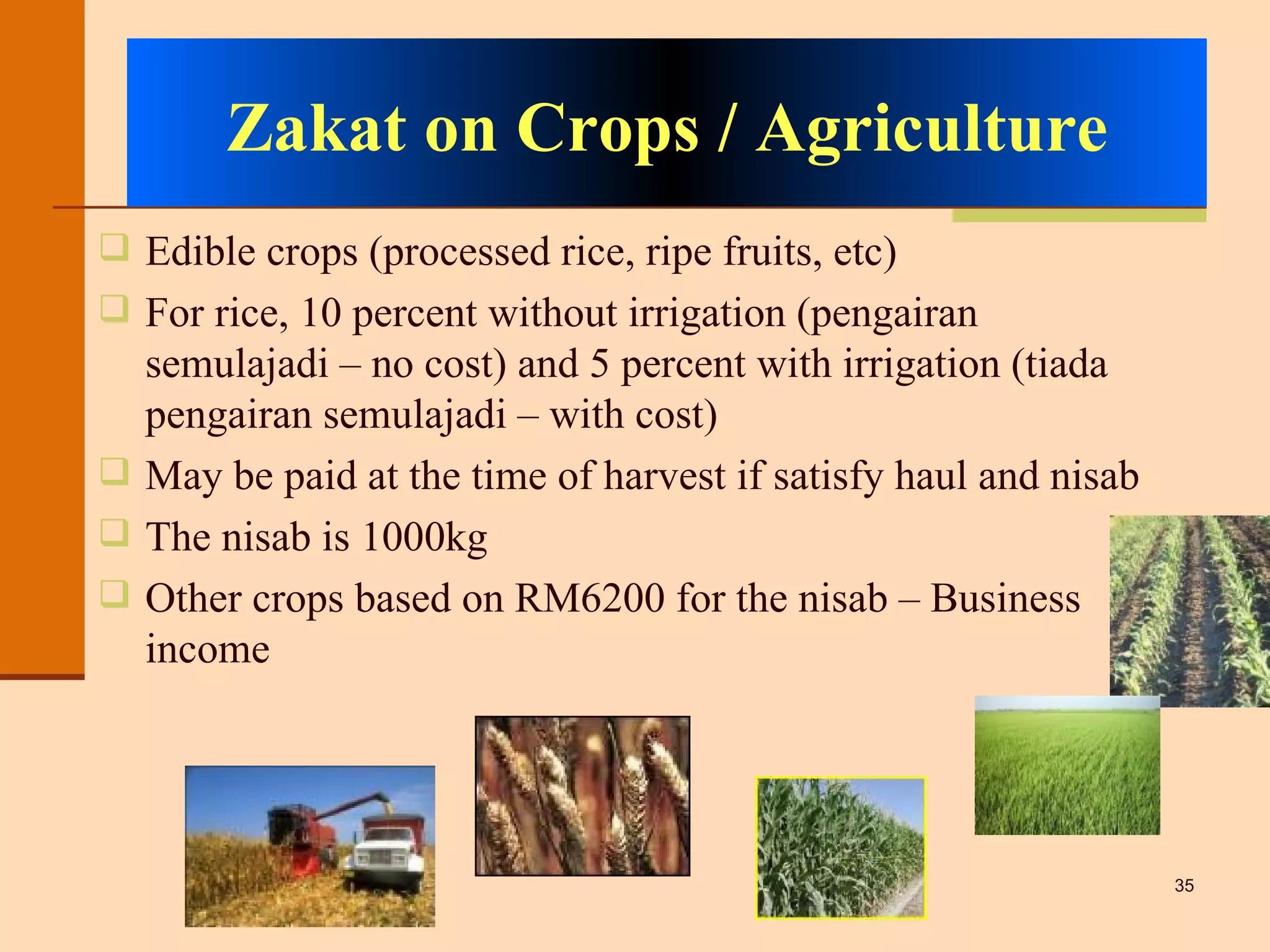
Zakat on agriculture to owner the  staple foods  of the particular countries which fulfill the  nisab  and  haul. Zakatable grains are paddy, dates, corn, wheat etc.  The  nisab  is 5  ausuk  or equivalent to 363  gantang /1000kg  in Malaysia.  The  haul  is equivalent to one full year ownership. The grains or fruits must be planted by the farmers.  The farmers need to pay the 5% zakat rate on agriculture after grains have been harvested. Zakat on Crops / Agriculture
Zakat on Crops / Agriculture Edible crops (processed rice, ripe fruits, etc) For rice, 10 percent without irrigation (pengairan semulajadi – no cost) and 5 percent with irrigation (tiada pengairan semulajadi – with cost) May be paid at the time of harvest if satisfy haul and nisab The nisab is 1000kg Other crops based on RM6200 for the nisab – Business income
LIVESTOCKS Zakat from livestocks The livestocks are zakatable when the owners have fulfilled the conditions for nisab and haul.  Zakatable livestocks are sheeps, cows, buffaloes and camels.  These livestocks must be healthy, not criple and must not be used to work in the paddy field or carry the goods.
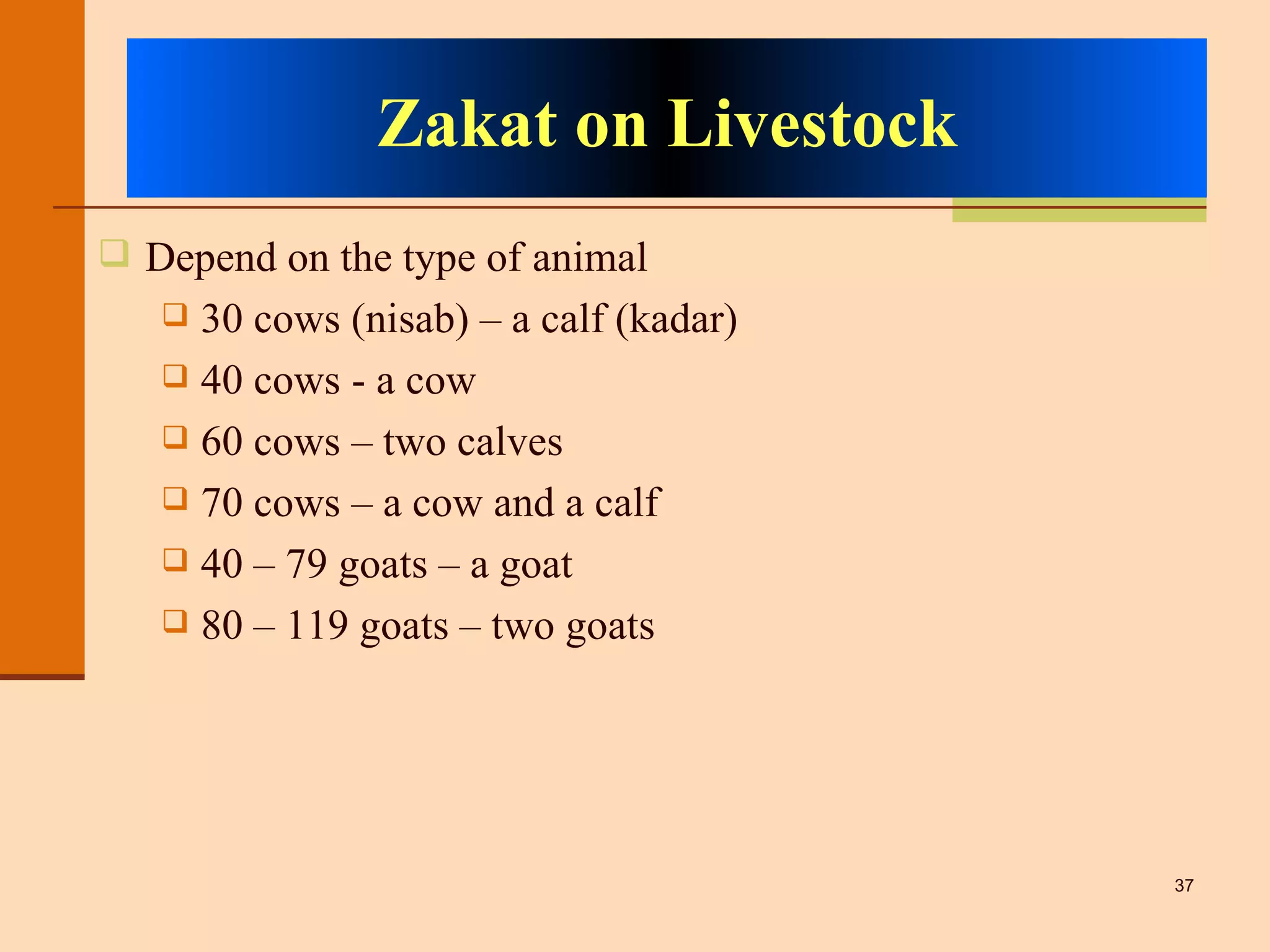
Zakat on Livestock Depend on the type of animal 30 cows (nisab) – a calf (kadar) 40 cows - a cow 60 cows – two calves 70 cows – a cow and a calf 40 – 79 goats – a goat 80 – 119 goats – two goats
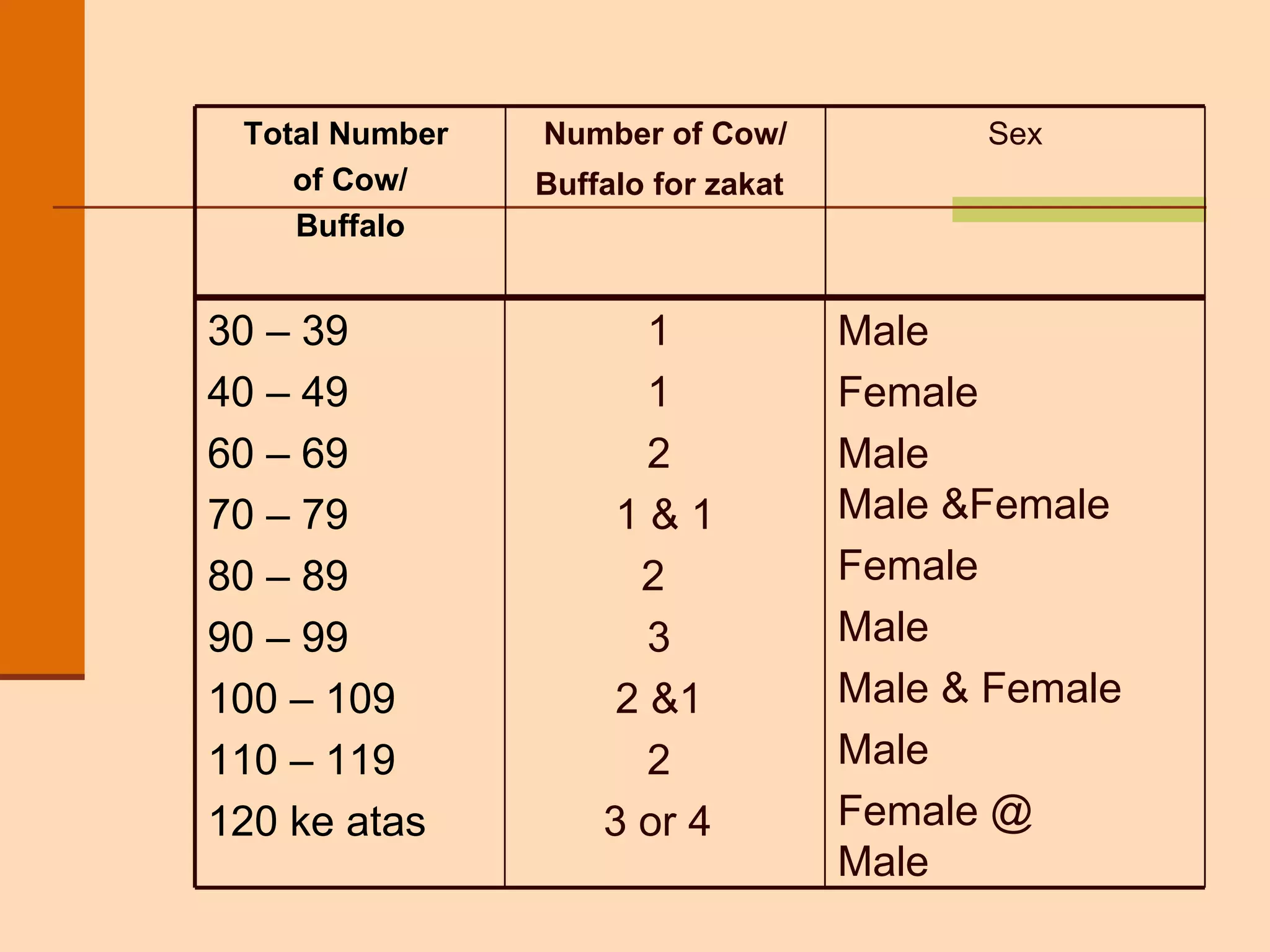
Total Number  of Cow/ Buffalo Number of Cow/ Buffalo for zakat   Sex 30 – 39 40 – 49 60 – 69 70 – 79 80 – 89 90 – 99 100 – 109 110 – 119 120 ke atas 1  1  2  1 & 1 2  3  2 &1  2  3 or 4   Male Female Male  Male &Female   Female Male Male & Female  Male Female @  Male
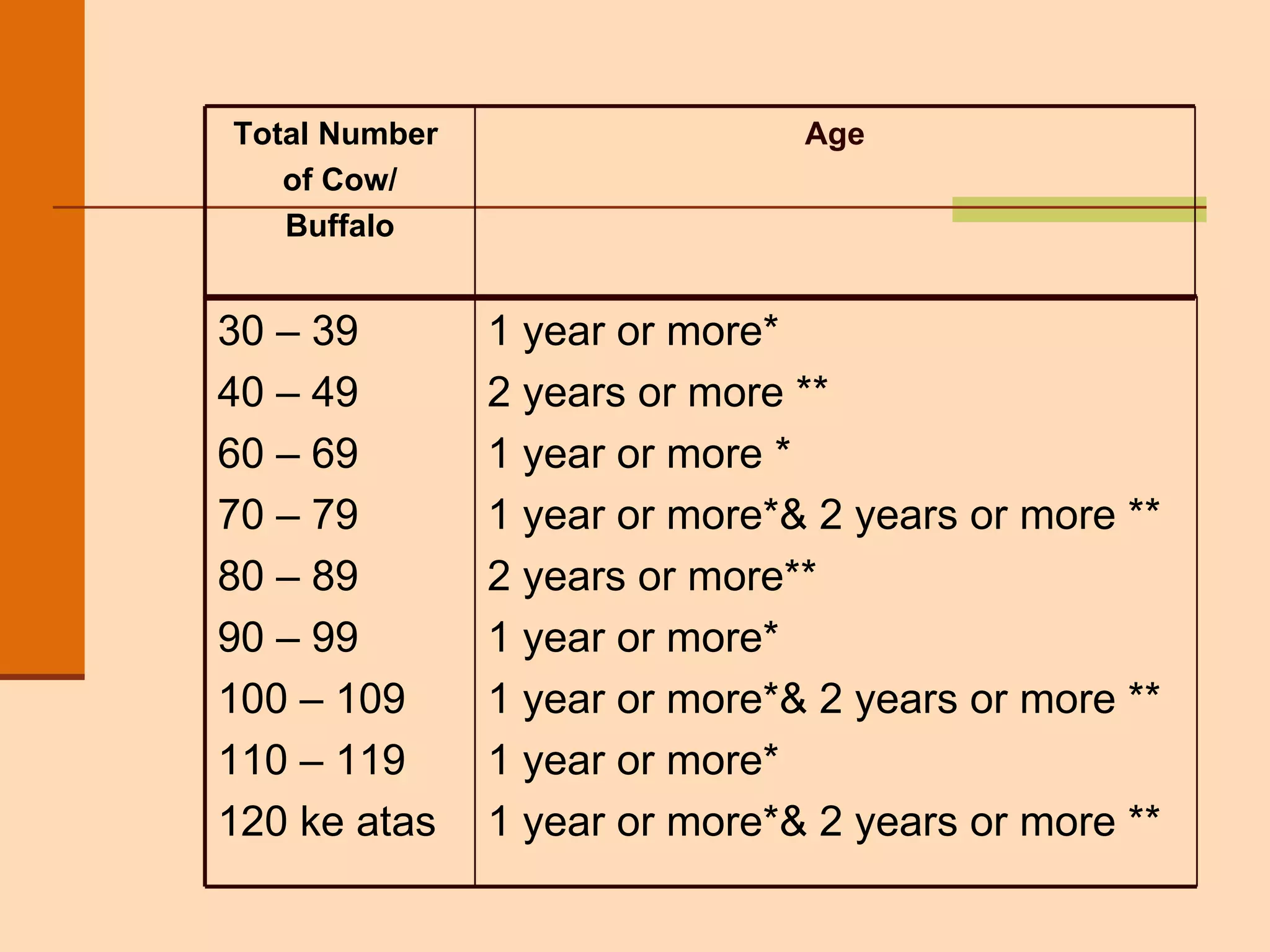
Total Number  of Cow/ Buffalo Age 30 – 39 40 – 49 60 – 69 70 – 79 80 – 89 90 – 99 100 – 109 110 – 119 120 ke atas 1 year or more* 2 years or more ** 1 year or more * 1 year or more*& 2 years or more **  2 years or more** 1 year or more* 1 year or more*& 2 years or more ** 1 year or more* 1 year or more*& 2 years or more **
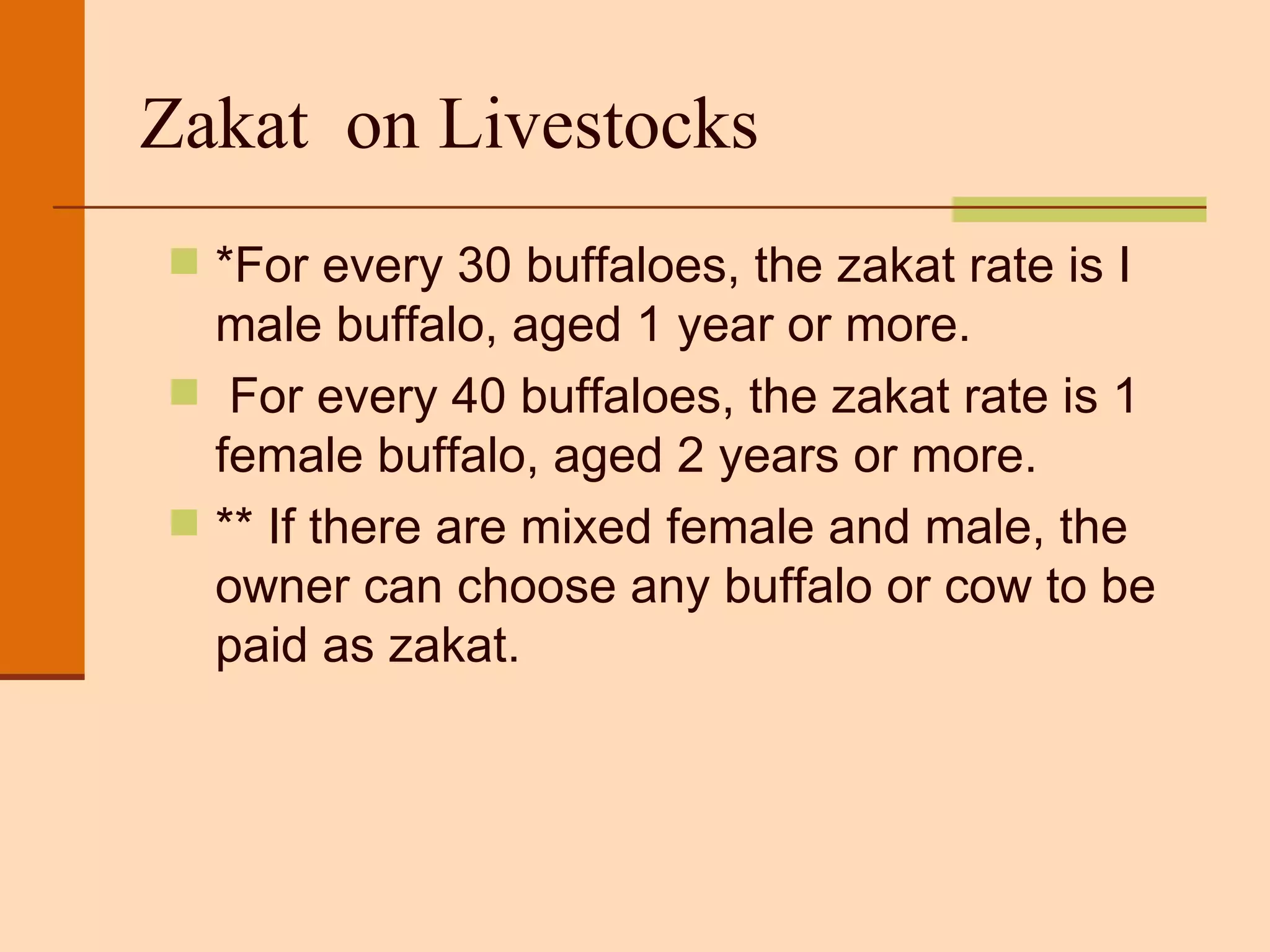
Zakat  on Livestocks *For every 30 buffaloes, the zakat rate is I male buffalo, aged 1 year or more.  For every 40 buffaloes, the zakat rate is 1 female buffalo, aged 2 years or more. ** If there are mixed female and male, the owner can choose any buffalo or cow to be paid as zakat.
EXEMPTION Certain conditions that assets can be exempted from zakat are: Non productive fixed asset,  Non current asset,  Asset which are not fully owned by the owner,  Current operating liability,  Fund for charity,  Net receivables after zakat deduction, and  Any receivables from  HARAM  sources.
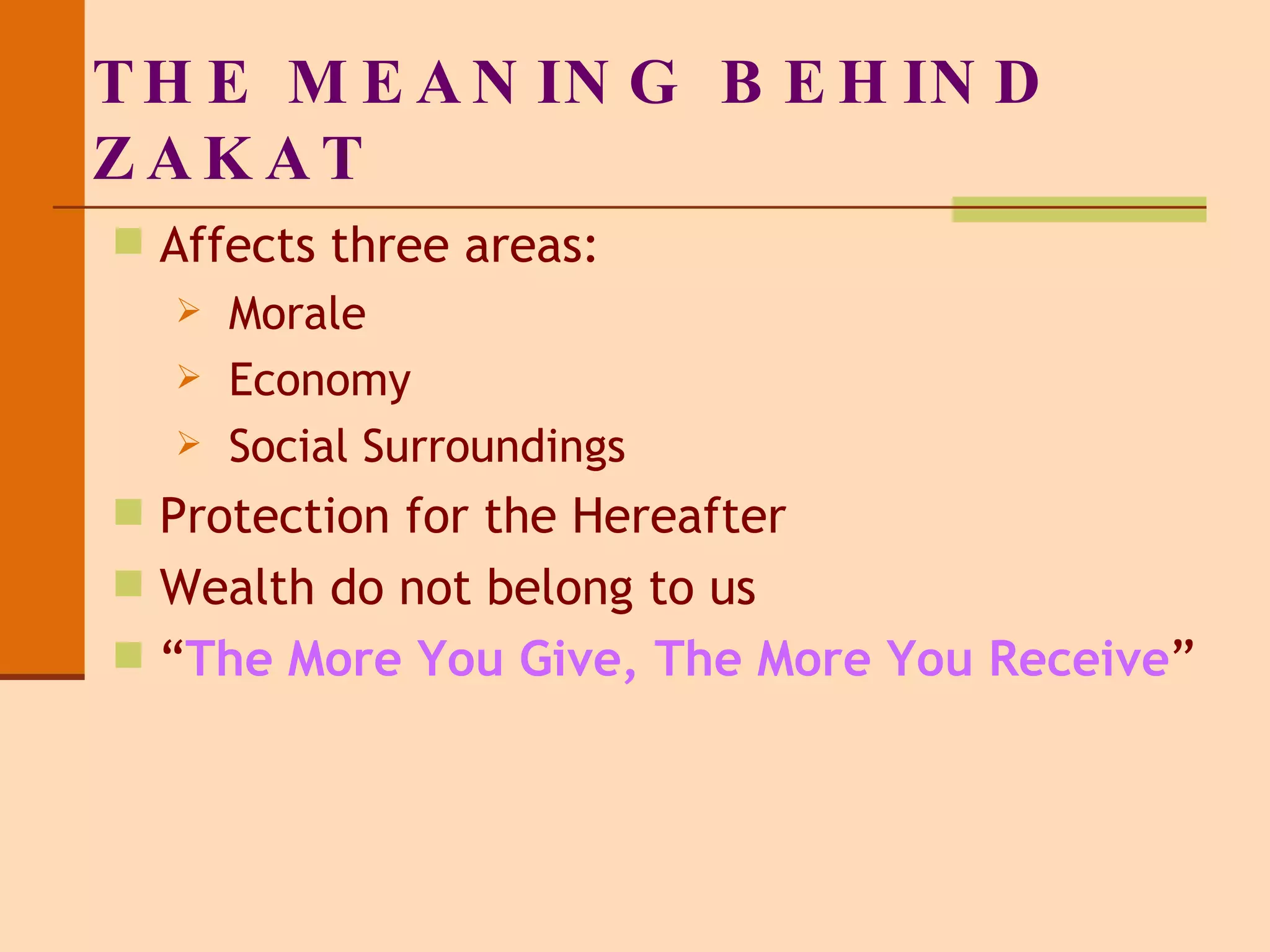
THE MEANING BEHIND ZAKAT Affects three areas: Morale Economy Social Surroundings Protection for the Hereafter Wealth do not belong to us “ The More You Give, The More You Receive ”
Benefits of zakat Zakat implies a deep humanitarian and social-political value such as free society from class warfare, distrust and corruption. Zakat will balance the socio economy in the country and encourage the rich to help the poor continuously. Zakat is the backbone of Muslim nation's financial system that keeps money in circulation.  Zakat also discourages hoarding and protect the muslims from many other vices, as love of wealth is the root of many immoral actions.
Benefits of zakat The practice of zakat will produce more loving, caring and helping society in the future.  Zakat payment will lead to growth and development of all human beings and remove the poor-due in the long term. Zakat  may also improve all human beings faith and spiritual progress.
Dalil (Sources)Benefits of zakat  " Who is he that will lend to Allah a goodly loan, then (Allah) will increase it manifold to his credit (in repaying), and he will have (besides) a good reward (i.e. paradise)."  [Surah Al Hadiid:11] “ Verily (Ketahuilah), those who give Sadaqah (i.e. Zakat and alms, etc.), men and women, and lend to Allah a goodly loan, it shall be increased manifold (to their credit), and theirs shall be an honourable good reward (i.e. paradise).”  [Surah Al-Hadiid :18]
Dalil (Sources)Benefits of zakat  If you lend to Allah a goodly loan (i.e. spend in Allah's Cause) He will double it for you, and will forgive you. And Allah is Most Ready to appreciate and to reward, Most Forbearing." [Surah Ath-Thalaaq:17]
ZAKAT IN THE QURAN 30 places  in the Quran stressing the importance of Zakat:- “…  And Allah said: “I am with you if you perform Prayer   and give  Zakat  and believe in My Messengers: honour and assist them, and lend a good loan to Allah, verily, I will expiate your sins and admit you to Gardens under which rivers flow (in Paradise). But if any of you after this, disbelieved, he has indeed gone astray from the Straight Path.”  (Al-Maidah: 12)
IN THE RED From an Islamic perspective, being in debt is not encouraged: Greatest sin  is to  die in a state of debt  &  no asset to pay it off Conventional loans – interest bearing and can increase the burden of the person! However, Islam encourages us to help one another…
FINANCING …  hence under Islamic Banking =  Financing! Profit rate again replaces interest rate So why is the profit rate under Islamic financing usually  higher  than the interest rate for a conventional loan?
FINANCING Under Islamic financing, the customer is  not  usually  penalized  for late payment Under the  “Reducing Balance”  concept, if you settle your loan before the maturity of the period, you do not have to pay the profit due to the bank for the remaining years Financing restructure  depends on  the  financial capability  of the client
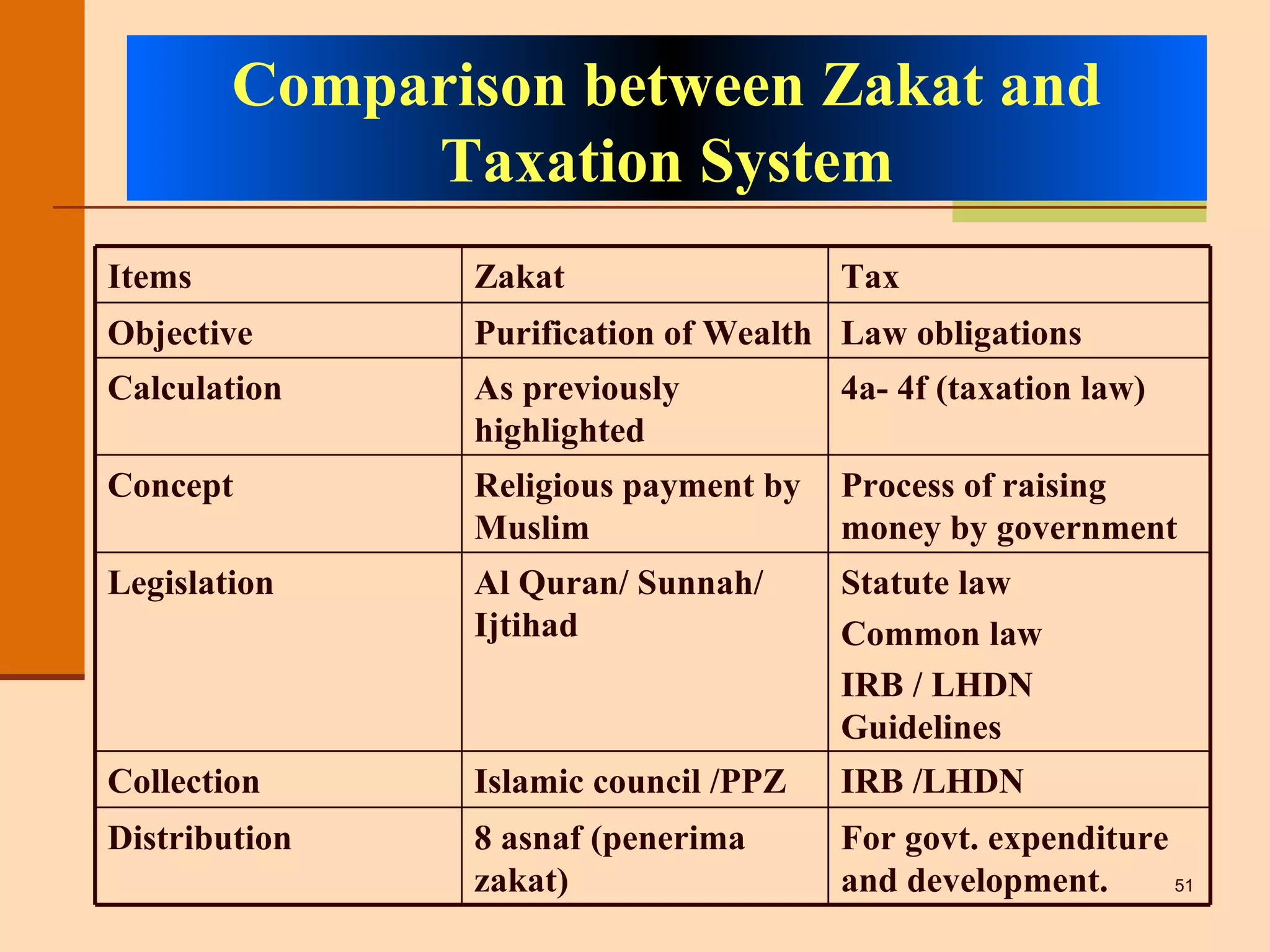
Comparison between Zakat and Taxation System Items Zakat Tax Objective Purification of Wealth Law obligations Calculation As previously highlighted 4a- 4f (taxation law) Concept Religious payment by Muslim Process of raising money by government Legislation Al Quran/ Sunnah/ Ijtihad Statute law Common law IRB / LHDN Guidelines Collection Islamic council /PPZ IRB /LHDN Distribution 8 asnaf (penerima zakat) For govt. expenditure and development.
References Basic readings:  http://www.muis.gov.sg/cms/uploadedFiles/CorporateGOV/Zakat/zakat_on_business_formula.pdf . Zakat calculation based on working capital model  Further readings: Bahari & Hamat (2004)“Rethinking zakat on employment income”, unpublished paper presented in 6 th  Asian Inter-University Seminar on social development, 14 th  – 16 th  May 2004. Available on the net: <http://www.geocities.com/idmpresources/04ASEANZakariaZahri.pdf>
Useful Links on Zakat calculation http://www.zakat.com.my/ http://www.zakatpahang.com.my/ http://www.e-zakat.com.my
THANK YOU ANY QUESTIONS.

types of zakat and calculation

  • 1.
    ZAKAT IN ISLAMAN OVERVIEW OF ZAKAT SYSTEM IN MALAYSIA
  • 2.
    Presentation outline Varioustypes of zakat Illustration to calculate zakat Comparison between zakat and taxation
  • 3.
    ZAKAT ZAKAT ZAKATFITRAH ZAKAT ON WEALTH
  • 4.
    Types of Zakat1. Zakat fitrah ( al-fitr) a flat fee or levy imposed on each person. due from the starting of Ramadhan and ends before the eid’ fitr prayer. 2. Zakat from earnings ( al-mal) – a religious levy on wealth. Traditional types of wealth subject to zakat Agricultural produce, reared animals, business, gold and silver. New types of wealth subject to zakat Various forms of wealth based on the consensus of Islamic scholars and jurists e.g. employment income, professional income
  • 5.
    Zakat Al Fitr/ Zakat Fitrah To contribute a certain amount of staple food or pay an equivalent monetary amount in the month of Ramadan before the Muslim festive celebration or Eid al Fitr (Ariff, 1991). The zakat al-fitr flat fee is one sa` – a little more than two kilograms of wheat, barley, dates, or rice – or the monetary equivalent (Al Qardawi, 1997).
  • 6.
    Compulsory on everyMuslim Not subjected to nisab or haul The rate between RM4 - RM5 per person Payable from the first day of Ramadhan until before the Aidil Fitri prayer. The best is on the eve of Shawal Zakat Al Fitr / Zakat Fitrah / Zakat on Self
  • 7.
    ZAKAT FITRAH -Example Can be paid in the form of staple food; rice, or in the form of money. For example: 1430H/2009 , the rates were: 2.268 kg (nisab / kadar) RM2.84 (according to the value of fragrant rice) RM1.93 (according to the value of Thai rice) Zakat bagi negeri-negeri di Malaysia bagi tahun 2009 (kecuali Kelantan), mengikut tahap kehidupan setiap negeri: Selangor, Wilayah Persekutuan, Pahang, Perak, Kedah dan Pulau Pinang – RM7 Terengganu – RM5, RM7 dan RM8 Johor – RM5 dan RM7.50 Sabah – RM6.60 Negeri Sembilan – RM6.50 Melaka – RM6.30 Sarawak dan Perlis – RM6 *Kadar zakat ditentukan oleh Majlis Agama Negeri
  • 8.
    Income refers to earnings from salary, dividends or other receivables income from services or consultation. Salary include annual, deferred (tunggakan), allowance, commission, bonuses, consultation fees. Zakat on Wealth / Al- Mal
  • 9.
    ZAKAT ON WEALTH/ Al- Mal Depends on the amount of wealth that you have and how long (haul) you had it for. Your wealth has to reached it’s nisab (the minimum amount upon which Zakat is payable) and reached it’s haul (one lunar year) Zakat al-mal or zakat from earnings is levied only on Muslims whose wealth exceeds a threshold called nisab (Kahf, 2005).
  • 10.
    Zakat Rate Theminimum threshold ( nisab) of zakat on savings or investments is 85 grams of gold / worth. The rate of zakat is 2.5%; as for livestock, both the minimum threshold and the rate depend on the type and the number of animals.
  • 11.
    Ways to calculatezakat Method 1 2.5 % on the total annual gross income ( if the total income is more than the nisab rate). Example : The total annual gross income is RM33,800.00. The zakat is RM33,800.00 x 2.5 % = RM845.00 Method 2 Zakat is paid after deducting all allowable basic expenses. Method 3   Zakat is paid after deducting all the liabilities.
  • 12.
    Calculation of zakat1. Urfiiyah Method ( Capital Growth ) Current capital = Owner’s Equity + Debt Financial Capital + Profit – Fixed Asset – Other Non Current Assets. 2.Syar’iiyah Method ( Working capital) Net Current Asset = Current Asset (full ownership) – Current Operating Liability only.
  • 13.
    Zakat on BusinessIncome Zakat on Employment Income Zakat on Saving Zakat on Shares Zakat on Gold Zakat on EPF Zakat on Crops Zakat on Livestock Illustration on the calculations Types of Zakat on Wealth (Al-Mal)
  • 14.
    Growth method Capital+ Long Term Liabilities – Fixed assets- Investment The results is multiply by 2.5percent Working capital method Current assets – current liabilities The results multiply by 2.5 percent Zakat on Business Income
  • 15.
    Zakat in business Hadith from Rasulullah s.a.w as narrated by Abu Daud: “ … indeed, Rasulullah s.a.w asked us to pay zakat from the property that we prepare to sell” All kind of businesses owned by Muslims are subject to zakat.
  • 16.
    Conditions tofulfill to pay zakat on business The conditions that must be fulfilled to be subject to zakat :- Muslim A freedom person The wealth must be from halal sources Those activities prohibited against Islam cannot be included in zakat calculation
  • 17.
    Continue……... Conditions to fulfill to pay zakat on business Meet the nisab at the end of haul. The nisab is 2.5% or equivalent to 85 grams of gold Meet the haul. Must be from productive property E.g cash, shares, bond, ending inventory, fixed assets (movable or immovable), net trade receivable Full ownership
  • 18.
    Continue……... Conditions to fulfill to pay zakat on business The business sources including donation are subject to zakat Exist the intention to be in business The intention The transaction The business property is not withdrawn for personal use
  • 19.
    Basic items ina business – Not subject to zakat. Fixed assets (bangunan, mesin, dan alat alat lain) Income accrued from productive fixed asset is subject to zakat Current assets Based on the value of assets provided in the Balance sheet or assessment on the inventory. Zakat is based on the equivalent value of the assets Zakat is imposed on accounts receivable if it is assured that the debtor will pay back Zakat will only be imposed in the year when the debt is collected
  • 20.
    Basic items ina business (cont..) Intangible assets E.g. Shares, patent, goodwill, bond, certificate of investment are considered equivalent to fixed assets if they are not traded but held in the purpose to gain dividend. If the company invested in has already paid zakat, thus the income is no longer subject to zakat Long term liability Long term liabillity to finance/ run the business is subject to zakat Capital and Shareholders’ fund E.g. Paid up capital, premium accounts, accrued profit are subject to zakat.
  • 21.
    Types of calculatingzakat on business: Growth Model Owner’s equity + Long term liability – fixed assets – intangible assets +/- adjustments Working Capital Model Current assets – current liability +/- adjustments
  • 22.
    Adjustments tobe made to the calculation of zakat DEDUCTION income which are not subject to zakat such as prohibited sources amount are not wholly owned such as deposits for utilities Creditors Sources that zakat has already been paid Current assets must be productive , thus bad debts, obselete stock, depreciation are deducted
  • 23.
    Adjustments tobe made to the calculation of zakat (cont..) DEDUCTION Charity fund such as tabung khairat, education fund Charity fund which has the concept of rolling fund is not subject to zakat on the principal amount only. Ending inventory Those liabilities related to the business operation e.g. trade creditors, payables.
  • 24.
    Adjustments to bemade to the calculation of zakat (cont..) Add to current assets All gift, donations paid by the company Add to current liability Not related to business operation e.g. restructuring of debt Dividend payable Overdraft Financial lease
  • 25.
    Zakat on EmploymentIncome Based on gross income 2.5 percent from the total net employment income Based on net income Deduction allowed for personal expenses RM8000 for wife RM3000 per person for children RM1000 per person Gift/ allowances to parents- actual amount KWSP -11percent per annum Contribution to organisation that pay zakat – Tabung Haji, Takaful
  • 26.
    Zakat on SavingIt is calculated based on the lowest balance in the saving accounts In case of more than one saving account, the total amount of the lowest balance need to be accounted Zakat is payable only if the balance is more than RM6200 Saving accounts in Tabung Haji is excluded
  • 27.
    A) Zakat fromsaving deposit. Cash d eposit in bank is zakatable. The nisab for cash money is based on the nisab for gold i.e. 20 mithqal (85 gram) or silver (595 gram). The minimum amount payable for 1410H/2009 is $6,200.00 , upon which 2.5% of Zakat is taxable Islamic calendar ( 354 Days )= 2.5% Normal calendar ( 365 Days ) = 2.577% Changes according to price of 21K gold in the market Zakat on Saving
  • 28.
    HOW TO CALCULATESay in 2008, minimum limit = $6,200 (from 1.1.08 to 31.12.08) Take minimum amount in account = $13,000. Why? Hence zakat = 2.577% x $13,000 = $335.01 Date Withdrawal Deposit Balance 01.01.08 $15,000 $15,000 05.02.08 $1,000 $14,000 04.04.08 $5,000 $19,000 15.11.08 $4,000 $13,000 31.12.08 $200 $13,200
  • 29.
    Zakat onShares Listed companies (from Syariah Councils) Shares owned at the end of haul period 2.5 percent on the lowest market price of the share Shares traded during the haul period 2.5 percent on the net profit (capital gain) Non-listed companies (from Syariah Councils) Difficulties to determine the market value Zakat is calculated based on the dividend received
  • 30.
    The shares that invested in the company is usually paid in cash . Zakat rate is 2.5% for the lowest value of shares. The shares must be held by the shareholders for one year and exclude any loan for purchasing the shares (if any). Zakat on Shares
  • 31.
    THE CALCULATIONS Example1 : Shares owned at the end of one full year. Zakat rate is 2.5 % on the lowest cost and the market value. 200,000 units of shares in (Halal stocks listed in Syariah Index) x RM 1.00 (the lowest price) = RM 200,000 The zakat is: RM 200,000 x 2.5% = RM5,000.   Example 2 : Shares purchases within a year. The zakat is calculated based on 2.5 % on the value of shares after deducting the cost of purchasing new shares. The value of shares – the cost of purchasing new shares RM500,000 - RM400,000 = RM100,000 The zakat is: RM100,000 x 2.5 % = RM2,500
  • 32.
    Zakat on Goldand Silver (Jewellery) Zakat from gold and silver The gold and silver are zakatable if they fulfill the nisab rate and one year ownership ( haul ). Unused gold Satisfied haul and nisab of 85 gram Value of gold as at 20/3/07 is RM71.34/gram The rate is 2.5 percent Used by the owner Not subject to zakat
  • 33.
    Zakat on EPFNon- absolute ownership method Zakat paid when the contributor received the money upon retirement The rate is 2.5 percent Absolute ownership method Based on nisab and haul Similar to zakat on saving Payable every applicable year regardless the actual money not received by contributors
  • 34.
    Zakat on agricultureto owner the staple foods of the particular countries which fulfill the nisab and haul. Zakatable grains are paddy, dates, corn, wheat etc. The nisab is 5 ausuk or equivalent to 363 gantang /1000kg in Malaysia. The haul is equivalent to one full year ownership. The grains or fruits must be planted by the farmers. The farmers need to pay the 5% zakat rate on agriculture after grains have been harvested. Zakat on Crops / Agriculture
  • 35.
    Zakat on Crops/ Agriculture Edible crops (processed rice, ripe fruits, etc) For rice, 10 percent without irrigation (pengairan semulajadi – no cost) and 5 percent with irrigation (tiada pengairan semulajadi – with cost) May be paid at the time of harvest if satisfy haul and nisab The nisab is 1000kg Other crops based on RM6200 for the nisab – Business income
  • 36.
    LIVESTOCKS Zakat fromlivestocks The livestocks are zakatable when the owners have fulfilled the conditions for nisab and haul. Zakatable livestocks are sheeps, cows, buffaloes and camels. These livestocks must be healthy, not criple and must not be used to work in the paddy field or carry the goods.
  • 37.
    Zakat on LivestockDepend on the type of animal 30 cows (nisab) – a calf (kadar) 40 cows - a cow 60 cows – two calves 70 cows – a cow and a calf 40 – 79 goats – a goat 80 – 119 goats – two goats
  • 38.
    Total Number of Cow/ Buffalo Number of Cow/ Buffalo for zakat Sex 30 – 39 40 – 49 60 – 69 70 – 79 80 – 89 90 – 99 100 – 109 110 – 119 120 ke atas 1 1 2 1 & 1 2 3 2 &1 2 3 or 4 Male Female Male Male &Female Female Male Male & Female Male Female @ Male
  • 39.
    Total Number of Cow/ Buffalo Age 30 – 39 40 – 49 60 – 69 70 – 79 80 – 89 90 – 99 100 – 109 110 – 119 120 ke atas 1 year or more* 2 years or more ** 1 year or more * 1 year or more*& 2 years or more ** 2 years or more** 1 year or more* 1 year or more*& 2 years or more ** 1 year or more* 1 year or more*& 2 years or more **
  • 40.
    Zakat onLivestocks *For every 30 buffaloes, the zakat rate is I male buffalo, aged 1 year or more. For every 40 buffaloes, the zakat rate is 1 female buffalo, aged 2 years or more. ** If there are mixed female and male, the owner can choose any buffalo or cow to be paid as zakat.
  • 41.
    EXEMPTION Certain conditionsthat assets can be exempted from zakat are: Non productive fixed asset, Non current asset, Asset which are not fully owned by the owner, Current operating liability, Fund for charity, Net receivables after zakat deduction, and Any receivables from HARAM sources.
  • 42.
    THE MEANING BEHINDZAKAT Affects three areas: Morale Economy Social Surroundings Protection for the Hereafter Wealth do not belong to us “ The More You Give, The More You Receive ”
  • 43.
    Benefits of zakatZakat implies a deep humanitarian and social-political value such as free society from class warfare, distrust and corruption. Zakat will balance the socio economy in the country and encourage the rich to help the poor continuously. Zakat is the backbone of Muslim nation's financial system that keeps money in circulation. Zakat also discourages hoarding and protect the muslims from many other vices, as love of wealth is the root of many immoral actions.
  • 44.
    Benefits of zakatThe practice of zakat will produce more loving, caring and helping society in the future. Zakat payment will lead to growth and development of all human beings and remove the poor-due in the long term. Zakat may also improve all human beings faith and spiritual progress.
  • 45.
    Dalil (Sources)Benefits ofzakat &quot; Who is he that will lend to Allah a goodly loan, then (Allah) will increase it manifold to his credit (in repaying), and he will have (besides) a good reward (i.e. paradise).&quot; [Surah Al Hadiid:11] “ Verily (Ketahuilah), those who give Sadaqah (i.e. Zakat and alms, etc.), men and women, and lend to Allah a goodly loan, it shall be increased manifold (to their credit), and theirs shall be an honourable good reward (i.e. paradise).” [Surah Al-Hadiid :18]
  • 46.
    Dalil (Sources)Benefits ofzakat If you lend to Allah a goodly loan (i.e. spend in Allah's Cause) He will double it for you, and will forgive you. And Allah is Most Ready to appreciate and to reward, Most Forbearing.&quot; [Surah Ath-Thalaaq:17]
  • 47.
    ZAKAT IN THEQURAN 30 places in the Quran stressing the importance of Zakat:- “… And Allah said: “I am with you if you perform Prayer and give Zakat and believe in My Messengers: honour and assist them, and lend a good loan to Allah, verily, I will expiate your sins and admit you to Gardens under which rivers flow (in Paradise). But if any of you after this, disbelieved, he has indeed gone astray from the Straight Path.” (Al-Maidah: 12)
  • 48.
    IN THE REDFrom an Islamic perspective, being in debt is not encouraged: Greatest sin is to die in a state of debt & no asset to pay it off Conventional loans – interest bearing and can increase the burden of the person! However, Islam encourages us to help one another…
  • 49.
    FINANCING … hence under Islamic Banking = Financing! Profit rate again replaces interest rate So why is the profit rate under Islamic financing usually higher than the interest rate for a conventional loan?
  • 50.
    FINANCING Under Islamicfinancing, the customer is not usually penalized for late payment Under the “Reducing Balance” concept, if you settle your loan before the maturity of the period, you do not have to pay the profit due to the bank for the remaining years Financing restructure depends on the financial capability of the client
  • 51.
    Comparison between Zakatand Taxation System Items Zakat Tax Objective Purification of Wealth Law obligations Calculation As previously highlighted 4a- 4f (taxation law) Concept Religious payment by Muslim Process of raising money by government Legislation Al Quran/ Sunnah/ Ijtihad Statute law Common law IRB / LHDN Guidelines Collection Islamic council /PPZ IRB /LHDN Distribution 8 asnaf (penerima zakat) For govt. expenditure and development.
  • 52.
    References Basic readings: http://www.muis.gov.sg/cms/uploadedFiles/CorporateGOV/Zakat/zakat_on_business_formula.pdf . Zakat calculation based on working capital model Further readings: Bahari & Hamat (2004)“Rethinking zakat on employment income”, unpublished paper presented in 6 th Asian Inter-University Seminar on social development, 14 th – 16 th May 2004. Available on the net: <http://www.geocities.com/idmpresources/04ASEANZakariaZahri.pdf>
  • 53.
    Useful Links onZakat calculation http://www.zakat.com.my/ http://www.zakatpahang.com.my/ http://www.e-zakat.com.my
  • 54.
    THANK YOU ANYQUESTIONS.