ZAKAT
THE FOURTH PILLAR OF ISLAM
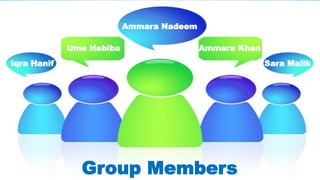
Ammara Nadeem
Ume Habiba
Iqra Hanif
Ammara Khan
Sara Malik
Group Members
Play Starts
 Introduction of Zakat
 Definition and Meaning
 History
 Verses on Zakat
 Hadiths on Zakat
 Importance of Zakat
 Benefits of Zakat
 Conditions for Zakat
 Recipients of Zakat
 Persons who cannot be given Zakat
 Calculation of Zakat
 Punishment for not giving Zakat
 How Zakat is dynamically fair
Content
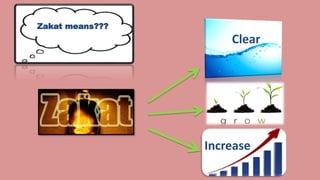
Clear
Increase
Zakat means???
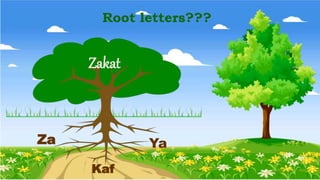
Zakat
Za
Kaf
Ya
Root letters???
Meanings???
to be clean [Al-Quran Chapter 24: Verse 21,
Chapter 23: Verse 4]
to pay the obligatory charity [Al-Quran 2:43]
to be better in purity [Al-Quran 18:81, 19:13]
HISTORY Zakat is a social and economic interaction and it comes under charity of
wealth.
 This phenomenon (charity) and movement was started in early days of
Islam. The practice of zakat is initiated by the Prophet Muhammad (PBUH).
 Qur'an Says:
“Oh, ye Prophet Muhammad (SAW) get zakat charity out of their wealth,
so that their wealth may become neat and clean.” (Quran 8- Hijra. )
 In Muharram, Six Hijra, all orders pertaining to receive Zakat were
pronounced.
 Abu Bakar (R A) declared war (the Ridda’s war) with sword against those,
who refused to pay Zakat/ UsherZakat became one of the five pillars of
Islam.
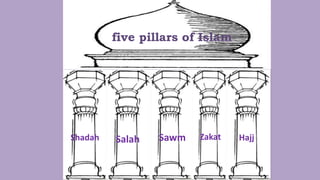
 Zakat became one of the five pillars of Islam.
five pillars of Islam
Shadah Salah Sawm Zakat Hajj
What Quran
Says about
Zakat???
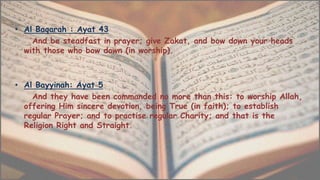
• Al Baqarah : Ayat 43
And be steadfast in prayer; give Zakat, and bow down your heads
with those who bow down (in worship).
• Al Bayyinah: Ayat 5
And they have been commanded no more than this: to worship Allah,
offering Him sincere devotion, being True (in faith); to establish
regular Prayer; and to practise regular Charity; and that is the
Religion Right and Straight.
What did Prophet Muhammad
(PBUH) say about Zakat ???
Zakat, a Bridge of Islam
“Zakat is the bridge of Islam; so whoever performs it can
cross the bridge and whoever withholds it will be detained
beneath it. And it (Zakat) extinguishes the anger of the
Lord.”
Bihar al-Anwar, Volume 74, Page 405
Zakat and its Importance
“Allah has not imposed anything more serious than Zakat
upon this nation – and due to it, many of them shall
perish.”
Al-Kafi, Volume 3, Page 497, and Bihar al-Anwar, Volume
93, Page 22
Zakat is coupled with Prayer and Piety
“There is no prayer for whom there is no zakat; and there is no zakat for whom
there is no piety.”
Bihar al-Anwar, Volume 81, Page 252
The Reason for Zakat, Sustaining the Poor
“Zakat has only been enforced to ensure the
sustenance of the poor and to secure the availability
of their wealth.”
Al-Kafi, Volume 3, Page 498, and Bihar al-Anwar, Volume 93, Page 18
 Zakat relates to one of the pillars of Islam
 While reading the Quran you would have come across a
number of times the command:
“Be steadfast in prayer; practice regular Charity.”
 "Take alms from their wealth in order to
purify them and sanctify them with it."
[Surah at-Tauba 103]
 Messenger of Allah (peace be upon him) was ordered to fight
the people until they made the established prayer and paid
zakat
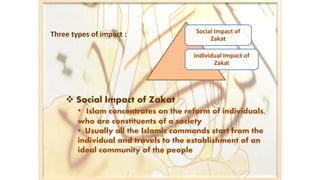
 Social Impact of Zakat
• Islam concentrates on the reform of individuals,
who are constituents of a society
• Usually all the Islamic commands start from the
individual and travels to the establishment of an
ideal community of the people
Social Impact of
Zakat
Individual Impact of
Zakat
Three types of impact :
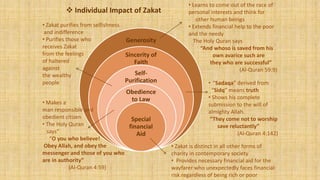
Generosity
Sincerity of
Faith
Self-
Purification
Obedience
to Law
Special
financial
Aid
• Learns to come out of the race of
personal interests and think for
other human beings
• Extends financial help to the poor
and the needy
The Holy Quran says
“And whoso is saved from his
own avarice such are
they who are successful”
(Al-Quran 59:9)
• “Sadaqa” derived from
“Sidq” means truth
• Shows his complete
submission to the will of
almighty Allah.
“They come not to worship
save reluctantly”
(Al-Quran 4:142)
• Zakat purifies from selfishness
and indifference
• Purifies those who
receives Zakat
from the feelings
of haltered
against
the wealthy
people
• Makes a
man responsible and
obedient citizen
• The Holy Quran
says”
“O you who believe!
Obey Allah, and obey the
messenger and those of you who
are in authority”
(Al-Quran 4:59)
• Zakat is distinct in all other forms of
charity in contemporary society
• Provides necessary financial aid for the
wayfarer who unexpectedly faces financial
risk regardless of being rich or poor
 Individual Impact of Zakat
Conditions on Zakat
Islamic Sharia laid down some conditions that
must be realized to make Zakat due.
These conditions are:
• Full Ownership
• Growth of Wealth, Whether Real or Assumed
• Reaching Nisab (Minimum Amount Liable to Zakat)
• Exceeding One's Basic Needs
• The lapse of a full year
• Forbidding Twice Payment of Zakat at the Same Year
• Public wealth and charitable properties
•Full Ownership
• The giver must purely own it.
• No Zakat is due on the property which is Dimar.
• Some Companions are reported to have said, "Zakat is not due on a
Dimar property, nor on the deferred amount of dower nor on the debt
owed by an insolvent person.’’
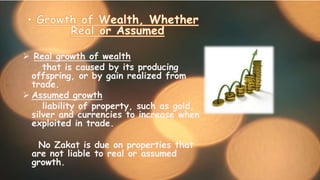
 Real growth of wealth
that is caused by its producing
offspring, or by gain realized from
trade.
 Assumed growth
liability of property, such as gold,
silver and currencies to increase when
exploited in trade.
No Zakat is due on properties that
are not liable to real or assumed
growth.
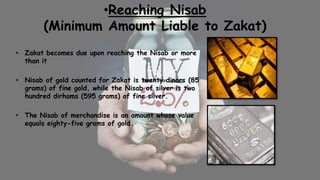
•Reaching Nisab
(Minimum Amount Liable to Zakat)
• Zakat becomes due upon reaching the Nisab or more
than it
• Nisab of gold counted for Zakat is twenty dinars (85
grams) of fine gold, while the Nisab of silver is two
hundred dirhams (595 grams) of fine silver.
• The Nisab of merchandise is an amount whose value
equals eighty-five grams of gold.
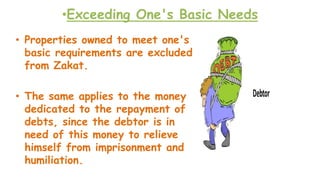
•Exceeding One's Basic Needs
• Properties owned to meet one's
basic requirements are excluded
from Zakat.
• The same applies to the money
dedicated to the repayment of
debts, since the debtor is in
need of this money to relieve
himself from imprisonment and
humiliation.
•The lapse of a full year
• A property is not counted for Zakat
unless after the lapse of a full lunar year
right from the day it reaches the Nisab.
•Forbidding Twice Payment of
Zakat at the Same Year
• The crops or cattle are sold, thus transferred to
cash money, this new type of property is not liable
to Zakat in the same year in which Zakat is paid
on the former type. "There is no repetition of
Zakat.”said by Holy Prophet Muhammad(PBUH).
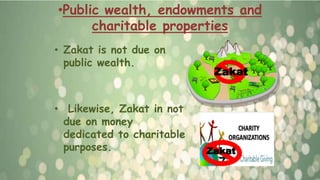
•Public wealth, endowments and
charitable properties
• Zakat is not due on
public wealth.
• Likewise, Zakat in not
due on money
dedicated to charitable
purposes.
Zakat
Zakat
Types of wealth on
which zakat is not
imposed
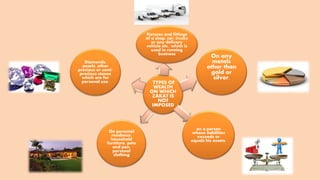
TYPES OF
WEALTH
ON WHICH
ZAKAT IS
NOT
IMPOSED
Fixtures and fittings
of a shop, car, trucks
or any delivery
vehicle etc., which is
used in running
business
On any
metals
other than
gold or
silver.
on a person
whose liabilities
exceeds or
equals his assets.
On personal
residence,
household
furniture, pots
and pan,
personal
clothing
Diamonds,
pearls, other
precious or semi-
precious stones
which are for
personal use.
Persons Who can’t be given Zakat
 The Banu Hashim who are the children of Hazrat Fatima
(RA) and all members of Rasoolullah (S.A.W.)'s family and
wives (RA).
 Parents, grandparents, children and grandchildren.
 Zakat cannot be given to Non-Muslims.
 Zakat cannot be given as remuneration for services rendered.
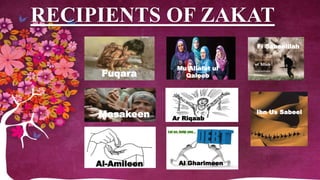
RECIPIENTS OF ZAKAT
Fuqara
Masakeen
Al-Amileen
Mu Allafat ul
Qaloob
Ar Riqaab
Al Gharimeen
Fi Sabeelilah
Ibn Us Sabeel
Zakat has many benefits not only in this world but also
in hereafter. Some of the advantages of giving zakat
are as follows:
1. Zakat reduces class struggles
2. Zakat strengthens the middle class
3. Zakat Cures Social Diseases
4. Zakat liberates society from interests
5. Reward by ALLAH (swt) for giving zakat
Three promises by ALLAH
 God will repay them hundred-fold in
this world for what they spend.
 they will be rewarded bounteously in
the Hereafter.
 there will be for them neither fear nor
grief on the Day of Judgment.
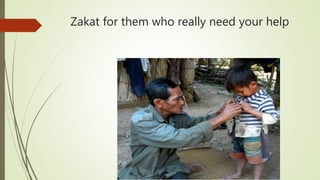
Zakat for them who really need your help
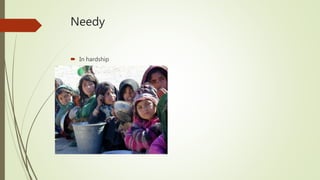
Needy
 In hardship
Help them who really need
Help them who really need your support
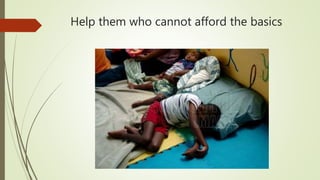
Help them who cannot afford the basics
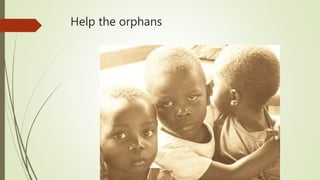
Help the orphans
THE PUNISHMENT FOR NOT GIVING ZAKAT
 Allah says in the Quran:
“On the Day of Judgment heat will be produced out of that wealth in the fire
of Hell.” (Al‐Quran 9:34‐35)
 Rasoolullah (SAWW) has said;
"The nation that does not give Zakat, Allah will bring about a drought on them
(i.e. necessities of life will become scarce)."
 (Bukhari)
on the Day of Qiyaamah, his wealth will be turned into a venomous bald
serpent which will wind around his neck and bite his jaws and say: "I am your
wealth, I am your treasure."
Lets see how Zakat is dynamically
fair!
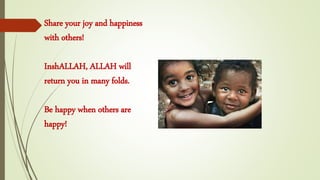
Share your joy and happiness
with others!
InshALLAH, ALLAH will
return you in many folds.
Be happy when others are
happy!
Play ends…
THANKS

Zakat presentations.pptx3

  • 2.
  • 3.
    Ammara Nadeem Ume Habiba IqraHanif Ammara Khan Sara Malik Group Members
  • 4.
  • 5.
     Introduction ofZakat  Definition and Meaning  History  Verses on Zakat  Hadiths on Zakat  Importance of Zakat  Benefits of Zakat  Conditions for Zakat  Recipients of Zakat  Persons who cannot be given Zakat  Calculation of Zakat  Punishment for not giving Zakat  How Zakat is dynamically fair Content
  • 6.
  • 7.
  • 8.
    Meanings??? to be clean[Al-Quran Chapter 24: Verse 21, Chapter 23: Verse 4] to pay the obligatory charity [Al-Quran 2:43] to be better in purity [Al-Quran 18:81, 19:13]
  • 9.
    HISTORY Zakat isa social and economic interaction and it comes under charity of wealth.  This phenomenon (charity) and movement was started in early days of Islam. The practice of zakat is initiated by the Prophet Muhammad (PBUH).  Qur'an Says: “Oh, ye Prophet Muhammad (SAW) get zakat charity out of their wealth, so that their wealth may become neat and clean.” (Quran 8- Hijra. )  In Muharram, Six Hijra, all orders pertaining to receive Zakat were pronounced.  Abu Bakar (R A) declared war (the Ridda’s war) with sword against those, who refused to pay Zakat/ UsherZakat became one of the five pillars of Islam.  Zakat became one of the five pillars of Islam.
  • 10.
    five pillars ofIslam Shadah Salah Sawm Zakat Hajj
  • 11.
  • 12.
    • Al Baqarah: Ayat 43 And be steadfast in prayer; give Zakat, and bow down your heads with those who bow down (in worship). • Al Bayyinah: Ayat 5 And they have been commanded no more than this: to worship Allah, offering Him sincere devotion, being True (in faith); to establish regular Prayer; and to practise regular Charity; and that is the Religion Right and Straight.
  • 13.
    What did ProphetMuhammad (PBUH) say about Zakat ???
  • 14.
    Zakat, a Bridgeof Islam “Zakat is the bridge of Islam; so whoever performs it can cross the bridge and whoever withholds it will be detained beneath it. And it (Zakat) extinguishes the anger of the Lord.” Bihar al-Anwar, Volume 74, Page 405 Zakat and its Importance “Allah has not imposed anything more serious than Zakat upon this nation – and due to it, many of them shall perish.” Al-Kafi, Volume 3, Page 497, and Bihar al-Anwar, Volume 93, Page 22
  • 15.
    Zakat is coupledwith Prayer and Piety “There is no prayer for whom there is no zakat; and there is no zakat for whom there is no piety.” Bihar al-Anwar, Volume 81, Page 252 The Reason for Zakat, Sustaining the Poor “Zakat has only been enforced to ensure the sustenance of the poor and to secure the availability of their wealth.” Al-Kafi, Volume 3, Page 498, and Bihar al-Anwar, Volume 93, Page 18
  • 16.
     Zakat relatesto one of the pillars of Islam  While reading the Quran you would have come across a number of times the command: “Be steadfast in prayer; practice regular Charity.”  "Take alms from their wealth in order to purify them and sanctify them with it." [Surah at-Tauba 103]  Messenger of Allah (peace be upon him) was ordered to fight the people until they made the established prayer and paid zakat
  • 17.
     Social Impactof Zakat • Islam concentrates on the reform of individuals, who are constituents of a society • Usually all the Islamic commands start from the individual and travels to the establishment of an ideal community of the people Social Impact of Zakat Individual Impact of Zakat Three types of impact :
  • 18.
    Generosity Sincerity of Faith Self- Purification Obedience to Law Special financial Aid •Learns to come out of the race of personal interests and think for other human beings • Extends financial help to the poor and the needy The Holy Quran says “And whoso is saved from his own avarice such are they who are successful” (Al-Quran 59:9) • “Sadaqa” derived from “Sidq” means truth • Shows his complete submission to the will of almighty Allah. “They come not to worship save reluctantly” (Al-Quran 4:142) • Zakat purifies from selfishness and indifference • Purifies those who receives Zakat from the feelings of haltered against the wealthy people • Makes a man responsible and obedient citizen • The Holy Quran says” “O you who believe! Obey Allah, and obey the messenger and those of you who are in authority” (Al-Quran 4:59) • Zakat is distinct in all other forms of charity in contemporary society • Provides necessary financial aid for the wayfarer who unexpectedly faces financial risk regardless of being rich or poor  Individual Impact of Zakat
  • 19.
  • 20.
    Islamic Sharia laiddown some conditions that must be realized to make Zakat due. These conditions are: • Full Ownership • Growth of Wealth, Whether Real or Assumed • Reaching Nisab (Minimum Amount Liable to Zakat) • Exceeding One's Basic Needs • The lapse of a full year • Forbidding Twice Payment of Zakat at the Same Year • Public wealth and charitable properties
  • 21.
    •Full Ownership • Thegiver must purely own it. • No Zakat is due on the property which is Dimar. • Some Companions are reported to have said, "Zakat is not due on a Dimar property, nor on the deferred amount of dower nor on the debt owed by an insolvent person.’’
  • 22.
     Real growthof wealth that is caused by its producing offspring, or by gain realized from trade.  Assumed growth liability of property, such as gold, silver and currencies to increase when exploited in trade. No Zakat is due on properties that are not liable to real or assumed growth.
  • 23.
    •Reaching Nisab (Minimum AmountLiable to Zakat) • Zakat becomes due upon reaching the Nisab or more than it • Nisab of gold counted for Zakat is twenty dinars (85 grams) of fine gold, while the Nisab of silver is two hundred dirhams (595 grams) of fine silver. • The Nisab of merchandise is an amount whose value equals eighty-five grams of gold.
  • 24.
    •Exceeding One's BasicNeeds • Properties owned to meet one's basic requirements are excluded from Zakat. • The same applies to the money dedicated to the repayment of debts, since the debtor is in need of this money to relieve himself from imprisonment and humiliation.
  • 25.
    •The lapse ofa full year • A property is not counted for Zakat unless after the lapse of a full lunar year right from the day it reaches the Nisab.
  • 26.
    •Forbidding Twice Paymentof Zakat at the Same Year • The crops or cattle are sold, thus transferred to cash money, this new type of property is not liable to Zakat in the same year in which Zakat is paid on the former type. "There is no repetition of Zakat.”said by Holy Prophet Muhammad(PBUH).
  • 27.
    •Public wealth, endowmentsand charitable properties • Zakat is not due on public wealth. • Likewise, Zakat in not due on money dedicated to charitable purposes. Zakat Zakat
  • 28.
    Types of wealthon which zakat is not imposed
  • 29.
    TYPES OF WEALTH ON WHICH ZAKATIS NOT IMPOSED Fixtures and fittings of a shop, car, trucks or any delivery vehicle etc., which is used in running business On any metals other than gold or silver. on a person whose liabilities exceeds or equals his assets. On personal residence, household furniture, pots and pan, personal clothing Diamonds, pearls, other precious or semi- precious stones which are for personal use.
  • 30.
    Persons Who can’tbe given Zakat  The Banu Hashim who are the children of Hazrat Fatima (RA) and all members of Rasoolullah (S.A.W.)'s family and wives (RA).  Parents, grandparents, children and grandchildren.  Zakat cannot be given to Non-Muslims.  Zakat cannot be given as remuneration for services rendered.
  • 31.
    RECIPIENTS OF ZAKAT Fuqara Masakeen Al-Amileen MuAllafat ul Qaloob Ar Riqaab Al Gharimeen Fi Sabeelilah Ibn Us Sabeel
  • 32.
    Zakat has manybenefits not only in this world but also in hereafter. Some of the advantages of giving zakat are as follows: 1. Zakat reduces class struggles 2. Zakat strengthens the middle class 3. Zakat Cures Social Diseases 4. Zakat liberates society from interests 5. Reward by ALLAH (swt) for giving zakat
  • 33.
    Three promises byALLAH  God will repay them hundred-fold in this world for what they spend.  they will be rewarded bounteously in the Hereafter.  there will be for them neither fear nor grief on the Day of Judgment.
  • 34.
    Zakat for themwho really need your help
  • 35.
  • 36.
    Help them whoreally need
  • 37.
    Help them whoreally need your support
  • 38.
    Help them whocannot afford the basics
  • 39.
  • 40.
    THE PUNISHMENT FORNOT GIVING ZAKAT  Allah says in the Quran: “On the Day of Judgment heat will be produced out of that wealth in the fire of Hell.” (Al‐Quran 9:34‐35)  Rasoolullah (SAWW) has said; "The nation that does not give Zakat, Allah will bring about a drought on them (i.e. necessities of life will become scarce)."  (Bukhari) on the Day of Qiyaamah, his wealth will be turned into a venomous bald serpent which will wind around his neck and bite his jaws and say: "I am your wealth, I am your treasure."
  • 41.
    Lets see howZakat is dynamically fair!
  • 43.
    Share your joyand happiness with others! InshALLAH, ALLAH will return you in many folds. Be happy when others are happy!
  • 44.
  • 45.