IJARAH – LEASING (Sewa atau Pajak)
AL IJARAH A contract is where  the financier  buys and leases equipment or other assets to the business owner for a fee or more often called  rental income .  The duration of the lease as well as the fee must be set in advance and mutually agreed.
Jenis-jenis IJARAH Ijarah  “ Jasa ”  ( Ijarah  ‘ ala al  ‘ amal )  I jarah Muntahiyah bi alTamlik Al-Ijarah wal-`Iqtina’
To  employ the services of a person on wages  given to him as a consideration for his hired services. Someone else  hires the services of a person . (Example: a doctor, a lawyer,  a teacher, a laborer, or any other person who can render some valuable services). The employer –  ‘Mustajir’ The employee –  ‘Ajir’ 1. Ijarah ‘ala al ‘amal - services
It is not relate to the services of human beings. To transfer the  asset or property  to another person in exchanged for rent claimed.  Another word – Leasing Lessor –  ‘Mujir’ Lessee –  ‘Mustajir’ Rent payable to lessor – ‘Ujrah’ 2. Ijarah Muntahiyah bi alTamlik – Assets and properties
3. Al-Ijarah wal-`Iqtina’  (Lease to Purchase or Hire Purchase)   A contract is just the same as that of the Al-Ijarah except that the business owner is committed to buying the equipment at the end of the lease period.  Fees previously paid constitute part of the purchase price.  This type of lease to purchase agreement is commonly used for  home financing .
The leasing contract must meet the following conditions: The  service  that the asset is supposed to provide and for which it is  being rented  should be definitely and clearly known to both parties. The asset remains in the  ownership of the lessor  who is responsible for its maintenance so that it continues to give the service for which it was rented. The leasing contract  is terminated  as soon as the  asset ceases  to give the service for which it was rented.
Continued…… If the asset becomes  damaged  during the period of the contract, the  contract will remain valid. The price  of an asset that may be sold to the lessee at the expiry of the contract  cannot be pre-determined. It can be determined  only at the time of the expiry  of the contract.
Rules of Ijarah Leasing is a contract whereby  the owner of something transfers  its asset/property  to another person  for an agreed  period , at an agreed  consideration. The  subject  of lease must have a  valuable use.  Therefore, things having no usufruct at all cannot be leased.
Rules of Ijarah It is necessary for a valid contract of lease that the corpus (quantity / amount) of the leased property remains in the ownership of the seller, and only its usufruct is transferred to the lessee. Thus, anything which  cannot be used  without consuming  cannot be leased  out. Therefore, the lease  cannot be affect  in respect of money, eatables, fuel and ammunition etc. because their use is not possible unless they are consumed.
Rules of Ijarah As the corpus of  the leased property remains in the ownership of the lessor , all the  liabilities  emerging from the ownership of the lessor,  all the liabilities  emerging from the ownership  shall be borne by the lessor , but the liabilities referable to the use of property shall be borne by the lessee. Example:  A has leased his house to B. The taxes referable to the property shall be borne by A, while the water tax, electricity bills and all expenses referable to the use of the house shall be borne by B, the lessee.
Rules of Ijarah The  period of lease  must be determined in clear terms. The  lessee cannot use the leased asset for any purpose other than the purpose specified in the lease agreement . If no such purpose is specified in the agreement, the lessee can use it for whatever purpose it is used in the normal course.  However, if he wishes to use it for an abnormal purpose, he cannot do unless the lessor allows him in express terms.
Rules of Ijarah The  lessee is liable to compensate the lessor for every harm to the leased asse t caused by any misuse or negligence on the part of the lessee. The leased asset shall be remained in  the risk of the lessor throughout the lease period  in the sense that any harm or loss caused by the factors beyond the control of the lessee shall be borne by the lessor.
A property  jointly owned  by two or more persons  can be leased out , and the rental shall be distributed between all the joint owners according to the proportion of their respective shares in the property.  A joint owner of a property can lease his proportionate share to his co-sharer only, and not to any other person. Rules of Ijarah
Akad Ijarah Berakhir Objek hilang/lenyap : terbakar, faktor alam Habis masa waktunya Salah satu pihak yang wafat dapat dialihkan pada ahli warisnya Objek disita.
Determination of Rental Must be determined at the time of contract for the whole period of the lease. It can be fix different amounts of rent for different phases during the lease period, depends as specified in the agreement.
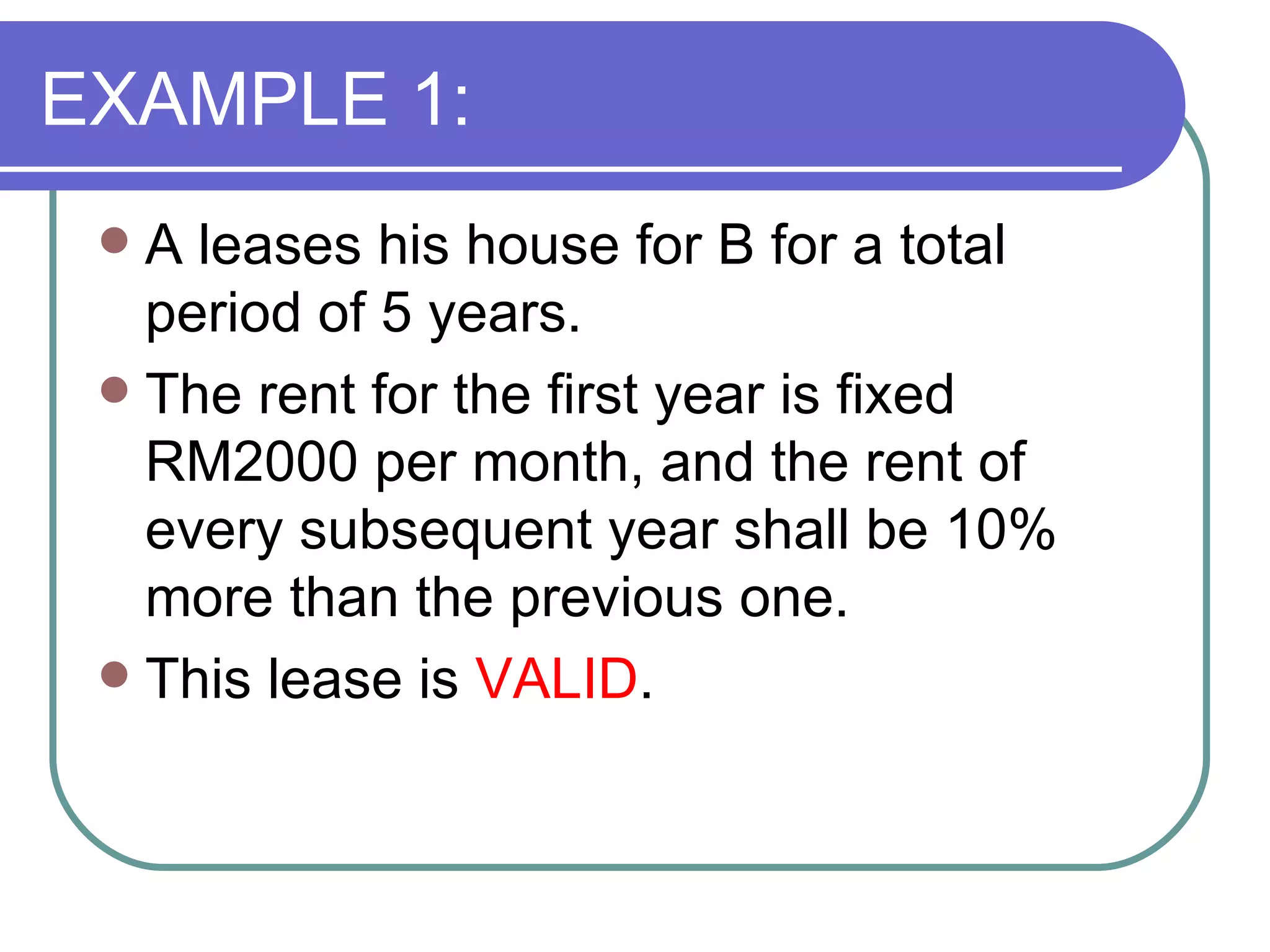
EXAMPLE 1: A leases his house for B for a total period of 5 years. The rent for the first year is fixed  RM2000 per month, and the rent of every subsequent year shall be 10% more than the previous one. This lease is  VALID .
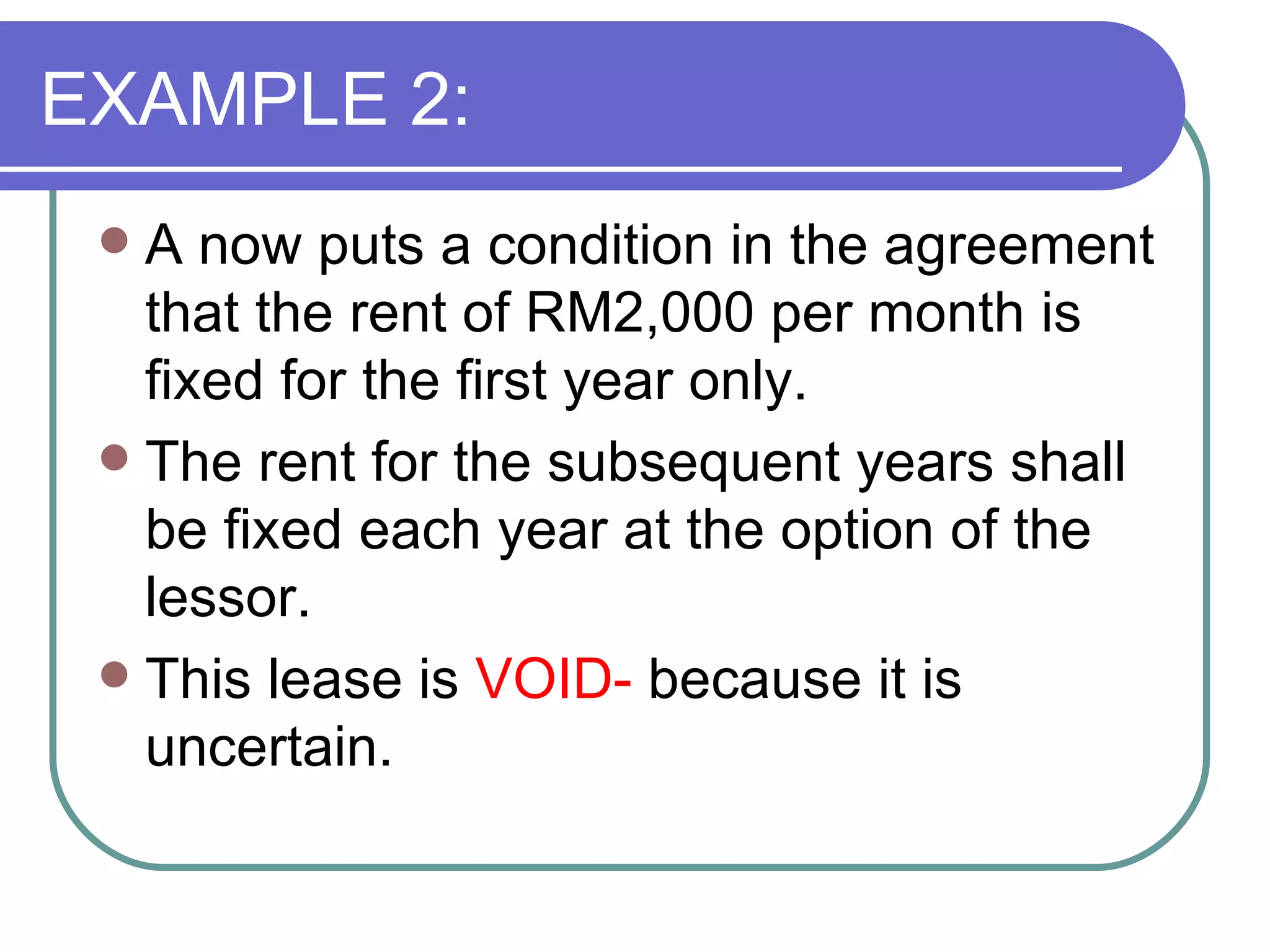
EXAMPLE 2: A now puts a condition in the agreement that the rent of RM2,000 per month is fixed for the first year only.  The rent for the subsequent years shall be fixed each year at the option of the lessor. This lease is  VOID-  because it is uncertain.
Differences between Leasing and Ijarah
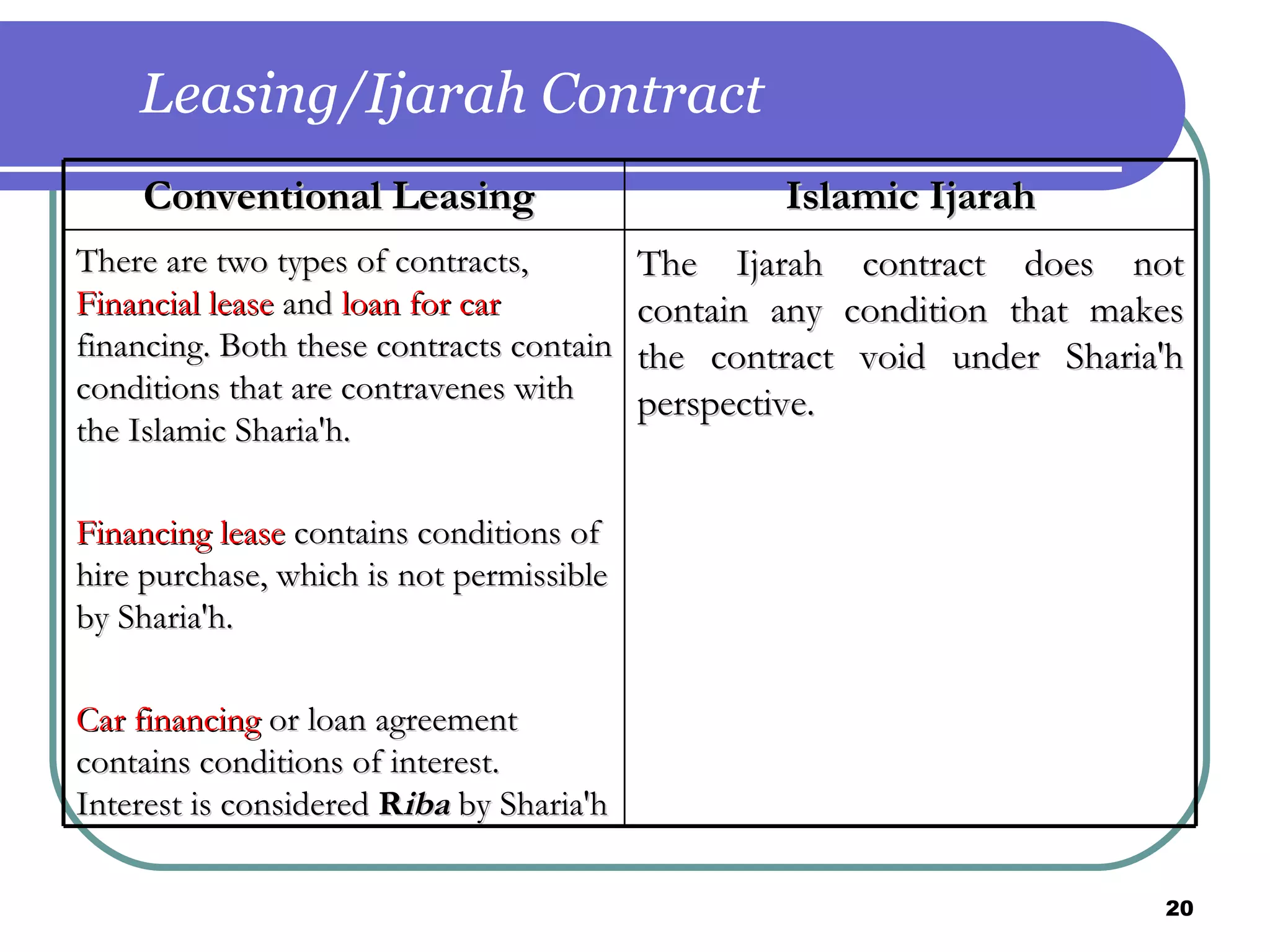
Leasing/Ijarah Contract Conventional Leasing  Islamic Ijarah There are two types of contracts,  Financial lease  and  loan for car  financing. Both these contracts contain conditions that are contravenes with the Islamic Sharia'h.  Financing lease  contains conditions of hire purchase, which is not permissible by Sharia'h.  Car financing  or loan agreement contains conditions of interest. Interest is considered  R iba   by Sharia'h The Ijarah contract does not contain any condition that makes the contract void under Sharia'h perspective.
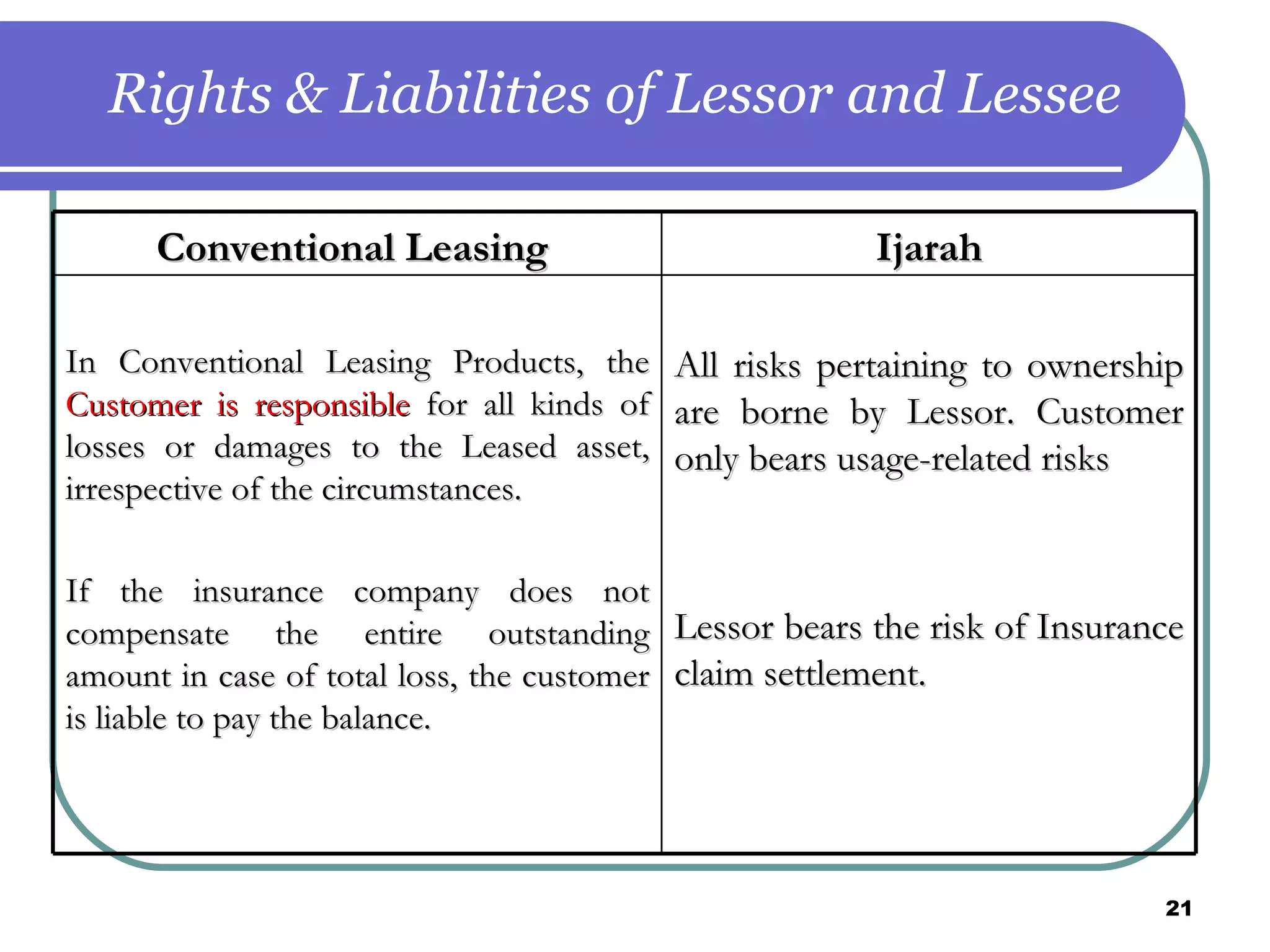
Rights & Liabilities of Lessor and Lessee Conventional Leasing  Ijarah In Conventional Leasing Products, the  Customer is responsible  for all kinds of losses or damages to the Leased asset, irrespective of the circumstances. If the insurance company does not compensate the entire outstanding amount in case of total loss, the customer is liable to pay the balance.  All risks pertaining to ownership are borne by Lessor. Customer only bears usage-related risks Lessor bears the risk of Insurance claim settlement.
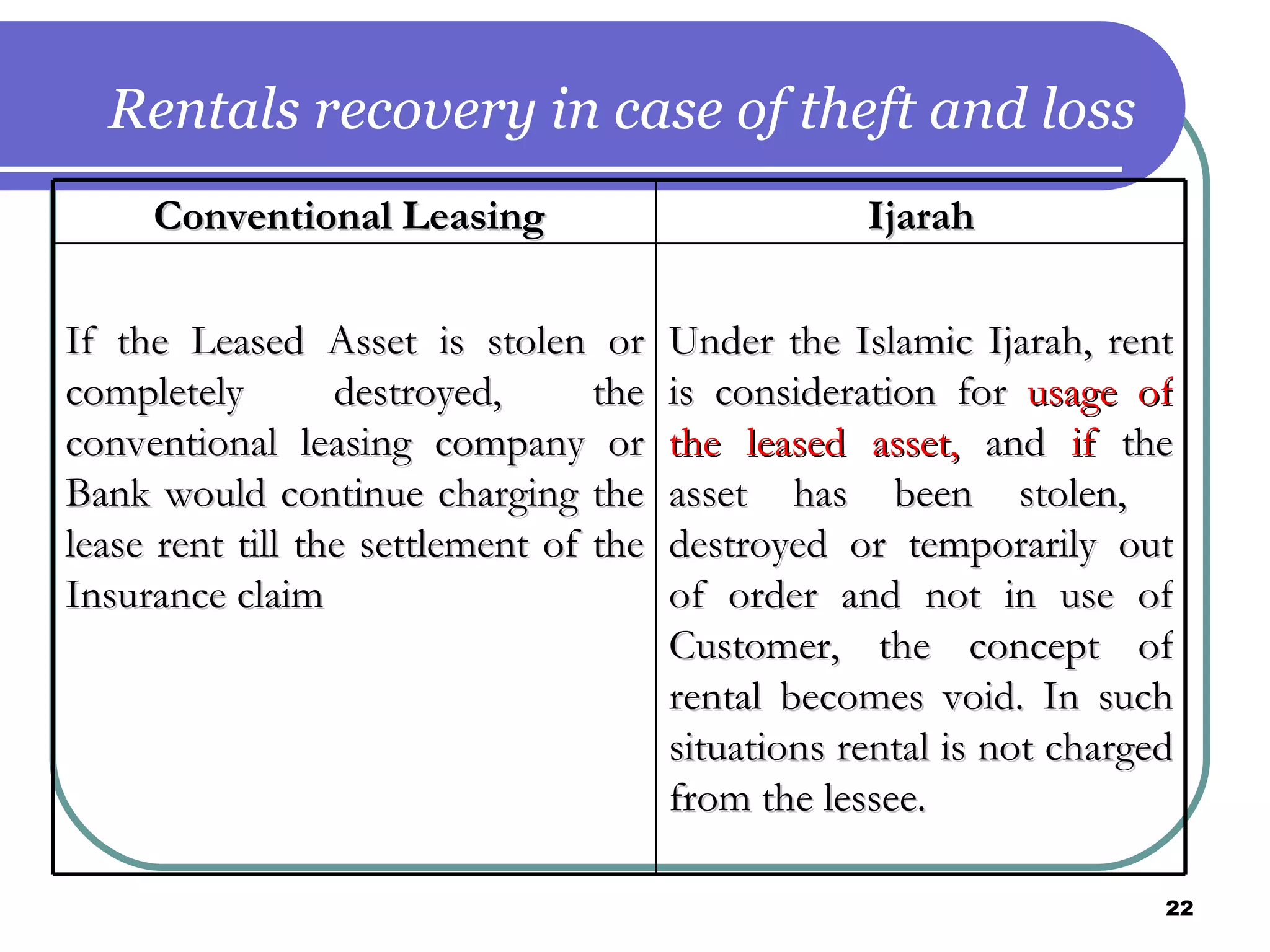
Rentals recovery in case of theft and loss Conventional Leasing  Ijarah If the Leased Asset is stolen or completely destroyed, the conventional leasing company or Bank would continue charging the lease rent till the settlement of the Insurance claim  Under the Islamic Ijarah, rent is consideration for  usage of the leased asset,  and  if  the asset has been stolen,  destroyed or temporarily out of order and not in use of Customer, the concept of rental becomes void. In such situations rental is not charged from the lessee.
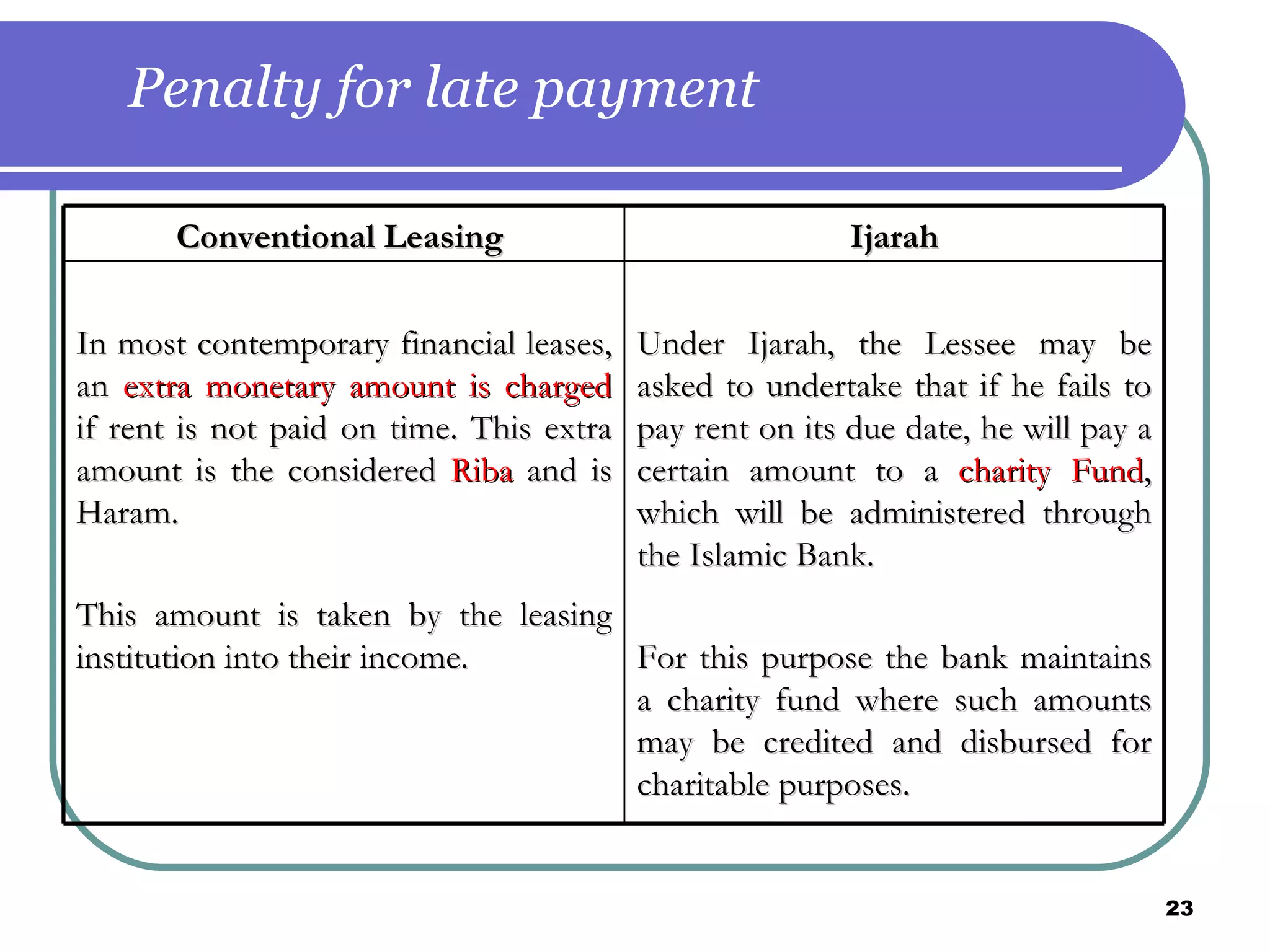
Penalty for late payment Conventional Leasing  Ijarah In most contemporary financial leases, an  extra monetary amount is charged  if rent is not paid on time. This extra amount is the considered  Riba  and is Haram.  This amount is taken by the leasing institution into their income.  Under Ijarah, the Lessee may be asked to undertake that if he fails to pay rent on its due date, he will pay a certain amount to a  charity Fund , which will be administered through the Islamic Bank.  For this purpose the bank maintains a charity fund where such amounts may be credited and disbursed for charitable purposes.
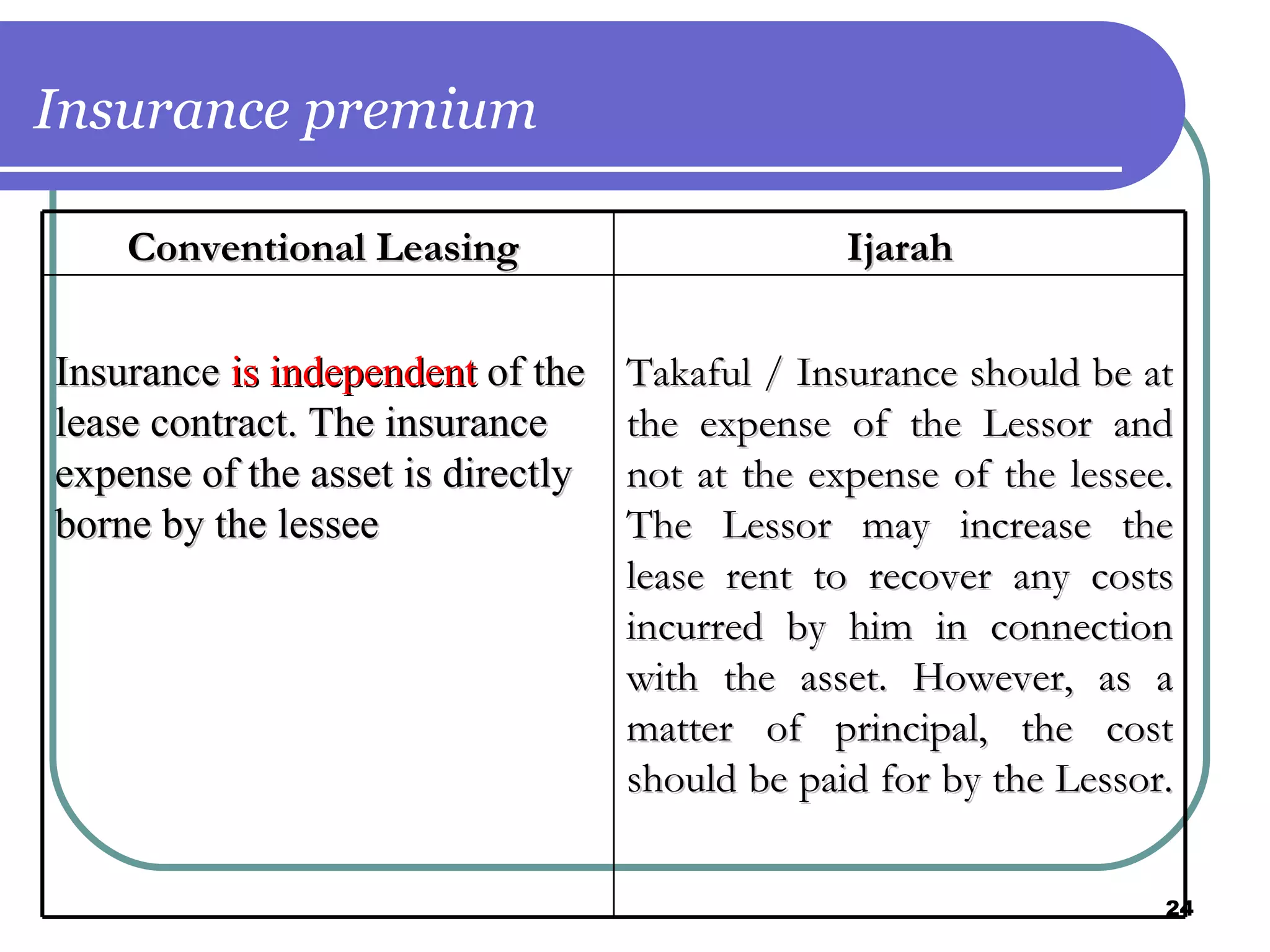
Insurance premium Conventional Leasing  Ijarah Insurance  is independent  of the lease contract. The insurance expense of the asset is directly borne by the lessee Takaful  /  Insurance   should be at the expense of the Lessor and not at the expense of the lessee. The Lessor may increase the lease rent to recover any costs incurred by him in connection with the asset. However, as a matter of principal, the cost should be paid for by the Lessor.
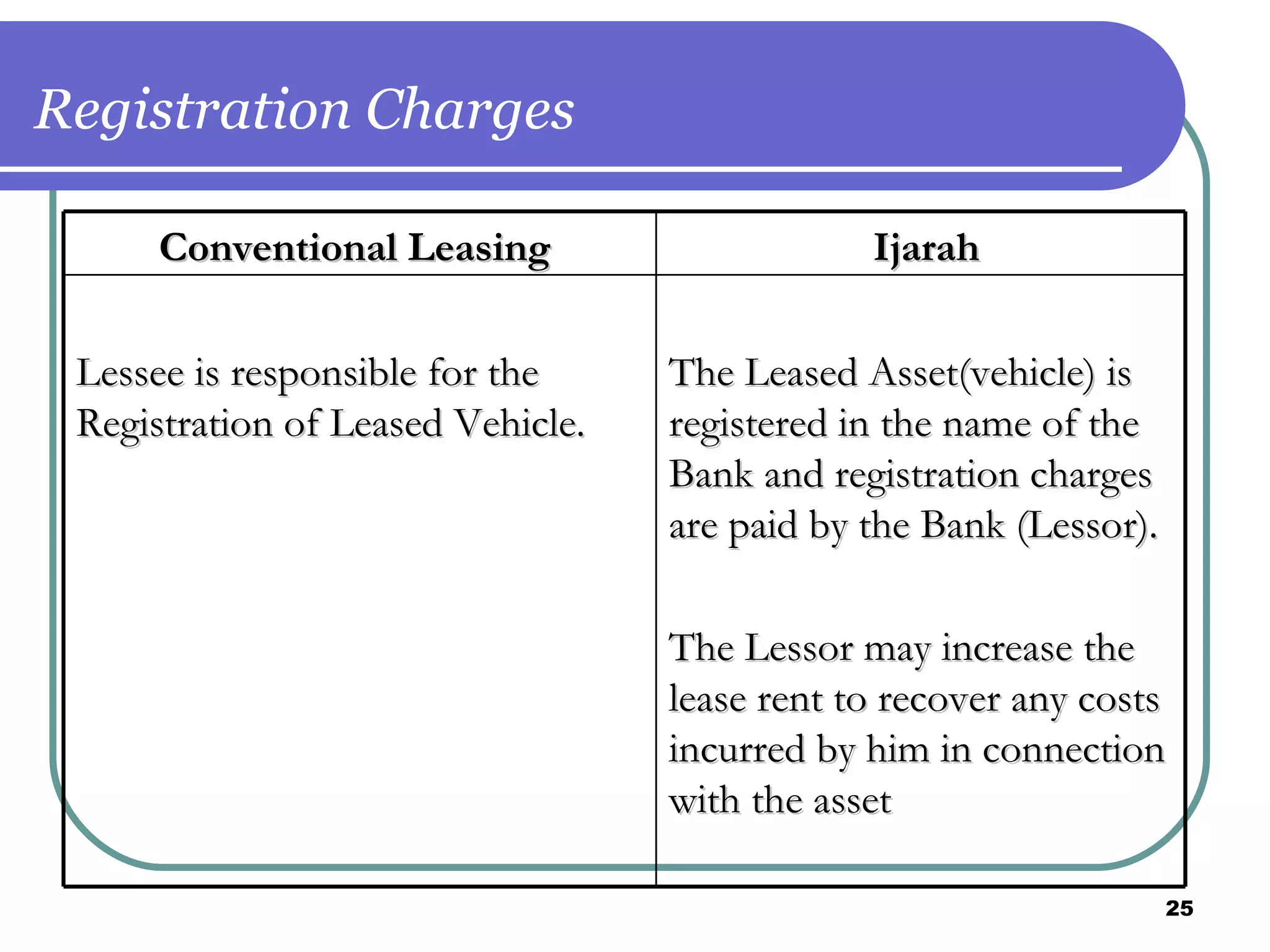
Registration Charges Conventional Leasing  Ijarah Lessee is responsible for the Registration of Leased Vehicle. The Leased Asset(vehicle) is registered in the name of the Bank and registration charges are paid by the Bank (Lessor). The Lessor may increase the lease rent to recover any costs incurred by him in connection with the asset
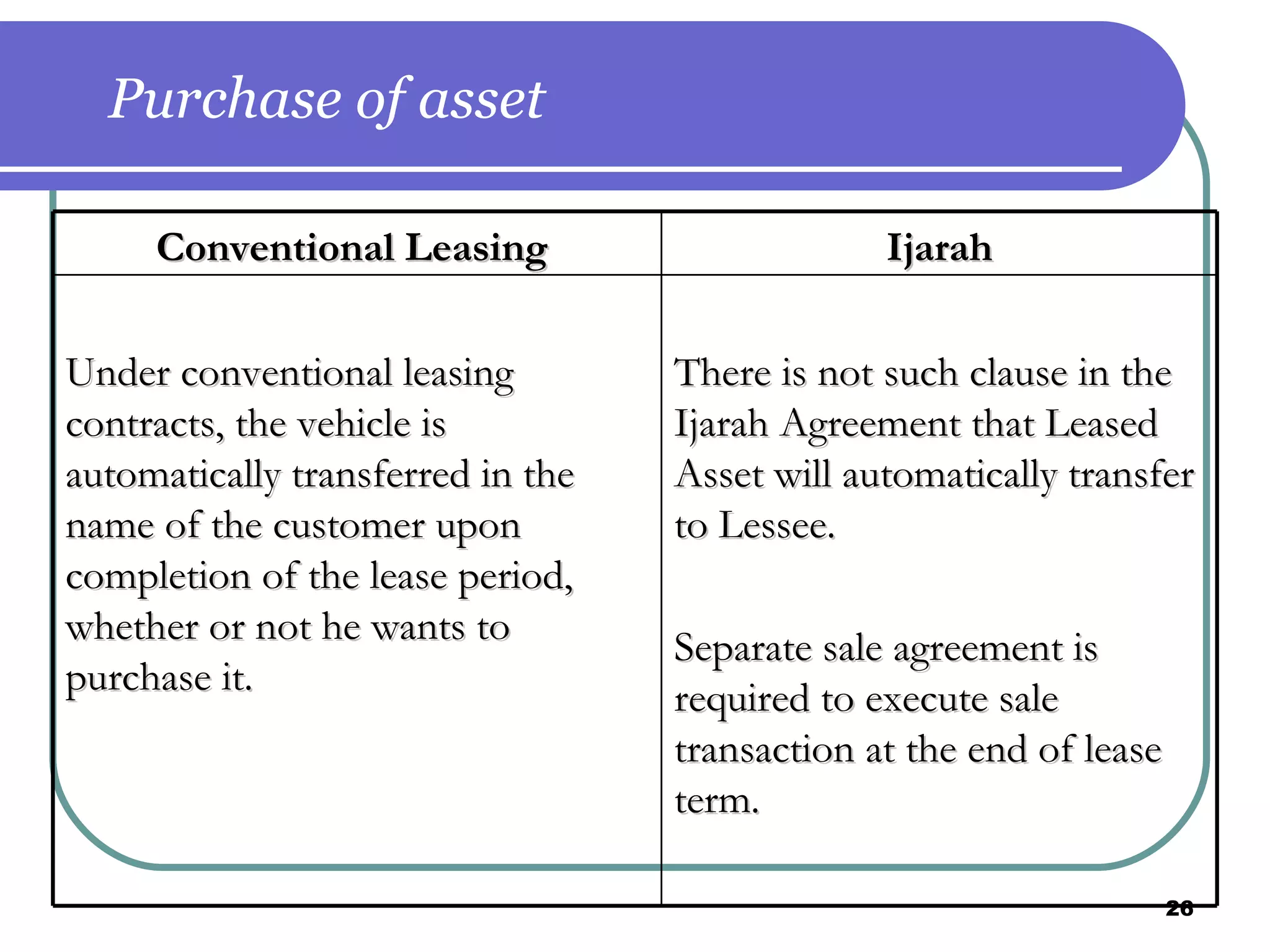
Purchase of asset Conventional Leasing  Ijarah Under conventional leasing contracts, the vehicle is automatically transferred in the name of the customer upon completion of the lease period, whether or not he wants to purchase it.  There is not such clause in the Ijarah Agreement that Leased Asset will automatically transfer to Lessee. Separate sale agreement is required to execute sale transaction at the end of lease term.
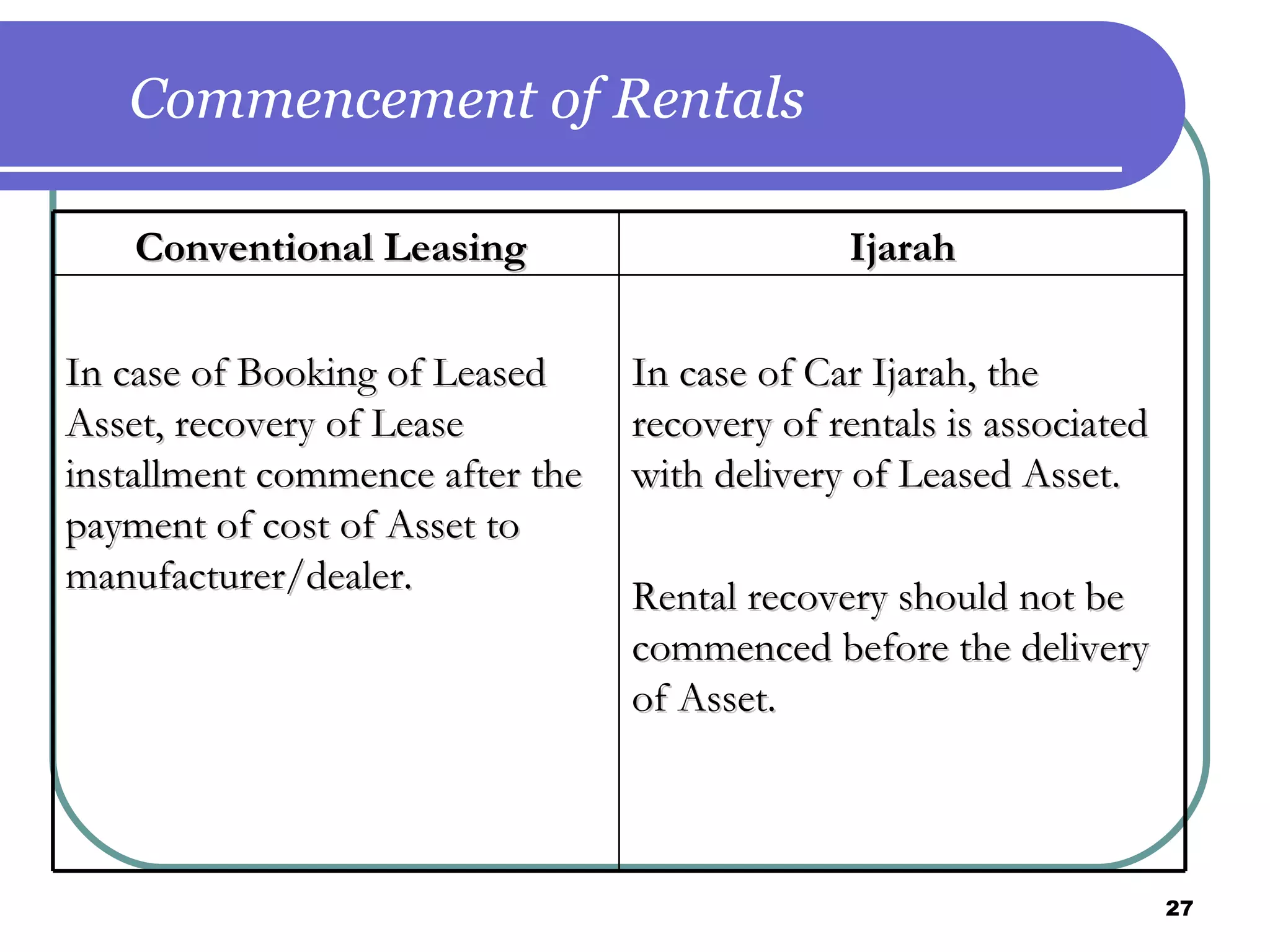
Commencement of Rentals Conventional Leasing  Ijarah In case of Booking of Leased Asset, recovery of Lease installment commence after the payment of cost of Asset to manufacturer/dealer. In case of Car Ijarah, the recovery of rentals is associated with delivery of Leased Asset.  Rental recovery should not be commenced before the delivery of Asset.
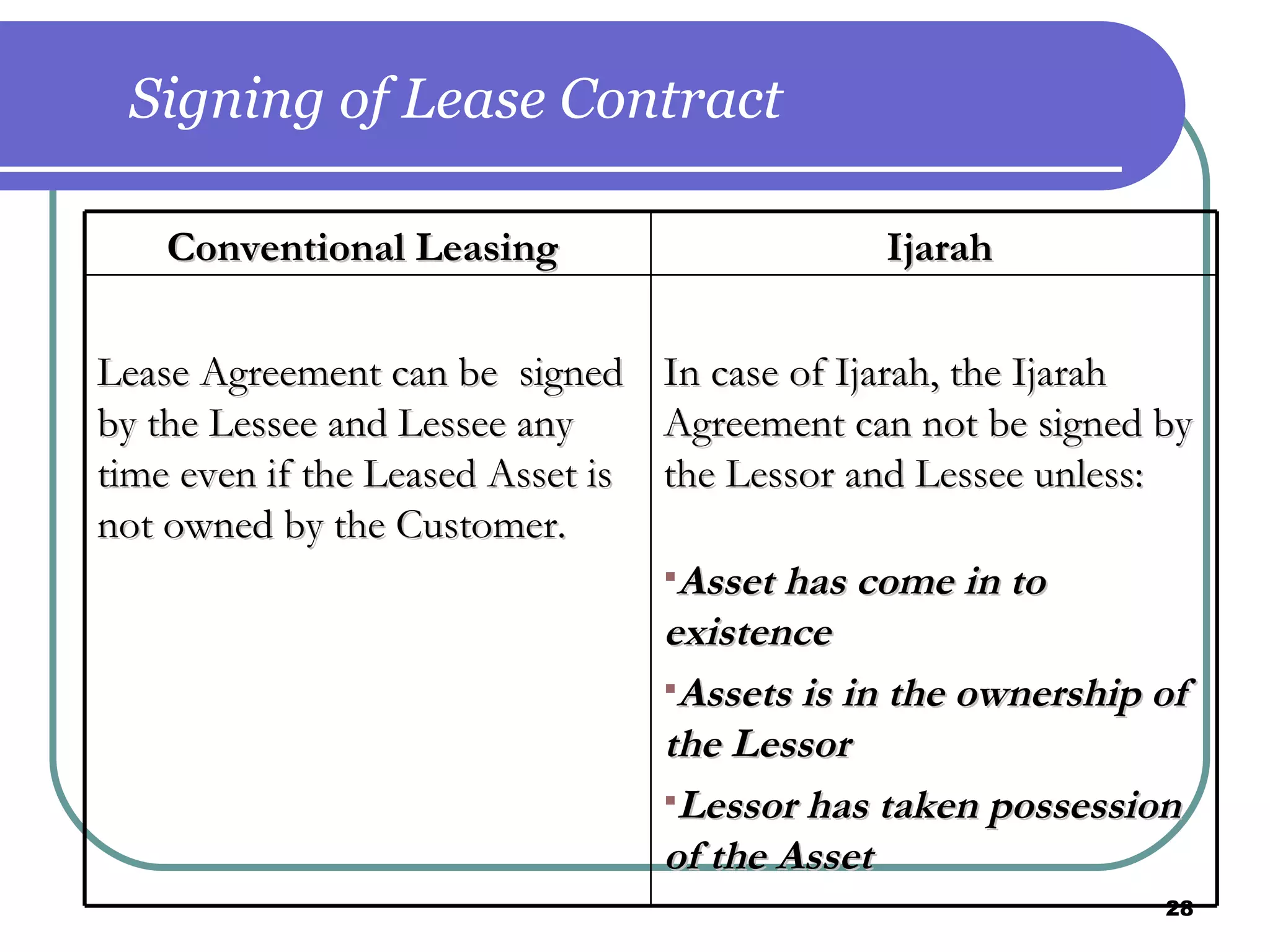
Signing of Lease Contract Conventional Leasing  Ijarah Lease Agreement can be  signed by the Lessee and Lessee any time even if the Leased Asset is not owned by the Customer. In case of Ijarah, the Ijarah Agreement can not be signed by the Lessor and Lessee unless: Asset has come in to existence Assets is in the ownership of the Lessor Lessor has taken possession of the Asset
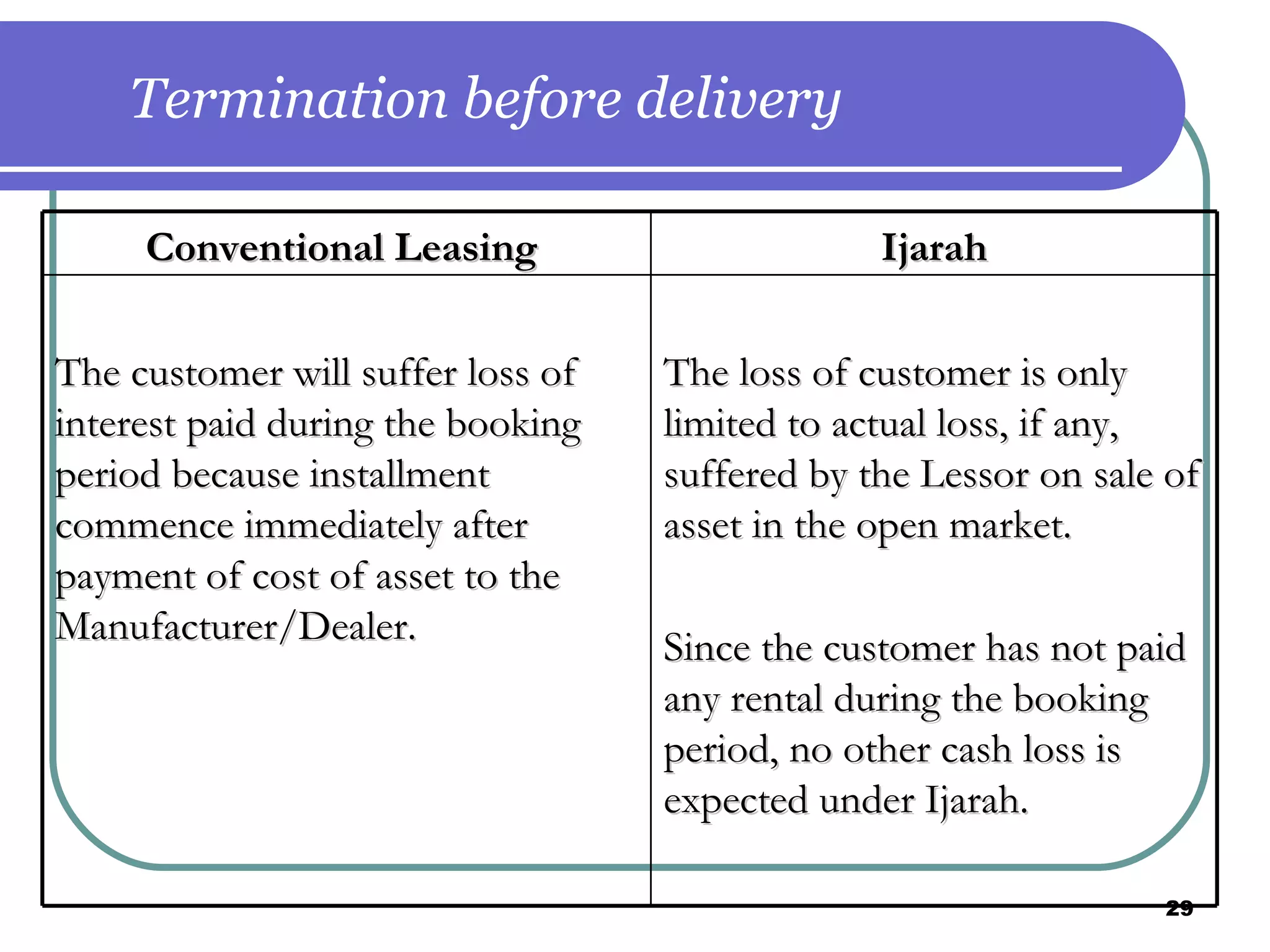
Termination before delivery Conventional Leasing  Ijarah The customer will suffer loss of interest paid during the booking period because installment commence immediately after payment of cost of asset to the Manufacturer/Dealer. The loss of customer is only limited to actual loss, if any,  suffered by the Lessor on sale of asset in the open market. Since the customer has not paid any rental during the booking period, no other cash loss is expected under Ijarah.
Documentation of IJARAH
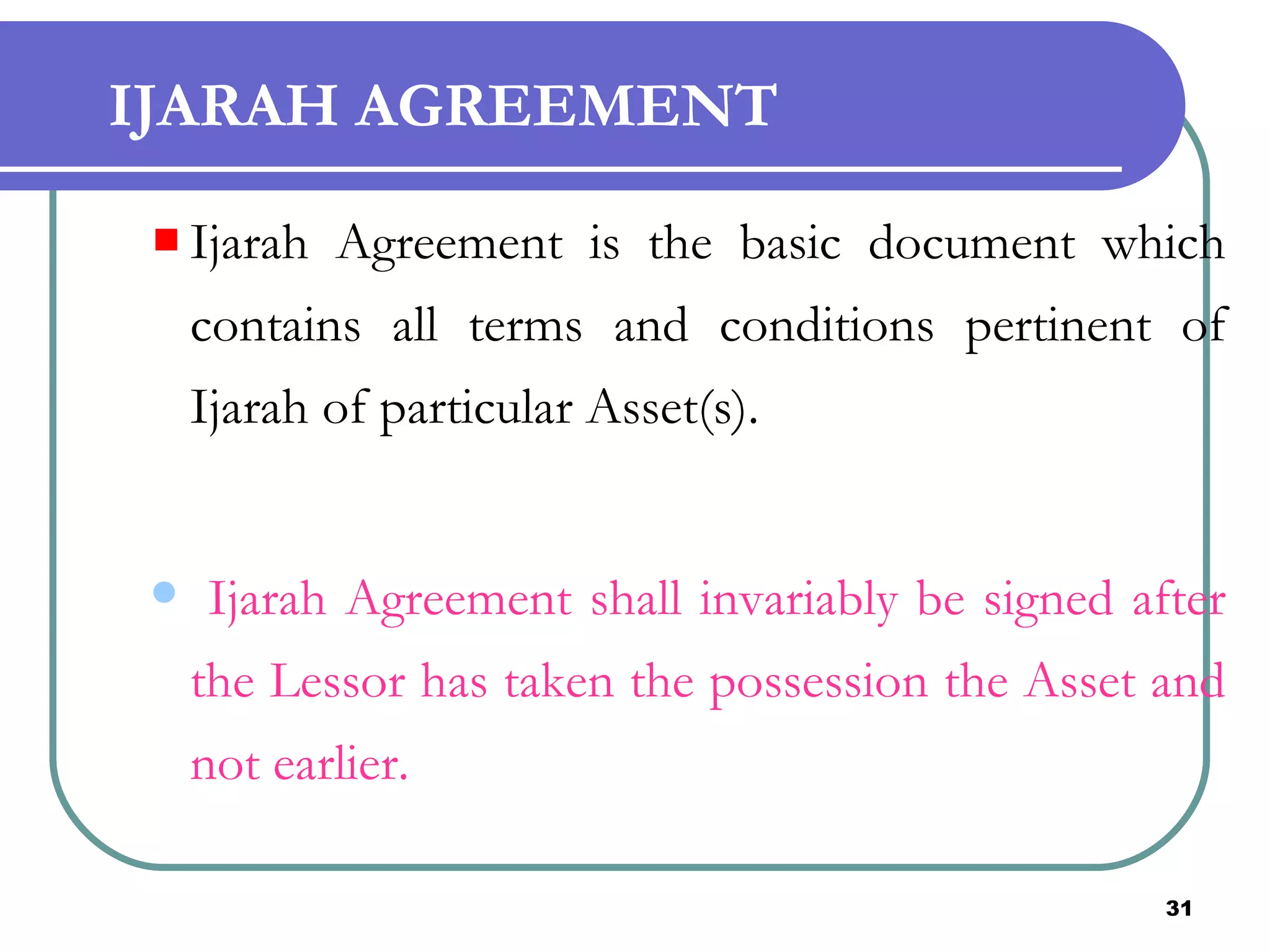
IJARAH AGREEMENT Ijarah Agreement is the basic document which contains all terms and conditions pertinent of Ijarah of particular Asset(s). Ijarah Agreement shall invariably be signed after the Lessor has taken the possession the Asset and not earlier.
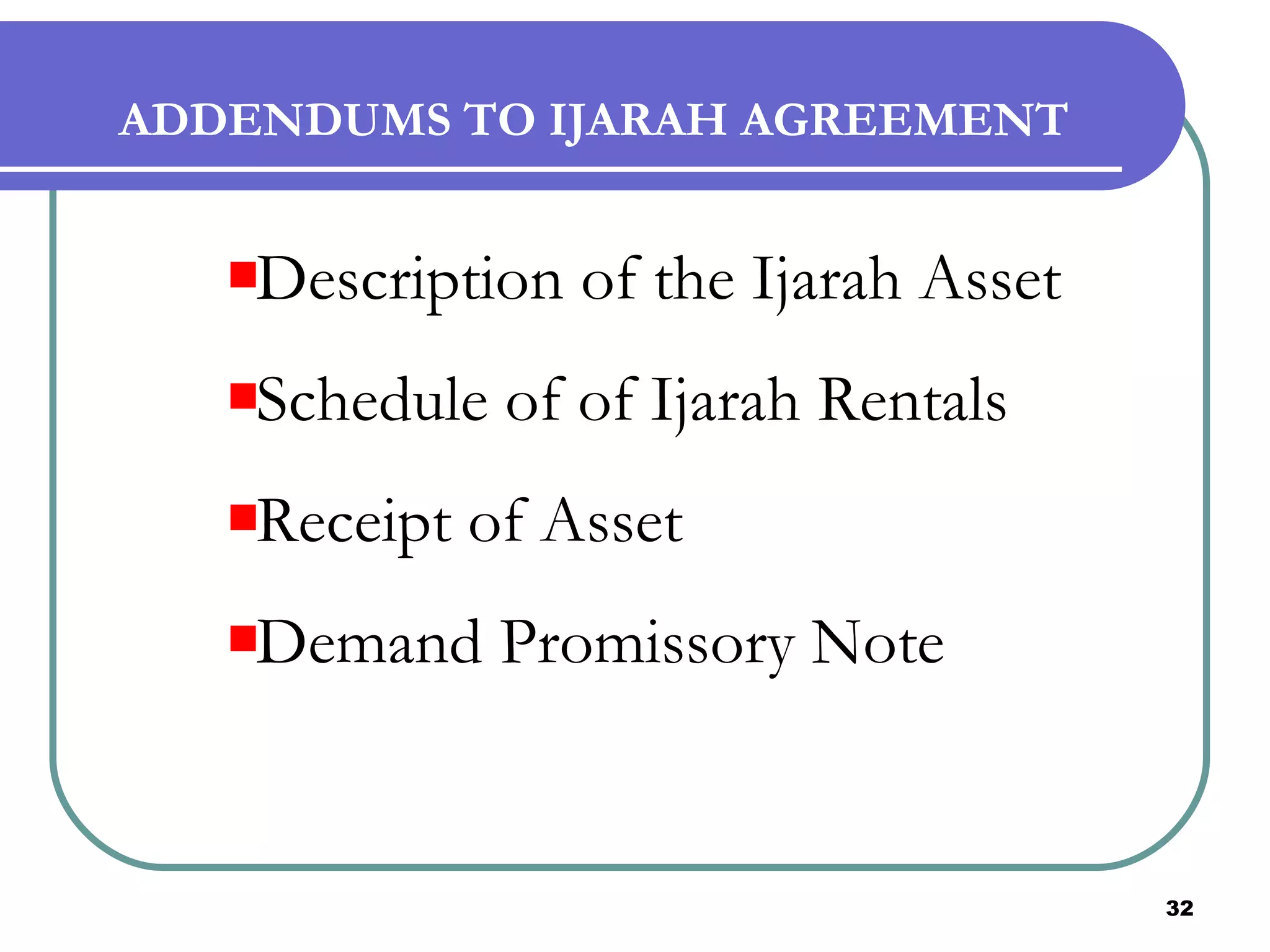
ADDENDUMS TO IJARAH AGREEMENT   Description of the Ijarah Asset  Schedule of of Ijarah Rentals Receipt of Asset Demand Promissory Note
DESCRIPTION OF IJARAH ASSET This document contains the detailed  description about the Leased Asset agreed between the parties e.g Name, Make ,Model,Engine No., Chassis No., Registration No. etc etc. This documents shall be signed  signed after Delivery of asset to the Lessee and not earlier.
SCHEDULE OF IJARAH RENTALS This schedule contains a table which shows: Amount of rental (Monthly/Quarterly/Half Yearly) Date of Payment of each rental This schedule will also contain the date on which first rental is due. This documents shall be signed  signed after Delivery of asset to the Lessee and not earlier.
RECEIPT OF ASSETS This document confirms that customer has taken the possession of Leased Asset as described in the earlier document “Description of Ijarah Asset”. This document is only signed by the Lessee on receipt of Asset, as an acknowledgement of receipt of described asset under Ijarah Contact.
PROMISSORY NOTE After signing of Ijarah Agreement, the amount of rentals become Debt (Dyan) to the Lessee. Promissory Note is Lessee’s acknowledgement to Debt amount and its promise to pay.
UNDERTAKING TO PURCHASE LEASED ASSET This documents contains undertaking from the Lessee that he/it will purchase the Leased asset on the purchase Price corresponding to the Purchase Date. This document contains a schedule which shows Purchase Price(s) during the Ijarah term on which the Lessee can purchase the asset by making lump sum payment.
OTHER DOCUMENTS Undertaking for Personal use of Ijarah Asset Trust Receipt Authorization to Take possession of Leased Asset Sale Deed
End of Lecture

al ijarah

  • 1.
    IJARAH – LEASING(Sewa atau Pajak)
  • 2.
    AL IJARAH Acontract is where the financier buys and leases equipment or other assets to the business owner for a fee or more often called rental income . The duration of the lease as well as the fee must be set in advance and mutually agreed.
  • 3.
    Jenis-jenis IJARAH Ijarah “ Jasa ” ( Ijarah ‘ ala al ‘ amal ) I jarah Muntahiyah bi alTamlik Al-Ijarah wal-`Iqtina’
  • 4.
    To employthe services of a person on wages given to him as a consideration for his hired services. Someone else hires the services of a person . (Example: a doctor, a lawyer, a teacher, a laborer, or any other person who can render some valuable services). The employer – ‘Mustajir’ The employee – ‘Ajir’ 1. Ijarah ‘ala al ‘amal - services
  • 5.
    It is notrelate to the services of human beings. To transfer the asset or property to another person in exchanged for rent claimed. Another word – Leasing Lessor – ‘Mujir’ Lessee – ‘Mustajir’ Rent payable to lessor – ‘Ujrah’ 2. Ijarah Muntahiyah bi alTamlik – Assets and properties
  • 6.
    3. Al-Ijarah wal-`Iqtina’ (Lease to Purchase or Hire Purchase) A contract is just the same as that of the Al-Ijarah except that the business owner is committed to buying the equipment at the end of the lease period. Fees previously paid constitute part of the purchase price. This type of lease to purchase agreement is commonly used for home financing .
  • 7.
    The leasing contractmust meet the following conditions: The service that the asset is supposed to provide and for which it is being rented should be definitely and clearly known to both parties. The asset remains in the ownership of the lessor who is responsible for its maintenance so that it continues to give the service for which it was rented. The leasing contract is terminated as soon as the asset ceases to give the service for which it was rented.
  • 8.
    Continued…… If theasset becomes damaged during the period of the contract, the contract will remain valid. The price of an asset that may be sold to the lessee at the expiry of the contract cannot be pre-determined. It can be determined only at the time of the expiry of the contract.
  • 9.
    Rules of IjarahLeasing is a contract whereby the owner of something transfers its asset/property to another person for an agreed period , at an agreed consideration. The subject of lease must have a valuable use. Therefore, things having no usufruct at all cannot be leased.
  • 10.
    Rules of IjarahIt is necessary for a valid contract of lease that the corpus (quantity / amount) of the leased property remains in the ownership of the seller, and only its usufruct is transferred to the lessee. Thus, anything which cannot be used without consuming cannot be leased out. Therefore, the lease cannot be affect in respect of money, eatables, fuel and ammunition etc. because their use is not possible unless they are consumed.
  • 11.
    Rules of IjarahAs the corpus of the leased property remains in the ownership of the lessor , all the liabilities emerging from the ownership of the lessor, all the liabilities emerging from the ownership shall be borne by the lessor , but the liabilities referable to the use of property shall be borne by the lessee. Example: A has leased his house to B. The taxes referable to the property shall be borne by A, while the water tax, electricity bills and all expenses referable to the use of the house shall be borne by B, the lessee.
  • 12.
    Rules of IjarahThe period of lease must be determined in clear terms. The lessee cannot use the leased asset for any purpose other than the purpose specified in the lease agreement . If no such purpose is specified in the agreement, the lessee can use it for whatever purpose it is used in the normal course. However, if he wishes to use it for an abnormal purpose, he cannot do unless the lessor allows him in express terms.
  • 13.
    Rules of IjarahThe lessee is liable to compensate the lessor for every harm to the leased asse t caused by any misuse or negligence on the part of the lessee. The leased asset shall be remained in the risk of the lessor throughout the lease period in the sense that any harm or loss caused by the factors beyond the control of the lessee shall be borne by the lessor.
  • 14.
    A property jointly owned by two or more persons can be leased out , and the rental shall be distributed between all the joint owners according to the proportion of their respective shares in the property. A joint owner of a property can lease his proportionate share to his co-sharer only, and not to any other person. Rules of Ijarah
  • 15.
    Akad Ijarah BerakhirObjek hilang/lenyap : terbakar, faktor alam Habis masa waktunya Salah satu pihak yang wafat dapat dialihkan pada ahli warisnya Objek disita.
  • 16.
    Determination of RentalMust be determined at the time of contract for the whole period of the lease. It can be fix different amounts of rent for different phases during the lease period, depends as specified in the agreement.
  • 17.
    EXAMPLE 1: Aleases his house for B for a total period of 5 years. The rent for the first year is fixed RM2000 per month, and the rent of every subsequent year shall be 10% more than the previous one. This lease is VALID .
  • 18.
    EXAMPLE 2: Anow puts a condition in the agreement that the rent of RM2,000 per month is fixed for the first year only. The rent for the subsequent years shall be fixed each year at the option of the lessor. This lease is VOID- because it is uncertain.
  • 19.
  • 20.
    Leasing/Ijarah Contract ConventionalLeasing Islamic Ijarah There are two types of contracts, Financial lease and loan for car financing. Both these contracts contain conditions that are contravenes with the Islamic Sharia'h. Financing lease contains conditions of hire purchase, which is not permissible by Sharia'h. Car financing or loan agreement contains conditions of interest. Interest is considered R iba by Sharia'h The Ijarah contract does not contain any condition that makes the contract void under Sharia'h perspective.
  • 21.
    Rights & Liabilitiesof Lessor and Lessee Conventional Leasing Ijarah In Conventional Leasing Products, the Customer is responsible for all kinds of losses or damages to the Leased asset, irrespective of the circumstances. If the insurance company does not compensate the entire outstanding amount in case of total loss, the customer is liable to pay the balance. All risks pertaining to ownership are borne by Lessor. Customer only bears usage-related risks Lessor bears the risk of Insurance claim settlement.
  • 22.
    Rentals recovery incase of theft and loss Conventional Leasing Ijarah If the Leased Asset is stolen or completely destroyed, the conventional leasing company or Bank would continue charging the lease rent till the settlement of the Insurance claim Under the Islamic Ijarah, rent is consideration for usage of the leased asset, and if the asset has been stolen, destroyed or temporarily out of order and not in use of Customer, the concept of rental becomes void. In such situations rental is not charged from the lessee.
  • 23.
    Penalty for latepayment Conventional Leasing Ijarah In most contemporary financial leases, an extra monetary amount is charged if rent is not paid on time. This extra amount is the considered Riba and is Haram. This amount is taken by the leasing institution into their income. Under Ijarah, the Lessee may be asked to undertake that if he fails to pay rent on its due date, he will pay a certain amount to a charity Fund , which will be administered through the Islamic Bank. For this purpose the bank maintains a charity fund where such amounts may be credited and disbursed for charitable purposes.
  • 24.
    Insurance premium ConventionalLeasing Ijarah Insurance is independent of the lease contract. The insurance expense of the asset is directly borne by the lessee Takaful / Insurance should be at the expense of the Lessor and not at the expense of the lessee. The Lessor may increase the lease rent to recover any costs incurred by him in connection with the asset. However, as a matter of principal, the cost should be paid for by the Lessor.
  • 25.
    Registration Charges ConventionalLeasing Ijarah Lessee is responsible for the Registration of Leased Vehicle. The Leased Asset(vehicle) is registered in the name of the Bank and registration charges are paid by the Bank (Lessor). The Lessor may increase the lease rent to recover any costs incurred by him in connection with the asset
  • 26.
    Purchase of assetConventional Leasing Ijarah Under conventional leasing contracts, the vehicle is automatically transferred in the name of the customer upon completion of the lease period, whether or not he wants to purchase it. There is not such clause in the Ijarah Agreement that Leased Asset will automatically transfer to Lessee. Separate sale agreement is required to execute sale transaction at the end of lease term.
  • 27.
    Commencement of RentalsConventional Leasing Ijarah In case of Booking of Leased Asset, recovery of Lease installment commence after the payment of cost of Asset to manufacturer/dealer. In case of Car Ijarah, the recovery of rentals is associated with delivery of Leased Asset. Rental recovery should not be commenced before the delivery of Asset.
  • 28.
    Signing of LeaseContract Conventional Leasing Ijarah Lease Agreement can be signed by the Lessee and Lessee any time even if the Leased Asset is not owned by the Customer. In case of Ijarah, the Ijarah Agreement can not be signed by the Lessor and Lessee unless: Asset has come in to existence Assets is in the ownership of the Lessor Lessor has taken possession of the Asset
  • 29.
    Termination before deliveryConventional Leasing Ijarah The customer will suffer loss of interest paid during the booking period because installment commence immediately after payment of cost of asset to the Manufacturer/Dealer. The loss of customer is only limited to actual loss, if any, suffered by the Lessor on sale of asset in the open market. Since the customer has not paid any rental during the booking period, no other cash loss is expected under Ijarah.
  • 30.
  • 31.
    IJARAH AGREEMENT IjarahAgreement is the basic document which contains all terms and conditions pertinent of Ijarah of particular Asset(s). Ijarah Agreement shall invariably be signed after the Lessor has taken the possession the Asset and not earlier.
  • 32.
    ADDENDUMS TO IJARAHAGREEMENT Description of the Ijarah Asset Schedule of of Ijarah Rentals Receipt of Asset Demand Promissory Note
  • 33.
    DESCRIPTION OF IJARAHASSET This document contains the detailed description about the Leased Asset agreed between the parties e.g Name, Make ,Model,Engine No., Chassis No., Registration No. etc etc. This documents shall be signed signed after Delivery of asset to the Lessee and not earlier.
  • 34.
    SCHEDULE OF IJARAHRENTALS This schedule contains a table which shows: Amount of rental (Monthly/Quarterly/Half Yearly) Date of Payment of each rental This schedule will also contain the date on which first rental is due. This documents shall be signed signed after Delivery of asset to the Lessee and not earlier.
  • 35.
    RECEIPT OF ASSETSThis document confirms that customer has taken the possession of Leased Asset as described in the earlier document “Description of Ijarah Asset”. This document is only signed by the Lessee on receipt of Asset, as an acknowledgement of receipt of described asset under Ijarah Contact.
  • 36.
    PROMISSORY NOTE Aftersigning of Ijarah Agreement, the amount of rentals become Debt (Dyan) to the Lessee. Promissory Note is Lessee’s acknowledgement to Debt amount and its promise to pay.
  • 37.
    UNDERTAKING TO PURCHASELEASED ASSET This documents contains undertaking from the Lessee that he/it will purchase the Leased asset on the purchase Price corresponding to the Purchase Date. This document contains a schedule which shows Purchase Price(s) during the Ijarah term on which the Lessee can purchase the asset by making lump sum payment.
  • 38.
    OTHER DOCUMENTS Undertakingfor Personal use of Ijarah Asset Trust Receipt Authorization to Take possession of Leased Asset Sale Deed
  • 39.