Semi-Supervised Learning 
Lukas Tencer 
PhD student @ ETS
Motivation
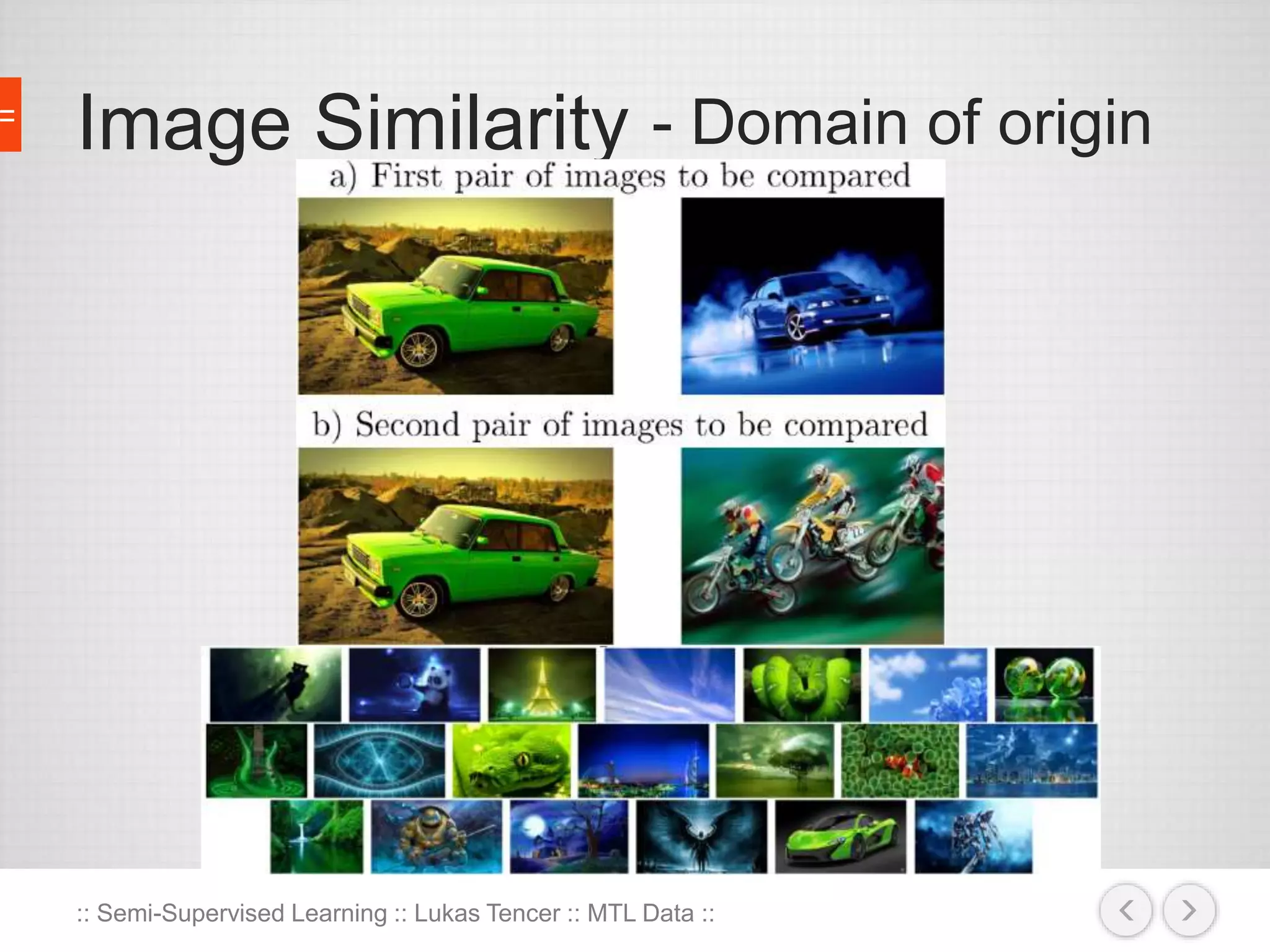
Image Similarity 
- Domain of origin 
:: Semi-Supervised Learning :: Lukas Tencer :: MTL Data ::
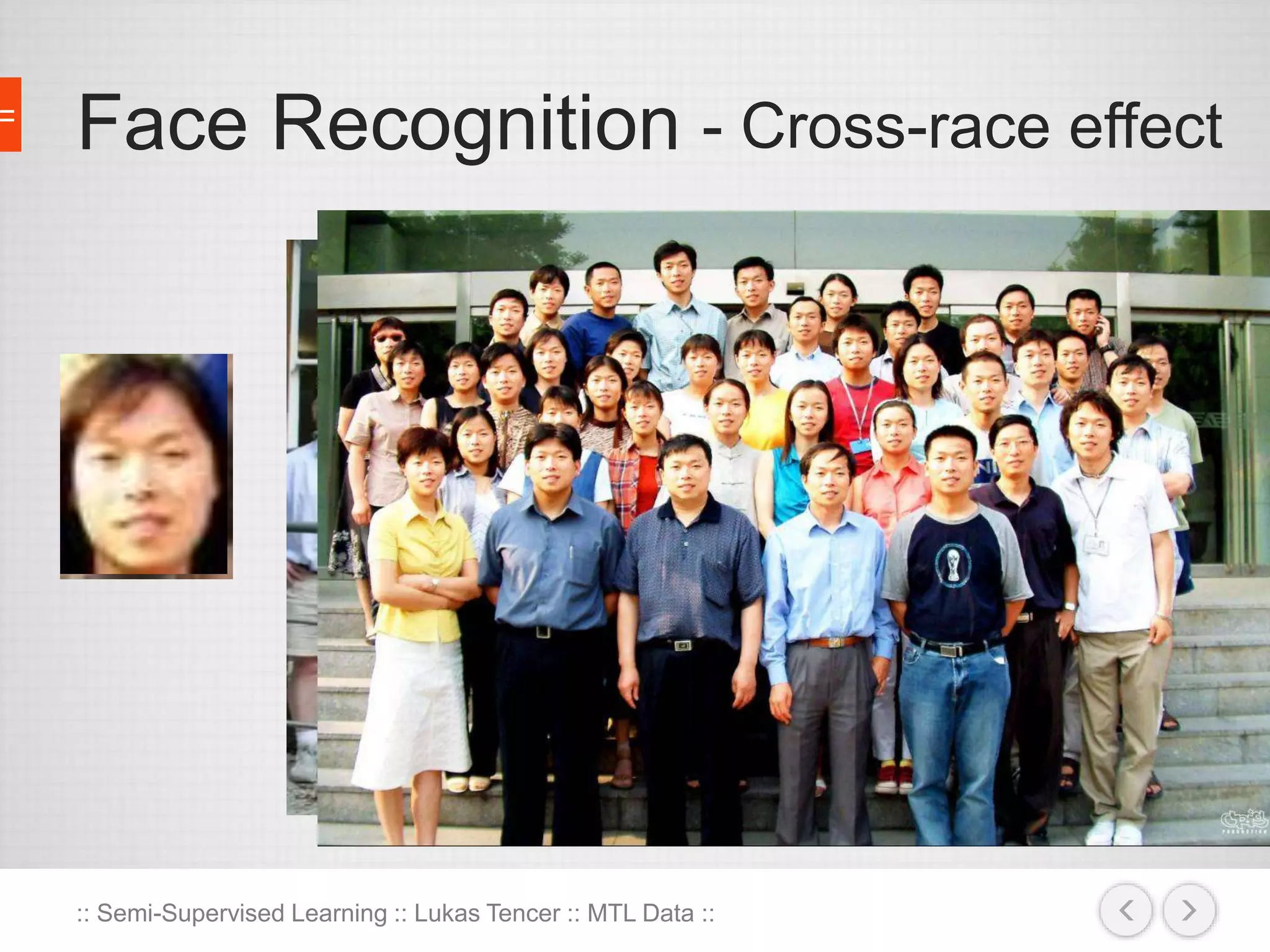
Face Recognition 
- Cross-race effect 
:: Semi-Supervised Learning :: Lukas Tencer :: MTL Data ::
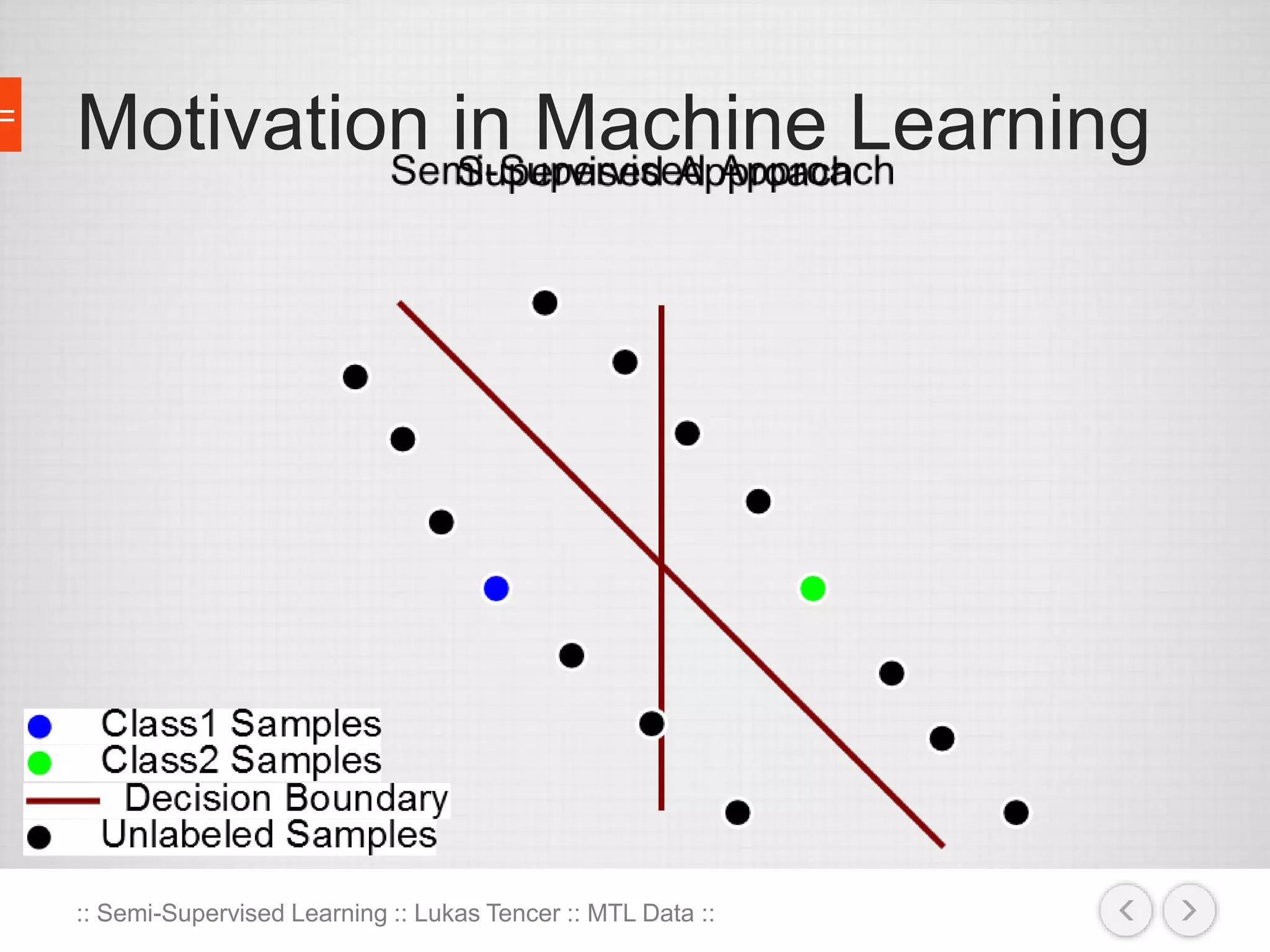
Motivation in Machine Learning 
:: Semi-Supervised Learning :: Lukas Tencer :: MTL Data ::
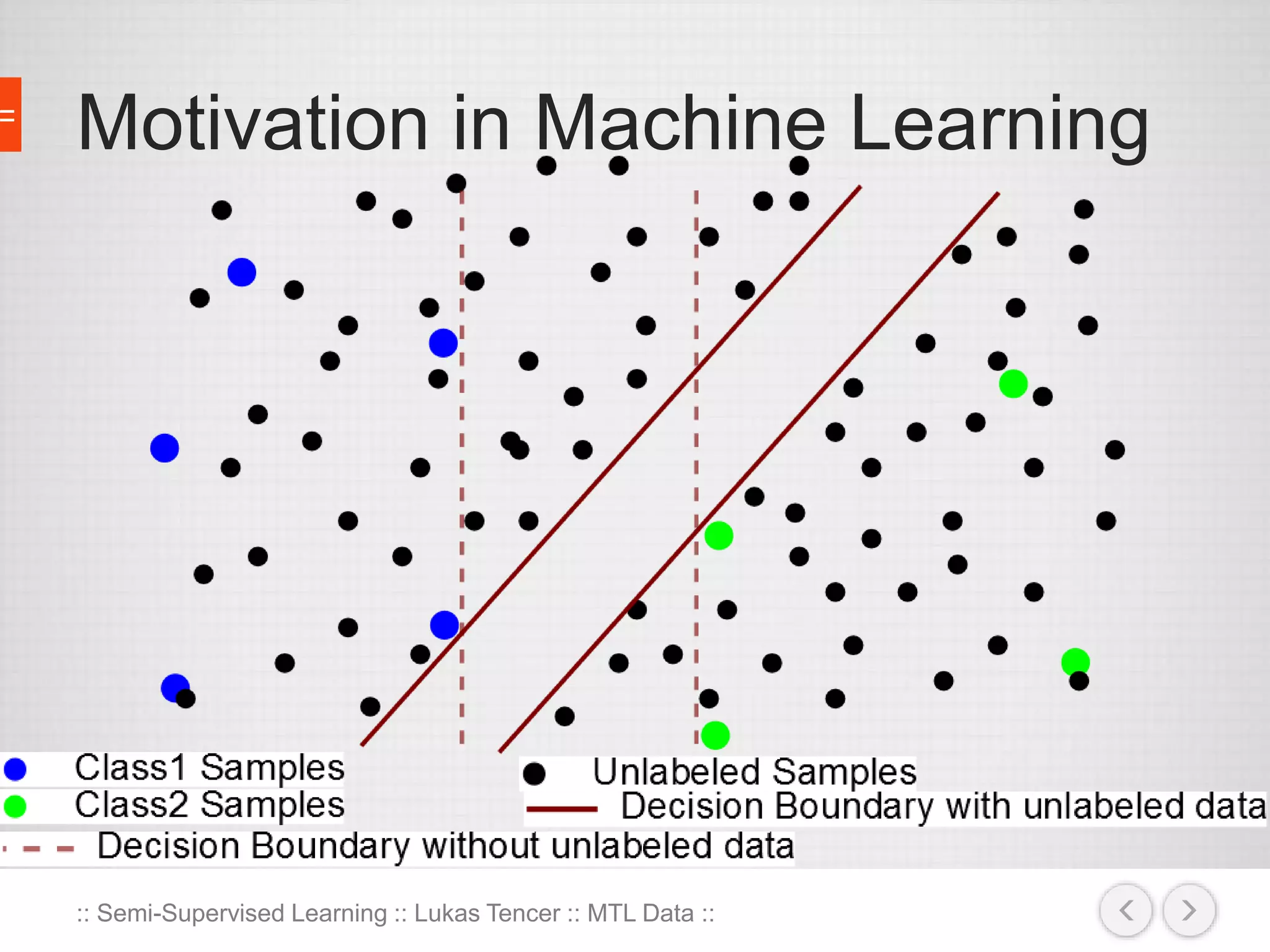
Motivation in Machine Learning 
:: Semi-Supervised Learning :: Lukas Tencer :: MTL Data ::
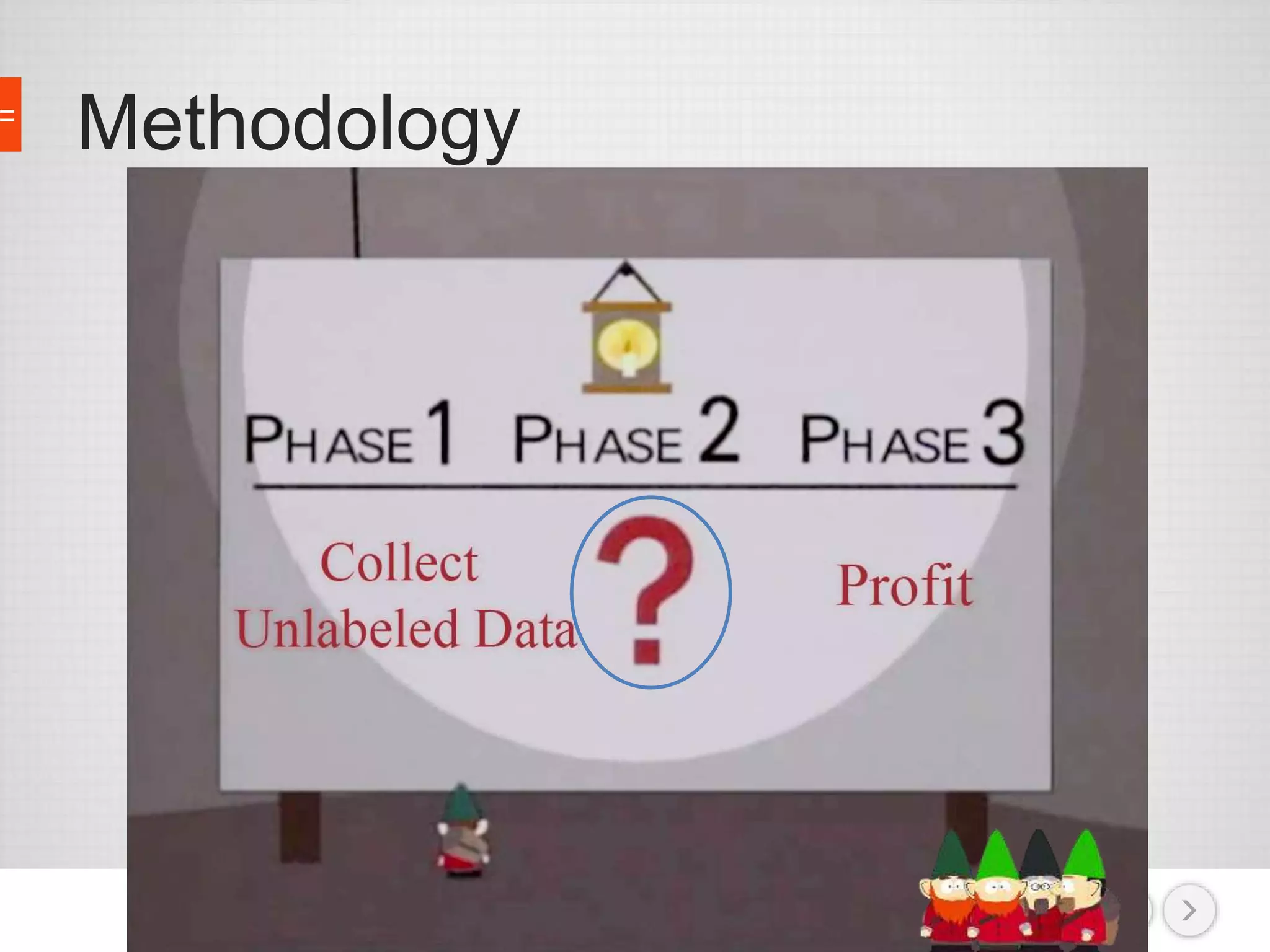
Methodology
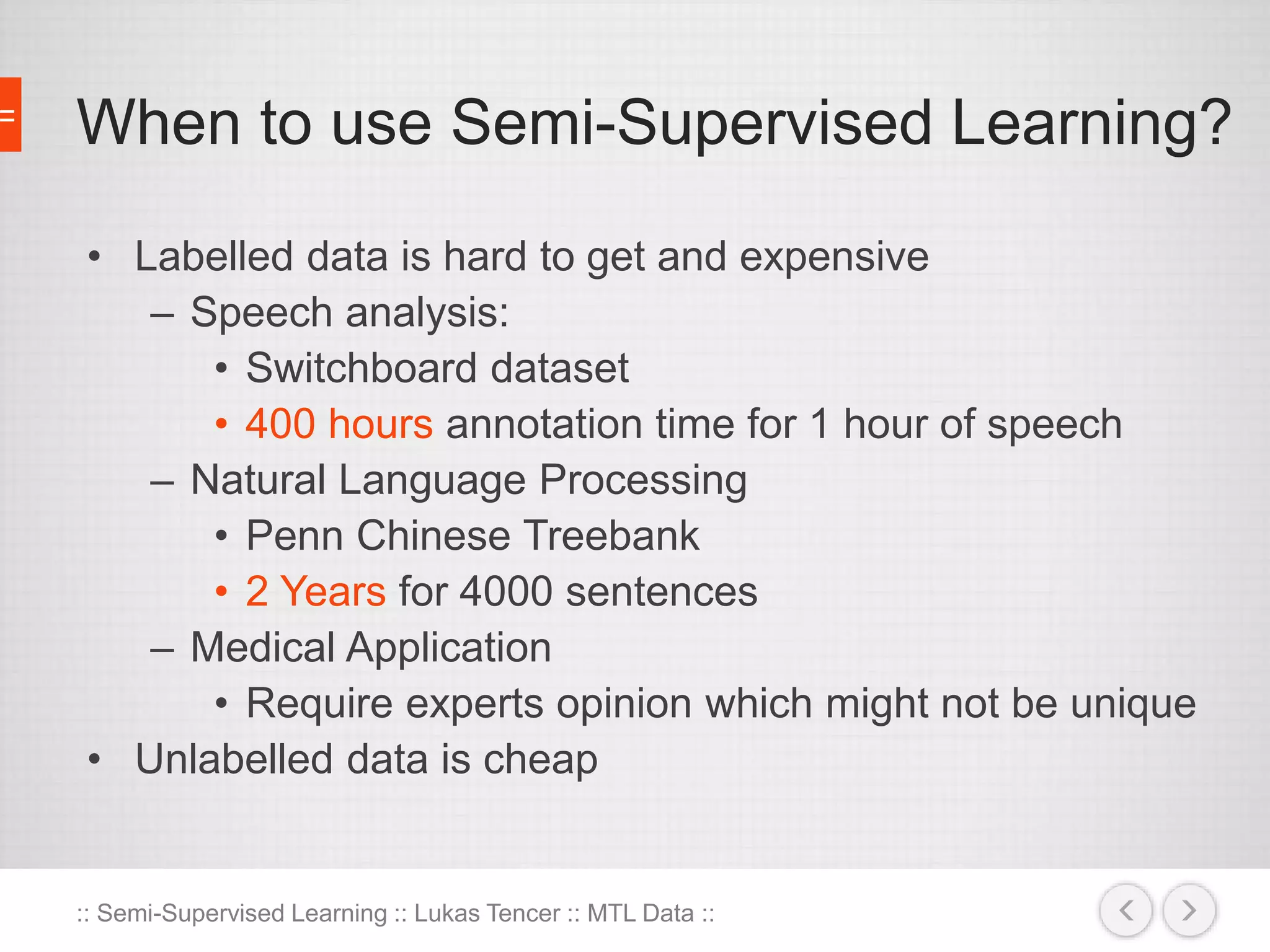
When to use Semi-Supervised Learning? 
• Labelled data is hard to get and expensive 
– Speech analysis: 
• Switchboard dataset 
• 400 hours annotation time for 1 hour of speech 
– Natural Language Processing 
• Penn Chinese Treebank 
• 2 Years for 4000 sentences 
– Medical Application 
• Require experts opinion which might not be unique 
• Unlabelled data is cheap 
:: Semi-Supervised Learning :: Lukas Tencer :: MTL Data ::
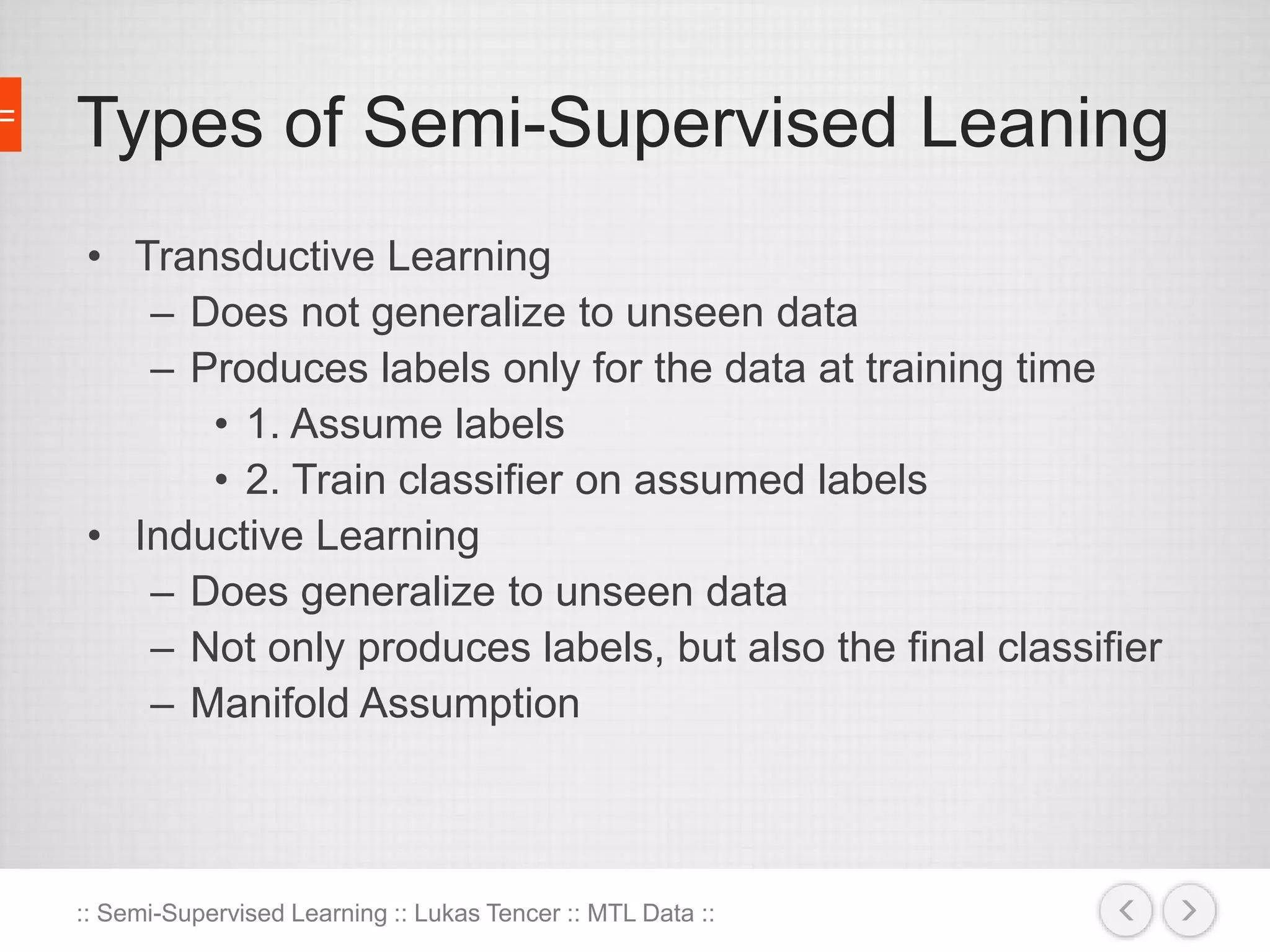
Types of Semi-Supervised Leaning 
• Transductive Learning 
– Does not generalize to unseen data 
– Produces labels only for the data at training time 
• 1. Assume labels 
• 2. Train classifier on assumed labels 
• Inductive Learning 
– Does generalize to unseen data 
– Not only produces labels, but also the final classifier 
– Manifold Assumption 
:: Semi-Supervised Learning :: Lukas Tencer :: MTL Data ::
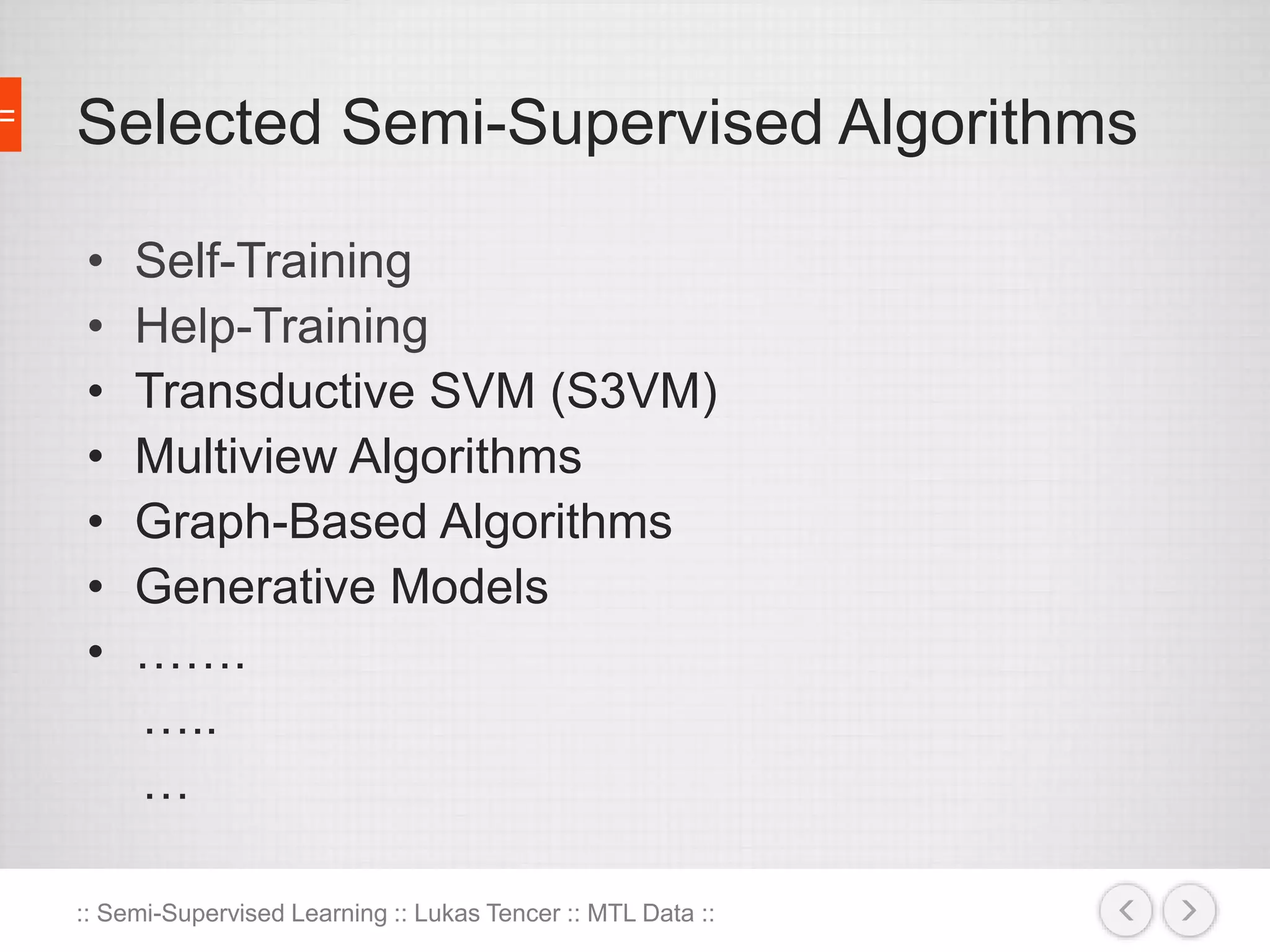
Selected Semi-Supervised Algorithms 
• Self-Training 
• Help-Training 
• Transductive SVM (S3VM) 
• Multiview Algorithms 
• Graph-Based Algorithms 
• Generative Models 
• ……. 
….. 
… 
:: Semi-Supervised Learning :: Lukas Tencer :: MTL Data ::
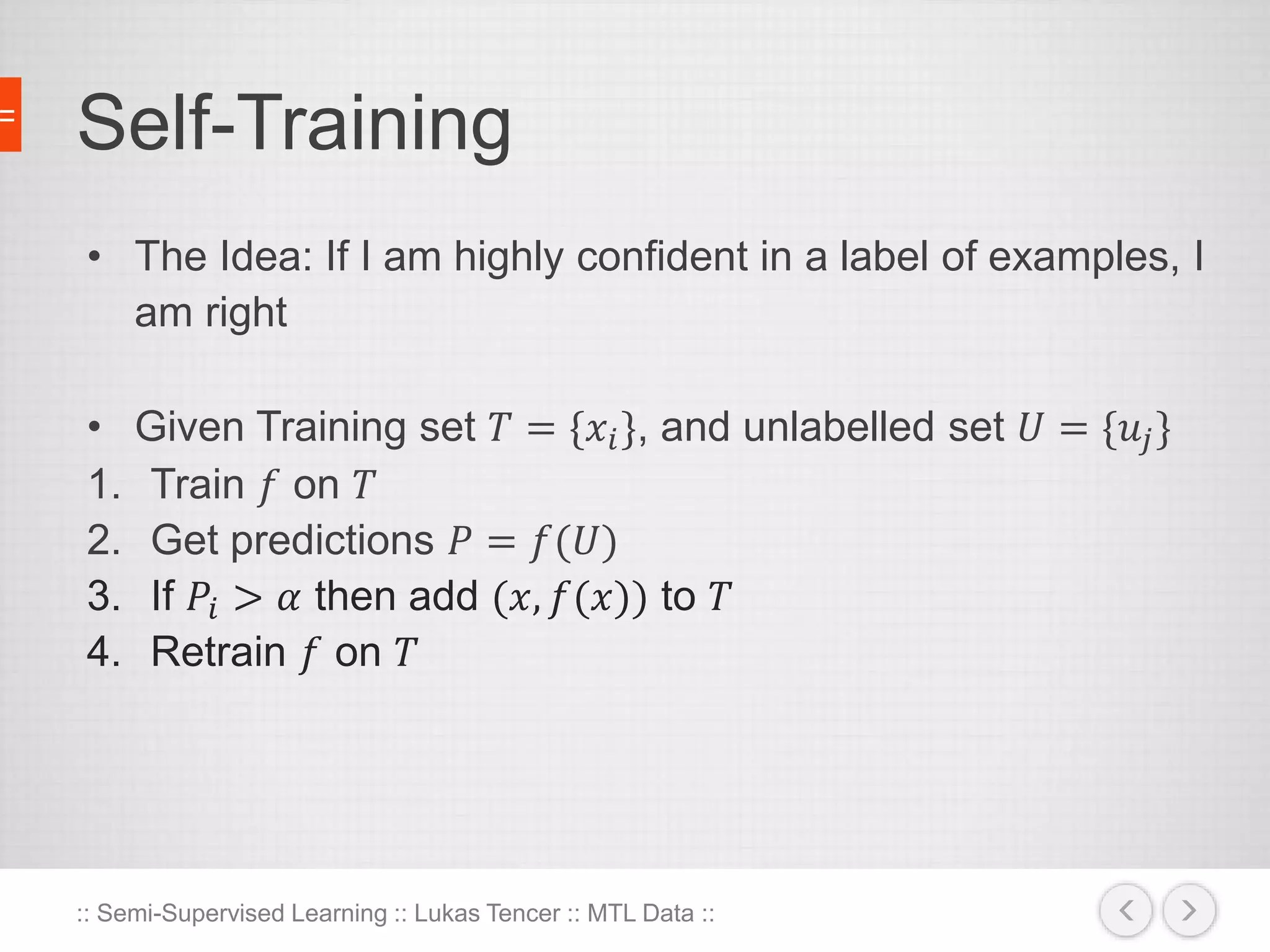
Self-Training 
• The Idea: If I am highly confident in a label of examples, I 
am right 
• Given Training set 푇 = {푥푖 }, and unlabelled set 푈 = {푢푗 } 
1. Train 푓 on 푇 
2. Get predictions 푃 = 푓(푈) 
3. If 푃푖 > 훼 then add (푥, 푓(푥)) to 푇 
4. Retrain 푓 on 푇 
:: Semi-Supervised Learning :: Lukas Tencer :: MTL Data ::
Self-Training 
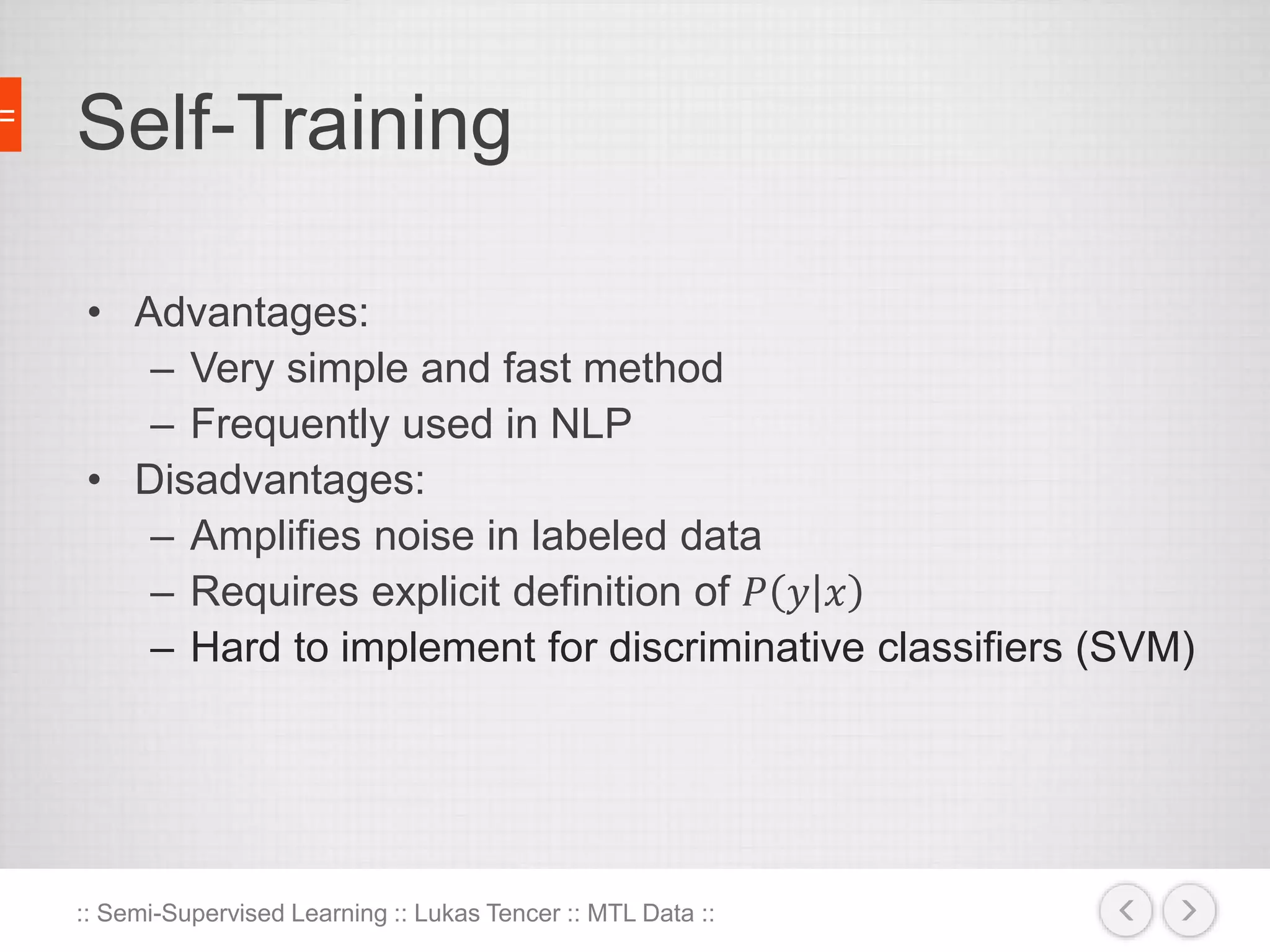
• Advantages: 
– Very simple and fast method 
– Frequently used in NLP 
• Disadvantages: 
– Amplifies noise in labeled data 
– Requires explicit definition of 푃 푦 푥 
– Hard to implement for discriminative classifiers (SVM) 
:: Semi-Supervised Learning :: Lukas Tencer :: MTL Data ::
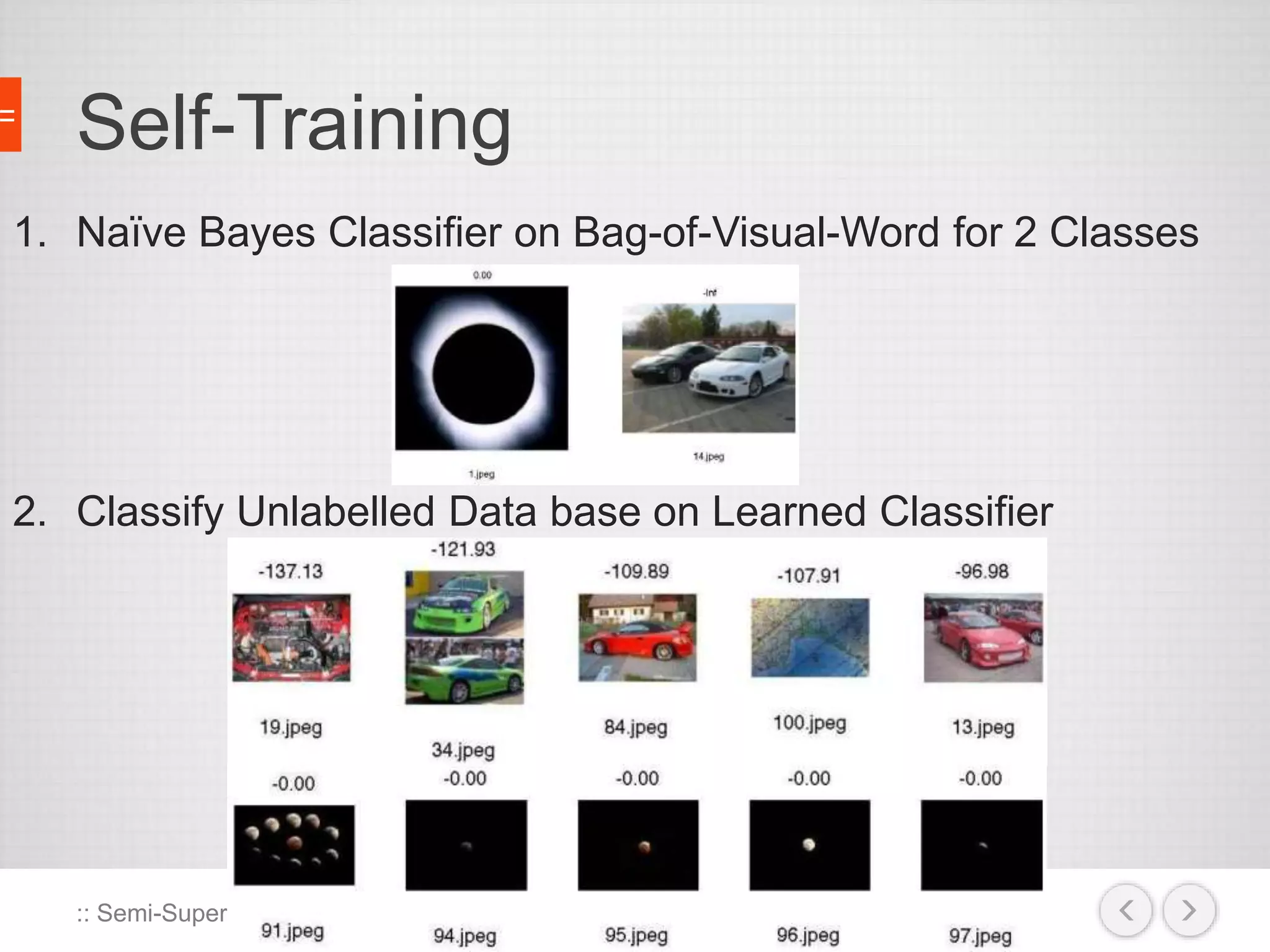
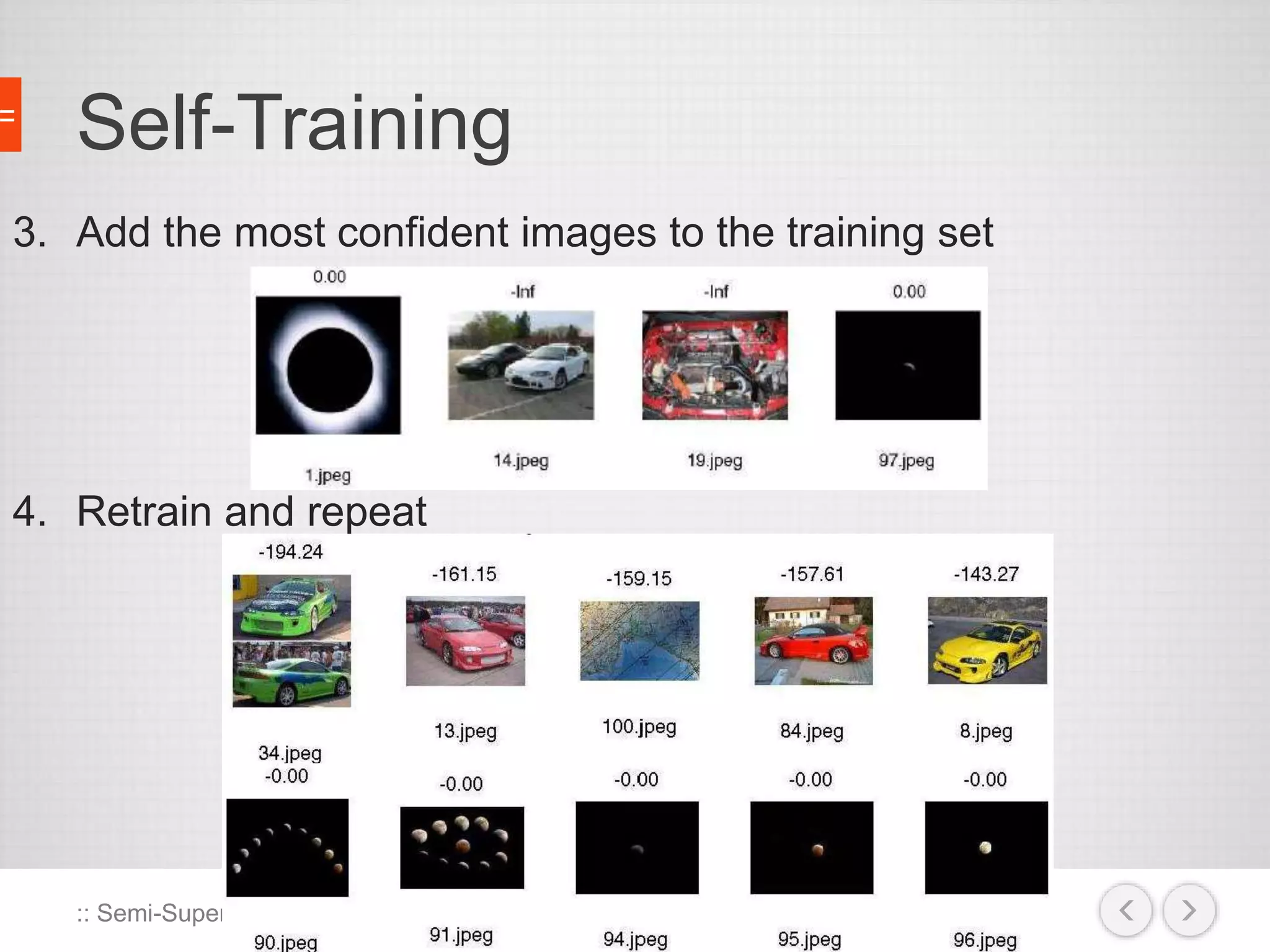
Self-Training 
1. Naïve Bayes Classifier on Bag-of-Visual-Word for 2 Classes 
2. Classify Unlabelled Data base on Learned Classifier 
:: Semi-Supervised Learning :: Lukas Tencer :: MTL Data ::
Self-Training 
3. Add the most confident images to the training set 
4. Retrain and repeat 
:: Semi-Supervised Learning :: Lukas Tencer :: MTL Data ::
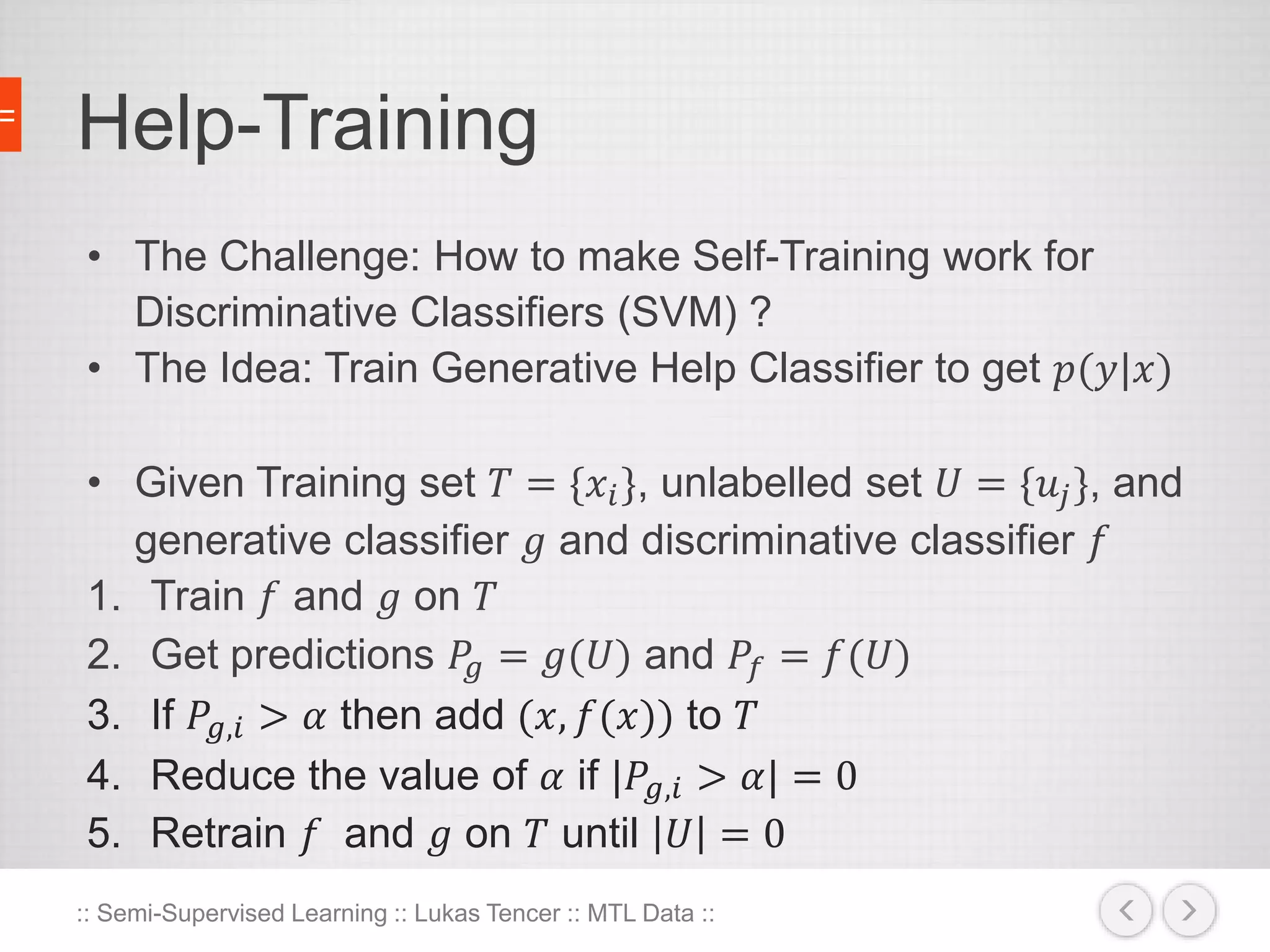
Help-Training 
• The Challenge: How to make Self-Training work for 
Discriminative Classifiers (SVM) ? 
• The Idea: Train Generative Help Classifier to get 푝(푦|푥) 
• Given Training set 푇 = {푥푖 }, unlabelled set 푈 = {푢푗 }, and 
generative classifier 푔 and discriminative classifier 푓 
1. Train 푓 and 푔 on 푇 
2. Get predictions 푃푔 = 푔(푈) and 푃푓 = 푓(푈) 
3. If 푃푔,푖 > 훼 then add (푥, 푓(푥)) to 푇 
4. Reduce the value of 훼 if |푃푔,푖 > 훼| = 0 
5. Retrain 푓 and 푔 on 푇 until 푈 = 0 
:: Semi-Supervised Learning :: Lukas Tencer :: MTL Data ::
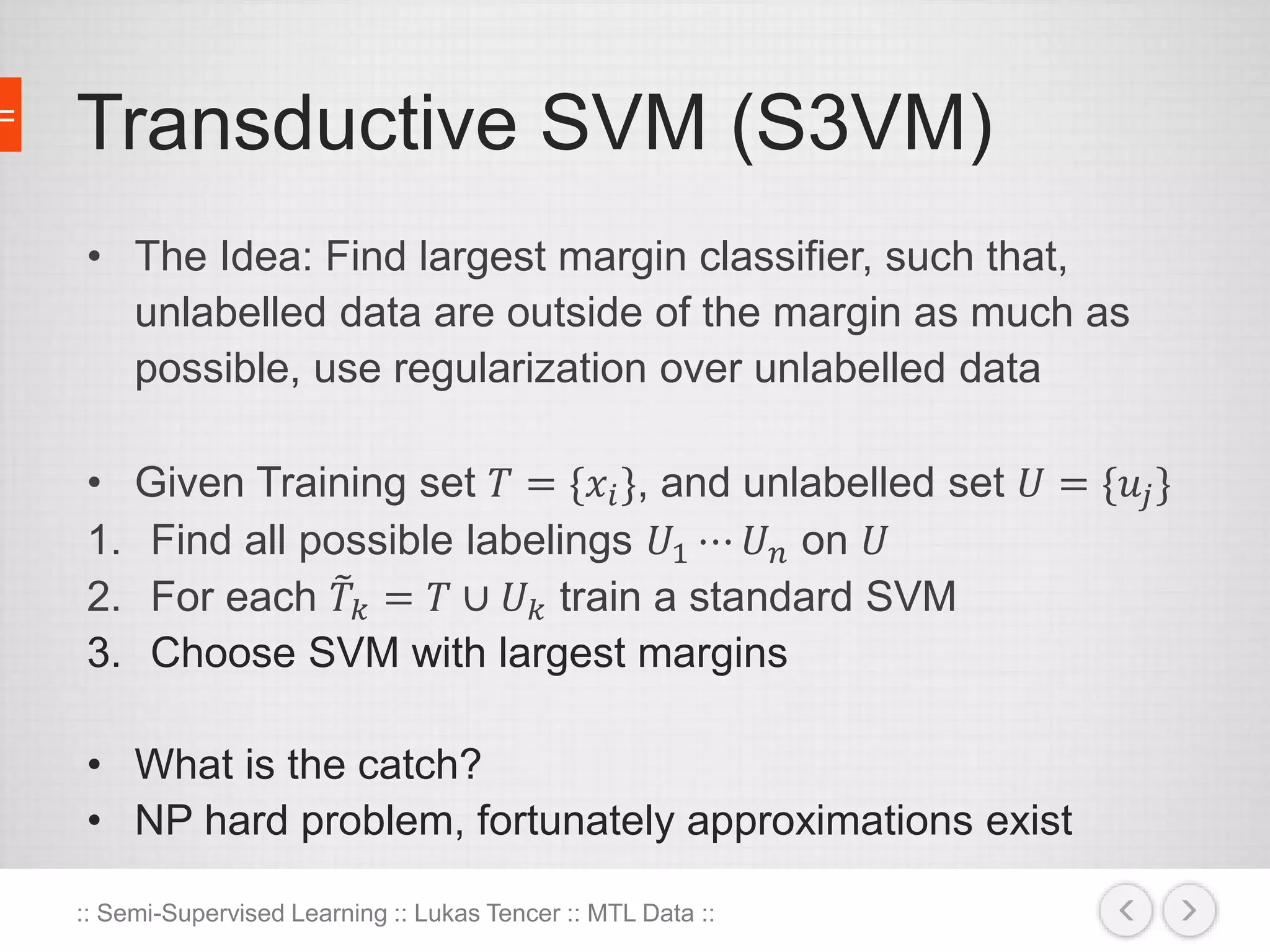
Transductive SVM (S3VM) 
• The Idea: Find largest margin classifier, such that, 
unlabelled data are outside of the margin as much as 
possible, use regularization over unlabelled data 
• Given Training set 푇 = {푥푖 }, and unlabelled set 푈 = {푢푗 } 
1. Find all possible labelings 푈1 ⋯ 푈푛 on 푈 
2. For each 푇 푘 = 푇 ∪ 푈푘 train a standard SVM 
3. Choose SVM with largest margins 
• What is the catch? 
• NP hard problem, fortunately approximations exist 
:: Semi-Supervised Learning :: Lukas Tencer :: MTL Data ::
Transductive SVM (S3VM) 
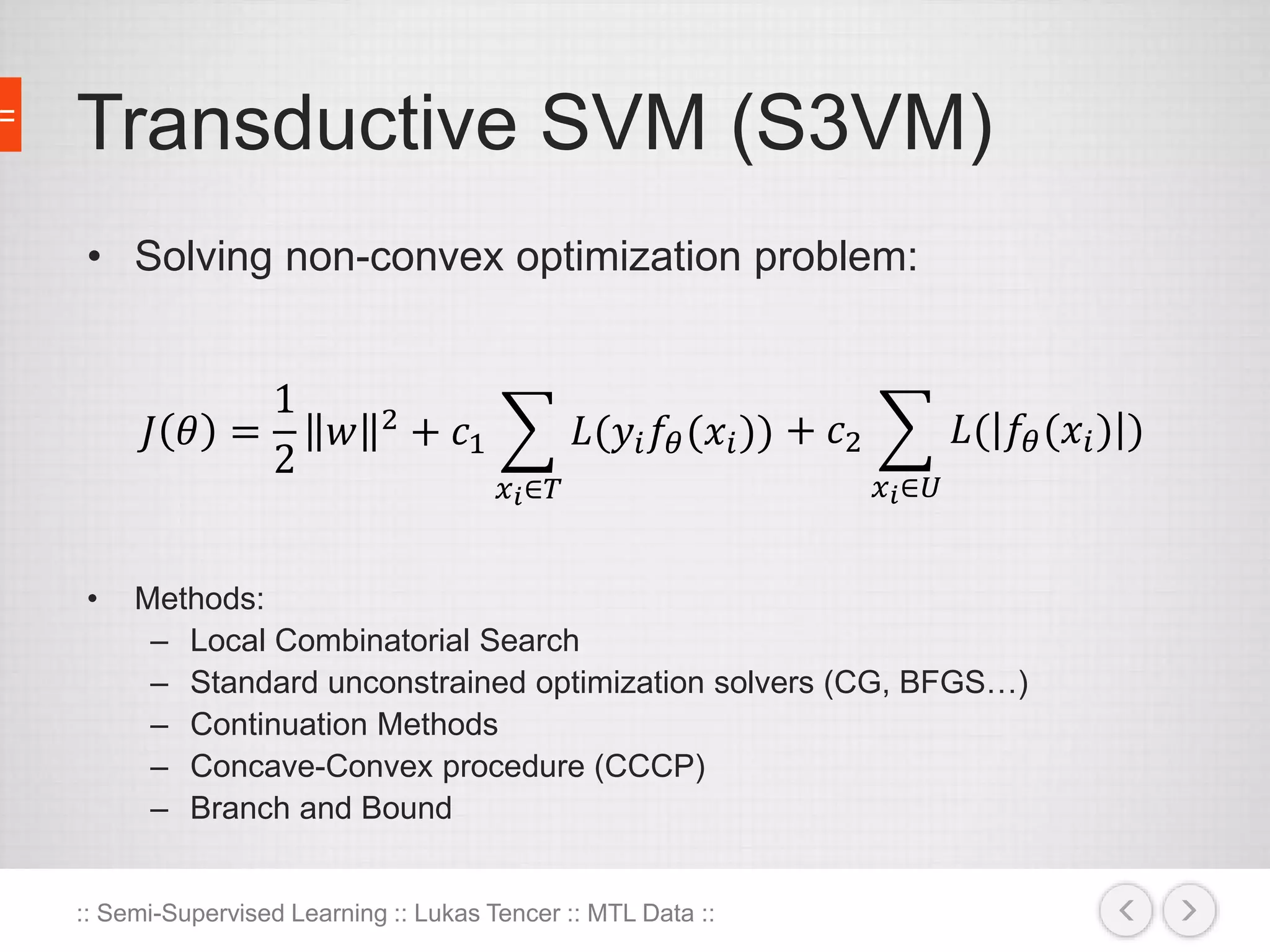
• Solving non-convex optimization problem: 
퐽 휃 = 
• Methods: 
1 
2 
푤 2 + 푐1 
푥푖∈푇 
퐿(푦푖푓휃 (푥푖 )) + 푐2 
– Local Combinatorial Search 
– Standard unconstrained optimization solvers (CG, BFGS…) 
– Continuation Methods 
– Concave-Convex procedure (CCCP) 
– Branch and Bound 
:: Semi-Supervised Learning :: Lukas Tencer :: MTL Data :: 
푥푖∈푈 
퐿( 푓휃 (푥푖 ) )
Transductive SVM (S3VM) 
• Advantages: 
– Can be used with any SVM 
– Clear optimization criterion, mathematically well 
formulated 
• Disadvantages: 
– Hard to optimize 
– Prone to local minima – non convex 
– Only small gain given modest assumptions 
:: Semi-Supervised Learning :: Lukas Tencer :: MTL Data ::
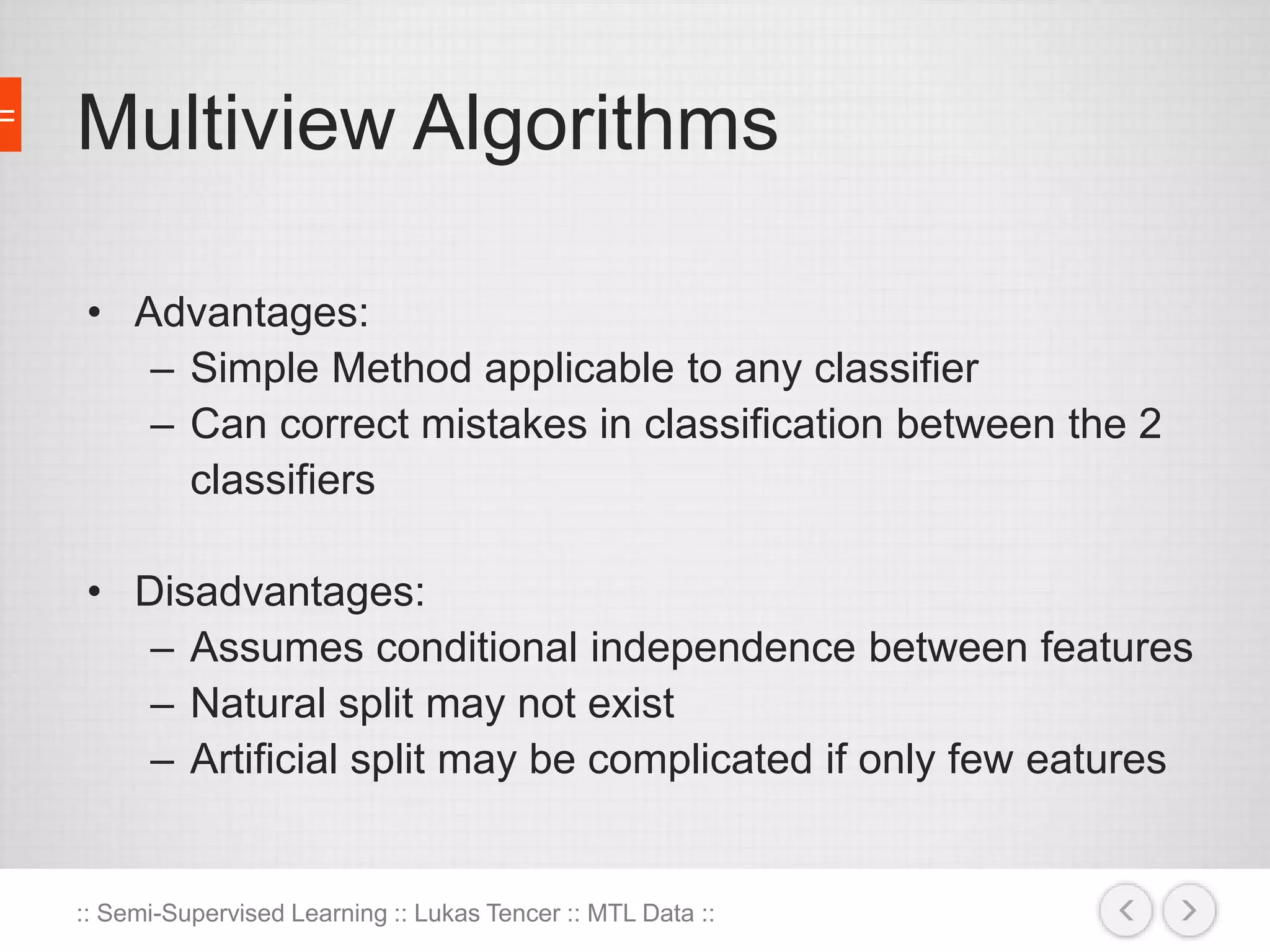
Multiview Algorithms 
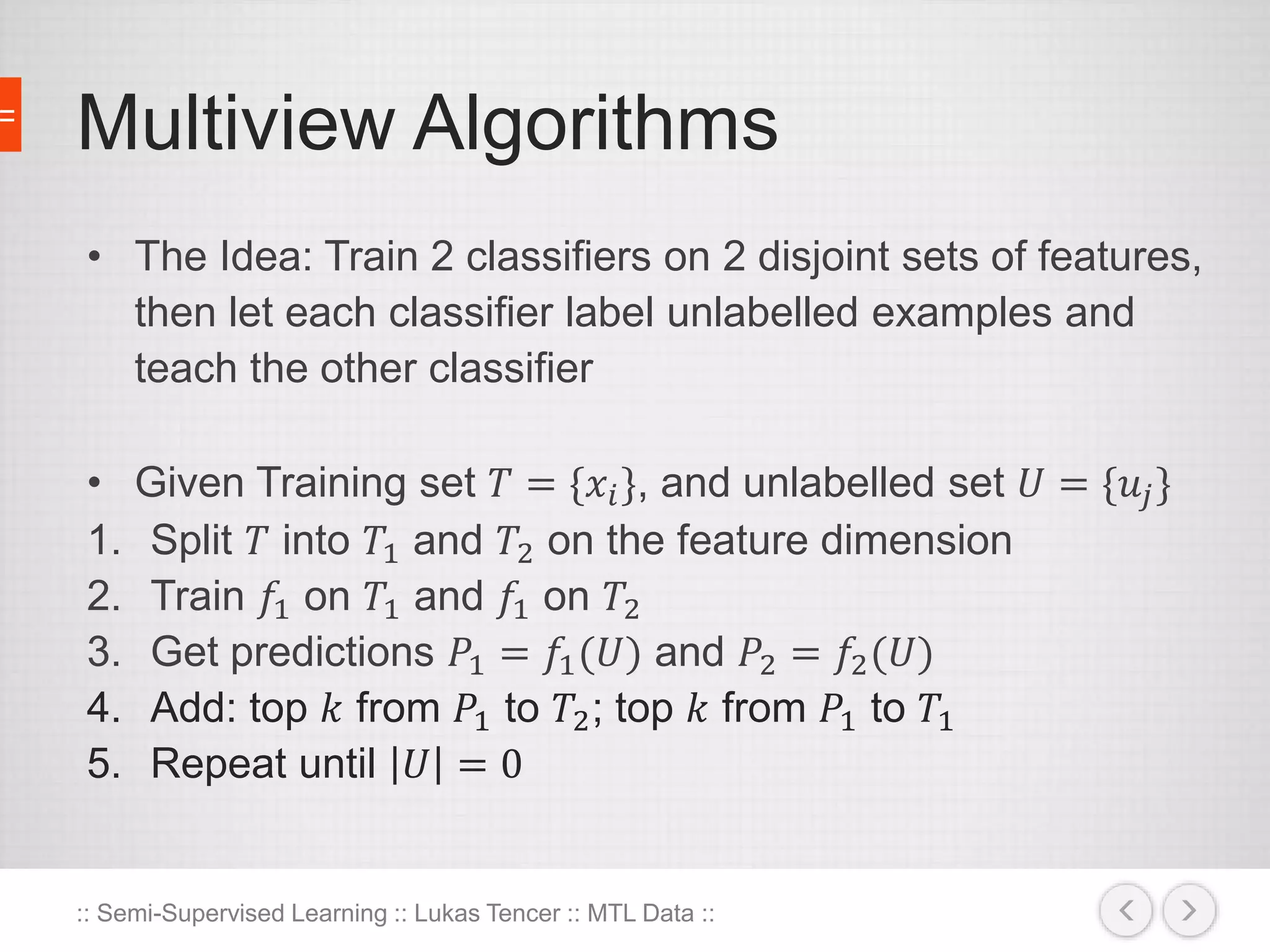
• The Idea: Train 2 classifiers on 2 disjoint sets of features, 
then let each classifier label unlabelled examples and 
teach the other classifier 
• Given Training set 푇 = {푥푖 }, and unlabelled set 푈 = {푢푗 } 
1. Split 푇 into 푇1 and 푇2 on the feature dimension 
2. Train 푓1 on 푇1 and 푓1 on 푇2 
3. Get predictions 푃1 = 푓1(푈) and 푃2 = 푓2(푈) 
4. Add: top 푘 from 푃1 to 푇2; top 푘 from 푃1 to 푇1 
5. Repeat until 푈 = 0 
:: Semi-Supervised Learning :: Lukas Tencer :: MTL Data ::
Multiview Algorithms 
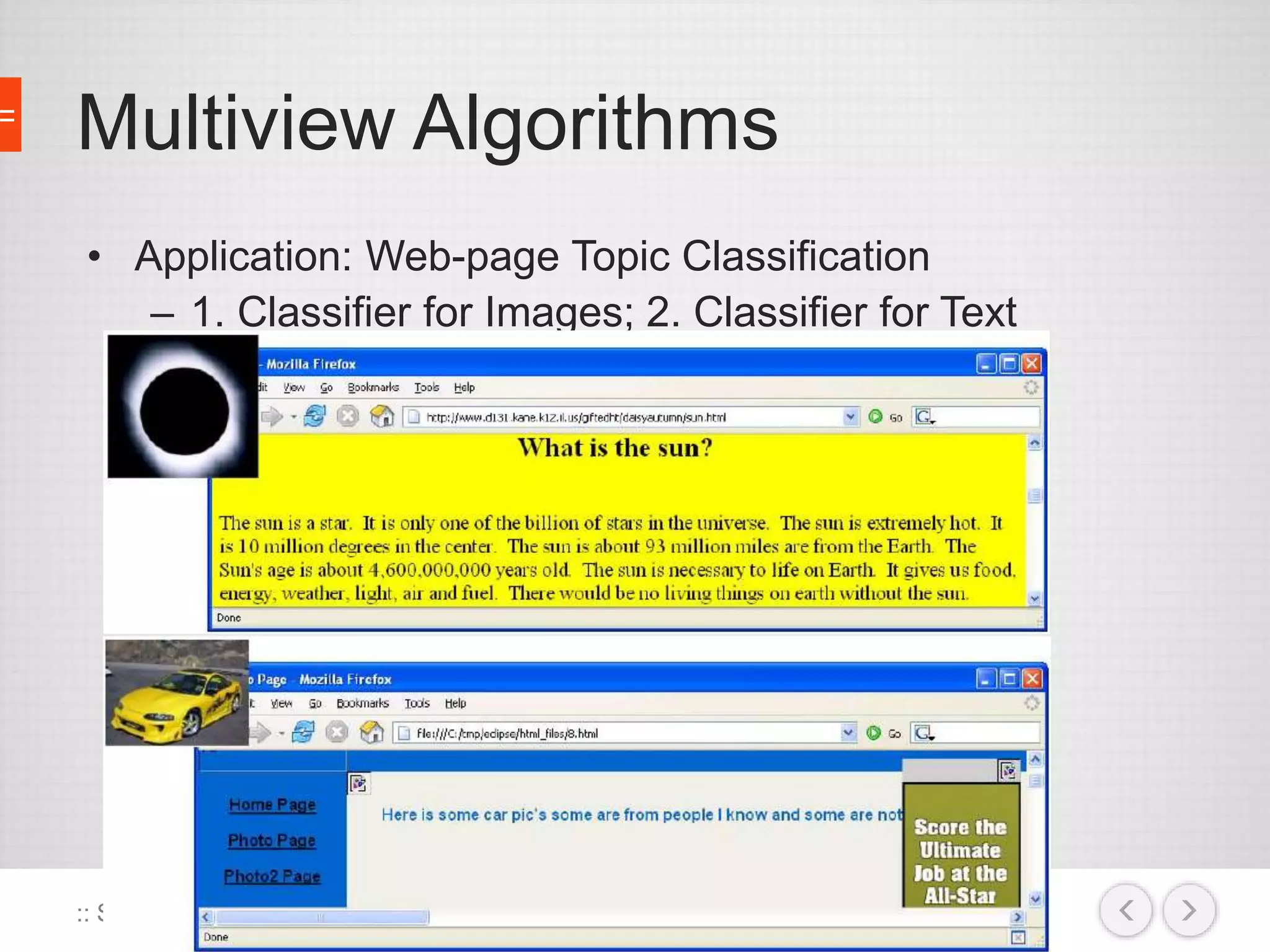
• Application: Web-page Topic Classification 
– 1. Classifier for Images; 2. Classifier for Text 
:: Semi-Supervised Learning :: Lukas Tencer :: MTL Data ::
Multiview Algorithms 
• Advantages: 
– Simple Method applicable to any classifier 
– Can correct mistakes in classification between the 2 
classifiers 
• Disadvantages: 
– Assumes conditional independence between features 
– Natural split may not exist 
– Artificial split may be complicated if only few eatures 
:: Semi-Supervised Learning :: Lukas Tencer :: MTL Data ::
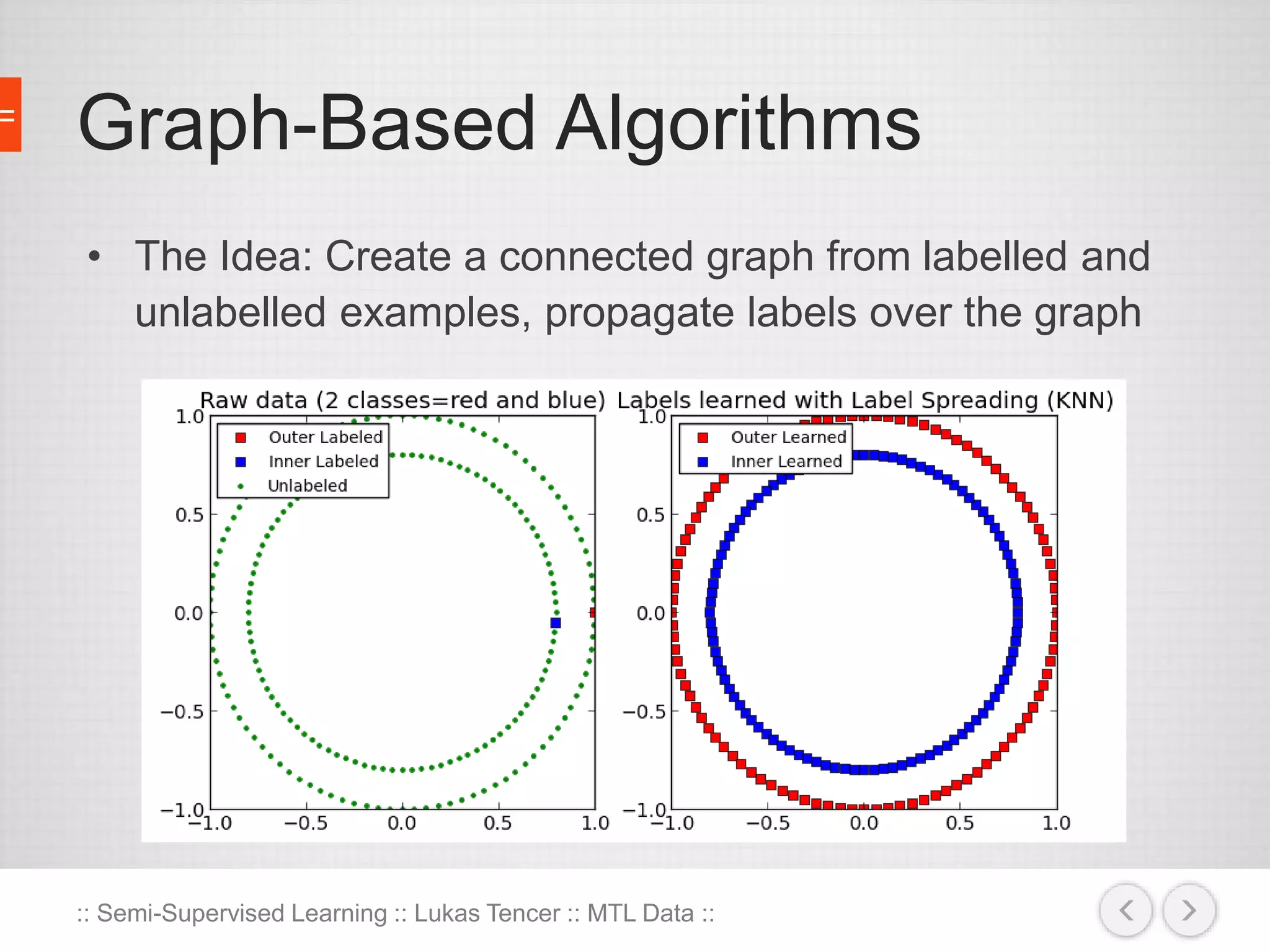
Graph-Based Algorithms 
• The Idea: Create a connected graph from labelled and 
unlabelled examples, propagate labels over the graph 
:: Semi-Supervised Learning :: Lukas Tencer :: MTL Data ::
Graph-Based Algorithms 
• Advantages: 
– Great performance if graph fits the tasks 
– Can be used in combination with any model 
– Explicit mathematical formulation 
• Disadvantages: 
– Problem if graph does not fit the task 
– Hard to construct graph in sparse spaces 
:: Semi-Supervised Learning :: Lukas Tencer :: MTL Data ::
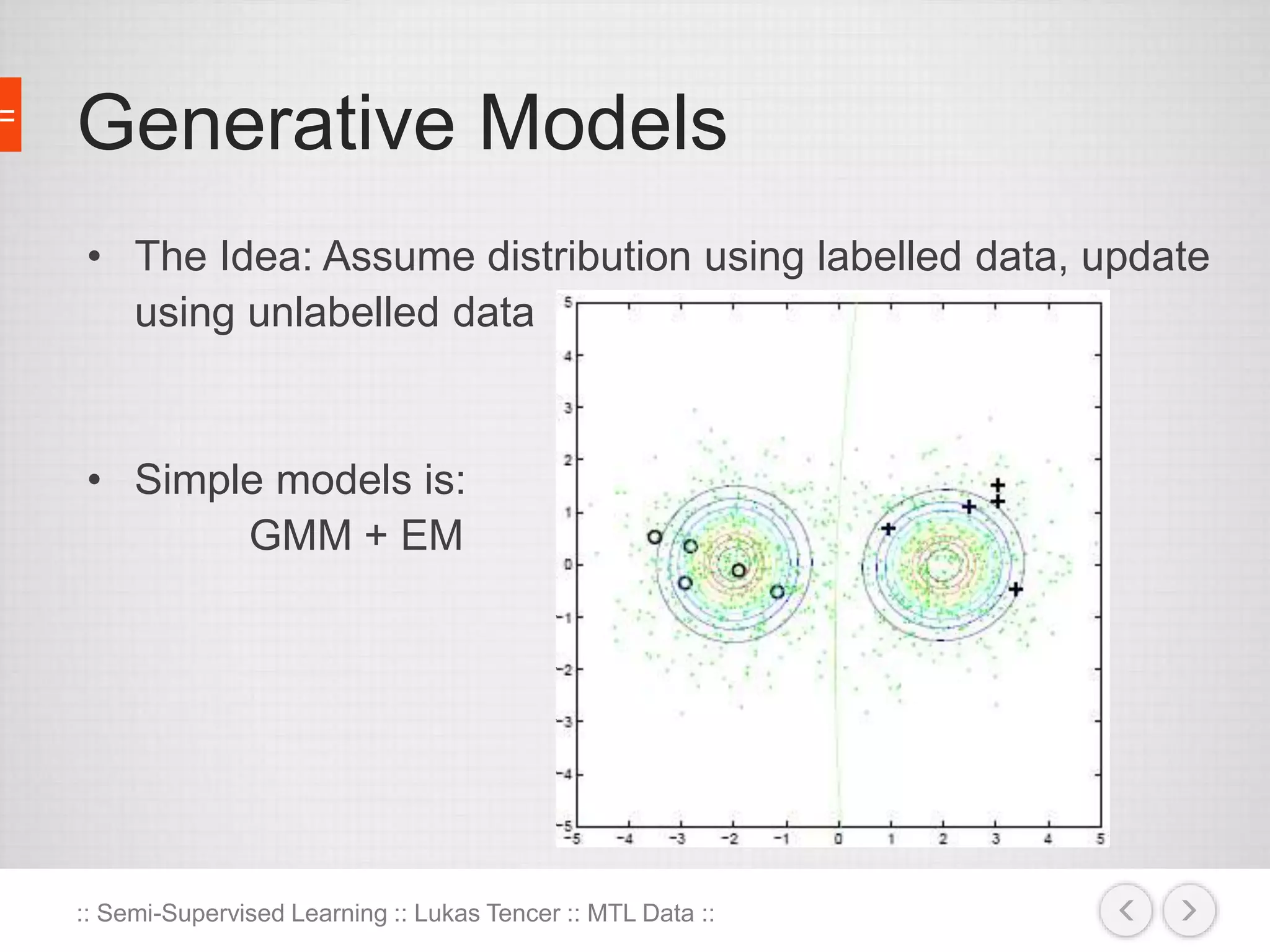
Generative Models 
• The Idea: Assume distribution using labelled data, update 
using unlabelled data 
• Simple models is: 
GMM + EM 
:: Semi-Supervised Learning :: Lukas Tencer :: MTL Data ::
Generative Models 
• Advantages: 
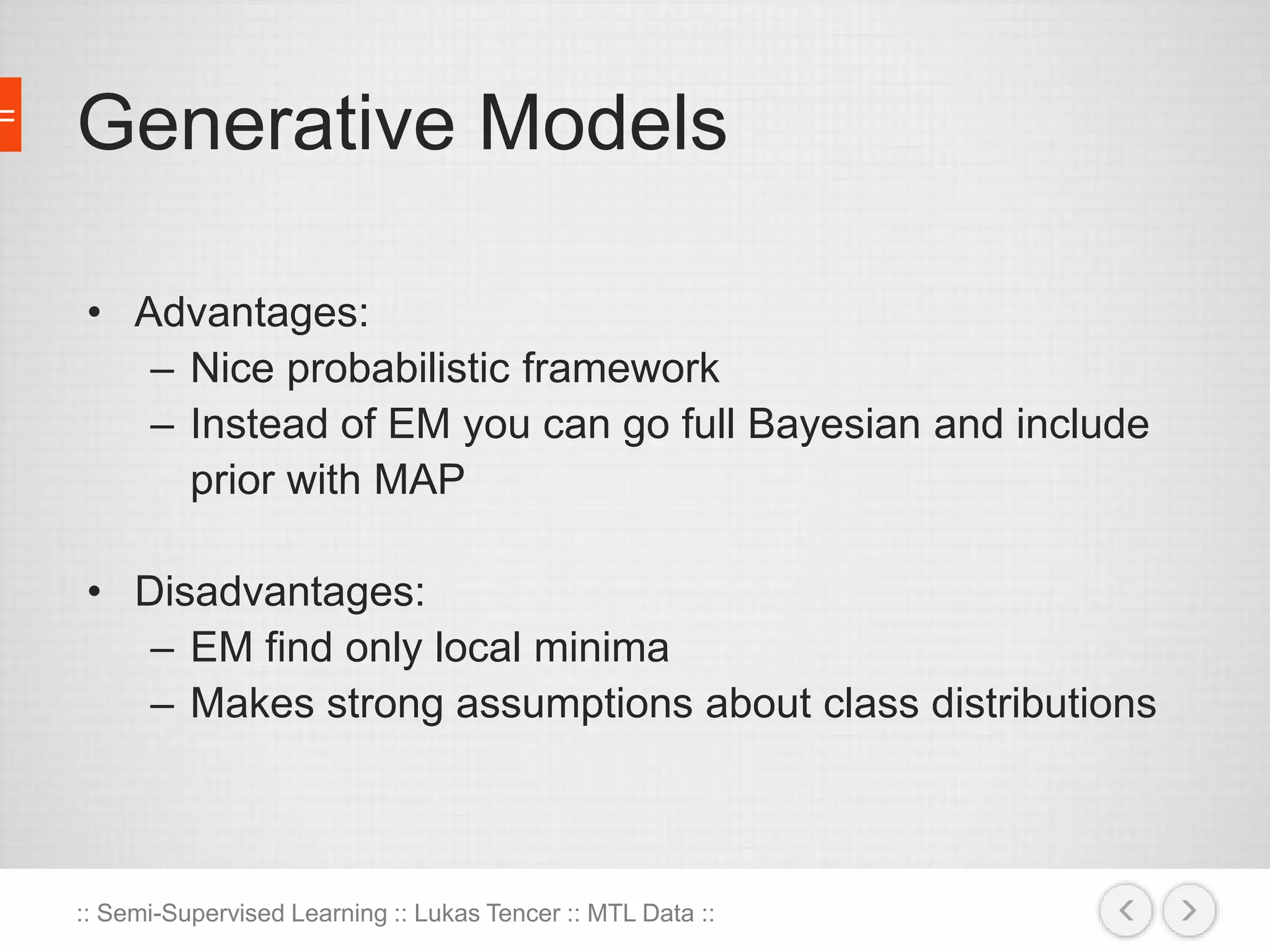
– Nice probabilistic framework 
– Instead of EM you can go full Bayesian and include 
prior with MAP 
• Disadvantages: 
– EM find only local minima 
– Makes strong assumptions about class distributions 
:: Semi-Supervised Learning :: Lukas Tencer :: MTL Data ::
What could go wrong? 
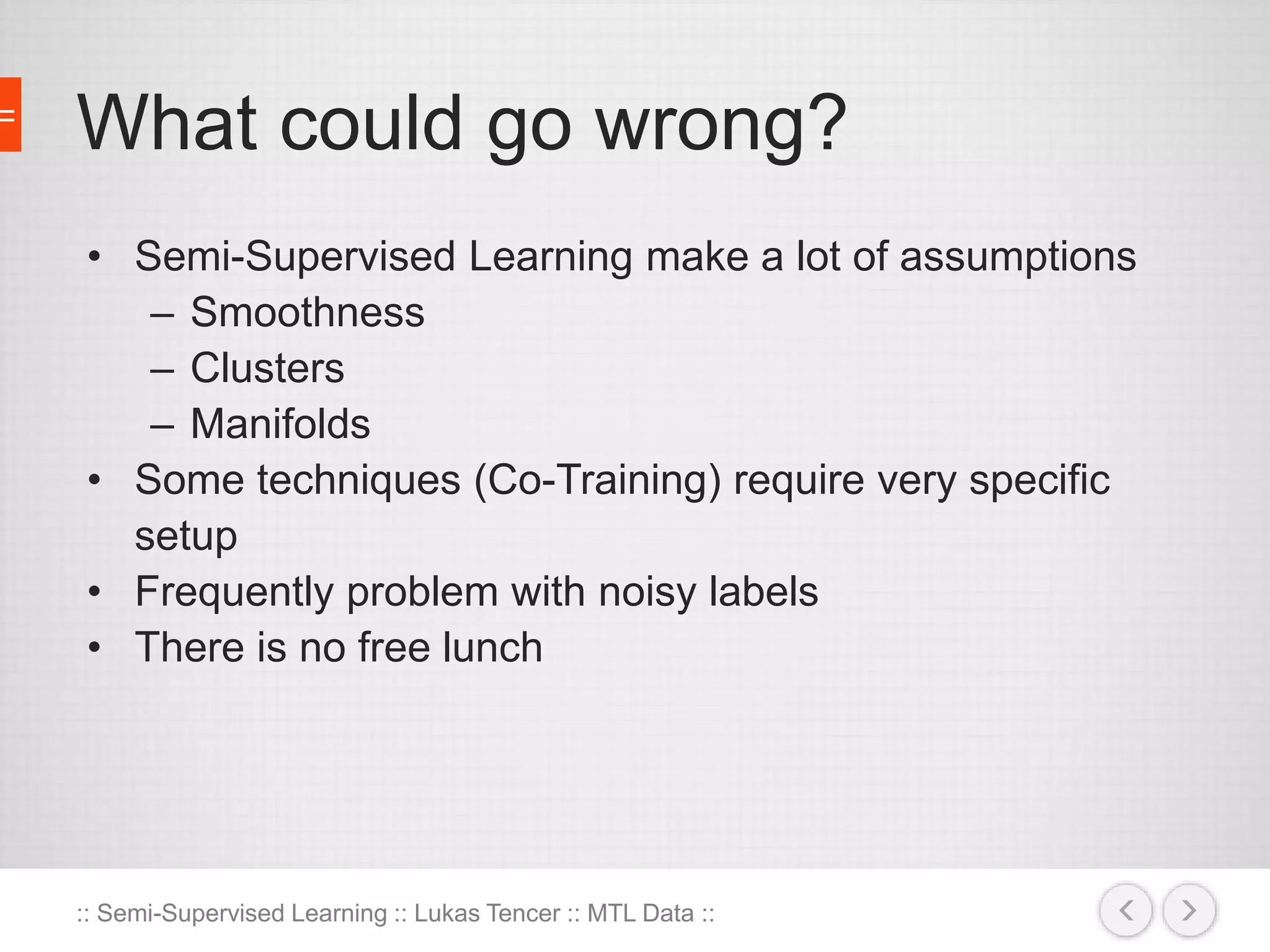
• Semi-Supervised Learning make a lot of assumptions 
– Smoothness 
– Clusters 
– Manifolds 
• Some techniques (Co-Training) require very specific 
setup 
• Frequently problem with noisy labels 
• There is no free lunch 
:: Semi-Supervised Learning :: Lukas Tencer :: MTL Data ::
There is much more out there 
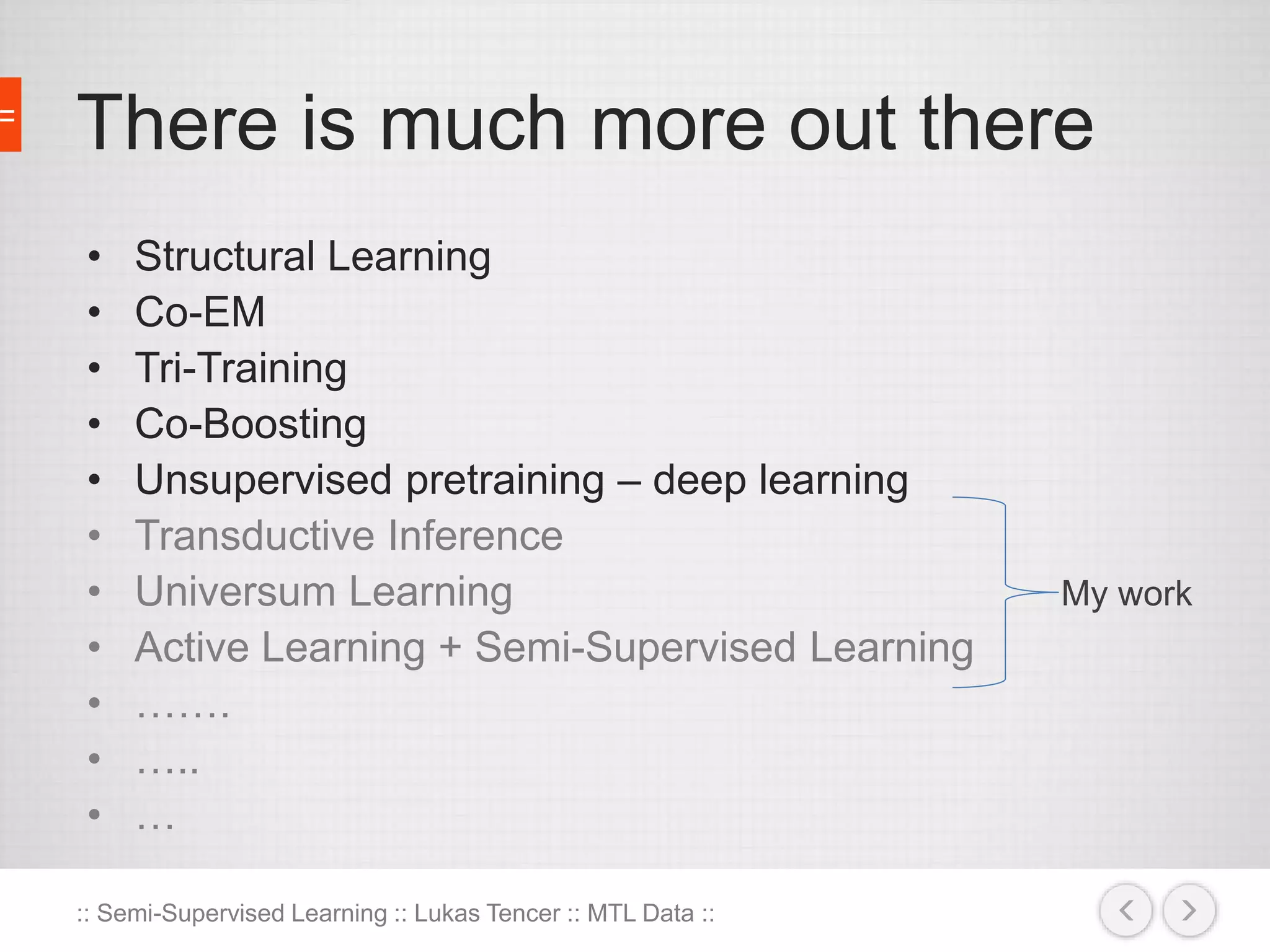
• Structural Learning 
• Co-EM 
• Tri-Training 
• Co-Boosting 
• Unsupervised pretraining – deep learning 
• Transductive Inference 
• Universum Learning 
• Active Learning + Semi-Supervised Learning 
• ……. 
• ….. 
• … 
:: Semi-Supervised Learning :: Lukas Tencer :: MTL Data :: 
My work
Demo
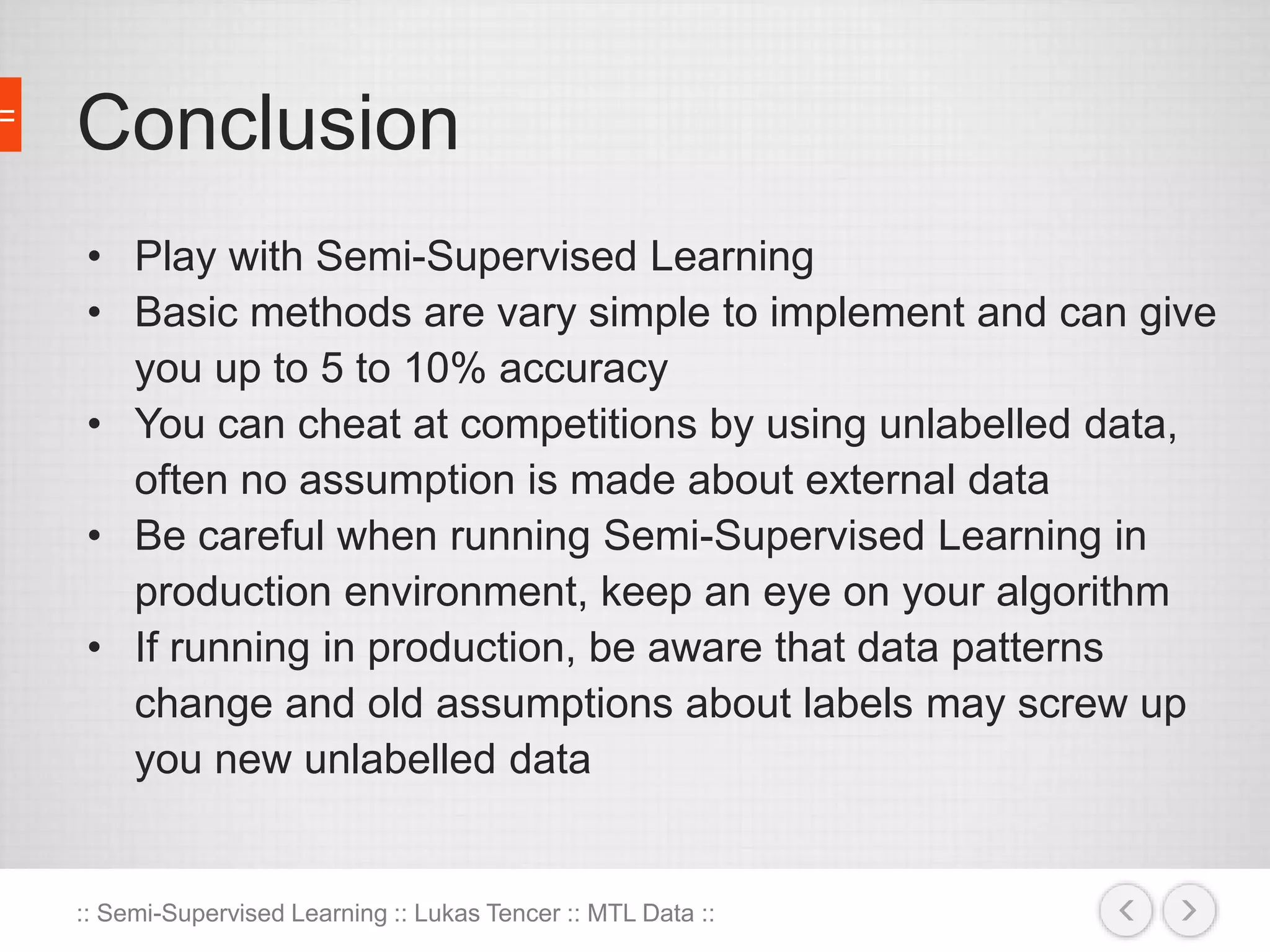
Conclusion 
• Play with Semi-Supervised Learning 
• Basic methods are vary simple to implement and can give 
you up to 5 to 10% accuracy 
• You can cheat at competitions by using unlabelled data, 
often no assumption is made about external data 
• Be careful when running Semi-Supervised Learning in 
production environment, keep an eye on your algorithm 
• If running in production, be aware that data patterns 
change and old assumptions about labels may screw up 
you new unlabelled data 
:: Semi-Supervised Learning :: Lukas Tencer :: MTL Data ::
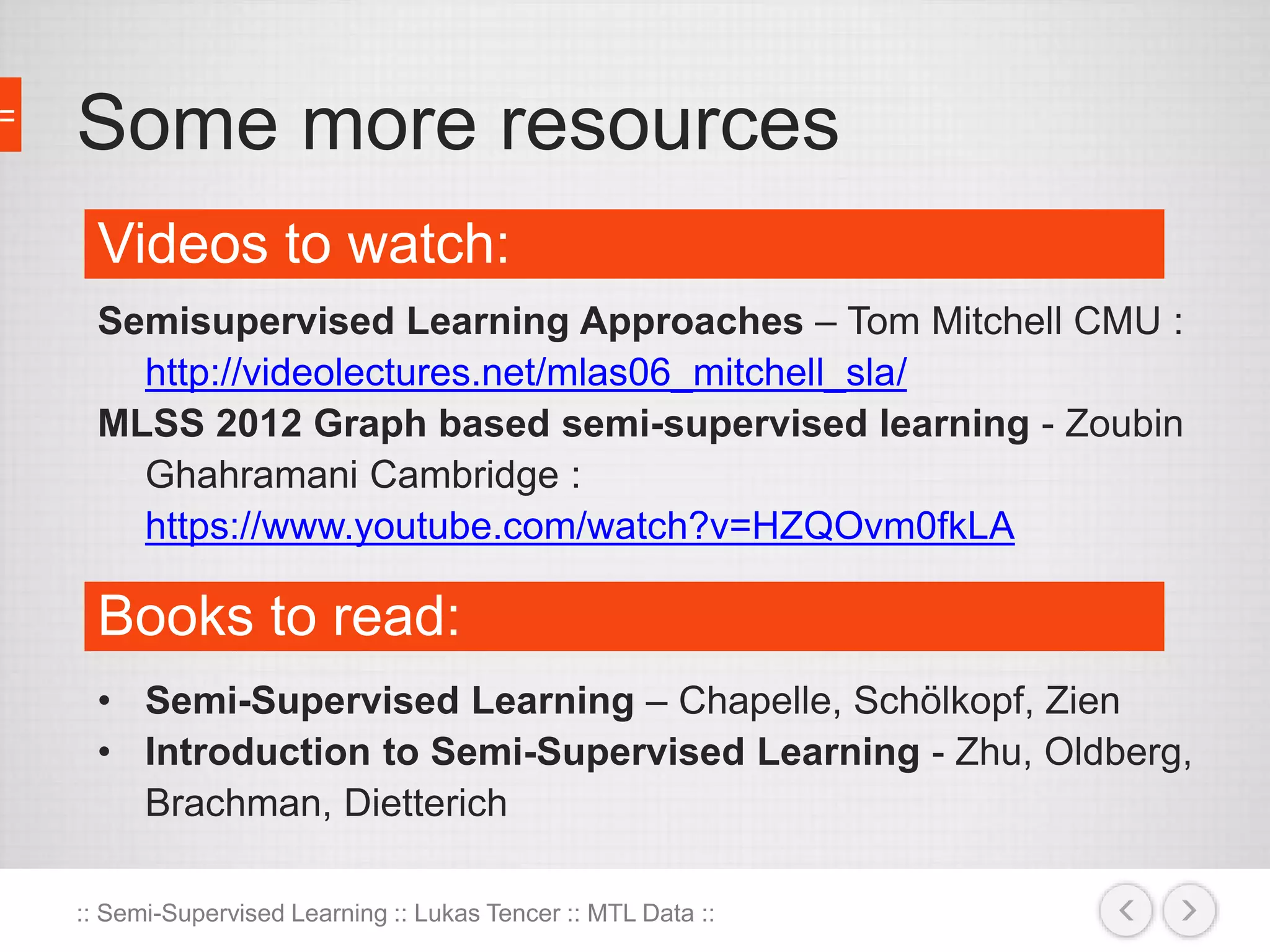
Some more resources 
Videos to watch: 
Semisupervised Learning Approaches – Tom Mitchell CMU : 
http://videolectures.net/mlas06_mitchell_sla/ 
MLSS 2012 Graph based semi-supervised learning - Zoubin 
Ghahramani Cambridge : 
https://www.youtube.com/watch?v=HZQOvm0fkLA 
Books to read: 
• Semi-Supervised Learning – Chapelle, Schölkopf, Zien 
• Introduction to Semi-Supervised Learning - Zhu, Oldberg, 
Brachman, Dietterich 
:: Semi-Supervised Learning :: Lukas Tencer :: MTL Data ::
THANKS FOR YOUR TIME 
Lukas Tencer 
lukas.tencer@gmail.com 
http://lukastencer.github.io/ 
https://github.com/lukastencer 
https://twitter.com/lukastencer 
Graduating August 2015, looking for ML and DS opportunities

Semi-Supervised Learning

  • 1.
    Semi-Supervised Learning LukasTencer PhD student @ ETS
  • 2.
  • 3.
    Image Similarity -Domain of origin :: Semi-Supervised Learning :: Lukas Tencer :: MTL Data ::
  • 4.
    Face Recognition -Cross-race effect :: Semi-Supervised Learning :: Lukas Tencer :: MTL Data ::
  • 5.
    Motivation in MachineLearning :: Semi-Supervised Learning :: Lukas Tencer :: MTL Data ::
  • 6.
    Motivation in MachineLearning :: Semi-Supervised Learning :: Lukas Tencer :: MTL Data ::
  • 7.
  • 8.
    When to useSemi-Supervised Learning? • Labelled data is hard to get and expensive – Speech analysis: • Switchboard dataset • 400 hours annotation time for 1 hour of speech – Natural Language Processing • Penn Chinese Treebank • 2 Years for 4000 sentences – Medical Application • Require experts opinion which might not be unique • Unlabelled data is cheap :: Semi-Supervised Learning :: Lukas Tencer :: MTL Data ::
  • 9.
    Types of Semi-SupervisedLeaning • Transductive Learning – Does not generalize to unseen data – Produces labels only for the data at training time • 1. Assume labels • 2. Train classifier on assumed labels • Inductive Learning – Does generalize to unseen data – Not only produces labels, but also the final classifier – Manifold Assumption :: Semi-Supervised Learning :: Lukas Tencer :: MTL Data ::
  • 10.
    Selected Semi-Supervised Algorithms • Self-Training • Help-Training • Transductive SVM (S3VM) • Multiview Algorithms • Graph-Based Algorithms • Generative Models • ……. ….. … :: Semi-Supervised Learning :: Lukas Tencer :: MTL Data ::
  • 11.
    Self-Training • TheIdea: If I am highly confident in a label of examples, I am right • Given Training set 푇 = {푥푖 }, and unlabelled set 푈 = {푢푗 } 1. Train 푓 on 푇 2. Get predictions 푃 = 푓(푈) 3. If 푃푖 > 훼 then add (푥, 푓(푥)) to 푇 4. Retrain 푓 on 푇 :: Semi-Supervised Learning :: Lukas Tencer :: MTL Data ::
  • 12.
    Self-Training • Advantages: – Very simple and fast method – Frequently used in NLP • Disadvantages: – Amplifies noise in labeled data – Requires explicit definition of 푃 푦 푥 – Hard to implement for discriminative classifiers (SVM) :: Semi-Supervised Learning :: Lukas Tencer :: MTL Data ::
  • 13.
    Self-Training 1. NaïveBayes Classifier on Bag-of-Visual-Word for 2 Classes 2. Classify Unlabelled Data base on Learned Classifier :: Semi-Supervised Learning :: Lukas Tencer :: MTL Data ::
  • 14.
    Self-Training 3. Addthe most confident images to the training set 4. Retrain and repeat :: Semi-Supervised Learning :: Lukas Tencer :: MTL Data ::
  • 15.
    Help-Training • TheChallenge: How to make Self-Training work for Discriminative Classifiers (SVM) ? • The Idea: Train Generative Help Classifier to get 푝(푦|푥) • Given Training set 푇 = {푥푖 }, unlabelled set 푈 = {푢푗 }, and generative classifier 푔 and discriminative classifier 푓 1. Train 푓 and 푔 on 푇 2. Get predictions 푃푔 = 푔(푈) and 푃푓 = 푓(푈) 3. If 푃푔,푖 > 훼 then add (푥, 푓(푥)) to 푇 4. Reduce the value of 훼 if |푃푔,푖 > 훼| = 0 5. Retrain 푓 and 푔 on 푇 until 푈 = 0 :: Semi-Supervised Learning :: Lukas Tencer :: MTL Data ::
  • 16.
    Transductive SVM (S3VM) • The Idea: Find largest margin classifier, such that, unlabelled data are outside of the margin as much as possible, use regularization over unlabelled data • Given Training set 푇 = {푥푖 }, and unlabelled set 푈 = {푢푗 } 1. Find all possible labelings 푈1 ⋯ 푈푛 on 푈 2. For each 푇 푘 = 푇 ∪ 푈푘 train a standard SVM 3. Choose SVM with largest margins • What is the catch? • NP hard problem, fortunately approximations exist :: Semi-Supervised Learning :: Lukas Tencer :: MTL Data ::
  • 17.
    Transductive SVM (S3VM) • Solving non-convex optimization problem: 퐽 휃 = • Methods: 1 2 푤 2 + 푐1 푥푖∈푇 퐿(푦푖푓휃 (푥푖 )) + 푐2 – Local Combinatorial Search – Standard unconstrained optimization solvers (CG, BFGS…) – Continuation Methods – Concave-Convex procedure (CCCP) – Branch and Bound :: Semi-Supervised Learning :: Lukas Tencer :: MTL Data :: 푥푖∈푈 퐿( 푓휃 (푥푖 ) )
  • 18.
    Transductive SVM (S3VM) • Advantages: – Can be used with any SVM – Clear optimization criterion, mathematically well formulated • Disadvantages: – Hard to optimize – Prone to local minima – non convex – Only small gain given modest assumptions :: Semi-Supervised Learning :: Lukas Tencer :: MTL Data ::
  • 19.
    Multiview Algorithms •The Idea: Train 2 classifiers on 2 disjoint sets of features, then let each classifier label unlabelled examples and teach the other classifier • Given Training set 푇 = {푥푖 }, and unlabelled set 푈 = {푢푗 } 1. Split 푇 into 푇1 and 푇2 on the feature dimension 2. Train 푓1 on 푇1 and 푓1 on 푇2 3. Get predictions 푃1 = 푓1(푈) and 푃2 = 푓2(푈) 4. Add: top 푘 from 푃1 to 푇2; top 푘 from 푃1 to 푇1 5. Repeat until 푈 = 0 :: Semi-Supervised Learning :: Lukas Tencer :: MTL Data ::
  • 20.
    Multiview Algorithms •Application: Web-page Topic Classification – 1. Classifier for Images; 2. Classifier for Text :: Semi-Supervised Learning :: Lukas Tencer :: MTL Data ::
  • 21.
    Multiview Algorithms •Advantages: – Simple Method applicable to any classifier – Can correct mistakes in classification between the 2 classifiers • Disadvantages: – Assumes conditional independence between features – Natural split may not exist – Artificial split may be complicated if only few eatures :: Semi-Supervised Learning :: Lukas Tencer :: MTL Data ::
  • 22.
    Graph-Based Algorithms •The Idea: Create a connected graph from labelled and unlabelled examples, propagate labels over the graph :: Semi-Supervised Learning :: Lukas Tencer :: MTL Data ::
  • 23.
    Graph-Based Algorithms •Advantages: – Great performance if graph fits the tasks – Can be used in combination with any model – Explicit mathematical formulation • Disadvantages: – Problem if graph does not fit the task – Hard to construct graph in sparse spaces :: Semi-Supervised Learning :: Lukas Tencer :: MTL Data ::
  • 24.
    Generative Models •The Idea: Assume distribution using labelled data, update using unlabelled data • Simple models is: GMM + EM :: Semi-Supervised Learning :: Lukas Tencer :: MTL Data ::
  • 25.
    Generative Models •Advantages: – Nice probabilistic framework – Instead of EM you can go full Bayesian and include prior with MAP • Disadvantages: – EM find only local minima – Makes strong assumptions about class distributions :: Semi-Supervised Learning :: Lukas Tencer :: MTL Data ::
  • 26.
    What could gowrong? • Semi-Supervised Learning make a lot of assumptions – Smoothness – Clusters – Manifolds • Some techniques (Co-Training) require very specific setup • Frequently problem with noisy labels • There is no free lunch :: Semi-Supervised Learning :: Lukas Tencer :: MTL Data ::
  • 27.
    There is muchmore out there • Structural Learning • Co-EM • Tri-Training • Co-Boosting • Unsupervised pretraining – deep learning • Transductive Inference • Universum Learning • Active Learning + Semi-Supervised Learning • ……. • ….. • … :: Semi-Supervised Learning :: Lukas Tencer :: MTL Data :: My work
  • 28.
  • 29.
    Conclusion • Playwith Semi-Supervised Learning • Basic methods are vary simple to implement and can give you up to 5 to 10% accuracy • You can cheat at competitions by using unlabelled data, often no assumption is made about external data • Be careful when running Semi-Supervised Learning in production environment, keep an eye on your algorithm • If running in production, be aware that data patterns change and old assumptions about labels may screw up you new unlabelled data :: Semi-Supervised Learning :: Lukas Tencer :: MTL Data ::
  • 30.
    Some more resources Videos to watch: Semisupervised Learning Approaches – Tom Mitchell CMU : http://videolectures.net/mlas06_mitchell_sla/ MLSS 2012 Graph based semi-supervised learning - Zoubin Ghahramani Cambridge : https://www.youtube.com/watch?v=HZQOvm0fkLA Books to read: • Semi-Supervised Learning – Chapelle, Schölkopf, Zien • Introduction to Semi-Supervised Learning - Zhu, Oldberg, Brachman, Dietterich :: Semi-Supervised Learning :: Lukas Tencer :: MTL Data ::
  • 31.
    THANKS FOR YOURTIME Lukas Tencer lukas.tencer@gmail.com http://lukastencer.github.io/ https://github.com/lukastencer https://twitter.com/lukastencer Graduating August 2015, looking for ML and DS opportunities