Real-Time Virtual
Machines with Linux
and kvm
Luca Abeni
luca.abeni@santannapisa.it
Real-Time Application
LinuxLab 2018 Luca Abeni – 2 / 36
■ The time when a result is produced matters
◆ A correct result produced too late is equivalent to a
wrong result (or to no result)
■ What does “too late” mean, here?
◆ Applications characterised by temporal constraints
■ Temporal constraints are modelled through deadlines
◆ Finish some activity before a time (deadline)
◆ Generate some data before a deadline
◆ Terminate some process/thread before a deadline
◆ ...
Real-Time Task
LinuxLab 2018 Luca Abeni – 3 / 36
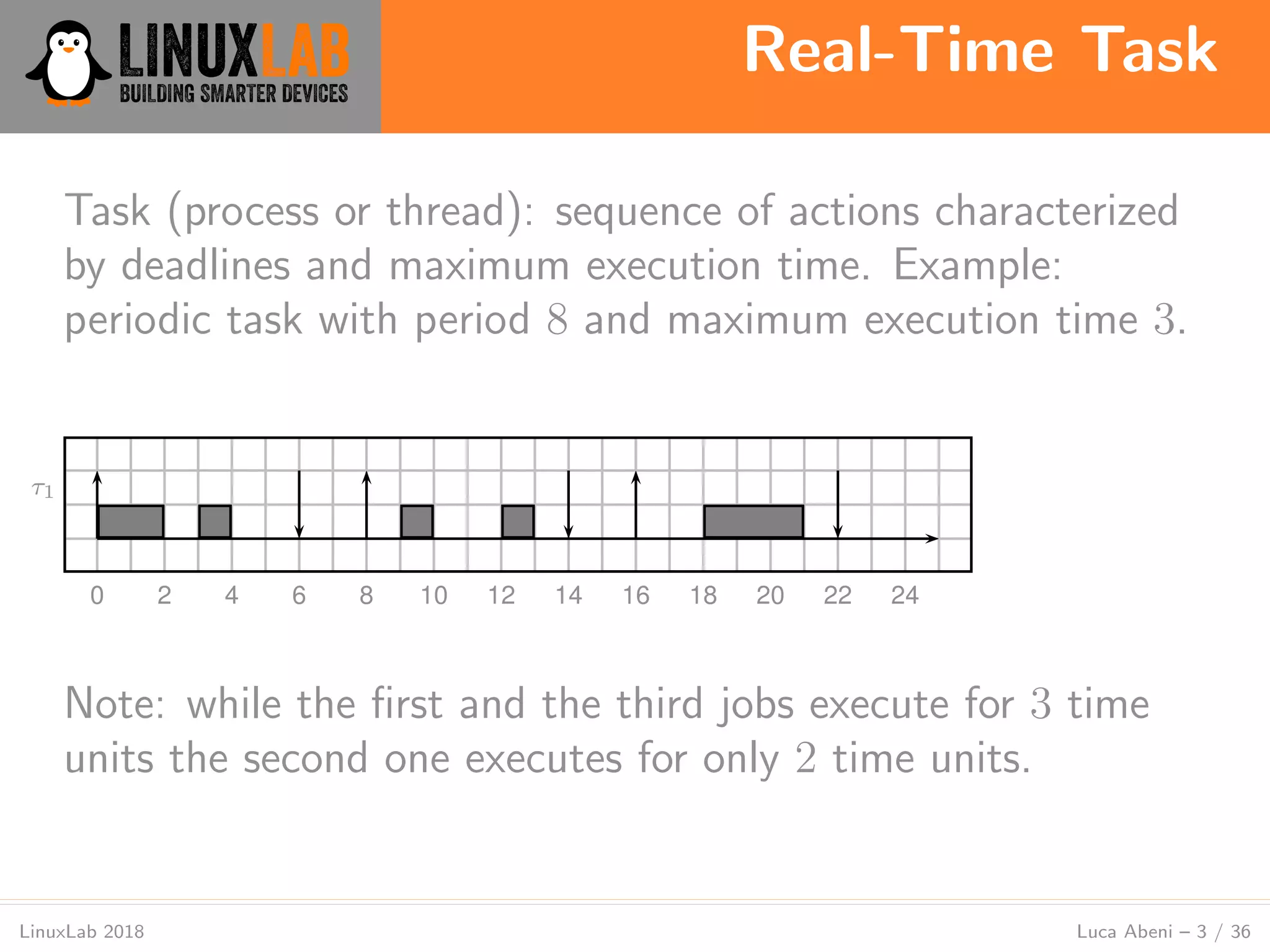
Task (process or thread): sequence of actions characterized
by deadlines and maximum execution time. Example:
periodic task with period 8 and maximum execution time 3.
0 2 4 6 8 10 12 14 16 18 20 22 24
τ1
Note: while the first and the third jobs execute for 3 time
units the second one executes for only 2 time units.
Formal Task Model
LinuxLab 2018 Luca Abeni – 4 / 36
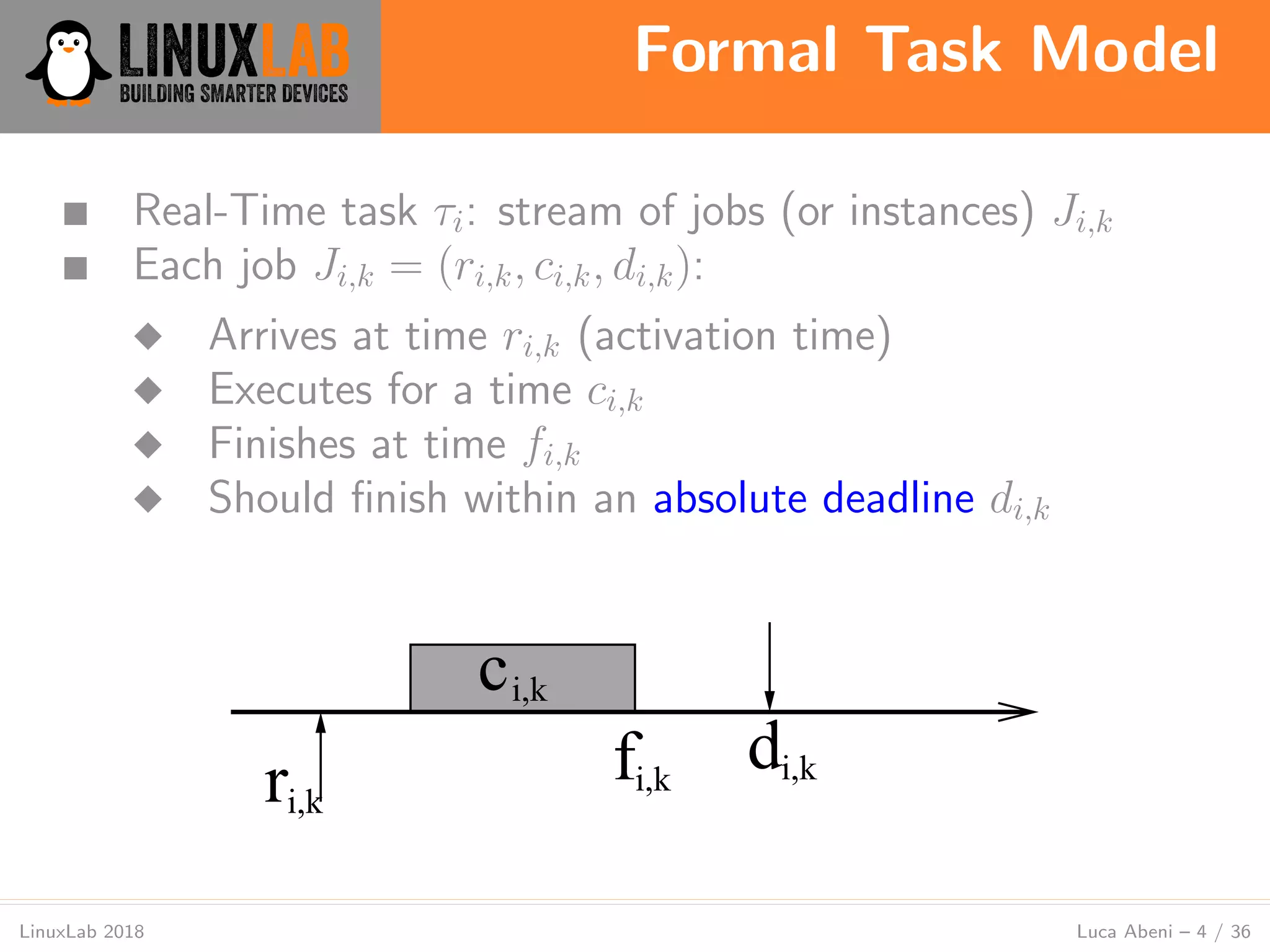
■ Real-Time task τi: stream of jobs (or instances) Ji,k
■ Each job Ji,k = (ri,k, ci,k, di,k):
◆ Arrives at time ri,k (activation time)
◆ Executes for a time ci,k
◆ Finishes at time fi,k
◆ Should finish within an absolute deadline di,k
ri,k
fi,k
di,k
ci,k
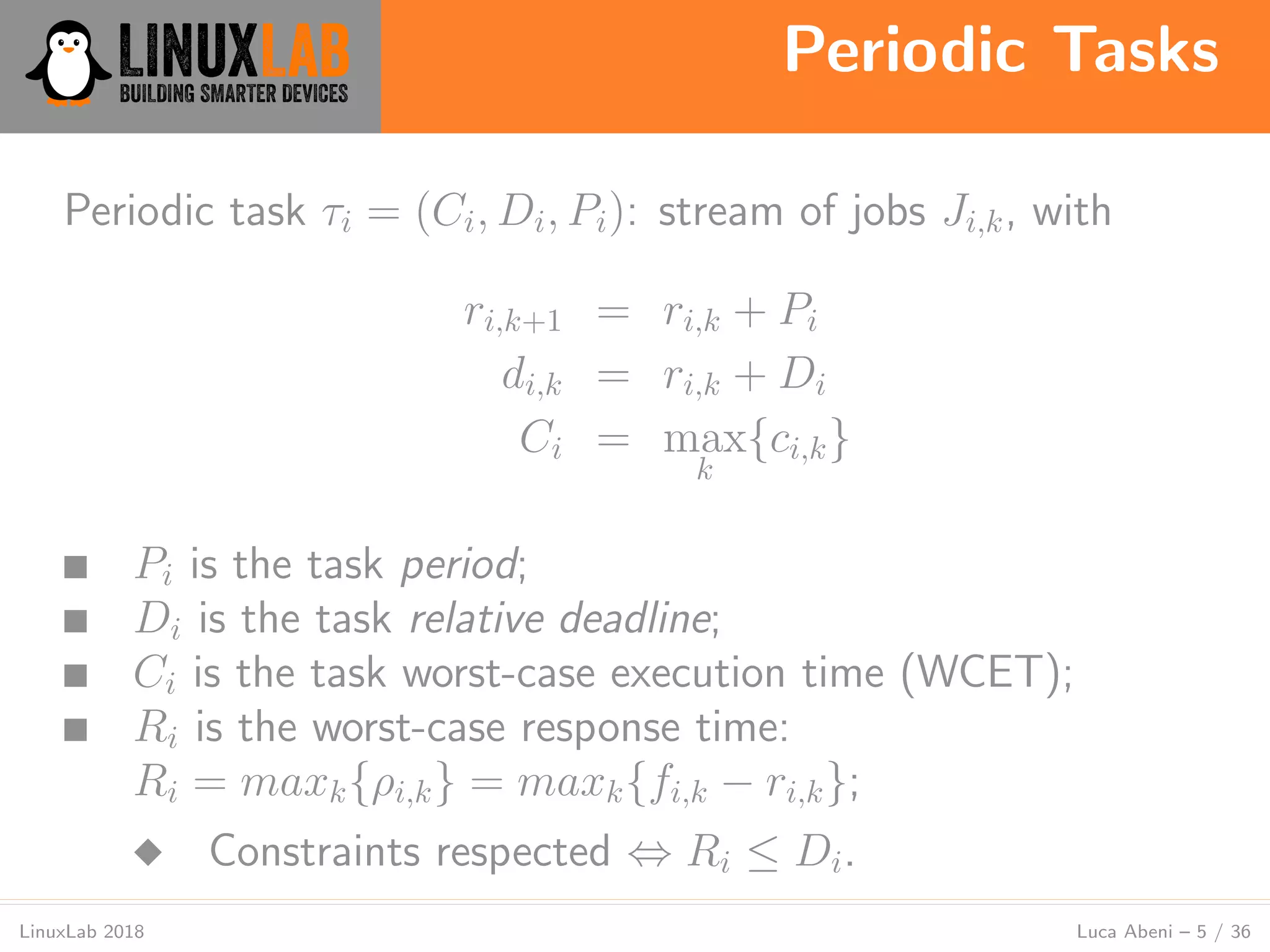
Periodic Tasks
LinuxLab 2018 Luca Abeni – 5 / 36
Periodic task τi = (Ci, Di, Pi): stream of jobs Ji,k, with
ri,k+1 = ri,k + Pi
di,k = ri,k + Di
Ci = max
k
{ci,k}
■ Pi is the task period;
■ Di is the task relative deadline;
■ Ci is the task worst-case execution time (WCET);
■ Ri is the worst-case response time:
Ri = maxk{ρi,k} = maxk{fi,k − ri,k};
◆ Constraints respected ⇔ Ri ≤ Di.
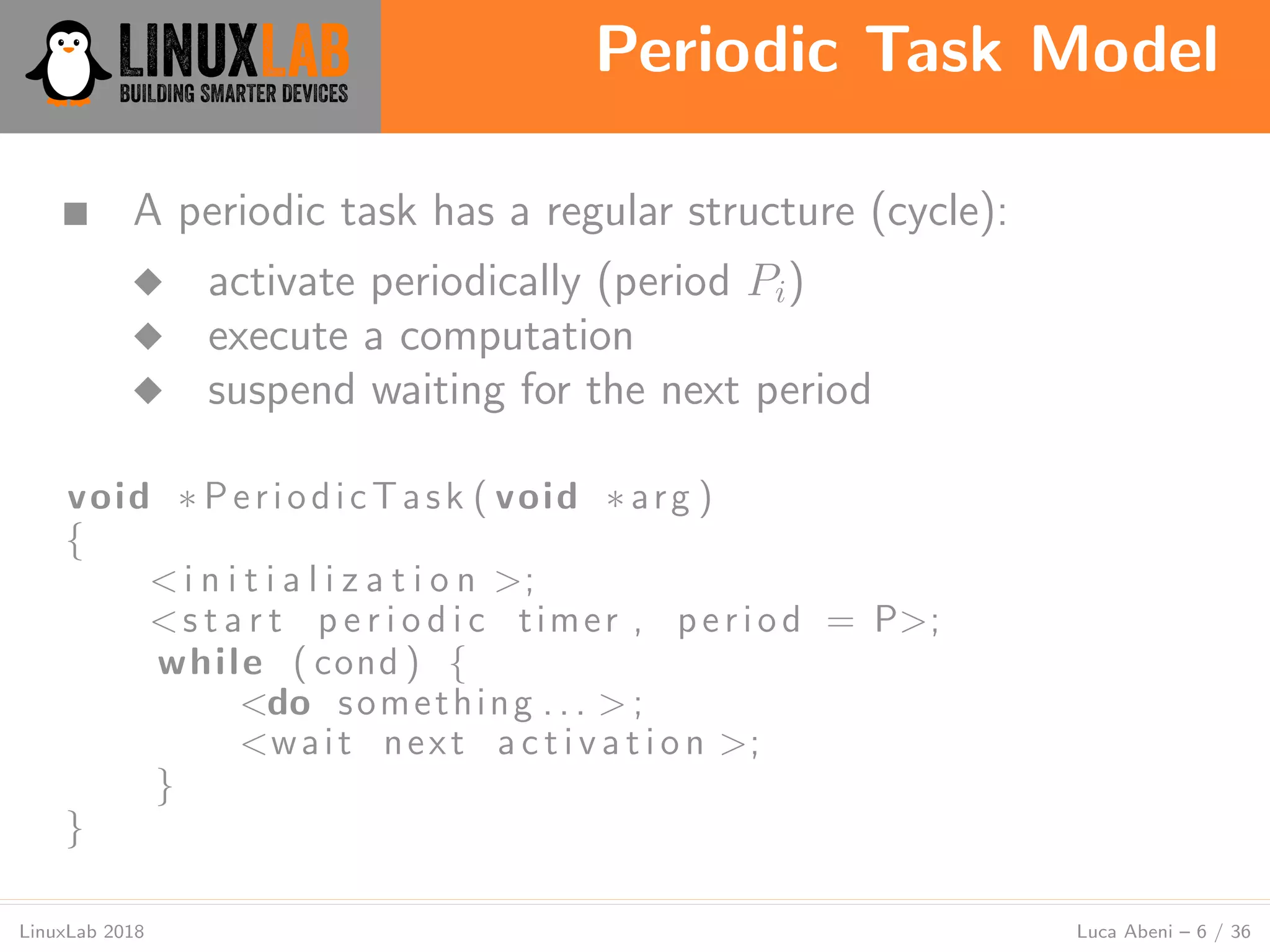
Periodic Task Model
LinuxLab 2018 Luca Abeni – 6 / 36
■ A periodic task has a regular structure (cycle):
◆ activate periodically (period Pi)
◆ execute a computation
◆ suspend waiting for the next period
void ∗ PeriodicTask ( void ∗ arg )
{
<i n i t i a l i z a t i o n >;
<s t a r t p e r i o d i c timer , period = P>;
while ( cond ) {
<do something . . . > ;
<wait next a c t i v a t i o n >;
}
}
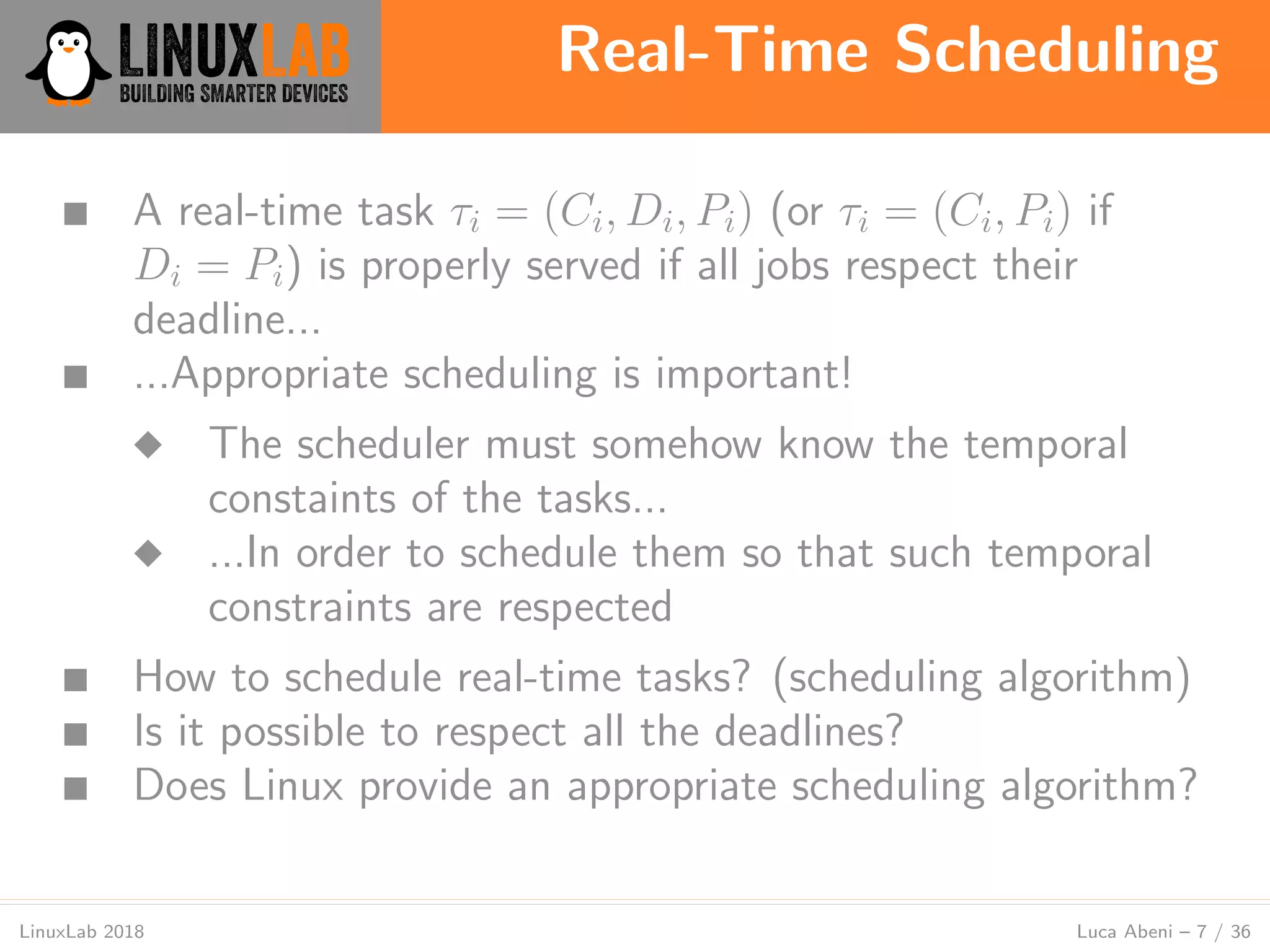
Real-Time Scheduling
LinuxLab 2018 Luca Abeni – 7 / 36
■ A real-time task τi = (Ci, Di, Pi) (or τi = (Ci, Pi) if
Di = Pi) is properly served if all jobs respect their
deadline...
■ ...Appropriate scheduling is important!
◆ The scheduler must somehow know the temporal
constaints of the tasks...
◆ ...In order to schedule them so that such temporal
constraints are respected
■ How to schedule real-time tasks? (scheduling algorithm)
■ Is it possible to respect all the deadlines?
■ Does Linux provide an appropriate scheduling algorithm?
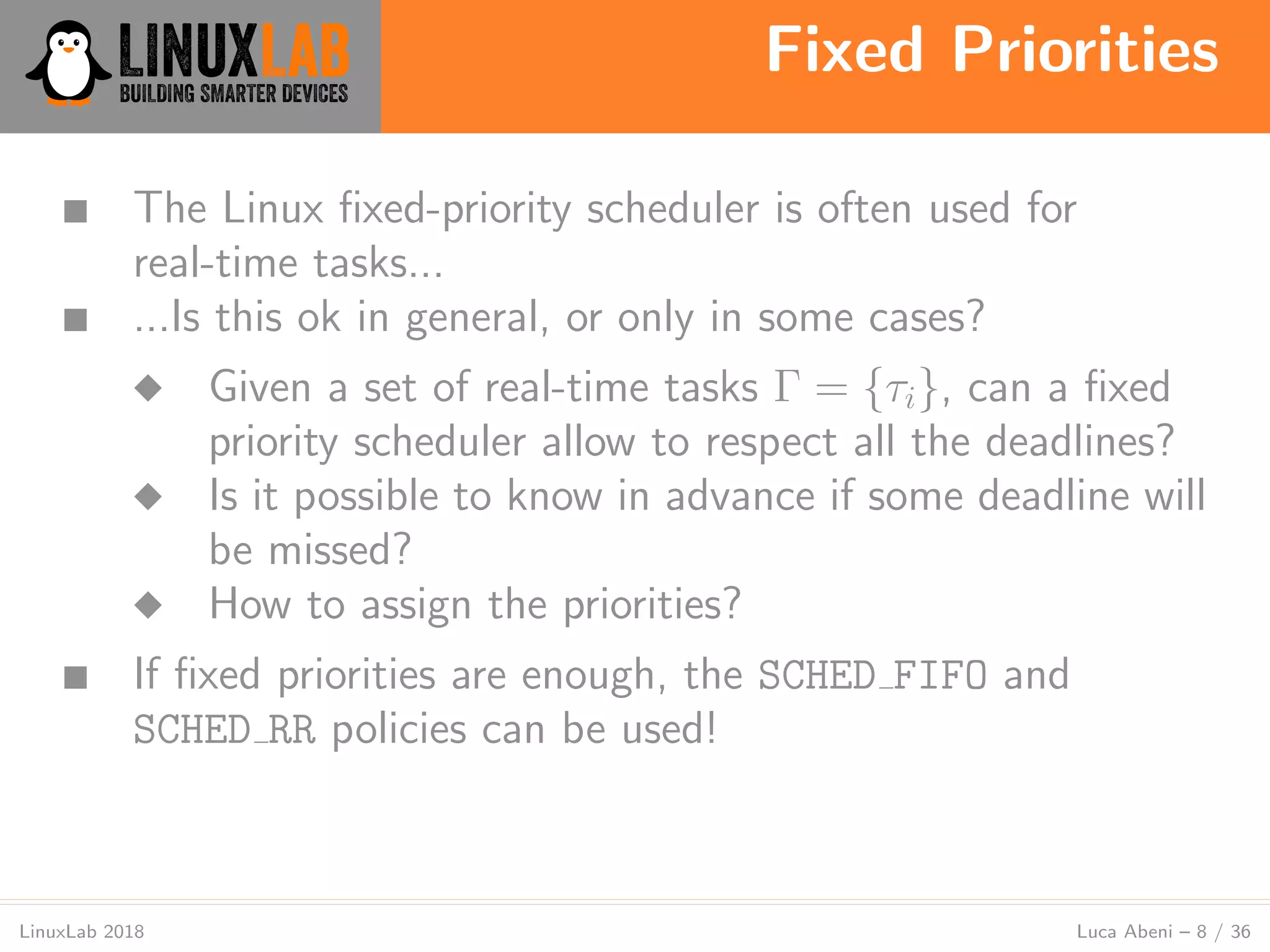
Fixed Priorities
LinuxLab 2018 Luca Abeni – 8 / 36
■ The Linux fixed-priority scheduler is often used for
real-time tasks...
■ ...Is this ok in general, or only in some cases?
◆ Given a set of real-time tasks Γ = {τi}, can a fixed
priority scheduler allow to respect all the deadlines?
◆ Is it possible to know in advance if some deadline will
be missed?
◆ How to assign the priorities?
■ If fixed priorities are enough, the SCHED FIFO and
SCHED RR policies can be used!
Schedulability Analysis
LinuxLab 2018 Luca Abeni – 9 / 36
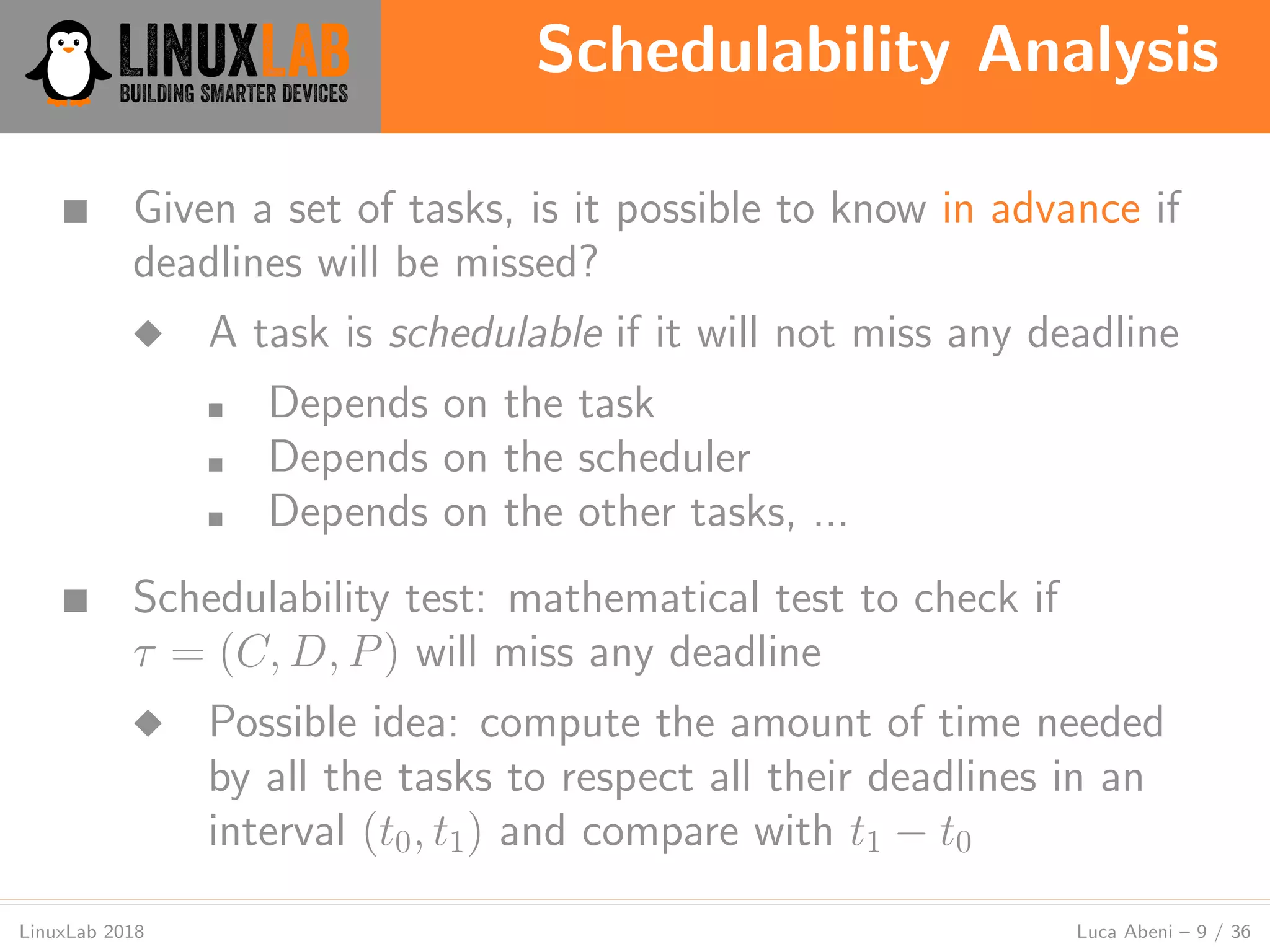
■ Given a set of tasks, is it possible to know in advance if
deadlines will be missed?
◆ A task is schedulable if it will not miss any deadline
■ Depends on the task
■ Depends on the scheduler
■ Depends on the other tasks, ...
■ Schedulability test: mathematical test to check if
τ = (C, D, P) will miss any deadline
◆ Possible idea: compute the amount of time needed
by all the tasks to respect all their deadlines in an
interval (t0, t1) and compare with t1 − t0
Partitioned Scheduling
LinuxLab 2018 Luca Abeni – 10 / 36
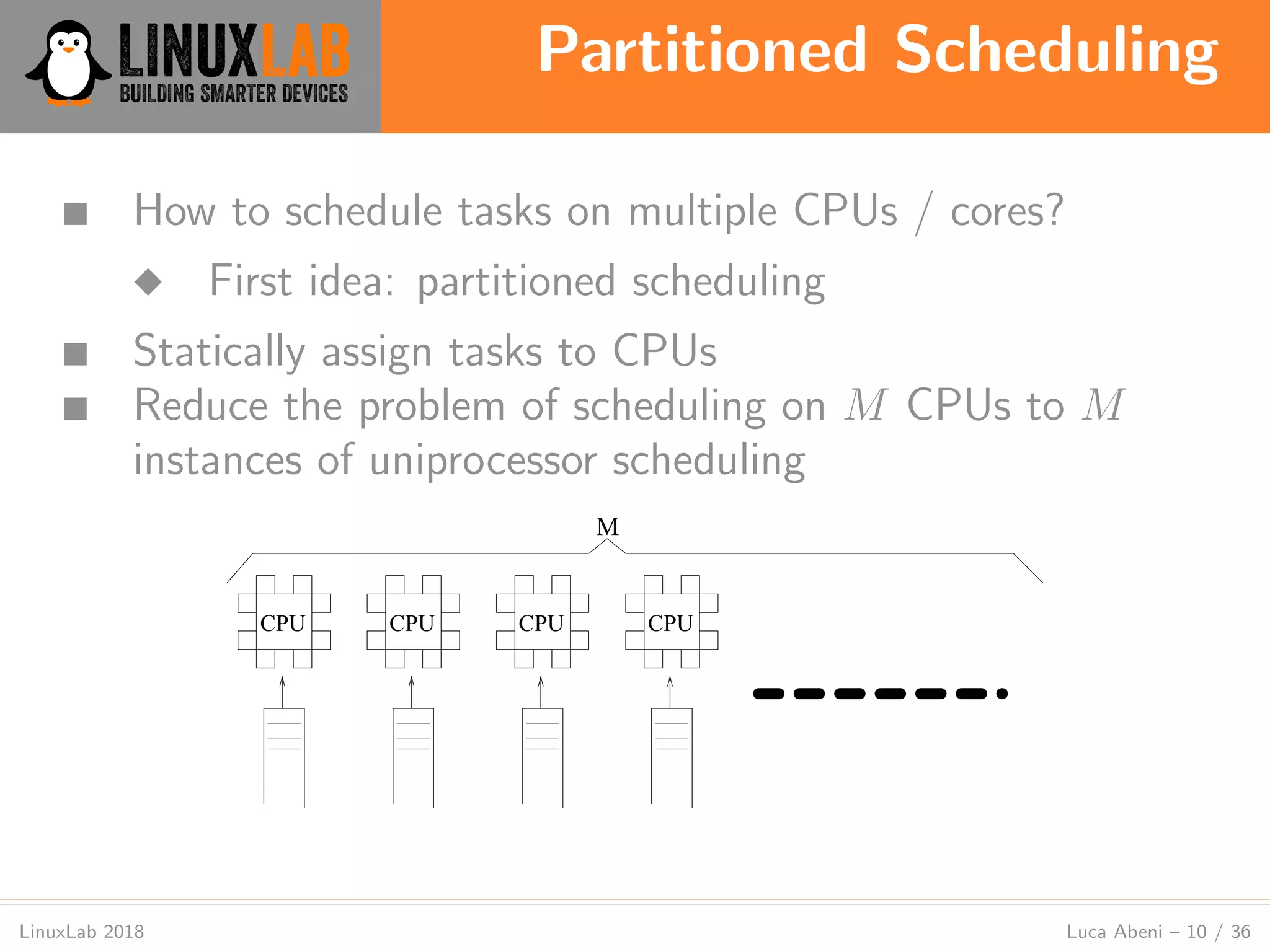
■ How to schedule tasks on multiple CPUs / cores?
◆ First idea: partitioned scheduling
■ Statically assign tasks to CPUs
■ Reduce the problem of scheduling on M CPUs to M
instances of uniprocessor scheduling
CPU CPU CPU CPU
M
Global Scheduling
LinuxLab 2018 Luca Abeni – 11 / 36
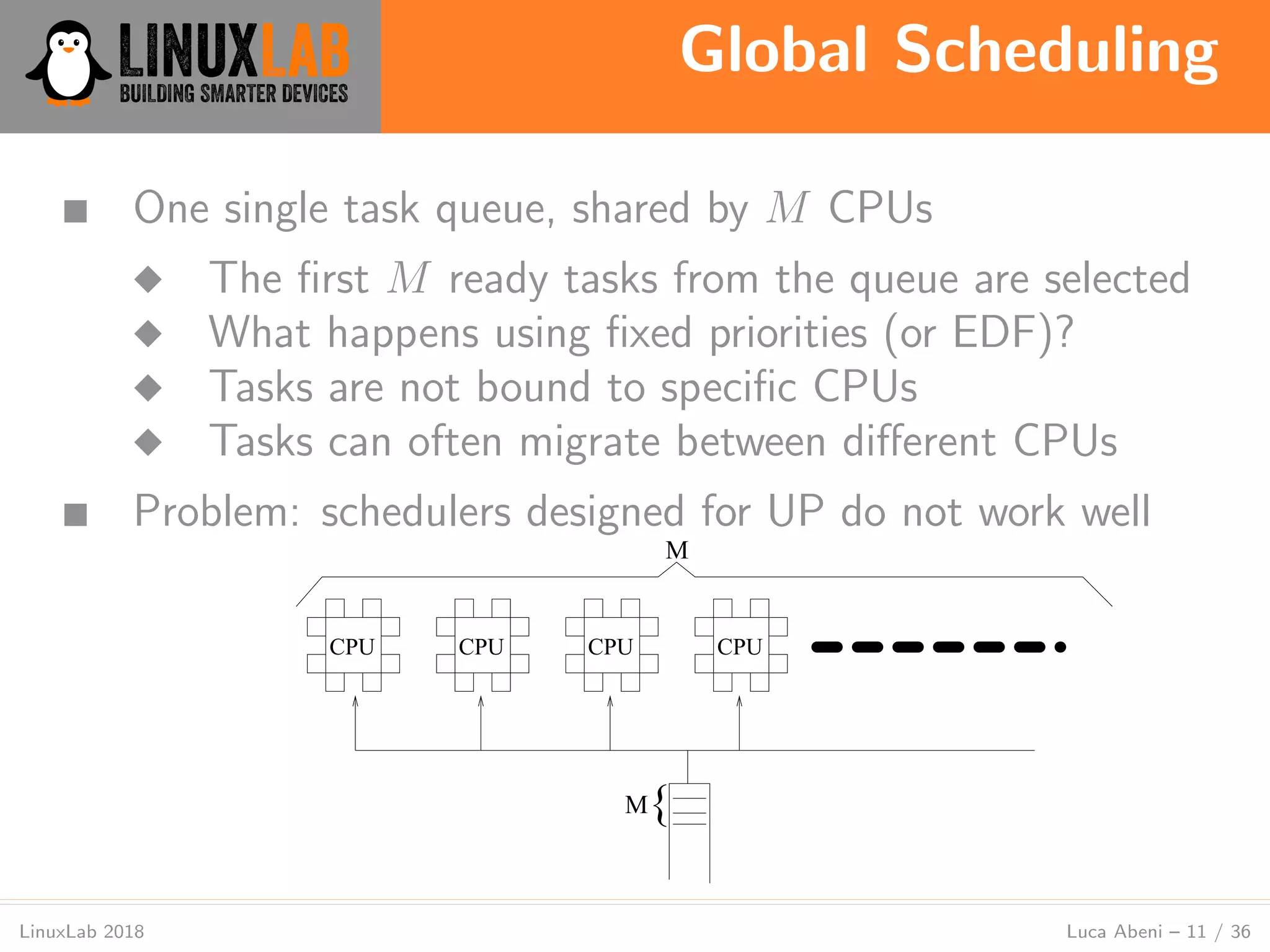
■ One single task queue, shared by M CPUs
◆ The first M ready tasks from the queue are selected
◆ What happens using fixed priorities (or EDF)?
◆ Tasks are not bound to specific CPUs
◆ Tasks can often migrate between different CPUs
■ Problem: schedulers designed for UP do not work well
M
CPU CPU CPU CPU
{M
Fixed Priorities in Linux
LinuxLab 2018 Luca Abeni – 12 / 36
■ SCHED FIFO and SCHED RR use fixed priorities
◆ They can be used for real-time tasks, to implement
RM and DM
◆ Real-time tasks have priority over non real-time
(SCHED OTHER) tasks
■ Difference between the two policies: visible when more
tasks have the same priority
■ The administrator can use sched setscheduler() (or
similar) to schedule real-time tasks
◆ Might be a little bit impractical, but can be used
■ However...
Periodic Task Example
LinuxLab 2018 Luca Abeni – 13 / 36
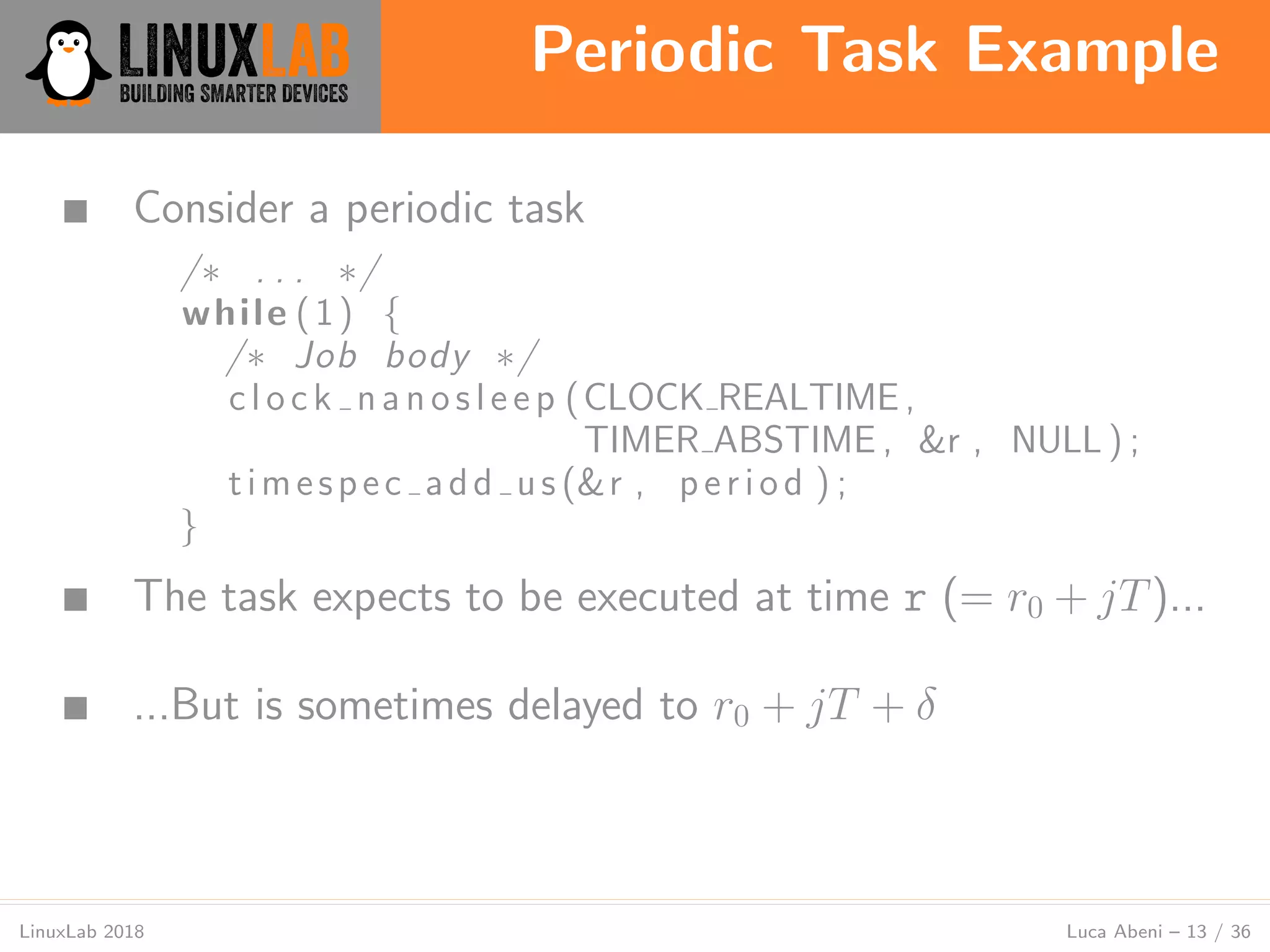
■ Consider a periodic task
/∗ . . . ∗/
while (1) {
/∗ Job body ∗/
c l o c k n a n o s l e e p (CLOCK REALTIME ,
TIMER ABSTIME , &r , NULL ) ;
timespec add us (&r , period ) ;
}
■ The task expects to be executed at time r (= r0 + jT)...
■ ...But is sometimes delayed to r0 + jT + δ
Theoretical Schedule
LinuxLab 2018 Luca Abeni – 14 / 36
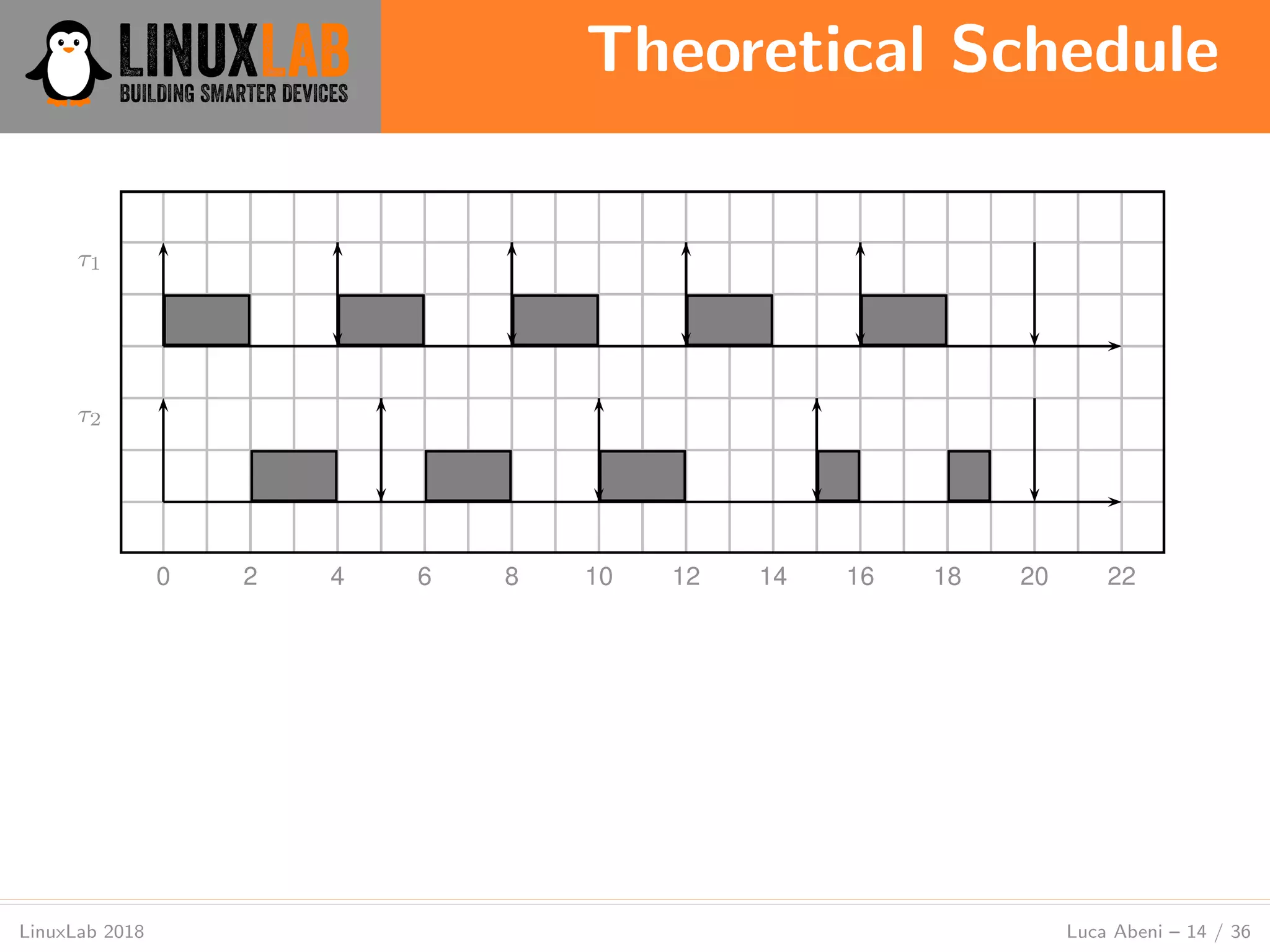
0 2 4 6 8 10 12 14 16 18 20 22
τ1
τ2
Actual Schedule
LinuxLab 2018 Luca Abeni – 15 / 36
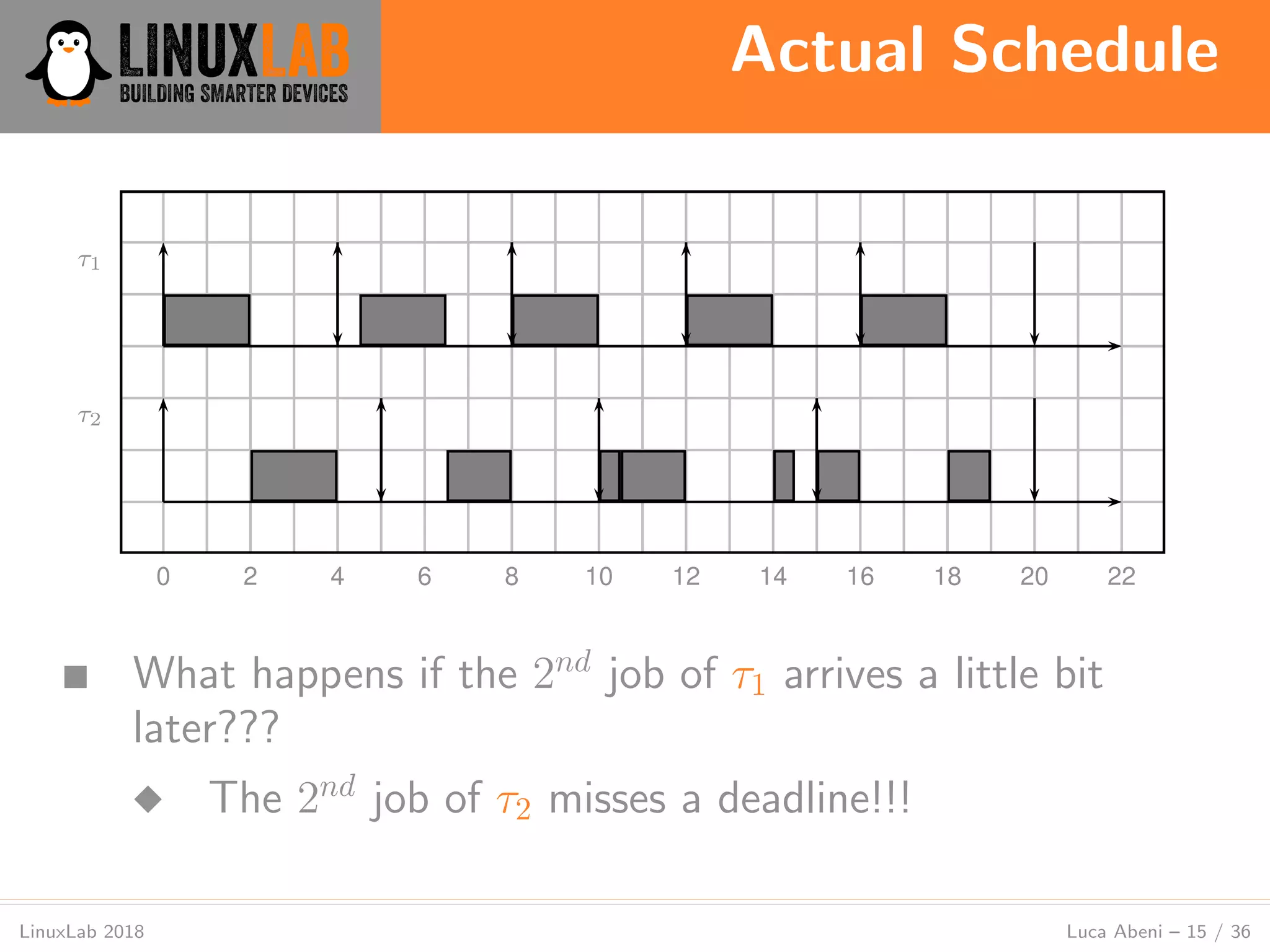
0 2 4 6 8 10 12 14 16 18 20 22
τ1
τ2
■ What happens if the 2nd
job of τ1 arrives a little bit
later???
◆ The 2nd
job of τ2 misses a deadline!!!
Theory vs Real Schedule
LinuxLab 2018 Luca Abeni – 16 / 36
■ The delay δ in scheduling a task is due to kernel latency
■ Kernel latency can be modelled as a blocking time
■ In real world, high priority tasks often suffer from
blocking times coming from the OS (more precisely, from
the kernel)
◆ Why?
◆ How?
◆ What can we do?
■ To answer the previous questions, we need to recall how
the hardware and the OS work...
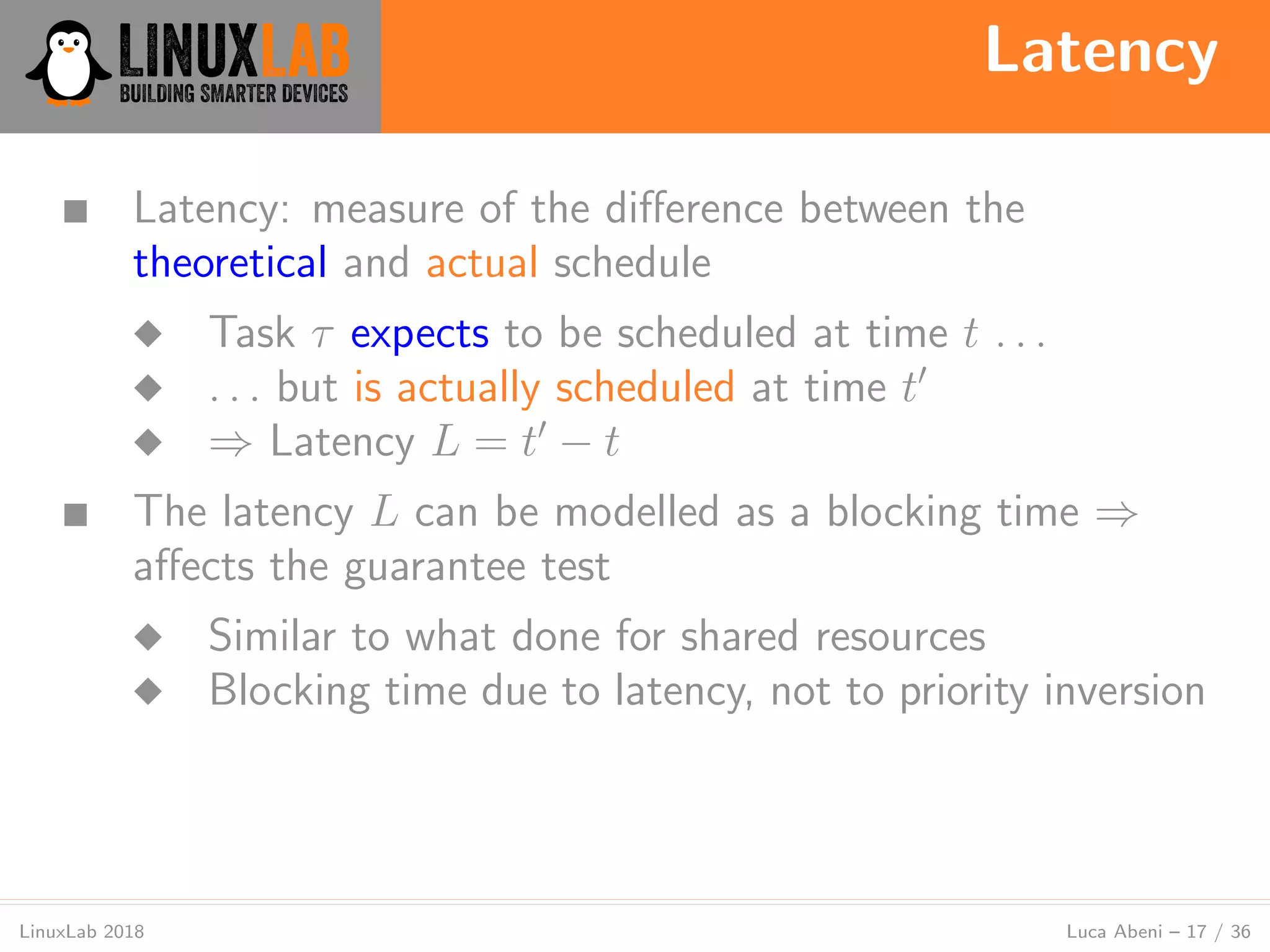
Latency
LinuxLab 2018 Luca Abeni – 17 / 36
■ Latency: measure of the difference between the
theoretical and actual schedule
◆ Task τ expects to be scheduled at time t . . .
◆ . . . but is actually scheduled at time t′
◆ ⇒ Latency L = t′
− t
■ The latency L can be modelled as a blocking time ⇒
affects the guarantee test
◆ Similar to what done for shared resources
◆ Blocking time due to latency, not to priority inversion
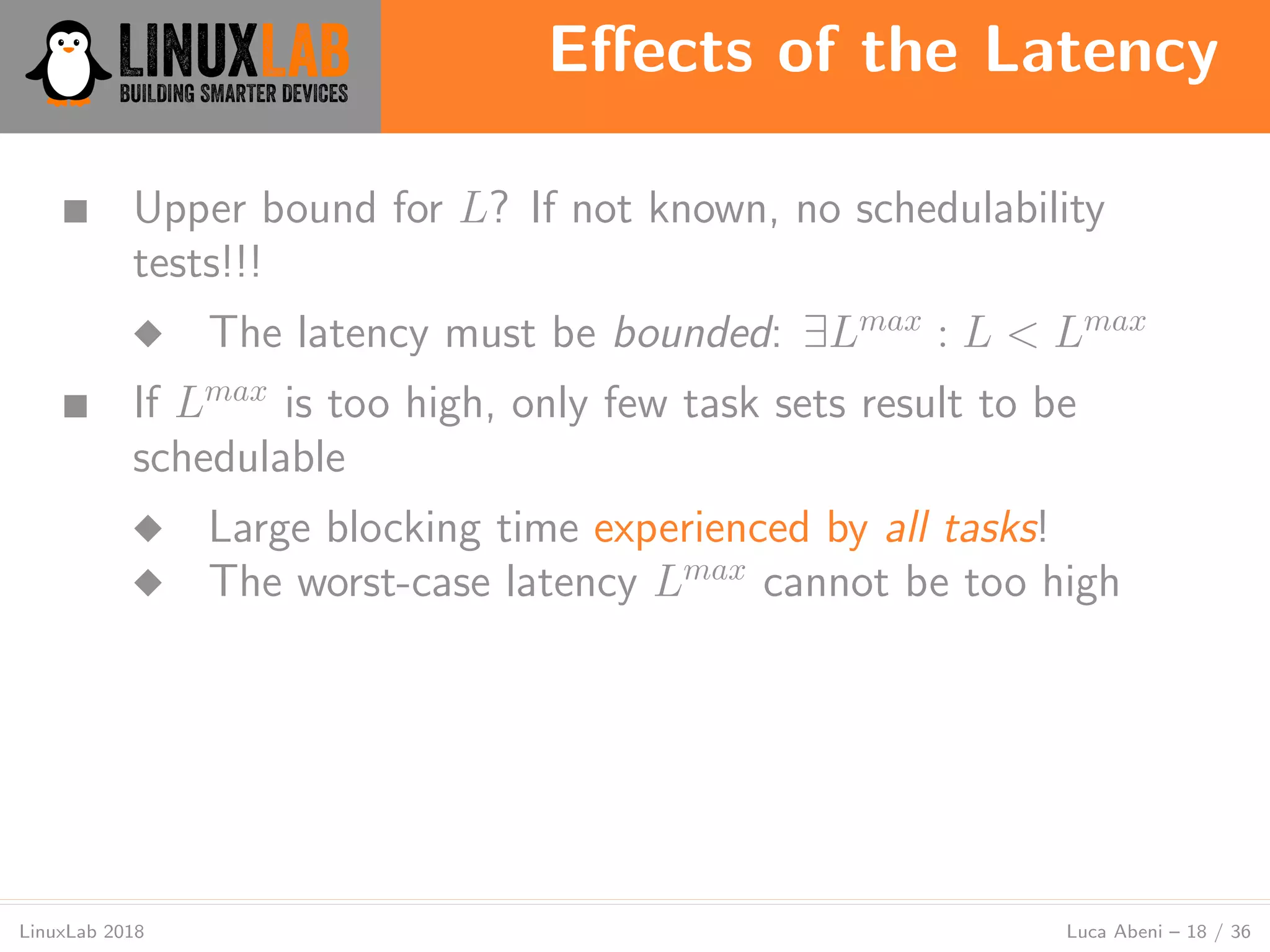
Effects of the Latency
LinuxLab 2018 Luca Abeni – 18 / 36
■ Upper bound for L? If not known, no schedulability
tests!!!
◆ The latency must be bounded: ∃Lmax
: L < Lmax
■ If Lmax
is too high, only few task sets result to be
schedulable
◆ Large blocking time experienced by all tasks!
◆ The worst-case latency Lmax
cannot be too high
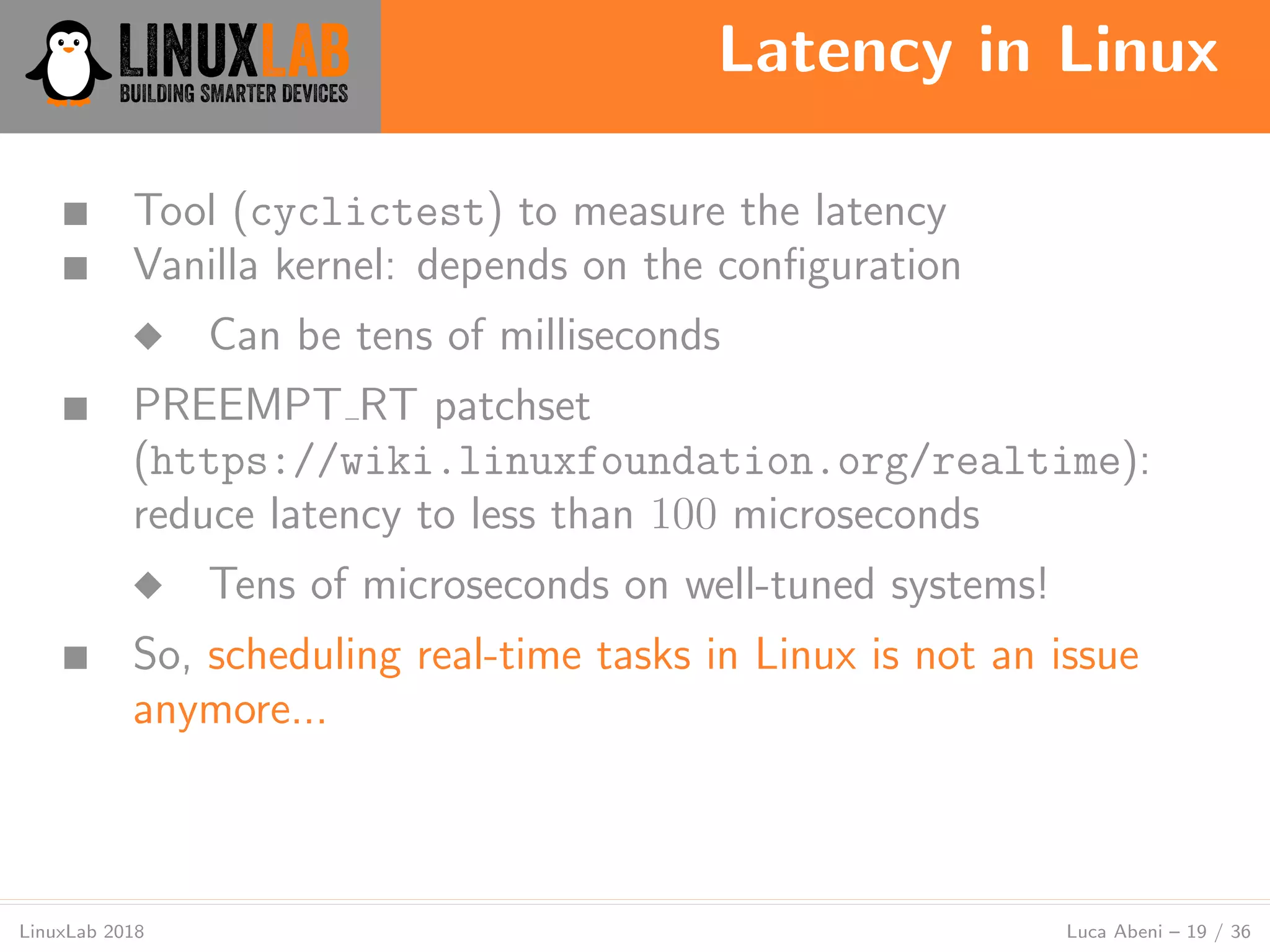
Latency in Linux
LinuxLab 2018 Luca Abeni – 19 / 36
■ Tool (cyclictest) to measure the latency
■ Vanilla kernel: depends on the configuration
◆ Can be tens of milliseconds
■ PREEMPT RT patchset
(https://wiki.linuxfoundation.org/realtime):
reduce latency to less than 100 microseconds
◆ Tens of microseconds on well-tuned systems!
■ So, scheduling real-time tasks in Linux is not an issue
anymore...
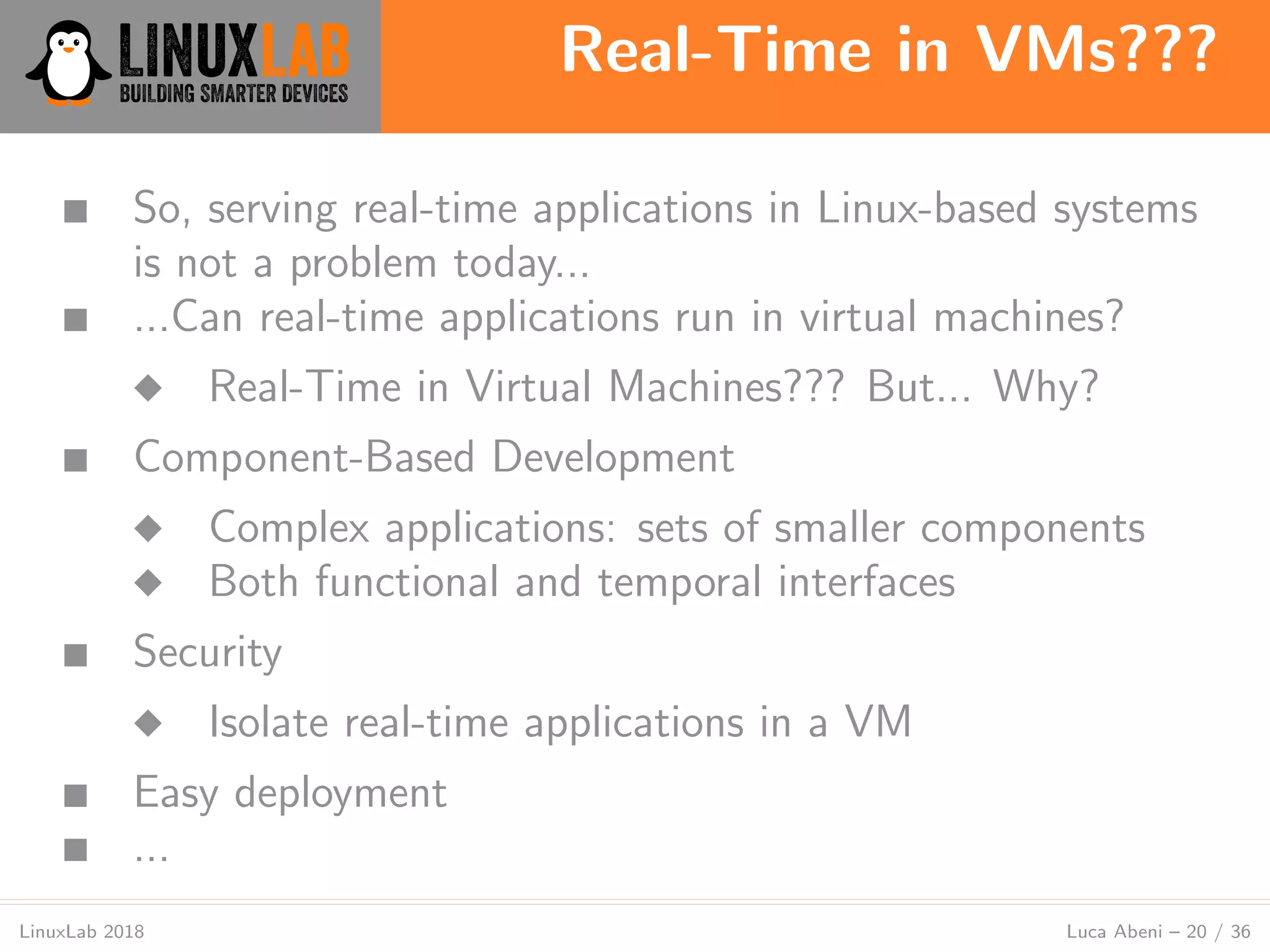
Real-Time in VMs???
LinuxLab 2018 Luca Abeni – 20 / 36
■ So, serving real-time applications in Linux-based systems
is not a problem today...
■ ...Can real-time applications run in virtual machines?
◆ Real-Time in Virtual Machines??? But... Why?
■ Component-Based Development
◆ Complex applications: sets of smaller components
◆ Both functional and temporal interfaces
■ Security
◆ Isolate real-time applications in a VM
■ Easy deployment
■ ...
Real-Time Components
LinuxLab 2018 Luca Abeni – 21 / 36
■ Assume to have N components...
◆ Each component is described by its interface...
◆ ...But a description of its temporal behaviour is also
somehow provided...
■ Component are assumed to respect some temporal
constraints
◆ Some kind of “contract” provided by real-time
guarantees
■ Is it possible to combine the components so that the
timing of the system is predictable?
◆ Can real-time guarantees be combined? How?
Combining Real-Time Apps
LinuxLab 2018 Luca Abeni – 22 / 36
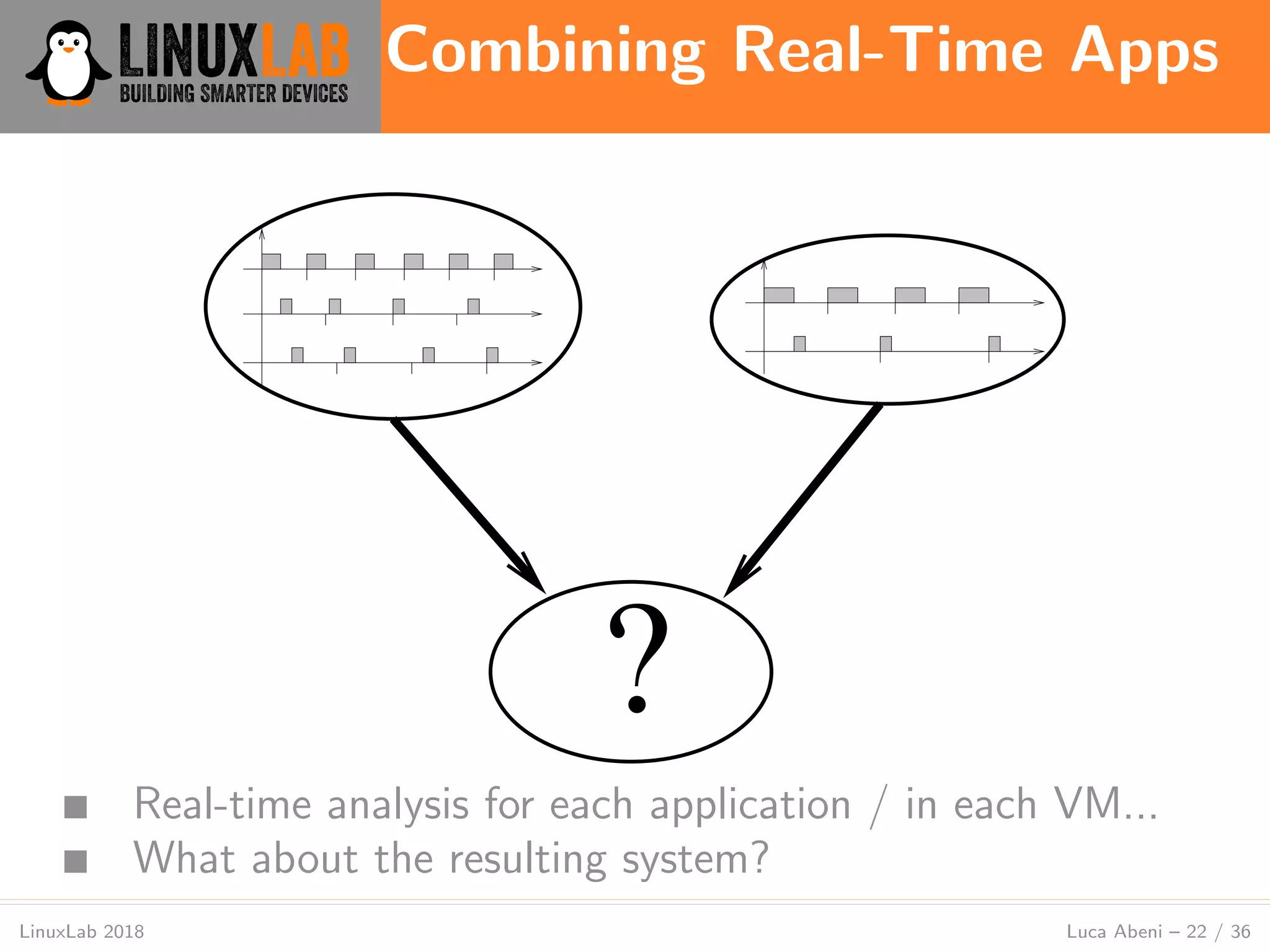
?
■ Real-time analysis for each application / in each VM...
■ What about the resulting system?
1 Real-Time Task per VM
LinuxLab 2018 Luca Abeni – 23 / 36
■ Single real-time thread/process in a VM → combining
VMs is easy...
◆ VMs can be modelled as real-time tasks
◆ Simple (C, D, T) model, or something more
complex...
■ What about VMs containing multiple real-time tasks?
◆ Model for a VM?
◆ How to summarize the VM’s temporal requirements?
◆ Scheduler in the VM? How to model it?
More Complex VMs
LinuxLab 2018 Luca Abeni – 24 / 36
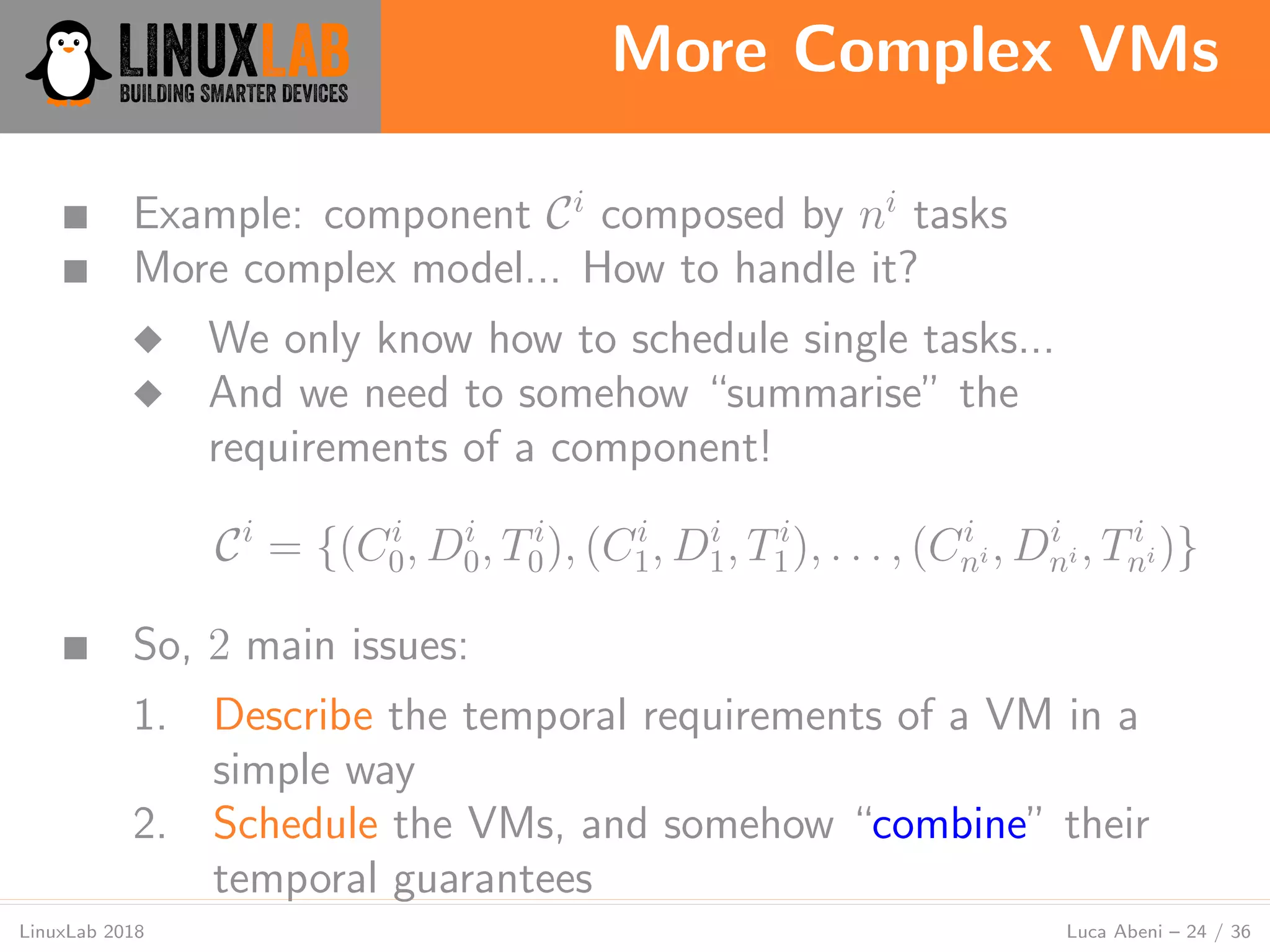
■ Example: component Ci
composed by ni
tasks
■ More complex model... How to handle it?
◆ We only know how to schedule single tasks...
◆ And we need to somehow “summarise” the
requirements of a component!
Ci
= {(Ci
0, Di
0, Ti
0), (Ci
1, Di
1, Ti
1), . . . , (Ci
ni, Di
ni, Ti
ni)}
■ So, 2 main issues:
1. Describe the temporal requirements of a VM in a
simple way
2. Schedule the VMs, and somehow “combine” their
temporal guarantees
Practical Issues
LinuxLab 2018 Luca Abeni – 25 / 36
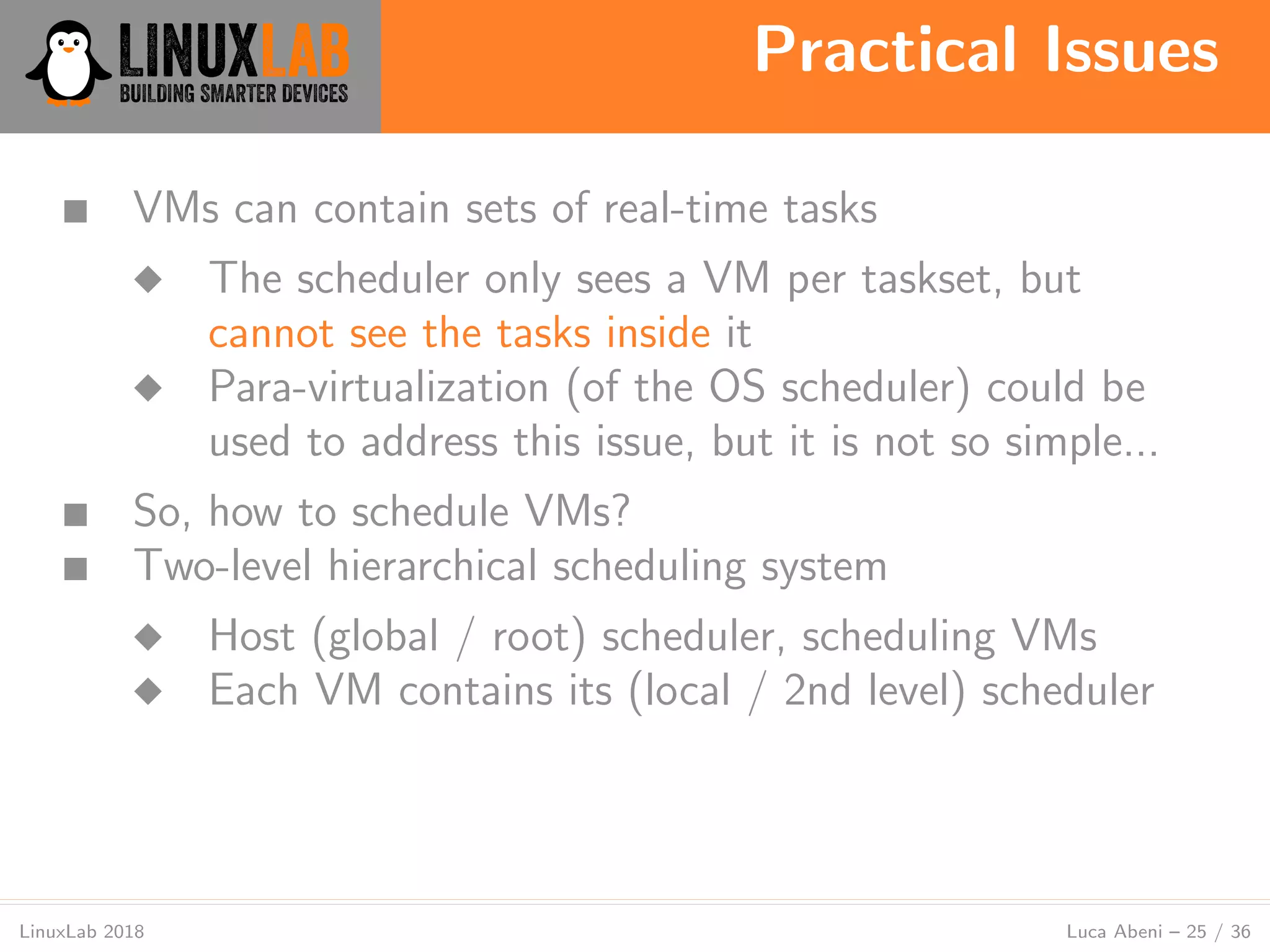
■ VMs can contain sets of real-time tasks
◆ The scheduler only sees a VM per taskset, but
cannot see the tasks inside it
◆ Para-virtualization (of the OS scheduler) could be
used to address this issue, but it is not so simple...
■ So, how to schedule VMs?
■ Two-level hierarchical scheduling system
◆ Host (global / root) scheduler, scheduling VMs
◆ Each VM contains its (local / 2nd level) scheduler
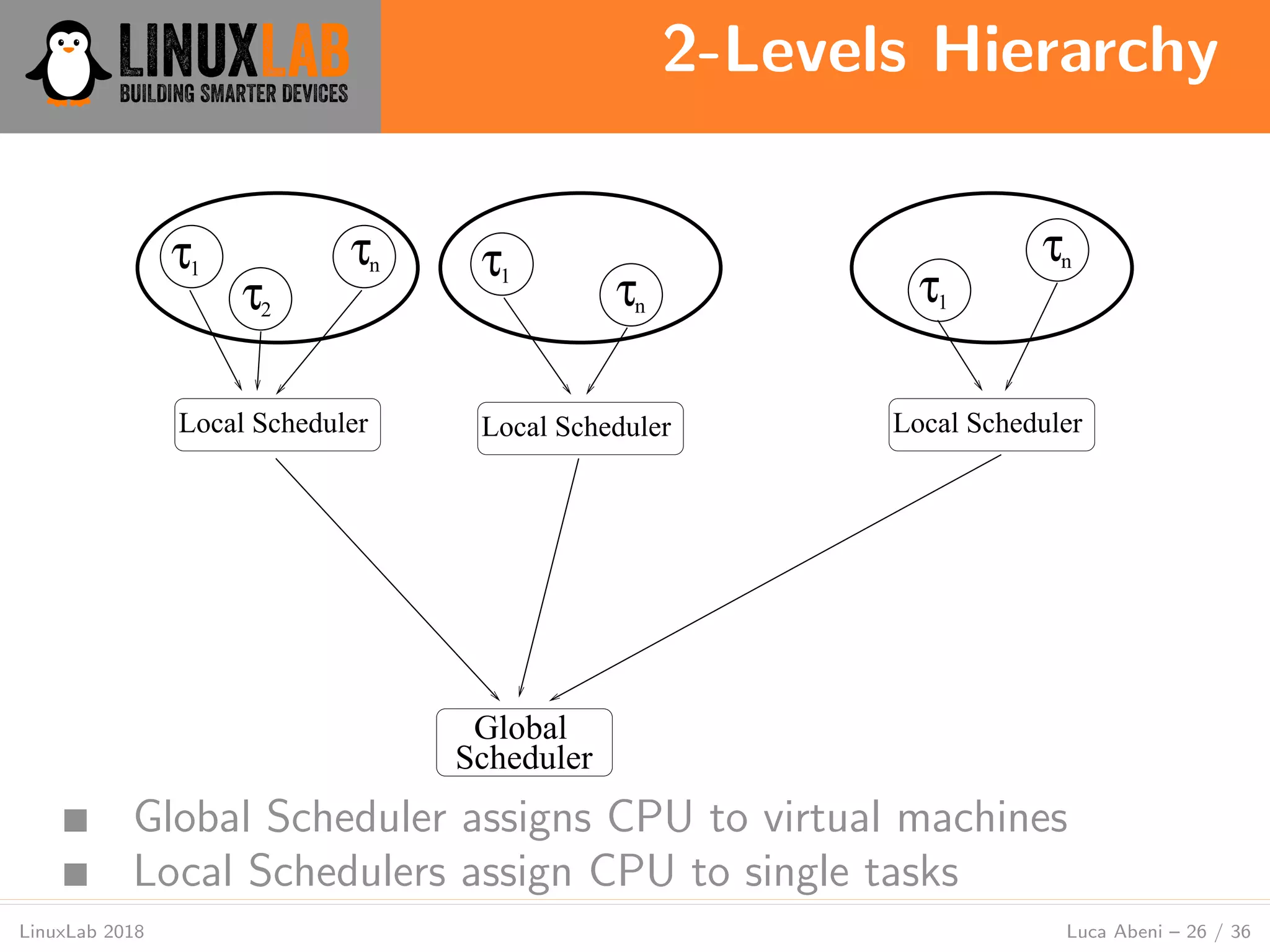
2-Levels Hierarchy
LinuxLab 2018 Luca Abeni – 26 / 36
1τ 1τ
1ττn
τn
Local Scheduler Local Scheduler Local Scheduler
2
τn
τ
Global
Scheduler
■ Global Scheduler assigns CPU to virtual machines
■ Local Schedulers assign CPU to single tasks
Hierarchical Scheduling
LinuxLab 2018 Luca Abeni – 27 / 36
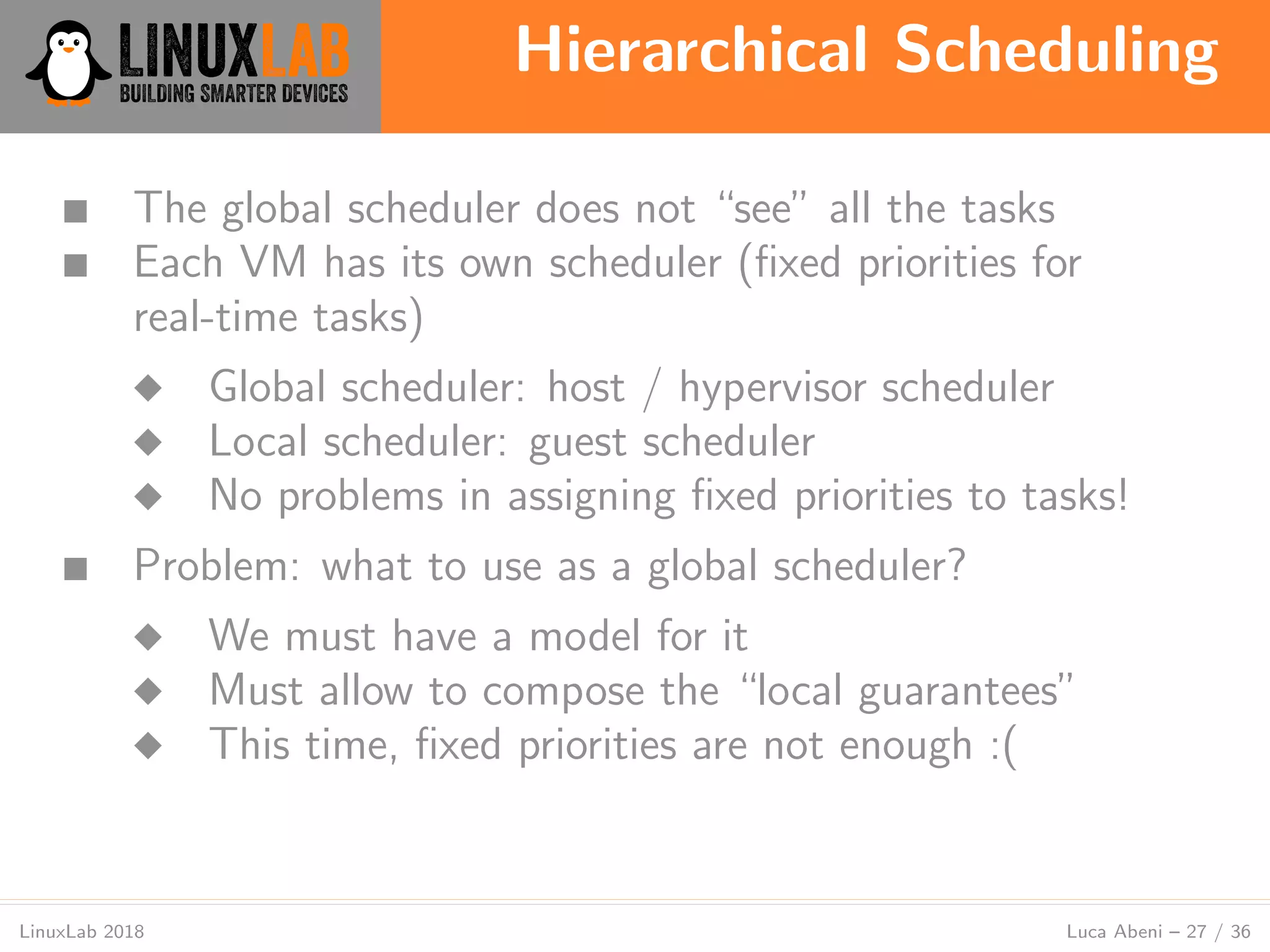
■ The global scheduler does not “see” all the tasks
■ Each VM has its own scheduler (fixed priorities for
real-time tasks)
◆ Global scheduler: host / hypervisor scheduler
◆ Local scheduler: guest scheduler
◆ No problems in assigning fixed priorities to tasks!
■ Problem: what to use as a global scheduler?
◆ We must have a model for it
◆ Must allow to compose the “local guarantees”
◆ This time, fixed priorities are not enough :(
Schedulability Analysis
LinuxLab 2018 Luca Abeni – 28 / 36
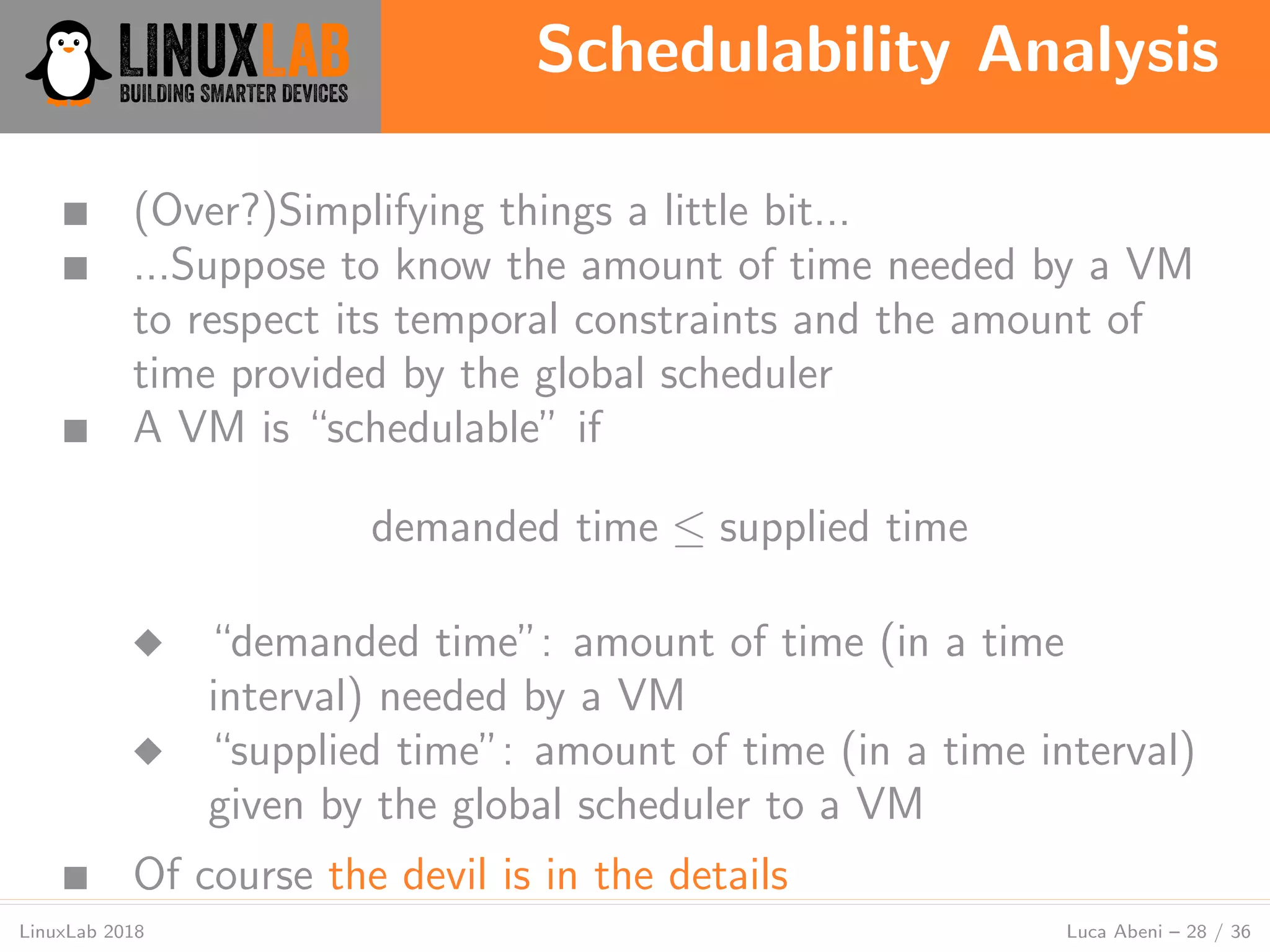
■ (Over?)Simplifying things a little bit...
■ ...Suppose to know the amount of time needed by a VM
to respect its temporal constraints and the amount of
time provided by the global scheduler
■ A VM is “schedulable” if
demanded time ≤ supplied time
◆ “demanded time”: amount of time (in a time
interval) needed by a VM
◆ “supplied time”: amount of time (in a time interval)
given by the global scheduler to a VM
■ Of course the devil is in the details
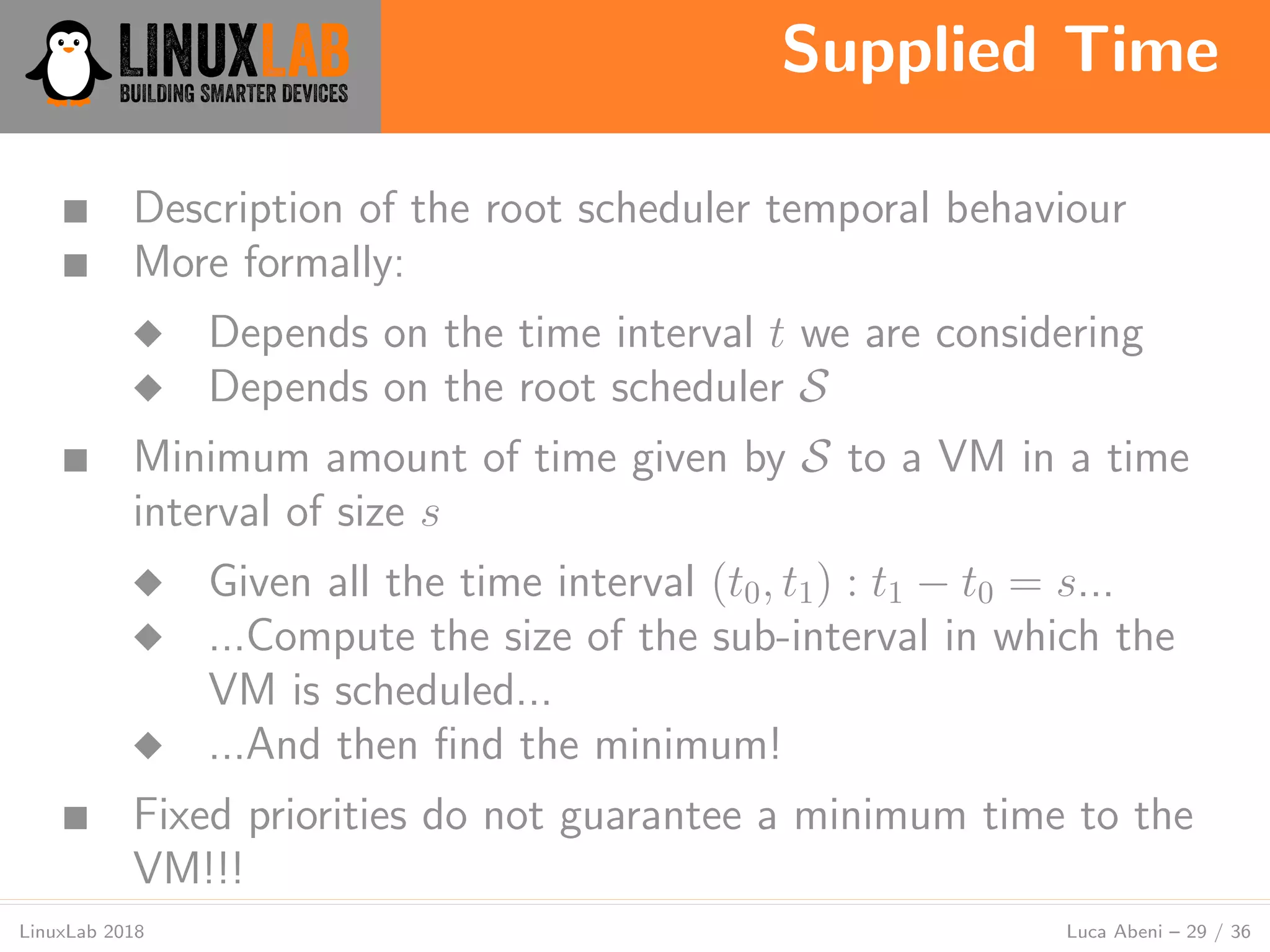
Supplied Time
LinuxLab 2018 Luca Abeni – 29 / 36
■ Description of the root scheduler temporal behaviour
■ More formally:
◆ Depends on the time interval t we are considering
◆ Depends on the root scheduler S
■ Minimum amount of time given by S to a VM in a time
interval of size s
◆ Given all the time interval (t0, t1) : t1 − t0 = s...
◆ ...Compute the size of the sub-interval in which the
VM is scheduled...
◆ ...And then find the minimum!
■ Fixed priorities do not guarantee a minimum time to the
VM!!!
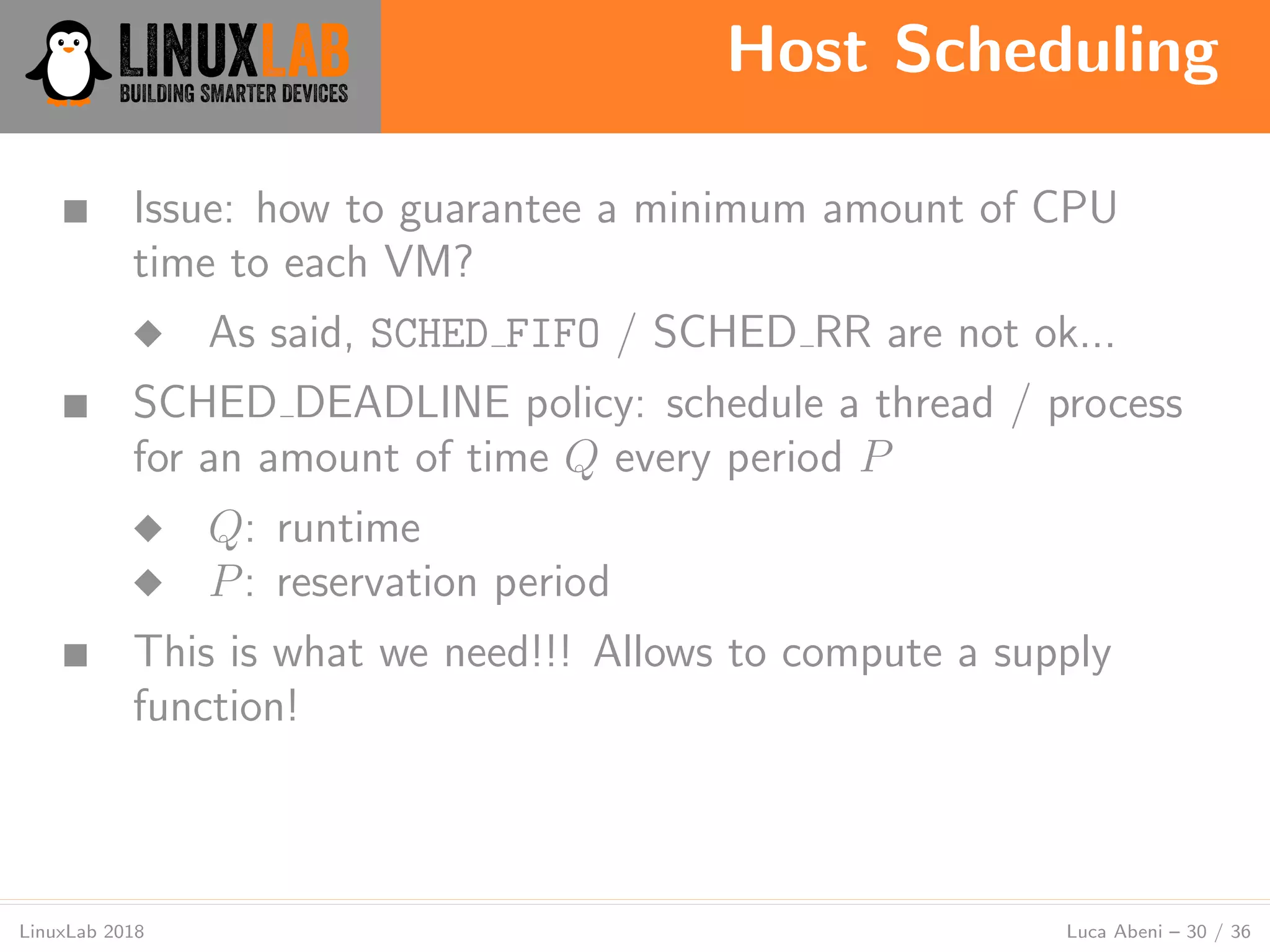
Host Scheduling
LinuxLab 2018 Luca Abeni – 30 / 36
■ Issue: how to guarantee a minimum amount of CPU
time to each VM?
◆ As said, SCHED FIFO / SCHED RR are not ok...
■ SCHED DEADLINE policy: schedule a thread / process
for an amount of time Q every period P
◆ Q: runtime
◆ P: reservation period
■ This is what we need!!! Allows to compute a supply
function!
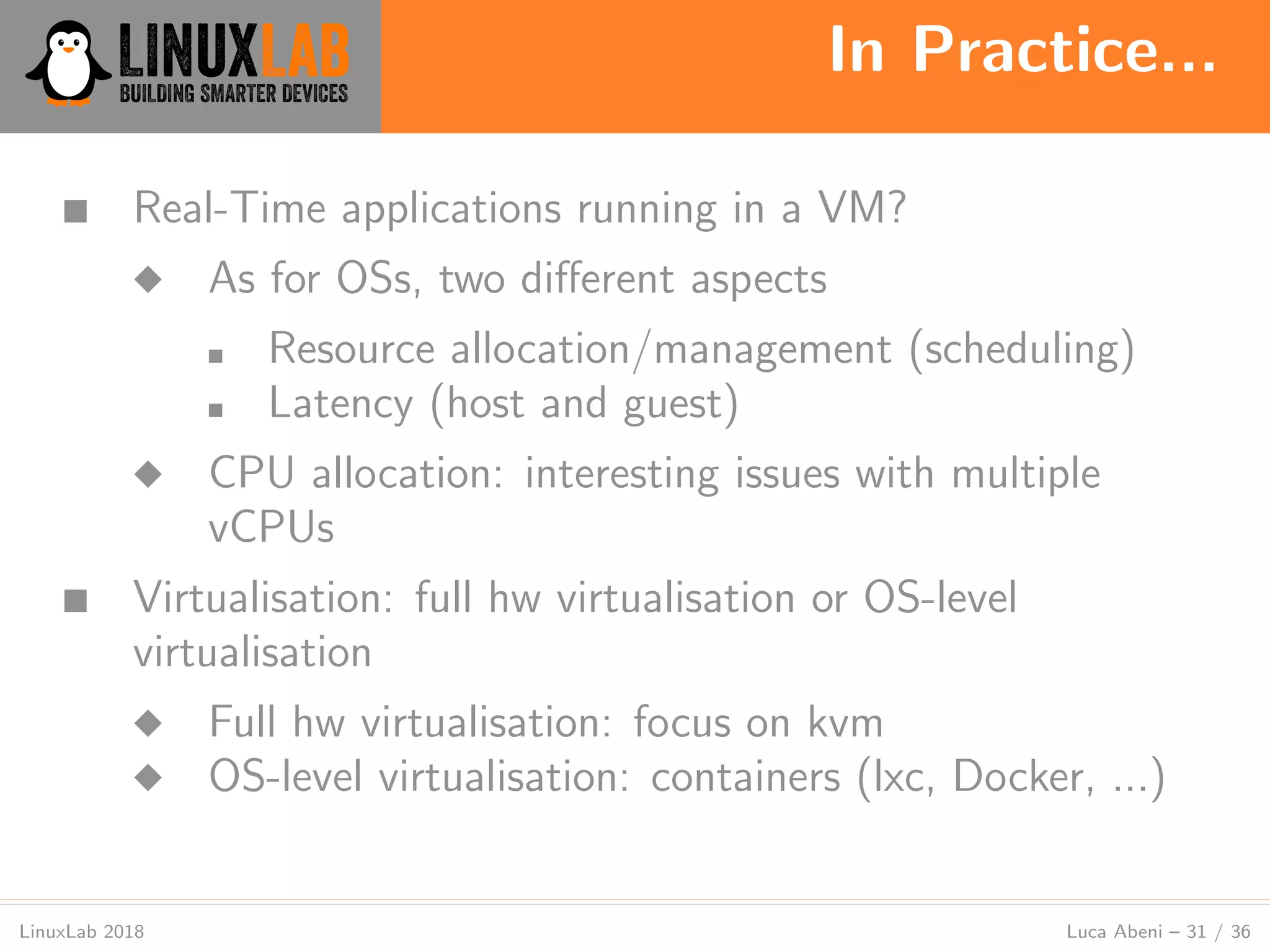
In Practice...
LinuxLab 2018 Luca Abeni – 31 / 36
■ Real-Time applications running in a VM?
◆ As for OSs, two different aspects
■ Resource allocation/management (scheduling)
■ Latency (host and guest)
◆ CPU allocation: interesting issues with multiple
vCPUs
■ Virtualisation: full hw virtualisation or OS-level
virtualisation
◆ Full hw virtualisation: focus on kvm
◆ OS-level virtualisation: containers (lxc, Docker, ...)
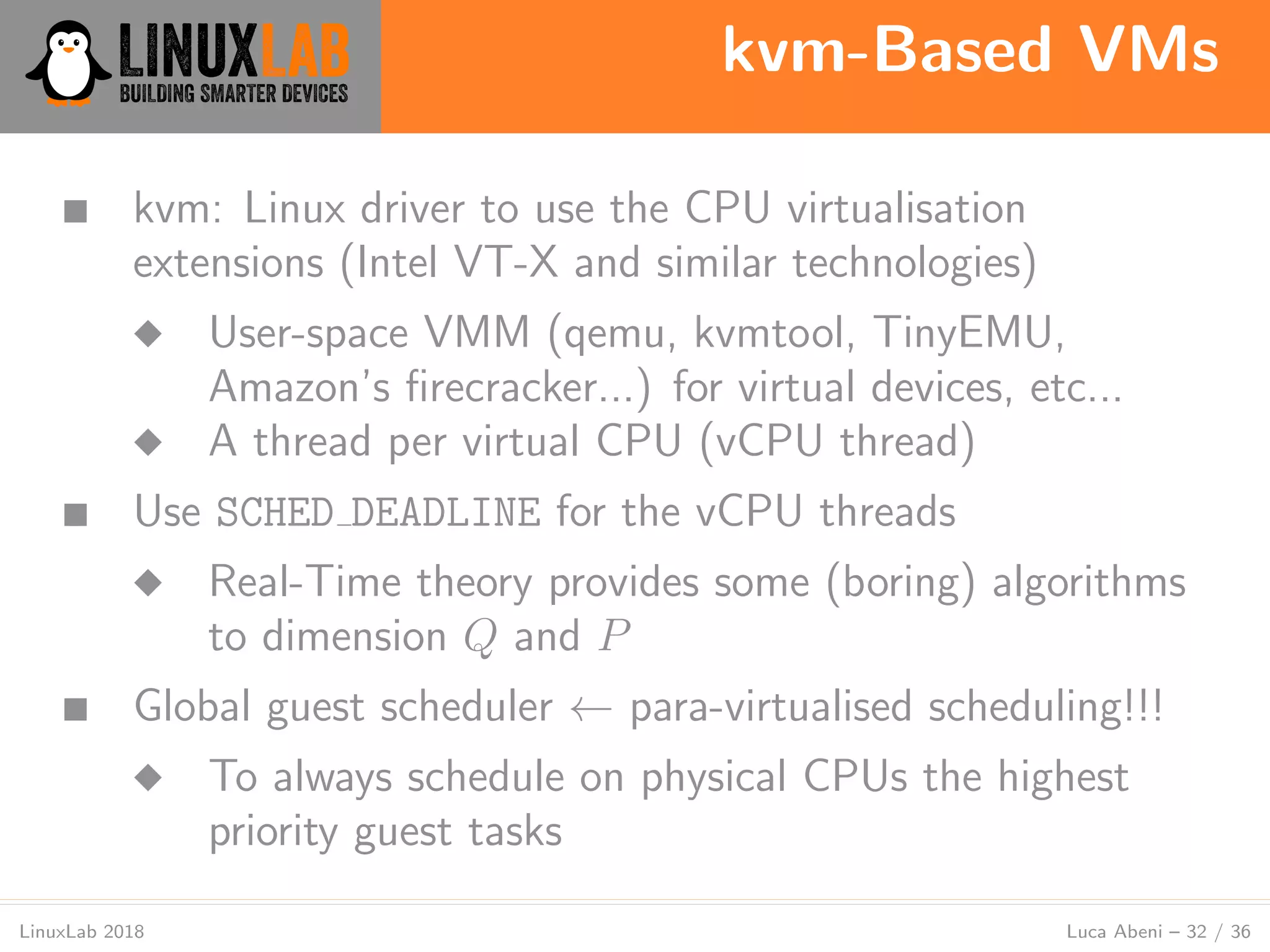
kvm-Based VMs
LinuxLab 2018 Luca Abeni – 32 / 36
■ kvm: Linux driver to use the CPU virtualisation
extensions (Intel VT-X and similar technologies)
◆ User-space VMM (qemu, kvmtool, TinyEMU,
Amazon’s firecracker...) for virtual devices, etc...
◆ A thread per virtual CPU (vCPU thread)
■ Use SCHED DEADLINE for the vCPU threads
◆ Real-Time theory provides some (boring) algorithms
to dimension Q and P
■ Global guest scheduler ← para-virtualised scheduling!!!
◆ To always schedule on physical CPUs the highest
priority guest tasks
Implementation
LinuxLab 2018 Luca Abeni – 33 / 36
■ Use PREEMPT RT for the host kernel
■ Use PREEMPT RT for the guest kernel
■ Use kvm-based VMs
◆ qemu as a user-space VMM (you can use kmvtool or
similar tools, too)
■ After starting the VM, use SCHED DEADLINE for the
vCPU threads
◆ Runtime and period computed according to the
real-time load of the VM
◆ There are existing tools to compute the values
■ Use partitioned fixed priority scheduling in the guest
Scheduler Setup
LinuxLab 2018 Luca Abeni – 34 / 36
Host Scheduling
■ CARTS: https://rtg.cis.upenn.edu/carts
■ Retina Tools:
retinaproject.eu/publications-deliverables#products
Guest Scheduling
■ Use fixed priorities (SCHED FIFO / SCHED RR)
■ Avoid global scheduling (set affinities to single CPUs)
◆ The Retina Tools provide support for partitioning
real-time tasks
Starting the VM
■ Retina Tools → example scripts using qemu/kvm
Conclusions
LinuxLab 2018 Luca Abeni – 35 / 36
■ Deterministic scheduling of real-time tasks in VMs is
possible
◆ But can be tricky; you need to know what to do
■ Use real-time support provided by Linux community →
PREEMPT RT
■ Use theory developed in real-time research →
SCHED DEADLINE
■ Use the virtualization support provided by Linux → kvm,
virtio, ...
◆ Some tools can help you in putting everything
together
Demo?
LinuxLab 2018 Luca Abeni – 36 / 36
■ “I have a truly marvelous demo of this, which the margin
of these slides is too narrow to contain...”
■ So, let’s try a less marvelos demo...

Luca Abeni - Real-Time Virtual Machines with Linux and kvm

  • 1.
    Real-Time Virtual Machines withLinux and kvm Luca Abeni luca.abeni@santannapisa.it
  • 2.
    Real-Time Application LinuxLab 2018Luca Abeni – 2 / 36 ■ The time when a result is produced matters ◆ A correct result produced too late is equivalent to a wrong result (or to no result) ■ What does “too late” mean, here? ◆ Applications characterised by temporal constraints ■ Temporal constraints are modelled through deadlines ◆ Finish some activity before a time (deadline) ◆ Generate some data before a deadline ◆ Terminate some process/thread before a deadline ◆ ...
  • 3.
    Real-Time Task LinuxLab 2018Luca Abeni – 3 / 36 Task (process or thread): sequence of actions characterized by deadlines and maximum execution time. Example: periodic task with period 8 and maximum execution time 3. 0 2 4 6 8 10 12 14 16 18 20 22 24 τ1 Note: while the first and the third jobs execute for 3 time units the second one executes for only 2 time units.
  • 4.
    Formal Task Model LinuxLab2018 Luca Abeni – 4 / 36 ■ Real-Time task τi: stream of jobs (or instances) Ji,k ■ Each job Ji,k = (ri,k, ci,k, di,k): ◆ Arrives at time ri,k (activation time) ◆ Executes for a time ci,k ◆ Finishes at time fi,k ◆ Should finish within an absolute deadline di,k ri,k fi,k di,k ci,k
  • 5.
    Periodic Tasks LinuxLab 2018Luca Abeni – 5 / 36 Periodic task τi = (Ci, Di, Pi): stream of jobs Ji,k, with ri,k+1 = ri,k + Pi di,k = ri,k + Di Ci = max k {ci,k} ■ Pi is the task period; ■ Di is the task relative deadline; ■ Ci is the task worst-case execution time (WCET); ■ Ri is the worst-case response time: Ri = maxk{ρi,k} = maxk{fi,k − ri,k}; ◆ Constraints respected ⇔ Ri ≤ Di.
  • 6.
    Periodic Task Model LinuxLab2018 Luca Abeni – 6 / 36 ■ A periodic task has a regular structure (cycle): ◆ activate periodically (period Pi) ◆ execute a computation ◆ suspend waiting for the next period void ∗ PeriodicTask ( void ∗ arg ) { <i n i t i a l i z a t i o n >; <s t a r t p e r i o d i c timer , period = P>; while ( cond ) { <do something . . . > ; <wait next a c t i v a t i o n >; } }
  • 7.
    Real-Time Scheduling LinuxLab 2018Luca Abeni – 7 / 36 ■ A real-time task τi = (Ci, Di, Pi) (or τi = (Ci, Pi) if Di = Pi) is properly served if all jobs respect their deadline... ■ ...Appropriate scheduling is important! ◆ The scheduler must somehow know the temporal constaints of the tasks... ◆ ...In order to schedule them so that such temporal constraints are respected ■ How to schedule real-time tasks? (scheduling algorithm) ■ Is it possible to respect all the deadlines? ■ Does Linux provide an appropriate scheduling algorithm?
  • 8.
    Fixed Priorities LinuxLab 2018Luca Abeni – 8 / 36 ■ The Linux fixed-priority scheduler is often used for real-time tasks... ■ ...Is this ok in general, or only in some cases? ◆ Given a set of real-time tasks Γ = {τi}, can a fixed priority scheduler allow to respect all the deadlines? ◆ Is it possible to know in advance if some deadline will be missed? ◆ How to assign the priorities? ■ If fixed priorities are enough, the SCHED FIFO and SCHED RR policies can be used!
  • 9.
    Schedulability Analysis LinuxLab 2018Luca Abeni – 9 / 36 ■ Given a set of tasks, is it possible to know in advance if deadlines will be missed? ◆ A task is schedulable if it will not miss any deadline ■ Depends on the task ■ Depends on the scheduler ■ Depends on the other tasks, ... ■ Schedulability test: mathematical test to check if τ = (C, D, P) will miss any deadline ◆ Possible idea: compute the amount of time needed by all the tasks to respect all their deadlines in an interval (t0, t1) and compare with t1 − t0
  • 10.
    Partitioned Scheduling LinuxLab 2018Luca Abeni – 10 / 36 ■ How to schedule tasks on multiple CPUs / cores? ◆ First idea: partitioned scheduling ■ Statically assign tasks to CPUs ■ Reduce the problem of scheduling on M CPUs to M instances of uniprocessor scheduling CPU CPU CPU CPU M
  • 11.
    Global Scheduling LinuxLab 2018Luca Abeni – 11 / 36 ■ One single task queue, shared by M CPUs ◆ The first M ready tasks from the queue are selected ◆ What happens using fixed priorities (or EDF)? ◆ Tasks are not bound to specific CPUs ◆ Tasks can often migrate between different CPUs ■ Problem: schedulers designed for UP do not work well M CPU CPU CPU CPU {M
  • 12.
    Fixed Priorities inLinux LinuxLab 2018 Luca Abeni – 12 / 36 ■ SCHED FIFO and SCHED RR use fixed priorities ◆ They can be used for real-time tasks, to implement RM and DM ◆ Real-time tasks have priority over non real-time (SCHED OTHER) tasks ■ Difference between the two policies: visible when more tasks have the same priority ■ The administrator can use sched setscheduler() (or similar) to schedule real-time tasks ◆ Might be a little bit impractical, but can be used ■ However...
  • 13.
    Periodic Task Example LinuxLab2018 Luca Abeni – 13 / 36 ■ Consider a periodic task /∗ . . . ∗/ while (1) { /∗ Job body ∗/ c l o c k n a n o s l e e p (CLOCK REALTIME , TIMER ABSTIME , &r , NULL ) ; timespec add us (&r , period ) ; } ■ The task expects to be executed at time r (= r0 + jT)... ■ ...But is sometimes delayed to r0 + jT + δ
  • 14.
    Theoretical Schedule LinuxLab 2018Luca Abeni – 14 / 36 0 2 4 6 8 10 12 14 16 18 20 22 τ1 τ2
  • 15.
    Actual Schedule LinuxLab 2018Luca Abeni – 15 / 36 0 2 4 6 8 10 12 14 16 18 20 22 τ1 τ2 ■ What happens if the 2nd job of τ1 arrives a little bit later??? ◆ The 2nd job of τ2 misses a deadline!!!
  • 16.
    Theory vs RealSchedule LinuxLab 2018 Luca Abeni – 16 / 36 ■ The delay δ in scheduling a task is due to kernel latency ■ Kernel latency can be modelled as a blocking time ■ In real world, high priority tasks often suffer from blocking times coming from the OS (more precisely, from the kernel) ◆ Why? ◆ How? ◆ What can we do? ■ To answer the previous questions, we need to recall how the hardware and the OS work...
  • 17.
    Latency LinuxLab 2018 LucaAbeni – 17 / 36 ■ Latency: measure of the difference between the theoretical and actual schedule ◆ Task τ expects to be scheduled at time t . . . ◆ . . . but is actually scheduled at time t′ ◆ ⇒ Latency L = t′ − t ■ The latency L can be modelled as a blocking time ⇒ affects the guarantee test ◆ Similar to what done for shared resources ◆ Blocking time due to latency, not to priority inversion
  • 18.
    Effects of theLatency LinuxLab 2018 Luca Abeni – 18 / 36 ■ Upper bound for L? If not known, no schedulability tests!!! ◆ The latency must be bounded: ∃Lmax : L < Lmax ■ If Lmax is too high, only few task sets result to be schedulable ◆ Large blocking time experienced by all tasks! ◆ The worst-case latency Lmax cannot be too high
  • 19.
    Latency in Linux LinuxLab2018 Luca Abeni – 19 / 36 ■ Tool (cyclictest) to measure the latency ■ Vanilla kernel: depends on the configuration ◆ Can be tens of milliseconds ■ PREEMPT RT patchset (https://wiki.linuxfoundation.org/realtime): reduce latency to less than 100 microseconds ◆ Tens of microseconds on well-tuned systems! ■ So, scheduling real-time tasks in Linux is not an issue anymore...
  • 20.
    Real-Time in VMs??? LinuxLab2018 Luca Abeni – 20 / 36 ■ So, serving real-time applications in Linux-based systems is not a problem today... ■ ...Can real-time applications run in virtual machines? ◆ Real-Time in Virtual Machines??? But... Why? ■ Component-Based Development ◆ Complex applications: sets of smaller components ◆ Both functional and temporal interfaces ■ Security ◆ Isolate real-time applications in a VM ■ Easy deployment ■ ...
  • 21.
    Real-Time Components LinuxLab 2018Luca Abeni – 21 / 36 ■ Assume to have N components... ◆ Each component is described by its interface... ◆ ...But a description of its temporal behaviour is also somehow provided... ■ Component are assumed to respect some temporal constraints ◆ Some kind of “contract” provided by real-time guarantees ■ Is it possible to combine the components so that the timing of the system is predictable? ◆ Can real-time guarantees be combined? How?
  • 22.
    Combining Real-Time Apps LinuxLab2018 Luca Abeni – 22 / 36 ? ■ Real-time analysis for each application / in each VM... ■ What about the resulting system?
  • 23.
    1 Real-Time Taskper VM LinuxLab 2018 Luca Abeni – 23 / 36 ■ Single real-time thread/process in a VM → combining VMs is easy... ◆ VMs can be modelled as real-time tasks ◆ Simple (C, D, T) model, or something more complex... ■ What about VMs containing multiple real-time tasks? ◆ Model for a VM? ◆ How to summarize the VM’s temporal requirements? ◆ Scheduler in the VM? How to model it?
  • 24.
    More Complex VMs LinuxLab2018 Luca Abeni – 24 / 36 ■ Example: component Ci composed by ni tasks ■ More complex model... How to handle it? ◆ We only know how to schedule single tasks... ◆ And we need to somehow “summarise” the requirements of a component! Ci = {(Ci 0, Di 0, Ti 0), (Ci 1, Di 1, Ti 1), . . . , (Ci ni, Di ni, Ti ni)} ■ So, 2 main issues: 1. Describe the temporal requirements of a VM in a simple way 2. Schedule the VMs, and somehow “combine” their temporal guarantees
  • 25.
    Practical Issues LinuxLab 2018Luca Abeni – 25 / 36 ■ VMs can contain sets of real-time tasks ◆ The scheduler only sees a VM per taskset, but cannot see the tasks inside it ◆ Para-virtualization (of the OS scheduler) could be used to address this issue, but it is not so simple... ■ So, how to schedule VMs? ■ Two-level hierarchical scheduling system ◆ Host (global / root) scheduler, scheduling VMs ◆ Each VM contains its (local / 2nd level) scheduler
  • 26.
    2-Levels Hierarchy LinuxLab 2018Luca Abeni – 26 / 36 1τ 1τ 1ττn τn Local Scheduler Local Scheduler Local Scheduler 2 τn τ Global Scheduler ■ Global Scheduler assigns CPU to virtual machines ■ Local Schedulers assign CPU to single tasks
  • 27.
    Hierarchical Scheduling LinuxLab 2018Luca Abeni – 27 / 36 ■ The global scheduler does not “see” all the tasks ■ Each VM has its own scheduler (fixed priorities for real-time tasks) ◆ Global scheduler: host / hypervisor scheduler ◆ Local scheduler: guest scheduler ◆ No problems in assigning fixed priorities to tasks! ■ Problem: what to use as a global scheduler? ◆ We must have a model for it ◆ Must allow to compose the “local guarantees” ◆ This time, fixed priorities are not enough :(
  • 28.
    Schedulability Analysis LinuxLab 2018Luca Abeni – 28 / 36 ■ (Over?)Simplifying things a little bit... ■ ...Suppose to know the amount of time needed by a VM to respect its temporal constraints and the amount of time provided by the global scheduler ■ A VM is “schedulable” if demanded time ≤ supplied time ◆ “demanded time”: amount of time (in a time interval) needed by a VM ◆ “supplied time”: amount of time (in a time interval) given by the global scheduler to a VM ■ Of course the devil is in the details
  • 29.
    Supplied Time LinuxLab 2018Luca Abeni – 29 / 36 ■ Description of the root scheduler temporal behaviour ■ More formally: ◆ Depends on the time interval t we are considering ◆ Depends on the root scheduler S ■ Minimum amount of time given by S to a VM in a time interval of size s ◆ Given all the time interval (t0, t1) : t1 − t0 = s... ◆ ...Compute the size of the sub-interval in which the VM is scheduled... ◆ ...And then find the minimum! ■ Fixed priorities do not guarantee a minimum time to the VM!!!
  • 30.
    Host Scheduling LinuxLab 2018Luca Abeni – 30 / 36 ■ Issue: how to guarantee a minimum amount of CPU time to each VM? ◆ As said, SCHED FIFO / SCHED RR are not ok... ■ SCHED DEADLINE policy: schedule a thread / process for an amount of time Q every period P ◆ Q: runtime ◆ P: reservation period ■ This is what we need!!! Allows to compute a supply function!
  • 31.
    In Practice... LinuxLab 2018Luca Abeni – 31 / 36 ■ Real-Time applications running in a VM? ◆ As for OSs, two different aspects ■ Resource allocation/management (scheduling) ■ Latency (host and guest) ◆ CPU allocation: interesting issues with multiple vCPUs ■ Virtualisation: full hw virtualisation or OS-level virtualisation ◆ Full hw virtualisation: focus on kvm ◆ OS-level virtualisation: containers (lxc, Docker, ...)
  • 32.
    kvm-Based VMs LinuxLab 2018Luca Abeni – 32 / 36 ■ kvm: Linux driver to use the CPU virtualisation extensions (Intel VT-X and similar technologies) ◆ User-space VMM (qemu, kvmtool, TinyEMU, Amazon’s firecracker...) for virtual devices, etc... ◆ A thread per virtual CPU (vCPU thread) ■ Use SCHED DEADLINE for the vCPU threads ◆ Real-Time theory provides some (boring) algorithms to dimension Q and P ■ Global guest scheduler ← para-virtualised scheduling!!! ◆ To always schedule on physical CPUs the highest priority guest tasks
  • 33.
    Implementation LinuxLab 2018 LucaAbeni – 33 / 36 ■ Use PREEMPT RT for the host kernel ■ Use PREEMPT RT for the guest kernel ■ Use kvm-based VMs ◆ qemu as a user-space VMM (you can use kmvtool or similar tools, too) ■ After starting the VM, use SCHED DEADLINE for the vCPU threads ◆ Runtime and period computed according to the real-time load of the VM ◆ There are existing tools to compute the values ■ Use partitioned fixed priority scheduling in the guest
  • 34.
    Scheduler Setup LinuxLab 2018Luca Abeni – 34 / 36 Host Scheduling ■ CARTS: https://rtg.cis.upenn.edu/carts ■ Retina Tools: retinaproject.eu/publications-deliverables#products Guest Scheduling ■ Use fixed priorities (SCHED FIFO / SCHED RR) ■ Avoid global scheduling (set affinities to single CPUs) ◆ The Retina Tools provide support for partitioning real-time tasks Starting the VM ■ Retina Tools → example scripts using qemu/kvm
  • 35.
    Conclusions LinuxLab 2018 LucaAbeni – 35 / 36 ■ Deterministic scheduling of real-time tasks in VMs is possible ◆ But can be tricky; you need to know what to do ■ Use real-time support provided by Linux community → PREEMPT RT ■ Use theory developed in real-time research → SCHED DEADLINE ■ Use the virtualization support provided by Linux → kvm, virtio, ... ◆ Some tools can help you in putting everything together
  • 36.
    Demo? LinuxLab 2018 LucaAbeni – 36 / 36 ■ “I have a truly marvelous demo of this, which the margin of these slides is too narrow to contain...” ■ So, let’s try a less marvelos demo...