The Linux Kernel
Scheduler
Viresh Kumar (PMWG)
viresh.kumar@linaro.org
IRC: vireshk
Topics
● CPU Scheduler
● The O(1) scheduler
● Current scheduler design
● Scheduling classes
● schedule()
● Scheduling classes and policies
● Sched class: STOP
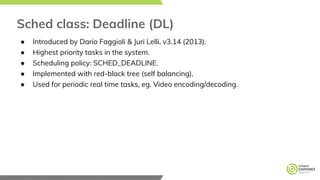
● Sched class: Deadline
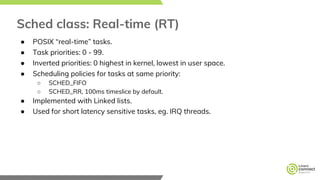
● Sched class: Realtime
● Sched class: CFS
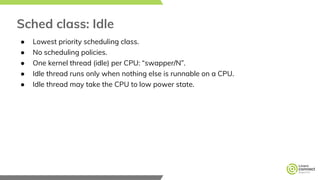
● Sched class: Idle
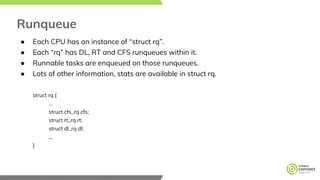
● Runqueue
CPU Scheduler
● Shares CPU between tasks.
● Selects next task to run (on each CPU) when:
○ Running task terminates
○ Running task sleeps (waiting for an event)
○ A new task created or sleeping task wakes up
○ Running task’s timeslice is over
● Goals:
○ Be *fair*
○ Timeslice based on task priority
○ Low task response time
○ High (task completion) throughput
○ Balance load among CPUs
○ Power efficient
○ Low overhead of running scheduler’s code
● Work with mainframes, servers, desktops/laptops, embedded/phones.
The O(1) scheduler
● 140 priorities. 0-99: RT tasks and 100-139: User tasks.
● Each CPU’s runqueue had 2 arrays: Active and Expired.
● Each arrays had 140 entries, one per priority level.
● Each entry was a linked list serviced in FIFO order.
● Bitmap (of 140 bits) used to find which priority lists aren’t empty.
● Timeslices were assigned to tasks based on these priorities.
● Expired tasks moved from Active to Expired array.
● Once Active array was empty, the arrays were swapped.
● Enqueue and dequeue of tasks and next task selection done in constant time.
● Replaced by CFS in Linux 2.6.23 (2007).
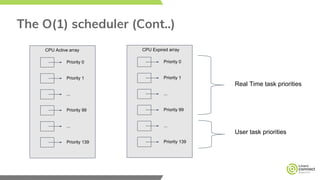
The O(1) scheduler (Cont..)
Priority 0
Priority 1
Priority 139
...
Priority 99
...
CPU Active array
Priority 0
Priority 1
Priority 139
...
Priority 99
...
CPU Expired array
Real Time task priorities
User task priorities
Current scheduler design
● Introduced by Ingo Molnar in 2.6.23 (2007).
● Scheduling policies within scheduling classes.
● Scheduling class with higher priority served first.
● Task can migrate between CPUs, scheduling policies and scheduling classes.
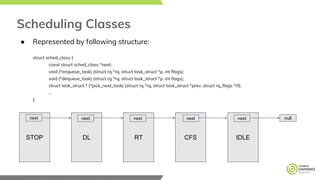
Scheduling Classes
● Represented by following structure:
struct sched_class {
const struct sched_class *next;
void (*enqueue_task) (struct rq *rq, struct task_struct *p, int flags);
void (*dequeue_task) (struct rq *rq, struct task_struct *p, int flags);
struct task_struct * (*pick_next_task) (struct rq *rq, struct task_struct *prev, struct rq_flags *rf);
…
};
STOP
next
DL RT CFS IDLE
null
next next next next
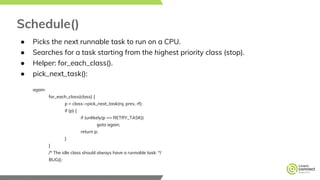
Schedule()
● Picks the next runnable task to run on a CPU.
● Searches for a task starting from the highest priority class (stop).
● Helper: for_each_class().
● pick_next_task():
again:
for_each_class(class) {
p = class->pick_next_task(rq, prev, rf);
if (p) {
if (unlikely(p == RETRY_TASK))
goto again;
return p;
}
}
/* The idle class should always have a runnable task: */
BUG();
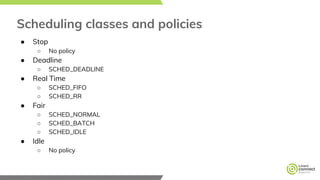
Scheduling classes and policies
● Stop
○ No policy
● Deadline
○ SCHED_DEADLINE
● Real Time
○ SCHED_FIFO
○ SCHED_RR
● Fair
○ SCHED_NORMAL
○ SCHED_BATCH
○ SCHED_IDLE
● Idle
○ No policy
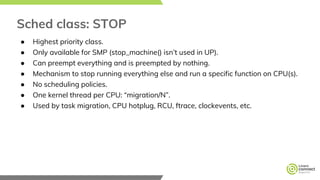
Sched class: STOP
● Highest priority class.
● Only available for SMP (stop_machine() isn’t used in UP).
● Can preempt everything and is preempted by nothing.
● Mechanism to stop running everything else and run a specific function on CPU(s).
● No scheduling policies.
● One kernel thread per CPU: “migration/N”.
● Used by task migration, CPU hotplug, RCU, ftrace, clockevents, etc.
Sched class: Deadline (DL)
● Introduced by Dario Faggioli & Juri Lelli, v3.14 (2013).
● Highest priority tasks in the system.
● Scheduling policy: SCHED_DEADLINE.
● Implemented with red-black tree (self balancing).
● Used for periodic real time tasks, eg. Video encoding/decoding.
Sched class: Real-time (RT)
● POSIX “real-time” tasks.
● Task priorities: 0 - 99.
● Inverted priorities: 0 highest in kernel, lowest in user space.
● Scheduling policies for tasks at same priority:
○ SCHED_FIFO
○ SCHED_RR, 100ms timeslice by default.
● Implemented with Linked lists.
● Used for short latency sensitive tasks, eg. IRQ threads.
Sched class: CFS (Completely fair scheduler)
● Introduced by Ingo Molnar (motivated by Rotating Staircase Deadline Scheduler
by Con Kolivas).
● Scheduling policies:
○ SCHED_NORMAL: Normal Unix tasks
○ SCHED_BATCH: Batch (non-interactive) tasks
○ SCHED_IDLE: Low priority tasks
● Implemented with red-black tree (self balancing).
● Tracks Virtual runtime of tasks (amount of time task has run).
● Tasks with shortest vruntime runs first.
● Priority is used to set task’s weight, that affects vruntime.
● Higher the weight, slower will vruntime increase.
● Task’s priority is calculated by 120 + nice (-20 to +19).
● Used for all other system tasks, eg: shell.
Sched class: Idle
● Lowest priority scheduling class.
● No scheduling policies.
● One kernel thread (idle) per CPU: “swapper/N”.
● Idle thread runs only when nothing else is runnable on a CPU.
● Idle thread may take the CPU to low power state.
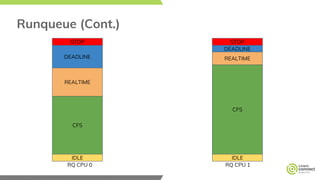
Runqueue
● Each CPU has an instance of “struct rq”.
● Each “rq” has DL, RT and CFS runqueues within it.
● Runnable tasks are enqueued on those runqueues.
● Lots of other information, stats are available in struct rq.
struct rq {
…
struct cfs_rq cfs;
struct rt_rq rt;
struct dl_rq dl;
...
}
Runqueue (Cont.)
STOP
CFS
IDLE
DEADLINE
REALTIME
RQ CPU 0
STOP
CFS
IDLE
DEADLINE
REALTIME
RQ CPU 1
Thank you
Join Linaro to accelerate deployment of your
Arm-based solutions through collaboration
contactus@linaro.org

Linux Scheduler Latest_ viresh Kumar.pdf

  • 1.
    The Linux Kernel Scheduler VireshKumar (PMWG) viresh.kumar@linaro.org IRC: vireshk
  • 2.
    Topics ● CPU Scheduler ●The O(1) scheduler ● Current scheduler design ● Scheduling classes ● schedule() ● Scheduling classes and policies ● Sched class: STOP ● Sched class: Deadline ● Sched class: Realtime ● Sched class: CFS ● Sched class: Idle ● Runqueue
  • 3.
    CPU Scheduler ● SharesCPU between tasks. ● Selects next task to run (on each CPU) when: ○ Running task terminates ○ Running task sleeps (waiting for an event) ○ A new task created or sleeping task wakes up ○ Running task’s timeslice is over ● Goals: ○ Be *fair* ○ Timeslice based on task priority ○ Low task response time ○ High (task completion) throughput ○ Balance load among CPUs ○ Power efficient ○ Low overhead of running scheduler’s code ● Work with mainframes, servers, desktops/laptops, embedded/phones.
  • 4.
    The O(1) scheduler ●140 priorities. 0-99: RT tasks and 100-139: User tasks. ● Each CPU’s runqueue had 2 arrays: Active and Expired. ● Each arrays had 140 entries, one per priority level. ● Each entry was a linked list serviced in FIFO order. ● Bitmap (of 140 bits) used to find which priority lists aren’t empty. ● Timeslices were assigned to tasks based on these priorities. ● Expired tasks moved from Active to Expired array. ● Once Active array was empty, the arrays were swapped. ● Enqueue and dequeue of tasks and next task selection done in constant time. ● Replaced by CFS in Linux 2.6.23 (2007).
  • 5.
    The O(1) scheduler(Cont..) Priority 0 Priority 1 Priority 139 ... Priority 99 ... CPU Active array Priority 0 Priority 1 Priority 139 ... Priority 99 ... CPU Expired array Real Time task priorities User task priorities
  • 6.
    Current scheduler design ●Introduced by Ingo Molnar in 2.6.23 (2007). ● Scheduling policies within scheduling classes. ● Scheduling class with higher priority served first. ● Task can migrate between CPUs, scheduling policies and scheduling classes.
  • 7.
    Scheduling Classes ● Representedby following structure: struct sched_class { const struct sched_class *next; void (*enqueue_task) (struct rq *rq, struct task_struct *p, int flags); void (*dequeue_task) (struct rq *rq, struct task_struct *p, int flags); struct task_struct * (*pick_next_task) (struct rq *rq, struct task_struct *prev, struct rq_flags *rf); … }; STOP next DL RT CFS IDLE null next next next next
  • 8.
    Schedule() ● Picks thenext runnable task to run on a CPU. ● Searches for a task starting from the highest priority class (stop). ● Helper: for_each_class(). ● pick_next_task(): again: for_each_class(class) { p = class->pick_next_task(rq, prev, rf); if (p) { if (unlikely(p == RETRY_TASK)) goto again; return p; } } /* The idle class should always have a runnable task: */ BUG();
  • 9.
    Scheduling classes andpolicies ● Stop ○ No policy ● Deadline ○ SCHED_DEADLINE ● Real Time ○ SCHED_FIFO ○ SCHED_RR ● Fair ○ SCHED_NORMAL ○ SCHED_BATCH ○ SCHED_IDLE ● Idle ○ No policy
  • 10.
    Sched class: STOP ●Highest priority class. ● Only available for SMP (stop_machine() isn’t used in UP). ● Can preempt everything and is preempted by nothing. ● Mechanism to stop running everything else and run a specific function on CPU(s). ● No scheduling policies. ● One kernel thread per CPU: “migration/N”. ● Used by task migration, CPU hotplug, RCU, ftrace, clockevents, etc.
  • 11.
    Sched class: Deadline(DL) ● Introduced by Dario Faggioli & Juri Lelli, v3.14 (2013). ● Highest priority tasks in the system. ● Scheduling policy: SCHED_DEADLINE. ● Implemented with red-black tree (self balancing). ● Used for periodic real time tasks, eg. Video encoding/decoding.
  • 12.
    Sched class: Real-time(RT) ● POSIX “real-time” tasks. ● Task priorities: 0 - 99. ● Inverted priorities: 0 highest in kernel, lowest in user space. ● Scheduling policies for tasks at same priority: ○ SCHED_FIFO ○ SCHED_RR, 100ms timeslice by default. ● Implemented with Linked lists. ● Used for short latency sensitive tasks, eg. IRQ threads.
  • 13.
    Sched class: CFS(Completely fair scheduler) ● Introduced by Ingo Molnar (motivated by Rotating Staircase Deadline Scheduler by Con Kolivas). ● Scheduling policies: ○ SCHED_NORMAL: Normal Unix tasks ○ SCHED_BATCH: Batch (non-interactive) tasks ○ SCHED_IDLE: Low priority tasks ● Implemented with red-black tree (self balancing). ● Tracks Virtual runtime of tasks (amount of time task has run). ● Tasks with shortest vruntime runs first. ● Priority is used to set task’s weight, that affects vruntime. ● Higher the weight, slower will vruntime increase. ● Task’s priority is calculated by 120 + nice (-20 to +19). ● Used for all other system tasks, eg: shell.
  • 14.
    Sched class: Idle ●Lowest priority scheduling class. ● No scheduling policies. ● One kernel thread (idle) per CPU: “swapper/N”. ● Idle thread runs only when nothing else is runnable on a CPU. ● Idle thread may take the CPU to low power state.
  • 15.
    Runqueue ● Each CPUhas an instance of “struct rq”. ● Each “rq” has DL, RT and CFS runqueues within it. ● Runnable tasks are enqueued on those runqueues. ● Lots of other information, stats are available in struct rq. struct rq { … struct cfs_rq cfs; struct rt_rq rt; struct dl_rq dl; ... }
  • 16.
    Runqueue (Cont.) STOP CFS IDLE DEADLINE REALTIME RQ CPU0 STOP CFS IDLE DEADLINE REALTIME RQ CPU 1
  • 17.
    Thank you Join Linaroto accelerate deployment of your Arm-based solutions through collaboration contactus@linaro.org