NYU, New York NY, April 22, 2016
Slides: http://slideshare.net/LaBlogga
Temporality of the Future
Part of a Series on Cryptophilosophy
cryptophilosophy
Melanie Swan
Time Theorist
Philosophy & Economic Theory
New School for Social Research, NY NY
melanie@BlockchainStudies.org
April 22, 2016
Temporality of the Future 1
Melanie Swan
 Time Theorist, Philosophy and Economic
Theory, New School for Social Research, NY
 Founder, Institute for Blockchain Studies
 Singularity University Instructor; Institute for Ethics and
Emerging Technology Affiliate Scholar; EDGE
Essayist; FQXi Advisor (Foundational Questions Inst)
Traditional Markets Background Economic Theory Leadership
http://www.amazon.com/Bitcoin-Blueprint-New-World-Currency/dp/1491920491
Book: Blockchain:
Blueprint for a New
Economy
April 22, 2016
Temporality of the Future 2
Posthuman-class
problem: how can we
make more time?
April 22, 2016
Temporality of the Future
Thesis Statement
3
A concept of temporality is needed that is
adequate to the future; a model that has an open
possibility space for both the form and content of time;
that is multiple and complex; discrete and continuous;
and integrates the unstoppable flow of physics and
biology human-time with manipulable compute-time
April 22, 2016
Temporality of the Future
Part I: A New Theory of Time
4
April 22, 2016
Temporality of the Future 5
http://www.robotandhwang.com/attorneys/
Law Firm,
San Francisco CA
How to develop empowering human-
machine collaborations, especially when…
April 22, 2016
Temporality of the Future
…humans and machines are running
different time paradigms
 Human-time of physics and
biology is continuous, inexorable,
flowing unidirectionally
 Fixed endpoints: birth and death
 Compute-time is discrete and
malleable, interruptible, with
multiple temporal regimes
(discrete time, no time,
asynchronous time), and the
possibility of evolving new
paradigms such as blocktime
6
April 22, 2016
Temporality of the Future
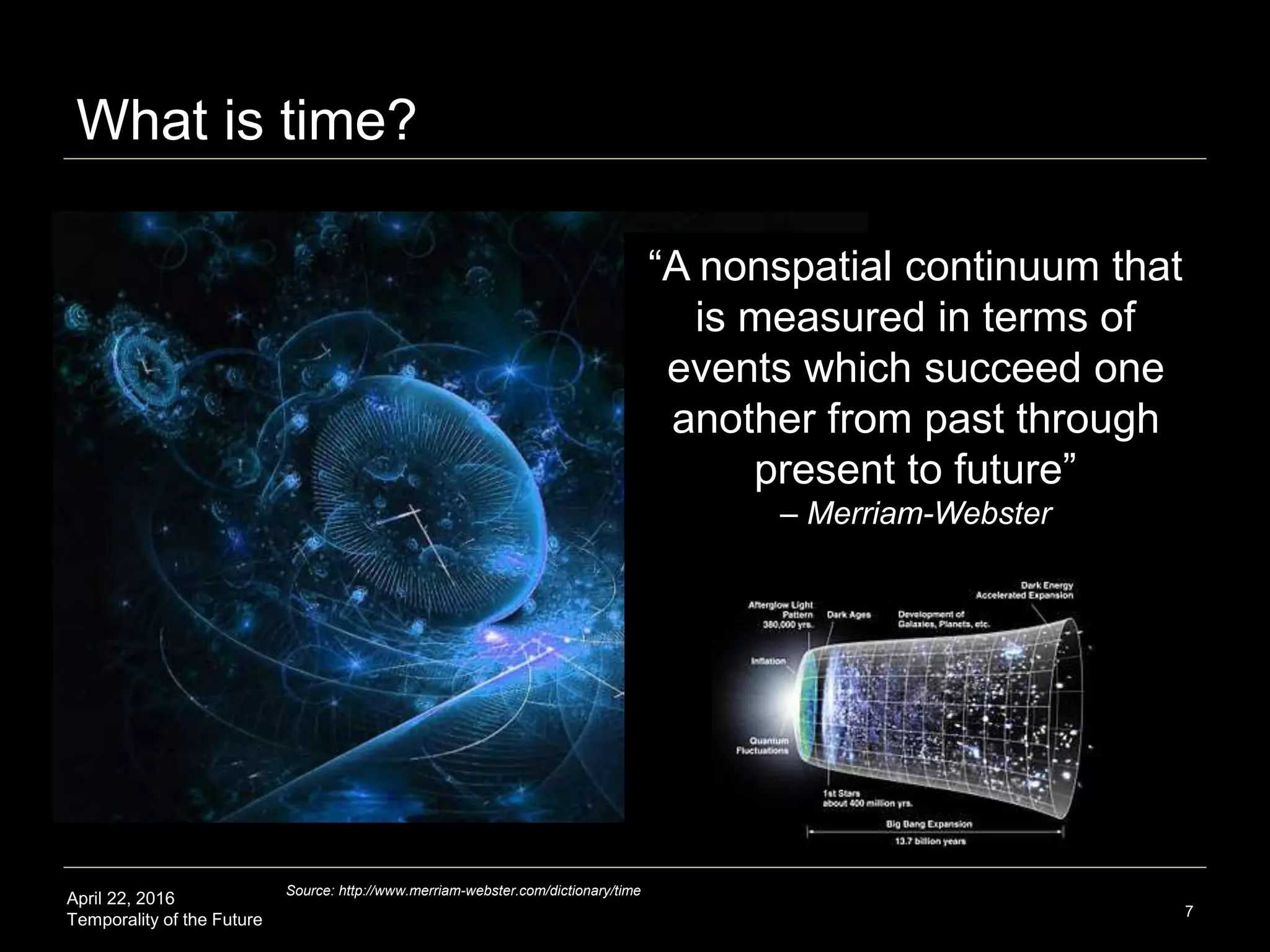
What is time?
7
“A nonspatial continuum that
is measured in terms of
events which succeed one
another from past through
present to future”
– Merriam-Webster
Source: http://www.merriam-webster.com/dictionary/time
April 22, 2016
Temporality of the Future
Bergson’s Duration (1889)
 Two time paradigms
1. Objective (quantitative):
Measurable clocktime
2. Subjective (qualitative): Internal
experience of lived time (flying by,
taking forever, flow state);
duration
 Claim: exercise of free will is
possible, by tuning into our
internal qualitative experience,
and acting from there
8
Source: Bergson, Henri. (1889, 2001). Time and Free Will: An Essay on the Immediate Data of Consciousness. Dover Publications,
London UK.
April 22, 2016
Temporality of the Future
Husserl’s Retentional-Protentional Internal
Time Consciousness (1893-1917)
 Three time paradigms
1. Bergson’s measurable clocktime
(quantitative) as objective time
2. Bergson’s internal sense slow/fast
(qualitative) as phenomenological time
3. A third domain where we comprehend and
distinguish 1 and 2
 Any present moment is comprised of a
primal impression (pure perception)
plus a link to what it retains of the past
(retention) and what it anticipates of the
future (pretention)
9
Source: Husserl, Edmund. (1991, 1964). On the Phenomenology of the Consciousness of Internal Time (1893-1917). Kluwer
Academic Publishers: Dordrecht NL.
April 22, 2016
Temporality of the Future 10
1. Retention 1. Protention
Present
Now
Primal
Impression
2. Recollection 2. Expectation
(Discrete) (Discrete)
(Continuous) (Continuous)
Husserl’s Internal Time Consciousness
I. Classic Diagram
Primal Impression: pure perception of the present-now moment
Retention-Protention: the link of the primal impression to what it retains
of the just recently-elapsing past (retention) and what it anticipates of
the rapidly-arriving future (protention); the horizon might be immediate
(only surrounding the present-now point) or extending to include all
recollections and expectations
Recollection-Expectation: discrete elements (snapshots or flows)
composed into re-plays or re-presentations of present-now moments in
new present-now moments when requested or imagined
Source: Husserl, Edmund. (1991, 1964). On the Phenomenology of the Consciousness of Internal Time (1893-1917). Kluwer
Academic Publishers: Dordrecht NL.
Past Future
April 22, 2016
Temporality of the Future
A “Middle Third” Time term is needed
 Overcome either/or conceptualizations of time
11
 Discrete
 Snapshot
 Digital
 Quantitative
 Objective
 Recollection-Expectation
 Computing Clocktime
 Machine-time
 Continuous
 Flow
 Analog
 Qualitative
 Subjective
 Retention-Protention
 Physics/Biology Time
 Human-time
April 22, 2016
Temporality of the Future
Why? Cognitive Bias
We know that we are not good at thinking about the future
 Always “20 years out” - AI, nanotech, life
extension, fuel cells, grand unified theory
 Minsky: computer vision=summer project
 Blackswans: positive/negative outliers occur
with greater frequency than anticipated
 Procrastination and fMRI studies: we
procrastinate because we think of our future
selves as strangers, third persons no
different than politicians or celebrities
 Supports Parfit: personal identity is not required
for survival, but relational experience between
past/future selves and experience is
12
Sources: http://nautil.us/issue/9/time/why-we-procrastinate citing van Gelder JL, Hershfield HE, Nordgren LF. (2013).
Vividness of the future self predicts delinquency. Psychol Sci. 24(6):974-80, and Pronin, Emily. (2008). How we see
ourselves and how we see others. Science. 320(5880):1177-80.
April 22, 2016
Temporality of the Future
Thus we need a Temporality of the Future
 A temporality in a more
open non-determined
possibility space of both
form and content,
where new trajectories
might be possible
 A temporality of
multiplicity and
complexity
 Non-linear, dynamic,
emergent, open, unknowable
at the outset, interdependent,
self-organizing
13
Source: Morin, Edgar. (2007). "Restricted complexity, general complexity." Trans. C. Gershenson. In Worldviews, Science and Us:
Philosophy and Complexity, ed. C. Gershenson, D. Aerts, and B. Edmonds, 5–29. World Scientific, Singapore.
April 22, 2016
Temporality of the Future
Inspiration: Light’s Wave-Particle Duality
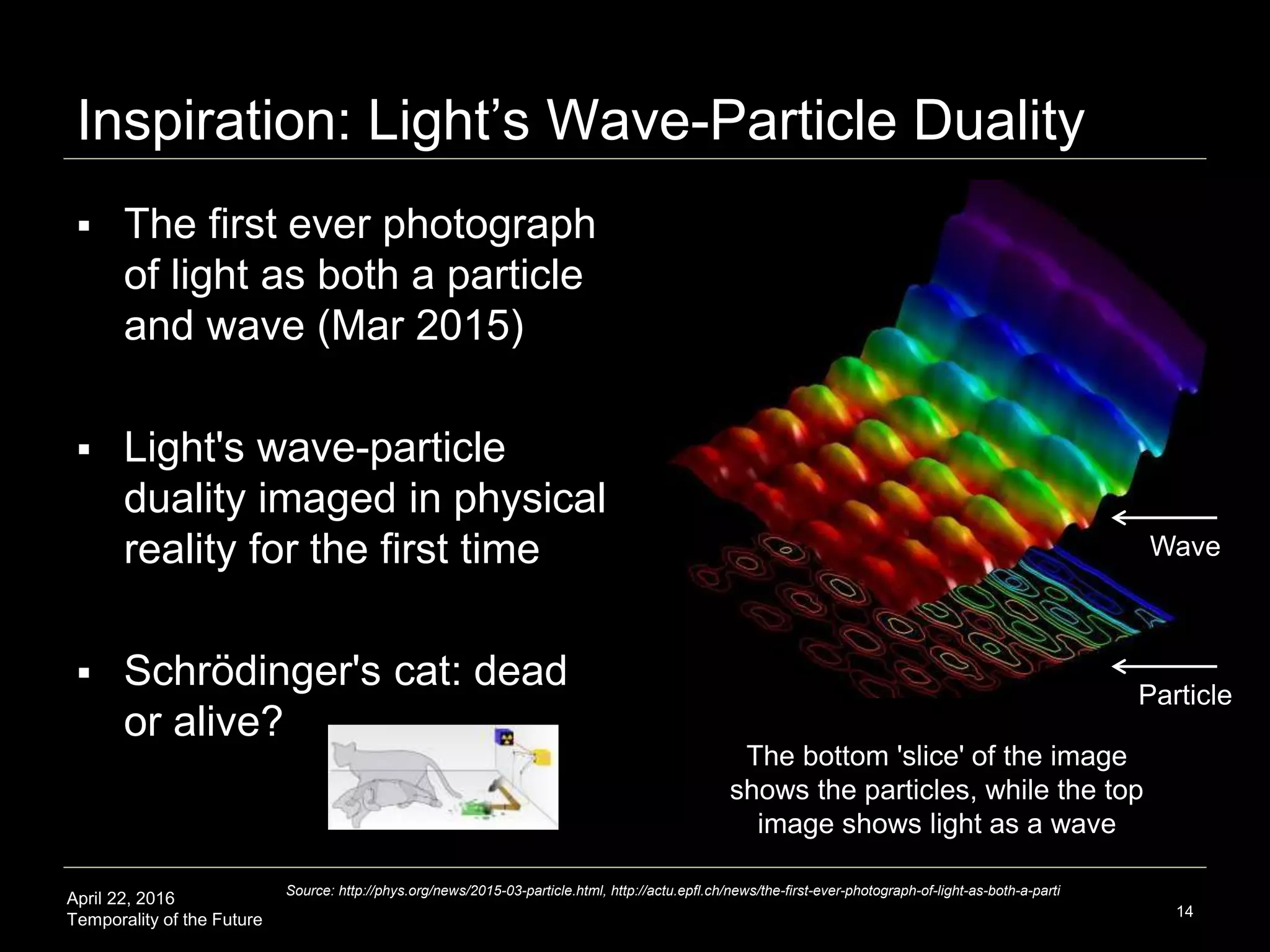
 The first ever photograph
of light as both a particle
and wave (Mar 2015)
 Light's wave-particle
duality imaged in physical
reality for the first time
 Schrödinger's cat: dead
or alive?
14
Source: http://phys.org/news/2015-03-particle.html, http://actu.epfl.ch/news/the-first-ever-photograph-of-light-as-both-a-parti
The bottom 'slice' of the image
shows the particles, while the top
image shows light as a wave
Particle
Wave
April 22, 2016
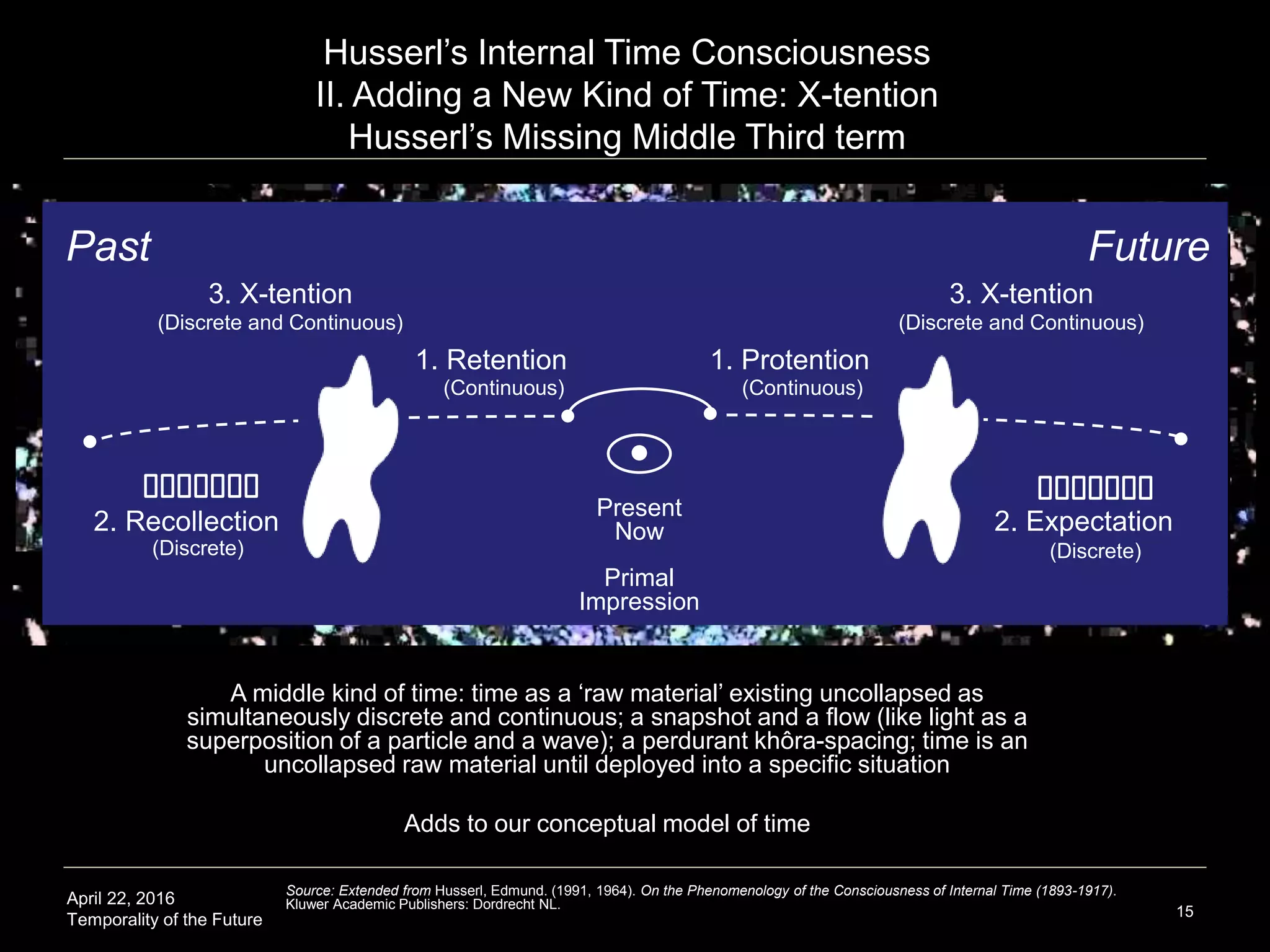
Temporality of the Future 15
1. Retention 1. Protention
Present
Now
Primal
Impression
2. Recollection
(Discrete) (Discrete)
A middle kind of time: time as a ‘raw material’ existing uncollapsed as
simultaneously discrete and continuous; a snapshot and a flow (like light as a
superposition of a particle and a wave); a perdurant khôra-spacing; time is an
uncollapsed raw material until deployed into a specific situation
Adds to our conceptual model of time
(Continuous) (Continuous)
Husserl’s Internal Time Consciousness
II. Adding a New Kind of Time: X-tention
Husserl’s Missing Middle Third term
3. X-tention 3. X-tention
2. Expectation
(Discrete and Continuous) (Discrete and Continuous)
Source: Extended from Husserl, Edmund. (1991, 1964). On the Phenomenology of the Consciousness of Internal Time (1893-1917).
Kluwer Academic Publishers: Dordrecht NL.
Past Future
April 22, 2016
Temporality of the Future
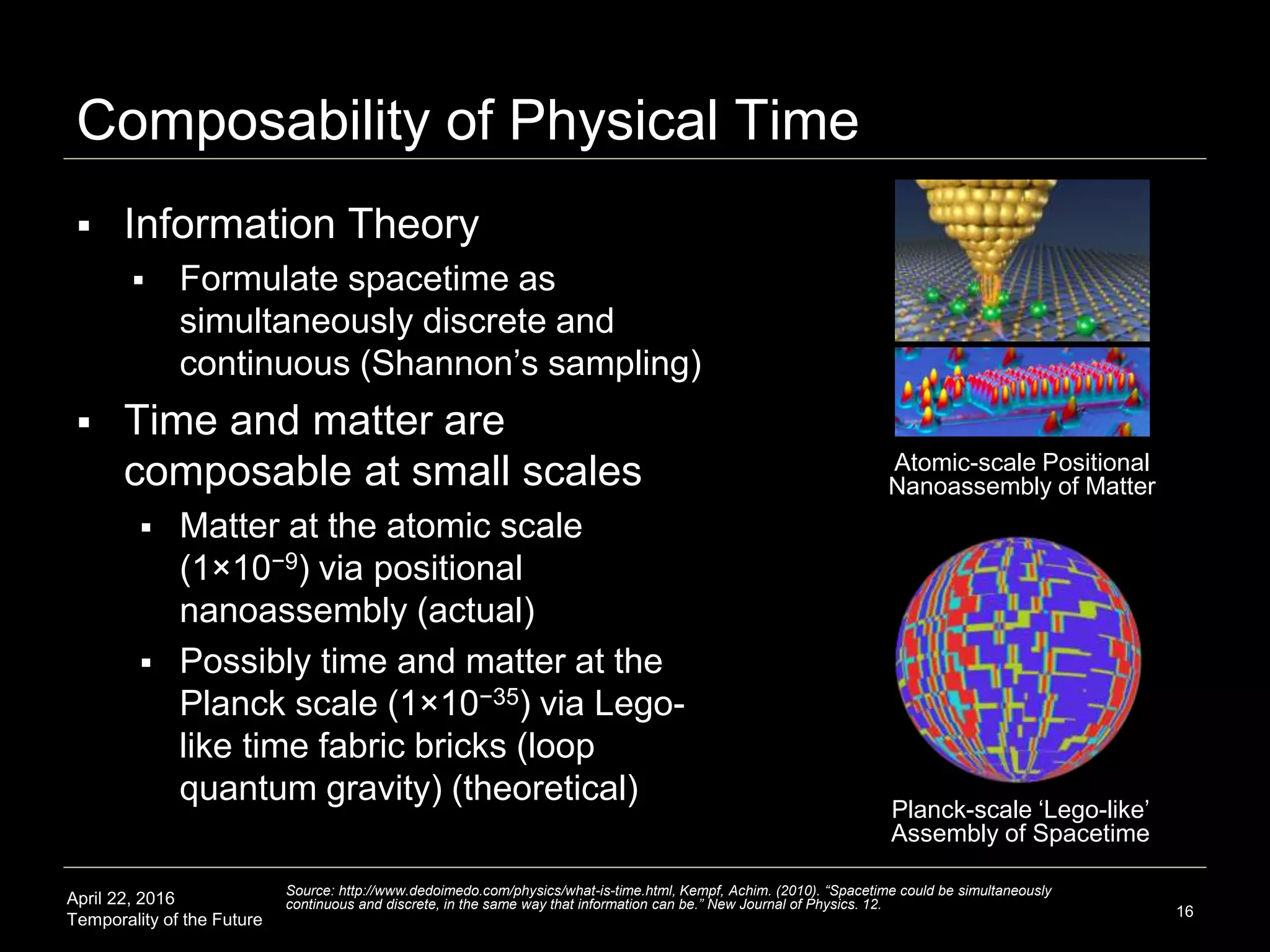
Composability of Physical Time
 Information Theory
 Formulate spacetime as
simultaneously discrete and
continuous (Shannon’s sampling)
 Time and matter are
composable at small scales
 Matter at the atomic scale
(1×10⁻⁹) via positional
nanoassembly (actual)
 Possibly time and matter at the
Planck scale (1×10⁻³⁵) via Lego-
like time fabric bricks (loop
quantum gravity) (theoretical)
16
Source: http://www.dedoimedo.com/physics/what-is-time.html, Kempf, Achim. (2010). “Spacetime could be simultaneously
continuous and discrete, in the same way that information can be.” New Journal of Physics. 12.
Atomic-scale Positional
Nanoassembly of Matter
Planck-scale ‘Lego-like’
Assembly of Spacetime
April 22, 2016
Temporality of the Future
Part II: FutureNow Posthuman Temporality
17
April 22, 2016
Temporality of the Future
Posthumanity: Current Situation
 Algorithmic Reality
 Increasing presence of technology
 Everything is a math problem
 Automation economy
 Explosion in classes of compute
technology
 BCIs (brain-computer interfaces),
personal robotics, drones, IoT (Internet
of Things), quantified self wearables,
smart cities, smart homes, self-driving
vehicles, factory automation, big data
analytics, recommendation engines,
deep-learning neural nets
18
Source: Swan, M. Rethinking Authority With The Blockchain Crypto Enlightenment. Response to The Edge Question 2016: What do
you consider the most interesting recent news? What makes it important? John Brockman, Ed., 2016.
April 22, 2016
Temporality of the Future
Posthuman Futures
 Radically-different situations
 Life extension, digital societies, cloudminds
 Temporality and spatiality have been the
fundamental organizing parameter in the
physical world but less relevant in digital situations
 Example: “location” not among 20 features in WoW
event-recording software Prat
 Need new models for correspondence between
internal mind/experience and external objects
 Meillassoux: conceptual grounds for the necessary
contingency of reality
19
Source: WoW = World of Warcraft http://www.wowace.com/addons/prat-3-0
April 22, 2016
Temporality of the Future
Temporality Paradigms
 Human-time
 Continuous flow of physics-biology time
 Compute-time: computing clocktime eras
1. General: time becomes stoppable and
malleable
2. Machine learning/big data temporality: time
becomes future-addressable
 All human and natural patterns modeled
 Shifts focus from reactive response to proactive
attending to the real-time present and future
3. Blocktime: time becomes future-assignable,
future-creatable
20
April 22, 2016
Temporality of the Future
Blocktime: Temporality of the Blockchain
 Blockchain: decentralized computing
software protocol upon which
cryptographic ledgers like Bitcoin run
 Blocktime: the temporal regime of
cryptographic ledgers and smart
contracts; time is specified in units of
transaction block confirmation times,
not minutes or hours like human-time
or variability like “park closes at dark”
21
Source: Swan, M. Magic Blockchains, but for Time? Blockchain Arbitrage. http://ieet.org/index.php/IEET/more/Swan20151202
April 22, 2016
Temporality of the Future
Specify Future Time with Smart Contracts
 Time has not been future-specifiable
before, in the way that it can be assigned
in blocktime smart contracts
 Example: assign MTL (machine trust language)
time primitives to a micropayment channel
dapp as a time arbiter
 Temporality as a Smart Contract feature
 Contract-specifiable parameter per drop-down
menu, just like legal regime
 Blocktime specifications: time speed-ups, slow-
downs, event-waiting, prediction markets,
future event-positing
22
Source: MTL (machine trust language) time primitives: http://futurememes.blogspot.com/2015/11/machine-trust-language-mtl-
human.html
April 22, 2016
Temporality of the Future
Conjecture: Blocktime “makes more time”
 Any compute-time like blocktime creates a
differential with human-time
 Since there is a differential, it is possible
to ‘make more time’ by accessing events
in other time trajectories; thereby getting
access to more time
 Hedge or arbitrage between time regimes
 Example of Blocktime Arbitrage: a
decentralized peer-to-peer loan coming due in
blocktime, without there being enough
physical-world time cycles available for
generating the ‘fiat resources’ to repay the loan
23
Source: Swan, M. Magic Blockchains, but for Time? Blockchain Arbitrage. http://ieet.org/index.php/IEET/more/Swan20151202
April 22, 2016
Temporality of the Future
“More time” Parallelism Argument
 Core argument: having sense of “more
time” due to ability to access events in
other time trajectories
 Future could be running parallel: Flesh-
space self and various digital selves; thus
acquiring “more time” through multiple and
parallel experienced trajectories
 History is a form of time parallelism
 Time parallelism already exists via history
where we access events pre-dating and
existing outside of our own direct experience
of time as individuals
24
Source: Carr, D. (2014). Experience and History: Phenomenological Perspectives on the Historical World.
April 22, 2016
Temporality of the Future
More philosophical questions raised…
 Do we need “more time”?
 How can we experience the
benefit and meaning of more
time and alternative time
trajectories?
 How to integrate myriad
subjective time regimes and
event trajectories?
 Moore’s Law for time?
 Limits of computational
complexity and time?
25
April 22, 2016
Temporality of the Future
Thesis Statement
26
A concept of temporality is needed that is
adequate to the future; a model that has an open
possibility space for both the form and content of time;
that is multiple and complex; discrete and continuous;
and integrates the unstoppable flow of physics and
biology human-time with manipulable compute-time
April 22, 2016
Temporality of the Future
Conclusion
 FutureNow as a Posthuman
Temporality
 Merges human-time and compute-time
 Extension of Husserl: time as
simultaneously discrete and continuous
 Make more time through access to
alternative time trajectories
 Could help orchestrate posthuman
futures such as human-machine
cloudmind collaborations, digital
smartnetwork societies, and
algorithmic reality more generally
27
April 22, 2016
Temporality of the Future
Kurt Vonnegut
“Salami-mercury (quantitative-qualitative) theory of time”
28
“I think one of the biggest mistakes we’re making, second
only to being people, has to do with what time really is. We
have all these instruments for slicing it up like a salami,
clocks and calendars, and we name the slices as though we
own them - when in fact they are as likely to break into
pieces or go scampering off as dollops of mercury.”
- Kurt Vonnegut, A Man without a Country, p. 119
NYU, New York NY, April 22, 2016
Slides: http://slideshare.net/LaBlogga
Melanie Swan
Time Theorist
Philosophy & Economic Theory
New School for Social Research, NY NY
melanie@BlockchainStudies.org
Thank You! Questions?
Temporality of the Future
Part of a Series on Cryptophilosophy
cryptophilosophy

Temporality of the Future

  • 1.
    NYU, New YorkNY, April 22, 2016 Slides: http://slideshare.net/LaBlogga Temporality of the Future Part of a Series on Cryptophilosophy cryptophilosophy Melanie Swan Time Theorist Philosophy & Economic Theory New School for Social Research, NY NY melanie@BlockchainStudies.org
  • 2.
    April 22, 2016 Temporalityof the Future 1 Melanie Swan  Time Theorist, Philosophy and Economic Theory, New School for Social Research, NY  Founder, Institute for Blockchain Studies  Singularity University Instructor; Institute for Ethics and Emerging Technology Affiliate Scholar; EDGE Essayist; FQXi Advisor (Foundational Questions Inst) Traditional Markets Background Economic Theory Leadership http://www.amazon.com/Bitcoin-Blueprint-New-World-Currency/dp/1491920491 Book: Blockchain: Blueprint for a New Economy
  • 3.
    April 22, 2016 Temporalityof the Future 2 Posthuman-class problem: how can we make more time?
  • 4.
    April 22, 2016 Temporalityof the Future Thesis Statement 3 A concept of temporality is needed that is adequate to the future; a model that has an open possibility space for both the form and content of time; that is multiple and complex; discrete and continuous; and integrates the unstoppable flow of physics and biology human-time with manipulable compute-time
  • 5.
    April 22, 2016 Temporalityof the Future Part I: A New Theory of Time 4
  • 6.
    April 22, 2016 Temporalityof the Future 5 http://www.robotandhwang.com/attorneys/ Law Firm, San Francisco CA How to develop empowering human- machine collaborations, especially when…
  • 7.
    April 22, 2016 Temporalityof the Future …humans and machines are running different time paradigms  Human-time of physics and biology is continuous, inexorable, flowing unidirectionally  Fixed endpoints: birth and death  Compute-time is discrete and malleable, interruptible, with multiple temporal regimes (discrete time, no time, asynchronous time), and the possibility of evolving new paradigms such as blocktime 6
  • 8.
    April 22, 2016 Temporalityof the Future What is time? 7 “A nonspatial continuum that is measured in terms of events which succeed one another from past through present to future” – Merriam-Webster Source: http://www.merriam-webster.com/dictionary/time
  • 9.
    April 22, 2016 Temporalityof the Future Bergson’s Duration (1889)  Two time paradigms 1. Objective (quantitative): Measurable clocktime 2. Subjective (qualitative): Internal experience of lived time (flying by, taking forever, flow state); duration  Claim: exercise of free will is possible, by tuning into our internal qualitative experience, and acting from there 8 Source: Bergson, Henri. (1889, 2001). Time and Free Will: An Essay on the Immediate Data of Consciousness. Dover Publications, London UK.
  • 10.
    April 22, 2016 Temporalityof the Future Husserl’s Retentional-Protentional Internal Time Consciousness (1893-1917)  Three time paradigms 1. Bergson’s measurable clocktime (quantitative) as objective time 2. Bergson’s internal sense slow/fast (qualitative) as phenomenological time 3. A third domain where we comprehend and distinguish 1 and 2  Any present moment is comprised of a primal impression (pure perception) plus a link to what it retains of the past (retention) and what it anticipates of the future (pretention) 9 Source: Husserl, Edmund. (1991, 1964). On the Phenomenology of the Consciousness of Internal Time (1893-1917). Kluwer Academic Publishers: Dordrecht NL.
  • 11.
    April 22, 2016 Temporalityof the Future 10 1. Retention 1. Protention Present Now Primal Impression 2. Recollection 2. Expectation (Discrete) (Discrete) (Continuous) (Continuous) Husserl’s Internal Time Consciousness I. Classic Diagram Primal Impression: pure perception of the present-now moment Retention-Protention: the link of the primal impression to what it retains of the just recently-elapsing past (retention) and what it anticipates of the rapidly-arriving future (protention); the horizon might be immediate (only surrounding the present-now point) or extending to include all recollections and expectations Recollection-Expectation: discrete elements (snapshots or flows) composed into re-plays or re-presentations of present-now moments in new present-now moments when requested or imagined Source: Husserl, Edmund. (1991, 1964). On the Phenomenology of the Consciousness of Internal Time (1893-1917). Kluwer Academic Publishers: Dordrecht NL. Past Future
  • 12.
    April 22, 2016 Temporalityof the Future A “Middle Third” Time term is needed  Overcome either/or conceptualizations of time 11  Discrete  Snapshot  Digital  Quantitative  Objective  Recollection-Expectation  Computing Clocktime  Machine-time  Continuous  Flow  Analog  Qualitative  Subjective  Retention-Protention  Physics/Biology Time  Human-time
  • 13.
    April 22, 2016 Temporalityof the Future Why? Cognitive Bias We know that we are not good at thinking about the future  Always “20 years out” - AI, nanotech, life extension, fuel cells, grand unified theory  Minsky: computer vision=summer project  Blackswans: positive/negative outliers occur with greater frequency than anticipated  Procrastination and fMRI studies: we procrastinate because we think of our future selves as strangers, third persons no different than politicians or celebrities  Supports Parfit: personal identity is not required for survival, but relational experience between past/future selves and experience is 12 Sources: http://nautil.us/issue/9/time/why-we-procrastinate citing van Gelder JL, Hershfield HE, Nordgren LF. (2013). Vividness of the future self predicts delinquency. Psychol Sci. 24(6):974-80, and Pronin, Emily. (2008). How we see ourselves and how we see others. Science. 320(5880):1177-80.
  • 14.
    April 22, 2016 Temporalityof the Future Thus we need a Temporality of the Future  A temporality in a more open non-determined possibility space of both form and content, where new trajectories might be possible  A temporality of multiplicity and complexity  Non-linear, dynamic, emergent, open, unknowable at the outset, interdependent, self-organizing 13 Source: Morin, Edgar. (2007). "Restricted complexity, general complexity." Trans. C. Gershenson. In Worldviews, Science and Us: Philosophy and Complexity, ed. C. Gershenson, D. Aerts, and B. Edmonds, 5–29. World Scientific, Singapore.
  • 15.
    April 22, 2016 Temporalityof the Future Inspiration: Light’s Wave-Particle Duality  The first ever photograph of light as both a particle and wave (Mar 2015)  Light's wave-particle duality imaged in physical reality for the first time  Schrödinger's cat: dead or alive? 14 Source: http://phys.org/news/2015-03-particle.html, http://actu.epfl.ch/news/the-first-ever-photograph-of-light-as-both-a-parti The bottom 'slice' of the image shows the particles, while the top image shows light as a wave Particle Wave
  • 16.
    April 22, 2016 Temporalityof the Future 15 1. Retention 1. Protention Present Now Primal Impression 2. Recollection (Discrete) (Discrete) A middle kind of time: time as a ‘raw material’ existing uncollapsed as simultaneously discrete and continuous; a snapshot and a flow (like light as a superposition of a particle and a wave); a perdurant khôra-spacing; time is an uncollapsed raw material until deployed into a specific situation Adds to our conceptual model of time (Continuous) (Continuous) Husserl’s Internal Time Consciousness II. Adding a New Kind of Time: X-tention Husserl’s Missing Middle Third term 3. X-tention 3. X-tention 2. Expectation (Discrete and Continuous) (Discrete and Continuous) Source: Extended from Husserl, Edmund. (1991, 1964). On the Phenomenology of the Consciousness of Internal Time (1893-1917). Kluwer Academic Publishers: Dordrecht NL. Past Future
  • 17.
    April 22, 2016 Temporalityof the Future Composability of Physical Time  Information Theory  Formulate spacetime as simultaneously discrete and continuous (Shannon’s sampling)  Time and matter are composable at small scales  Matter at the atomic scale (1×10⁻⁹) via positional nanoassembly (actual)  Possibly time and matter at the Planck scale (1×10⁻³⁵) via Lego- like time fabric bricks (loop quantum gravity) (theoretical) 16 Source: http://www.dedoimedo.com/physics/what-is-time.html, Kempf, Achim. (2010). “Spacetime could be simultaneously continuous and discrete, in the same way that information can be.” New Journal of Physics. 12. Atomic-scale Positional Nanoassembly of Matter Planck-scale ‘Lego-like’ Assembly of Spacetime
  • 18.
    April 22, 2016 Temporalityof the Future Part II: FutureNow Posthuman Temporality 17
  • 19.
    April 22, 2016 Temporalityof the Future Posthumanity: Current Situation  Algorithmic Reality  Increasing presence of technology  Everything is a math problem  Automation economy  Explosion in classes of compute technology  BCIs (brain-computer interfaces), personal robotics, drones, IoT (Internet of Things), quantified self wearables, smart cities, smart homes, self-driving vehicles, factory automation, big data analytics, recommendation engines, deep-learning neural nets 18 Source: Swan, M. Rethinking Authority With The Blockchain Crypto Enlightenment. Response to The Edge Question 2016: What do you consider the most interesting recent news? What makes it important? John Brockman, Ed., 2016.
  • 20.
    April 22, 2016 Temporalityof the Future Posthuman Futures  Radically-different situations  Life extension, digital societies, cloudminds  Temporality and spatiality have been the fundamental organizing parameter in the physical world but less relevant in digital situations  Example: “location” not among 20 features in WoW event-recording software Prat  Need new models for correspondence between internal mind/experience and external objects  Meillassoux: conceptual grounds for the necessary contingency of reality 19 Source: WoW = World of Warcraft http://www.wowace.com/addons/prat-3-0
  • 21.
    April 22, 2016 Temporalityof the Future Temporality Paradigms  Human-time  Continuous flow of physics-biology time  Compute-time: computing clocktime eras 1. General: time becomes stoppable and malleable 2. Machine learning/big data temporality: time becomes future-addressable  All human and natural patterns modeled  Shifts focus from reactive response to proactive attending to the real-time present and future 3. Blocktime: time becomes future-assignable, future-creatable 20
  • 22.
    April 22, 2016 Temporalityof the Future Blocktime: Temporality of the Blockchain  Blockchain: decentralized computing software protocol upon which cryptographic ledgers like Bitcoin run  Blocktime: the temporal regime of cryptographic ledgers and smart contracts; time is specified in units of transaction block confirmation times, not minutes or hours like human-time or variability like “park closes at dark” 21 Source: Swan, M. Magic Blockchains, but for Time? Blockchain Arbitrage. http://ieet.org/index.php/IEET/more/Swan20151202
  • 23.
    April 22, 2016 Temporalityof the Future Specify Future Time with Smart Contracts  Time has not been future-specifiable before, in the way that it can be assigned in blocktime smart contracts  Example: assign MTL (machine trust language) time primitives to a micropayment channel dapp as a time arbiter  Temporality as a Smart Contract feature  Contract-specifiable parameter per drop-down menu, just like legal regime  Blocktime specifications: time speed-ups, slow- downs, event-waiting, prediction markets, future event-positing 22 Source: MTL (machine trust language) time primitives: http://futurememes.blogspot.com/2015/11/machine-trust-language-mtl- human.html
  • 24.
    April 22, 2016 Temporalityof the Future Conjecture: Blocktime “makes more time”  Any compute-time like blocktime creates a differential with human-time  Since there is a differential, it is possible to ‘make more time’ by accessing events in other time trajectories; thereby getting access to more time  Hedge or arbitrage between time regimes  Example of Blocktime Arbitrage: a decentralized peer-to-peer loan coming due in blocktime, without there being enough physical-world time cycles available for generating the ‘fiat resources’ to repay the loan 23 Source: Swan, M. Magic Blockchains, but for Time? Blockchain Arbitrage. http://ieet.org/index.php/IEET/more/Swan20151202
  • 25.
    April 22, 2016 Temporalityof the Future “More time” Parallelism Argument  Core argument: having sense of “more time” due to ability to access events in other time trajectories  Future could be running parallel: Flesh- space self and various digital selves; thus acquiring “more time” through multiple and parallel experienced trajectories  History is a form of time parallelism  Time parallelism already exists via history where we access events pre-dating and existing outside of our own direct experience of time as individuals 24 Source: Carr, D. (2014). Experience and History: Phenomenological Perspectives on the Historical World.
  • 26.
    April 22, 2016 Temporalityof the Future More philosophical questions raised…  Do we need “more time”?  How can we experience the benefit and meaning of more time and alternative time trajectories?  How to integrate myriad subjective time regimes and event trajectories?  Moore’s Law for time?  Limits of computational complexity and time? 25
  • 27.
    April 22, 2016 Temporalityof the Future Thesis Statement 26 A concept of temporality is needed that is adequate to the future; a model that has an open possibility space for both the form and content of time; that is multiple and complex; discrete and continuous; and integrates the unstoppable flow of physics and biology human-time with manipulable compute-time
  • 28.
    April 22, 2016 Temporalityof the Future Conclusion  FutureNow as a Posthuman Temporality  Merges human-time and compute-time  Extension of Husserl: time as simultaneously discrete and continuous  Make more time through access to alternative time trajectories  Could help orchestrate posthuman futures such as human-machine cloudmind collaborations, digital smartnetwork societies, and algorithmic reality more generally 27
  • 29.
    April 22, 2016 Temporalityof the Future Kurt Vonnegut “Salami-mercury (quantitative-qualitative) theory of time” 28 “I think one of the biggest mistakes we’re making, second only to being people, has to do with what time really is. We have all these instruments for slicing it up like a salami, clocks and calendars, and we name the slices as though we own them - when in fact they are as likely to break into pieces or go scampering off as dollops of mercury.” - Kurt Vonnegut, A Man without a Country, p. 119
  • 30.
    NYU, New YorkNY, April 22, 2016 Slides: http://slideshare.net/LaBlogga Melanie Swan Time Theorist Philosophy & Economic Theory New School for Social Research, NY NY melanie@BlockchainStudies.org Thank You! Questions? Temporality of the Future Part of a Series on Cryptophilosophy cryptophilosophy