Transformational 
Leadership 
Theory 
Kathy Achen 
Henrietta Maestas 
Brandon McIntire
The Change Oriented Leader 
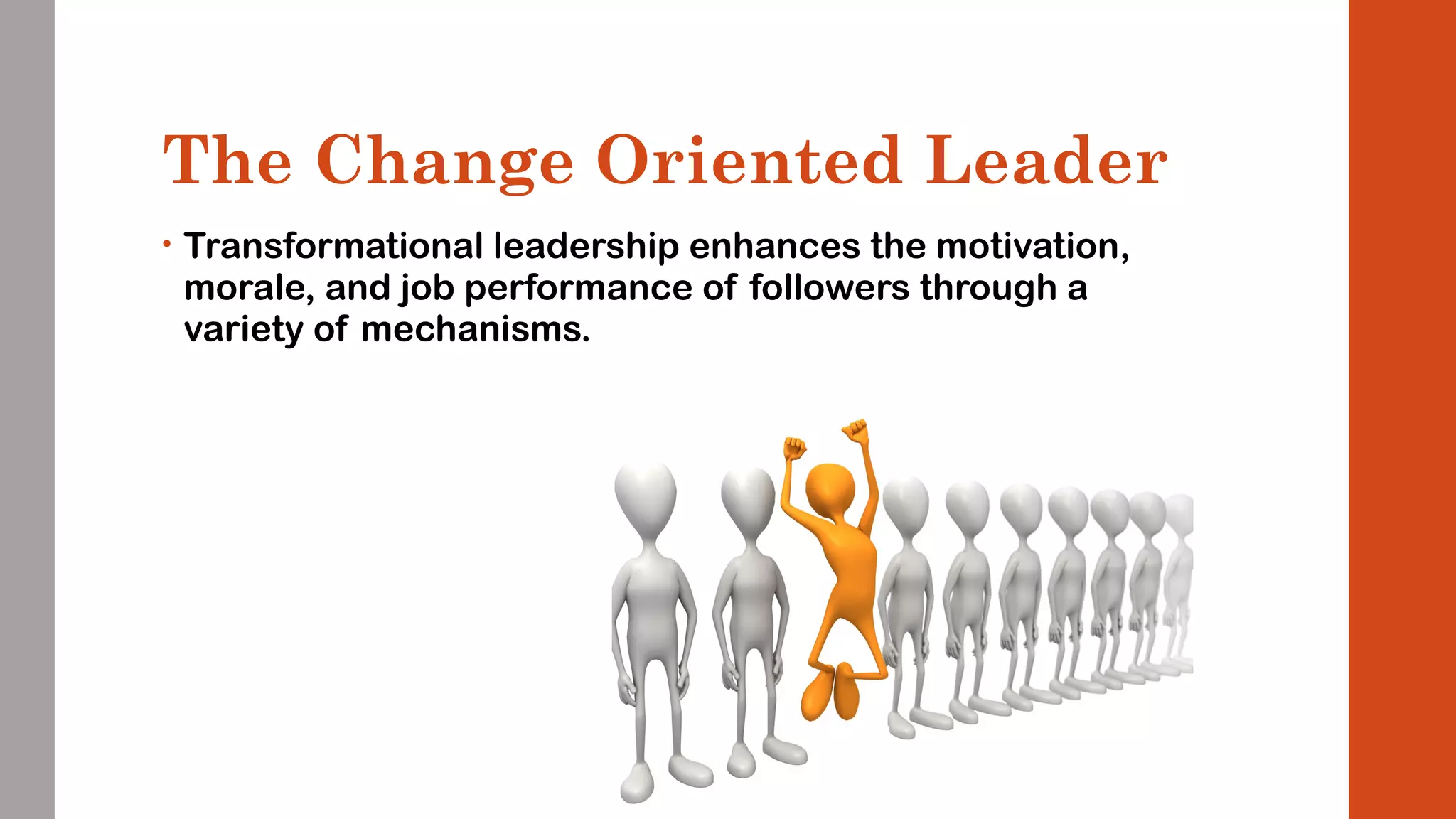
• Transformational leadership enhances the motivation, 
morale, and job performance of followers through a 
variety of mechanisms.
These mechanisims include: 
• being a role model for followers that 
inspires them and makes them 
interested; 
• challenging followers to take greater 
ownership for their work, 
• and understanding the strengths and 
weaknesses of followers, so the leader 
can align followers with tasks that 
enhance their performance.
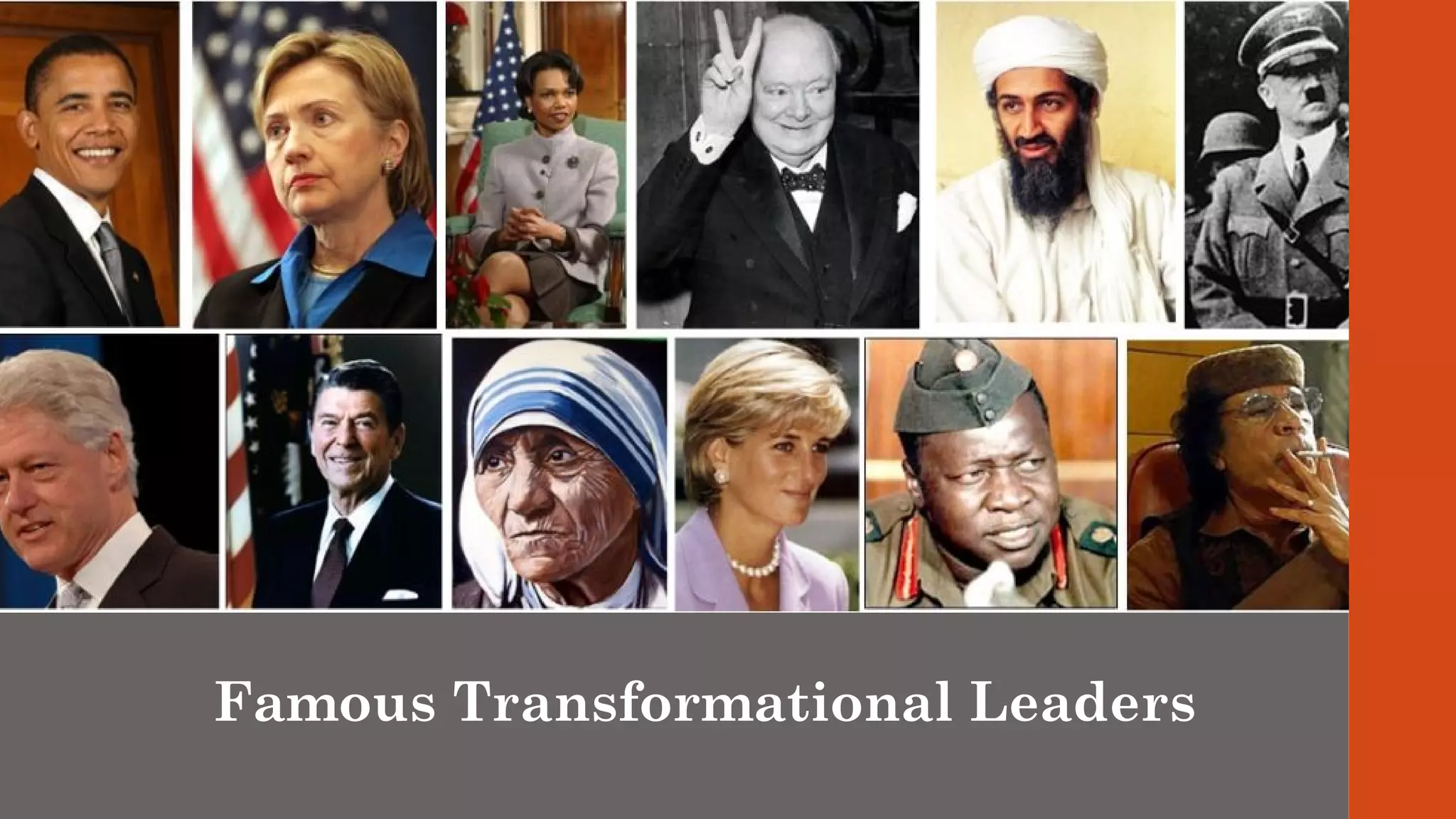
Famous Transformational Leaders
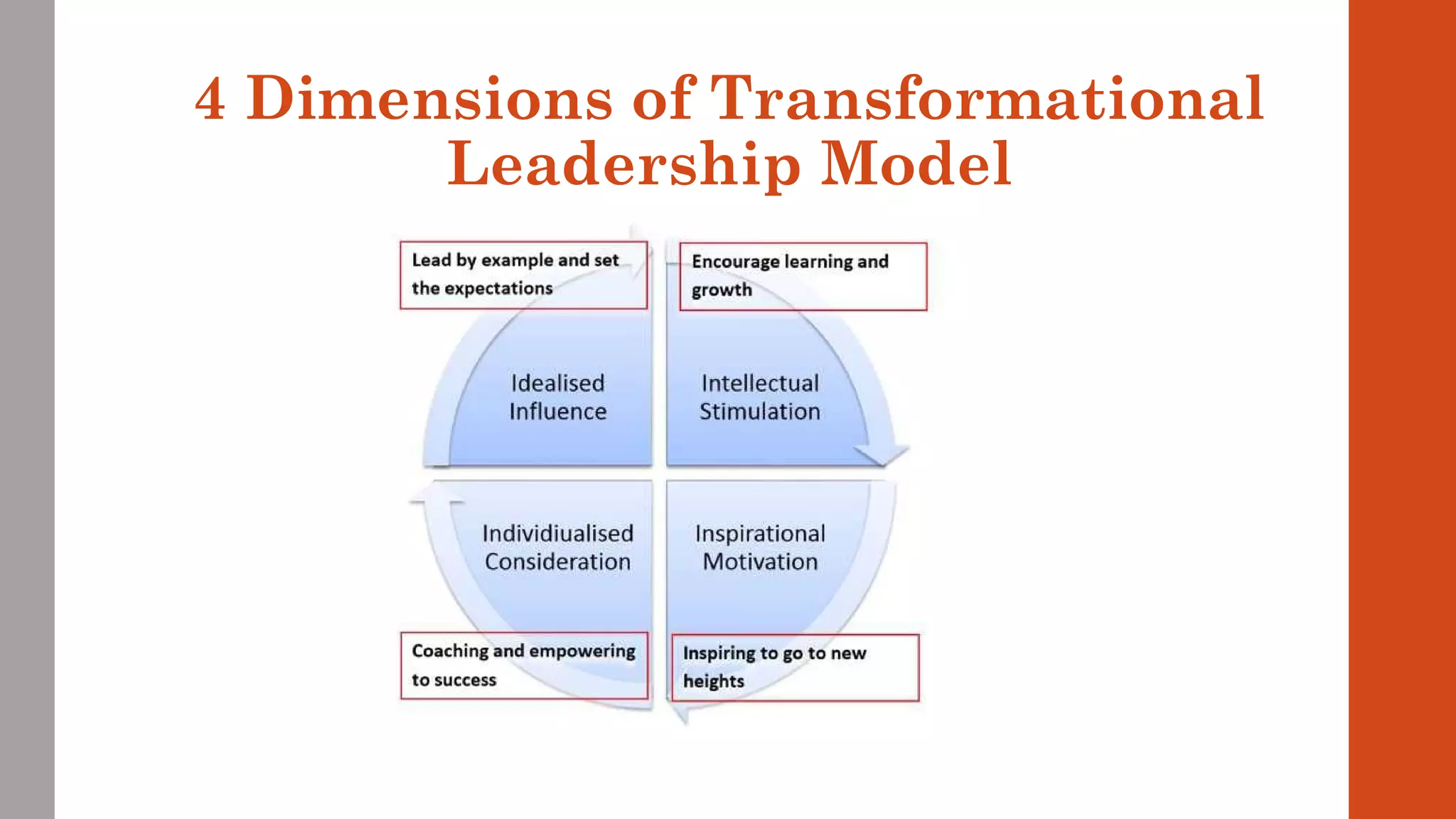
4 Dimensions of Transformational 
Leadership Model
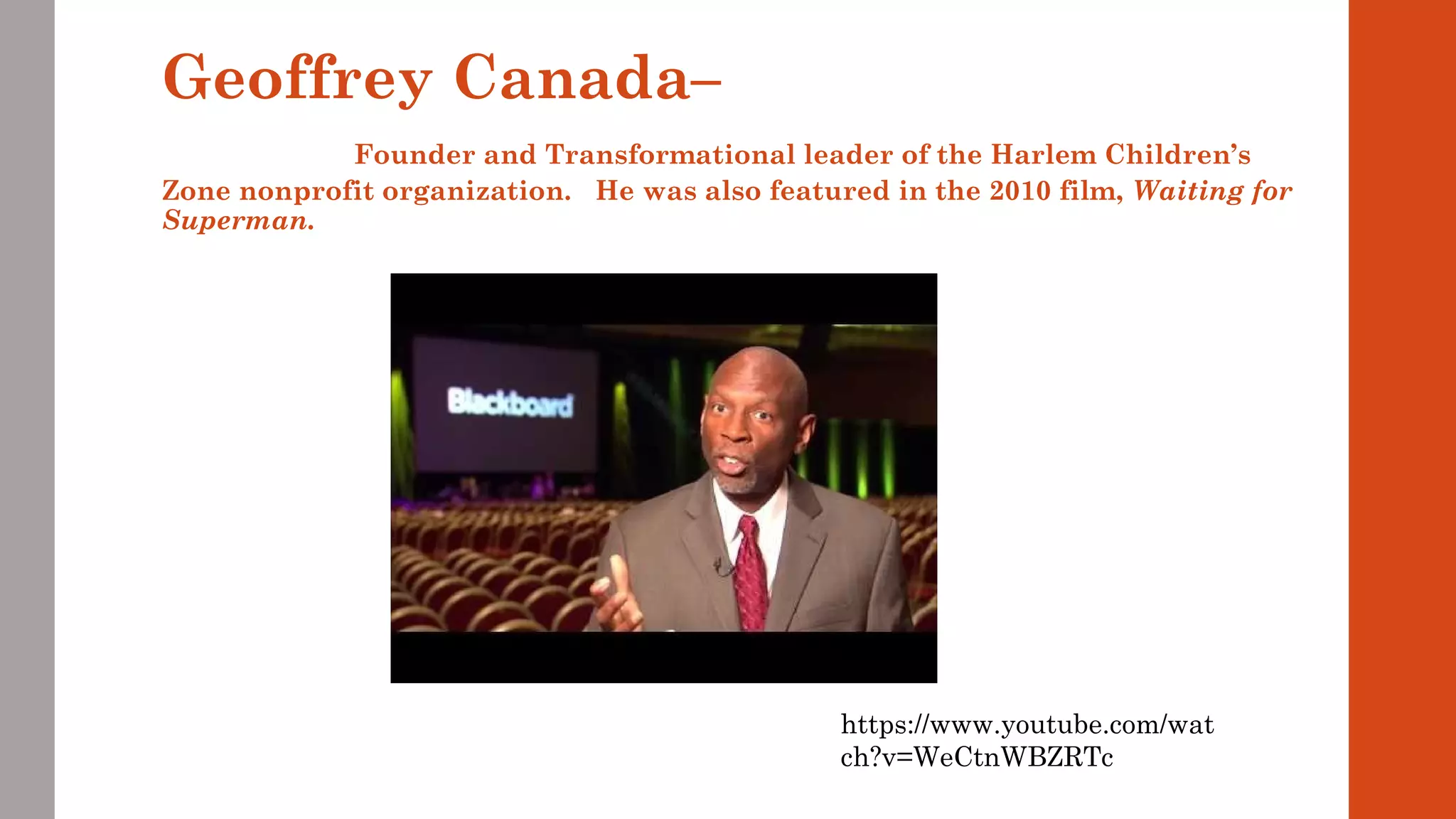
Geoffrey Canada– 
Founder and Transformational leader of the Harlem Children’s 
Zone nonprofit organization. He was also featured in the 2010 film, Waiting for 
Superman. 
https://www.youtube.com/wat 
ch?v=WeCtnWBZRTc
TL’s Major Theorists 
James MacGregor Burns 
and 
Bernard Bass
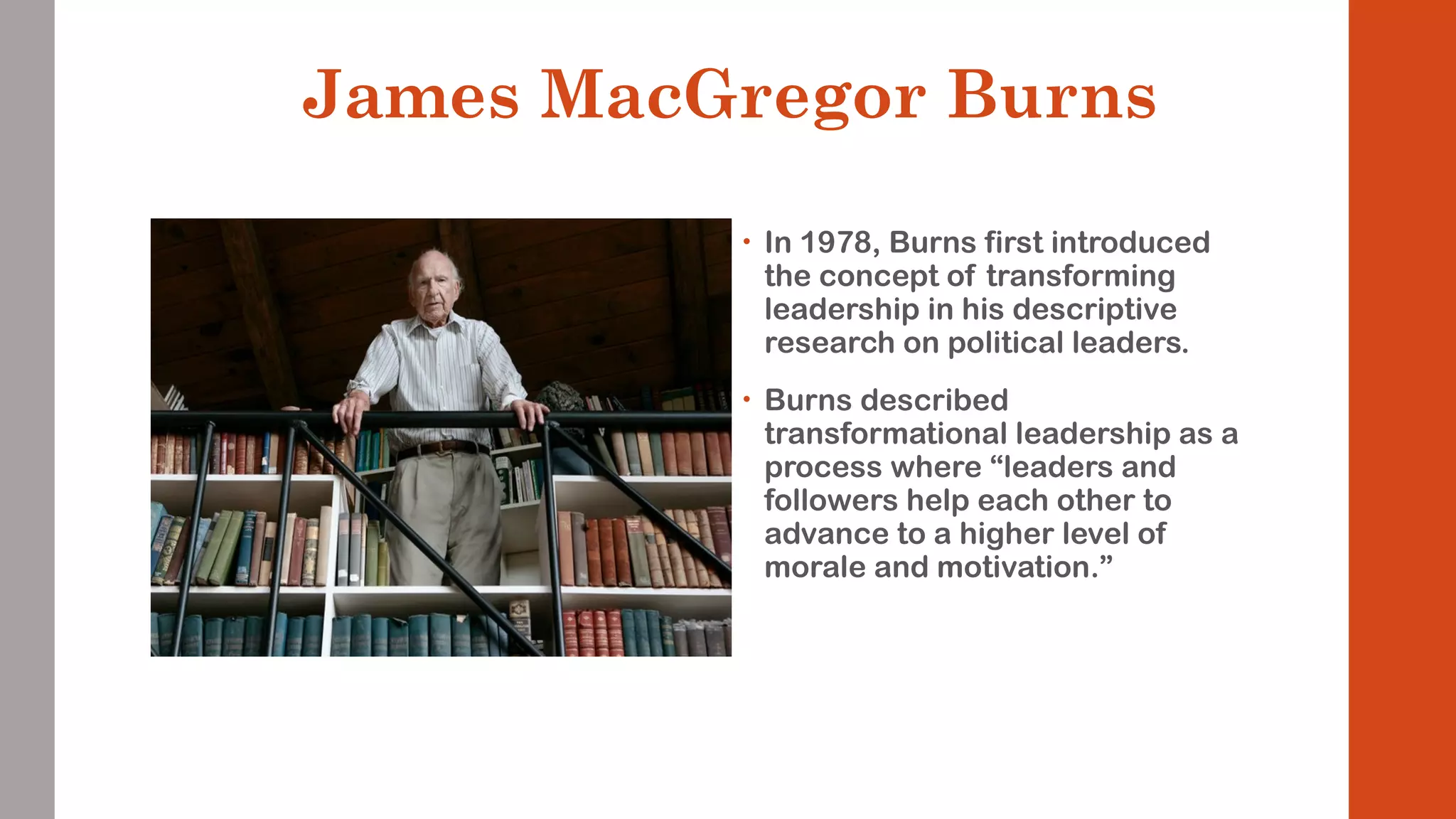
James MacGregor Burns 
• In 1978, Burns first introduced 
the concept of transforming 
leadership in his descriptive 
research on political leaders. 
• Burns described 
transformational leadership as a 
process where “leaders and 
followers help each other to 
advance to a higher level of 
morale and motivation.”
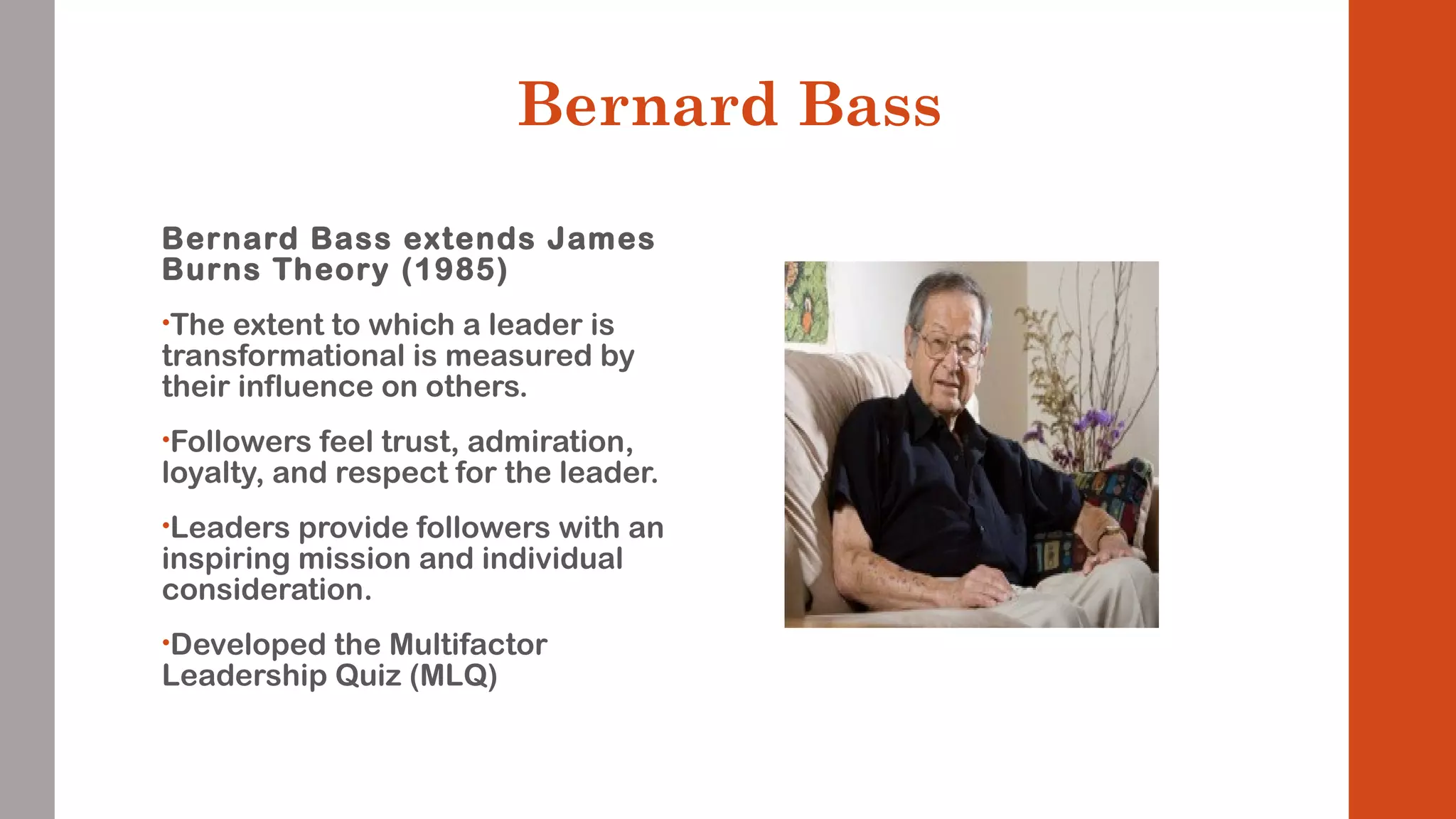
Bernard Bass 
Bernard Bass extends James 
Burns Theory (1985) 
•The extent to which a leader is 
transformational is measured by 
their influence on others. 
•Followers feel trust, admiration, 
loyalty, and respect for the leader. 
•Leaders provide followers with an 
inspiring mission and individual 
consideration. 
•Developed the Multifactor 
Leadership Quiz (MLQ)
Multifactor Leadership Questionnaire 
(MLQ) 
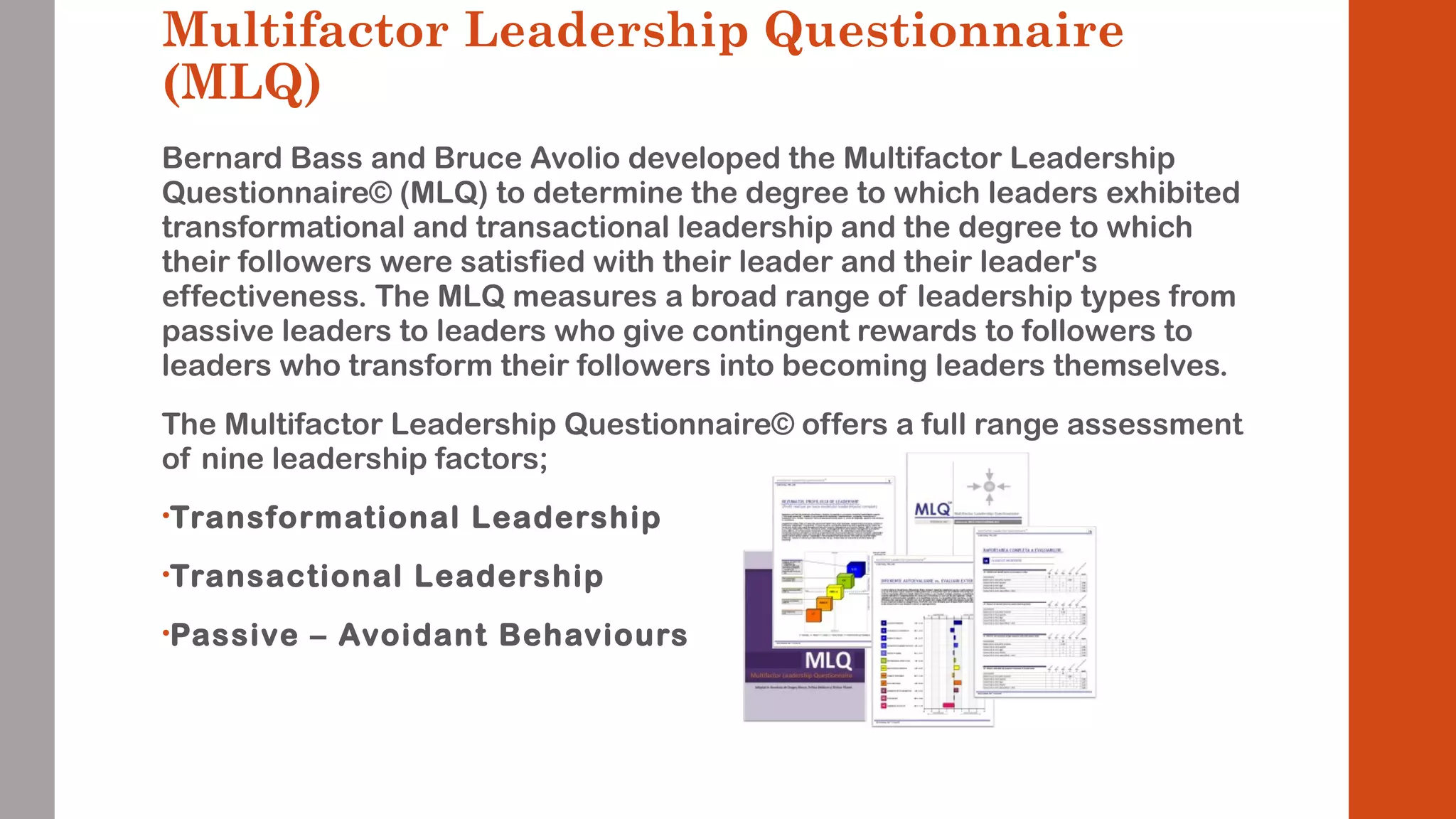
Bernard Bass and Bruce Avolio developed the Multifactor Leadership 
QuestionnaireŠ (MLQ) to determine the degree to which leaders exhibited 
transformational and transactional leadership and the degree to which 
their followers were satisfied with their leader and their leader's 
effectiveness. The MLQ measures a broad range of leadership types from 
passive leaders to leaders who give contingent rewards to followers to 
leaders who transform their followers into becoming leaders themselves. 
The Multifactor Leadership QuestionnaireŠ offers a full range assessment 
of nine leadership factors; 
•Transformational Leadership 
•Transactional Leadership 
•Passive – Avoidant Behaviours
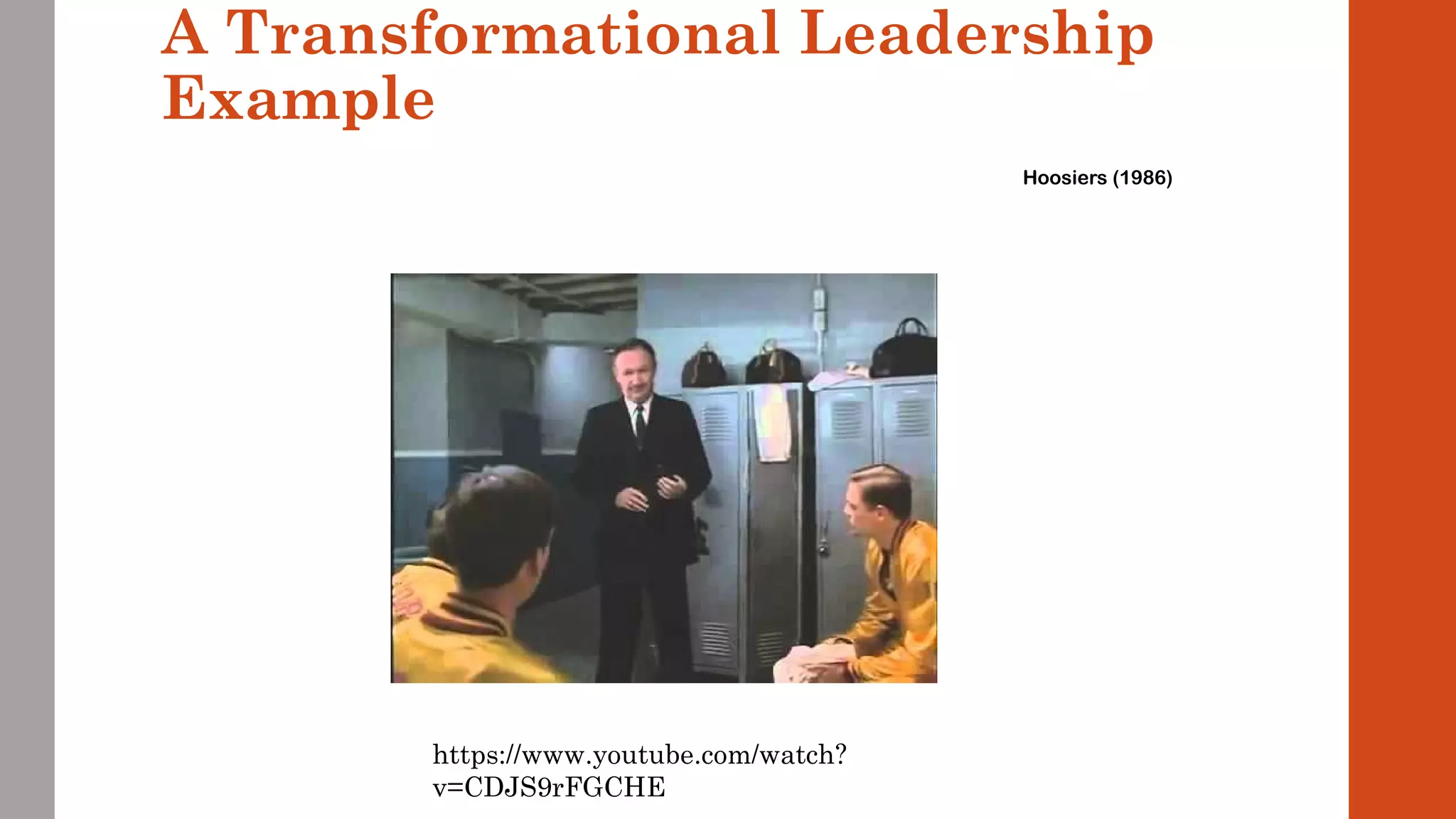
A Transformational Leadership 
Example 
Hoosiers (1986) 
https://www.youtube.com/watch? 
v=CDJS9rFGCHE
Transactional Theory 
• Transactional leadership styles 
are more concerned with 
maintaining the normal flow of 
operations. 
• Set disciplinary power and an 
array of incentives to motivate 
employees to perform at their 
best. 
• The term "transactional" refers 
to the fact that this type of leader 
essentially motivates 
subordinates by exchanging 
rewards for performance. 
Breaksfast Club (1985) 
https://www.youtube.com/watch? 
v=Z2WZrxuwDhs
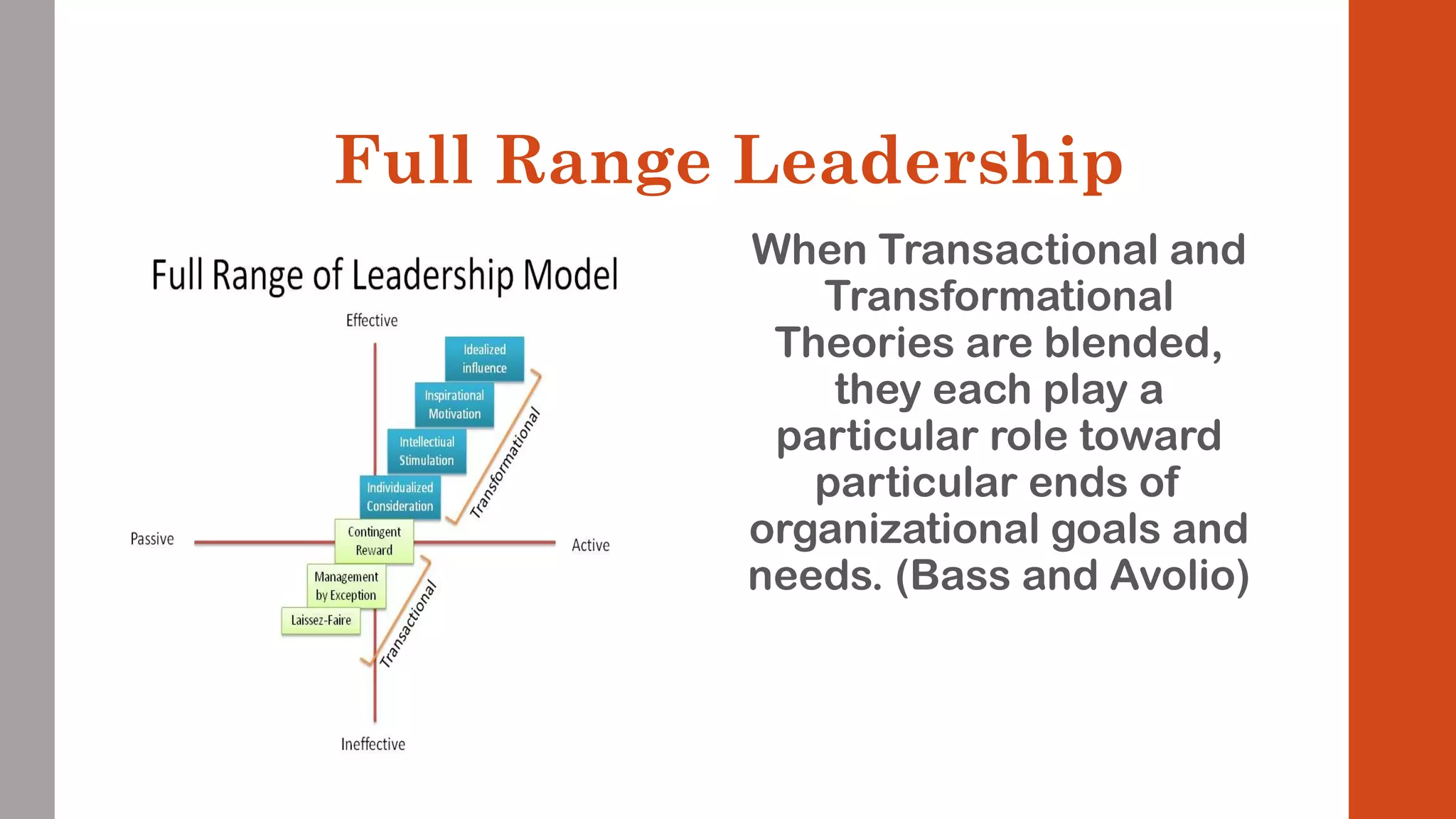
Full Range Leadership 
When Transactional and 
Transformational 
Theories are blended, 
they each play a 
particular role toward 
particular ends of 
organizational goals and 
needs. (Bass and Avolio)
Seven Strong Claims On School 
Improvement 
Transformational Leadership 
in schools was advanced by 
Kenneth Leithwood, Alma 
Harris, and David Hopkins 
(2008). They reported 
“Seven Strong Claims” 
regarding the kinds of 
leadership necessary for 
transforming schools to the 
better. “Better,” is in 
reference to the raising of 
test scores.
The Seven Claims Are: 
1. School leadership is second only to classroom teaching as an influence on pupil learning. 
2. Almost all successful leaders draw on the same repertoire of basic leadership practices. 
3. The ways in which leaders apply these basic leadership practices – not the practices 
themselves – demonstrate responsiveness to, rather than dictation by, the contexts in which 
they work. 
4. School leaders improve teaching and learning indirectly and most powerfully through their 
influence on staff motivation, commitment, and working conditions. 
5. School leadership has a greater influence on schools and students when it is widely 
distributed. 
6. Some patterns of distribution are more effective than others. 
7. A small handful of personal traits explains a high proportion of the variation in leadership 
effectiveness.
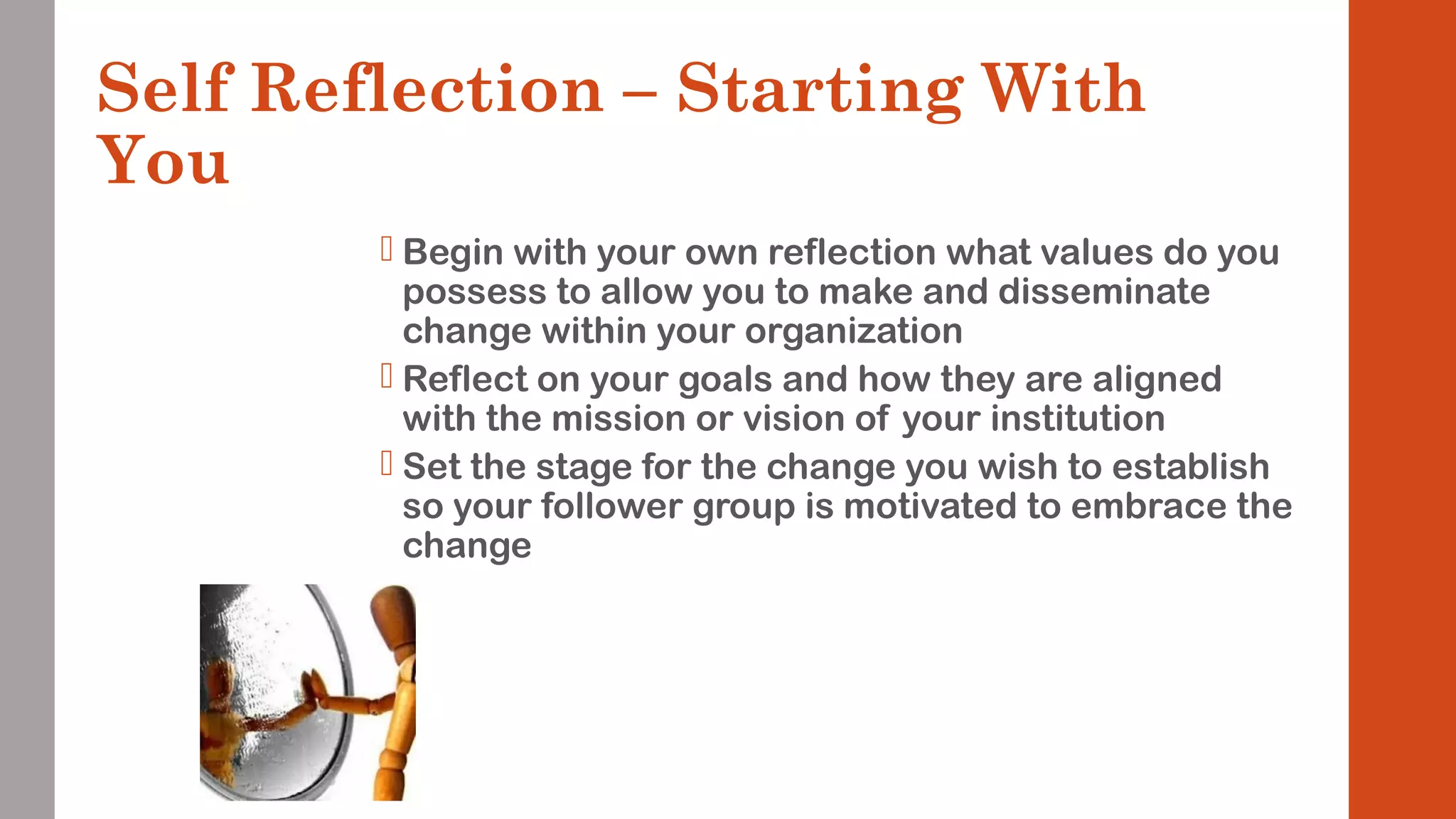
Self Reflection – Starting With 
You 
 Begin with your own reflection what values do you 
possess to allow you to make and disseminate 
change within your organization 
 Reflect on your goals and how they are aligned 
with the mission or vision of your institution 
 Set the stage for the change you wish to establish 
so your follower group is motivated to embrace the 
change
After the “You Analysis” 
After Self-Reflection 
Once self-reflection is established and a clear focus on 
your goals, preferences, and capabilities (the text 
states) “the transformative leader can more carefully 
craft a vision, understand its potential pitfalls and 
biases, and transparently ask others to help her or him 
through such challenges by seeking their expertise”. 
(pg. 164)
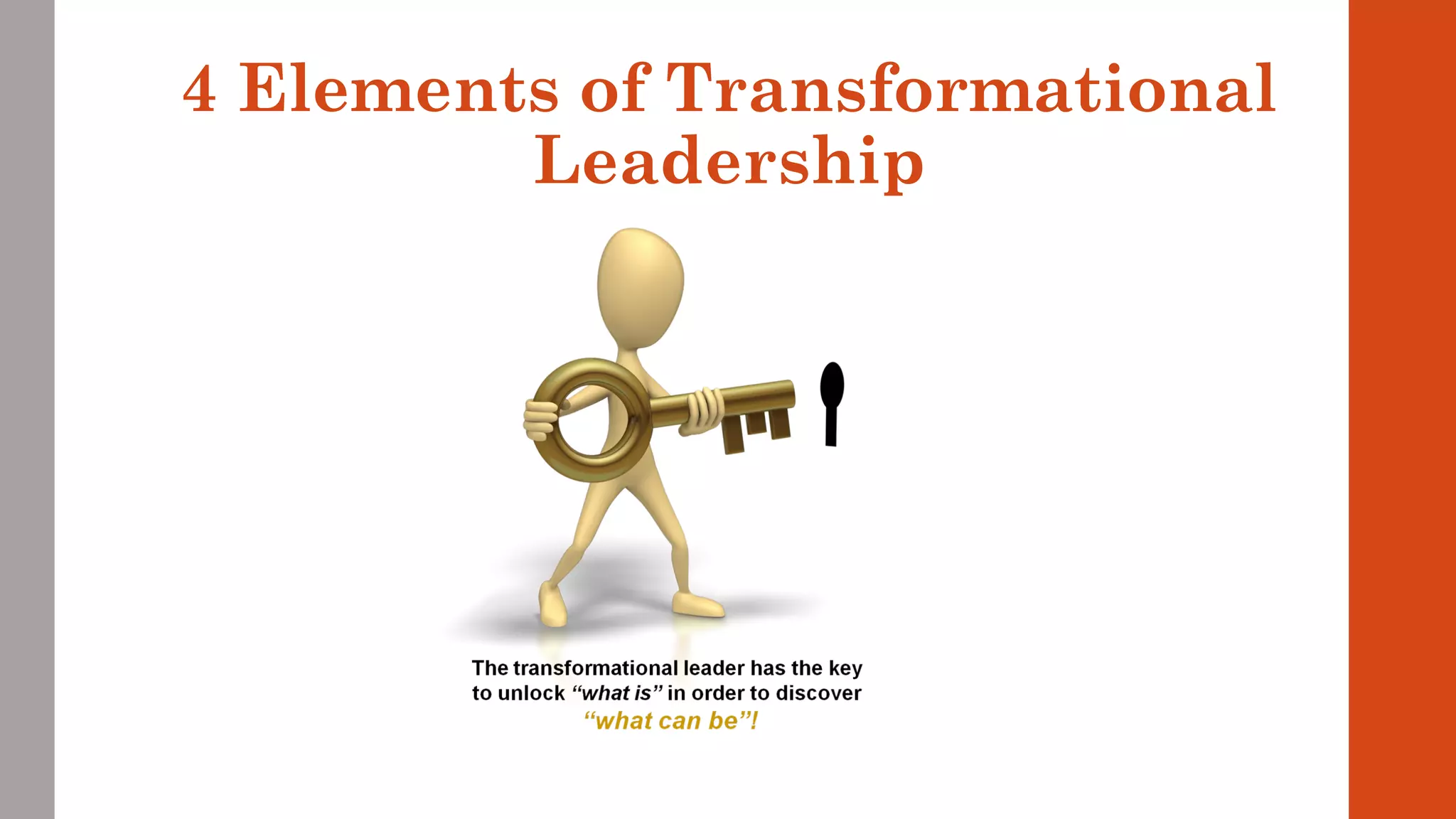
4 Elements of Transformational 
Leadership
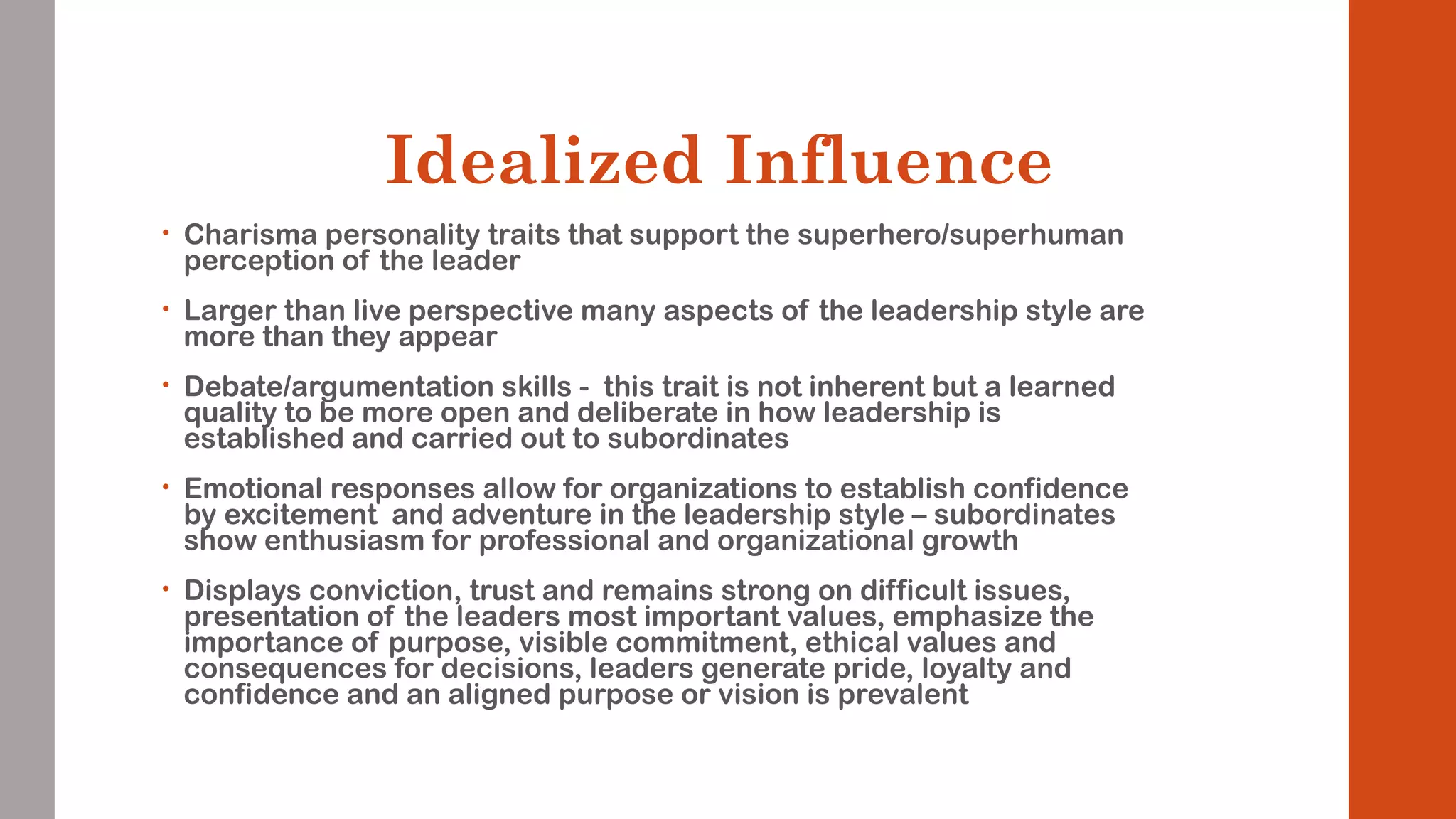
Idealized Influence 
• Charisma personality traits that support the superhero/superhuman 
perception of the leader 
• Larger than live perspective many aspects of the leadership style are 
more than they appear 
• Debate/argumentation skills - this trait is not inherent but a learned 
quality to be more open and deliberate in how leadership is 
established and carried out to subordinates 
• Emotional responses allow for organizations to establish confidence 
by excitement and adventure in the leadership style – subordinates 
show enthusiasm for professional and organizational growth 
• Displays conviction, trust and remains strong on difficult issues, 
presentation of the leaders most important values, emphasize the 
importance of purpose, visible commitment, ethical values and 
consequences for decisions, leaders generate pride, loyalty and 
confidence and an aligned purpose or vision is prevalent
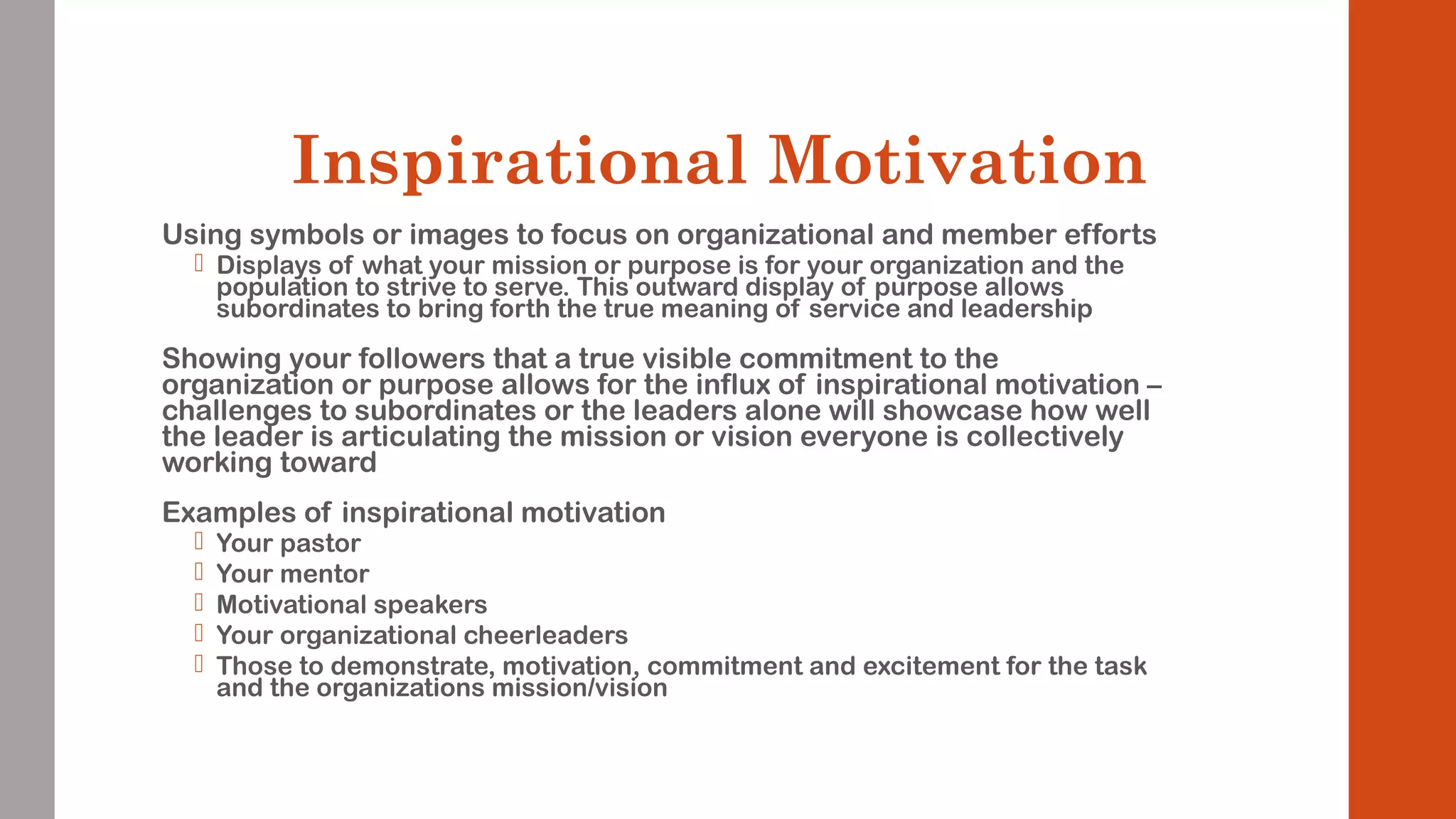
Inspirational Motivation 
Using symbols or images to focus on organizational and member efforts 
 Displays of what your mission or purpose is for your organization and the 
population to strive to serve. This outward display of purpose allows 
subordinates to bring forth the true meaning of service and leadership 
Showing your followers that a true visible commitment to the 
organization or purpose allows for the influx of inspirational motivation – 
challenges to subordinates or the leaders alone will showcase how well 
the leader is articulating the mission or vision everyone is collectively 
working toward 
Examples of inspirational motivation 
 Your pastor 
 Your mentor 
 Motivational speakers 
 Your organizational cheerleaders 
 Those to demonstrate, motivation, commitment and excitement for the task 
and the organizations mission/vision
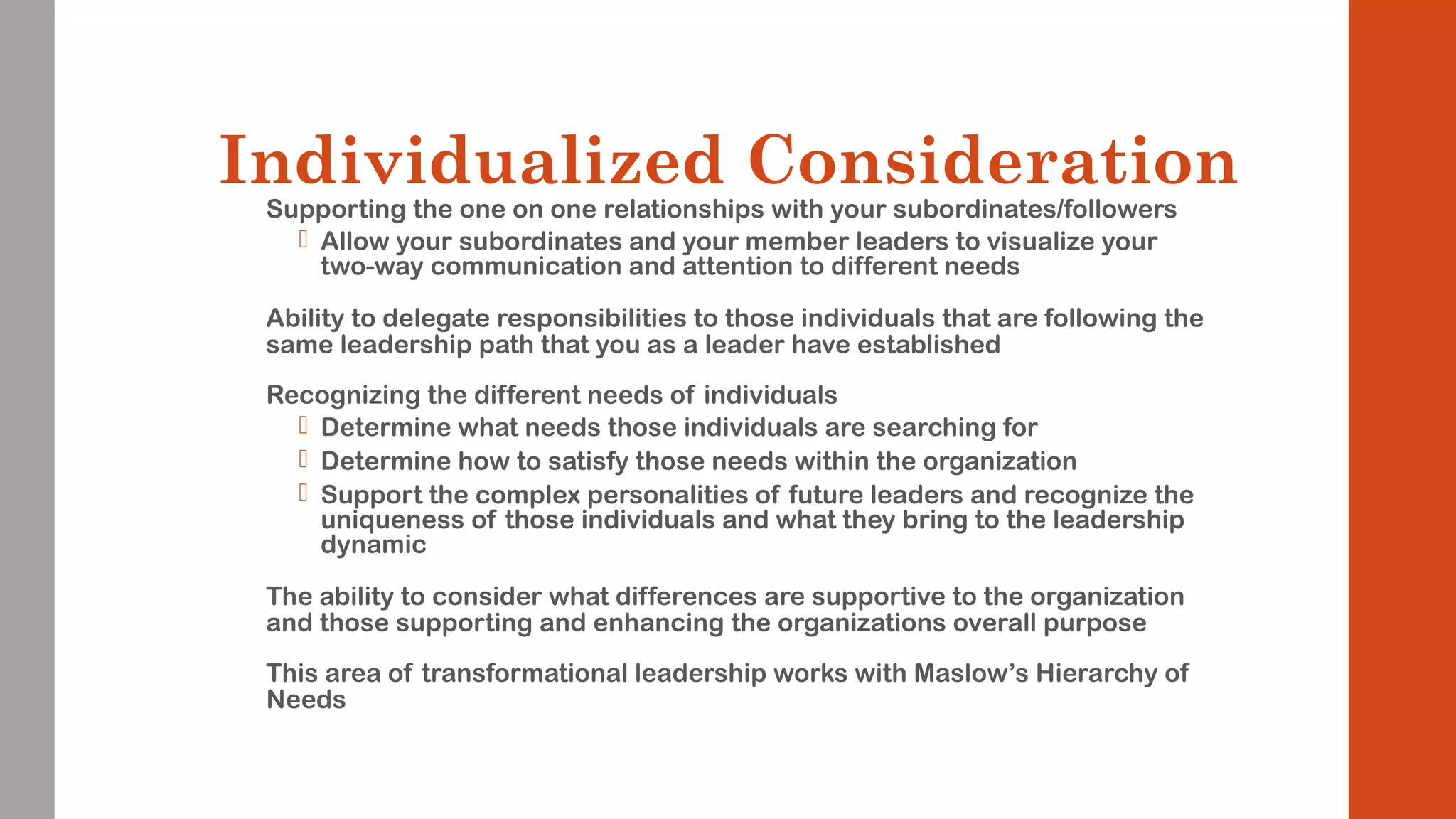
Individualized Consideration 
Supporting the one on one relationships with your subordinates/followers 
 Allow your subordinates and your member leaders to visualize your 
two-way communication and attention to different needs 
Ability to delegate responsibilities to those individuals that are following the 
same leadership path that you as a leader have established 
Recognizing the different needs of individuals 
 Determine what needs those individuals are searching for 
 Determine how to satisfy those needs within the organization 
 Support the complex personalities of future leaders and recognize the 
uniqueness of those individuals and what they bring to the leadership 
dynamic 
The ability to consider what differences are supportive to the organization 
and those supporting and enhancing the organizations overall purpose 
This area of transformational leadership works with Maslow’s Hierarchy of 
Needs
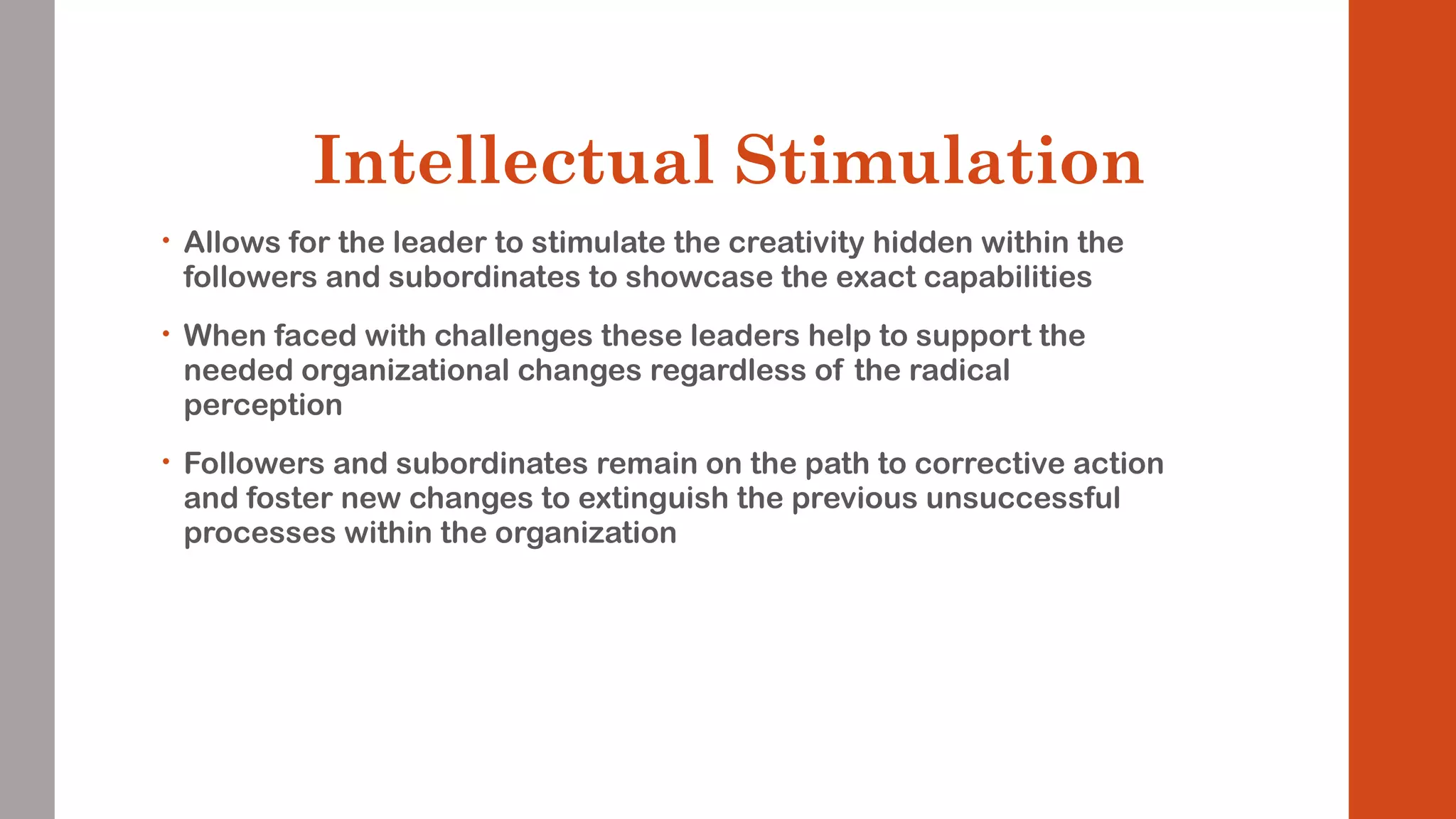
Intellectual Stimulation 
• Allows for the leader to stimulate the creativity hidden within the 
followers and subordinates to showcase the exact capabilities 
• When faced with challenges these leaders help to support the 
needed organizational changes regardless of the radical 
perception 
• Followers and subordinates remain on the path to corrective action 
and foster new changes to extinguish the previous unsuccessful 
processes within the organization
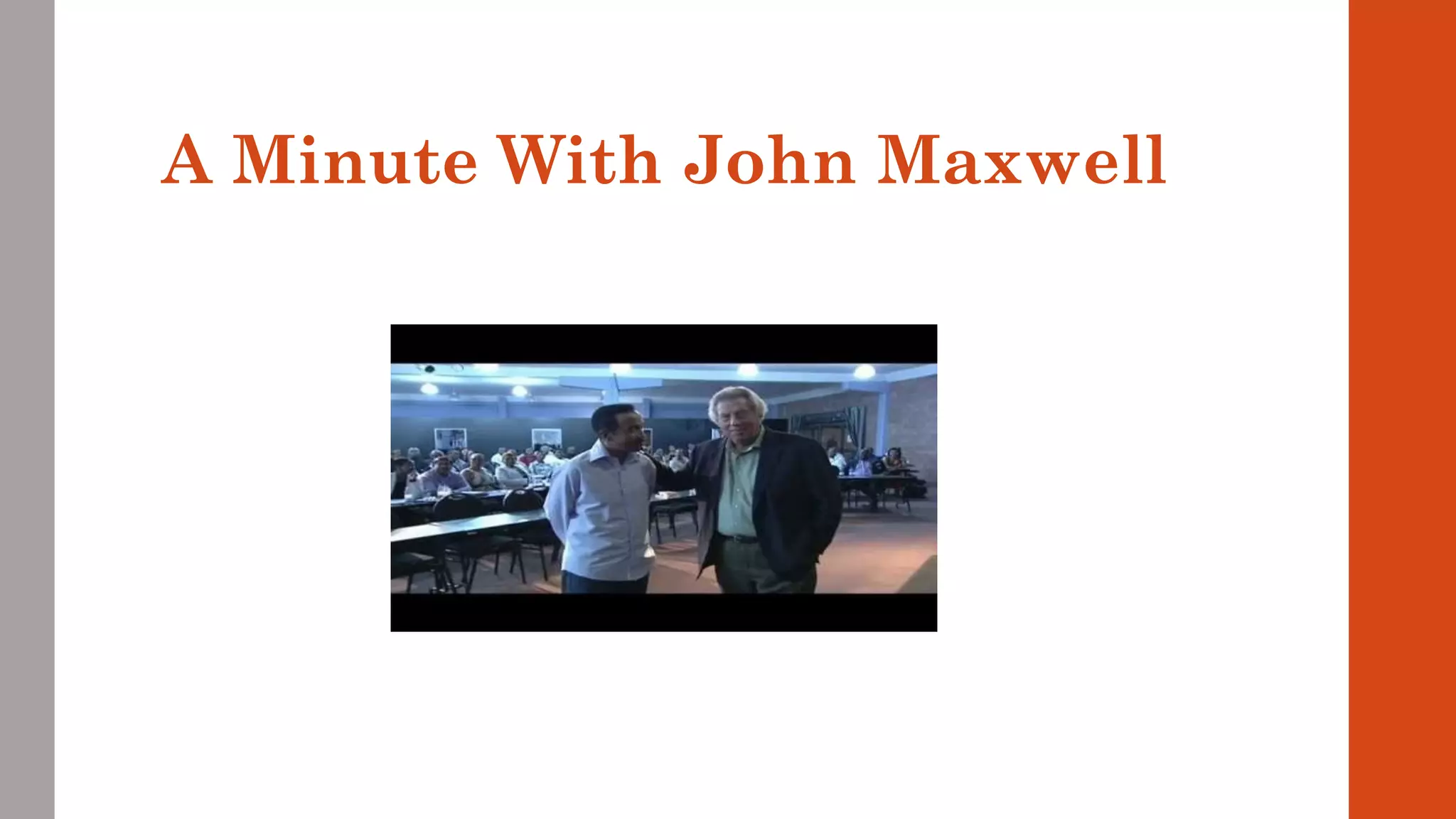
A Minute With John Maxwell
The Personality Test 
A personality test of the leader can be found at 
http://similarminds.com/maslow.html. this test allows for individuals 
to openly and honestly answer questions about themselves to 
determine where they fall in Maslow’s Hierarchy of Needs. This 
personality test can help future leaders establish the types of 
needed change to support and enhance their leadership qualities 
 Answering these questions accurately requires honest 
ref lection on how you really think, feel, and act in general 
and maybe taking the test on more than one occasion. Some 
of the questions on this test measure personality traits differently than 
you might guess so trying to answer the test in a way you think would be 
ideal is just going to screw up your results, so just focus on being 
honest if you want the most accurate results.
• I have more general 
knowledge/skills than specific 
knowledge/skills. 
• I am more interested in 
intellectual pursuits than 
anything else. 
• I am satisfied with my 
connections to others. 
• I am closer to 'tried everything' 
than 'mastered one thing'. 
• I like to be impressive to others. 
• I relate to wizards. 
• I (or my guardian) don't have 
enough money for food. 
• I can afford everything I really 
need. 
• Fame is attractive. 
• I am prestigious or attracted to 
prestige. 
• I am content with the quality of 
my friendships. 
• I would rather be a generalist 
than a specialist. 
• Answers to the questions are on a scale 
basis such as below 
(SELECTING THE MIDDLE ANSWER MEANS A STATEMENT IS 
AROUND 50% ACCURATE) 
Very 
Inaccurate 
Very 
Accurate 
• After the assessment results reflective 
of the Hierarchy of Needs is established 
in a legend such as below 
Physiological Needs |||||||||||||| 57% 
Safety Needs |||||| 30% 
Love Needs |||||||||||||||||| 77% 
Esteem Needs |||||||||||| 50% 
Self-Actualization |||||||||| 36% 
• The assessment allows you to what you 
are sufficient in, in terms of needs and 
what needs more attention or 
consideration this test can be taken 
multiple times and can be used as a 
guide on improving your leadership 
style
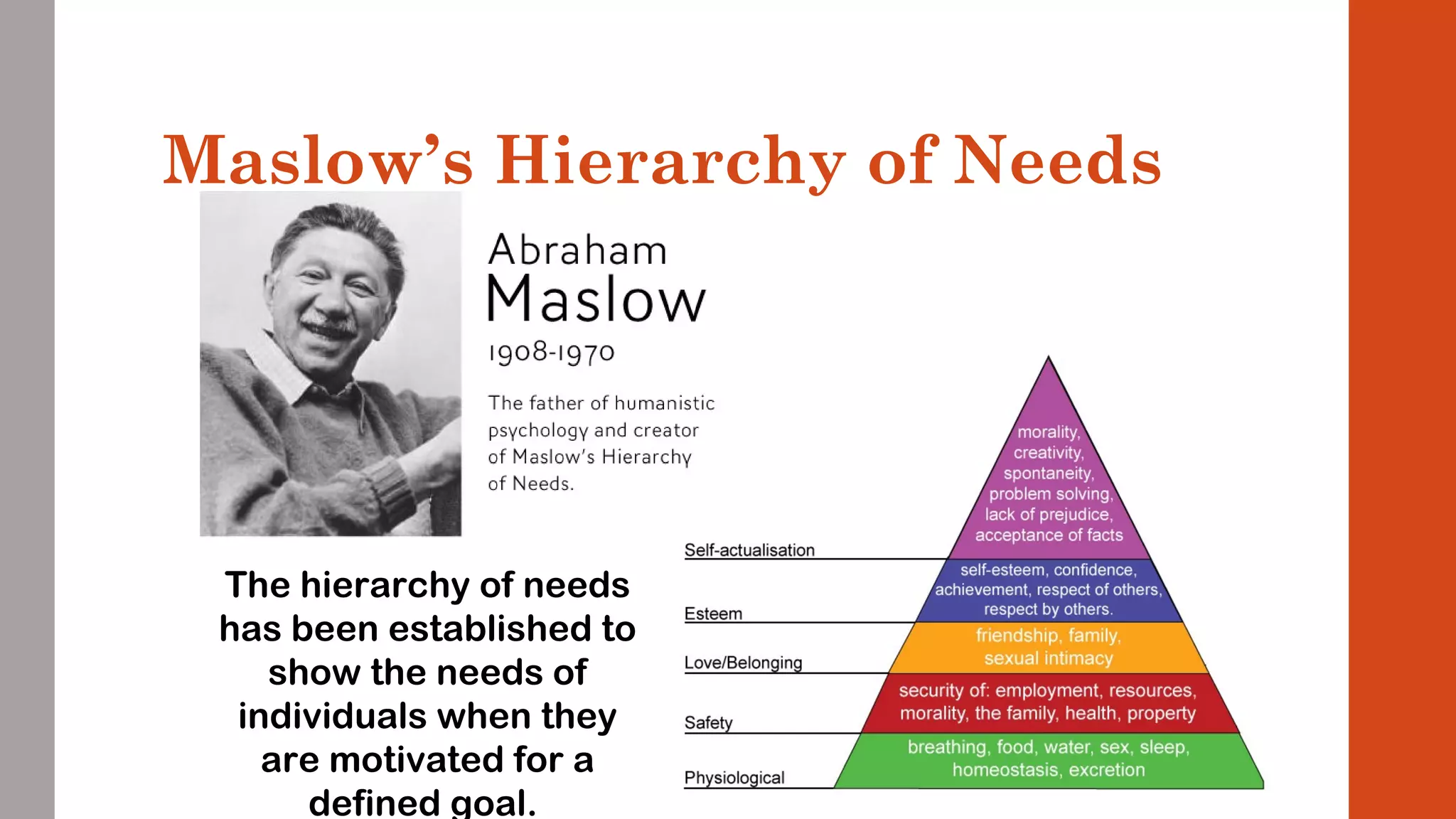
Maslow’s Hierarchy of Needs 
The hierarchy of needs 
has been established to 
show the needs of 
individuals when they 
are motivated for a 
defined goal.
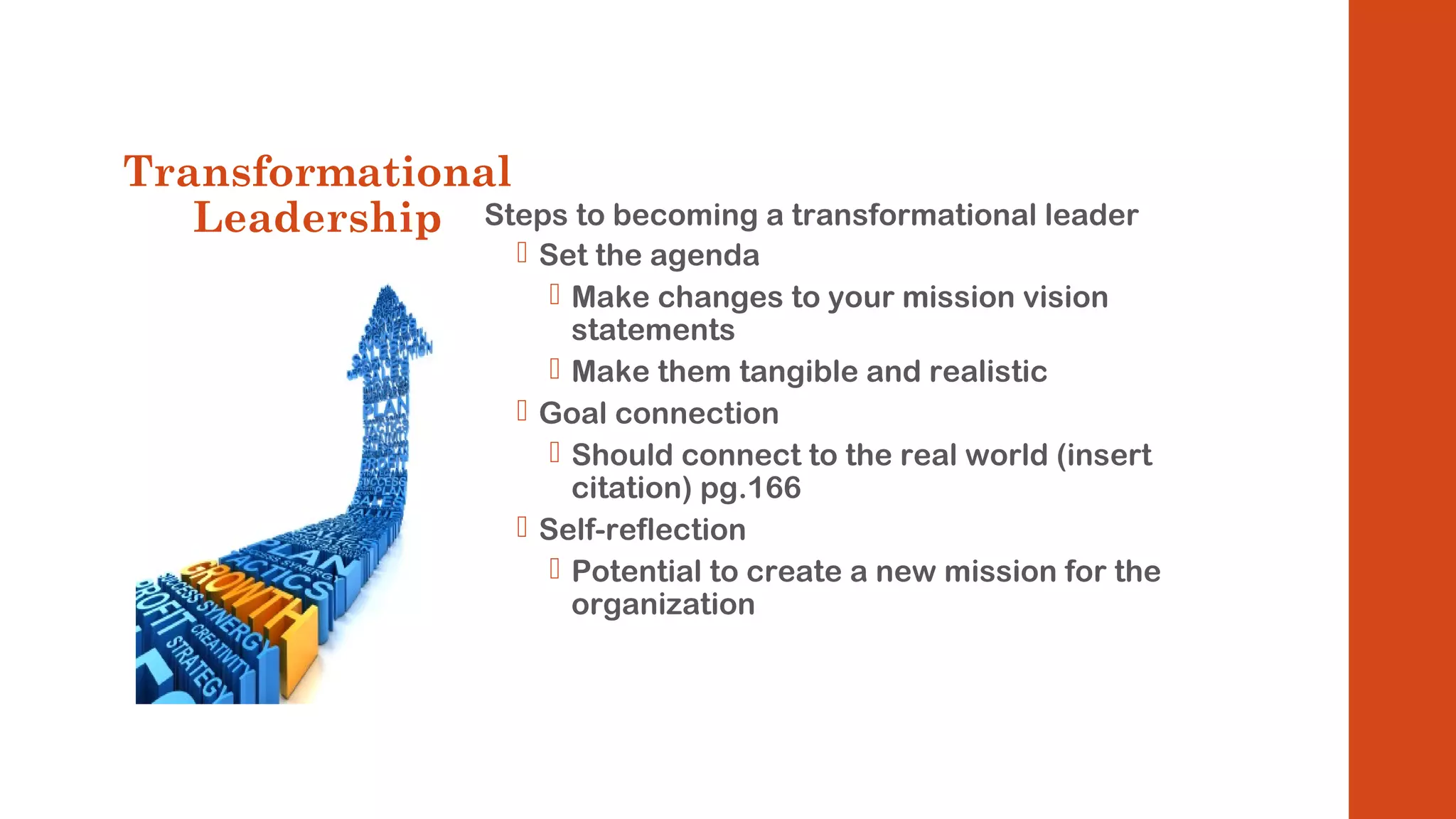
Transformational 
Leadership Steps to becoming a transformational leader 
 Set the agenda 
 Make changes to your mission vision 
statements 
 Make them tangible and realistic 
 Goal connection 
 Should connect to the real world (insert 
citation) pg.166 
 Self-reflection 
 Potential to create a new mission for the 
organization
Impacts of Transformational 
Leadership 
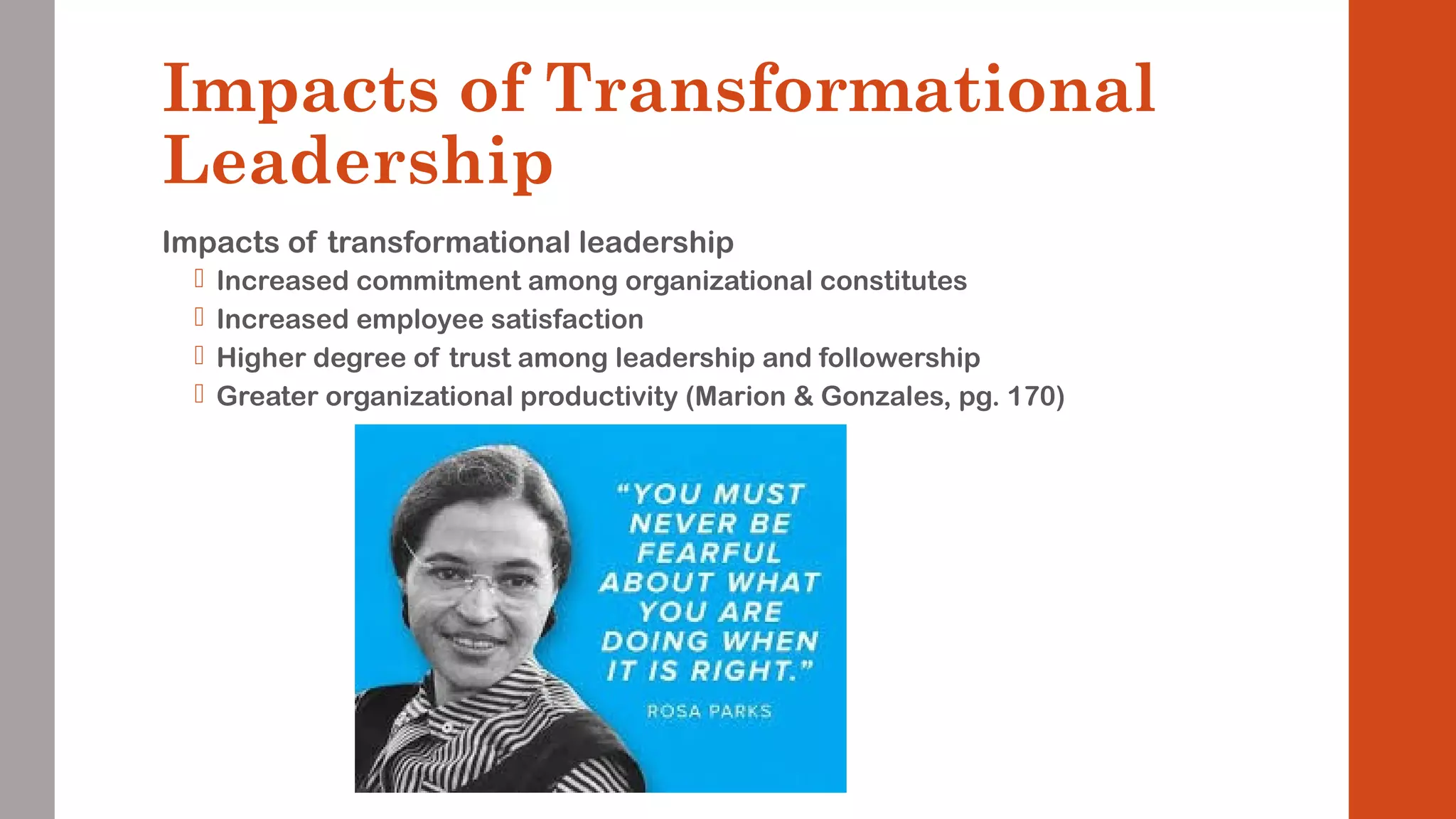
Impacts of transformational leadership 
 Increased commitment among organizational constitutes 
 Increased employee satisfaction 
 Higher degree of trust among leadership and followership 
 Greater organizational productivity (Marion & Gonzales, pg. 170)
Research on TL 
One study examined the TL on head (nurse) leadership 
styles on staff (nurse). 
 Results: The head nurses that utilized TL styles, 
received greater employee satisfaction than those 
who didn’t utilize the TL style. 
 Medly and Larochelle (Researchers) were unable to 
pinpoint the exact ways and means of the 
correlations. 
 Significant correlations were found between TL and: 
professional status, interaction, organizational 
polices, and autonomy (Marion & Gonzales, pg. 171)
School Settings & Transformational 
Leadership 
• TL practiced in school settings, does not have the same effects 
as in the hospitals. 
• TL in schools has a greater impact at the organizational level, 
as opposed to the individual level. In other words, individual 
change is usually indirect, coming from other structural 
circumstances. 
 The work of staff and classroom instruction is more directly 
related to student and achievement than the work of 
principles (TL leaders) (Marion & Gonzales, pg. 171). 
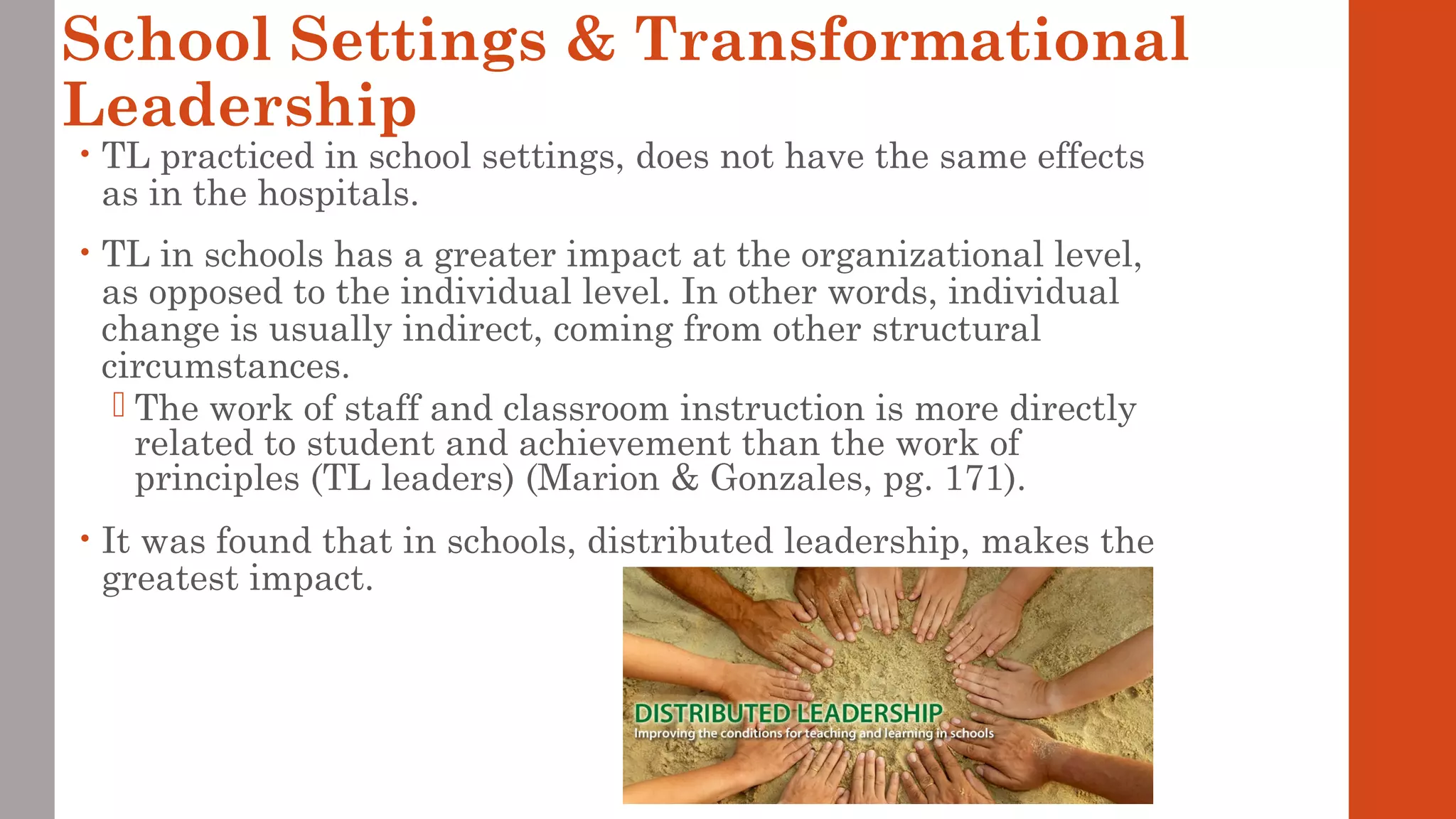
• It was found that in schools, distributed leadership, makes the 
greatest impact.
Complexities of 
Transformational Leadership 
Many scholars agree that it is difficult to measure the 
impact of transformational leadership. TL leadership 
plays out in complex ways, because organizations are 
complex. 
A Singapore hospital study showed high levels and 
commitment to goals and the mission under TL. These 
results were moderated by two factors: 
The sense of empowerment that individuals felt in their 
position. 
The distance between the individual and the 
transformational leader.
Critiques of Transformational 
Leadership 
Pseudo transformational leaders: They may 
exhibit TL qualities, but, in the long run, they are 
only carrying out their own self interests. 
Pseudo Trans Leaders are difficult to spot. 
 TL are generally only viewed authentic if they 
embody morality, ethical values, and integrity. 
This theory lacks multidimensionality because 
what one person considers moral, another 
may consider something completely opposite. 
(Marion & Gonzales, pg. 173)
Transformational Leadership 
and Founder’s Syndrome 
Founder’s Syndrome : 
Influential powers and privileges 
that the founder exercises or that 
others attribute to the founder. The 
use of the word syndrome further 
suggests unhealthy organizational 
situations in which founders are 
more heavy-handed and 
indifferent about the imbalance of 
their control over organizations 
(Bass, 1998, p. 15). 
•If the followers look to the TL for 
the answers, then the opposite 
process is occurring from the TL 
theory. 
• The followers should not look to 
the leader in a hero fashion.
Morality under Fire 
Morality of TL has been questioned. 
Key criticism’s of TL are: 
Abuse of power 
Some leaders have Narcissistic 
tendencies 
Followers may have dependent 
characters and form unfortunate 
bonds 
TL lacks checks and balances
Transformational Leadership’s 
Power Problem 
• TL’s are supposed to act purely moral, selfless, 
and socially responsible. 
• TL’s have to be aware that what may be 
transformational to one group, may not be to 
another. 
• Issues may arise when a follower raises 
questions in relation to a TL’s power.
Summary 
TL’s can shape, move, and inspire 
large groups of people. 
TL’s contribute to an organization's 
productivity, in unanswered ways. 
TL theory’s are not without 
opposition. 
https://www.youtube.com/watch? 
v=60O2OH7mHys
References 
• Bass, B.M. (1985). Leadership and performance beyond expectations. New 
York: Collier Macmillan. 
• http://www.langston.edu/sites/default/files/basic-content-files/ 
TransformationalLeadership.pdf 
• http://www.nytimes.com/2014/07/16/us/james-m-burns-a-scholar-of-presidents- 
and-leadership-dies-at-95.html?_r=0 
• http://www.centerforleaderdevelopment.com/blog/?page_id=14 
• Marion, R. & Gonzales L. D. (2014) Leadership in Education : Organizational 
Theory for the Practitioner. (2E). (pp. 163-170). Long Grove, IL: Waveland 
Press , Inc. 
• McLeod, S. A. (2007). Maslow’s Hierarchy of Needs. Retrieved from 
http://www.simplypsychology.org/maslow.html 
• Personality Test. Retrieved from http://similarminds.com/cgi-bin/maslow.pl 
(2014)

Transformation theory

  • 1.
    Transformational Leadership Theory Kathy Achen Henrietta Maestas Brandon McIntire
  • 2.
    The Change OrientedLeader • Transformational leadership enhances the motivation, morale, and job performance of followers through a variety of mechanisms.
  • 3.
    These mechanisims include: • being a role model for followers that inspires them and makes them interested; • challenging followers to take greater ownership for their work, • and understanding the strengths and weaknesses of followers, so the leader can align followers with tasks that enhance their performance.
  • 4.
  • 5.
    4 Dimensions ofTransformational Leadership Model
  • 6.
    Geoffrey Canada– Founderand Transformational leader of the Harlem Children’s Zone nonprofit organization. He was also featured in the 2010 film, Waiting for Superman. https://www.youtube.com/wat ch?v=WeCtnWBZRTc
  • 7.
    TL’s Major Theorists James MacGregor Burns and Bernard Bass
  • 8.
    James MacGregor Burns • In 1978, Burns first introduced the concept of transforming leadership in his descriptive research on political leaders. • Burns described transformational leadership as a process where “leaders and followers help each other to advance to a higher level of morale and motivation.”
  • 9.
    Bernard Bass BernardBass extends James Burns Theory (1985) •The extent to which a leader is transformational is measured by their influence on others. •Followers feel trust, admiration, loyalty, and respect for the leader. •Leaders provide followers with an inspiring mission and individual consideration. •Developed the Multifactor Leadership Quiz (MLQ)
  • 10.
    Multifactor Leadership Questionnaire (MLQ) Bernard Bass and Bruce Avolio developed the Multifactor Leadership Questionnaire© (MLQ) to determine the degree to which leaders exhibited transformational and transactional leadership and the degree to which their followers were satisfied with their leader and their leader's effectiveness. The MLQ measures a broad range of leadership types from passive leaders to leaders who give contingent rewards to followers to leaders who transform their followers into becoming leaders themselves. The Multifactor Leadership Questionnaire© offers a full range assessment of nine leadership factors; •Transformational Leadership •Transactional Leadership •Passive – Avoidant Behaviours
  • 11.
    A Transformational Leadership Example Hoosiers (1986) https://www.youtube.com/watch? v=CDJS9rFGCHE
  • 12.
    Transactional Theory •Transactional leadership styles are more concerned with maintaining the normal flow of operations. • Set disciplinary power and an array of incentives to motivate employees to perform at their best. • The term "transactional" refers to the fact that this type of leader essentially motivates subordinates by exchanging rewards for performance. Breaksfast Club (1985) https://www.youtube.com/watch? v=Z2WZrxuwDhs
  • 13.
    Full Range Leadership When Transactional and Transformational Theories are blended, they each play a particular role toward particular ends of organizational goals and needs. (Bass and Avolio)
  • 14.
    Seven Strong ClaimsOn School Improvement Transformational Leadership in schools was advanced by Kenneth Leithwood, Alma Harris, and David Hopkins (2008). They reported “Seven Strong Claims” regarding the kinds of leadership necessary for transforming schools to the better. “Better,” is in reference to the raising of test scores.
  • 15.
    The Seven ClaimsAre: 1. School leadership is second only to classroom teaching as an influence on pupil learning. 2. Almost all successful leaders draw on the same repertoire of basic leadership practices. 3. The ways in which leaders apply these basic leadership practices – not the practices themselves – demonstrate responsiveness to, rather than dictation by, the contexts in which they work. 4. School leaders improve teaching and learning indirectly and most powerfully through their influence on staff motivation, commitment, and working conditions. 5. School leadership has a greater influence on schools and students when it is widely distributed. 6. Some patterns of distribution are more effective than others. 7. A small handful of personal traits explains a high proportion of the variation in leadership effectiveness.
  • 16.
    Self Reflection –Starting With You  Begin with your own reflection what values do you possess to allow you to make and disseminate change within your organization  Reflect on your goals and how they are aligned with the mission or vision of your institution  Set the stage for the change you wish to establish so your follower group is motivated to embrace the change
  • 17.
    After the “YouAnalysis” After Self-Reflection Once self-reflection is established and a clear focus on your goals, preferences, and capabilities (the text states) “the transformative leader can more carefully craft a vision, understand its potential pitfalls and biases, and transparently ask others to help her or him through such challenges by seeking their expertise”. (pg. 164)
  • 18.
    4 Elements ofTransformational Leadership
  • 19.
    Idealized Influence •Charisma personality traits that support the superhero/superhuman perception of the leader • Larger than live perspective many aspects of the leadership style are more than they appear • Debate/argumentation skills - this trait is not inherent but a learned quality to be more open and deliberate in how leadership is established and carried out to subordinates • Emotional responses allow for organizations to establish confidence by excitement and adventure in the leadership style – subordinates show enthusiasm for professional and organizational growth • Displays conviction, trust and remains strong on difficult issues, presentation of the leaders most important values, emphasize the importance of purpose, visible commitment, ethical values and consequences for decisions, leaders generate pride, loyalty and confidence and an aligned purpose or vision is prevalent
  • 20.
    Inspirational Motivation Usingsymbols or images to focus on organizational and member efforts  Displays of what your mission or purpose is for your organization and the population to strive to serve. This outward display of purpose allows subordinates to bring forth the true meaning of service and leadership Showing your followers that a true visible commitment to the organization or purpose allows for the influx of inspirational motivation – challenges to subordinates or the leaders alone will showcase how well the leader is articulating the mission or vision everyone is collectively working toward Examples of inspirational motivation  Your pastor  Your mentor  Motivational speakers  Your organizational cheerleaders  Those to demonstrate, motivation, commitment and excitement for the task and the organizations mission/vision
  • 21.
    Individualized Consideration Supportingthe one on one relationships with your subordinates/followers  Allow your subordinates and your member leaders to visualize your two-way communication and attention to different needs Ability to delegate responsibilities to those individuals that are following the same leadership path that you as a leader have established Recognizing the different needs of individuals  Determine what needs those individuals are searching for  Determine how to satisfy those needs within the organization  Support the complex personalities of future leaders and recognize the uniqueness of those individuals and what they bring to the leadership dynamic The ability to consider what differences are supportive to the organization and those supporting and enhancing the organizations overall purpose This area of transformational leadership works with Maslow’s Hierarchy of Needs
  • 22.
    Intellectual Stimulation •Allows for the leader to stimulate the creativity hidden within the followers and subordinates to showcase the exact capabilities • When faced with challenges these leaders help to support the needed organizational changes regardless of the radical perception • Followers and subordinates remain on the path to corrective action and foster new changes to extinguish the previous unsuccessful processes within the organization
  • 23.
    A Minute WithJohn Maxwell
  • 24.
    The Personality Test A personality test of the leader can be found at http://similarminds.com/maslow.html. this test allows for individuals to openly and honestly answer questions about themselves to determine where they fall in Maslow’s Hierarchy of Needs. This personality test can help future leaders establish the types of needed change to support and enhance their leadership qualities  Answering these questions accurately requires honest ref lection on how you really think, feel, and act in general and maybe taking the test on more than one occasion. Some of the questions on this test measure personality traits differently than you might guess so trying to answer the test in a way you think would be ideal is just going to screw up your results, so just focus on being honest if you want the most accurate results.
  • 25.
    • I havemore general knowledge/skills than specific knowledge/skills. • I am more interested in intellectual pursuits than anything else. • I am satisfied with my connections to others. • I am closer to 'tried everything' than 'mastered one thing'. • I like to be impressive to others. • I relate to wizards. • I (or my guardian) don't have enough money for food. • I can afford everything I really need. • Fame is attractive. • I am prestigious or attracted to prestige. • I am content with the quality of my friendships. • I would rather be a generalist than a specialist. • Answers to the questions are on a scale basis such as below (SELECTING THE MIDDLE ANSWER MEANS A STATEMENT IS AROUND 50% ACCURATE) Very Inaccurate Very Accurate • After the assessment results reflective of the Hierarchy of Needs is established in a legend such as below Physiological Needs |||||||||||||| 57% Safety Needs |||||| 30% Love Needs |||||||||||||||||| 77% Esteem Needs |||||||||||| 50% Self-Actualization |||||||||| 36% • The assessment allows you to what you are sufficient in, in terms of needs and what needs more attention or consideration this test can be taken multiple times and can be used as a guide on improving your leadership style
  • 26.
    Maslow’s Hierarchy ofNeeds The hierarchy of needs has been established to show the needs of individuals when they are motivated for a defined goal.
  • 27.
    Transformational Leadership Stepsto becoming a transformational leader  Set the agenda  Make changes to your mission vision statements  Make them tangible and realistic  Goal connection  Should connect to the real world (insert citation) pg.166  Self-reflection  Potential to create a new mission for the organization
  • 28.
    Impacts of Transformational Leadership Impacts of transformational leadership  Increased commitment among organizational constitutes  Increased employee satisfaction  Higher degree of trust among leadership and followership  Greater organizational productivity (Marion & Gonzales, pg. 170)
  • 29.
    Research on TL One study examined the TL on head (nurse) leadership styles on staff (nurse).  Results: The head nurses that utilized TL styles, received greater employee satisfaction than those who didn’t utilize the TL style.  Medly and Larochelle (Researchers) were unable to pinpoint the exact ways and means of the correlations.  Significant correlations were found between TL and: professional status, interaction, organizational polices, and autonomy (Marion & Gonzales, pg. 171)
  • 30.
    School Settings &Transformational Leadership • TL practiced in school settings, does not have the same effects as in the hospitals. • TL in schools has a greater impact at the organizational level, as opposed to the individual level. In other words, individual change is usually indirect, coming from other structural circumstances.  The work of staff and classroom instruction is more directly related to student and achievement than the work of principles (TL leaders) (Marion & Gonzales, pg. 171). • It was found that in schools, distributed leadership, makes the greatest impact.
  • 31.
    Complexities of TransformationalLeadership Many scholars agree that it is difficult to measure the impact of transformational leadership. TL leadership plays out in complex ways, because organizations are complex. A Singapore hospital study showed high levels and commitment to goals and the mission under TL. These results were moderated by two factors: The sense of empowerment that individuals felt in their position. The distance between the individual and the transformational leader.
  • 32.
    Critiques of Transformational Leadership Pseudo transformational leaders: They may exhibit TL qualities, but, in the long run, they are only carrying out their own self interests. Pseudo Trans Leaders are difficult to spot.  TL are generally only viewed authentic if they embody morality, ethical values, and integrity. This theory lacks multidimensionality because what one person considers moral, another may consider something completely opposite. (Marion & Gonzales, pg. 173)
  • 33.
    Transformational Leadership andFounder’s Syndrome Founder’s Syndrome : Influential powers and privileges that the founder exercises or that others attribute to the founder. The use of the word syndrome further suggests unhealthy organizational situations in which founders are more heavy-handed and indifferent about the imbalance of their control over organizations (Bass, 1998, p. 15). •If the followers look to the TL for the answers, then the opposite process is occurring from the TL theory. • The followers should not look to the leader in a hero fashion.
  • 34.
    Morality under Fire Morality of TL has been questioned. Key criticism’s of TL are: Abuse of power Some leaders have Narcissistic tendencies Followers may have dependent characters and form unfortunate bonds TL lacks checks and balances
  • 35.
    Transformational Leadership’s PowerProblem • TL’s are supposed to act purely moral, selfless, and socially responsible. • TL’s have to be aware that what may be transformational to one group, may not be to another. • Issues may arise when a follower raises questions in relation to a TL’s power.
  • 36.
    Summary TL’s canshape, move, and inspire large groups of people. TL’s contribute to an organization's productivity, in unanswered ways. TL theory’s are not without opposition. https://www.youtube.com/watch? v=60O2OH7mHys
  • 37.
    References • Bass,B.M. (1985). Leadership and performance beyond expectations. New York: Collier Macmillan. • http://www.langston.edu/sites/default/files/basic-content-files/ TransformationalLeadership.pdf • http://www.nytimes.com/2014/07/16/us/james-m-burns-a-scholar-of-presidents- and-leadership-dies-at-95.html?_r=0 • http://www.centerforleaderdevelopment.com/blog/?page_id=14 • Marion, R. & Gonzales L. D. (2014) Leadership in Education : Organizational Theory for the Practitioner. (2E). (pp. 163-170). Long Grove, IL: Waveland Press , Inc. • McLeod, S. A. (2007). Maslow’s Hierarchy of Needs. Retrieved from http://www.simplypsychology.org/maslow.html • Personality Test. Retrieved from http://similarminds.com/cgi-bin/maslow.pl (2014)