Writing an Editorial
                                Another Tutorial by:
                                   Alan Weintraut
                               Annandale High School
                                Annandale, VA 22312
                                  Atraut@aol.com


CHARACTERISTICS OF EDITORIAL WRITING

An editorial is an article that presents the newspaper's opinion on an issue. It reflects
the majority vote of the editorial board, the governing body of the newspaper made up
of editors and business managers. It is usually unsigned. Much in the same manner of
a lawyer, editorial writers build on an argument and try to persuade readers to think
the same way they do. Editorials are meant to influence public opinion, promote
critical thinking, and sometimes cause people to take action on an issue. In essence, an
editorial is an opinionated news story.

Editorials have:

1. Introduction, body and conclusion like other news stories
2. An objective explanation of the issue, especially complex issues
3. A timely news angle
4. Opinions from the opposing viewpoint that refute directly the same issues the writer
addresses
5. The opinions of the writer delivered in a professional manner. Good editorials
engage issues, not personalities and refrain from name-calling or other petty tactics of
persuasion.
6. Alternative solutions to the problem or issue being criticized. Anyone can gripe
about a problem, but a good editorial should take a pro-active approach to making the
situation better by using constructive criticism and giving solutions.
7. A solid and concise conclusion that powerfully summarizes the writer's opinion.
Give it some punch.

Four Types of Editorials Will:

1. Explain or interpret: Editors often use these editorials to explain the way the
newspaper covered a sensitive or controversial subject. School newspapers may
explain new school rules or a particular student-body effort like a food drive.
2. Criticize: These editorials constructively criticize actions, decisions or situations
while providing solutions to the problem identified. Immediate purpose is to get
readers to see the problem, not the solution.
3. Persuade: Editorials of persuasion aim to immediately see the solution, not the
problem. From the first paragraph, readers will be encouraged to take a specific,
positive action. Political endorsements are good examples of editorials of persuasion.
4. Praise: These editorials commend people and organizations for something done
well. They are not as common as the other three.

Writing an Editorial

1. Pick a significant topic that has a current news angle and would interest readers.
2. Collect information and facts; include objective reporting; do research
3. State your opinion briefly in the fashion of a thesis statement
4. Explain the issue objectively as a reporter would and tell why this situation is
important
5. Give opposing viewpoint first with its quotations and facts
6. Refute (reject) the other side and develop your case using facts, details, figures,
quotations. Pick apart the other side's logic.
7. Concede a point of the opposition — they must have some good points you can
acknowledge that would make you look rational.
8. Repeat key phrases to reinforce an idea into the reader's minds.
9. Give a realistic solution(s) to the problem that goes beyond common knowledge.
Encourage critical thinking and pro-active reaction.
10. Wrap it up in a concluding punch that restates your opening remark (thesis
statement).
11. Keep it to 500 words; make every work count; never use "I"

A Sample Structure

I. Lead with an Objective Explanation of the Issue/Controversy.

Include the five W's and the H. (Members of Congress, in effort to reduce the budget,
are looking to cut funding from public television. Hearings were held …)

      Pull in facts and quotations from the sources which are relevant.
      Additional research may be necessary.

II. Present Your Opposition First.

As the writer you disagree with these viewpoints. Identify the people (specifically
who oppose you. (Republicans feel that these cuts are necessary; other cable stations
can pick them; only the rich watch public television.)

      Use facts and quotations to state objectively their opinions.
      Give a strong position of the opposition. You gain nothing in refuting a weak position.
III. Directly Refute The Opposition's Beliefs.

You can begin your article with transition. (Republicans believe public televison is a
"sandbox for the rich." However, statistics show most people who watch public
television make less than $40,000 per year.)

      Pull in other facts and quotations from people who support your position.
      Concede a valid point of the opposition which will make you appear rational, one who
      has considered all the options (fiscal times are tough, and we can cut some of the funding
      for the arts; however, …).

IV. Give Other, Original Reasons/Analogies

In defense of your position, give reasons from strong to strongest order. (Taking
money away from public television is robbing children of their education …)

      Use a literary or cultural allusion that lends to your credibility and perceived intelligence
      (We should render unto Caesar that which belongs to him …)

V. Conclude With Some Punch.

Give solutions to the problem or challenge the reader to be informed. (Congress
should look to where real wastes exist — perhaps in defense and entitlements — to
find ways to save money. Digging into public television's pocket hurts us all.)

      A quotation can be effective, especially if from a respected source
      A rhetorical question can be an effective concluder as well (If the government doesn't
      defend the interests of children, who will?)
Go to the library or any computer lab and complete the “webquest” located at
Sample Editorial

                                        A True Follower

“It is hard to have leadership when you have a divided followership”.

Gloria Resign! Oust Gloria! Impeached GMA! These statements have been avid visual flicks
in our streets nowadays. The day our President made a public statement and apologizes to
the Filipino people has been a political and social turmoil. It did not only affect our economy
but it also made us Filipinos barbaric in such a way that justice seems a far-fetched
ignorance. Protests here, political rally there, and social activism everywhere. In effect of
this social unrest cause by idealistic militants, the President humbled herself by quoting the
second letter of St. Paul to the Corinthians for the Filipino people, “I cannot boast about
myself except about my weaknesses.” But for the ordinary Filipinos who seemed pushed by
political opportunists and economic saboteurs, this humbleness seemed not enough.

What has come to us? Have we not learned the lessons from the two previous mass-revolts
we have launched? Are our streets the new place where we can seek justice? Or are we just
bleak and hopeless followers in the verge of social downfall? The answer to this to this
candid questions lies beneath the essence of a true follower. What is a true follower? What
makes a good follower? Followership according to the pessimist’s point of view signifies
subjection and execution of an order a leader makes. These characteristics beleaguer an
attention that one must fully conceptualized and understand. A proactive follower also
demonstrates a great respect and thinks a win-win solution, and at the same time gaining
the trust and confidence of his leader. An abled follower thinks and works within a system;
which in our present social case is our legalized Philippine constitution; based on a set of
values that a society dictates for our own common good.

The most important characteristic of a follower is the willingness to tell the truth. A truth
that speaks the voice of the majority. A truth that coincides with fair justice. A truth that
leads to the uplifting of a unified nation under the guidance of the moral values we have.
But be reminded that the truth hurts. It’s a complex word full of power and pain. It can
shutter ones mind and aura to the extent of one’s downfall and seizure. However, followers
who tell the truth and leaders who listen to it are an unbeatable combination. But this does
that not include the “extra-constitutional means” of forcing down a duly elected public
official to resign against not only to her well but also to the mandate of the Filipino majority.

However, there is one thing that totally confuses my young and arable mind. In the
principles of ideal followership, one must recognize the authority a leader possesses. A
recognition that requires great respect given to the leader itself. Now then, can we be both
an upbeat follower at the same time tailoring our actions and beliefs to accord with the
leaders’ position? Or can we be just like the bamboo tree, able to change its side to the
strung of the winds? Whatever is your answer, one thing is for sure, leaders need its
followers; followers too need their leaders. It’s a symbiotic process that is proven and tested
since time immemorial.

The present social and political crisis we Filipinos currently face needs constant attention
both from our leaders and we as their followers inorder to attain our vision. A vision to bring
moral enrichment for our ailing nation! A vision to achieve an end to political bickering that
is causing us much harm!
We are not experiencing a leadership crisis but a follower’s predicament. Indeed, inorder for
us to step forward, we must be a true follower first!


How To Become an Editorial Writer
By Ranier Allen

Editorial writers are savvy people who want to seek the truth in every situation,
whether it is in world events or politics; sharing opinions with their readers and backing
them up with facts and examples that help the reader agree or disagree with the
editorial writer! If you are interested in pursuing a career as an editorial writer, here is
how.

It is necessary to have a good educational background for any type of writing business;
further your education by joining journalism courses that relate to basic writing for print
media, specific editorial writing courses or any kind of editing courses, to gain
necessary skills. Getting a degree in journalism will help build a strong background on
how to write effective editorials.

Hone your writing skills by starting to write and keeping at it! You could also try to
write a letter to the editor of your local newspapers which will gain you necessary
recognition by editors.

Start in the newsroom; most successful editorial writers started with being reporters!
Be open minded to new learning and work your way into the editorial department.


Ads by Google


InDesign Development
Custom InDesign plug-in development
www.65bit.com


Online Writing Courses
Learn Crime Writing Skills Online 9 Quality Modules - Start Today!
www.primewritingacademy.com

Jobs Toronto
5 urgent open positions. Apply now! Jobs Toronto
jobrapido.com/jobs+toronto


Become a voracious reader of what’s going around both at home and abroad; this will
help you in providing accurate details and lively commentary on current events.

Before you start to write identify your audience. This will help you write a strong,
focused editorial that answers the concerns of your audience to the point. For example,
if you are writing an editorial on sports, you must have a basic understanding of your
reader’s knowledge on this topic. Are they familiar with the sport you are discussing?
Are they going to let you simply jump into your idea about the sport? Or will you need
to start with the basics?
It is equally necessary for you to ask questions. Seeking answers to your doubts will
give you a better understanding if you were to write commentary on the world around
you.

Be concise and write to the point in order to keep your readers interested.

Conforming to journalistic style to a certain degree while writing editorials is good, but
you must create your own unique voice! Your style will set you apart from other
editorial writers/competitors.

Tips

       Know your audience
       Writing is an art, it is necessary to polish this art periodically; work hard and daily to improve
       your skills as an editorial writer.
Photo journalism is a particular form of journalism (the collecting, editing, and presenting of news
material for publication or broadcast) that creates images in order to tell a news story. It is now usually
understood to refer only to still images, but in some cases the term also refers to video used in broadcast
journalism. Photojournalism is distinguished from other close branches of photography (i.e., documentary
photography, social documentary photography, street photography or celebrity photography) by
complying with a rigid ethical framework which demands that the work is both honest and impartial whilst
telling the story in strictly journalistic terms. Photojournalists create pictures that contribute to the news
media.

    Timeliness — the images have meaning in the context of a recently published record of events.

    Objectivity — the situation implied by the images is a fair and accurate representation of the events
     they depict in both content and tone.

    Narrative — the images combine with other news elements to make facts relatable to the viewer or
     reader on a cultural level.
Like a writer, a photojournalist is a reporter but he or she must often make decisions instantly and
carry photographic equipment, often while exposed to significant obstacles (i.e., physical danger,
weather, crowds).


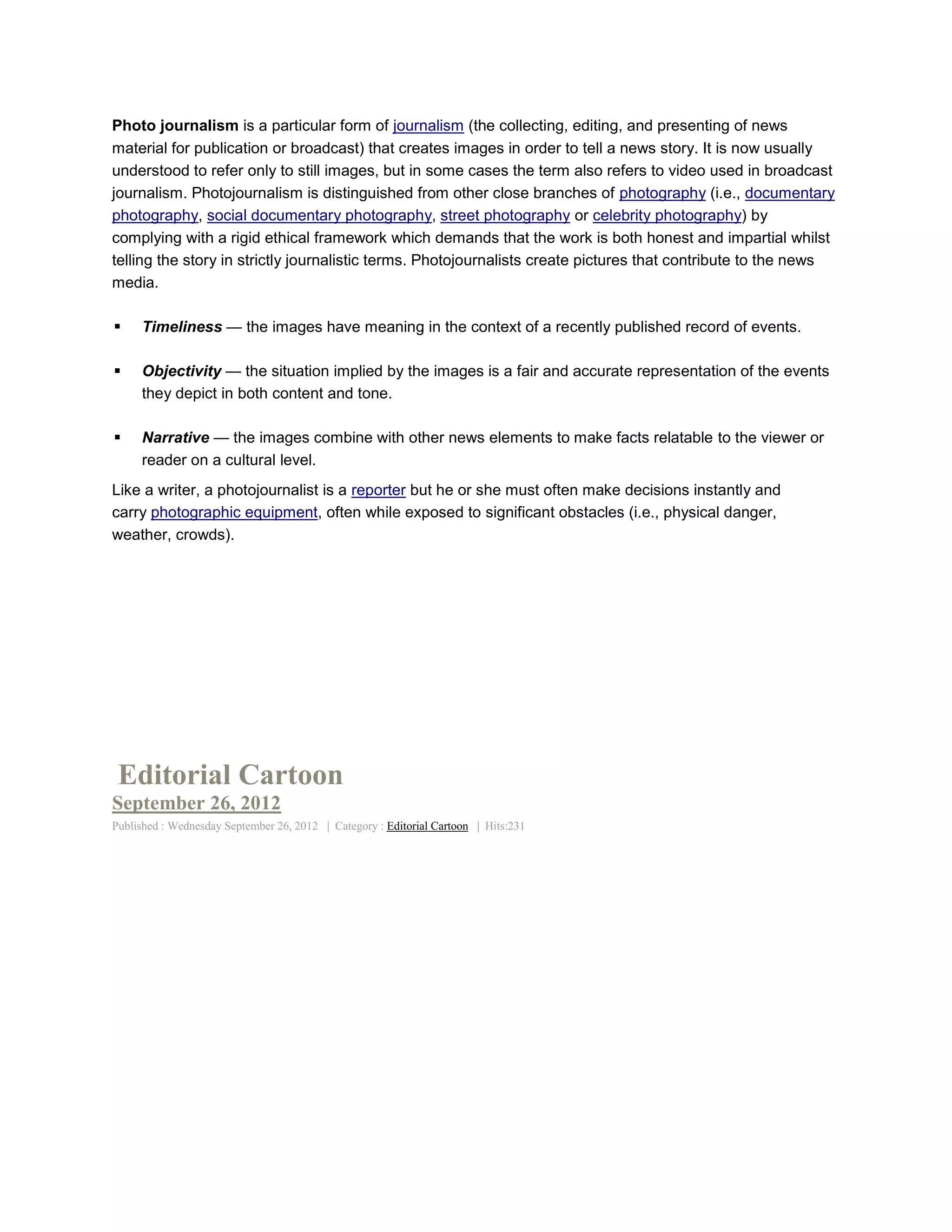
 Editorial Cartoon
September 26, 2012
Published : Wednesday September 26, 2012 | Category : Editorial Cartoon | Hits:231
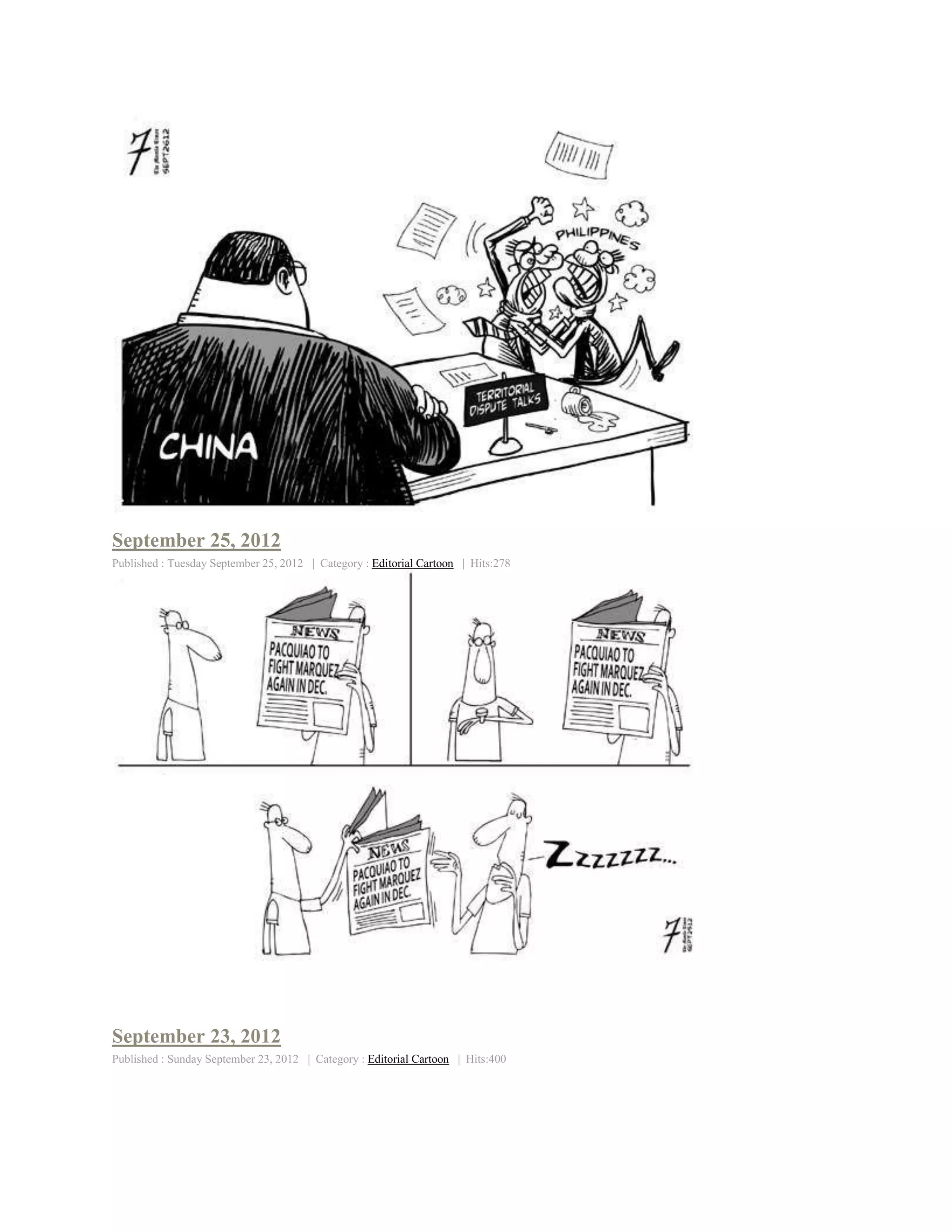
September 25, 2012
Published : Tuesday September 25, 2012 | Category : Editorial Cartoon | Hits:278


September 23, 2012
Published : Sunday September 23, 2012 | Category : Editorial Cartoon | Hits:400
September 22, 2012
Published : Saturday September 22, 2012 | Category : Editorial Cartoon | Hits:385


September 21, 2012
Published : Friday September 21, 2012 | Category : Editorial Cartoon | Hits:387
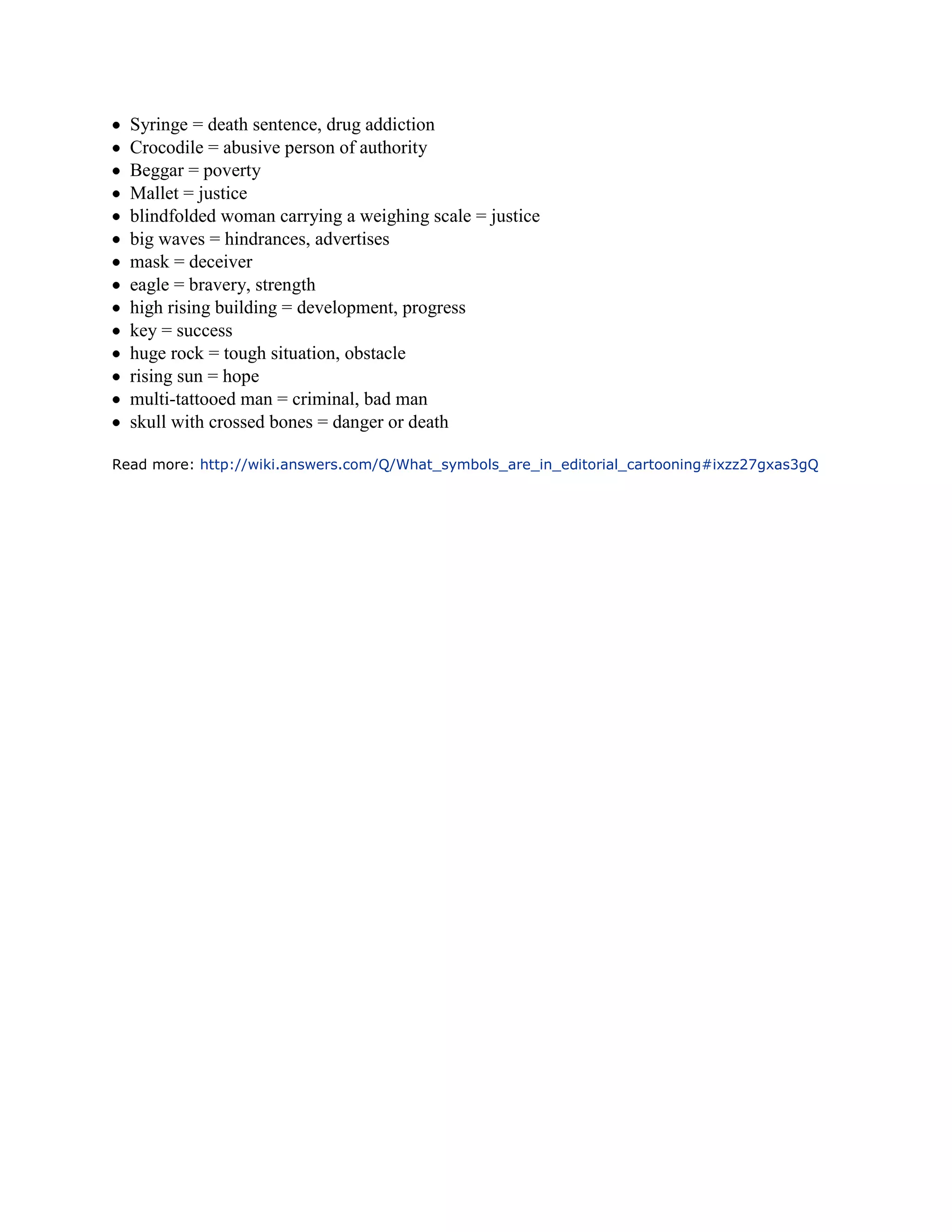
Pencil/Pen/Newspaper = journalism, media
Dove = peace, freedom
Salakot = Juan dela Cruz representing a Filipino citizen
Chain = maltreatment
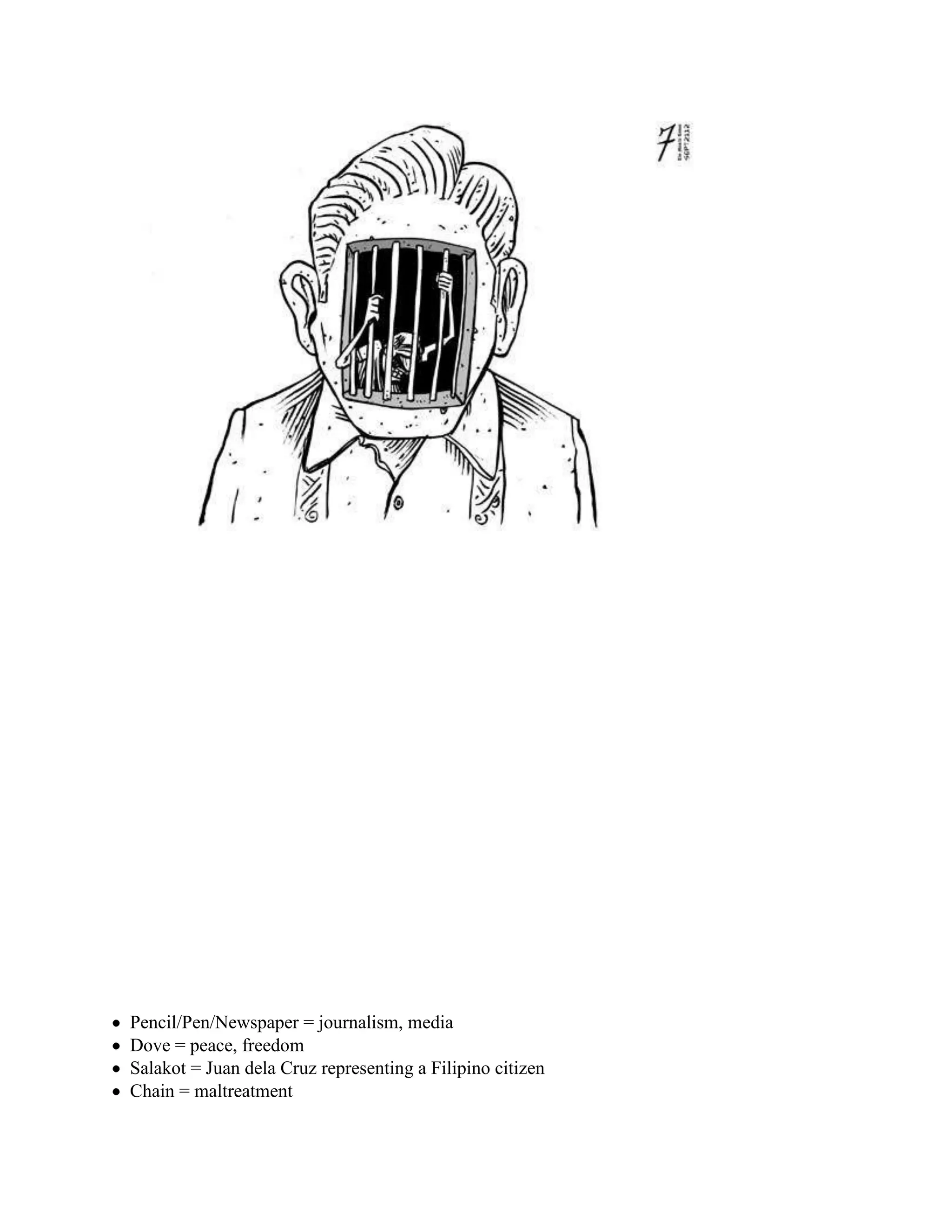
Syringe = death sentence, drug addiction
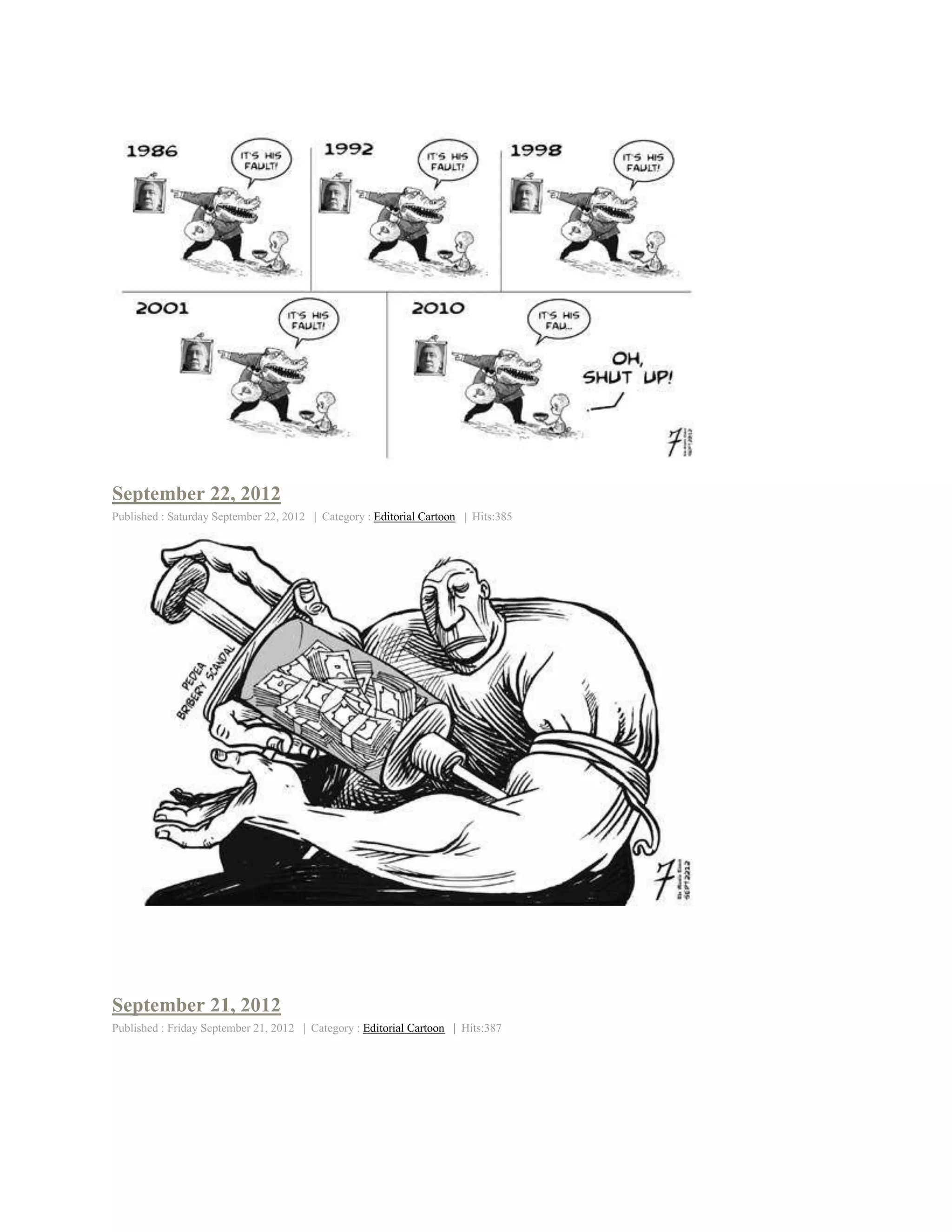
  Crocodile = abusive person of authority
  Beggar = poverty
  Mallet = justice
  blindfolded woman carrying a weighing scale = justice
  big waves = hindrances, advertises
  mask = deceiver
  eagle = bravery, strength
  high rising building = development, progress
  key = success
  huge rock = tough situation, obstacle
  rising sun = hope
  multi-tattooed man = criminal, bad man
  skull with crossed bones = danger or death

Read more: http://wiki.answers.com/Q/What_symbols_are_in_editorial_cartooning#ixzz27gxas3gQ

Writing an editorial

  • 1.
    Writing an Editorial Another Tutorial by: Alan Weintraut Annandale High School Annandale, VA 22312 Atraut@aol.com CHARACTERISTICS OF EDITORIAL WRITING An editorial is an article that presents the newspaper's opinion on an issue. It reflects the majority vote of the editorial board, the governing body of the newspaper made up of editors and business managers. It is usually unsigned. Much in the same manner of a lawyer, editorial writers build on an argument and try to persuade readers to think the same way they do. Editorials are meant to influence public opinion, promote critical thinking, and sometimes cause people to take action on an issue. In essence, an editorial is an opinionated news story. Editorials have: 1. Introduction, body and conclusion like other news stories 2. An objective explanation of the issue, especially complex issues 3. A timely news angle 4. Opinions from the opposing viewpoint that refute directly the same issues the writer addresses 5. The opinions of the writer delivered in a professional manner. Good editorials engage issues, not personalities and refrain from name-calling or other petty tactics of persuasion. 6. Alternative solutions to the problem or issue being criticized. Anyone can gripe about a problem, but a good editorial should take a pro-active approach to making the situation better by using constructive criticism and giving solutions. 7. A solid and concise conclusion that powerfully summarizes the writer's opinion. Give it some punch. Four Types of Editorials Will: 1. Explain or interpret: Editors often use these editorials to explain the way the newspaper covered a sensitive or controversial subject. School newspapers may explain new school rules or a particular student-body effort like a food drive.
  • 2.
    2. Criticize: Theseeditorials constructively criticize actions, decisions or situations while providing solutions to the problem identified. Immediate purpose is to get readers to see the problem, not the solution. 3. Persuade: Editorials of persuasion aim to immediately see the solution, not the problem. From the first paragraph, readers will be encouraged to take a specific, positive action. Political endorsements are good examples of editorials of persuasion. 4. Praise: These editorials commend people and organizations for something done well. They are not as common as the other three. Writing an Editorial 1. Pick a significant topic that has a current news angle and would interest readers. 2. Collect information and facts; include objective reporting; do research 3. State your opinion briefly in the fashion of a thesis statement 4. Explain the issue objectively as a reporter would and tell why this situation is important 5. Give opposing viewpoint first with its quotations and facts 6. Refute (reject) the other side and develop your case using facts, details, figures, quotations. Pick apart the other side's logic. 7. Concede a point of the opposition — they must have some good points you can acknowledge that would make you look rational. 8. Repeat key phrases to reinforce an idea into the reader's minds. 9. Give a realistic solution(s) to the problem that goes beyond common knowledge. Encourage critical thinking and pro-active reaction. 10. Wrap it up in a concluding punch that restates your opening remark (thesis statement). 11. Keep it to 500 words; make every work count; never use "I" A Sample Structure I. Lead with an Objective Explanation of the Issue/Controversy. Include the five W's and the H. (Members of Congress, in effort to reduce the budget, are looking to cut funding from public television. Hearings were held …) Pull in facts and quotations from the sources which are relevant. Additional research may be necessary. II. Present Your Opposition First. As the writer you disagree with these viewpoints. Identify the people (specifically
  • 3.
    who oppose you.(Republicans feel that these cuts are necessary; other cable stations can pick them; only the rich watch public television.) Use facts and quotations to state objectively their opinions. Give a strong position of the opposition. You gain nothing in refuting a weak position.
  • 4.
    III. Directly RefuteThe Opposition's Beliefs. You can begin your article with transition. (Republicans believe public televison is a "sandbox for the rich." However, statistics show most people who watch public television make less than $40,000 per year.) Pull in other facts and quotations from people who support your position. Concede a valid point of the opposition which will make you appear rational, one who has considered all the options (fiscal times are tough, and we can cut some of the funding for the arts; however, …). IV. Give Other, Original Reasons/Analogies In defense of your position, give reasons from strong to strongest order. (Taking money away from public television is robbing children of their education …) Use a literary or cultural allusion that lends to your credibility and perceived intelligence (We should render unto Caesar that which belongs to him …) V. Conclude With Some Punch. Give solutions to the problem or challenge the reader to be informed. (Congress should look to where real wastes exist — perhaps in defense and entitlements — to find ways to save money. Digging into public television's pocket hurts us all.) A quotation can be effective, especially if from a respected source A rhetorical question can be an effective concluder as well (If the government doesn't defend the interests of children, who will?) Go to the library or any computer lab and complete the “webquest” located at
  • 5.
    Sample Editorial A True Follower “It is hard to have leadership when you have a divided followership”. Gloria Resign! Oust Gloria! Impeached GMA! These statements have been avid visual flicks in our streets nowadays. The day our President made a public statement and apologizes to the Filipino people has been a political and social turmoil. It did not only affect our economy but it also made us Filipinos barbaric in such a way that justice seems a far-fetched ignorance. Protests here, political rally there, and social activism everywhere. In effect of this social unrest cause by idealistic militants, the President humbled herself by quoting the second letter of St. Paul to the Corinthians for the Filipino people, “I cannot boast about myself except about my weaknesses.” But for the ordinary Filipinos who seemed pushed by political opportunists and economic saboteurs, this humbleness seemed not enough. What has come to us? Have we not learned the lessons from the two previous mass-revolts we have launched? Are our streets the new place where we can seek justice? Or are we just bleak and hopeless followers in the verge of social downfall? The answer to this to this candid questions lies beneath the essence of a true follower. What is a true follower? What makes a good follower? Followership according to the pessimist’s point of view signifies subjection and execution of an order a leader makes. These characteristics beleaguer an attention that one must fully conceptualized and understand. A proactive follower also demonstrates a great respect and thinks a win-win solution, and at the same time gaining the trust and confidence of his leader. An abled follower thinks and works within a system; which in our present social case is our legalized Philippine constitution; based on a set of values that a society dictates for our own common good. The most important characteristic of a follower is the willingness to tell the truth. A truth that speaks the voice of the majority. A truth that coincides with fair justice. A truth that leads to the uplifting of a unified nation under the guidance of the moral values we have. But be reminded that the truth hurts. It’s a complex word full of power and pain. It can shutter ones mind and aura to the extent of one’s downfall and seizure. However, followers who tell the truth and leaders who listen to it are an unbeatable combination. But this does that not include the “extra-constitutional means” of forcing down a duly elected public official to resign against not only to her well but also to the mandate of the Filipino majority. However, there is one thing that totally confuses my young and arable mind. In the principles of ideal followership, one must recognize the authority a leader possesses. A recognition that requires great respect given to the leader itself. Now then, can we be both an upbeat follower at the same time tailoring our actions and beliefs to accord with the leaders’ position? Or can we be just like the bamboo tree, able to change its side to the strung of the winds? Whatever is your answer, one thing is for sure, leaders need its followers; followers too need their leaders. It’s a symbiotic process that is proven and tested since time immemorial. The present social and political crisis we Filipinos currently face needs constant attention both from our leaders and we as their followers inorder to attain our vision. A vision to bring moral enrichment for our ailing nation! A vision to achieve an end to political bickering that is causing us much harm!
  • 6.
    We are notexperiencing a leadership crisis but a follower’s predicament. Indeed, inorder for us to step forward, we must be a true follower first! How To Become an Editorial Writer By Ranier Allen Editorial writers are savvy people who want to seek the truth in every situation, whether it is in world events or politics; sharing opinions with their readers and backing them up with facts and examples that help the reader agree or disagree with the editorial writer! If you are interested in pursuing a career as an editorial writer, here is how. It is necessary to have a good educational background for any type of writing business; further your education by joining journalism courses that relate to basic writing for print media, specific editorial writing courses or any kind of editing courses, to gain necessary skills. Getting a degree in journalism will help build a strong background on how to write effective editorials. Hone your writing skills by starting to write and keeping at it! You could also try to write a letter to the editor of your local newspapers which will gain you necessary recognition by editors. Start in the newsroom; most successful editorial writers started with being reporters! Be open minded to new learning and work your way into the editorial department. Ads by Google InDesign Development Custom InDesign plug-in development www.65bit.com Online Writing Courses Learn Crime Writing Skills Online 9 Quality Modules - Start Today! www.primewritingacademy.com Jobs Toronto 5 urgent open positions. Apply now! Jobs Toronto jobrapido.com/jobs+toronto Become a voracious reader of what’s going around both at home and abroad; this will help you in providing accurate details and lively commentary on current events. Before you start to write identify your audience. This will help you write a strong, focused editorial that answers the concerns of your audience to the point. For example, if you are writing an editorial on sports, you must have a basic understanding of your reader’s knowledge on this topic. Are they familiar with the sport you are discussing? Are they going to let you simply jump into your idea about the sport? Or will you need to start with the basics?
  • 7.
    It is equallynecessary for you to ask questions. Seeking answers to your doubts will give you a better understanding if you were to write commentary on the world around you. Be concise and write to the point in order to keep your readers interested. Conforming to journalistic style to a certain degree while writing editorials is good, but you must create your own unique voice! Your style will set you apart from other editorial writers/competitors. Tips Know your audience Writing is an art, it is necessary to polish this art periodically; work hard and daily to improve your skills as an editorial writer.
  • 8.
    Photo journalism isa particular form of journalism (the collecting, editing, and presenting of news material for publication or broadcast) that creates images in order to tell a news story. It is now usually understood to refer only to still images, but in some cases the term also refers to video used in broadcast journalism. Photojournalism is distinguished from other close branches of photography (i.e., documentary photography, social documentary photography, street photography or celebrity photography) by complying with a rigid ethical framework which demands that the work is both honest and impartial whilst telling the story in strictly journalistic terms. Photojournalists create pictures that contribute to the news media.  Timeliness — the images have meaning in the context of a recently published record of events.  Objectivity — the situation implied by the images is a fair and accurate representation of the events they depict in both content and tone.  Narrative — the images combine with other news elements to make facts relatable to the viewer or reader on a cultural level. Like a writer, a photojournalist is a reporter but he or she must often make decisions instantly and carry photographic equipment, often while exposed to significant obstacles (i.e., physical danger, weather, crowds). Editorial Cartoon September 26, 2012 Published : Wednesday September 26, 2012 | Category : Editorial Cartoon | Hits:231
  • 9.
    September 25, 2012 Published: Tuesday September 25, 2012 | Category : Editorial Cartoon | Hits:278 September 23, 2012 Published : Sunday September 23, 2012 | Category : Editorial Cartoon | Hits:400
  • 10.
    September 22, 2012 Published: Saturday September 22, 2012 | Category : Editorial Cartoon | Hits:385 September 21, 2012 Published : Friday September 21, 2012 | Category : Editorial Cartoon | Hits:387
  • 11.
    Pencil/Pen/Newspaper = journalism,media Dove = peace, freedom Salakot = Juan dela Cruz representing a Filipino citizen Chain = maltreatment
  • 12.
    Syringe = deathsentence, drug addiction Crocodile = abusive person of authority Beggar = poverty Mallet = justice blindfolded woman carrying a weighing scale = justice big waves = hindrances, advertises mask = deceiver eagle = bravery, strength high rising building = development, progress key = success huge rock = tough situation, obstacle rising sun = hope multi-tattooed man = criminal, bad man skull with crossed bones = danger or death Read more: http://wiki.answers.com/Q/What_symbols_are_in_editorial_cartooning#ixzz27gxas3gQ