The Backward design
An instructional design approach
starting with the end…
… my own summary…
Jaime Oyarzo
What is Understanding by Design?
A framework for improving
student achievement,
emphasizing the teacher's critical role
as a designer of student learning
Understanding by Design® is based on
• A primary goal of education: development
and deepening of student understanding
• Student’s understanding increase with
opportunities to explain, interpret, apply, shift
perspective, empathize, and self-assess
• Effective curriculum development: a three-
stage design process called "backward design"
…what is not working?
• Too many students learn without thinking
• Instruction has become a teacher’s repeating
activity
• The course is NOT
– The textbook (this is a resource)
– The activities (these are the steps)
– The content (this is to be mastered)
• There is a big difference between just knowing
and understanding
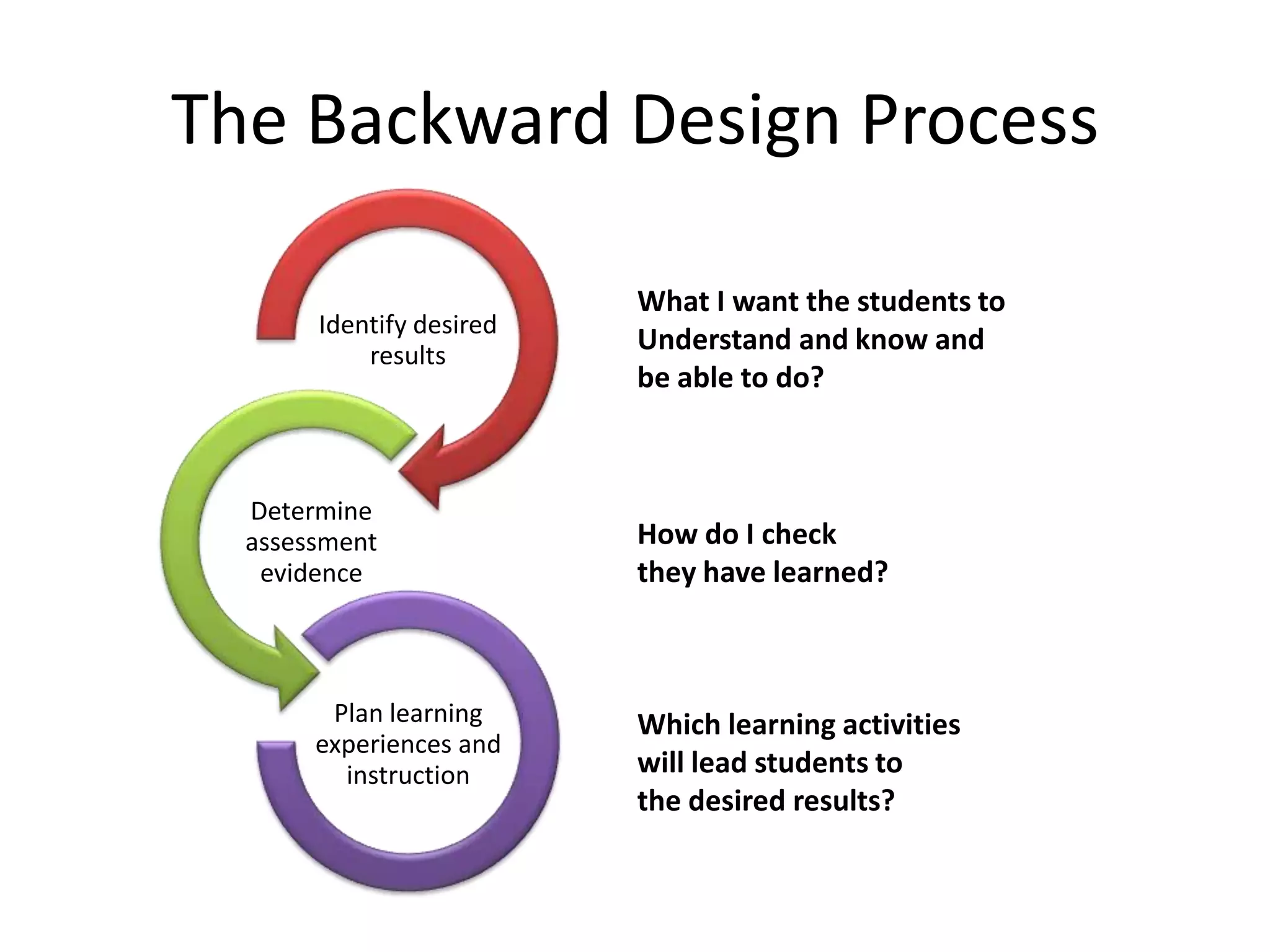
The Backward Design Process
Identify desired
results
Determine
assessment
evidence
Plan learning
experiences and
instruction
What I want the students to
Understand and know and
be able to do?
How do I check
they have learned?
Which learning activities
will lead students to
the desired results?
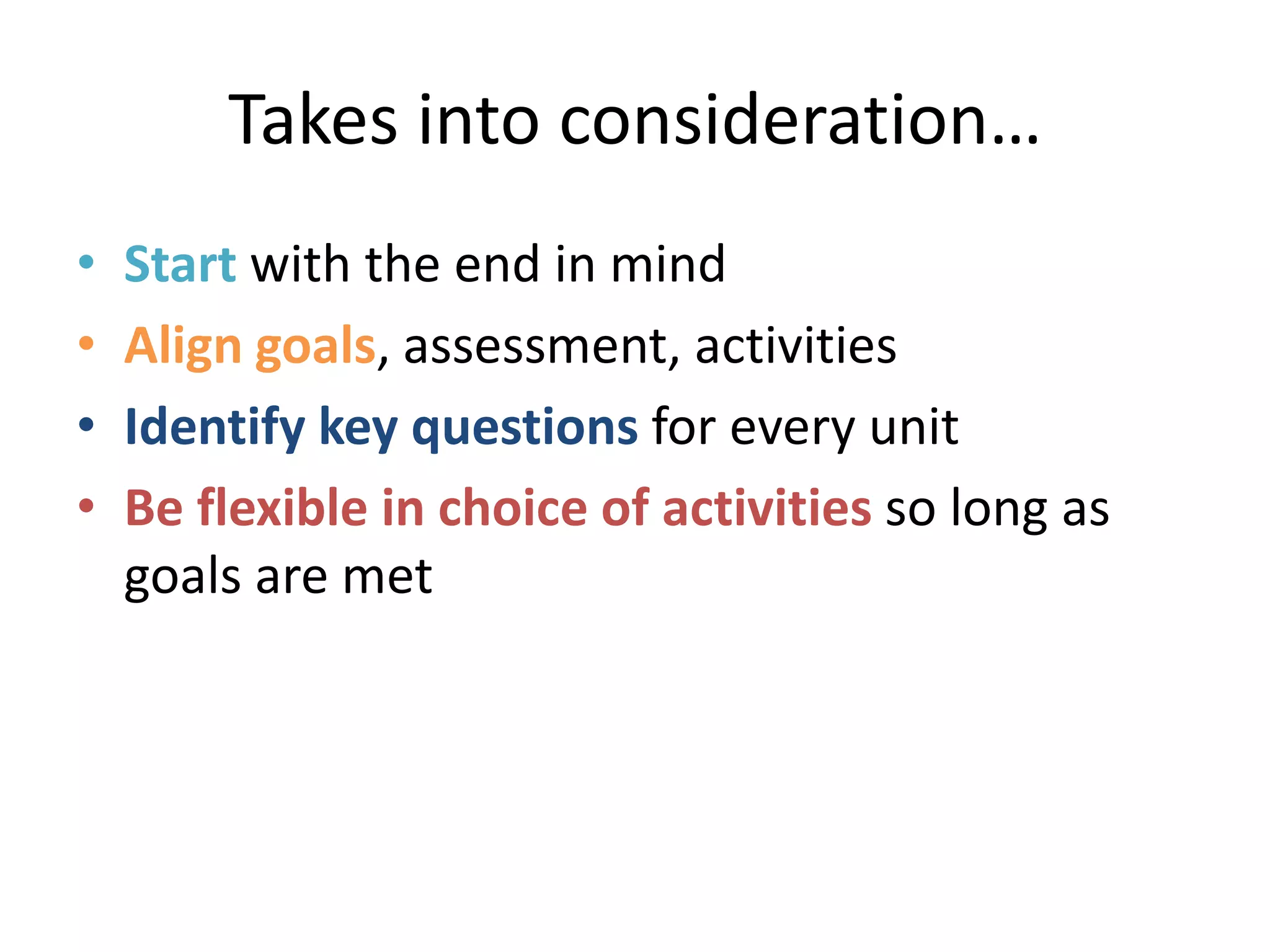
Takes into consideration…
• Start with the end in mind
• Align goals, assessment, activities
• Identify key questions for every unit
• Be flexible in choice of activities so long as
goals are met
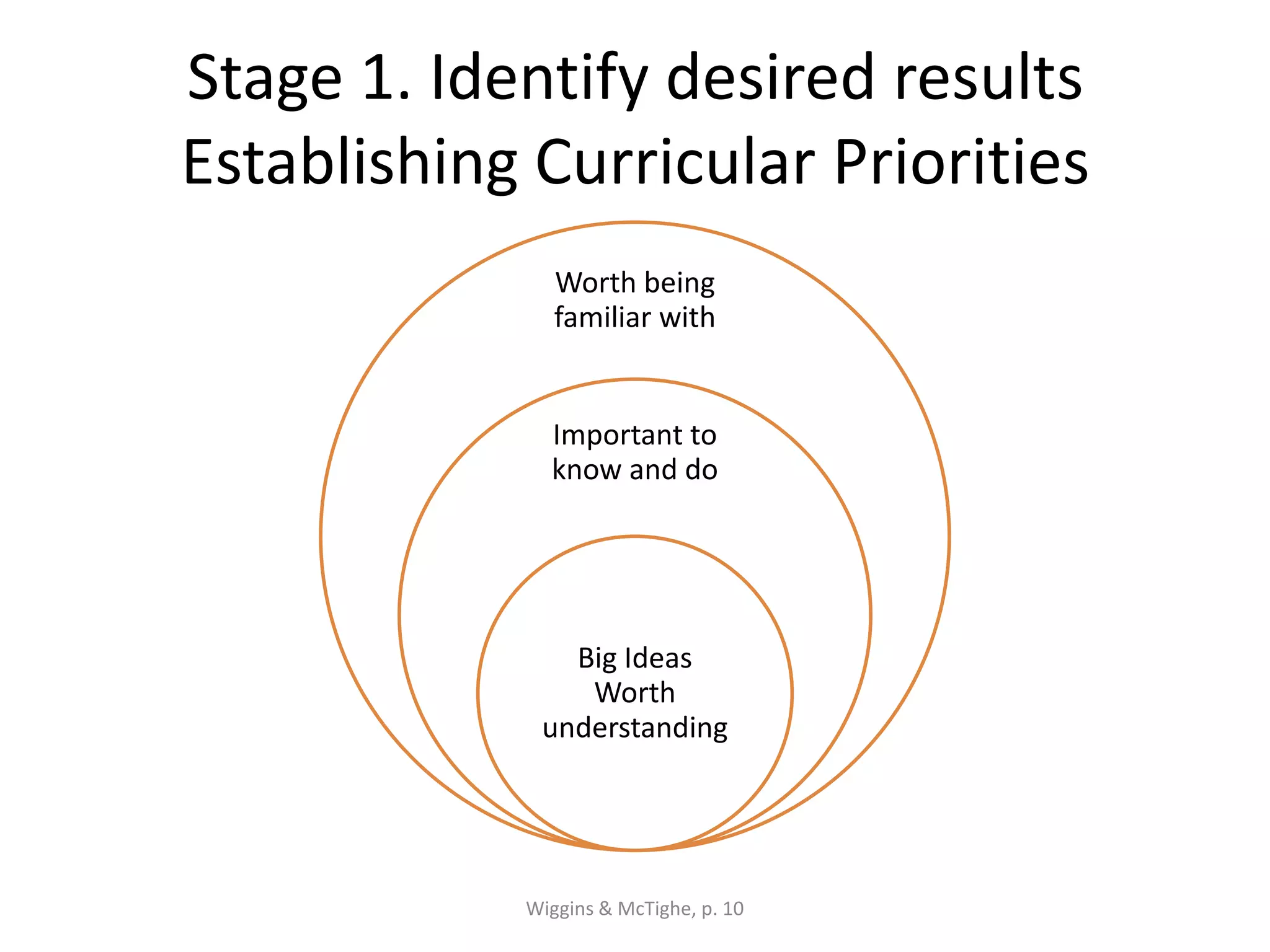
Stage 1. Identify desired results
Establishing Curricular Priorities
Worth being
familiar with
Important to
know and do
Big Ideas
Worth
understanding
Wiggins & McTighe, p. 10
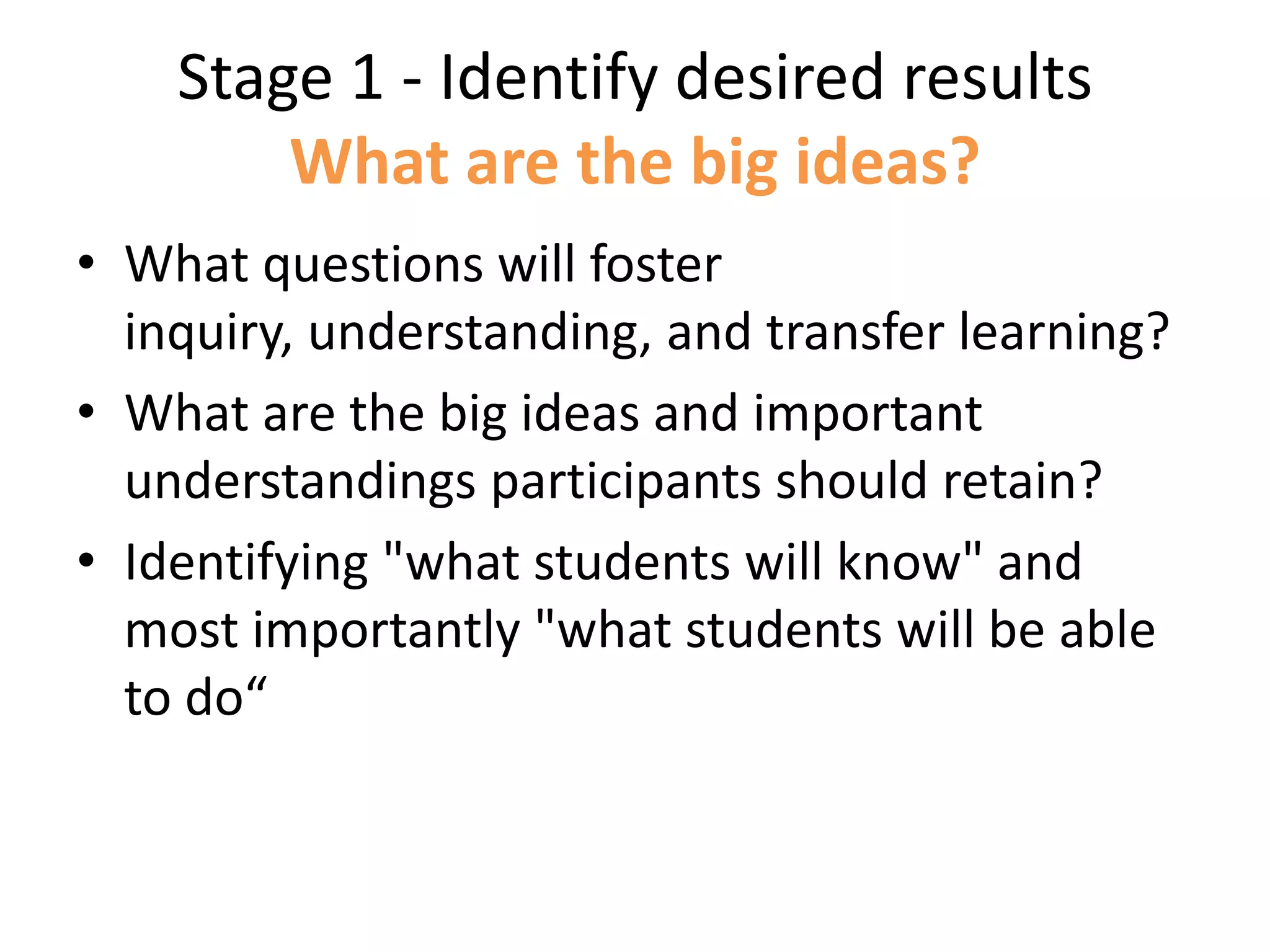
Stage 1 - Identify desired results
What are the big ideas?
• What questions will foster
inquiry, understanding, and transfer learning?
• What are the big ideas and important
understandings participants should retain?
• Identifying "what students will know" and
most importantly "what students will be able
to do“
Stage 1 - Identify desired results
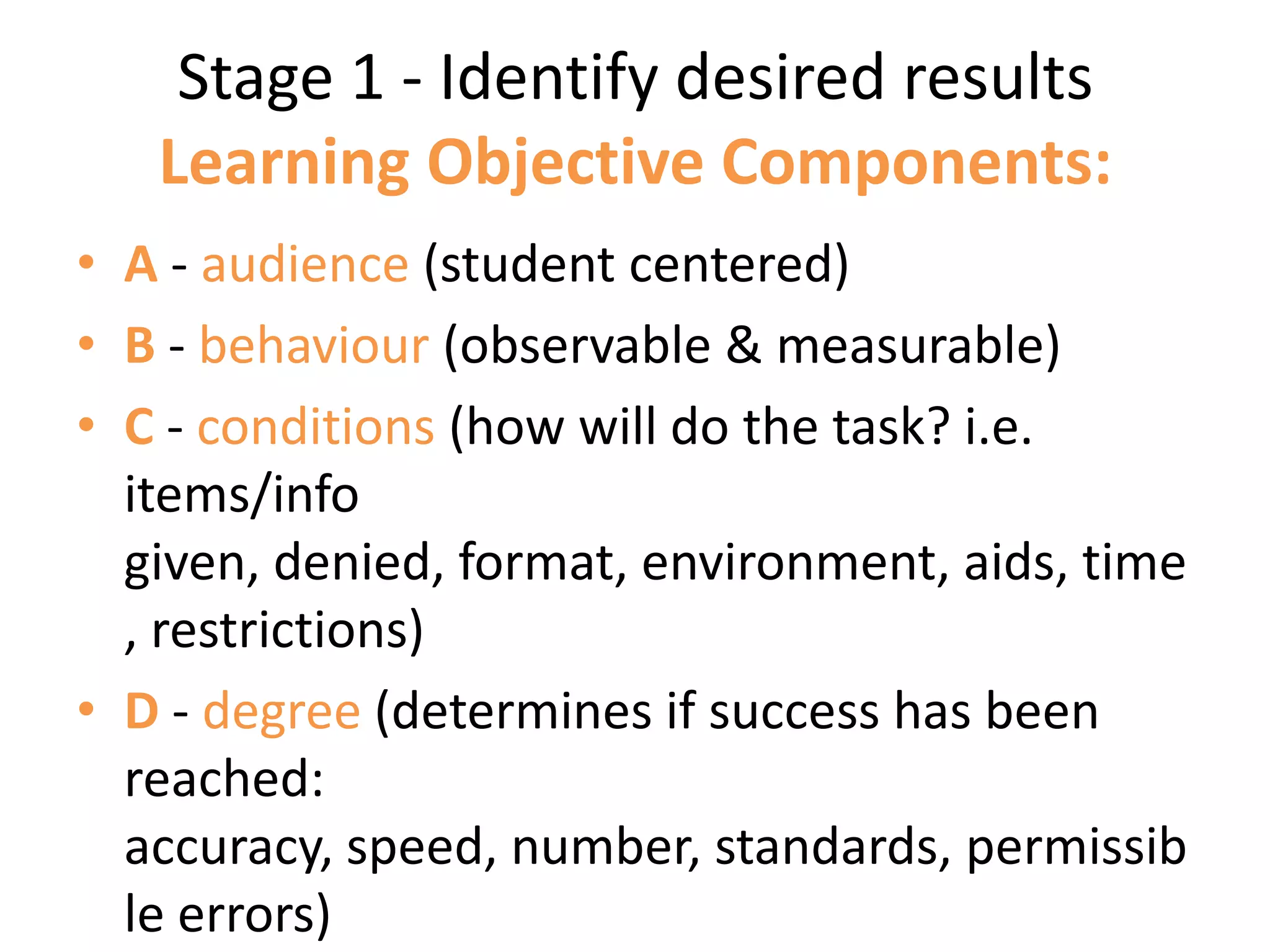
Learning Objective Components:
• A - audience (student centered)
• B - behaviour (observable & measurable)
• C - conditions (how will do the task? i.e.
items/info
given, denied, format, environment, aids, time
, restrictions)
• D - degree (determines if success has been
reached:
accuracy, speed, number, standards, permissib
le errors)
Stage 1 - Identify desired results
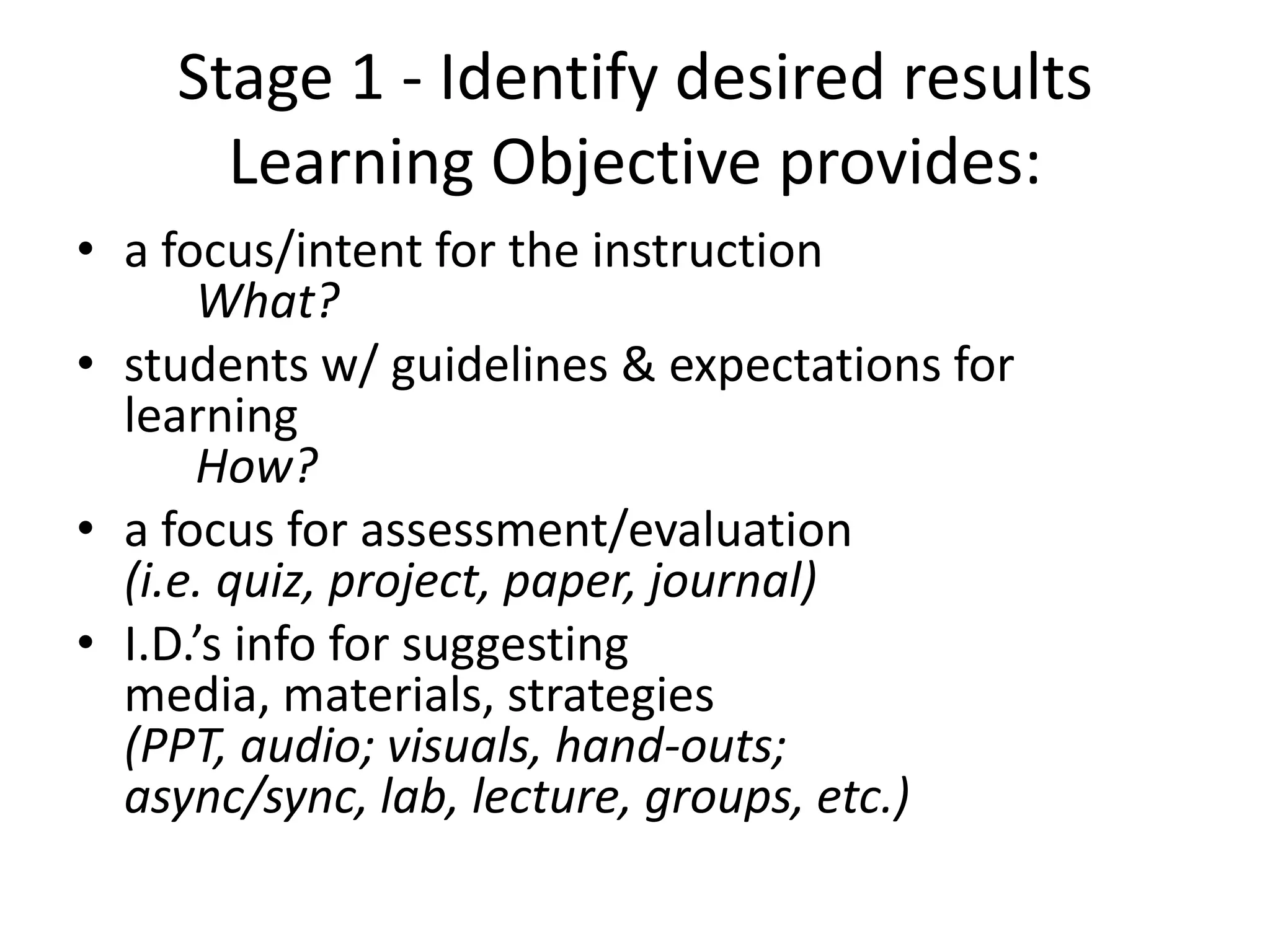
Learning Objective provides:
• a focus/intent for the instruction
What?
• students w/ guidelines & expectations for
learning
How?
• a focus for assessment/evaluation
(i.e. quiz, project, paper, journal)
• I.D.’s info for suggesting
media, materials, strategies
(PPT, audio; visuals, hand-outs;
async/sync, lab, lecture, groups, etc.)
Stage 1 - Identify desired results
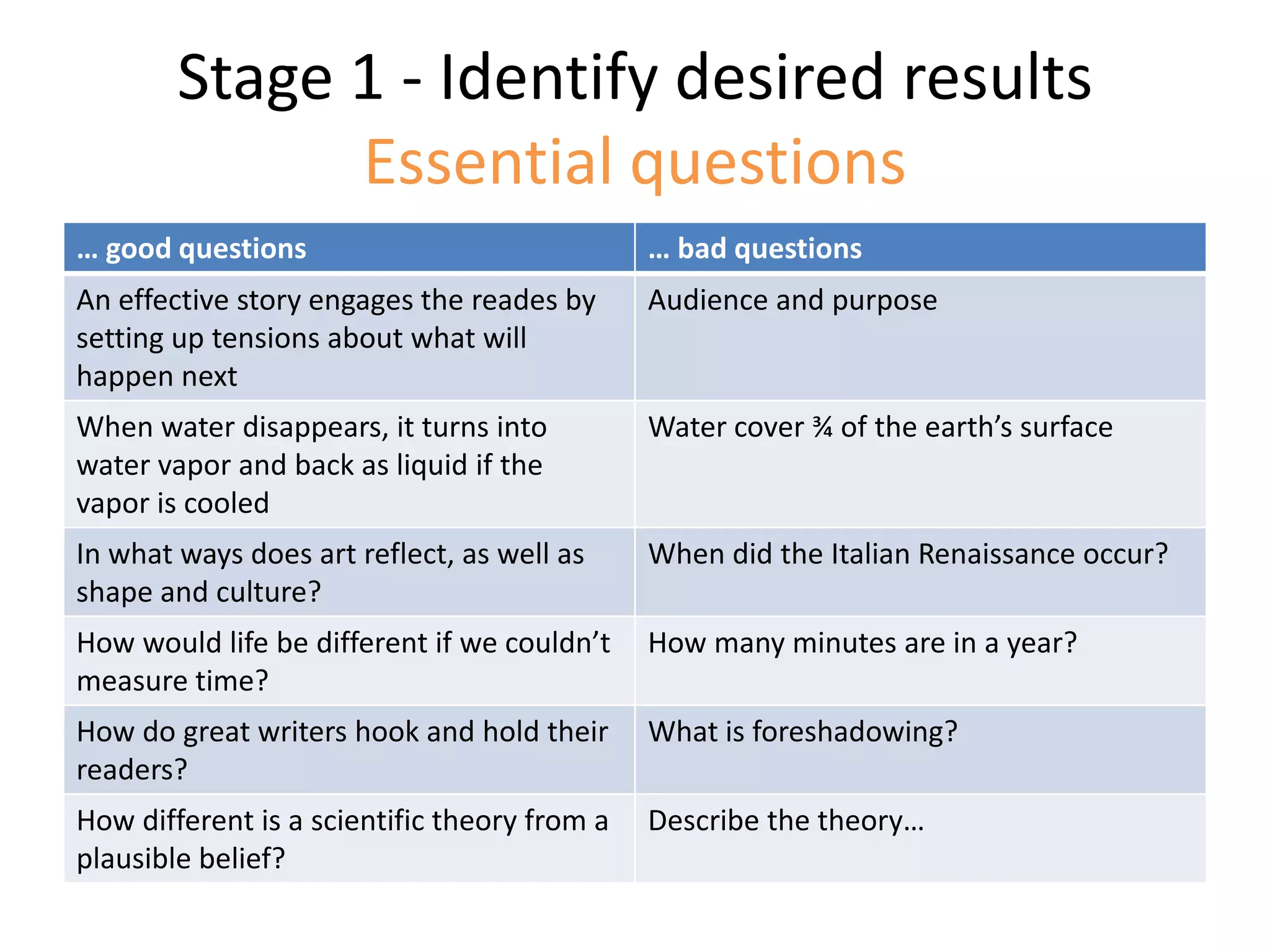
Essential questions
… good questions … bad questions
An effective story engages the reades by
setting up tensions about what will
happen next
Audience and purpose
When water disappears, it turns into
water vapor and back as liquid if the
vapor is cooled
Water cover ¾ of the earth’s surface
In what ways does art reflect, as well as
shape and culture?
When did the Italian Renaissance occur?
How would life be different if we couldn’t
measure time?
How many minutes are in a year?
How do great writers hook and hold their
readers?
What is foreshadowing?
How different is a scientific theory from a
plausible belief?
Describe the theory…
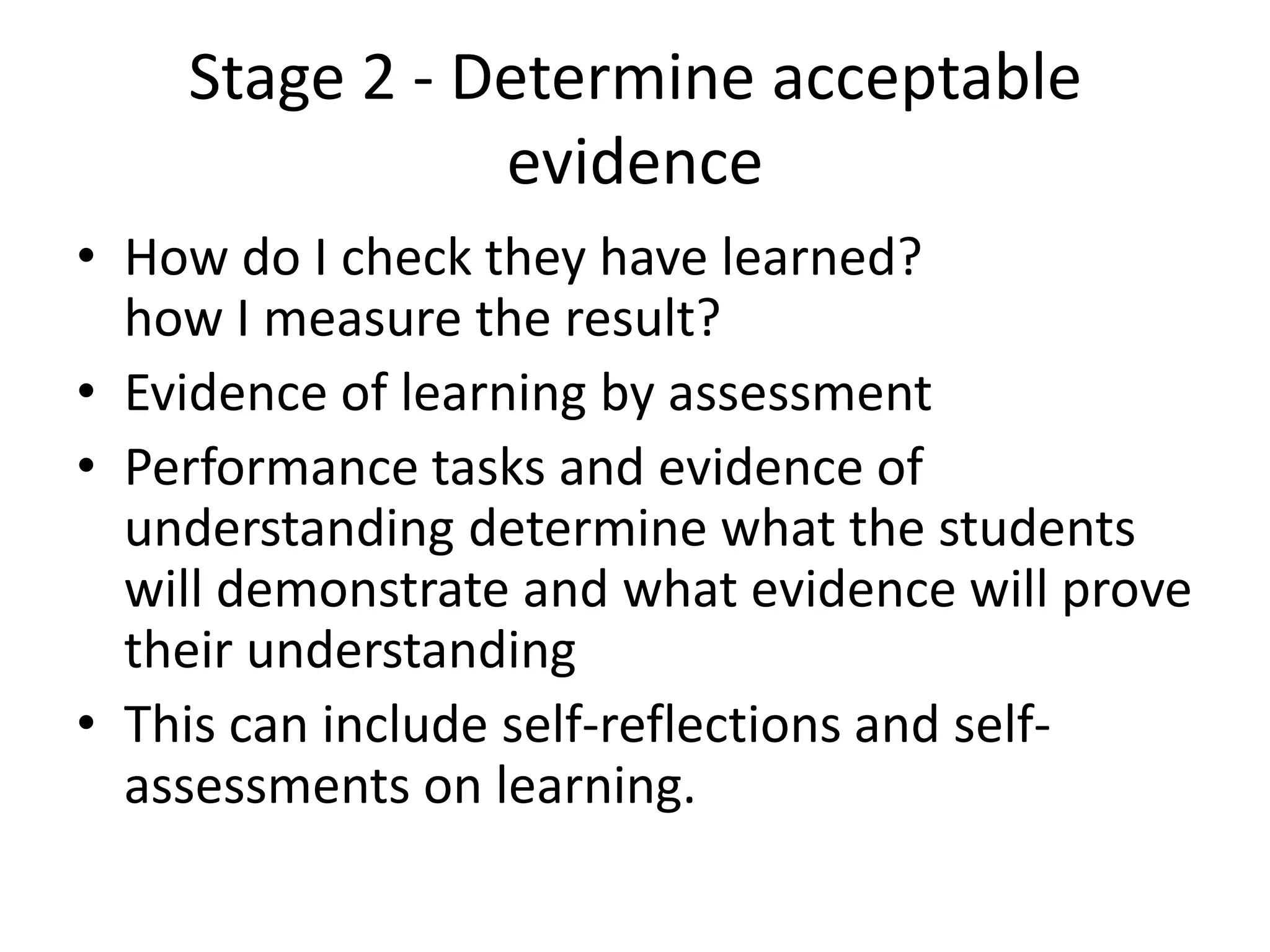
Stage 2 - Determine acceptable
evidence
• How do I check they have learned?
how I measure the result?
• Evidence of learning by assessment
• Performance tasks and evidence of
understanding determine what the students
will demonstrate and what evidence will prove
their understanding
• This can include self-reflections and self-
assessments on learning.
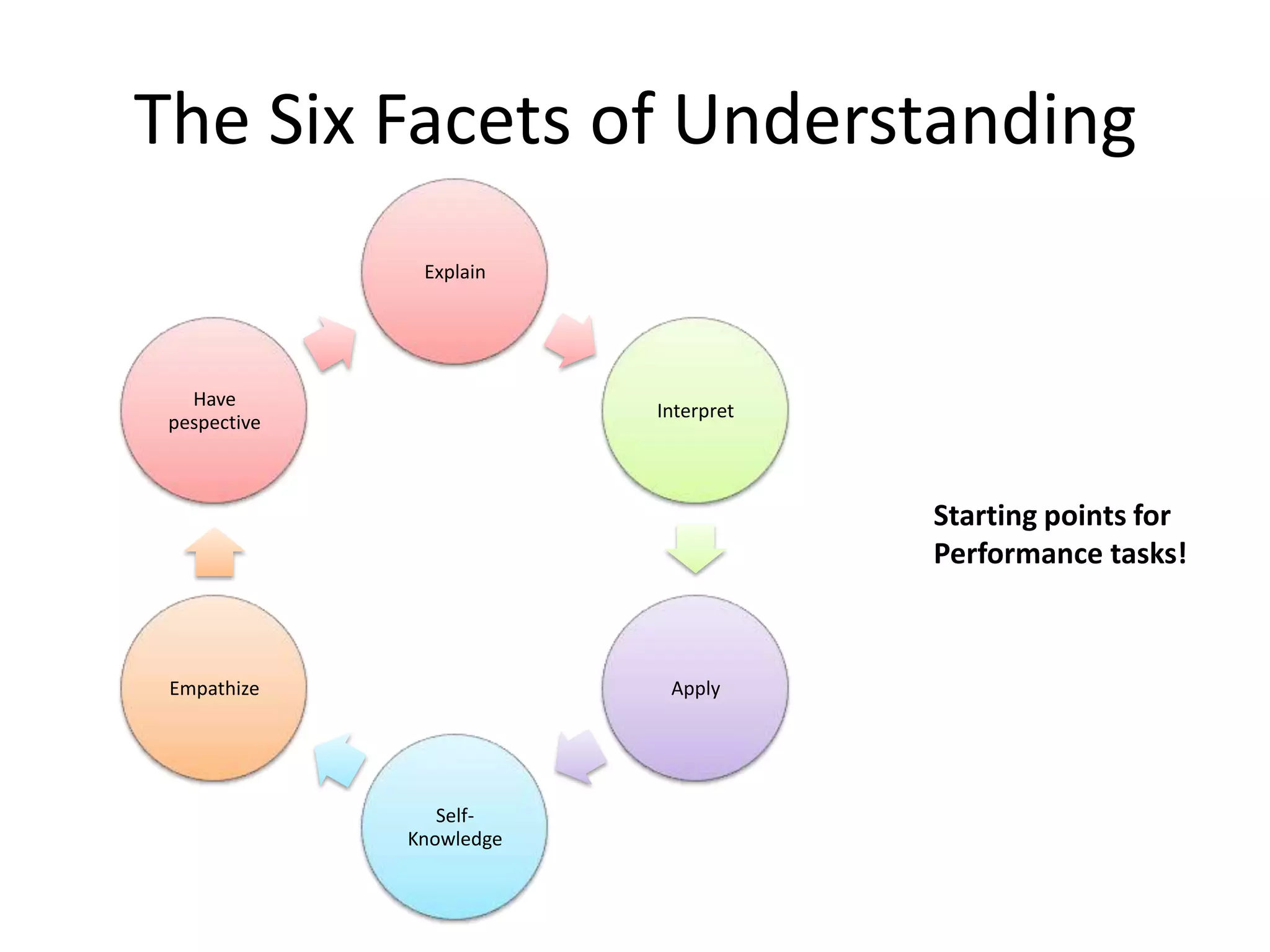
The Six Facets of Understanding
Explain
Interpret
Apply
Self-
Knowledge
Empathize
Have
pespective
Starting points for
Performance tasks!
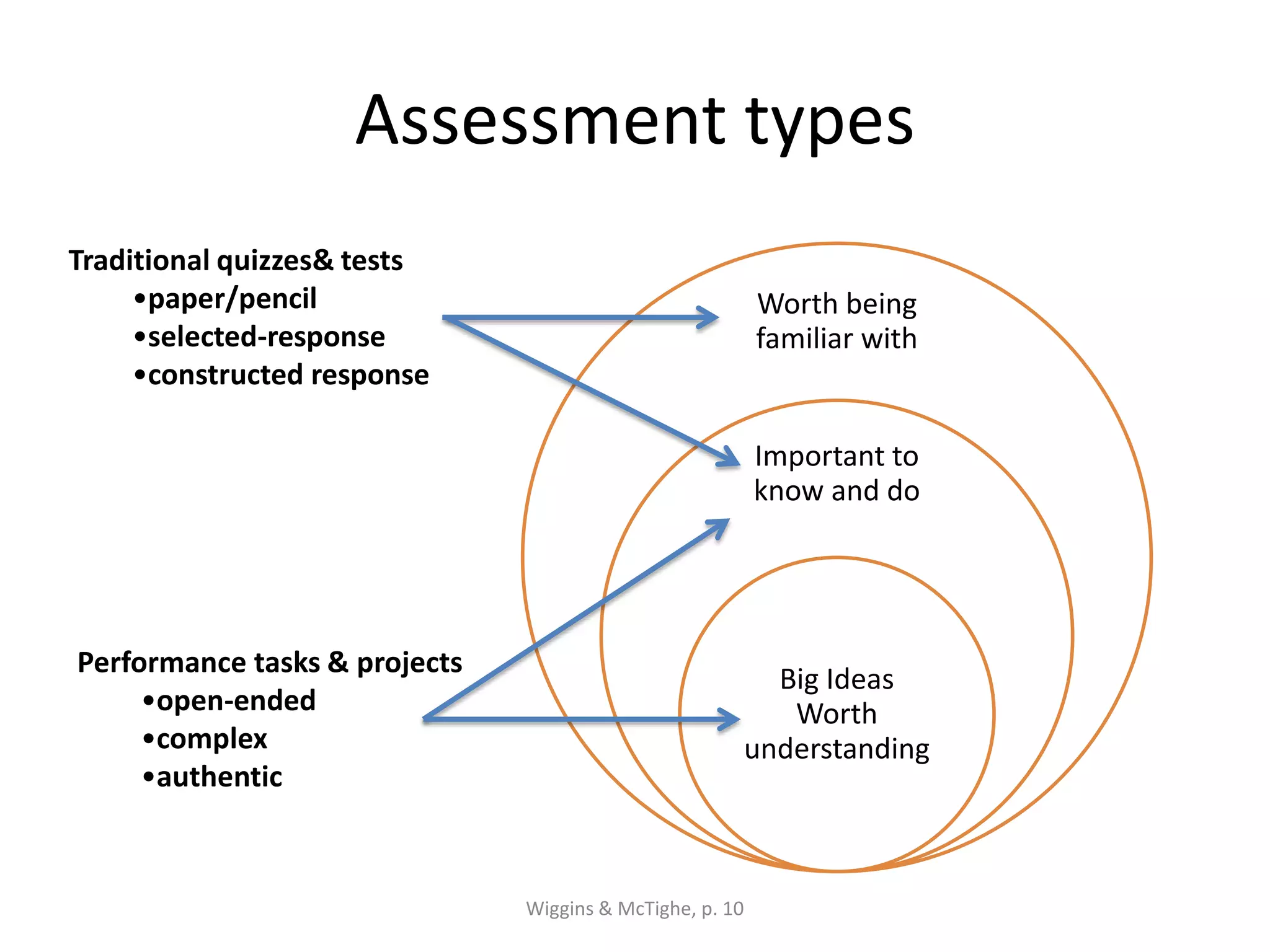
Assessment types
Worth being
familiar with
Important to
know and do
Big Ideas
Worth
understanding
Traditional quizzes& tests
•paper/pencil
•selected-response
•constructed response
Performance tasks & projects
•open-ended
•complex
•authentic
Wiggins & McTighe, p. 10
Stage 3 - Plan learning experiences
&instruction
• How do I teach to achieve the learning
outcomes?
• How will students be “hooked”?
• Lists the learning activities that will lead
students to your desired results
• How will the work be “tailored” to individual
interest and learning styles?
Stage 3 - Plan Activities, Experiences
&instruction
• What is the enabling…needed to perform effectively
and achieve desired results?
• What needs to be taught and coached?
Determine the content
• How should it best be taught?
– Instructional Strategies
• What activities will equip students with these needed
knowledge and skills?
• What materials and resources are best suited to
accomplish these desired results/goals?
• Is the learning plan effective and engaging?
Backward Design Results
If followed completely and correctly … students
should be able to answer the following questions:
• What are you doing?
• Why are you being asked to do it?
• What will it help you do?
• How does it fit into what you have previously
done?
• How will you show that you have learned it?
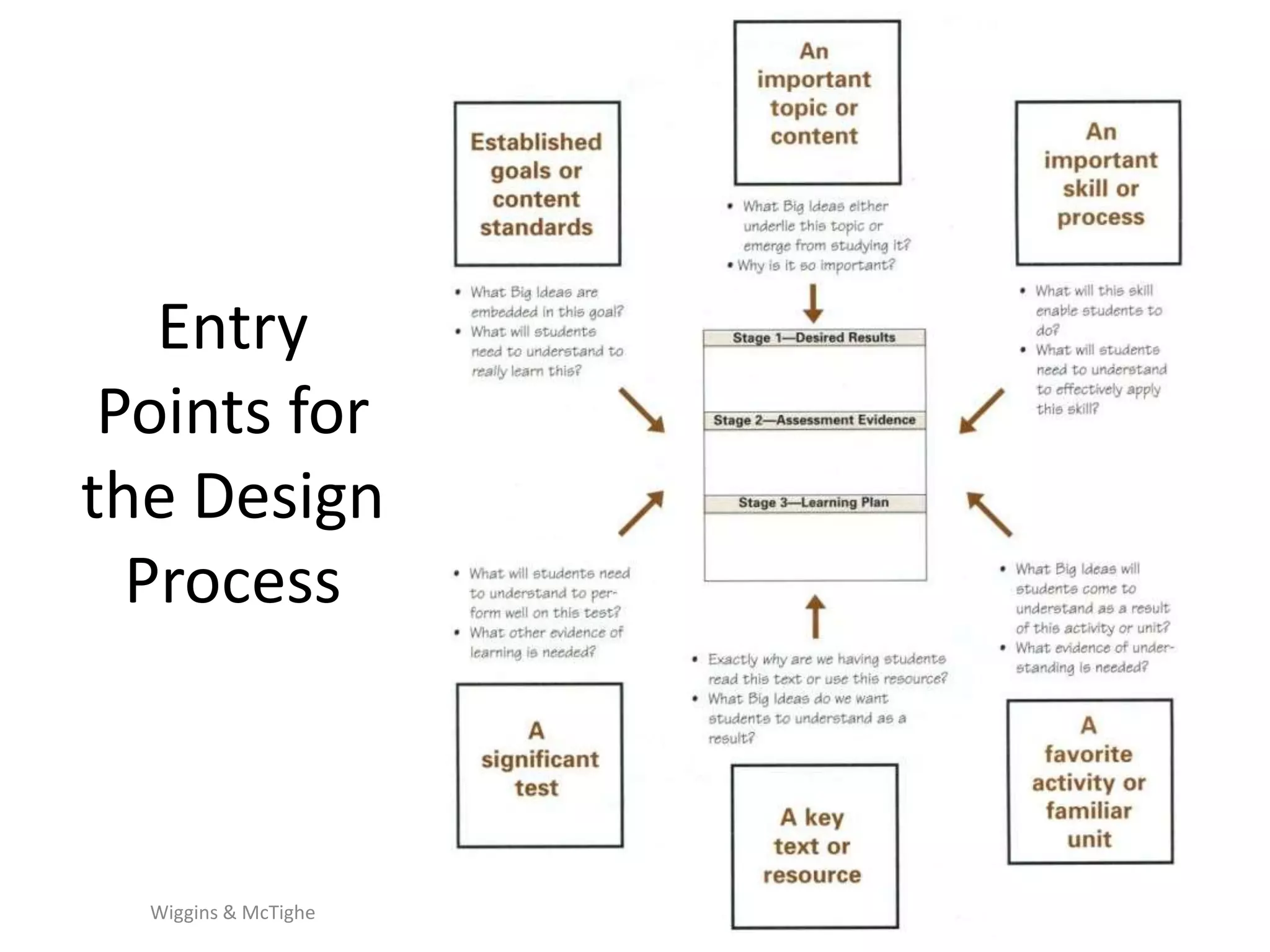
Entry
Points for
the Design
Process
Wiggins & McTighe

The Backward Design

  • 1.
    The Backward design Aninstructional design approach starting with the end… … my own summary… Jaime Oyarzo
  • 2.
    What is Understandingby Design? A framework for improving student achievement, emphasizing the teacher's critical role as a designer of student learning
  • 3.
    Understanding by Design®is based on • A primary goal of education: development and deepening of student understanding • Student’s understanding increase with opportunities to explain, interpret, apply, shift perspective, empathize, and self-assess • Effective curriculum development: a three- stage design process called "backward design"
  • 4.
    …what is notworking? • Too many students learn without thinking • Instruction has become a teacher’s repeating activity • The course is NOT – The textbook (this is a resource) – The activities (these are the steps) – The content (this is to be mastered) • There is a big difference between just knowing and understanding
  • 5.
    The Backward DesignProcess Identify desired results Determine assessment evidence Plan learning experiences and instruction What I want the students to Understand and know and be able to do? How do I check they have learned? Which learning activities will lead students to the desired results?
  • 6.
    Takes into consideration… •Start with the end in mind • Align goals, assessment, activities • Identify key questions for every unit • Be flexible in choice of activities so long as goals are met
  • 7.
    Stage 1. Identifydesired results Establishing Curricular Priorities Worth being familiar with Important to know and do Big Ideas Worth understanding Wiggins & McTighe, p. 10
  • 8.
    Stage 1 -Identify desired results What are the big ideas? • What questions will foster inquiry, understanding, and transfer learning? • What are the big ideas and important understandings participants should retain? • Identifying "what students will know" and most importantly "what students will be able to do“
  • 9.
    Stage 1 -Identify desired results Learning Objective Components: • A - audience (student centered) • B - behaviour (observable & measurable) • C - conditions (how will do the task? i.e. items/info given, denied, format, environment, aids, time , restrictions) • D - degree (determines if success has been reached: accuracy, speed, number, standards, permissib le errors)
  • 10.
    Stage 1 -Identify desired results Learning Objective provides: • a focus/intent for the instruction What? • students w/ guidelines & expectations for learning How? • a focus for assessment/evaluation (i.e. quiz, project, paper, journal) • I.D.’s info for suggesting media, materials, strategies (PPT, audio; visuals, hand-outs; async/sync, lab, lecture, groups, etc.)
  • 11.
    Stage 1 -Identify desired results Essential questions … good questions … bad questions An effective story engages the reades by setting up tensions about what will happen next Audience and purpose When water disappears, it turns into water vapor and back as liquid if the vapor is cooled Water cover ¾ of the earth’s surface In what ways does art reflect, as well as shape and culture? When did the Italian Renaissance occur? How would life be different if we couldn’t measure time? How many minutes are in a year? How do great writers hook and hold their readers? What is foreshadowing? How different is a scientific theory from a plausible belief? Describe the theory…
  • 12.
    Stage 2 -Determine acceptable evidence • How do I check they have learned? how I measure the result? • Evidence of learning by assessment • Performance tasks and evidence of understanding determine what the students will demonstrate and what evidence will prove their understanding • This can include self-reflections and self- assessments on learning.
  • 13.
    The Six Facetsof Understanding Explain Interpret Apply Self- Knowledge Empathize Have pespective Starting points for Performance tasks!
  • 14.
    Assessment types Worth being familiarwith Important to know and do Big Ideas Worth understanding Traditional quizzes& tests •paper/pencil •selected-response •constructed response Performance tasks & projects •open-ended •complex •authentic Wiggins & McTighe, p. 10
  • 15.
    Stage 3 -Plan learning experiences &instruction • How do I teach to achieve the learning outcomes? • How will students be “hooked”? • Lists the learning activities that will lead students to your desired results • How will the work be “tailored” to individual interest and learning styles?
  • 16.
    Stage 3 -Plan Activities, Experiences &instruction • What is the enabling…needed to perform effectively and achieve desired results? • What needs to be taught and coached? Determine the content • How should it best be taught? – Instructional Strategies • What activities will equip students with these needed knowledge and skills? • What materials and resources are best suited to accomplish these desired results/goals? • Is the learning plan effective and engaging?
  • 17.
    Backward Design Results Iffollowed completely and correctly … students should be able to answer the following questions: • What are you doing? • Why are you being asked to do it? • What will it help you do? • How does it fit into what you have previously done? • How will you show that you have learned it?
  • 18.