This document discusses different types of drill bits and drilling methods used in mining. It covers percussive drill bits like brazed and button bits, and rotary bits like drag bits, diamond bits, and roller cone bits. It also discusses down-the-hole percussive drills and rotary drills. Down-the-hole drills are powered by compressed air and eliminate energy losses through drill rods. Rotary drills use hydraulic motors and cylinders and are used for larger diameter holes in surface and underground mines. The principal drilling methods are mechanical with static or dynamic force, while some alternative methods use heat, water, or electricity in specific situations.
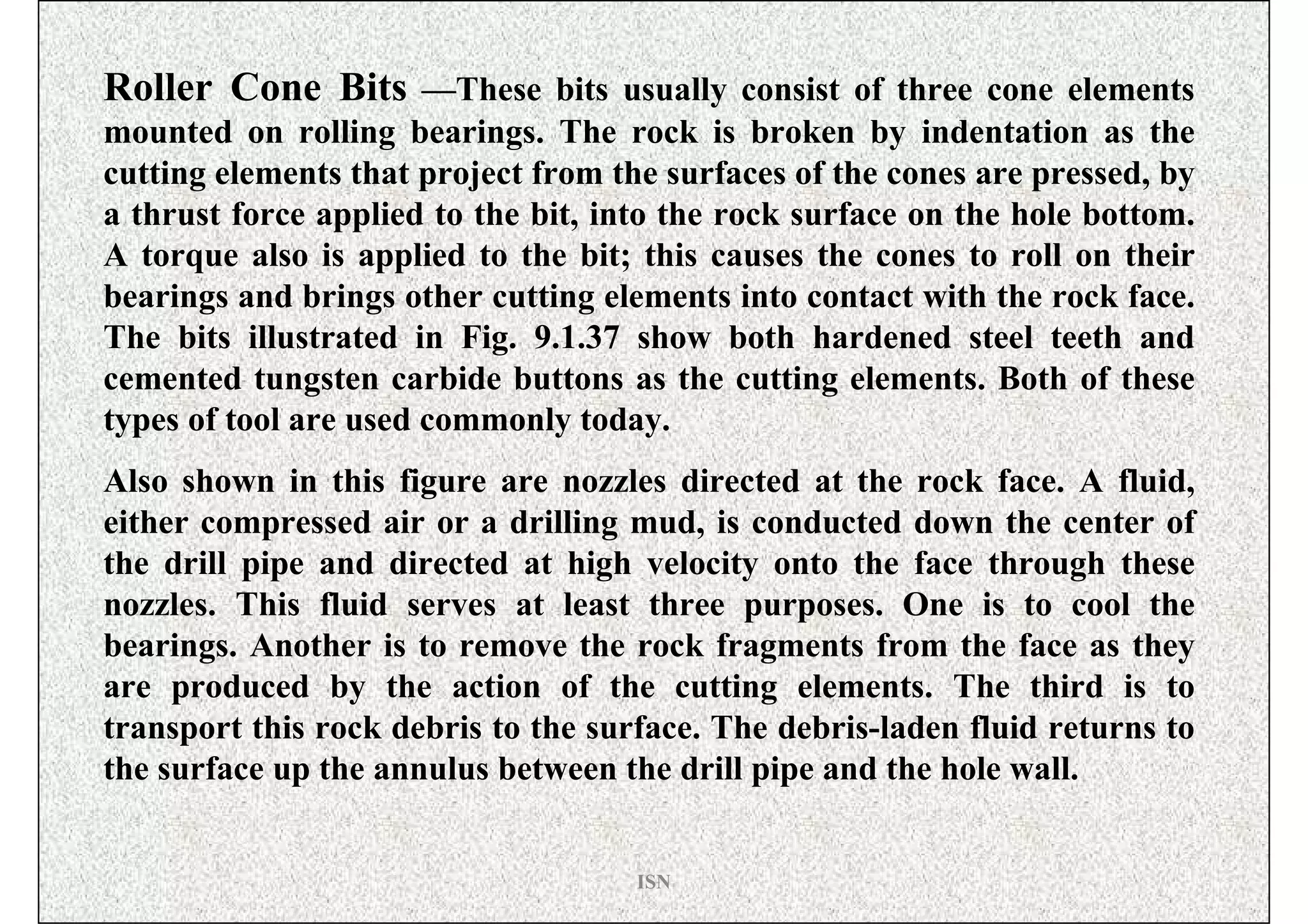
Roller Cone Bits—These bits usually consist of three cone elements
mounted on rolling bearings. The rock is broken by indentation as the
cutting elements that project from the surfaces of the cones are pressed, by
a thrust force applied to the bit, into the rock surface on the hole bottom.
A torque also is applied to the bit; this causes the cones to roll on their
bearings and brings other cutting elements into contact with the rock face.
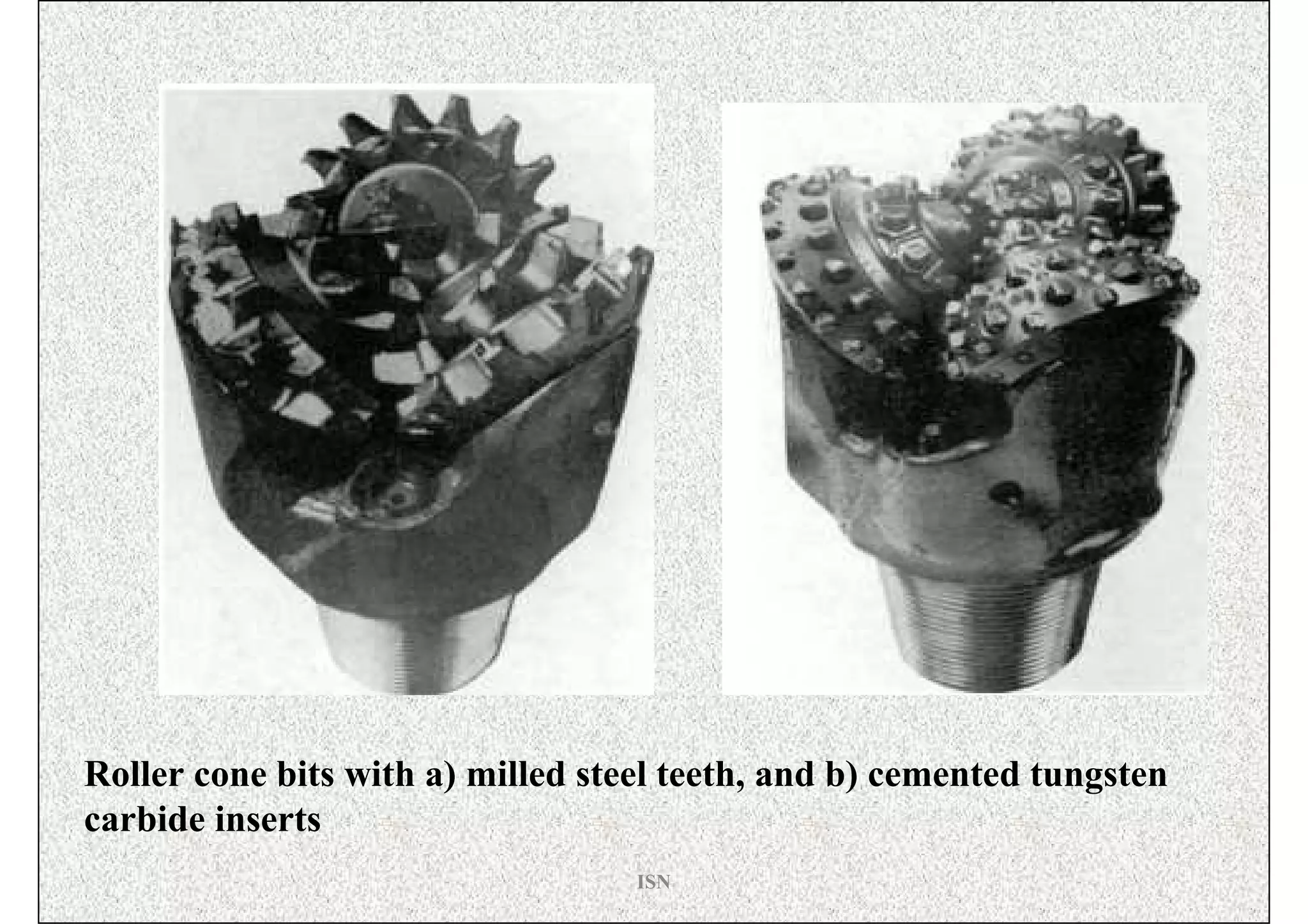
The bits illustrated in Fig. 9.1.37 show both hardened steel teeth and
cemented tungsten carbide buttons as the cutting elements. Both of these
types of tool are used commonly today.
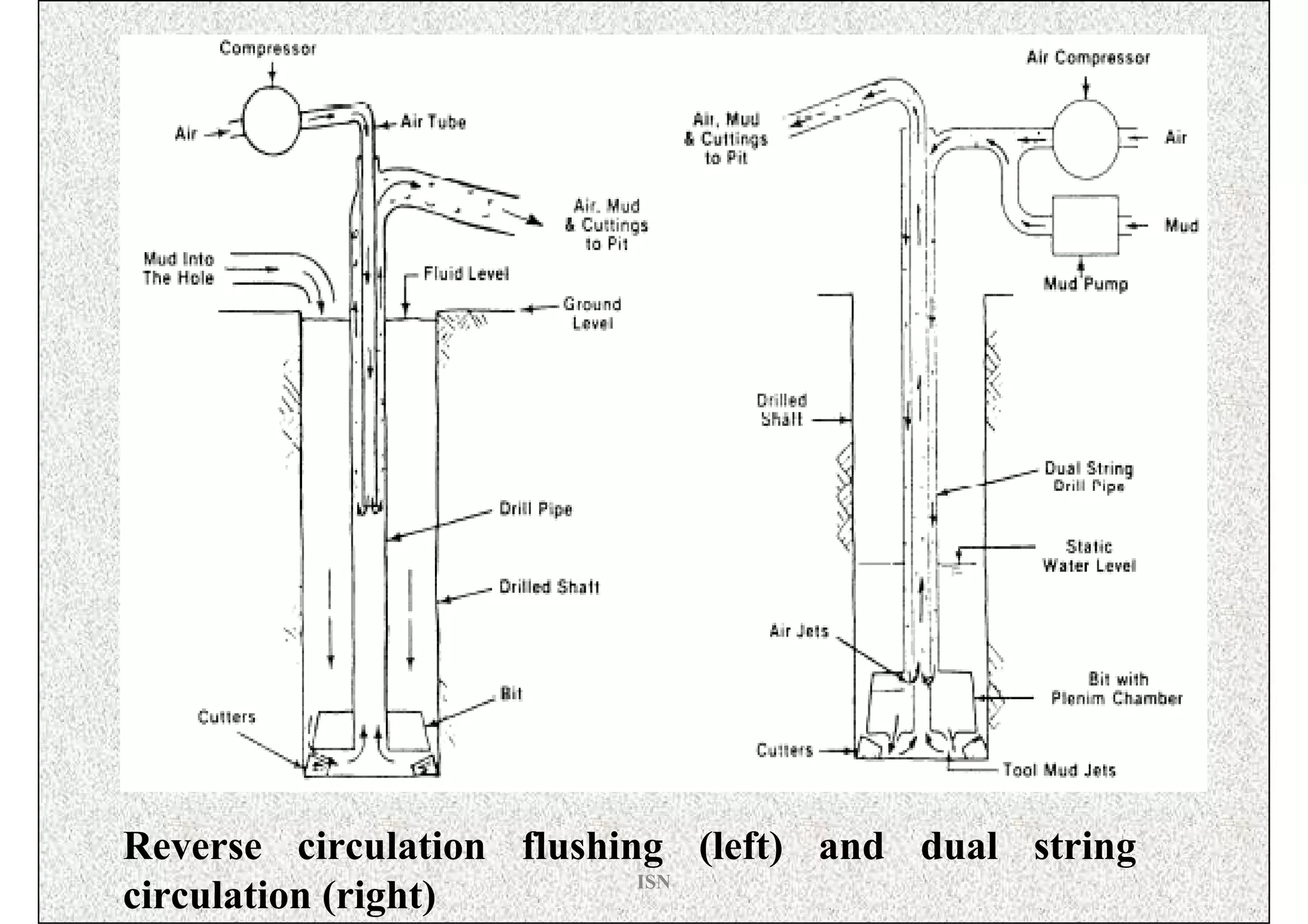
Also shown in this figure are nozzles directed at the rock face. A fluid,
either compressed air or a drilling mud, is conducted down the center of
the drill pipe and directed at high velocity onto the face through these
nozzles. This fluid serves at least three purposes. One is to cool the
bearings. Another is to remove the rock fragments from the face as they
are produced by the action of the cutting elements. The third is to
transport this rock debris to the surface. The debris-laden fluid returns to
the surface up the annulus between the drill pipe and the hole wall.
ISN
13.
Roller cone bitswith a) milled steel teeth, and b) cemented tungsten
carbide inserts
ISN
Down-the-Hole Drills —Theprevious discussion makes it
clear that in a conventional percussive drill the mechanism
that imparts energy to the rock remains outside the hole and
this energy is transmitted in the hole through the drill rod(s)
and the bit. As the name, down-hole (DTH) drill implies,
with this percussive unit the mechanism for imparting
energy to the rock is located in the hole. The piston in these
drills is powered by compressed air. Holes 4 to 8 in. (100 to
200 mm) in diameter up to 500 ft (150 m) long can be drilled
with a DTH drill (Anderson, 1982).
This system eliminates energy transmission losses in the drill
rods; thus a major advantage of a DTH drill is a constant
penetration rate that is independent of hole depth.
ISN
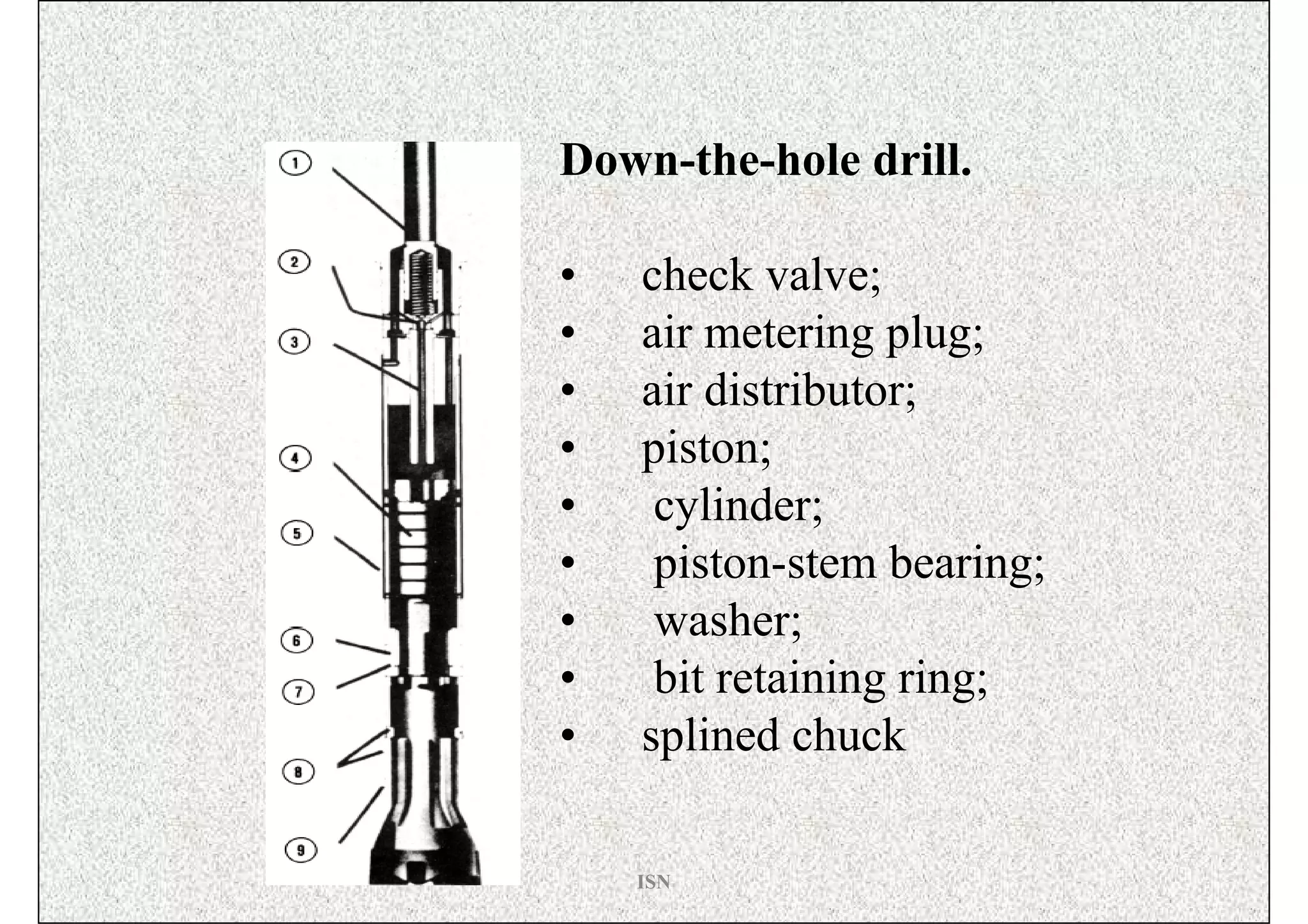
16.
Down-the-hole drill.
• check valve;
• air metering plug;
• air distributor;
• piston;
• cylinder;
• piston-stem bearing;
• washer;
• bit retaining ring;
• splined chuck
ISN
Rotary Drills: Small-diameterrotary drills are used for drilling weaker
rock types. These drills usually employ a rotary hydraulic motor to
provide the drill torque, and a hydraulic cylinder to provide the thrust.
They are mounted, in a similar manner to percussive drills, on drill
jumbos for face drilling and for roof drilling.
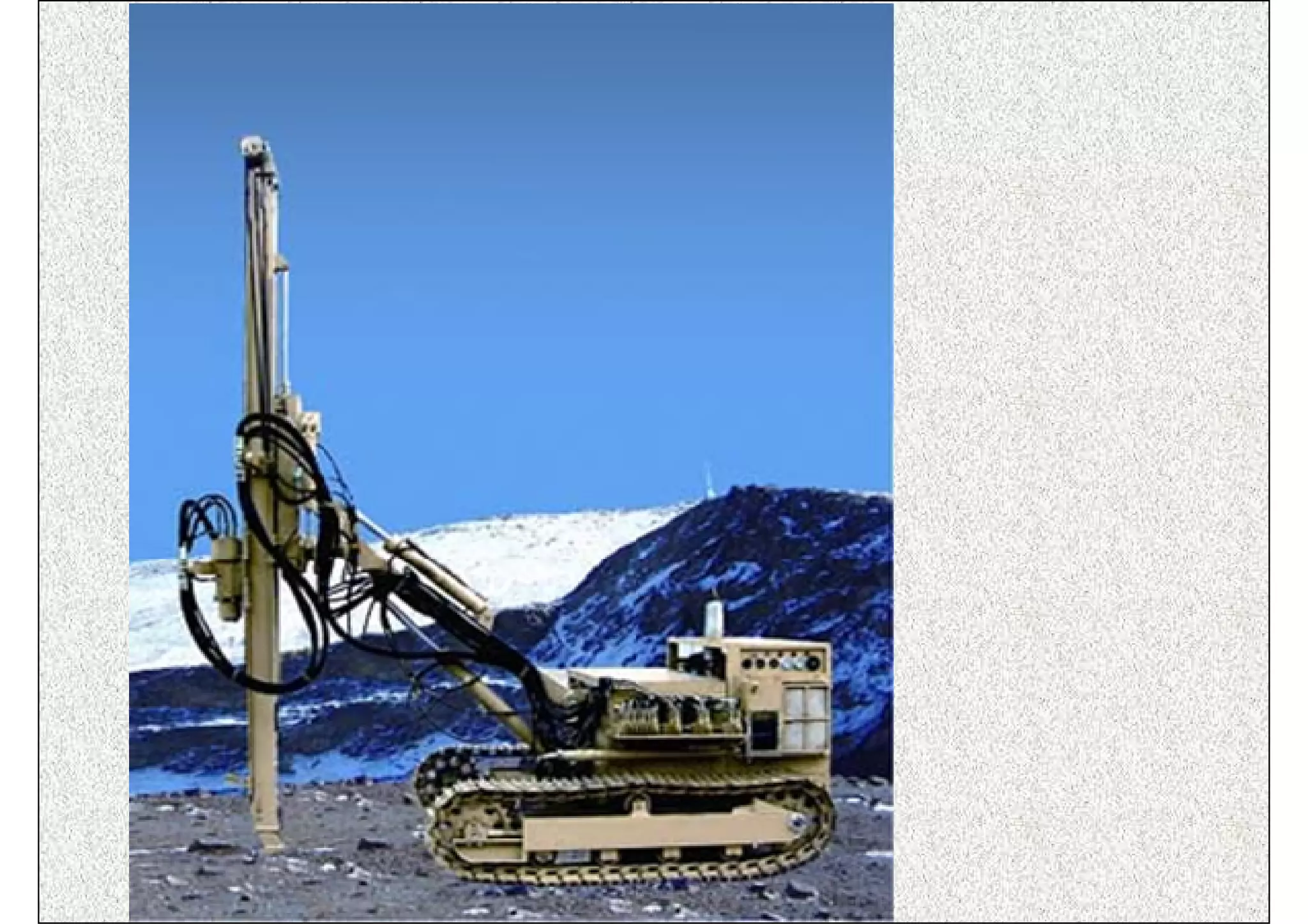
Large-diameter holes in both underground and, more frequently, in
surface mines typically are drilled with roller cone bits. The essential
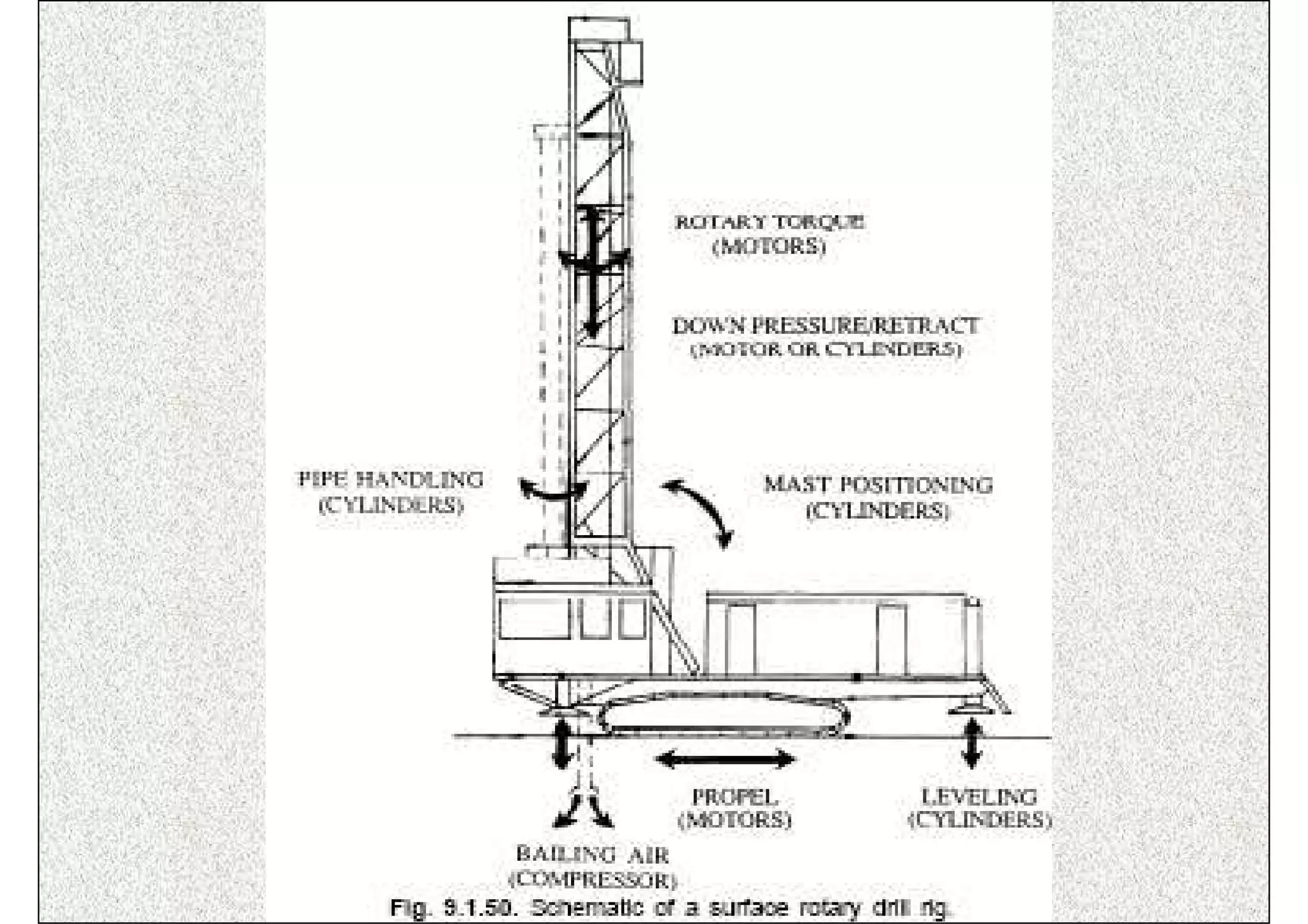
features of a rotary drill rig for a surface mining operation are shown in
Fig. 9.1.50. These features include a motor as the rotary drive, a chain
pull-down arrangement operated by hydraulic rams to provide thrust, a
rod handling device, a compressor for flushing the rock debris from the
hole bottom, hydraulic leveling jacks, a dust collection system, and a main
motor, either diesel or electric.
ISN
Conclusion
• The principaldrilling methods used in mines today are
mechanical ones in which a drill drives cutting tools into rock
by means of static (simple rotation) or dynamic force
(impact).
• Alternative methods, employing heat, flame, high-pressure
water, or high voltage electric discharges, for example, are
used only in particular situations or in laboratory studies.
• Percussion rock drills are the most commonly used
equipment for drilling in small-scale surface or underground
mining situations, whereas rotary crushing drills or down the
hole drills (DTHs) are generally employed for mining in large-
scale surface mines.
ISN




![Vibe Coding vs. Spec-Driven Development [Free Meetup]](https://cdn.slidesharecdn.com/ss_thumbnails/vibecodingvsspecdrivendevelopment-251209105622-43f455e7-thumbnail.jpg?width=640&height=640&fit=bounds)


