Recreational Maths
What is Recreational Maths ? Recreational Mathematics is an umbrella term, referring to Mathematical puzzles and Mathematical games. Not all problems in this field require a knowledge of advanced Mathematics, and thus, recreational Mathematics often attracts the curiosity of non-Mathematicians, and inspires their further study of Mathematics.
This genre of mathematics  includes logic puzzles and other puzzles that require deductive reasoning, the aesthetics of mathematics, and peculiar or amusing stories and coincidences about mathematics and mathematicians. Some of the more well-known topics in recreational mathematics are magic squares and fractals.
Mathematical games Mathematical  games  are  multiplayer  games  whose  rules,  strategies,  and  outcomes  can  be  studied  and  explained by mathematics.  The  players  of  the  game  may not need to use mathematics in order to play mathematical  games.   For  example,  Mancala  is  a  mathematical  game,  because mathematicians  can  study  it  using  combinatorial  game  theory,  even  though  no mathematics  is  necessary  in  order  to  play  it.
The "Mathematical Games" column ran by Martin Gardener from 1956 to 1981 in the American Magazine “Scientific America” and was the first introduction of many subjects to a wider audience, including :   Flexagons John Horton Conway's Game of Life Polyominoes The Soma cube Hare and Hounds Tangrams Penrose tiling The work of  M. C. Escher Fractals
Mathematical puzzles require  mathematics in order to solve  them. They have specific rules,  as do multiplayer games, but  mathematical puzzles don't  usually involve competition between two or more players. Instead, in order to solve such a puzzle, the solver must find a solution that satisfies the given conditions. Logic puzzles are a common type of mathematical puzzle. Conway's Game of Life and fractals are also considered mathematical puzzles, even though the solver only interacts with them by providing a set of initial conditions. Maths Puzzles
Tangrams  Palindrome Rubik’s Cube Magic Square Common and Famous Topics of Recreational Maths
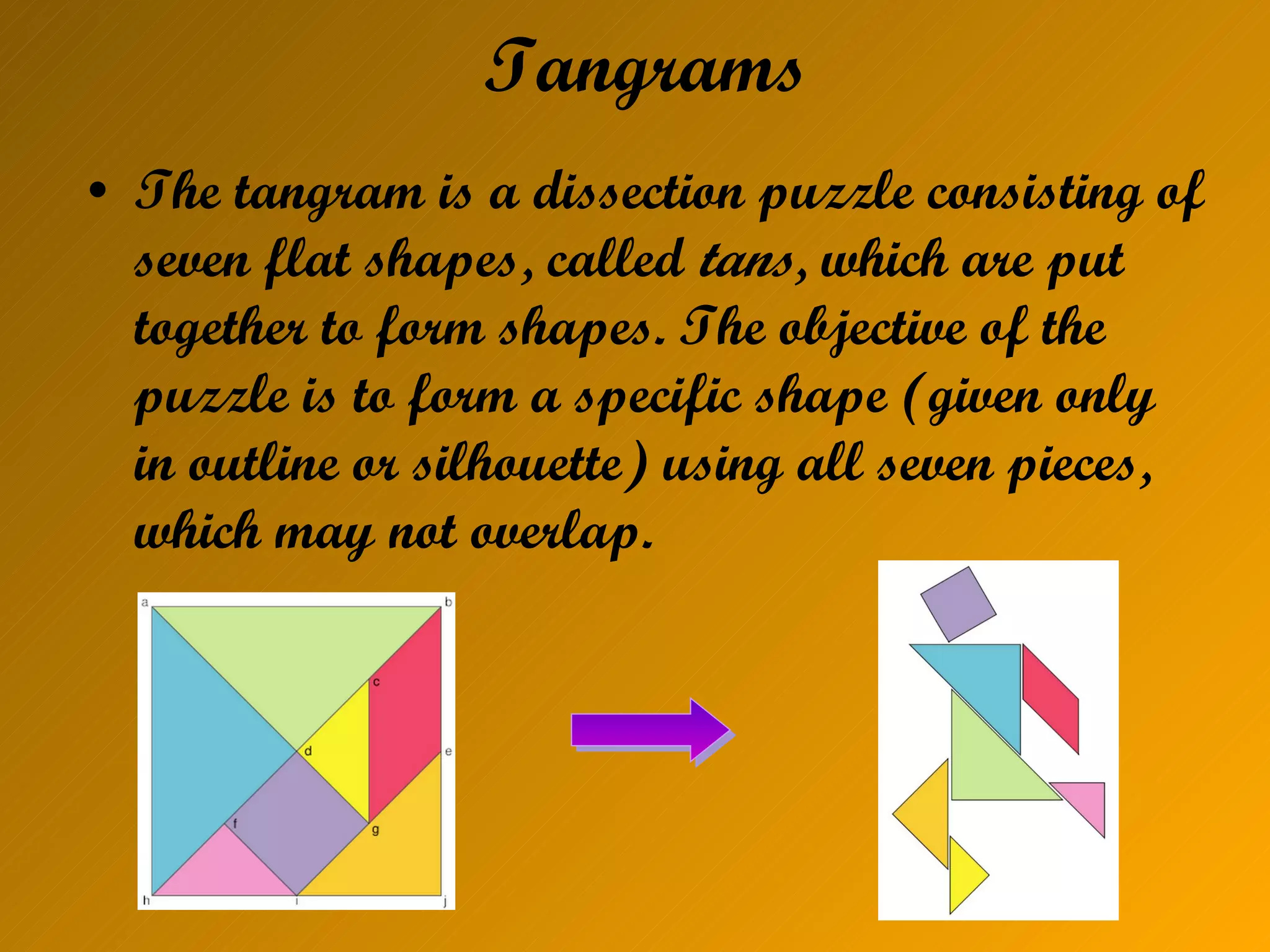
Tangrams The  tangram   is a dissection puzzle consisting of seven flat shapes, called  tans , which are put together to form shapes. The objective of the puzzle is to form a specific shape (given only in outline or silhouette) using all seven pieces, which may not overlap.
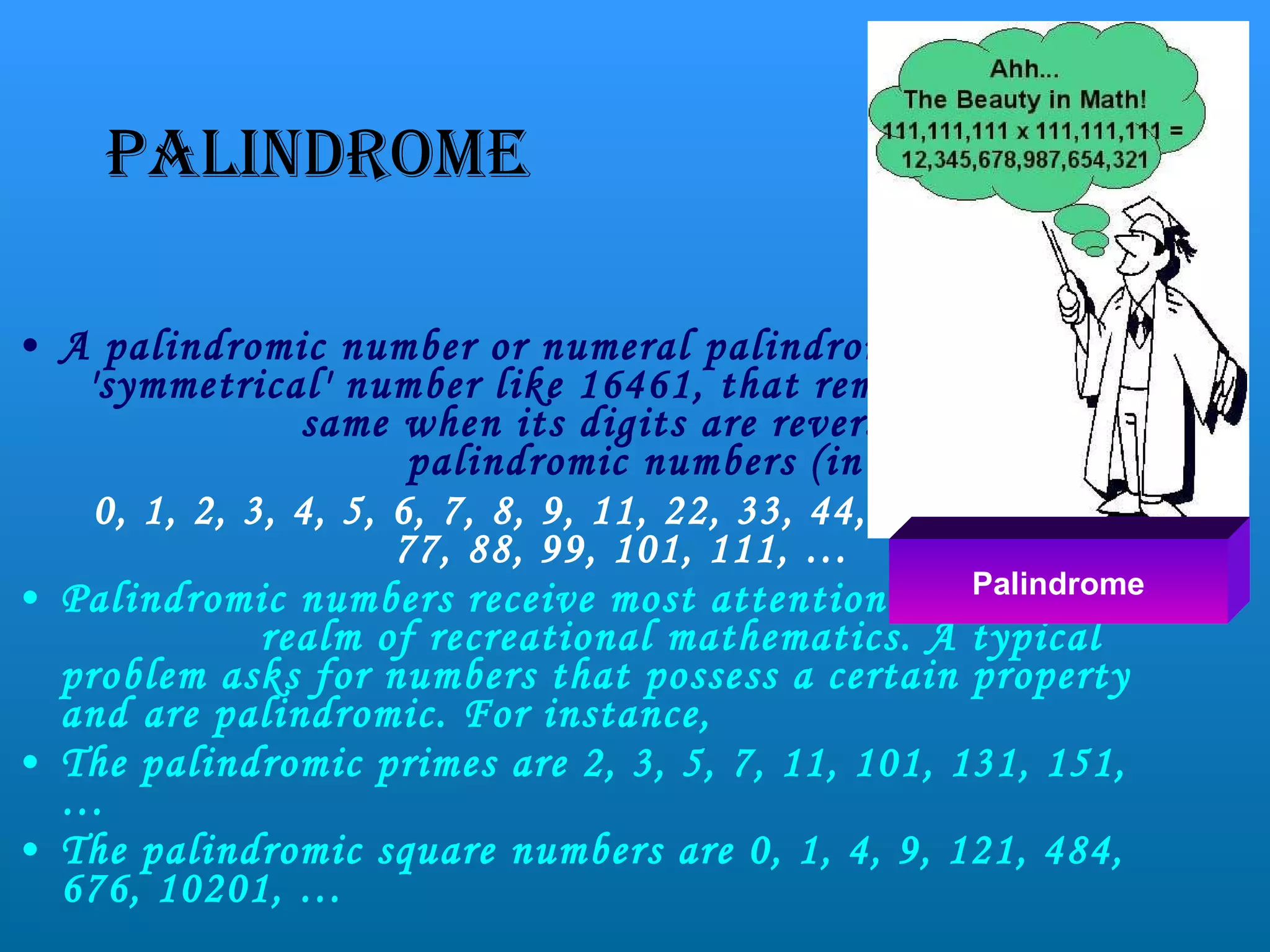
Palindrome A palindromic number or numeral palindrome is a  'symmetrical' number like 16461, that remains the  same when its digits are reversed. The first  palindromic numbers (in decimal) are: 0, 1, 2, 3, 4, 5, 6, 7, 8, 9, 11, 22, 33, 44, 55, 66,  77, 88, 99, 101, 111, …   Palindromic numbers receive most attention in the  realm of recreational mathematics. A typical problem asks for numbers that possess a certain property  and  are palindromic. For instance, The palindromic primes are 2, 3, 5, 7, 11, 101, 131, 151, … The palindromic square numbers are 0, 1, 4, 9, 121, 484, 676, 10201, …   Palindrome
Rubik’s Cube The most famous of recent puzzles is the Rubik's cube invented by the Hungarian Ernö Rubik. Its fame is incredible. Invented in 1974, patented in 1975 it was put on the market in Hungary in 1977. However it did not really begin as a craze until 1981. By 1982 10 million cubes had been sold in Hungary, more than the population of the country. It is estimated that 100 million were sold world-wide.  The cube consists of 3 × 3 × 3 smaller cubes which, in the initial configuration, are coloured so that the 6 faces of the large cube are coloured in 6 distinct colours. The 9 cubes forming one face can be rotated through 45°. There are 43,252,003,274,489,856,000 different arrangements of the small cubes, only one of these arrangements being the initial position. Solving the cube shows the importance of conjugates and commutators in a group.
Magic Square In recreational mathematics, a magic square is a square which is divided into smaller squares and each smaller square usually contains distinct integers. In a magic square, the sum of all the integers in every horizontal, vertical and diagonal line is the same.
Thank You

Recreational Mathematics

  • 1.
  • 2.
    What is RecreationalMaths ? Recreational Mathematics is an umbrella term, referring to Mathematical puzzles and Mathematical games. Not all problems in this field require a knowledge of advanced Mathematics, and thus, recreational Mathematics often attracts the curiosity of non-Mathematicians, and inspires their further study of Mathematics.
  • 3.
    This genre ofmathematics includes logic puzzles and other puzzles that require deductive reasoning, the aesthetics of mathematics, and peculiar or amusing stories and coincidences about mathematics and mathematicians. Some of the more well-known topics in recreational mathematics are magic squares and fractals.
  • 4.
    Mathematical games Mathematical games are multiplayer games whose rules, strategies, and outcomes can be studied and explained by mathematics. The players of the game may not need to use mathematics in order to play mathematical games. For example, Mancala is a mathematical game, because mathematicians can study it using combinatorial game theory, even though no mathematics is necessary in order to play it.
  • 5.
    The "Mathematical Games"column ran by Martin Gardener from 1956 to 1981 in the American Magazine “Scientific America” and was the first introduction of many subjects to a wider audience, including : Flexagons John Horton Conway's Game of Life Polyominoes The Soma cube Hare and Hounds Tangrams Penrose tiling The work of M. C. Escher Fractals
  • 6.
    Mathematical puzzles require mathematics in order to solve them. They have specific rules, as do multiplayer games, but mathematical puzzles don't usually involve competition between two or more players. Instead, in order to solve such a puzzle, the solver must find a solution that satisfies the given conditions. Logic puzzles are a common type of mathematical puzzle. Conway's Game of Life and fractals are also considered mathematical puzzles, even though the solver only interacts with them by providing a set of initial conditions. Maths Puzzles
  • 7.
    Tangrams PalindromeRubik’s Cube Magic Square Common and Famous Topics of Recreational Maths
  • 8.
    Tangrams The tangram is a dissection puzzle consisting of seven flat shapes, called tans , which are put together to form shapes. The objective of the puzzle is to form a specific shape (given only in outline or silhouette) using all seven pieces, which may not overlap.
  • 9.
    Palindrome A palindromicnumber or numeral palindrome is a 'symmetrical' number like 16461, that remains the same when its digits are reversed. The first palindromic numbers (in decimal) are: 0, 1, 2, 3, 4, 5, 6, 7, 8, 9, 11, 22, 33, 44, 55, 66, 77, 88, 99, 101, 111, … Palindromic numbers receive most attention in the realm of recreational mathematics. A typical problem asks for numbers that possess a certain property and are palindromic. For instance, The palindromic primes are 2, 3, 5, 7, 11, 101, 131, 151, … The palindromic square numbers are 0, 1, 4, 9, 121, 484, 676, 10201, … Palindrome
  • 10.
    Rubik’s Cube Themost famous of recent puzzles is the Rubik's cube invented by the Hungarian Ernö Rubik. Its fame is incredible. Invented in 1974, patented in 1975 it was put on the market in Hungary in 1977. However it did not really begin as a craze until 1981. By 1982 10 million cubes had been sold in Hungary, more than the population of the country. It is estimated that 100 million were sold world-wide. The cube consists of 3 × 3 × 3 smaller cubes which, in the initial configuration, are coloured so that the 6 faces of the large cube are coloured in 6 distinct colours. The 9 cubes forming one face can be rotated through 45°. There are 43,252,003,274,489,856,000 different arrangements of the small cubes, only one of these arrangements being the initial position. Solving the cube shows the importance of conjugates and commutators in a group.
  • 11.
    Magic Square Inrecreational mathematics, a magic square is a square which is divided into smaller squares and each smaller square usually contains distinct integers. In a magic square, the sum of all the integers in every horizontal, vertical and diagonal line is the same.
  • 12.