Introduction to the  ARM Instruction Set
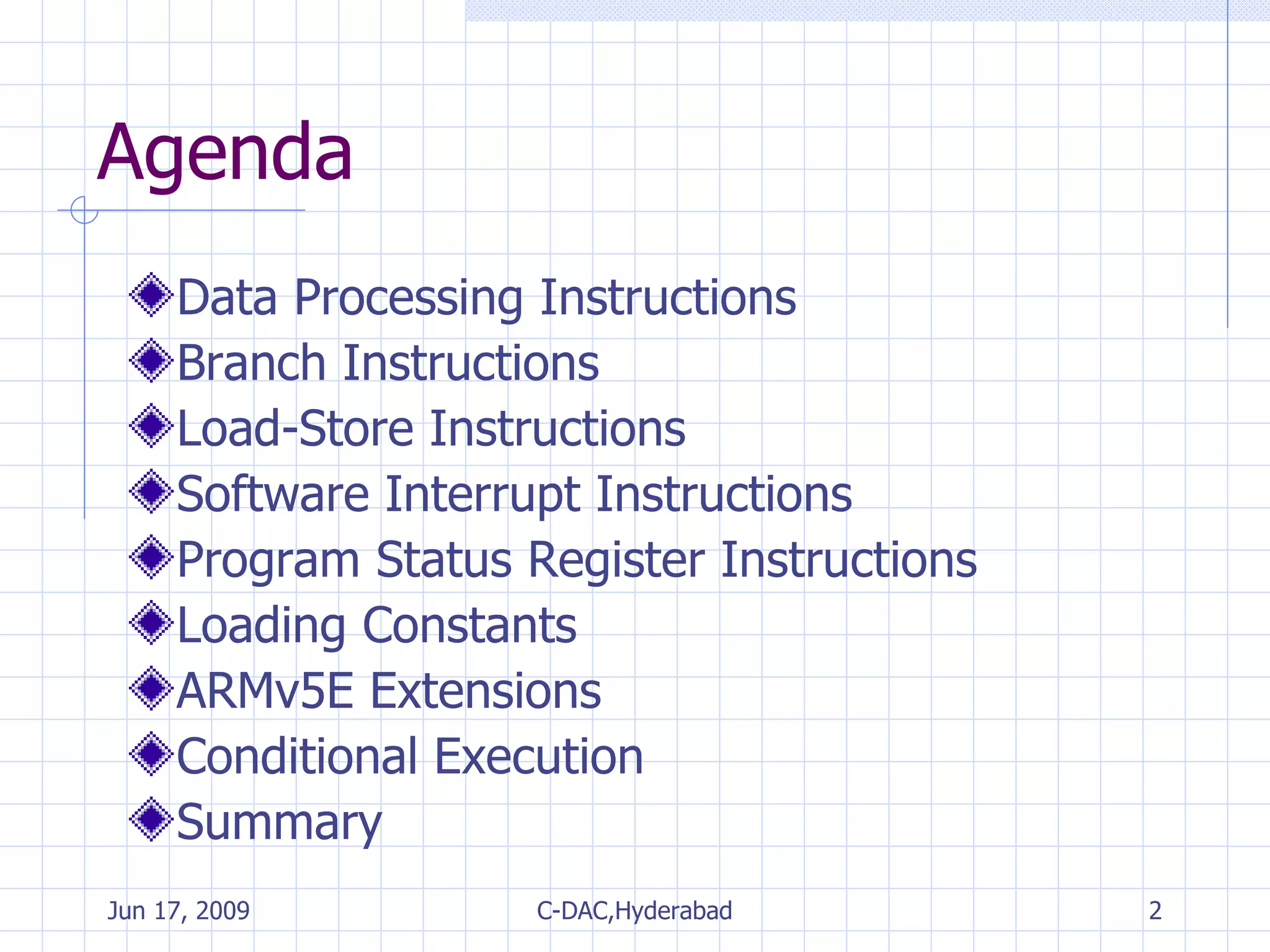
Agenda Data Processing Instructions  Branch Instructions Load-Store Instructions Software Interrupt Instructions Program Status Register Instructions Loading Constants ARMv5E Extensions Conditional Execution Summary
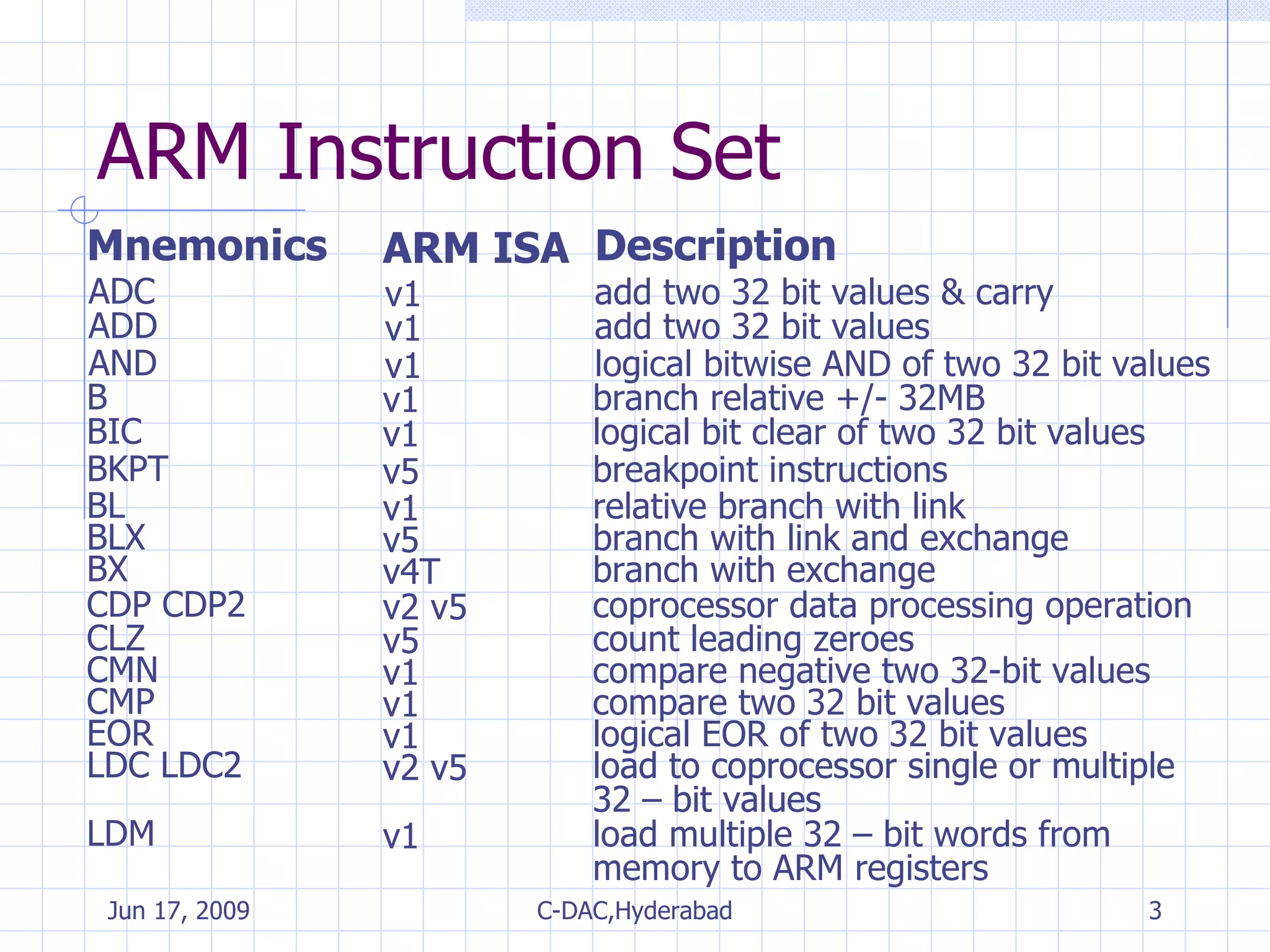
ARM Instruction Set Mnemonics ARM ISA  Description ADC v1 add two 32 bit values & carry ADD v1 add two 32 bit values AND v1 logical bitwise AND of two 32 bit values B v1 branch relative +/- 32MB BIC v1 logical bit clear of two 32 bit values BKPT v5 breakpoint instructions BL v1 relative branch with link BLX v5 branch with link and exchange BX v4T branch with exchange CDP CDP2 v2 v5 coprocessor data processing operation CLZ v5 count leading zeroes CMN v1 compare negative two 32-bit values CMP v1 compare two 32 bit values EOR v1 logical EOR of two 32 bit values LDC LDC2 v2 v5 load to coprocessor single or multiple 32 – bit values LDC LDC2 v2 v5 load to coprocessor single or multiple 32 – bit values LDM v1 load multiple 32 – bit words from  memory to ARM registers
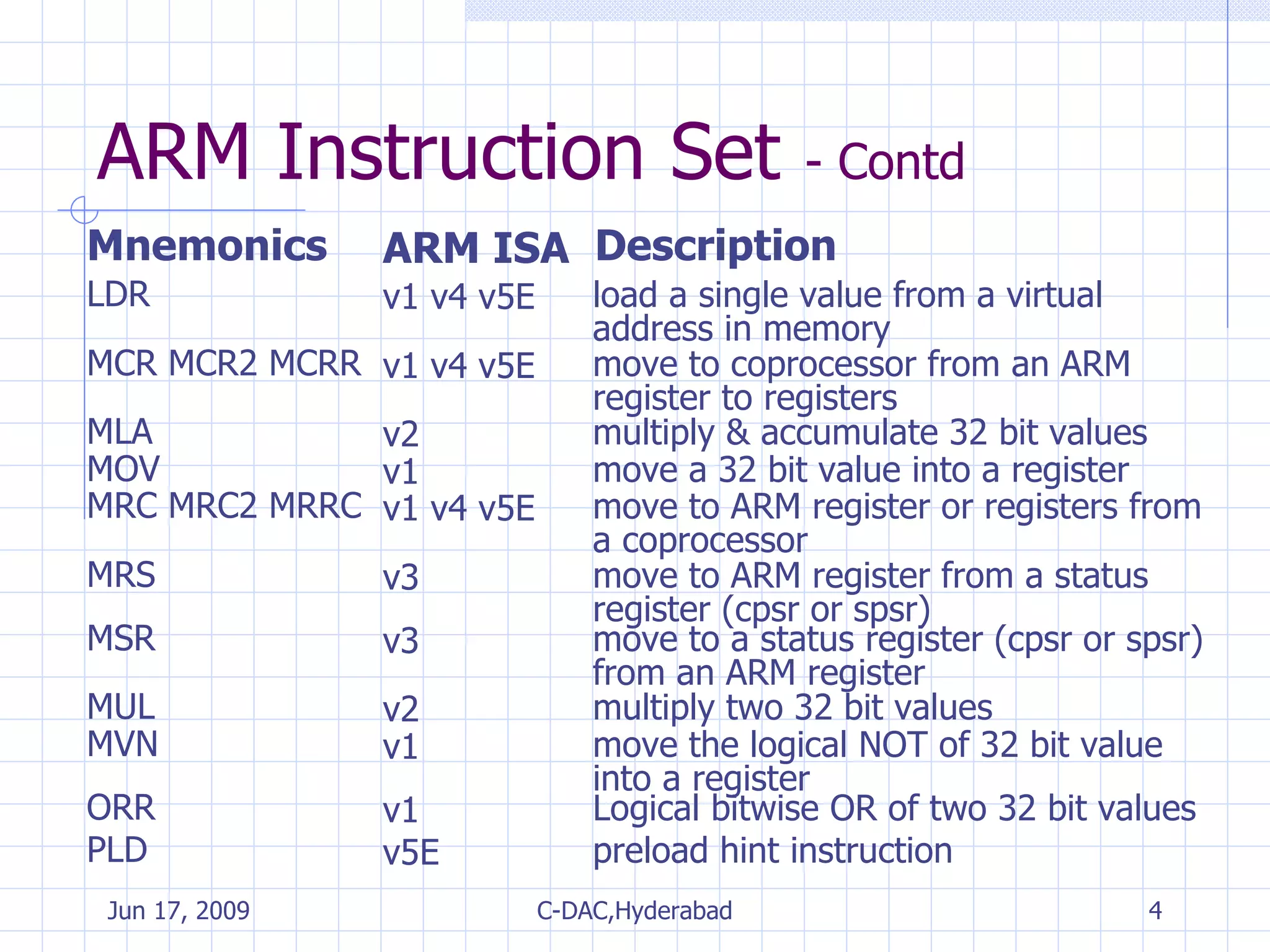
ARM Instruction Set  - Contd Mnemonics ARM ISA  Description LDR v1 v4 v5E load a single value from a virtual  address in memory MCR MCR2 MCRR v1 v4 v5E move to coprocessor from an ARM  register to registers MLA v2 multiply & accumulate 32 bit values  MOV v1 move a 32 bit value into a register  MRC MRC2 MRRC v1 v4 v5E move to ARM register or registers from  a coprocessor MRS v3 move to ARM register from a status register (cpsr or spsr) MSR v3 move to a status register (cpsr or spsr) from an ARM register MUL v2 multiply two 32 bit values  MVN v1 move the logical NOT of 32 bit value  into a register  ORR v1 Logical bitwise OR of two 32 bit values PLD v5E preload hint instruction
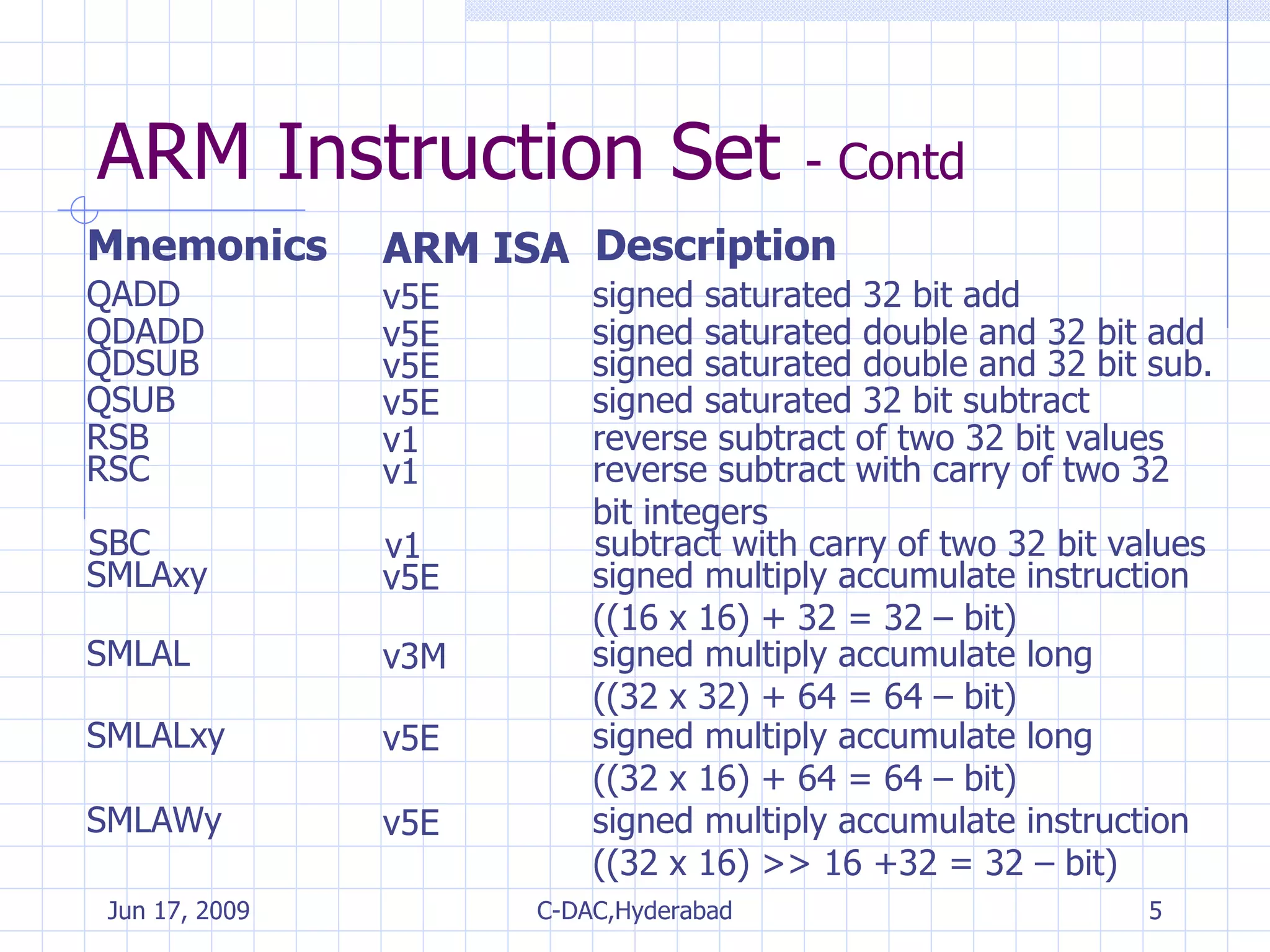
ARM Instruction Set  - Contd Mnemonics ARM ISA  Description QADD v5E signed saturated 32 bit add  QDADD v5E signed saturated double and 32 bit add  QDSUB v5E signed saturated double and 32 bit sub.  QSUB v5E signed saturated 32 bit subtract  RSB v1 reverse subtract of two 32 bit values RSC v1 reverse subtract with carry of two 32 bit integers SBC v1 subtract with carry of two 32 bit values SMLAxy v5E signed multiply accumulate instruction ((16 x 16) + 32 = 32 – bit)  SMLAL v3M signed multiply accumulate long  ((32 x 32) + 64 = 64 – bit)  SMLALxy v5E signed multiply accumulate long  ((32 x 16) + 64 = 64 – bit)  SMLAWy v5E signed multiply accumulate instruction ((32 x 16) >> 16 +32 = 32 – bit)
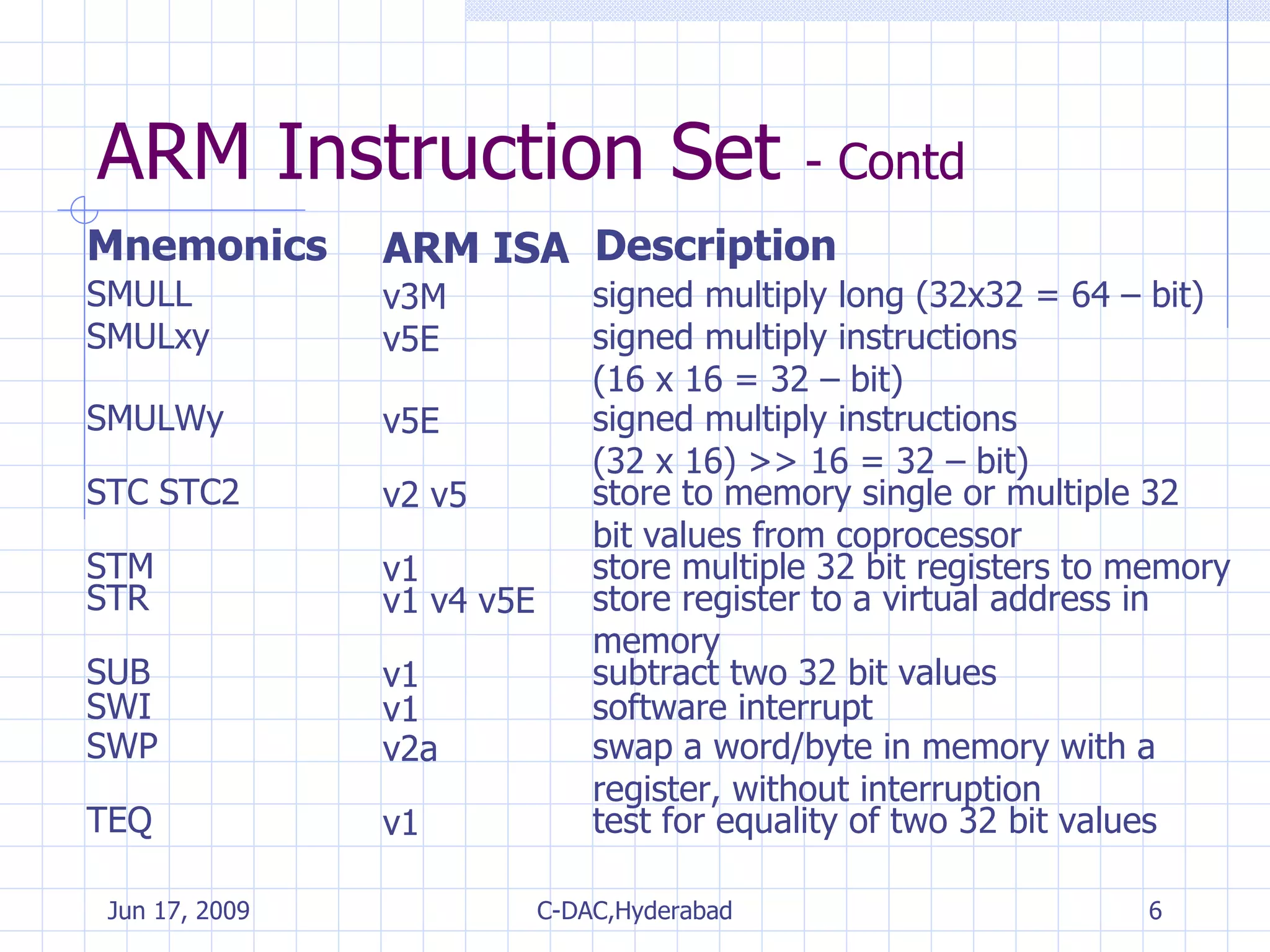
ARM Instruction Set  - Contd Mnemonics ARM ISA  Description STM v1 store multiple 32 bit registers to memory SMULL v3M signed multiply long (32x32 = 64 – bit)  SMULxy v5E signed multiply instructions  (16 x 16 = 32 – bit)  SMULWy v5E signed multiply instructions  (32 x 16) >> 16 = 32 – bit)  STC STC2 v2 v5 store to memory single or multiple 32 bit values from coprocessor  STR v1 v4 v5E store register to a virtual address in memory SUB v1 subtract two 32 bit values  SWI v1 software interrupt SWP v2a swap a word/byte in memory with a register, without interruption  TEQ v1 test for equality of two 32 bit values
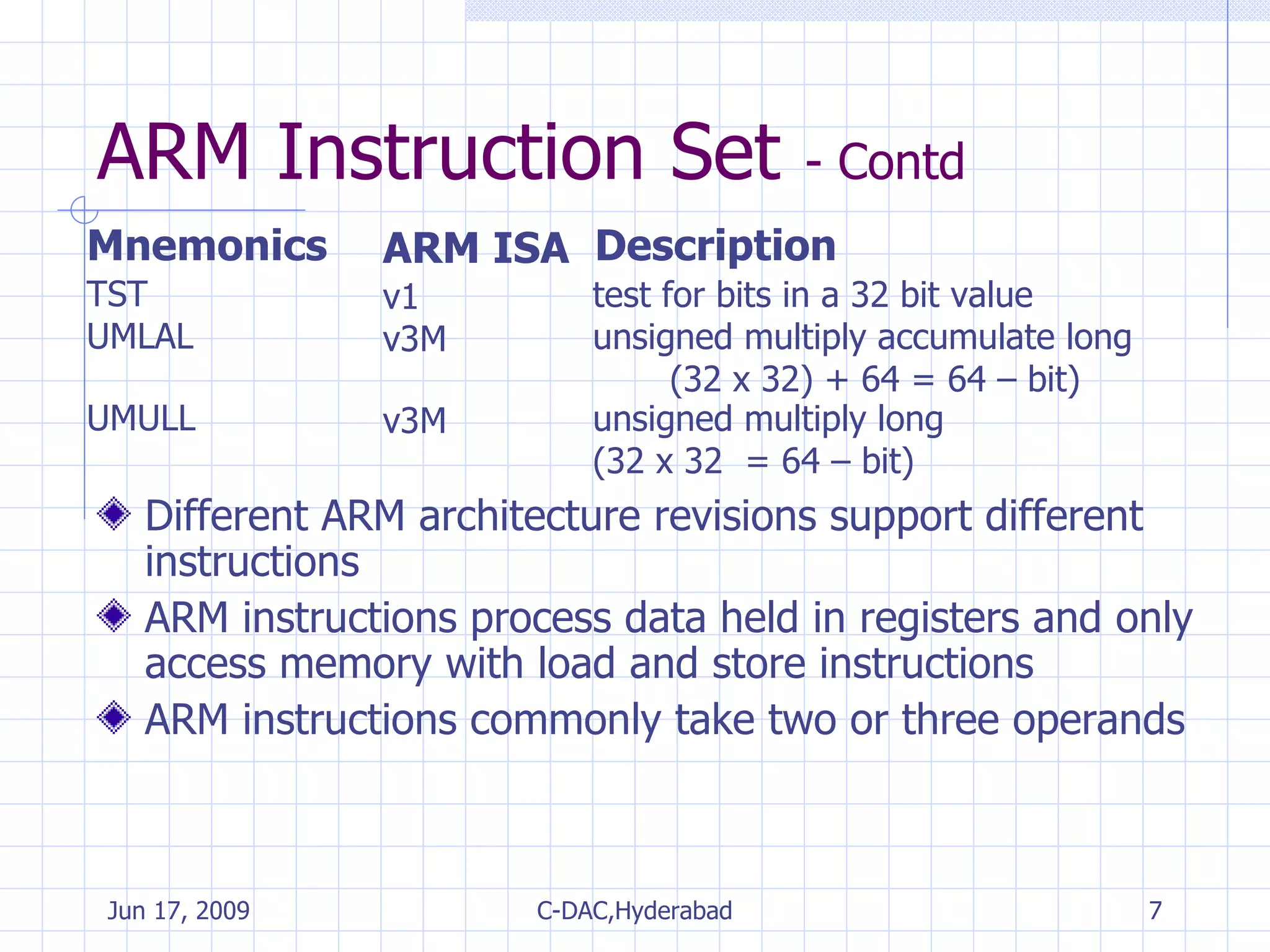
ARM Instruction Set  - Contd Mnemonics ARM ISA  Description Different ARM architecture revisions support different instructions ARM instructions process data held in registers and only access memory with load and store instructions ARM instructions commonly take two or three operands TST v1 test for bits in a 32 bit value  UMLAL v3M unsigned multiply accumulate long  (32 x 32) + 64 = 64 – bit)  UMULL v3M unsigned multiply long  (32 x 32  = 64 – bit)
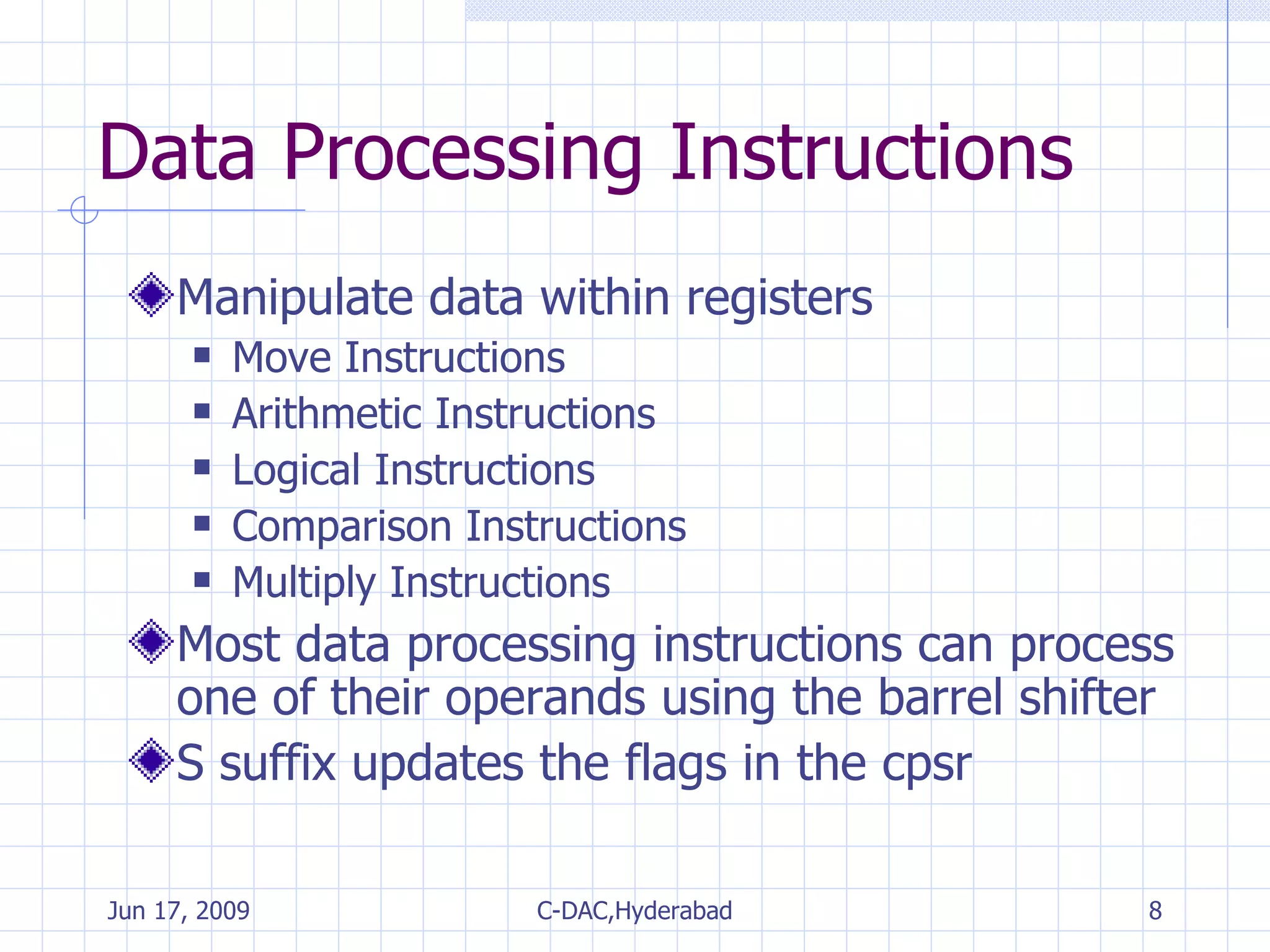
Data Processing Instructions Manipulate data within registers Move Instructions Arithmetic Instructions Logical Instructions Comparison Instructions Multiply Instructions Most data processing instructions can process one of their operands using the barrel shifter S suffix updates the flags in the cpsr
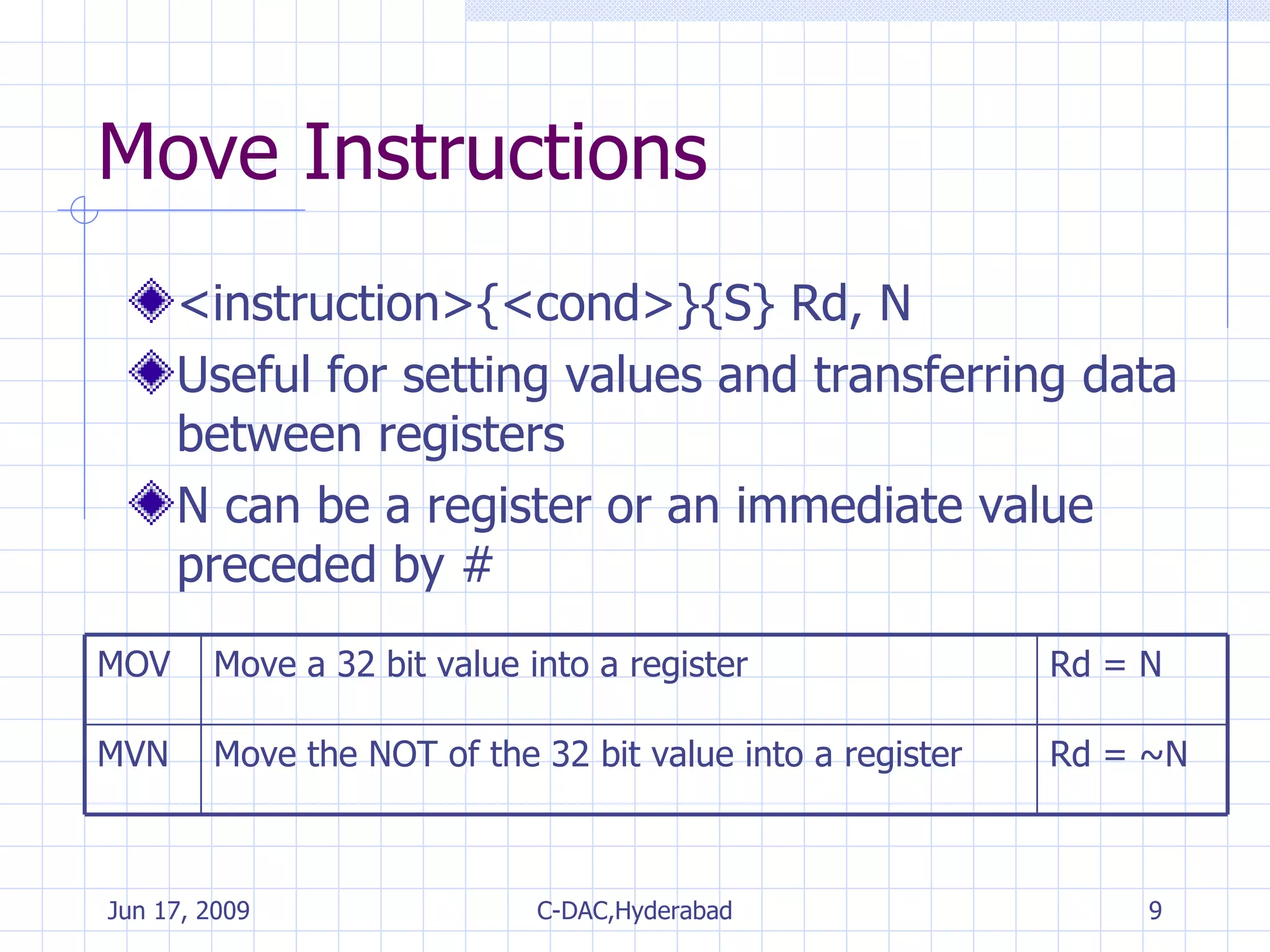
Move Instructions <instruction>{<cond>}{S} Rd, N Useful for setting values and transferring data between registers N can be a register or an immediate value preceded by # Rd = ~N Move the NOT of the 32 bit value into a register MVN Rd = N Move a 32 bit value into a register MOV
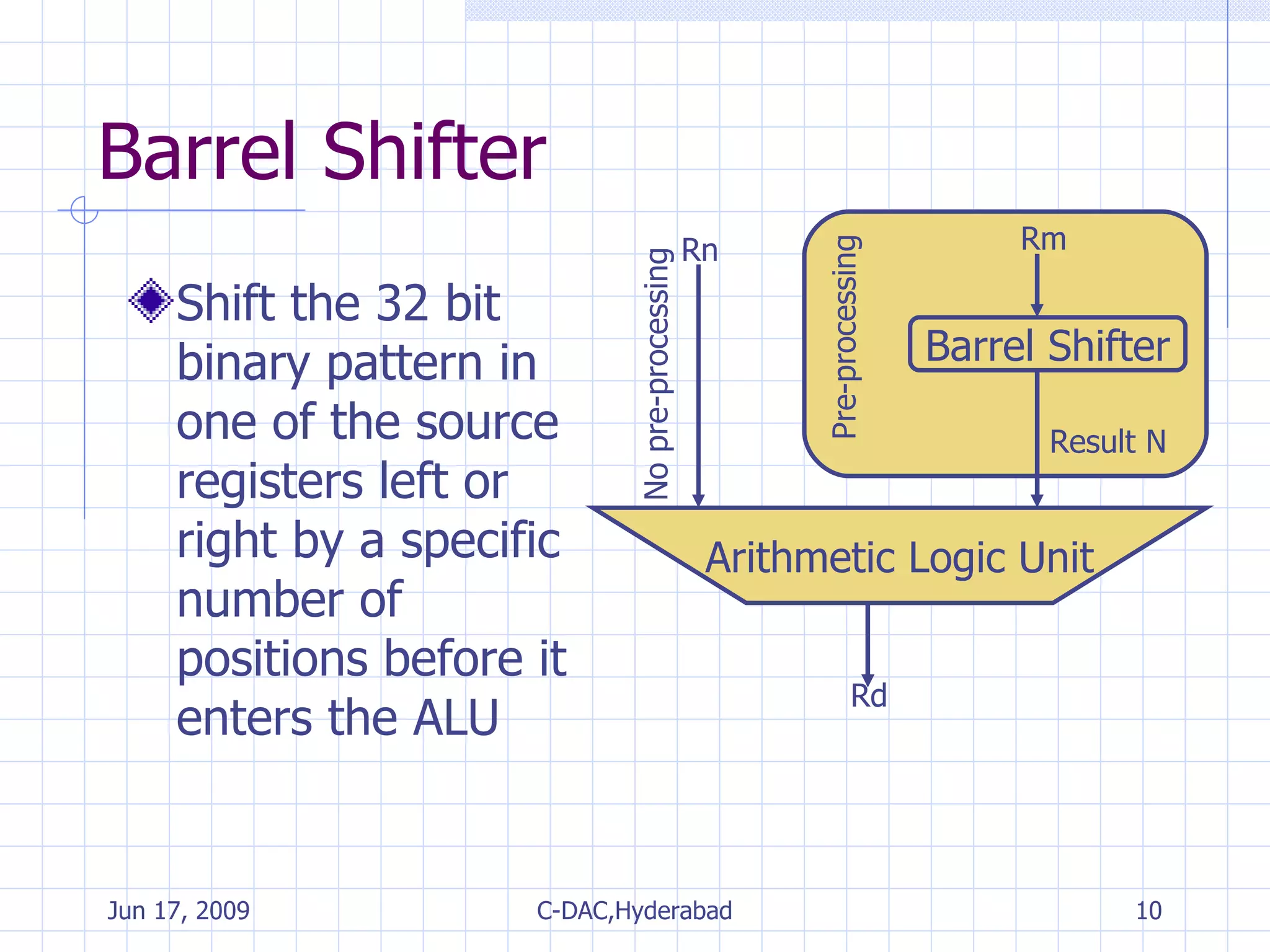
Barrel Shifter Shift the 32 bit binary pattern in one of the source registers left or right by a specific number of positions before it enters the ALU Arithmetic Logic Unit Rm Result N Rd Rn No pre-processing Pre-processing Barrel Shifter
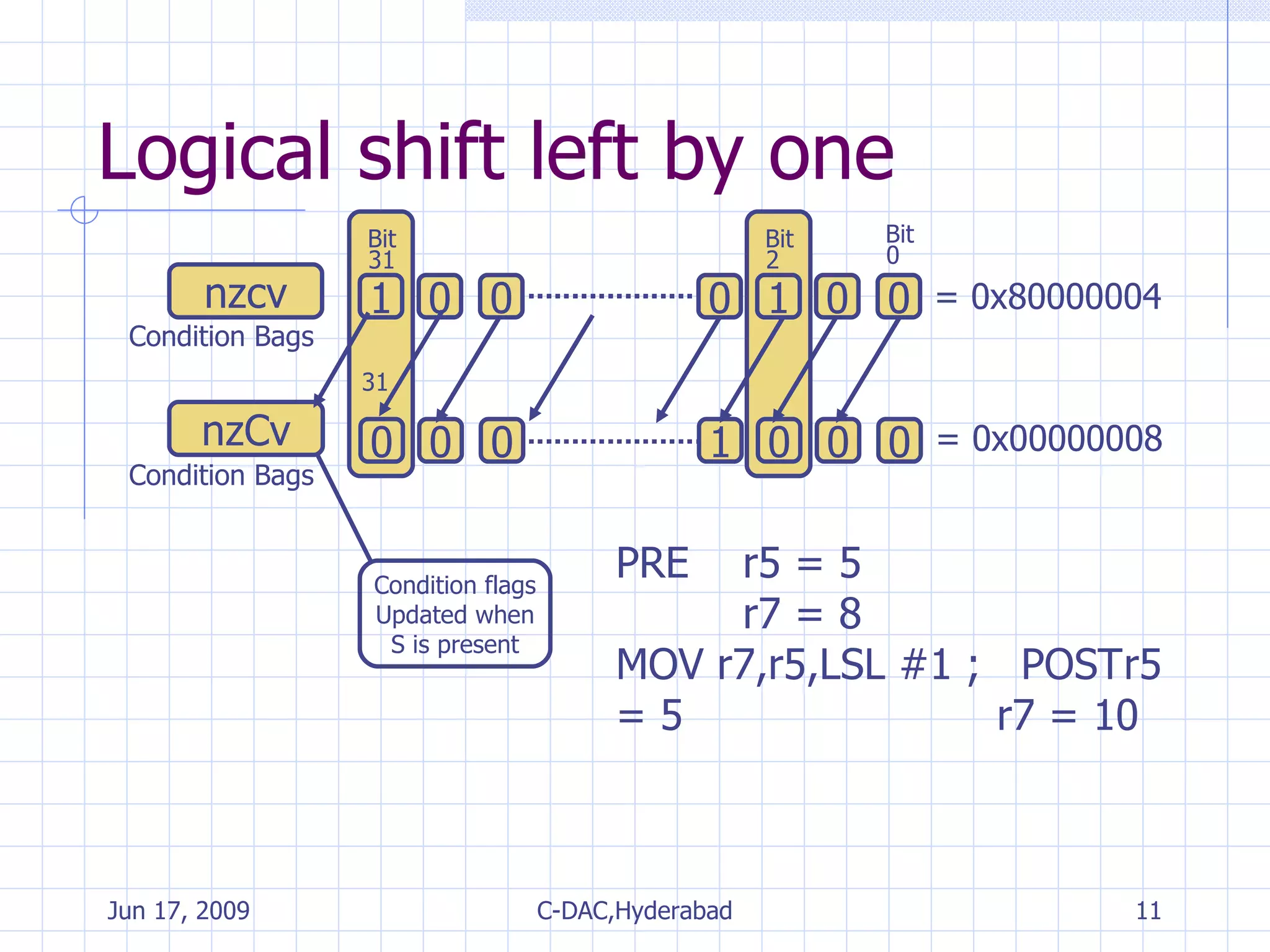
Logical shift left by one PRE r5 = 5  r7 = 8  MOV r7,r5,LSL #1 ;  POST r5 = 5  r7 = 10 1 0 0 0 0 0 0 1 Bit 2 Bit 0 1 0 0 nzcv 0 0 0 nzCv Bit 31 = 0x80000004 = 0x00000008 31 Condition Bags Condition Bags Condition flags Updated when S is present
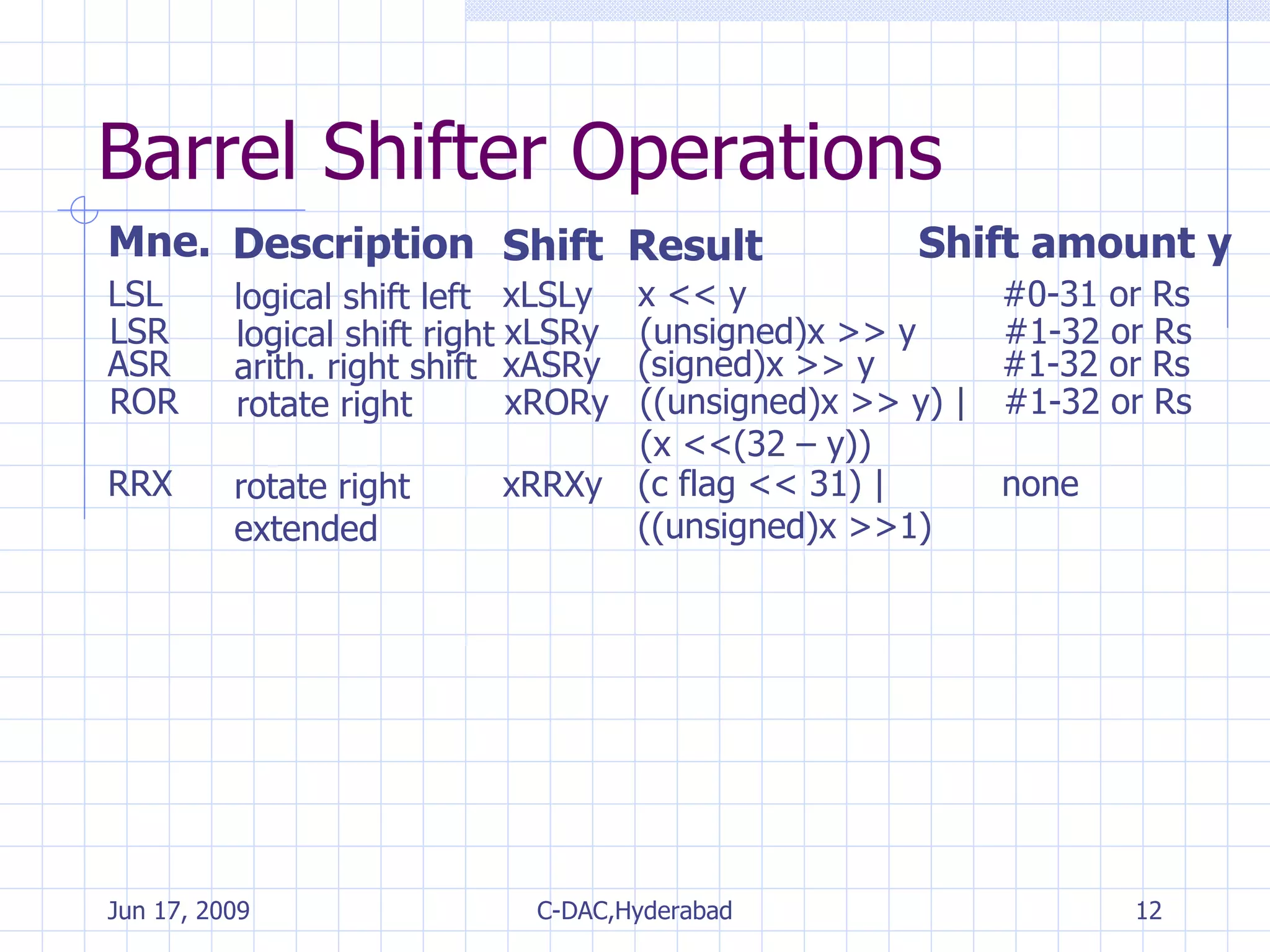
Barrel Shifter Operations Mne. Shift Description Result Shift amount y LSL logical shift left xLSLy x << y #0-31 or Rs LSR logical shift right xLSRy (unsigned)x >> y #1-32 or Rs ASR arith. right shift xASRy (signed)x >> y #1-32 or Rs ROR rotate right xRORy ((unsigned)x >> y) | (x <<(32 – y)) #1-32 or Rs RRX rotate right  extended xRRXy (c flag << 31) |  ((unsigned)x >>1) none
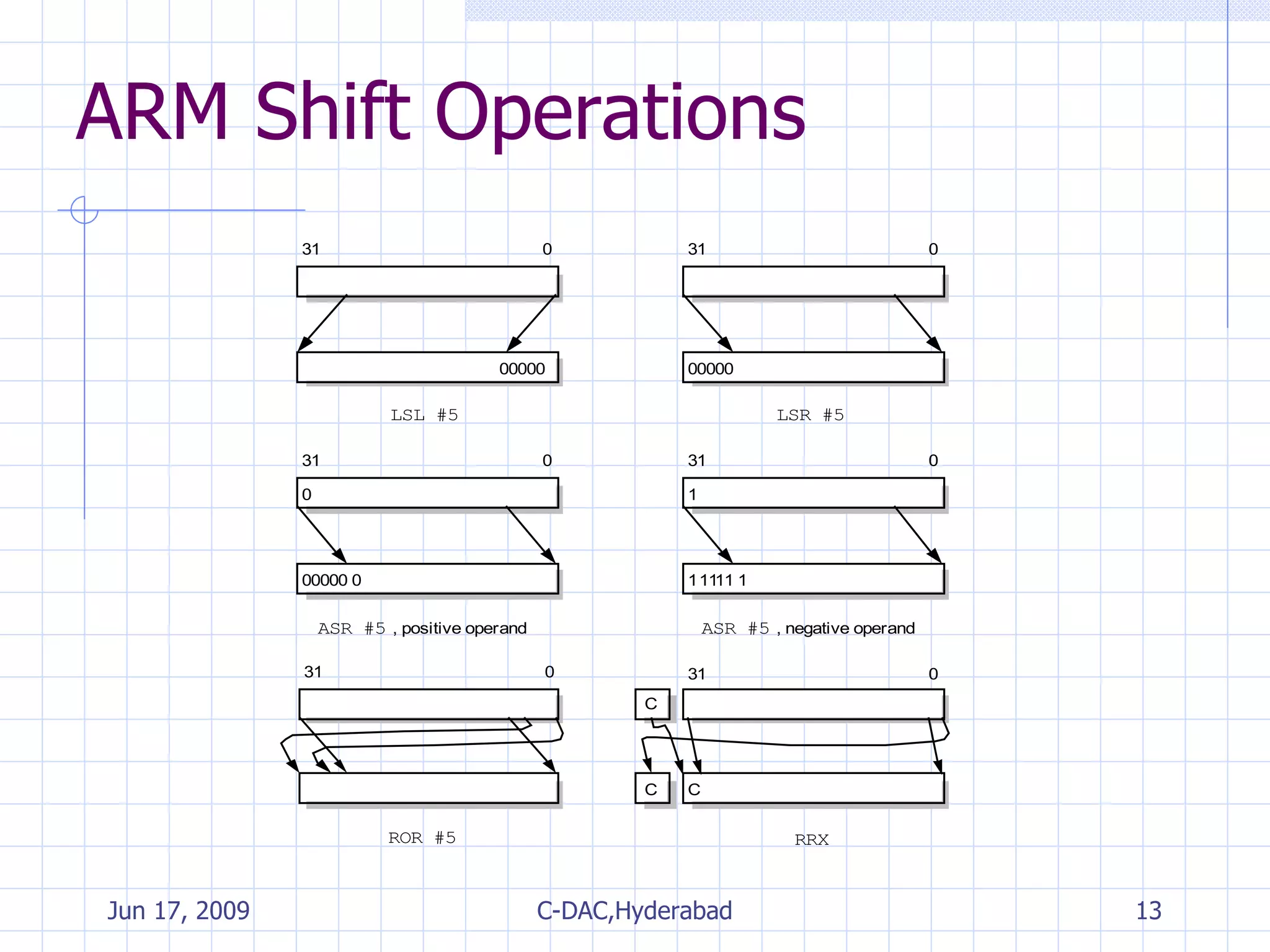
ARM Shift Operations
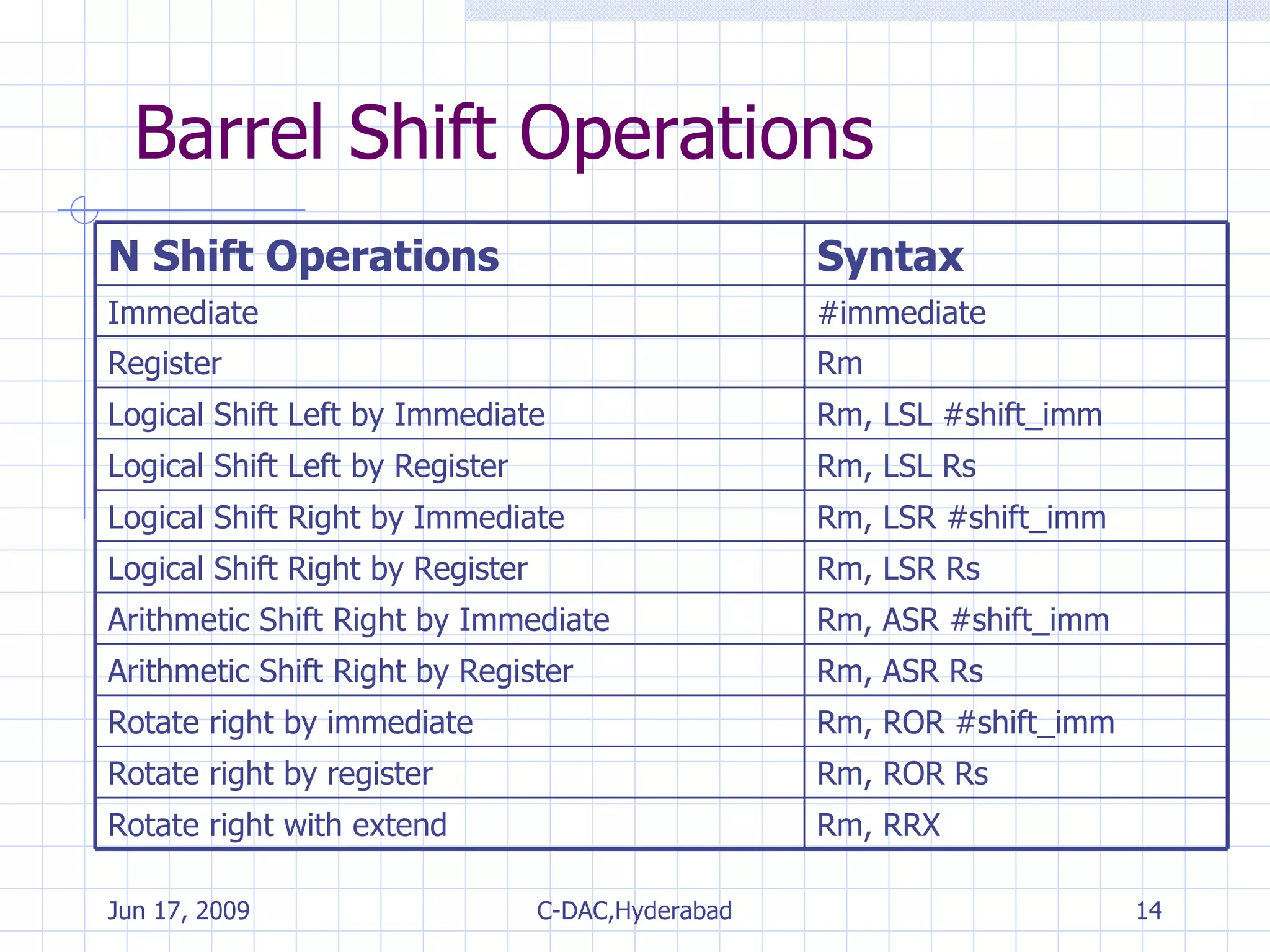
Barrel Shift Operations Rm, RRX Rotate right with extend Rm, ROR Rs Rotate right by register Rm, ROR #shift_imm Rotate right by immediate Rm, ASR Rs Arithmetic Shift Right by Register Rm, ASR #shift_imm Arithmetic Shift Right by Immediate Rm, LSR Rs Logical Shift Right by Register Rm, LSL Rs Logical Shift Left by Register Rm, LSR #shift_imm Logical Shift Right by Immediate Rm, LSL #shift_imm Logical Shift Left by Immediate Rm Register #immediate Immediate Syntax N Shift Operations
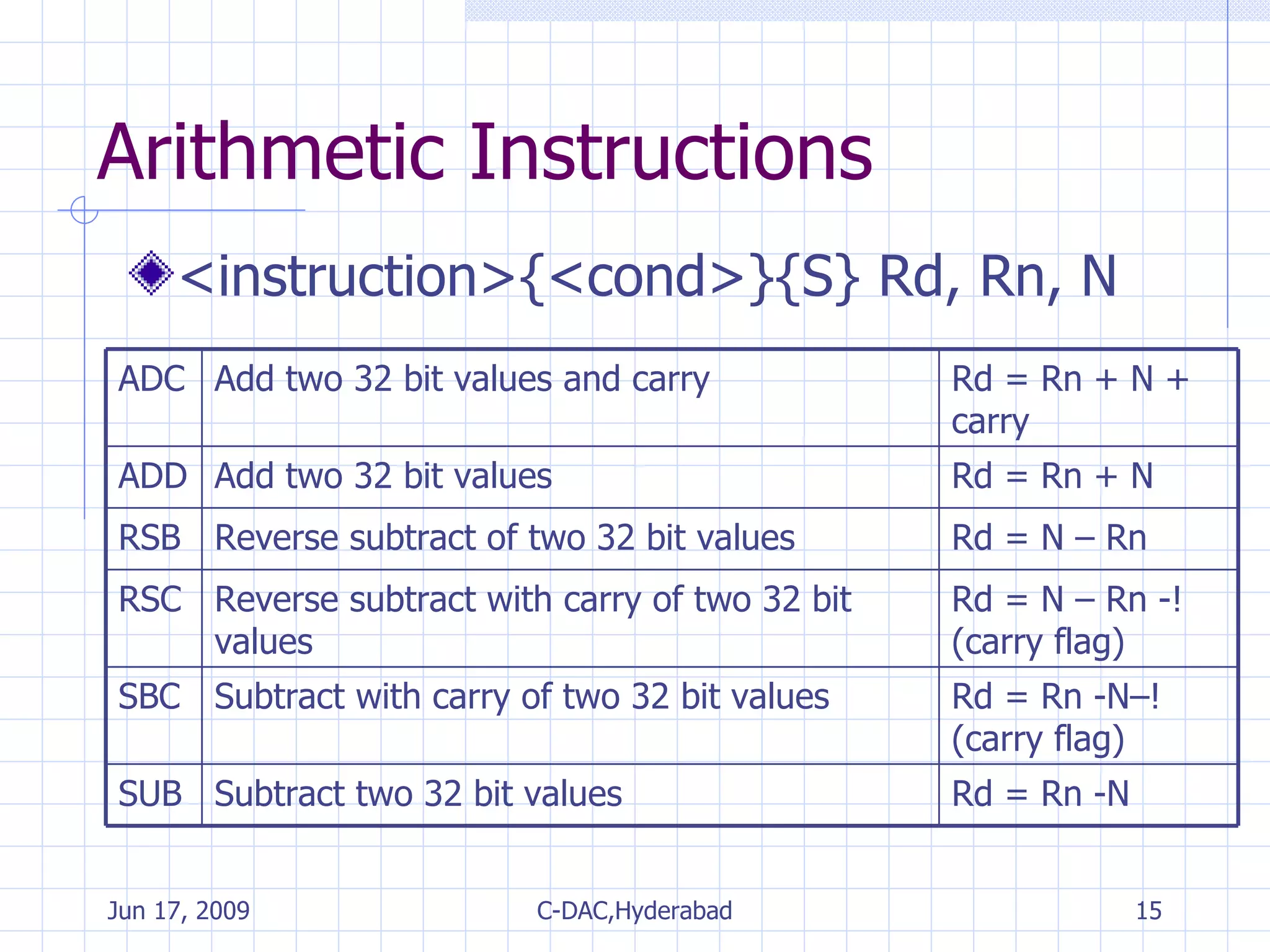
Arithmetic Instructions <instruction>{<cond>}{S} Rd, Rn, N Rd = Rn -N Subtract two 32 bit values SUB Rd = Rn -N–!(carry flag) Subtract with carry of two 32 bit values SBC Rd = N – Rn -!(carry flag) Reverse subtract with carry of two 32 bit values RSC Rd = N – Rn  Reverse subtract of two 32 bit values RSB Rd = Rn + N Add two 32 bit values ADD Rd = Rn + N + carry Add two 32 bit values and carry ADC
Arithmetic Instructions RSB can be used to negate numbers
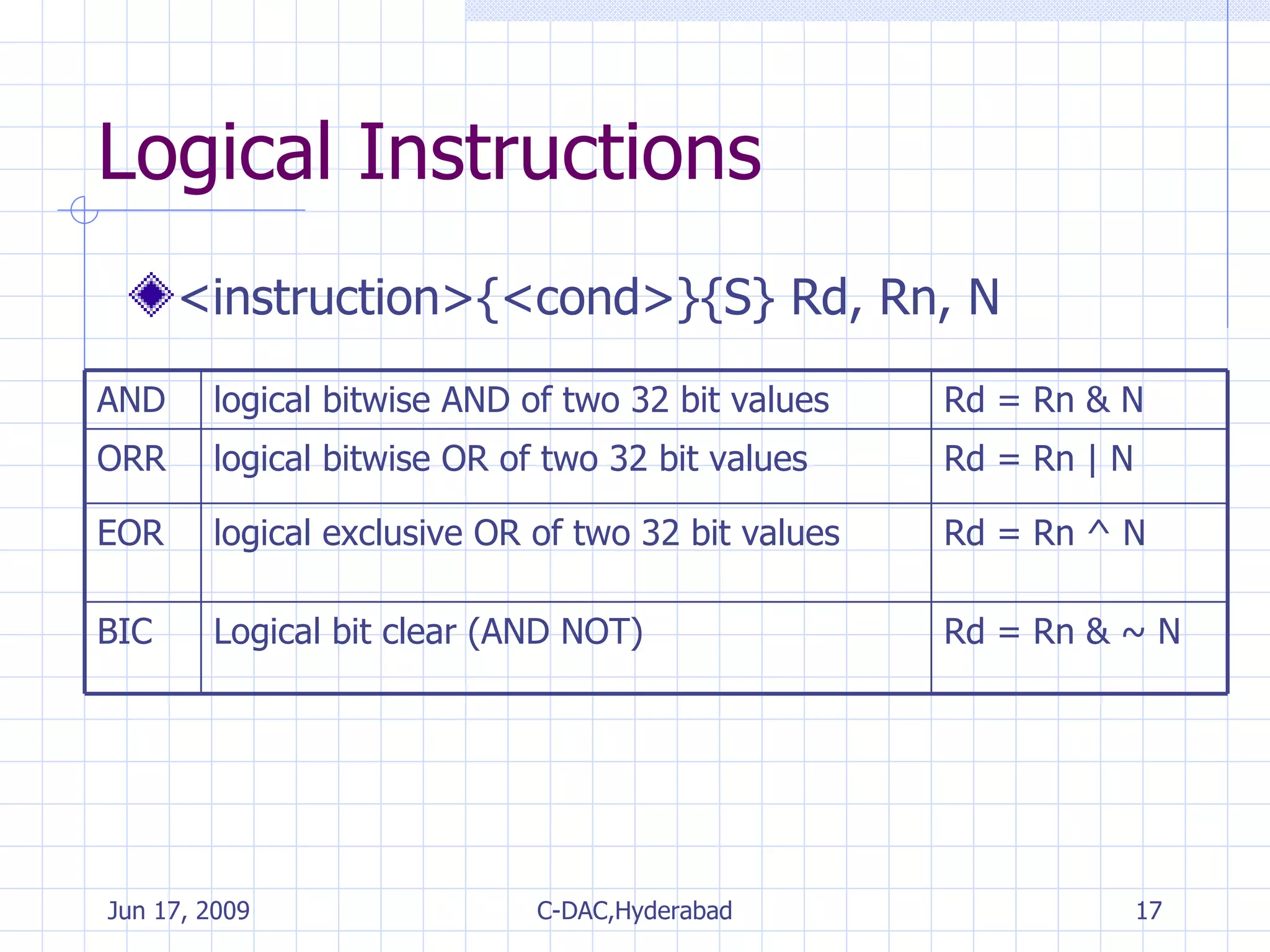
Logical Instructions <instruction>{<cond>}{S} Rd, Rn, N Rd = Rn & ~ N Logical bit clear (AND NOT) BIC Rd = Rn ^ N logical exclusive OR of two 32 bit values EOR Rd = Rn | N logical bitwise OR of two 32 bit values ORR Rd = Rn & N logical bitwise AND of two 32 bit values AND
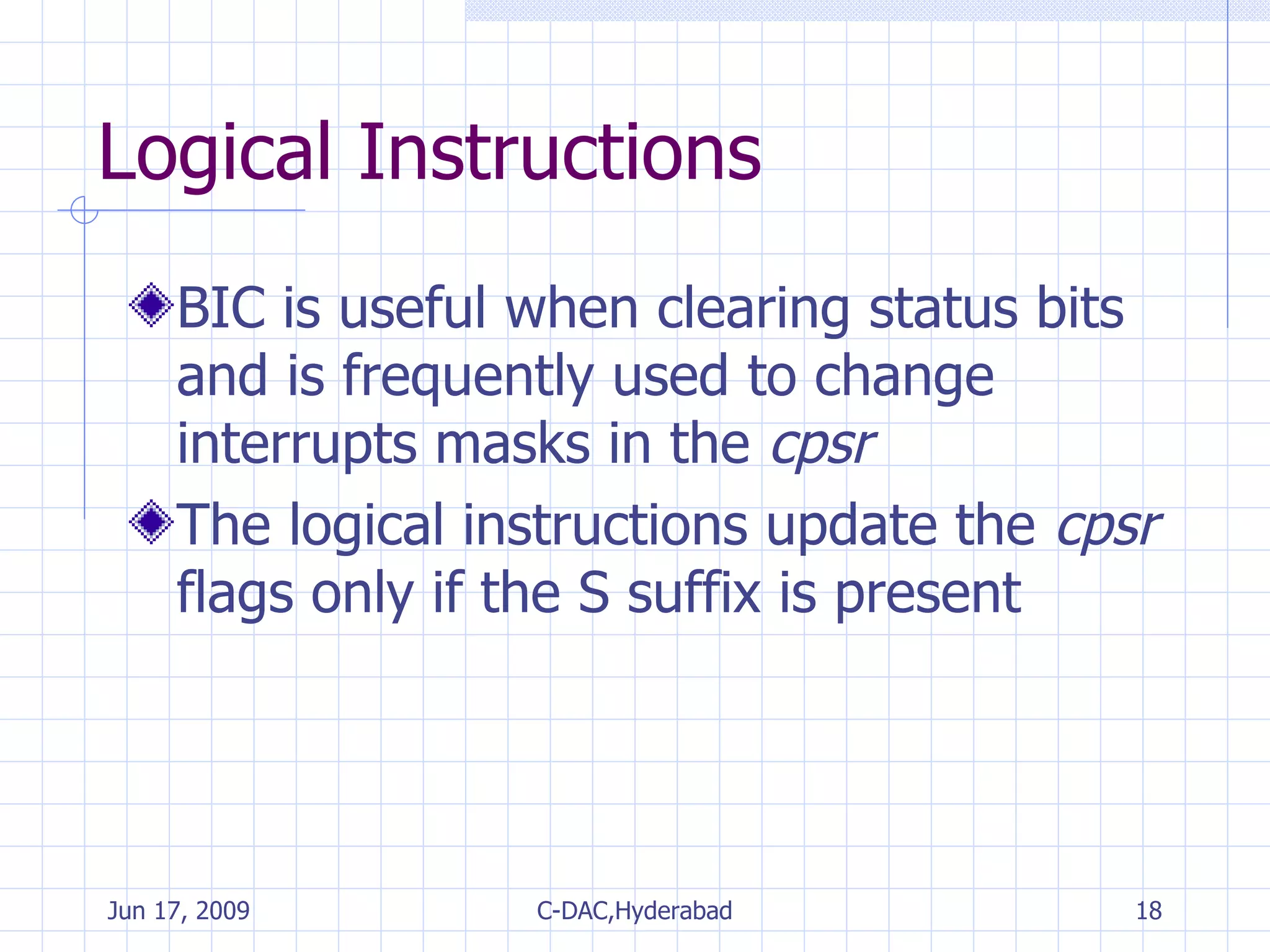
Logical Instructions BIC is useful when clearing status bits and is frequently used to change interrupts masks in the  cpsr The logical instructions update the  cpsr  flags only if the S suffix is present
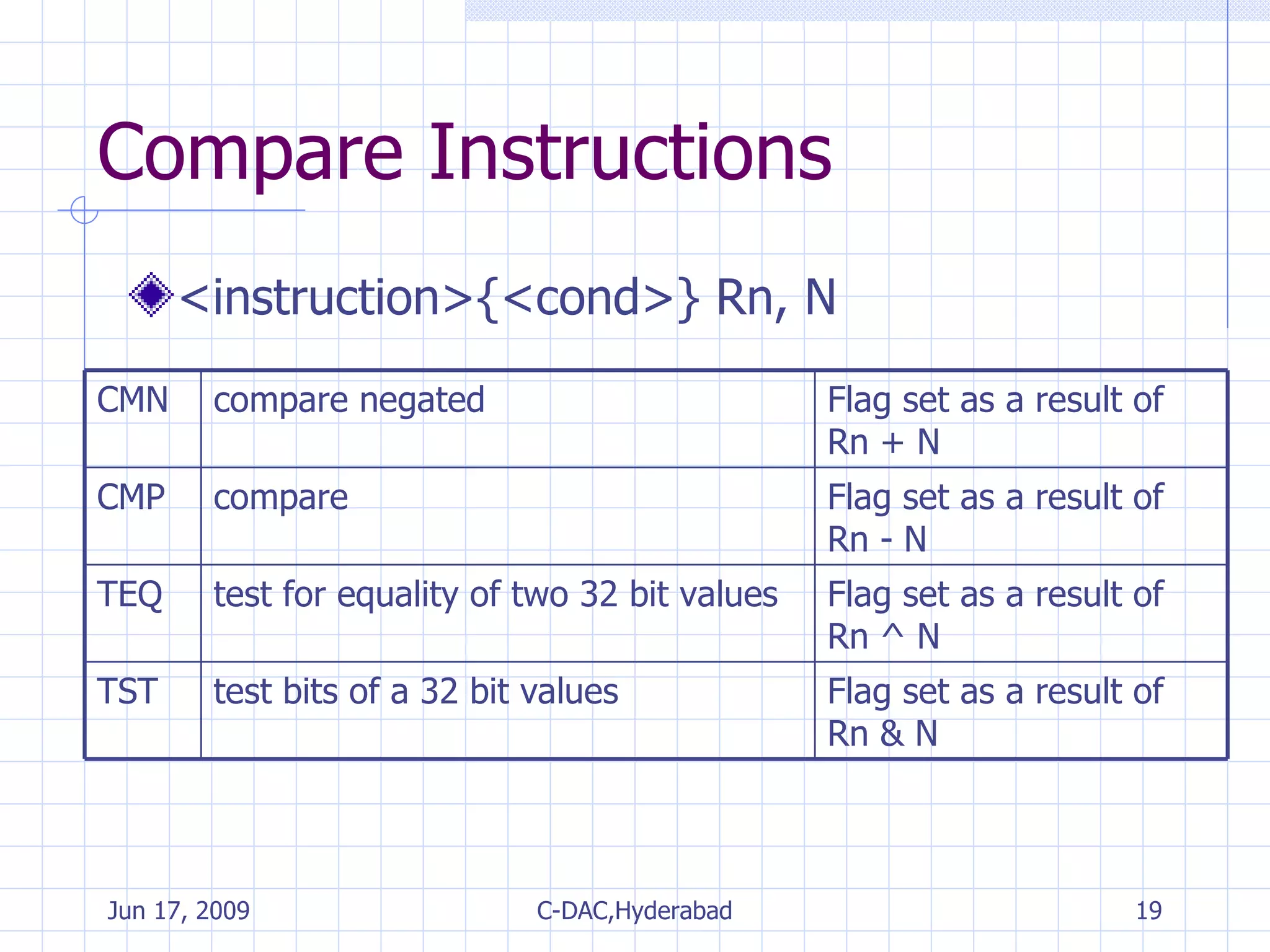
Compare Instructions <instruction>{<cond>} Rn, N Flag set as a result of Rn & N test bits of a 32 bit values TST Flag set as a result of Rn ^ N test for equality of two 32 bit values TEQ Flag set as a result of Rn - N compare CMP Flag set as a result of Rn + N compare negated CMN
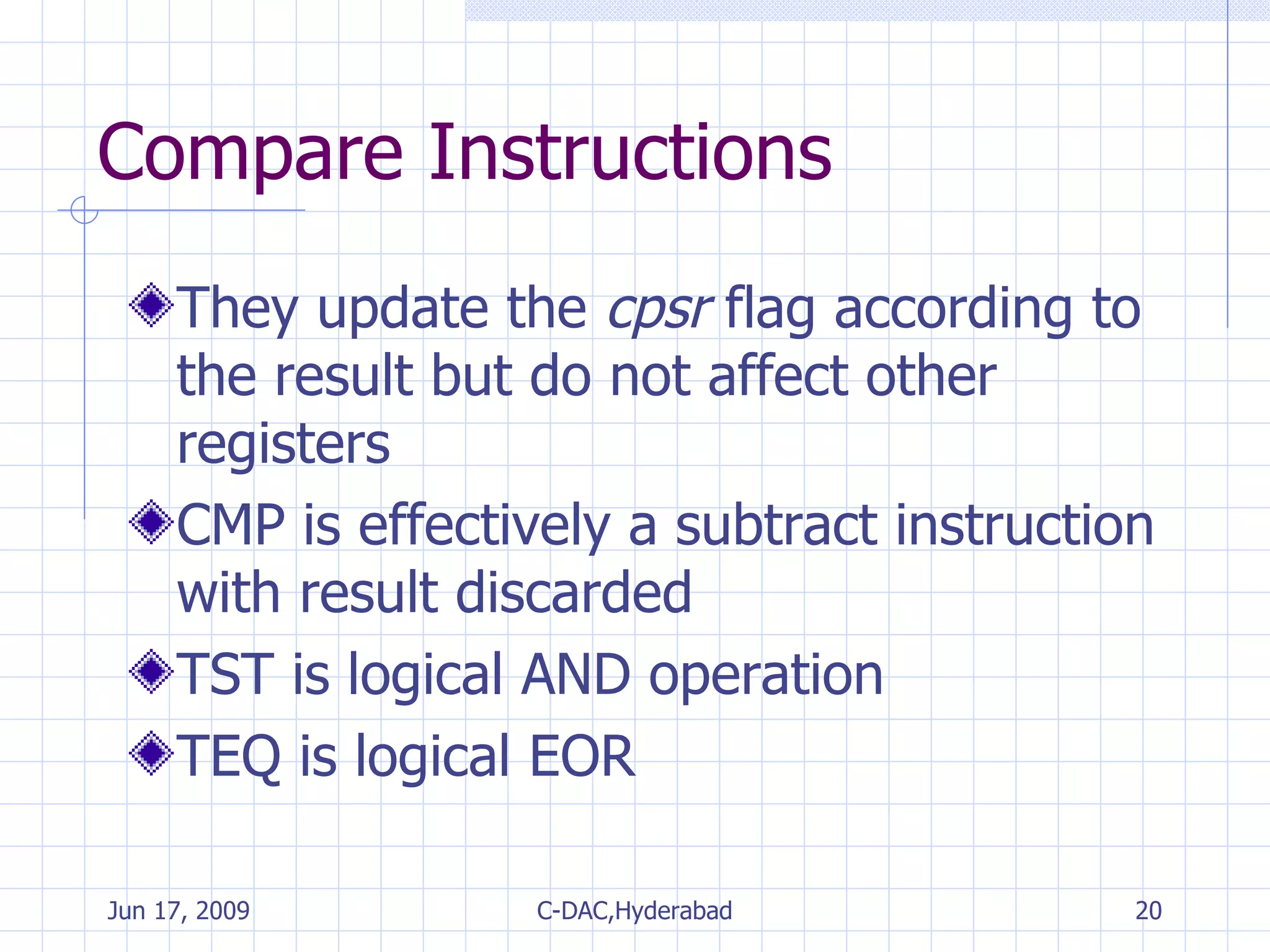
Compare Instructions They update the  cpsr  flag according to the result but do not affect other registers CMP is effectively a subtract instruction with result discarded TST is logical AND operation TEQ is logical EOR
Multiply Instructions MLA{<cond>}{S} Rd, Rm, Rs, Rn MUL{<cond>}{S} Rd, Rm, Rs instruction>{<cond>}{S} RdLo, RdHi, Rm, Rs Rd = Rm * Rs multiply MUL Rd = (Rm * Rs) + Rn multiply & accumulate MLA [RdHi,RdLo]=Rm * Rs unsigned multiply long UMULL [RdHi,RdLo]=[RdHi,RdLo] + (Rm * Rs) unsigned multiply accumulate long UMLAL [RdHi,RdLo]=(Rm * Rs) signed multiply long SMULL [RdHi,RdLo]=[RdHi,RdLo] + (Rm * Rs) signed multiply accumulate long SMLAL
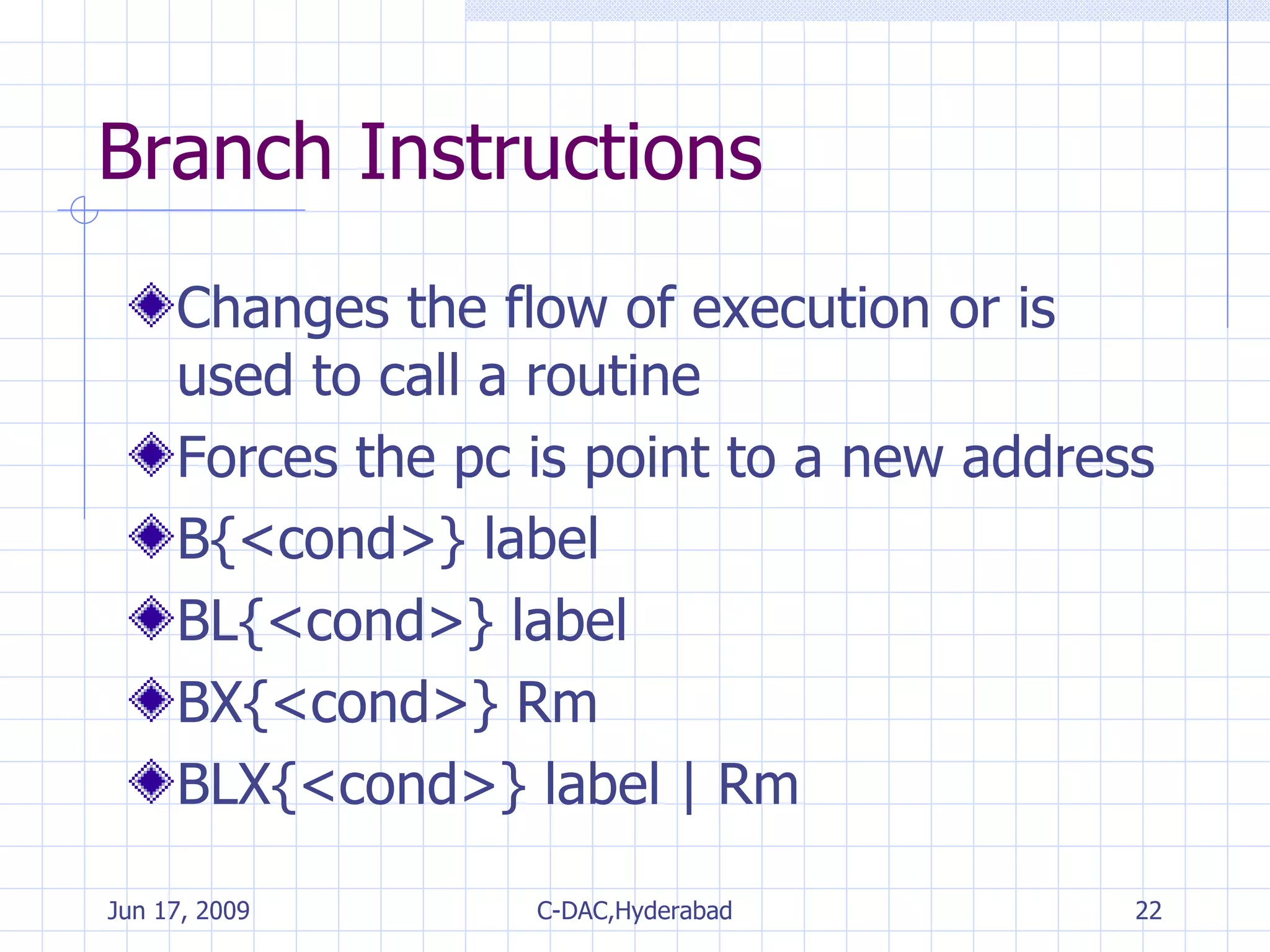
Branch Instructions Changes the flow of execution or is used to call a routine Forces the pc is point to a new address B{<cond>} label BL{<cond>} label BX{<cond>} Rm BLX{<cond>} label | Rm
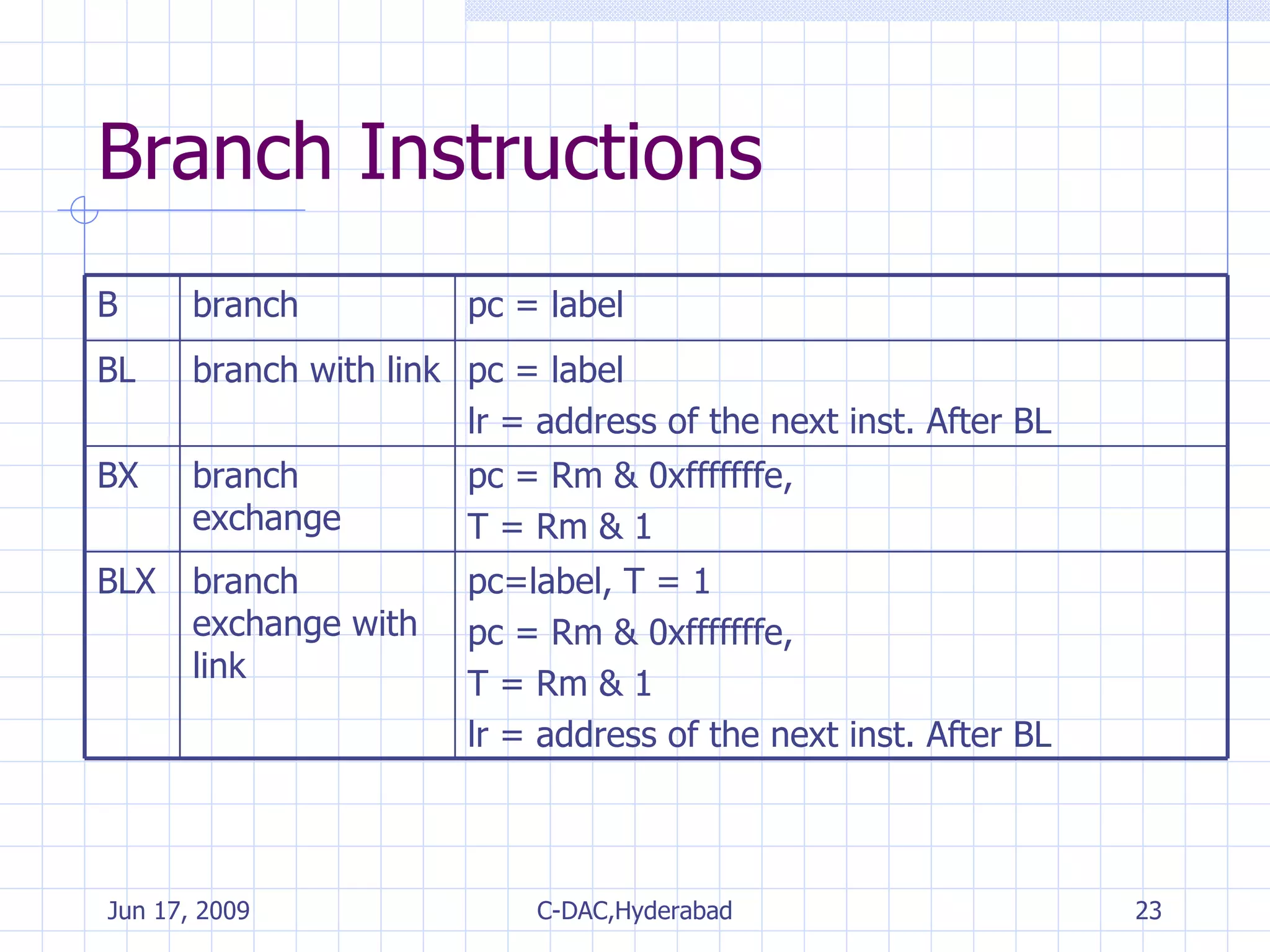
Branch Instructions pc=label, T = 1 pc = Rm & 0xfffffffe,  T = Rm & 1 lr = address of the next inst. After BL branch exchange with link BLX pc = Rm & 0xfffffffe,  T = Rm & 1 branch exchange BX pc = label lr = address of the next inst. After BL branch with link BL pc = label branch B
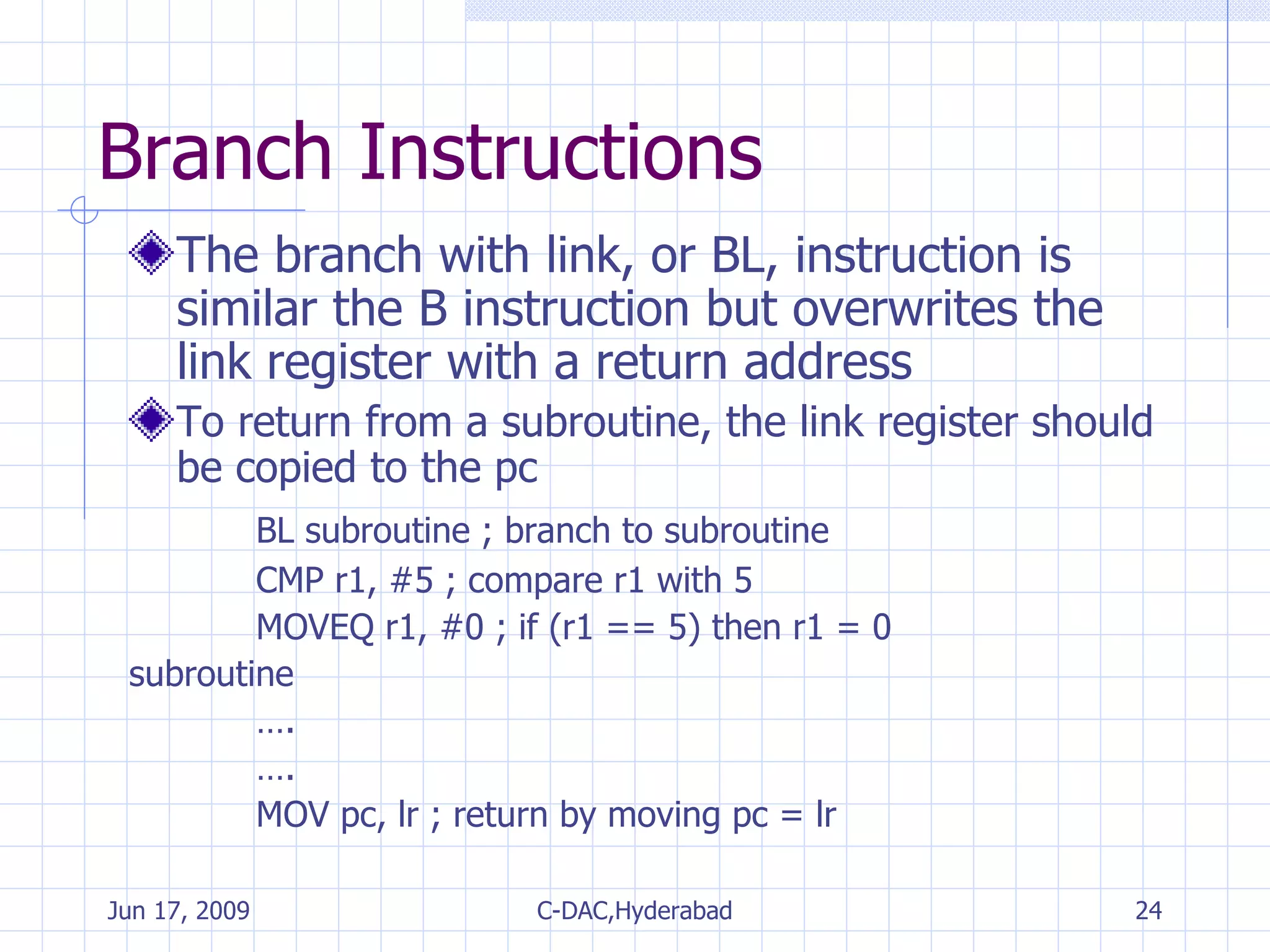
Branch Instructions The branch with link, or BL, instruction is similar the B instruction but overwrites the link register with a return address To return from a subroutine, the link register should be copied to the pc BL subroutine ; branch to subroutine CMP r1, #5 ; compare r1 with 5 MOVEQ r1, #0 ; if (r1 == 5) then r1 = 0 subroutine … . … . MOV pc, lr ; return by moving pc = lr
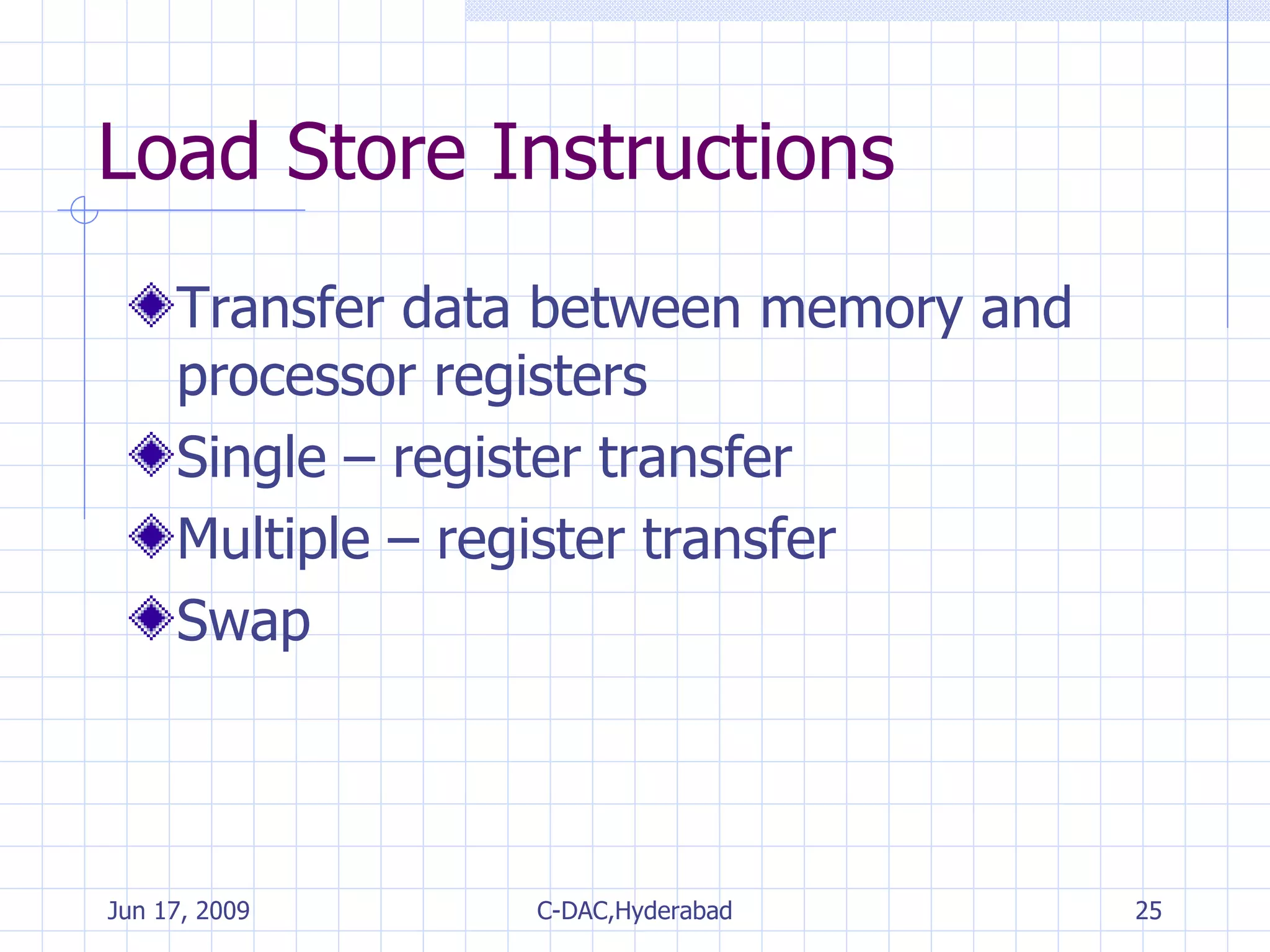
Load Store Instructions Transfer data between memory and processor registers Single – register transfer Multiple – register transfer Swap
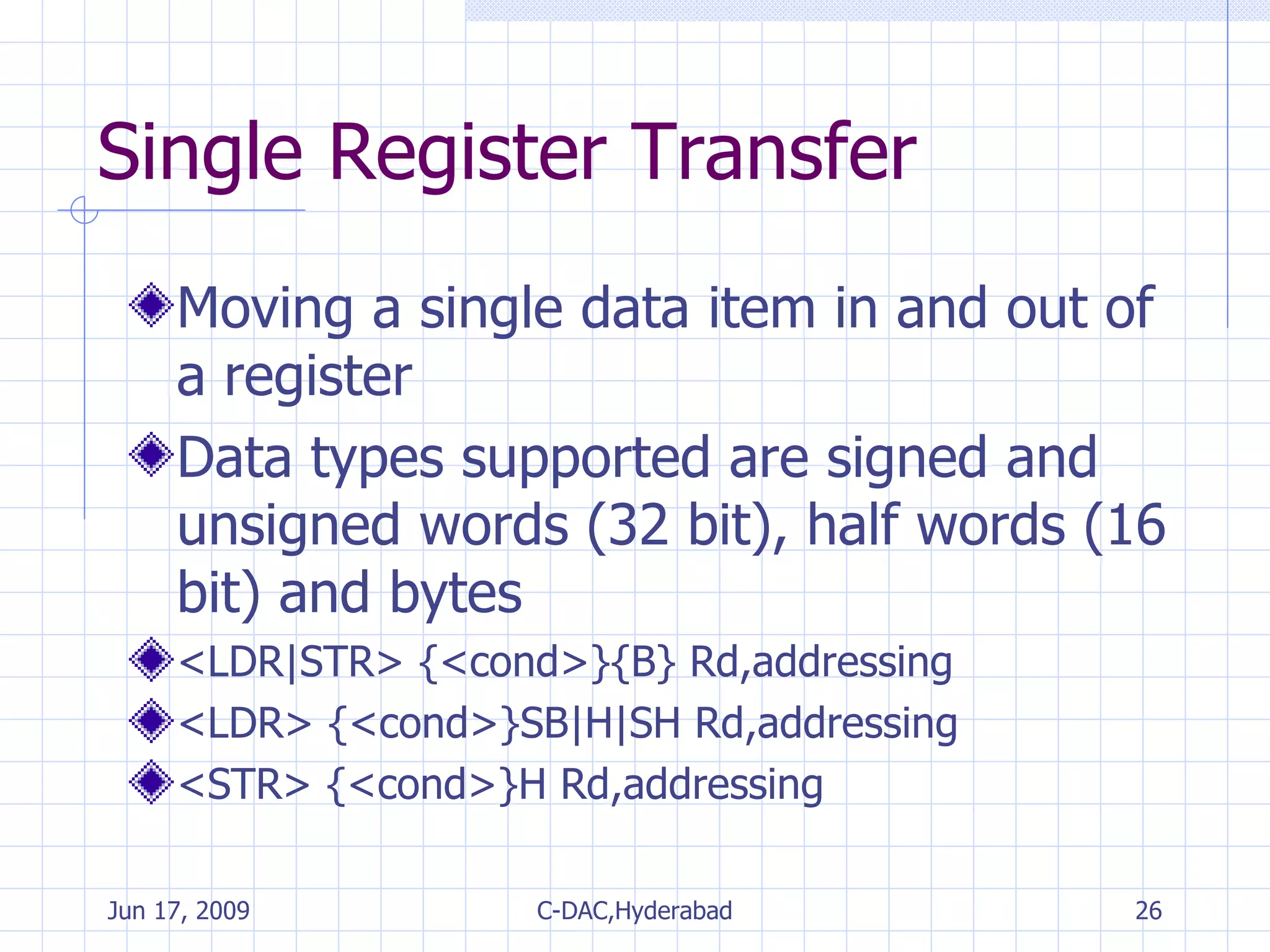
Single Register Transfer Moving a single data item in and out of a register Data types supported are signed and unsigned words (32 bit), half words (16 bit) and bytes <LDR|STR> {<cond>}{B} Rd,addressing <LDR> {<cond>}SB|H|SH Rd,addressing <STR> {<cond>}H Rd,addressing
Single Register Transfer Rd <-SignExtend (mem16[address]) load signed half word into a register LDRSH Rd <-SignExtend (mem8[address]) load signed byte into a register LDRSB Rd ->mem16[address] save half word from a register STRH Rd <-mem16[address] load half word into a register LDRH Rd ->mem8[address] save byte from a register STRB Rd <-mem8[address] load byte into a register LDRB Rd ->mem32[address] save byte or word from a register STR Rd <-mem32[address] load word into a register LDR
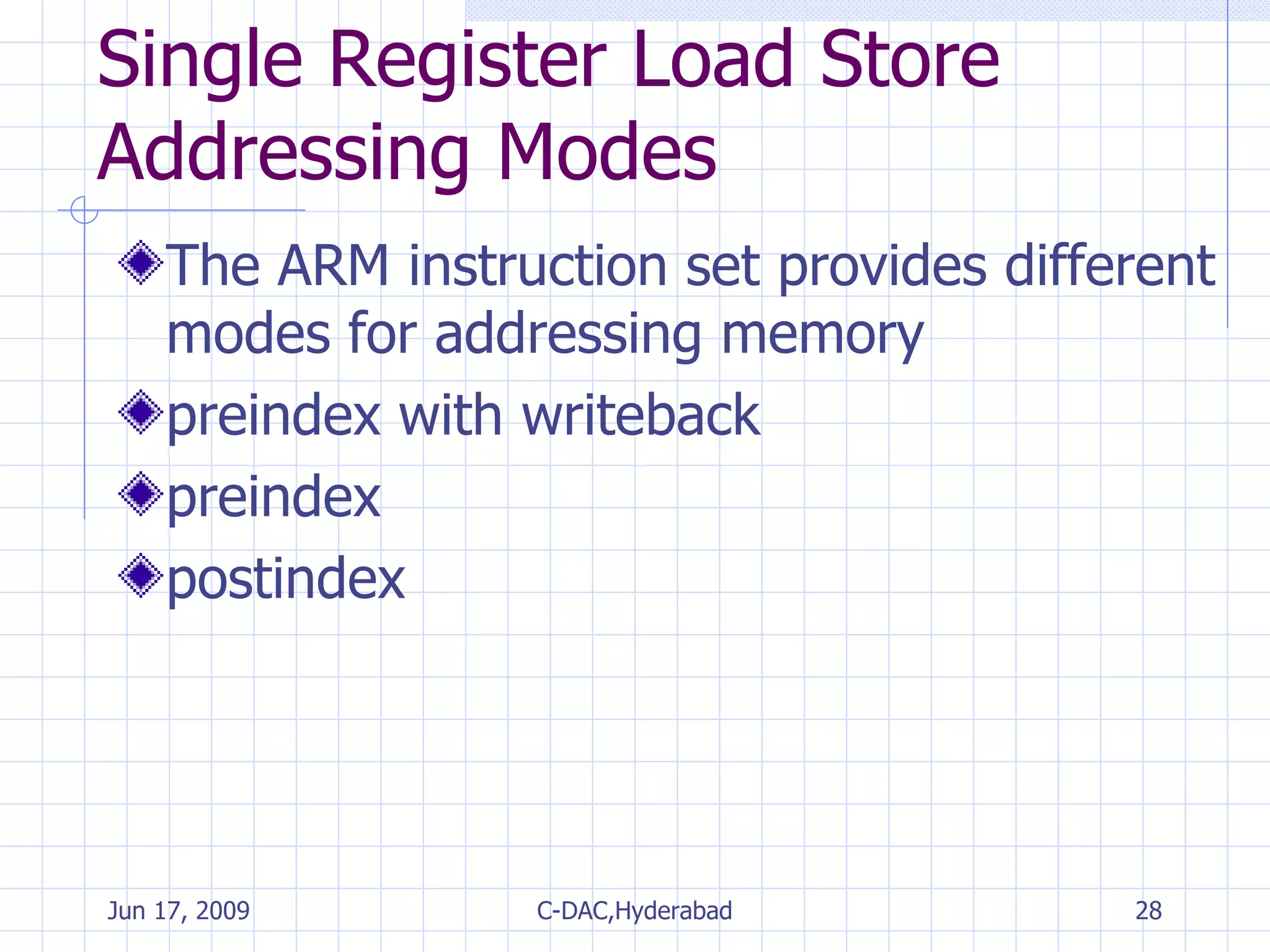
Single Register Load Store Addressing Modes The ARM instruction set provides different modes for addressing memory preindex with writeback preindex postindex
Index Methods LDR r0, [r1], #4 base+ offset mem[base] postindex LDR r0, [r1, #4] not updated mem[base+offset] preindex LDR r0, [r1, #4]! base+ offset mem[base+offset] preindex with writeback Example Base Address Register Data Index Method
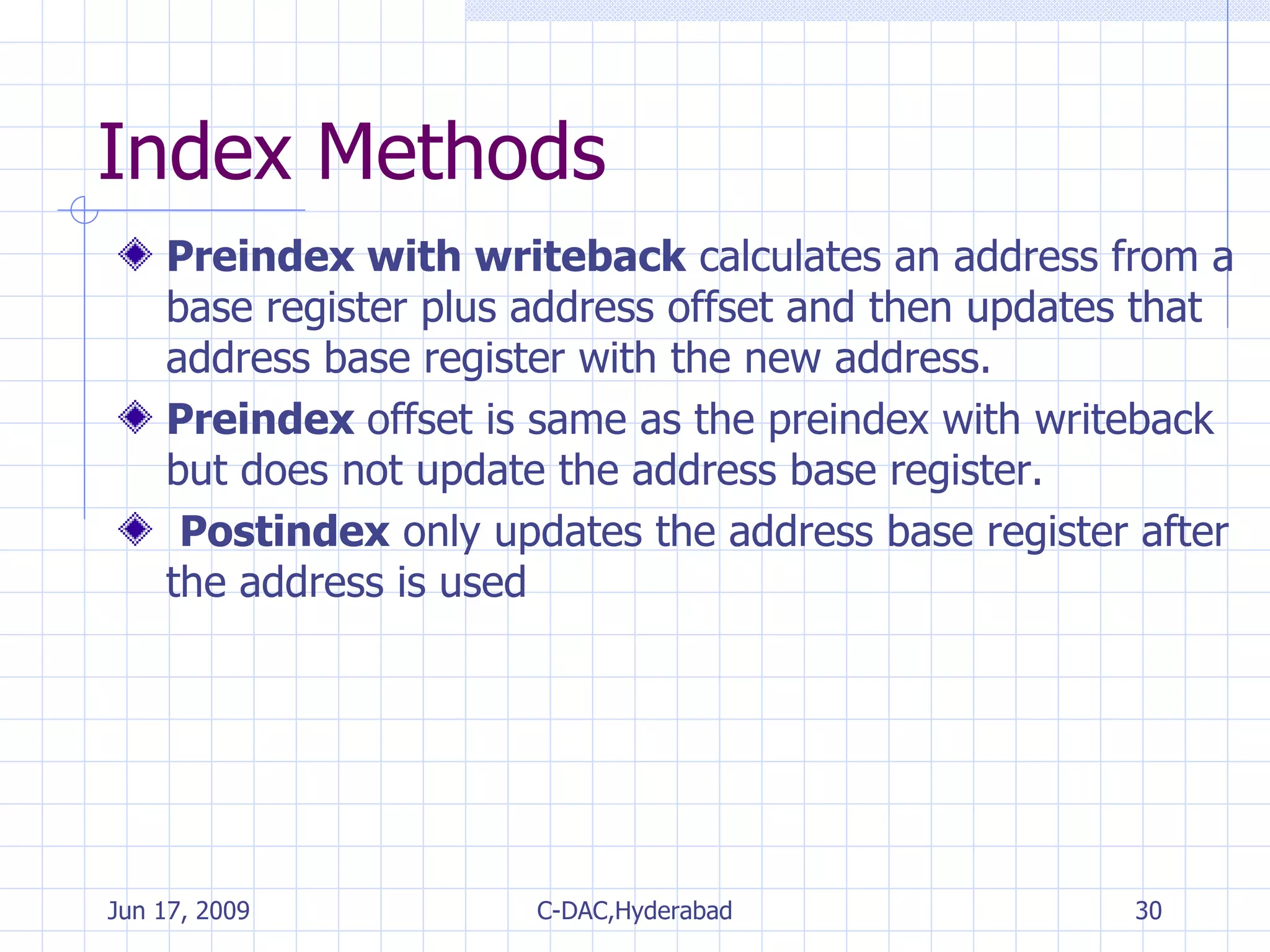
Index Methods Preindex with writeback  calculates an address from a base register plus address offset and then updates that address base register with the new address. Preindex  offset is same as the preindex with writeback but does not update the address base register. Postindex  only updates the address base register after the address is used
Single Register Load Store Addressing word or unsigned byte Addressing Mode & Index Method Addressing Syntax Preindex with immediate offset [Rn, #+/-offset_12] Preindex writeback with scaled register offset [Rn, +/-Rm, shift #shift_imm]! Preindex with register offset [Rn, +/-Rm] Preindex with scaled register offset [Rn, +/-Rm, shift #shift_imm] Preindex writeback with immediate offset [Rn, +/-offset_12]! Preindex writeback with register offset [Rn, +/-Rm]! Immediate postindexed [Rn], +/-offset_12 Register postindex [Rn], +/-Rm Scaled register postindex [Rn], +/-Rm, shift #shift_imm
Eg. of LDR instructions using different addressing modes Instruction r0= r1+= Preindexwith writeback LDR r0,[r1,#0x4]! mem32[r1+0x4] 0x4 Preindex Postindex LDR r0,[r1,r2]! mem32[r1+r2] r2 LDR r0,[r1,r2,LSR#0x4]! mem32[r1+(r2 LSR 0x4)] r2 LSR 0x4 LDR r0,[r1,#0x4] mem32[r1+0x4] not updated LDR r0,[r1,r2] mem32[r1+r2] not updated LDR r0,[r1,-r2,LSR#0x4] mem32[r1-(r2 LSR 0x4)] not updated LDR r0,[r1],#0x4 mem32[r1] 0x4 LDR r0,[r1],r2 mem32[r1] r2 LDR r0,[r1],r2,LSR#0x4 mem32[r1] R2 LSR 0x4
Variations of STRH instructions Instruction Result r1+= Preindexwith writeback STRH r0,[r1,#0x4]! mem16[r1+0x4] =r0 0x4 Preindex Postindex STRH r0,[r1,r2]! mem16[r1+r2] =r0 r2 STRH r0,[r1,#0x4]! mem16[r1+0x4] =r0 not updated STRH r0,[r1,r2] mem16[r1+r2] =r0 not updated STRH r0,[r1],#0x4 mem16[r1] =r0 0x4 STRH r0,[r1],r2 mem16[r1] =r0 r2
Multiple Register Transfer Load–store multiple instructions can transfer multiple registers between memory and the processor in a single instruction. Moving blocks of data around memory and saving and restoring context stacks <LDM|STM>{<cond>}<addressing mode> Rn{!},<registers>{^} {Rd}*N -> mem32[start address + 4*N] optional Rn updated save multiple registers STM {Rd}*N <- mem32[start address + 4*N] optional Rn updated load multiple registers LDM
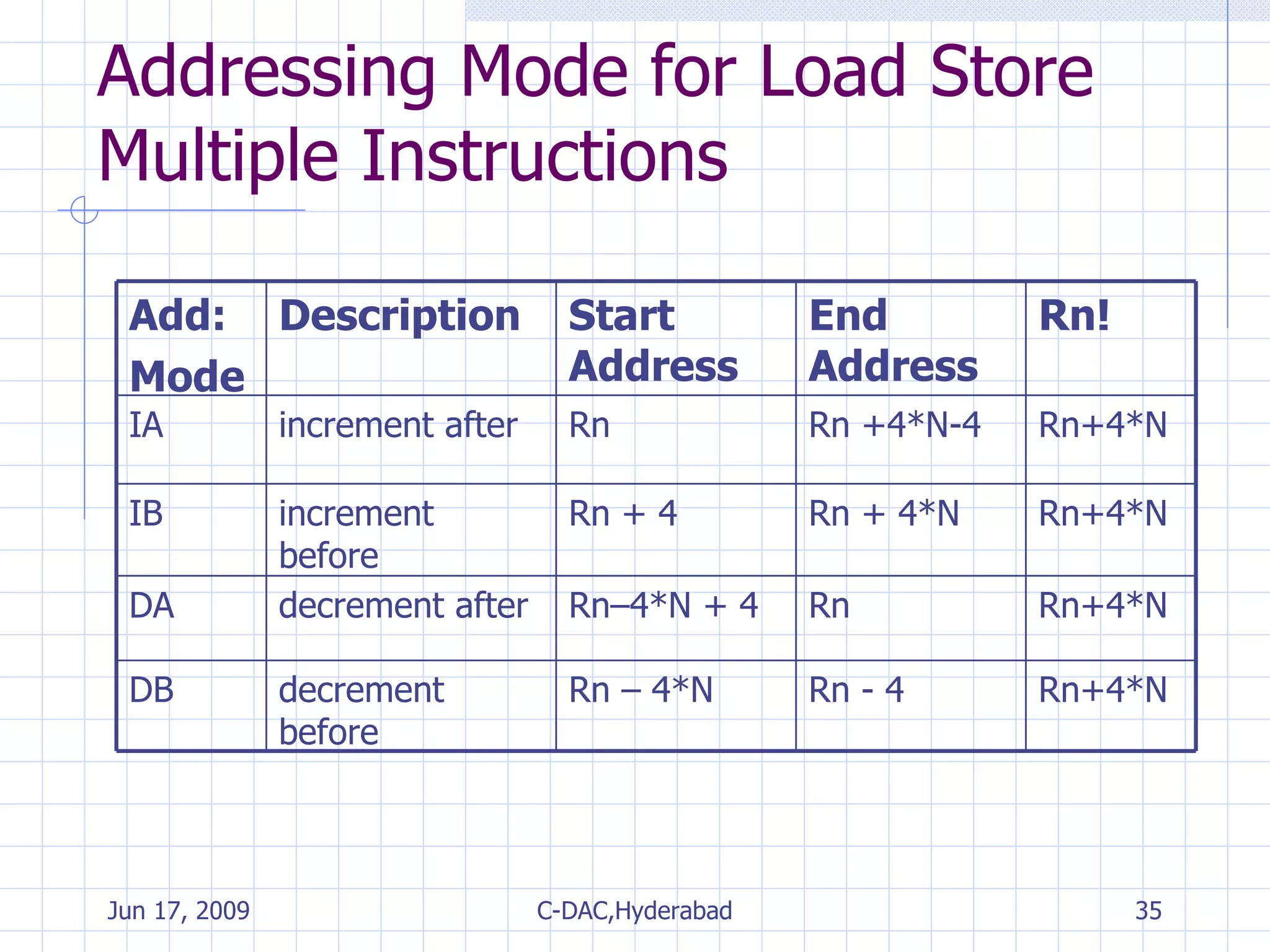
Addressing Mode for Load Store Multiple Instructions Rn+4*N Rn - 4 Rn – 4*N decrement before DB Rn+4*N Rn Rn–4*N + 4 decrement after DA Rn+4*N Rn + 4*N Rn + 4 increment before IB Rn+4*N Rn +4*N-4 Rn increment after IA Rn! End Address Start Address Description Add: Mode
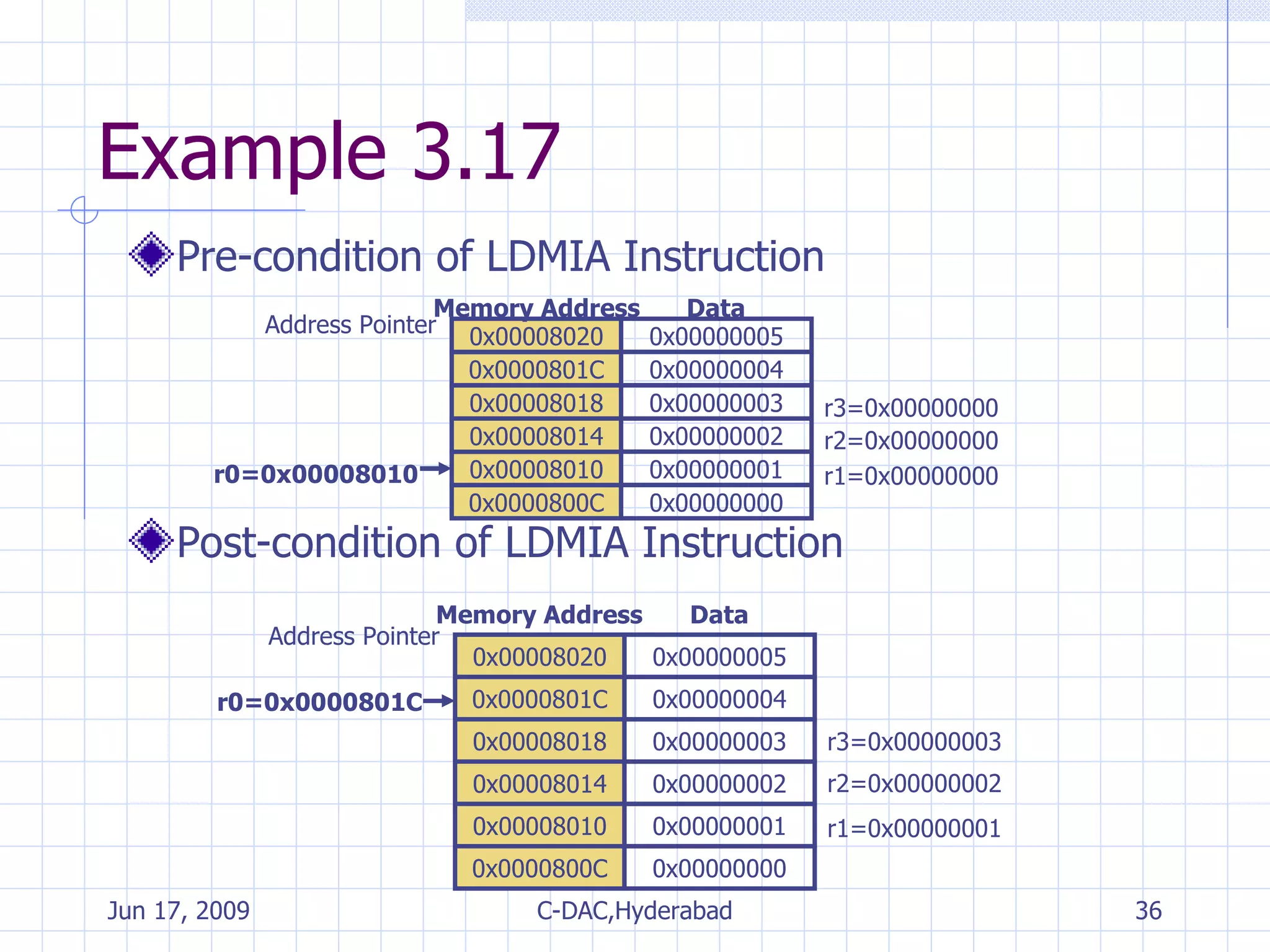
Example 3.17 Pre-condition of LDMIA Instruction Post-condition of LDMIA Instruction 0x00008020 0x0000801C 0x00008018 0x00008014 0x00008010 0x0000800C r3=0x00000003 r2=0x00000002 r1=0x00000001 Address Pointer Data Memory Address 0x00008020 0x0000801C 0x00008018 0x00008014 0x00008010 0x0000800C 0x00000005 0x00000004 0x00000003 0x00000002 0x00000001 0x00000000 r3=0x00000000 r2=0x00000000 r1=0x00000000 r0=0x00008010 Address Pointer Data Memory Address 0x00000005 0x00000004 0x00000003 0x00000002 0x00000001 0x00000000 r0=0x0000801C
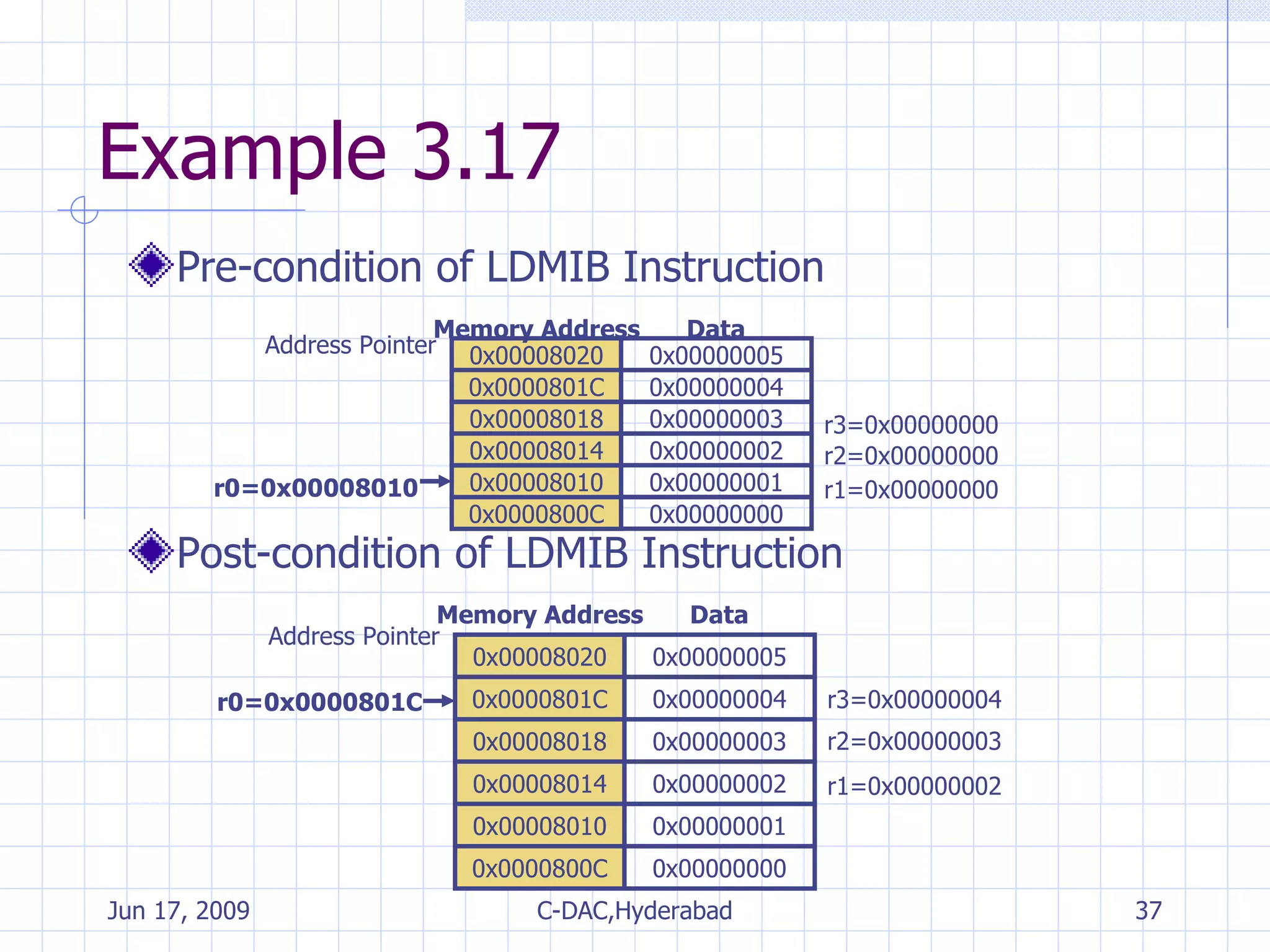
Example 3.17 Pre-condition of LDMIB Instruction Post-condition of LDMIB Instruction 0x00008020 0x0000801C 0x00008018 0x00008014 0x00008010 0x0000800C r3=0x00000004 r2=0x00000003 r1=0x00000002 Address Pointer Data Memory Address 0x00008020 0x0000801C 0x00008018 0x00008014 0x00008010 0x0000800C 0x00000005 0x00000004 0x00000003 0x00000002 0x00000001 0x00000000 r3=0x00000000 r2=0x00000000 r1=0x00000000 r0=0x00008010 Address Pointer Data Memory Address 0x00000005 0x00000004 0x00000003 0x00000002 0x00000001 0x00000000 r0=0x0000801C
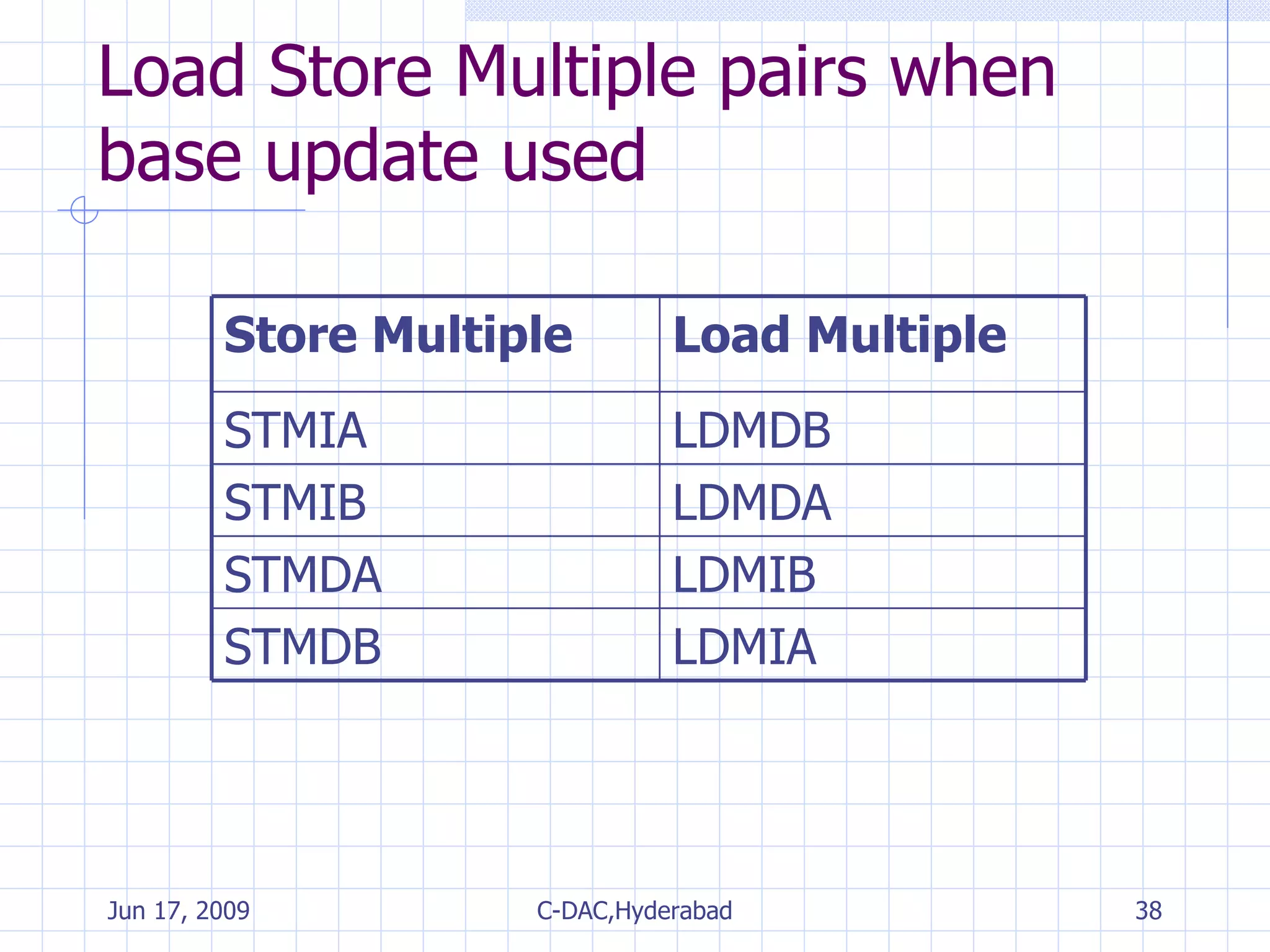
Load Store Multiple pairs when base update used LDMIA STMDB LDMIB STMDA LDMDA STMIB LDMDB STMIA Load Multiple Store Multiple
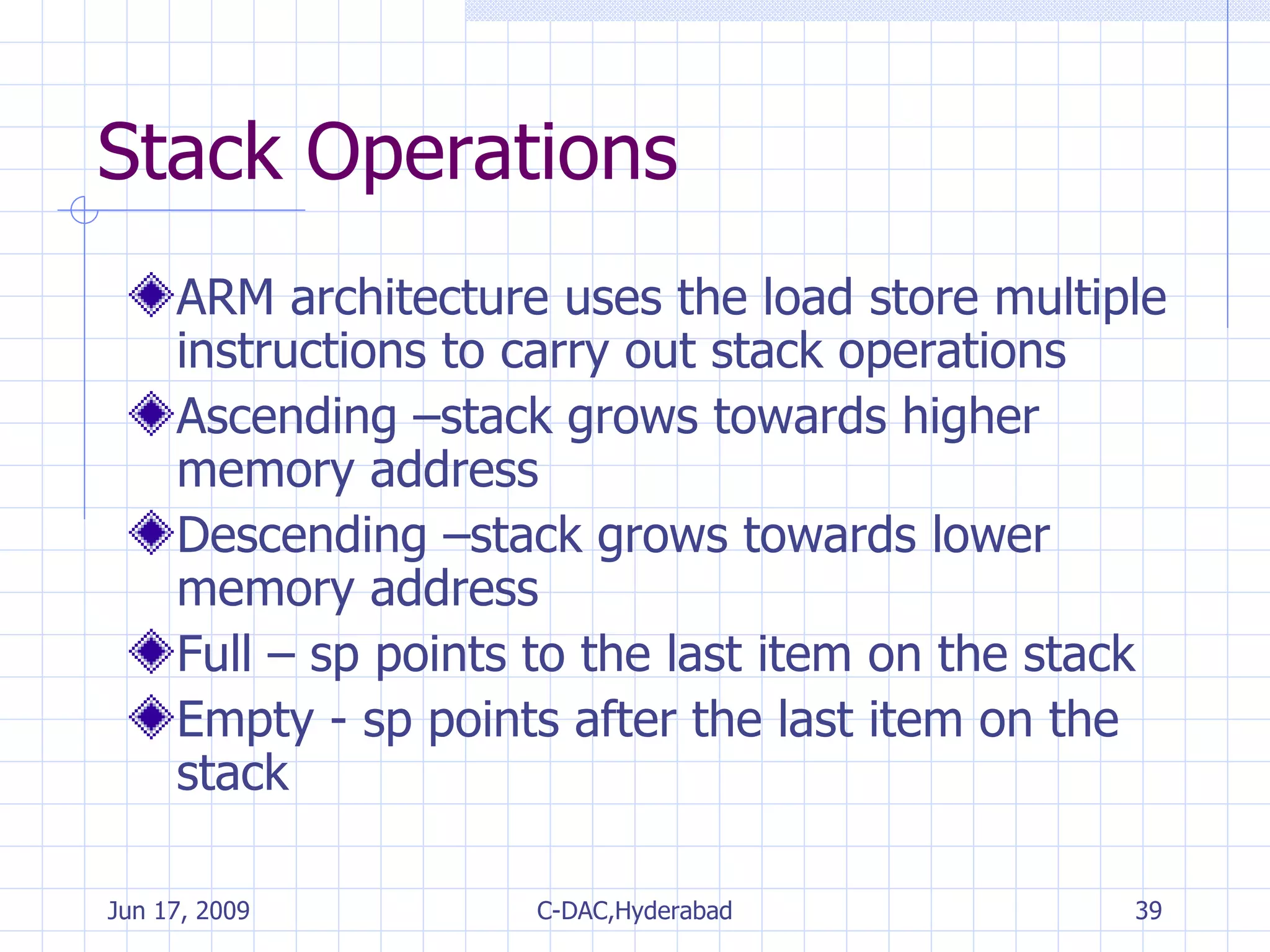
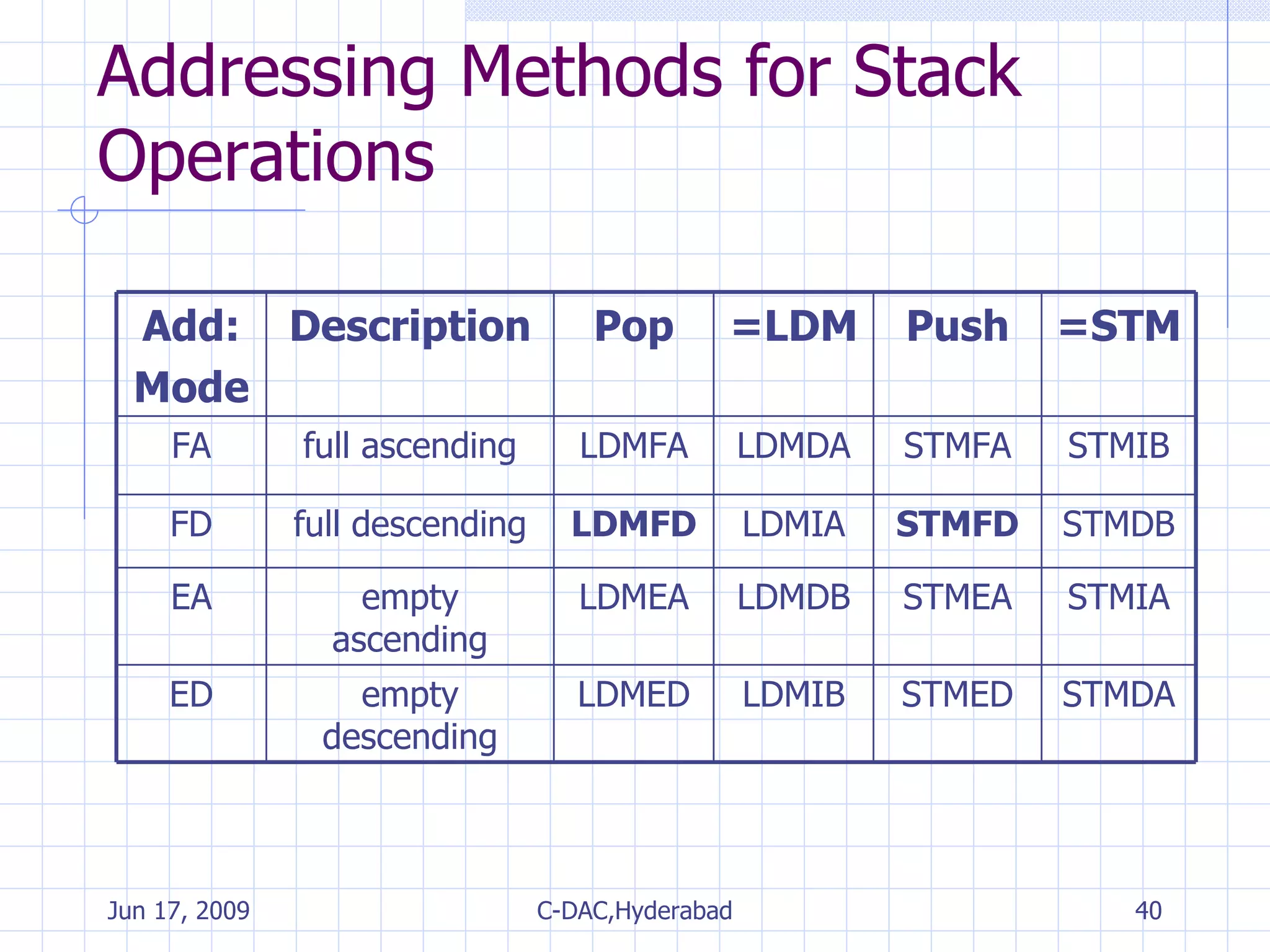
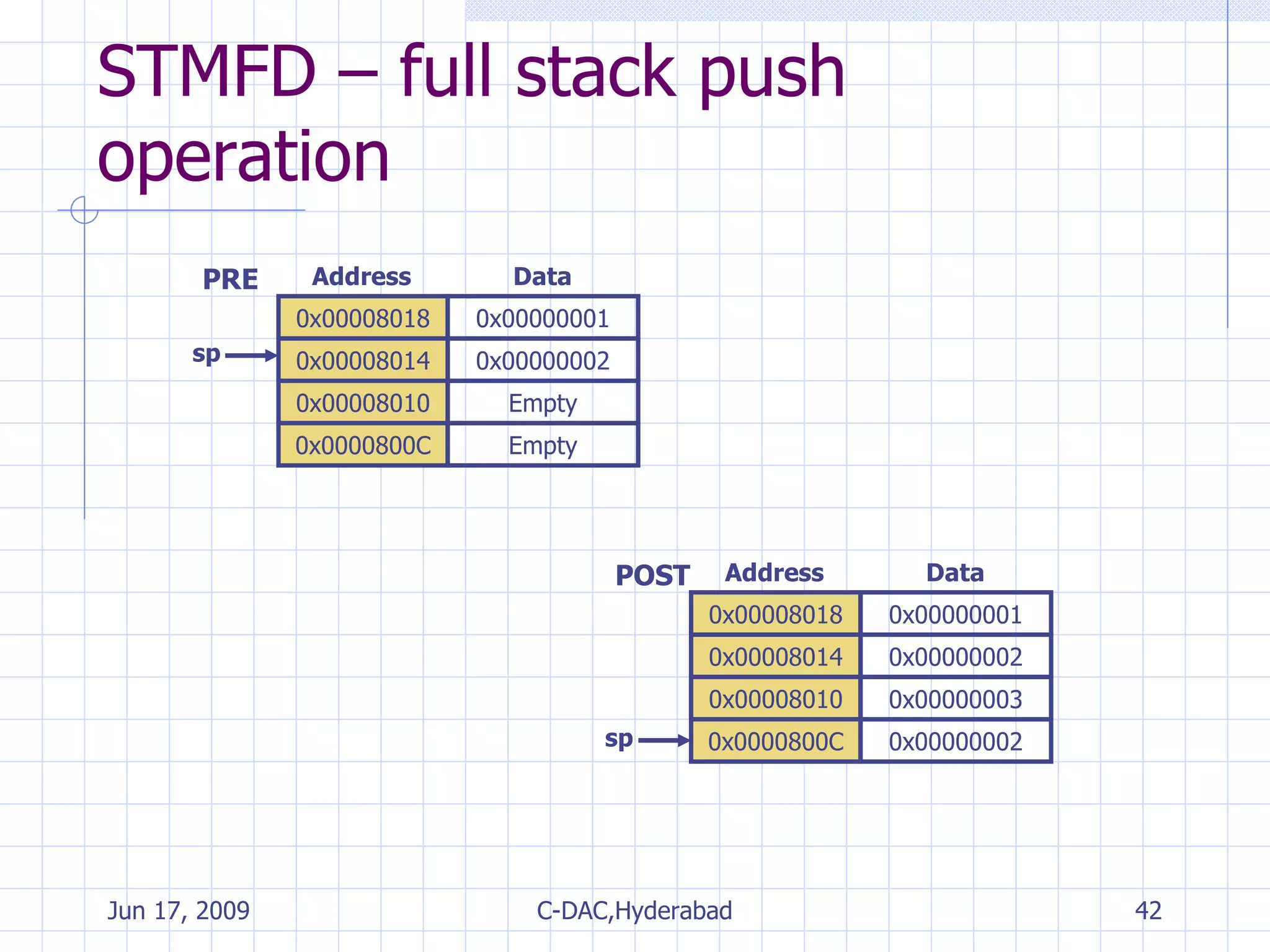
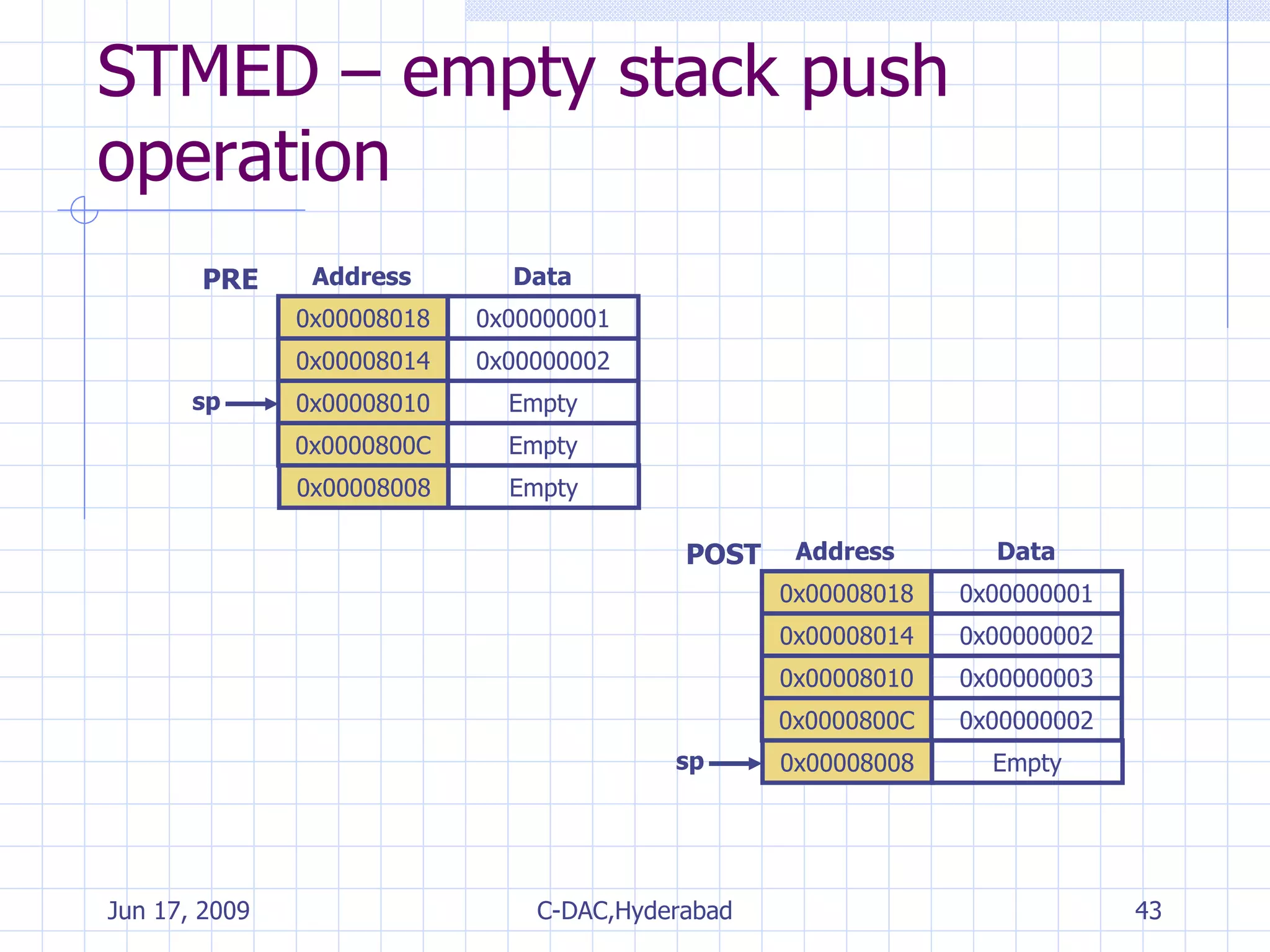
Stack Operations ARM architecture uses the load store multiple instructions to carry out stack operations Ascending –stack grows towards higher memory address Descending –stack grows towards lower memory address Full – sp points to the last item on the stack Empty - sp points after the last item on the stack
Addressing Methods for Stack Operations STMDA STMED LDMIB LDMED empty descending ED STMIA STMEA LDMDB LDMEA empty ascending EA STMDB STMFD LDMIA LDMFD full descending FD STMIB STMFA LDMDA LDMFA full ascending FA =STM Push =LDM Pop Description Add: Mode
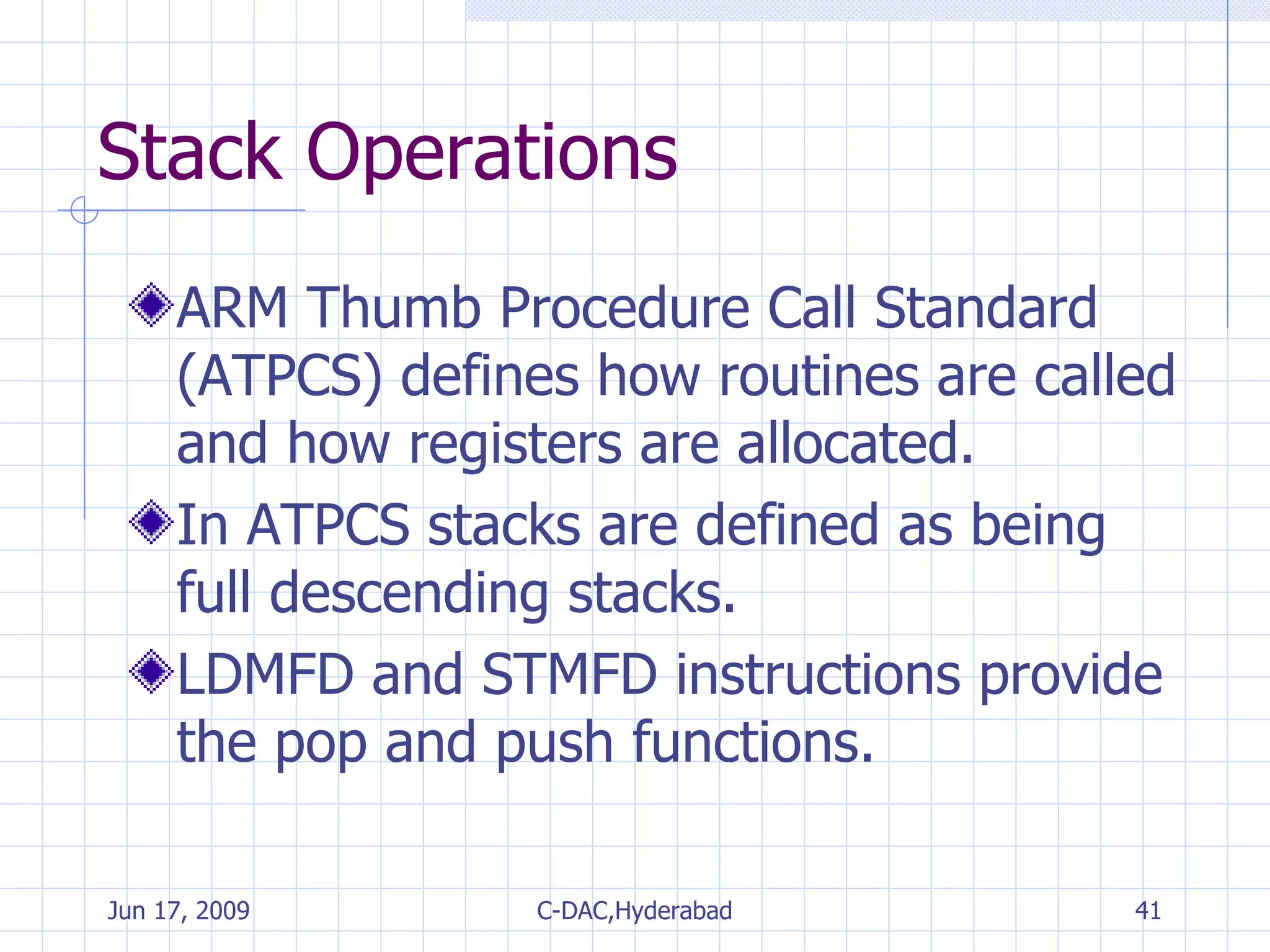
Stack Operations ARM Thumb Procedure Call Standard (ATPCS) defines how routines are called and how registers are allocated.  In ATPCS stacks are defined as being full descending stacks.  LDMFD and STMFD instructions provide the pop and push functions.
STMFD – full stack push operation 0x00008018 0x00008014 0x00008010 0x0000800C 0x00000001 0x00000002 Empty Empty sp PRE Data Address 0x00008018 0x00008014 0x00008010 0x0000800C 0x00000001 0x00000002 0x00000003 0x00000002 sp POST Data Address
STMED – empty stack push operation 0x00008018 0x00008014 0x00008010 0x0000800C 0x00000001 0x00000002 Empty Empty sp PRE Data Address 0x00008008 Empty 0x00008018 0x00008014 0x00008010 0x0000800C 0x00000001 0x00000002 0x00000003 0x00000002 sp POST Data Address 0x00008008 Empty
SWAP Instruction Swaps the contents of memory with the contents of a register Atomic operation–  it reads and writes a location in the same bus operation,preventing any other instruction from reading or writing to that location until it completes. SWP{B}{<cond>} Rd, Rm, [Rn]
SWAP Instruction tmp=mem8[Rn] mem8[Rn]=Rm Rd=tmp swap a byte between memory and a register SWPB tmp=mem32[Rn] mem32[Rn]=Rm Rd=tmp swap a word between memory and a register SWP
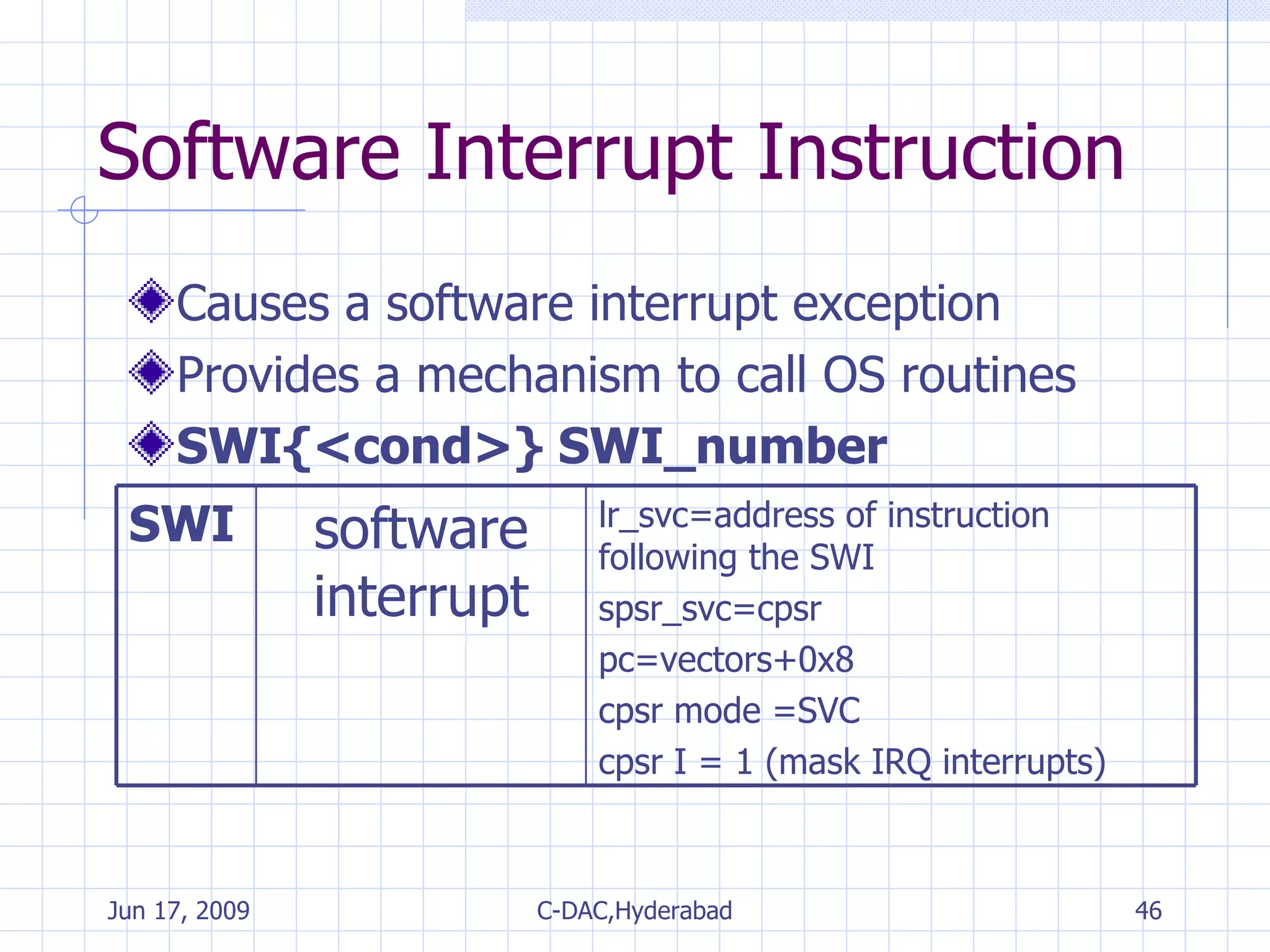
Software Interrupt Instruction Causes a software interrupt exception Provides a mechanism to call OS routines SWI{<cond>} SWI_number lr_svc=address of instruction following the SWI spsr_svc=cpsr pc=vectors+0x8 cpsr mode =SVC cpsr I = 1 (mask IRQ interrupts) software interrupt SWI
Program Status Register Instructions 2 instructions to directly control a psr MRS - transfers the contents of cpsr or spsr into a register MSR - transfers the contents of register into cpsr or spsr N Z C V I F T Mode 31 30 29 28 7 6 5 4 0 Condition Flags Processor Mode Interrupt Masks Thumb State Function Bit Fields Flags[24:31] Status[16:23] Extension[8:15] Control[0:7]
Program Status Register Instructions MRS{<cond>} Rd,<cpsr|spsr> MSR{<cond>} <cpsr|spsr>_<fields>,Rm MSR{<cond>} <cpsr|spsr>_<fields>,#immediate psr[field] = immediate move an immediate value to a psr  MSR psr[field] = Rm move gpr to a psr MSR Rd = psr copy psr to a gpr MRS
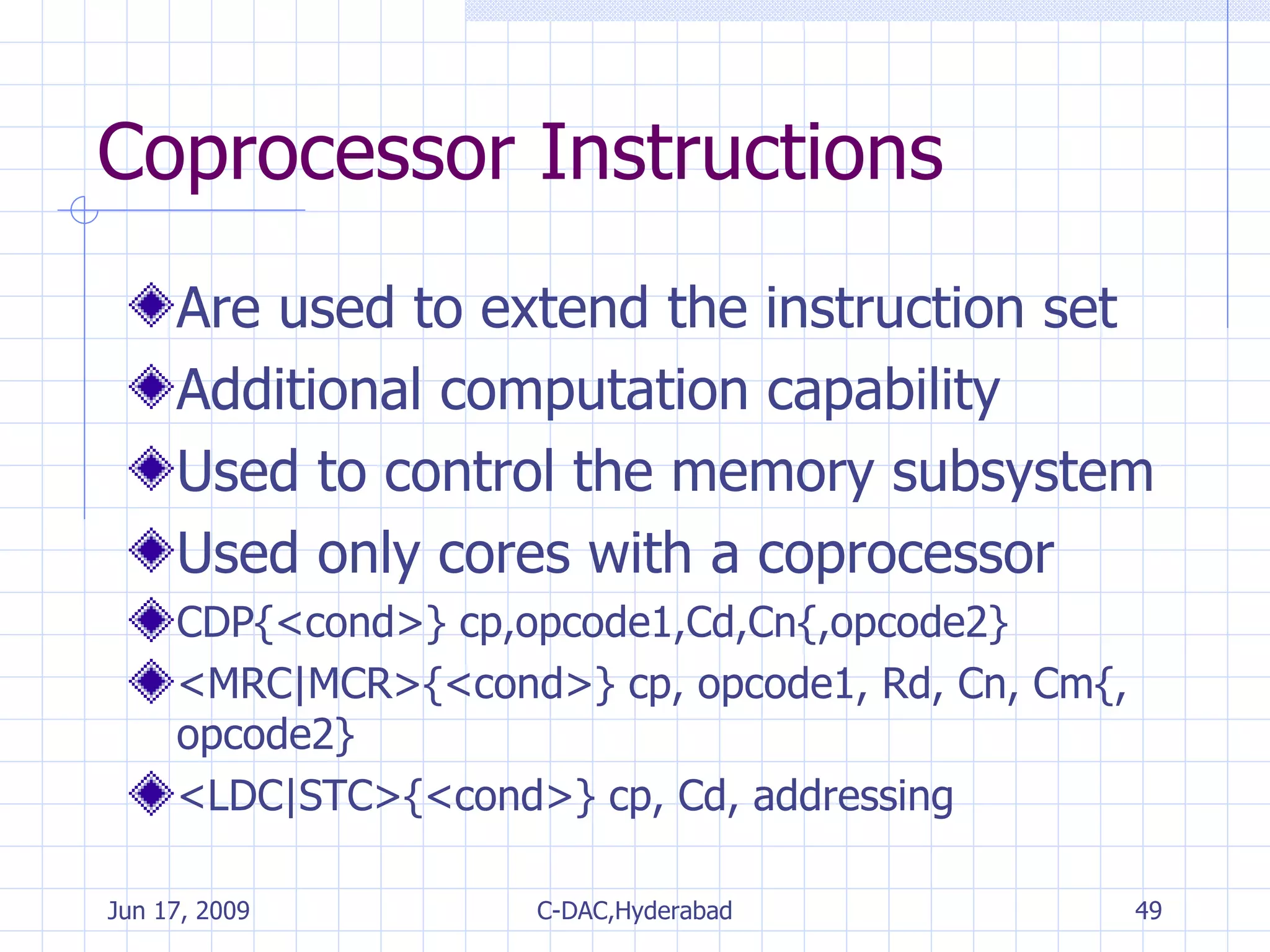
Coprocessor Instructions Are used to extend the instruction set Additional computation capability Used to control the memory subsystem Used only cores with a coprocessor CDP{<cond>} cp,opcode1,Cd,Cn{,opcode2} <MRC|MCR>{<cond>} cp, opcode1, Rd, Cn, Cm{, opcode2} <LDC|STC>{<cond>} cp, Cd, addressing
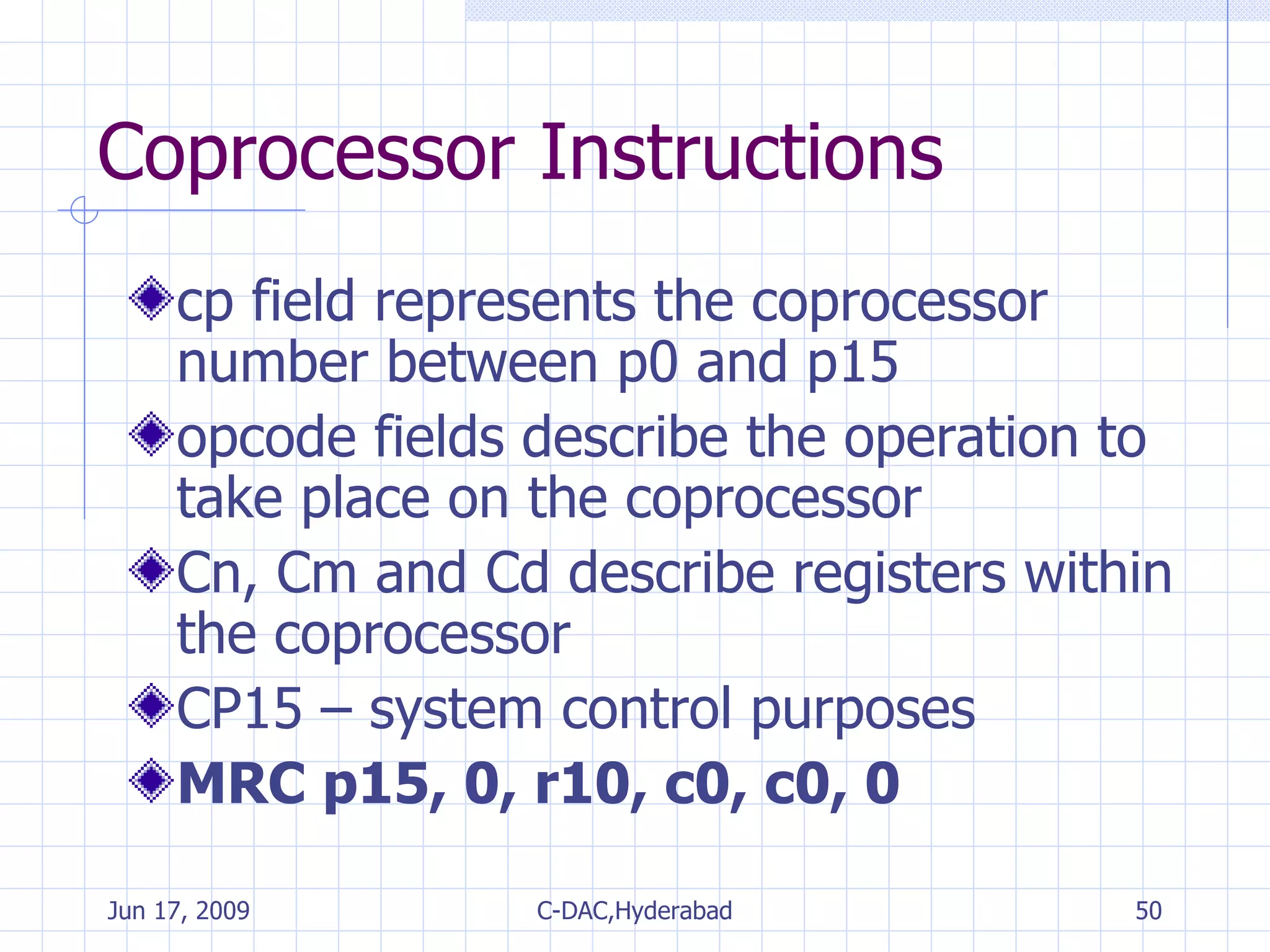
Coprocessor Instructions cp field represents the coprocessor number between p0 and p15 opcode fields describe the operation to take place on the coprocessor Cn, Cm and Cd describe registers within the coprocessor CP15 – system control purposes MRC p15, 0, r10, c0, c0, 0
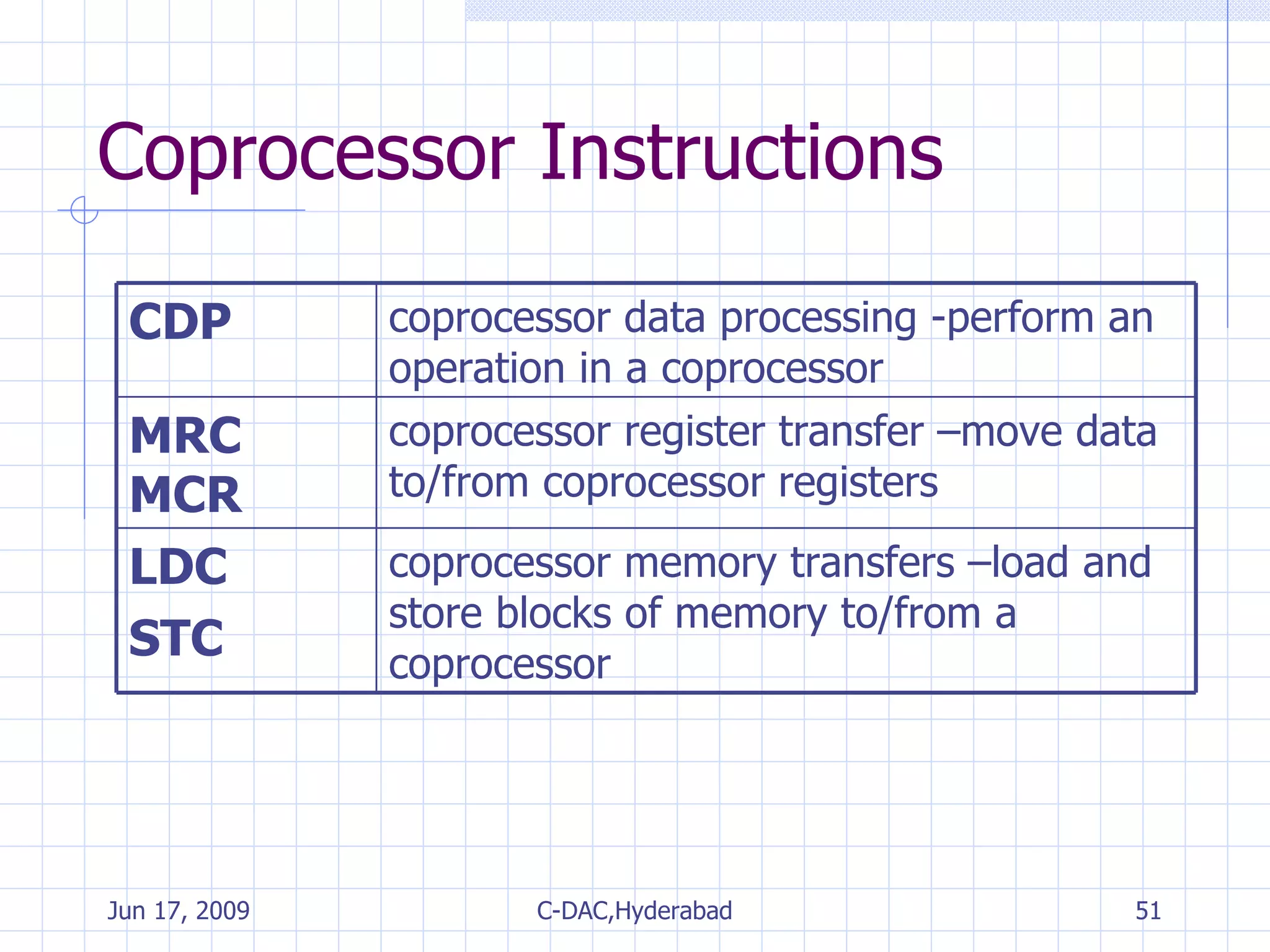
Coprocessor Instructions coprocessor memory transfers –load and store blocks of memory to/from a coprocessor LDC  STC coprocessor register transfer –move data to/from coprocessor registers MRC MCR coprocessor data processing -perform an operation in a coprocessor CDP
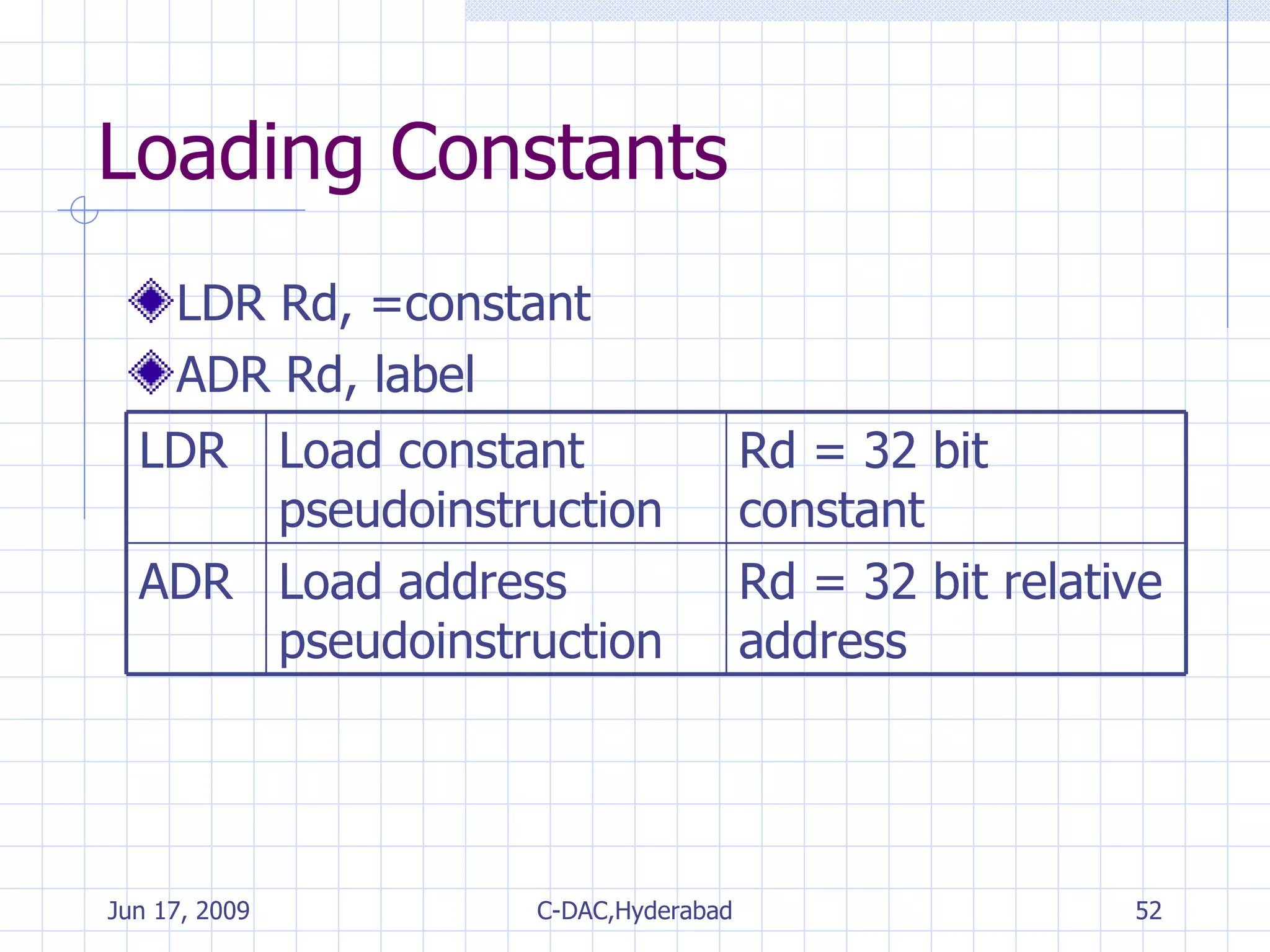
Loading Constants LDR Rd, =constant ADR Rd, label Rd = 32 bit relative address Load address pseudoinstruction ADR Rd = 32 bit constant Load constant pseudoinstruction LDR
Loading Constants LDR r0, [pc,#offset_12] LDR r0, =0x55555555 MOV r0, #0xff LDR r0, =0xff Actual instruction Pseudo instruction
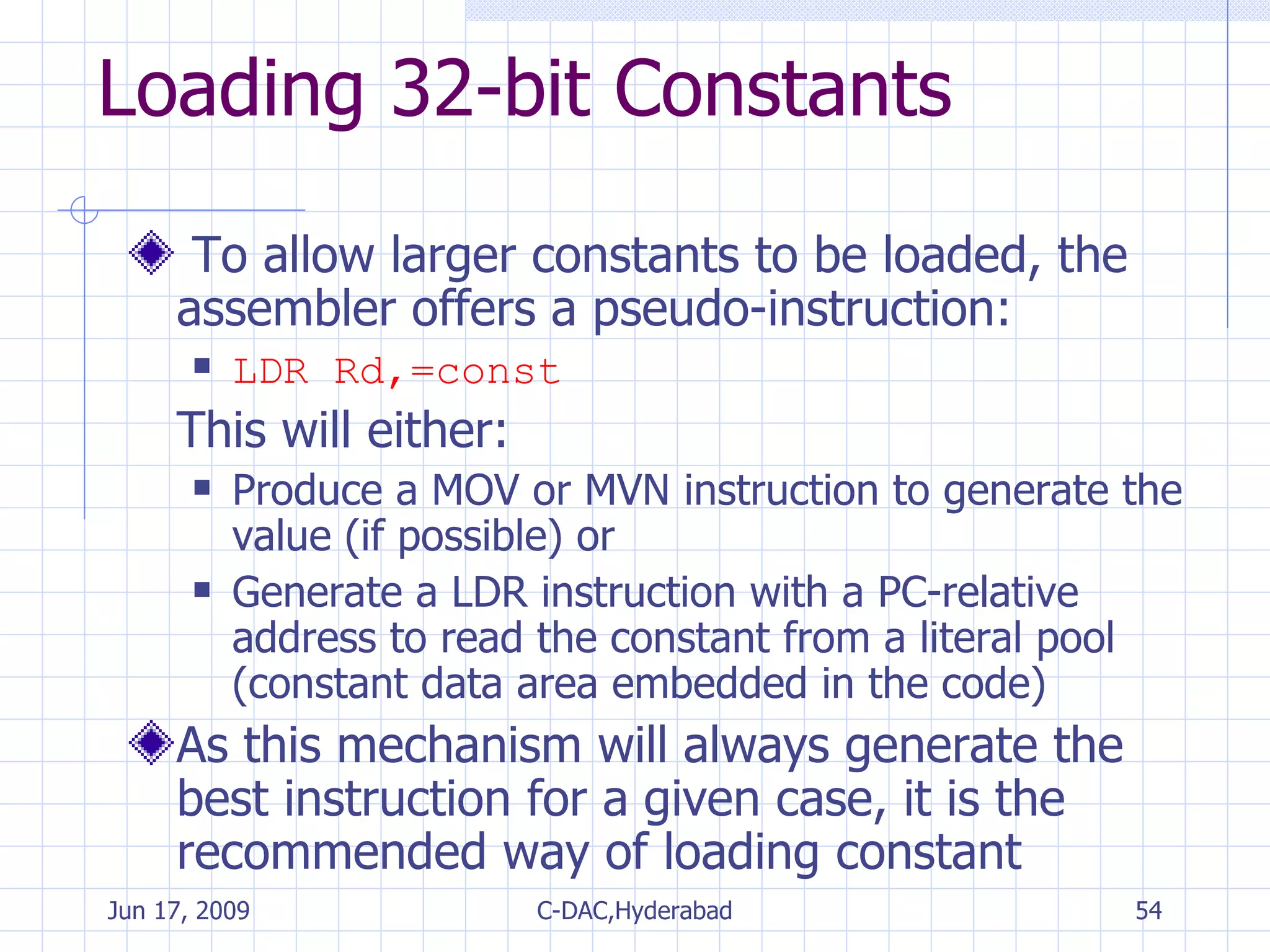
Loading 32-bit Constants To allow larger constants to be loaded, the assembler offers a pseudo-instruction: LDR Rd,=const This will either: Produce a MOV or MVN instruction to generate the value (if possible) or Generate a LDR instruction with a PC-relative address to read the constant from a literal pool (constant data area embedded in the code) As this mechanism will always generate the best instruction for a given case, it is the recommended way of loading constant
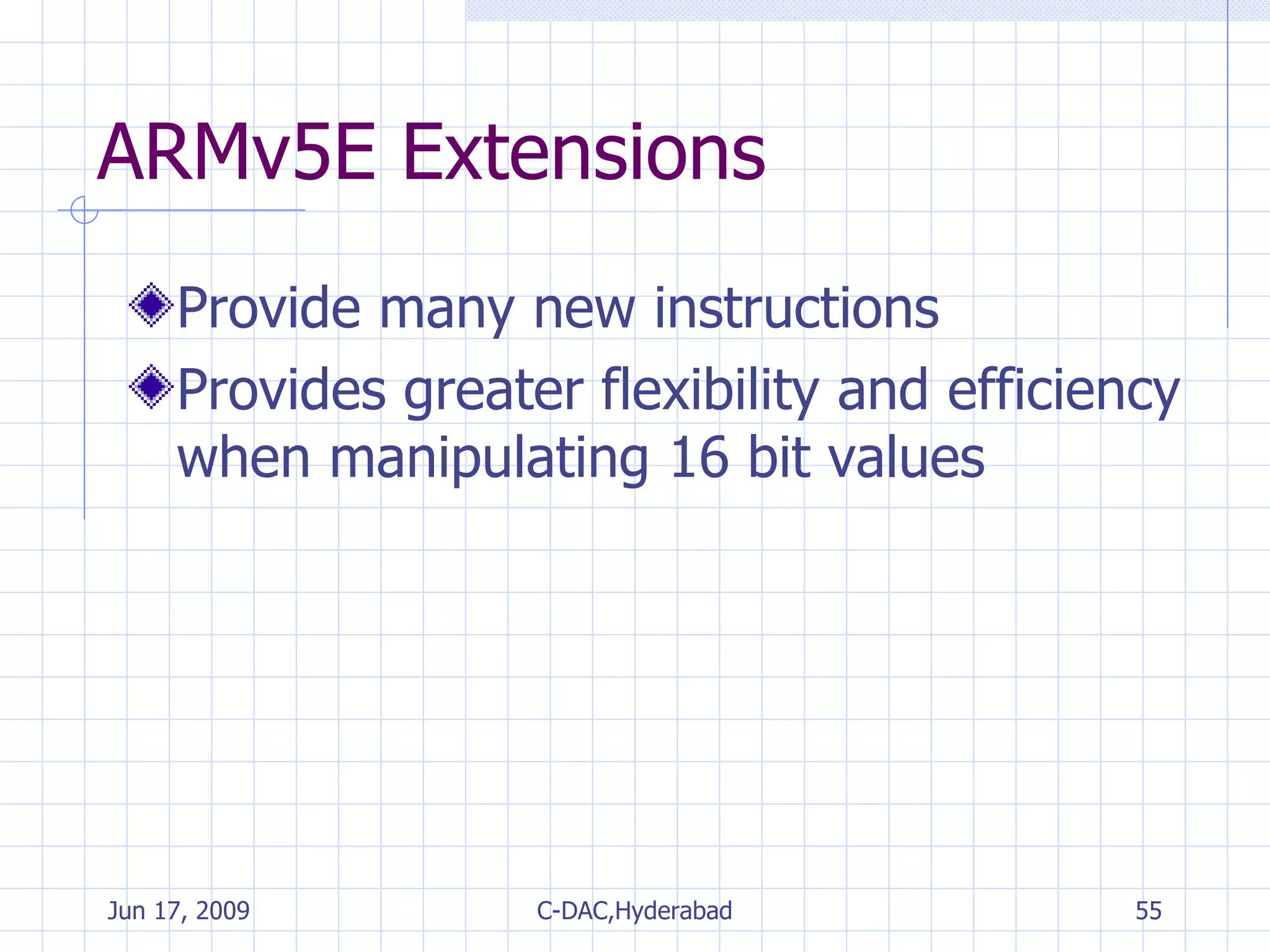
ARMv5E Extensions Provide many new instructions Provides greater flexibility and efficiency when manipulating 16 bit values
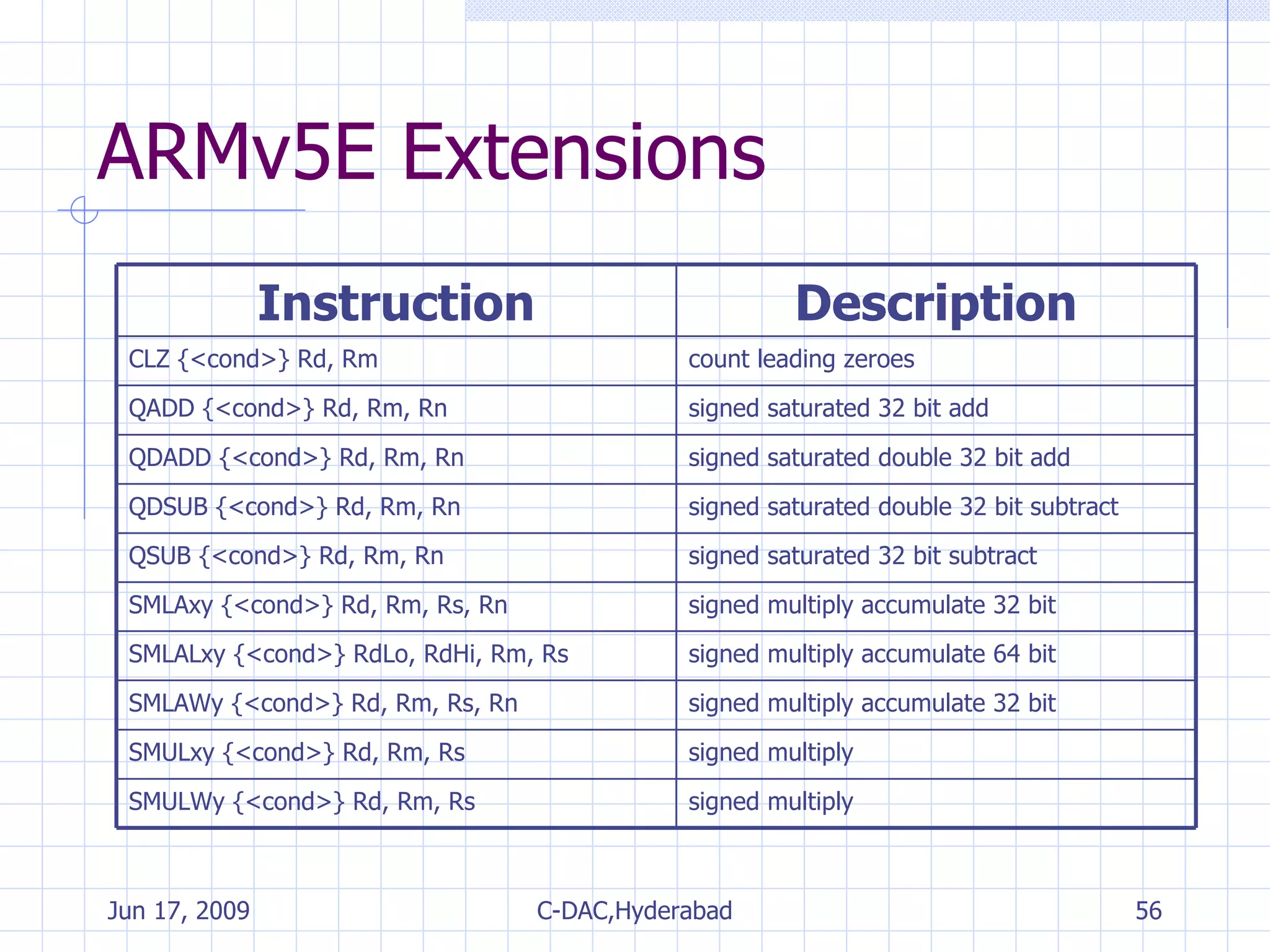
ARMv5E Extensions signed multiply SMULWy {<cond>} Rd, Rm, Rs signed multiply SMULxy {<cond>} Rd, Rm, Rs signed multiply accumulate 32 bit SMLAWy {<cond>} Rd, Rm, Rs, Rn signed multiply accumulate 64 bit SMLALxy {<cond>} RdLo, RdHi, Rm, Rs signed multiply accumulate 32 bit SMLAxy {<cond>} Rd, Rm, Rs, Rn signed saturated 32 bit subtract QSUB {<cond>} Rd, Rm, Rn signed saturated double 32 bit subtract QDSUB {<cond>} Rd, Rm, Rn signed saturated double 32 bit add QDADD {<cond>} Rd, Rm, Rn signed saturated 32 bit add QADD {<cond>} Rd, Rm, Rn count leading zeroes CLZ {<cond>} Rd, Rm Description Instruction
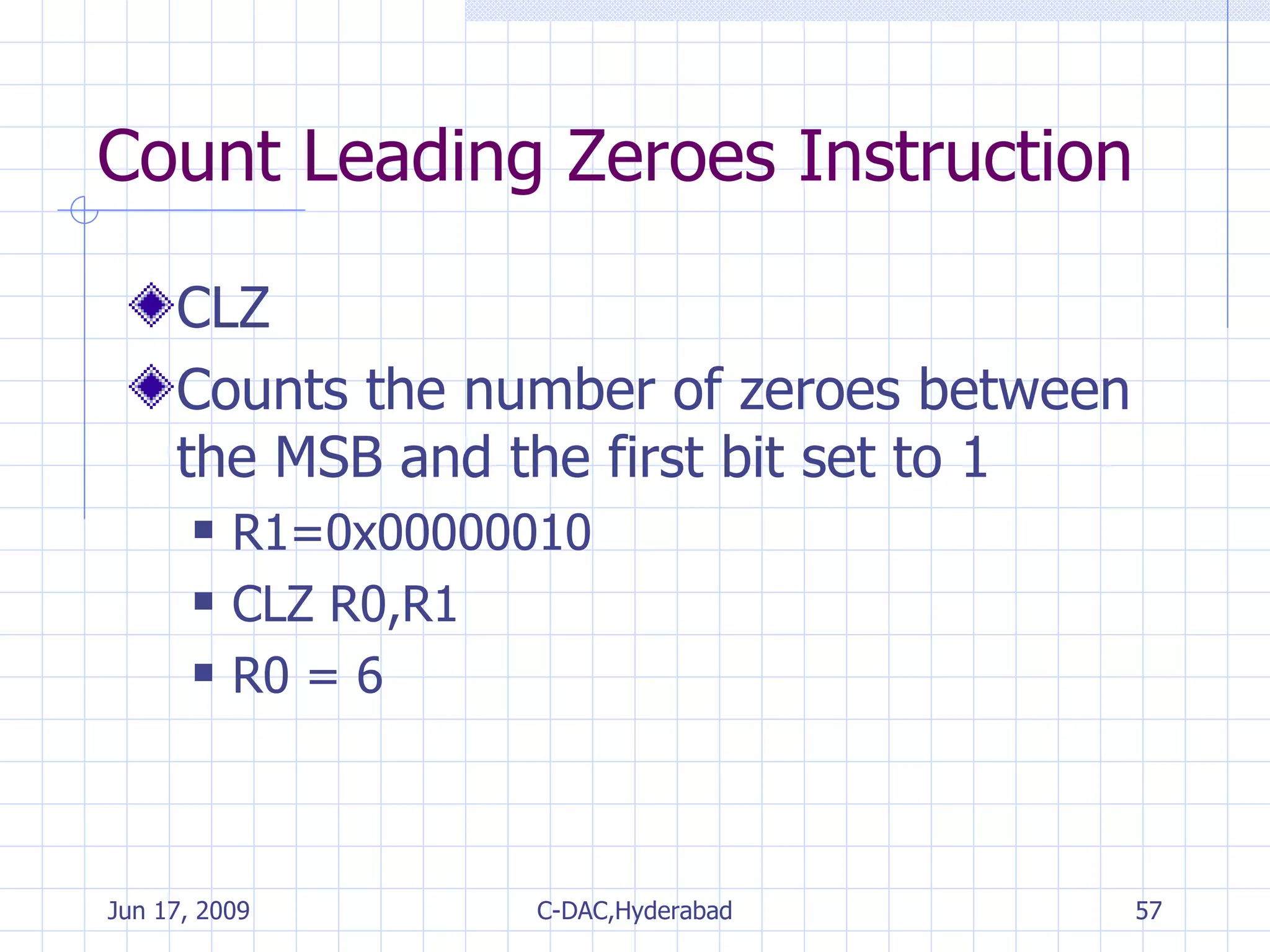
Count Leading Zeroes Instruction CLZ Counts the number of zeroes between the MSB and the first bit set to 1 R1=0x00000010 CLZ R0,R1 R0 = 6
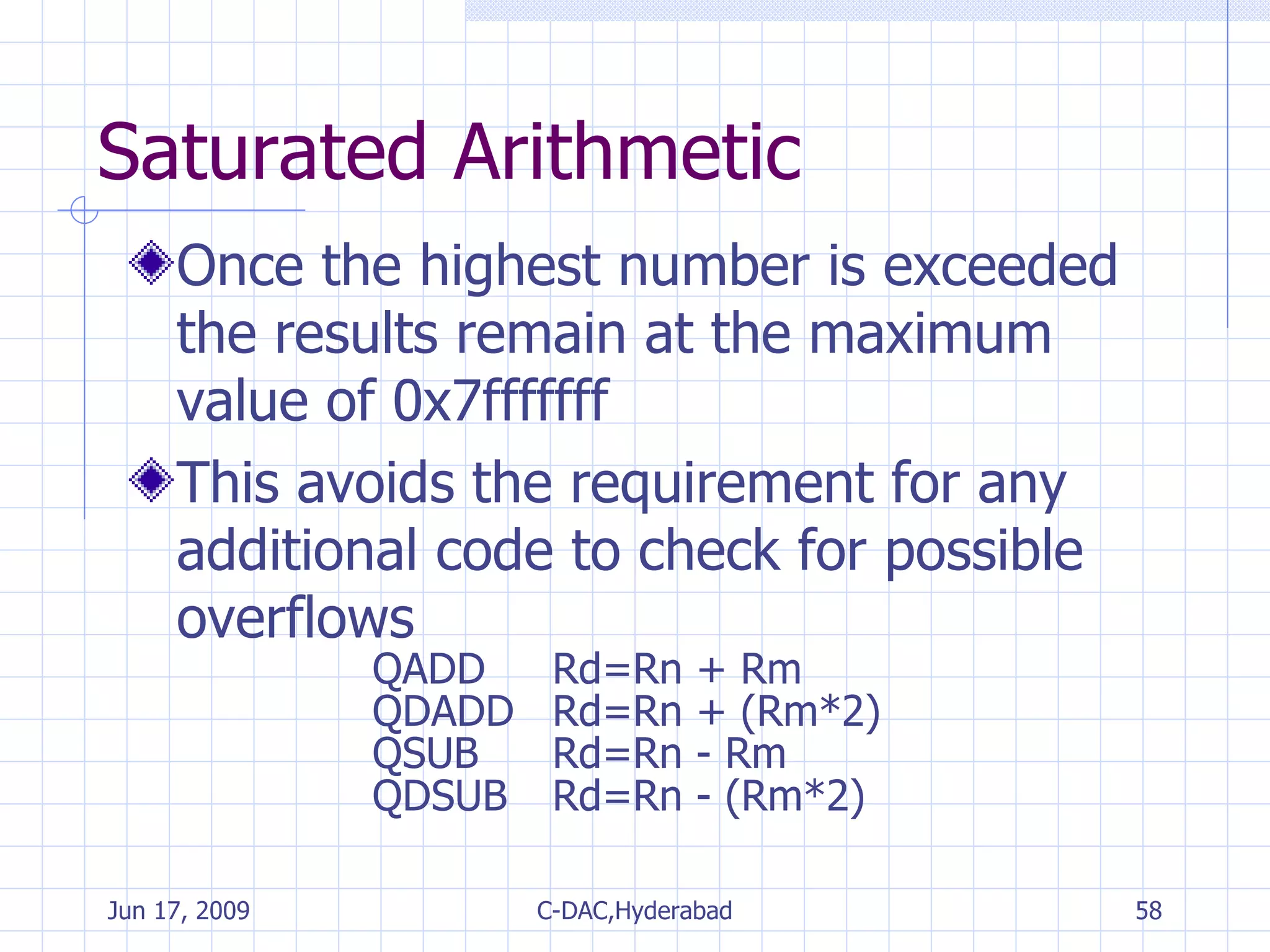
Saturated Arithmetic Once the highest number is exceeded the results remain at the maximum value of 0x7fffffff This avoids the requirement for any additional code to check for possible overflows QADD Rd=Rn + Rm QDADD Rd=Rn + (Rm*2) QSUB Rd=Rn - Rm QDSUB Rd=Rn - (Rm*2)
ARMv5.E Multiply Instructions Instruction Signed Multiply [Accumulate] Signed Result Q Flag updated Calculation SMLAxy (16-bit*16-bit)+32-bit 32-bit yes Rd=(Rm.x*Rs.y)+Rn SMLALxy (16-bit*16-bit)+64-bit 64-bit - [RdHi,RdLo]+= Rm.x*Rs.y SMLAWxy ((32-bit*16-bit) >>16)  +32-bit 32-bit yes Rd=((Rm*Rs.y) >>16) +Rn SMULxy (16-bit*16-bit) 32-bit - Rd=Rm.x*Rs.y SMULWy ((32-bit*16-bit) >>16) 32-bit - Rd=(Rm*Rs.y) >>16 x and y select which 16 bits of a 32 bit register are used for the first and second operands T for the top 16 bits and B for the bottom 16 bits SMLATB r4, r1, r2, r3    r4 = (r1.T * r2.B) + r3
Conditional Execution The instruction only executes if the condition code flags pass a given condition or test Increase performance & code density 2 letter mnemonic (eg: AL) Conditional execution depends on Condition field Condition flags
Summary All ARM instructions are 32 bit in length Arithmetic, logical, comparison & move instructions can all use the inline barrel shifter 3 types of load store instruction – single register, multiple register, swap SWI & Program Status Register ARMv5E –CLZ, saturation, improved multiply instructions Conditional execution

ARM Fundamentals

  • 1.
    Introductionto the ARM Instruction Set
  • 2.
    Agenda Data ProcessingInstructions Branch Instructions Load-Store Instructions Software Interrupt Instructions Program Status Register Instructions Loading Constants ARMv5E Extensions Conditional Execution Summary
  • 3.
    ARM Instruction SetMnemonics ARM ISA Description ADC v1 add two 32 bit values & carry ADD v1 add two 32 bit values AND v1 logical bitwise AND of two 32 bit values B v1 branch relative +/- 32MB BIC v1 logical bit clear of two 32 bit values BKPT v5 breakpoint instructions BL v1 relative branch with link BLX v5 branch with link and exchange BX v4T branch with exchange CDP CDP2 v2 v5 coprocessor data processing operation CLZ v5 count leading zeroes CMN v1 compare negative two 32-bit values CMP v1 compare two 32 bit values EOR v1 logical EOR of two 32 bit values LDC LDC2 v2 v5 load to coprocessor single or multiple 32 – bit values LDC LDC2 v2 v5 load to coprocessor single or multiple 32 – bit values LDM v1 load multiple 32 – bit words from memory to ARM registers
  • 4.
    ARM Instruction Set - Contd Mnemonics ARM ISA Description LDR v1 v4 v5E load a single value from a virtual address in memory MCR MCR2 MCRR v1 v4 v5E move to coprocessor from an ARM register to registers MLA v2 multiply & accumulate 32 bit values MOV v1 move a 32 bit value into a register MRC MRC2 MRRC v1 v4 v5E move to ARM register or registers from a coprocessor MRS v3 move to ARM register from a status register (cpsr or spsr) MSR v3 move to a status register (cpsr or spsr) from an ARM register MUL v2 multiply two 32 bit values MVN v1 move the logical NOT of 32 bit value into a register ORR v1 Logical bitwise OR of two 32 bit values PLD v5E preload hint instruction
  • 5.
    ARM Instruction Set - Contd Mnemonics ARM ISA Description QADD v5E signed saturated 32 bit add QDADD v5E signed saturated double and 32 bit add QDSUB v5E signed saturated double and 32 bit sub. QSUB v5E signed saturated 32 bit subtract RSB v1 reverse subtract of two 32 bit values RSC v1 reverse subtract with carry of two 32 bit integers SBC v1 subtract with carry of two 32 bit values SMLAxy v5E signed multiply accumulate instruction ((16 x 16) + 32 = 32 – bit) SMLAL v3M signed multiply accumulate long ((32 x 32) + 64 = 64 – bit) SMLALxy v5E signed multiply accumulate long ((32 x 16) + 64 = 64 – bit) SMLAWy v5E signed multiply accumulate instruction ((32 x 16) >> 16 +32 = 32 – bit)
  • 6.
    ARM Instruction Set - Contd Mnemonics ARM ISA Description STM v1 store multiple 32 bit registers to memory SMULL v3M signed multiply long (32x32 = 64 – bit) SMULxy v5E signed multiply instructions (16 x 16 = 32 – bit) SMULWy v5E signed multiply instructions (32 x 16) >> 16 = 32 – bit) STC STC2 v2 v5 store to memory single or multiple 32 bit values from coprocessor STR v1 v4 v5E store register to a virtual address in memory SUB v1 subtract two 32 bit values SWI v1 software interrupt SWP v2a swap a word/byte in memory with a register, without interruption TEQ v1 test for equality of two 32 bit values
  • 7.
    ARM Instruction Set - Contd Mnemonics ARM ISA Description Different ARM architecture revisions support different instructions ARM instructions process data held in registers and only access memory with load and store instructions ARM instructions commonly take two or three operands TST v1 test for bits in a 32 bit value UMLAL v3M unsigned multiply accumulate long (32 x 32) + 64 = 64 – bit) UMULL v3M unsigned multiply long (32 x 32 = 64 – bit)
  • 8.
    Data Processing InstructionsManipulate data within registers Move Instructions Arithmetic Instructions Logical Instructions Comparison Instructions Multiply Instructions Most data processing instructions can process one of their operands using the barrel shifter S suffix updates the flags in the cpsr
  • 9.
    Move Instructions <instruction>{<cond>}{S}Rd, N Useful for setting values and transferring data between registers N can be a register or an immediate value preceded by # Rd = ~N Move the NOT of the 32 bit value into a register MVN Rd = N Move a 32 bit value into a register MOV
  • 10.
    Barrel Shifter Shiftthe 32 bit binary pattern in one of the source registers left or right by a specific number of positions before it enters the ALU Arithmetic Logic Unit Rm Result N Rd Rn No pre-processing Pre-processing Barrel Shifter
  • 11.
    Logical shift leftby one PRE r5 = 5 r7 = 8 MOV r7,r5,LSL #1 ; POST r5 = 5 r7 = 10 1 0 0 0 0 0 0 1 Bit 2 Bit 0 1 0 0 nzcv 0 0 0 nzCv Bit 31 = 0x80000004 = 0x00000008 31 Condition Bags Condition Bags Condition flags Updated when S is present
  • 12.
    Barrel Shifter OperationsMne. Shift Description Result Shift amount y LSL logical shift left xLSLy x << y #0-31 or Rs LSR logical shift right xLSRy (unsigned)x >> y #1-32 or Rs ASR arith. right shift xASRy (signed)x >> y #1-32 or Rs ROR rotate right xRORy ((unsigned)x >> y) | (x <<(32 – y)) #1-32 or Rs RRX rotate right extended xRRXy (c flag << 31) | ((unsigned)x >>1) none
  • 13.
  • 14.
    Barrel Shift OperationsRm, RRX Rotate right with extend Rm, ROR Rs Rotate right by register Rm, ROR #shift_imm Rotate right by immediate Rm, ASR Rs Arithmetic Shift Right by Register Rm, ASR #shift_imm Arithmetic Shift Right by Immediate Rm, LSR Rs Logical Shift Right by Register Rm, LSL Rs Logical Shift Left by Register Rm, LSR #shift_imm Logical Shift Right by Immediate Rm, LSL #shift_imm Logical Shift Left by Immediate Rm Register #immediate Immediate Syntax N Shift Operations
  • 15.
    Arithmetic Instructions <instruction>{<cond>}{S}Rd, Rn, N Rd = Rn -N Subtract two 32 bit values SUB Rd = Rn -N–!(carry flag) Subtract with carry of two 32 bit values SBC Rd = N – Rn -!(carry flag) Reverse subtract with carry of two 32 bit values RSC Rd = N – Rn Reverse subtract of two 32 bit values RSB Rd = Rn + N Add two 32 bit values ADD Rd = Rn + N + carry Add two 32 bit values and carry ADC
  • 16.
    Arithmetic Instructions RSBcan be used to negate numbers
  • 17.
    Logical Instructions <instruction>{<cond>}{S}Rd, Rn, N Rd = Rn & ~ N Logical bit clear (AND NOT) BIC Rd = Rn ^ N logical exclusive OR of two 32 bit values EOR Rd = Rn | N logical bitwise OR of two 32 bit values ORR Rd = Rn & N logical bitwise AND of two 32 bit values AND
  • 18.
    Logical Instructions BICis useful when clearing status bits and is frequently used to change interrupts masks in the cpsr The logical instructions update the cpsr flags only if the S suffix is present
  • 19.
    Compare Instructions <instruction>{<cond>}Rn, N Flag set as a result of Rn & N test bits of a 32 bit values TST Flag set as a result of Rn ^ N test for equality of two 32 bit values TEQ Flag set as a result of Rn - N compare CMP Flag set as a result of Rn + N compare negated CMN
  • 20.
    Compare Instructions Theyupdate the cpsr flag according to the result but do not affect other registers CMP is effectively a subtract instruction with result discarded TST is logical AND operation TEQ is logical EOR
  • 21.
    Multiply Instructions MLA{<cond>}{S}Rd, Rm, Rs, Rn MUL{<cond>}{S} Rd, Rm, Rs instruction>{<cond>}{S} RdLo, RdHi, Rm, Rs Rd = Rm * Rs multiply MUL Rd = (Rm * Rs) + Rn multiply & accumulate MLA [RdHi,RdLo]=Rm * Rs unsigned multiply long UMULL [RdHi,RdLo]=[RdHi,RdLo] + (Rm * Rs) unsigned multiply accumulate long UMLAL [RdHi,RdLo]=(Rm * Rs) signed multiply long SMULL [RdHi,RdLo]=[RdHi,RdLo] + (Rm * Rs) signed multiply accumulate long SMLAL
  • 22.
    Branch Instructions Changesthe flow of execution or is used to call a routine Forces the pc is point to a new address B{<cond>} label BL{<cond>} label BX{<cond>} Rm BLX{<cond>} label | Rm
  • 23.
    Branch Instructions pc=label,T = 1 pc = Rm & 0xfffffffe, T = Rm & 1 lr = address of the next inst. After BL branch exchange with link BLX pc = Rm & 0xfffffffe, T = Rm & 1 branch exchange BX pc = label lr = address of the next inst. After BL branch with link BL pc = label branch B
  • 24.
    Branch Instructions Thebranch with link, or BL, instruction is similar the B instruction but overwrites the link register with a return address To return from a subroutine, the link register should be copied to the pc BL subroutine ; branch to subroutine CMP r1, #5 ; compare r1 with 5 MOVEQ r1, #0 ; if (r1 == 5) then r1 = 0 subroutine … . … . MOV pc, lr ; return by moving pc = lr
  • 25.
    Load Store InstructionsTransfer data between memory and processor registers Single – register transfer Multiple – register transfer Swap
  • 26.
    Single Register TransferMoving a single data item in and out of a register Data types supported are signed and unsigned words (32 bit), half words (16 bit) and bytes <LDR|STR> {<cond>}{B} Rd,addressing <LDR> {<cond>}SB|H|SH Rd,addressing <STR> {<cond>}H Rd,addressing
  • 27.
    Single Register TransferRd <-SignExtend (mem16[address]) load signed half word into a register LDRSH Rd <-SignExtend (mem8[address]) load signed byte into a register LDRSB Rd ->mem16[address] save half word from a register STRH Rd <-mem16[address] load half word into a register LDRH Rd ->mem8[address] save byte from a register STRB Rd <-mem8[address] load byte into a register LDRB Rd ->mem32[address] save byte or word from a register STR Rd <-mem32[address] load word into a register LDR
  • 28.
    Single Register LoadStore Addressing Modes The ARM instruction set provides different modes for addressing memory preindex with writeback preindex postindex
  • 29.
    Index Methods LDRr0, [r1], #4 base+ offset mem[base] postindex LDR r0, [r1, #4] not updated mem[base+offset] preindex LDR r0, [r1, #4]! base+ offset mem[base+offset] preindex with writeback Example Base Address Register Data Index Method
  • 30.
    Index Methods Preindexwith writeback calculates an address from a base register plus address offset and then updates that address base register with the new address. Preindex offset is same as the preindex with writeback but does not update the address base register. Postindex only updates the address base register after the address is used
  • 31.
    Single Register LoadStore Addressing word or unsigned byte Addressing Mode & Index Method Addressing Syntax Preindex with immediate offset [Rn, #+/-offset_12] Preindex writeback with scaled register offset [Rn, +/-Rm, shift #shift_imm]! Preindex with register offset [Rn, +/-Rm] Preindex with scaled register offset [Rn, +/-Rm, shift #shift_imm] Preindex writeback with immediate offset [Rn, +/-offset_12]! Preindex writeback with register offset [Rn, +/-Rm]! Immediate postindexed [Rn], +/-offset_12 Register postindex [Rn], +/-Rm Scaled register postindex [Rn], +/-Rm, shift #shift_imm
  • 32.
    Eg. of LDRinstructions using different addressing modes Instruction r0= r1+= Preindexwith writeback LDR r0,[r1,#0x4]! mem32[r1+0x4] 0x4 Preindex Postindex LDR r0,[r1,r2]! mem32[r1+r2] r2 LDR r0,[r1,r2,LSR#0x4]! mem32[r1+(r2 LSR 0x4)] r2 LSR 0x4 LDR r0,[r1,#0x4] mem32[r1+0x4] not updated LDR r0,[r1,r2] mem32[r1+r2] not updated LDR r0,[r1,-r2,LSR#0x4] mem32[r1-(r2 LSR 0x4)] not updated LDR r0,[r1],#0x4 mem32[r1] 0x4 LDR r0,[r1],r2 mem32[r1] r2 LDR r0,[r1],r2,LSR#0x4 mem32[r1] R2 LSR 0x4
  • 33.
    Variations of STRHinstructions Instruction Result r1+= Preindexwith writeback STRH r0,[r1,#0x4]! mem16[r1+0x4] =r0 0x4 Preindex Postindex STRH r0,[r1,r2]! mem16[r1+r2] =r0 r2 STRH r0,[r1,#0x4]! mem16[r1+0x4] =r0 not updated STRH r0,[r1,r2] mem16[r1+r2] =r0 not updated STRH r0,[r1],#0x4 mem16[r1] =r0 0x4 STRH r0,[r1],r2 mem16[r1] =r0 r2
  • 34.
    Multiple Register TransferLoad–store multiple instructions can transfer multiple registers between memory and the processor in a single instruction. Moving blocks of data around memory and saving and restoring context stacks <LDM|STM>{<cond>}<addressing mode> Rn{!},<registers>{^} {Rd}*N -> mem32[start address + 4*N] optional Rn updated save multiple registers STM {Rd}*N <- mem32[start address + 4*N] optional Rn updated load multiple registers LDM
  • 35.
    Addressing Mode forLoad Store Multiple Instructions Rn+4*N Rn - 4 Rn – 4*N decrement before DB Rn+4*N Rn Rn–4*N + 4 decrement after DA Rn+4*N Rn + 4*N Rn + 4 increment before IB Rn+4*N Rn +4*N-4 Rn increment after IA Rn! End Address Start Address Description Add: Mode
  • 36.
    Example 3.17 Pre-conditionof LDMIA Instruction Post-condition of LDMIA Instruction 0x00008020 0x0000801C 0x00008018 0x00008014 0x00008010 0x0000800C r3=0x00000003 r2=0x00000002 r1=0x00000001 Address Pointer Data Memory Address 0x00008020 0x0000801C 0x00008018 0x00008014 0x00008010 0x0000800C 0x00000005 0x00000004 0x00000003 0x00000002 0x00000001 0x00000000 r3=0x00000000 r2=0x00000000 r1=0x00000000 r0=0x00008010 Address Pointer Data Memory Address 0x00000005 0x00000004 0x00000003 0x00000002 0x00000001 0x00000000 r0=0x0000801C
  • 37.
    Example 3.17 Pre-conditionof LDMIB Instruction Post-condition of LDMIB Instruction 0x00008020 0x0000801C 0x00008018 0x00008014 0x00008010 0x0000800C r3=0x00000004 r2=0x00000003 r1=0x00000002 Address Pointer Data Memory Address 0x00008020 0x0000801C 0x00008018 0x00008014 0x00008010 0x0000800C 0x00000005 0x00000004 0x00000003 0x00000002 0x00000001 0x00000000 r3=0x00000000 r2=0x00000000 r1=0x00000000 r0=0x00008010 Address Pointer Data Memory Address 0x00000005 0x00000004 0x00000003 0x00000002 0x00000001 0x00000000 r0=0x0000801C
  • 38.
    Load Store Multiplepairs when base update used LDMIA STMDB LDMIB STMDA LDMDA STMIB LDMDB STMIA Load Multiple Store Multiple
  • 39.
    Stack Operations ARMarchitecture uses the load store multiple instructions to carry out stack operations Ascending –stack grows towards higher memory address Descending –stack grows towards lower memory address Full – sp points to the last item on the stack Empty - sp points after the last item on the stack
  • 40.
    Addressing Methods forStack Operations STMDA STMED LDMIB LDMED empty descending ED STMIA STMEA LDMDB LDMEA empty ascending EA STMDB STMFD LDMIA LDMFD full descending FD STMIB STMFA LDMDA LDMFA full ascending FA =STM Push =LDM Pop Description Add: Mode
  • 41.
    Stack Operations ARMThumb Procedure Call Standard (ATPCS) defines how routines are called and how registers are allocated. In ATPCS stacks are defined as being full descending stacks. LDMFD and STMFD instructions provide the pop and push functions.
  • 42.
    STMFD – fullstack push operation 0x00008018 0x00008014 0x00008010 0x0000800C 0x00000001 0x00000002 Empty Empty sp PRE Data Address 0x00008018 0x00008014 0x00008010 0x0000800C 0x00000001 0x00000002 0x00000003 0x00000002 sp POST Data Address
  • 43.
    STMED – emptystack push operation 0x00008018 0x00008014 0x00008010 0x0000800C 0x00000001 0x00000002 Empty Empty sp PRE Data Address 0x00008008 Empty 0x00008018 0x00008014 0x00008010 0x0000800C 0x00000001 0x00000002 0x00000003 0x00000002 sp POST Data Address 0x00008008 Empty
  • 44.
    SWAP Instruction Swapsthe contents of memory with the contents of a register Atomic operation– it reads and writes a location in the same bus operation,preventing any other instruction from reading or writing to that location until it completes. SWP{B}{<cond>} Rd, Rm, [Rn]
  • 45.
    SWAP Instruction tmp=mem8[Rn]mem8[Rn]=Rm Rd=tmp swap a byte between memory and a register SWPB tmp=mem32[Rn] mem32[Rn]=Rm Rd=tmp swap a word between memory and a register SWP
  • 46.
    Software Interrupt InstructionCauses a software interrupt exception Provides a mechanism to call OS routines SWI{<cond>} SWI_number lr_svc=address of instruction following the SWI spsr_svc=cpsr pc=vectors+0x8 cpsr mode =SVC cpsr I = 1 (mask IRQ interrupts) software interrupt SWI
  • 47.
    Program Status RegisterInstructions 2 instructions to directly control a psr MRS - transfers the contents of cpsr or spsr into a register MSR - transfers the contents of register into cpsr or spsr N Z C V I F T Mode 31 30 29 28 7 6 5 4 0 Condition Flags Processor Mode Interrupt Masks Thumb State Function Bit Fields Flags[24:31] Status[16:23] Extension[8:15] Control[0:7]
  • 48.
    Program Status RegisterInstructions MRS{<cond>} Rd,<cpsr|spsr> MSR{<cond>} <cpsr|spsr>_<fields>,Rm MSR{<cond>} <cpsr|spsr>_<fields>,#immediate psr[field] = immediate move an immediate value to a psr MSR psr[field] = Rm move gpr to a psr MSR Rd = psr copy psr to a gpr MRS
  • 49.
    Coprocessor Instructions Areused to extend the instruction set Additional computation capability Used to control the memory subsystem Used only cores with a coprocessor CDP{<cond>} cp,opcode1,Cd,Cn{,opcode2} <MRC|MCR>{<cond>} cp, opcode1, Rd, Cn, Cm{, opcode2} <LDC|STC>{<cond>} cp, Cd, addressing
  • 50.
    Coprocessor Instructions cpfield represents the coprocessor number between p0 and p15 opcode fields describe the operation to take place on the coprocessor Cn, Cm and Cd describe registers within the coprocessor CP15 – system control purposes MRC p15, 0, r10, c0, c0, 0
  • 51.
    Coprocessor Instructions coprocessormemory transfers –load and store blocks of memory to/from a coprocessor LDC STC coprocessor register transfer –move data to/from coprocessor registers MRC MCR coprocessor data processing -perform an operation in a coprocessor CDP
  • 52.
    Loading Constants LDRRd, =constant ADR Rd, label Rd = 32 bit relative address Load address pseudoinstruction ADR Rd = 32 bit constant Load constant pseudoinstruction LDR
  • 53.
    Loading Constants LDRr0, [pc,#offset_12] LDR r0, =0x55555555 MOV r0, #0xff LDR r0, =0xff Actual instruction Pseudo instruction
  • 54.
    Loading 32-bit ConstantsTo allow larger constants to be loaded, the assembler offers a pseudo-instruction: LDR Rd,=const This will either: Produce a MOV or MVN instruction to generate the value (if possible) or Generate a LDR instruction with a PC-relative address to read the constant from a literal pool (constant data area embedded in the code) As this mechanism will always generate the best instruction for a given case, it is the recommended way of loading constant
  • 55.
    ARMv5E Extensions Providemany new instructions Provides greater flexibility and efficiency when manipulating 16 bit values
  • 56.
    ARMv5E Extensions signedmultiply SMULWy {<cond>} Rd, Rm, Rs signed multiply SMULxy {<cond>} Rd, Rm, Rs signed multiply accumulate 32 bit SMLAWy {<cond>} Rd, Rm, Rs, Rn signed multiply accumulate 64 bit SMLALxy {<cond>} RdLo, RdHi, Rm, Rs signed multiply accumulate 32 bit SMLAxy {<cond>} Rd, Rm, Rs, Rn signed saturated 32 bit subtract QSUB {<cond>} Rd, Rm, Rn signed saturated double 32 bit subtract QDSUB {<cond>} Rd, Rm, Rn signed saturated double 32 bit add QDADD {<cond>} Rd, Rm, Rn signed saturated 32 bit add QADD {<cond>} Rd, Rm, Rn count leading zeroes CLZ {<cond>} Rd, Rm Description Instruction
  • 57.
    Count Leading ZeroesInstruction CLZ Counts the number of zeroes between the MSB and the first bit set to 1 R1=0x00000010 CLZ R0,R1 R0 = 6
  • 58.
    Saturated Arithmetic Oncethe highest number is exceeded the results remain at the maximum value of 0x7fffffff This avoids the requirement for any additional code to check for possible overflows QADD Rd=Rn + Rm QDADD Rd=Rn + (Rm*2) QSUB Rd=Rn - Rm QDSUB Rd=Rn - (Rm*2)
  • 59.
    ARMv5.E Multiply InstructionsInstruction Signed Multiply [Accumulate] Signed Result Q Flag updated Calculation SMLAxy (16-bit*16-bit)+32-bit 32-bit yes Rd=(Rm.x*Rs.y)+Rn SMLALxy (16-bit*16-bit)+64-bit 64-bit - [RdHi,RdLo]+= Rm.x*Rs.y SMLAWxy ((32-bit*16-bit) >>16) +32-bit 32-bit yes Rd=((Rm*Rs.y) >>16) +Rn SMULxy (16-bit*16-bit) 32-bit - Rd=Rm.x*Rs.y SMULWy ((32-bit*16-bit) >>16) 32-bit - Rd=(Rm*Rs.y) >>16 x and y select which 16 bits of a 32 bit register are used for the first and second operands T for the top 16 bits and B for the bottom 16 bits SMLATB r4, r1, r2, r3  r4 = (r1.T * r2.B) + r3
  • 60.
    Conditional Execution Theinstruction only executes if the condition code flags pass a given condition or test Increase performance & code density 2 letter mnemonic (eg: AL) Conditional execution depends on Condition field Condition flags
  • 61.
    Summary All ARMinstructions are 32 bit in length Arithmetic, logical, comparison & move instructions can all use the inline barrel shifter 3 types of load store instruction – single register, multiple register, swap SWI & Program Status Register ARMv5E –CLZ, saturation, improved multiply instructions Conditional execution

Editor's Notes

  • #2 http://www.arm.com/documentation/Instruction_Set/