1
Chapter 4 ARM Assembly Language
Smruti Ranjan Sarangi,
IIT Delhi
Computer Organisation and Architecture
PowerPoint Slides
PROPRIETARY MATERIAL. © 2014 The McGraw-Hill Companies, Inc. All rights reserved. No part of this PowerPoint slide may be displayed, reproduced or distributed in any form or by any means, without the
prior written permission of the publisher, or used beyond the limited distribution to teachers and educators permitted by McGraw-Hill for their individual course preparation. PowerPoint Slides are being provided only
to authorized professors and instructors for use in preparing for classes using the affiliated textbook. No other use or distribution of this PowerPoint slide is permitted. The PowerPoint slide may not be sold and may
not be distributed or be used by any student or any other third party. No part of the slide may be reproduced, displayed or distributed in any form or by any means, electronic or otherwise, without the prior written
permission of McGraw Hill Education (India) Private Limited.
1
Download the pdf of the book
www.basiccomparch.com
videos
Slides, software, solution manual
Print version
(Publisher: WhiteFalcon, 2021)
Available on e-commerce sites.
The pdf version of the book and
all the learning resources can be
freely downloaded from the
website: www.basiccomparch.com
2nd
version
3
ARM Assembly Language
* One of the most popular RISC instruction
sets in use today
* Used by licensees of ARM Limited, UK
* ARM processors
* Some processors by Samsung, Qualcomm, and Apple
* Highly versatile instruction set
* Floating-point and vector (multiple operations per
instruction) extensions
4
Outline
* Basic Instructions
* Advanced Instructions
* Branch Instructions
* Memory Instructions
* Instruction Encoding
5
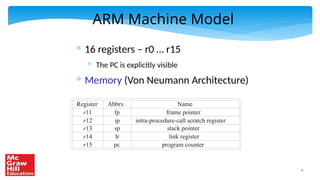
ARM Machine Model
* 16 registers – r0 … r15
* The PC is explicitly visible
* Memory (Von Neumann Architecture)
Register Abbrv. Name
r11 fp frame pointer
r12 ip intra-procedure-call scratch register
r13 sp stack pointer
r14 lr link register
r15 pc program counter
6
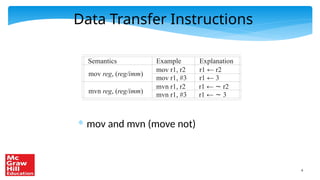
Data Transfer Instructions
* mov and mvn (move not)
Semantics Example Explanation
mov reg, (reg/imm)
mov r1, r2 r1 ← r2
mov r1, #3 r1 ← 3
mvn r1, r2 r1 ← r2
∼
mvn r1, #3 r1 ← 3
∼
mvn reg, (reg/imm)
7
Arithmetic Instructions
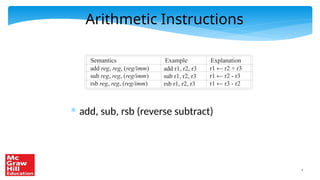
* add, sub, rsb (reverse subtract)
Semantics Example Explanation
add reg, reg, (reg/imm)
sub reg, reg, (reg/imm)
rsb reg, reg, (reg/imm)
add r1, r2, r3
sub r1, r2, r3
rsb r1, r2, r3
r1 ← r2 + r3
r1 ← r2 - r3
r1 ← r3 - r2
8
Example
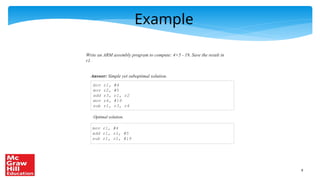
Write an ARM assembly program to compute: 4+5 - 19. Save the result in
r1.
Answer: Simple yet suboptimal solution.
mov r1, #4
mov r2, #5
add r3, r1, r2
mov r4, #19
sub r1, r3, r4
Optimal solution.
mov r1, #4
add r1, r1, #5
sub r1, r1, #19
9
Logical Instructions
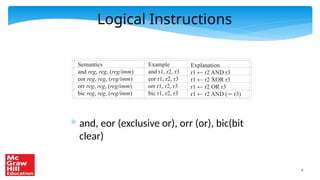
* and, eor (exclusive or), orr (or), bic(bit
clear)
Semantics
and reg, reg, (reg/imm)
eor reg, reg, (reg/imm)
orr reg, reg, (reg/imm)
bic reg, reg, (reg/imm)
Example
and r1, r2, r3
eor r1, r2, r3
orr r1, r2, r3
bic r1, r2, r3
Explanation
r1 ← r2 AND r3
r1 ← r2 XOR r3
r1 ← r2 OR r3
r1 ← r2 AND ( r3)
∼
10
Example
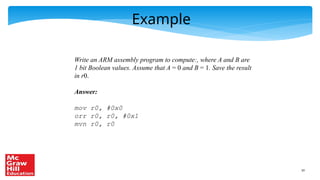
Write an ARM assembly program to compute:, where A and B are
1 bit Boolean values. Assume that A = 0 and B = 1. Save the result
in r0.
Answer:
mov r0, #0x0
orr r0, r0, #0x1
mvn r0, r0
11
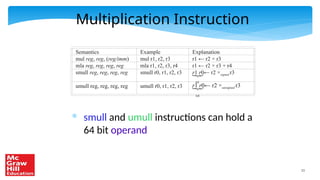
Multiplication Instruction
* smull and umull instructions can hold a
64 bit operand
Semantics
mul reg, reg, (reg/imm)
mla reg, reg, reg, reg
smull reg, reg, reg, reg
umull reg, reg, reg, reg
Example
mul r1, r2, r3
mla r1, r2, r3, r4
smull r0, r1, r2, r3
umull r0, r1, r2, r3
Explanation
r1 ← r2 × r3
r1 ← r2 × r3 + r4
r1 r0← r2 ×signed r3
64
r1 r0← r2 ×unsigned r3
64
12
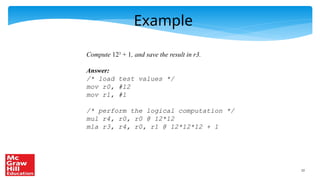
Example
Compute 123
+ 1, and save the result in r3.
Answer:
/* load test values */
mov r0, #12
mov r1, #1
/* perform the logical computation */
mul r4, r0, r0 @ 12*12
mla r3, r4, r0, r1 @ 12*12*12 + 1
13
Outline
* Basic Instructions
* Advanced Instructions
* Branch Instructions
* Memory Instructions
* Instruction Encoding
14
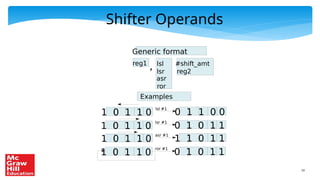
Shifter Operands
reg1
, lsl
lsr
asr
ror
#shift_amt
reg2
1 0 1 1 0
lsl #1
0 1 1 0 0
1 0 1 1 0
lsr #1
0 1 0 1 1
Generic format
1 0 1 1 0
asr #1
1 1 0 1 1
1 0 1 1 0
ror #1
0 1 0 1 1
Examples
15
Examples of Shifter Operands
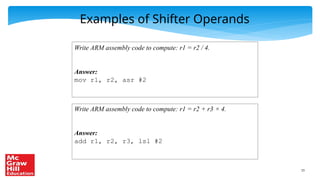
Write ARM assembly code to compute: r1 = r2 / 4.
Answer:
mov r1, r2, asr #2
Write ARM assembly code to compute: r1 = r2 + r3 × 4.
Answer:
add r1, r2, r3, lsl #2
16
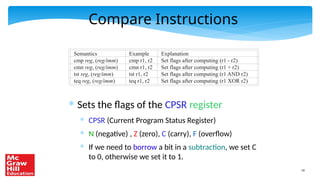
Compare Instructions
* Sets the flags of the CPSR register
* CPSR (Current Program Status Register)
* N (negative) , Z (zero), C (carry), F (overflow)
* If we need to borrow a bit in a subtraction, we set C
to 0, otherwise we set it to 1.
Semantics
cmp reg, (reg/imm)
cmn reg, (reg/imm)
tst reg, (reg/imm)
teq reg, (reg/imm)
Example
cmp r1, r2
cmn r1, r2
tst r1, r2
teq r1, r2
Explanation
Set flags after computing (r1 - r2)
Set flags after computing (r1 + r2)
Set flags after computing (r1 AND r2)
Set flags after computing (r1 XOR r2)
17
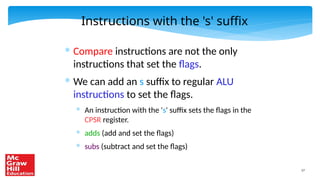
Instructions with the 's' suffix
* Compare instructions are not the only
instructions that set the flags.
* We can add an s suffix to regular ALU
instructions to set the flags.
* An instruction with the 's' suffix sets the flags in the
CPSR register.
* adds (add and set the flags)
* subs (subtract and set the flags)
18
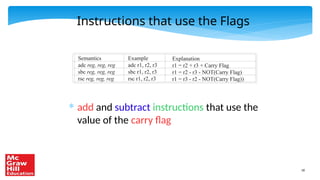
Instructions that use the Flags
* add and subtract instructions that use the
value of the carry flag
Semantics
adc reg, reg, reg
sbc reg, reg, reg
rsc reg, reg, reg
Example
adc r1, r2, r3
sbc r1, r2, r3
rsc r1, r2, r3
Explanation
r1 = r2 + r3 + Carry Flag
r1 = r2 - r3 - NOT(Carry Flag)
r1 = r3 - r2 - NOT(Carry Flag))
19
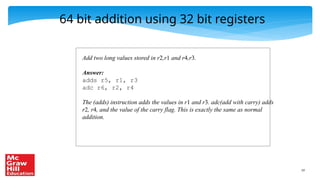
64 bit addition using 32 bit registers
Add two long values stored in r2,r1 and r4,r3.
Answer:
adds r5, r1, r3
adc r6, r2, r4
The (adds) instruction adds the values in r1 and r3. adc(add with carry) adds
r2, r4, and the value of the carry flag. This is exactly the same as normal
addition.
20
Outline
* Basic Instructions
* Advanced Instructions
* Branch Instructions
* Memory Instructions
* Instruction Encoding
21
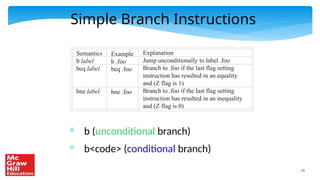
Simple Branch Instructions
* b (unconditional branch)
* b<code> (conditional branch)
Semantics
b label
beq label
bne label
Example
b .foo
beq .foo
bne .foo
Explanation
Jump unconditionally to label .foo
Branch to .foo if the last flag setting
instruction has resulted in an equality
and (Z flag is 1)
Branch to .foo if the last flag setting
instruction has resulted in an inequality
and (Z flag is 0)
22
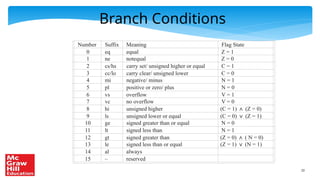
Branch Conditions
Number Suffix Meaning Flag State
0 eq equal Z = 1
1 ne notequal Z = 0
2 cs/hs carry set/ unsigned higher or equal C = 1
3 cc/lo carry clear/ unsigned lower C = 0
4 mi negative/ minus N = 1
5 pl positive or zero/ plus N = 0
6 vs overflow V = 1
7 vc no overflow V = 0
8 hi unsigned higher (C = 1) (Z = 0)
∧
9 ls unsigned lower or equal (C = 0) (Z = 1)
∨
10 ge signed greater than or equal N = 0
11 lt signed less than N = 1
12 gt signed greater than (Z = 0) ( N = 0)
∧
13 le signed less than or equal (Z = 1) (N = 1)
∨
14 al always
15 – reserved
23
Example
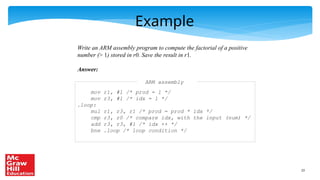
Write an ARM assembly program to compute the factorial of a positive
number (> 1) stored in r0. Save the result in r1.
Answer:
ARM assembly
mov r1, #1 /* prod = 1 */
mov r3, #1 /* idx = 1 */
.loop:
mul r1, r3, r1 /* prod = prod * idx */
cmp r3, r0 /* compare idx, with the input (num) */
add r3, r3, #1 /* idx ++ */
bne .loop /* loop condition */
24
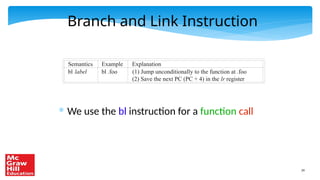
Branch and Link Instruction
* We use the bl instruction for a function call
Semantics Example Explanation
bl label bl .foo (1) Jump unconditionally to the function at .foo
(2) Save the next PC (PC + 4) in the lr register
25
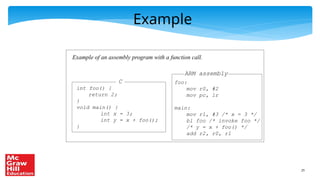
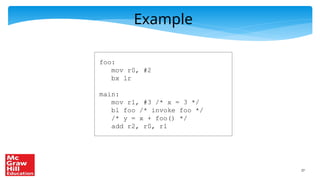
Example
Example of an assembly program with a function call.
C
int foo() {
return 2;
}
void main() {
int x = 3;
int y = x + foo();
}
ARM assembly
foo:
mov r0, #2
mov pc, lr
main:
mov r1, #3 /* x = 3 */
bl foo /* invoke foo */
/* y = x + foo() */
add r2, r0, r1
26
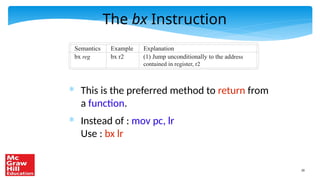
The bx Instruction
* This is the preferred method to return from
a function.
* Instead of : mov pc, lr
Use : bx lr
Semantics Example Explanation
bx reg bx r2 (1) Jump unconditionally to the address
contained in register, r2
27
Example
foo:
mov r0, #2
bx lr
main:
mov r1, #3 /* x = 3 */
bl foo /* invoke foo */
/* y = x + foo() */
add r2, r0, r1
28
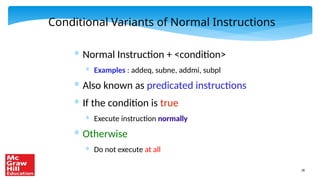
Conditional Variants of Normal Instructions
* Normal Instruction + <condition>
* Examples : addeq, subne, addmi, subpl
* Also known as predicated instructions
* If the condition is true
* Execute instruction normally
* Otherwise
* Do not execute at all
29
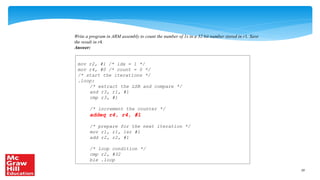
Write a program in ARM assembly to count the number of 1s in a 32 bit number stored in r1. Save
the result in r4.
Answer:
mov r2, #1 /* idx = 1 */
mov r4, #0 /* count = 0 */
/* start the iterations */
.loop:
/* extract the LSB and compare */
and r3, r1, #1
cmp r3, #1
/* increment the counter */
addeq r4, r4, #1
/* prepare for the next iteration */
mov r1, r1, lsr #1
add r2, r2, #1
/* loop condition */
cmp r2, #32
ble .loop
30
Outline
* Basic Instructions
* Advanced Instructions
* Branch Instructions
* Memory Instructions
* Instruction Encoding
31
Basic Load Instruction
●
ldr r1, [r0]
ldr r1, [r0]
r0
r1
register
file
memory
32
Basic Store Instruction
●
str r1, [r0]
str r1, [r0]
r0
r1
register
file
memory
33
Memory Instructions with an Offset
* ldr r1, [r0, #4]
* r1 ← mem[r0 + 4]
* ldr r1, [r0, r2]
* r1 ← mem[r0 + r2]
34
Table of Load/Store Instructions
* Note the base-scaled-index addressing mode
Semantics
ldr reg, [reg]
ldr reg, [reg, imm]
ldr reg, [reg, reg]
ldr reg, [reg, reg, shift imm]
Example
ldr r1, [r0]
ldr r1, [r0, #4]
ldr r1, [r0, r2]
ldr r1, [r0, r2, lsl #2]
Explanation
r1 ← [r0]
r1 ← [r0 + 4]
r1 ← [r0 + r2]
r1 ← [r0 + r2 << 2]
Addressing Mode
register-indirect
base-offset
base-index
base-scaled-index
str reg, [reg]
str reg, [reg, imm]
str reg, [reg, reg]
str reg, [reg, reg, shift imm]
str r1, [r0]
str r1, [r0, #4]
str r1, [r0, r2]
str r1, [r0, r2, lsl #2]
[r0] ← r1
[r0 + 4] ← r1
[r0 + r2] ← r1
[r0 + r2 << 2] ← r1
register-indirect
base-offset
base-index
base-scaled-index
35
Example with Arrays
C
void addNumbers(int a[100]) {
int idx;
int sum = 0;
for (idx = 0; idx < 100; idx++){
sum = sum + a[idx];
}
}
Answer:
ARM assembly
/* base address of array a in r0 */
mov r1, #0 /* sum = 0 */
mov r2, #0 /* idx = 0 */
.loop:
ldr r3, [r0, r2, lsl #2]
add r2, r2, #1 /* idx ++ */
add r1, r1, r3 /* sum += a[idx] */
cmp r2, #100 /* loop condition */
bne .loop
36
Advanced Memory Instructions
* Consider an array access again
* ldr r3, [r0, r2, lsl #2] /* access array */
* add r2, r2, #1 /* increment index */
* Can we fuse both into one instruction
* ldr r3, [r0], r2, lsl #2
* Equivalent to :
* r3 = [r0]
* r0 = r0 + r2 << 2
Post-indexed addressing
mode
37
Pre-Indexed Addressing Mode
* Consider
* ldr r0, [r1, #4]!
* This is equivalent to:
* r0  mem [r1 + 4]
* r1  r1 + 4
Similar to i++ and ++i in Java/C/C++
38
C
void addNumbers(int a[100]) {
int idx;
int sum = 0;
for (idx = 0; idx < 100; idx++){
sum = sum + a[idx];
}
}
Answer:
ARM assembly
/* base address of array a in r0 */
mov r1, #0 /* sum = 0 */
add r4, r0, #400 /* set r4 to address of a[100] */
.loop:
ldr r3, [r0], #4
add r1, r1, r3 /* sum += a[idx] */
cmp r0, r4 /* loop condition */
bne .loop
Example with Arrays
39
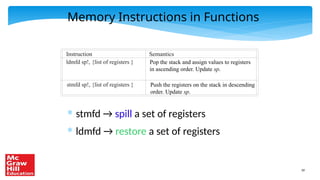
Memory Instructions in Functions
* stmfd → spill a set of registers
* ldmfd → restore a set of registers
Instruction Semantics
ldmfd sp!, {list of registers }
stmfd sp!, {list of registers }
Pop the stack and assign values to registers
in ascending order. Update sp.
Push the registers on the stack in descending
order. Update sp.
40
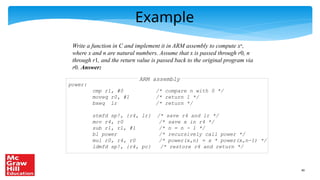
Example
Write a function in C and implement it in ARM assembly to compute xn
,
where x and n are natural numbers. Assume that x is passed through r0, n
through r1, and the return value is passed back to the original program via
r0. Answer:
ARM assembly
power:
cmp r1, #0 /* compare n with 0 */
moveq r0, #1 /* return 1 */
bxeq lr /* return */
stmfd sp!, {r4, lr} /* save r4 and lr */
mov r4, r0 /* save x in r4 */
sub r1, r1, #1 /* n = n - 1 */
bl power /* recursively call power */
mul r0, r4, r0 /* power(x,n) = x * power(x,n-1) */
ldmfd sp!, {r4, pc} /* restore r4 and return */
41
Outline
* Basic Instructions
* Advanced Instructions
* Branch Instructions
* Memory Instructions
* Instruction Encoding
42
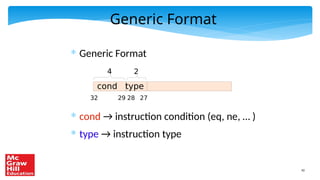
Generic Format
* Generic Format
* cond → instruction condition (eq, ne, … )
* type → instruction type
cond
32 29
type
27
28
4 2
43
Data Processing Instructions
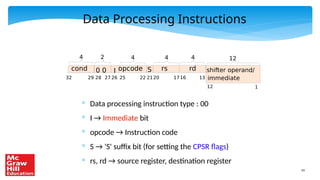
* Data processing instruction type : 00
* I → Immediate bit
* opcode → Instruction code
* S → 'S' suffix bit (for setting the CPSR flags)
* rs, rd → source register, destination register
cond
32 29
0 0
27
28
4 2
I
26
4
shifter operand/
immediate
25 22
S
21
4
rs
20 17
rd
4
16 13
12
12 1
opcode
44
Encoding Immediate Values
* ARM has 12 bits for immediates
* 12 bits
* What do we do with 12 bits ?
* It is not 1 byte, nor is it 2 bytes
* Let us divide 12 bits into two parts
* 8 bit payload + 4 bit rot
45
Encoding Immediates - II
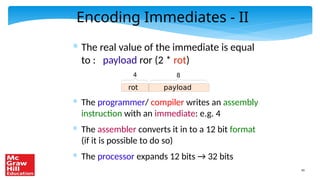
* The real value of the immediate is equal
to : payload ror (2 * rot)
* The programmer/ compiler writes an assembly
instruction with an immediate: e.g. 4
* The assembler converts it in to a 12 bit format
(if it is possible to do so)
* The processor expands 12 bits → 32 bits
rot payload
4 8
46
Encoding Immediates - III
* Explanation of encoding the immediate in
lay man's terms
* The payload is an 8 bit quantity
* A number is a 32 bit quantity.
* We can set 8 contiguous bits in the 32 bit number while
specifying an immediate
* The starting point of this sequence of bits needs to be
an even number such as 0, 2, 4, ...
47
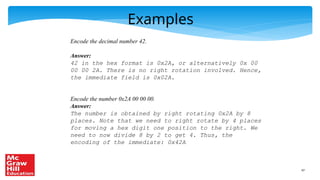
Examples
Encode the decimal number 42.
Answer:
42 in the hex format is 0x2A, or alternatively 0x 00
00 00 2A. There is no right rotation involved. Hence,
the immediate field is 0x02A.
Encode the number 0x2A 00 00 00.
Answer:
The number is obtained by right rotating 0x2A by 8
places. Note that we need to right rotate by 4 places
for moving a hex digit one position to the right. We
need to now divide 8 by 2 to get 4. Thus, the
encoding of the immediate: 0x42A
48
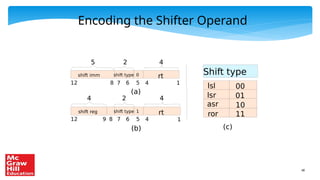
Encoding the Shifter Operand
rt
4
4 1
0
5
7 6
shift type
12 8
shift imm
2
5
rt
4
4 1
1
5
7 6
shift type
12 8
shift reg
2
4
9
Shift type
lsl
lsr
asr
ror
00
01
10
11
(a)
(b) (c)
49
Load/Store Instructions
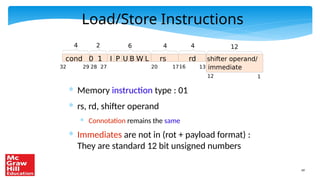
* Memory instruction type : 01
* rs, rd, shifter operand
* Connotation remains the same
* Immediates are not in (rot + payload format) :
They are standard 12 bit unsigned numbers
cond
32 29
0 1
27
28
4 2
I
6
shifter operand/
immediate
4
rs
20 17
rd
4
16 13
12
12 1
P U B W L
50
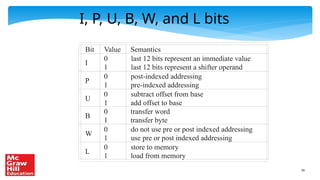
I, P, U, B, W, and L bits
Bit Value Semantics
I
0 last 12 bits represent an immediate value
1 last 12 bits represent a shifter operand
P
0 post-indexed addressing
1 pre-indexed addressing
U
0 subtract offset from base
1 add offset to base
B
0 transfer word
1 transfer byte
W
0 do not use pre or post indexed addressing
1 use pre or post indexed addressing
L
0 store to memory
1 load from memory
51
Branch Instructions
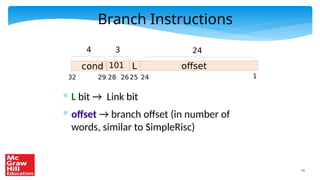
* L bit → Link bit
* offset → branch offset (in number of
words, similar to SimpleRisc)
offset
32 29 26
28
4 3
L
25 24
101
1
24
cond
52
Branch Instructions - II
* What does the processor do
* Expands the offset to 32 bits (with proper sign
extensions)
* Shifts it to the left by 2 bits (because offset is in
terms of memory words)
* Adds it to PC + 8 to generate the branch target
* Why, PC + 8 ?
* Read chapter 9
53
THE END

Chapter_04_ARM_Assembly.pptx ARM ASSEMBLY CODE

  • 1.
    1 Chapter 4 ARMAssembly Language Smruti Ranjan Sarangi, IIT Delhi Computer Organisation and Architecture PowerPoint Slides PROPRIETARY MATERIAL. © 2014 The McGraw-Hill Companies, Inc. All rights reserved. No part of this PowerPoint slide may be displayed, reproduced or distributed in any form or by any means, without the prior written permission of the publisher, or used beyond the limited distribution to teachers and educators permitted by McGraw-Hill for their individual course preparation. PowerPoint Slides are being provided only to authorized professors and instructors for use in preparing for classes using the affiliated textbook. No other use or distribution of this PowerPoint slide is permitted. The PowerPoint slide may not be sold and may not be distributed or be used by any student or any other third party. No part of the slide may be reproduced, displayed or distributed in any form or by any means, electronic or otherwise, without the prior written permission of McGraw Hill Education (India) Private Limited. 1
  • 2.
    Download the pdfof the book www.basiccomparch.com videos Slides, software, solution manual Print version (Publisher: WhiteFalcon, 2021) Available on e-commerce sites. The pdf version of the book and all the learning resources can be freely downloaded from the website: www.basiccomparch.com 2nd version
  • 3.
    3 ARM Assembly Language *One of the most popular RISC instruction sets in use today * Used by licensees of ARM Limited, UK * ARM processors * Some processors by Samsung, Qualcomm, and Apple * Highly versatile instruction set * Floating-point and vector (multiple operations per instruction) extensions
  • 4.
    4 Outline * Basic Instructions *Advanced Instructions * Branch Instructions * Memory Instructions * Instruction Encoding
  • 5.
    5 ARM Machine Model *16 registers – r0 … r15 * The PC is explicitly visible * Memory (Von Neumann Architecture) Register Abbrv. Name r11 fp frame pointer r12 ip intra-procedure-call scratch register r13 sp stack pointer r14 lr link register r15 pc program counter
  • 6.
    6 Data Transfer Instructions *mov and mvn (move not) Semantics Example Explanation mov reg, (reg/imm) mov r1, r2 r1 ← r2 mov r1, #3 r1 ← 3 mvn r1, r2 r1 ← r2 ∼ mvn r1, #3 r1 ← 3 ∼ mvn reg, (reg/imm)
  • 7.
    7 Arithmetic Instructions * add,sub, rsb (reverse subtract) Semantics Example Explanation add reg, reg, (reg/imm) sub reg, reg, (reg/imm) rsb reg, reg, (reg/imm) add r1, r2, r3 sub r1, r2, r3 rsb r1, r2, r3 r1 ← r2 + r3 r1 ← r2 - r3 r1 ← r3 - r2
  • 8.
    8 Example Write an ARMassembly program to compute: 4+5 - 19. Save the result in r1. Answer: Simple yet suboptimal solution. mov r1, #4 mov r2, #5 add r3, r1, r2 mov r4, #19 sub r1, r3, r4 Optimal solution. mov r1, #4 add r1, r1, #5 sub r1, r1, #19
  • 9.
    9 Logical Instructions * and,eor (exclusive or), orr (or), bic(bit clear) Semantics and reg, reg, (reg/imm) eor reg, reg, (reg/imm) orr reg, reg, (reg/imm) bic reg, reg, (reg/imm) Example and r1, r2, r3 eor r1, r2, r3 orr r1, r2, r3 bic r1, r2, r3 Explanation r1 ← r2 AND r3 r1 ← r2 XOR r3 r1 ← r2 OR r3 r1 ← r2 AND ( r3) ∼
  • 10.
    10 Example Write an ARMassembly program to compute:, where A and B are 1 bit Boolean values. Assume that A = 0 and B = 1. Save the result in r0. Answer: mov r0, #0x0 orr r0, r0, #0x1 mvn r0, r0
  • 11.
    11 Multiplication Instruction * smulland umull instructions can hold a 64 bit operand Semantics mul reg, reg, (reg/imm) mla reg, reg, reg, reg smull reg, reg, reg, reg umull reg, reg, reg, reg Example mul r1, r2, r3 mla r1, r2, r3, r4 smull r0, r1, r2, r3 umull r0, r1, r2, r3 Explanation r1 ← r2 × r3 r1 ← r2 × r3 + r4 r1 r0← r2 ×signed r3 64 r1 r0← r2 ×unsigned r3 64
  • 12.
    12 Example Compute 123 + 1,and save the result in r3. Answer: /* load test values */ mov r0, #12 mov r1, #1 /* perform the logical computation */ mul r4, r0, r0 @ 12*12 mla r3, r4, r0, r1 @ 12*12*12 + 1
  • 13.
    13 Outline * Basic Instructions *Advanced Instructions * Branch Instructions * Memory Instructions * Instruction Encoding
  • 14.
    14 Shifter Operands reg1 , lsl lsr asr ror #shift_amt reg2 10 1 1 0 lsl #1 0 1 1 0 0 1 0 1 1 0 lsr #1 0 1 0 1 1 Generic format 1 0 1 1 0 asr #1 1 1 0 1 1 1 0 1 1 0 ror #1 0 1 0 1 1 Examples
  • 15.
    15 Examples of ShifterOperands Write ARM assembly code to compute: r1 = r2 / 4. Answer: mov r1, r2, asr #2 Write ARM assembly code to compute: r1 = r2 + r3 × 4. Answer: add r1, r2, r3, lsl #2
  • 16.
    16 Compare Instructions * Setsthe flags of the CPSR register * CPSR (Current Program Status Register) * N (negative) , Z (zero), C (carry), F (overflow) * If we need to borrow a bit in a subtraction, we set C to 0, otherwise we set it to 1. Semantics cmp reg, (reg/imm) cmn reg, (reg/imm) tst reg, (reg/imm) teq reg, (reg/imm) Example cmp r1, r2 cmn r1, r2 tst r1, r2 teq r1, r2 Explanation Set flags after computing (r1 - r2) Set flags after computing (r1 + r2) Set flags after computing (r1 AND r2) Set flags after computing (r1 XOR r2)
  • 17.
    17 Instructions with the's' suffix * Compare instructions are not the only instructions that set the flags. * We can add an s suffix to regular ALU instructions to set the flags. * An instruction with the 's' suffix sets the flags in the CPSR register. * adds (add and set the flags) * subs (subtract and set the flags)
  • 18.
    18 Instructions that usethe Flags * add and subtract instructions that use the value of the carry flag Semantics adc reg, reg, reg sbc reg, reg, reg rsc reg, reg, reg Example adc r1, r2, r3 sbc r1, r2, r3 rsc r1, r2, r3 Explanation r1 = r2 + r3 + Carry Flag r1 = r2 - r3 - NOT(Carry Flag) r1 = r3 - r2 - NOT(Carry Flag))
  • 19.
    19 64 bit additionusing 32 bit registers Add two long values stored in r2,r1 and r4,r3. Answer: adds r5, r1, r3 adc r6, r2, r4 The (adds) instruction adds the values in r1 and r3. adc(add with carry) adds r2, r4, and the value of the carry flag. This is exactly the same as normal addition.
  • 20.
    20 Outline * Basic Instructions *Advanced Instructions * Branch Instructions * Memory Instructions * Instruction Encoding
  • 21.
    21 Simple Branch Instructions *b (unconditional branch) * b<code> (conditional branch) Semantics b label beq label bne label Example b .foo beq .foo bne .foo Explanation Jump unconditionally to label .foo Branch to .foo if the last flag setting instruction has resulted in an equality and (Z flag is 1) Branch to .foo if the last flag setting instruction has resulted in an inequality and (Z flag is 0)
  • 22.
    22 Branch Conditions Number SuffixMeaning Flag State 0 eq equal Z = 1 1 ne notequal Z = 0 2 cs/hs carry set/ unsigned higher or equal C = 1 3 cc/lo carry clear/ unsigned lower C = 0 4 mi negative/ minus N = 1 5 pl positive or zero/ plus N = 0 6 vs overflow V = 1 7 vc no overflow V = 0 8 hi unsigned higher (C = 1) (Z = 0) ∧ 9 ls unsigned lower or equal (C = 0) (Z = 1) ∨ 10 ge signed greater than or equal N = 0 11 lt signed less than N = 1 12 gt signed greater than (Z = 0) ( N = 0) ∧ 13 le signed less than or equal (Z = 1) (N = 1) ∨ 14 al always 15 – reserved
  • 23.
    23 Example Write an ARMassembly program to compute the factorial of a positive number (> 1) stored in r0. Save the result in r1. Answer: ARM assembly mov r1, #1 /* prod = 1 */ mov r3, #1 /* idx = 1 */ .loop: mul r1, r3, r1 /* prod = prod * idx */ cmp r3, r0 /* compare idx, with the input (num) */ add r3, r3, #1 /* idx ++ */ bne .loop /* loop condition */
  • 24.
    24 Branch and LinkInstruction * We use the bl instruction for a function call Semantics Example Explanation bl label bl .foo (1) Jump unconditionally to the function at .foo (2) Save the next PC (PC + 4) in the lr register
  • 25.
    25 Example Example of anassembly program with a function call. C int foo() { return 2; } void main() { int x = 3; int y = x + foo(); } ARM assembly foo: mov r0, #2 mov pc, lr main: mov r1, #3 /* x = 3 */ bl foo /* invoke foo */ /* y = x + foo() */ add r2, r0, r1
  • 26.
    26 The bx Instruction *This is the preferred method to return from a function. * Instead of : mov pc, lr Use : bx lr Semantics Example Explanation bx reg bx r2 (1) Jump unconditionally to the address contained in register, r2
  • 27.
    27 Example foo: mov r0, #2 bxlr main: mov r1, #3 /* x = 3 */ bl foo /* invoke foo */ /* y = x + foo() */ add r2, r0, r1
  • 28.
    28 Conditional Variants ofNormal Instructions * Normal Instruction + <condition> * Examples : addeq, subne, addmi, subpl * Also known as predicated instructions * If the condition is true * Execute instruction normally * Otherwise * Do not execute at all
  • 29.
    29 Write a programin ARM assembly to count the number of 1s in a 32 bit number stored in r1. Save the result in r4. Answer: mov r2, #1 /* idx = 1 */ mov r4, #0 /* count = 0 */ /* start the iterations */ .loop: /* extract the LSB and compare */ and r3, r1, #1 cmp r3, #1 /* increment the counter */ addeq r4, r4, #1 /* prepare for the next iteration */ mov r1, r1, lsr #1 add r2, r2, #1 /* loop condition */ cmp r2, #32 ble .loop
  • 30.
    30 Outline * Basic Instructions *Advanced Instructions * Branch Instructions * Memory Instructions * Instruction Encoding
  • 31.
    31 Basic Load Instruction ● ldrr1, [r0] ldr r1, [r0] r0 r1 register file memory
  • 32.
    32 Basic Store Instruction ● strr1, [r0] str r1, [r0] r0 r1 register file memory
  • 33.
    33 Memory Instructions withan Offset * ldr r1, [r0, #4] * r1 ← mem[r0 + 4] * ldr r1, [r0, r2] * r1 ← mem[r0 + r2]
  • 34.
    34 Table of Load/StoreInstructions * Note the base-scaled-index addressing mode Semantics ldr reg, [reg] ldr reg, [reg, imm] ldr reg, [reg, reg] ldr reg, [reg, reg, shift imm] Example ldr r1, [r0] ldr r1, [r0, #4] ldr r1, [r0, r2] ldr r1, [r0, r2, lsl #2] Explanation r1 ← [r0] r1 ← [r0 + 4] r1 ← [r0 + r2] r1 ← [r0 + r2 << 2] Addressing Mode register-indirect base-offset base-index base-scaled-index str reg, [reg] str reg, [reg, imm] str reg, [reg, reg] str reg, [reg, reg, shift imm] str r1, [r0] str r1, [r0, #4] str r1, [r0, r2] str r1, [r0, r2, lsl #2] [r0] ← r1 [r0 + 4] ← r1 [r0 + r2] ← r1 [r0 + r2 << 2] ← r1 register-indirect base-offset base-index base-scaled-index
  • 35.
    35 Example with Arrays C voidaddNumbers(int a[100]) { int idx; int sum = 0; for (idx = 0; idx < 100; idx++){ sum = sum + a[idx]; } } Answer: ARM assembly /* base address of array a in r0 */ mov r1, #0 /* sum = 0 */ mov r2, #0 /* idx = 0 */ .loop: ldr r3, [r0, r2, lsl #2] add r2, r2, #1 /* idx ++ */ add r1, r1, r3 /* sum += a[idx] */ cmp r2, #100 /* loop condition */ bne .loop
  • 36.
    36 Advanced Memory Instructions *Consider an array access again * ldr r3, [r0, r2, lsl #2] /* access array */ * add r2, r2, #1 /* increment index */ * Can we fuse both into one instruction * ldr r3, [r0], r2, lsl #2 * Equivalent to : * r3 = [r0] * r0 = r0 + r2 << 2 Post-indexed addressing mode
  • 37.
    37 Pre-Indexed Addressing Mode *Consider * ldr r0, [r1, #4]! * This is equivalent to: * r0  mem [r1 + 4] * r1  r1 + 4 Similar to i++ and ++i in Java/C/C++
  • 38.
    38 C void addNumbers(int a[100]){ int idx; int sum = 0; for (idx = 0; idx < 100; idx++){ sum = sum + a[idx]; } } Answer: ARM assembly /* base address of array a in r0 */ mov r1, #0 /* sum = 0 */ add r4, r0, #400 /* set r4 to address of a[100] */ .loop: ldr r3, [r0], #4 add r1, r1, r3 /* sum += a[idx] */ cmp r0, r4 /* loop condition */ bne .loop Example with Arrays
  • 39.
    39 Memory Instructions inFunctions * stmfd → spill a set of registers * ldmfd → restore a set of registers Instruction Semantics ldmfd sp!, {list of registers } stmfd sp!, {list of registers } Pop the stack and assign values to registers in ascending order. Update sp. Push the registers on the stack in descending order. Update sp.
  • 40.
    40 Example Write a functionin C and implement it in ARM assembly to compute xn , where x and n are natural numbers. Assume that x is passed through r0, n through r1, and the return value is passed back to the original program via r0. Answer: ARM assembly power: cmp r1, #0 /* compare n with 0 */ moveq r0, #1 /* return 1 */ bxeq lr /* return */ stmfd sp!, {r4, lr} /* save r4 and lr */ mov r4, r0 /* save x in r4 */ sub r1, r1, #1 /* n = n - 1 */ bl power /* recursively call power */ mul r0, r4, r0 /* power(x,n) = x * power(x,n-1) */ ldmfd sp!, {r4, pc} /* restore r4 and return */
  • 41.
    41 Outline * Basic Instructions *Advanced Instructions * Branch Instructions * Memory Instructions * Instruction Encoding
  • 42.
    42 Generic Format * GenericFormat * cond → instruction condition (eq, ne, … ) * type → instruction type cond 32 29 type 27 28 4 2
  • 43.
    43 Data Processing Instructions *Data processing instruction type : 00 * I → Immediate bit * opcode → Instruction code * S → 'S' suffix bit (for setting the CPSR flags) * rs, rd → source register, destination register cond 32 29 0 0 27 28 4 2 I 26 4 shifter operand/ immediate 25 22 S 21 4 rs 20 17 rd 4 16 13 12 12 1 opcode
  • 44.
    44 Encoding Immediate Values *ARM has 12 bits for immediates * 12 bits * What do we do with 12 bits ? * It is not 1 byte, nor is it 2 bytes * Let us divide 12 bits into two parts * 8 bit payload + 4 bit rot
  • 45.
    45 Encoding Immediates -II * The real value of the immediate is equal to : payload ror (2 * rot) * The programmer/ compiler writes an assembly instruction with an immediate: e.g. 4 * The assembler converts it in to a 12 bit format (if it is possible to do so) * The processor expands 12 bits → 32 bits rot payload 4 8
  • 46.
    46 Encoding Immediates -III * Explanation of encoding the immediate in lay man's terms * The payload is an 8 bit quantity * A number is a 32 bit quantity. * We can set 8 contiguous bits in the 32 bit number while specifying an immediate * The starting point of this sequence of bits needs to be an even number such as 0, 2, 4, ...
  • 47.
    47 Examples Encode the decimalnumber 42. Answer: 42 in the hex format is 0x2A, or alternatively 0x 00 00 00 2A. There is no right rotation involved. Hence, the immediate field is 0x02A. Encode the number 0x2A 00 00 00. Answer: The number is obtained by right rotating 0x2A by 8 places. Note that we need to right rotate by 4 places for moving a hex digit one position to the right. We need to now divide 8 by 2 to get 4. Thus, the encoding of the immediate: 0x42A
  • 48.
    48 Encoding the ShifterOperand rt 4 4 1 0 5 7 6 shift type 12 8 shift imm 2 5 rt 4 4 1 1 5 7 6 shift type 12 8 shift reg 2 4 9 Shift type lsl lsr asr ror 00 01 10 11 (a) (b) (c)
  • 49.
    49 Load/Store Instructions * Memoryinstruction type : 01 * rs, rd, shifter operand * Connotation remains the same * Immediates are not in (rot + payload format) : They are standard 12 bit unsigned numbers cond 32 29 0 1 27 28 4 2 I 6 shifter operand/ immediate 4 rs 20 17 rd 4 16 13 12 12 1 P U B W L
  • 50.
    50 I, P, U,B, W, and L bits Bit Value Semantics I 0 last 12 bits represent an immediate value 1 last 12 bits represent a shifter operand P 0 post-indexed addressing 1 pre-indexed addressing U 0 subtract offset from base 1 add offset to base B 0 transfer word 1 transfer byte W 0 do not use pre or post indexed addressing 1 use pre or post indexed addressing L 0 store to memory 1 load from memory
  • 51.
    51 Branch Instructions * Lbit → Link bit * offset → branch offset (in number of words, similar to SimpleRisc) offset 32 29 26 28 4 3 L 25 24 101 1 24 cond
  • 52.
    52 Branch Instructions -II * What does the processor do * Expands the offset to 32 bits (with proper sign extensions) * Shifts it to the left by 2 bits (because offset is in terms of memory words) * Adds it to PC + 8 to generate the branch target * Why, PC + 8 ? * Read chapter 9
  • 53.