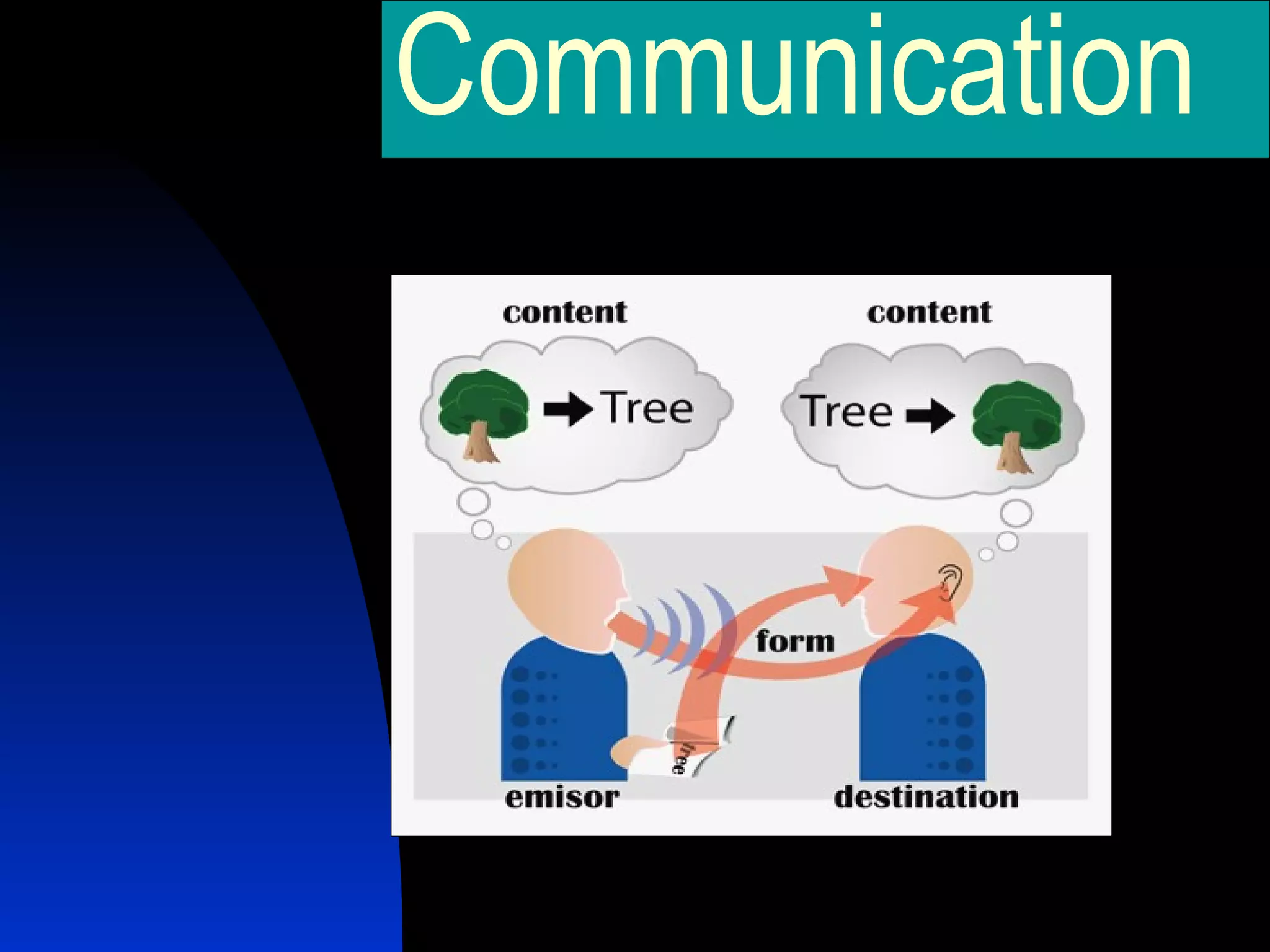
Communication
Definition Communication is a dynamic process to transmit meanings,social values and share experience Communication is a process of exchange of thoughts,feelings,ideas information and knowledge between two or more people.
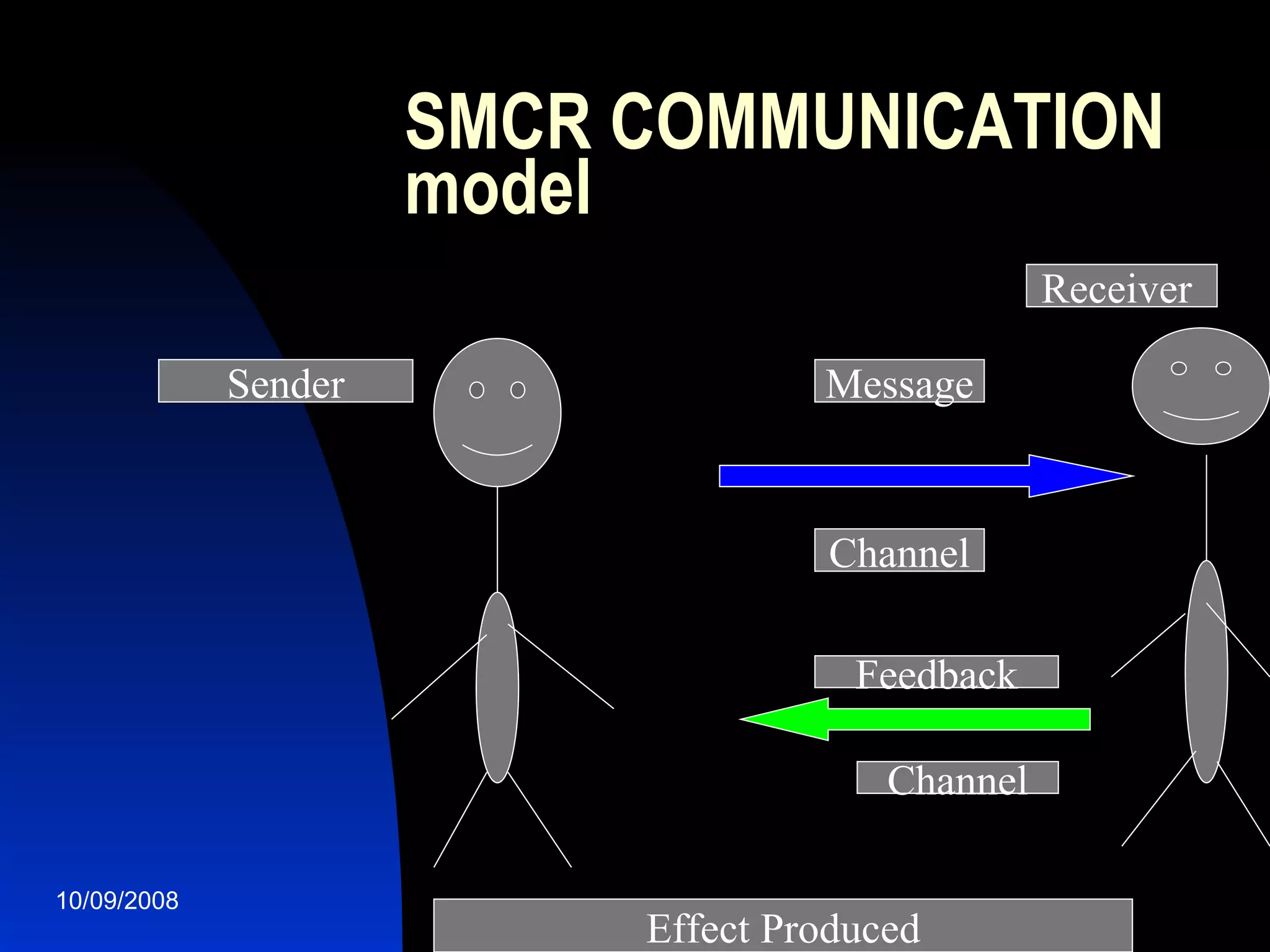
SMCR COMMUNICATION model Message Channel Feedback Channel Sender Receiver  Effect Produced
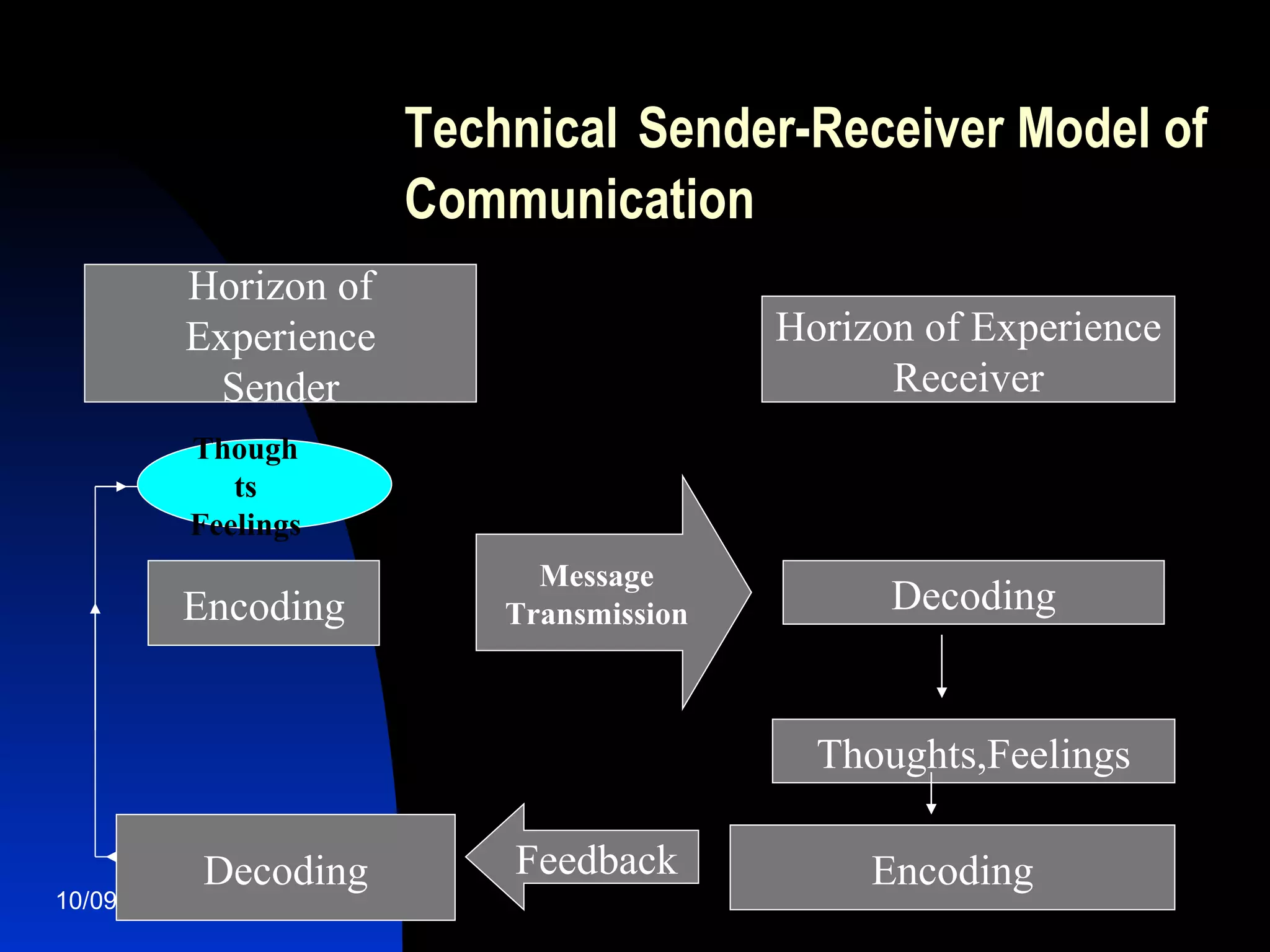
Technical   Sender-Receiver Model of Communication   Horizon of Experience Sender Horizon of Experience Receiver Thoughts Feelings Encoding Decoding Decoding Thoughts,Feelings Encoding Message Transmission Feedback
Remember  What you say also depends on how you say. How it is received depends on a set of events,stimuli,that person is exposed to.
Why is Communication   important Because: We transfer knowledge from one generation to the next through communication. It allows us develop a civilized society. It is the only biggest instinct which distinguishes Human from other creatures Helps us to organize and work together in groups.
Theories of Communication There are two theories of Communication The Technical and  The contextual
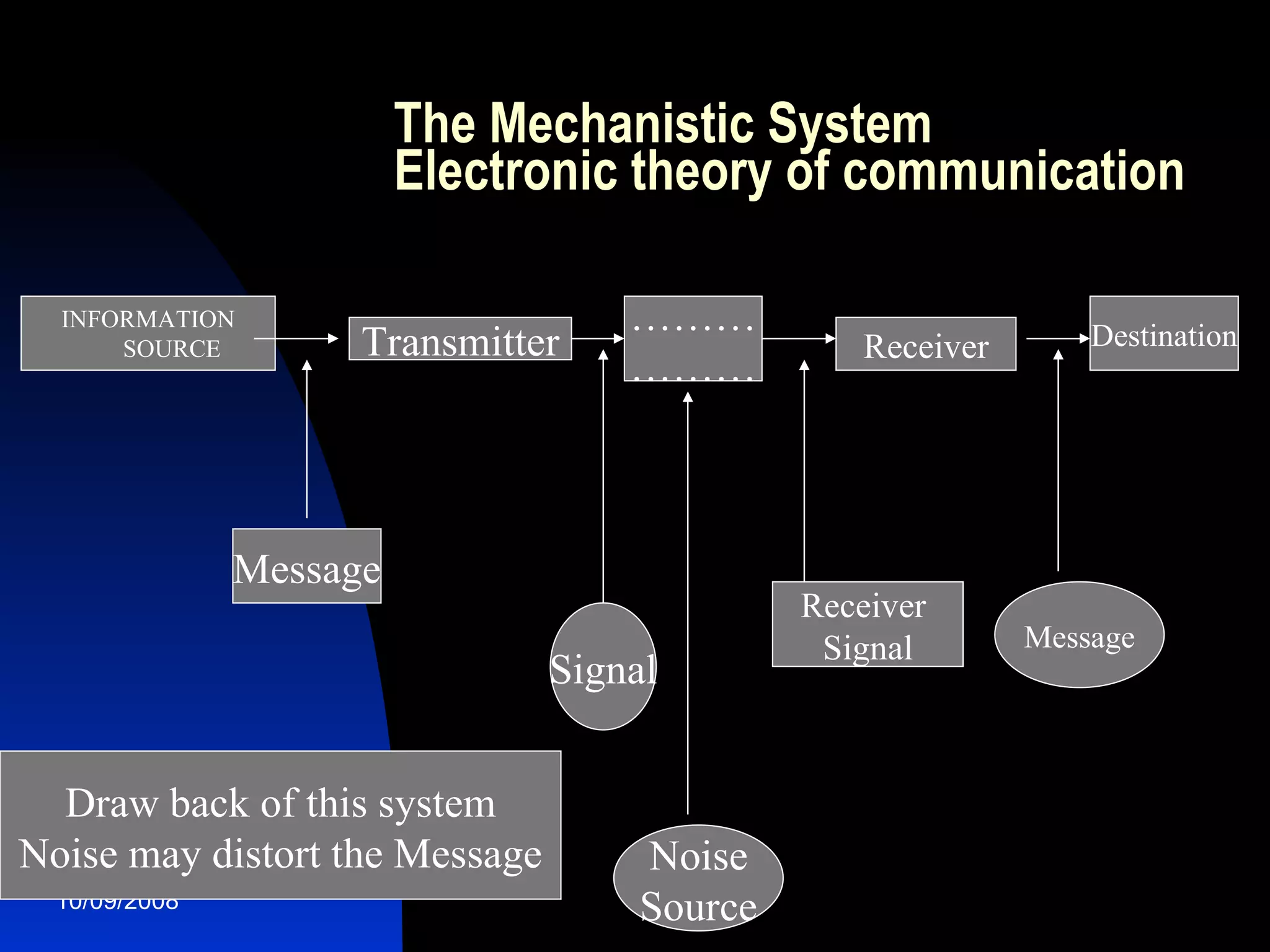
The Technical Theory The technical Theory view of communication is associated with information theory and is traced back to Claude E.Shannon and Warren Weaver (1949) According to this theory communication is based on and uses the language of electronics. The message begins with an information source,the mind of the sender(Writer/speaker) Sender encodes the message into words and sentences. This message is transmitted as signal. Receiver decodes the message
The Mechanistic System Electronic theory of communication  INFORMATION SOURCE Transmitter ……… ……… Receiver Destination Noise Source Signal Message Receiver  Signal Message Draw back of this system Noise may distort the Message
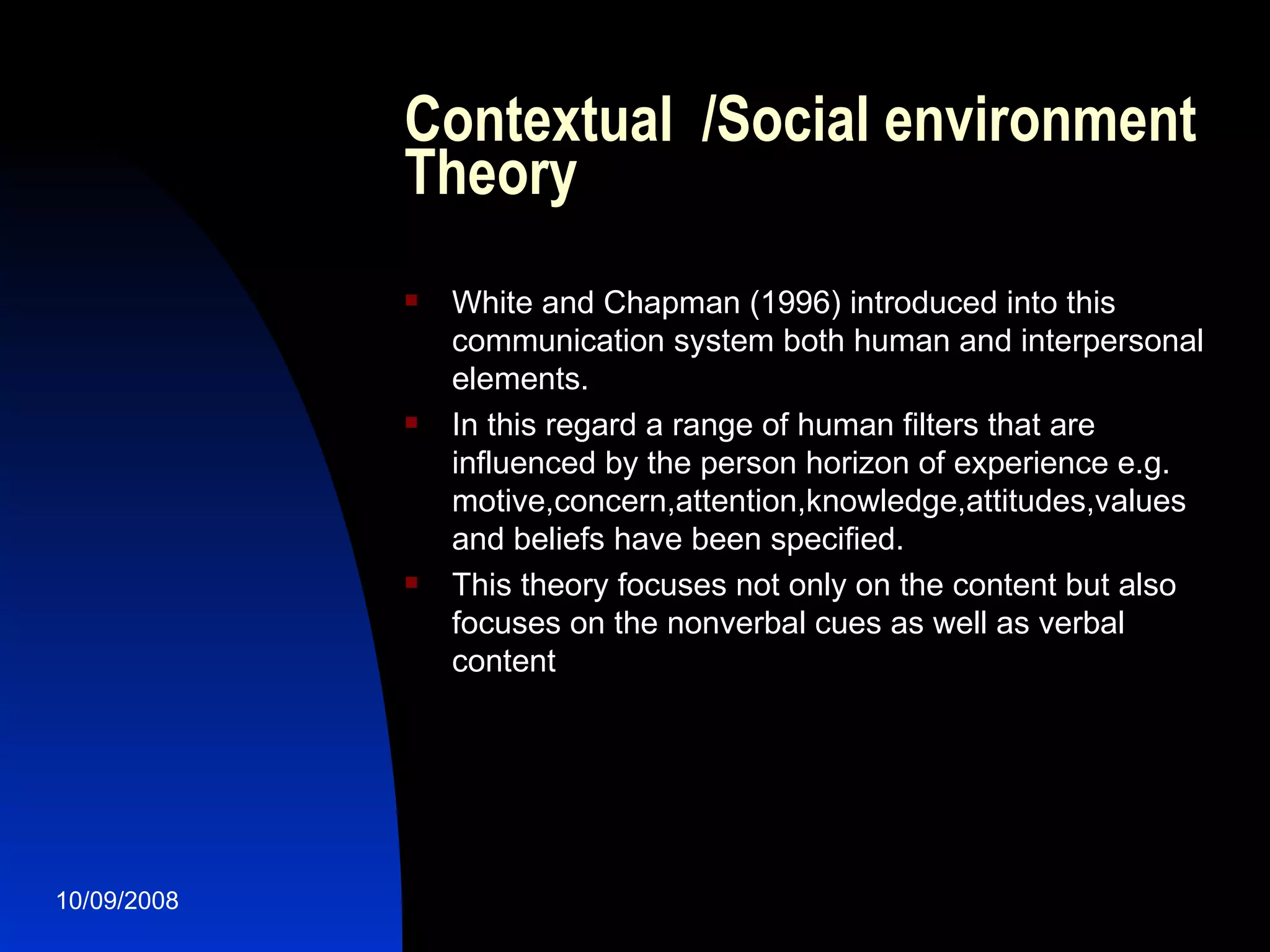
Contextual  /Social environment Theory White and Chapman (1996) introduced into this communication system both human and interpersonal elements. In this regard a range of human filters that are influenced by the person horizon of experience e.g. motive,concern,attention,knowledge,attitudes,values and beliefs have been specified. This theory focuses not only on the content but also focuses on the nonverbal cues as well as verbal content
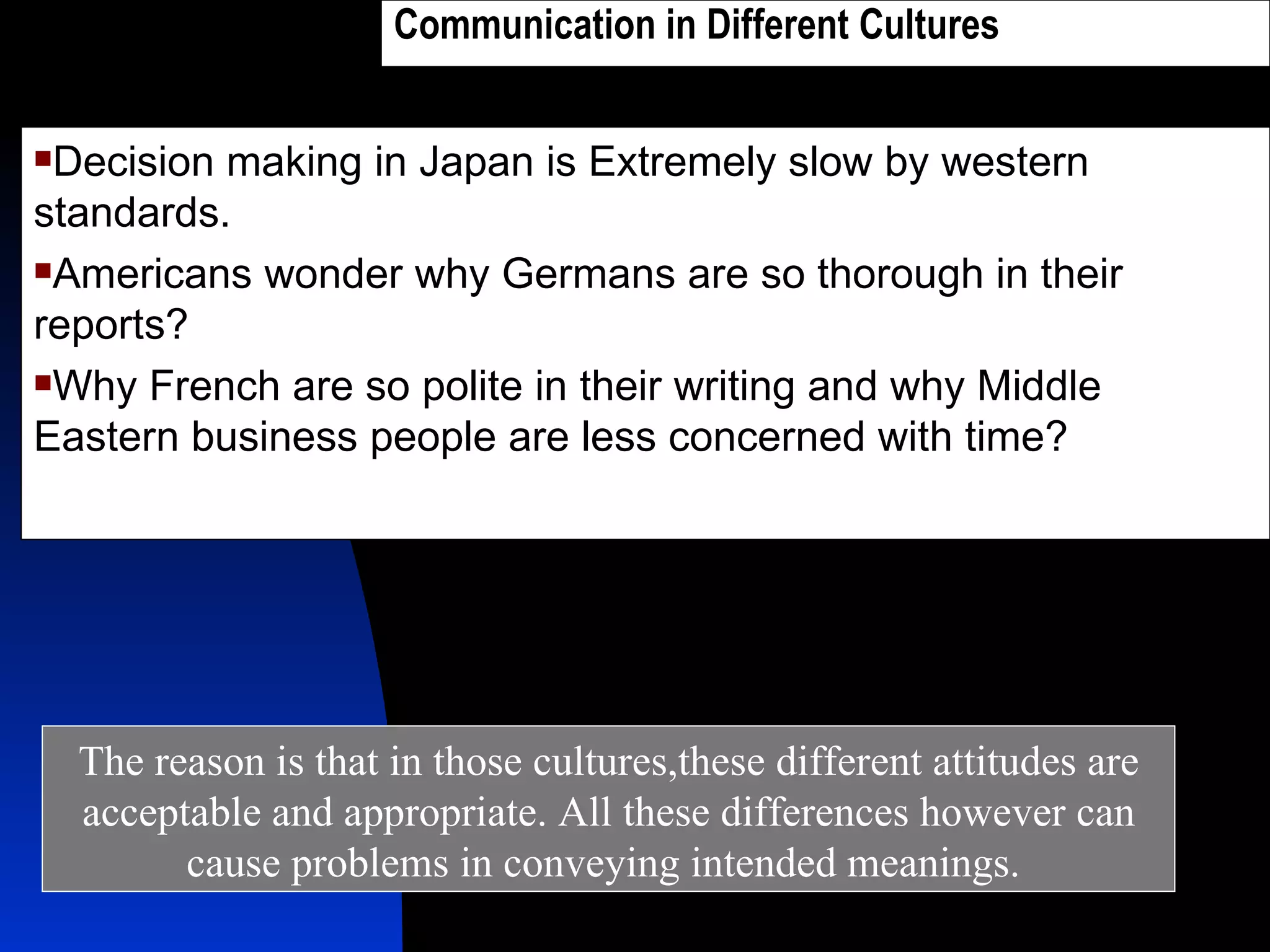
Communication in Different Cultures   Decision making in Japan is Extremely slow by western standards. Americans wonder why Germans are so thorough in their reports? Why French are so polite in their writing and why Middle Eastern business people are less concerned with time? The reason is that in those cultures,these different attitudes are acceptable and appropriate. All these differences however can cause problems in conveying intended meanings.
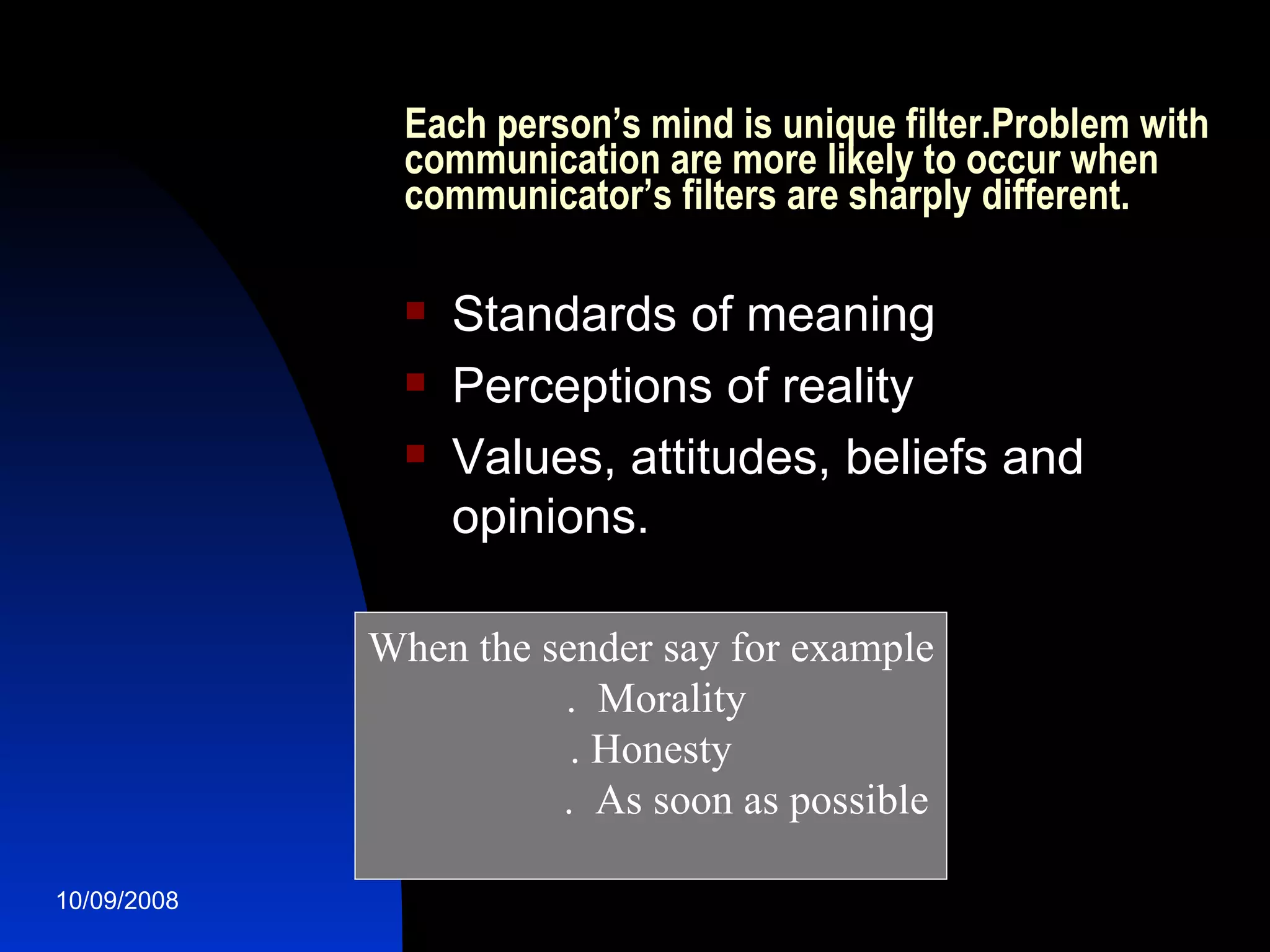
Each person’s mind is unique filter.Problem with communication are more likely to occur when communicator’s filters are sharply different. Standards of meaning Perceptions of reality Values, attitudes, beliefs and opinions. When the sender say for example .  Morality . Honesty .  As soon as possible
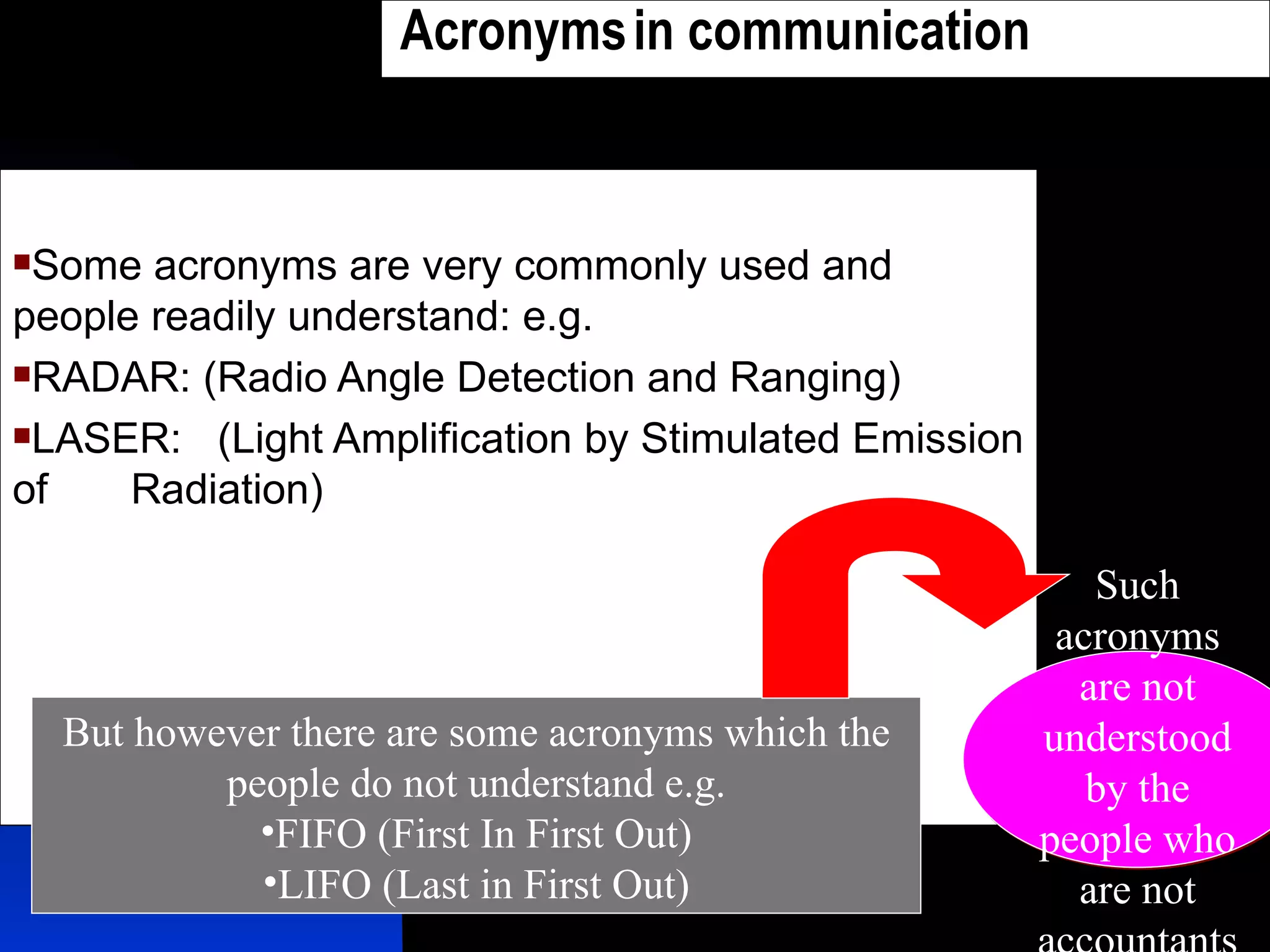
Acronyms   in communication Many acronyms are understood by the people like Some acronyms are very commonly used and people readily understand: e.g. RADAR: (Radio Angle Detection   and Ranging) LASER:  (Light Amplification by Stimulated Emission   of  Radiation) But however there are some acronyms which the people do not understand e.g. FIFO (First In First Out) LIFO (Last in First Out) Such acronyms are not understood by the people who are not accountants
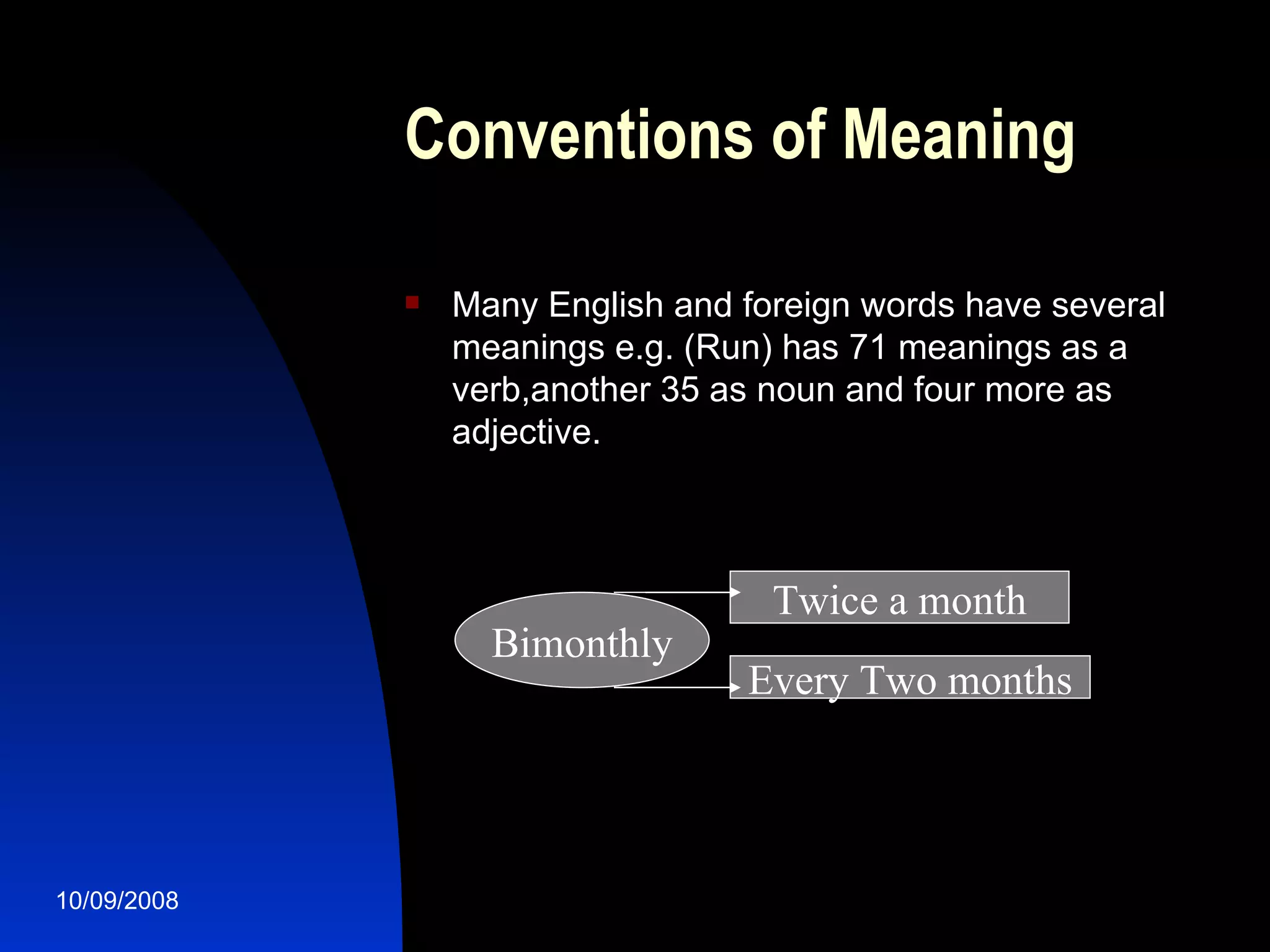
Conventions of Meaning Many English and foreign words have several meanings e.g. (Run) has 71 meanings as a verb,another 35 as noun and four more as adjective. Twice a month Every Two months Bimonthly
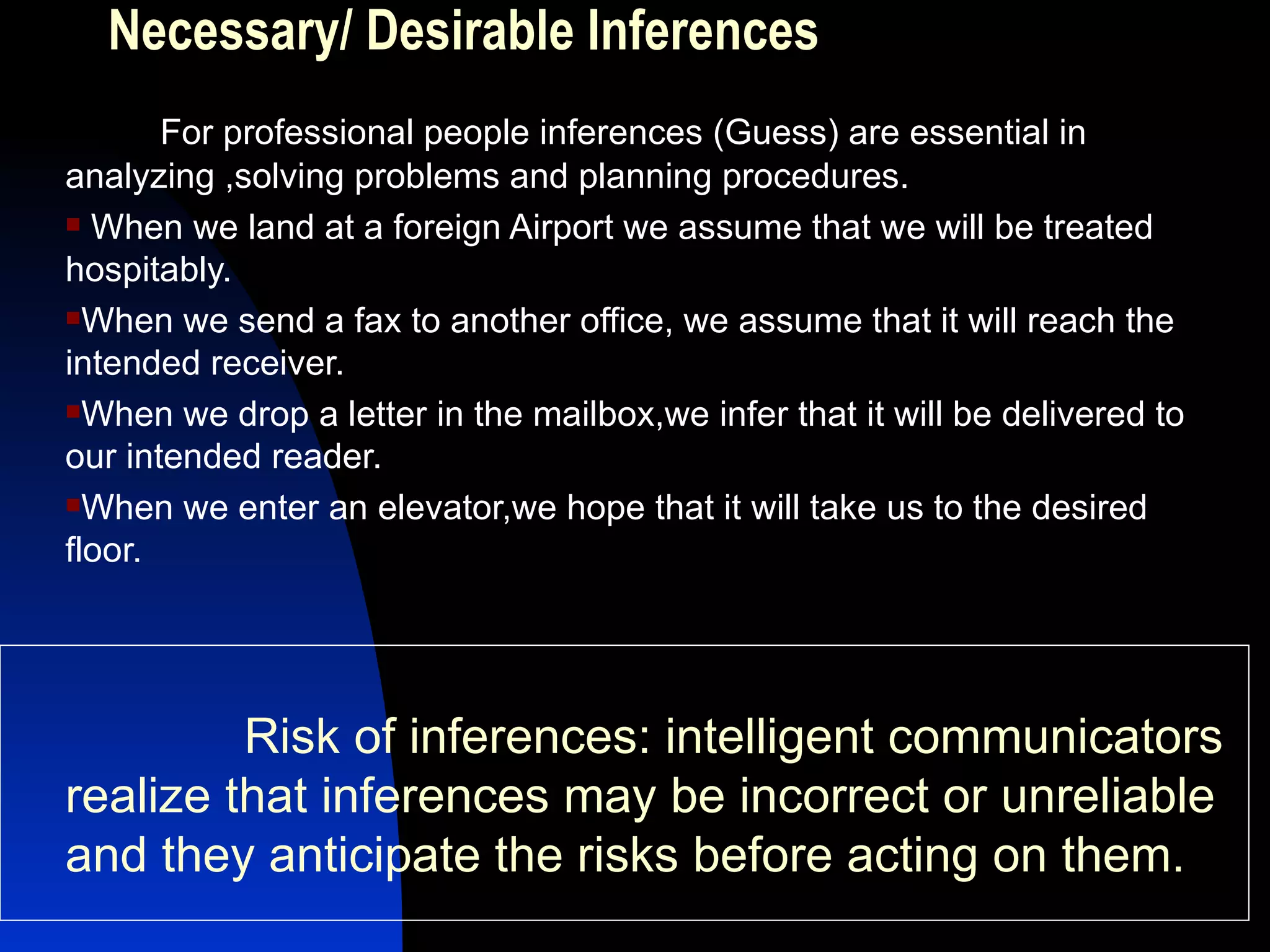
Necessary/ Desirable Inferences For professional people inferences (Guess) are essential in analyzing ,solving problems and planning procedures. When we land at a foreign Airport we assume that we will be treated hospitably. When we send a fax to another office, we assume that it will reach the intended receiver. When we drop a letter in the mailbox,we infer that it will be delivered to our intended reader. When we enter an elevator,we hope that it will take us to the desired floor. Risk of inferences: intelligent communicators realize that inferences may be incorrect or unreliable and they anticipate the risks before acting on them.
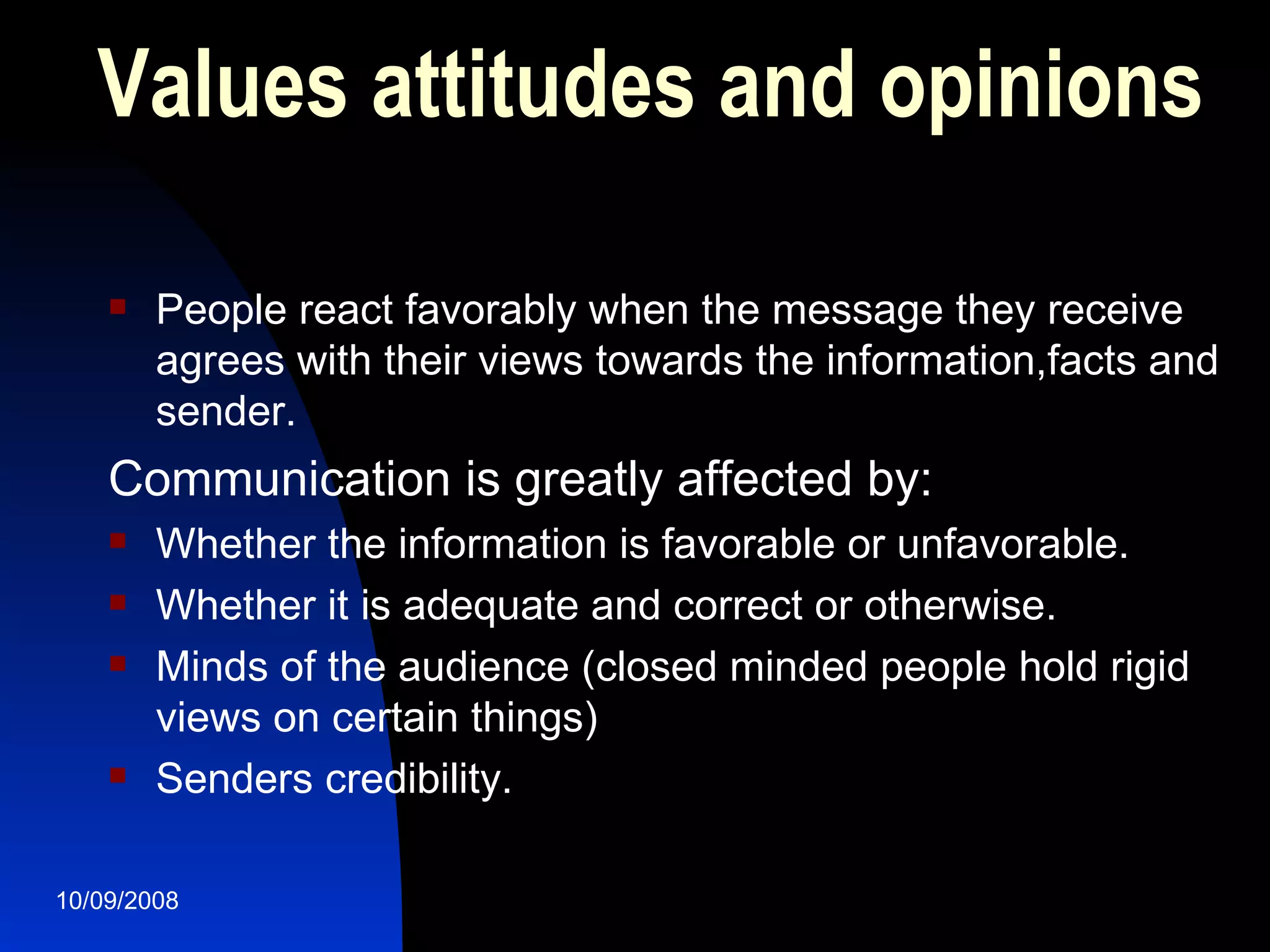
Values attitudes and opinions People react favorably when the message they receive agrees with their views towards the information,facts and sender. Communication is greatly affected by: Whether the information is favorable or unfavorable.  Whether it is adequate and correct or otherwise. Minds of the audience (closed minded people hold rigid views on certain things) Senders credibility.
Nonverbal Communication. There are three components of nonverbal communication. Appearance  (the appearance of the speaker,appearance of the written messages and title page) Body language  (postures ,gestures ,face and eyes) Silence,time and space.
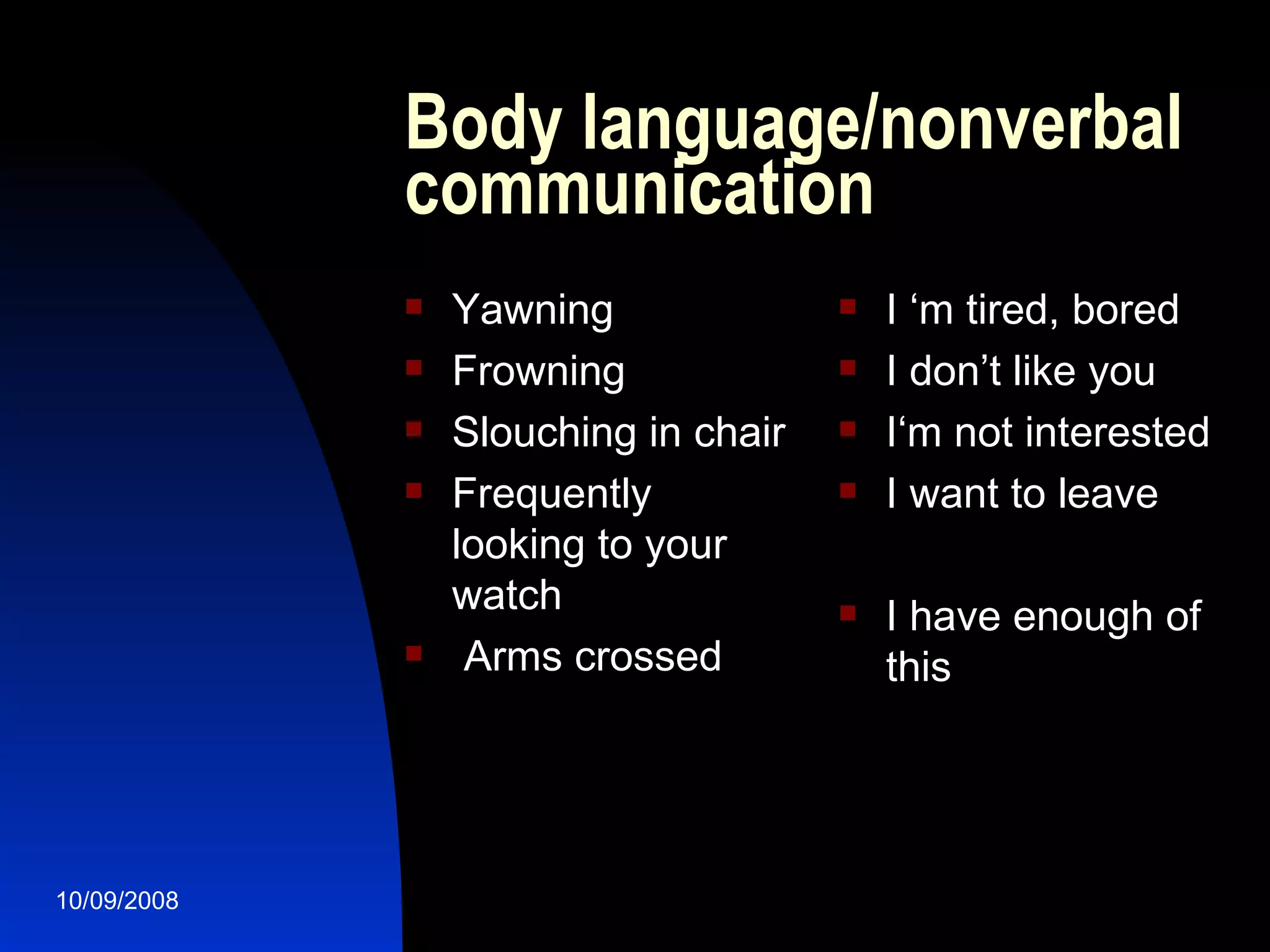
Body language/nonverbal communication Yawning  Frowning Slouching in chair Frequently looking to your watch Arms crossed I ‘m tired, bored I don’t like you I‘m not interested I want to leave I have enough of this
Silence:   The very attempt to remain silent communicates something.At times it may create great confusion. Time: Waiting when an important request is ignored.It creates problems and causes attitude changes. Space: Intimate Zone :  6-18 inches,in this zone the person guards himself as if it were its own property Only those who are emotionally close to that person are permitted to enter it this includes,parents,spouse,children,close friends and relatives. Personal Zone: 18– 48 inches This is the distance that we stand from others at parties,social functions and family gatherings.
Social Zone: 4– 12 feet we stand at this distance from strangers. Public Zone:  Over 12 feet whenever we address a large group of people ,this is the comfortable distance at which we choose to stand If you want people to feel comfortable in your company the  “ Golden Rule is Keep Your Distance”
Organizational Communication Downwards Communication Communication from the Higher level to the lower level. like Staff meetings,procedures,policies,instructions,announcements, Telephones and performance appraisal. Upwards Communication:   the communication flowing from the subordinates to their supervisors  e.g. Reports and Memos Horizontal Communication. Purpose: communication between people at the same hierarchical rank but in different functional level. Lateral communication is much more important than upward or down wards  Communication. To coordinate various functions by encouraging teamwork. Outward Communication.   It includes communicating to different audiences outside the organization.e.g. Dealers,Suppliers,Manufactures,Other Government Agencies/Departments,Communities etc
Channels of Communication Mass Media Small Print Computers Fax Telegraph Telephone Face to Face
Challenges of Communication The challenge of communication really is that the receiver receives the message that the sender intended to send with the same meaning,because the message is received translated and perceived by the receiver before responding and therefore it is important to ensure that the process of interaction is clear and being understood by all involved within the original intended context. It is only then the message that the communication is effective.
The essentials of effective Communication The Message Should be Clear (no ambiguity) Concise (Expressing much in few words) Complete (No gaps to understand) Convincing (to bring to belief) Capable of being carried out The language should be familiar to both sender and receiver and should have value to the audience Media should be appropriate.
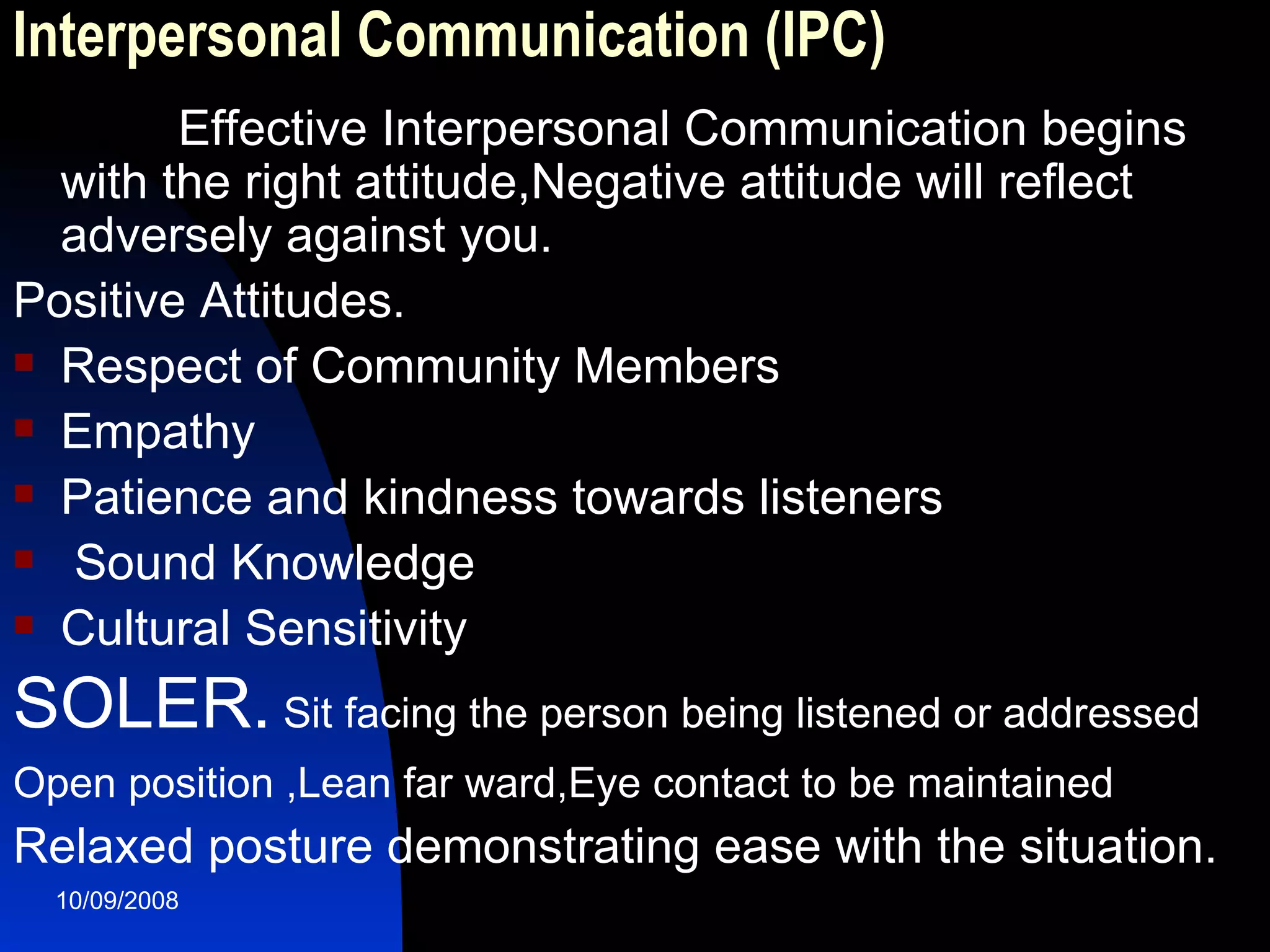
Interpersonal Communication (IPC) Effective Interpersonal Communication begins with the right attitude,Negative attitude will reflect adversely against you. Positive Attitudes. Respect of Community Members Empathy Patience and kindness towards listeners Sound Knowledge Cultural Sensitivity  SOLER.  Sit facing the person being listened or addressed  Open position ,Lean far ward,Eye contact to be maintained   Relaxed posture demonstrating ease with the situation.
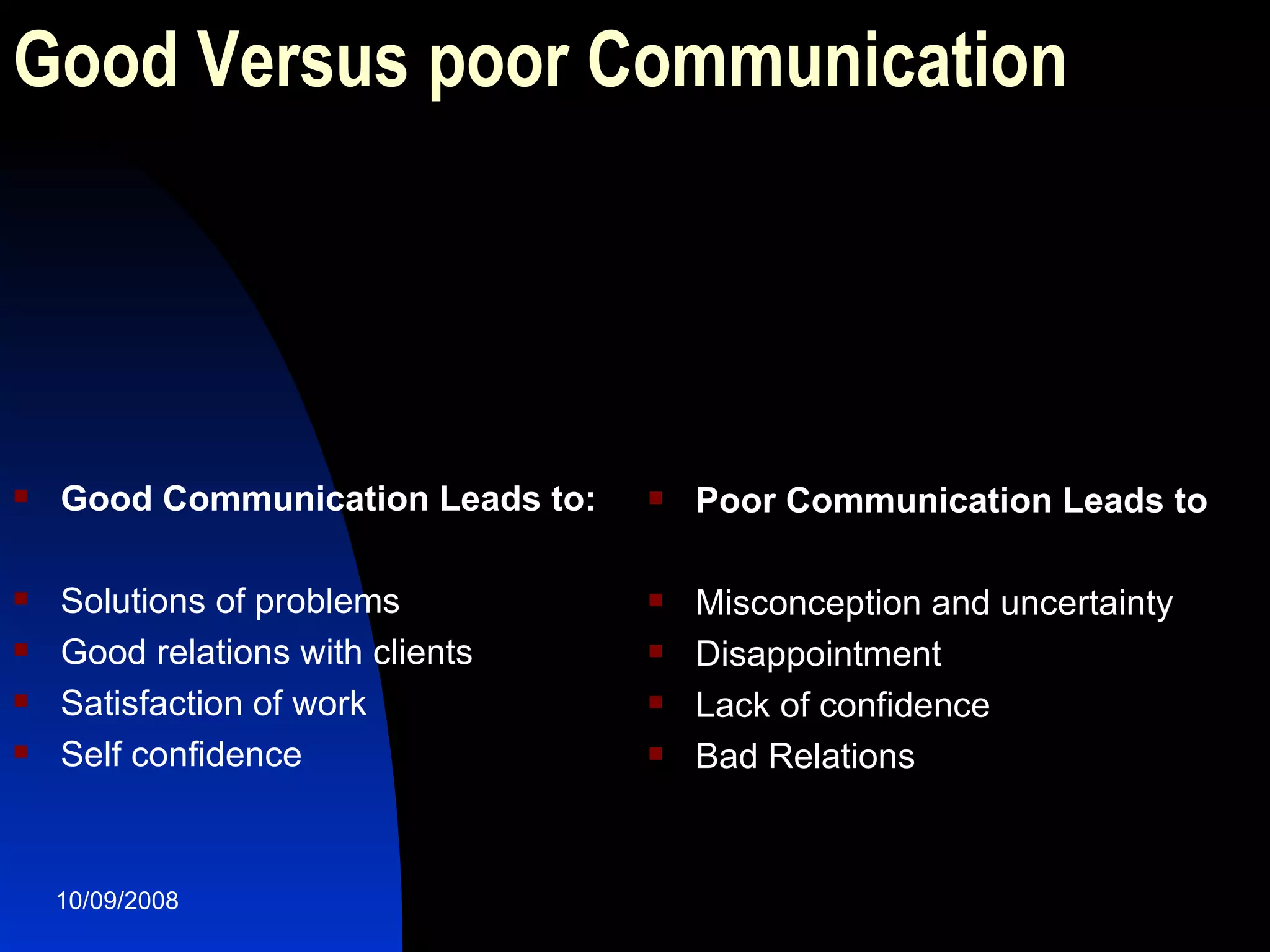
Good Versus poor Communication Good Communication Leads to: Solutions of problems Good relations with clients Satisfaction of work Self confidence Poor Communication Leads to Misconception and uncertainty Disappointment Lack of confidence Bad Relations
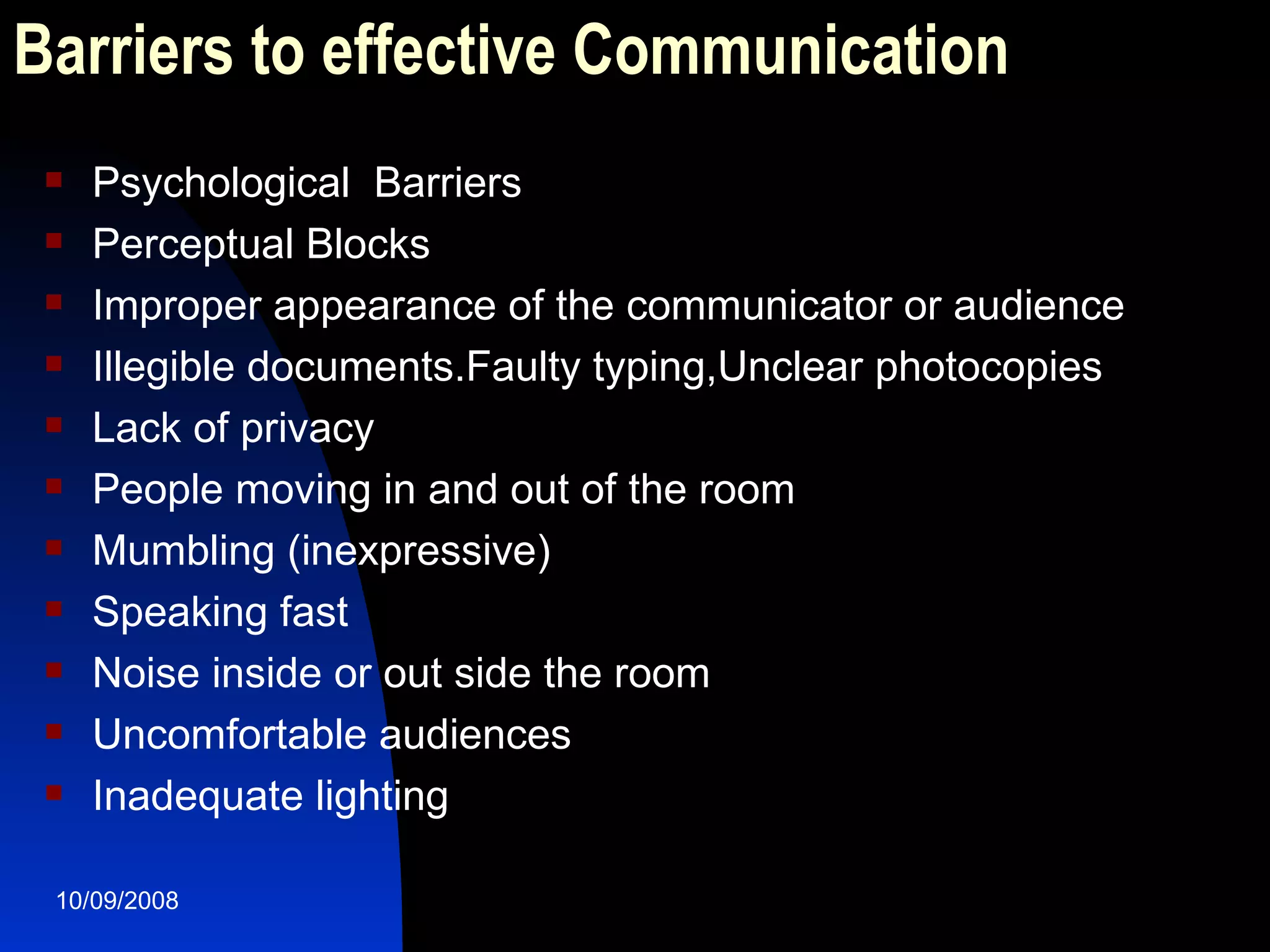
Barriers to effective Communication Psychological  Barriers Perceptual Blocks Improper appearance of the communicator or audience Illegible documents.Faulty typing,Unclear photocopies Lack of privacy People moving in and out of the room Mumbling (inexpressive) Speaking fast Noise inside or out side the room Uncomfortable audiences Inadequate lighting
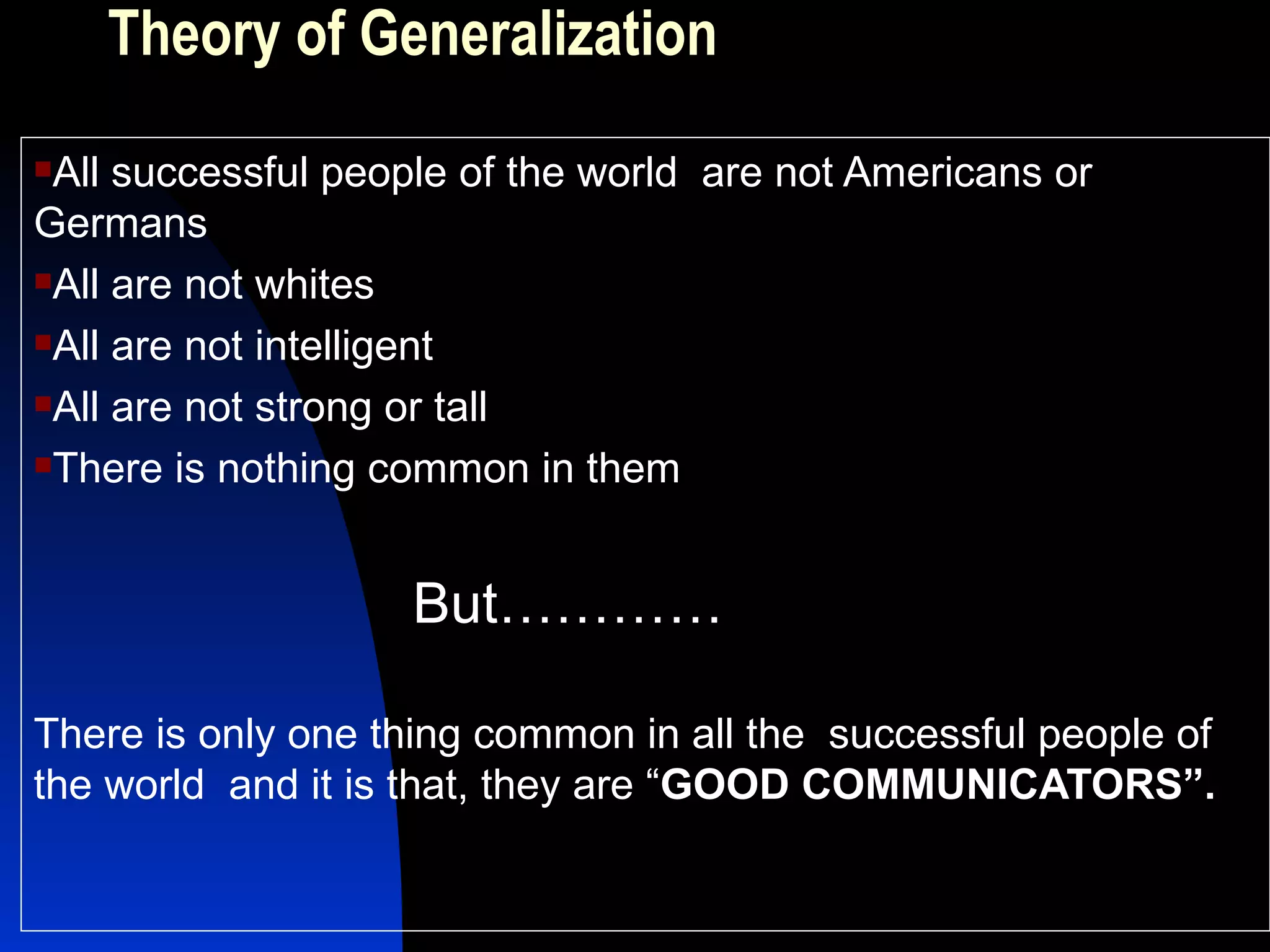
Theory of Generalization  All successful people of the world  are not Americans or Germans All are not whites All are not intelligent  All are not strong or tall  There is nothing common in them  But………… There is only one thing common in all the  successful people of the world  and it is that, they are “ GOOD COMMUNICATORS”.
Thank You

Communication For Presentation

  • 1.
  • 2.
    Definition Communication isa dynamic process to transmit meanings,social values and share experience Communication is a process of exchange of thoughts,feelings,ideas information and knowledge between two or more people.
  • 3.
    SMCR COMMUNICATION modelMessage Channel Feedback Channel Sender Receiver Effect Produced
  • 4.
    Technical Sender-Receiver Model of Communication Horizon of Experience Sender Horizon of Experience Receiver Thoughts Feelings Encoding Decoding Decoding Thoughts,Feelings Encoding Message Transmission Feedback
  • 5.
    Remember Whatyou say also depends on how you say. How it is received depends on a set of events,stimuli,that person is exposed to.
  • 6.
    Why is Communication important Because: We transfer knowledge from one generation to the next through communication. It allows us develop a civilized society. It is the only biggest instinct which distinguishes Human from other creatures Helps us to organize and work together in groups.
  • 7.
    Theories of CommunicationThere are two theories of Communication The Technical and The contextual
  • 8.
    The Technical TheoryThe technical Theory view of communication is associated with information theory and is traced back to Claude E.Shannon and Warren Weaver (1949) According to this theory communication is based on and uses the language of electronics. The message begins with an information source,the mind of the sender(Writer/speaker) Sender encodes the message into words and sentences. This message is transmitted as signal. Receiver decodes the message
  • 9.
    The Mechanistic SystemElectronic theory of communication INFORMATION SOURCE Transmitter ……… ……… Receiver Destination Noise Source Signal Message Receiver Signal Message Draw back of this system Noise may distort the Message
  • 10.
    Contextual /Socialenvironment Theory White and Chapman (1996) introduced into this communication system both human and interpersonal elements. In this regard a range of human filters that are influenced by the person horizon of experience e.g. motive,concern,attention,knowledge,attitudes,values and beliefs have been specified. This theory focuses not only on the content but also focuses on the nonverbal cues as well as verbal content
  • 11.
    Communication in DifferentCultures Decision making in Japan is Extremely slow by western standards. Americans wonder why Germans are so thorough in their reports? Why French are so polite in their writing and why Middle Eastern business people are less concerned with time? The reason is that in those cultures,these different attitudes are acceptable and appropriate. All these differences however can cause problems in conveying intended meanings.
  • 12.
    Each person’s mindis unique filter.Problem with communication are more likely to occur when communicator’s filters are sharply different. Standards of meaning Perceptions of reality Values, attitudes, beliefs and opinions. When the sender say for example . Morality . Honesty . As soon as possible
  • 13.
    Acronyms in communication Many acronyms are understood by the people like Some acronyms are very commonly used and people readily understand: e.g. RADAR: (Radio Angle Detection and Ranging) LASER: (Light Amplification by Stimulated Emission of Radiation) But however there are some acronyms which the people do not understand e.g. FIFO (First In First Out) LIFO (Last in First Out) Such acronyms are not understood by the people who are not accountants
  • 14.
    Conventions of MeaningMany English and foreign words have several meanings e.g. (Run) has 71 meanings as a verb,another 35 as noun and four more as adjective. Twice a month Every Two months Bimonthly
  • 15.
    Necessary/ Desirable InferencesFor professional people inferences (Guess) are essential in analyzing ,solving problems and planning procedures. When we land at a foreign Airport we assume that we will be treated hospitably. When we send a fax to another office, we assume that it will reach the intended receiver. When we drop a letter in the mailbox,we infer that it will be delivered to our intended reader. When we enter an elevator,we hope that it will take us to the desired floor. Risk of inferences: intelligent communicators realize that inferences may be incorrect or unreliable and they anticipate the risks before acting on them.
  • 16.
    Values attitudes andopinions People react favorably when the message they receive agrees with their views towards the information,facts and sender. Communication is greatly affected by: Whether the information is favorable or unfavorable. Whether it is adequate and correct or otherwise. Minds of the audience (closed minded people hold rigid views on certain things) Senders credibility.
  • 17.
    Nonverbal Communication. Thereare three components of nonverbal communication. Appearance (the appearance of the speaker,appearance of the written messages and title page) Body language (postures ,gestures ,face and eyes) Silence,time and space.
  • 18.
    Body language/nonverbal communicationYawning Frowning Slouching in chair Frequently looking to your watch Arms crossed I ‘m tired, bored I don’t like you I‘m not interested I want to leave I have enough of this
  • 19.
    Silence: The very attempt to remain silent communicates something.At times it may create great confusion. Time: Waiting when an important request is ignored.It creates problems and causes attitude changes. Space: Intimate Zone : 6-18 inches,in this zone the person guards himself as if it were its own property Only those who are emotionally close to that person are permitted to enter it this includes,parents,spouse,children,close friends and relatives. Personal Zone: 18– 48 inches This is the distance that we stand from others at parties,social functions and family gatherings.
  • 20.
    Social Zone: 4–12 feet we stand at this distance from strangers. Public Zone: Over 12 feet whenever we address a large group of people ,this is the comfortable distance at which we choose to stand If you want people to feel comfortable in your company the “ Golden Rule is Keep Your Distance”
  • 21.
    Organizational Communication DownwardsCommunication Communication from the Higher level to the lower level. like Staff meetings,procedures,policies,instructions,announcements, Telephones and performance appraisal. Upwards Communication: the communication flowing from the subordinates to their supervisors e.g. Reports and Memos Horizontal Communication. Purpose: communication between people at the same hierarchical rank but in different functional level. Lateral communication is much more important than upward or down wards Communication. To coordinate various functions by encouraging teamwork. Outward Communication. It includes communicating to different audiences outside the organization.e.g. Dealers,Suppliers,Manufactures,Other Government Agencies/Departments,Communities etc
  • 22.
    Channels of CommunicationMass Media Small Print Computers Fax Telegraph Telephone Face to Face
  • 23.
    Challenges of CommunicationThe challenge of communication really is that the receiver receives the message that the sender intended to send with the same meaning,because the message is received translated and perceived by the receiver before responding and therefore it is important to ensure that the process of interaction is clear and being understood by all involved within the original intended context. It is only then the message that the communication is effective.
  • 24.
    The essentials ofeffective Communication The Message Should be Clear (no ambiguity) Concise (Expressing much in few words) Complete (No gaps to understand) Convincing (to bring to belief) Capable of being carried out The language should be familiar to both sender and receiver and should have value to the audience Media should be appropriate.
  • 25.
    Interpersonal Communication (IPC)Effective Interpersonal Communication begins with the right attitude,Negative attitude will reflect adversely against you. Positive Attitudes. Respect of Community Members Empathy Patience and kindness towards listeners Sound Knowledge Cultural Sensitivity SOLER. Sit facing the person being listened or addressed Open position ,Lean far ward,Eye contact to be maintained Relaxed posture demonstrating ease with the situation.
  • 26.
    Good Versus poorCommunication Good Communication Leads to: Solutions of problems Good relations with clients Satisfaction of work Self confidence Poor Communication Leads to Misconception and uncertainty Disappointment Lack of confidence Bad Relations
  • 27.
    Barriers to effectiveCommunication Psychological Barriers Perceptual Blocks Improper appearance of the communicator or audience Illegible documents.Faulty typing,Unclear photocopies Lack of privacy People moving in and out of the room Mumbling (inexpressive) Speaking fast Noise inside or out side the room Uncomfortable audiences Inadequate lighting
  • 28.
    Theory of Generalization All successful people of the world are not Americans or Germans All are not whites All are not intelligent All are not strong or tall There is nothing common in them But………… There is only one thing common in all the successful people of the world and it is that, they are “ GOOD COMMUNICATORS”.
  • 29.