


Insuring Social
Justice through Food
Security
Hunter Hartley - Presenter
Introduction
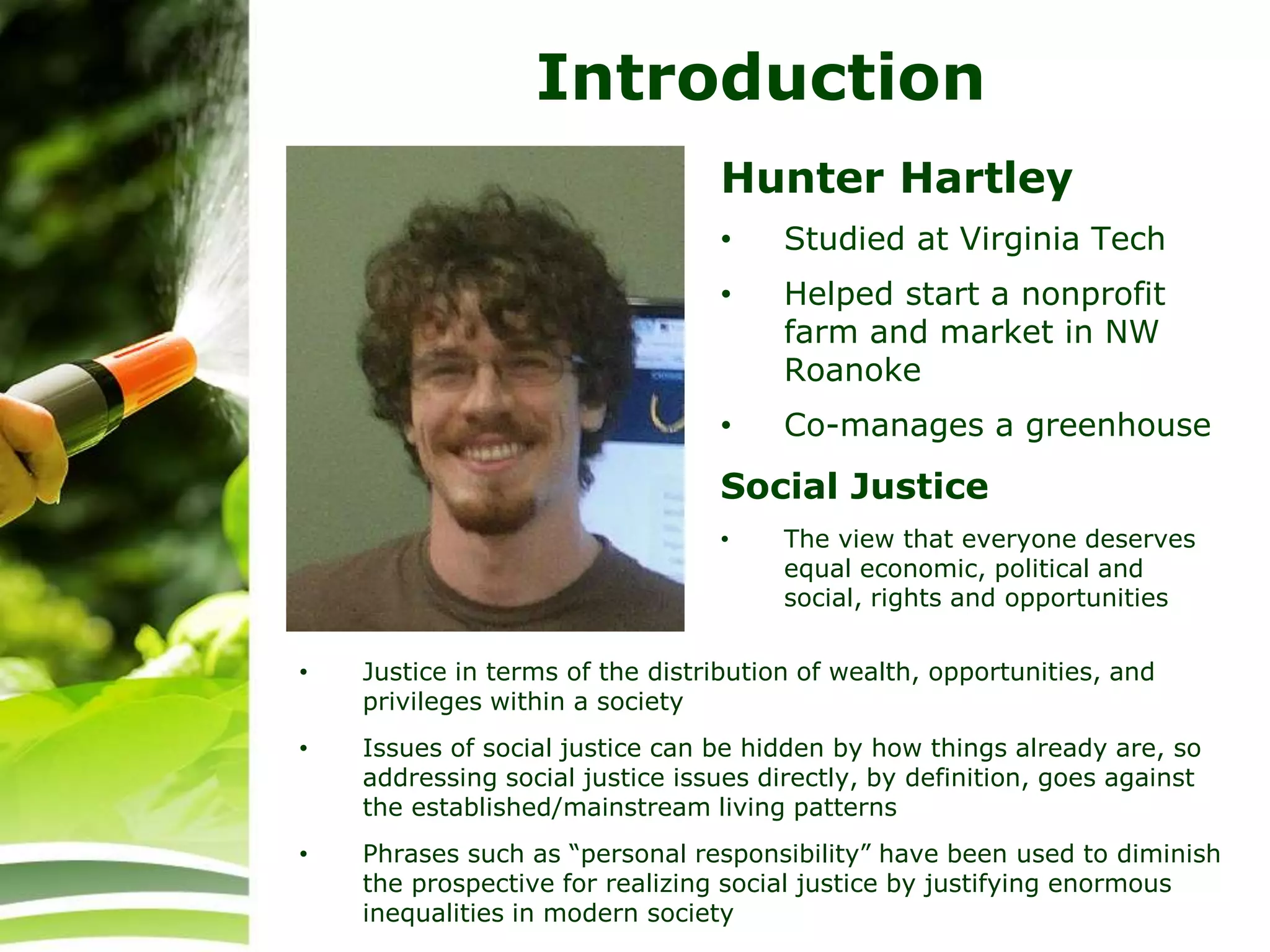
Hunter Hartley
• Studied at Virginia Tech
• Helped start a nonprofit
farm and market in NW
Roanoke
• Co-manages a greenhouse
Social Justice
• The view that everyone deserves
equal economic, political and
social, rights and opportunities
• Justice in terms of the distribution of wealth, opportunities, and
privileges within a society
• Issues of social justice can be hidden by how things already are, so
addressing social justice issues directly, by definition, goes against
the established/mainstream living patterns
• Phrases such as “personal responsibility” have been used to diminish
the prospective for realizing social justice by justifying enormous
inequalities in modern society
Introduction
Food Security
• Consistent and dependable
access to adequate, safe and
nutritious food for an active
and healthy life. For a region
to be food secure, it must
have an adequate, stable
supply of food even during
drought and other difficult
conditions; and its people
must be able to locate and
afford food, even in the
presence of an abundant
supply.
• The people, activities and resources involved in getting food
from farms, ranches, rivers, oceans and other sources to
consumers’ plates. Major stages along the supply chain
include production, processing, distribution, retail and
consumption.
Food System/Supply Chain
Introduction
• Economic Sectors
– Primary – 1.0 operating system(s)
• Extraction or harvesting of product from the earth.
– Secondary - 2.0 operating system(s)
• Production of finished goods, manufacturing, processing and
construction
– Tertiary - 3.0 operating system(s)
• Service industry, sales, transportation/
distribution, insurance, banking, law
– Quaternary – 4.0 operating system(s)
• Intellectual pursuits, education, IT, scientific research, etc.
Introduction
• The relational activity between these
sectors may be either sustainable or
unsustainable.
– A region that consumes what it produces will
generally have larger “primary” and
“secondary” sectors.
– Today, many “tertiary” and “quaternary”
economic activities are unsustainable.
– “Primary” and “secondary” economic
activities however, can also be
unsustainable.
Community
Wealth Building
• Some of Roanoke’s most concerted efforts in local
agriculture are conducted through nonprofits.
• The conventional working of a 501(c)(3)’s structure may
actually constrict that organization’s capacity to contribute
wealth to the community.
• Consequently, it may also become reliant on donor
contributions to meet operating expenses.
• This reliance on external funds can result in misdirecting the
organization’s efforts and compromising its overall
effectiveness.
Micro/Urban Farms
• Pose a viable solution to food deserts
• Are capable of producing large quantities of nutrient
dense vegetables
• Offer the potential of gainful employment
• Higher capital investment can generate year-round
production
• Appropriate technology vs conventional
farming
• Grow more per square foot
• Use 1/10th the water
• Utilize brownfields
• Coordination Deficit
• There aren’t adequate programs in place to cultivate
the required skill sets to sustain local agriculture.
Productivity
and Consumption
• Reshape Roanoke to become a net food exporter
• Create greater resilience in our primary and secondary economic
sectors
• Existing revenue streams
- Federal funds help feed a large portion (68.63%) of
Roanoke City Public School students
- $3/lunch** x 9,299 students* = $27,897 each day
 Provide “appealing and nutritionally sound school meals as
economically as possible” – from “Roanoke School Board eyes
outsourcing of food services”
* NSLP Free and Reduced Price Eligibility Report
** Federal Register/Vol.79, No. 136 - Notices
Future Trends
• Resettlement
– War and geopolitical instability, ecological change and instability
– Displaced groups already relocating to Roanoke with their Agri-Cultura
• Increase in food prices especially for food that travels
a distance
• Conventional land management techniques
– Loss of pasture to desertification
– Soil depletion and pollution from reliance on inorganic fertilizers
– Water scarcity (California Central Valley drought)
• Global resource depletion necessitates regional self-
reliance
Complex Problems
Complex Solutions
• We know schools strive to educate, but informally,
they also strive to keep students fed
• Because it is informal, schools aren’t capable of
meaningfully addressing the issue
• If we want students effectively engaging the world
around them, it involves learning the scope of the
problems they face and the skills relevant to
resolving those issues.
• In addressing complex social issues there are two
essentials:
- Convening the right players, frontline people connected
with one another through the same value chain
- The social technology to shift multi-stakeholder gatherings
from debate to co-creation
Ego to Eco
Our Coordination Deficit
1. In the face of disruption, what emerging
future is already possible to discern?
2. How do we lead from the emerging future?
3. What evolutionary economic framework can
guide us forward?
4. How can we create practical strategies that
help us to operate from the future that we
want to create?
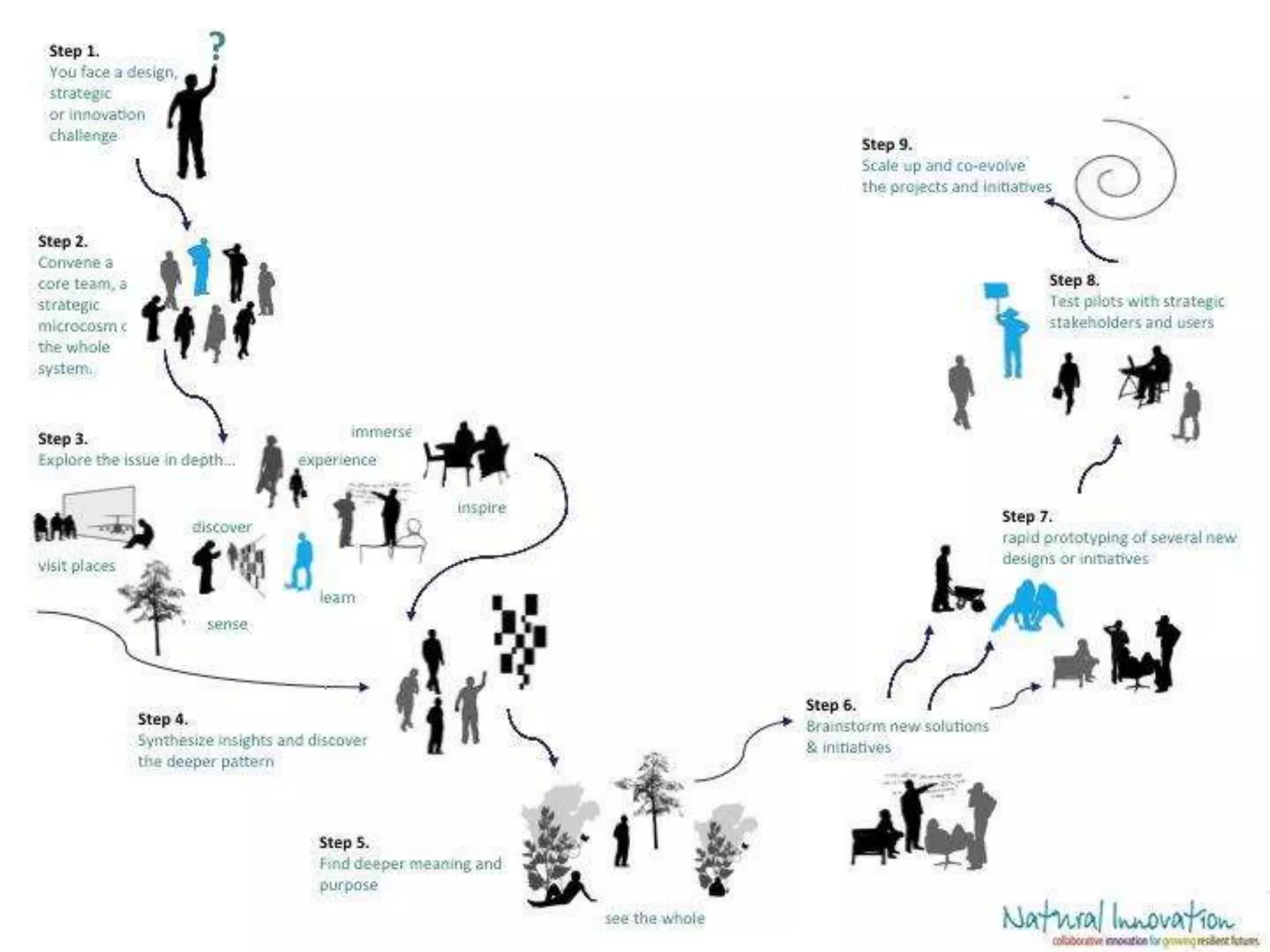
“U”
Methodology
1.0 – Downloading: our habits of
judgment
2.0 - Precise Listening: noticing
differences
3.0 – Empathic: open heart
4.0 - Generative Listening: reflecting
our emerging future
Listening
Insuring Social Justice through Food Security

Insuring Social Justice through Food Security

  • 1.
    Insuring Social Justice throughFood Security Hunter Hartley - Presenter
  • 2.
    Introduction Hunter Hartley • Studiedat Virginia Tech • Helped start a nonprofit farm and market in NW Roanoke • Co-manages a greenhouse Social Justice • The view that everyone deserves equal economic, political and social, rights and opportunities • Justice in terms of the distribution of wealth, opportunities, and privileges within a society • Issues of social justice can be hidden by how things already are, so addressing social justice issues directly, by definition, goes against the established/mainstream living patterns • Phrases such as “personal responsibility” have been used to diminish the prospective for realizing social justice by justifying enormous inequalities in modern society
  • 3.
    Introduction Food Security • Consistentand dependable access to adequate, safe and nutritious food for an active and healthy life. For a region to be food secure, it must have an adequate, stable supply of food even during drought and other difficult conditions; and its people must be able to locate and afford food, even in the presence of an abundant supply. • The people, activities and resources involved in getting food from farms, ranches, rivers, oceans and other sources to consumers’ plates. Major stages along the supply chain include production, processing, distribution, retail and consumption. Food System/Supply Chain
  • 4.
    Introduction • Economic Sectors –Primary – 1.0 operating system(s) • Extraction or harvesting of product from the earth. – Secondary - 2.0 operating system(s) • Production of finished goods, manufacturing, processing and construction – Tertiary - 3.0 operating system(s) • Service industry, sales, transportation/ distribution, insurance, banking, law – Quaternary – 4.0 operating system(s) • Intellectual pursuits, education, IT, scientific research, etc.
  • 5.
    Introduction • The relationalactivity between these sectors may be either sustainable or unsustainable. – A region that consumes what it produces will generally have larger “primary” and “secondary” sectors. – Today, many “tertiary” and “quaternary” economic activities are unsustainable. – “Primary” and “secondary” economic activities however, can also be unsustainable.
  • 6.
    Community Wealth Building • Someof Roanoke’s most concerted efforts in local agriculture are conducted through nonprofits. • The conventional working of a 501(c)(3)’s structure may actually constrict that organization’s capacity to contribute wealth to the community. • Consequently, it may also become reliant on donor contributions to meet operating expenses. • This reliance on external funds can result in misdirecting the organization’s efforts and compromising its overall effectiveness.
  • 7.
    Micro/Urban Farms • Posea viable solution to food deserts • Are capable of producing large quantities of nutrient dense vegetables • Offer the potential of gainful employment • Higher capital investment can generate year-round production • Appropriate technology vs conventional farming • Grow more per square foot • Use 1/10th the water • Utilize brownfields • Coordination Deficit • There aren’t adequate programs in place to cultivate the required skill sets to sustain local agriculture.
  • 8.
    Productivity and Consumption • ReshapeRoanoke to become a net food exporter • Create greater resilience in our primary and secondary economic sectors • Existing revenue streams - Federal funds help feed a large portion (68.63%) of Roanoke City Public School students - $3/lunch** x 9,299 students* = $27,897 each day  Provide “appealing and nutritionally sound school meals as economically as possible” – from “Roanoke School Board eyes outsourcing of food services” * NSLP Free and Reduced Price Eligibility Report ** Federal Register/Vol.79, No. 136 - Notices
  • 9.
    Future Trends • Resettlement –War and geopolitical instability, ecological change and instability – Displaced groups already relocating to Roanoke with their Agri-Cultura • Increase in food prices especially for food that travels a distance • Conventional land management techniques – Loss of pasture to desertification – Soil depletion and pollution from reliance on inorganic fertilizers – Water scarcity (California Central Valley drought) • Global resource depletion necessitates regional self- reliance
  • 10.
    Complex Problems Complex Solutions •We know schools strive to educate, but informally, they also strive to keep students fed • Because it is informal, schools aren’t capable of meaningfully addressing the issue • If we want students effectively engaging the world around them, it involves learning the scope of the problems they face and the skills relevant to resolving those issues. • In addressing complex social issues there are two essentials: - Convening the right players, frontline people connected with one another through the same value chain - The social technology to shift multi-stakeholder gatherings from debate to co-creation
  • 11.
    Ego to Eco OurCoordination Deficit 1. In the face of disruption, what emerging future is already possible to discern? 2. How do we lead from the emerging future? 3. What evolutionary economic framework can guide us forward? 4. How can we create practical strategies that help us to operate from the future that we want to create?
  • 12.
  • 14.
    1.0 – Downloading:our habits of judgment 2.0 - Precise Listening: noticing differences 3.0 – Empathic: open heart 4.0 - Generative Listening: reflecting our emerging future Listening