ganeti

Comparing IaaS
VMware vs OpenStack vs Google’s Ganeti
November 2013

Giuseppe “Gippa” Paternò
Knowing “Gippa” ....
• EMEA Cloud Solution Architect for Canonical (the company
behind Ubuntu). In this role I work closely with the OpenStack
community to deploy clouds mostly for big telcos in Europe and
Middle-East. (www.canonical.com and www.ubuntu.com)
• CTO of GARL, the Swiss company behind the SecurePass
cloud identity management service. While mostly focused on
identity and security, I cooperate with the Google’s Ganeti
project and team. (www.garl.ch and www.secure-pass.net)
• Previously Senior Solution Architect in Red Hat, Sun
Microsystems and also in IBM.
• Works with Linux since 1996, I know most of the Open Source
community. Within my (little) spare time, I publish books and
whitepapers
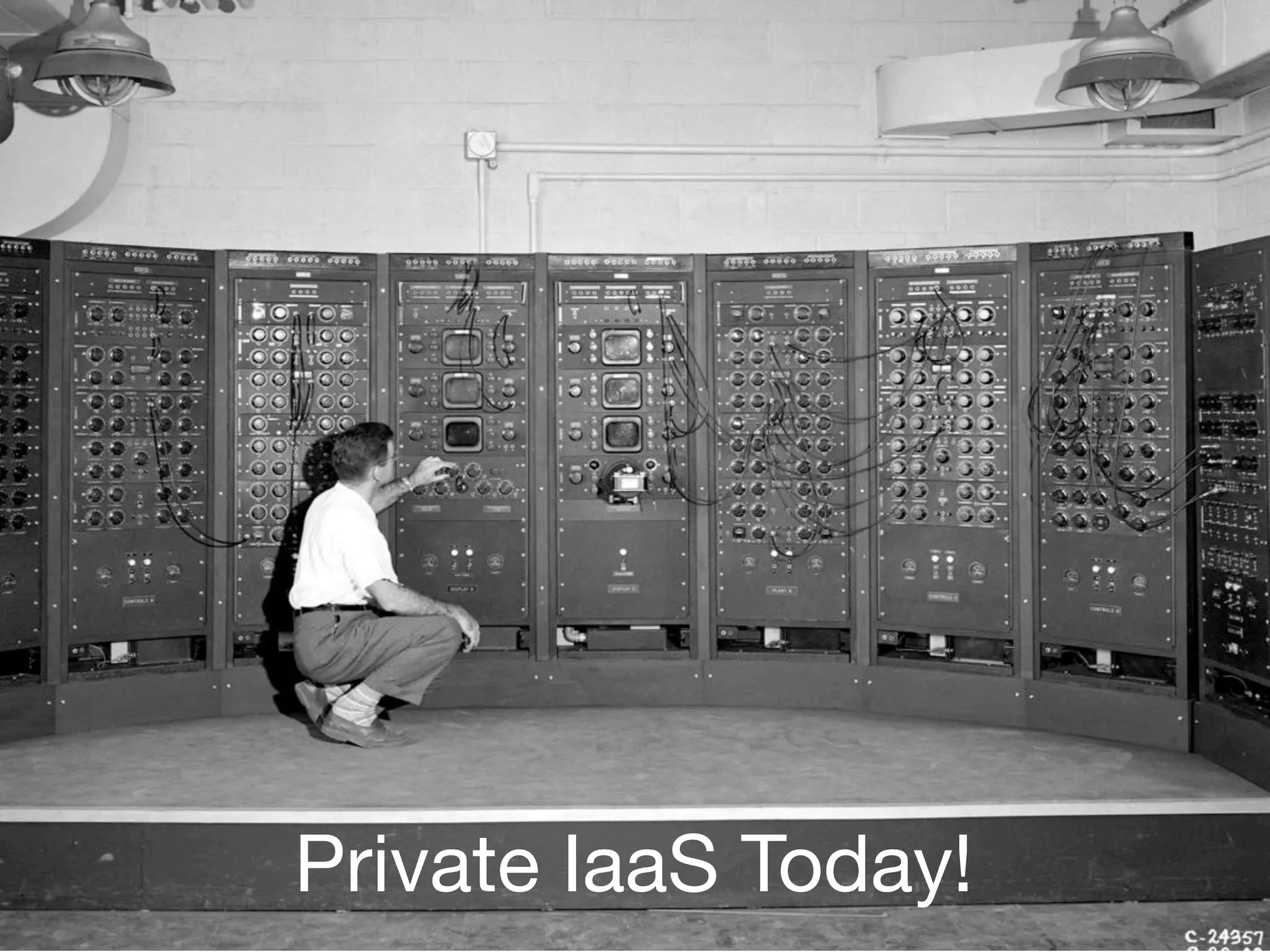
Private IaaS Today!
You don’t know VMware?
Seriously?
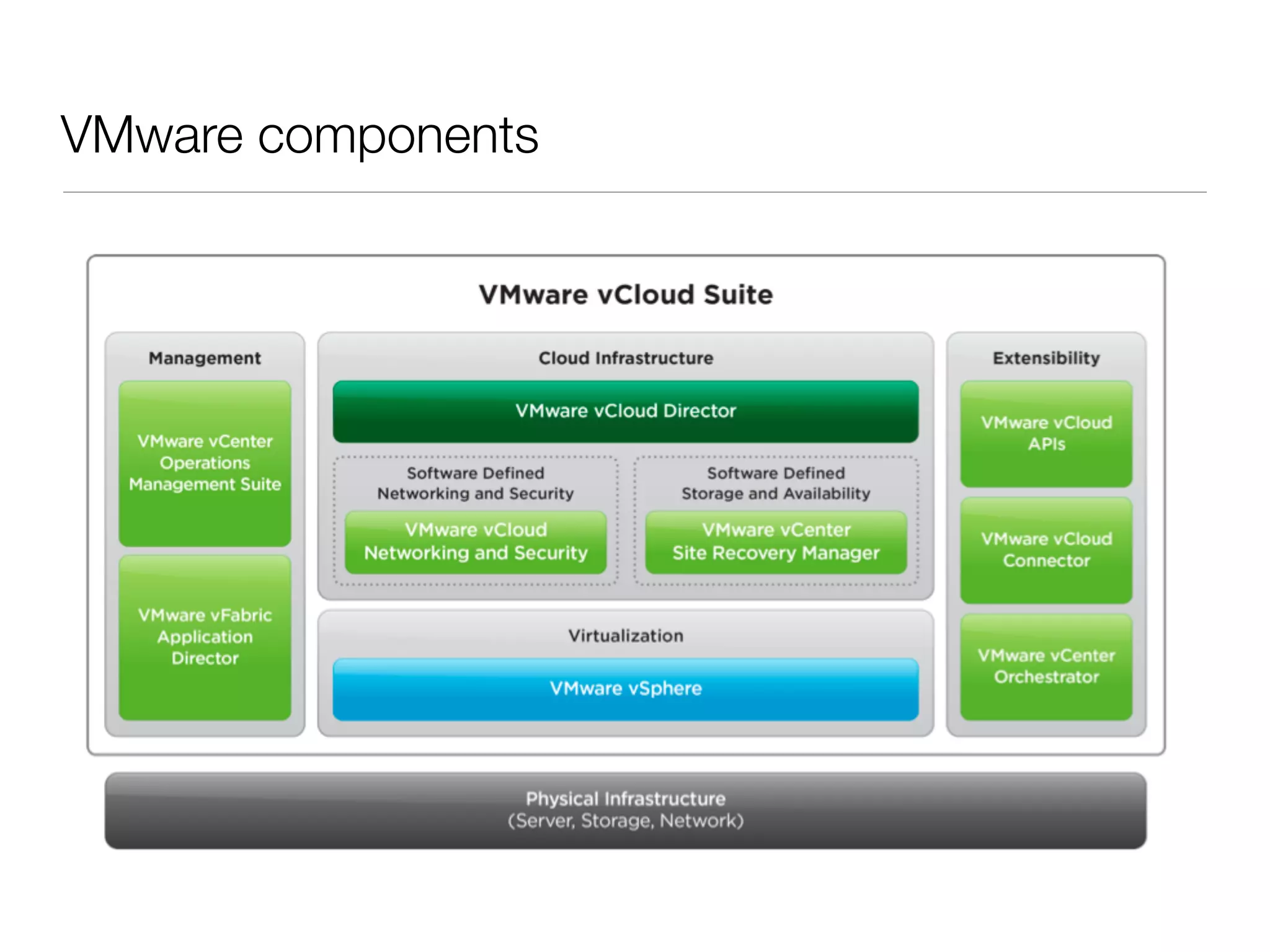
VMware components
About OpenStack
• OpenSource under Apache license
• Born in 2010 from an idea of NASA and RackSpace
• Managed by the OpenStack Foundation, a non-profit corporate entity
established in September 2012
• Aim to create Amazon-like services, with EC2 and S3 compatibility
• More than 200 members, among those: Canonical/Ubuntu, VMware, HP, IBM,
RackSpace, Microsoft, AT&T, SuSE, RedHat
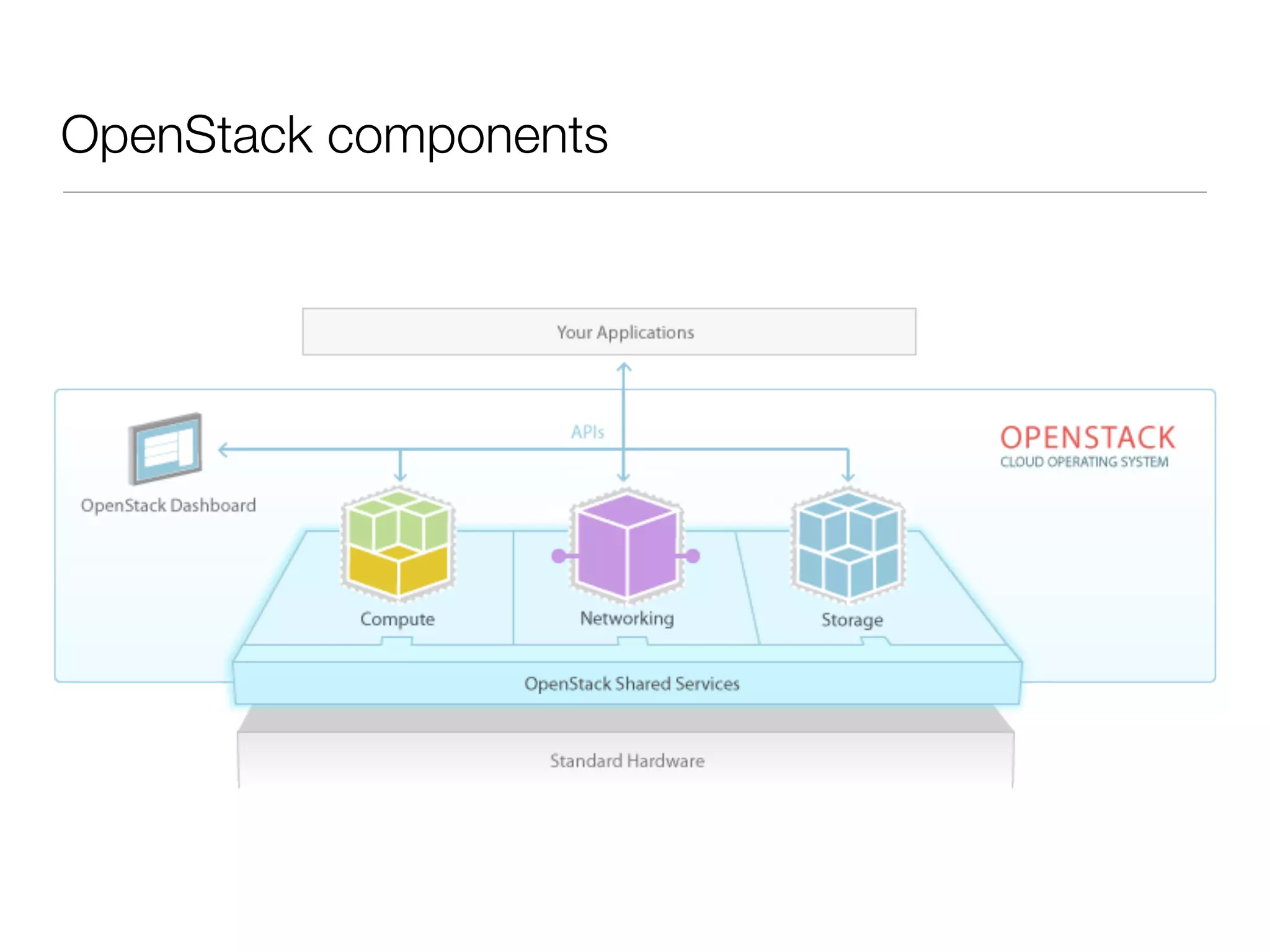
OpenStack components
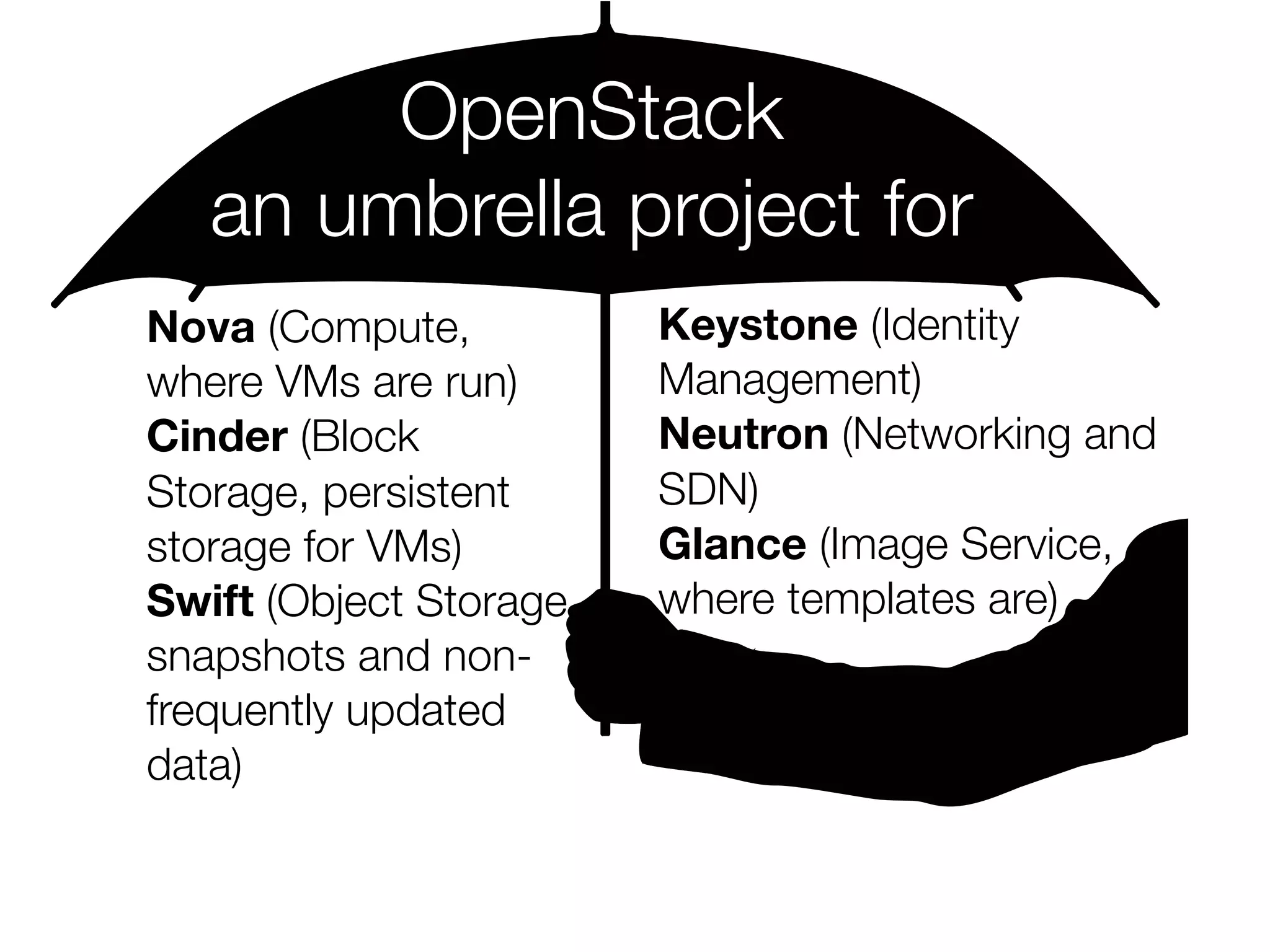
OpenStack
an umbrella project for
Nova (Compute,
where VMs are run)
Cinder (Block
Storage, persistent
storage for VMs)
Swift (Object Storage,
snapshots and nonfrequently updated
data)

Keystone (Identity
Management)
Neutron (Networking and
SDN)
Glance (Image Service,
where templates are)
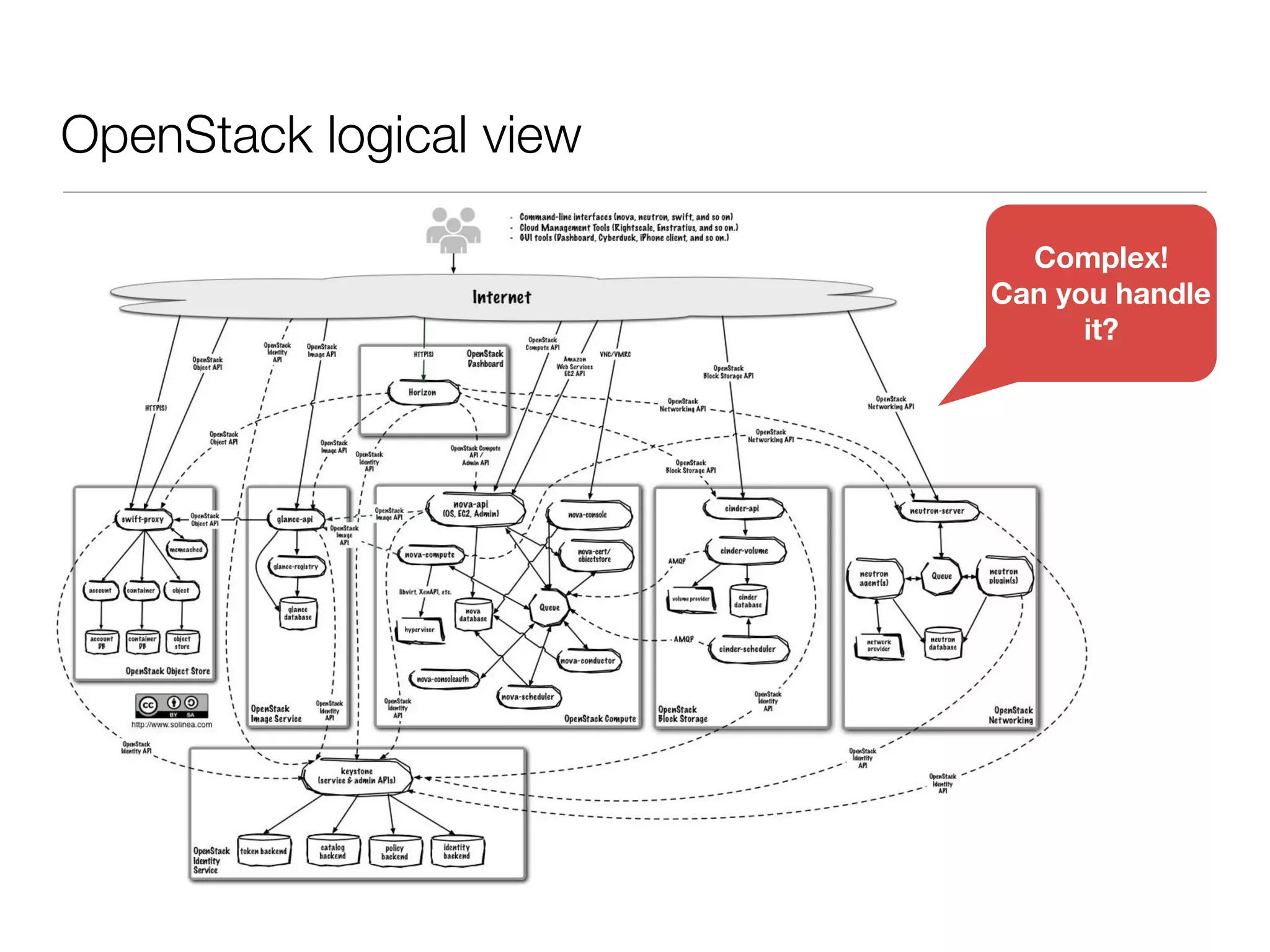
OpenStack logical view
Complex!
Can you handle
it?
About Google’s Ganeti
• Ganeti is a virtual machine cluster
management tool
• Created by Google for Google
(don’t forget!)
• Used internally in Google to serve
the whole of Google's corporate
infrastructure globally
• Open Source since 2007

• Essentially a wrapper for existing
well-proven rock-solid Linux
technologies
• In-line with Google’s philosophy of
using commodity hardware
• Conceived to use cheap local
storage
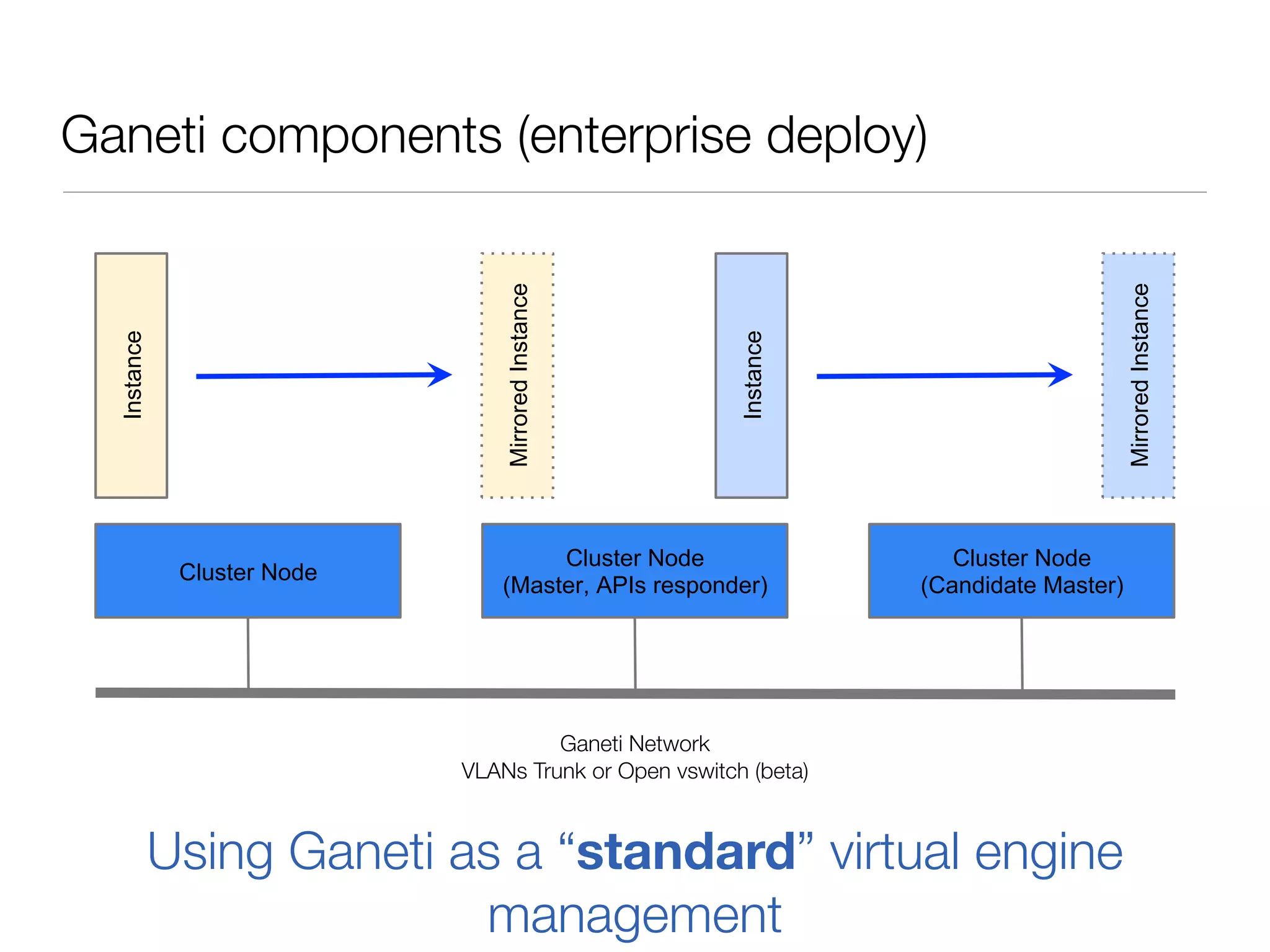
Cluster Node

Mirrored Instance

Instance

Instance

Mirrored Instance

Ganeti components (enterprise deploy)

Cluster Node
(Master, APIs responder)

Cluster Node
(Candidate Master)

Ganeti Network
VLANs Trunk or Open vswitch (beta)

Using Ganeti as a “standard” virtual engine
management
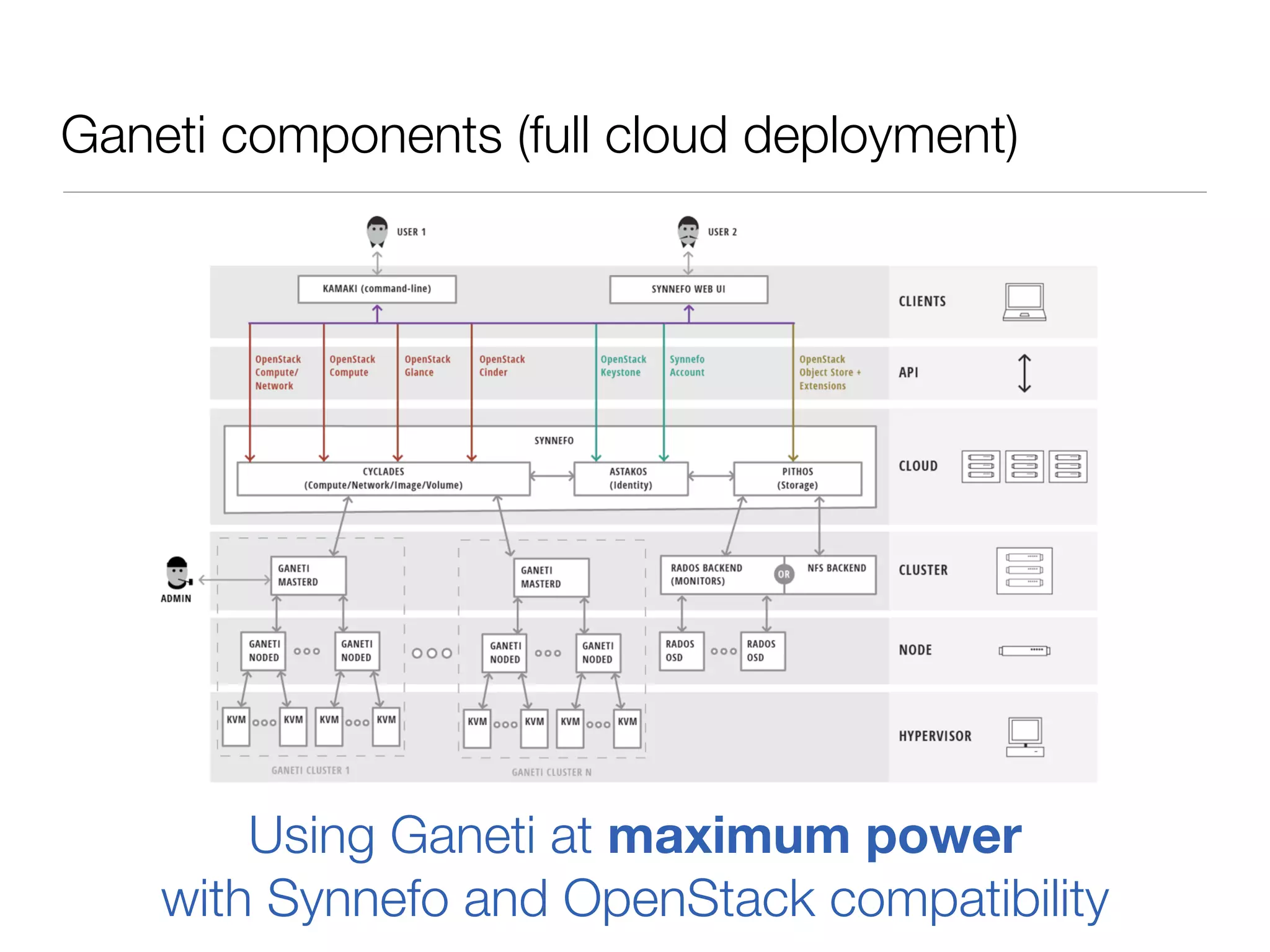
Ganeti components (full cloud deployment)

Using Ganeti at maximum power
with Synnefo and OpenStack compatibility
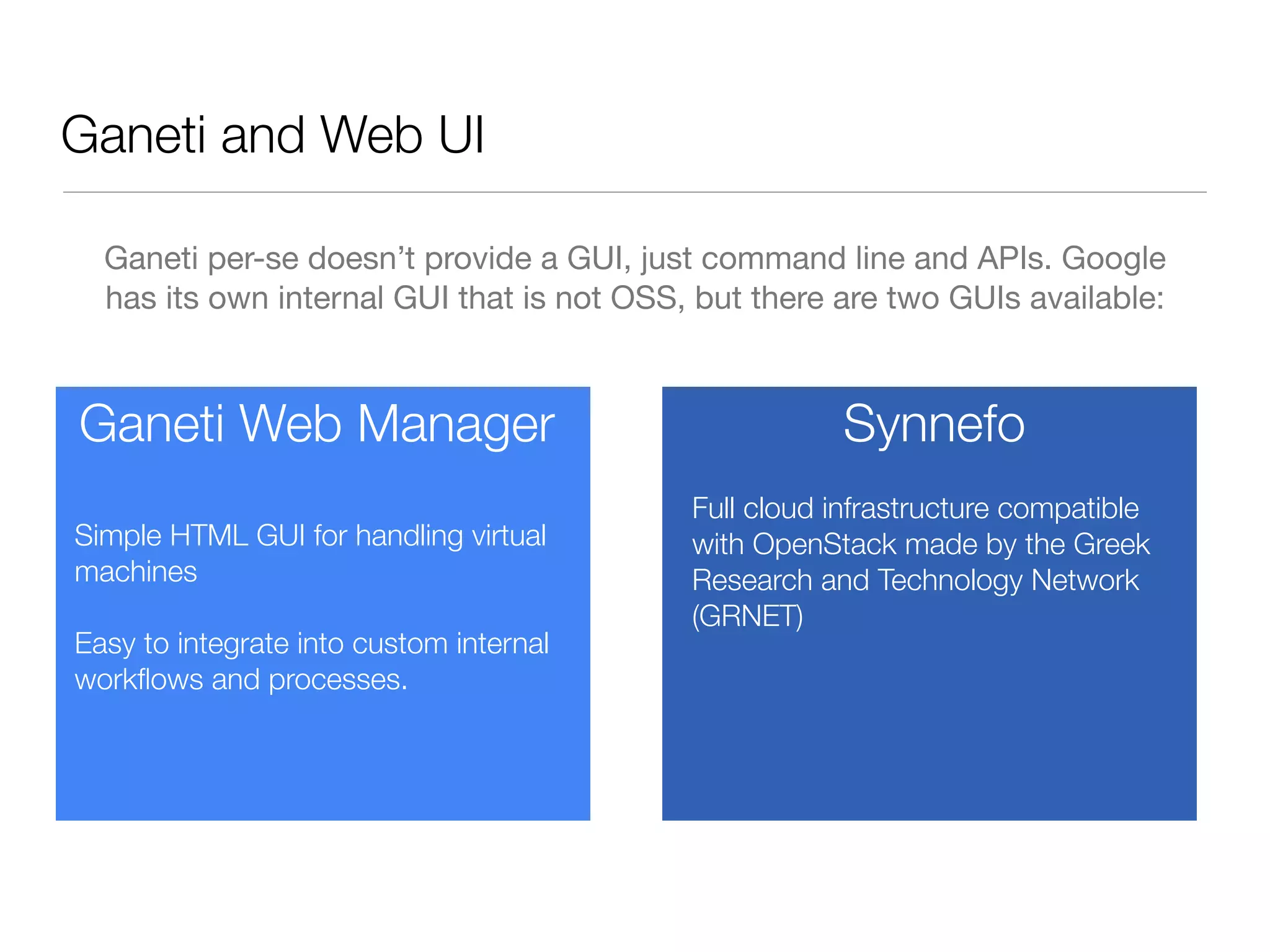
Ganeti and Web UI
Ganeti per-se doesn’t provide a GUI, just command line and APIs. Google
has its own internal GUI that is not OSS, but there are two GUIs available:

Ganeti Web Manager
Simple HTML GUI for handling virtual
machines
Easy to integrate into custom internal
workflows and processes.

Synnefo
Full cloud infrastructure compatible
with OpenStack made by the Greek
Research and Technology Network
(GRNET)
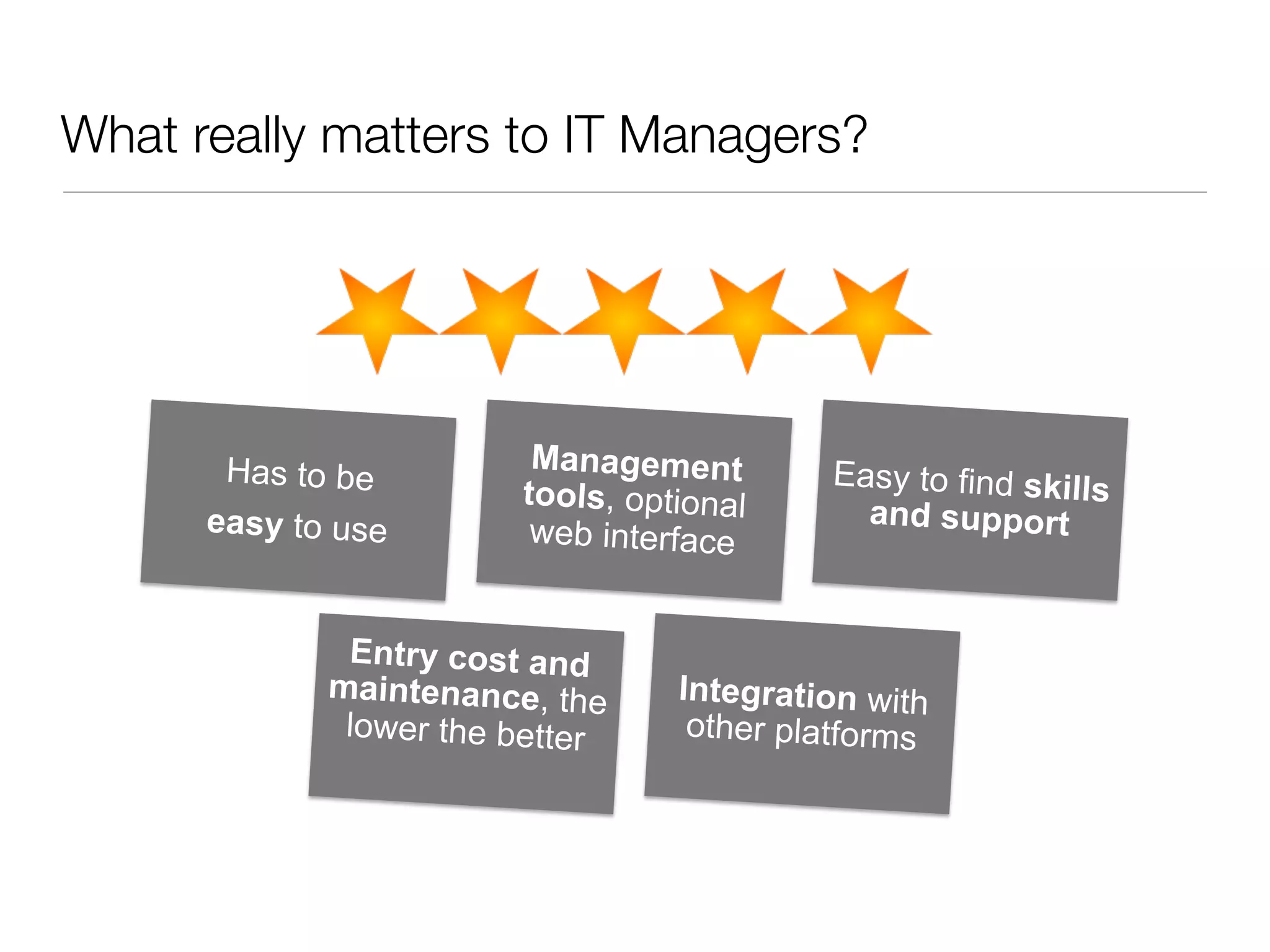
What really matters to IT Managers?

Has to be
easy to use

Management
tools, optional
web interface

Entry cost and
maintenance, the
lower the better

Easy to find skills
and support

Integration with
other platforms
VMware Pro/Cons
• Feature rich (vSphere HA, vMotion,
DRS, I/O control)

• Per core license - expensive
• Proprietary platform

• Very large ecosystems
• All os vendors make it supported
and certified under ESXi
• ESXi can be downloaded and used
freely

• ESXi can not be APIs accessed need to buy licenses
OpenStack Pro/Cons
• Probably the most successful
example of Open Source project
after Linux
• Support from many OEMs and OS
vendors
• Interoperability with many
components, just pick your favorite
one and plug it in
• Standard and well accepted APIs

• Very complex to setup and
troubleshoot
• Although common codebase, might
differ from implementations
• Need high numbers of management
nodes
• High skills required to run the
cluster
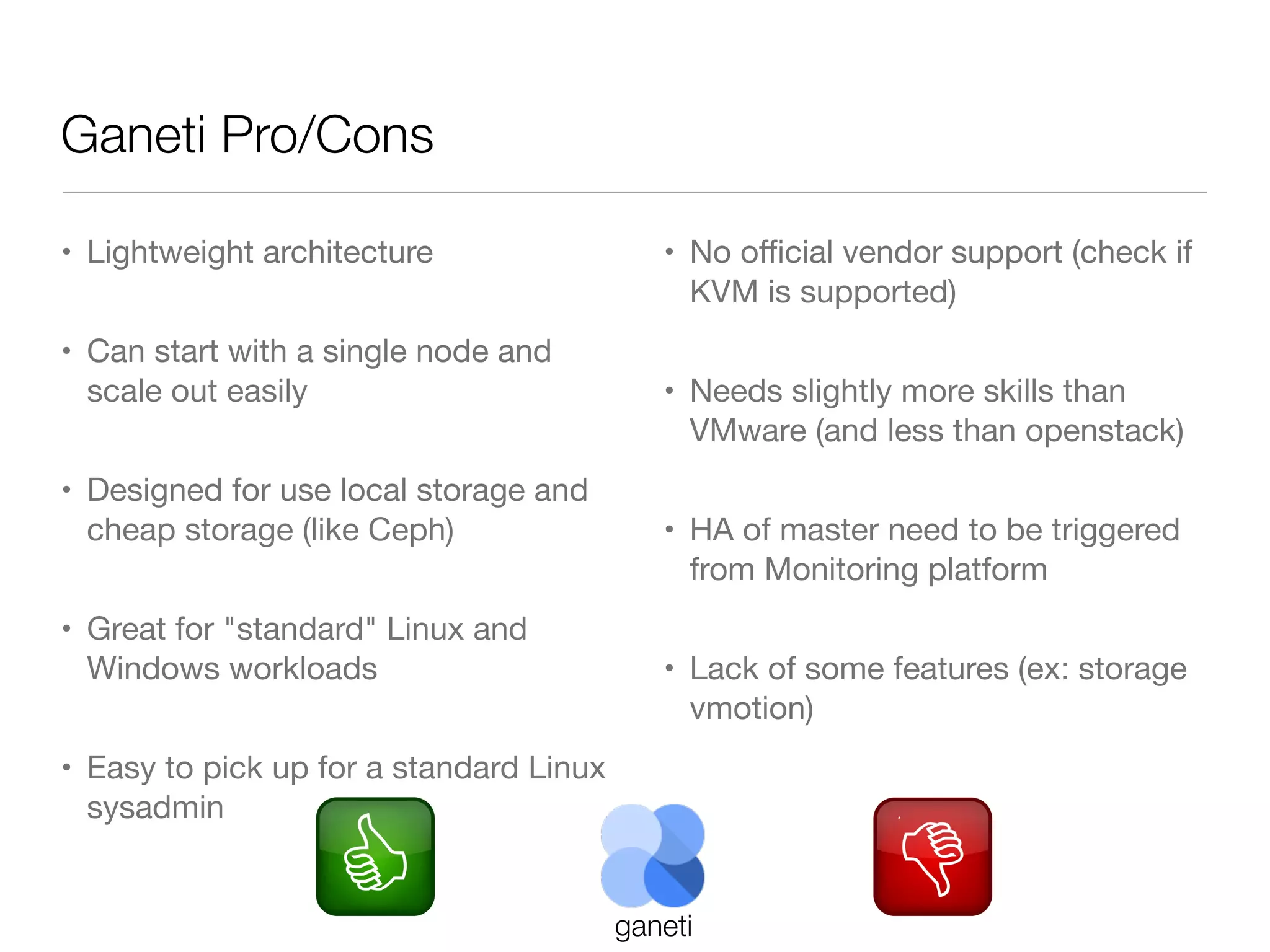
Ganeti Pro/Cons
• Lightweight architecture
• Can start with a single node and
scale out easily
• Designed for use local storage and
cheap storage (like Ceph)
• Great for "standard" Linux and
Windows workloads

• No official vendor support (check if
KVM is supported)
• Needs slightly more skills than
VMware (and less than openstack)
• HA of master need to be triggered
from Monitoring platform
• Lack of some features (ex: storage
vmotion)

• Easy to pick up for a standard Linux
sysadmin

ganeti
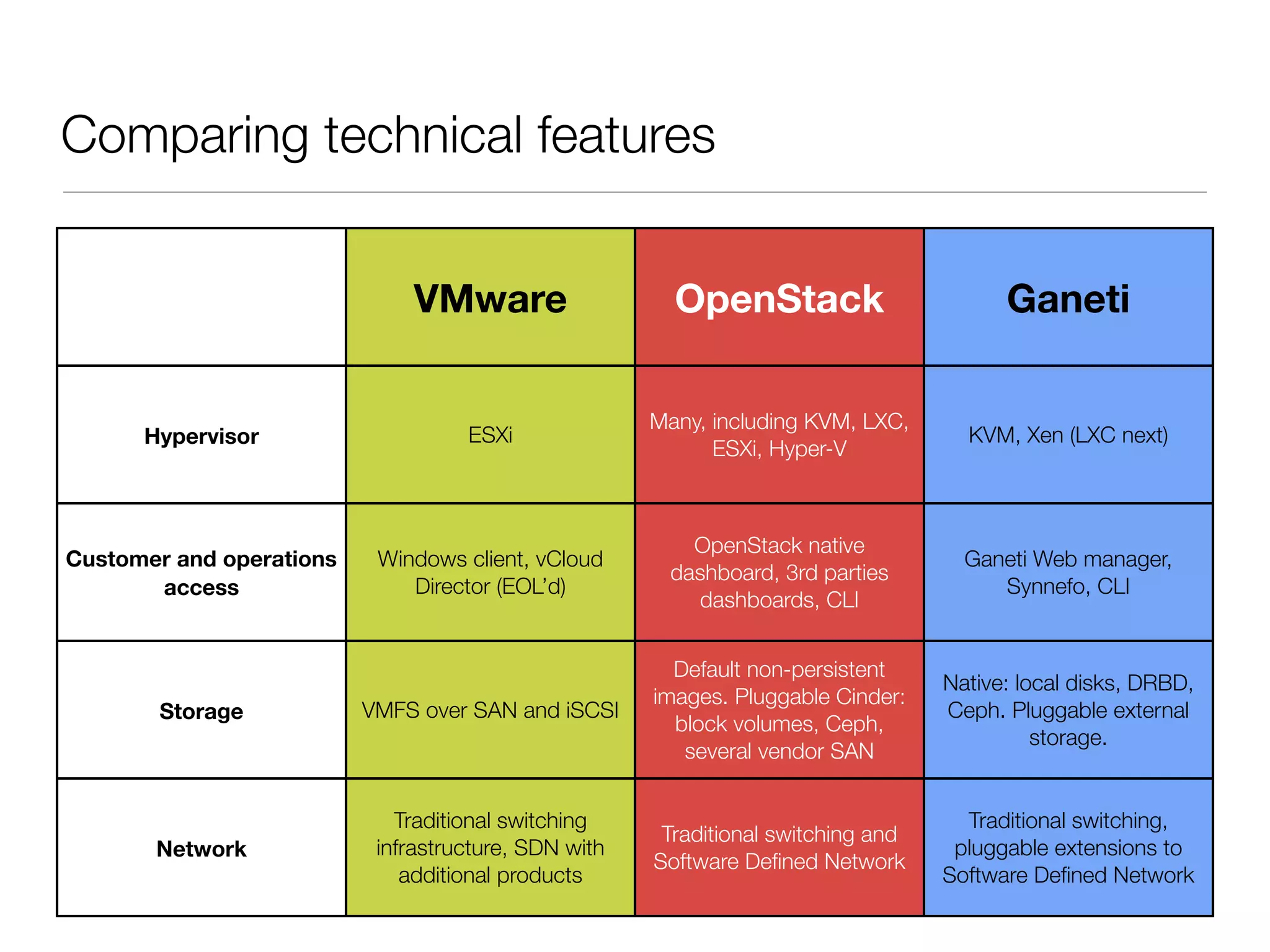
Comparing technical features
VMware

OpenStack

Ganeti

Hypervisor

ESXi

Many, including KVM, LXC,
ESXi, Hyper-V

KVM, Xen (LXC next)

Customer and operations
access

Windows client, vCloud
Director (EOL’d)

OpenStack native
dashboard, 3rd parties
dashboards, CLI

Ganeti Web manager,
Synnefo, CLI

Storage

VMFS over SAN and iSCSI

Default non-persistent
images. Pluggable Cinder:
block volumes, Ceph,
several vendor SAN

Native: local disks, DRBD,
Ceph. Pluggable external
storage.

Network

Traditional switching
infrastructure, SDN with
additional products

Traditional switching and
Software Defined Network

Traditional switching,
pluggable extensions to
Software Defined Network
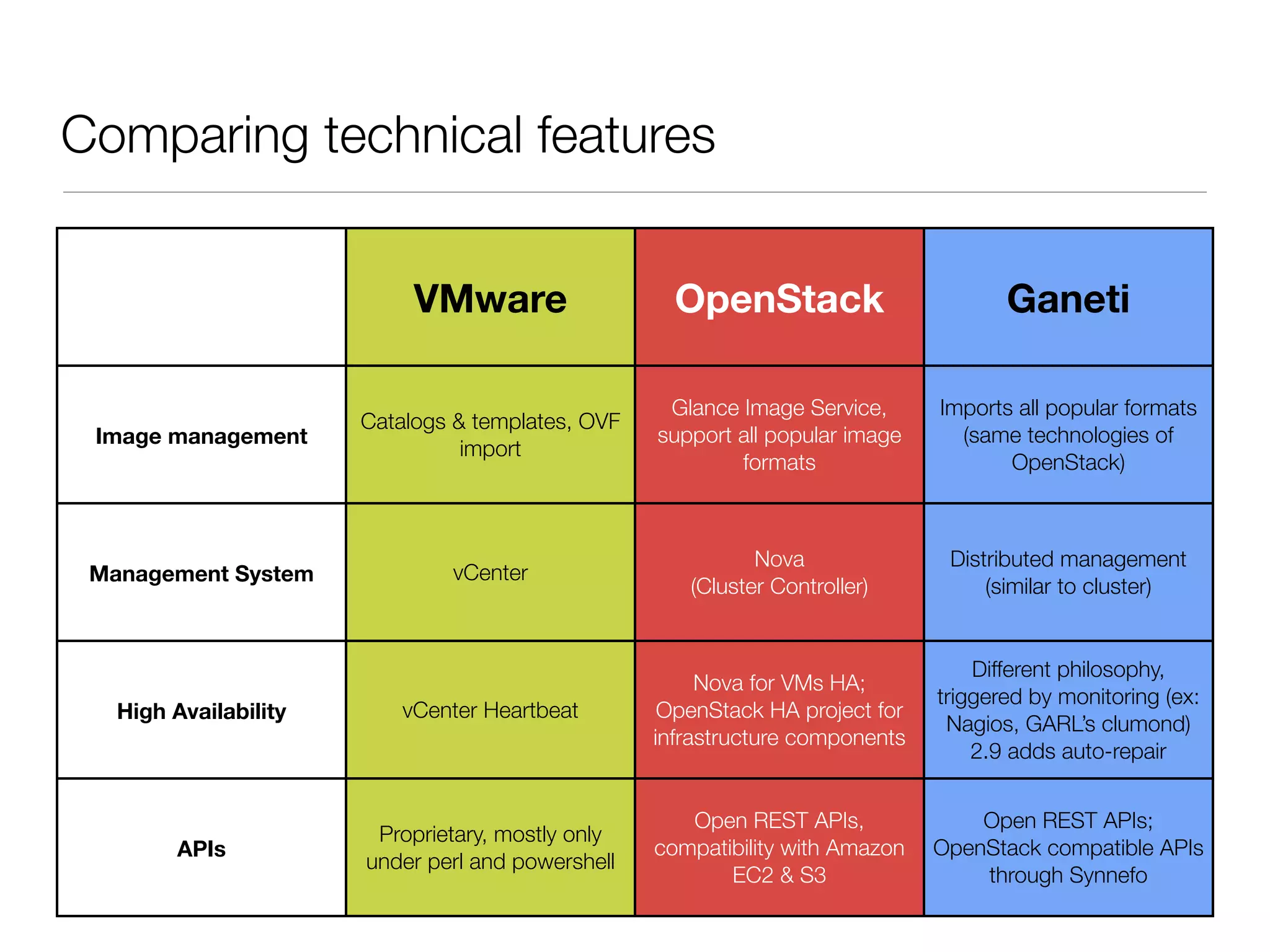
Comparing technical features
VMware

OpenStack

Ganeti

Image management

Catalogs & templates, OVF
import

Glance Image Service,
support all popular image
formats

Imports all popular formats
(same technologies of
OpenStack)

Management System

vCenter

Nova
(Cluster Controller)

Distributed management
(similar to cluster)

High Availability

vCenter Heartbeat

Nova for VMs HA;
OpenStack HA project for
infrastructure components

Different philosophy,
triggered by monitoring (ex:
Nagios, GARL’s clumond)
2.9 adds auto-repair

APIs

Proprietary, mostly only
under perl and powershell

Open REST APIs,
compatibility with Amazon
EC2 & S3

Open REST APIs;
OpenStack compatible APIs
through Synnefo
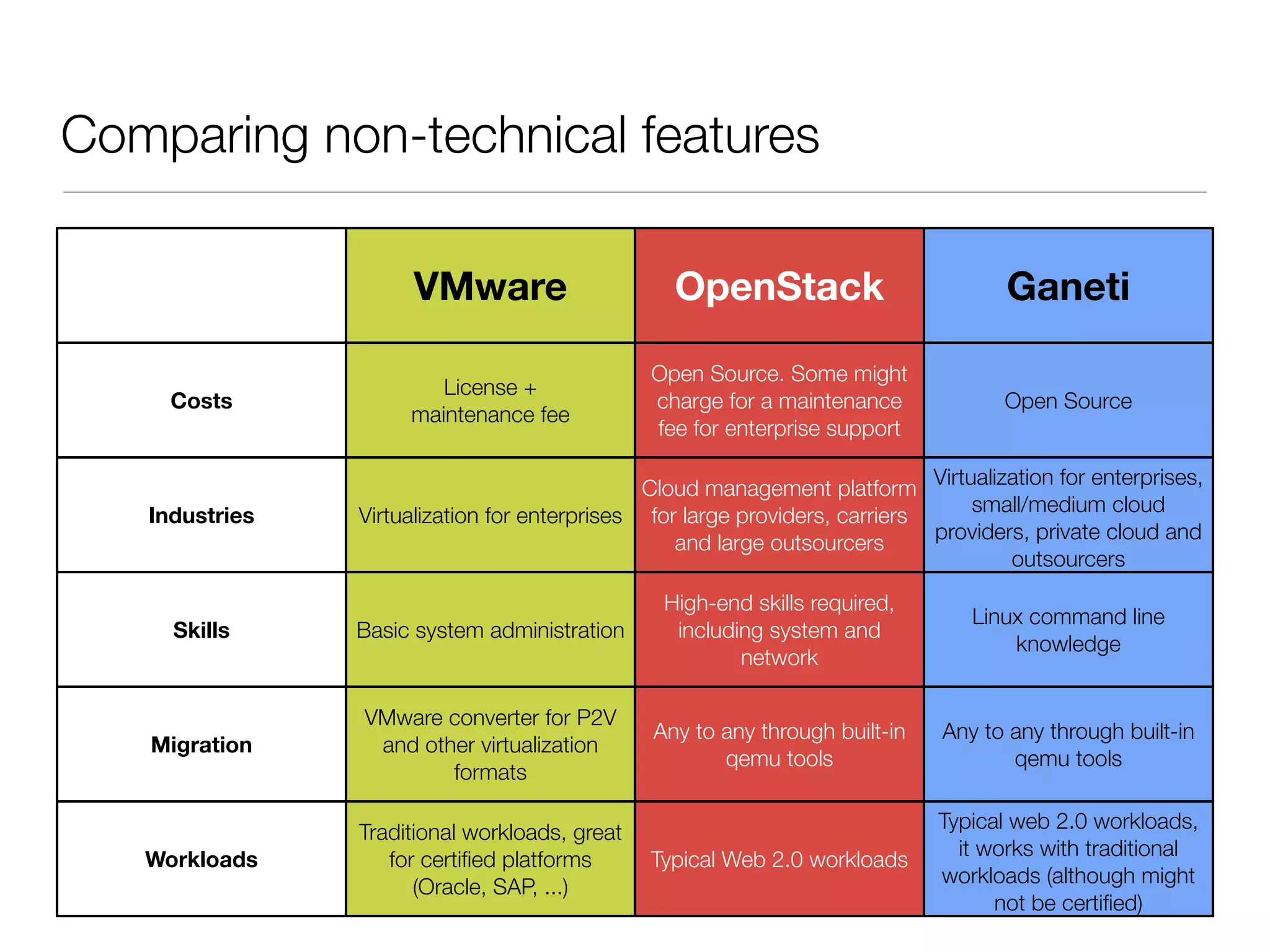
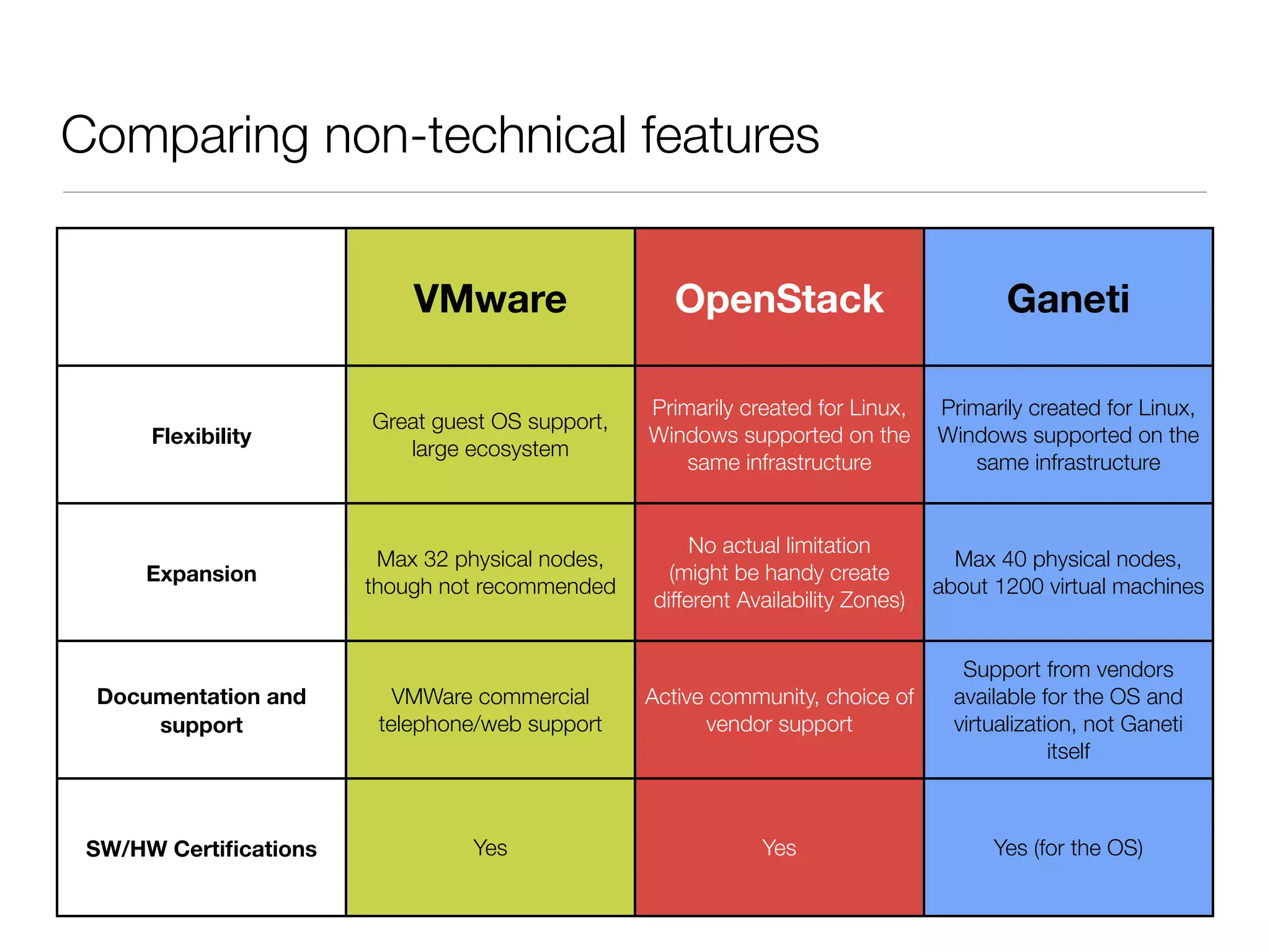
Comparing non-technical features
VMware
Costs

OpenStack

Ganeti

License +
maintenance fee

Open Source. Some might
charge for a maintenance
fee for enterprise support

Open Source

Industries

Cloud management platform Virtualization for enterprises,
small/medium cloud
Virtualization for enterprises for large providers, carriers
providers, private cloud and
and large outsourcers
outsourcers

Skills

Basic system administration

High-end skills required,
including system and
network

Linux command line
knowledge

Migration

VMware converter for P2V
and other virtualization
formats

Any to any through built-in
qemu tools

Any to any through built-in
qemu tools

Workloads

Traditional workloads, great
for certified platforms
(Oracle, SAP, ...)

Typical Web 2.0 workloads

Typical web 2.0 workloads,
it works with traditional
workloads (although might
not be certified)
Comparing non-technical features
VMware

OpenStack

Ganeti

Flexibility

Great guest OS support,
large ecosystem

Primarily created for Linux,
Windows supported on the
same infrastructure

Primarily created for Linux,
Windows supported on the
same infrastructure

Expansion

Max 32 physical nodes,
though not recommended

No actual limitation
(might be handy create
different Availability Zones)

Max 40 physical nodes,
about 1200 virtual machines

Documentation and
support

VMWare commercial
telephone/web support

Active community, choice of
vendor support

Support from vendors
available for the OS and
virtualization, not Ganeti
itself

SW/HW Certifications

Yes

Yes

Yes (for the OS)
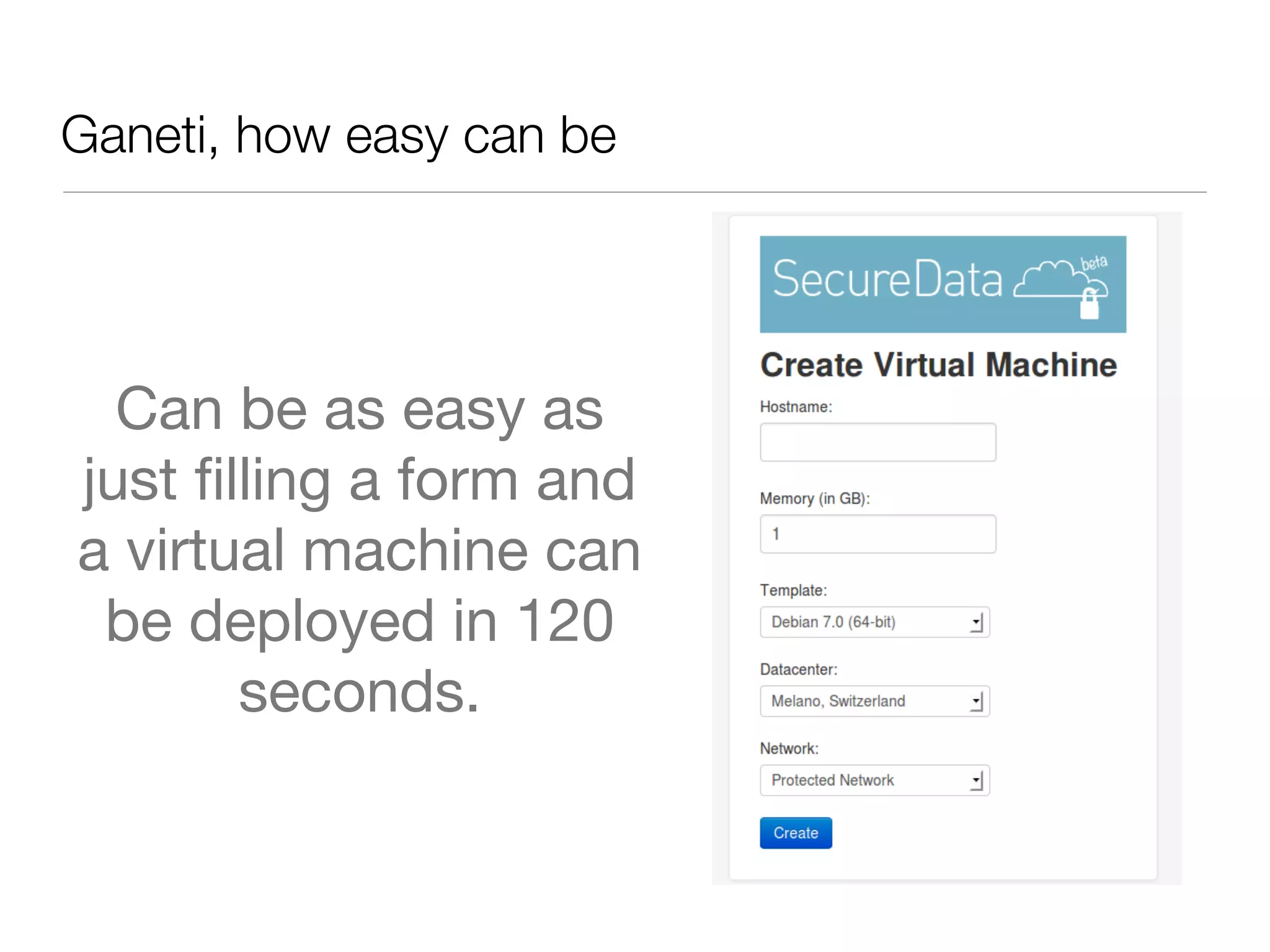
Ganeti, how easy can be

Can be as easy as
just filling a form and
a virtual machine can
be deployed in 120
seconds.
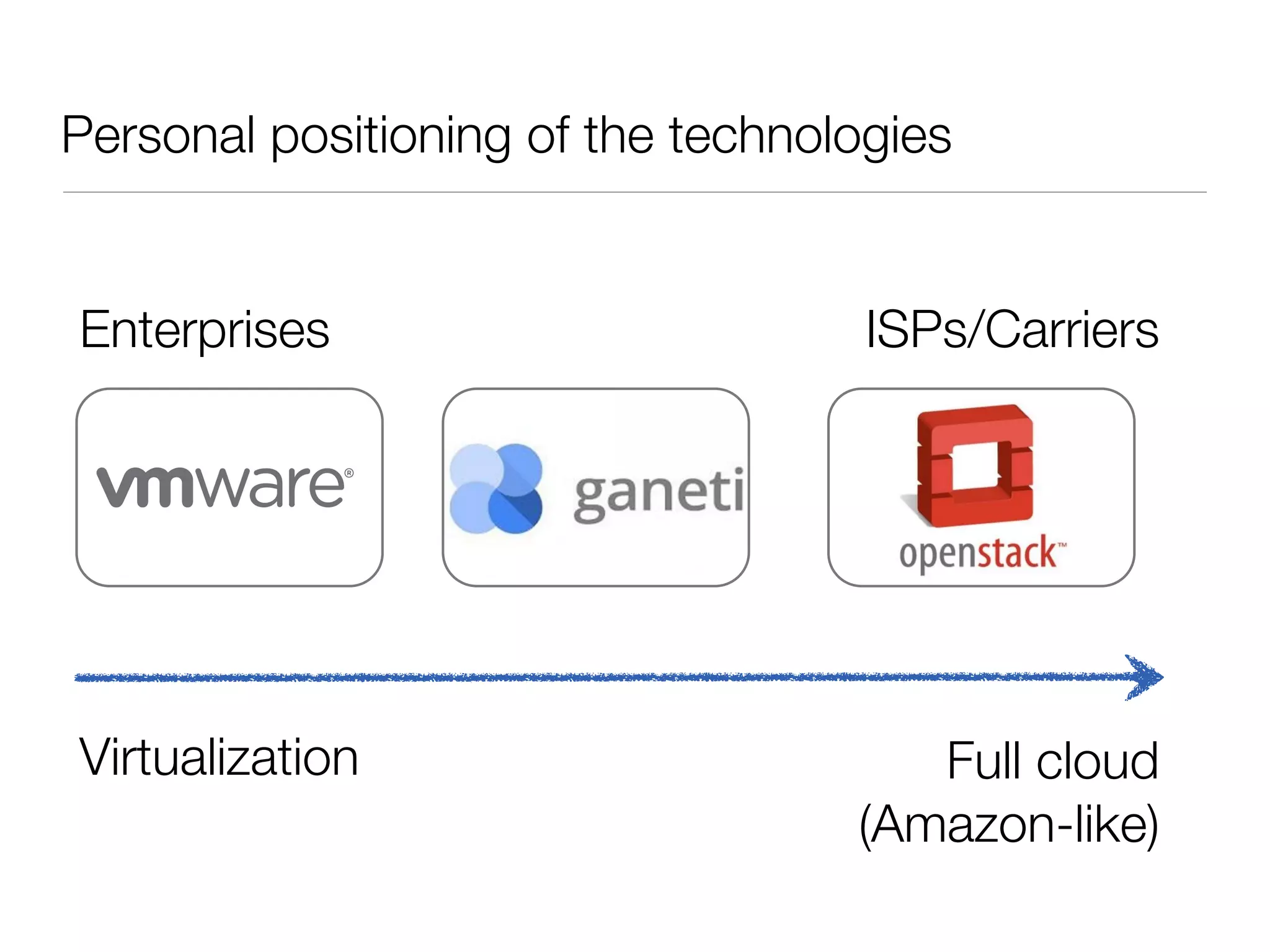
Personal positioning of the technologies

Enterprises

ISPs/Carriers

Virtualization

Full cloud
(Amazon-like)
What platform is good for you?
If you need certified traditional
workloads (ex: Oracle, SAP,
Microsoft Dynamics, …)
AND
you have money
AND
you want all the point-and-click
features, this is a no-brainer
decision:
go for VMware
What platform is good for you?
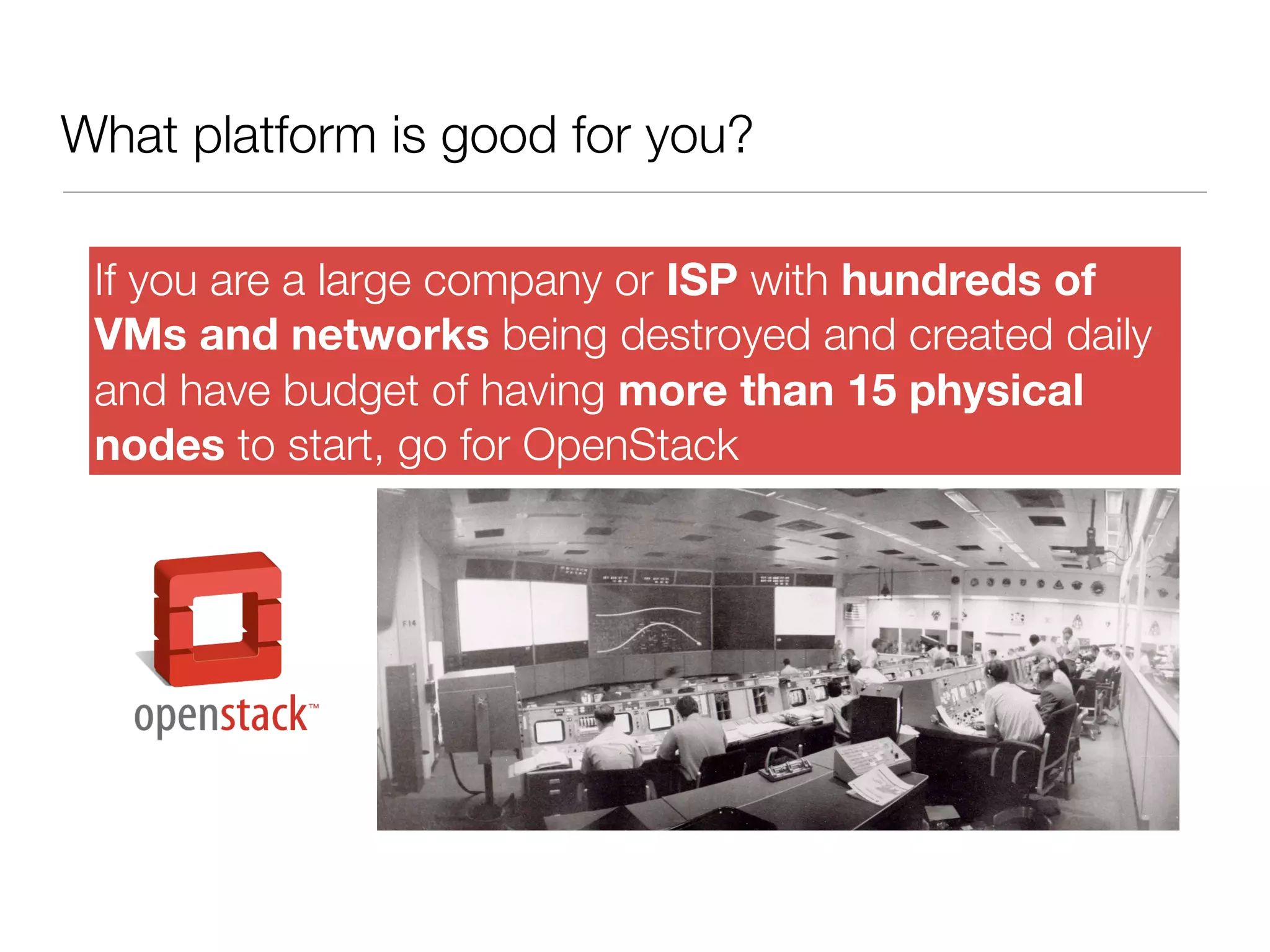
If you are a large company or ISP with hundreds of
VMs and networks being destroyed and created daily
and have budget of having more than 15 physical
nodes to start, go for OpenStack
What platform is good for you?
If you wish to start small, but wish
to be able to scale and you are not
caught in the certification craziness
(the most important thing is that
works with no problem), then
choose Ganeti
Acknowledgements	
Donatella Dalla Benetta, Marketing GARL
Michele Tartara, Engineering Google
Constantinos Venetsanopoulos, Engineering GRNET
Also thanks to the remaining Google engineering team
(in particular Guido Trotter and Helga Velroyen) and all
my colleagues and former colleagues involved in the
OpenStack community (special thanks to Stefano
Maffulli)
Giuseppe “Gippa” Paternò
gpaterno@gpaterno.com
www.gpaterno.com
Twitter: @gpaterno

Comparing IaaS: VMware vs OpenStack vs Google’s Ganeti

  • 1.
    ganeti Comparing IaaS VMware vsOpenStack vs Google’s Ganeti November 2013 Giuseppe “Gippa” Paternò
  • 2.
    Knowing “Gippa” .... •EMEA Cloud Solution Architect for Canonical (the company behind Ubuntu). In this role I work closely with the OpenStack community to deploy clouds mostly for big telcos in Europe and Middle-East. (www.canonical.com and www.ubuntu.com) • CTO of GARL, the Swiss company behind the SecurePass cloud identity management service. While mostly focused on identity and security, I cooperate with the Google’s Ganeti project and team. (www.garl.ch and www.secure-pass.net) • Previously Senior Solution Architect in Red Hat, Sun Microsystems and also in IBM. • Works with Linux since 1996, I know most of the Open Source community. Within my (little) spare time, I publish books and whitepapers
  • 3.
  • 4.
    You don’t knowVMware? Seriously?
  • 5.
  • 6.
    About OpenStack • OpenSourceunder Apache license • Born in 2010 from an idea of NASA and RackSpace • Managed by the OpenStack Foundation, a non-profit corporate entity established in September 2012 • Aim to create Amazon-like services, with EC2 and S3 compatibility • More than 200 members, among those: Canonical/Ubuntu, VMware, HP, IBM, RackSpace, Microsoft, AT&T, SuSE, RedHat
  • 7.
  • 8.
    OpenStack an umbrella projectfor Nova (Compute, where VMs are run) Cinder (Block Storage, persistent storage for VMs) Swift (Object Storage, snapshots and nonfrequently updated data) Keystone (Identity Management) Neutron (Networking and SDN) Glance (Image Service, where templates are)
  • 9.
  • 10.
    About Google’s Ganeti •Ganeti is a virtual machine cluster management tool • Created by Google for Google (don’t forget!) • Used internally in Google to serve the whole of Google's corporate infrastructure globally • Open Source since 2007 • Essentially a wrapper for existing well-proven rock-solid Linux technologies • In-line with Google’s philosophy of using commodity hardware • Conceived to use cheap local storage
  • 11.
    Cluster Node Mirrored Instance Instance Instance MirroredInstance Ganeti components (enterprise deploy) Cluster Node (Master, APIs responder) Cluster Node (Candidate Master) Ganeti Network VLANs Trunk or Open vswitch (beta) Using Ganeti as a “standard” virtual engine management
  • 12.
    Ganeti components (fullcloud deployment) Using Ganeti at maximum power with Synnefo and OpenStack compatibility
  • 13.
    Ganeti and WebUI Ganeti per-se doesn’t provide a GUI, just command line and APIs. Google has its own internal GUI that is not OSS, but there are two GUIs available: Ganeti Web Manager Simple HTML GUI for handling virtual machines Easy to integrate into custom internal workflows and processes. Synnefo Full cloud infrastructure compatible with OpenStack made by the Greek Research and Technology Network (GRNET)
  • 14.
    What really mattersto IT Managers? Has to be easy to use Management tools, optional web interface Entry cost and maintenance, the lower the better Easy to find skills and support Integration with other platforms
  • 15.
    VMware Pro/Cons • Featurerich (vSphere HA, vMotion, DRS, I/O control) • Per core license - expensive • Proprietary platform • Very large ecosystems • All os vendors make it supported and certified under ESXi • ESXi can be downloaded and used freely • ESXi can not be APIs accessed need to buy licenses
  • 16.
    OpenStack Pro/Cons • Probablythe most successful example of Open Source project after Linux • Support from many OEMs and OS vendors • Interoperability with many components, just pick your favorite one and plug it in • Standard and well accepted APIs • Very complex to setup and troubleshoot • Although common codebase, might differ from implementations • Need high numbers of management nodes • High skills required to run the cluster
  • 17.
    Ganeti Pro/Cons • Lightweightarchitecture • Can start with a single node and scale out easily • Designed for use local storage and cheap storage (like Ceph) • Great for "standard" Linux and Windows workloads • No official vendor support (check if KVM is supported) • Needs slightly more skills than VMware (and less than openstack) • HA of master need to be triggered from Monitoring platform • Lack of some features (ex: storage vmotion) • Easy to pick up for a standard Linux sysadmin ganeti
  • 18.
    Comparing technical features VMware OpenStack Ganeti Hypervisor ESXi Many,including KVM, LXC, ESXi, Hyper-V KVM, Xen (LXC next) Customer and operations access Windows client, vCloud Director (EOL’d) OpenStack native dashboard, 3rd parties dashboards, CLI Ganeti Web manager, Synnefo, CLI Storage VMFS over SAN and iSCSI Default non-persistent images. Pluggable Cinder: block volumes, Ceph, several vendor SAN Native: local disks, DRBD, Ceph. Pluggable external storage. Network Traditional switching infrastructure, SDN with additional products Traditional switching and Software Defined Network Traditional switching, pluggable extensions to Software Defined Network
  • 19.
    Comparing technical features VMware OpenStack Ganeti Imagemanagement Catalogs & templates, OVF import Glance Image Service, support all popular image formats Imports all popular formats (same technologies of OpenStack) Management System vCenter Nova (Cluster Controller) Distributed management (similar to cluster) High Availability vCenter Heartbeat Nova for VMs HA; OpenStack HA project for infrastructure components Different philosophy, triggered by monitoring (ex: Nagios, GARL’s clumond) 2.9 adds auto-repair APIs Proprietary, mostly only under perl and powershell Open REST APIs, compatibility with Amazon EC2 & S3 Open REST APIs; OpenStack compatible APIs through Synnefo
  • 20.
    Comparing non-technical features VMware Costs OpenStack Ganeti License+ maintenance fee Open Source. Some might charge for a maintenance fee for enterprise support Open Source Industries Cloud management platform Virtualization for enterprises, small/medium cloud Virtualization for enterprises for large providers, carriers providers, private cloud and and large outsourcers outsourcers Skills Basic system administration High-end skills required, including system and network Linux command line knowledge Migration VMware converter for P2V and other virtualization formats Any to any through built-in qemu tools Any to any through built-in qemu tools Workloads Traditional workloads, great for certified platforms (Oracle, SAP, ...) Typical Web 2.0 workloads Typical web 2.0 workloads, it works with traditional workloads (although might not be certified)
  • 21.
    Comparing non-technical features VMware OpenStack Ganeti Flexibility Greatguest OS support, large ecosystem Primarily created for Linux, Windows supported on the same infrastructure Primarily created for Linux, Windows supported on the same infrastructure Expansion Max 32 physical nodes, though not recommended No actual limitation (might be handy create different Availability Zones) Max 40 physical nodes, about 1200 virtual machines Documentation and support VMWare commercial telephone/web support Active community, choice of vendor support Support from vendors available for the OS and virtualization, not Ganeti itself SW/HW Certifications Yes Yes Yes (for the OS)
  • 22.
    Ganeti, how easycan be Can be as easy as just filling a form and a virtual machine can be deployed in 120 seconds.
  • 23.
    Personal positioning ofthe technologies Enterprises ISPs/Carriers Virtualization Full cloud (Amazon-like)
  • 24.
    What platform isgood for you? If you need certified traditional workloads (ex: Oracle, SAP, Microsoft Dynamics, …) AND you have money AND you want all the point-and-click features, this is a no-brainer decision: go for VMware
  • 25.
    What platform isgood for you? If you are a large company or ISP with hundreds of VMs and networks being destroyed and created daily and have budget of having more than 15 physical nodes to start, go for OpenStack
  • 26.
    What platform isgood for you? If you wish to start small, but wish to be able to scale and you are not caught in the certification craziness (the most important thing is that works with no problem), then choose Ganeti
  • 27.
    Acknowledgements Donatella Dalla Benetta,Marketing GARL Michele Tartara, Engineering Google Constantinos Venetsanopoulos, Engineering GRNET Also thanks to the remaining Google engineering team (in particular Guido Trotter and Helga Velroyen) and all my colleagues and former colleagues involved in the OpenStack community (special thanks to Stefano Maffulli)
  • 28.