Below is a conversation between Katniss Everdeen and a
President.
Please analyze to which deixis does it belong and interpret
distance between Katniss Everdeen and the President.



“My advisors were concerned Miss Everdeen would be
difficult, but Miss Everdeen is not planning on being
difficult, isn‟t she?” The President asks.
“No,” I answer.
“The President has a problem, Miss Everdeen. A problem
that began back then when Miss Everdeen pulled out
those poisonous berries in the arena.”
3.1 Referential and attributive uses
3.2 Names and referents
3.3 The role of co-text
3.4 Anaphoric reference
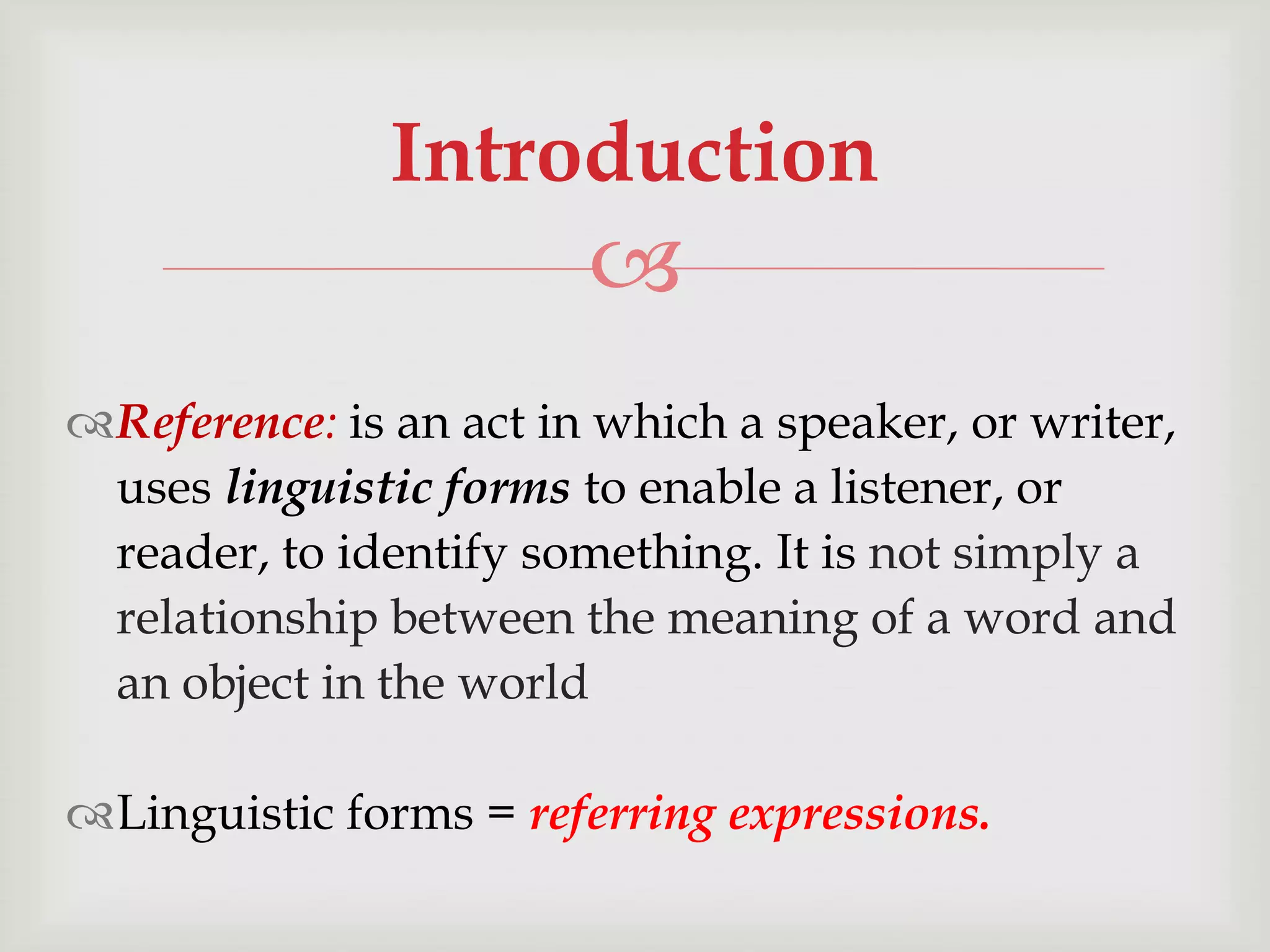
Introduction


Yule:
“Words themselves do not refer to
anything, people refer”
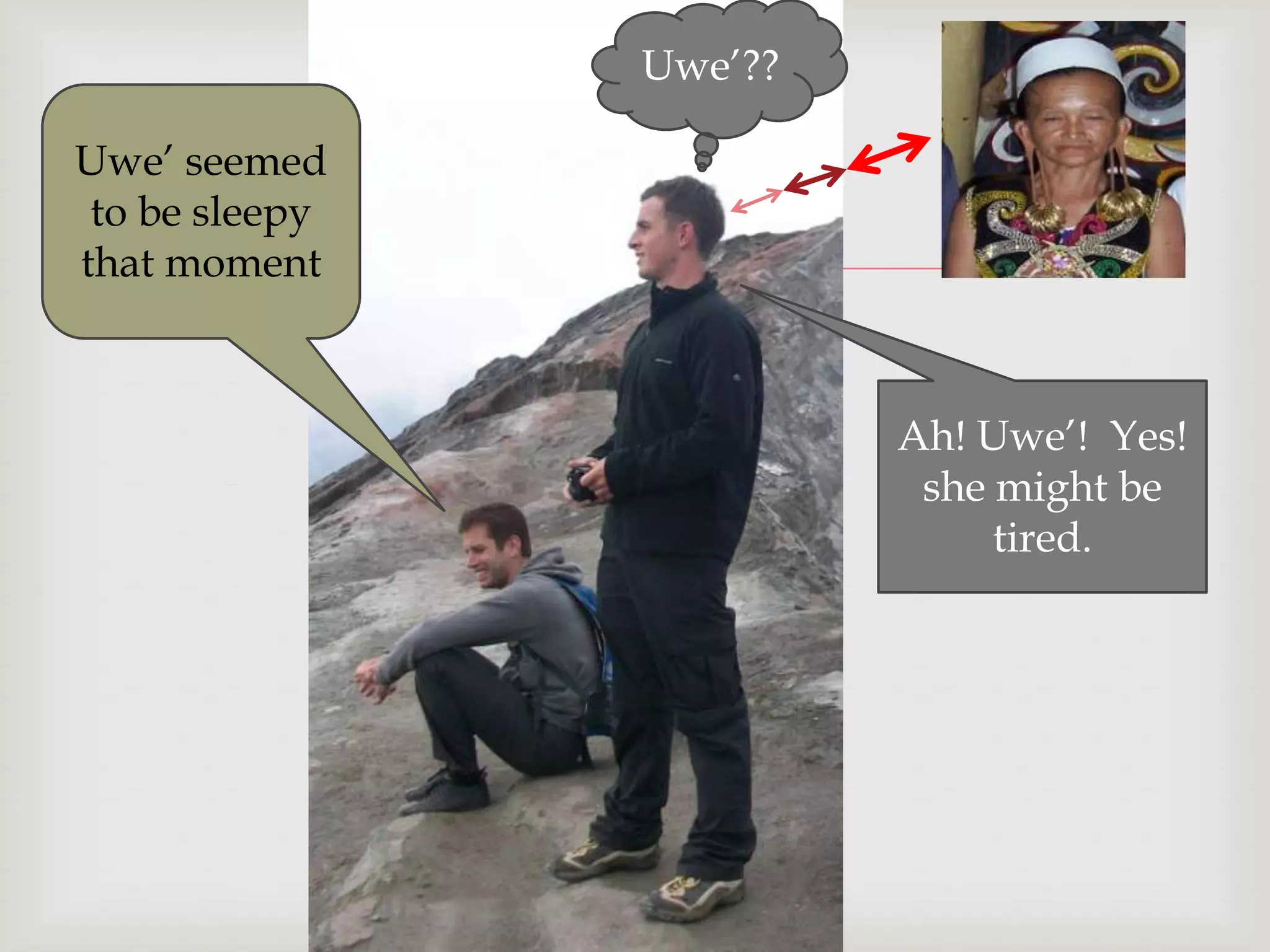
Uwe‟??
Uwe‟ seemed
to be sleepy
that moment


Ah! Uwe‟! Yes!
she might be
tired.
Introduction


Reference: is an act in which a speaker, or writer,
uses linguistic forms to enable a listener, or
reader, to identify something. It is not simply a
relationship between the meaning of a word and
an object in the world
Linguistic forms = referring expressions.
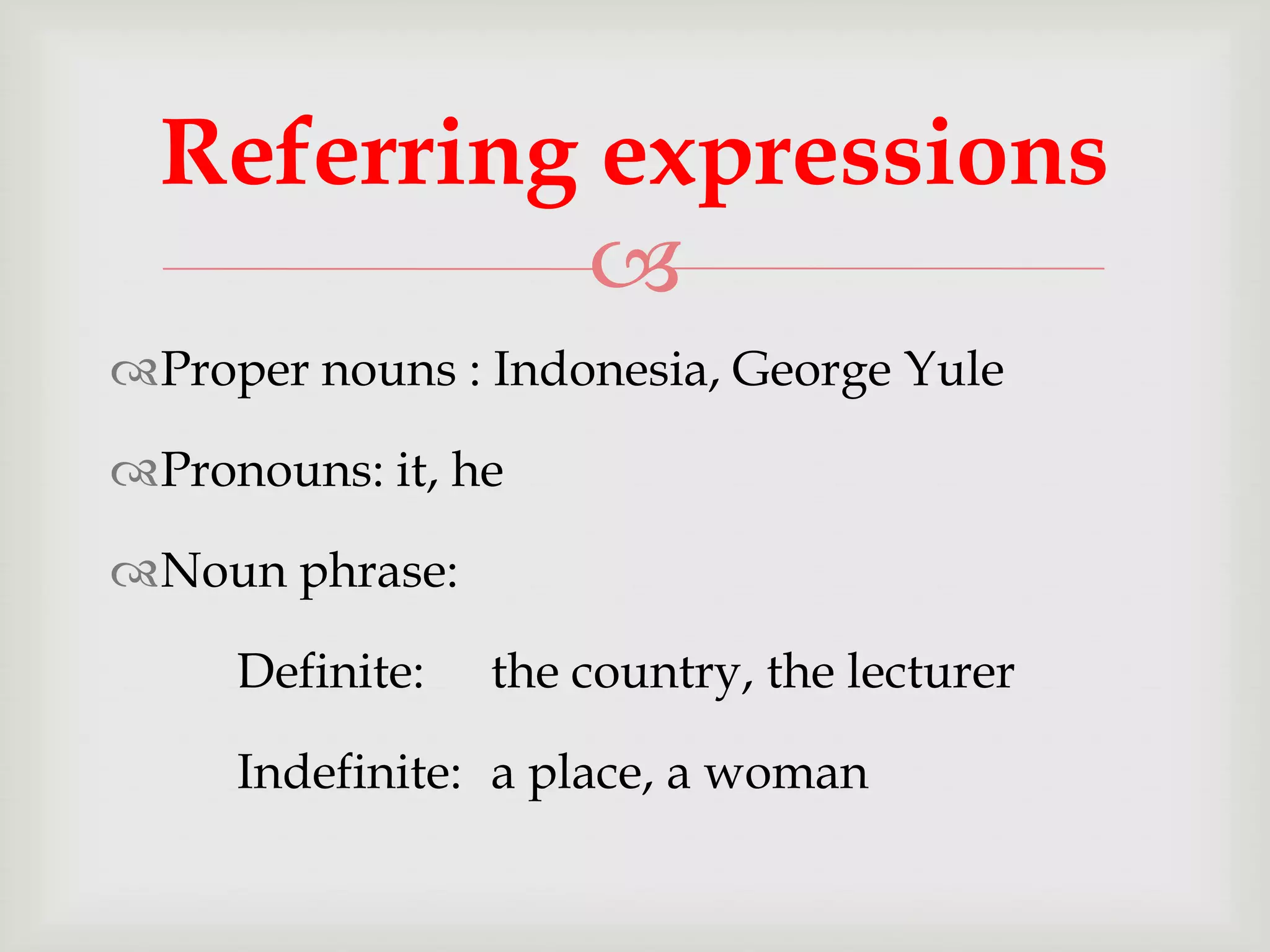
Referring expressions

Proper nouns : Indonesia, George Yule

Pronouns: it, he
Noun phrase:

Definite:

the country, the lecturer

Indefinite: a place, a woman
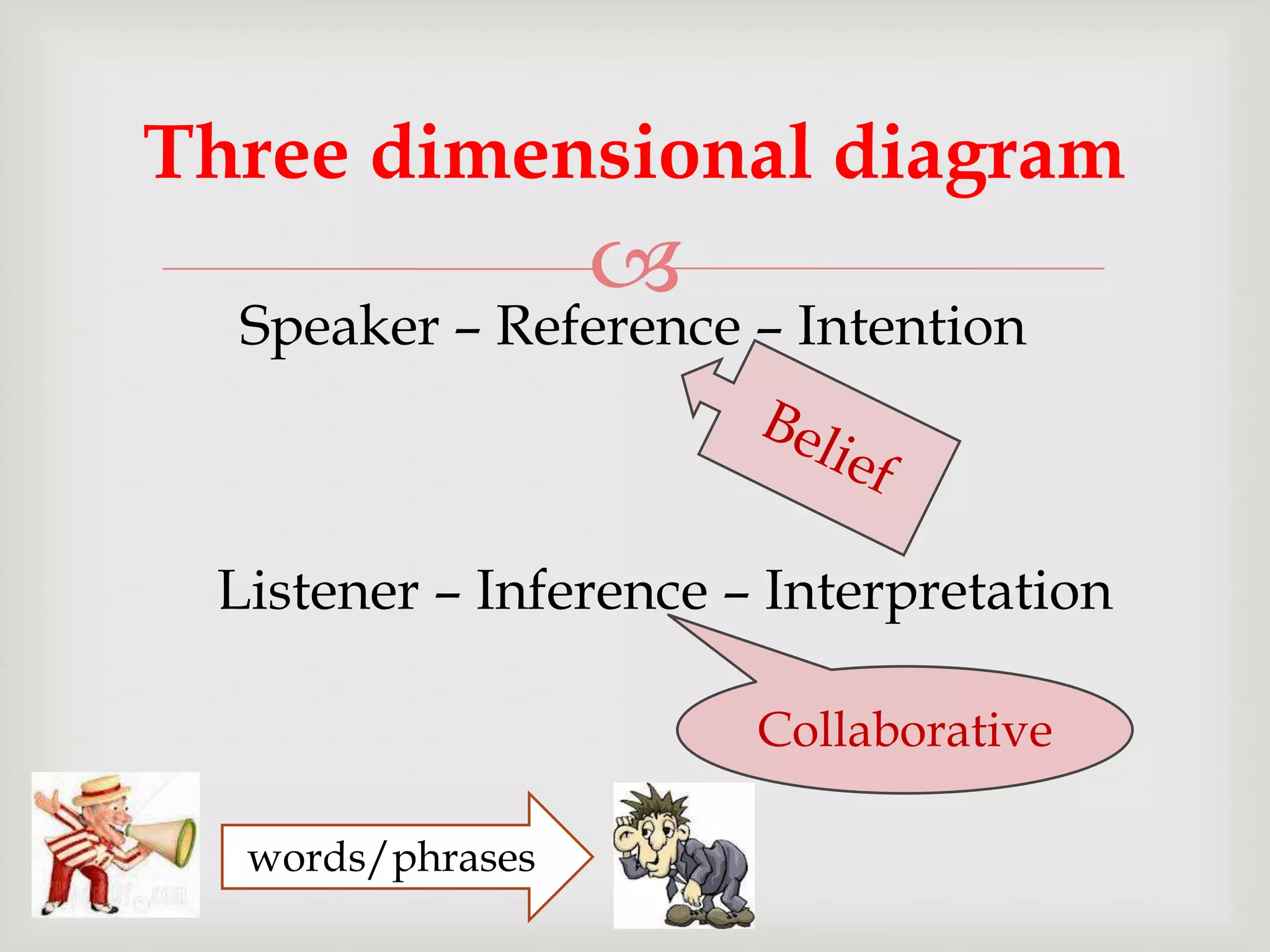
Three dimensional diagram



Speaker – Reference – Intention

Listener – Inference – Interpretation
Collaborative
words/phrases
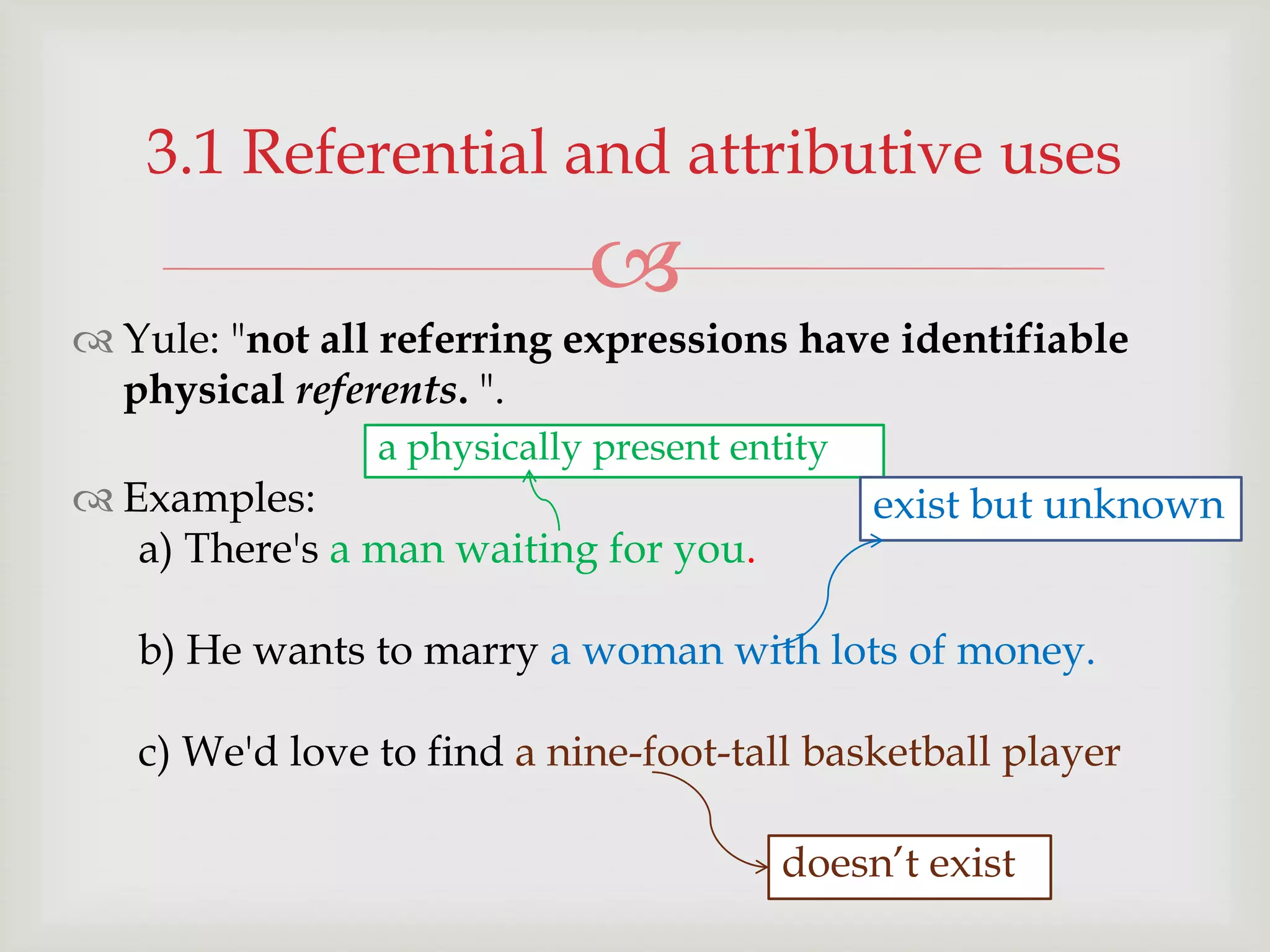
3.1 Referential and attributive uses


 Yule: "not all referring expressions have identifiable
physical referents. ".
a physically present entity

 Examples:
a) There's a man waiting for you.

exist but unknown

b) He wants to marry a woman with lots of money.

c) We'd love to find a nine-foot-tall basketball player
doesn‟t exist
Attributive use and referential use
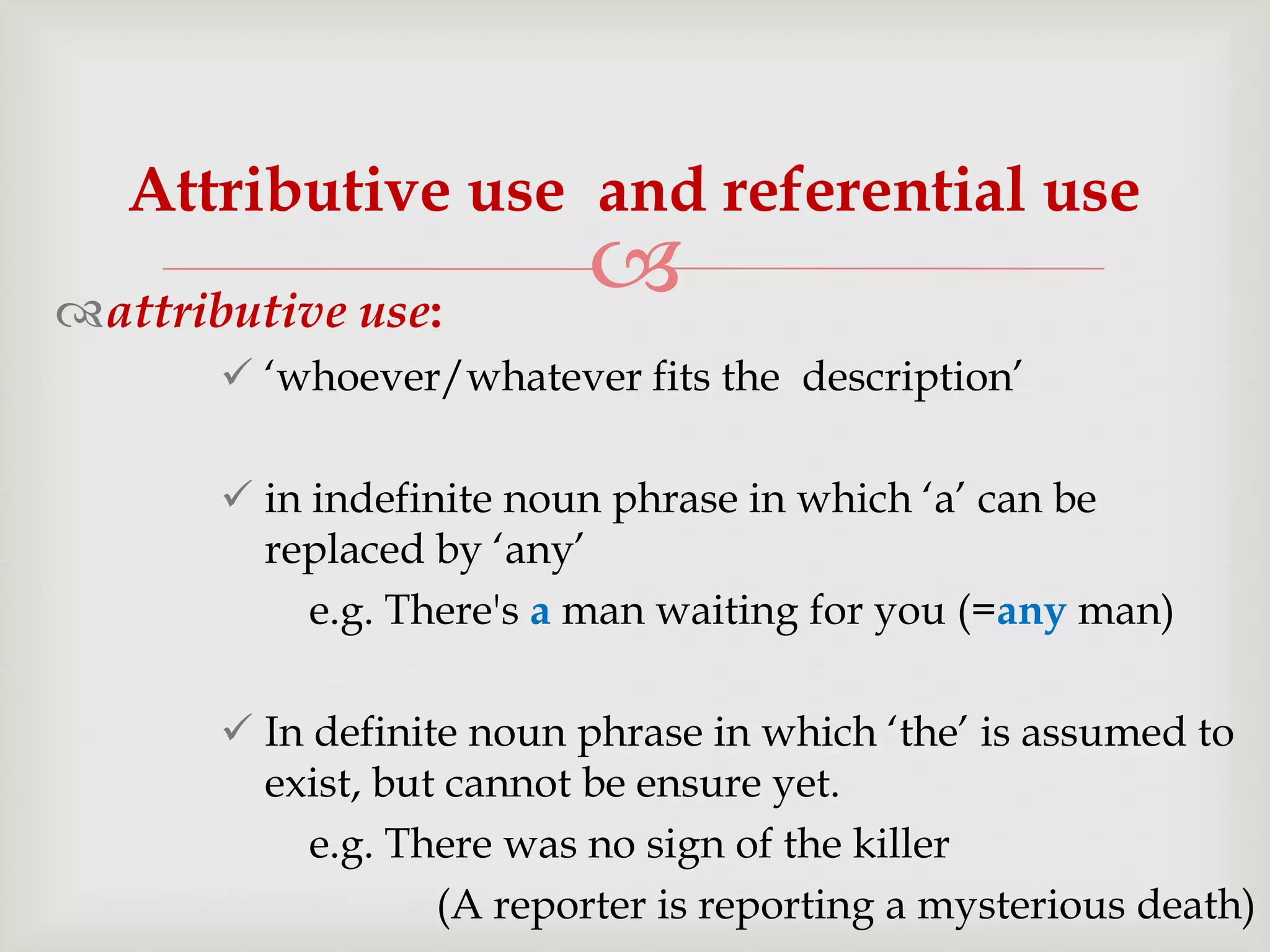
attributive use:



 „whoever/whatever fits the description‟
 in indefinite noun phrase in which „a‟ can be
replaced by „any‟
e.g. There's a man waiting for you (=any man)
 In definite noun phrase in which „the‟ is assumed to
exist, but cannot be ensure yet.
e.g. There was no sign of the killer
(A reporter is reporting a mysterious death)
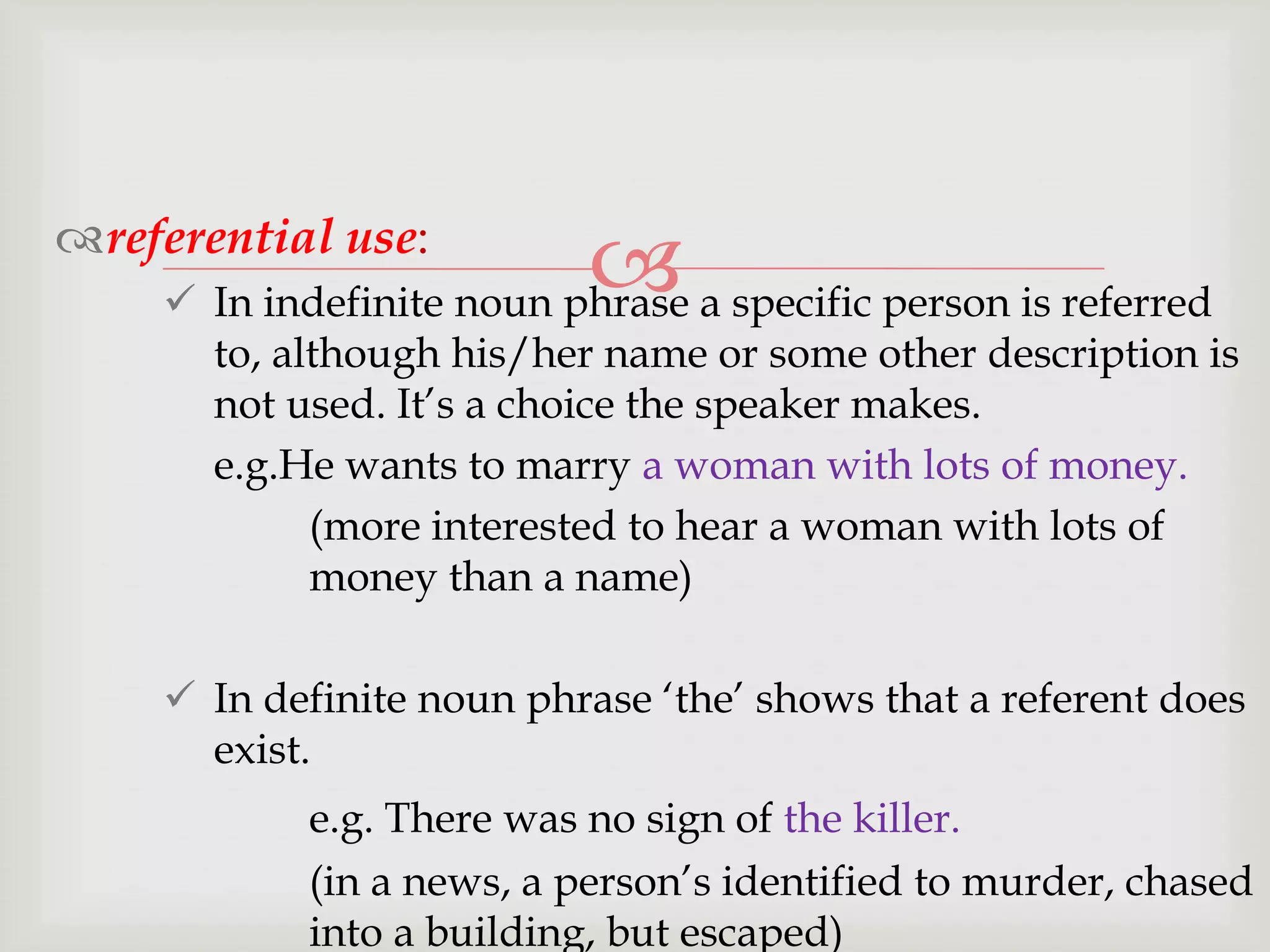
referential use:



 In indefinite noun phrase a specific person is referred
to, although his/her name or some other description is
not used. It‟s a choice the speaker makes.
e.g.He wants to marry a woman with lots of money.
(more interested to hear a woman with lots of
money than a name)
 In definite noun phrase „the‟ shows that a referent does
exist.
e.g. There was no sign of the killer.
(in a news, a person‟s identified to murder, chased
into a building, but escaped)
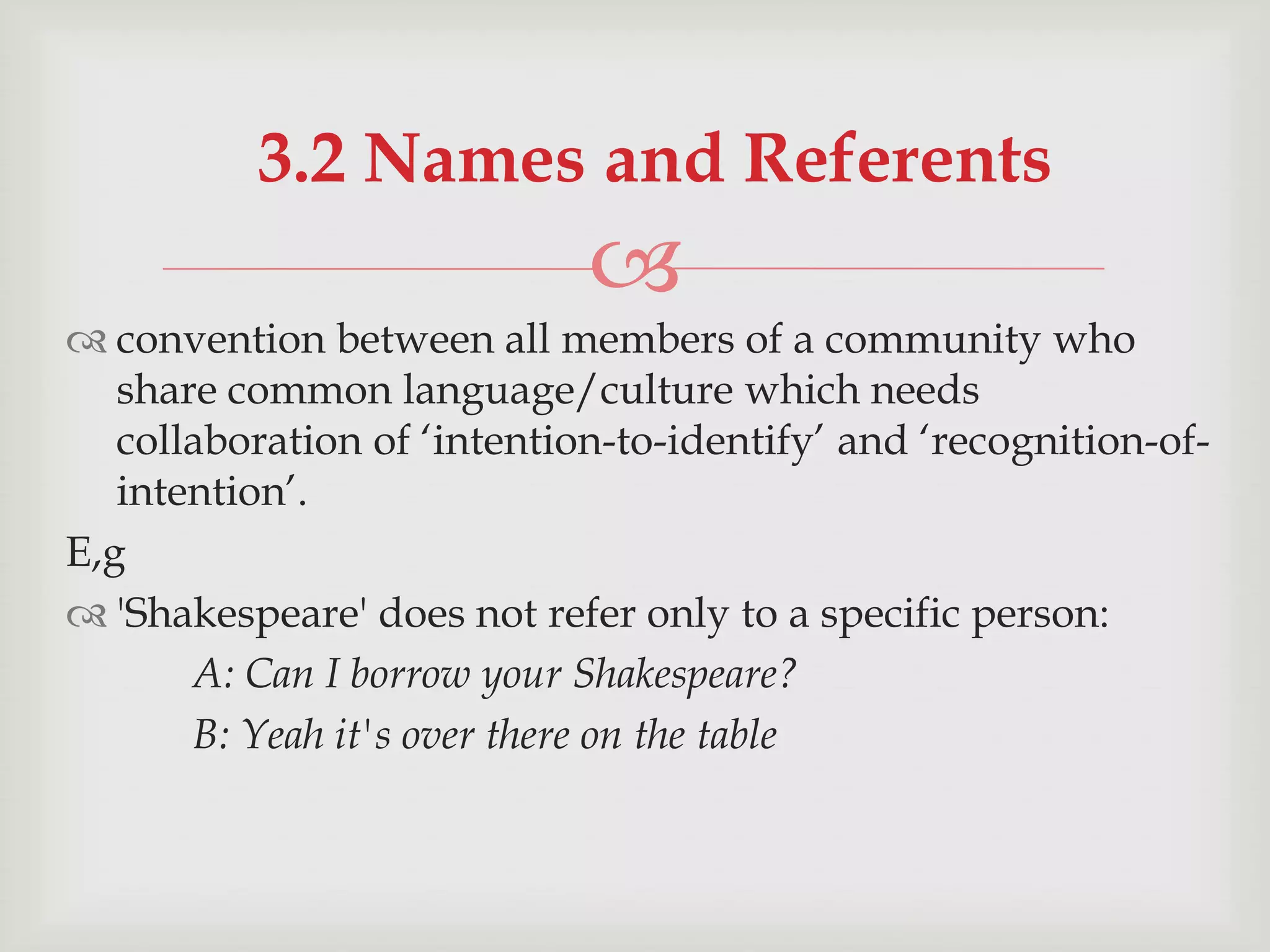
3.2 Names and Referents


 convention between all members of a community who
share common language/culture which needs
collaboration of „intention-to-identify‟ and „recognition-ofintention‟.
E,g
 'Shakespeare' does not refer only to a specific person:
A: Can I borrow your Shakespeare?
B: Yeah it's over there on the table


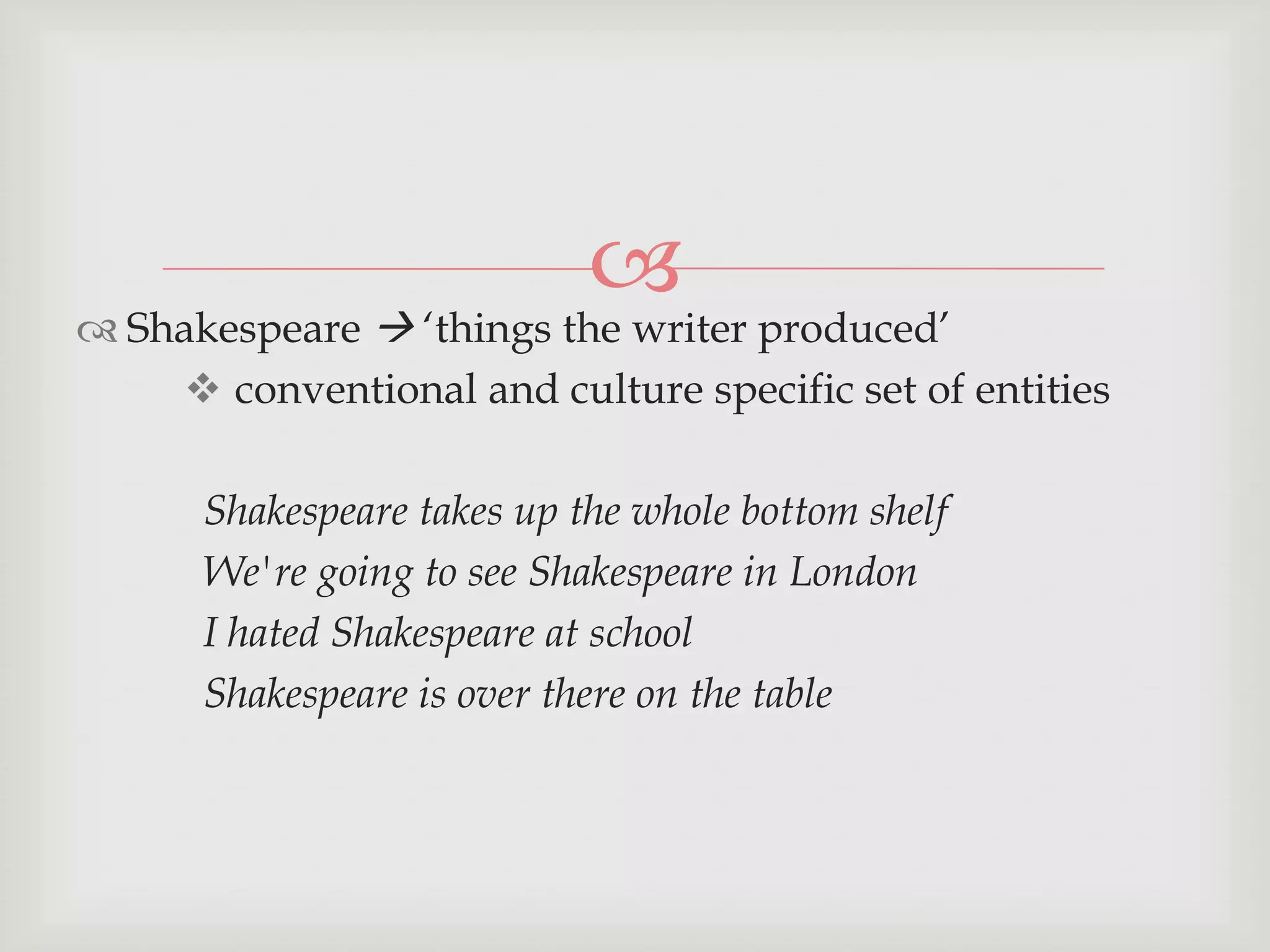
 Shakespeare  „things the writer produced‟
 conventional and culture specific set of entities
Shakespeare takes up the whole bottom shelf
We're going to see Shakespeare in London
I hated Shakespeare at school
Shakespeare is over there on the table
 to a person
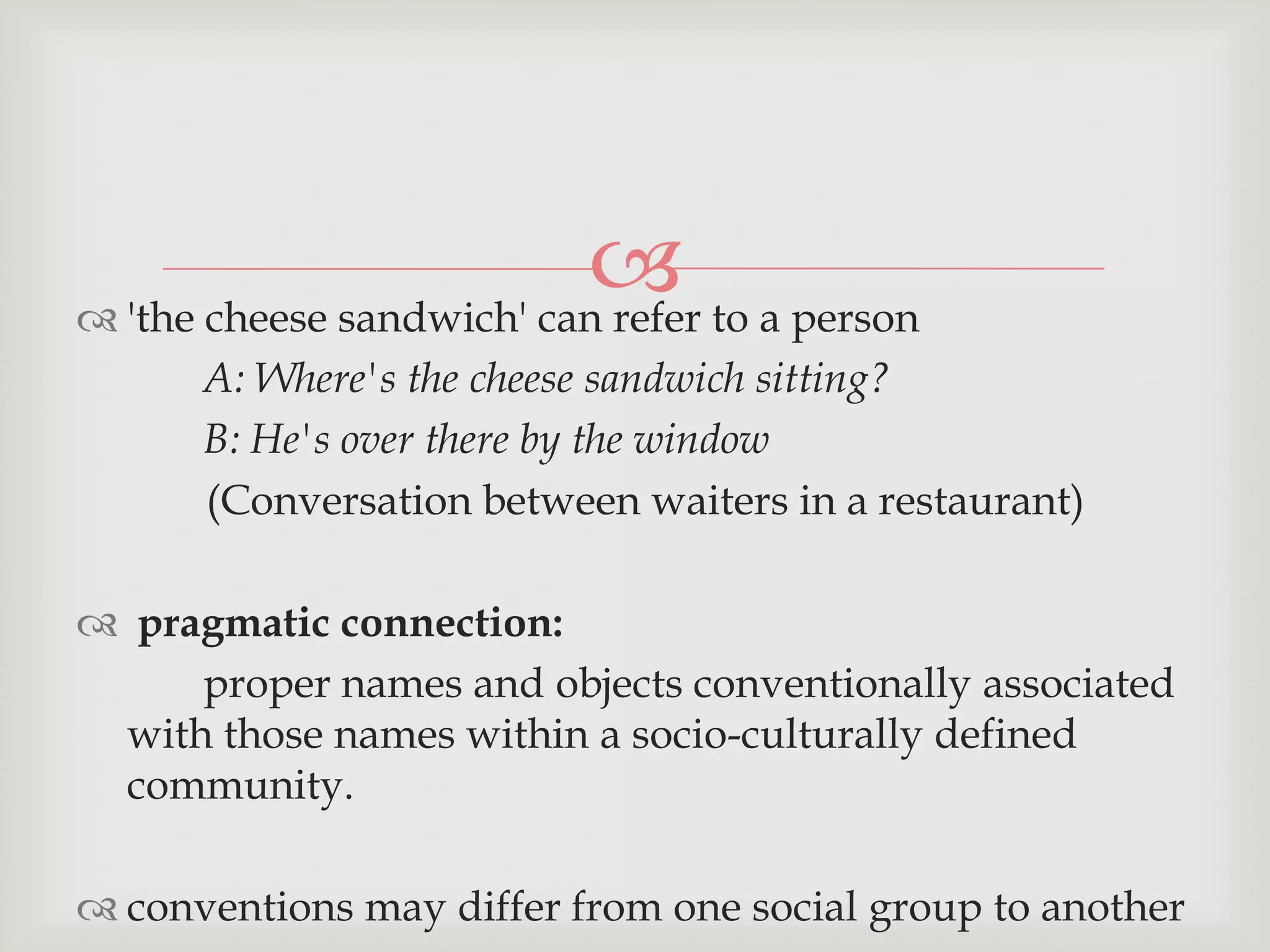
 'the cheese sandwich' can refer
A: Where's the cheese sandwich sitting?
B: He's over there by the window
(Conversation between waiters in a restaurant)
 pragmatic connection:
proper names and objects conventionally associated
with those names within a socio-culturally defined
community.
 conventions may differ from one social group to another
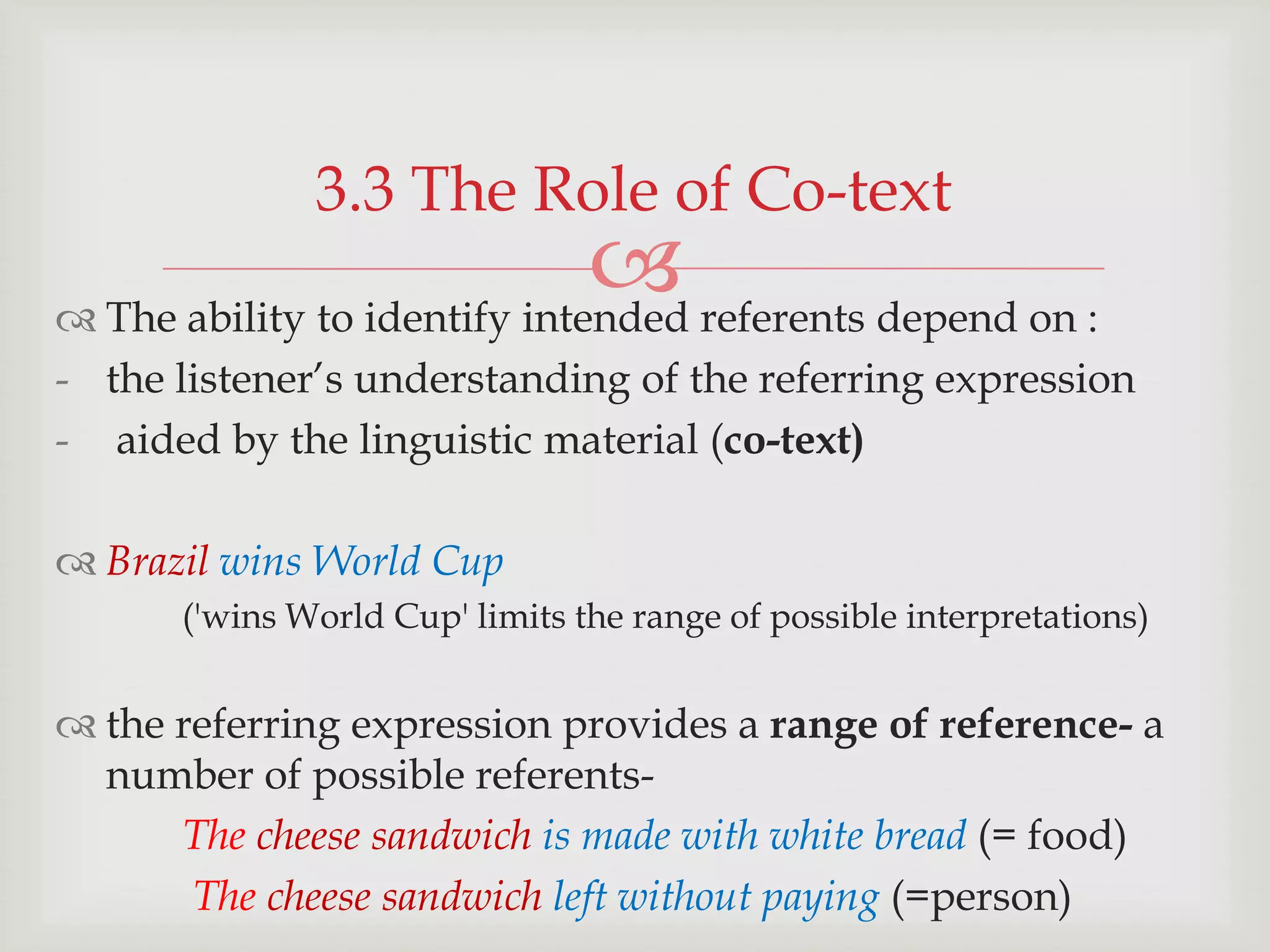
3.3 The Role of Co-text

 referents depend on :
 The ability to identify intended
- the listener‟s understanding of the referring expression
- aided by the linguistic material (co-text)

 Brazil wins World Cup
('wins World Cup' limits the range of possible interpretations)

 the referring expression provides a range of reference- a
number of possible referentsThe cheese sandwich is made with white bread (= food)
The cheese sandwich left without paying (=person)
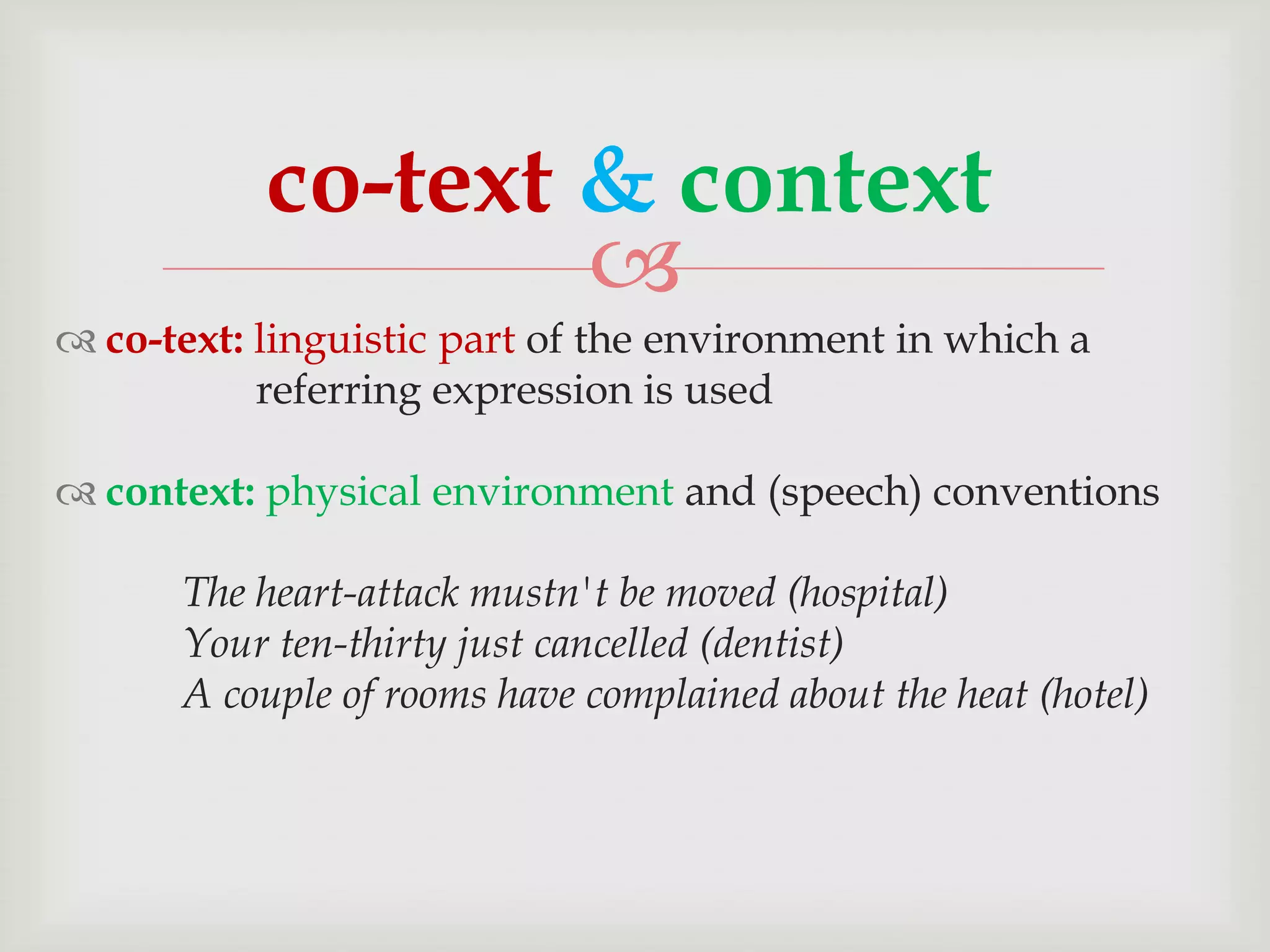
co-text & context

 co-text: linguistic part of the environment in which a
referring expression is used
 context: physical environment and (speech) conventions
The heart-attack mustn't be moved (hospital)
Your ten-thirty just cancelled (dentist)
A couple of rooms have complained about the heat (hotel)
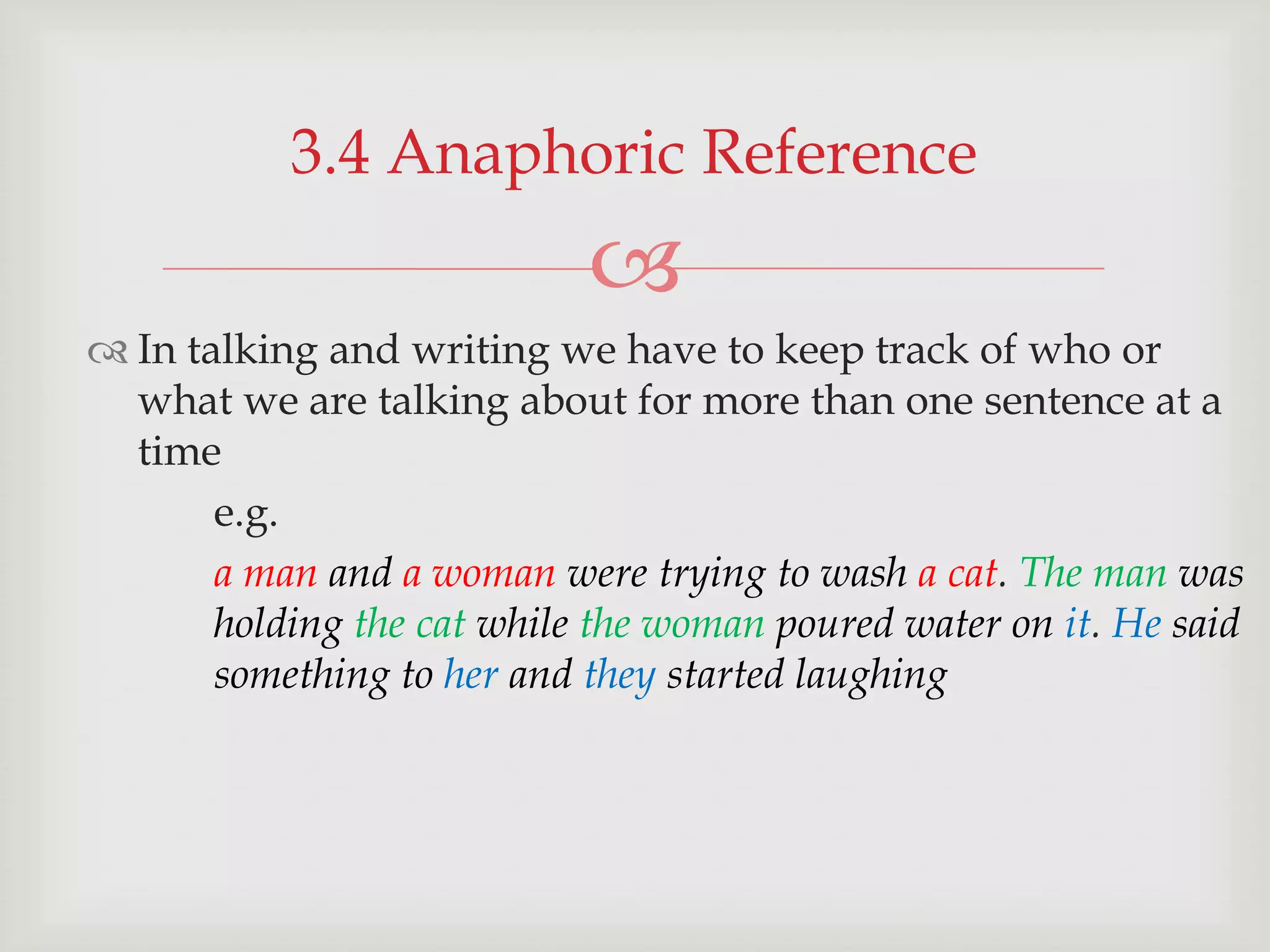
3.4 Anaphoric Reference


 In talking and writing we have to keep track of who or
what we are talking about for more than one sentence at a
time
e.g.
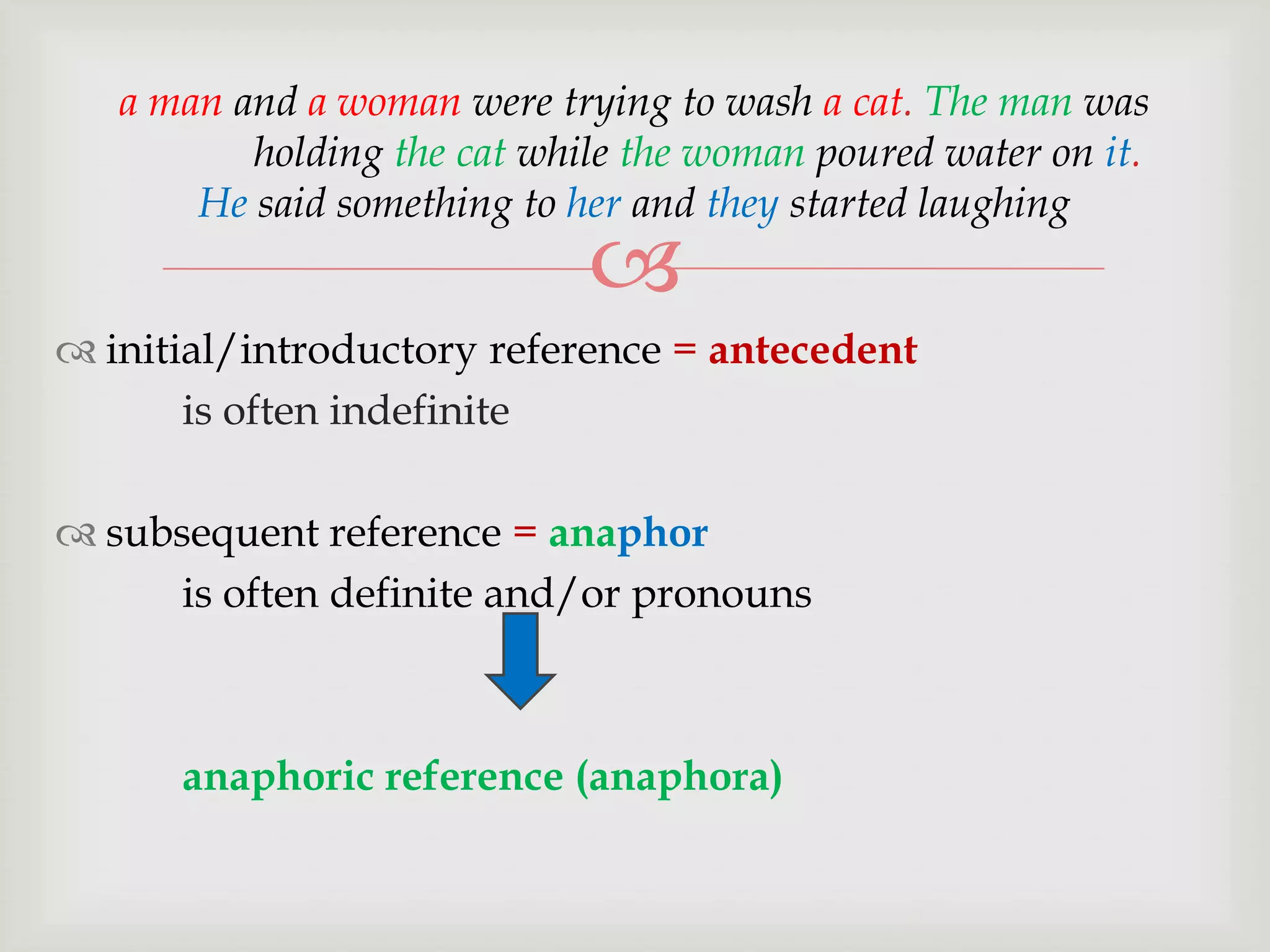
a man and a woman were trying to wash a cat. The man was
holding the cat while the woman poured water on it. He said
something to her and they started laughing
a man and a woman were trying to wash a cat. The man was
holding the cat while the woman poured water on it.
He said something to her and they started laughing



 initial/introductory reference = antecedent
is often indefinite

 subsequent reference = anaphor
is often definite and/or pronouns

anaphoric reference (anaphora)
Anaphora & Cataphora



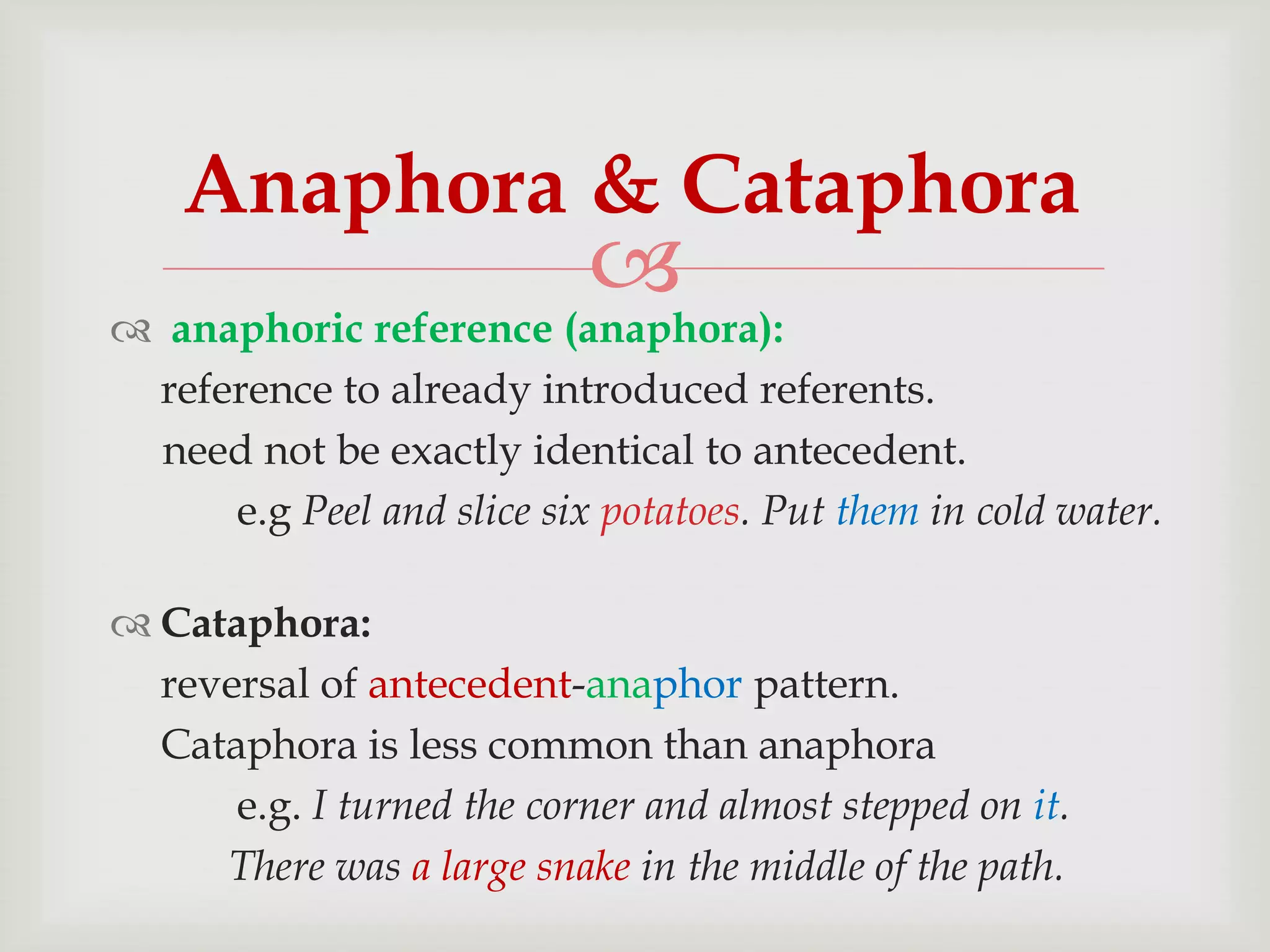
 anaphoric reference (anaphora):
reference to already introduced referents.
need not be exactly identical to antecedent.
e.g Peel and slice six potatoes. Put them in cold water.
 Cataphora:
reversal of antecedent-anaphor pattern.
Cataphora is less common than anaphora
e.g. I turned the corner and almost stepped on it.
There was a large snake in the middle of the path.
Zero anaphora /ellipsis



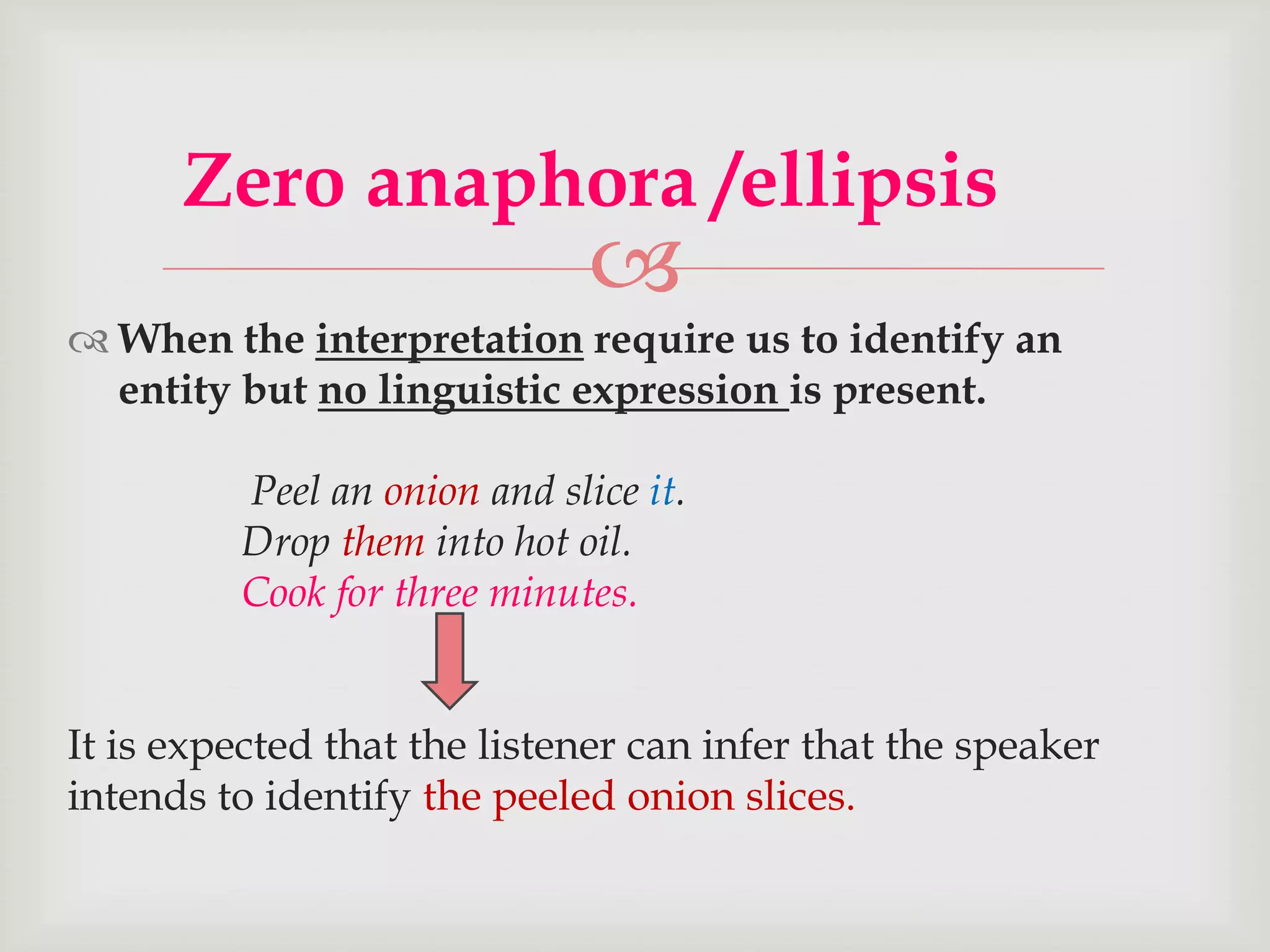
 When the interpretation require us to identify an
entity but no linguistic expression is present.
Peel an onion and slice it.
Drop them into hot oil.
Cook for three minutes.

It is expected that the listener can infer that the speaker
intends to identify the peeled onion slices.


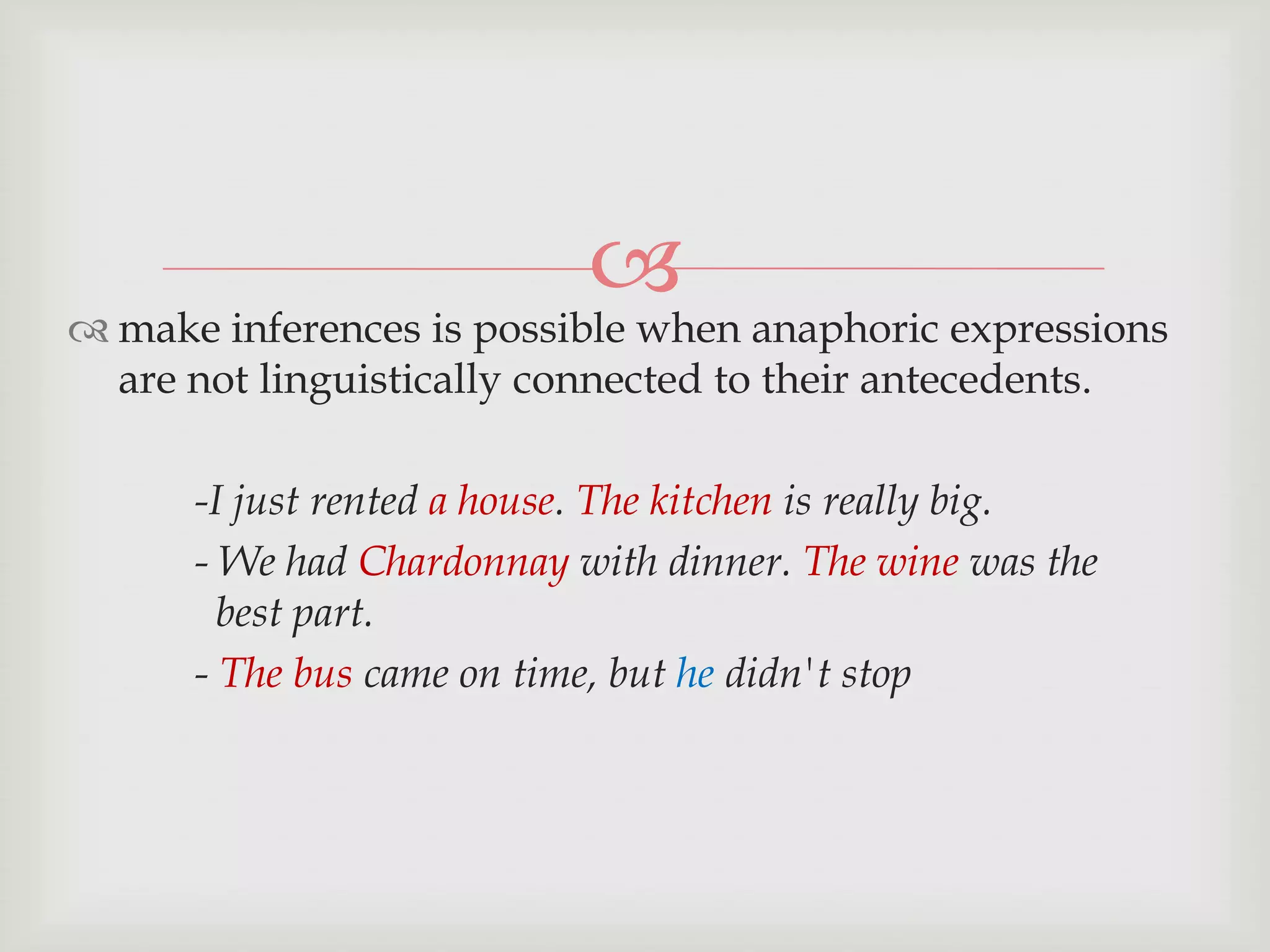
 make inferences is possible when anaphoric expressions
are not linguistically connected to their antecedents.
-I just rented a house. The kitchen is really big.
- We had Chardonnay with dinner. The wine was the
best part.
- The bus came on time, but he didn't stop
Successful reference



 Doesn‟t depend on some strictly literal, or grammatically
„correct‟ relationship between referent and referring
expression chosen.
 The key to making sense of reference is that an intention
was recognized, via inference, indicating a shared
knowledge and social connection.
 Social dimension of reference is tied to the effect of
collaboration - social closeness that they share.
Don‟t forget:
Pragmatics is the study of how more gets
communicated than is said.

03 reference and inference

  • 1.
    Below is aconversation between Katniss Everdeen and a President. Please analyze to which deixis does it belong and interpret distance between Katniss Everdeen and the President.  “My advisors were concerned Miss Everdeen would be difficult, but Miss Everdeen is not planning on being difficult, isn‟t she?” The President asks. “No,” I answer. “The President has a problem, Miss Everdeen. A problem that began back then when Miss Everdeen pulled out those poisonous berries in the arena.”
  • 2.
    3.1 Referential andattributive uses 3.2 Names and referents 3.3 The role of co-text 3.4 Anaphoric reference
  • 3.
    Introduction  Yule: “Words themselves donot refer to anything, people refer”
  • 4.
    Uwe‟?? Uwe‟ seemed to besleepy that moment  Ah! Uwe‟! Yes! she might be tired.
  • 5.
    Introduction  Reference: is anact in which a speaker, or writer, uses linguistic forms to enable a listener, or reader, to identify something. It is not simply a relationship between the meaning of a word and an object in the world Linguistic forms = referring expressions.
  • 6.
    Referring expressions  Proper nouns: Indonesia, George Yule Pronouns: it, he Noun phrase: Definite: the country, the lecturer Indefinite: a place, a woman
  • 7.
    Three dimensional diagram  Speaker– Reference – Intention Listener – Inference – Interpretation Collaborative words/phrases
  • 8.
    3.1 Referential andattributive uses   Yule: "not all referring expressions have identifiable physical referents. ". a physically present entity  Examples: a) There's a man waiting for you. exist but unknown b) He wants to marry a woman with lots of money. c) We'd love to find a nine-foot-tall basketball player doesn‟t exist
  • 9.
    Attributive use andreferential use attributive use:   „whoever/whatever fits the description‟  in indefinite noun phrase in which „a‟ can be replaced by „any‟ e.g. There's a man waiting for you (=any man)  In definite noun phrase in which „the‟ is assumed to exist, but cannot be ensure yet. e.g. There was no sign of the killer (A reporter is reporting a mysterious death)
  • 10.
    referential use:   Inindefinite noun phrase a specific person is referred to, although his/her name or some other description is not used. It‟s a choice the speaker makes. e.g.He wants to marry a woman with lots of money. (more interested to hear a woman with lots of money than a name)  In definite noun phrase „the‟ shows that a referent does exist. e.g. There was no sign of the killer. (in a news, a person‟s identified to murder, chased into a building, but escaped)
  • 11.
    3.2 Names andReferents   convention between all members of a community who share common language/culture which needs collaboration of „intention-to-identify‟ and „recognition-ofintention‟. E,g  'Shakespeare' does not refer only to a specific person: A: Can I borrow your Shakespeare? B: Yeah it's over there on the table
  • 12.
      Shakespeare „things the writer produced‟  conventional and culture specific set of entities Shakespeare takes up the whole bottom shelf We're going to see Shakespeare in London I hated Shakespeare at school Shakespeare is over there on the table
  • 13.
     to aperson  'the cheese sandwich' can refer A: Where's the cheese sandwich sitting? B: He's over there by the window (Conversation between waiters in a restaurant)  pragmatic connection: proper names and objects conventionally associated with those names within a socio-culturally defined community.  conventions may differ from one social group to another
  • 14.
    3.3 The Roleof Co-text  referents depend on :  The ability to identify intended - the listener‟s understanding of the referring expression - aided by the linguistic material (co-text)  Brazil wins World Cup ('wins World Cup' limits the range of possible interpretations)  the referring expression provides a range of reference- a number of possible referentsThe cheese sandwich is made with white bread (= food) The cheese sandwich left without paying (=person)
  • 15.
    co-text & context  co-text: linguistic part of the environment in which a referring expression is used  context: physical environment and (speech) conventions The heart-attack mustn't be moved (hospital) Your ten-thirty just cancelled (dentist) A couple of rooms have complained about the heat (hotel)
  • 16.
    3.4 Anaphoric Reference  In talking and writing we have to keep track of who or what we are talking about for more than one sentence at a time e.g. a man and a woman were trying to wash a cat. The man was holding the cat while the woman poured water on it. He said something to her and they started laughing
  • 17.
    a man anda woman were trying to wash a cat. The man was holding the cat while the woman poured water on it. He said something to her and they started laughing   initial/introductory reference = antecedent is often indefinite  subsequent reference = anaphor is often definite and/or pronouns anaphoric reference (anaphora)
  • 18.
    Anaphora & Cataphora  anaphoric reference (anaphora): reference to already introduced referents. need not be exactly identical to antecedent. e.g Peel and slice six potatoes. Put them in cold water.  Cataphora: reversal of antecedent-anaphor pattern. Cataphora is less common than anaphora e.g. I turned the corner and almost stepped on it. There was a large snake in the middle of the path.
  • 19.
    Zero anaphora /ellipsis  When the interpretation require us to identify an entity but no linguistic expression is present. Peel an onion and slice it. Drop them into hot oil. Cook for three minutes. It is expected that the listener can infer that the speaker intends to identify the peeled onion slices.
  • 20.
      make inferencesis possible when anaphoric expressions are not linguistically connected to their antecedents. -I just rented a house. The kitchen is really big. - We had Chardonnay with dinner. The wine was the best part. - The bus came on time, but he didn't stop
  • 21.
    Successful reference   Doesn‟tdepend on some strictly literal, or grammatically „correct‟ relationship between referent and referring expression chosen.  The key to making sense of reference is that an intention was recognized, via inference, indicating a shared knowledge and social connection.  Social dimension of reference is tied to the effect of collaboration - social closeness that they share. Don‟t forget: Pragmatics is the study of how more gets communicated than is said.