IPv6 The Big Move: Transition and Coexistent
               Frenil V. Dand
                 Touro College


                                               10
IPv6 The Big Move: Transition and Coexistent                                                                           2


                                                  Table of Content
Introduction………………………………………………………………………… 2

Advantages of IPv6 over IPv4……………………………………………………....4

How does IPv6 work?............................................................................................... 4

IPv6 Global Unicast Address………………………………………………………. 7

IPv6 Multicast and Anycast Addressing…………………………………………… 9

IPv6 Headers……………………………………………………………………….. 10

IPv6 Address Autoconfiguration and Renumbering……………………………….. 13

IPv4-IPv6 Transition and Coexistence…………………………………………….. 15

Conclusion…………………………………………………………………………. 20

Appendix 1…………………………………………………………………………. 22

Appendix 2…………………………………………………………………………. 24
IPv6 The Big Move: Transition and Coexistent                                                       3


                                               Abstract

This paper talks about the move from current Internet Protocol (IPv4) to next generation of

Internet Protocol, which is refer to as the next-generation IP (IPng) or IP version 6 (IPv6). It

looks at the history of IP and why the move is necessary. It talks about advantages of IPv6 over

IPv4 and how IPv6 works and looks, since it’s completely re-designed. We look at the division

of the address space and headers. Then we look at how IPv6 willcoexist with IPv4 over a long

period of time. We look at some the technologies IPv6 and IPv4 networks will have to use in

order to talk to each other.There are number solution currently available ranging from off-the-

shelf application to 3rd party vendor. Then there are other transition mechanisms which are more

complex and involved that require much more work and new hardware/software implementation

on the networks; before IPv4 traffic can talk to IPv6 or IPv6 can talk to IPv4. Also the operating

system like Windows 7 and Vista are IPv6 ready. We also look at some of the technologies that

will help corporations with move, since most of the enterprises are behind NAT. This move is

happening worldwide and some of the country in Asia-Pac region are much more ahead then

U.S, although Federal Agencies have already made the move to IPv6.
IPv6 The Big Move: Transition and Coexistent                                                         4


Introduction:

The next-generation Internet Protocol (IPng) or Internet Protocol version 6 (IPv6) as it’s known

formally in tech world is successor to current Internet Protocol (IPv4). The rate at which the

Internet is growing it’s running out of IP address. There is a very cool counter at

http://www.ipv6forum.com/ and its counting down reaming IPv4 address. According to site X-

day is May 30th 2011. Given the current rate at which IPv4 address are been take, its calculated

that IPv4 address will completely run out in about 12 months plus or minus few weeks, that’s

sometime in third quarter of 2011(Santo, 2010).

Let’s talk bit of history, because those to forget the history are doom to repeat it. And we know

that’s not case with IPv6, because IPv6 addresses are not running out any time soon. It all began

in the 60’s when ARPANET (Advance Research Projects Agency Network) was created; it was

design with Network Control Protocol (NCP). NCP made different types of host to connect on

the same network and talk to each other, but NCP had its limitations. So they stared the work on

something new and better and the engineers split the massive NCP in two as we know it today

TCP and IP. An Internet Protocol (IP) that allows data to be routed between the different

network and a Transport Control Protocol (TCP) take the data (Beijnum, 2007).

TCP/IP as also its own limitations but unlike NCP it was served Internet and the tech world very

well since its birth in 80’s and it is doing until this day. But limitations on IP part of TCP/IP will

make further growth of the Internet come to halt, and impossible for new technologies and next

generation of eBay’s and Google’s to emerge. Not only IP is limited by its 32 bit address size but

its QoS (Quality of Service) and security as well. With 32 bits, it's possible to express

4,294,967,296 different values. Over half a billion of those are unusable as addresses for various

reasons, giving us a total of 3.7 billion possible addresses, inadequate for giving even one

address to every living person, much less to new generation of IP cars, phones, PDA’s, T.V’sand
IPv6 The Big Move: Transition and Coexistent                                                        5


refrigerators; while IPv6 supports about 340 undecillion (1036) addresses.We know IPv6 is going

to give very very very large amount of address space since it is based on 128bits. This number is

beyond enormous 340,282,366,920,938,463,463,374,607,431,768,211,456. Beijnum very nicely

put this number perspective: there are currently 130 million people born each year. If this

number of births remains the same until the sun goes dark in 5 billion years, and all of these

people live to be 72 years old, they can all have 53 times the address space of the IPv4 Internet

for every second of their lives.(Beijnum, 2007).

Work on IPv6 has be going on since the early 90’s and it was first to be implemented in Linux

and IBM’s AIX (Langley, 2007). It has been adopted by the Internet Engineering Task Force

(IETF) since then. The IETF is the standards body responsible for IPv6 and IPv4. Move to IPv6

has been slowed by Network Address Translation (NAT), which could whole another paper.

Basically with NAT you only need one public IP address and all the hosts behind a NAT device

will be given one of the private IP blocks e.g. 10.0.0.0, 172.16.0.0 or 192.168.0.0. These address

block have been set aside for private use in RFC 1918. But NAT does not solve the problem but

only make things more complex with peer-to-peer application like the multi-user games, VoIP

and only prolongs address issue (Beijnum, 2007). Some of the leading Web content providers

like Google, Yahoo, Netflix, and Microsoft are already in talks about creating a shared DNS

Whitelist of customers who can access their Web sites using IPv6 and would use this list to

provide the content to these Whitlisted IP’s via IPv6 rather than through IPv4. Google has said

that the DNS Whitelist for IPv6 was the easiest way it could provide IPv6 services without

blocking customers with broken IPv6 links (Marsan, Google, Microsoft, Netflix in talks to create

shared list of IPv6 users; Open source 'whitelist' would aid transition to next-gen Internet service,

proponents say, 2010).
IPv6 The Big Move: Transition and Coexistent                                                        6


Advantages of IPv6 over IPv4:

Let’s talk about some of the advantages of IPv6 over IPv4. We know one of the biggest

advantages is trillions times more address than IPv4, but there are others as well.

   1. Larger address space.

   2. Simpler and leaner headers by removing six unnecessary fields and adding one new field.

       This will provide for more efficient routing.

   3. It will much easier to configure IPv6 because it supports both stateful and stateless

       address configurations. It uses neighbor discovery to find other IPv6 systems and work

       with or without DHCP server.

   4. Much more secure, since the IPSec is mandatory.

   5. Better Quality of Service, this is part of the new header field. These fields will define

       how the traffic is identified and routed.

   6. Better real-time performance by packet prioritization this will improve the response time

       of real-time applications.

   7. IPv6 also has improved multicast support, unlike IPv4 it does not support broadcast. IPv6

       has much broader range for multicast address which will perform all the functions that

       required broadcasts. Multicast is a very basic and essential feature of IPv6 (3Com, 2004).


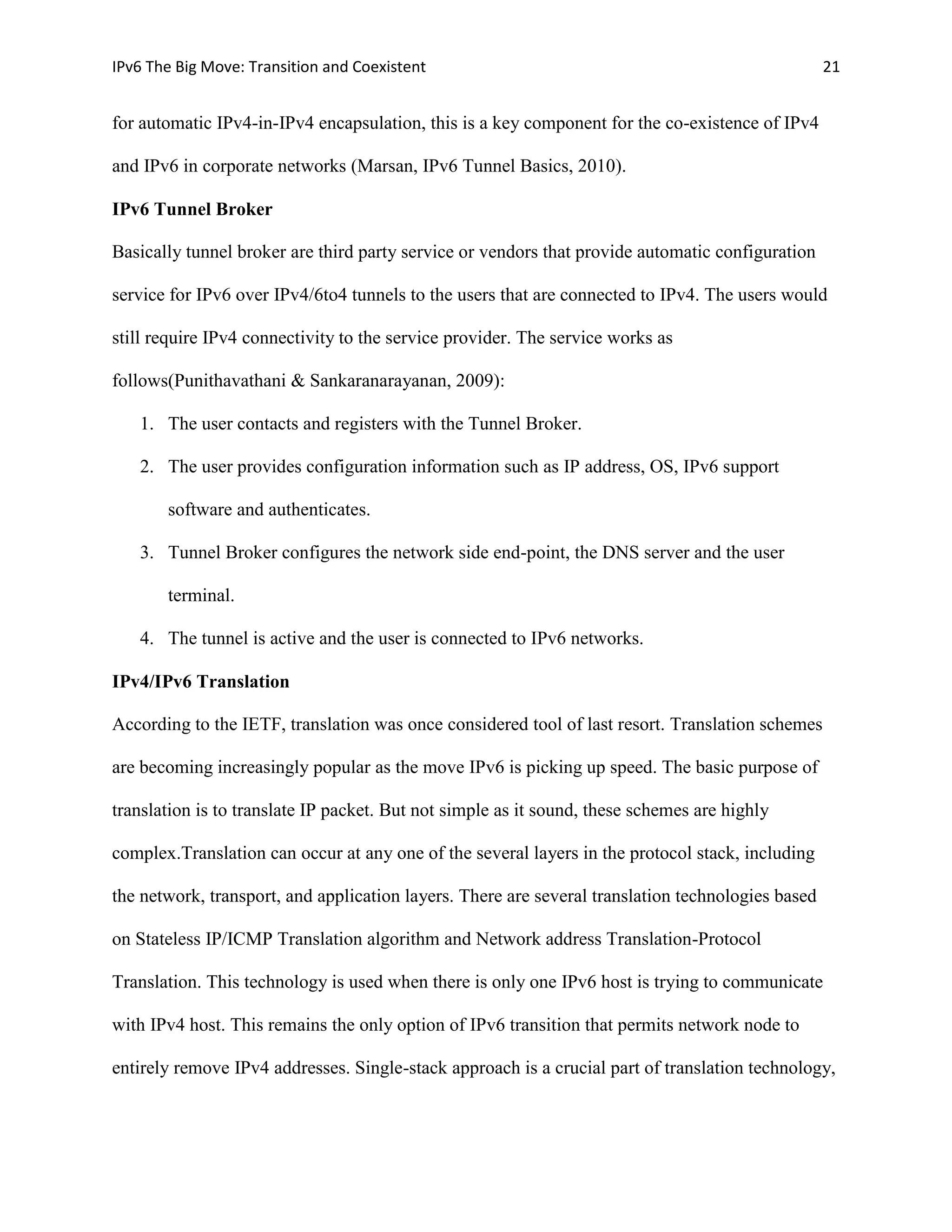
See Table 1: Comparison between IPv4 and IPv6 (3Com, 2004).

How does IPv6 Work?

This is a great analogy by Allied Telesis, when there is a shortage of telephone number in larger

city; additional digits are added to the front of the telephone numbers to increase the amount of

available numbers. In the same way, IP addresses shortage is solved in IPv6 by adding additional

bytes to the IP address. But it is easier said than done and bit more complex, so the change is not
IPv6 The Big Move: Transition and Coexistent                                                           7


going to be overnight like in the case of adding the telephone number. There for IPv4 and IPv6

are going to have to play nice with each other to coexist over a transition period (Allied Telesis,

2007).

IPv6 Addressing

IPv6 addresses not only look much different than IPv4 address, but they are built different and

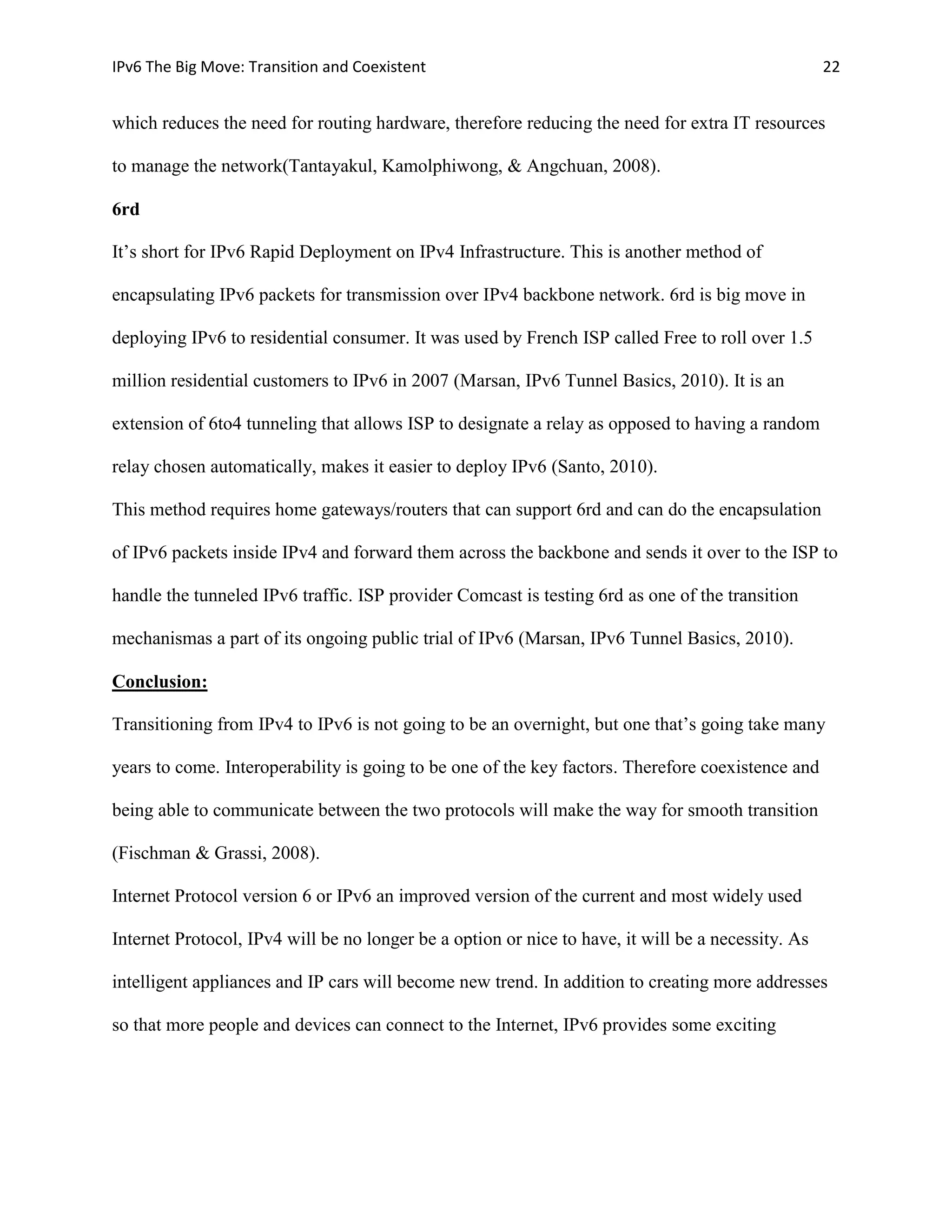
have hierarchical addressing. IPv6 increases the IP address space from 32 bits to 128 bits (see

figure 1). The new 128-bit IPv6 addresses are written in the form of 8-16 bit hex components

separated by colons (e.g. X:X:X:X:X:X:X:X) unlike the IPv4 address X.X.X.X. Let’s take a look

an actual IPv6 address and how it can be compressed. Like we said IPv6 addresses are written in

hexadecimal notation, rather than familiar dotted decimal notation of IPv4, as shown in the

following example:

2001:0DB8:C003:0001:0000:0000:0000:F00D

Can be represented in shorter format by removing leading zeros

2001:DB8:C003:1:0:0:0:F00D

         Further reduction by removing consecutive fields of zeros using the double-colon ::

         option

         Note the double-colon can be used only once, because multiple occurrences would lead to

         ambiguity (e.g. address 2001:0:0:FFD3:0:0:0:57ab, if written as 2001::FFD3::57ab, could

         represent 2001:0:0:0:0:FFD3:0:57ab/ 2001:0:0:0:FFD3:0:0:57ab/

         2001:0:0:FFD3:0:0:0:57ab/ and 2001:0:FFD3:0:0:0:0:57ab.

2001:DB8:C003:1::F00D(Cisco Systems, 2006)

IPv6 addresses are organized in hierarchical manner. Let’s use Allied Telesis telephone analogy

to understand this better. In a telephone hierarchical structure is obtain through use of area code,
IPv6 The Big Move: Transition and Coexistent                                                         8


city code, and country code, allowing aggregation by using shorter telephone numbers closer to

home. But as you are dialing far away you will have to use extra number or code to reach far

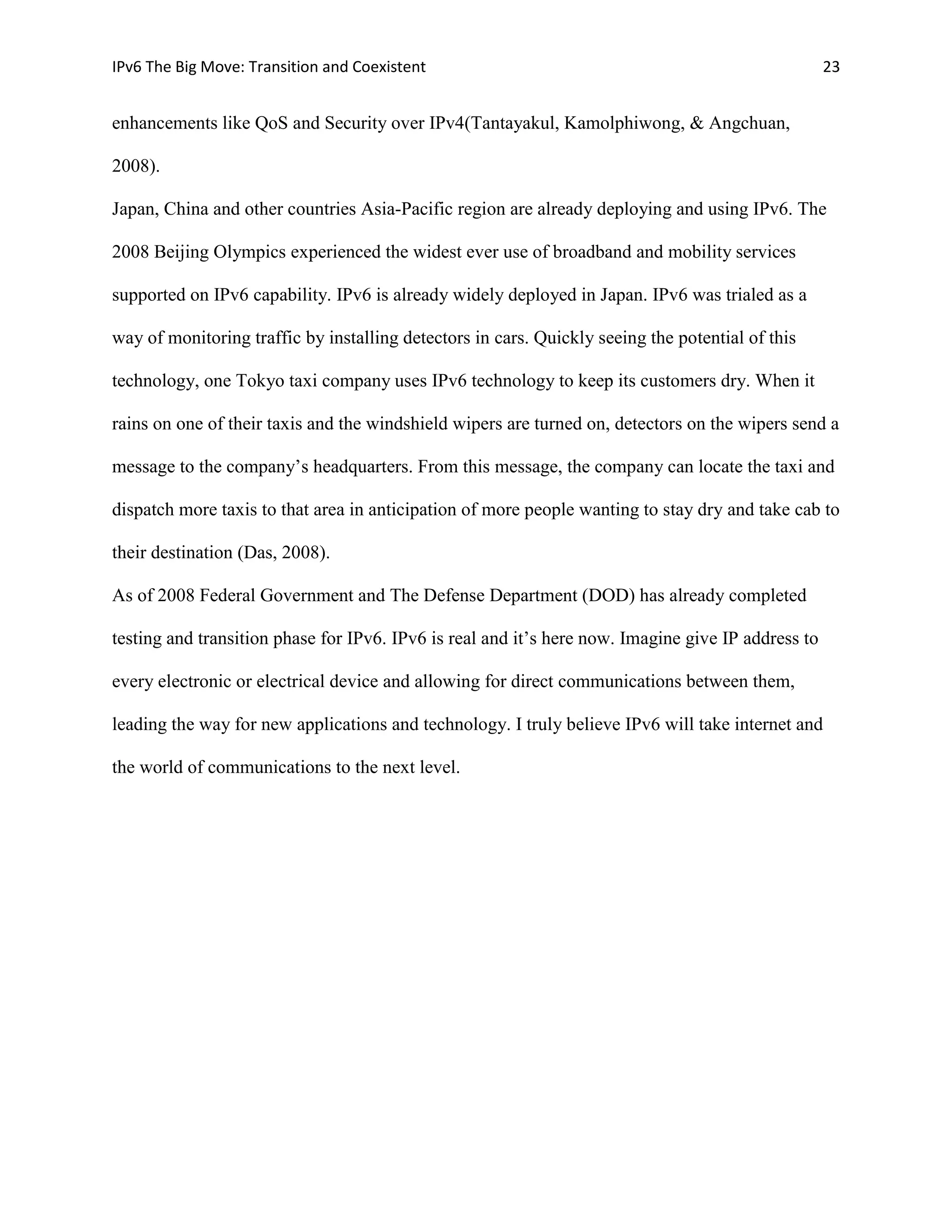
away. In IPv6 aggregation is obtained by providing an address prefix and the organization of

addresses into two levels they called public topology and interface identifier. Public topology is

for providers of public Internet services and the interface identifier is for specific node on a link.

Hierarchical routing allows for smaller routing tables and more efficient address allocation.

Faster routes lookup and reduced latency are direct result of this. The general format IPv6

address will look like this (see figure 2)(Allied Telesis, 2007).

Basically there are three address types which are supported by IPv6:

Unicast Addresses

One-to-one this type of communication is between a single host and a single receiver. Packets

sent to a unicast address are delivered to the node identified by that address.

Multicast Addresses

One-to-many this has replaced broadcast address type from IPv4. These addresses could

represent various groups of IP devices. A message sent to multicast address goes to all the nodes

in that group. In IPv6 multicasting is required address type. Has much better feature and many

more addresses.

Anycast Addresses

One-to-nearest this is allocated from unicast, is used when a message must be sent to any node in

the group, but does not need to go to all, usually the node that is easiest to reach (Das, 2008).

Special address types

Besides the three address types we just discussed, IPv6 has several other types of addresses. The

two most important special purpose address types are:
IPv6 The Big Move: Transition and Coexistent                                                        9


Link local

These addresses are used to communicate over one physical or logical network or subnetwork.

These addresses are extensively used for IPv6’s internal network and start with FE80.They are

automatically configured on a IPv6 node by using prefix FE80::/10. Link-local addresses are also

used in the neighbor discovery protocol, even in the absence of all other unicast addresses

(Kozierok, 2005).

Site local

This is the IPv6 equivalent of the RFC 1918 private address space in IPv4. But IETF found a

situation it did not like where if different organizations use the same address space, so they

created a “unique site local” addresses where organizations takes a randomly selected block out

of IPv6 address space starting with FD (Beijnum, 2007).

IPv6 Global Unicast Address:

A very large number of IPv6 address space is dedicated to unicast addressing because it will be

used for the vast majority of the Internet traffic under IPv6. One-eighth of all the IPv6 address

will be unicast addresses which start with 001 in the first three bits of the address. So what

happens to the remaining 125 bits and how do we use them.

When Internet was first created using IPv4 it was very small and easy to manage, anyone that

wanted a presence on the web when to the Internet Assigned Numbers Authority and got an IP.

As the Internet got bigger and bigger it got harder to manage and IANA model was not working.

So the big ISP got large blocks of IP from the IANA and sold them or leased them to the

customers. Learning from this experience the designers of IPv6 have incorporated overall

topology of the Internet in designing unicast address with tremendous advantages some of them

are as follows:
IPv6 The Big Move: Transition and Coexistent                                                       10


         Easier allocation of address block at any levels of the Internet topological hierarchy.

         ISP’s have greater flexibility to subdivide address blocks for customers

         End-used organizations have more flexibility to subdivide their address blocks to match

         internal networks.

         IP addresses will have more meaning to them. It won’t be just string of HEX number

         with no structure. You would be able to tell certain things about it just by looking at the

         number (Kozierok, 2005).

Division of IPv6 Address Space

128 bits of the unicast address space is divided into three sections:

       Site prefix

       Subnet ID

       Interface ID

These three components are identified by the position of the bits within the address. The first

three fields in an IPv6 address make up the site prefix (in red). The next field represents the

subnet ID (in blue). And the last four fields are used for the interface ID (in green).

2001:0DB8:C003:0001:0000:0000:0000:F00D

The first 48 bits of site prefix are equivalent to network number in IPv4, this is used for routing,

and the first three bits are always “001” to indicate a unicast address. The next 16 bits are subnet

ID, a number that identifies a subnet within the site. Gives us 64 bits remaining for the interface

ID which is a unique identifier for a particular interface this could be a host or any other device.

This will be unique within a specific prefix and subnet (Kozierok, 2005).

IPv6 Multicast and Anycast Addressing:
IPv6 The Big Move: Transition and Coexistent                                                       11


Since Broadcast as an address type has been eliminated from IPv6 and Unicast addresses are still

the choice for the vast majority of communications as it was in IPv4. But the “bulk” addressing

methods are different in IPv6. Hence one of the major changes to general addressing model in

IPv6 was a change to the basic types of addresses, support for Multicast addressing has been

expanded and a required part of IPv6, and a new address type called Anycast (Kozierok, 2005).

Multicast Addresses

A multicast address identifies multiple interfaces it is used to allow a one device to send packets

to group of devices. All multicast addresses start with prefix format of “FF” in Hex or 1111 1111

in binary. The key here is the second octet or the next four bits it defines the lifetime of the

address. They are called the Flags bit 0 = permanent and 1 = temporary. The next four bits after

that defines the scope of the address. There are possible of 16 different values from 0 to 15, these

values make it possible for multicast addresses to be created that are global to the entire Internet

or restricted smaller environment or to a specific organization. That leaves us with remain 112

bits which are used for group ID, it defines a specific group within each scope level (Kozierok,

2005).

Anycast Addresses

This is the new and unique address type that is new to IPv6. You can think of anycast address as

a mix between unicast and multicast addresses. Unicast sends packet to only one address and

multicast send packet to every member of the group, but anycast sends the packet to any one

member of the group choosing the closest member on its route. Router have to be configured to

respond to anycast packets will do so when a packet comes in for the anycast address (Kozierok,

2005).

IPv6 Headers:
IPv6 The Big Move: Transition and Coexistent                                                          12


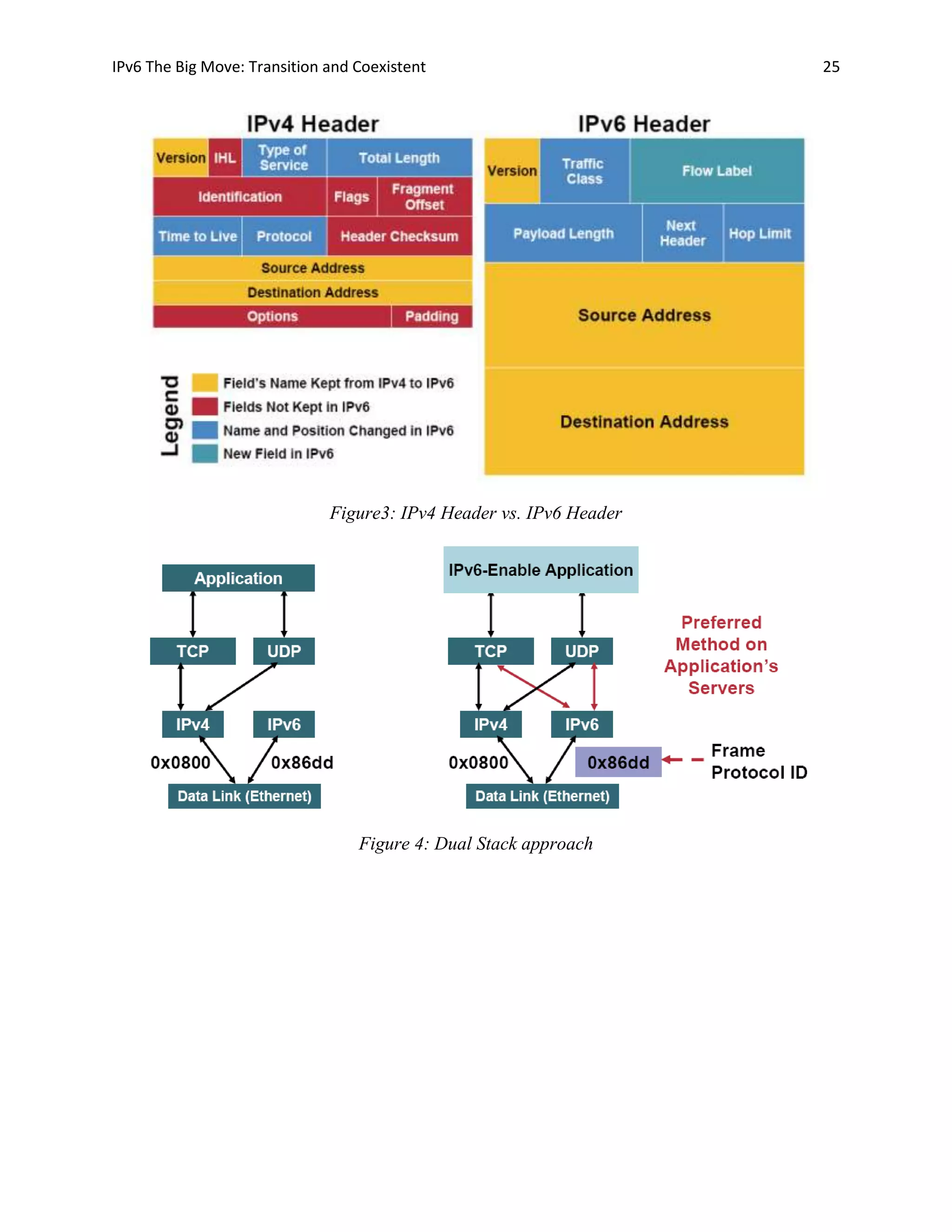
The simplified header allows for easier and less complicated processing of IP packets. The

header fields are as follows: Source Address, Destination Address, Version, Class, Flow label,

Payload Length, Next Header, and Hop Limit. There are few changes to the format and fields

(see figure 3), gives a high-level view of the basic comparison between the IPv4 and IPv6. IPv6

has better Quality of Service (QoS) or content prioritization over IPv4 by using header

compression and optional header extensions(Allied Telesis, 2007).

Source address (128 bits) The 128-bit source address field contains the IPv6 address of the

originating node of the packet. It is the address of the originator of the IPv6 packet.

Destination address (128 bits) The 128-bit contains the destination address of the recipient

node of the IPv6 packet. It is the address of the intended recipient of the IPv6 packet.

Version/IP version (4-bits) The 4-bit version field contains the number 6. It indicates the

version of the IPv6 protocol. This field is the same size as the IPv4 version field that contains the

number 4.

Packet priority/Traffic class (8 bits) The 8-bit Traffic Class field replaced the Type of Service

(TOS) field in the IPv4 header. IPv6 header can assume different values to enable the source

node to differentiate between the packets generated by it by associating different delivery

priorities to them. This field is used by the originating node and the routers to identify the data

packets that belong to the same traffic class and distinguish between packets with different

priorities.

Flow Label/QoS management (20 bits) The 20-bit flow label field in the IPv6 header can be

used by a source to label a set of packets belonging to the same flow. This field is new to IPv6.

This will improve quality of real-time service, because all packets belonging to the same flow

must be sent with the same source address, destination address, and flow label. Router saves a
IPv6 The Big Move: Transition and Coexistent                                                          13


cache of handling requirement for a particular flow label is known as the state information.

When packets arrive at a router it can be efficiently routed to the destination since the

information is already cached and the router does not have to examine the rest of the header for

each packet in same flow.

Payload length in bytes(16 bits) The 16-bit payload length field replaced the Total Length field

from the IPv4 header. But unlike IPv4 header it does not measure the length of the whole packet,

it only contains the number of bytes of the payload. It puts an upper limit on the maximum

packet payload to 64 kilobytes. In case a higher packet payload is required, a Jumbo payload

extension header is provided in the IPv6 protocol.

Next Header (8 bits) The 8-bit Next Header field replaced the Protocol field and serves two

purposes. Itidentifies the type of header immediately following the IPv6 header and located at

the beginning of the data field (payload) of the IPv6 packet. This field usually specifies the

transport layer protocol used by a packet's payload. When a packet only has main header and no

extension headers, it is used as the old IPv4 Protocol field and has the same values.

Hop Limit (8 bits)The 8-bit Hop Limit field replaced Time To Live (TTL) field in the IPv4

header. If the Hop Limit field is decremented to zero, the packet is discarded. The main function

of this field is to identify and to discard packets that are stuck in an indefinite loop due to any

routing information errors (Das, 2008).

IPv6 Extension Headers

The IPv4 header includes all options. Therefore, each intermediate router must check for their

existence and process them when present. This can cause performance degradation in the

forwarding of IPv4 packets. With IPv6, delivery and forwarding options are moved to extension

headers. The only extension header that must be processed at each intermediate router is the
IPv6 The Big Move: Transition and Coexistent                                                        14


Hop-by-Hop Options extension header. This increases IPv6 header processing speed and

improves forwarding process performance.

RFC 2460 defines the following IPv6 extension headers that must be supported by all IPv6 nodes

(Cisco Systems, 2006):

           Hop-by-Hop Options header

           Destination Options header

           Routing header

           Fragment header

           Authentication header

           Encapsulating Security Payload header

In a typical IPv6 packet, no extension headers are present. If special handling is required by

either the intermediate routers or the destination, one or more extension headers are added by the

sending host. Most IPv6 extension headers are not examined or processed by any router along a

packet’s routing path until the packet gets to the final destination. This results in a major

improvement in router performance for packets containing extensions. Each extension header

must fall on a 64-bit (8-byte) boundary. Extension headers of variable size contain a Header

Extension Length field and must use padding as needed to ensure that their size is a multiple of 8

bytes(Hinden, 1996).

IPv6 Address Autoconfiguration and Renumbering:

A highly useful aspect of IPv6 is its ability to automatically configure itself without the use of a

stateful configuration protocol, such as Dynamic Host Configuration Protocol for IPv6

(DHCPv6). By default, an IPv6 host can configure a link-local address for each interface. By

using router discovery, a host can also determine the addresses of routers, additional addresses,
IPv6 The Big Move: Transition and Coexistent                                                          15


and other configuration parameters. Included in the Router Advertisement message is an

indication of whether a stateful address configuration protocol should be used.

Address autoconfiguration can only be performed on multicast-capable interfaces. Address

autoconfiguration is described in RFC 2462, "IPv6 Stateless Address Autoconfiguration."

(Kozierok, 2005)

The following is a summary of the steps a device takes when using stateless autoconfiguration:

   1. Link-Local Address Generation The device generates a link-local address. You’ll recall

       that this is one of the two types of local-use IPv6 addresses. Linklocal addresses have

       1111 1110 10 for the first 10 bits. The generated address uses those 10 bits, followed by

       54 zeros and then the 64-bit interface ID. Typically, this will be derived from the data

       link layer (MAC) address as explained in the "IPv6 Interface Identifiers and Physical

       Address Mapping" section earlier in this chapter, or it may be a "token" generated in

       some other manner.

   2. Link-Local Address Uniqueness Test The node tests to ensure that the address it

       generated isn’t already in use on the local network. (This is very unlikely to be an issue if

       the link-local address came from a MAC address; it is more likely that the address is

       already in use if it was based on a generated token.) It sends a Neighbor Solicitation

       message using the ND protocol. In response, it listens for a Neighbor Advertisement,

       which indicates that another device is already using its link-local address. If so, either a

       new address must be generated or autoconfiguration fails, and another method must be

       employed.

   3. Link-Local Address Assignment Assuming the uniqueness test passes, the device

       assigns the link-local address to its IP interface. This address can be used for
IPv6 The Big Move: Transition and Coexistent                                                        16


       communication on the local network, but not on the wider Internet (since link-local

       addresses are not routed).

   4. Router Contact The node next attempts to contact a local router for more information on

       continuing the configuration. This is done either by listening for Router Advertisement

       messages sent periodically by routers or by sending a specific Router Solicitation

       message to ask a router for information on what to do next.

   5. Router Direction The router provides direction to the node about how to proceed with

       the autoconfiguration. It may tell the node that on this network stateful autoconfiguration

       is in use, and it may give it the address of a DHCP server to use. Alternatively, it will tell

       the host how to determine its global Internet address.

   6. Global Address Configuration Assuming that stateless autoconfiguration is in use on

       the network, the host will configure itself with its globally unique Internet address. This

       address is generally formed from a network prefix provided to the host by the router. The

       prefix is combined with the device’s identifier, as generated in step 1.

This method has numerous advantages over both manual and serverbased configuration. It is

particularly helpful in supporting the mobility of IP devices, because they can move to new

networks and get a valid address without any knowledge of local servers or network prefixes. At

the same time, it still allows for the management of IP addresses using the (IPv6-compatible)

version of DHCP, if that is desired. Routers on the local network will typically tell hosts which

type of autoconfiguration is supported using special flags in Internet Control Message Protocol

version 6 (ICMPv6) Router Advertisement messages (Kozierok, 2005).

IPv6 Transition & Coexistence:

As of today if you are on the Internet, you are using only IPv4 which would be the majority of

the population. But there are parts of Internet that are also running on IPv6. And if you are only
IPv6 The Big Move: Transition and Coexistent                                                        17


running IPv4 you will not be able to get to parts of Internet running IPv6, which is increasing as I

am writing this paper. Unfortunately IPv4 and IPv6 are incompatible protocols. As a user if you

want to access all part of the Internet running IPv4 and IPv6 you will require some kind of

technology that will allow you visit the IPv6 world. IPv6 will have to coexist with IPv4 until the

entire migration is completed. This is no simple task and one that could be year in

progress(Punithavathani & Sankaranarayanan, 2009). The degree of difficulty is huge especially

for large and complex networks. Some IT professionals have described it as to changing the

engine on a moving airplane (Fischman & Grassi, 2008).

There are various transition technologies available to help achieve seamless coexistence during

the transition period. IETF has also created the Ngtrans Group to facilitate smooth transition.

There are three major categories for transition technologies (Punithavathani &

Sankaranarayanan, 2009):

        Dual stack

        Tunneling

        Translation


Dual-Stack

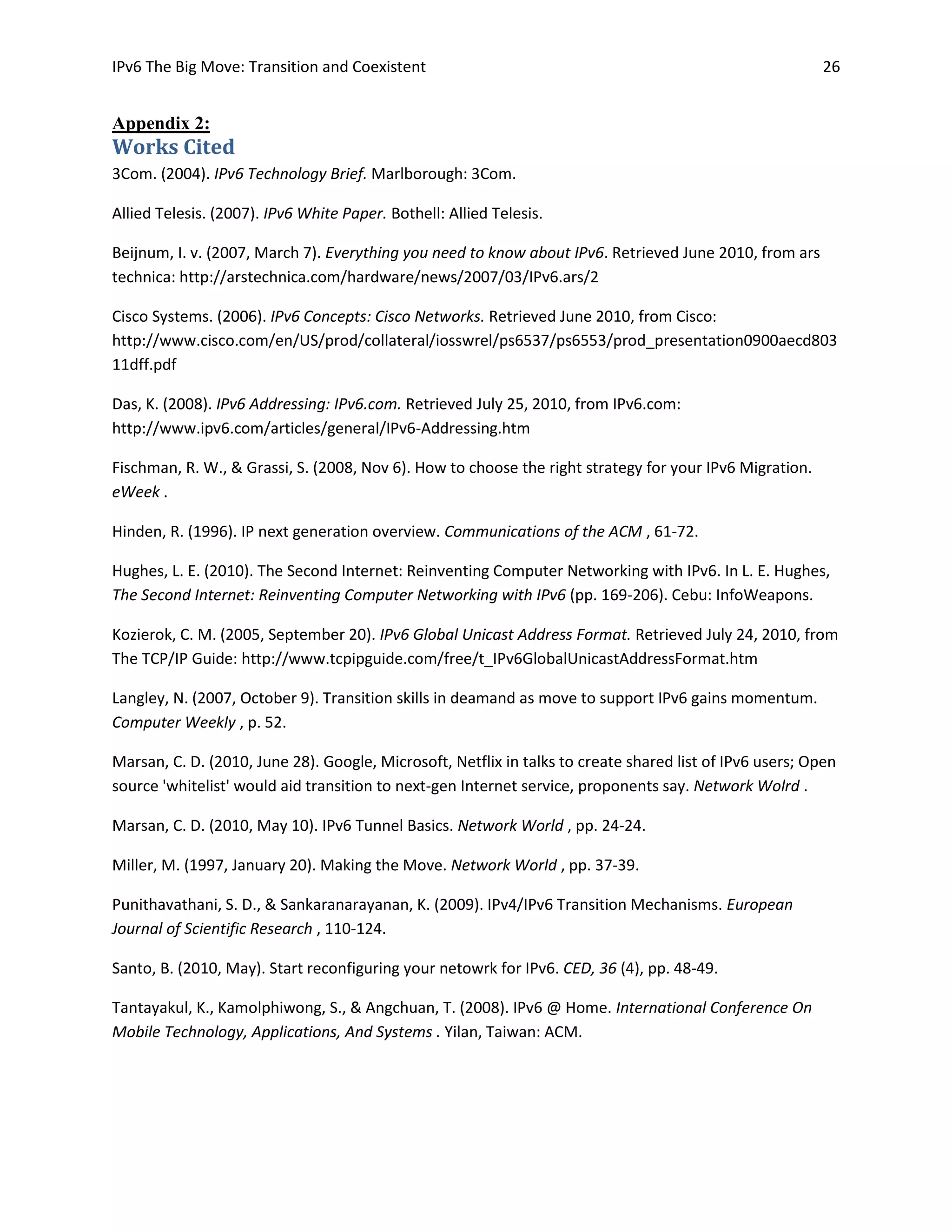
This is one of the main transition/coexistence techniques used, as the name says it all “Dual-

stack” this technique includes two protocol stacks that run in parallel (see figure 4). It allows

network nodes to communicate either via IPv4 or IPv6 and can be implemented on both end

systems such as workstation or server and network nodes such as routers and switches. There is

no direct communication between IPv4 and IPv6. On the workstations and servers it enables
IPv6 The Big Move: Transition and Coexistent                                                     18


both IPv4 and IPv6 applications to operate at the same time and on the network side it transports

both the IPv4 and IPv6 packets. A major challenge with dual-stack is that all network resources

need to have plenty of processing power to allow two different IP stacks at same time. And it

will also require dual management of the network (Fischman & Grassi, 2008).

IPv4 applications use the IPv4 stack, and IPv6 applications use the IPv6 stack. Version filed of

the IP header is used to make flow decisions for receiving and on the destination address type

for sending packets. DNS lookups are used to get address types and the appropriate stack is

selected based upon types of DNS records returned. Great thing about dual-stack mechanism is

that many off-the-shelf operating systems already have dual-stack IP protocol built in. Therefore

this is one of the most widely used transition method used currently(Miller, 1997).

Tunneling

Another transitioning technology is the use of tunnels. This technology encapsulates one

protocol type within another protocol. If you look at it from the transitioning standpoint

tunneling allows incompatible networks to be linked, which you are not able to do with stand

alone dual-stack. You can encapsulate IPv6 packet inside an IPv4 and transport it over IPv4

network. But tunneling does require running dual-stack at each end of the tunnel. Three main

tunneling techniques are(Punithavathani & Sankaranarayanan, 2009):

        IPv6 over IPv4

        IPv6 to IPv4 automatic tunneling

        Tunnel Broker

The tunneling process dose involves three distinct steps (Miller, 1997):

       Encapsulation

       Decapsulation
IPv6 The Big Move: Transition and Coexistent                                                        19


       Tunnel management

Starting at the encapsulating node, or the tunnel entry point an IPv6 packet is placed inside the

data field of an IPv4 packet. So now the packet contains both an IPv4 header and an IPv6 header

with all the upper layer information such as the TCP header and application data. Node that is

doing the encapsulation also manages configuration information regarding the tunnel or tunnels

that are established. The IPv4 header is read by the router which sends the packet across the IPv4

network to the decapsulating node or the tunnel endpoint. Over there the IPv4 header is

examined and then discarded leaving us with IPv6 header plus data that is then delivered to the

IPv6 host (Miller, 1997).

IPv6 over IPv4

The IPv6 over IPv4 mechanism embeds an IPv4 address in an IPv6 address link layer identifier

part, which is the first octet of the address and defines Neighbor Discovery over IPv4 using

organization-local multicast. IPv6 over IPv4 is a configured tunneling in which the network

administrator will be involved in defining the endpoint configuration. Configured tunneling and

automatic tunneling are two techniques use by IPv6 node to see the end of the tunnel. A tunnel

end point address is different from the final destination endpoint. Tunnel endpoint is usually a

router and final destination is an IPv6 node(Punithavathani & Sankaranarayanan, 2009).

IPv6 toIPv4 Automatic Tunneling

Automatic tunneling is almost as same as configured tunneling, except (and the name says it all)

here tunnel endpoint configuration does not require direct management or an administrator.

Address has an IPv4 address embedded in the last 32 bits of the IPv6 address. The embedded

IPv4 address can be easily removed and the whole IPv6 packet can be delivered over the IPv4

network, encapsulated in an IPv4 packet. There is no need for configured tunnel to send packet
IPv6 The Big Move: Transition and Coexistent                                                       20


among 6to4 and it can be implemented on border routers without major router reconfiguration.

This is also called 6to4 and is the method of choice for user or network that wants to connect to

the IPv6 world of the Internet, but get there using IPv4 road. These users and network can also

talk to other users and network that are travelling in same 6to4 bus (Punithavathani &

Sankaranarayanan, 2009).

Teredo

This is an extension of basic 6to4 tunneling that provides IPv6 connectivity to devices behind

NAT. Teredo adds encapsulation over UDP putting IPv6 packets inside IPv4 packets and uses a

NAT traversal across IPv4 based NAT devices. The name “Teredo” is part of the Latin name for

a little worm that bores holes through wooden ship hulls (Hughes, 2010). Microsoft is one of the

supporters of Teredo and ships Vista and Windows 7 with Teredo enabled by default (Marsan,

IPv6 Tunnel Basics, 2010).

Companies like Hurricane Electric and Microsoft have made possible for publically available

Teredo relay service that allows any node with Teredo running to access the IPv6 Internet. This

has improved the use of IPv6 Internet for an average user since the new Windows node are

preconfigured to use these Teredo relay services, giving this technology a great deal of boost

(Hughes, 2010).

Intra-Site Automatic Tunnel Addressing Protocol (ISATAP)

ISATAP is a transition technology which encapsulates and transmits IPv6 packets over IPv4

networks. It is similar to 6over4; it provides automatic encapsulation by using a virtual IPv6

overlay on top of an IPv4 network (Hughes, 2010). It is mostly targeted use for IPv6 roll out in

enterprise network since it operates in dual-stack environment. ISATAP was enhanced to allow
IPv6 The Big Move: Transition and Coexistent                                                       21


for automatic IPv4-in-IPv4 encapsulation, this is a key component for the co-existence of IPv4

and IPv6 in corporate networks (Marsan, IPv6 Tunnel Basics, 2010).

IPv6 Tunnel Broker

Basically tunnel broker are third party service or vendors that provide automatic configuration

service for IPv6 over IPv4/6to4 tunnels to the users that are connected to IPv4. The users would

still require IPv4 connectivity to the service provider. The service works as

follows(Punithavathani & Sankaranarayanan, 2009):

   1. The user contacts and registers with the Tunnel Broker.

   2. The user provides configuration information such as IP address, OS, IPv6 support

       software and authenticates.

   3. Tunnel Broker configures the network side end-point, the DNS server and the user

       terminal.

   4. The tunnel is active and the user is connected to IPv6 networks.

IPv4/IPv6 Translation

According to the IETF, translation was once considered tool of last resort. Translation schemes

are becoming increasingly popular as the move IPv6 is picking up speed. The basic purpose of

translation is to translate IP packet. But not simple as it sound, these schemes are highly

complex.Translation can occur at any one of the several layers in the protocol stack, including

the network, transport, and application layers. There are several translation technologies based

on Stateless IP/ICMP Translation algorithm and Network address Translation-Protocol

Translation. This technology is used when there is only one IPv6 host is trying to communicate

with IPv4 host. This remains the only option of IPv6 transition that permits network node to

entirely remove IPv4 addresses. Single-stack approach is a crucial part of translation technology,
IPv6 The Big Move: Transition and Coexistent                                                        22


which reduces the need for routing hardware, therefore reducing the need for extra IT resources

to manage the network(Tantayakul, Kamolphiwong, & Angchuan, 2008).

6rd

It’s short for IPv6 Rapid Deployment on IPv4 Infrastructure. This is another method of

encapsulating IPv6 packets for transmission over IPv4 backbone network. 6rd is big move in

deploying IPv6 to residential consumer. It was used by French ISP called Free to roll over 1.5

million residential customers to IPv6 in 2007 (Marsan, IPv6 Tunnel Basics, 2010). It is an

extension of 6to4 tunneling that allows ISP to designate a relay as opposed to having a random

relay chosen automatically, makes it easier to deploy IPv6 (Santo, 2010).

This method requires home gateways/routers that can support 6rd and can do the encapsulation

of IPv6 packets inside IPv4 and forward them across the backbone and sends it over to the ISP to

handle the tunneled IPv6 traffic. ISP provider Comcast is testing 6rd as one of the transition

mechanismas a part of its ongoing public trial of IPv6 (Marsan, IPv6 Tunnel Basics, 2010).

Conclusion:

Transitioning from IPv4 to IPv6 is not going to be an overnight, but one that’s going take many

years to come. Interoperability is going to be one of the key factors. Therefore coexistence and

being able to communicate between the two protocols will make the way for smooth transition

(Fischman & Grassi, 2008).

Internet Protocol version 6 or IPv6 an improved version of the current and most widely used

Internet Protocol, IPv4 will be no longer be a option or nice to have, it will be a necessity. As

intelligent appliances and IP cars will become new trend. In addition to creating more addresses

so that more people and devices can connect to the Internet, IPv6 provides some exciting
IPv6 The Big Move: Transition and Coexistent                                                        23


enhancements like QoS and Security over IPv4(Tantayakul, Kamolphiwong, & Angchuan,

2008).

Japan, China and other countries Asia-Pacific region are already deploying and using IPv6. The

2008 Beijing Olympics experienced the widest ever use of broadband and mobility services

supported on IPv6 capability. IPv6 is already widely deployed in Japan. IPv6 was trialed as a

way of monitoring traffic by installing detectors in cars. Quickly seeing the potential of this

technology, one Tokyo taxi company uses IPv6 technology to keep its customers dry. When it

rains on one of their taxis and the windshield wipers are turned on, detectors on the wipers send a

message to the company’s headquarters. From this message, the company can locate the taxi and

dispatch more taxis to that area in anticipation of more people wanting to stay dry and take cab to

their destination (Das, 2008).

As of 2008 Federal Government and The Defense Department (DOD) has already completed

testing and transition phase for IPv6. IPv6 is real and it’s here now. Imagine give IP address to

every electronic or electrical device and allowing for direct communications between them,

leading the way for new applications and technology. I truly believe IPv6 will take internet and

the world of communications to the next level.
IPv6 The Big Move: Transition and Coexistent                                    24


Appendix 1: Table and Figures

Feature                         IPv4                  IPv6
Address Bits                    32                    128
Configuration                   DHCP                   Auto/DHCPv6
QoS                             DiffServ/IntServ      DiffServ/IntServ
Security                        IPSec (optional)      IPSec (mandatory)
Multicast                       IGMP/PIM/MBGP         MLD/PIM/MBGP (Scope ID)

                      Table 1: Comparison between IPv4 and IPv6


                                    Figure 1: IPv4 vs. IPv6 bits


                         Figure 2: The general format for IPv6 addresses
IPv6 The Big Move: Transition and Coexistent                         25


                              Figure3: IPv4 Header vs. IPv6 Header


                                  Figure 4: Dual Stack approach
IPv6 The Big Move: Transition and Coexistent                                                              26


Appendix 2:
Works Cited
3Com. (2004). IPv6 Technology Brief. Marlborough: 3Com.

Allied Telesis. (2007). IPv6 White Paper. Bothell: Allied Telesis.

Beijnum, I. v. (2007, March 7). Everything you need to know about IPv6. Retrieved June 2010, from ars
technica: http://arstechnica.com/hardware/news/2007/03/IPv6.ars/2

Cisco Systems. (2006). IPv6 Concepts: Cisco Networks. Retrieved June 2010, from Cisco:
http://www.cisco.com/en/US/prod/collateral/iosswrel/ps6537/ps6553/prod_presentation0900aecd803
11dff.pdf

Das, K. (2008). IPv6 Addressing: IPv6.com. Retrieved July 25, 2010, from IPv6.com:
http://www.ipv6.com/articles/general/IPv6-Addressing.htm

Fischman, R. W., & Grassi, S. (2008, Nov 6). How to choose the right strategy for your IPv6 Migration.
eWeek .

Hinden, R. (1996). IP next generation overview. Communications of the ACM , 61-72.

Hughes, L. E. (2010). The Second Internet: Reinventing Computer Networking with IPv6. In L. E. Hughes,
The Second Internet: Reinventing Computer Networking with IPv6 (pp. 169-206). Cebu: InfoWeapons.

Kozierok, C. M. (2005, September 20). IPv6 Global Unicast Address Format. Retrieved July 24, 2010, from
The TCP/IP Guide: http://www.tcpipguide.com/free/t_IPv6GlobalUnicastAddressFormat.htm

Langley, N. (2007, October 9). Transition skills in deamand as move to support IPv6 gains momentum.
Computer Weekly , p. 52.

Marsan, C. D. (2010, June 28). Google, Microsoft, Netflix in talks to create shared list of IPv6 users; Open
source 'whitelist' would aid transition to next-gen Internet service, proponents say. Network Wolrd .

Marsan, C. D. (2010, May 10). IPv6 Tunnel Basics. Network World , pp. 24-24.

Miller, M. (1997, January 20). Making the Move. Network World , pp. 37-39.

Punithavathani, S. D., & Sankaranarayanan, K. (2009). IPv4/IPv6 Transition Mechanisms. European
Journal of Scientific Research , 110-124.

Santo, B. (2010, May). Start reconfiguring your netowrk for IPv6. CED, 36 (4), pp. 48-49.

Tantayakul, K., Kamolphiwong, S., & Angchuan, T. (2008). IPv6 @ Home. International Conference On
Mobile Technology, Applications, And Systems . Yilan, Taiwan: ACM.

IPv6 The Big Move Transition And Coexistent

  • 1.
    IPv6 The BigMove: Transition and Coexistent Frenil V. Dand Touro College 10
  • 2.
    IPv6 The BigMove: Transition and Coexistent 2 Table of Content Introduction………………………………………………………………………… 2 Advantages of IPv6 over IPv4……………………………………………………....4 How does IPv6 work?............................................................................................... 4 IPv6 Global Unicast Address………………………………………………………. 7 IPv6 Multicast and Anycast Addressing…………………………………………… 9 IPv6 Headers……………………………………………………………………….. 10 IPv6 Address Autoconfiguration and Renumbering……………………………….. 13 IPv4-IPv6 Transition and Coexistence…………………………………………….. 15 Conclusion…………………………………………………………………………. 20 Appendix 1…………………………………………………………………………. 22 Appendix 2…………………………………………………………………………. 24
  • 3.
    IPv6 The BigMove: Transition and Coexistent 3 Abstract This paper talks about the move from current Internet Protocol (IPv4) to next generation of Internet Protocol, which is refer to as the next-generation IP (IPng) or IP version 6 (IPv6). It looks at the history of IP and why the move is necessary. It talks about advantages of IPv6 over IPv4 and how IPv6 works and looks, since it’s completely re-designed. We look at the division of the address space and headers. Then we look at how IPv6 willcoexist with IPv4 over a long period of time. We look at some the technologies IPv6 and IPv4 networks will have to use in order to talk to each other.There are number solution currently available ranging from off-the- shelf application to 3rd party vendor. Then there are other transition mechanisms which are more complex and involved that require much more work and new hardware/software implementation on the networks; before IPv4 traffic can talk to IPv6 or IPv6 can talk to IPv4. Also the operating system like Windows 7 and Vista are IPv6 ready. We also look at some of the technologies that will help corporations with move, since most of the enterprises are behind NAT. This move is happening worldwide and some of the country in Asia-Pac region are much more ahead then U.S, although Federal Agencies have already made the move to IPv6.
  • 4.
    IPv6 The BigMove: Transition and Coexistent 4 Introduction: The next-generation Internet Protocol (IPng) or Internet Protocol version 6 (IPv6) as it’s known formally in tech world is successor to current Internet Protocol (IPv4). The rate at which the Internet is growing it’s running out of IP address. There is a very cool counter at http://www.ipv6forum.com/ and its counting down reaming IPv4 address. According to site X- day is May 30th 2011. Given the current rate at which IPv4 address are been take, its calculated that IPv4 address will completely run out in about 12 months plus or minus few weeks, that’s sometime in third quarter of 2011(Santo, 2010). Let’s talk bit of history, because those to forget the history are doom to repeat it. And we know that’s not case with IPv6, because IPv6 addresses are not running out any time soon. It all began in the 60’s when ARPANET (Advance Research Projects Agency Network) was created; it was design with Network Control Protocol (NCP). NCP made different types of host to connect on the same network and talk to each other, but NCP had its limitations. So they stared the work on something new and better and the engineers split the massive NCP in two as we know it today TCP and IP. An Internet Protocol (IP) that allows data to be routed between the different network and a Transport Control Protocol (TCP) take the data (Beijnum, 2007). TCP/IP as also its own limitations but unlike NCP it was served Internet and the tech world very well since its birth in 80’s and it is doing until this day. But limitations on IP part of TCP/IP will make further growth of the Internet come to halt, and impossible for new technologies and next generation of eBay’s and Google’s to emerge. Not only IP is limited by its 32 bit address size but its QoS (Quality of Service) and security as well. With 32 bits, it's possible to express 4,294,967,296 different values. Over half a billion of those are unusable as addresses for various reasons, giving us a total of 3.7 billion possible addresses, inadequate for giving even one address to every living person, much less to new generation of IP cars, phones, PDA’s, T.V’sand
  • 5.
    IPv6 The BigMove: Transition and Coexistent 5 refrigerators; while IPv6 supports about 340 undecillion (1036) addresses.We know IPv6 is going to give very very very large amount of address space since it is based on 128bits. This number is beyond enormous 340,282,366,920,938,463,463,374,607,431,768,211,456. Beijnum very nicely put this number perspective: there are currently 130 million people born each year. If this number of births remains the same until the sun goes dark in 5 billion years, and all of these people live to be 72 years old, they can all have 53 times the address space of the IPv4 Internet for every second of their lives.(Beijnum, 2007). Work on IPv6 has be going on since the early 90’s and it was first to be implemented in Linux and IBM’s AIX (Langley, 2007). It has been adopted by the Internet Engineering Task Force (IETF) since then. The IETF is the standards body responsible for IPv6 and IPv4. Move to IPv6 has been slowed by Network Address Translation (NAT), which could whole another paper. Basically with NAT you only need one public IP address and all the hosts behind a NAT device will be given one of the private IP blocks e.g. 10.0.0.0, 172.16.0.0 or 192.168.0.0. These address block have been set aside for private use in RFC 1918. But NAT does not solve the problem but only make things more complex with peer-to-peer application like the multi-user games, VoIP and only prolongs address issue (Beijnum, 2007). Some of the leading Web content providers like Google, Yahoo, Netflix, and Microsoft are already in talks about creating a shared DNS Whitelist of customers who can access their Web sites using IPv6 and would use this list to provide the content to these Whitlisted IP’s via IPv6 rather than through IPv4. Google has said that the DNS Whitelist for IPv6 was the easiest way it could provide IPv6 services without blocking customers with broken IPv6 links (Marsan, Google, Microsoft, Netflix in talks to create shared list of IPv6 users; Open source 'whitelist' would aid transition to next-gen Internet service, proponents say, 2010).
  • 6.
    IPv6 The BigMove: Transition and Coexistent 6 Advantages of IPv6 over IPv4: Let’s talk about some of the advantages of IPv6 over IPv4. We know one of the biggest advantages is trillions times more address than IPv4, but there are others as well. 1. Larger address space. 2. Simpler and leaner headers by removing six unnecessary fields and adding one new field. This will provide for more efficient routing. 3. It will much easier to configure IPv6 because it supports both stateful and stateless address configurations. It uses neighbor discovery to find other IPv6 systems and work with or without DHCP server. 4. Much more secure, since the IPSec is mandatory. 5. Better Quality of Service, this is part of the new header field. These fields will define how the traffic is identified and routed. 6. Better real-time performance by packet prioritization this will improve the response time of real-time applications. 7. IPv6 also has improved multicast support, unlike IPv4 it does not support broadcast. IPv6 has much broader range for multicast address which will perform all the functions that required broadcasts. Multicast is a very basic and essential feature of IPv6 (3Com, 2004). See Table 1: Comparison between IPv4 and IPv6 (3Com, 2004). How does IPv6 Work? This is a great analogy by Allied Telesis, when there is a shortage of telephone number in larger city; additional digits are added to the front of the telephone numbers to increase the amount of available numbers. In the same way, IP addresses shortage is solved in IPv6 by adding additional bytes to the IP address. But it is easier said than done and bit more complex, so the change is not
  • 7.
    IPv6 The BigMove: Transition and Coexistent 7 going to be overnight like in the case of adding the telephone number. There for IPv4 and IPv6 are going to have to play nice with each other to coexist over a transition period (Allied Telesis, 2007). IPv6 Addressing IPv6 addresses not only look much different than IPv4 address, but they are built different and have hierarchical addressing. IPv6 increases the IP address space from 32 bits to 128 bits (see figure 1). The new 128-bit IPv6 addresses are written in the form of 8-16 bit hex components separated by colons (e.g. X:X:X:X:X:X:X:X) unlike the IPv4 address X.X.X.X. Let’s take a look an actual IPv6 address and how it can be compressed. Like we said IPv6 addresses are written in hexadecimal notation, rather than familiar dotted decimal notation of IPv4, as shown in the following example: 2001:0DB8:C003:0001:0000:0000:0000:F00D Can be represented in shorter format by removing leading zeros 2001:DB8:C003:1:0:0:0:F00D Further reduction by removing consecutive fields of zeros using the double-colon :: option Note the double-colon can be used only once, because multiple occurrences would lead to ambiguity (e.g. address 2001:0:0:FFD3:0:0:0:57ab, if written as 2001::FFD3::57ab, could represent 2001:0:0:0:0:FFD3:0:57ab/ 2001:0:0:0:FFD3:0:0:57ab/ 2001:0:0:FFD3:0:0:0:57ab/ and 2001:0:FFD3:0:0:0:0:57ab. 2001:DB8:C003:1::F00D(Cisco Systems, 2006) IPv6 addresses are organized in hierarchical manner. Let’s use Allied Telesis telephone analogy to understand this better. In a telephone hierarchical structure is obtain through use of area code,
  • 8.
    IPv6 The BigMove: Transition and Coexistent 8 city code, and country code, allowing aggregation by using shorter telephone numbers closer to home. But as you are dialing far away you will have to use extra number or code to reach far away. In IPv6 aggregation is obtained by providing an address prefix and the organization of addresses into two levels they called public topology and interface identifier. Public topology is for providers of public Internet services and the interface identifier is for specific node on a link. Hierarchical routing allows for smaller routing tables and more efficient address allocation. Faster routes lookup and reduced latency are direct result of this. The general format IPv6 address will look like this (see figure 2)(Allied Telesis, 2007). Basically there are three address types which are supported by IPv6: Unicast Addresses One-to-one this type of communication is between a single host and a single receiver. Packets sent to a unicast address are delivered to the node identified by that address. Multicast Addresses One-to-many this has replaced broadcast address type from IPv4. These addresses could represent various groups of IP devices. A message sent to multicast address goes to all the nodes in that group. In IPv6 multicasting is required address type. Has much better feature and many more addresses. Anycast Addresses One-to-nearest this is allocated from unicast, is used when a message must be sent to any node in the group, but does not need to go to all, usually the node that is easiest to reach (Das, 2008). Special address types Besides the three address types we just discussed, IPv6 has several other types of addresses. The two most important special purpose address types are:
  • 9.
    IPv6 The BigMove: Transition and Coexistent 9 Link local These addresses are used to communicate over one physical or logical network or subnetwork. These addresses are extensively used for IPv6’s internal network and start with FE80.They are automatically configured on a IPv6 node by using prefix FE80::/10. Link-local addresses are also used in the neighbor discovery protocol, even in the absence of all other unicast addresses (Kozierok, 2005). Site local This is the IPv6 equivalent of the RFC 1918 private address space in IPv4. But IETF found a situation it did not like where if different organizations use the same address space, so they created a “unique site local” addresses where organizations takes a randomly selected block out of IPv6 address space starting with FD (Beijnum, 2007). IPv6 Global Unicast Address: A very large number of IPv6 address space is dedicated to unicast addressing because it will be used for the vast majority of the Internet traffic under IPv6. One-eighth of all the IPv6 address will be unicast addresses which start with 001 in the first three bits of the address. So what happens to the remaining 125 bits and how do we use them. When Internet was first created using IPv4 it was very small and easy to manage, anyone that wanted a presence on the web when to the Internet Assigned Numbers Authority and got an IP. As the Internet got bigger and bigger it got harder to manage and IANA model was not working. So the big ISP got large blocks of IP from the IANA and sold them or leased them to the customers. Learning from this experience the designers of IPv6 have incorporated overall topology of the Internet in designing unicast address with tremendous advantages some of them are as follows:
  • 10.
    IPv6 The BigMove: Transition and Coexistent 10 Easier allocation of address block at any levels of the Internet topological hierarchy. ISP’s have greater flexibility to subdivide address blocks for customers End-used organizations have more flexibility to subdivide their address blocks to match internal networks. IP addresses will have more meaning to them. It won’t be just string of HEX number with no structure. You would be able to tell certain things about it just by looking at the number (Kozierok, 2005). Division of IPv6 Address Space 128 bits of the unicast address space is divided into three sections: Site prefix Subnet ID Interface ID These three components are identified by the position of the bits within the address. The first three fields in an IPv6 address make up the site prefix (in red). The next field represents the subnet ID (in blue). And the last four fields are used for the interface ID (in green). 2001:0DB8:C003:0001:0000:0000:0000:F00D The first 48 bits of site prefix are equivalent to network number in IPv4, this is used for routing, and the first three bits are always “001” to indicate a unicast address. The next 16 bits are subnet ID, a number that identifies a subnet within the site. Gives us 64 bits remaining for the interface ID which is a unique identifier for a particular interface this could be a host or any other device. This will be unique within a specific prefix and subnet (Kozierok, 2005). IPv6 Multicast and Anycast Addressing:
  • 11.
    IPv6 The BigMove: Transition and Coexistent 11 Since Broadcast as an address type has been eliminated from IPv6 and Unicast addresses are still the choice for the vast majority of communications as it was in IPv4. But the “bulk” addressing methods are different in IPv6. Hence one of the major changes to general addressing model in IPv6 was a change to the basic types of addresses, support for Multicast addressing has been expanded and a required part of IPv6, and a new address type called Anycast (Kozierok, 2005). Multicast Addresses A multicast address identifies multiple interfaces it is used to allow a one device to send packets to group of devices. All multicast addresses start with prefix format of “FF” in Hex or 1111 1111 in binary. The key here is the second octet or the next four bits it defines the lifetime of the address. They are called the Flags bit 0 = permanent and 1 = temporary. The next four bits after that defines the scope of the address. There are possible of 16 different values from 0 to 15, these values make it possible for multicast addresses to be created that are global to the entire Internet or restricted smaller environment or to a specific organization. That leaves us with remain 112 bits which are used for group ID, it defines a specific group within each scope level (Kozierok, 2005). Anycast Addresses This is the new and unique address type that is new to IPv6. You can think of anycast address as a mix between unicast and multicast addresses. Unicast sends packet to only one address and multicast send packet to every member of the group, but anycast sends the packet to any one member of the group choosing the closest member on its route. Router have to be configured to respond to anycast packets will do so when a packet comes in for the anycast address (Kozierok, 2005). IPv6 Headers:
  • 12.
    IPv6 The BigMove: Transition and Coexistent 12 The simplified header allows for easier and less complicated processing of IP packets. The header fields are as follows: Source Address, Destination Address, Version, Class, Flow label, Payload Length, Next Header, and Hop Limit. There are few changes to the format and fields (see figure 3), gives a high-level view of the basic comparison between the IPv4 and IPv6. IPv6 has better Quality of Service (QoS) or content prioritization over IPv4 by using header compression and optional header extensions(Allied Telesis, 2007). Source address (128 bits) The 128-bit source address field contains the IPv6 address of the originating node of the packet. It is the address of the originator of the IPv6 packet. Destination address (128 bits) The 128-bit contains the destination address of the recipient node of the IPv6 packet. It is the address of the intended recipient of the IPv6 packet. Version/IP version (4-bits) The 4-bit version field contains the number 6. It indicates the version of the IPv6 protocol. This field is the same size as the IPv4 version field that contains the number 4. Packet priority/Traffic class (8 bits) The 8-bit Traffic Class field replaced the Type of Service (TOS) field in the IPv4 header. IPv6 header can assume different values to enable the source node to differentiate between the packets generated by it by associating different delivery priorities to them. This field is used by the originating node and the routers to identify the data packets that belong to the same traffic class and distinguish between packets with different priorities. Flow Label/QoS management (20 bits) The 20-bit flow label field in the IPv6 header can be used by a source to label a set of packets belonging to the same flow. This field is new to IPv6. This will improve quality of real-time service, because all packets belonging to the same flow must be sent with the same source address, destination address, and flow label. Router saves a
  • 13.
    IPv6 The BigMove: Transition and Coexistent 13 cache of handling requirement for a particular flow label is known as the state information. When packets arrive at a router it can be efficiently routed to the destination since the information is already cached and the router does not have to examine the rest of the header for each packet in same flow. Payload length in bytes(16 bits) The 16-bit payload length field replaced the Total Length field from the IPv4 header. But unlike IPv4 header it does not measure the length of the whole packet, it only contains the number of bytes of the payload. It puts an upper limit on the maximum packet payload to 64 kilobytes. In case a higher packet payload is required, a Jumbo payload extension header is provided in the IPv6 protocol. Next Header (8 bits) The 8-bit Next Header field replaced the Protocol field and serves two purposes. Itidentifies the type of header immediately following the IPv6 header and located at the beginning of the data field (payload) of the IPv6 packet. This field usually specifies the transport layer protocol used by a packet's payload. When a packet only has main header and no extension headers, it is used as the old IPv4 Protocol field and has the same values. Hop Limit (8 bits)The 8-bit Hop Limit field replaced Time To Live (TTL) field in the IPv4 header. If the Hop Limit field is decremented to zero, the packet is discarded. The main function of this field is to identify and to discard packets that are stuck in an indefinite loop due to any routing information errors (Das, 2008). IPv6 Extension Headers The IPv4 header includes all options. Therefore, each intermediate router must check for their existence and process them when present. This can cause performance degradation in the forwarding of IPv4 packets. With IPv6, delivery and forwarding options are moved to extension headers. The only extension header that must be processed at each intermediate router is the
  • 14.
    IPv6 The BigMove: Transition and Coexistent 14 Hop-by-Hop Options extension header. This increases IPv6 header processing speed and improves forwarding process performance. RFC 2460 defines the following IPv6 extension headers that must be supported by all IPv6 nodes (Cisco Systems, 2006): Hop-by-Hop Options header Destination Options header Routing header Fragment header Authentication header Encapsulating Security Payload header In a typical IPv6 packet, no extension headers are present. If special handling is required by either the intermediate routers or the destination, one or more extension headers are added by the sending host. Most IPv6 extension headers are not examined or processed by any router along a packet’s routing path until the packet gets to the final destination. This results in a major improvement in router performance for packets containing extensions. Each extension header must fall on a 64-bit (8-byte) boundary. Extension headers of variable size contain a Header Extension Length field and must use padding as needed to ensure that their size is a multiple of 8 bytes(Hinden, 1996). IPv6 Address Autoconfiguration and Renumbering: A highly useful aspect of IPv6 is its ability to automatically configure itself without the use of a stateful configuration protocol, such as Dynamic Host Configuration Protocol for IPv6 (DHCPv6). By default, an IPv6 host can configure a link-local address for each interface. By using router discovery, a host can also determine the addresses of routers, additional addresses,
  • 15.
    IPv6 The BigMove: Transition and Coexistent 15 and other configuration parameters. Included in the Router Advertisement message is an indication of whether a stateful address configuration protocol should be used. Address autoconfiguration can only be performed on multicast-capable interfaces. Address autoconfiguration is described in RFC 2462, "IPv6 Stateless Address Autoconfiguration." (Kozierok, 2005) The following is a summary of the steps a device takes when using stateless autoconfiguration: 1. Link-Local Address Generation The device generates a link-local address. You’ll recall that this is one of the two types of local-use IPv6 addresses. Linklocal addresses have 1111 1110 10 for the first 10 bits. The generated address uses those 10 bits, followed by 54 zeros and then the 64-bit interface ID. Typically, this will be derived from the data link layer (MAC) address as explained in the "IPv6 Interface Identifiers and Physical Address Mapping" section earlier in this chapter, or it may be a "token" generated in some other manner. 2. Link-Local Address Uniqueness Test The node tests to ensure that the address it generated isn’t already in use on the local network. (This is very unlikely to be an issue if the link-local address came from a MAC address; it is more likely that the address is already in use if it was based on a generated token.) It sends a Neighbor Solicitation message using the ND protocol. In response, it listens for a Neighbor Advertisement, which indicates that another device is already using its link-local address. If so, either a new address must be generated or autoconfiguration fails, and another method must be employed. 3. Link-Local Address Assignment Assuming the uniqueness test passes, the device assigns the link-local address to its IP interface. This address can be used for
  • 16.
    IPv6 The BigMove: Transition and Coexistent 16 communication on the local network, but not on the wider Internet (since link-local addresses are not routed). 4. Router Contact The node next attempts to contact a local router for more information on continuing the configuration. This is done either by listening for Router Advertisement messages sent periodically by routers or by sending a specific Router Solicitation message to ask a router for information on what to do next. 5. Router Direction The router provides direction to the node about how to proceed with the autoconfiguration. It may tell the node that on this network stateful autoconfiguration is in use, and it may give it the address of a DHCP server to use. Alternatively, it will tell the host how to determine its global Internet address. 6. Global Address Configuration Assuming that stateless autoconfiguration is in use on the network, the host will configure itself with its globally unique Internet address. This address is generally formed from a network prefix provided to the host by the router. The prefix is combined with the device’s identifier, as generated in step 1. This method has numerous advantages over both manual and serverbased configuration. It is particularly helpful in supporting the mobility of IP devices, because they can move to new networks and get a valid address without any knowledge of local servers or network prefixes. At the same time, it still allows for the management of IP addresses using the (IPv6-compatible) version of DHCP, if that is desired. Routers on the local network will typically tell hosts which type of autoconfiguration is supported using special flags in Internet Control Message Protocol version 6 (ICMPv6) Router Advertisement messages (Kozierok, 2005). IPv6 Transition & Coexistence: As of today if you are on the Internet, you are using only IPv4 which would be the majority of the population. But there are parts of Internet that are also running on IPv6. And if you are only
  • 17.
    IPv6 The BigMove: Transition and Coexistent 17 running IPv4 you will not be able to get to parts of Internet running IPv6, which is increasing as I am writing this paper. Unfortunately IPv4 and IPv6 are incompatible protocols. As a user if you want to access all part of the Internet running IPv4 and IPv6 you will require some kind of technology that will allow you visit the IPv6 world. IPv6 will have to coexist with IPv4 until the entire migration is completed. This is no simple task and one that could be year in progress(Punithavathani & Sankaranarayanan, 2009). The degree of difficulty is huge especially for large and complex networks. Some IT professionals have described it as to changing the engine on a moving airplane (Fischman & Grassi, 2008). There are various transition technologies available to help achieve seamless coexistence during the transition period. IETF has also created the Ngtrans Group to facilitate smooth transition. There are three major categories for transition technologies (Punithavathani & Sankaranarayanan, 2009): Dual stack Tunneling Translation Dual-Stack This is one of the main transition/coexistence techniques used, as the name says it all “Dual- stack” this technique includes two protocol stacks that run in parallel (see figure 4). It allows network nodes to communicate either via IPv4 or IPv6 and can be implemented on both end systems such as workstation or server and network nodes such as routers and switches. There is no direct communication between IPv4 and IPv6. On the workstations and servers it enables
  • 18.
    IPv6 The BigMove: Transition and Coexistent 18 both IPv4 and IPv6 applications to operate at the same time and on the network side it transports both the IPv4 and IPv6 packets. A major challenge with dual-stack is that all network resources need to have plenty of processing power to allow two different IP stacks at same time. And it will also require dual management of the network (Fischman & Grassi, 2008). IPv4 applications use the IPv4 stack, and IPv6 applications use the IPv6 stack. Version filed of the IP header is used to make flow decisions for receiving and on the destination address type for sending packets. DNS lookups are used to get address types and the appropriate stack is selected based upon types of DNS records returned. Great thing about dual-stack mechanism is that many off-the-shelf operating systems already have dual-stack IP protocol built in. Therefore this is one of the most widely used transition method used currently(Miller, 1997). Tunneling Another transitioning technology is the use of tunnels. This technology encapsulates one protocol type within another protocol. If you look at it from the transitioning standpoint tunneling allows incompatible networks to be linked, which you are not able to do with stand alone dual-stack. You can encapsulate IPv6 packet inside an IPv4 and transport it over IPv4 network. But tunneling does require running dual-stack at each end of the tunnel. Three main tunneling techniques are(Punithavathani & Sankaranarayanan, 2009): IPv6 over IPv4 IPv6 to IPv4 automatic tunneling Tunnel Broker The tunneling process dose involves three distinct steps (Miller, 1997): Encapsulation Decapsulation
  • 19.
    IPv6 The BigMove: Transition and Coexistent 19 Tunnel management Starting at the encapsulating node, or the tunnel entry point an IPv6 packet is placed inside the data field of an IPv4 packet. So now the packet contains both an IPv4 header and an IPv6 header with all the upper layer information such as the TCP header and application data. Node that is doing the encapsulation also manages configuration information regarding the tunnel or tunnels that are established. The IPv4 header is read by the router which sends the packet across the IPv4 network to the decapsulating node or the tunnel endpoint. Over there the IPv4 header is examined and then discarded leaving us with IPv6 header plus data that is then delivered to the IPv6 host (Miller, 1997). IPv6 over IPv4 The IPv6 over IPv4 mechanism embeds an IPv4 address in an IPv6 address link layer identifier part, which is the first octet of the address and defines Neighbor Discovery over IPv4 using organization-local multicast. IPv6 over IPv4 is a configured tunneling in which the network administrator will be involved in defining the endpoint configuration. Configured tunneling and automatic tunneling are two techniques use by IPv6 node to see the end of the tunnel. A tunnel end point address is different from the final destination endpoint. Tunnel endpoint is usually a router and final destination is an IPv6 node(Punithavathani & Sankaranarayanan, 2009). IPv6 toIPv4 Automatic Tunneling Automatic tunneling is almost as same as configured tunneling, except (and the name says it all) here tunnel endpoint configuration does not require direct management or an administrator. Address has an IPv4 address embedded in the last 32 bits of the IPv6 address. The embedded IPv4 address can be easily removed and the whole IPv6 packet can be delivered over the IPv4 network, encapsulated in an IPv4 packet. There is no need for configured tunnel to send packet
  • 20.
    IPv6 The BigMove: Transition and Coexistent 20 among 6to4 and it can be implemented on border routers without major router reconfiguration. This is also called 6to4 and is the method of choice for user or network that wants to connect to the IPv6 world of the Internet, but get there using IPv4 road. These users and network can also talk to other users and network that are travelling in same 6to4 bus (Punithavathani & Sankaranarayanan, 2009). Teredo This is an extension of basic 6to4 tunneling that provides IPv6 connectivity to devices behind NAT. Teredo adds encapsulation over UDP putting IPv6 packets inside IPv4 packets and uses a NAT traversal across IPv4 based NAT devices. The name “Teredo” is part of the Latin name for a little worm that bores holes through wooden ship hulls (Hughes, 2010). Microsoft is one of the supporters of Teredo and ships Vista and Windows 7 with Teredo enabled by default (Marsan, IPv6 Tunnel Basics, 2010). Companies like Hurricane Electric and Microsoft have made possible for publically available Teredo relay service that allows any node with Teredo running to access the IPv6 Internet. This has improved the use of IPv6 Internet for an average user since the new Windows node are preconfigured to use these Teredo relay services, giving this technology a great deal of boost (Hughes, 2010). Intra-Site Automatic Tunnel Addressing Protocol (ISATAP) ISATAP is a transition technology which encapsulates and transmits IPv6 packets over IPv4 networks. It is similar to 6over4; it provides automatic encapsulation by using a virtual IPv6 overlay on top of an IPv4 network (Hughes, 2010). It is mostly targeted use for IPv6 roll out in enterprise network since it operates in dual-stack environment. ISATAP was enhanced to allow
  • 21.
    IPv6 The BigMove: Transition and Coexistent 21 for automatic IPv4-in-IPv4 encapsulation, this is a key component for the co-existence of IPv4 and IPv6 in corporate networks (Marsan, IPv6 Tunnel Basics, 2010). IPv6 Tunnel Broker Basically tunnel broker are third party service or vendors that provide automatic configuration service for IPv6 over IPv4/6to4 tunnels to the users that are connected to IPv4. The users would still require IPv4 connectivity to the service provider. The service works as follows(Punithavathani & Sankaranarayanan, 2009): 1. The user contacts and registers with the Tunnel Broker. 2. The user provides configuration information such as IP address, OS, IPv6 support software and authenticates. 3. Tunnel Broker configures the network side end-point, the DNS server and the user terminal. 4. The tunnel is active and the user is connected to IPv6 networks. IPv4/IPv6 Translation According to the IETF, translation was once considered tool of last resort. Translation schemes are becoming increasingly popular as the move IPv6 is picking up speed. The basic purpose of translation is to translate IP packet. But not simple as it sound, these schemes are highly complex.Translation can occur at any one of the several layers in the protocol stack, including the network, transport, and application layers. There are several translation technologies based on Stateless IP/ICMP Translation algorithm and Network address Translation-Protocol Translation. This technology is used when there is only one IPv6 host is trying to communicate with IPv4 host. This remains the only option of IPv6 transition that permits network node to entirely remove IPv4 addresses. Single-stack approach is a crucial part of translation technology,
  • 22.
    IPv6 The BigMove: Transition and Coexistent 22 which reduces the need for routing hardware, therefore reducing the need for extra IT resources to manage the network(Tantayakul, Kamolphiwong, & Angchuan, 2008). 6rd It’s short for IPv6 Rapid Deployment on IPv4 Infrastructure. This is another method of encapsulating IPv6 packets for transmission over IPv4 backbone network. 6rd is big move in deploying IPv6 to residential consumer. It was used by French ISP called Free to roll over 1.5 million residential customers to IPv6 in 2007 (Marsan, IPv6 Tunnel Basics, 2010). It is an extension of 6to4 tunneling that allows ISP to designate a relay as opposed to having a random relay chosen automatically, makes it easier to deploy IPv6 (Santo, 2010). This method requires home gateways/routers that can support 6rd and can do the encapsulation of IPv6 packets inside IPv4 and forward them across the backbone and sends it over to the ISP to handle the tunneled IPv6 traffic. ISP provider Comcast is testing 6rd as one of the transition mechanismas a part of its ongoing public trial of IPv6 (Marsan, IPv6 Tunnel Basics, 2010). Conclusion: Transitioning from IPv4 to IPv6 is not going to be an overnight, but one that’s going take many years to come. Interoperability is going to be one of the key factors. Therefore coexistence and being able to communicate between the two protocols will make the way for smooth transition (Fischman & Grassi, 2008). Internet Protocol version 6 or IPv6 an improved version of the current and most widely used Internet Protocol, IPv4 will be no longer be a option or nice to have, it will be a necessity. As intelligent appliances and IP cars will become new trend. In addition to creating more addresses so that more people and devices can connect to the Internet, IPv6 provides some exciting
  • 23.
    IPv6 The BigMove: Transition and Coexistent 23 enhancements like QoS and Security over IPv4(Tantayakul, Kamolphiwong, & Angchuan, 2008). Japan, China and other countries Asia-Pacific region are already deploying and using IPv6. The 2008 Beijing Olympics experienced the widest ever use of broadband and mobility services supported on IPv6 capability. IPv6 is already widely deployed in Japan. IPv6 was trialed as a way of monitoring traffic by installing detectors in cars. Quickly seeing the potential of this technology, one Tokyo taxi company uses IPv6 technology to keep its customers dry. When it rains on one of their taxis and the windshield wipers are turned on, detectors on the wipers send a message to the company’s headquarters. From this message, the company can locate the taxi and dispatch more taxis to that area in anticipation of more people wanting to stay dry and take cab to their destination (Das, 2008). As of 2008 Federal Government and The Defense Department (DOD) has already completed testing and transition phase for IPv6. IPv6 is real and it’s here now. Imagine give IP address to every electronic or electrical device and allowing for direct communications between them, leading the way for new applications and technology. I truly believe IPv6 will take internet and the world of communications to the next level.
  • 24.
    IPv6 The BigMove: Transition and Coexistent 24 Appendix 1: Table and Figures Feature IPv4 IPv6 Address Bits 32 128 Configuration DHCP Auto/DHCPv6 QoS DiffServ/IntServ DiffServ/IntServ Security IPSec (optional) IPSec (mandatory) Multicast IGMP/PIM/MBGP MLD/PIM/MBGP (Scope ID) Table 1: Comparison between IPv4 and IPv6 Figure 1: IPv4 vs. IPv6 bits Figure 2: The general format for IPv6 addresses
  • 25.
    IPv6 The BigMove: Transition and Coexistent 25 Figure3: IPv4 Header vs. IPv6 Header Figure 4: Dual Stack approach
  • 26.
    IPv6 The BigMove: Transition and Coexistent 26 Appendix 2: Works Cited 3Com. (2004). IPv6 Technology Brief. Marlborough: 3Com. Allied Telesis. (2007). IPv6 White Paper. Bothell: Allied Telesis. Beijnum, I. v. (2007, March 7). Everything you need to know about IPv6. Retrieved June 2010, from ars technica: http://arstechnica.com/hardware/news/2007/03/IPv6.ars/2 Cisco Systems. (2006). IPv6 Concepts: Cisco Networks. Retrieved June 2010, from Cisco: http://www.cisco.com/en/US/prod/collateral/iosswrel/ps6537/ps6553/prod_presentation0900aecd803 11dff.pdf Das, K. (2008). IPv6 Addressing: IPv6.com. Retrieved July 25, 2010, from IPv6.com: http://www.ipv6.com/articles/general/IPv6-Addressing.htm Fischman, R. W., & Grassi, S. (2008, Nov 6). How to choose the right strategy for your IPv6 Migration. eWeek . Hinden, R. (1996). IP next generation overview. Communications of the ACM , 61-72. Hughes, L. E. (2010). The Second Internet: Reinventing Computer Networking with IPv6. In L. E. Hughes, The Second Internet: Reinventing Computer Networking with IPv6 (pp. 169-206). Cebu: InfoWeapons. Kozierok, C. M. (2005, September 20). IPv6 Global Unicast Address Format. Retrieved July 24, 2010, from The TCP/IP Guide: http://www.tcpipguide.com/free/t_IPv6GlobalUnicastAddressFormat.htm Langley, N. (2007, October 9). Transition skills in deamand as move to support IPv6 gains momentum. Computer Weekly , p. 52. Marsan, C. D. (2010, June 28). Google, Microsoft, Netflix in talks to create shared list of IPv6 users; Open source 'whitelist' would aid transition to next-gen Internet service, proponents say. Network Wolrd . Marsan, C. D. (2010, May 10). IPv6 Tunnel Basics. Network World , pp. 24-24. Miller, M. (1997, January 20). Making the Move. Network World , pp. 37-39. Punithavathani, S. D., & Sankaranarayanan, K. (2009). IPv4/IPv6 Transition Mechanisms. European Journal of Scientific Research , 110-124. Santo, B. (2010, May). Start reconfiguring your netowrk for IPv6. CED, 36 (4), pp. 48-49. Tantayakul, K., Kamolphiwong, S., & Angchuan, T. (2008). IPv6 @ Home. International Conference On Mobile Technology, Applications, And Systems . Yilan, Taiwan: ACM.