Power Systems I
Power System Analysis
Fundamentals of Power Systems (EEL 3216)
basic models of power apparatus,
transformers, synchronous machines, transmission lines
simple systems
one feeder radial to single load
What more is there?
large interconnected systems
multiple loads; multiple generators
why have large interconnected systems?
reliability; economics
analysis of the large system
flow of power and currents; control and stability of the system
proper handling of fault conditions; economic operation
Power Systems I
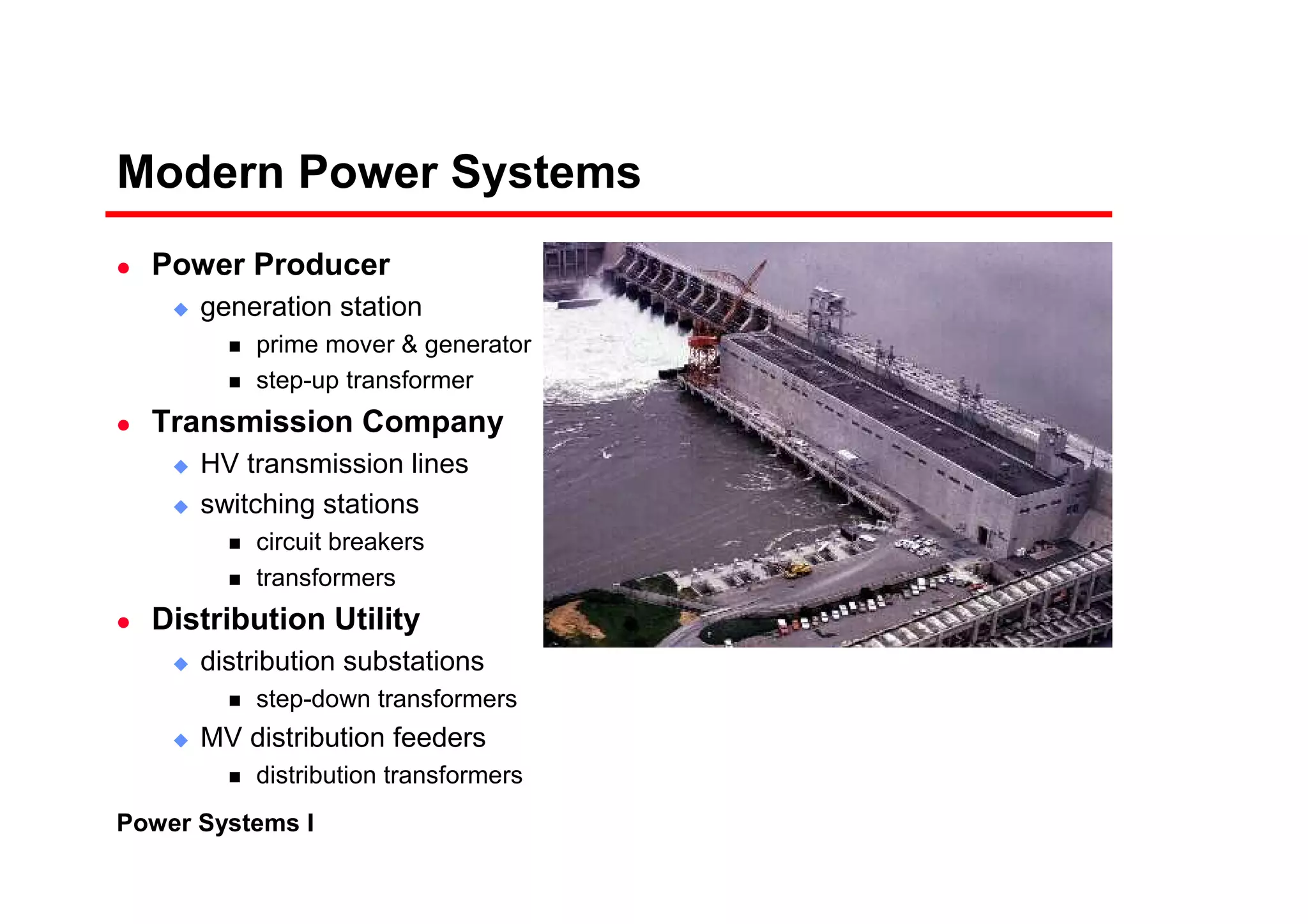
Modern Power Systems
Power Producer
generation station
prime mover & generator
step-up transformer
Transmission Company
HV transmission lines
switching stations
circuit breakers
transformers
Distribution Utility
distribution substations
step-down transformers
MV distribution feeders
distribution transformers
Power Systems I
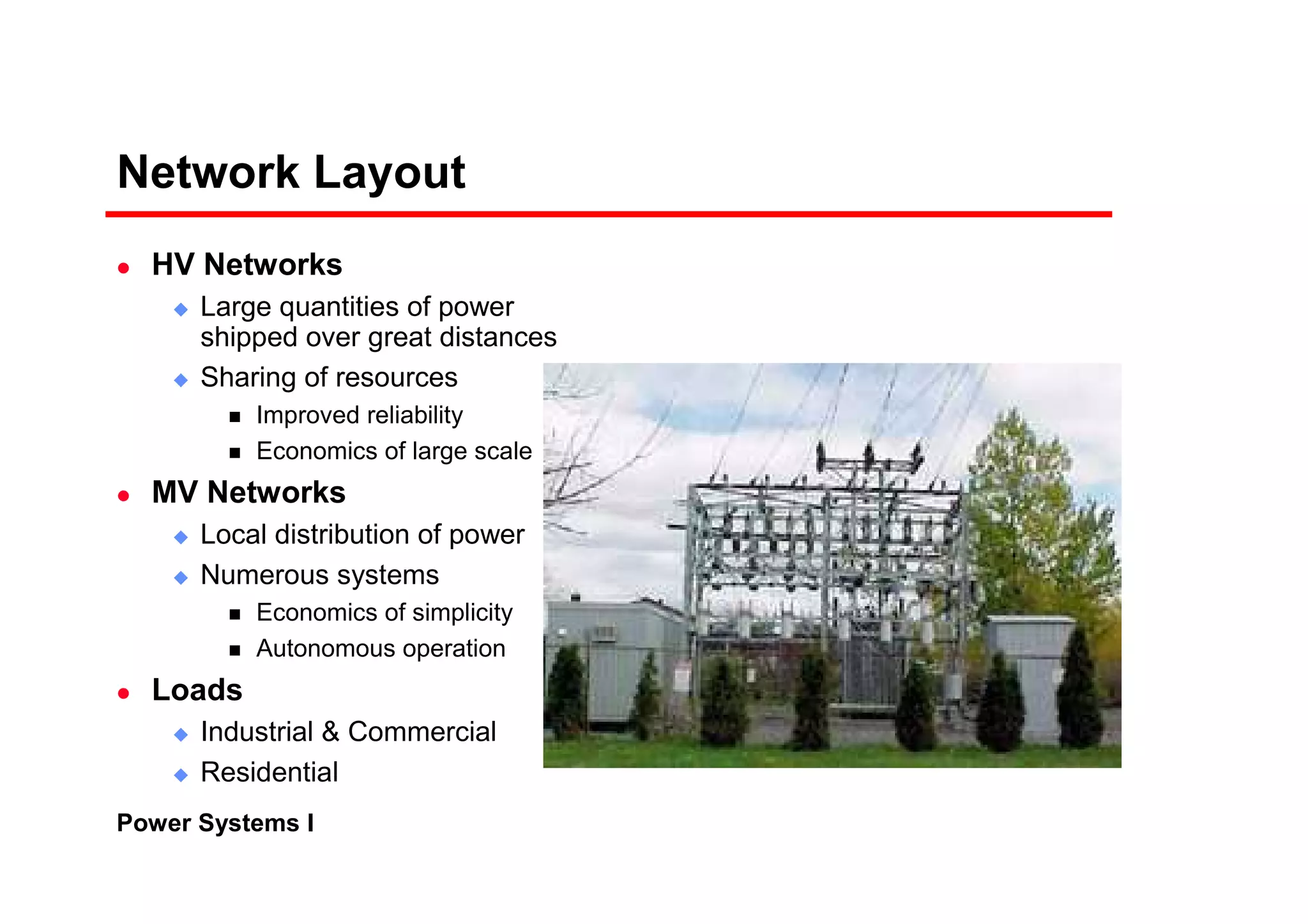
Network Layout
HV Networks
Large quantities of power
shipped over great distances
Sharing of resources
Improved reliability
Economics of large scale
MV Networks
Local distribution of power
Numerous systems
Economics of simplicity
Autonomous operation
Loads
Industrial & Commercial
Residential
Power Systems I
System Control
Network Protection
Switchgear
instrumentation transformers
circuit breakers
disconnect switches
fuses
lightning arrestors
protective relays
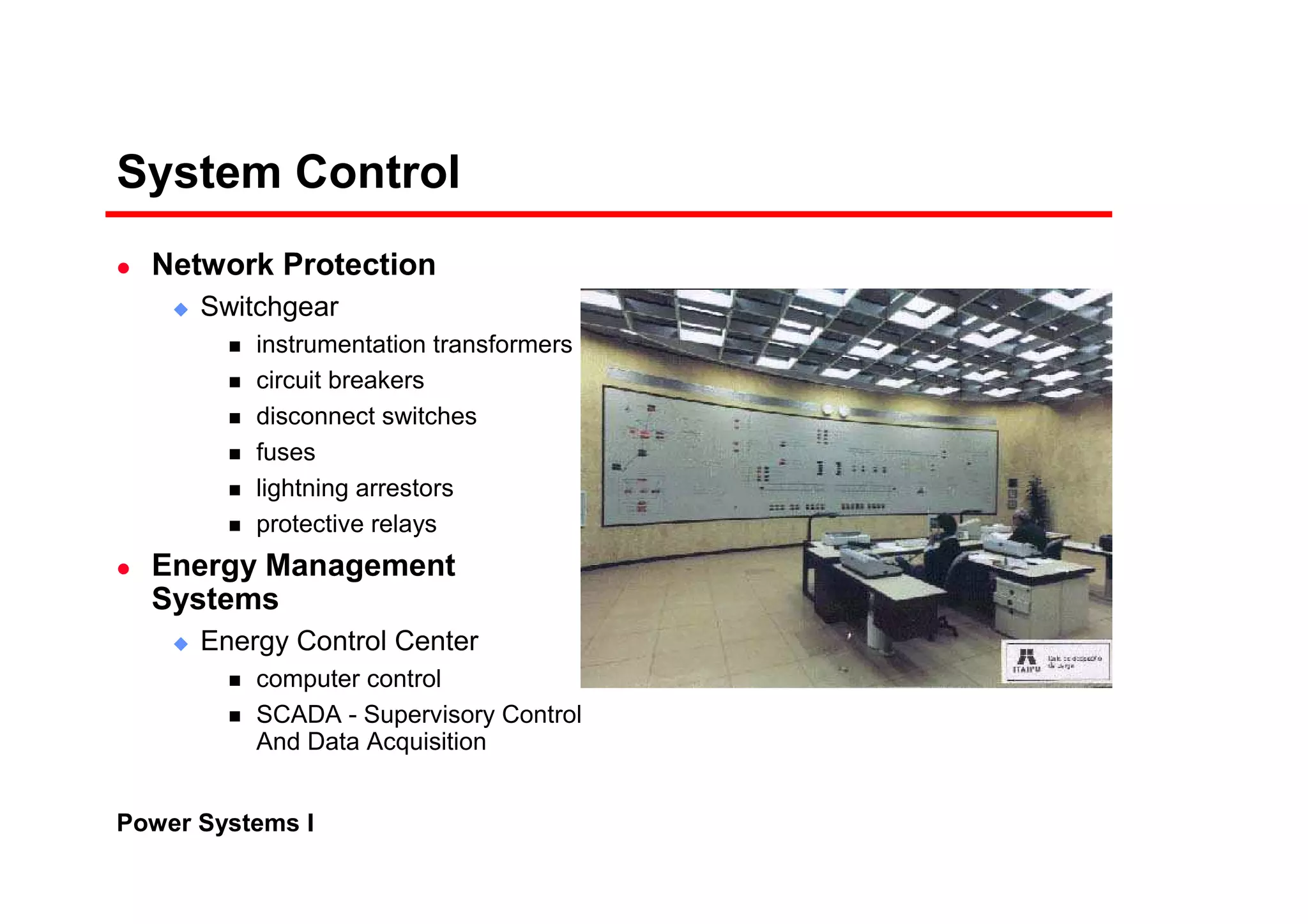
Energy Management
Systems
Energy Control Center
computer control
SCADA - Supervisory Control
And Data Acquisition
Power Systems I
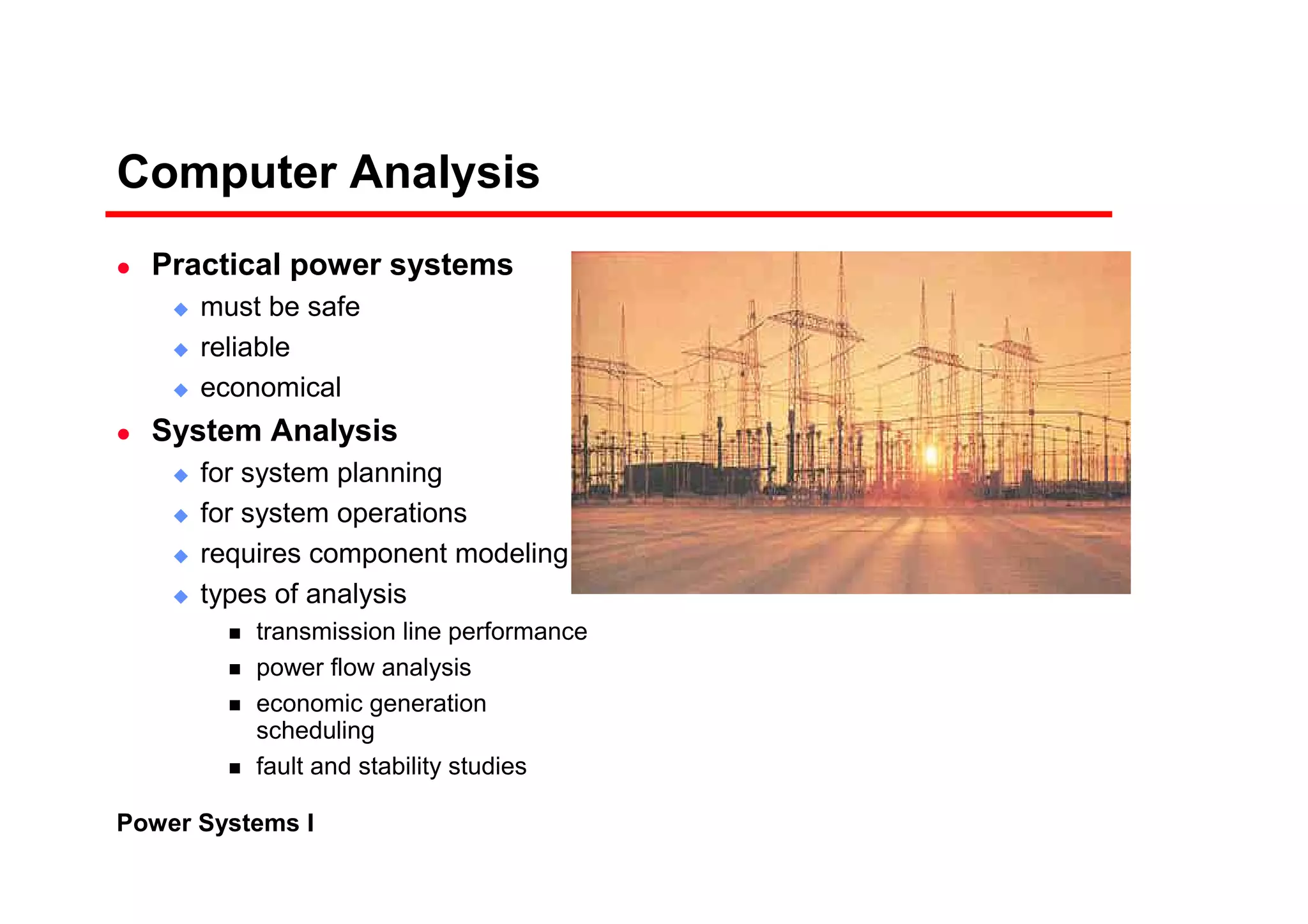
Computer Analysis
Practical power systems
must be safe
reliable
economical
System Analysis
for system planning
for system operations
requires component modeling
types of analysis
transmission line performance
power flow analysis
economic generation
scheduling
fault and stability studies
FAMU-FSU College of Engineering
Chapter 2
AC Power
Power Systems I
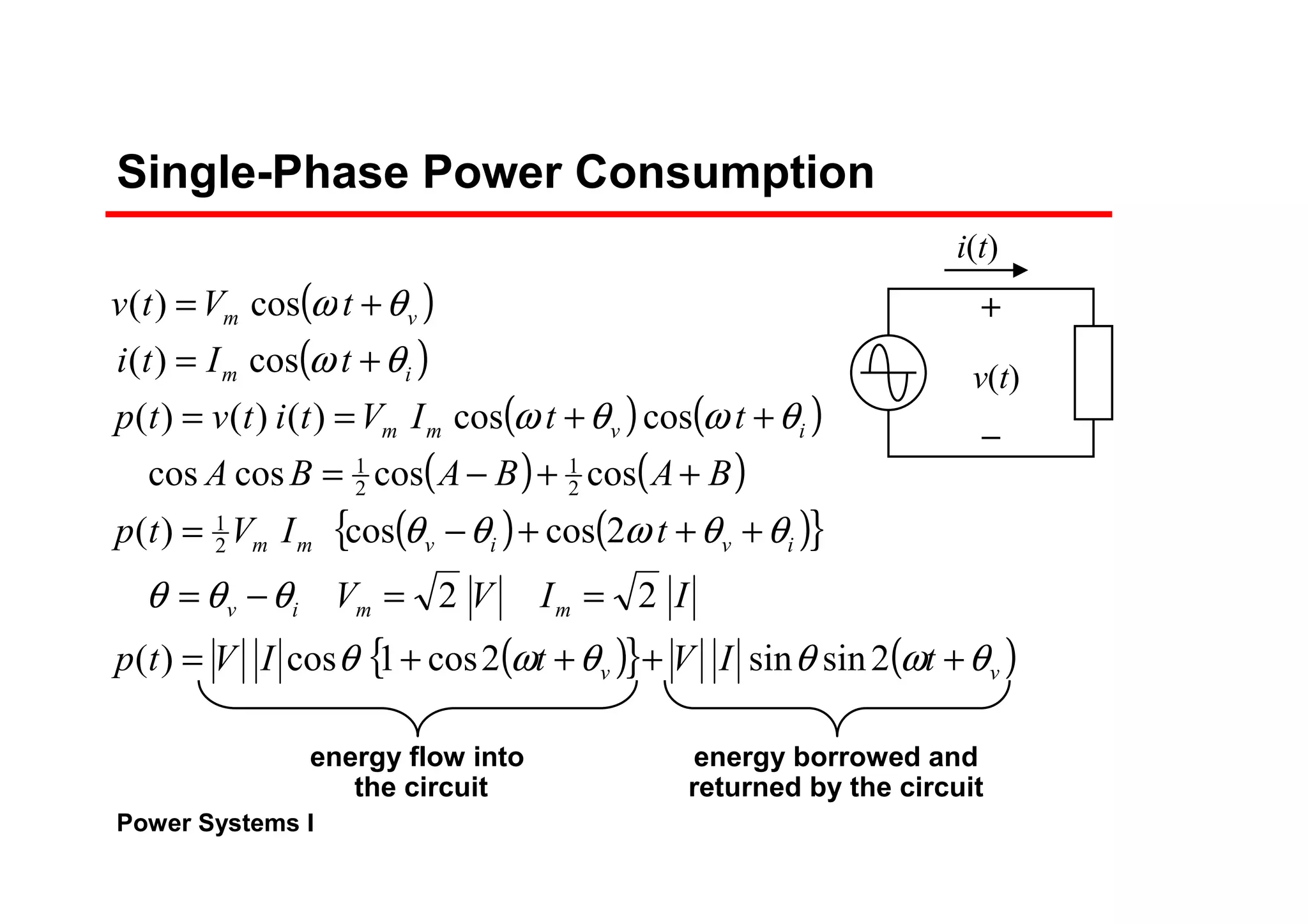
Single-Phase Power Consumption
( )
( )
( ) ( )
( ) ( )
( ) ( ){ }
( ){ } ( )vv
mmiv
ivivmm
ivmm
im
vm
tIVtIVtp
IIVV
tIVtp
BABABA
ttIVtitvtp
tIti
tVtv
θωθθωθ
θθθ
θθωθθ
θωθω
θω
θω
++++=
==−=
+++−=
++−=
++==
+=
+=
2sinsin2cos1cos)(
22
2coscos)(
coscoscoscos
coscos)()()(
cos)(
cos)(
2
1
2
1
2
1
energy flow into
the circuit
energy borrowed and
returned by the circuit
i(t)
v(t)
Power Systems I
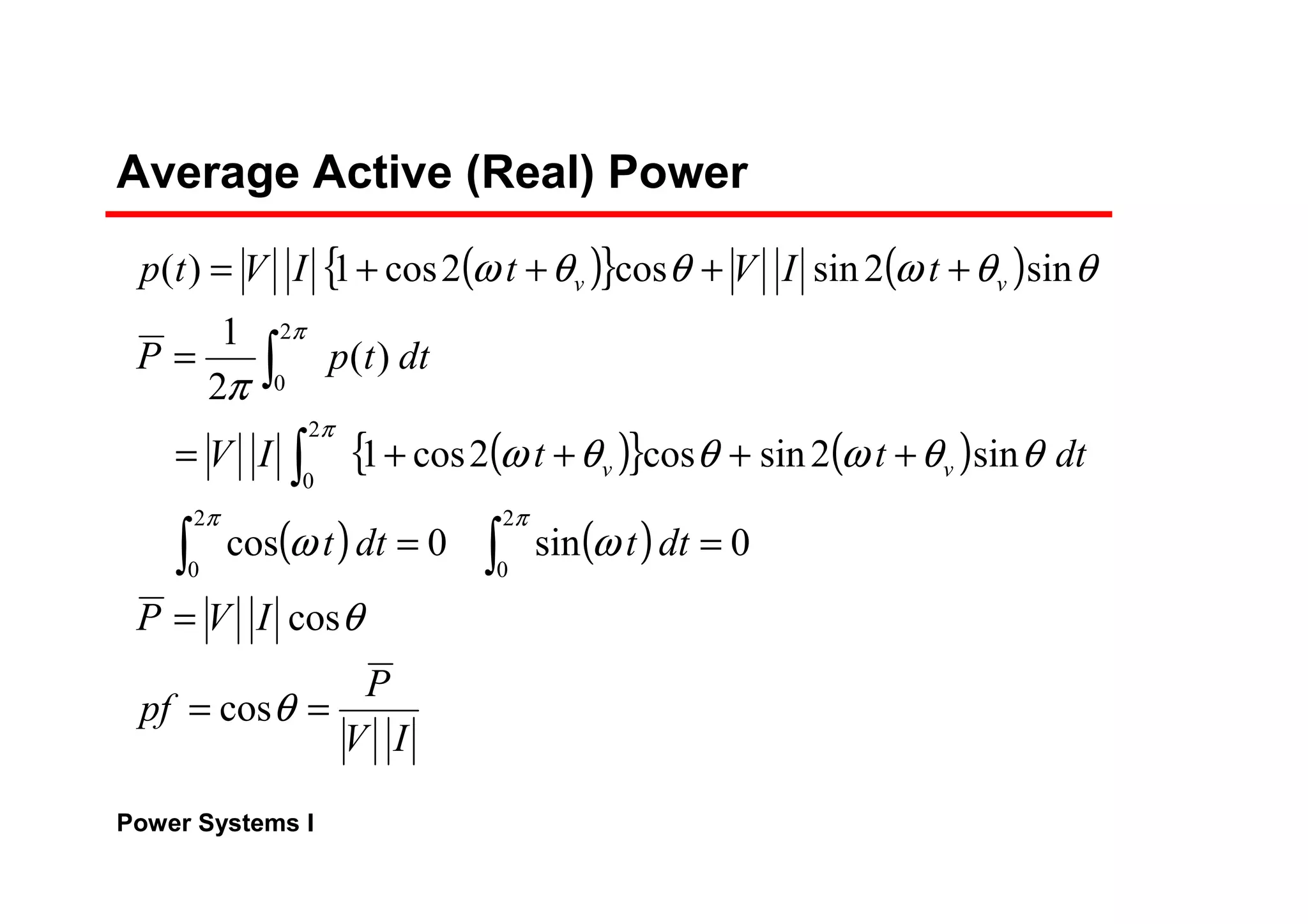
Average Active (Real) Power
( ){ } ( )
( ){ } ( )
( ) ( )
IV
P
pf
IVP
dttdtt
dtttIV
dttpP
tIVtIVtp
vv
vv
==
=
==
++++=
=
++++=
∫∫
∫
∫
θ
θ
ωω
θθωθθω
π
θθωθθω
ππ
π
π
cos
cos
0sin0cos
sin2sincos2cos1
)(
2
1
sin2sincos2cos1)(
2
0
2
0
2
0
2
0
Power Systems I
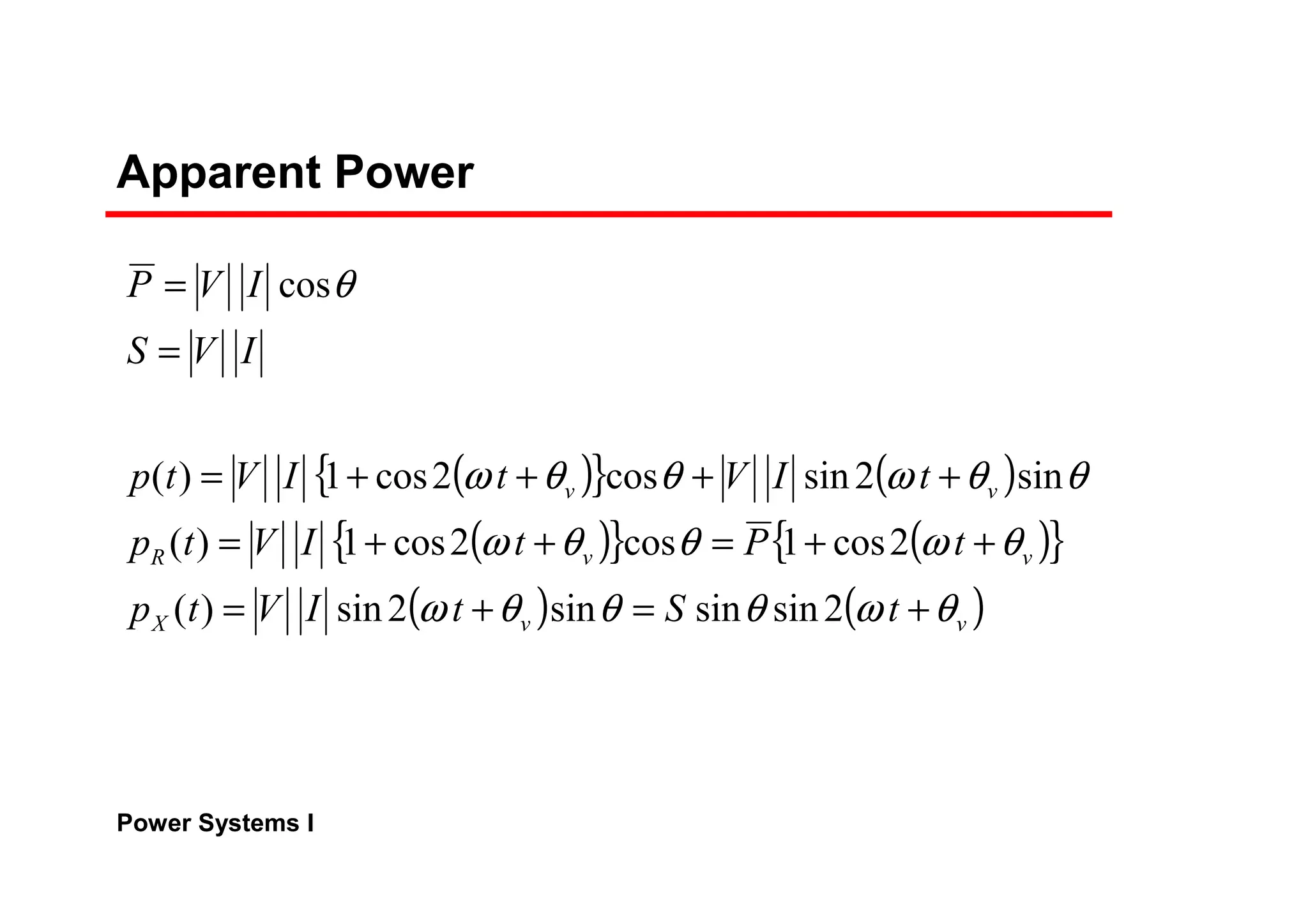
Apparent Power
( ){ } ( )
( ){ } ( ){ }
( ) ( )vvX
vvR
vv
tStIVtp
tPtIVtp
tIVtIVtp
IVS
IVP
θωθθθω
θωθθω
θθωθθω
θ
+=+=
++=++=
++++=
=
=
2sinsinsin2sin)(
2cos1cos2cos1)(
sin2sincos2cos1)(
cos
Power Systems I
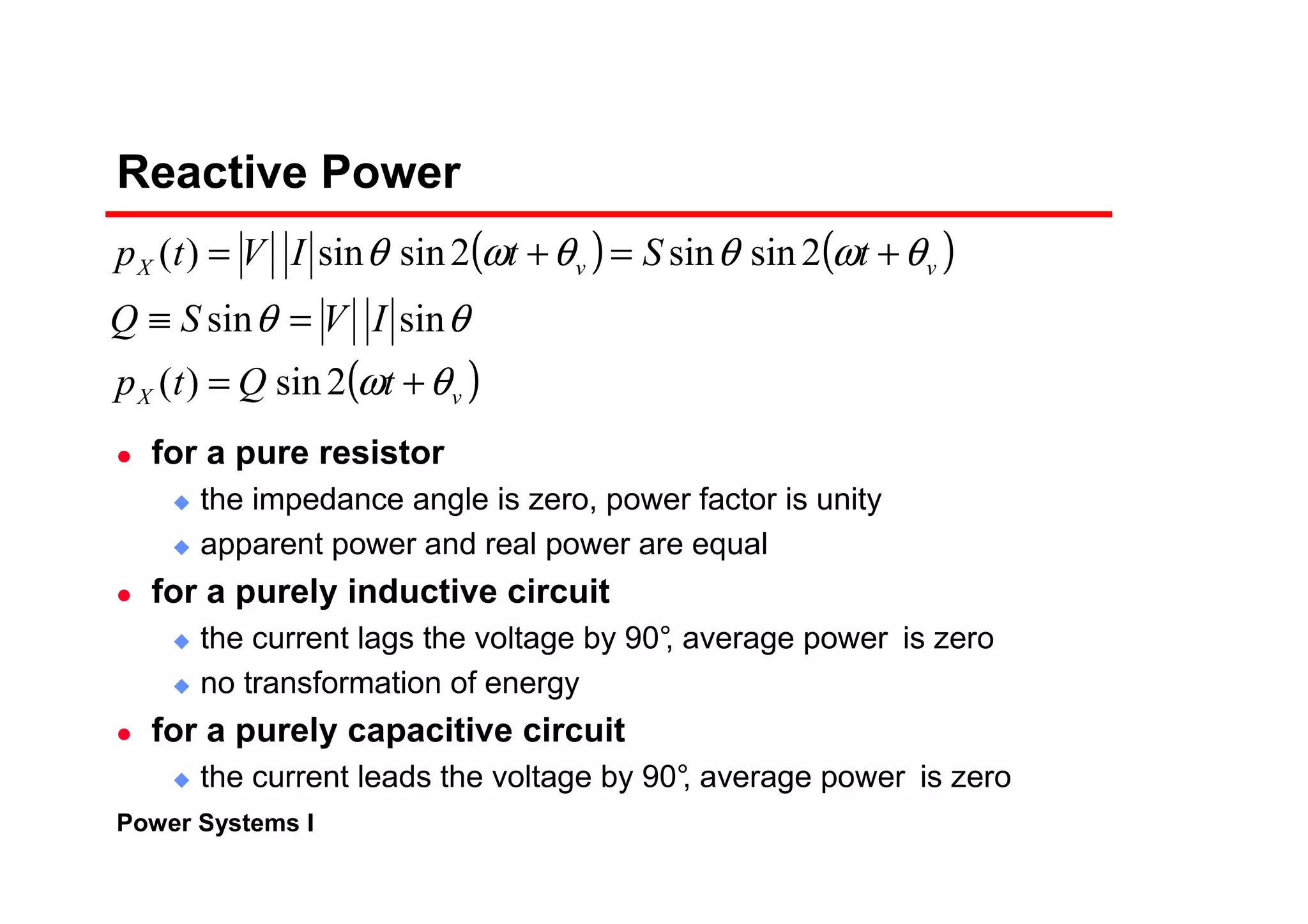
Reactive Power
for a pure resistor
the impedance angle is zero, power factor is unity
apparent power and real power are equal
for a purely inductive circuit
the current lags the voltage by 90°, average power is zero
no transformation of energy
for a purely capacitive circuit
the current leads the voltage by 90°, average power is zero
( ) ( )
( )vX
vvX
tQtp
IVSQ
tStIVtp
θω
θθ
θωθθωθ
+=
=≡
+=+=
2sin)(
sinsin
2sinsin2sinsin)(
Power Systems I
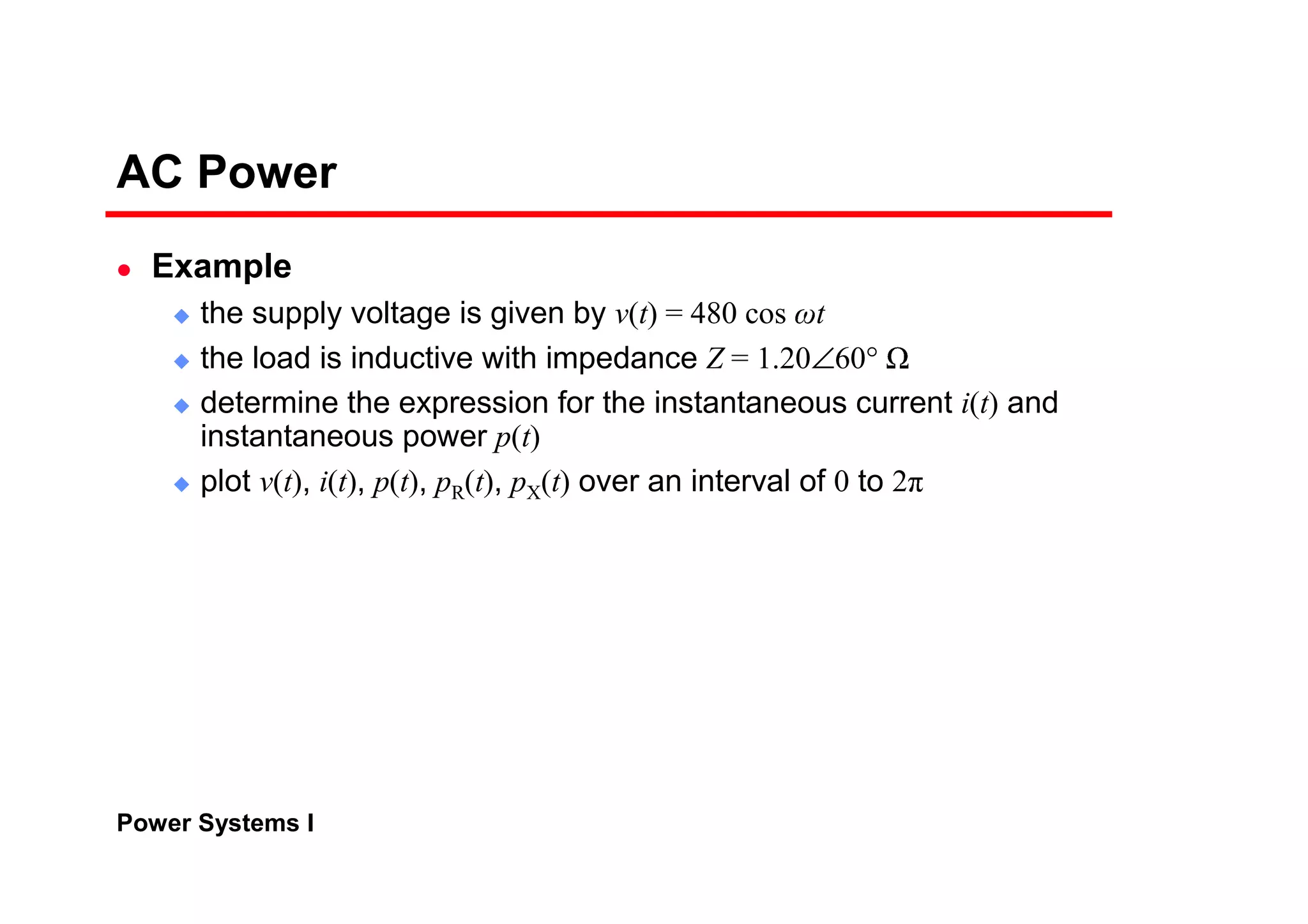
AC Power
Example
the supply voltage is given by v(t) = 480 cos
ω
t
the load is inductive with impedance Z = 1.20∠60°
¡
determine the expression for the instantaneous current i(t) and
instantaneous power p(t)
plot v(t), i(t), p(t), pR(t), pX(t) over an interval of 0 to 2
π
Power Systems I
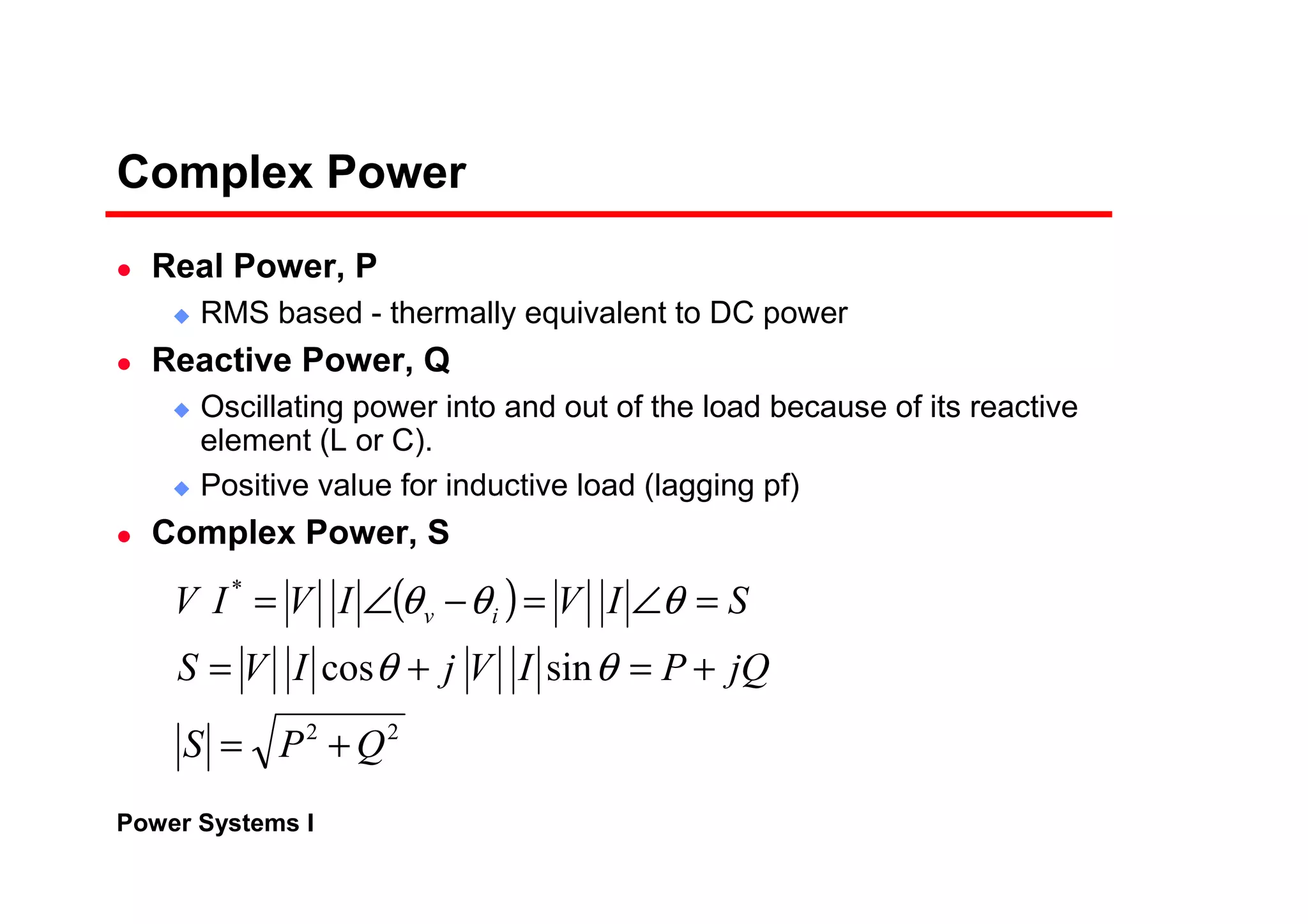
Complex Power
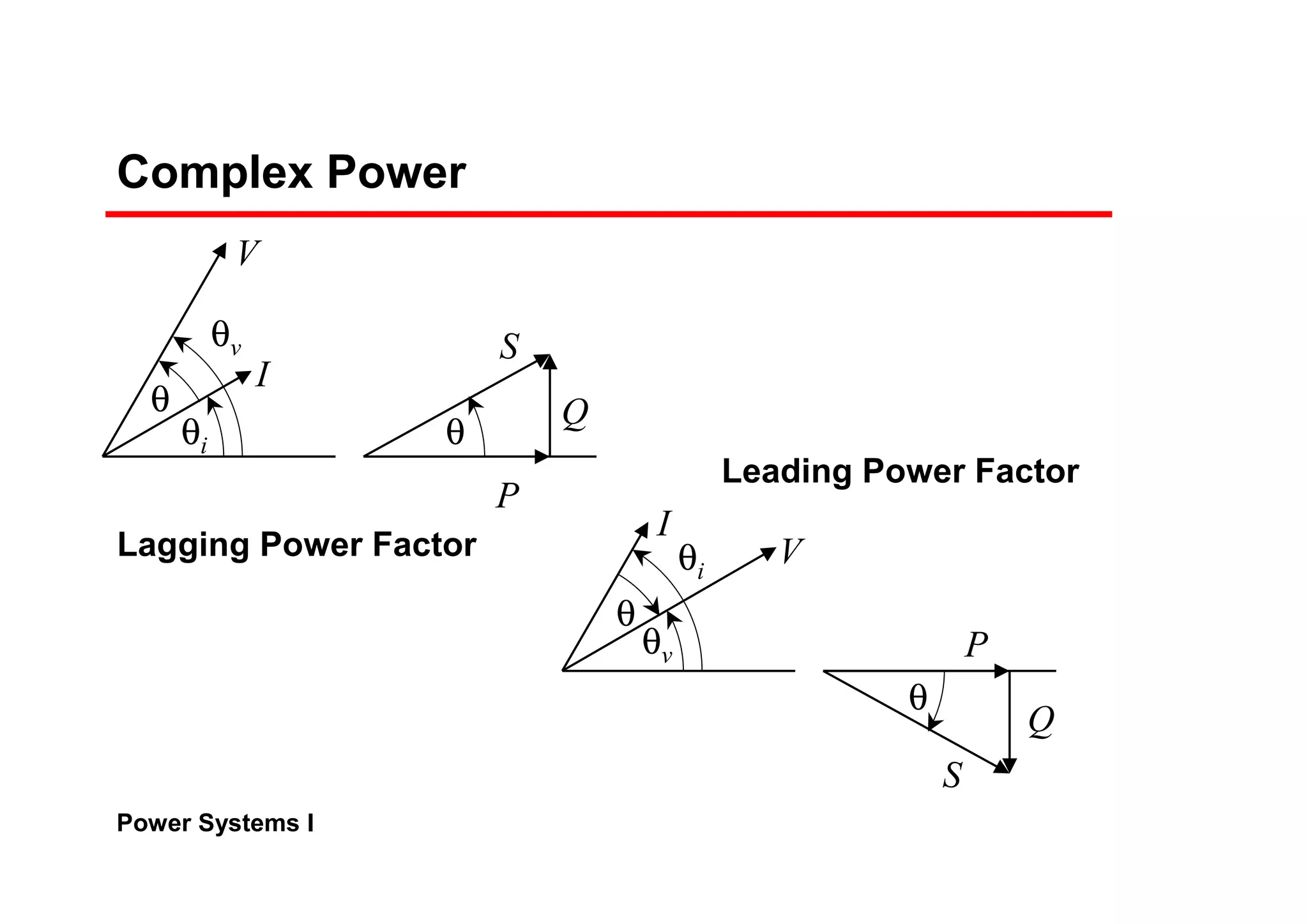
Real Power, P
RMS based - thermally equivalent to DC power
Reactive Power, Q
Oscillating power into and out of the load because of its reactive
element (L or C).
Positive value for inductive load (lagging pf)
Complex Power, S
( )
22
*
sincos
QPS
jQPIVjIVS
SIVIVIV iv
+=
+=+=
=∠=−∠=
θθ
θθθ
Power Systems I
Complex Power
P
Q
S
V
I
θv
θi
θ
θ
Q
S
P
V
I
θv
θi
θ
θ
Lagging Power Factor
Leading Power Factor
Power Systems I
The Complex Power Balance
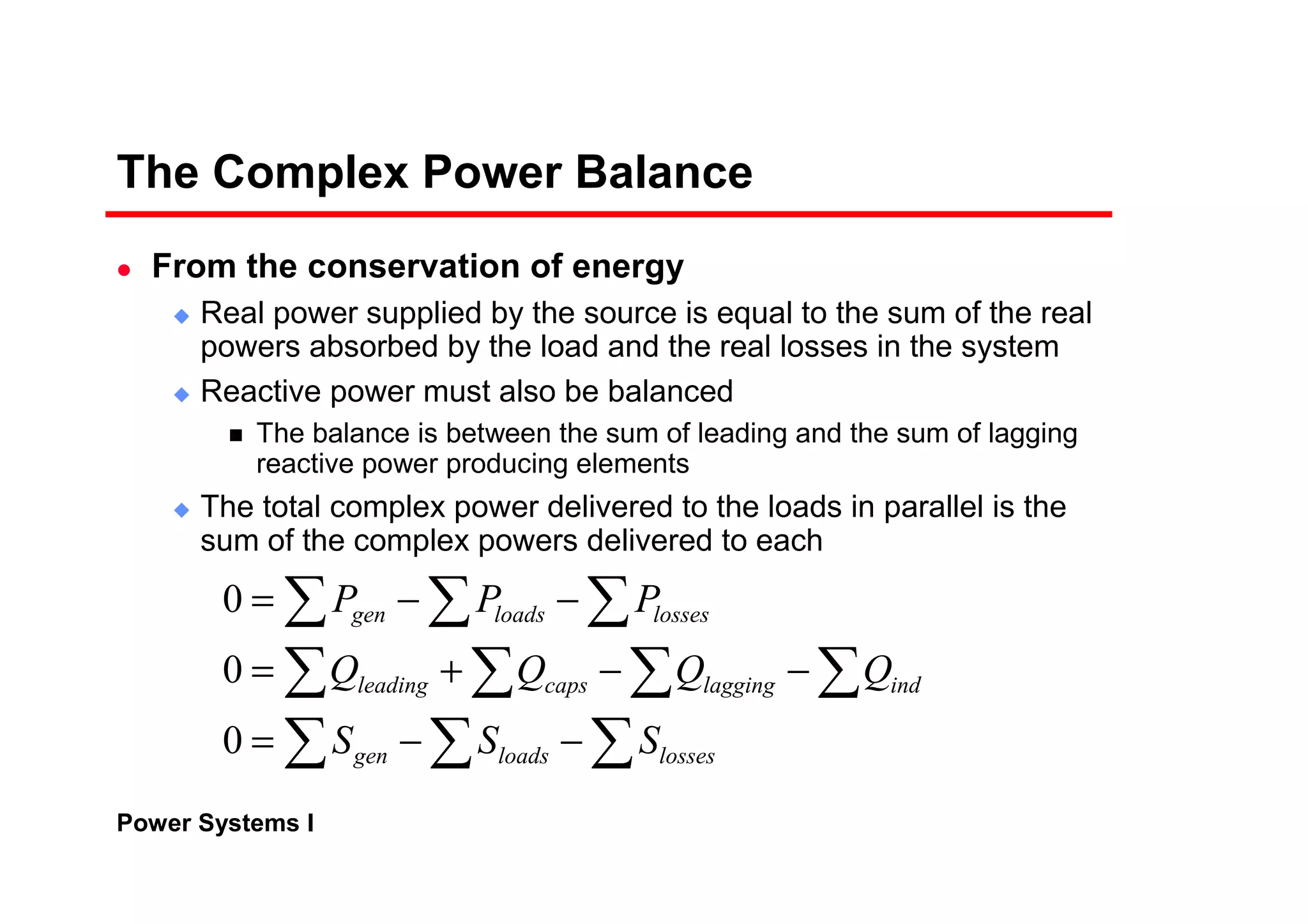
From the conservation of energy
Real power supplied by the source is equal to the sum of the real
powers absorbed by the load and the real losses in the system
Reactive power must also be balanced
The balance is between the sum of leading and the sum of lagging
reactive power producing elements
The total complex power delivered to the loads in parallel is the
sum of the complex powers delivered to each
∑∑∑
∑∑∑∑
∑∑ ∑
−−=
−−+=
−−=
lossesloadsgen
indlaggingcapsleading
lossesloadsgen
SSS
QQQQ
PPP
0
0
0
Power Systems I
Complex Power
Example
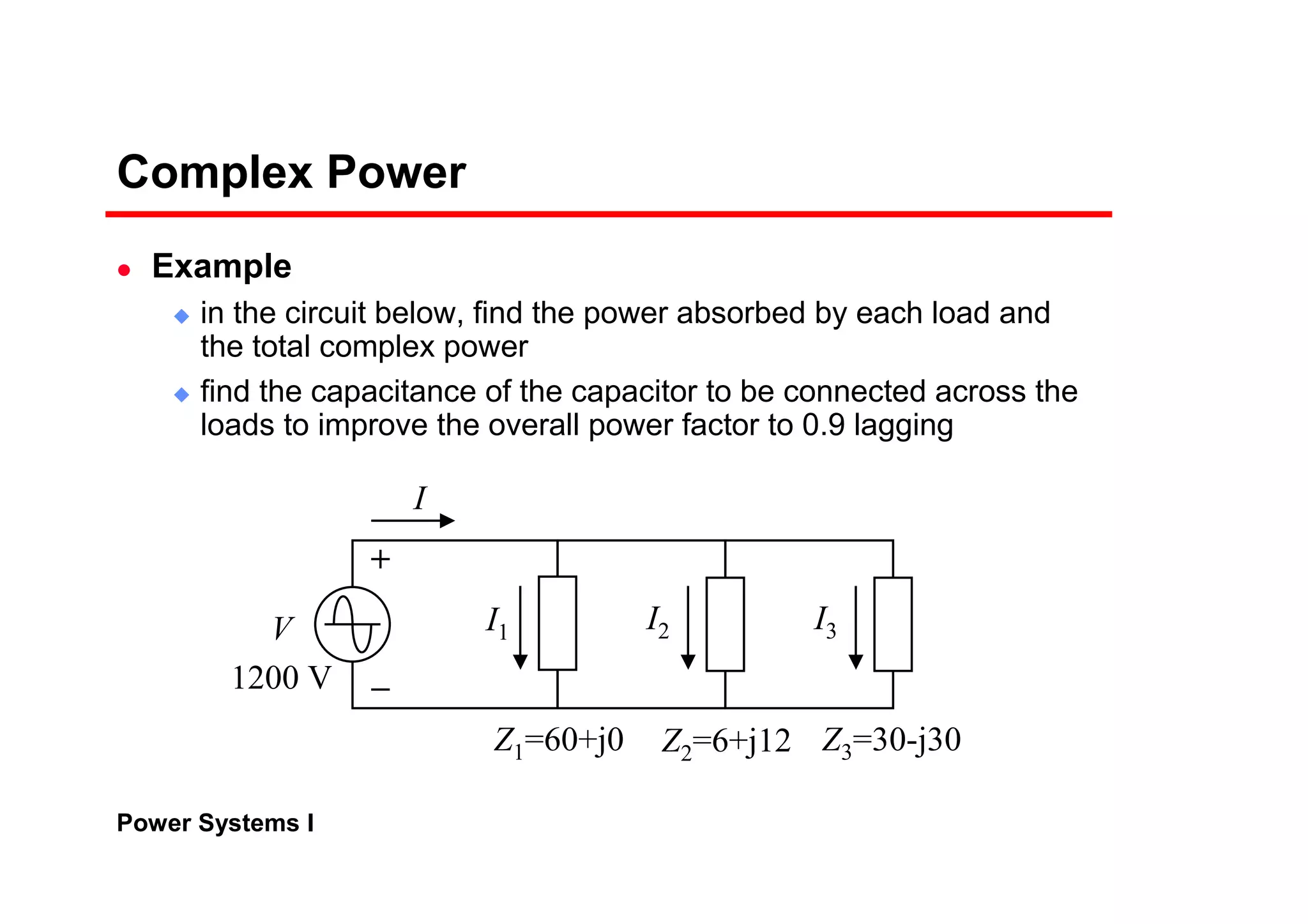
in the circuit below, find the power absorbed by each load and
the total complex power
find the capacitance of the capacitor to be connected across the
loads to improve the overall power factor to 0.9 lagging
I
V
1200 V
I2 I3
Z1=60+j0 Z2=6+j12 Z3=30-j30
I1
Power Systems I
Complex Power Flow
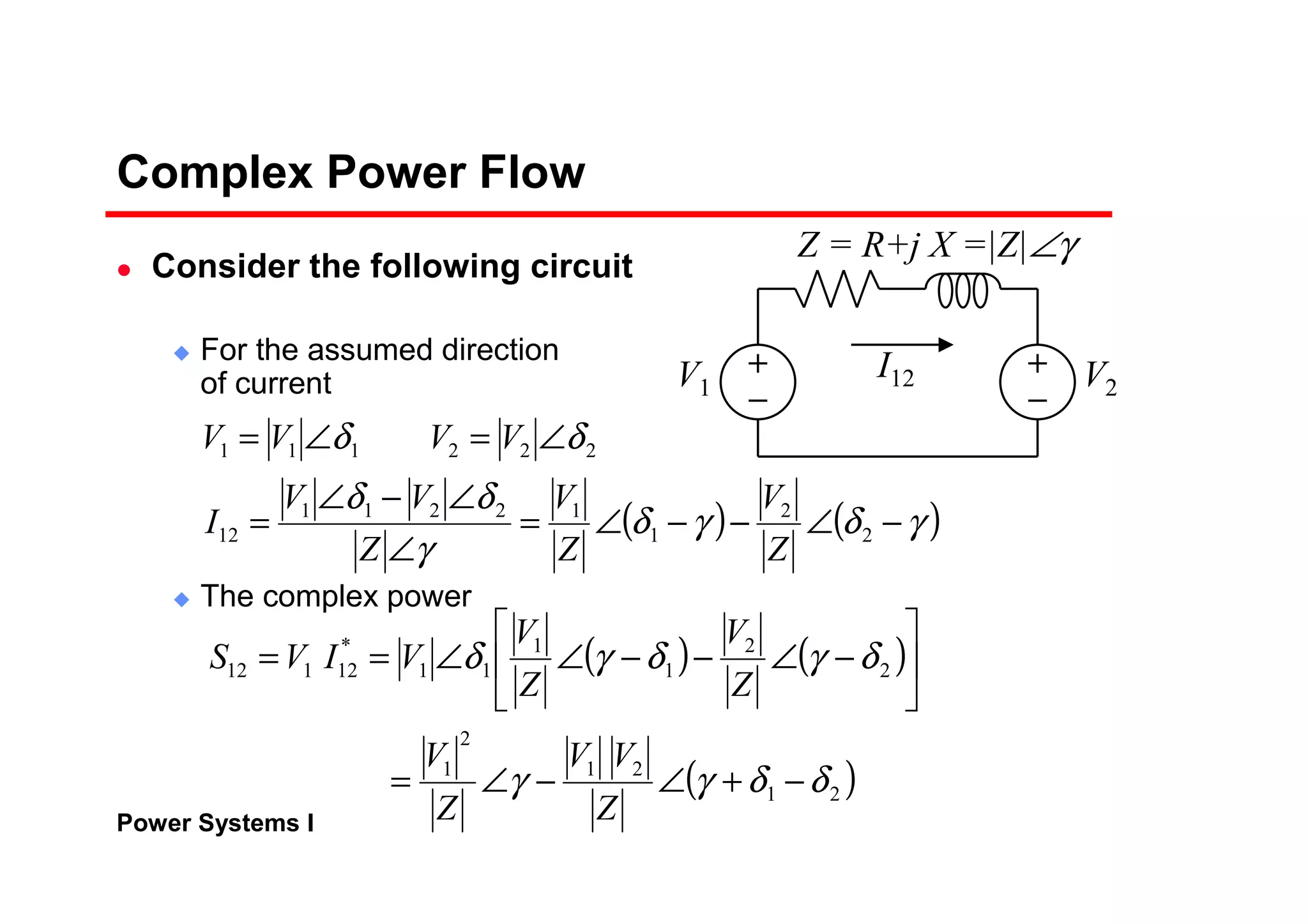
Consider the following circuit
For the assumed direction
of current
The complex power
V2
Z = R+j X =|Z|∠γ
V1
I12
( ) ( )γδγδ
γ
δδ
δδ
−∠−−∠=
∠
∠−∠
=
∠=∠=
2
2
1
12211
12
222111
Z
V
Z
V
Z
VV
I
VVVV
( ) ( )
( )21
21
2
1
2
2
1
1
11
*
12112
δδγγ
δγδγδ
−+∠−∠=






−∠−−∠∠==
Z
VV
Z
V
Z
V
Z
V
VIVS
Power Systems I
Complex Power Flow
The real and reactive power at the sending end
Transmission lines have small resistance compared to the
reactance. Often, it is assumed R = 0 (Z = X∠90°)
( )
( )21
21
2
1
12
21
21
2
1
12
sinsin
coscos
δδγγ
δδγγ
−+−=
−+−=
Z
VV
Z
V
Q
Z
VV
Z
V
P
( ) ( )[ ]2121
1
1221
21
12 cossin δδδδ −−=−= VV
X
V
Q
X
VV
P
Power Systems I
Complex Power Flow
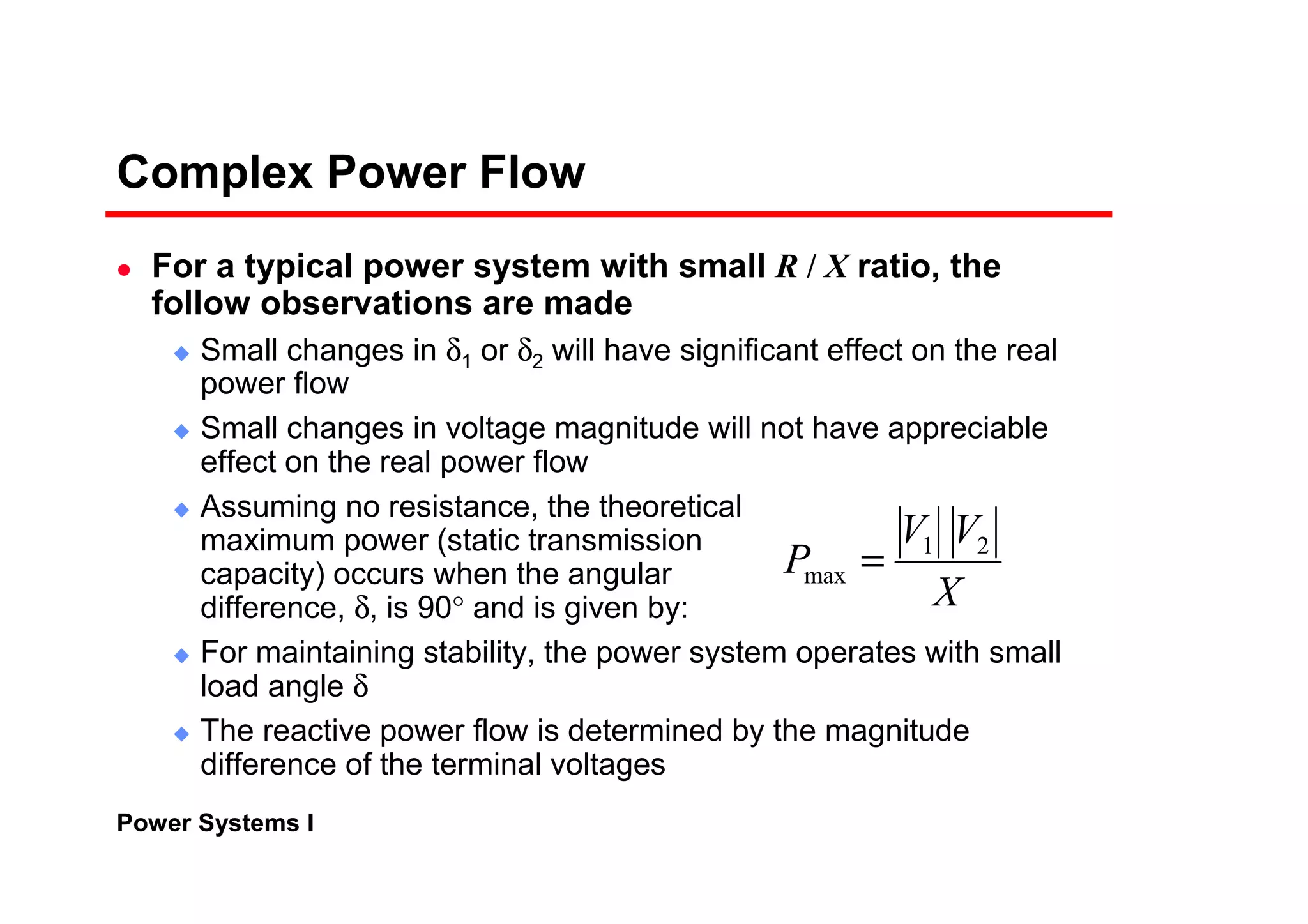
For a typical power system with small R / X ratio, the
follow observations are made
Small changes in δ1 or δ2 will have significant effect on the real
power flow
Small changes in voltage magnitude will not have appreciable
effect on the real power flow
Assuming no resistance, the theoretical
maximum power (static transmission
capacity) occurs when the angular
difference, δ, is 90° and is given by:
For maintaining stability, the power system operates with small
load angle δ
The reactive power flow is determined by the magnitude
difference of the terminal voltages
X
VV
P 21
max =
Power Systems I
Three-Phase Power
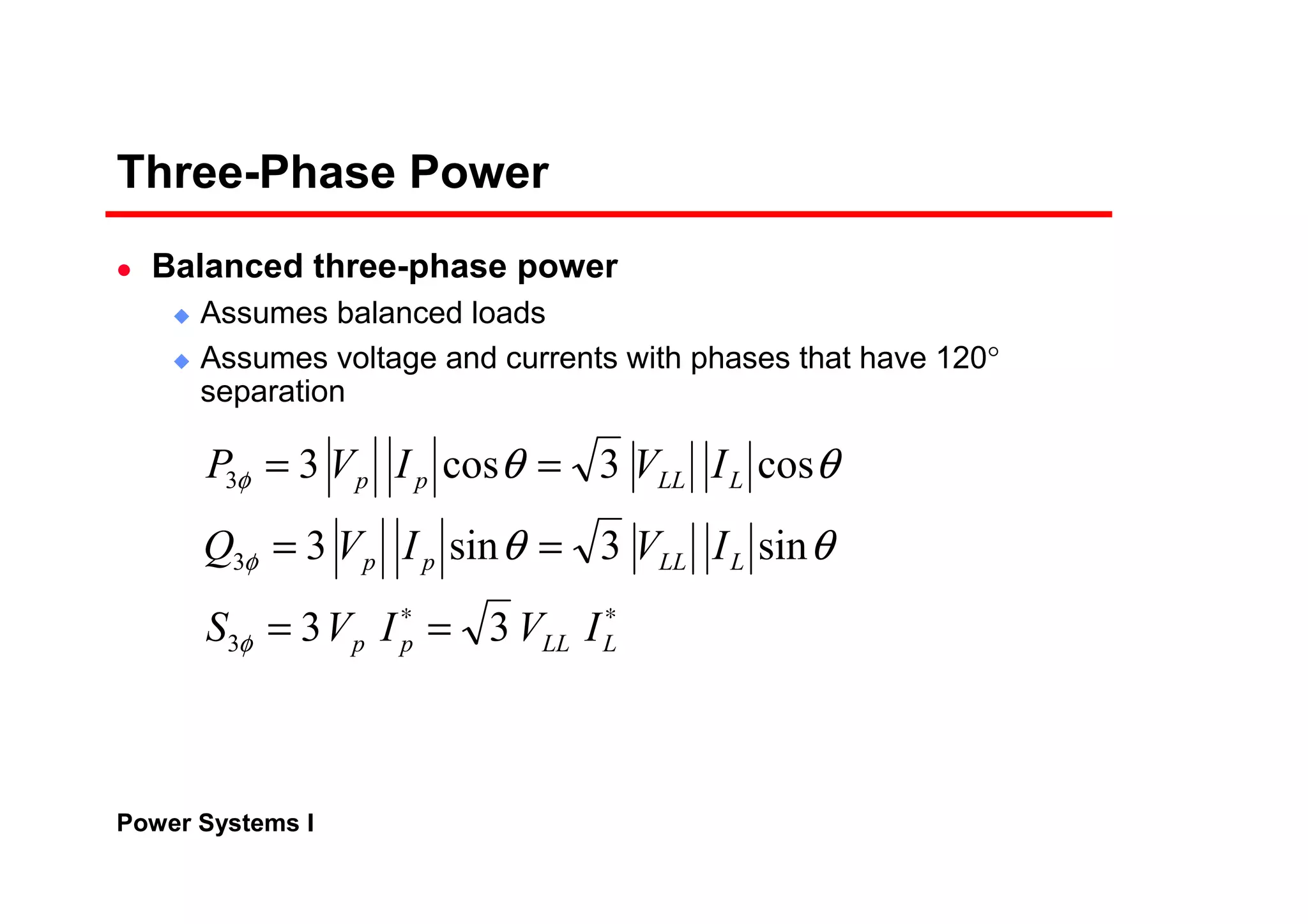
Balanced three-phase power
Assumes balanced loads
Assumes voltage and currents with phases that have 120°
separation
∗∗
==
==
==
LLLpp
LLLpp
LLLpp
IVIVS
IVIVQ
IVIVP
33
sin3sin3
cos3cos3
3
3
3
φ
φ
φ
θθ
θθ
FAMU-FSU College of Engineering
Chapter 3
Power Apparatus Modeling
Power Systems I
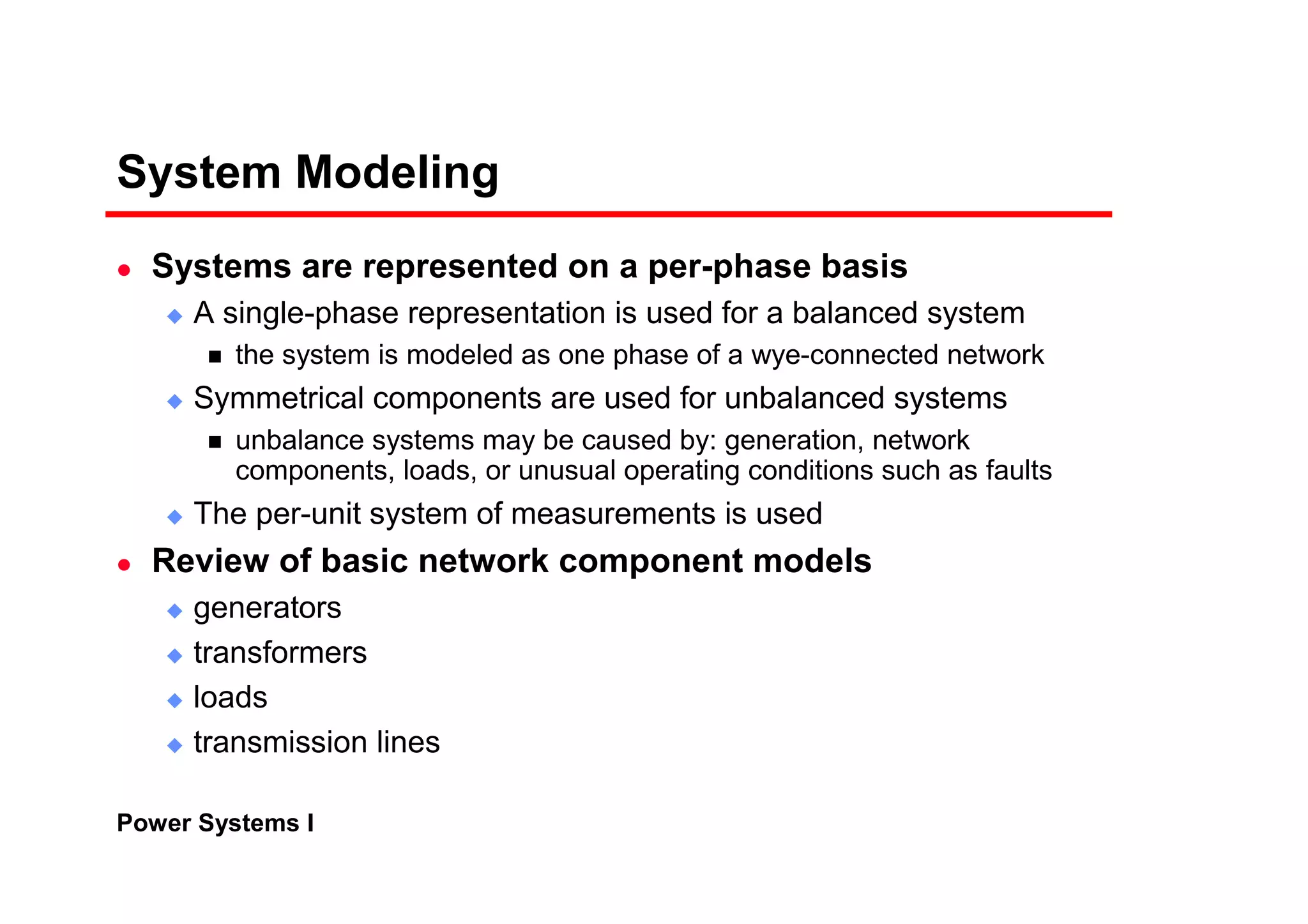
System Modeling
Systems are represented on a per-phase basis
A single-phase representation is used for a balanced system
the system is modeled as one phase of a wye-connected network
Symmetrical components are used for unbalanced systems
unbalance systems may be caused by: generation, network
components, loads, or unusual operating conditions such as faults
The per-unit system of measurements is used
Review of basic network component models
generators
transformers
loads
transmission lines
Power Systems I
Generator Models
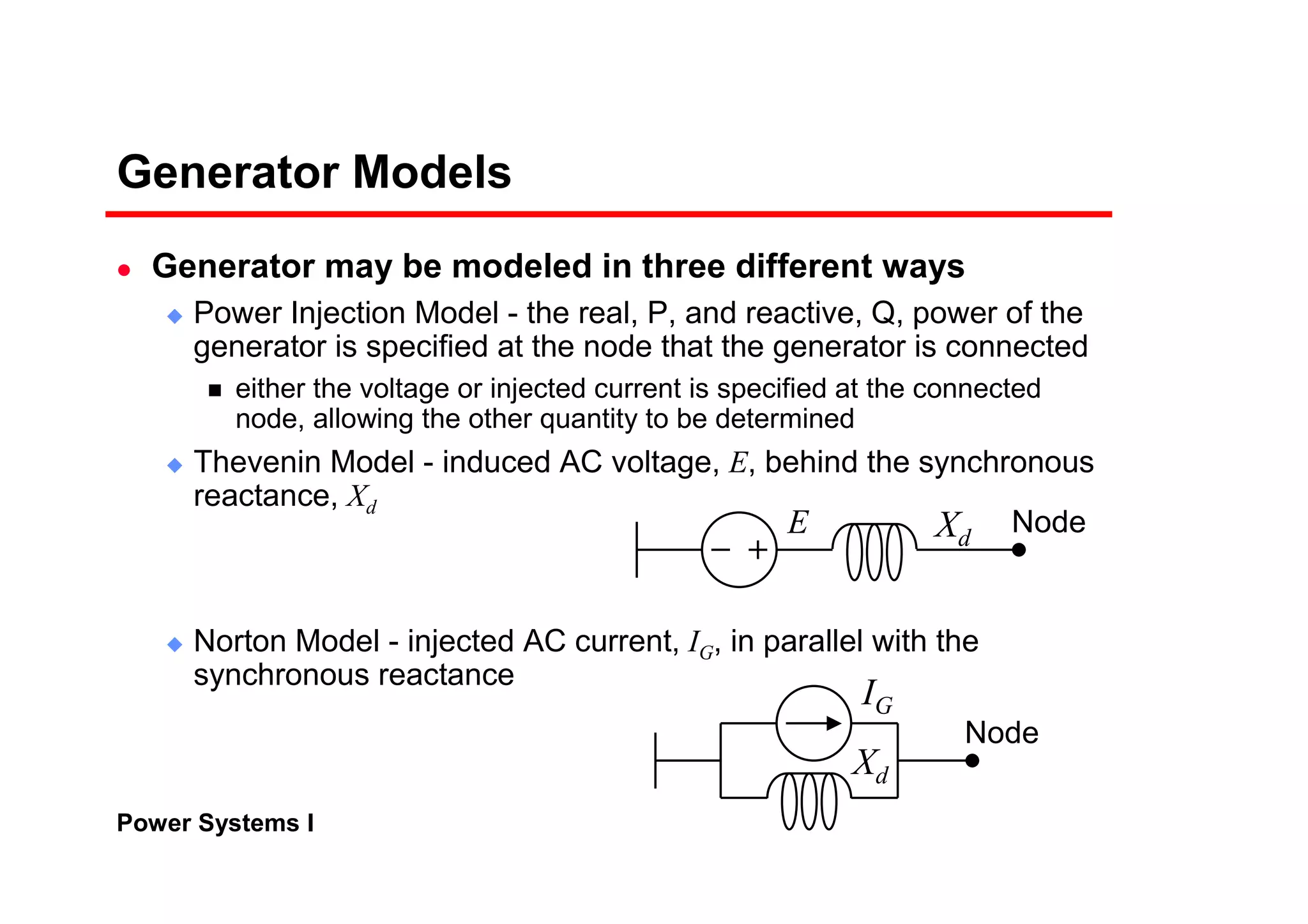
Generator may be modeled in three different ways
Power Injection Model - the real, P, and reactive, Q, power of the
generator is specified at the node that the generator is connected
either the voltage or injected current is specified at the connected
node, allowing the other quantity to be determined
Thevenin Model - induced AC voltage, E, behind the synchronous
reactance, Xd
Norton Model - injected AC current, IG, in parallel with the
synchronous reactance
E
Xd
Xd
IG
Node
Node
Power Systems I
Transformer Model
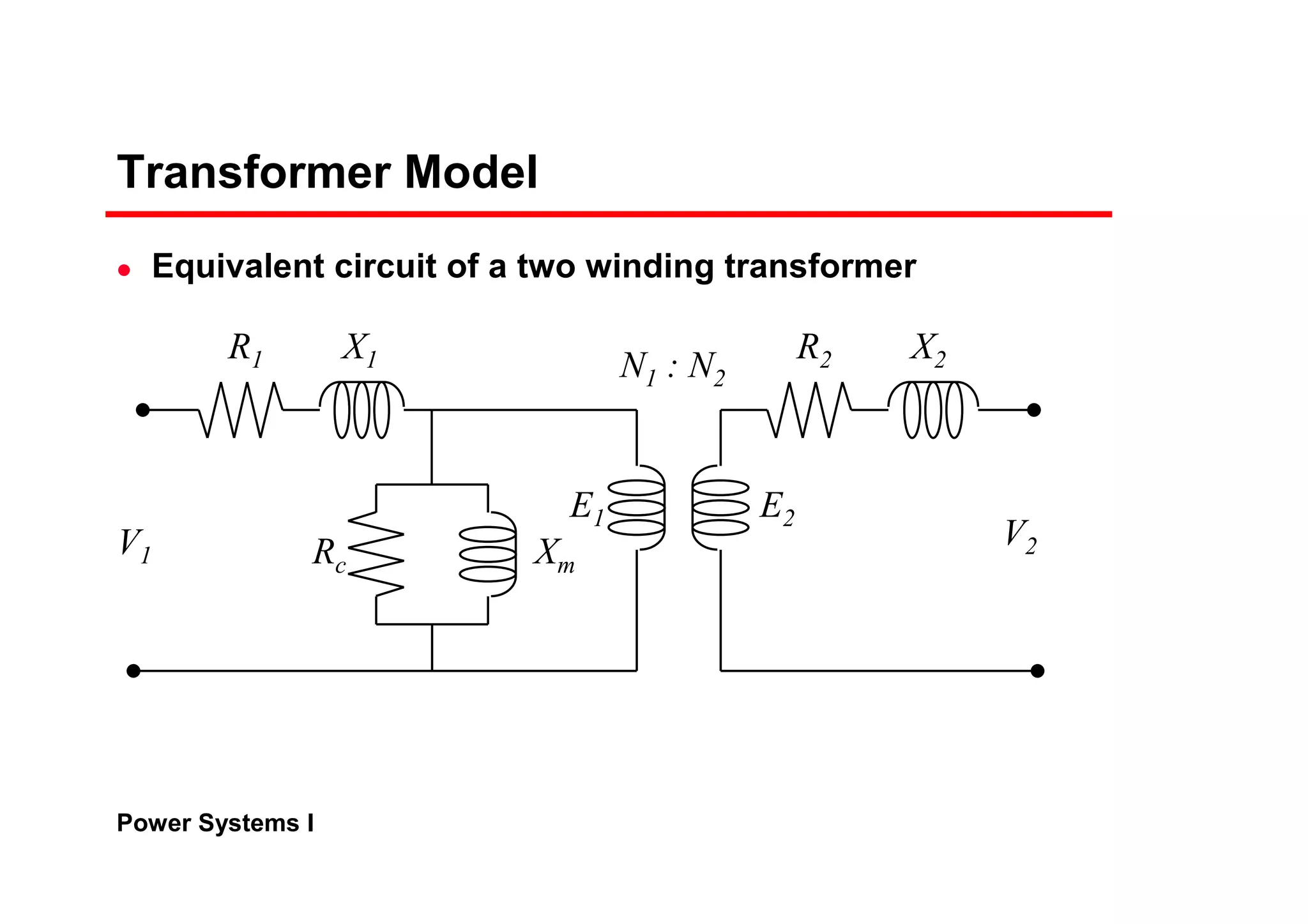
Equivalent circuit of a two winding transformer
XmRc
X2R2X1R1
V1
V2
E2
N1 : N2
E1
Power Systems I
Transformer Model
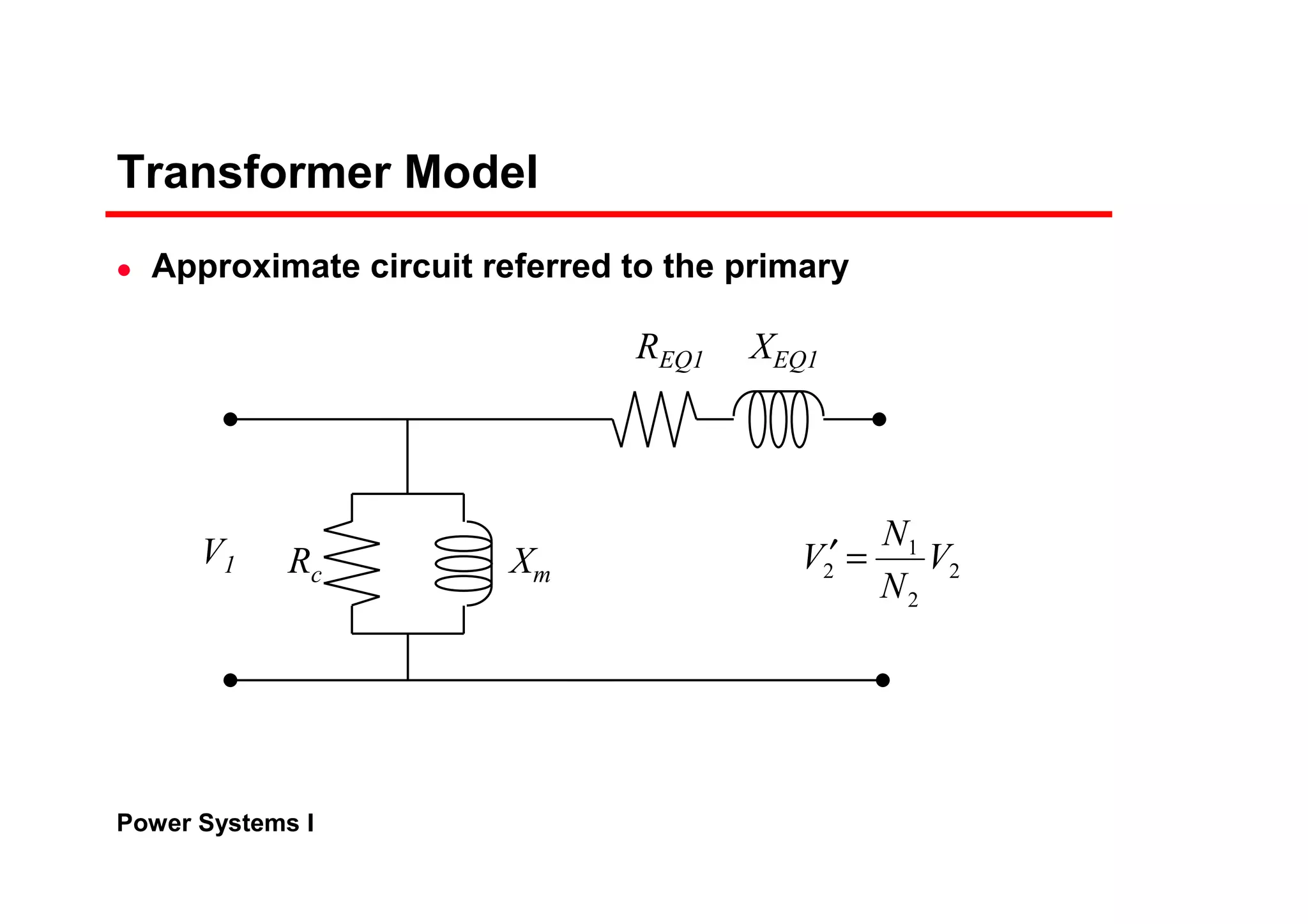
Approximate circuit referred to the primary
XEQ1REQ1
XmRc
V1 2
2
1
2 V
N
N
V =′
Power Systems I
Load Models
Models are selected based on both the type of analysis
and the load characteristics
Constant impedance, Zload
Load is made up of R, L, and C elements connected to a network
node and the ground (or neutral point of the system)
Constant current, Iload
The load has a constant current magnitude I, and a constant
power factor, independent of the nodal voltage
Also considered as a current injection into the network
Constant power, Sload
The load has a constant real, P, and reactive, Q, power
component independent of nodal voltage or current injection
Also considered as a negative power injection into the network
Power Systems I
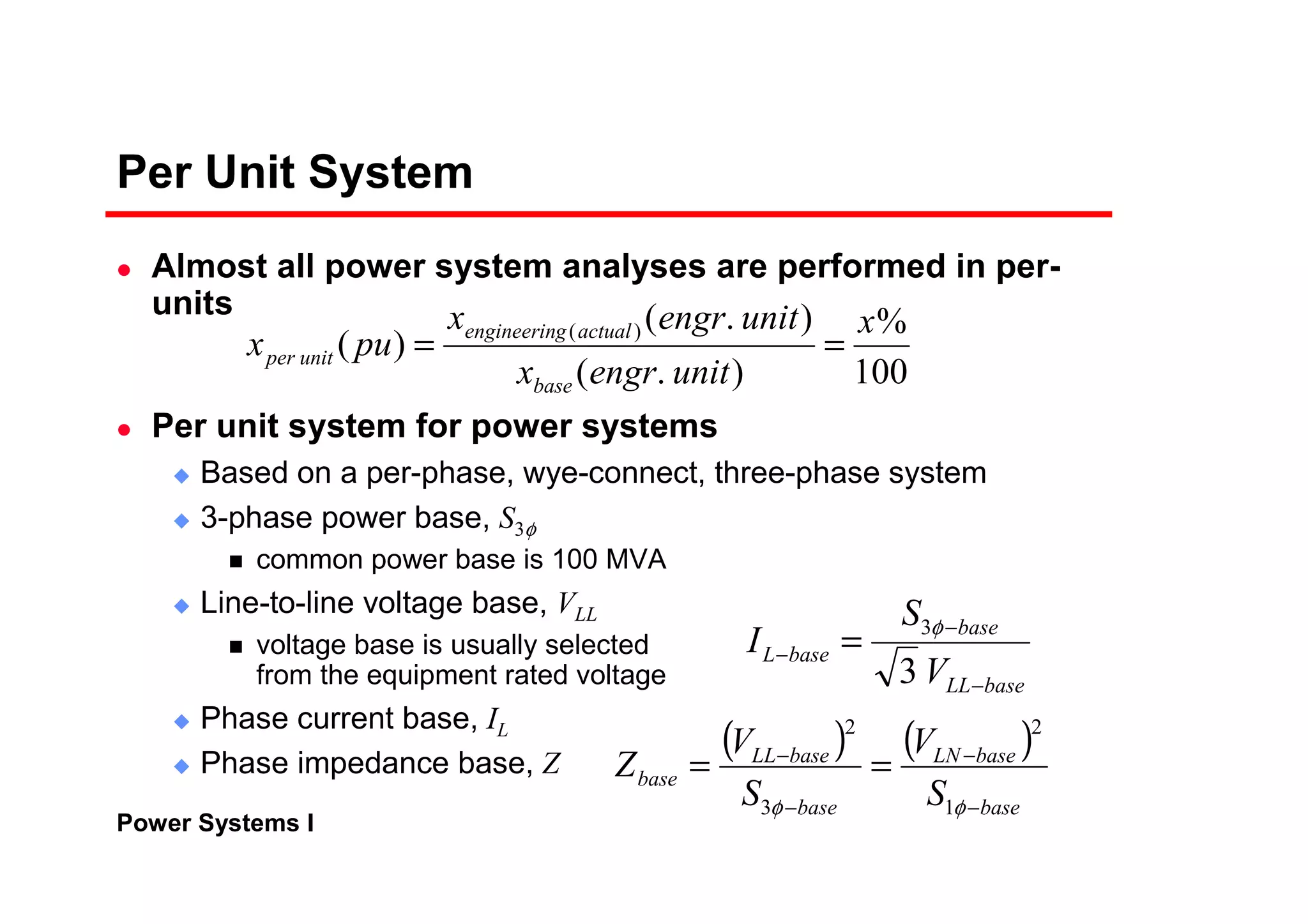
Per Unit System
Almost all power system analyses are performed in per-
units
Per unit system for power systems
Based on a per-phase, wye-connect, three-phase system
3-phase power base, S3φ
common power base is 100 MVA
Line-to-line voltage base, VLL
voltage base is usually selected
from the equipment rated voltage
Phase current base, IL
Phase impedance base, Z
baseLL
base
baseL
V
S
I
−
−
− =
3
3φ
( ) ( )
base
baseLN
base
baseLL
base
S
V
S
V
Z
−
−
−
−
==
φφ 1
2
3
2
100
%
).(
).(
)( )( x
unitengrx
unitengrx
pux
base
actualgengineerin
unitper ==
Power Systems I
Per Unit System
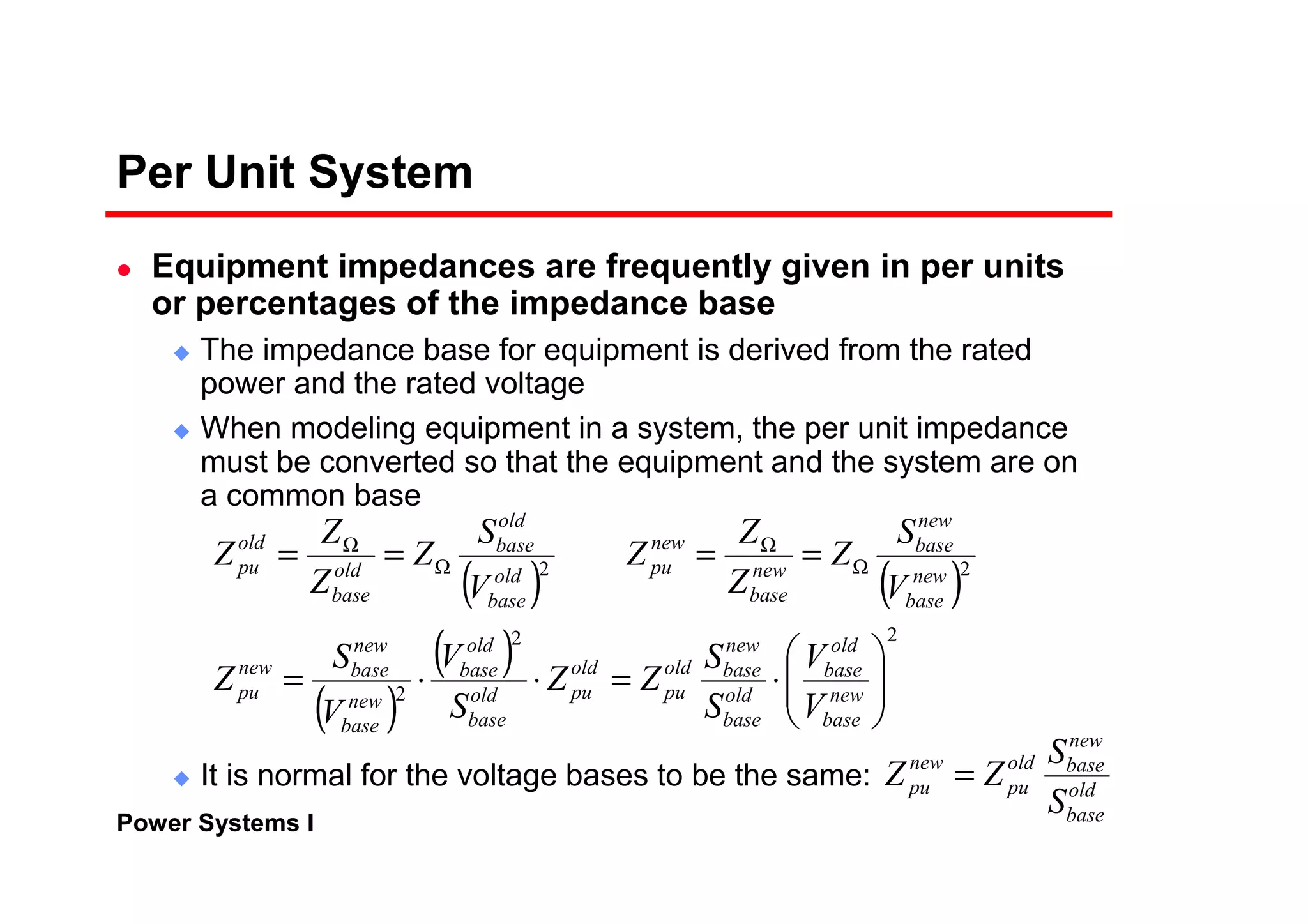
Equipment impedances are frequently given in per units
or percentages of the impedance base
The impedance base for equipment is derived from the rated
power and the rated voltage
When modeling equipment in a system, the per unit impedance
must be converted so that the equipment and the system are on
a common base
It is normal for the voltage bases to be the same:
( ) ( )
( )
( ) 22
2
22






⋅=⋅⋅=
==== Ω
Ω
Ω
Ω
new
base
old
base
old
base
new
baseold
pu
old
puold
base
old
base
new
base
new
basenew
pu
new
base
new
base
new
base
new
puold
base
old
base
old
base
old
pu
V
V
S
S
ZZ
S
V
V
S
Z
V
S
Z
Z
Z
Z
V
S
Z
Z
Z
Z
old
base
new
baseold
pu
new
pu
S
S
ZZ =
Power Systems I
Per Unit System
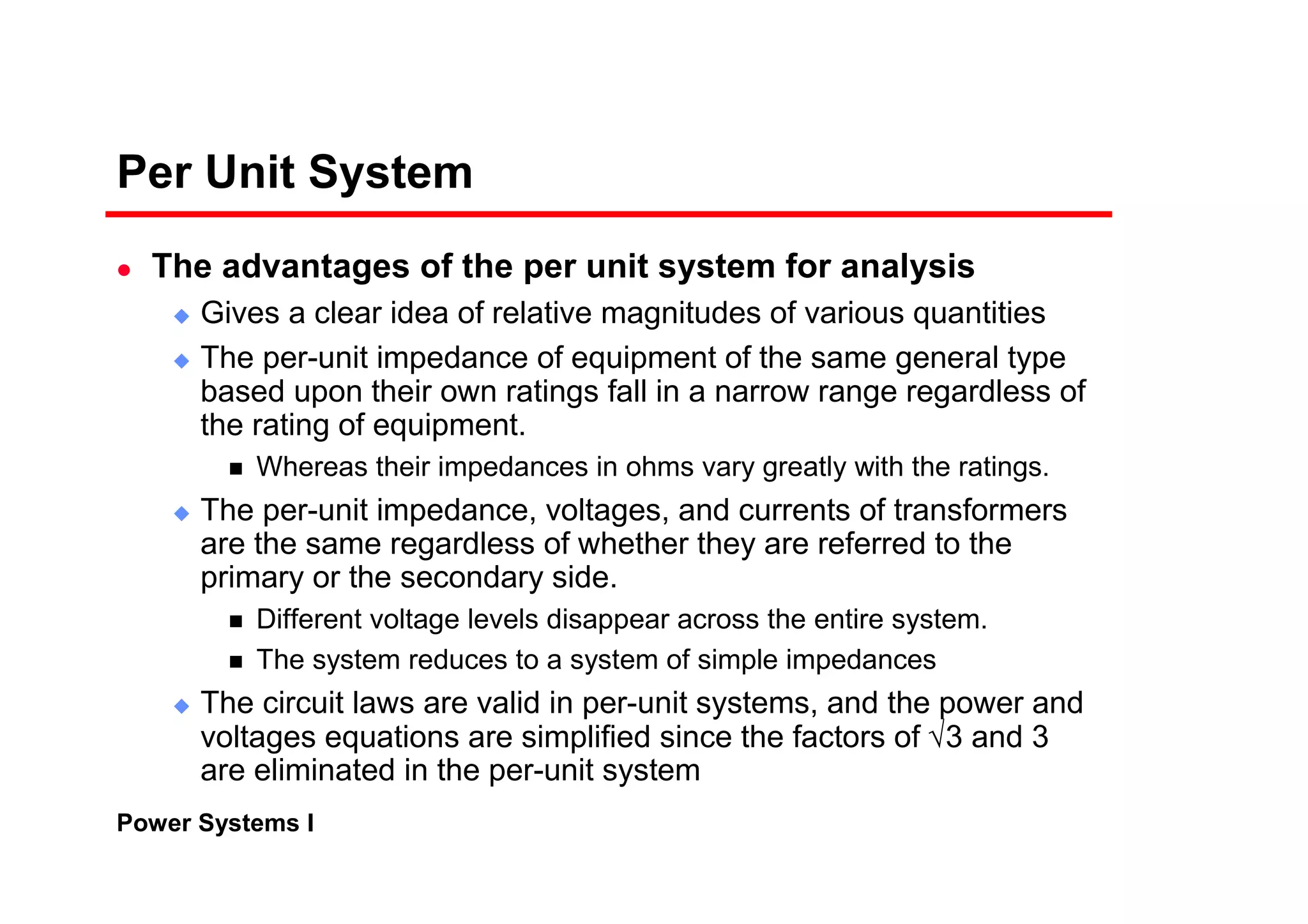
The advantages of the per unit system for analysis
Gives a clear idea of relative magnitudes of various quantities
The per-unit impedance of equipment of the same general type
based upon their own ratings fall in a narrow range regardless of
the rating of equipment.
Whereas their impedances in ohms vary greatly with the ratings.
The per-unit impedance, voltages, and currents of transformers
are the same regardless of whether they are referred to the
primary or the secondary side.
Different voltage levels disappear across the entire system.
The system reduces to a system of simple impedances
The circuit laws are valid in per-unit systems, and the power and
voltages equations are simplified since the factors of √3 and 3
are eliminated in the per-unit system
Power Systems I
Per Unit System
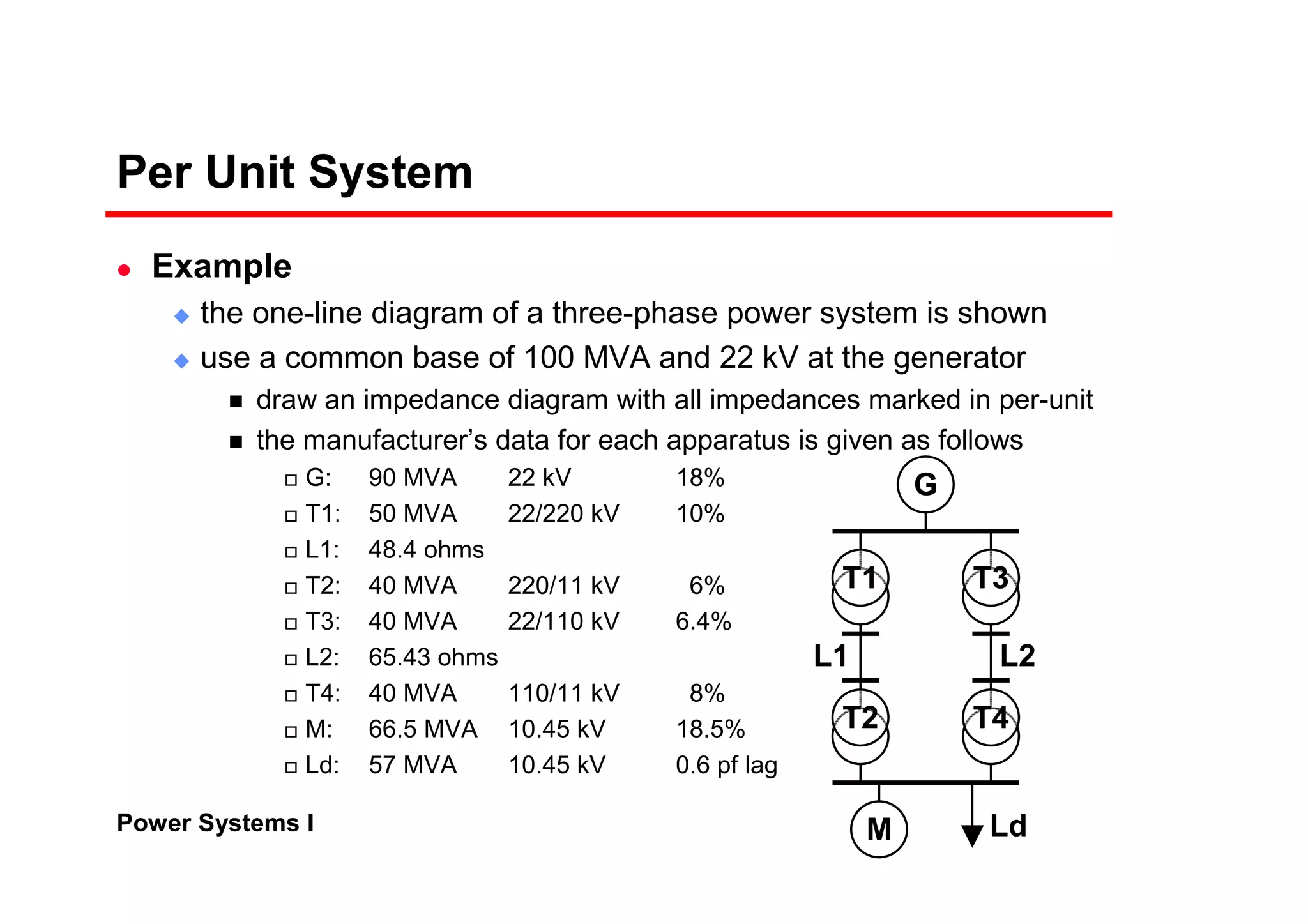
Example
the one-line diagram of a three-phase power system is shown
use a common base of 100 MVA and 22 kV at the generator
draw an impedance diagram with all impedances marked in per-unit
the manufacturer’s data for each apparatus is given as follows
G: 90 MVA 22 kV 18%
T1: 50 MVA 22/220 kV 10%
L1: 48.4 ohms
T2: 40 MVA 220/11 kV 6%
T3: 40 MVA 22/110 kV 6.4%
L2: 65.43 ohms
T4: 40 MVA 110/11 kV 8%
M: 66.5 MVA 10.45 kV 18.5%
Ld: 57 MVA 10.45 kV 0.6 pf lag
G
M
T2
T1
T4
T3
L1 L2
Ld

Lecture1

  • 1.
    Power Systems I PowerSystem Analysis Fundamentals of Power Systems (EEL 3216) basic models of power apparatus, transformers, synchronous machines, transmission lines simple systems one feeder radial to single load What more is there? large interconnected systems multiple loads; multiple generators why have large interconnected systems? reliability; economics analysis of the large system flow of power and currents; control and stability of the system proper handling of fault conditions; economic operation
  • 2.
    Power Systems I ModernPower Systems Power Producer generation station prime mover & generator step-up transformer Transmission Company HV transmission lines switching stations circuit breakers transformers Distribution Utility distribution substations step-down transformers MV distribution feeders distribution transformers
  • 3.
    Power Systems I NetworkLayout HV Networks Large quantities of power shipped over great distances Sharing of resources Improved reliability Economics of large scale MV Networks Local distribution of power Numerous systems Economics of simplicity Autonomous operation Loads Industrial & Commercial Residential
  • 4.
    Power Systems I SystemControl Network Protection Switchgear instrumentation transformers circuit breakers disconnect switches fuses lightning arrestors protective relays Energy Management Systems Energy Control Center computer control SCADA - Supervisory Control And Data Acquisition
  • 5.
    Power Systems I ComputerAnalysis Practical power systems must be safe reliable economical System Analysis for system planning for system operations requires component modeling types of analysis transmission line performance power flow analysis economic generation scheduling fault and stability studies
  • 6.
    FAMU-FSU College ofEngineering Chapter 2 AC Power
  • 7.
    Power Systems I Single-PhasePower Consumption ( ) ( ) ( ) ( ) ( ) ( ) ( ) ( ){ } ( ){ } ( )vv mmiv ivivmm ivmm im vm tIVtIVtp IIVV tIVtp BABABA ttIVtitvtp tIti tVtv θωθθωθ θθθ θθωθθ θωθω θω θω ++++= ==−= +++−= ++−= ++== += += 2sinsin2cos1cos)( 22 2coscos)( coscoscoscos coscos)()()( cos)( cos)( 2 1 2 1 2 1 energy flow into the circuit energy borrowed and returned by the circuit i(t) v(t)
  • 8.
    Power Systems I AverageActive (Real) Power ( ){ } ( ) ( ){ } ( ) ( ) ( ) IV P pf IVP dttdtt dtttIV dttpP tIVtIVtp vv vv == = == ++++= = ++++= ∫∫ ∫ ∫ θ θ ωω θθωθθω π θθωθθω ππ π π cos cos 0sin0cos sin2sincos2cos1 )( 2 1 sin2sincos2cos1)( 2 0 2 0 2 0 2 0
  • 9.
    Power Systems I ApparentPower ( ){ } ( ) ( ){ } ( ){ } ( ) ( )vvX vvR vv tStIVtp tPtIVtp tIVtIVtp IVS IVP θωθθθω θωθθω θθωθθω θ +=+= ++=++= ++++= = = 2sinsinsin2sin)( 2cos1cos2cos1)( sin2sincos2cos1)( cos
  • 10.
    Power Systems I ReactivePower for a pure resistor the impedance angle is zero, power factor is unity apparent power and real power are equal for a purely inductive circuit the current lags the voltage by 90°, average power is zero no transformation of energy for a purely capacitive circuit the current leads the voltage by 90°, average power is zero ( ) ( ) ( )vX vvX tQtp IVSQ tStIVtp θω θθ θωθθωθ += =≡ +=+= 2sin)( sinsin 2sinsin2sinsin)(
  • 11.
    Power Systems I ACPower Example the supply voltage is given by v(t) = 480 cos ω t the load is inductive with impedance Z = 1.20∠60° ¡ determine the expression for the instantaneous current i(t) and instantaneous power p(t) plot v(t), i(t), p(t), pR(t), pX(t) over an interval of 0 to 2 π
  • 12.
    Power Systems I ComplexPower Real Power, P RMS based - thermally equivalent to DC power Reactive Power, Q Oscillating power into and out of the load because of its reactive element (L or C). Positive value for inductive load (lagging pf) Complex Power, S ( ) 22 * sincos QPS jQPIVjIVS SIVIVIV iv += +=+= =∠=−∠= θθ θθθ
  • 13.
    Power Systems I ComplexPower P Q S V I θv θi θ θ Q S P V I θv θi θ θ Lagging Power Factor Leading Power Factor
  • 14.
    Power Systems I TheComplex Power Balance From the conservation of energy Real power supplied by the source is equal to the sum of the real powers absorbed by the load and the real losses in the system Reactive power must also be balanced The balance is between the sum of leading and the sum of lagging reactive power producing elements The total complex power delivered to the loads in parallel is the sum of the complex powers delivered to each ∑∑∑ ∑∑∑∑ ∑∑ ∑ −−= −−+= −−= lossesloadsgen indlaggingcapsleading lossesloadsgen SSS QQQQ PPP 0 0 0
  • 15.
    Power Systems I ComplexPower Example in the circuit below, find the power absorbed by each load and the total complex power find the capacitance of the capacitor to be connected across the loads to improve the overall power factor to 0.9 lagging I V 1200 V I2 I3 Z1=60+j0 Z2=6+j12 Z3=30-j30 I1
  • 16.
    Power Systems I ComplexPower Flow Consider the following circuit For the assumed direction of current The complex power V2 Z = R+j X =|Z|∠γ V1 I12 ( ) ( )γδγδ γ δδ δδ −∠−−∠= ∠ ∠−∠ = ∠=∠= 2 2 1 12211 12 222111 Z V Z V Z VV I VVVV ( ) ( ) ( )21 21 2 1 2 2 1 1 11 * 12112 δδγγ δγδγδ −+∠−∠=       −∠−−∠∠== Z VV Z V Z V Z V VIVS
  • 17.
    Power Systems I ComplexPower Flow The real and reactive power at the sending end Transmission lines have small resistance compared to the reactance. Often, it is assumed R = 0 (Z = X∠90°) ( ) ( )21 21 2 1 12 21 21 2 1 12 sinsin coscos δδγγ δδγγ −+−= −+−= Z VV Z V Q Z VV Z V P ( ) ( )[ ]2121 1 1221 21 12 cossin δδδδ −−=−= VV X V Q X VV P
  • 18.
    Power Systems I ComplexPower Flow For a typical power system with small R / X ratio, the follow observations are made Small changes in δ1 or δ2 will have significant effect on the real power flow Small changes in voltage magnitude will not have appreciable effect on the real power flow Assuming no resistance, the theoretical maximum power (static transmission capacity) occurs when the angular difference, δ, is 90° and is given by: For maintaining stability, the power system operates with small load angle δ The reactive power flow is determined by the magnitude difference of the terminal voltages X VV P 21 max =
  • 19.
    Power Systems I Three-PhasePower Balanced three-phase power Assumes balanced loads Assumes voltage and currents with phases that have 120° separation ∗∗ == == == LLLpp LLLpp LLLpp IVIVS IVIVQ IVIVP 33 sin3sin3 cos3cos3 3 3 3 φ φ φ θθ θθ
  • 20.
    FAMU-FSU College ofEngineering Chapter 3 Power Apparatus Modeling
  • 21.
    Power Systems I SystemModeling Systems are represented on a per-phase basis A single-phase representation is used for a balanced system the system is modeled as one phase of a wye-connected network Symmetrical components are used for unbalanced systems unbalance systems may be caused by: generation, network components, loads, or unusual operating conditions such as faults The per-unit system of measurements is used Review of basic network component models generators transformers loads transmission lines
  • 22.
    Power Systems I GeneratorModels Generator may be modeled in three different ways Power Injection Model - the real, P, and reactive, Q, power of the generator is specified at the node that the generator is connected either the voltage or injected current is specified at the connected node, allowing the other quantity to be determined Thevenin Model - induced AC voltage, E, behind the synchronous reactance, Xd Norton Model - injected AC current, IG, in parallel with the synchronous reactance E Xd Xd IG Node Node
  • 23.
    Power Systems I TransformerModel Equivalent circuit of a two winding transformer XmRc X2R2X1R1 V1 V2 E2 N1 : N2 E1
  • 24.
    Power Systems I TransformerModel Approximate circuit referred to the primary XEQ1REQ1 XmRc V1 2 2 1 2 V N N V =′
  • 25.
    Power Systems I LoadModels Models are selected based on both the type of analysis and the load characteristics Constant impedance, Zload Load is made up of R, L, and C elements connected to a network node and the ground (or neutral point of the system) Constant current, Iload The load has a constant current magnitude I, and a constant power factor, independent of the nodal voltage Also considered as a current injection into the network Constant power, Sload The load has a constant real, P, and reactive, Q, power component independent of nodal voltage or current injection Also considered as a negative power injection into the network
  • 26.
    Power Systems I PerUnit System Almost all power system analyses are performed in per- units Per unit system for power systems Based on a per-phase, wye-connect, three-phase system 3-phase power base, S3φ common power base is 100 MVA Line-to-line voltage base, VLL voltage base is usually selected from the equipment rated voltage Phase current base, IL Phase impedance base, Z baseLL base baseL V S I − − − = 3 3φ ( ) ( ) base baseLN base baseLL base S V S V Z − − − − == φφ 1 2 3 2 100 % ).( ).( )( )( x unitengrx unitengrx pux base actualgengineerin unitper ==
  • 27.
    Power Systems I PerUnit System Equipment impedances are frequently given in per units or percentages of the impedance base The impedance base for equipment is derived from the rated power and the rated voltage When modeling equipment in a system, the per unit impedance must be converted so that the equipment and the system are on a common base It is normal for the voltage bases to be the same: ( ) ( ) ( ) ( ) 22 2 22       ⋅=⋅⋅= ==== Ω Ω Ω Ω new base old base old base new baseold pu old puold base old base new base new basenew pu new base new base new base new puold base old base old base old pu V V S S ZZ S V V S Z V S Z Z Z Z V S Z Z Z Z old base new baseold pu new pu S S ZZ =
  • 28.
    Power Systems I PerUnit System The advantages of the per unit system for analysis Gives a clear idea of relative magnitudes of various quantities The per-unit impedance of equipment of the same general type based upon their own ratings fall in a narrow range regardless of the rating of equipment. Whereas their impedances in ohms vary greatly with the ratings. The per-unit impedance, voltages, and currents of transformers are the same regardless of whether they are referred to the primary or the secondary side. Different voltage levels disappear across the entire system. The system reduces to a system of simple impedances The circuit laws are valid in per-unit systems, and the power and voltages equations are simplified since the factors of √3 and 3 are eliminated in the per-unit system
  • 29.
    Power Systems I PerUnit System Example the one-line diagram of a three-phase power system is shown use a common base of 100 MVA and 22 kV at the generator draw an impedance diagram with all impedances marked in per-unit the manufacturer’s data for each apparatus is given as follows G: 90 MVA 22 kV 18% T1: 50 MVA 22/220 kV 10% L1: 48.4 ohms T2: 40 MVA 220/11 kV 6% T3: 40 MVA 22/110 kV 6.4% L2: 65.43 ohms T4: 40 MVA 110/11 kV 8% M: 66.5 MVA 10.45 kV 18.5% Ld: 57 MVA 10.45 kV 0.6 pf lag G M T2 T1 T4 T3 L1 L2 Ld