The	
  Death	
  of	
  Disk	
  
Panel	
  Session	
  
Erik	
  Riedel,	
  EMC	
  
HEC	
  FSIO	
  Workshop	
  
August	
  2011	
  
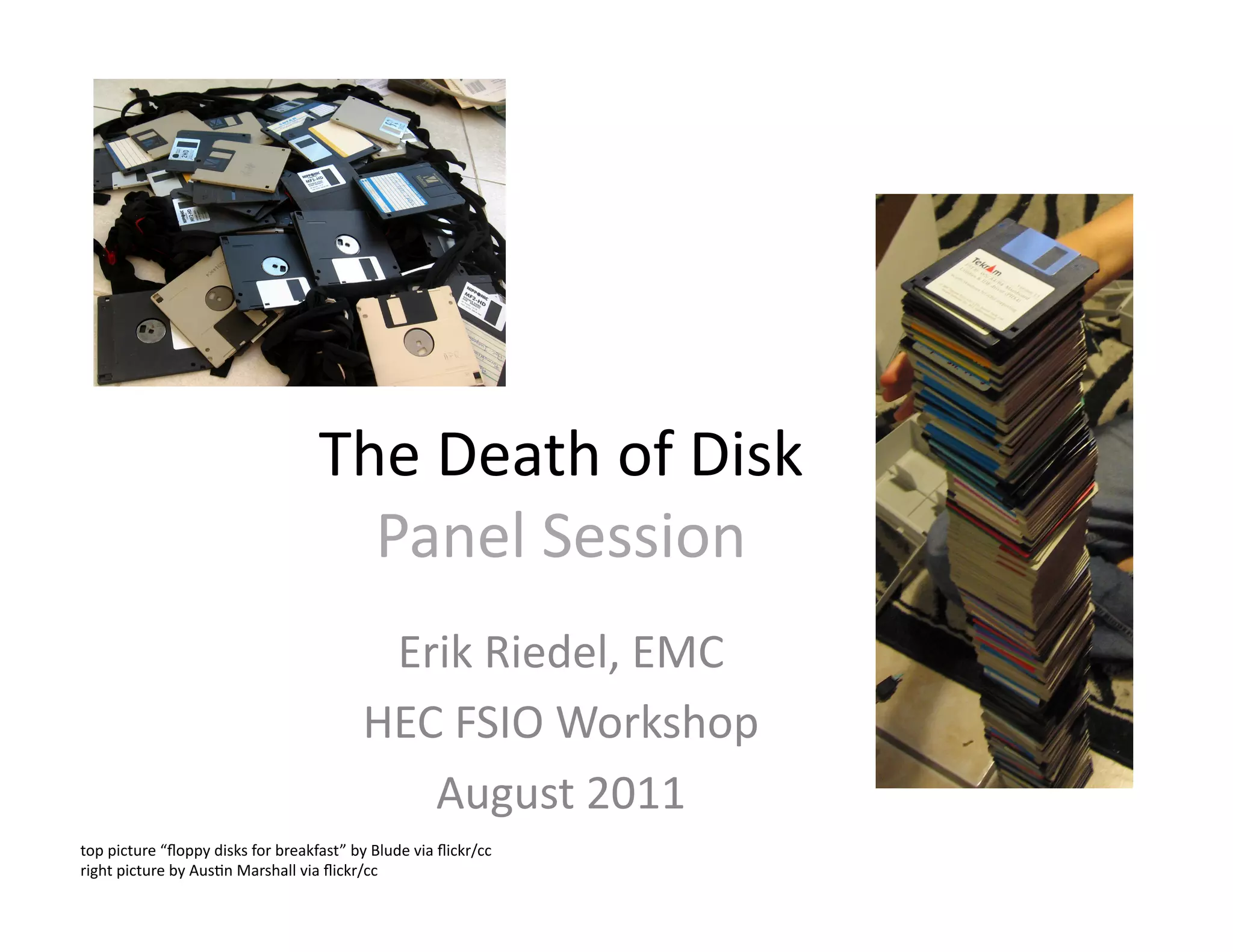
top	
  picture	
  “floppy	
  disks	
  for	
  breakfast”	
  by	
  Blude	
  via	
  flickr/cc	
  	
  
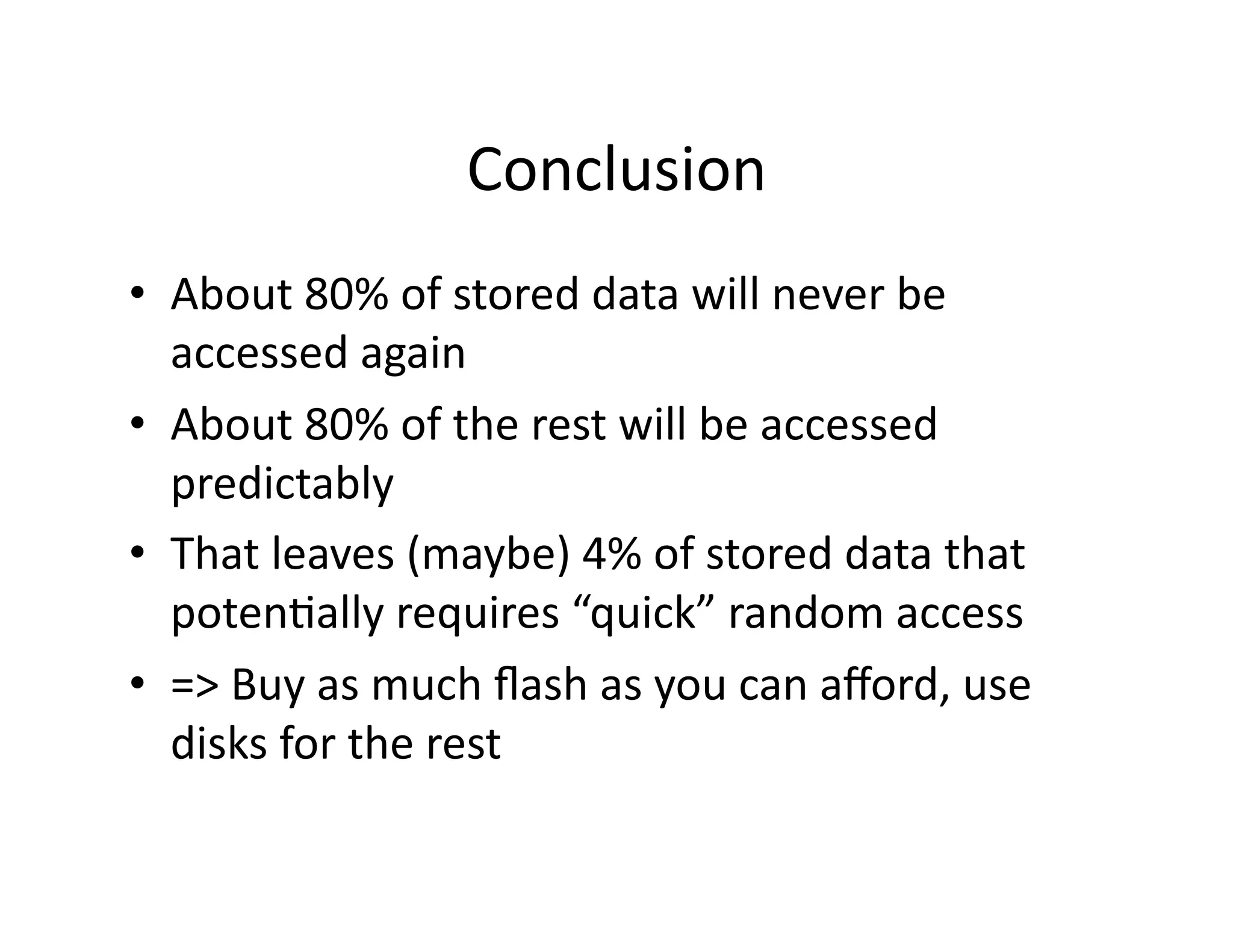
right	
  picture	
  by	
  AusMn	
  Marshall	
  via	
  flickr/cc	
  
Conclusion	
  
•  About	
  80%	
  of	
  stored	
  data	
  will	
  never	
  be	
  
accessed	
  again	
  
•  About	
  80%	
  of	
  the	
  rest	
  will	
  be	
  accessed	
  
predictably	
  
•  That	
  leaves	
  (maybe)	
  4%	
  of	
  stored	
  data	
  that	
  
potenMally	
  requires	
  “quick”	
  random	
  access	
  
•  =>	
  Buy	
  as	
  much	
  flash	
  as	
  you	
  can	
  afford,	
  use	
  
disks	
  for	
  the	
  rest	
  	
  
Most	
  Data	
  Is	
  Idle	
  
•  About	
  80%	
  of	
  stored	
  data	
  will	
  never	
  be	
  
accessed	
  again	
  
•  Disk	
  drives	
  have	
  long	
  been	
  designed	
  around	
  
this	
  key	
  fact	
  of	
  the	
  digital	
  world	
  
•  AmorMze	
  a	
  relaMvely	
  small	
  amount	
  of	
  
expensive	
  read/write	
  electronics	
  and	
  fancy	
  
material	
  science	
  over	
  a	
  large	
  and	
  cheap	
  
magneMc	
  media	
  
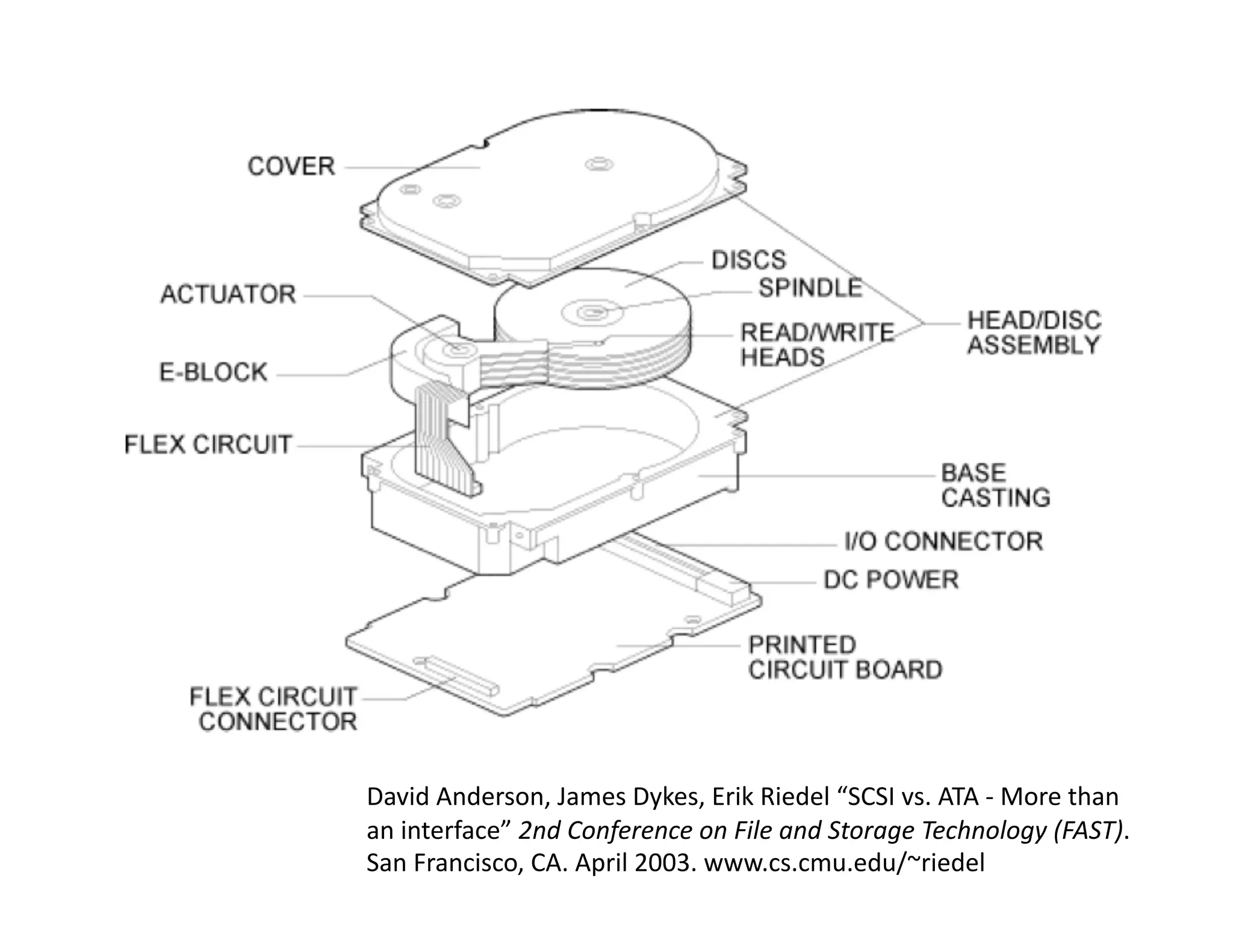
David	
  Anderson,	
  James	
  Dykes,	
  Erik	
  Riedel	
  “SCSI	
  vs.	
  ATA	
  -­‐	
  More	
  than	
  
an	
  interface”	
  2nd	
  Conference	
  on	
  File	
  and	
  Storage	
  Technology	
  (FAST).	
  
San	
  Francisco,	
  CA.	
  April	
  2003.	
  www.cs.cmu.edu/~riedel	
  
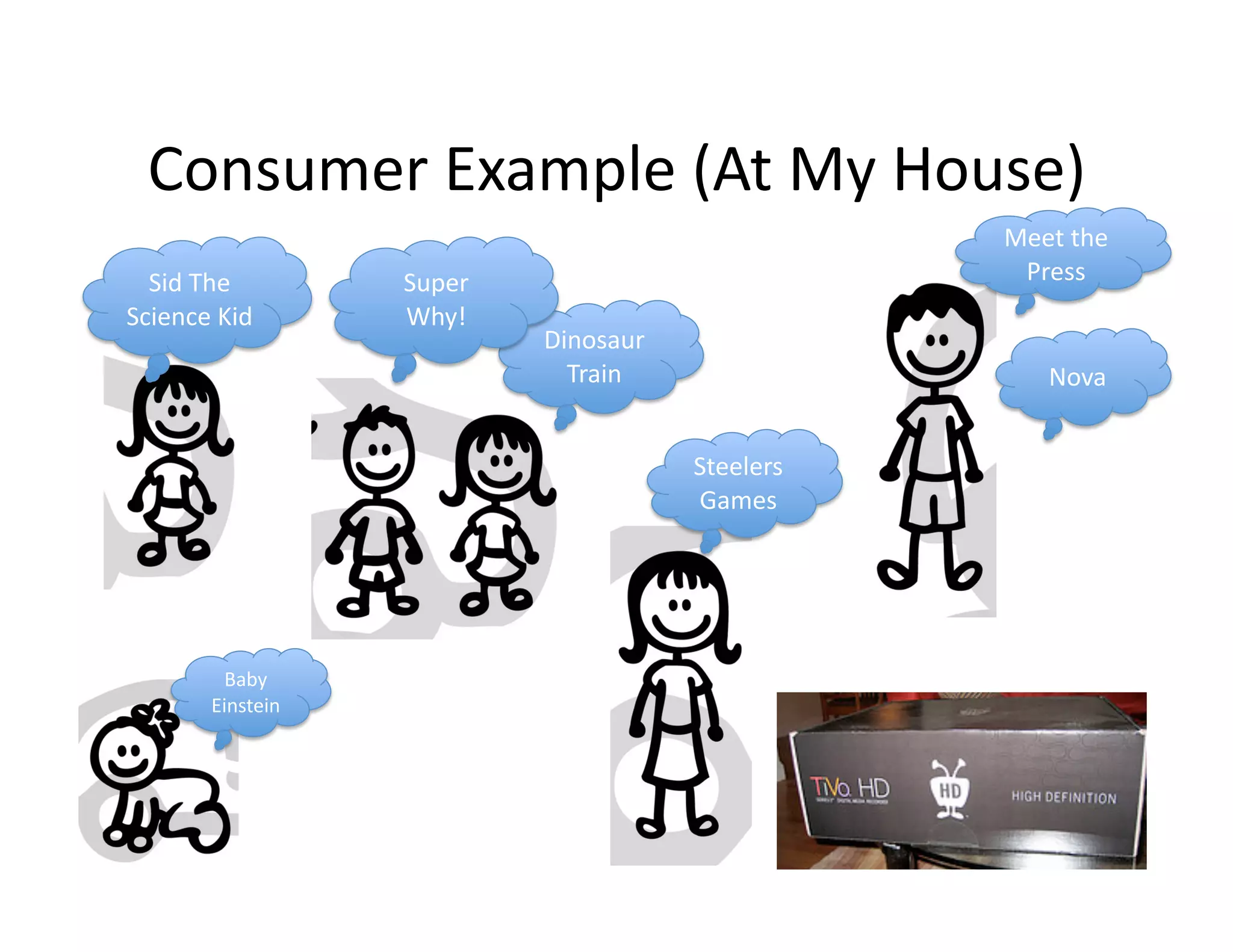
Consumer	
  Example	
  (At	
  My	
  House)	
  
Dinosaur	
  
Train	
  
Sid	
  The	
  
Science	
  Kid	
  
Super	
  
Why!	
  
Steelers	
  
Games	
  
Meet	
  the	
  
Press	
  
Nova	
  
Baby	
  
Einstein	
  
Most	
  Data	
  Access	
  Is	
  Predictable	
  
•  Caching	
  
•  Prefetching	
  
•  Tiering	
  
•  Staging	
  
•  Hierarchical	
  Storage	
  Mgmt	
  
•  all	
  these	
  tools	
  have	
  been	
  known	
  for	
  years	
  
•  just	
  need	
  to	
  open	
  our	
  toolbox,	
  sharpen	
  some	
  of	
  
them	
  to	
  apply	
  to	
  today’s	
  infrastructure/apps	
  
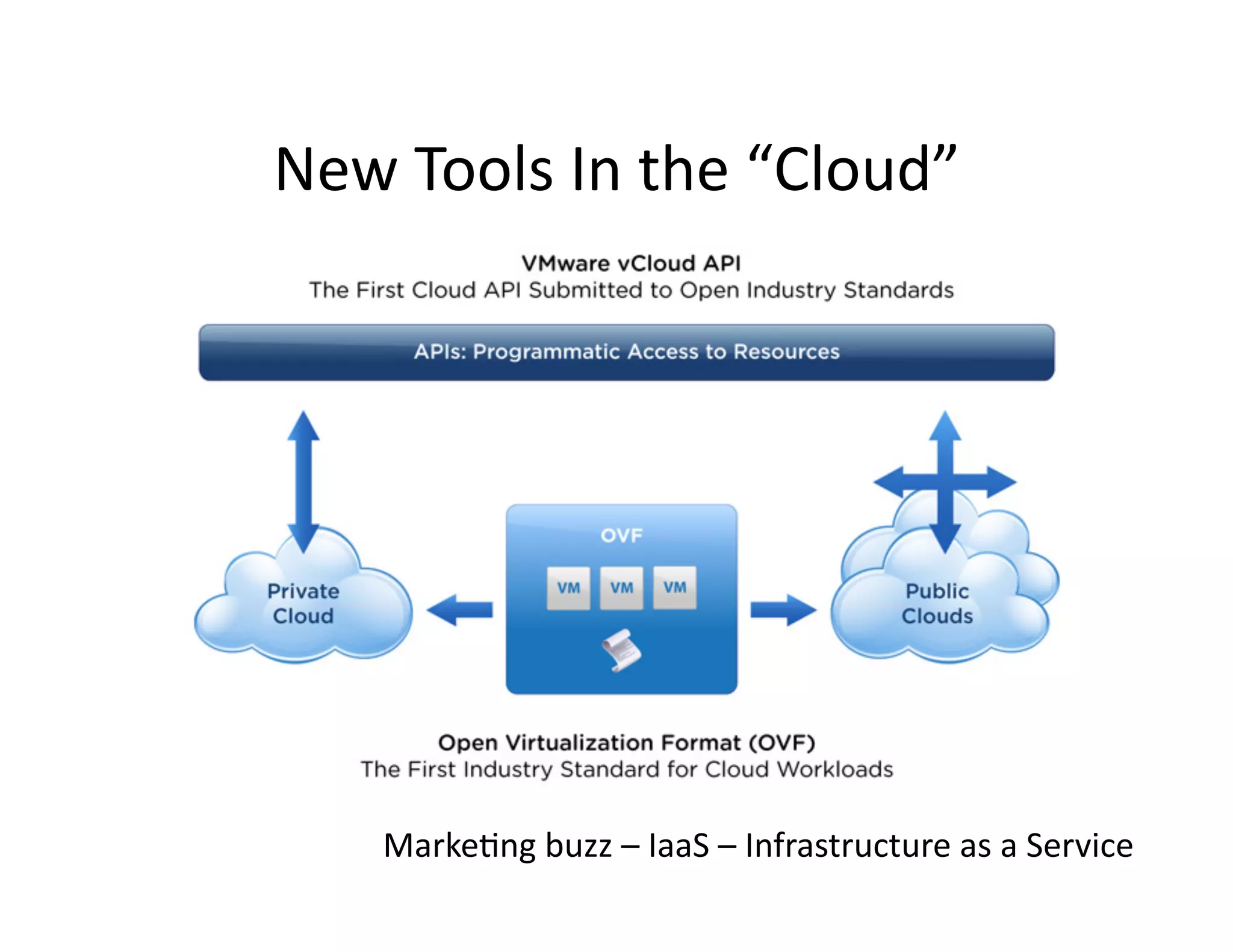
New	
  Tools	
  In	
  the	
  “Cloud”	
  
MarkeMng	
  buzz	
  –	
  IaaS	
  –	
  Infrastructure	
  as	
  a	
  Service	
  
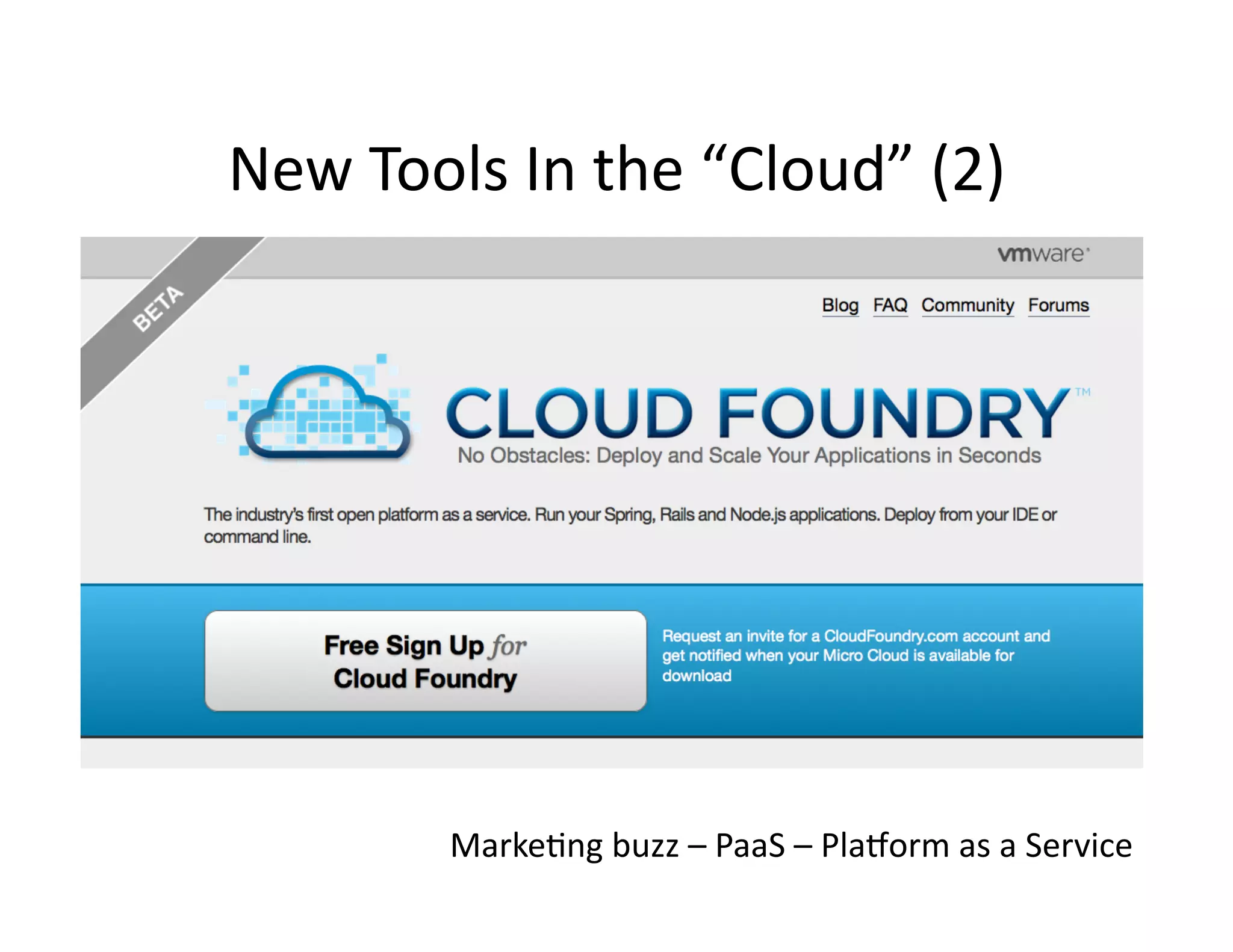
New	
  Tools	
  In	
  the	
  “Cloud”	
  (2)	
  
MarkeMng	
  buzz	
  –	
  PaaS	
  –	
  Plagorm	
  as	
  a	
  Service	
  
New	
  Tools	
  in	
  the	
  “Cloud”	
  (3)	
  
•  Key	
  takeaways	
  
– both	
  IaaS	
  and	
  PaaS	
  are	
  “closed	
  loop”	
  
infrastructures	
  
– apps	
  cannot	
  be	
  deployed	
  except	
  at	
  the	
  “direcMon”	
  
of	
  the	
  system	
  
– logging	
  and	
  monitoring	
  are	
  constant	
  
•  need	
  to	
  get	
  high	
  uMlizaMon	
  rates	
  ($$)	
  
•  need	
  to	
  send	
  out	
  bills	
  ($$)	
  
•  want	
  high	
  rates	
  of	
  “mulM-­‐tenancy”	
  to	
  be	
  efficient	
  ($$)	
  
– this	
  leads	
  to	
  a	
  significant	
  level	
  of	
  “predictability”	
  
Get	
  Predictability	
  Into	
  Storage	
  
•  Key	
  challenge	
  is	
  how	
  to	
  translate	
  what	
  “the	
  
system”	
  knows	
  about	
  apps	
  and	
  behaviors	
  and	
  
“SLAs”	
  into	
  guidance	
  for	
  our	
  system-­‐level	
  tools	
  
(caching,	
  prefetching,	
  Mering,	
  etc.)	
  
•  Secondary	
  challenge	
  is	
  avoiding	
  “surprises”	
  
– where	
  performance	
  or	
  availability	
  or	
  durability	
  
don’t	
  meet	
  the	
  SLAs	
  (“quality	
  of	
  service”)	
  
•  Good	
  news	
  is	
  that	
  the	
  new	
  infrastructures	
  
have	
  some	
  powerful	
  new	
  ways	
  to	
  help	
  us	
  
One	
  Example	
  New	
  Tool	
  –	
  Stunning	
  
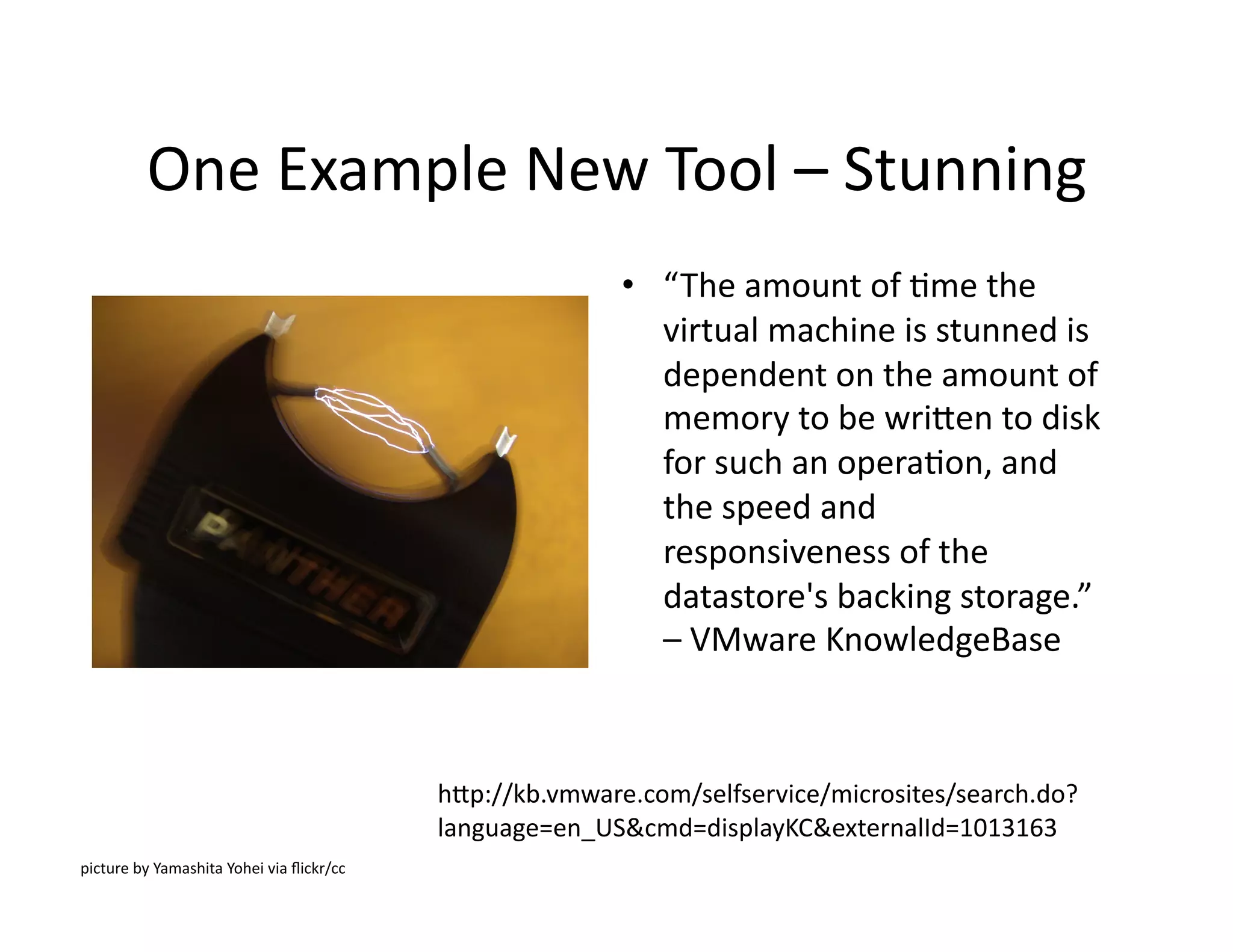
•  “The	
  amount	
  of	
  Mme	
  the	
  
virtual	
  machine	
  is	
  stunned	
  is	
  
dependent	
  on	
  the	
  amount	
  of	
  
memory	
  to	
  be	
  wrilen	
  to	
  disk	
  
for	
  such	
  an	
  operaMon,	
  and	
  
the	
  speed	
  and	
  
responsiveness	
  of	
  the	
  
datastore's	
  backing	
  storage.”	
  
–	
  VMware	
  KnowledgeBase	
  
hlp://kb.vmware.com/selfservice/microsites/search.do?
language=en_US&cmd=displayKC&externalId=1013163	
  
picture	
  by	
  Yamashita	
  Yohei	
  via	
  flickr/cc	
  	
  
What	
  About	
  Tape?	
  
pictures	
  by	
  Gill	
  Wildman	
  via	
  flickr/cc	
  
What	
  About	
  Tape?	
  
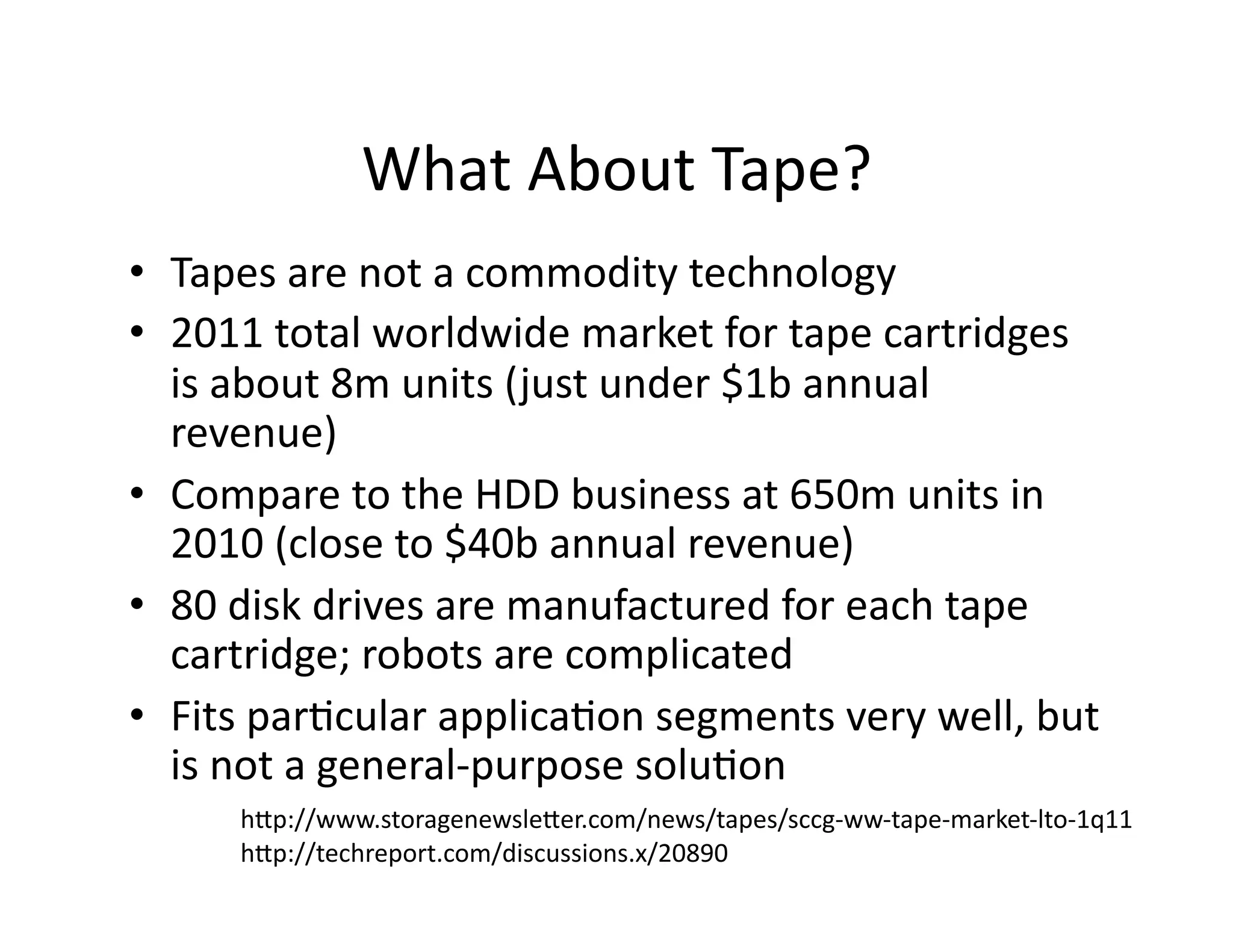
•  Tapes	
  are	
  not	
  a	
  commodity	
  technology	
  
•  2011	
  total	
  worldwide	
  market	
  for	
  tape	
  cartridges	
  
is	
  about	
  8m	
  units	
  (just	
  under	
  $1b	
  annual	
  
revenue)	
  
•  Compare	
  to	
  the	
  HDD	
  business	
  at	
  650m	
  units	
  in	
  
2010	
  (close	
  to	
  $40b	
  annual	
  revenue)	
  
•  80	
  disk	
  drives	
  are	
  manufactured	
  for	
  each	
  tape	
  
cartridge;	
  robots	
  are	
  complicated	
  
•  Fits	
  parMcular	
  applicaMon	
  segments	
  very	
  well,	
  but	
  
is	
  not	
  a	
  general-­‐purpose	
  soluMon	
  
hlp://www.storagenewsleler.com/news/tapes/sccg-­‐ww-­‐tape-­‐market-­‐lto-­‐1q11	
  
hlp://techreport.com/discussions.x/20890	
  
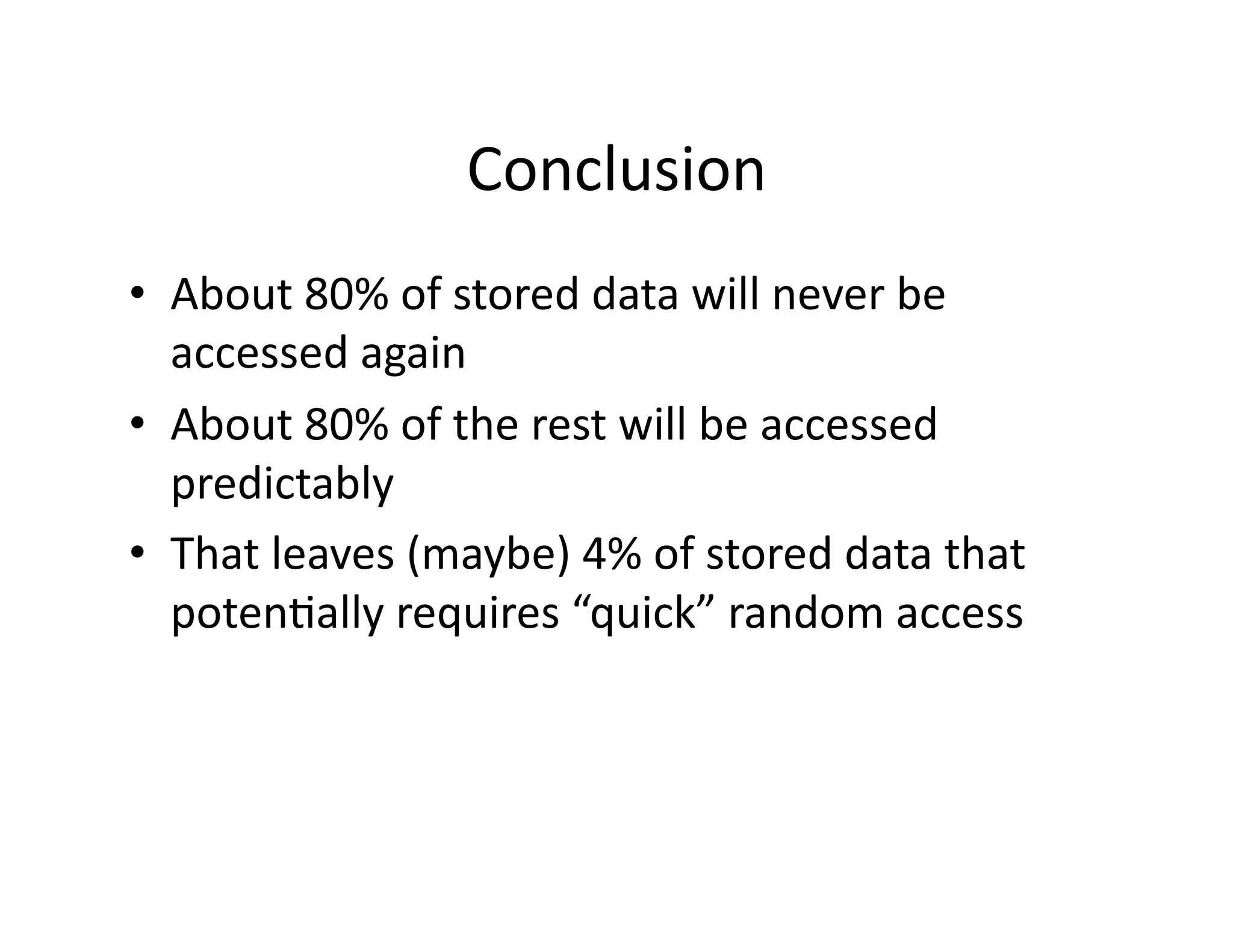
Conclusion	
  
•  About	
  80%	
  of	
  stored	
  data	
  will	
  never	
  be	
  
accessed	
  again	
  
•  About	
  80%	
  of	
  the	
  rest	
  will	
  be	
  accessed	
  
predictably	
  
•  That	
  leaves	
  (maybe)	
  4%	
  of	
  stored	
  data	
  that	
  
potenMally	
  requires	
  “quick”	
  random	
  access	
  
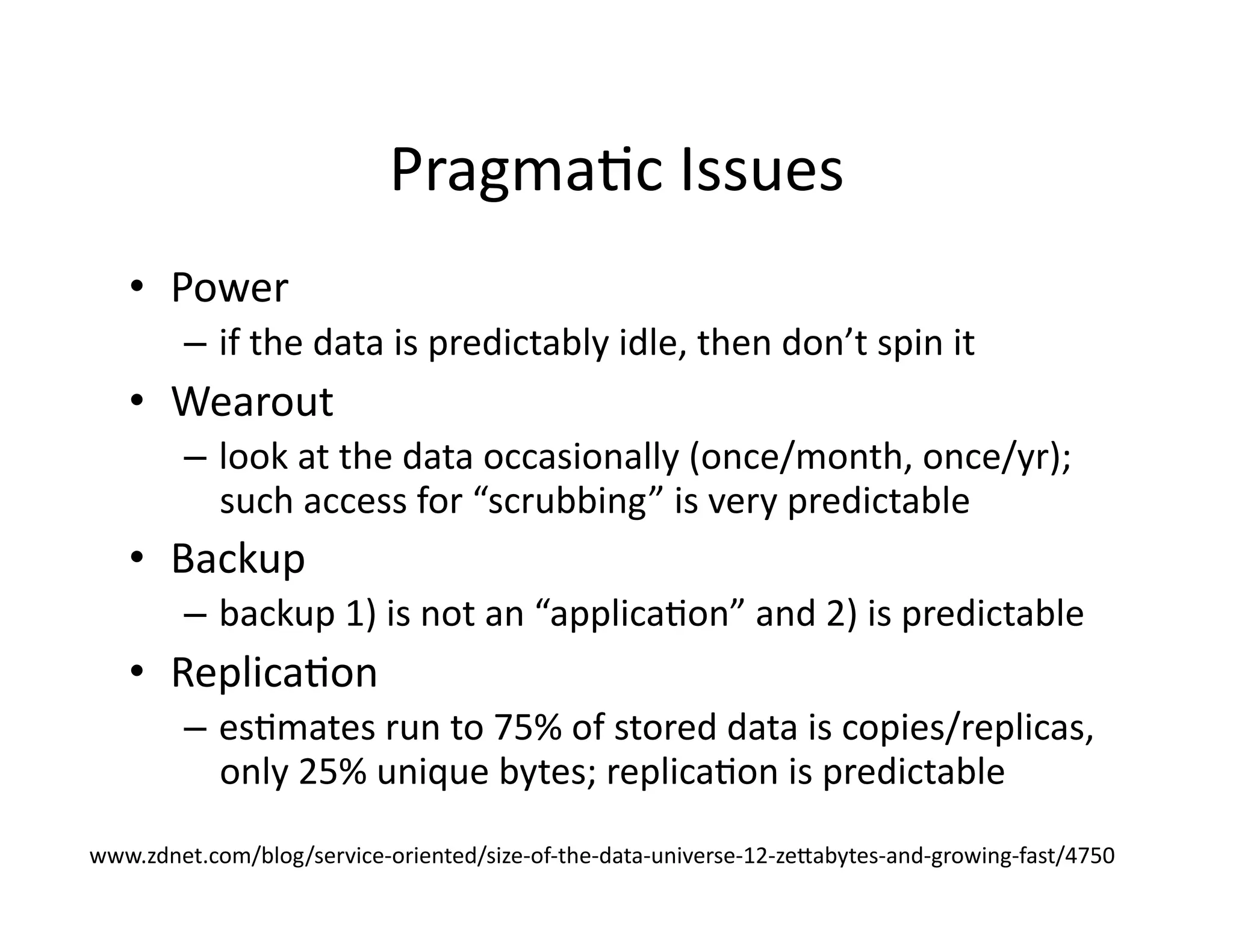
PragmaMc	
  Issues	
  
•  Power	
  
–  if	
  the	
  data	
  is	
  predictably	
  idle,	
  then	
  don’t	
  spin	
  it	
  
•  Wearout	
  
–  look	
  at	
  the	
  data	
  occasionally	
  (once/month,	
  once/yr);	
  
such	
  access	
  for	
  “scrubbing”	
  is	
  very	
  predictable	
  
•  Backup	
  
–  backup	
  1)	
  is	
  not	
  an	
  “applicaMon”	
  and	
  2)	
  is	
  predictable	
  
•  ReplicaMon	
  
–  esMmates	
  run	
  to	
  75%	
  of	
  stored	
  data	
  is	
  copies/replicas,	
  
only	
  25%	
  unique	
  bytes;	
  replicaMon	
  is	
  predictable	
  	
  
www.zdnet.com/blog/service-­‐oriented/size-­‐of-­‐the-­‐data-­‐universe-­‐12-­‐zelabytes-­‐and-­‐growing-­‐fast/4750	
  
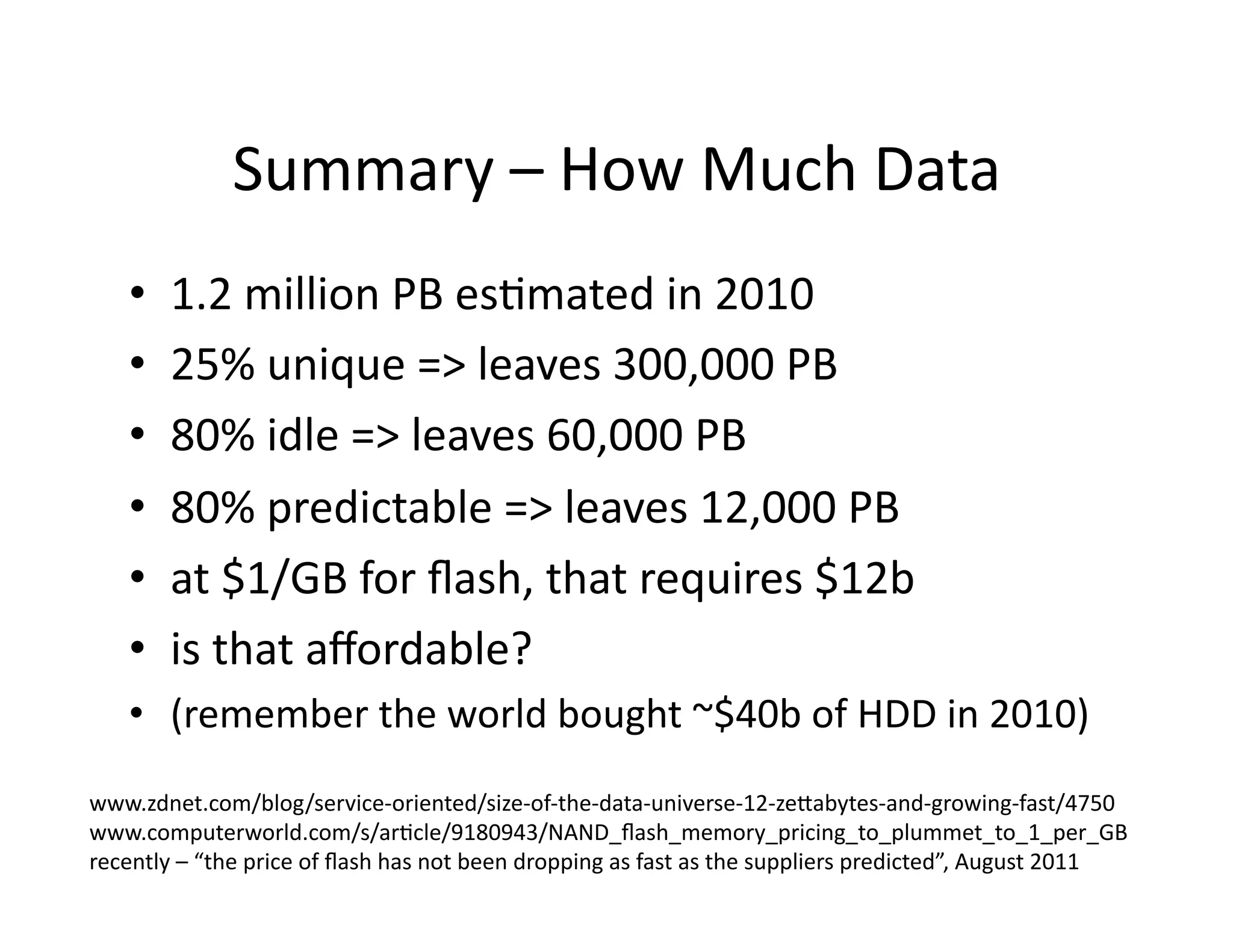
Summary	
  –	
  How	
  Much	
  Data	
  
•  1.2	
  million	
  PB	
  esMmated	
  in	
  2010	
  
•  25%	
  unique	
  =>	
  leaves	
  300,000	
  PB	
  
•  80%	
  idle	
  =>	
  leaves	
  60,000	
  PB	
  
•  80%	
  predictable	
  =>	
  leaves	
  12,000	
  PB	
  
•  at	
  $1/GB	
  for	
  flash,	
  that	
  requires	
  $12b	
  
•  is	
  that	
  affordable?	
  
•  (remember	
  the	
  world	
  bought	
  ~$40b	
  of	
  HDD	
  in	
  2010)	
  
www.zdnet.com/blog/service-­‐oriented/size-­‐of-­‐the-­‐data-­‐universe-­‐12-­‐zelabytes-­‐and-­‐growing-­‐fast/4750	
  
www.computerworld.com/s/arMcle/9180943/NAND_flash_memory_pricing_to_plummet_to_1_per_GB	
  
recently	
  –	
  “the	
  price	
  of	
  flash	
  has	
  not	
  been	
  dropping	
  as	
  fast	
  as	
  the	
  suppliers	
  predicted”,	
  August	
  2011	
  
Conclusion	
  
•  About	
  80%	
  of	
  stored	
  data	
  will	
  never	
  be	
  
accessed	
  again	
  
•  About	
  80%	
  of	
  the	
  rest	
  will	
  be	
  accessed	
  
predictably	
  
•  That	
  leaves	
  (maybe)	
  4%	
  of	
  stored	
  data	
  that	
  
potenMally	
  requires	
  “quick”	
  random	
  access	
  
•  =>	
  Buy	
  as	
  much	
  flash	
  as	
  you	
  can	
  afford,	
  use	
  
disks	
  for	
  the	
  rest	
  	
  
n.b.	
  73.6%	
  of	
  all	
  staMsMcs	
  are	
  made	
  up,	
  
do	
  the	
  calculaMons	
  for	
  your	
  own	
  
environments,	
  your	
  mileage	
  may	
  vary	
  
www.businessinsider.com/736-­‐of-­‐all-­‐
staMsMcs-­‐are-­‐made-­‐up-­‐2010-­‐2	
  
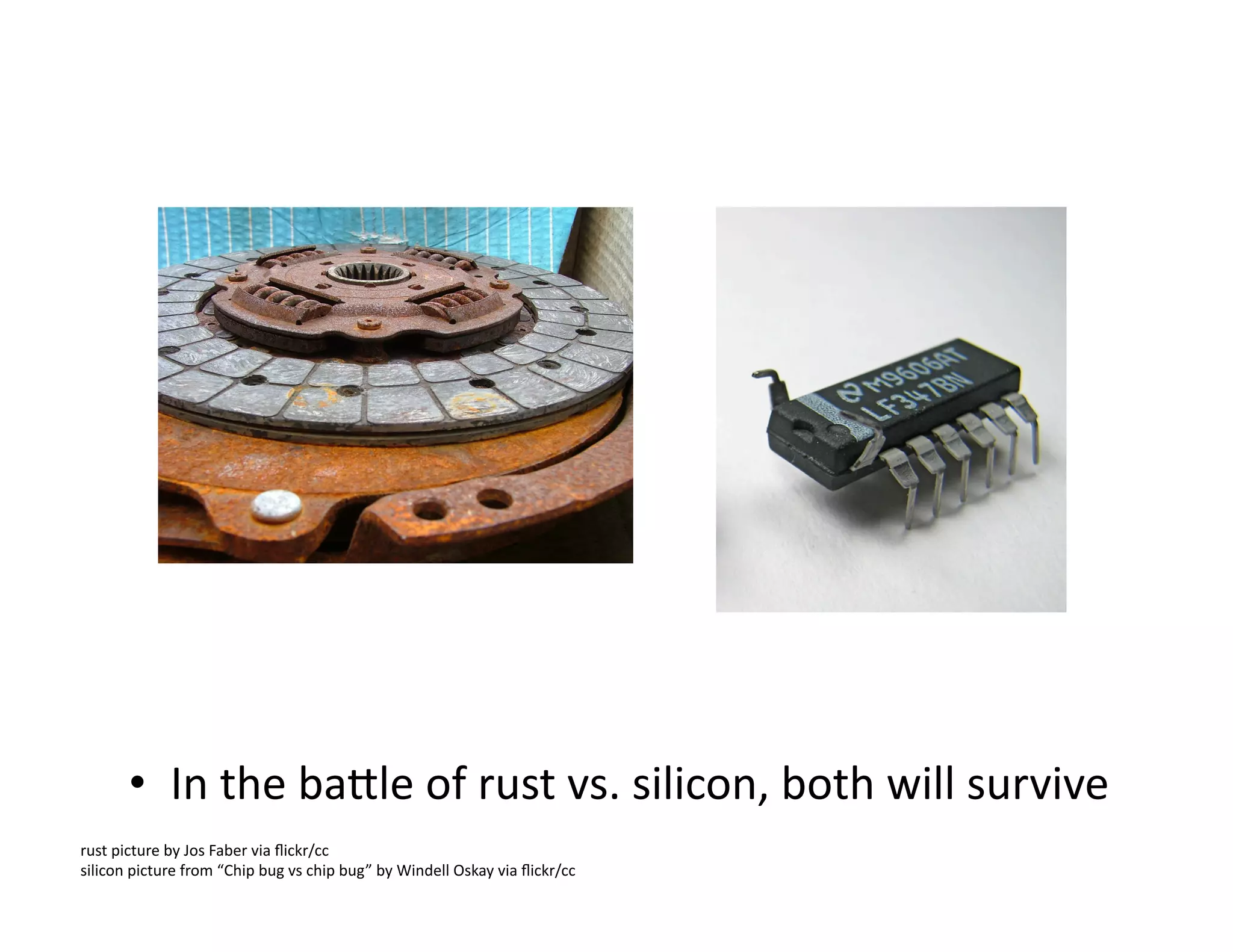
•  In	
  the	
  balle	
  of	
  rust	
  vs.	
  silicon,	
  both	
  will	
  survive	
  
rust	
  picture	
  by	
  Jos	
  Faber	
  via	
  flickr/cc	
  	
  
silicon	
  picture	
  from	
  “Chip	
  bug	
  vs	
  chip	
  bug”	
  by	
  Windell	
  Oskay	
  via	
  flickr/cc	
  
hlp://www.emc.com/storage/atmos/atmos.htm	
  
a	
  brief	
  word	
  from	
  my	
  sponsors	
  

Death of Disk Panel Session - HEC-FSIO Workshop

  • 1.
    The  Death  of  Disk   Panel  Session   Erik  Riedel,  EMC   HEC  FSIO  Workshop   August  2011   top  picture  “floppy  disks  for  breakfast”  by  Blude  via  flickr/cc     right  picture  by  AusMn  Marshall  via  flickr/cc  
  • 2.
    Conclusion   •  About  80%  of  stored  data  will  never  be   accessed  again   •  About  80%  of  the  rest  will  be  accessed   predictably   •  That  leaves  (maybe)  4%  of  stored  data  that   potenMally  requires  “quick”  random  access   •  =>  Buy  as  much  flash  as  you  can  afford,  use   disks  for  the  rest    
  • 3.
    Most  Data  Is  Idle   •  About  80%  of  stored  data  will  never  be   accessed  again   •  Disk  drives  have  long  been  designed  around   this  key  fact  of  the  digital  world   •  AmorMze  a  relaMvely  small  amount  of   expensive  read/write  electronics  and  fancy   material  science  over  a  large  and  cheap   magneMc  media  
  • 4.
    David  Anderson,  James  Dykes,  Erik  Riedel  “SCSI  vs.  ATA  -­‐  More  than   an  interface”  2nd  Conference  on  File  and  Storage  Technology  (FAST).   San  Francisco,  CA.  April  2003.  www.cs.cmu.edu/~riedel  
  • 5.
    Consumer  Example  (At  My  House)   Dinosaur   Train   Sid  The   Science  Kid   Super   Why!   Steelers   Games   Meet  the   Press   Nova   Baby   Einstein  
  • 6.
    Most  Data  Access  Is  Predictable   •  Caching   •  Prefetching   •  Tiering   •  Staging   •  Hierarchical  Storage  Mgmt   •  all  these  tools  have  been  known  for  years   •  just  need  to  open  our  toolbox,  sharpen  some  of   them  to  apply  to  today’s  infrastructure/apps  
  • 7.
    New  Tools  In  the  “Cloud”   MarkeMng  buzz  –  IaaS  –  Infrastructure  as  a  Service  
  • 8.
    New  Tools  In  the  “Cloud”  (2)   MarkeMng  buzz  –  PaaS  –  Plagorm  as  a  Service  
  • 9.
    New  Tools  in  the  “Cloud”  (3)   •  Key  takeaways   – both  IaaS  and  PaaS  are  “closed  loop”   infrastructures   – apps  cannot  be  deployed  except  at  the  “direcMon”   of  the  system   – logging  and  monitoring  are  constant   •  need  to  get  high  uMlizaMon  rates  ($$)   •  need  to  send  out  bills  ($$)   •  want  high  rates  of  “mulM-­‐tenancy”  to  be  efficient  ($$)   – this  leads  to  a  significant  level  of  “predictability”  
  • 10.
    Get  Predictability  Into  Storage   •  Key  challenge  is  how  to  translate  what  “the   system”  knows  about  apps  and  behaviors  and   “SLAs”  into  guidance  for  our  system-­‐level  tools   (caching,  prefetching,  Mering,  etc.)   •  Secondary  challenge  is  avoiding  “surprises”   – where  performance  or  availability  or  durability   don’t  meet  the  SLAs  (“quality  of  service”)   •  Good  news  is  that  the  new  infrastructures   have  some  powerful  new  ways  to  help  us  
  • 11.
    One  Example  New  Tool  –  Stunning   •  “The  amount  of  Mme  the   virtual  machine  is  stunned  is   dependent  on  the  amount  of   memory  to  be  wrilen  to  disk   for  such  an  operaMon,  and   the  speed  and   responsiveness  of  the   datastore's  backing  storage.”   –  VMware  KnowledgeBase   hlp://kb.vmware.com/selfservice/microsites/search.do? language=en_US&cmd=displayKC&externalId=1013163   picture  by  Yamashita  Yohei  via  flickr/cc    
  • 12.
    What  About  Tape?   pictures  by  Gill  Wildman  via  flickr/cc  
  • 13.
    What  About  Tape?   •  Tapes  are  not  a  commodity  technology   •  2011  total  worldwide  market  for  tape  cartridges   is  about  8m  units  (just  under  $1b  annual   revenue)   •  Compare  to  the  HDD  business  at  650m  units  in   2010  (close  to  $40b  annual  revenue)   •  80  disk  drives  are  manufactured  for  each  tape   cartridge;  robots  are  complicated   •  Fits  parMcular  applicaMon  segments  very  well,  but   is  not  a  general-­‐purpose  soluMon   hlp://www.storagenewsleler.com/news/tapes/sccg-­‐ww-­‐tape-­‐market-­‐lto-­‐1q11   hlp://techreport.com/discussions.x/20890  
  • 14.
    Conclusion   •  About  80%  of  stored  data  will  never  be   accessed  again   •  About  80%  of  the  rest  will  be  accessed   predictably   •  That  leaves  (maybe)  4%  of  stored  data  that   potenMally  requires  “quick”  random  access  
  • 15.
    PragmaMc  Issues   • Power   –  if  the  data  is  predictably  idle,  then  don’t  spin  it   •  Wearout   –  look  at  the  data  occasionally  (once/month,  once/yr);   such  access  for  “scrubbing”  is  very  predictable   •  Backup   –  backup  1)  is  not  an  “applicaMon”  and  2)  is  predictable   •  ReplicaMon   –  esMmates  run  to  75%  of  stored  data  is  copies/replicas,   only  25%  unique  bytes;  replicaMon  is  predictable     www.zdnet.com/blog/service-­‐oriented/size-­‐of-­‐the-­‐data-­‐universe-­‐12-­‐zelabytes-­‐and-­‐growing-­‐fast/4750  
  • 16.
    Summary  –  How  Much  Data   •  1.2  million  PB  esMmated  in  2010   •  25%  unique  =>  leaves  300,000  PB   •  80%  idle  =>  leaves  60,000  PB   •  80%  predictable  =>  leaves  12,000  PB   •  at  $1/GB  for  flash,  that  requires  $12b   •  is  that  affordable?   •  (remember  the  world  bought  ~$40b  of  HDD  in  2010)   www.zdnet.com/blog/service-­‐oriented/size-­‐of-­‐the-­‐data-­‐universe-­‐12-­‐zelabytes-­‐and-­‐growing-­‐fast/4750   www.computerworld.com/s/arMcle/9180943/NAND_flash_memory_pricing_to_plummet_to_1_per_GB   recently  –  “the  price  of  flash  has  not  been  dropping  as  fast  as  the  suppliers  predicted”,  August  2011  
  • 17.
    Conclusion   •  About  80%  of  stored  data  will  never  be   accessed  again   •  About  80%  of  the  rest  will  be  accessed   predictably   •  That  leaves  (maybe)  4%  of  stored  data  that   potenMally  requires  “quick”  random  access   •  =>  Buy  as  much  flash  as  you  can  afford,  use   disks  for  the  rest     n.b.  73.6%  of  all  staMsMcs  are  made  up,   do  the  calculaMons  for  your  own   environments,  your  mileage  may  vary   www.businessinsider.com/736-­‐of-­‐all-­‐ staMsMcs-­‐are-­‐made-­‐up-­‐2010-­‐2  
  • 18.
    •  In  the  balle  of  rust  vs.  silicon,  both  will  survive   rust  picture  by  Jos  Faber  via  flickr/cc     silicon  picture  from  “Chip  bug  vs  chip  bug”  by  Windell  Oskay  via  flickr/cc  
  • 19.