Microbiology  Sample Collection Anuj Sharma Sr Consultant, Clinical Microbiology Sir Ganga Ram Hospital
GIGO Diagnostic results depend on  quality of specimens Poorly collected / transported  specimens Fail to isolate causative microorganism Recover contaminants / normal flora Before the administration of Antimicrobials (or trough levels)
 
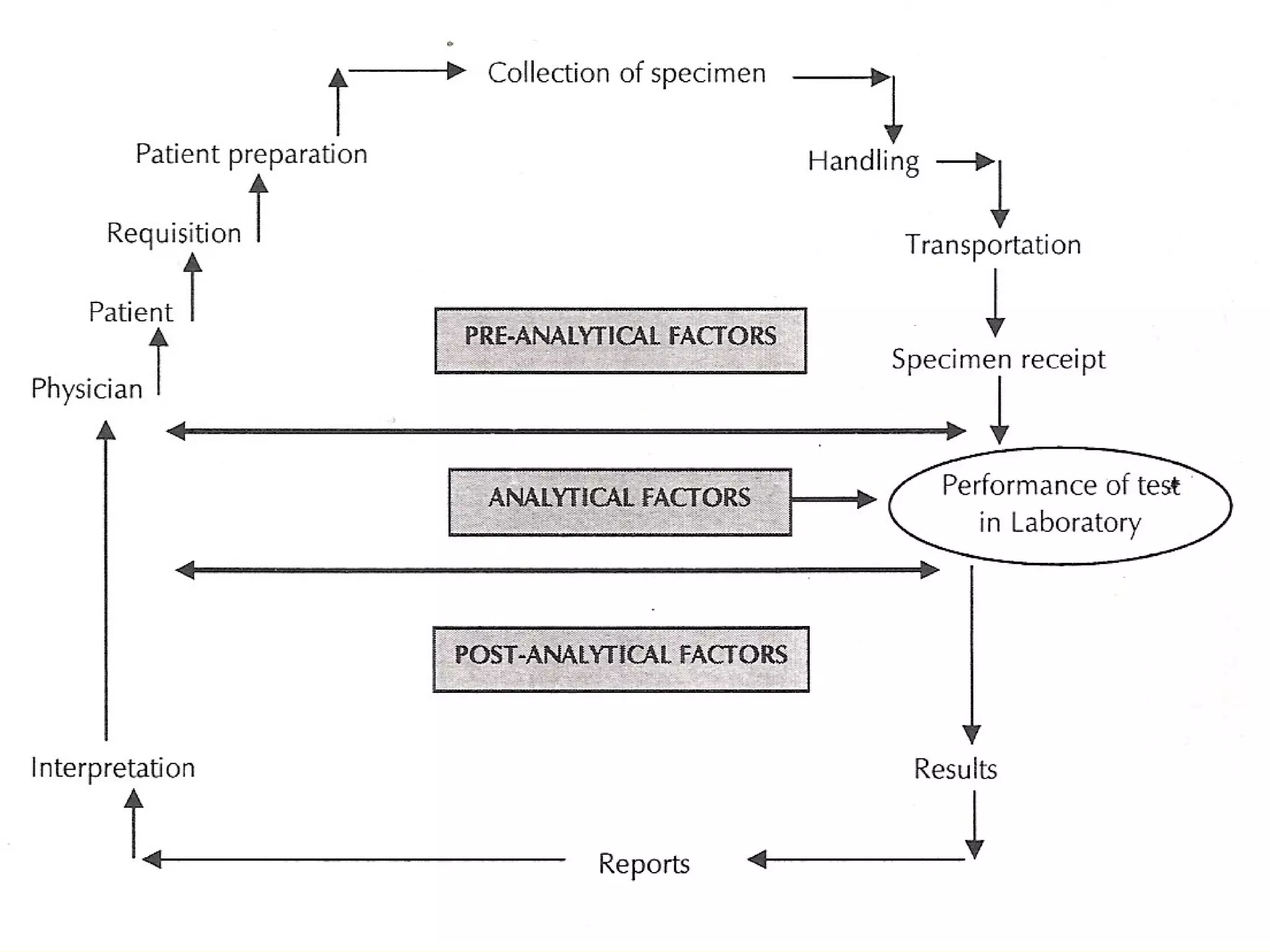
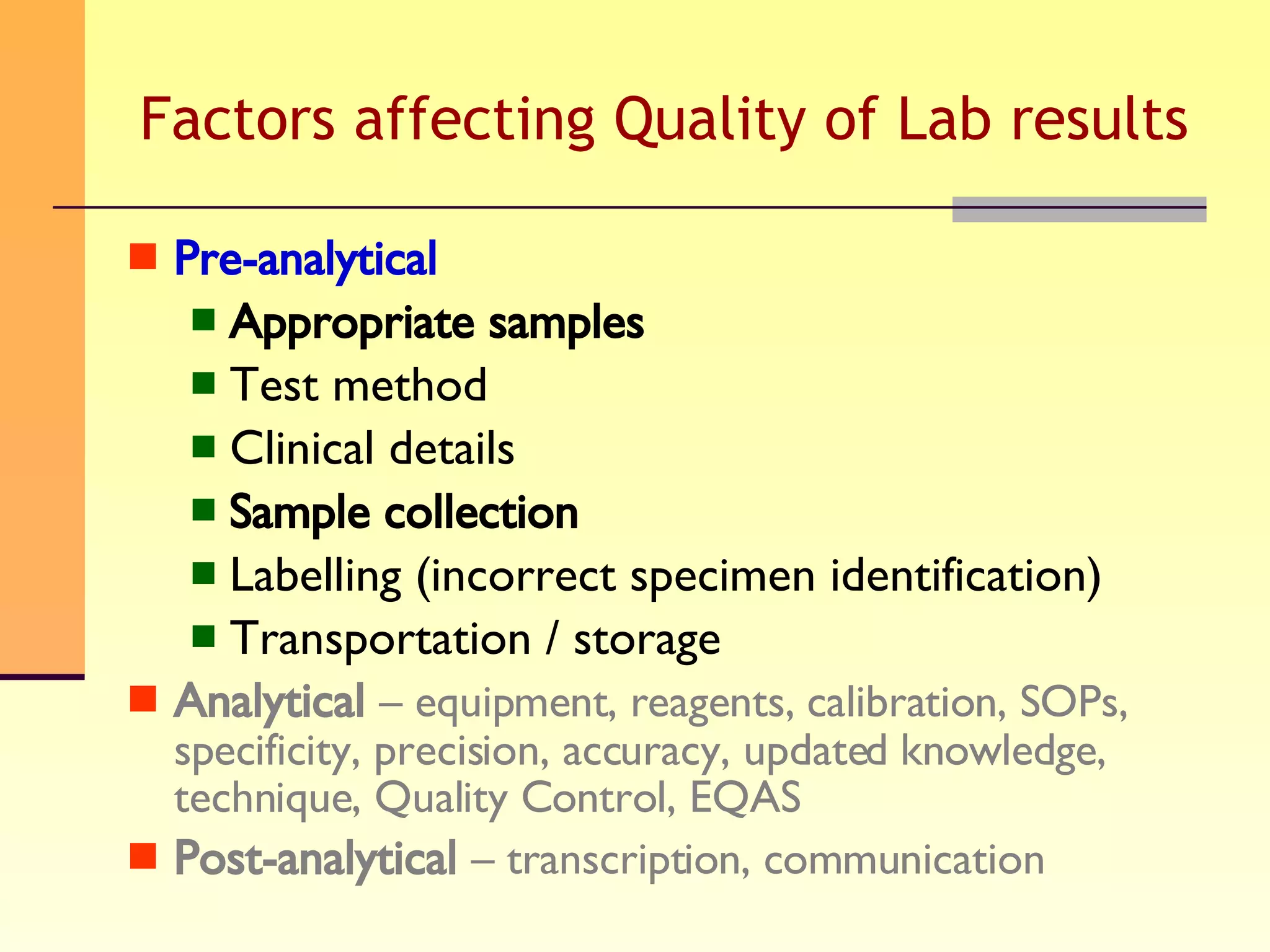
Factors affecting Quality of Lab results Pre-analytical   Appropriate samples Test method Clinical details Sample collection Labelling (incorrect specimen identification) Transportation / storage  Analytical   – equipment, reagents, calibration, SOPs, specificity, precision, accuracy, updated knowledge, technique, Quality Control, EQAS Post-analytical   – transcription, communication
Help the Lab to help patients Work “blindfolded” without clinical details Provide clinical details Symptoms / signs Diagnosis Antimicrobial therapy  – current / prior Prosthetic devices Immunosuppression Previous results Other relevant investigations
Blood cultures Acute sepsis - 2-3 sets of blood cultures from separate sites Endocarditis - 3 cultures over 1-2 hours,   15 minutes apart (repeat if negative after 24 hours) PUO - 2 cultures, at least 1 hour apart  (if negative - repeat 2 cultures 1 hour apart, after 24-36 hours) Single sample does not help Intermittent bacteraemia  Opportunistic pathogens
Blood culture Sample collection Site Strict aseptic technique Palpation Skin disinfection 0.5% Chlorhexidine in 70% alcohol OR Tincture Iodine or 10% Povidone Iodine 3 times, allow to dry First sample should be blood culture Clean top of the bottle (alcohol)
Blood culture Bacteraemia / Enteric fever Volume - critical Adults: 5-20 ml Children: 2-5 ml Neonates: 0.5-1 ml No of samples 2 Sets – different sites, within 10 minutes Positivity
Blood culture CRBSI - DTP cultures Equal Volumes Timing Simultaneous Trough levels Central line hub - clean with 70% alcohol Line tip should be sent for culture after removal in CRBSI
Interpretation of CRBSI - DTP cultures Discordant isolates - repeat + + Bacteraemia + - >2hours –  CRBSI  + + <2 hours – Bacteraemia + + Colonisation - + Interpretation Peripheral Central
Blood culture Anaerobic culture  Brain abscess Gastrointestinal infections Closed abscesses Miliary TB – Rapid TB Culture
Blood culture Do NOT Palpate the vein after skin disinfection Palpate only before skin disinfection Use iodine to clean bottle caps Instead use alcohol / chlorhexidine
Device tips Central line / intravascular devices Long  (distal tip and proximal transcutaneous segment) long term Percutaneous: Broviac, Hickman, etc Subcutaneous ports short term percutaneous: Swan-Ganz, Intracath, etc Short  (entirety, remove hub) peripheral, umbilical, arterial, etc Foley’s or ETT tips NOT recommended for culture
Respiratory Samples Sputum  Patient instructions Induced sputum Quality of sample Acceptable specimen: PMN: SEC ratio    2:1 Unacceptable specimen: PMN: SEC ratio < 2:1 BAL ET aspirates – suction extractor Throat swab  Sample collection One swab / investigation
LRT Sputum (expectorated) rinse mouth and gargle before collection Sputum (induced) use a wet toothbrush to clean buccal mucosa, tongue and gums rinse the mouth thoroughly 20-30 ml of 3-10% saline Tracheostomy secretions Bronchoscopy secretions - lavage, bronchial brush, biopsy Lung aspirations Lung biopsies
Respiratory samples Aerobes: 3-5 ml Sputum (not saliva) Fungi (3-5ml) - 3 early morning samples; lung biopsy / aspirate Mycobacteria (5-10ml) - 3 early morning samples; lung biopsy / aspirate Anaerobes (1ml) - aspirate from sinus, middle ear, trachea, lung or biopsy Pneumocystis (2ml) - induced sputum, BAL, or lung biopsy Parasites (3-5ml) Amoeba, helminth eggs ( Paragonimus westermani ), hooklets of Echinococcus, larvae of hookworm, ascaris and Strongyloides sp.
Body fluids Skin disinfection; aseptic technique Pleural, pericardial, peritoneal, CAPD*, synovial Bacteria (1-5ml); whole bag for CAPD Fungi (>10ml) - Blood for  Histoplasma capsulatum, Cryptococcus sp, Candida sp . Anaerobes (1-5ml) Mycobacteria (>10ml) Greater volumes increase the chances of organism recovery
CSF Aseptic technique 3 sets –  Microbiology, Biochemistry and Haematology First sample (or most turbid) to Microbiology (unless haemorrhagic) Recommended minimum volumes  (greater volumes increase the chance of organism recovery) Routine culture: 1 ml Fungal culture: 2 ml Mycobacterial culture: 2 ml Microbiology does not mean microscopic samples!
Pus Surgically obtained pus / fluid Pus better than swabs Tissue in small amount of saline Aspirates from closed abscesses If anaerobes suspected Ask for and inoculate in anaerobic transport medium / BacT/Alert bottle Immediate transport
Skin and s/c tissue Burns - punch biopsy (3-4mm) of deeper tissue - quantitative culture Superficial wounds Syringe aspiration better than swabs Fungal - scrape the periphery of the lesion Ulcers and nodules - curette base, exudate in syringe or swab Viral recovery (HSV, Varicella zoster) is highest from young vesicles, than from pustules, ulcers or crusted lesions.
Wounds, aspirates and tissue Biopsies are better than aspirates Bite wounds - aspirate pus Bone - kept moist in sterile saline Deep wounds / abscesses Punch skin biopsies Soft tissue aspirate
Anaerobic culture Pus from closed abscesses Blood Bone marrow Bile CSF  Peritoneal fluid Suprapubic aspirate (Urine)
Anaerobic culture Unacceptable  specimens Gastrointestinal  Faeces Gastric / small bowel contents Rectal swab Urogenital Urine Urethral swab Vaginal Swabs Respiratory  Throat swabs Coughed sputum
Anaerobic cultures Collection technique Exclusion of air Blood (anaerobic) culture before all other samples Rapid transport
Urine Direct collection; first morning sample (3 samples for AFB culture) ideal – highest counts; in practice best time to collect is when patient is able to provide an adequate sample 24 hour urine cultures not recommended Collect clean catch, mid-stream urine (MSU); do not stop flow of urine Transport within 2 hours; otherwise refrigerate at 2-8°C
Urine Supra-pubic aspirate (SPA) Bladder washout Foley’s catheter sample Maintain a sterile, closed catheter system at all times Urine specimens should he obtained aseptically without opening the catheter-collection junction Urine should be aspirated from the distal end of the catheter with sterile needle and syringe after disinfecting the area
Urine Bacteria (0.5-1ml) Fungi (>20ml)12 Mycobacteria (100ml) Anaerobes (1ml) Virus (10-50ml) Parasites (24 hour collection) - Schistosoma haematobium  eggs,  Trichomonas vaginalis  trophozoites and  Ochocerca volvulus  microfilariae
Urine culture Suprapubic / Foley’s aspirates – clearly labelled, different interpretation Operative sample – details Foley’s catheter tip not recommended Catheter sample collection; label AFB / Mycobacteria Early morning sample; 100ml 3 consecutive days
Doubtful significance Foley’s catheter tip Burns - wounds swabs Colostomy discharge Vomitus Lochia Gastric aspirates of new born Bed sore swabs ET tube / suction catheter tips
Rejection criteria Leaking container Unlabelled / wrongly labeled / mismatched samples Specimen received in fixative Insufficient quantity Specimen unsuitable for request Prolonged transport Dried specimen Duplicate specimens on the same day for the same test (except blood, CSF, tissue, sterile body fluids exc. urine)
Labelling Label specimen container & form Patient name Identification number Source / site Date / time of collection Collector (esp in case of blood cultures)
Transportation ASAP / within two hours For Anaerobic / amoebic abscess aspirate 15-30 minutes If delay unavoidable Refrigerate, 2-4°C / ice (2-4 hours) Exceptions - CSF, genital, eye, internal ear specimens, amoebic abscess aspirate.
Thank you Good samples are essential for good results

Sample Collection In Microbiology

  • 1.
    Microbiology SampleCollection Anuj Sharma Sr Consultant, Clinical Microbiology Sir Ganga Ram Hospital
  • 2.
    GIGO Diagnostic resultsdepend on quality of specimens Poorly collected / transported specimens Fail to isolate causative microorganism Recover contaminants / normal flora Before the administration of Antimicrobials (or trough levels)
  • 3.
  • 4.
    Factors affecting Qualityof Lab results Pre-analytical Appropriate samples Test method Clinical details Sample collection Labelling (incorrect specimen identification) Transportation / storage Analytical – equipment, reagents, calibration, SOPs, specificity, precision, accuracy, updated knowledge, technique, Quality Control, EQAS Post-analytical – transcription, communication
  • 5.
    Help the Labto help patients Work “blindfolded” without clinical details Provide clinical details Symptoms / signs Diagnosis Antimicrobial therapy – current / prior Prosthetic devices Immunosuppression Previous results Other relevant investigations
  • 6.
    Blood cultures Acutesepsis - 2-3 sets of blood cultures from separate sites Endocarditis - 3 cultures over 1-2 hours,  15 minutes apart (repeat if negative after 24 hours) PUO - 2 cultures, at least 1 hour apart (if negative - repeat 2 cultures 1 hour apart, after 24-36 hours) Single sample does not help Intermittent bacteraemia Opportunistic pathogens
  • 7.
    Blood culture Samplecollection Site Strict aseptic technique Palpation Skin disinfection 0.5% Chlorhexidine in 70% alcohol OR Tincture Iodine or 10% Povidone Iodine 3 times, allow to dry First sample should be blood culture Clean top of the bottle (alcohol)
  • 8.
    Blood culture Bacteraemia/ Enteric fever Volume - critical Adults: 5-20 ml Children: 2-5 ml Neonates: 0.5-1 ml No of samples 2 Sets – different sites, within 10 minutes Positivity
  • 9.
    Blood culture CRBSI- DTP cultures Equal Volumes Timing Simultaneous Trough levels Central line hub - clean with 70% alcohol Line tip should be sent for culture after removal in CRBSI
  • 10.
    Interpretation of CRBSI- DTP cultures Discordant isolates - repeat + + Bacteraemia + - >2hours – CRBSI + + <2 hours – Bacteraemia + + Colonisation - + Interpretation Peripheral Central
  • 11.
    Blood culture Anaerobicculture Brain abscess Gastrointestinal infections Closed abscesses Miliary TB – Rapid TB Culture
  • 12.
    Blood culture DoNOT Palpate the vein after skin disinfection Palpate only before skin disinfection Use iodine to clean bottle caps Instead use alcohol / chlorhexidine
  • 13.
    Device tips Centralline / intravascular devices Long (distal tip and proximal transcutaneous segment) long term Percutaneous: Broviac, Hickman, etc Subcutaneous ports short term percutaneous: Swan-Ganz, Intracath, etc Short (entirety, remove hub) peripheral, umbilical, arterial, etc Foley’s or ETT tips NOT recommended for culture
  • 14.
    Respiratory Samples Sputum Patient instructions Induced sputum Quality of sample Acceptable specimen: PMN: SEC ratio  2:1 Unacceptable specimen: PMN: SEC ratio < 2:1 BAL ET aspirates – suction extractor Throat swab Sample collection One swab / investigation
  • 15.
    LRT Sputum (expectorated)rinse mouth and gargle before collection Sputum (induced) use a wet toothbrush to clean buccal mucosa, tongue and gums rinse the mouth thoroughly 20-30 ml of 3-10% saline Tracheostomy secretions Bronchoscopy secretions - lavage, bronchial brush, biopsy Lung aspirations Lung biopsies
  • 16.
    Respiratory samples Aerobes:3-5 ml Sputum (not saliva) Fungi (3-5ml) - 3 early morning samples; lung biopsy / aspirate Mycobacteria (5-10ml) - 3 early morning samples; lung biopsy / aspirate Anaerobes (1ml) - aspirate from sinus, middle ear, trachea, lung or biopsy Pneumocystis (2ml) - induced sputum, BAL, or lung biopsy Parasites (3-5ml) Amoeba, helminth eggs ( Paragonimus westermani ), hooklets of Echinococcus, larvae of hookworm, ascaris and Strongyloides sp.
  • 17.
    Body fluids Skindisinfection; aseptic technique Pleural, pericardial, peritoneal, CAPD*, synovial Bacteria (1-5ml); whole bag for CAPD Fungi (>10ml) - Blood for Histoplasma capsulatum, Cryptococcus sp, Candida sp . Anaerobes (1-5ml) Mycobacteria (>10ml) Greater volumes increase the chances of organism recovery
  • 18.
    CSF Aseptic technique3 sets – Microbiology, Biochemistry and Haematology First sample (or most turbid) to Microbiology (unless haemorrhagic) Recommended minimum volumes (greater volumes increase the chance of organism recovery) Routine culture: 1 ml Fungal culture: 2 ml Mycobacterial culture: 2 ml Microbiology does not mean microscopic samples!
  • 19.
    Pus Surgically obtainedpus / fluid Pus better than swabs Tissue in small amount of saline Aspirates from closed abscesses If anaerobes suspected Ask for and inoculate in anaerobic transport medium / BacT/Alert bottle Immediate transport
  • 20.
    Skin and s/ctissue Burns - punch biopsy (3-4mm) of deeper tissue - quantitative culture Superficial wounds Syringe aspiration better than swabs Fungal - scrape the periphery of the lesion Ulcers and nodules - curette base, exudate in syringe or swab Viral recovery (HSV, Varicella zoster) is highest from young vesicles, than from pustules, ulcers or crusted lesions.
  • 21.
    Wounds, aspirates andtissue Biopsies are better than aspirates Bite wounds - aspirate pus Bone - kept moist in sterile saline Deep wounds / abscesses Punch skin biopsies Soft tissue aspirate
  • 22.
    Anaerobic culture Pusfrom closed abscesses Blood Bone marrow Bile CSF Peritoneal fluid Suprapubic aspirate (Urine)
  • 23.
    Anaerobic culture Unacceptable specimens Gastrointestinal Faeces Gastric / small bowel contents Rectal swab Urogenital Urine Urethral swab Vaginal Swabs Respiratory Throat swabs Coughed sputum
  • 24.
    Anaerobic cultures Collectiontechnique Exclusion of air Blood (anaerobic) culture before all other samples Rapid transport
  • 25.
    Urine Direct collection;first morning sample (3 samples for AFB culture) ideal – highest counts; in practice best time to collect is when patient is able to provide an adequate sample 24 hour urine cultures not recommended Collect clean catch, mid-stream urine (MSU); do not stop flow of urine Transport within 2 hours; otherwise refrigerate at 2-8°C
  • 26.
    Urine Supra-pubic aspirate(SPA) Bladder washout Foley’s catheter sample Maintain a sterile, closed catheter system at all times Urine specimens should he obtained aseptically without opening the catheter-collection junction Urine should be aspirated from the distal end of the catheter with sterile needle and syringe after disinfecting the area
  • 27.
    Urine Bacteria (0.5-1ml)Fungi (>20ml)12 Mycobacteria (100ml) Anaerobes (1ml) Virus (10-50ml) Parasites (24 hour collection) - Schistosoma haematobium eggs, Trichomonas vaginalis trophozoites and Ochocerca volvulus microfilariae
  • 28.
    Urine culture Suprapubic/ Foley’s aspirates – clearly labelled, different interpretation Operative sample – details Foley’s catheter tip not recommended Catheter sample collection; label AFB / Mycobacteria Early morning sample; 100ml 3 consecutive days
  • 29.
    Doubtful significance Foley’scatheter tip Burns - wounds swabs Colostomy discharge Vomitus Lochia Gastric aspirates of new born Bed sore swabs ET tube / suction catheter tips
  • 30.
    Rejection criteria Leakingcontainer Unlabelled / wrongly labeled / mismatched samples Specimen received in fixative Insufficient quantity Specimen unsuitable for request Prolonged transport Dried specimen Duplicate specimens on the same day for the same test (except blood, CSF, tissue, sterile body fluids exc. urine)
  • 31.
    Labelling Label specimencontainer & form Patient name Identification number Source / site Date / time of collection Collector (esp in case of blood cultures)
  • 32.
    Transportation ASAP /within two hours For Anaerobic / amoebic abscess aspirate 15-30 minutes If delay unavoidable Refrigerate, 2-4°C / ice (2-4 hours) Exceptions - CSF, genital, eye, internal ear specimens, amoebic abscess aspirate.
  • 33.
    Thank you Goodsamples are essential for good results