Lightweight virtualization
-- docker in practice
• Baidu BAE team -- Chen YiFei
• 2013-10.25

2013/12/5
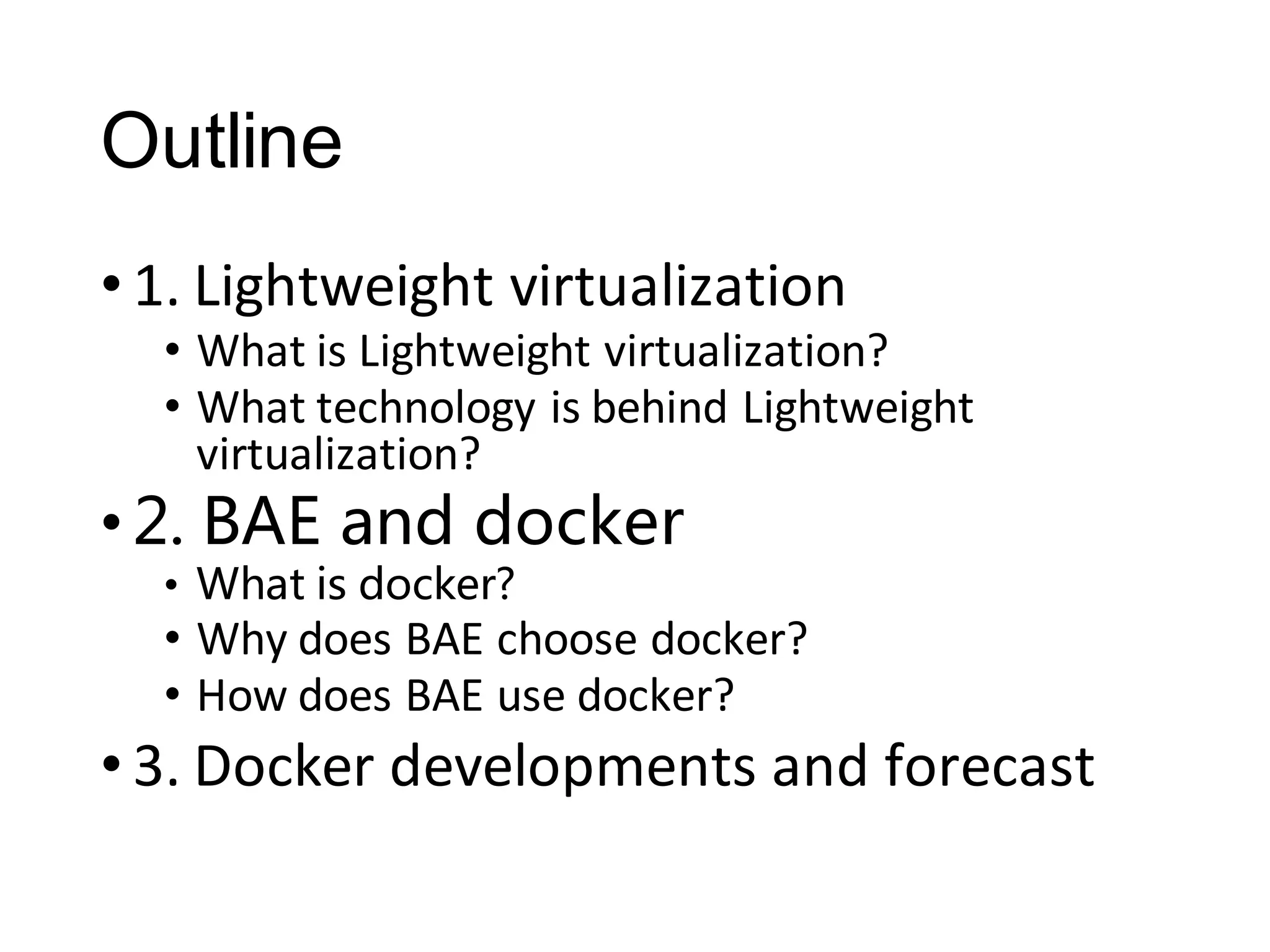
Outline
• 1. Lightweight virtualization
• What is Lightweight virtualization?
• What technology is behind Lightweight
virtualization?

• 2. BAE and docker
• What is docker?

• Why does BAE choose docker?
• How does BAE use docker?

• 3. Docker developments and forecast
What is Lightweight virtualization
technology
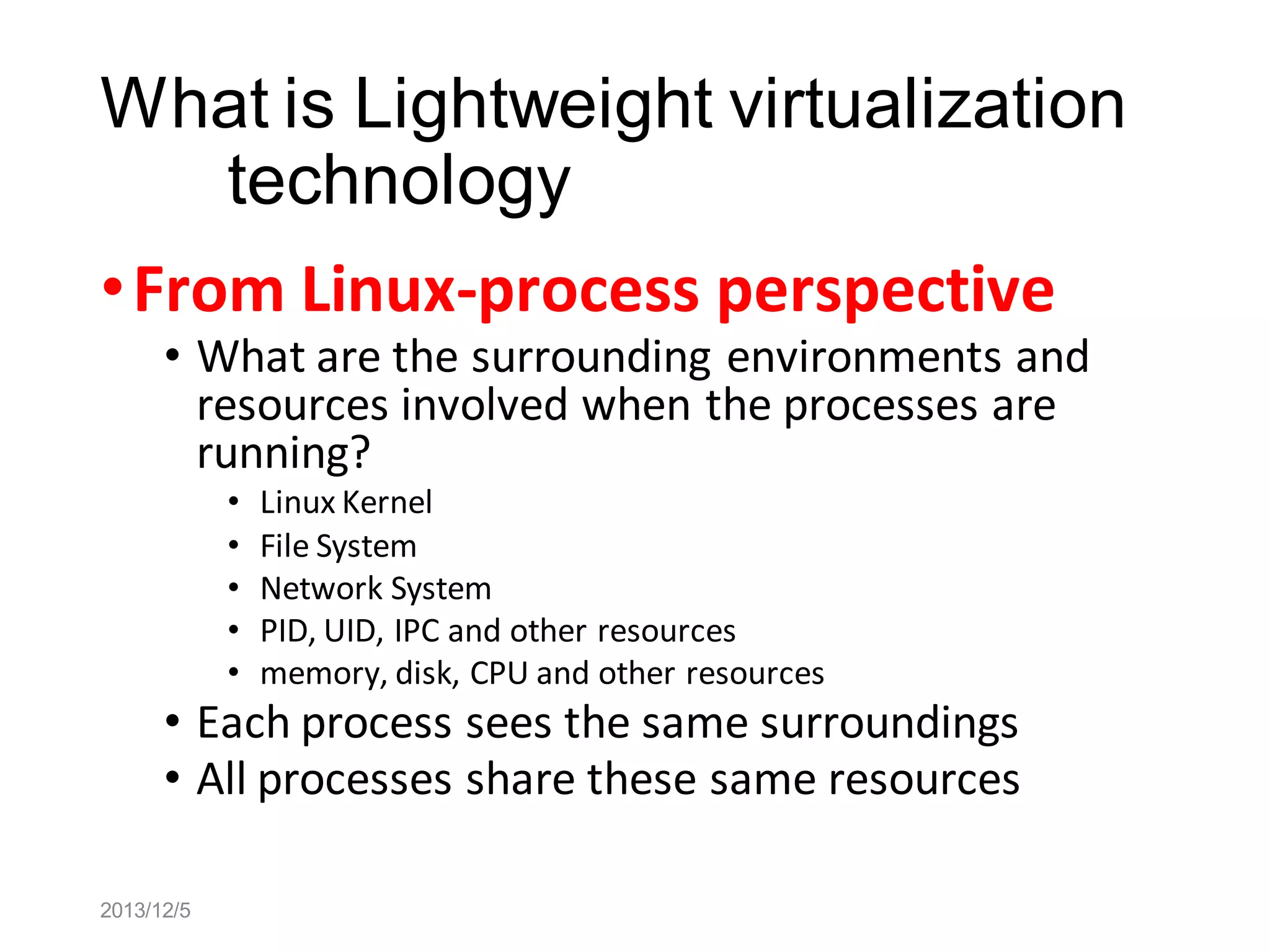
• From Linux-process perspective

• What are the surrounding environments and
resources involved when the processes are
running?
•
•
•
•
•

Linux Kernel
File System
Network System
PID, UID, IPC and other resources
memory, disk, CPU and other resources

• Each process sees the same surroundings
• All processes share these same resources
2013/12/5
What is Lightweight virtualization
technology
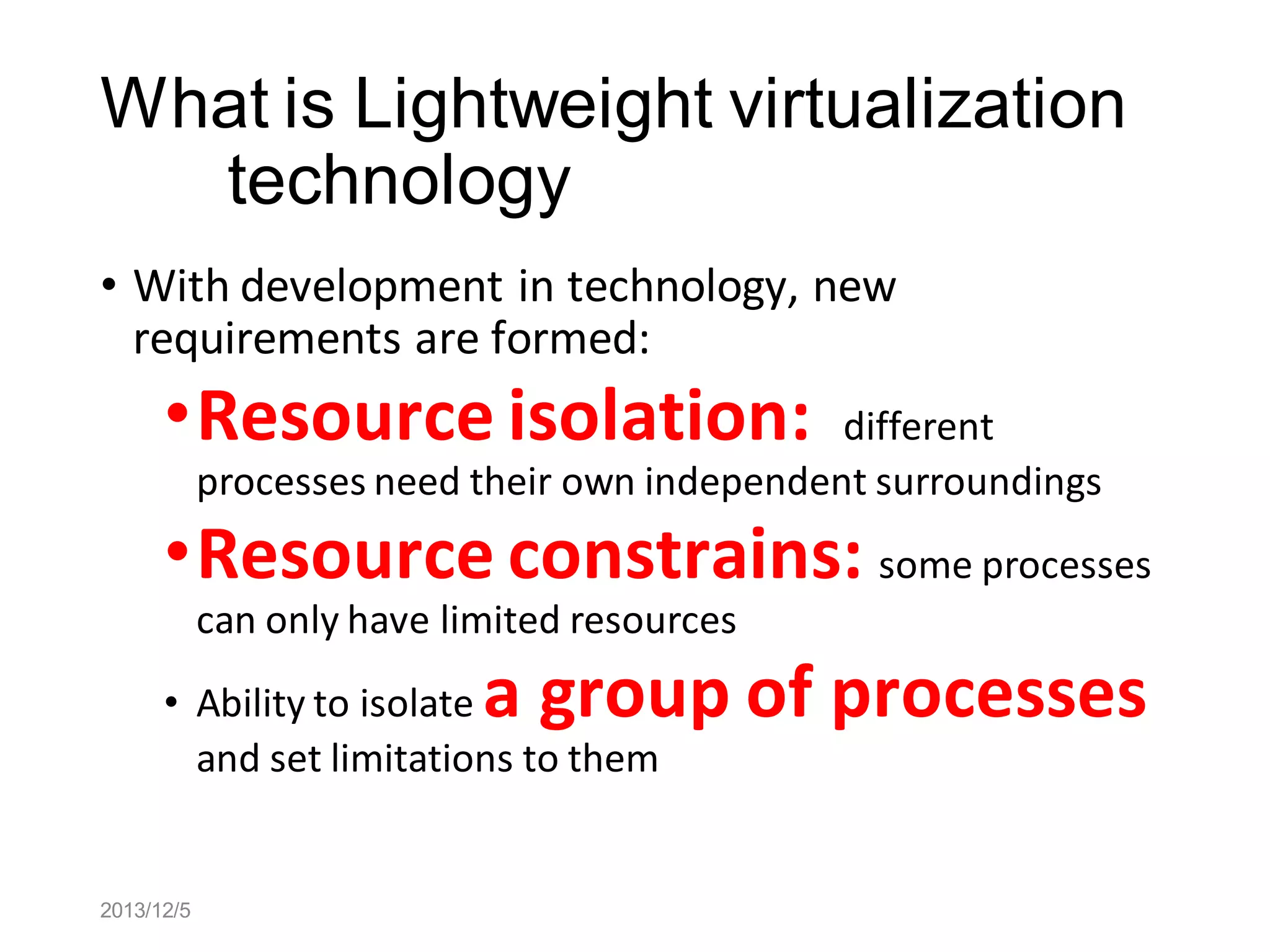
• With development in technology, new
requirements are formed:

•Resource isolation:

different
processes need their own independent surroundings

•Resource constrains: some processes
can only have limited resources

a group of processes

• Ability to isolate
and set limitations to them

2013/12/5
What is Lightweight virtualization
technology
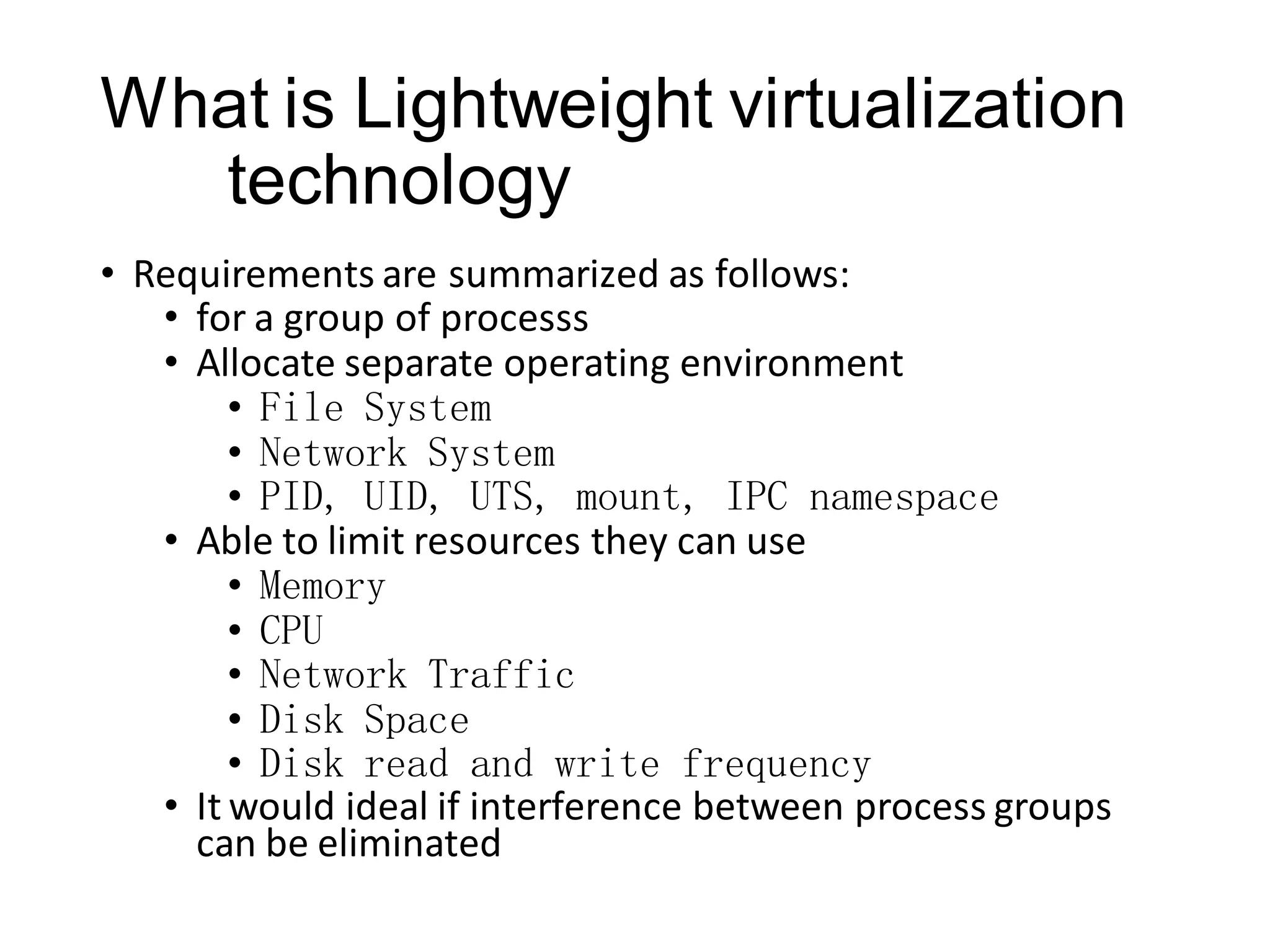
• Requirements are summarized as follows:
• for a group of processs
• Allocate separate operating environment
• File System
• Network System
• PID, UID, UTS, mount, IPC namespace
• Able to limit resources they can use
• Memory
• CPU
• Network Traffic
• Disk Space
• Disk read and write frequency
• It would ideal if interference between process groups
can be eliminated
What is Lightweight virtualization
technology
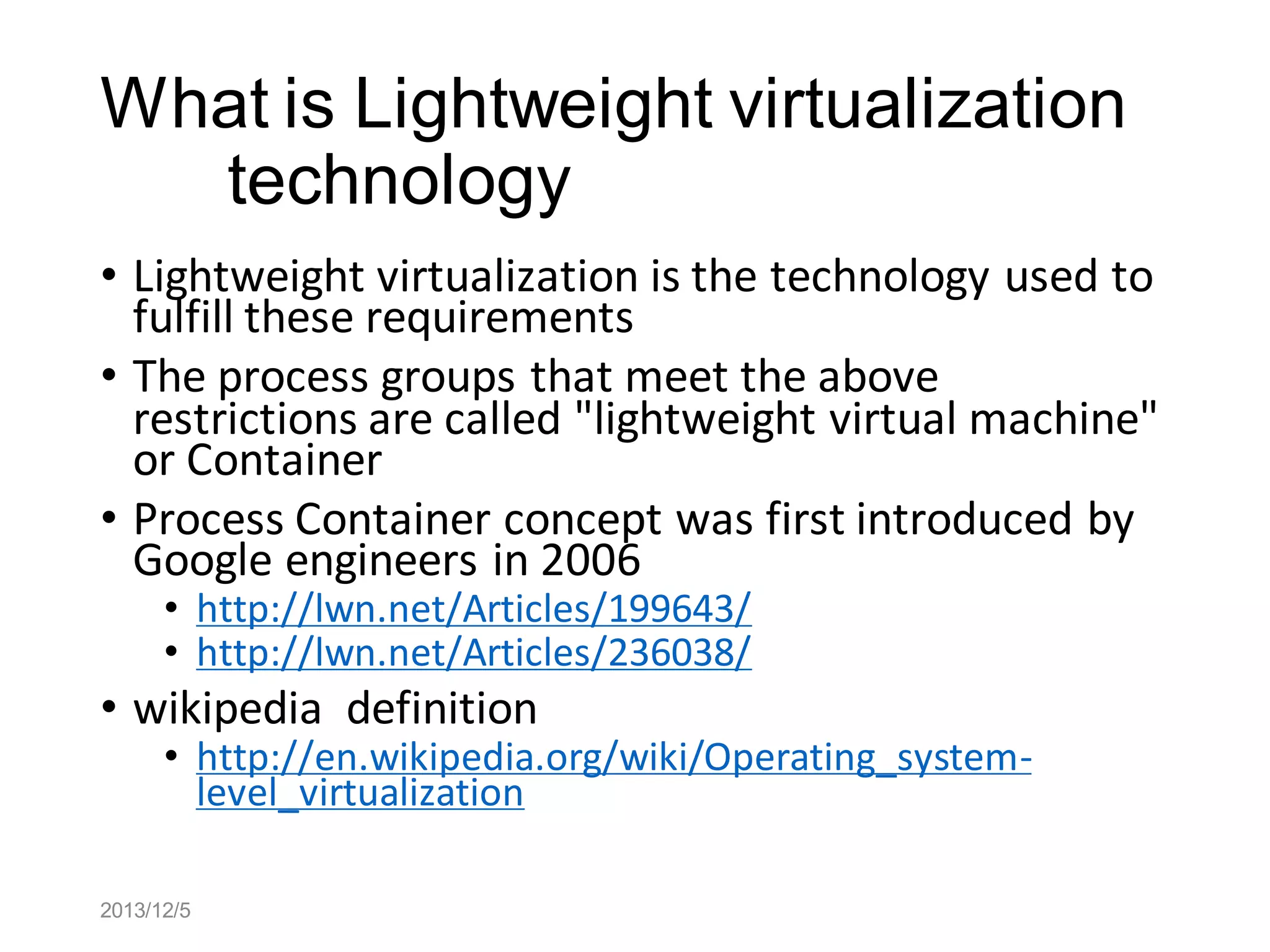
• Lightweight virtualization is the technology used to
fulfill these requirements
• The process groups that meet the above
restrictions are called "lightweight virtual machine"
or Container
• Process Container concept was first introduced by
Google engineers in 2006
• http://lwn.net/Articles/199643/
• http://lwn.net/Articles/236038/

• wikipedia definition

• http://en.wikipedia.org/wiki/Operating_systemlevel_virtualization

2013/12/5
What is Lightweight virtualization
technology
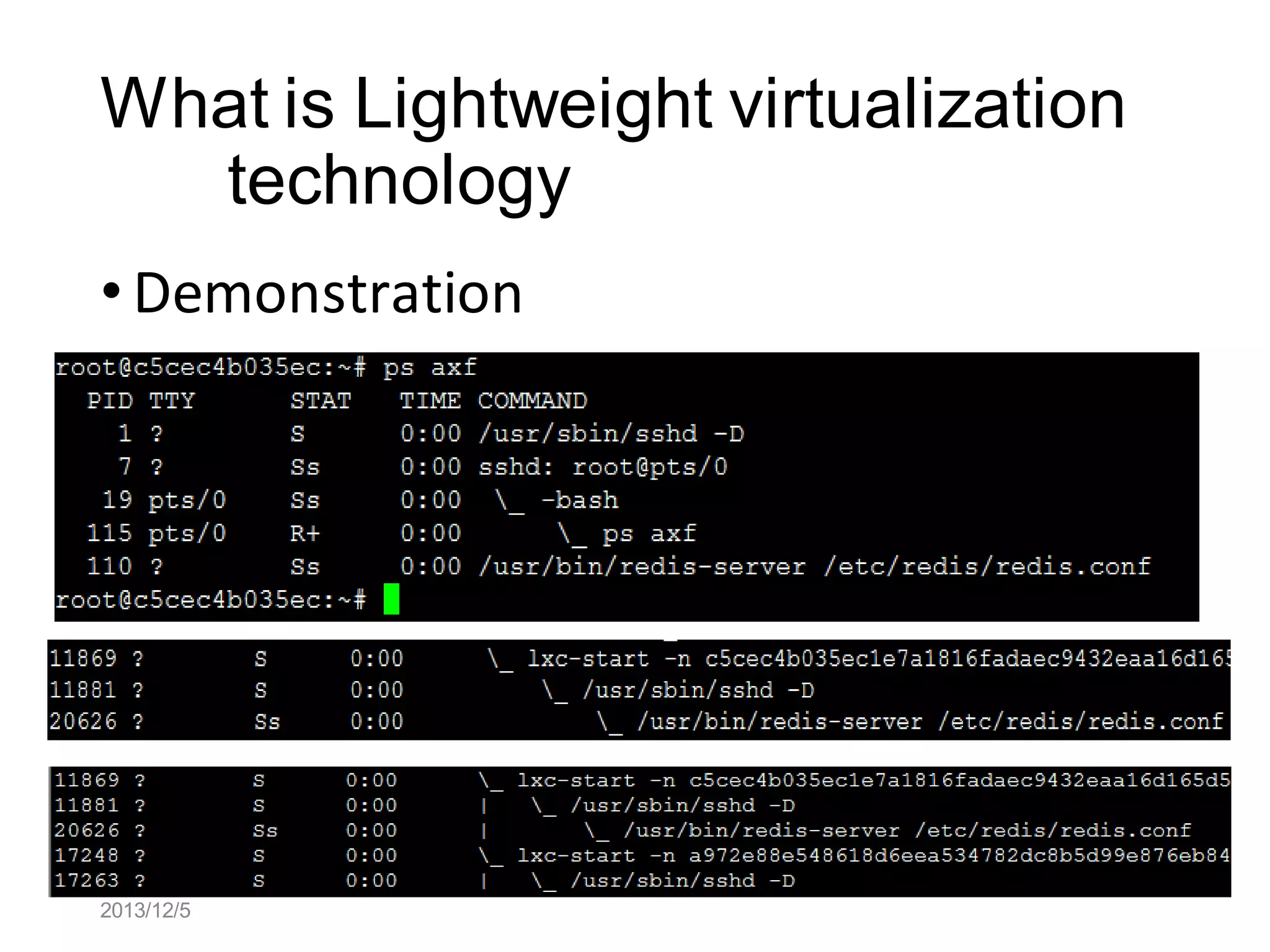
• Demonstration

2013/12/5
Lightweight virtualization
--technologies and projects
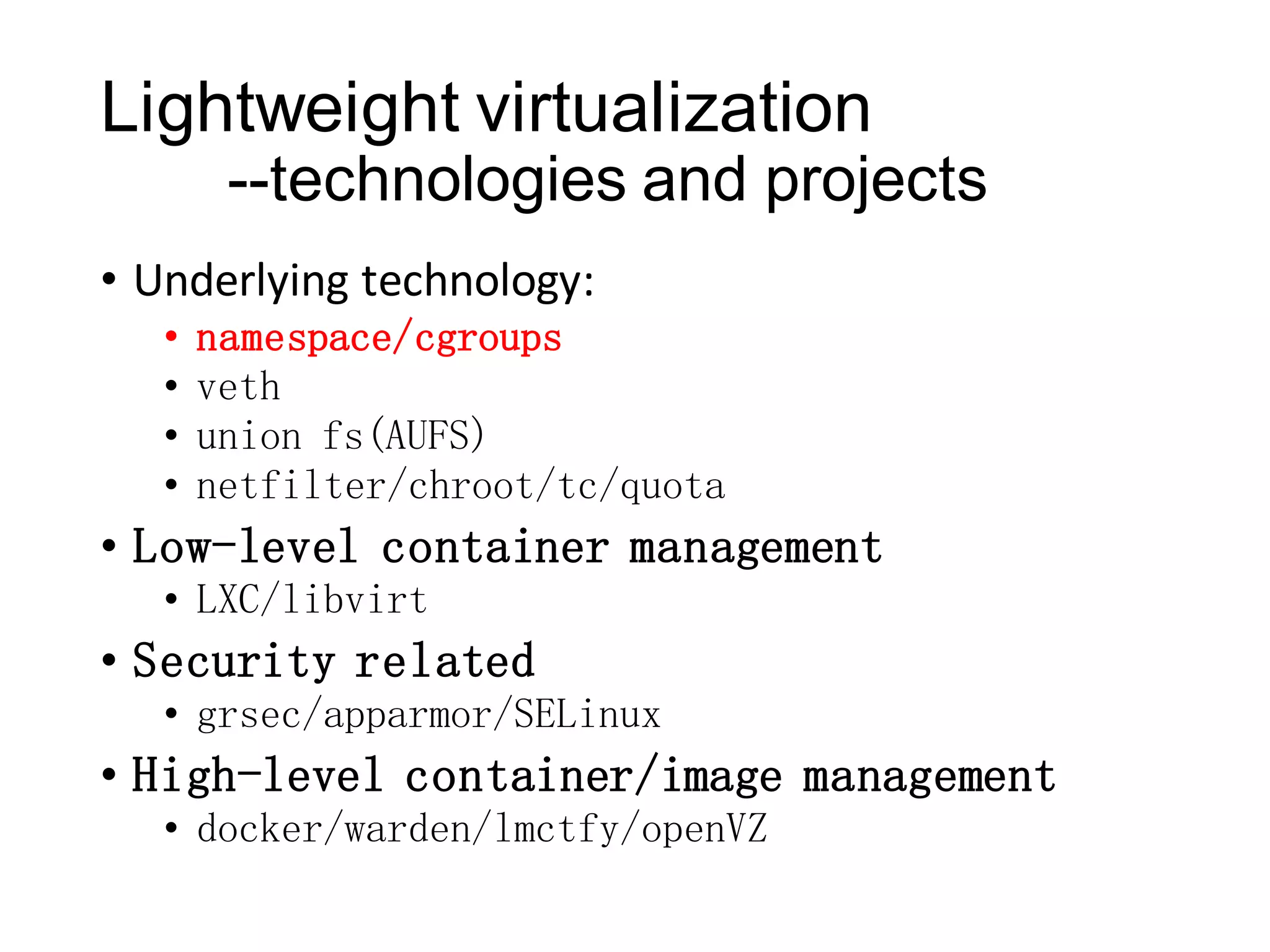
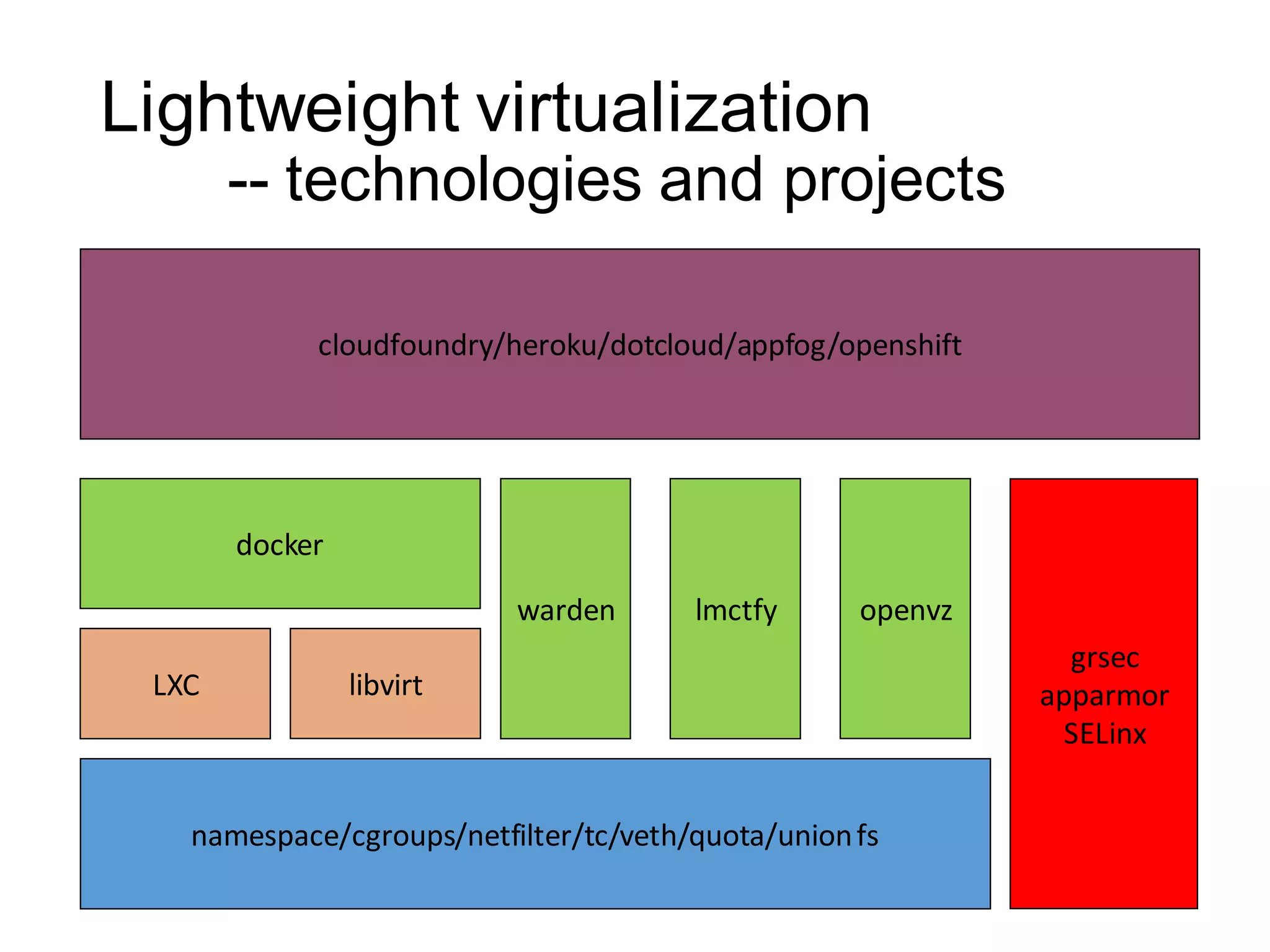
• Underlying technology:
•
•
•
•

namespace/cgroups
veth
union fs(AUFS)
netfilter/chroot/tc/quota

• Low-level container management
• LXC/libvirt

• Security related
• grsec/apparmor/SELinux

• High-level container/image management
• docker/warden/lmctfy/openVZ
Lightweight virtualization
-- technologies and projects
cloudfoundry/heroku/dotcloud/appfog/openshift

docker
warden
LXC

lmctfy

openvz

libvirt

namespace/cgroups/netfilter/tc/veth/quota/union fs

grsec
apparmor
SELinx
BAE and docker
--what is docker

• A complete solution for Lightweight virtual
machine.
• Open source project developed by dotCloud
• https://www.docker.io/
• https://github.com/dotcloud/docker
• Introduced about 6 months ago, ranked first in
language activity by Github GO language
BAE and docker
--what is docker
• Based on LXC tools , but easier to use
• AUFS: speedy creation of container, cool image
management.
• Client-Server Architecture
• REST API: Clear interface
• Command-line tool: easy to use
BAE and docker
--what is BAE
• http://developer.baidu.com
• Baidu PAAS platform for developers

2013/12/5
BAE and docker
--why does BAE choose docker
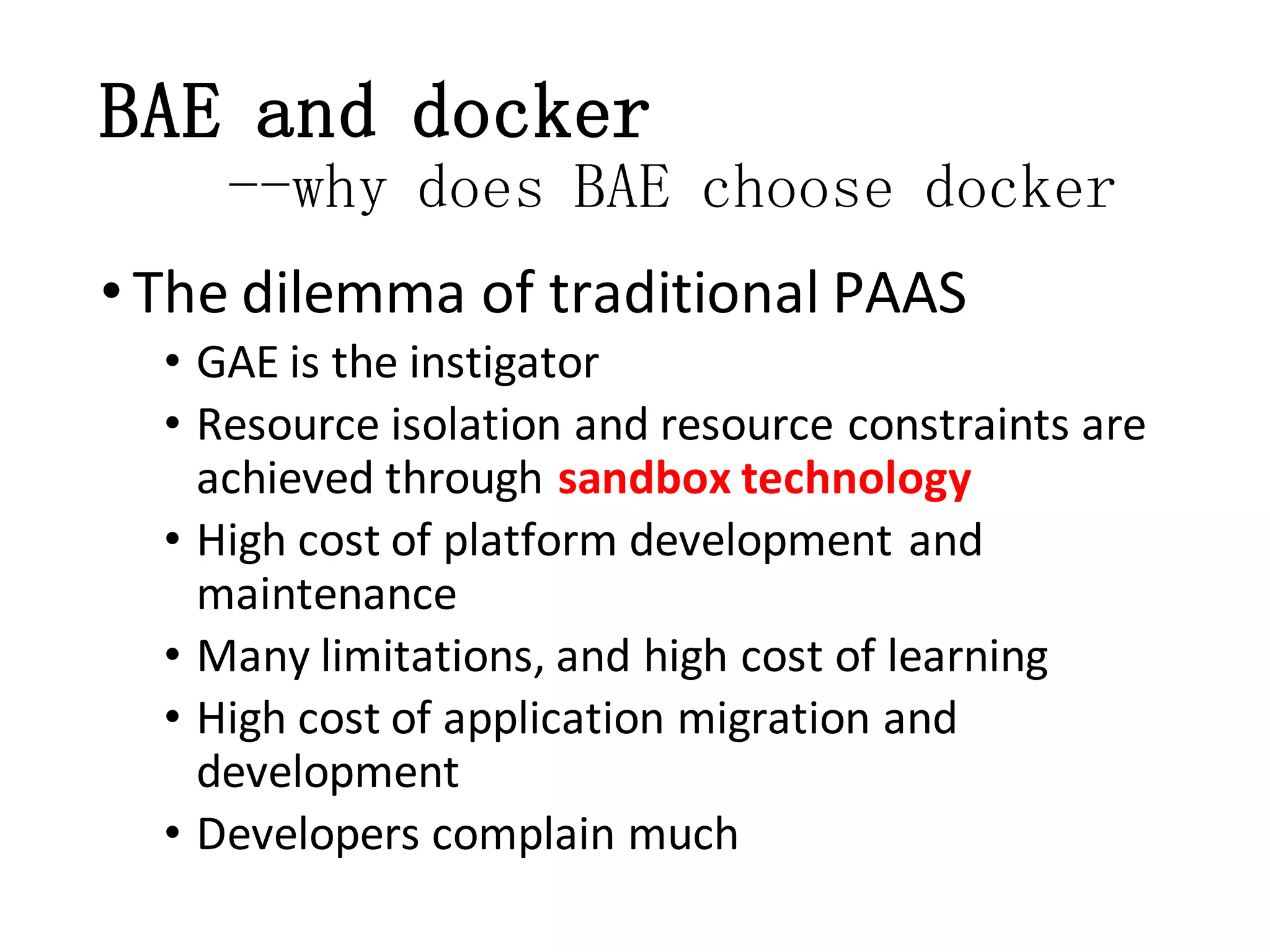
• The dilemma of traditional PAAS
• GAE is the instigator
• Resource isolation and resource constraints are
achieved through sandbox technology
• High cost of platform development and
maintenance
• Many limitations, and high cost of learning
• High cost of application migration and
development
• Developers complain much
BAE and docker
--why does BAE choose docker
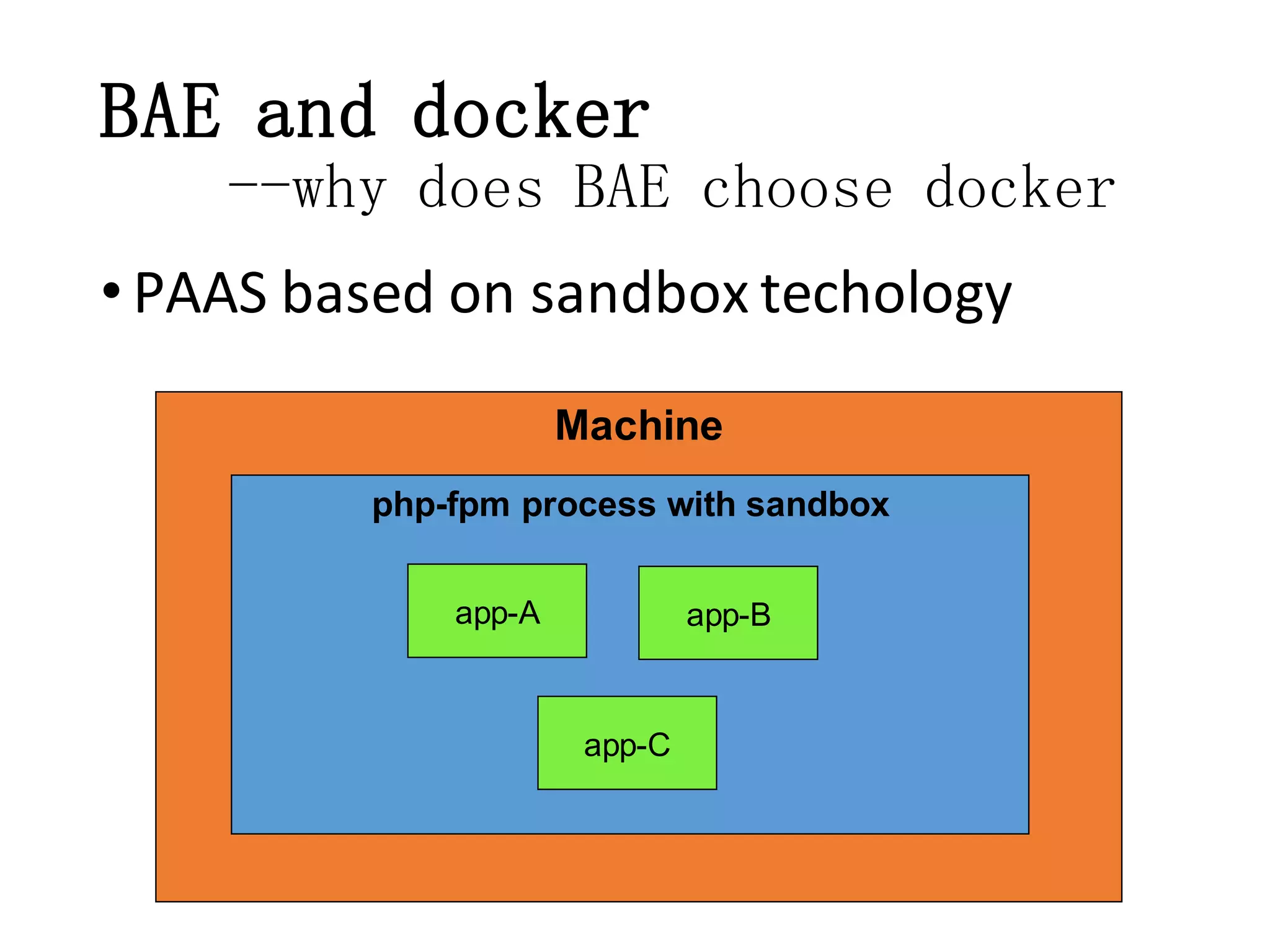
• PAAS based on sandbox techology
Machine
php-fpm process with sandbox
app-A

app-B

app-C
BAE and docker
--why does BAE choose docker
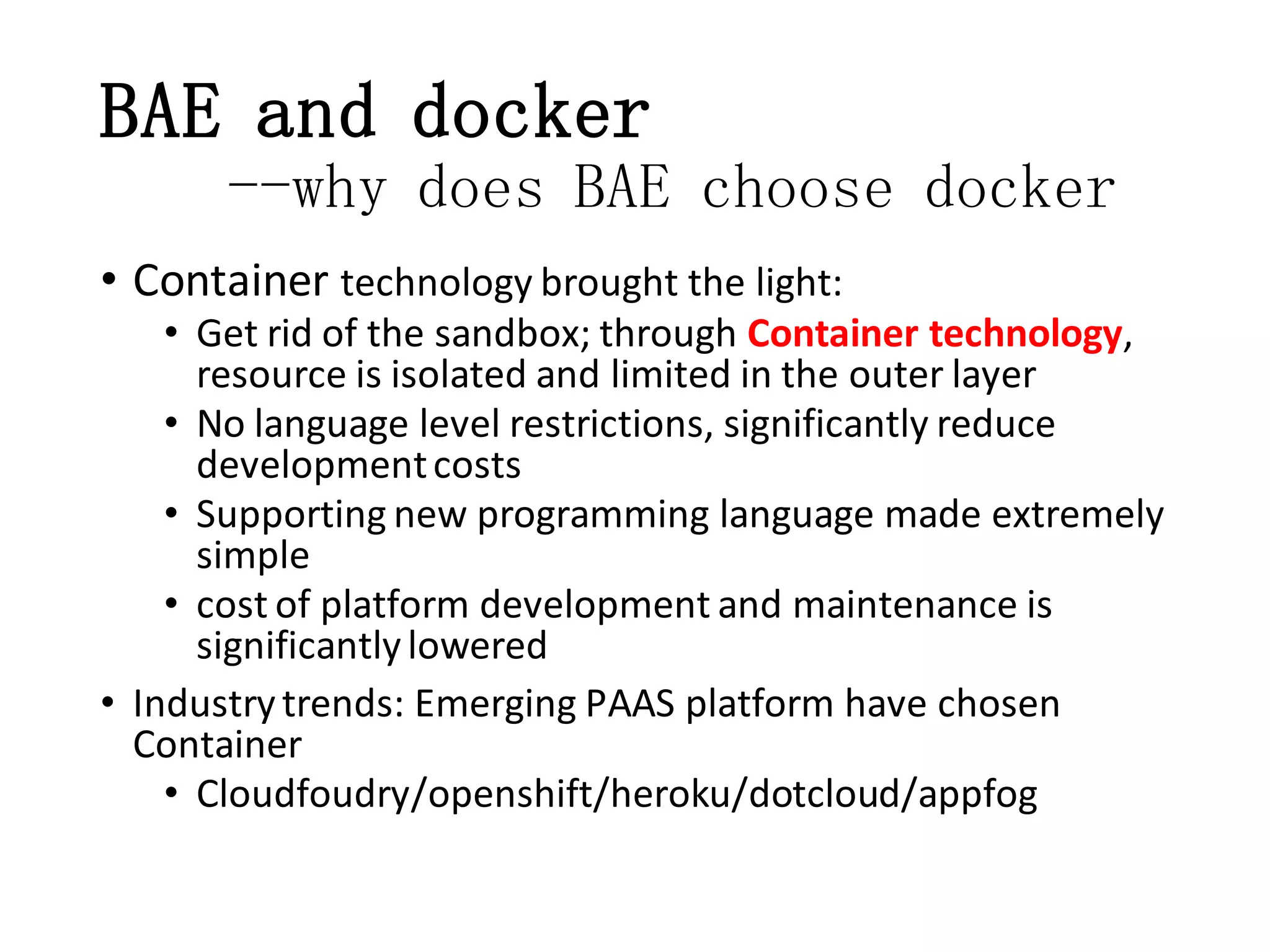
• Container technology brought the light:
• Get rid of the sandbox; through Container technology,
resource is isolated and limited in the outer layer
• No language level restrictions, significantly reduce
development costs
• Supporting new programming language made extremely
simple
• cost of platform development and maintenance is
significantly lowered
• Industry trends: Emerging PAAS platform have chosen
Container
• Cloudfoudry/openshift/heroku/dotcloud/appfog
BAE and docker
--why does BAE choose docker
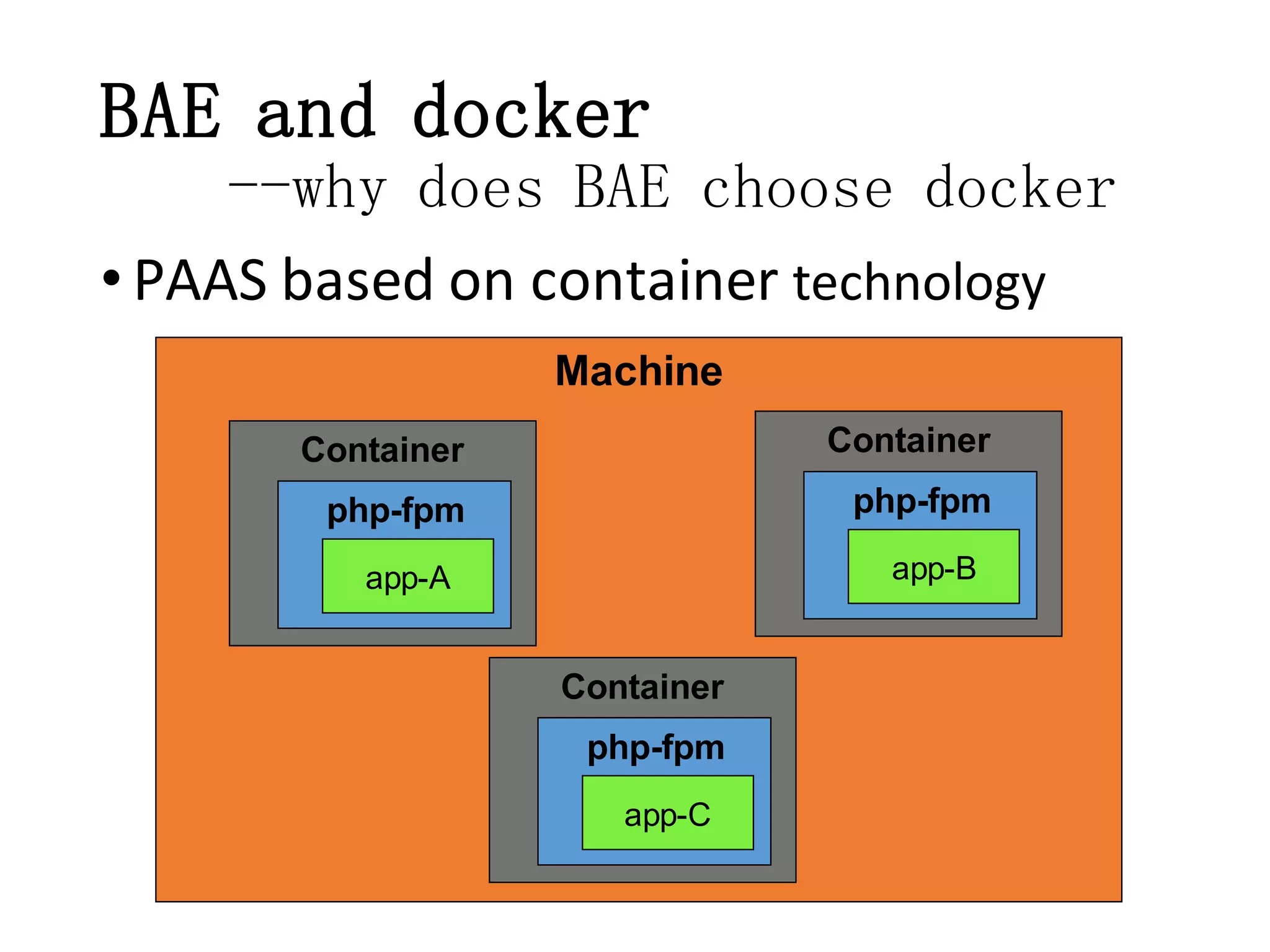
• PAAS based on container technology
Machine
Container

Container

php-fpm

php-fpm
app-B

app-A

Container
php-fpm
app-C
BAE and docker
--why does BAE choose docker
• BAE2.0 platform is a sandbox-based PAAS
• We are deeply troubled by the sandbox
• Noting Container technology, began preliminary
research and exploration
BAE and docker
-- technology option one: to develop by
ourself
• Internal virtual machine team gave the following solution:
• openstack + libvirt
• Functionally, it meets the basic needs

• Problems:

• the most important requirements are not addressed:
• Need frequent creation and deletion of Container
• Need to create and delete container within a few
seconds
• Actually creation of the Container takes more than
15 seconds (not acceptable)
• Openstack superfluous
• Not enough confidence in the quality of the code
• Lack of follow-up technical support
BAE and docker
-- technology option two: warden
• The warden from cloudfoundry
• warden is a more complete solution
• However:
• not familiar with Ruby
• deang tightly coupled with warden
• Not active enough in the technical
community
BAE and docker
-- get to know docker
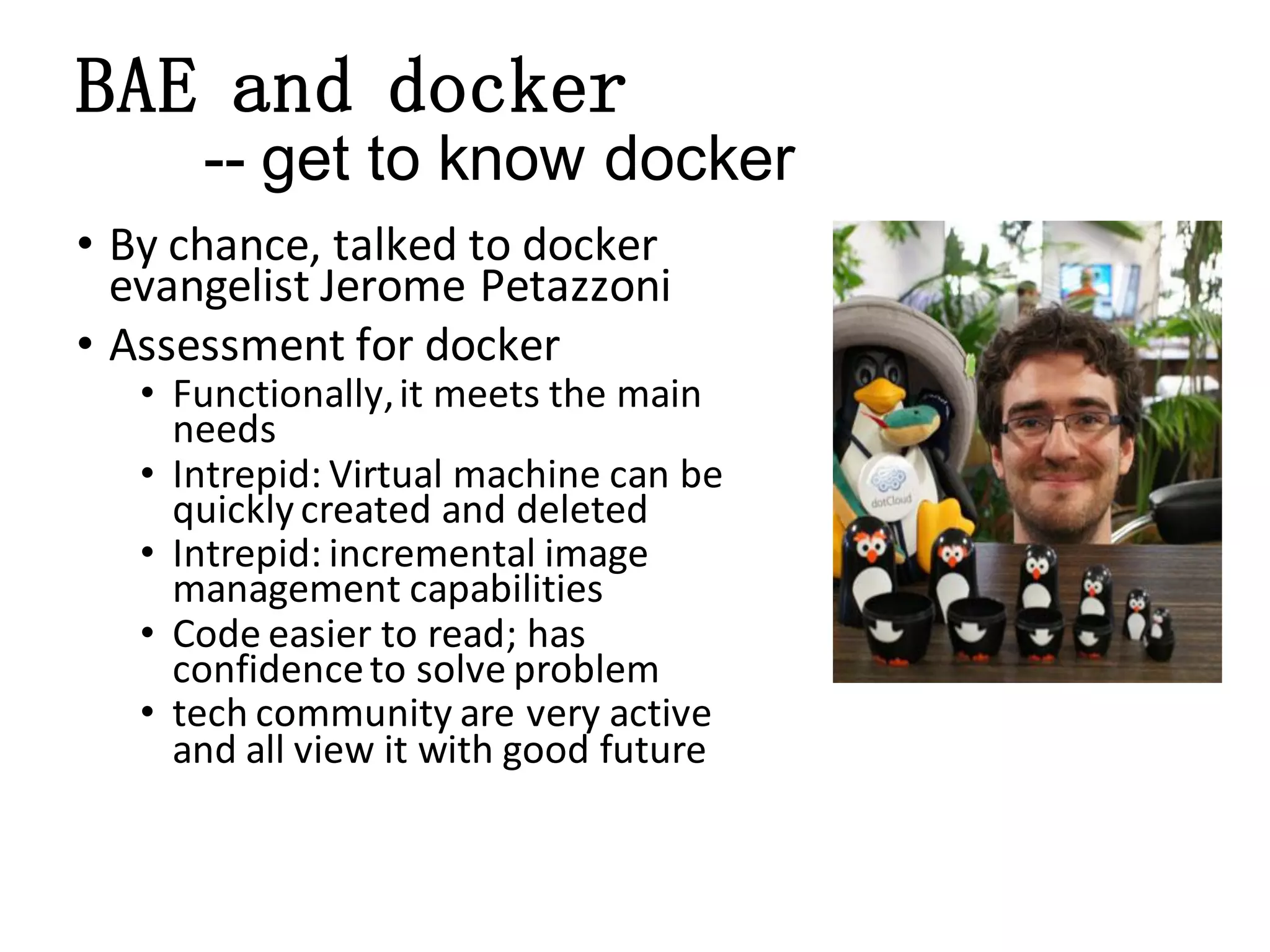
• By chance, talked to docker
evangelist Jerome Petazzoni
• Assessment for docker

• Functionally, it meets the main
needs
• Intrepid: Virtual machine can be
quickly created and deleted
• Intrepid: incremental image
management capabilities
• Code easier to read; has
confidence to solve problem
• tech community are very active
and all view it with good future
BAE and docker
-- docker in practice
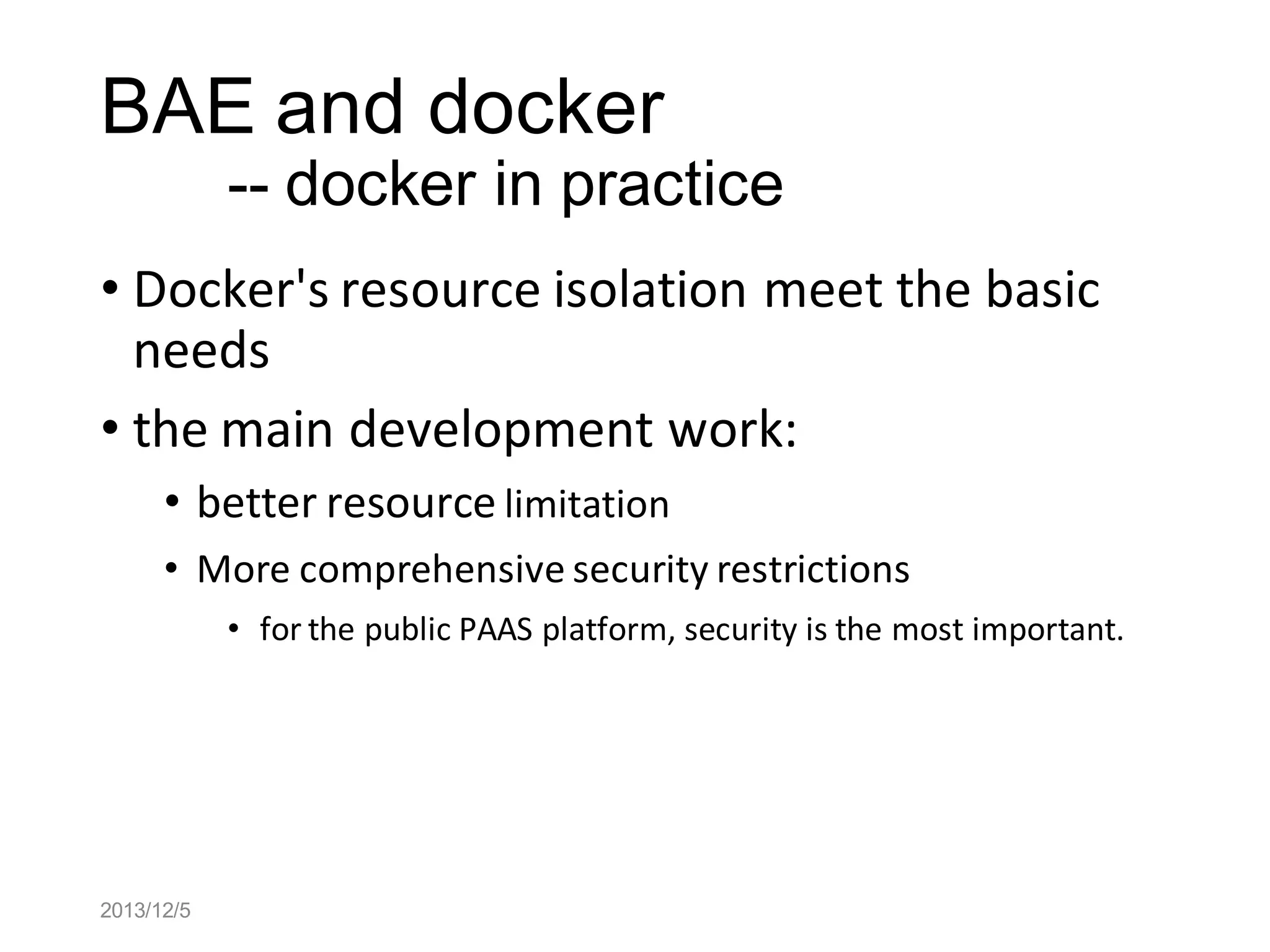
• Docker's resource isolation meet the basic
needs
• the main development work:
• better resource limitation
• More comprehensive security restrictions
• for the public PAAS platform, security is the most important.

2013/12/5
BAE and docker
-- docker in practice
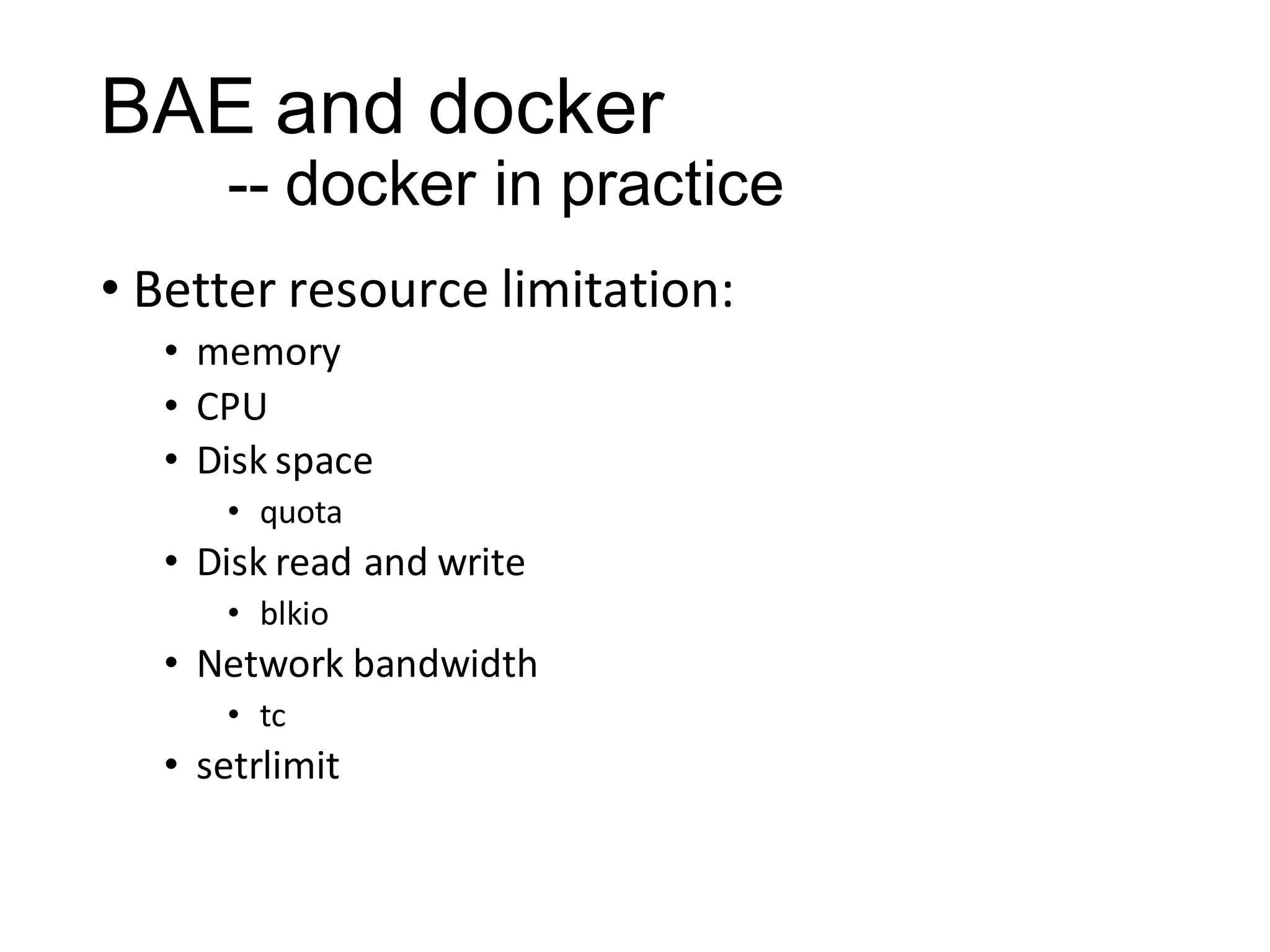
• Better resource limitation:
• memory
• CPU
• Disk space
• quota

• Disk read and write
• blkio

• Network bandwidth
• tc

• setrlimit
BAE and docker
-- docker in practice
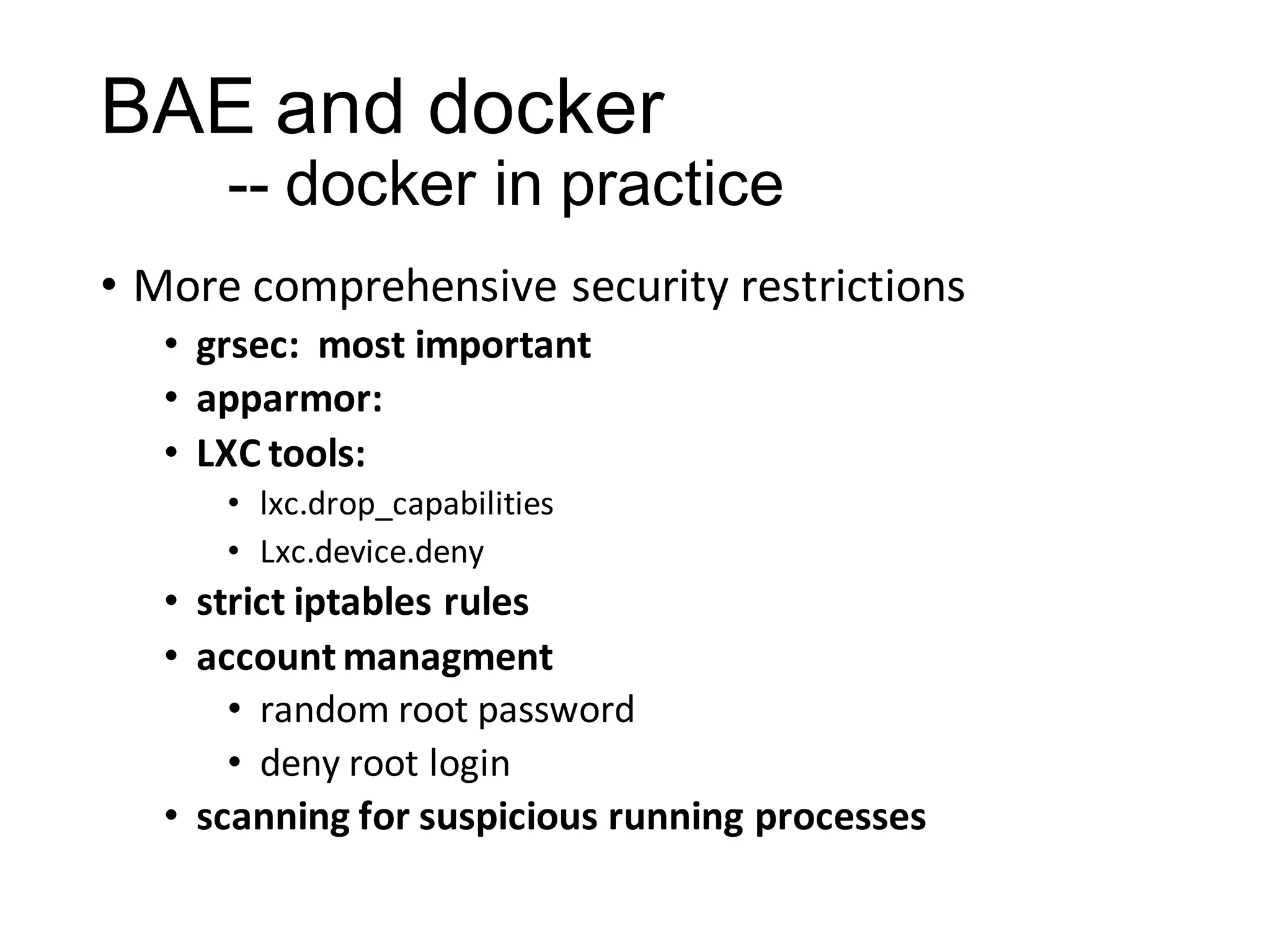
• More comprehensive security restrictions
• grsec: most important
• apparmor:
• LXC tools:
• lxc.drop_capabilities
• Lxc.device.deny

• strict iptables rules
• account managment
• random root password
• deny root login
• scanning for suspicious running processes
BAE and docker
-- docker in practice
• using docker private image registry to take care of
image management problem
BAE and docker
-- docker in practice
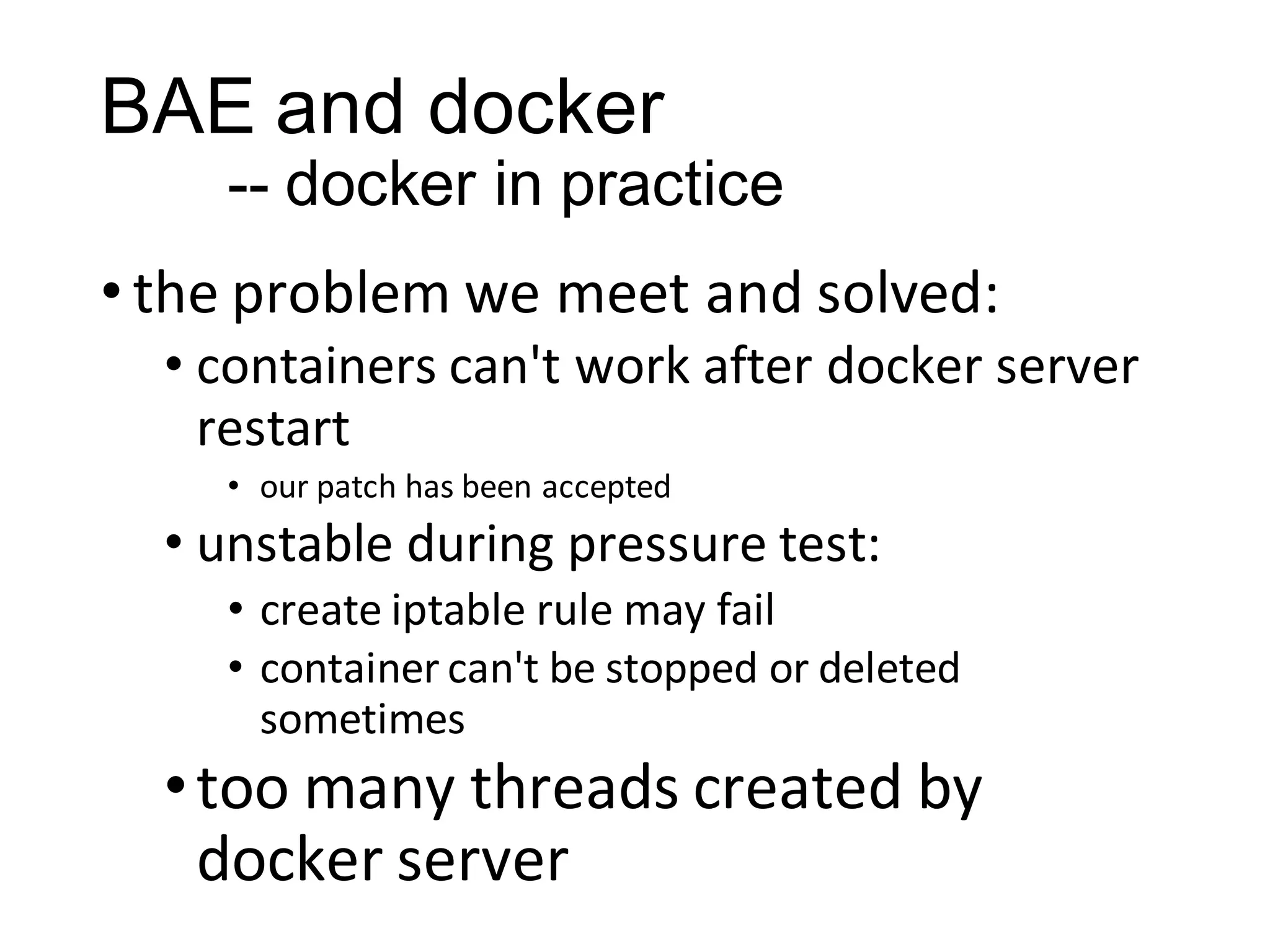
• the problem we meet and solved:
• containers can't work after docker server
restart
• our patch has been accepted

• unstable during pressure test:
• create iptable rule may fail
• container can't be stopped or deleted
sometimes

• too many threads created by
docker server
the development of docker
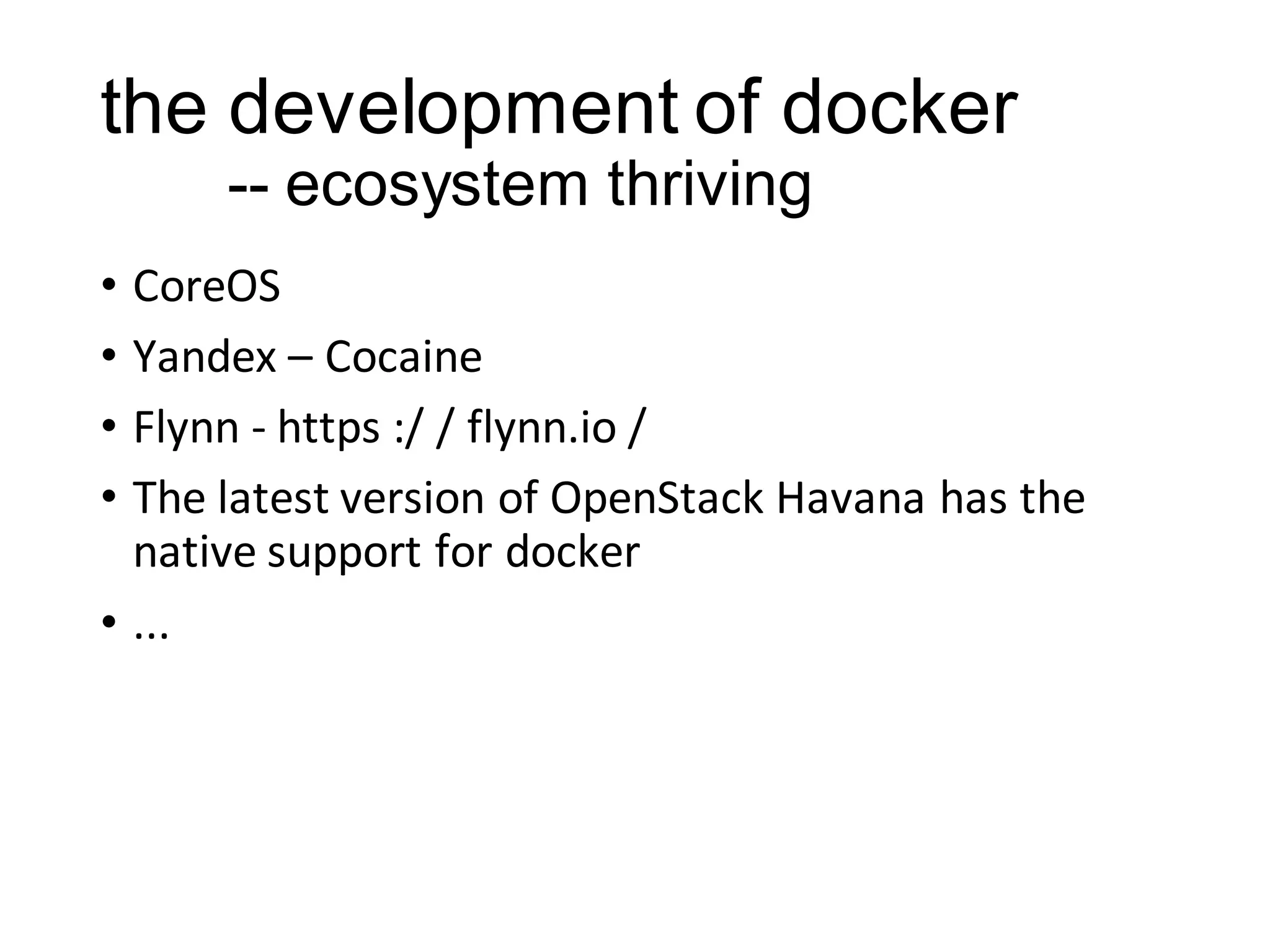
-- ecosystem thriving
•
•
•
•

CoreOS
Yandex – Cocaine
Flynn - https :/ / flynn.io /
The latest version of OpenStack Havana has the
native support for docker
• ...
the development of docker
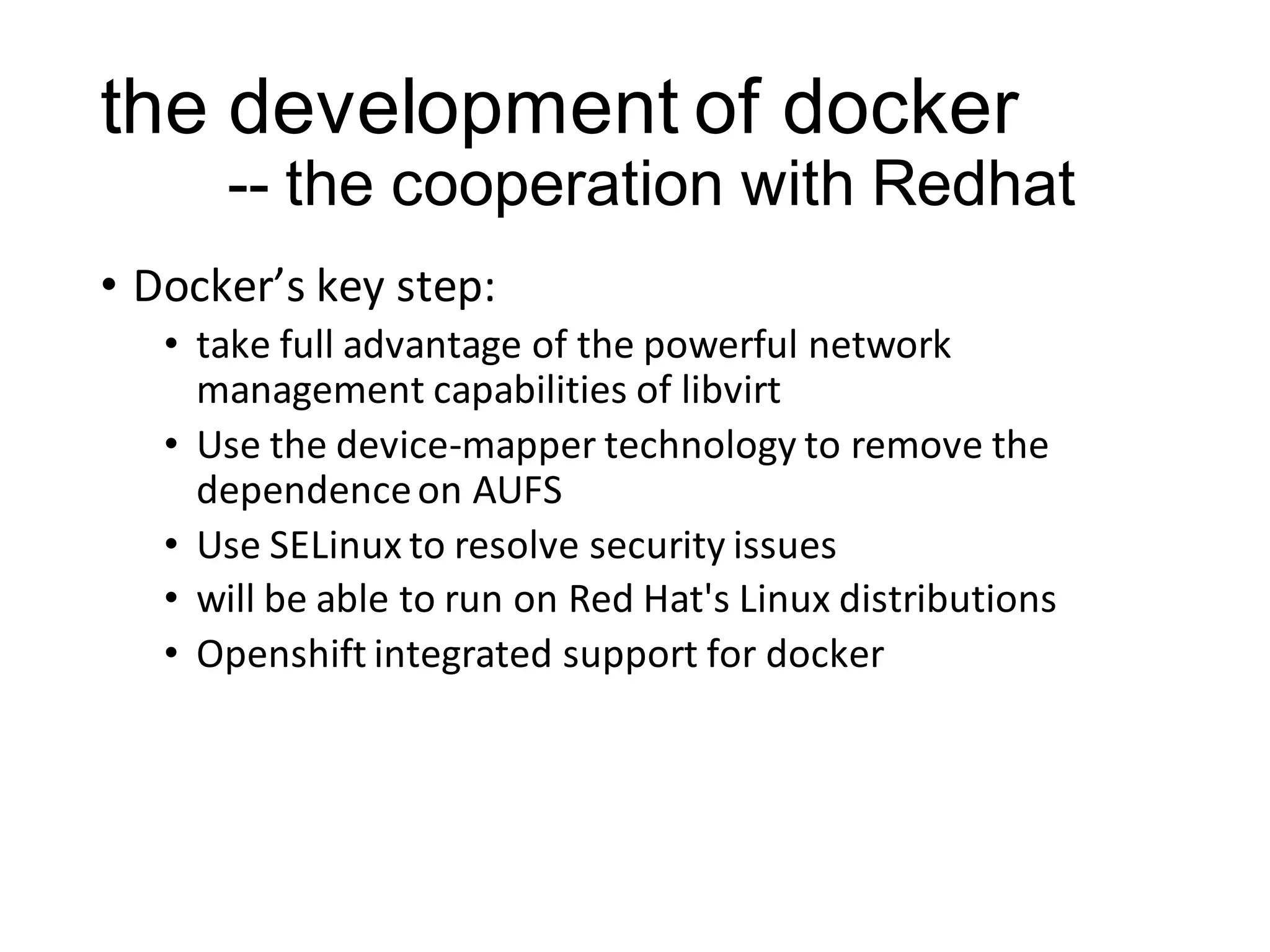
-- the cooperation with Redhat
• Docker’s key step:
• take full advantage of the powerful network
management capabilities of libvirt
• Use the device-mapper technology to remove the
dependence on AUFS
• Use SELinux to resolve security issues
• will be able to run on Red Hat's Linux distributions
• Openshift integrated support for docker
the development of docker
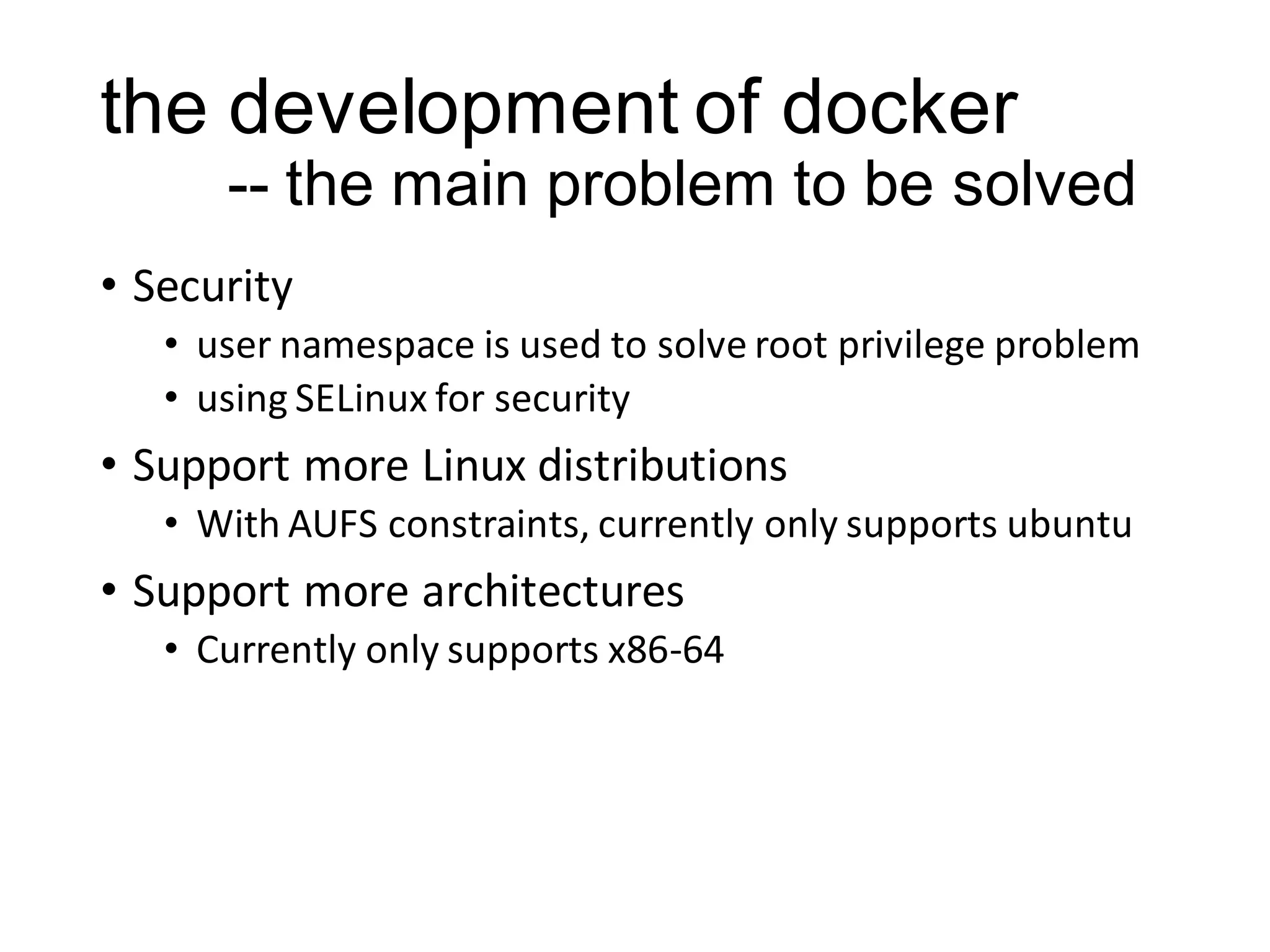
-- the main problem to be solved
• Security
• user namespace is used to solve root privilege problem
• using SELinux for security

• Support more Linux distributions
• With AUFS constraints, currently only supports ubuntu

• Support more architectures
• Currently only supports x86-64
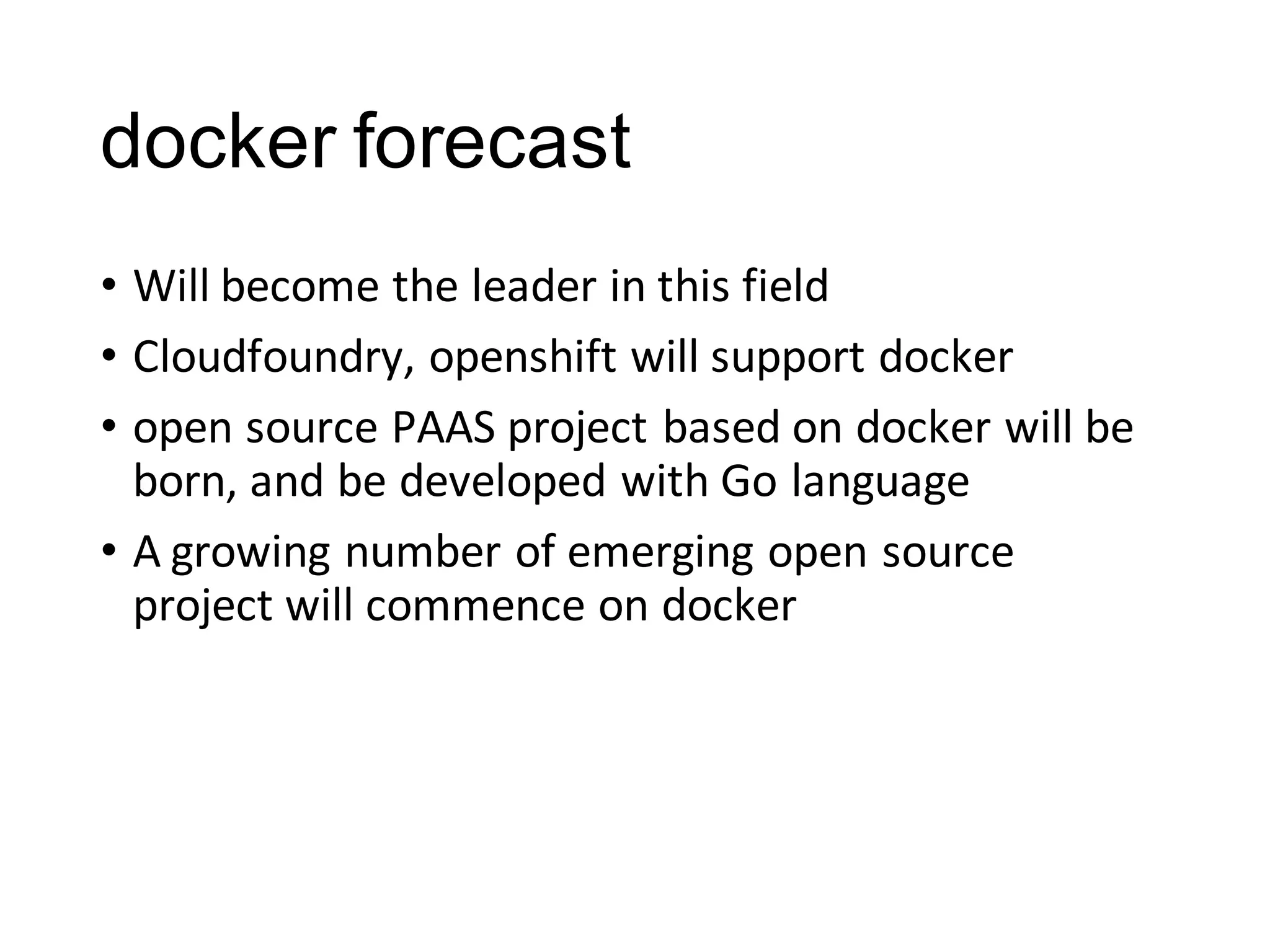
docker forecast
• Will become the leader in this field
• Cloudfoundry, openshift will support docker
• open source PAAS project based on docker will be
born, and be developed with Go language
• A growing number of emerging open source
project will commence on docker
Reference
•
•
•
•
•
•
•
•
•
•

http://www.infoq.com/articles/docker-containers
http://en.wikipedia.org/wiki/Operating_system-level_virtualization
http://en.wikipedia.org/wiki/LXC
http://en.wikipedia.org/wiki/Cgroups
http://en.wikipedia.org/wiki/Linux_Containers
http://en.wikipedia.org/wiki/Aufs
http://libvirt.org/
http://linuxcontainers.org/
https://wiki.ubuntu.com/LxcSecurity
http://lwn.net/Articles/236038/
Reference
• http://blog.dotcloud.com/under-the-hood-linux-kernels-on-dotcloudpart

• http://blog.dotcloud.com/kernel-secrets-from-the-paasgarage-part-24-c
• http://www.nsnam.org/wiki/index.php/HOWTO_Use_Linux
_Containers_to_set_up_virtual_networks
• http://openvz.org/Main_Page
• http://aufs.sourceforge.net/
• http://blog.docker.io/2013/08/containers-docker-howsecure-are-they/

Docker in pratice -chenyifei

  • 1.
    Lightweight virtualization -- dockerin practice • Baidu BAE team -- Chen YiFei • 2013-10.25 2013/12/5
  • 2.
    Outline • 1. Lightweightvirtualization • What is Lightweight virtualization? • What technology is behind Lightweight virtualization? • 2. BAE and docker • What is docker? • Why does BAE choose docker? • How does BAE use docker? • 3. Docker developments and forecast
  • 3.
    What is Lightweightvirtualization technology • From Linux-process perspective • What are the surrounding environments and resources involved when the processes are running? • • • • • Linux Kernel File System Network System PID, UID, IPC and other resources memory, disk, CPU and other resources • Each process sees the same surroundings • All processes share these same resources 2013/12/5
  • 4.
    What is Lightweightvirtualization technology • With development in technology, new requirements are formed: •Resource isolation: different processes need their own independent surroundings •Resource constrains: some processes can only have limited resources a group of processes • Ability to isolate and set limitations to them 2013/12/5
  • 5.
    What is Lightweightvirtualization technology • Requirements are summarized as follows: • for a group of processs • Allocate separate operating environment • File System • Network System • PID, UID, UTS, mount, IPC namespace • Able to limit resources they can use • Memory • CPU • Network Traffic • Disk Space • Disk read and write frequency • It would ideal if interference between process groups can be eliminated
  • 6.
    What is Lightweightvirtualization technology • Lightweight virtualization is the technology used to fulfill these requirements • The process groups that meet the above restrictions are called "lightweight virtual machine" or Container • Process Container concept was first introduced by Google engineers in 2006 • http://lwn.net/Articles/199643/ • http://lwn.net/Articles/236038/ • wikipedia definition • http://en.wikipedia.org/wiki/Operating_systemlevel_virtualization 2013/12/5
  • 7.
    What is Lightweightvirtualization technology • Demonstration 2013/12/5
  • 8.
    Lightweight virtualization --technologies andprojects • Underlying technology: • • • • namespace/cgroups veth union fs(AUFS) netfilter/chroot/tc/quota • Low-level container management • LXC/libvirt • Security related • grsec/apparmor/SELinux • High-level container/image management • docker/warden/lmctfy/openVZ
  • 9.
    Lightweight virtualization -- technologiesand projects cloudfoundry/heroku/dotcloud/appfog/openshift docker warden LXC lmctfy openvz libvirt namespace/cgroups/netfilter/tc/veth/quota/union fs grsec apparmor SELinx
  • 10.
    BAE and docker --whatis docker • A complete solution for Lightweight virtual machine. • Open source project developed by dotCloud • https://www.docker.io/ • https://github.com/dotcloud/docker • Introduced about 6 months ago, ranked first in language activity by Github GO language
  • 11.
    BAE and docker --whatis docker • Based on LXC tools , but easier to use • AUFS: speedy creation of container, cool image management. • Client-Server Architecture • REST API: Clear interface • Command-line tool: easy to use
  • 12.
    BAE and docker --whatis BAE • http://developer.baidu.com • Baidu PAAS platform for developers 2013/12/5
  • 13.
    BAE and docker --whydoes BAE choose docker • The dilemma of traditional PAAS • GAE is the instigator • Resource isolation and resource constraints are achieved through sandbox technology • High cost of platform development and maintenance • Many limitations, and high cost of learning • High cost of application migration and development • Developers complain much
  • 14.
    BAE and docker --whydoes BAE choose docker • PAAS based on sandbox techology Machine php-fpm process with sandbox app-A app-B app-C
  • 15.
    BAE and docker --whydoes BAE choose docker • Container technology brought the light: • Get rid of the sandbox; through Container technology, resource is isolated and limited in the outer layer • No language level restrictions, significantly reduce development costs • Supporting new programming language made extremely simple • cost of platform development and maintenance is significantly lowered • Industry trends: Emerging PAAS platform have chosen Container • Cloudfoudry/openshift/heroku/dotcloud/appfog
  • 16.
    BAE and docker --whydoes BAE choose docker • PAAS based on container technology Machine Container Container php-fpm php-fpm app-B app-A Container php-fpm app-C
  • 17.
    BAE and docker --whydoes BAE choose docker • BAE2.0 platform is a sandbox-based PAAS • We are deeply troubled by the sandbox • Noting Container technology, began preliminary research and exploration
  • 18.
    BAE and docker --technology option one: to develop by ourself • Internal virtual machine team gave the following solution: • openstack + libvirt • Functionally, it meets the basic needs • Problems: • the most important requirements are not addressed: • Need frequent creation and deletion of Container • Need to create and delete container within a few seconds • Actually creation of the Container takes more than 15 seconds (not acceptable) • Openstack superfluous • Not enough confidence in the quality of the code • Lack of follow-up technical support
  • 19.
    BAE and docker --technology option two: warden • The warden from cloudfoundry • warden is a more complete solution • However: • not familiar with Ruby • deang tightly coupled with warden • Not active enough in the technical community
  • 20.
    BAE and docker --get to know docker • By chance, talked to docker evangelist Jerome Petazzoni • Assessment for docker • Functionally, it meets the main needs • Intrepid: Virtual machine can be quickly created and deleted • Intrepid: incremental image management capabilities • Code easier to read; has confidence to solve problem • tech community are very active and all view it with good future
  • 21.
    BAE and docker --docker in practice • Docker's resource isolation meet the basic needs • the main development work: • better resource limitation • More comprehensive security restrictions • for the public PAAS platform, security is the most important. 2013/12/5
  • 22.
    BAE and docker --docker in practice • Better resource limitation: • memory • CPU • Disk space • quota • Disk read and write • blkio • Network bandwidth • tc • setrlimit
  • 23.
    BAE and docker --docker in practice • More comprehensive security restrictions • grsec: most important • apparmor: • LXC tools: • lxc.drop_capabilities • Lxc.device.deny • strict iptables rules • account managment • random root password • deny root login • scanning for suspicious running processes
  • 24.
    BAE and docker --docker in practice • using docker private image registry to take care of image management problem
  • 25.
    BAE and docker --docker in practice • the problem we meet and solved: • containers can't work after docker server restart • our patch has been accepted • unstable during pressure test: • create iptable rule may fail • container can't be stopped or deleted sometimes • too many threads created by docker server
  • 26.
    the development ofdocker -- ecosystem thriving • • • • CoreOS Yandex – Cocaine Flynn - https :/ / flynn.io / The latest version of OpenStack Havana has the native support for docker • ...
  • 27.
    the development ofdocker -- the cooperation with Redhat • Docker’s key step: • take full advantage of the powerful network management capabilities of libvirt • Use the device-mapper technology to remove the dependence on AUFS • Use SELinux to resolve security issues • will be able to run on Red Hat's Linux distributions • Openshift integrated support for docker
  • 28.
    the development ofdocker -- the main problem to be solved • Security • user namespace is used to solve root privilege problem • using SELinux for security • Support more Linux distributions • With AUFS constraints, currently only supports ubuntu • Support more architectures • Currently only supports x86-64
  • 29.
    docker forecast • Willbecome the leader in this field • Cloudfoundry, openshift will support docker • open source PAAS project based on docker will be born, and be developed with Go language • A growing number of emerging open source project will commence on docker
  • 30.
  • 31.
    Reference • http://blog.dotcloud.com/under-the-hood-linux-kernels-on-dotcloudpart • http://blog.dotcloud.com/kernel-secrets-from-the-paasgarage-part-24-c •http://www.nsnam.org/wiki/index.php/HOWTO_Use_Linux _Containers_to_set_up_virtual_networks • http://openvz.org/Main_Page • http://aufs.sourceforge.net/ • http://blog.docker.io/2013/08/containers-docker-howsecure-are-they/