An Explainer Post from
Ed Dolan’s Econ Blog
What is the Nairu
and Why does it Matter?
Posted December 18, 2016
Terms of Use: These slides are provided under Creative Commons License Attribution—Share Alike 3.0 . You are free
to use these slides as a resource for your economics classes together with whatever textbook you are using. If you like
the slides, you may also want to take a look at my textbook, Introduction to Economics, from BVT Publishing.
The Wonkiest Number in Economics
 Nairu (or NAIRU) stands for Non-
Accelerating-Inflation Rate of
Unemployment
 As unemployment falls, tightening
labor and product markets put
upward pressure on wages and
prices
 The Nairu is supposed to capture
the sweet spot—the lowest level to
which the unemployment rate can
safely fall before inflation starts to
accelerate
December 18, 2016 Ed Dolan’s Econ Blog
In the 1960s, Milton Friedman
introduced the term natural rate of
unemployment. Today, many
economists treat Friedman’s “natural
rate” as a synonym for Nairu
The Nairu and the Fed’s Dual Mandate
 Under its so-called dual mandate,
the Fed is supposed to aim for
maximum employment and stable
prices.
 The Nairu captures both parts of
the dual mandate, being the
maximum employment that is
consistent with inflation that does
not accelerate from month to
month.
December 18, 2016 Ed Dolan’s Econ Blog
Federal Reserve Headquarters
Washington, DC
The Nairu and the Fed’s Dual Mandate
 To put the dual mandate to work,
economists at the Fed must attach
numbers to both of its parts
 The Fed has set its inflation target at
2 percent annually, measured by the
personal consumption expenditure
(PCE) index
 The unemployment target—the
Nairu—is harder to pin down exactly
December 18, 2016 Ed Dolan’s Econ Blog
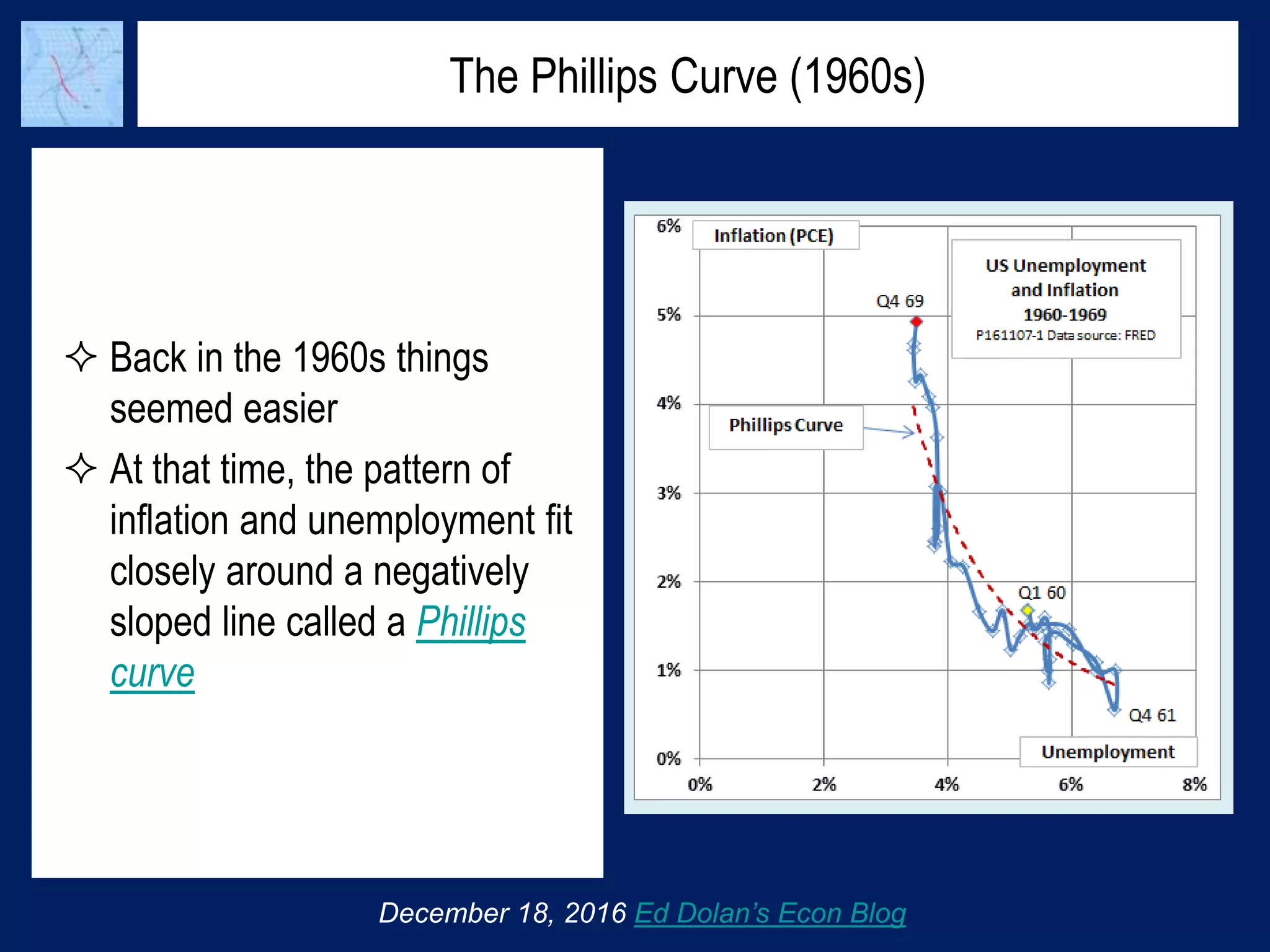
The Phillips Curve (1960s)
 Back in the 1960s things
seemed easier
 At that time, the pattern of
inflation and unemployment fit
closely around a negatively
sloped line called a Phillips
curve
December 18, 2016 Ed Dolan’s Econ Blog
Using the Phillips Curve to Find the Nairu
 Given a Phillips curve and an
inflation target, it would be easy
to find the Nairu
 Just look for the intersection
December 18, 2016 Ed Dolan’s Econ Blog
The Disappearing Phillips Curve
 Unfortunately, the Phillips curve did
not turn out to be stable
 In the 1970s, the Phillips curve
shifted higher
 During more recent economic
expansions it is hard to see any
pattern resembling a negatively
sloped Phillips curve
December 18, 2016 Ed Dolan’s Econ Blog
The Nairu Since 1950
 With no stable Phillips curve to
go by, economists use other
statistical methods
 This chart shows estimates by
the Congressional Budget
Office of the Nairu (or natural
rate of unemployment, as the
CBO still prefers to call it)
December 18, 2016 Ed Dolan’s Econ Blog
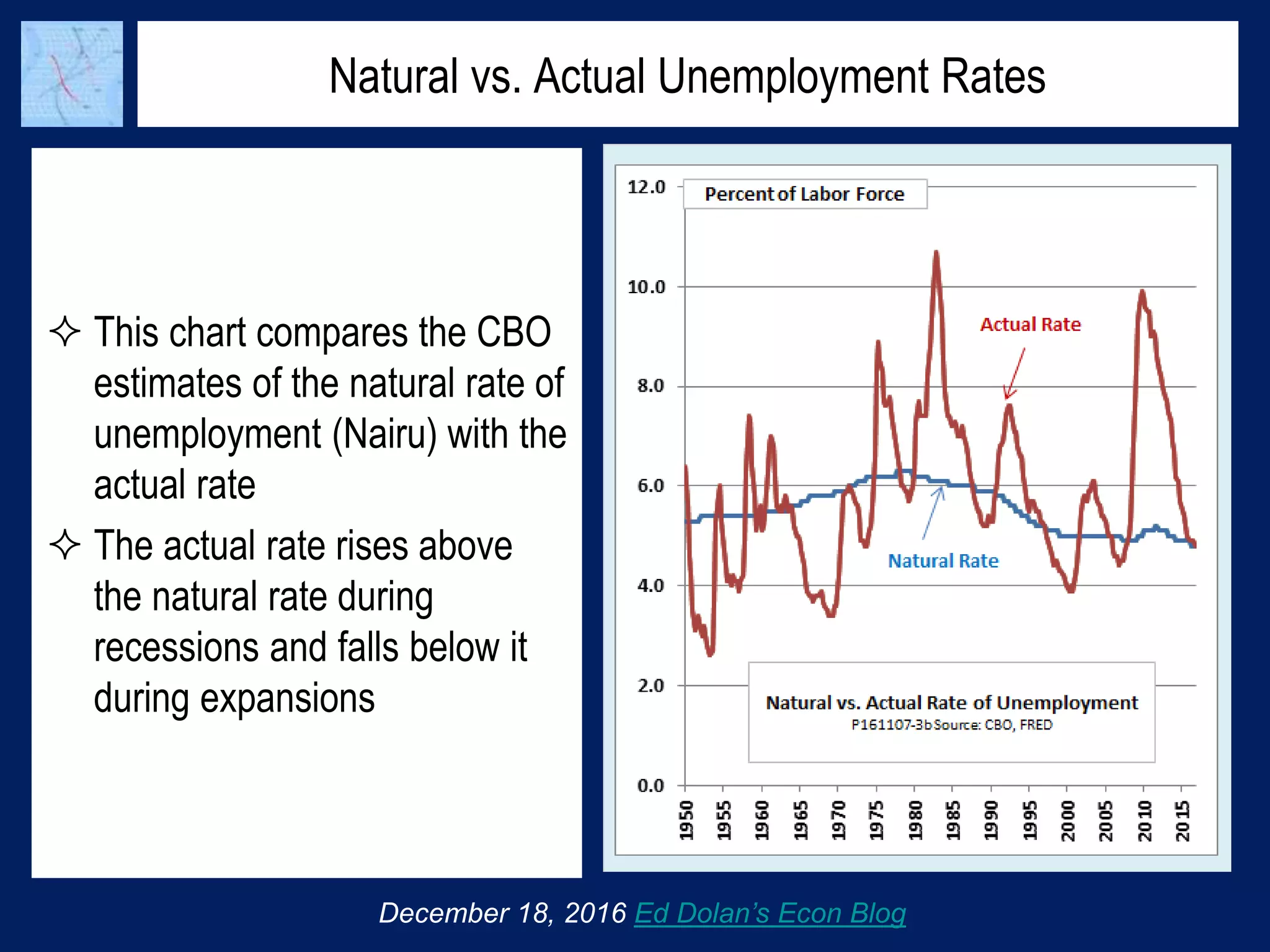
Natural vs. Actual Unemployment Rates
 This chart compares the CBO
estimates of the natural rate of
unemployment (Nairu) with the
actual rate
 The actual rate rises above
the natural rate during
recessions and falls below it
during expansions
December 18, 2016 Ed Dolan’s Econ Blog
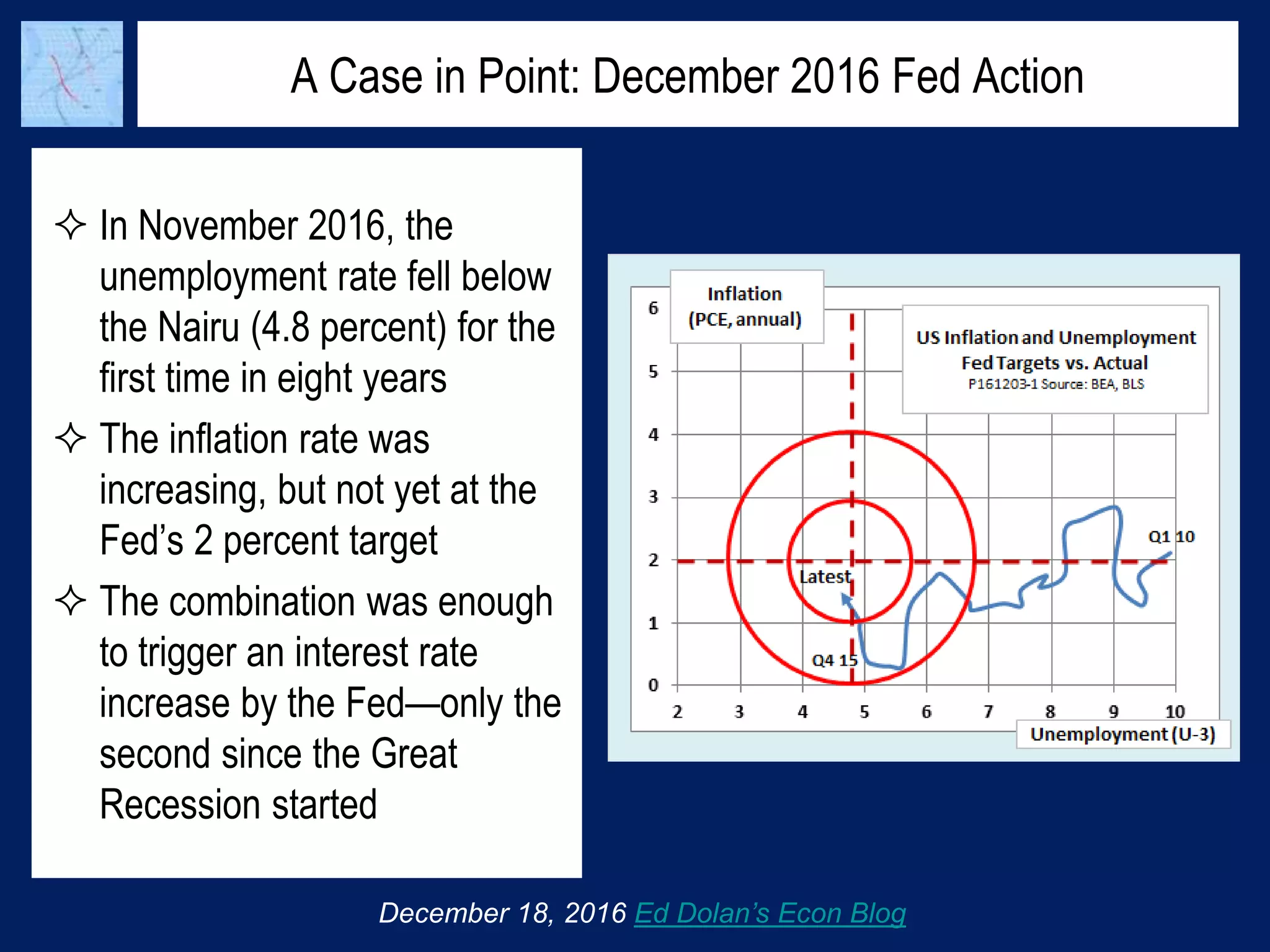
A Case in Point: December 2016 Fed Action
 In November 2016, the
unemployment rate fell below
the Nairu (4.8 percent) for the
first time in eight years
 The inflation rate was
increasing, but not yet at the
Fed’s 2 percent target
 The combination was enough
to trigger an interest rate
increase by the Fed—only the
second since the Great
Recession started
December 18, 2016 Ed Dolan’s Econ Blog
Summary: Why the Nairu Matters
 The Nairu is an estimate of the
unemployment rate below
which inflation begins to
accelerate
 It is difficult to measure exactly
and varies from year to year
 Despite problems of
measurement, the relationship
of actual unemployment to the
Nairu strongly influences
monetary policy
December 18, 2016 Ed Dolan’s Econ Blog
Click on the image to learn more about
Ed Dolan’s Econ texts
or visit www.bvtpublishing.com
For more posts and slideshows, Follow Ed Dolan’s Econ Blog
Follow @DolanEcon on Twitter

What is the Nairu and Why Does It Matter?

  • 1.
    An Explainer Postfrom Ed Dolan’s Econ Blog What is the Nairu and Why does it Matter? Posted December 18, 2016 Terms of Use: These slides are provided under Creative Commons License Attribution—Share Alike 3.0 . You are free to use these slides as a resource for your economics classes together with whatever textbook you are using. If you like the slides, you may also want to take a look at my textbook, Introduction to Economics, from BVT Publishing.
  • 2.
    The Wonkiest Numberin Economics  Nairu (or NAIRU) stands for Non- Accelerating-Inflation Rate of Unemployment  As unemployment falls, tightening labor and product markets put upward pressure on wages and prices  The Nairu is supposed to capture the sweet spot—the lowest level to which the unemployment rate can safely fall before inflation starts to accelerate December 18, 2016 Ed Dolan’s Econ Blog In the 1960s, Milton Friedman introduced the term natural rate of unemployment. Today, many economists treat Friedman’s “natural rate” as a synonym for Nairu
  • 3.
    The Nairu andthe Fed’s Dual Mandate  Under its so-called dual mandate, the Fed is supposed to aim for maximum employment and stable prices.  The Nairu captures both parts of the dual mandate, being the maximum employment that is consistent with inflation that does not accelerate from month to month. December 18, 2016 Ed Dolan’s Econ Blog Federal Reserve Headquarters Washington, DC
  • 4.
    The Nairu andthe Fed’s Dual Mandate  To put the dual mandate to work, economists at the Fed must attach numbers to both of its parts  The Fed has set its inflation target at 2 percent annually, measured by the personal consumption expenditure (PCE) index  The unemployment target—the Nairu—is harder to pin down exactly December 18, 2016 Ed Dolan’s Econ Blog
  • 5.
    The Phillips Curve(1960s)  Back in the 1960s things seemed easier  At that time, the pattern of inflation and unemployment fit closely around a negatively sloped line called a Phillips curve December 18, 2016 Ed Dolan’s Econ Blog
  • 6.
    Using the PhillipsCurve to Find the Nairu  Given a Phillips curve and an inflation target, it would be easy to find the Nairu  Just look for the intersection December 18, 2016 Ed Dolan’s Econ Blog
  • 7.
    The Disappearing PhillipsCurve  Unfortunately, the Phillips curve did not turn out to be stable  In the 1970s, the Phillips curve shifted higher  During more recent economic expansions it is hard to see any pattern resembling a negatively sloped Phillips curve December 18, 2016 Ed Dolan’s Econ Blog
  • 8.
    The Nairu Since1950  With no stable Phillips curve to go by, economists use other statistical methods  This chart shows estimates by the Congressional Budget Office of the Nairu (or natural rate of unemployment, as the CBO still prefers to call it) December 18, 2016 Ed Dolan’s Econ Blog
  • 9.
    Natural vs. ActualUnemployment Rates  This chart compares the CBO estimates of the natural rate of unemployment (Nairu) with the actual rate  The actual rate rises above the natural rate during recessions and falls below it during expansions December 18, 2016 Ed Dolan’s Econ Blog
  • 10.
    A Case inPoint: December 2016 Fed Action  In November 2016, the unemployment rate fell below the Nairu (4.8 percent) for the first time in eight years  The inflation rate was increasing, but not yet at the Fed’s 2 percent target  The combination was enough to trigger an interest rate increase by the Fed—only the second since the Great Recession started December 18, 2016 Ed Dolan’s Econ Blog
  • 11.
    Summary: Why theNairu Matters  The Nairu is an estimate of the unemployment rate below which inflation begins to accelerate  It is difficult to measure exactly and varies from year to year  Despite problems of measurement, the relationship of actual unemployment to the Nairu strongly influences monetary policy December 18, 2016 Ed Dolan’s Econ Blog
  • 12.
    Click on theimage to learn more about Ed Dolan’s Econ texts or visit www.bvtpublishing.com For more posts and slideshows, Follow Ed Dolan’s Econ Blog Follow @DolanEcon on Twitter