DNA Guide……Navigating Genetic Data Regulation, Privacy and Ease of Use The volume of personalized genetic data is exploding and there currently is no solution for secure and easy access to this information. Both the costs of personalized medicine and its rate of adoption have been negatively impacted by the absence of an intuitive and scalable personalized bioinformatics infrastructure. DNA Guide proposes opening up DNA navigation to a whole new audience by providing: SECURITY - DNA Guide uses values within the DNA sample to uniquely identify each dataset and administer security over the data. VISUALIZATION – DNA Guide leverages Geographic Information Systems Technology (GIS mapping software) to link genetic data to a 2D or 3D representation of the genome, cell, or human Method for preparing and using personal and genetic profiles body US Patent: 7089498
The New Patient DN DN Te A Te A s s Kit t Kit tPersonal genetic data is being incorporated into our health care services.While most people agree individuals have a right to own their genetic data, a controversy exists over thequality of the information as well as who’s authorized to perform and monetize genetic testing services.
FDA Regulation of Genetic Information DNA Test Results www.DNAguide.comIn response, the FDA has stepped in. Different types of base pairs and different combinations of base pairs will likely be regulateddifferently. Hence, software tools that for the management of interpretation and access down to the base pair level will be criticalfor transmitting genetic information from the lab to the physician and patient consistent with FDA regulations.
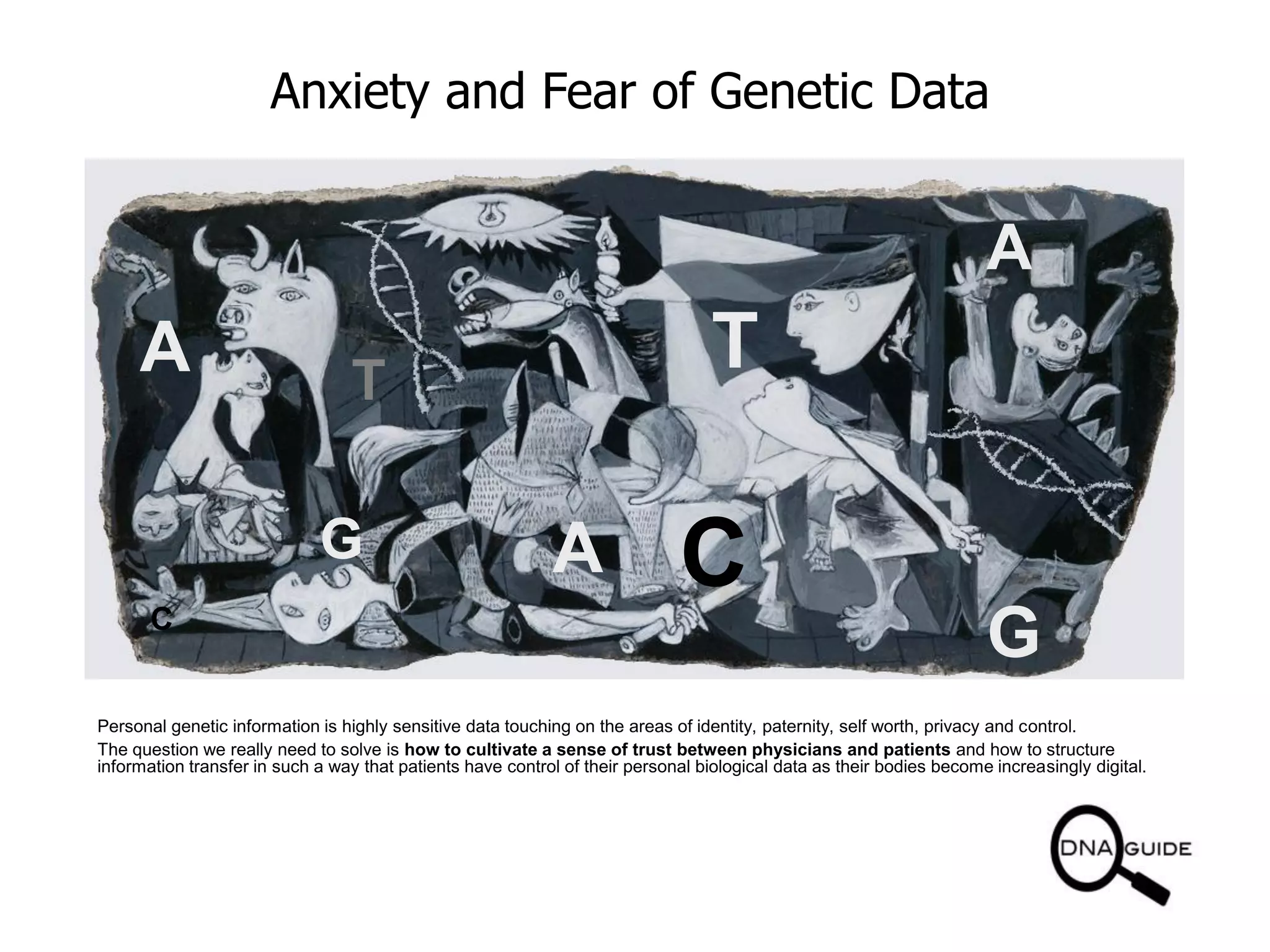
Anxiety and Fear of Genetic Data A TA T T G A C C GPersonal genetic information is highly sensitive data touching on the areas of identity, paternity, self worth, privacy and control.The question we really need to solve is how to cultivate a sense of trust between physicians and patients and how to structureinformation transfer in such a way that patients have control of their personal biological data as their bodies become increasingly digital.
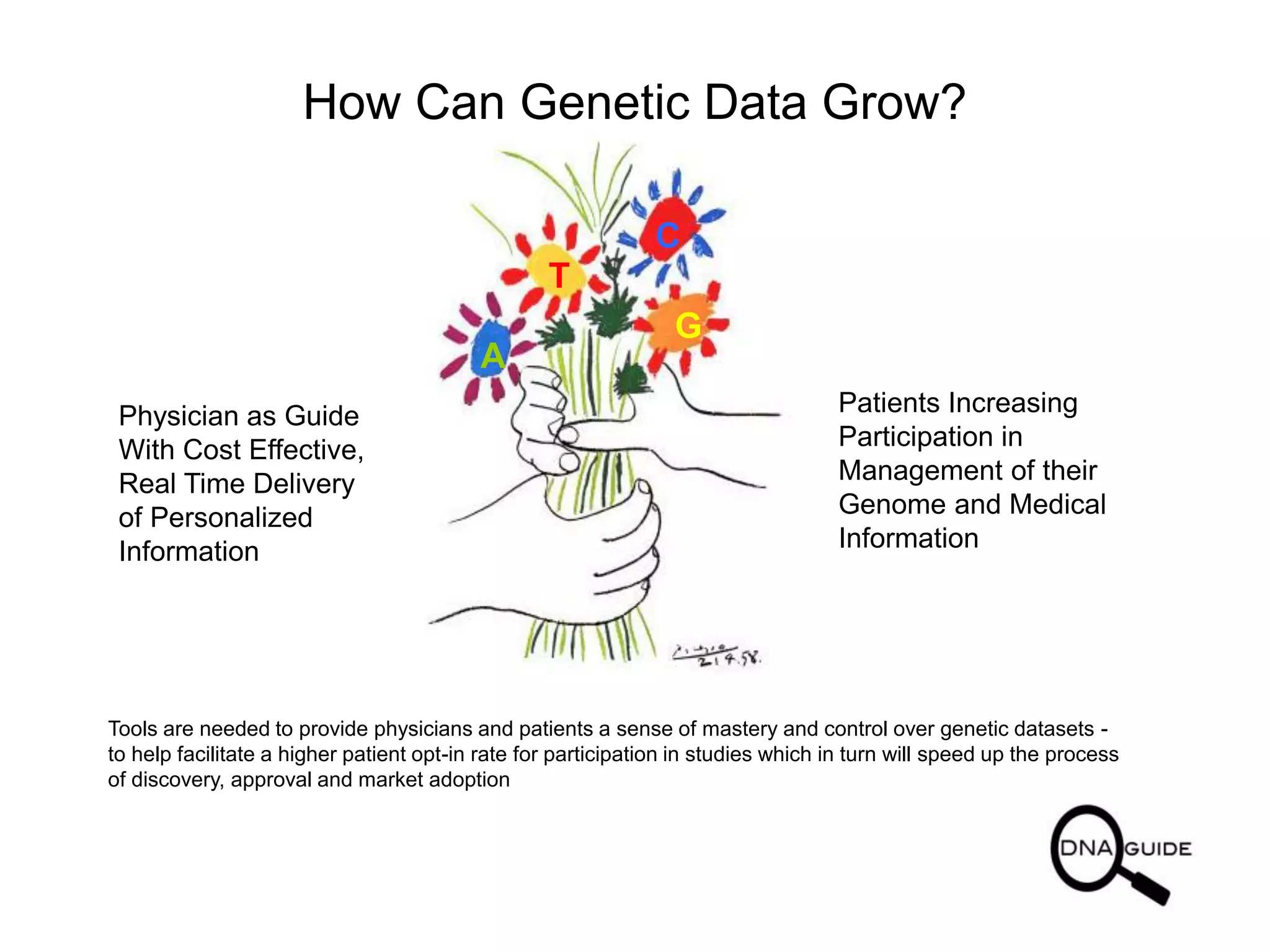
How Can Genetic Data Grow? C T G A Physician as Guide Patients Increasing With Cost Effective, Participation in Real Time Delivery Management of their of Personalized Genome and Medical Information InformationTools are needed to provide physicians and patients a sense of mastery and control over genetic datasets -to help facilitate a higher patient opt-in rate for participation in studies which in turn will speed up the processof discovery, approval and market adoption
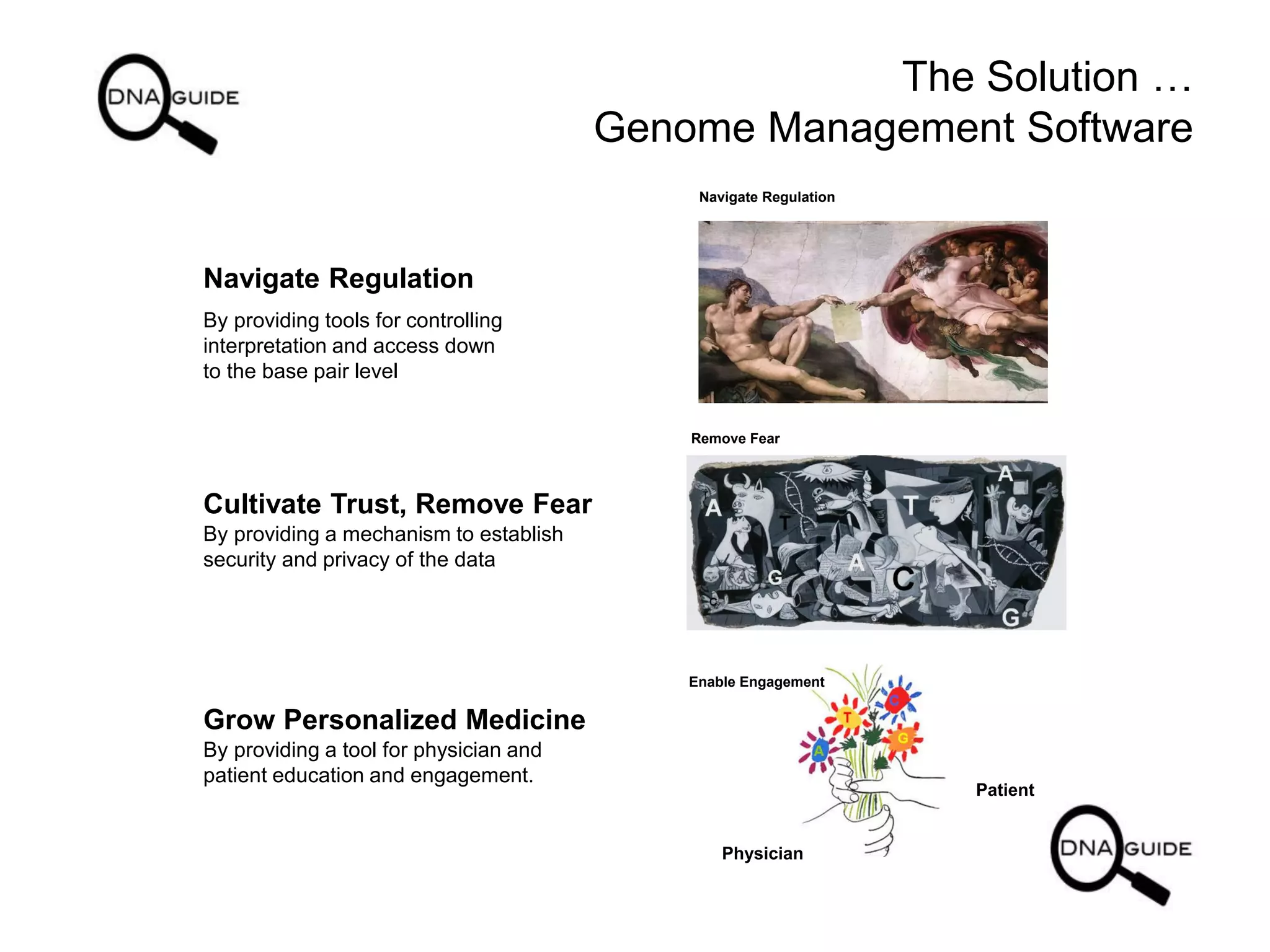
The Solution … Genome Management Software Navigate RegulationNavigate RegulationBy providing tools for controllinginterpretation and access downto the base pair level Remove FearCultivate Trust, Remove FearBy providing a mechanism to establishsecurity and privacy of the data Enable EngagementGrow Personalized MedicineBy providing a tool for physician andpatient education and engagement. Patient Physician
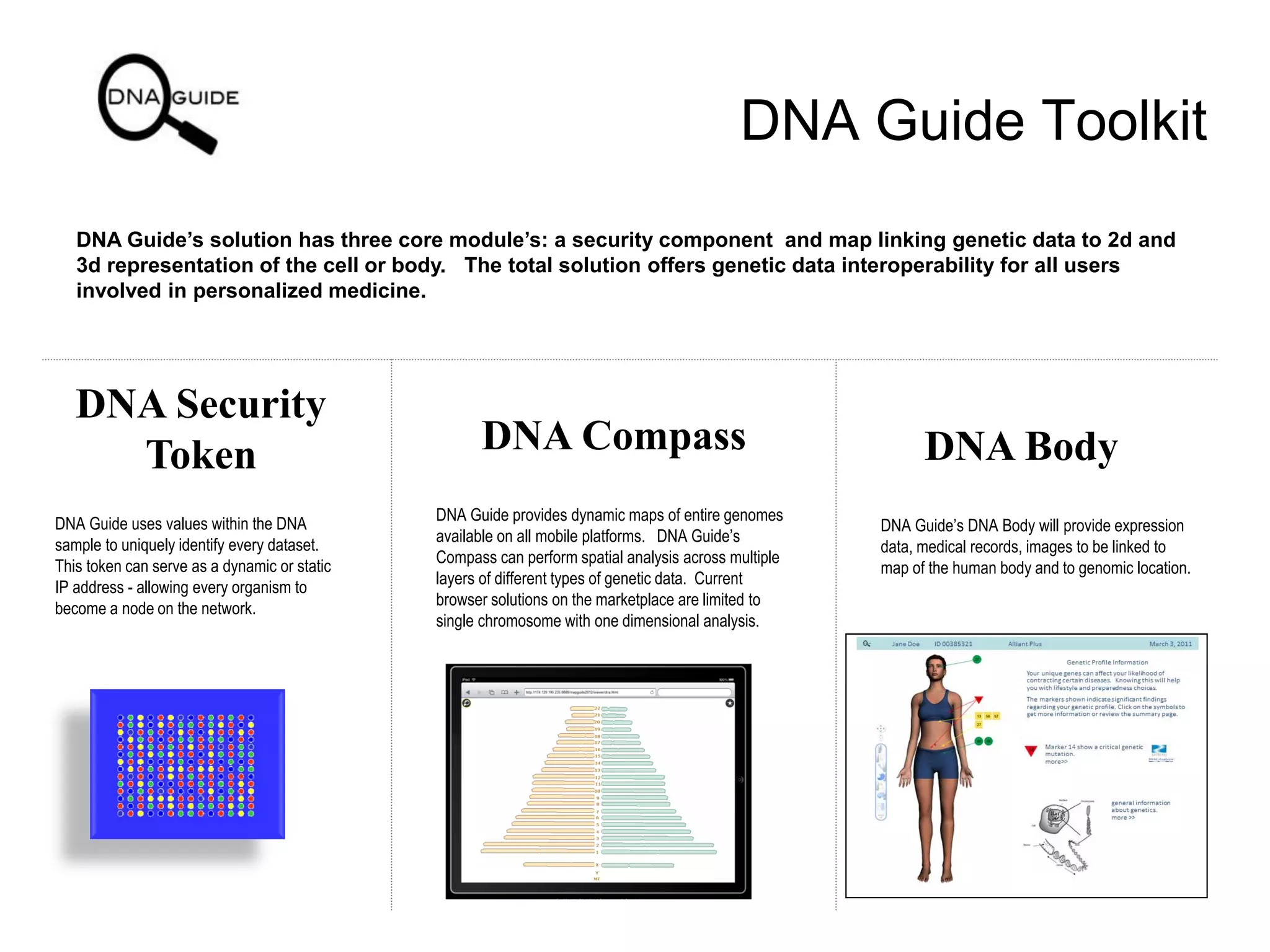
DNA Guide Toolkit DNA Guide’s solution has three core module’s stemming from claims in the patent (US Patent: 7089498 ) A security component and map linking genetic data to 2d and 3d representation of the cell or body. The total solution offers genetic data interoperability for all users involved in personalized medicine. DNA Security Token DNA Compass DNA Body DNA Guide provides dynamic maps of entire genomesDNA Guide uses values within the DNA DNA Guide’s DNA Body will provide expression available on all mobile platforms. DNA Guide’ssample to uniquely identify every dataset. data, medical records, images to be linked to Compass can perform spatial analysis across multipleThis token can serve as a dynamic or static map of the human body and to genomic location. layers of different types of genetic data. CurrentIP address - allowing every organism to browser solutions on the marketplace are limited tobecome a node on the network. single chromosome with one dimensional analysis.
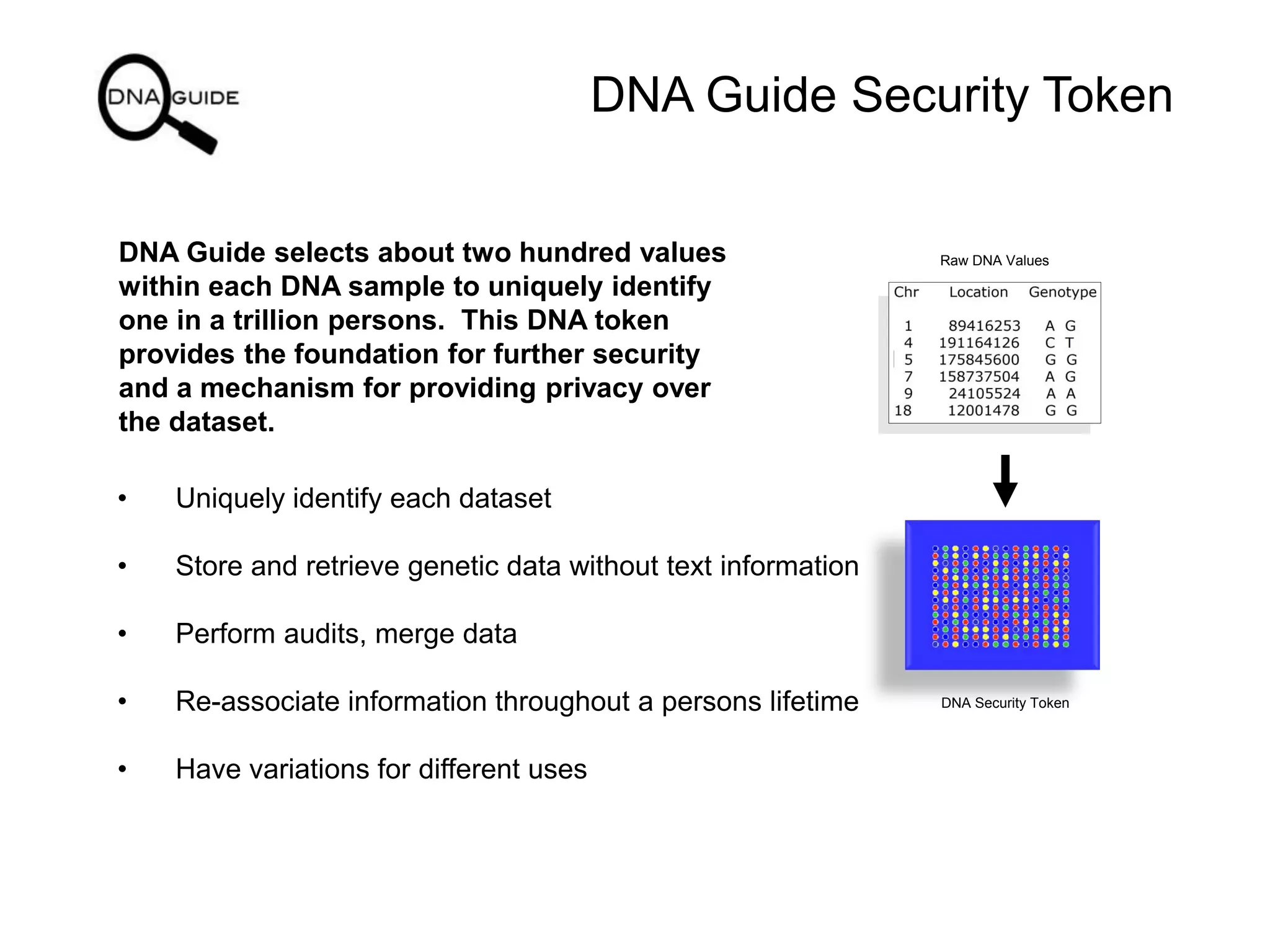
DNA Guide Security TokenDNA Guide selects about two hundred values Raw DNA Valueswithin each DNA sample to uniquely identifyone in a trillion persons. This DNA tokenprovides the foundation for further securityand a mechanism for providing privacy overthe dataset.• Uniquely identify each dataset• Store and retrieve genetic data without text information• Perform audits, merge data• Re-associate information throughout a persons lifetime DNA Security Token• Have variations for different uses
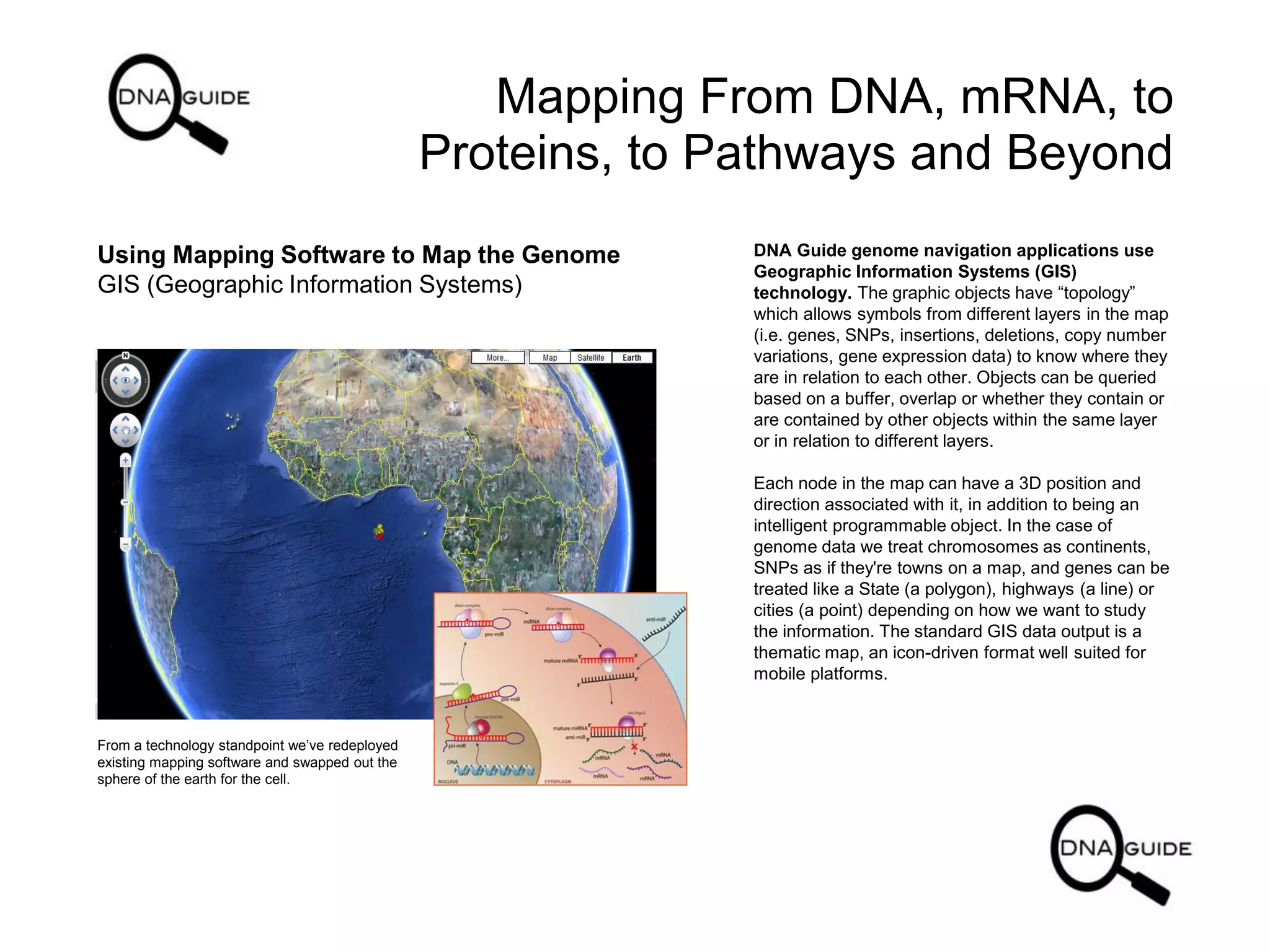
Mapping From DNA, mRNA, to Proteins, to Pathways and BeyondUsing Mapping Software to Map the Genome DNA Guide genome navigation applications use Geographic Information Systems (GIS)GIS (Geographic Information Systems) technology. The graphic objects have “topology” which allows symbols from different layers in the map (i.e. genes, SNPs, insertions, deletions, copy number variations, gene expression data) to know where they are in relation to each other. Objects can be queried based on a buffer, overlap or whether they contain or are contained by other objects within the same layer or in relation to different layers. Each node in the map can have a 3D position and direction associated with it, in addition to being an intelligent programmable object. In the case of genome data we treat chromosomes as continents, SNPs as if theyre towns on a map, and genes can be treated like a State (a polygon), highways (a line) or cities (a point) depending on how we want to study the information. The standard GIS data output is a thematic map, an icon-driven format well suited for mobile platforms.From a technology standpoint we’ve redeployedexisting mapping software and swapped out thesphere of the earth for the cell.
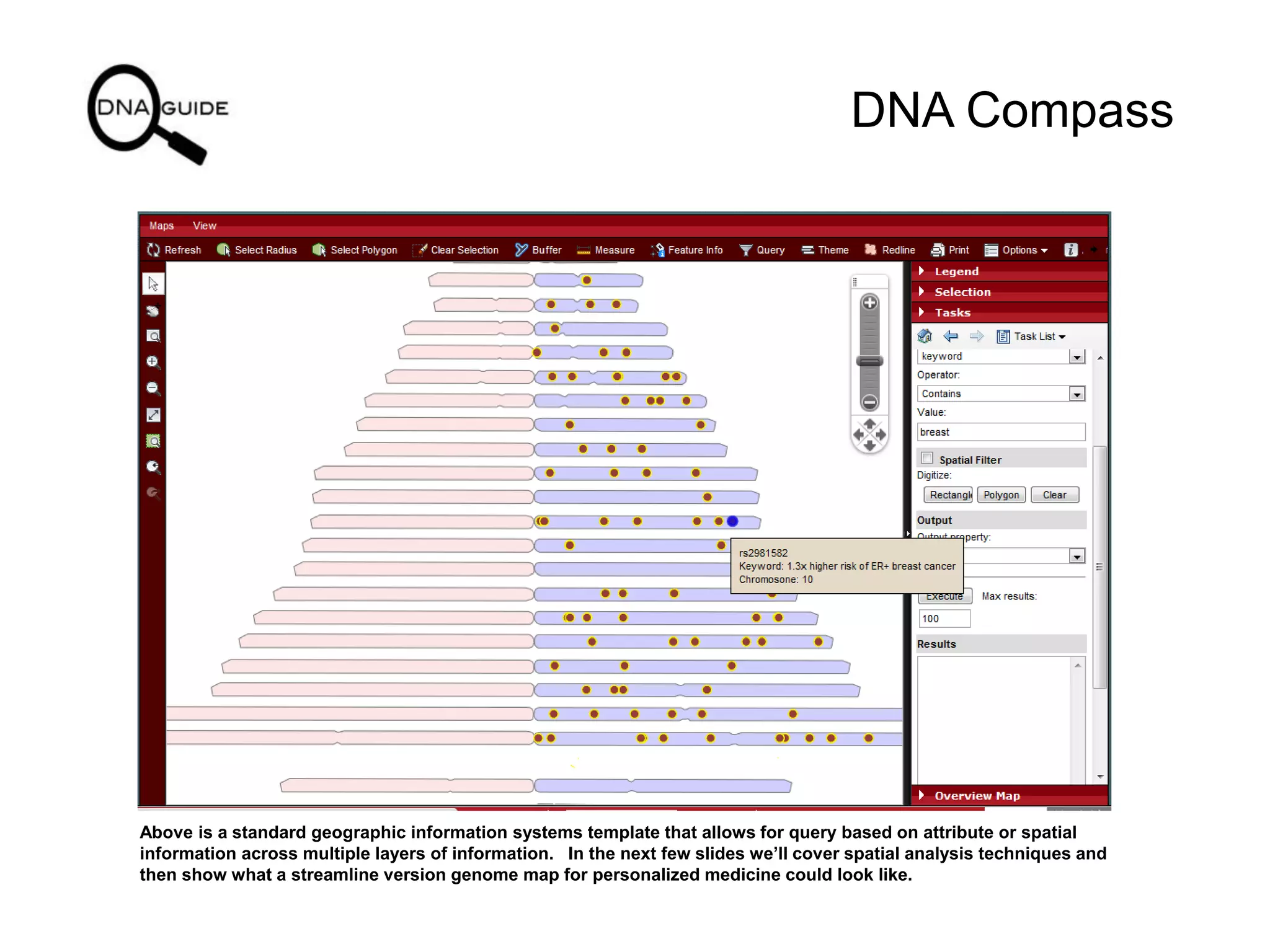
DNA CompassAbove is a standard geographic information systems template that allows for query based on attribute or spatialinformation across multiple layers of information. In the next few slides we’ll cover spatial analysis techniques andthen show what a streamline version genome map for personalized medicine could look like.
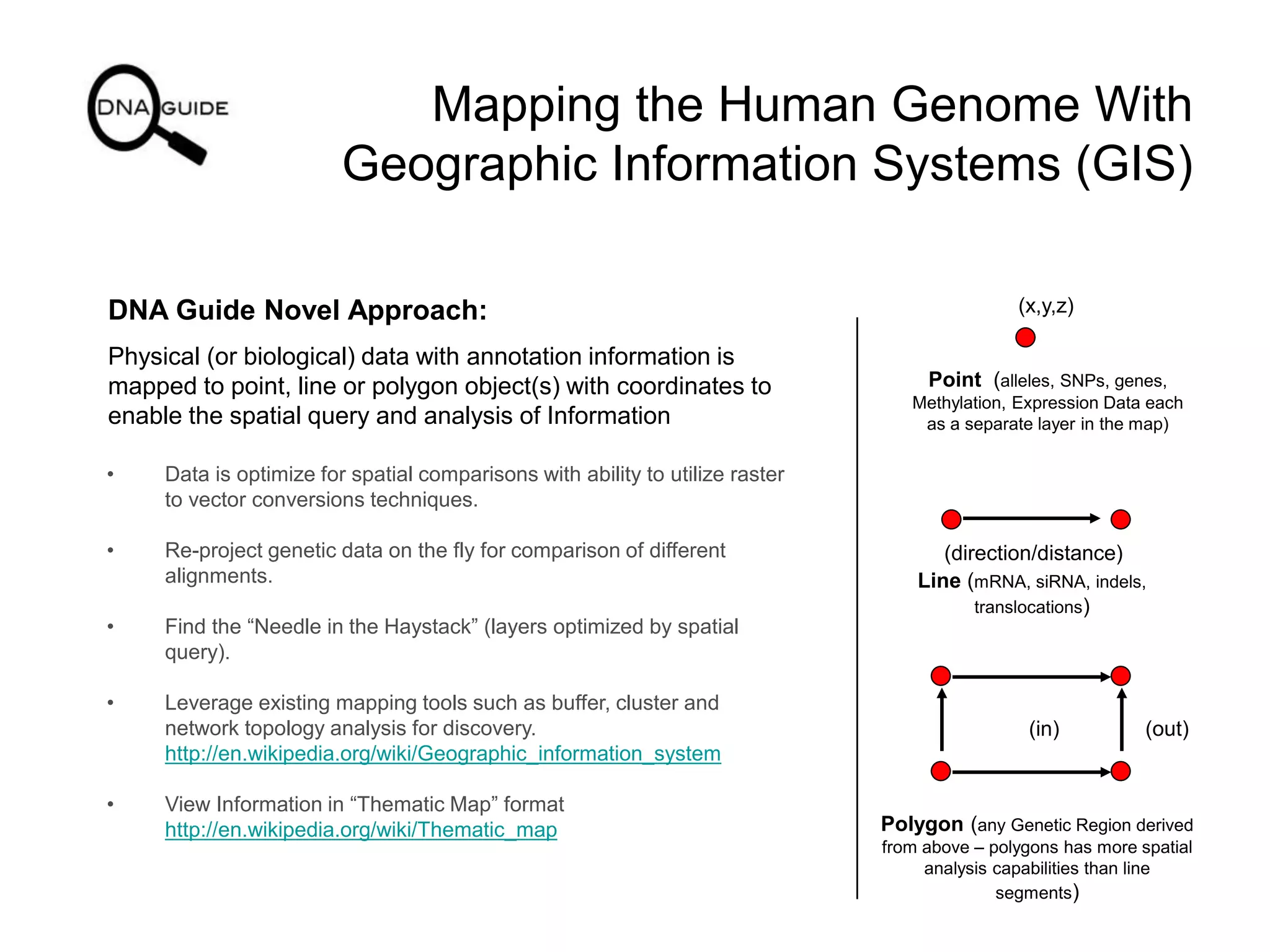
Mapping the Human Genome With Geographic Information Systems (GIS)DNA Guide Novel Approach: (x,y,z)Physical (or biological) data with annotation information ismapped to point, line or polygon object(s) with coordinates to Point (alleles, SNPs, genes, Methylation, Expression Data eachenable the spatial query and analysis of Information as a separate layer in the map)• Data is optimize for spatial comparisons with ability to utilize raster to vector conversions techniques.• Re-project genetic data on the fly for comparison of different (direction/distance) alignments. Line (mRNA, siRNA, indels, translocations)• Find the “Needle in the Haystack” (layers optimized by spatial query).• Leverage existing mapping tools such as buffer, cluster and network topology analysis for discovery. (in) (out) http://en.wikipedia.org/wiki/Geographic_information_system• View Information in “Thematic Map” format http://en.wikipedia.org/wiki/Thematic_map Polygon (any Genetic Region derived from above – polygons has more spatial analysis capabilities than line segments)
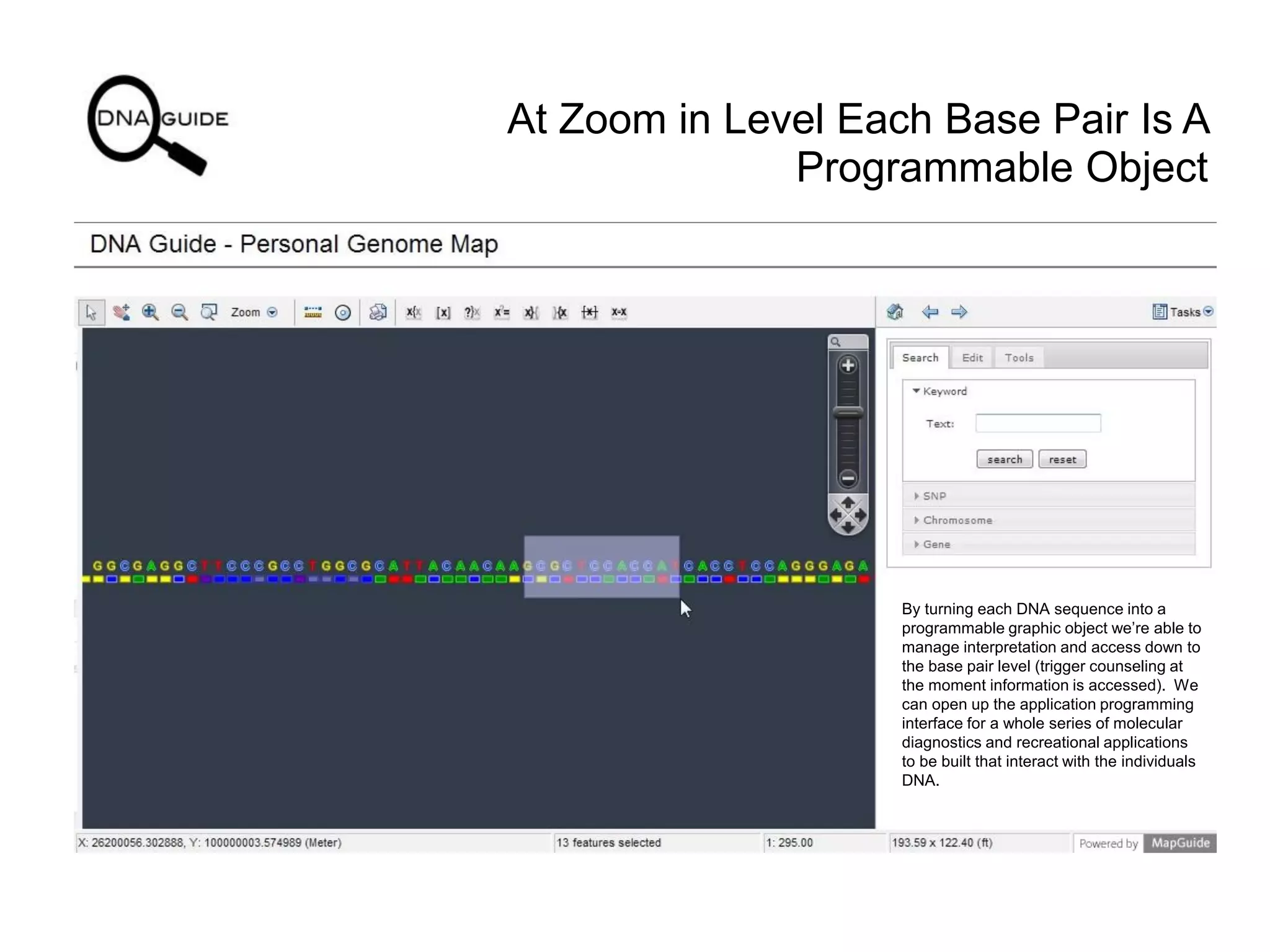
At Zoom in Level Each Base Pair Is A Programmable Object By turning each DNA sequence into a programmable graphic object we’re able to manage interpretation and access down to the base pair level (trigger counseling at the moment information is accessed). We can open up the application programming interface for a whole series of molecular diagnostics and recreational applications to be built that interact with the individuals DNA.
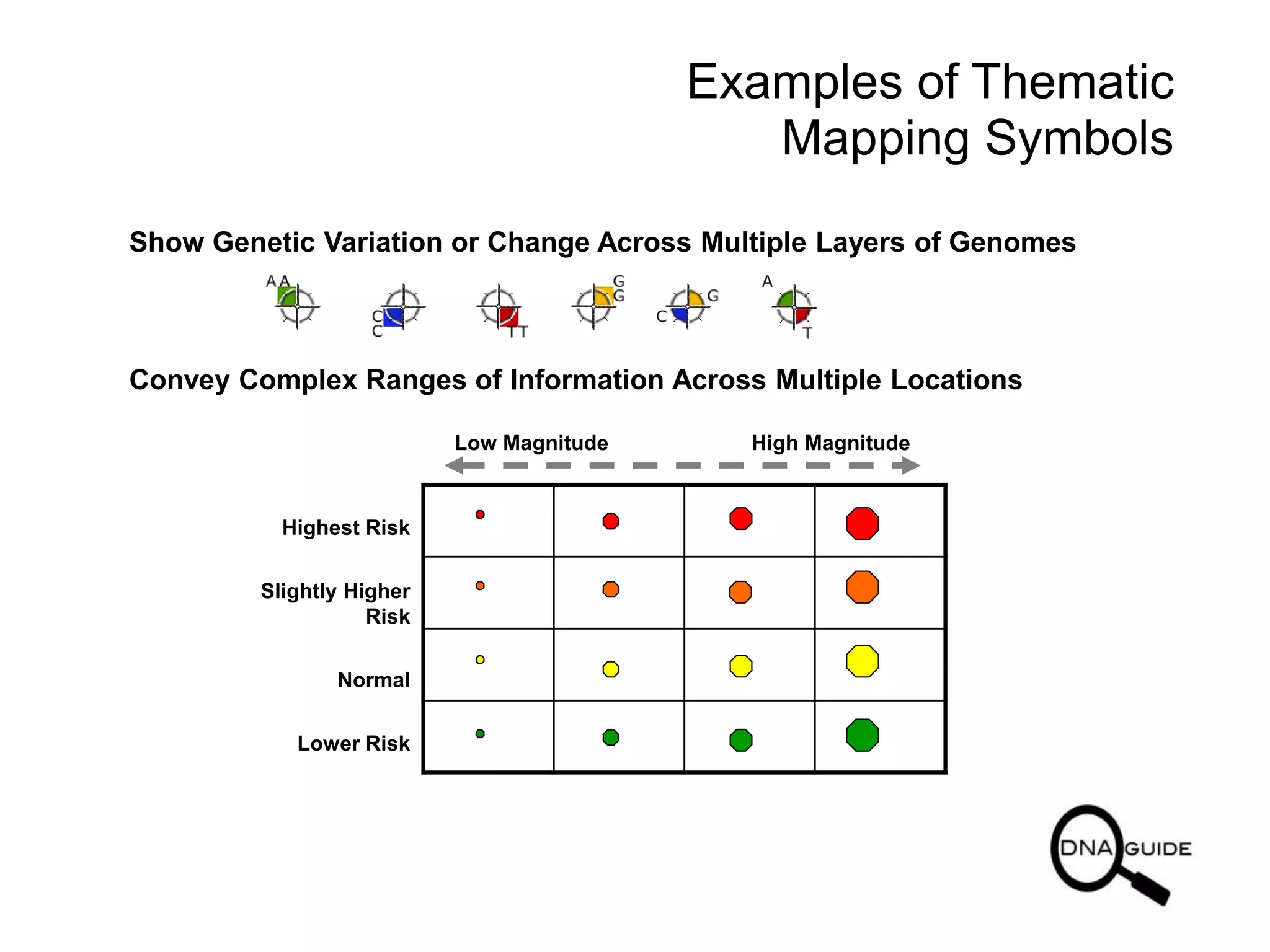
Examples of Thematic Mapping SymbolsShow Genetic Variation or Change Across Multiple Layers of GenomesConvey Complex Ranges of Information Across Multiple Locations Low Magnitude High Magnitude Highest Risk Slightly Higher Risk Normal Lower Risk
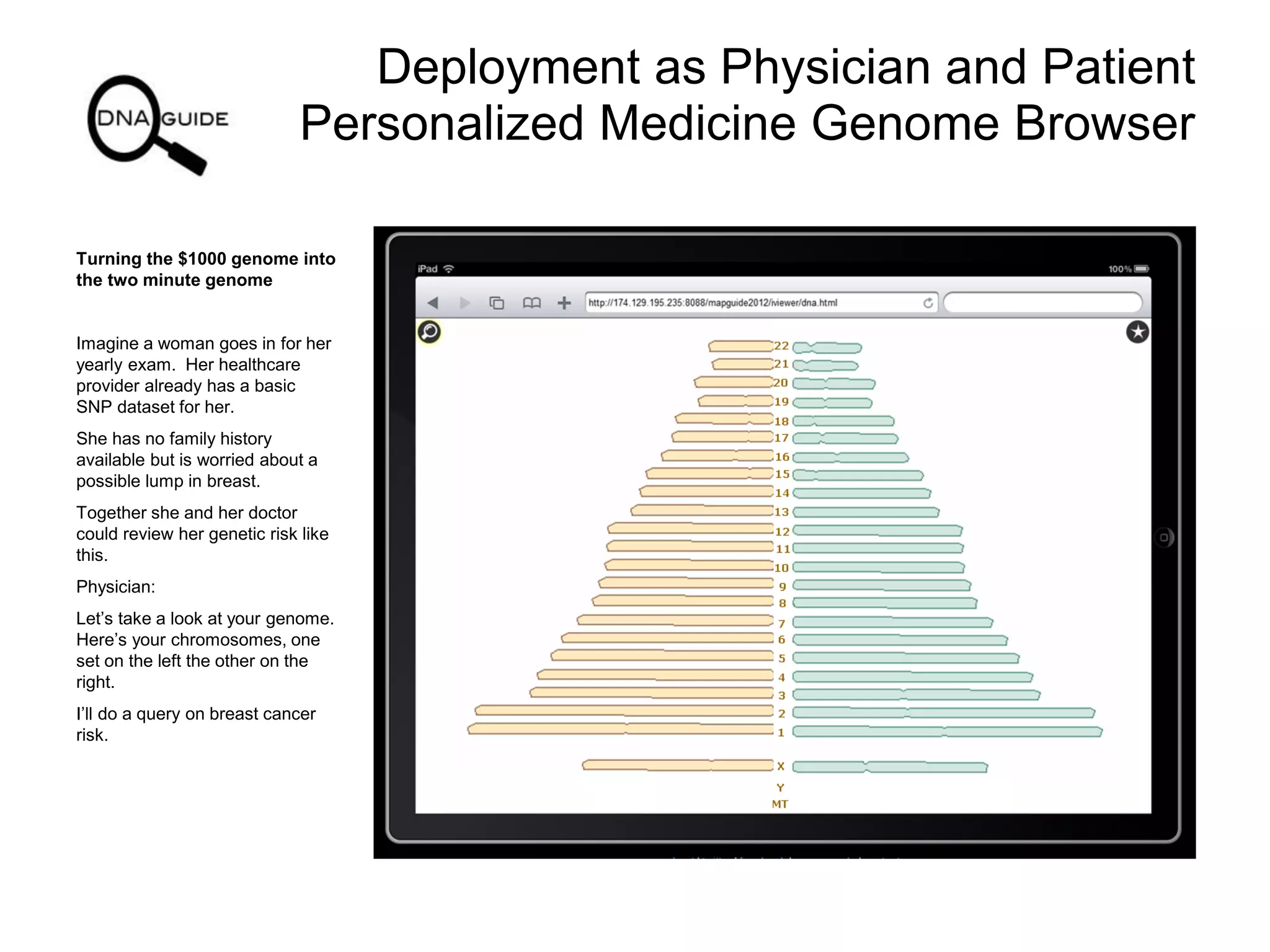
Deployment as Physician and Patient Personalized Medicine Genome BrowserTurning the $1000 genome intothe two minute genomeImagine a woman goes in for heryearly exam. Her healthcareprovider already has a basicSNP dataset for her.She has no family historyavailable but is worried about apossible lump in breast.Together she and her doctorcould review her genetic risk likethis.Physician:Let’s take a look at your genome.Here’s your chromosomes, oneset on the left the other on theright.I’ll do a query on breast cancerrisk.
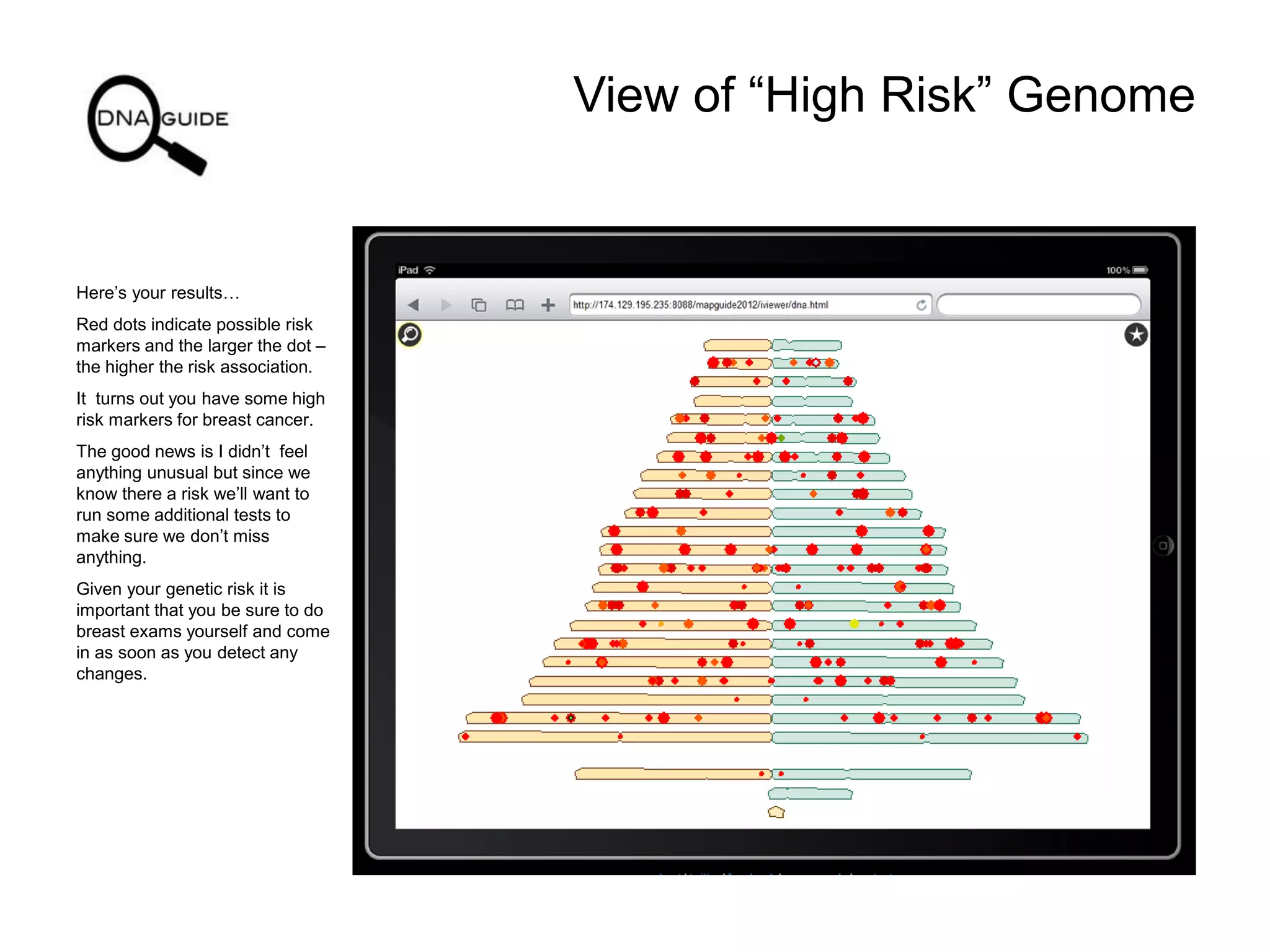
View of “High Risk” GenomeHere’s your results…Red dots indicate possible riskmarkers and the larger the dot –the higher the risk association.It turns out you have some highrisk markers for breast cancer.The good news is I didn’t feelanything unusual but since weknow there a risk we’ll want torun some additional tests tomake sure we don’t missanything.Given your genetic risk it isimportant that you be sure to dobreast exams yourself and comein as soon as you detect anychanges.
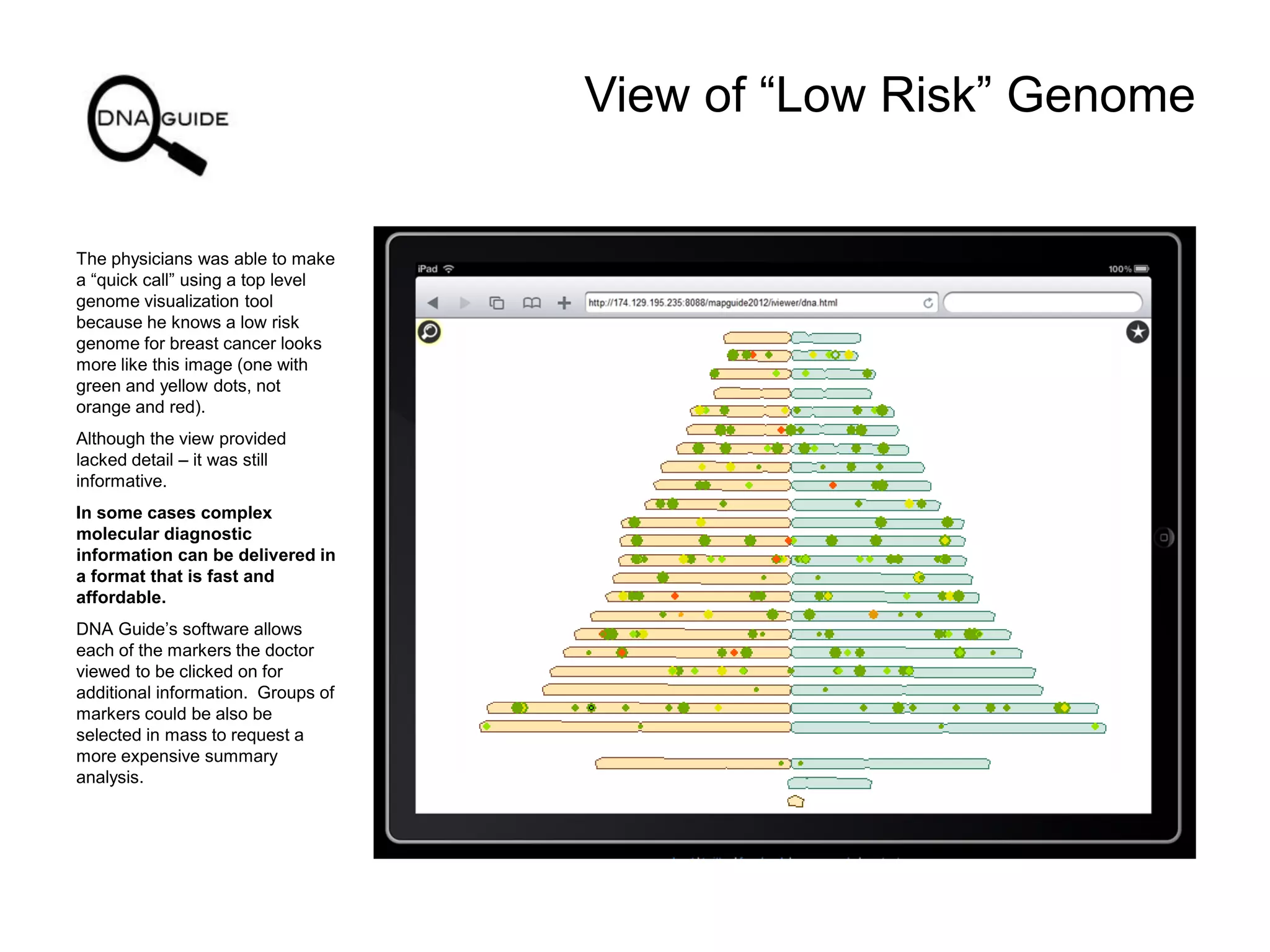
View of “Low Risk” GenomeThe physicians was able to makea “quick call” using a top levelgenome visualization toolbecause he knows a low riskgenome for breast cancer looksmore like this image (one withgreen and yellow dots, notorange and red).Although the view providedlacked detail – it was stillinformative.In some cases complexmolecular diagnosticinformation can be delivered ina format that is fast andaffordable.DNA Guide’s software allowseach of the markers the doctorviewed to be clicked on foradditional information. Groups ofmarkers could be also beselected in mass to request amore expensive summaryanalysis.
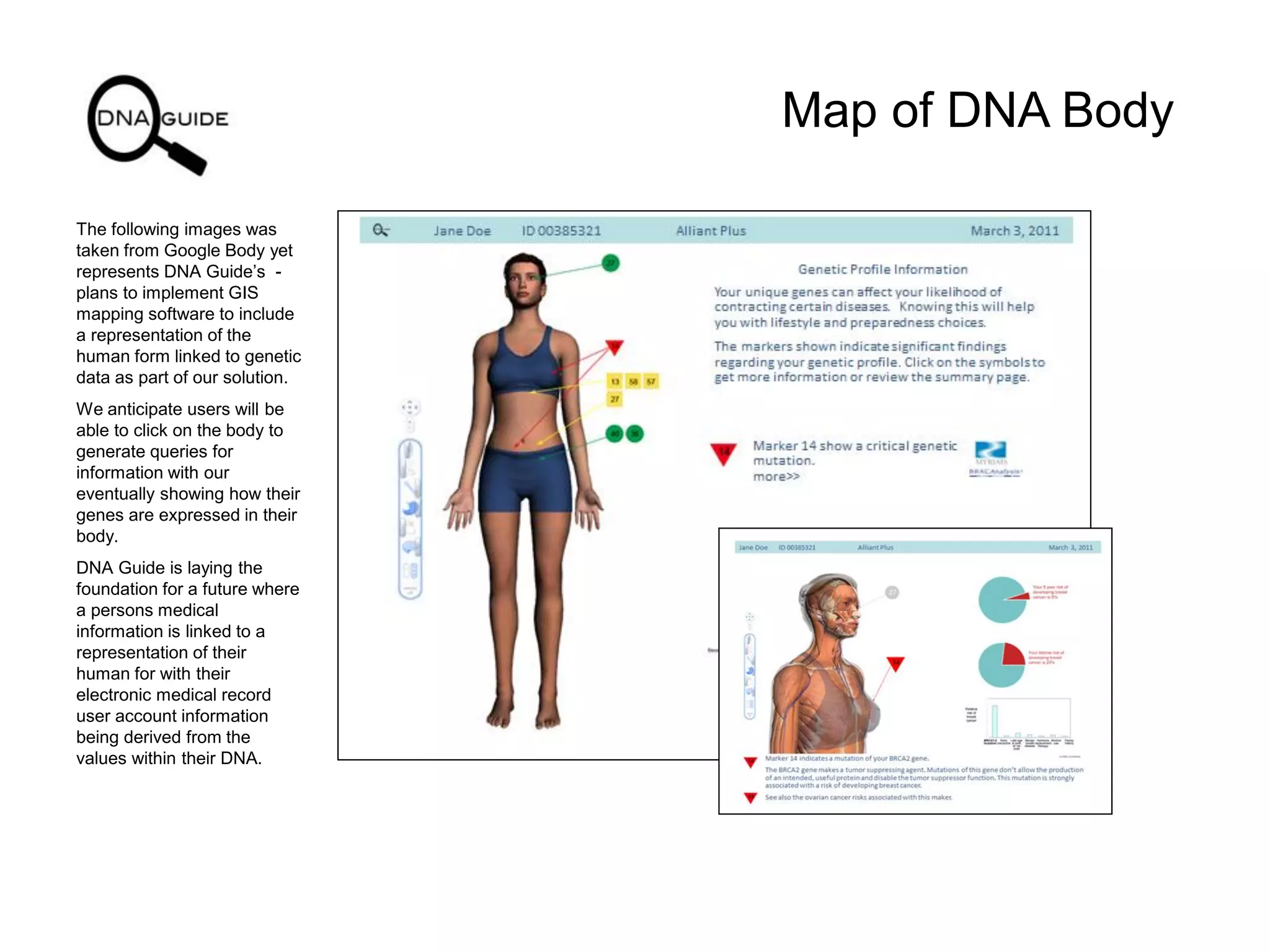
Map of DNA BodyThe following images wastaken from Google Body yetrepresents DNA Guide’splans to implement GISmapping software to includea representation of thehuman form linked to geneticdata as part of our solution.We anticipate users will beable to click on the body togenerate queries forinformation with oureventually showing how theirgenes are expressed in theirbody.DNA Guide is laying thefoundation for a future wherea persons medicalinformation is linked to arepresentation of theirhuman for with theirelectronic medical recorduser account informationbeing derived from thevalues within their DNA.
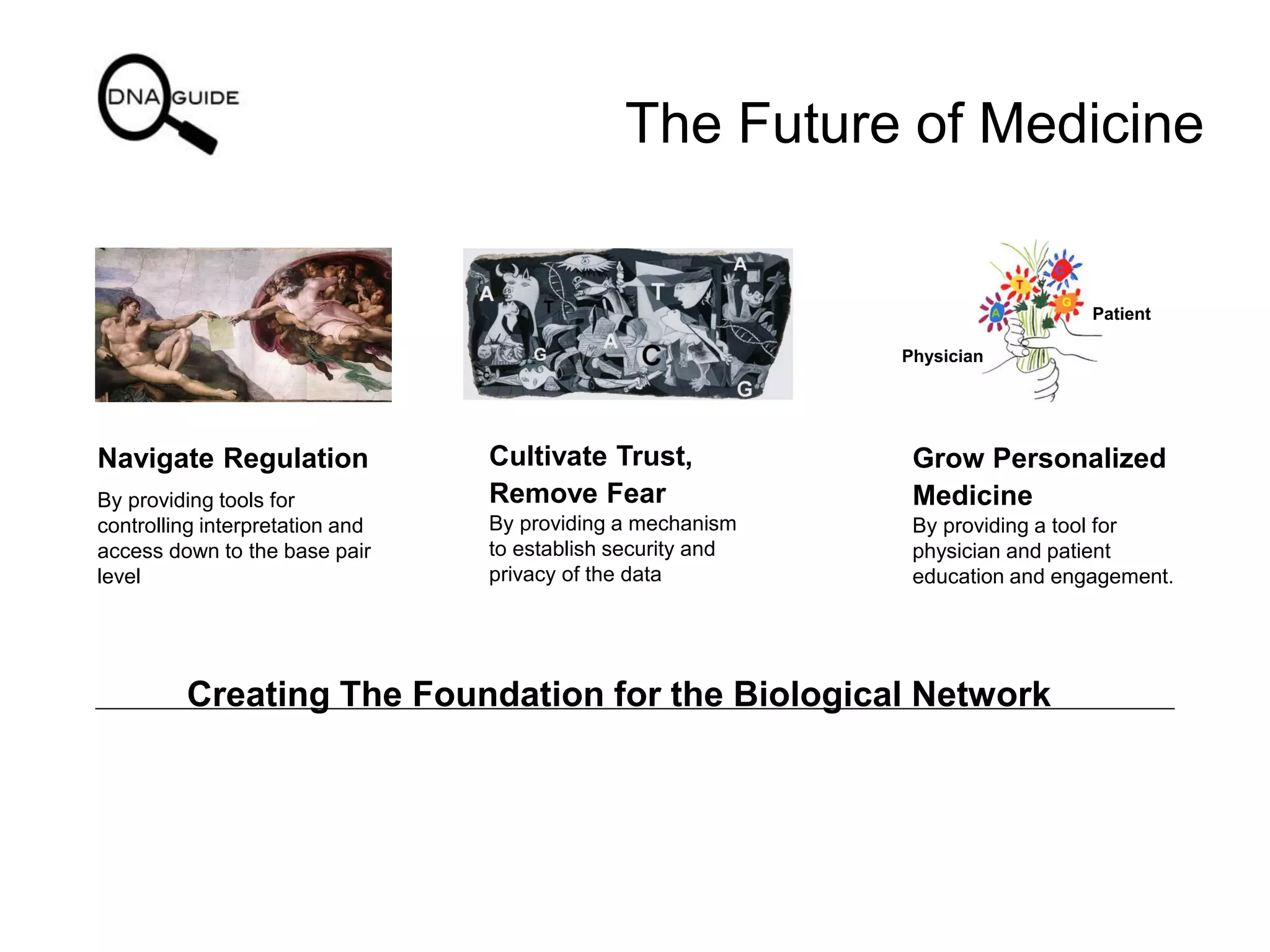
The Future of Medicine Patient PhysicianNavigate Regulation Cultivate Trust, Grow PersonalizedBy providing tools for Remove Fear Medicinecontrolling interpretation and By providing a mechanism By providing a tool foraccess down to the base pair to establish security and physician and patientlevel privacy of the data education and engagement. Creating The Foundation for the Biological Network
Contributors/TeamDNA Guide, Inc.Deborah Kessler, CEOAlice Rathjen, President, FounderWilliam Kimmerly, Ph.D. CSOXavier Thomas, Product DirectorSaw Yu Wai, Software ArchitectChris Kritzer, Software EngineerAdvisor: Mark S. Boguski, M.D., Ph.D.Center for Biomedical Informatics, Harvard Medical School DNA Guide, Inc. http://www.dnaguide.com 708 Gravenstein Hwy N. #103, Sebastopol, CA 95472 Primary Entry Contact: Alice Rathjen alice@dnaguide.com (707)322-4686 March 15, 2011
1–1 of 1 previous next