learningdisability(LD)referstoa groupofdisordersthat
affectabroad range of academicand functionalskills
includingtheabilityto
speak,
listen,
read,
write,
spell,
reasonand
organizeinformation
Types of Learning Disabilities
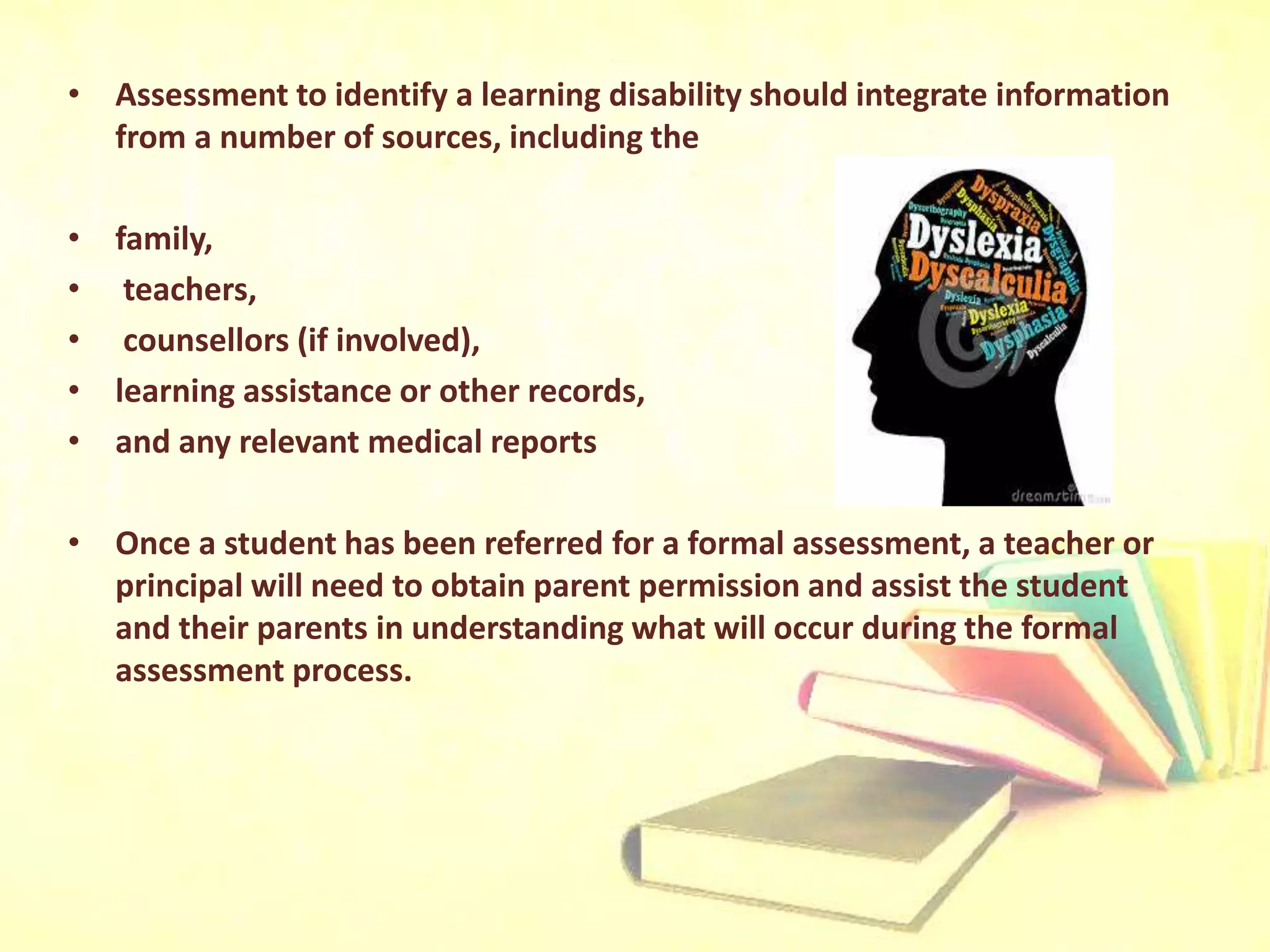
 Dyslexia
A language and reading disability
 Dyscalculia
Problems with arithmetic and math
concepts
 Dysgraphia
A writing disorder resulting in
illegibility
 Dyspraxia (Sensory Integration
Disorder)
Problems with motor coordination
 Central Auditory Processing
Disorder
Difficulty processing and
remembering language-related
tasks
 Non-Verbal Learning Disorders
Trouble with nonverbal cues, e.g.,
body language; poor coordination,
clumsy
 Visual Perceptual/Visual Motor
Deficit
Reverses letters; cannot copy
accurately;
 Language Disorders
(Aphasia/Dysphasia)
Trouble understanding spoken
language; poor reading
comprehension
Suspected Etiologies of Learning Disabilities
NO real causes
Might be caused by:
Hereditary
Teratogenic
Medical
Environmental
Types of assessment:
 Informal assessment
 Formal psycho educational assessment
Learning disabilities
Testing for learning disabilities usually involves three primary
types of assessment:
• Testing of intellectual or cognitive potential;
• Testing of information processing or sensory motor abilities
that are indicative of a learning disability;
• Assessment of current educational achievement.
INFORMAL ASSESMENT
• such as classroom assessments,
• systematic observation,
• file review and interviews
• These are as important as administering formal instruments to determine levels
of academic skill .
• For development and identity of strengths and weaknesses in learning
processes.
• Because it is so important to intervene as early as possible, teachers should not
wait for formal assessment to occur before they put strategies in place.
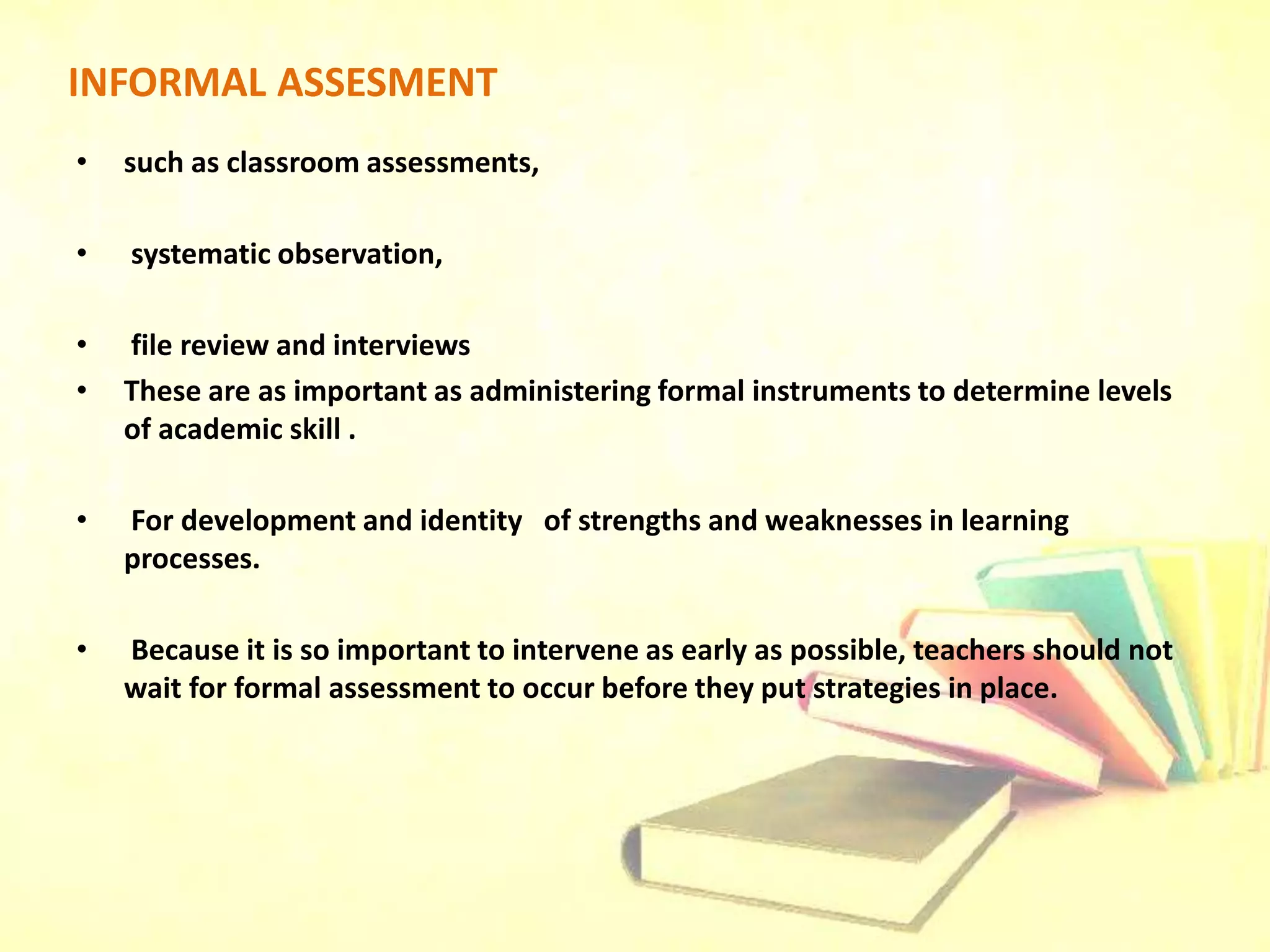
• Assessment to identify a learning disability should integrate information
from a number of sources, including the
• family,
• teachers,
• counsellors (if involved),
• learning assistance or other records,
• and any relevant medical reports
• Once a student has been referred for a formal assessment, a teacher or
principal will need to obtain parent permission and assist the student
and their parents in understanding what will occur during the formal
assessment process.
Formal assessment
• It is done by psychologists
• It involves the usage of different instruments(tools)
• psycho-educational assessments reveal difficulties in the areas of
• perceptual and information processing,
• language and auditory processing,
• attention and other areas of executive function,
• motor abilities and/or social skills as well as reading, written language,
or mathematics,
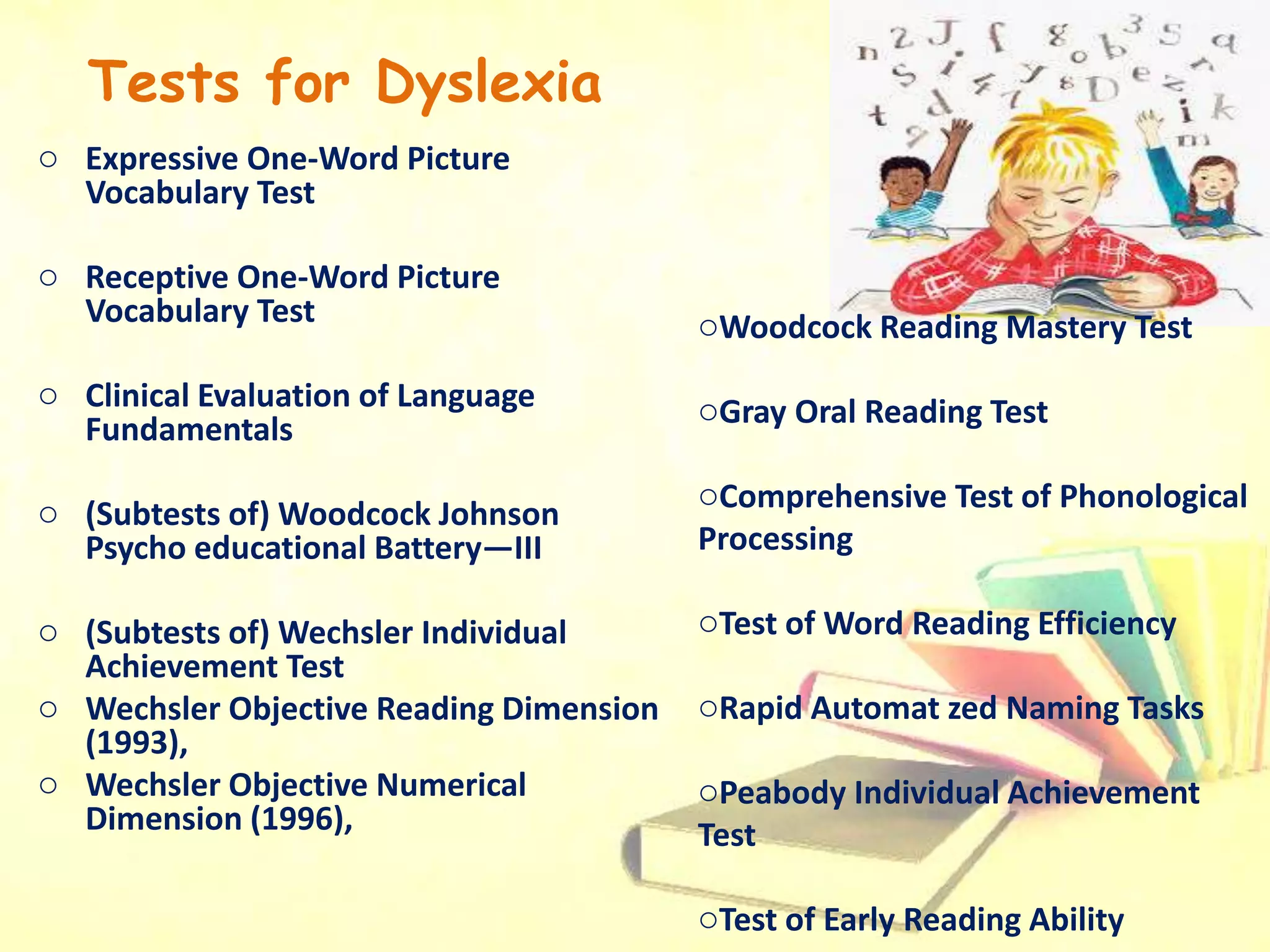
Tests for Dyslexia
o Expressive One-Word Picture
Vocabulary Test
o Receptive One-Word Picture
Vocabulary Test
o Clinical Evaluation of Language
Fundamentals
o (Subtests of) Woodcock Johnson
Psycho educational Battery—III
o (Subtests of) Wechsler Individual
Achievement Test
o Wechsler Objective Reading Dimension
(1993),
o Wechsler Objective Numerical
Dimension (1996),
oWoodcock Reading Mastery Test
oGray Oral Reading Test
oComprehensive Test of Phonological
Processing
oTest of Word Reading Efficiency
oRapid Automat zed Naming Tasks
oPeabody Individual Achievement
Test
oTest of Early Reading Ability
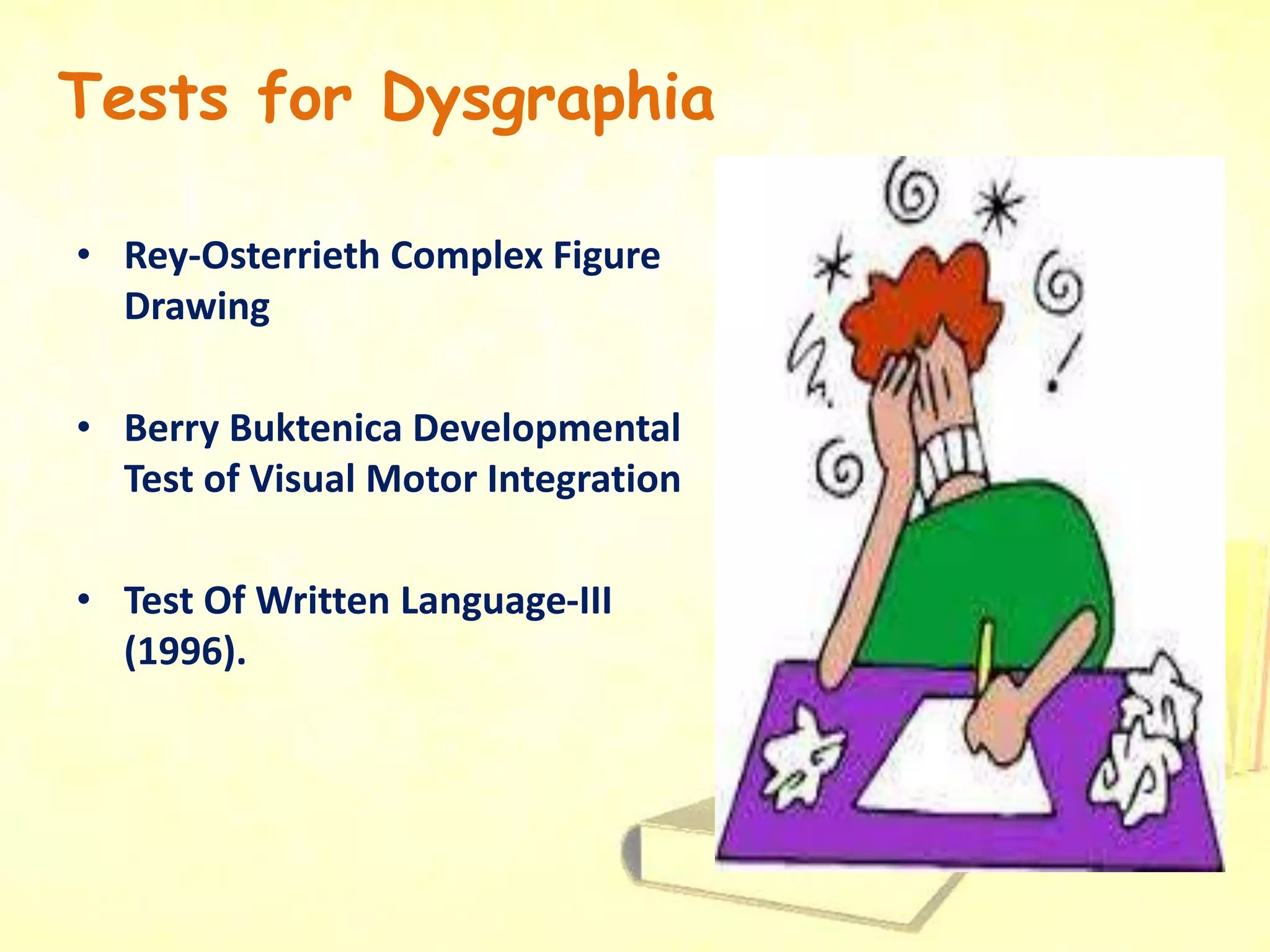
Tests for Dysgraphia
• Rey-Osterrieth Complex Figure
Drawing
• Berry Buktenica Developmental
Test of Visual Motor Integration
• Test Of Written Language-III
(1996).
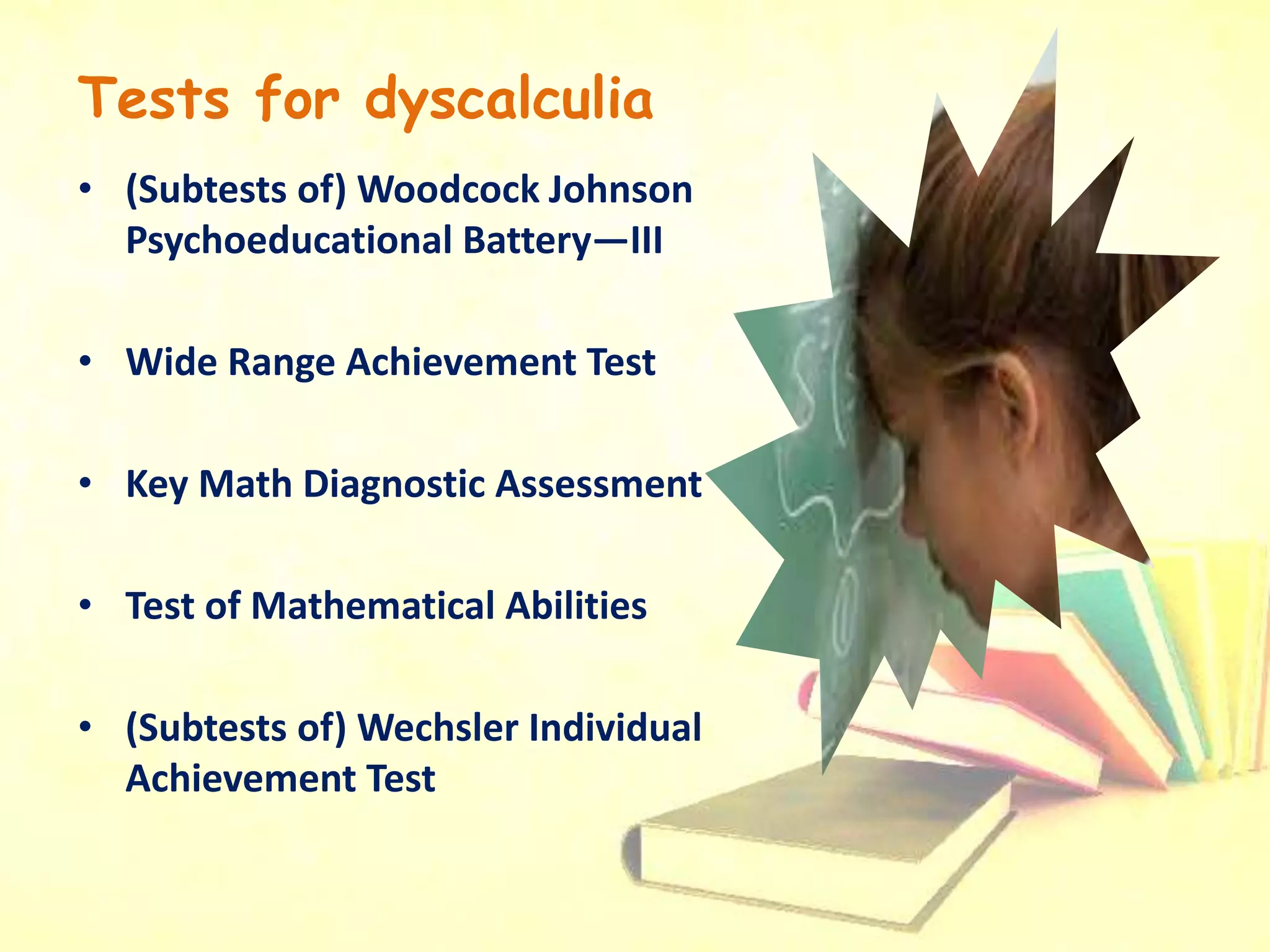
Tests for dyscalculia
• (Subtests of) Woodcock Johnson
Psychoeducational Battery—III
• Wide Range Achievement Test
• Key Math Diagnostic Assessment
• Test of Mathematical Abilities
• (Subtests of) Wechsler Individual
Achievement Test
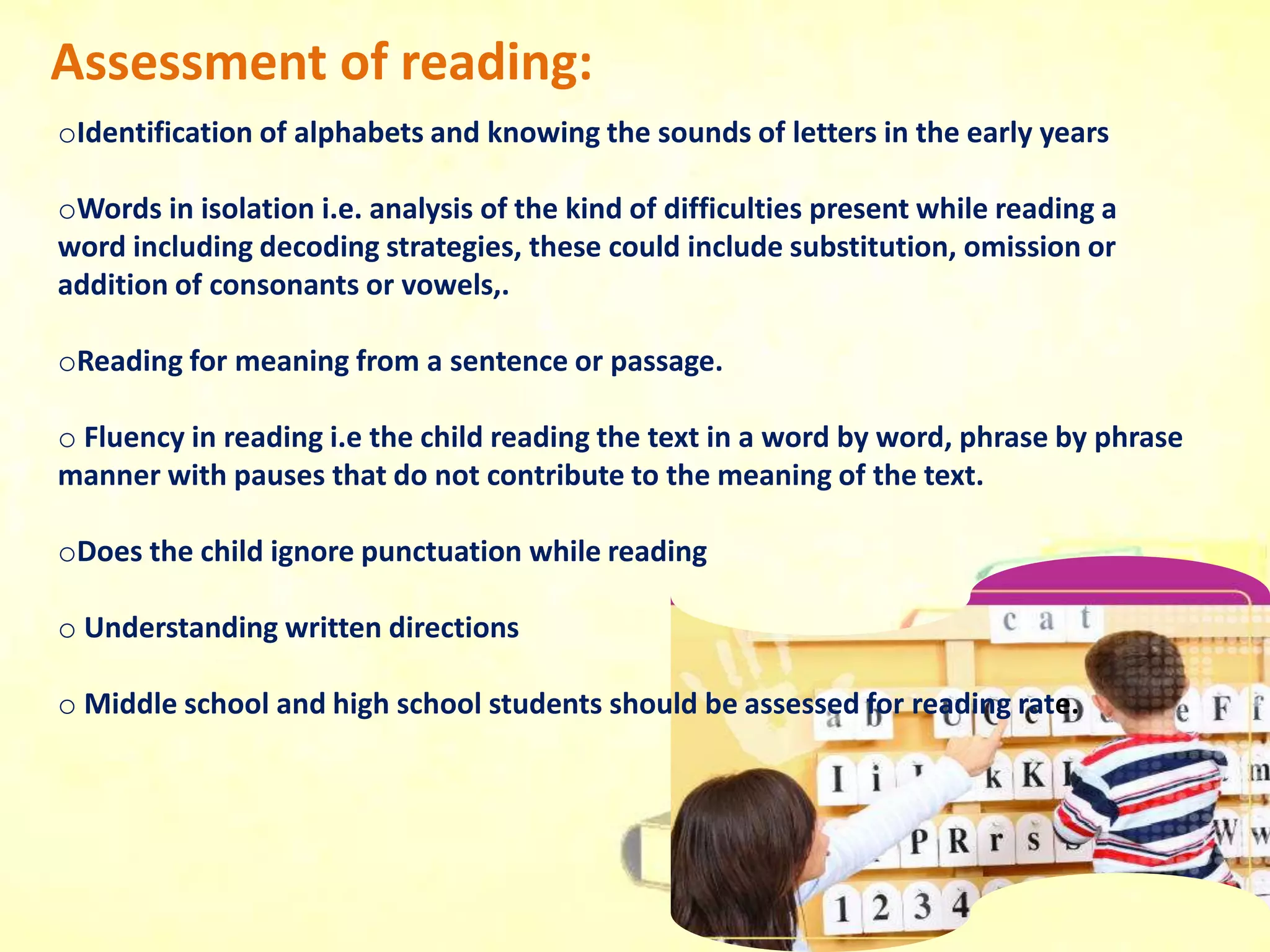
Assessment of reading:
oIdentification of alphabets and knowing the sounds of letters in the early years
oWords in isolation i.e. analysis of the kind of difficulties present while reading a
word including decoding strategies, these could include substitution, omission or
addition of consonants or vowels,.
oReading for meaning from a sentence or passage.
o Fluency in reading i.e the child reading the text in a word by word, phrase by phrase
manner with pauses that do not contribute to the meaning of the text.
oDoes the child ignore punctuation while reading
o Understanding written directions
o Middle school and high school students should be assessed for reading rate.
Assessment of writing
•Proper pencil grip
•Ability to retrieve alphabets representing sounds
•The formation and legibility of letters or numbers
•A mixture of print and cursive the appearance of upper case in the
middle of a word should also be noted.
•Spelling as part of comprehension or essay writing,
•Punctuation
•Use of vocabulary and synonyms in a piece of free writing,
•Ability to present ideas in an understandable sequence,
•Ability to plan and organize a written text for a particular audience or purpose
• Organization of writing and the mechanics of writing a paragraph or essay.
•Speed of writing
Assessment of mathematical skills
•The ability to recall basic math facts, procedures, rules, or formulas
•Ability to maintain precision during mathematical work
•Ability to sequence and carry out successfully multiple steps
•Understanding of the final goal of the math problem
•Ability to identify salient aspects of a mathematical situation, particularly in word
problems or other problem solving situations where some information is not relevant
•Ability to remember and understand the vocabulary and language of math
•Ability to know when irrelevant information is included or when information is given
out of sequence
•Ability to explain and communicate about math, including asking and answering
questions
•Ability to read texts to direct own learning
•Ability to remember assigned values or definitions in specific problems
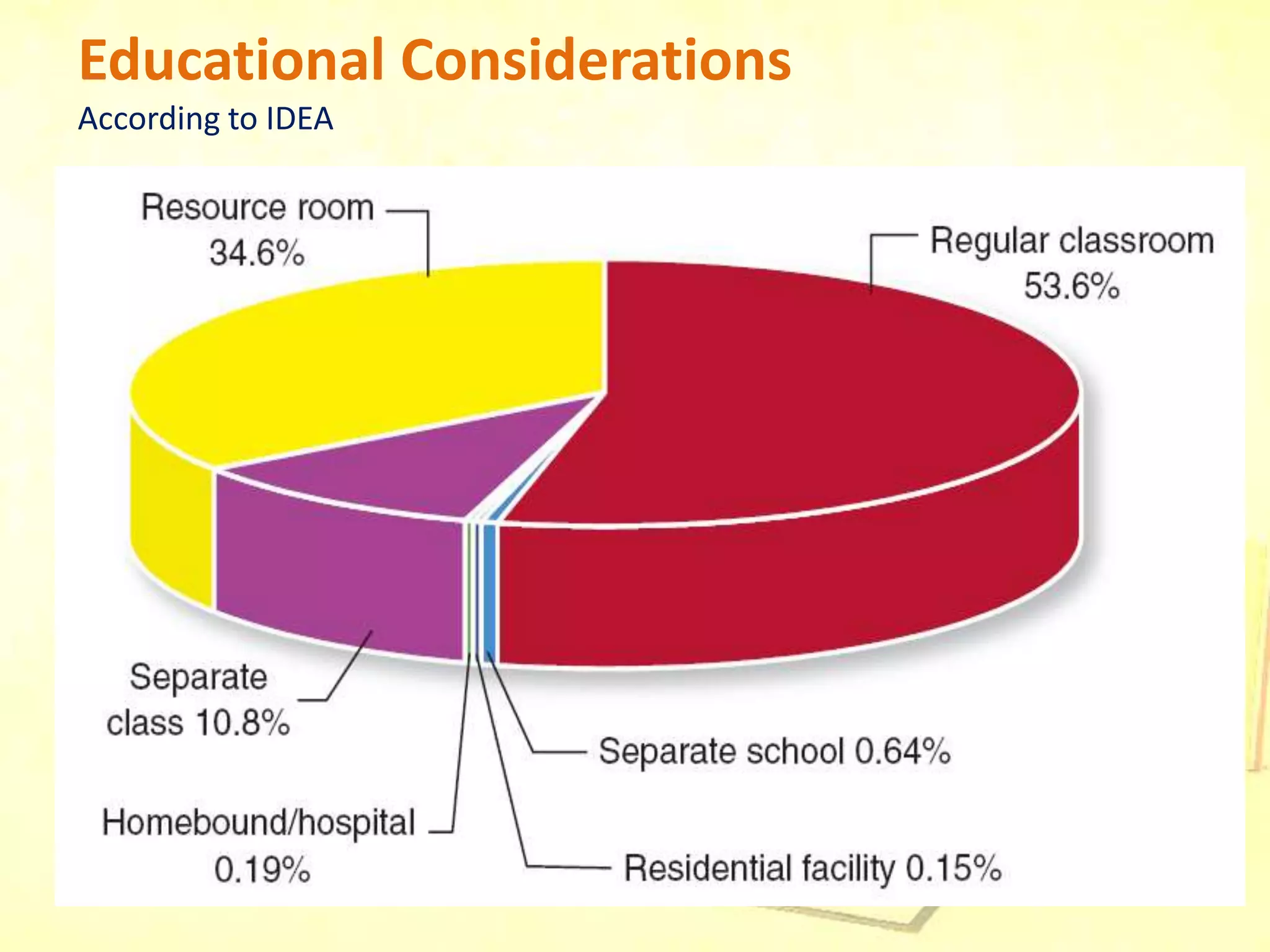
Educational Considerations
According to IDEA
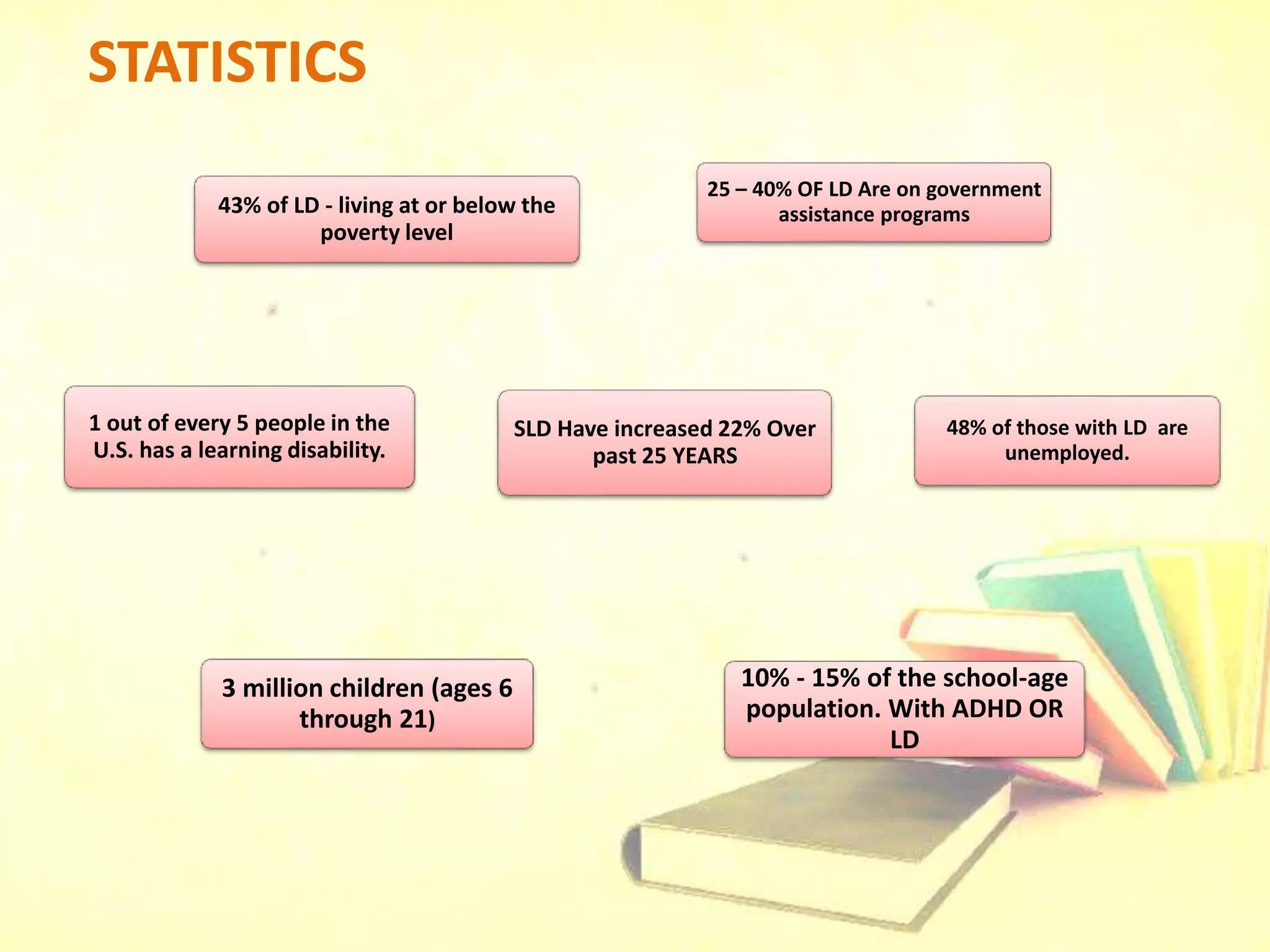
STATISTICS
43% of LD - living at or below the
poverty level
1 out of every 5 people in the
U.S. has a learning disability.
3 million children (ages 6
through 21)
10% - 15% of the school-age
population. With ADHD OR
LD
SLD Have increased 22% Over
past 25 YEARS
48% of those with LD are
unemployed.
25 – 40% OF LD Are on government
assistance programs
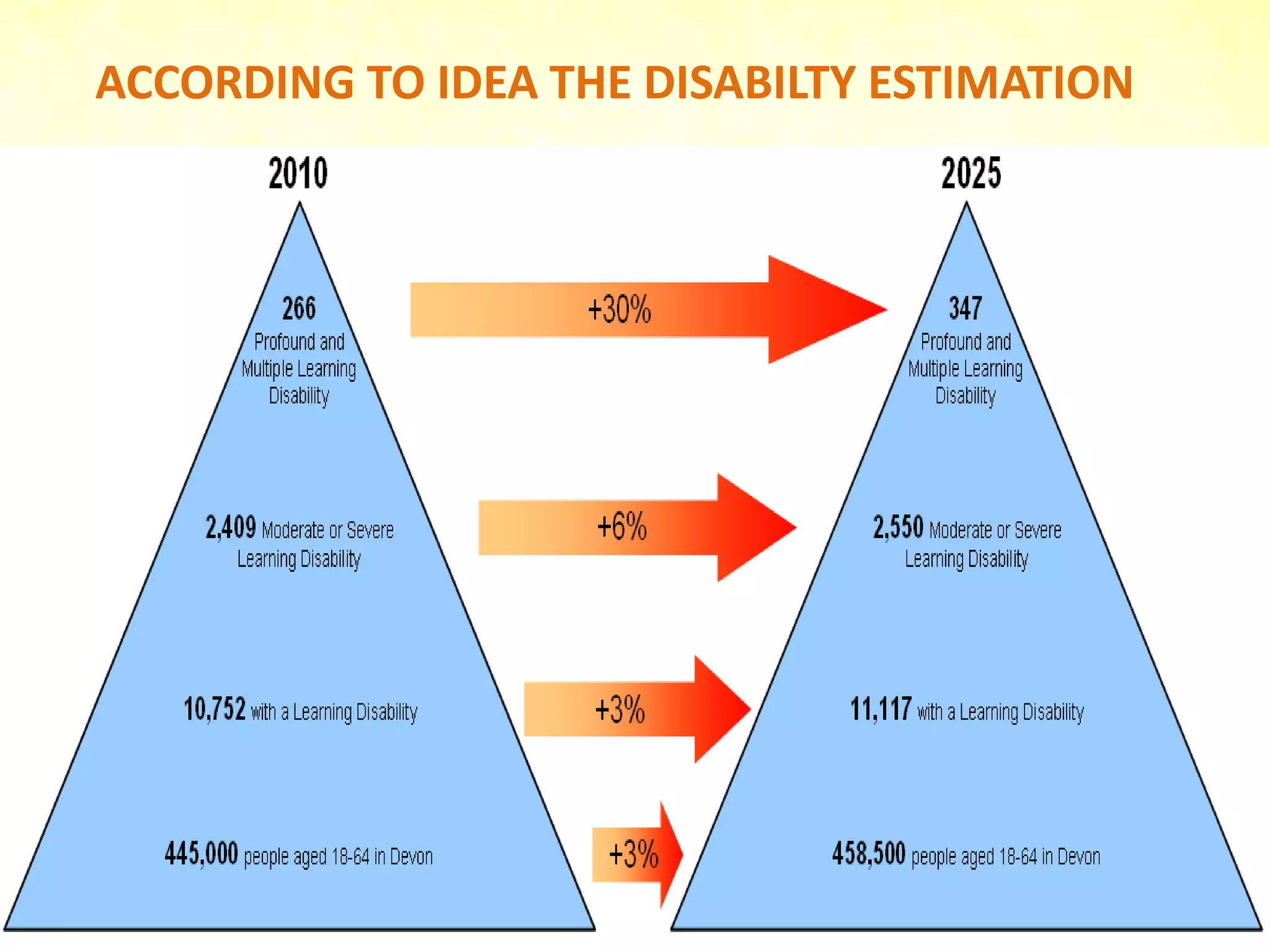
ACCORDING TO IDEA THE DISABILTY ESTIMATION
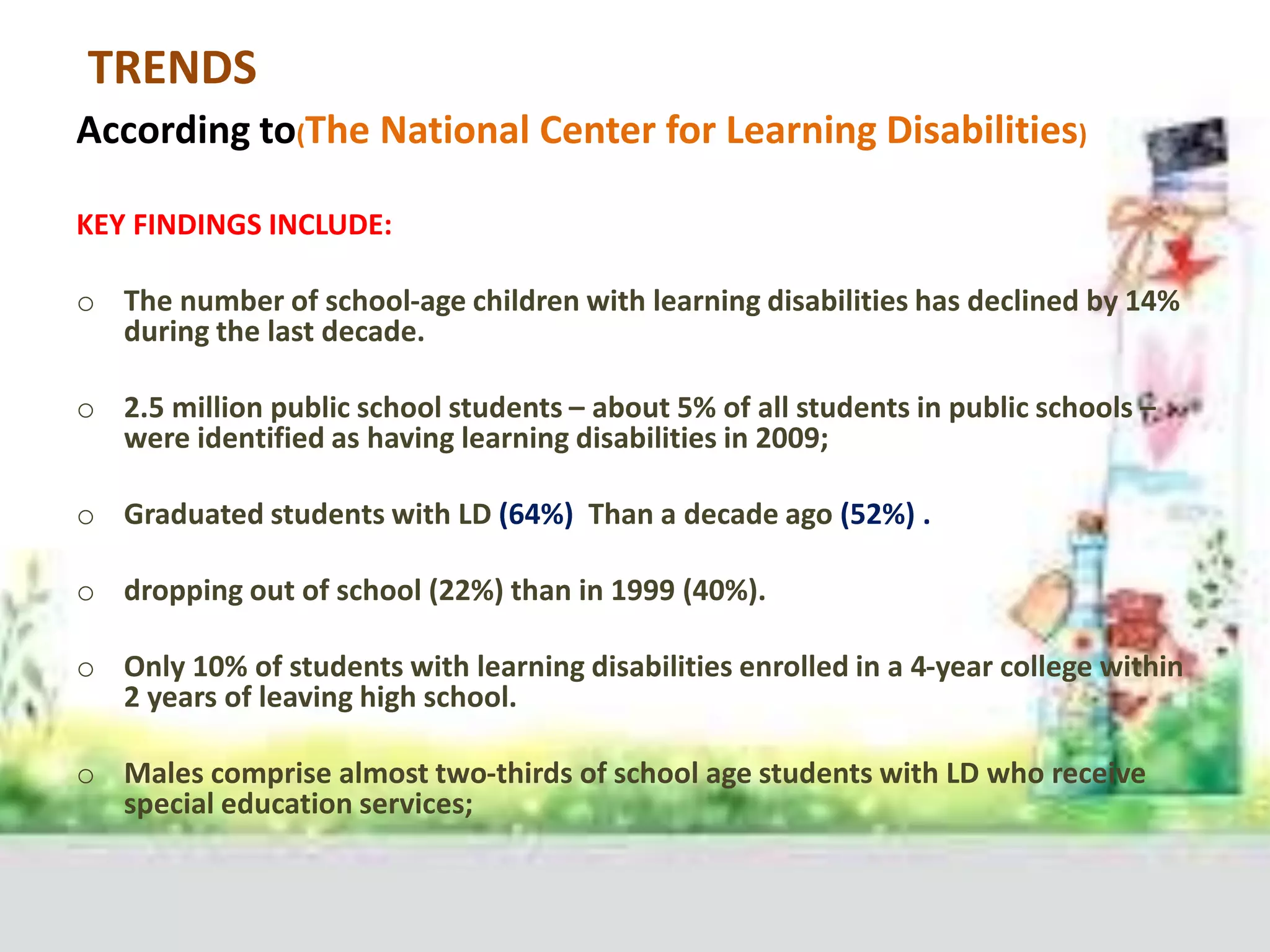
TRENDS
According to(The National Center for Learning Disabilities)
KEY FINDINGS INCLUDE:
o The number of school-age children with learning disabilities has declined by 14%
during the last decade.
o 2.5 million public school students – about 5% of all students in public schools –
were identified as having learning disabilities in 2009;
o Graduated students with LD (64%) Than a decade ago (52%) .
o dropping out of school (22%) than in 1999 (40%).
o Only 10% of students with learning disabilities enrolled in a 4-year college within
2 years of leaving high school.
o Males comprise almost two-thirds of school age students with LD who receive
special education services;
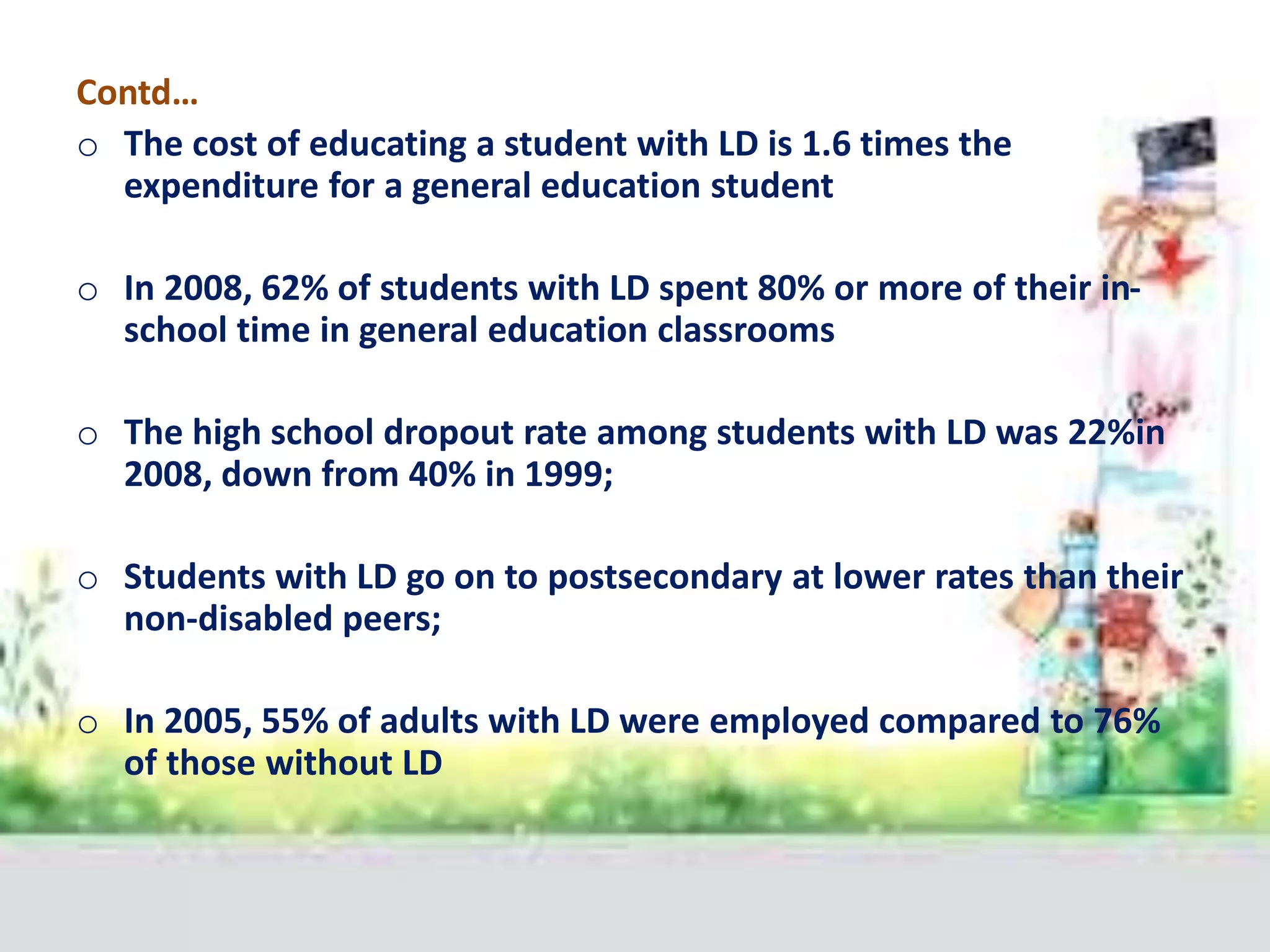
Contd…
o The cost of educating a student with LD is 1.6 times the
expenditure for a general education student
o In 2008, 62% of students with LD spent 80% or more of their in-
school time in general education classrooms
o The high school dropout rate among students with LD was 22%in
2008, down from 40% in 1999;
o Students with LD go on to postsecondary at lower rates than their
non-disabled peers;
o In 2005, 55% of adults with LD were employed compared to 76%
of those without LD
Facts of Learning Disabilities
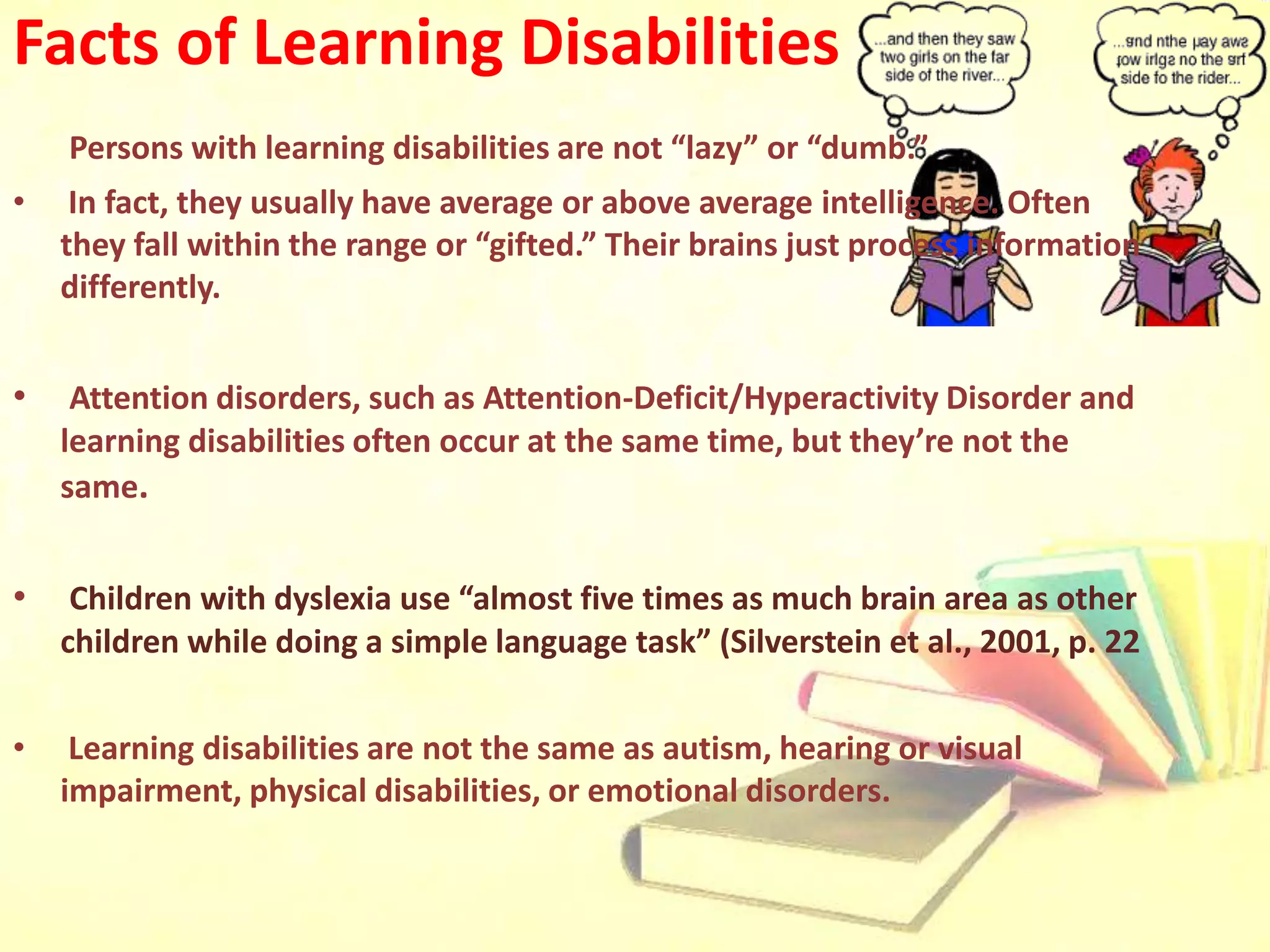
Persons with learning disabilities are not “lazy” or “dumb.”
• In fact, they usually have average or above average intelligence. Often
they fall within the range or “gifted.” Their brains just process information
differently.
• Attention disorders, such as Attention-Deficit/Hyperactivity Disorder and
learning disabilities often occur at the same time, but they’re not the
same.
• Children with dyslexia use “almost five times as much brain area as other
children while doing a simple language task” (Silverstein et al., 2001, p. 22
• Learning disabilities are not the same as autism, hearing or visual
impairment, physical disabilities, or emotional disorders.
contd….
• Learning disabilities aren’t caused by lack of educational opportunities,
such as frequent changes of schools, poor school attendance, or lack of
instruction in basic skills.
• A learning disability is not a disease, so there is no cure, but there are
ways to overcome the challenges it poses through identification and
accommodation.
• Because many people with dyslexia are right-brained thinkers, they may
be more artistic and creative, becoming poets, actors, inventors, and
artists.
• Dyslexia does not mean that the person sees words “backwards
EMOTIONAL ISSUES
 Students with learning disabilities may suffer from
emotional problems/depression, and/or low
self-esteem. This may cause students to withdraw
from social interaction.
 These same students may turn to drugs or alcohol for relief
from feelings of low self-worth.
 As many as 35% of students with learning disorders,
drop out of High School (Girod, 2001, p. 31).
 “Teenagers with dyslexia …[are] more likely to…think about
and to attempt suicide than other young people their age” (Landau, 2004,).
Technology and Individuals with Learning Disabilities
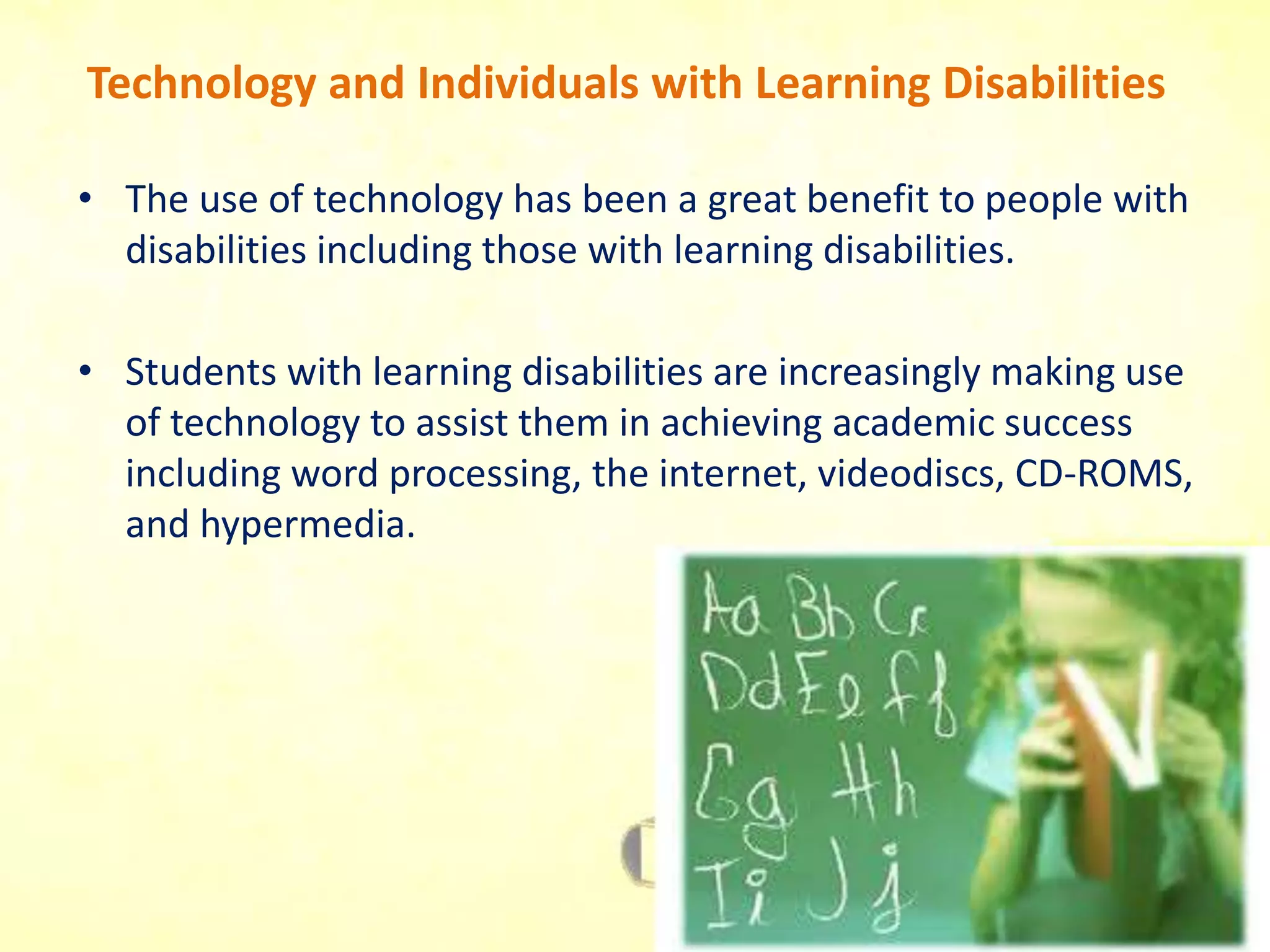
• The use of technology has been a great benefit to people with
disabilities including those with learning disabilities.
• Students with learning disabilities are increasingly making use
of technology to assist them in achieving academic success
including word processing, the internet, videodiscs, CD-ROMS,
and hypermedia.
TECHNOLOGY USED
COMPUTERS:
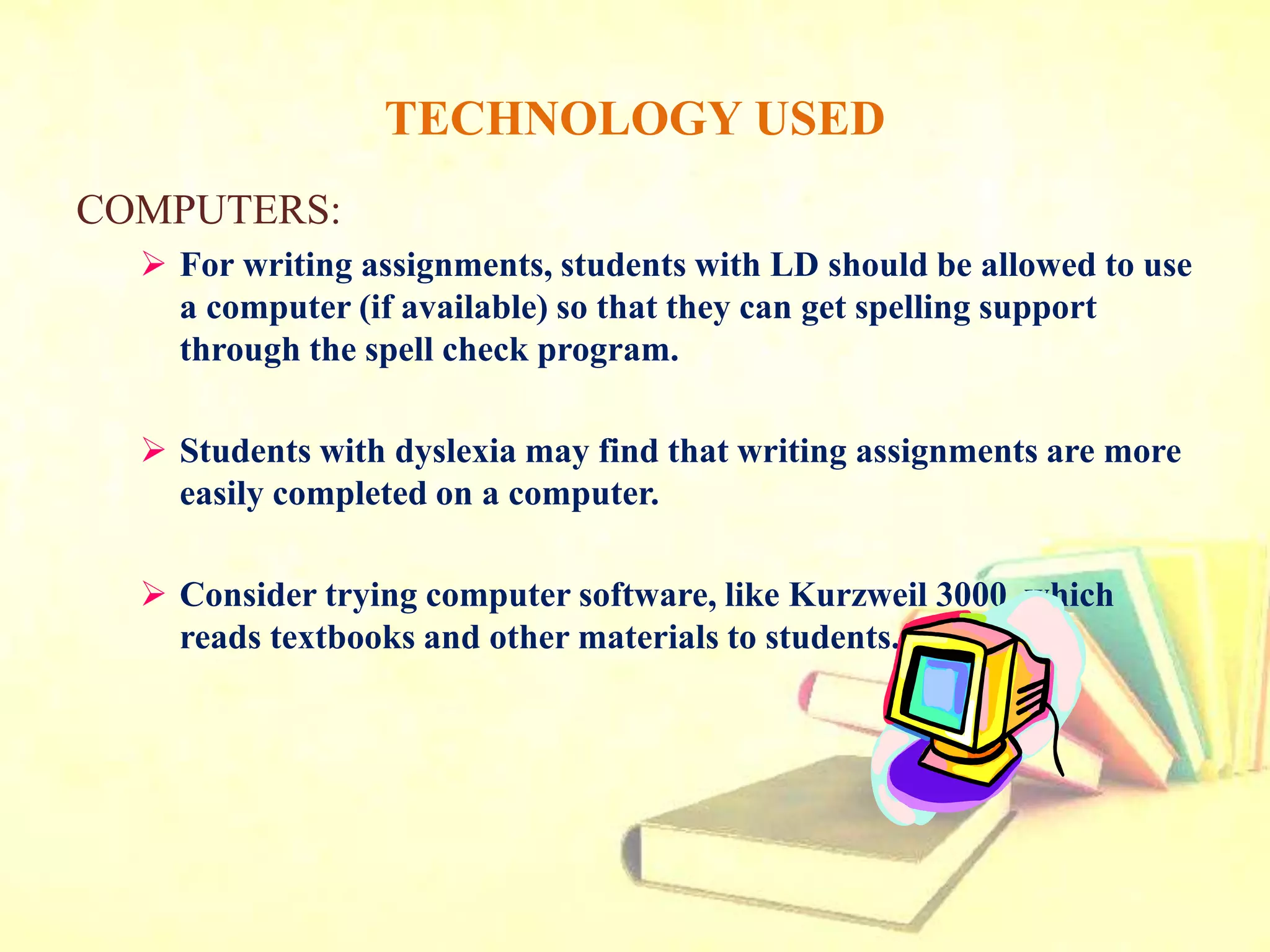
 For writing assignments, students with LD should be allowed to use
a computer (if available) so that they can get spelling support
through the spell check program.
 Students with dyslexia may find that writing assignments are more
easily completed on a computer.
 Consider trying computer software, like Kurzweil 3000, which
reads textbooks and other materials to students.
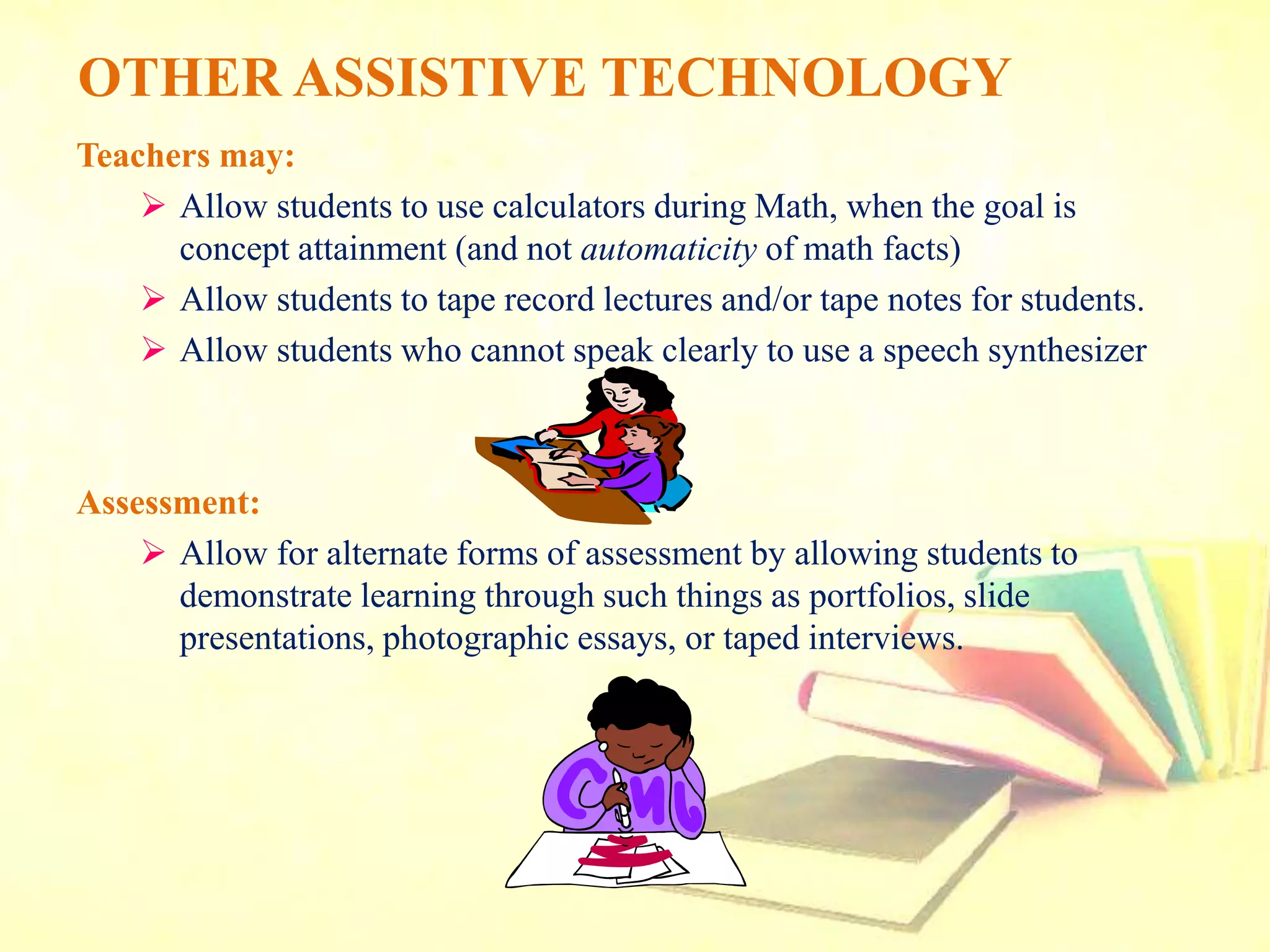
OTHER ASSISTIVE TECHNOLOGY
Teachers may:
 Allow students to use calculators during Math, when the goal is
concept attainment (and not automaticity of math facts)
 Allow students to tape record lectures and/or tape notes for students.
 Allow students who cannot speak clearly to use a speech synthesizer
Assessment:
 Allow for alternate forms of assessment by allowing students to
demonstrate learning through such things as portfolios, slide
presentations, photographic essays, or taped interviews.
LEGAL CONSIDERATIONS
• IDEA
• Section 504 of the Rehabilitation Act of 1973
• Americans with Disabilities Act
• Elementary and Secondary Education Act (ESEA)
Reauthorization
IDEA
• Provides free and appropriate public education in the
least restrictive environment
Individuals with Disabilities Education Act (IDEA)
Reauthorization
• A host of issues will be examined in the next IDEA
reauthorization process.
• Organizations representing the interests of the LD
population will need to be solidly united behind a set of
• principles and recommendations so as to show a face of
unquestionable unity to policymakers.
Section 508 and 504 - Rehabilitation Act of 1973
• No individual with disability should be denied or rejected from school
participation and from receiving programs
• Section 508- concentrates on accessibility of assistive technology to
learning disability children.
• A revised version of Section 508 was approved in August, 1998 which
makes strong recommendations for web accessibility
• Only covers federal agencies or state agencies that receive Tech Act
funding
Americans with Disabilities Act
The 2008 Americans with Disabilities Act Amendments Act made
significant changes to
Section 504, providing expanded coverage for students with
disabilities not in need of
specially designed instruction as well as those with serious health
conditions.
Widespread understanding of new rights and responsibilities by
both school officials
Elementary and Secondary Education Act (ESEA)
• Involve threats to students with disabilities. Most prevalent among these
is the perception that students receiving special education are
persistently low performing and should not be Expected to perform at
grade level.
• The accountability framework of No Child Left Behind (NCLB) – the
current version of ESEA –
• has provided substantial improvements for students w/ LD in terms of
access to the general
• curriculum at their enrolled grade level and accountability for proficiency
on state assessments.
• NCLD has led the way in documenting these advancements with
groundbreaking reports.
detailed presentation on learning disabilities

detailed presentation on learning disabilities

  • 2.
    learningdisability(LD)referstoa groupofdisordersthat affectabroad rangeof academicand functionalskills includingtheabilityto speak, listen, read, write, spell, reasonand organizeinformation
  • 3.
    Types of LearningDisabilities  Dyslexia A language and reading disability  Dyscalculia Problems with arithmetic and math concepts  Dysgraphia A writing disorder resulting in illegibility  Dyspraxia (Sensory Integration Disorder) Problems with motor coordination  Central Auditory Processing Disorder Difficulty processing and remembering language-related tasks  Non-Verbal Learning Disorders Trouble with nonverbal cues, e.g., body language; poor coordination, clumsy  Visual Perceptual/Visual Motor Deficit Reverses letters; cannot copy accurately;  Language Disorders (Aphasia/Dysphasia) Trouble understanding spoken language; poor reading comprehension
  • 4.
    Suspected Etiologies ofLearning Disabilities NO real causes Might be caused by: Hereditary Teratogenic Medical Environmental
  • 6.
    Types of assessment: Informal assessment  Formal psycho educational assessment Learning disabilities Testing for learning disabilities usually involves three primary types of assessment: • Testing of intellectual or cognitive potential; • Testing of information processing or sensory motor abilities that are indicative of a learning disability; • Assessment of current educational achievement.
  • 7.
    INFORMAL ASSESMENT • suchas classroom assessments, • systematic observation, • file review and interviews • These are as important as administering formal instruments to determine levels of academic skill . • For development and identity of strengths and weaknesses in learning processes. • Because it is so important to intervene as early as possible, teachers should not wait for formal assessment to occur before they put strategies in place.
  • 8.
    • Assessment toidentify a learning disability should integrate information from a number of sources, including the • family, • teachers, • counsellors (if involved), • learning assistance or other records, • and any relevant medical reports • Once a student has been referred for a formal assessment, a teacher or principal will need to obtain parent permission and assist the student and their parents in understanding what will occur during the formal assessment process.
  • 9.
    Formal assessment • Itis done by psychologists • It involves the usage of different instruments(tools) • psycho-educational assessments reveal difficulties in the areas of • perceptual and information processing, • language and auditory processing, • attention and other areas of executive function, • motor abilities and/or social skills as well as reading, written language, or mathematics,
  • 10.
    Tests for Dyslexia oExpressive One-Word Picture Vocabulary Test o Receptive One-Word Picture Vocabulary Test o Clinical Evaluation of Language Fundamentals o (Subtests of) Woodcock Johnson Psycho educational Battery—III o (Subtests of) Wechsler Individual Achievement Test o Wechsler Objective Reading Dimension (1993), o Wechsler Objective Numerical Dimension (1996), oWoodcock Reading Mastery Test oGray Oral Reading Test oComprehensive Test of Phonological Processing oTest of Word Reading Efficiency oRapid Automat zed Naming Tasks oPeabody Individual Achievement Test oTest of Early Reading Ability
  • 11.
    Tests for Dysgraphia •Rey-Osterrieth Complex Figure Drawing • Berry Buktenica Developmental Test of Visual Motor Integration • Test Of Written Language-III (1996).
  • 12.
    Tests for dyscalculia •(Subtests of) Woodcock Johnson Psychoeducational Battery—III • Wide Range Achievement Test • Key Math Diagnostic Assessment • Test of Mathematical Abilities • (Subtests of) Wechsler Individual Achievement Test
  • 13.
    Assessment of reading: oIdentificationof alphabets and knowing the sounds of letters in the early years oWords in isolation i.e. analysis of the kind of difficulties present while reading a word including decoding strategies, these could include substitution, omission or addition of consonants or vowels,. oReading for meaning from a sentence or passage. o Fluency in reading i.e the child reading the text in a word by word, phrase by phrase manner with pauses that do not contribute to the meaning of the text. oDoes the child ignore punctuation while reading o Understanding written directions o Middle school and high school students should be assessed for reading rate.
  • 14.
    Assessment of writing •Properpencil grip •Ability to retrieve alphabets representing sounds •The formation and legibility of letters or numbers •A mixture of print and cursive the appearance of upper case in the middle of a word should also be noted. •Spelling as part of comprehension or essay writing, •Punctuation •Use of vocabulary and synonyms in a piece of free writing, •Ability to present ideas in an understandable sequence, •Ability to plan and organize a written text for a particular audience or purpose • Organization of writing and the mechanics of writing a paragraph or essay. •Speed of writing
  • 15.
    Assessment of mathematicalskills •The ability to recall basic math facts, procedures, rules, or formulas •Ability to maintain precision during mathematical work •Ability to sequence and carry out successfully multiple steps •Understanding of the final goal of the math problem •Ability to identify salient aspects of a mathematical situation, particularly in word problems or other problem solving situations where some information is not relevant •Ability to remember and understand the vocabulary and language of math •Ability to know when irrelevant information is included or when information is given out of sequence •Ability to explain and communicate about math, including asking and answering questions •Ability to read texts to direct own learning •Ability to remember assigned values or definitions in specific problems
  • 16.
  • 17.
    STATISTICS 43% of LD- living at or below the poverty level 1 out of every 5 people in the U.S. has a learning disability. 3 million children (ages 6 through 21) 10% - 15% of the school-age population. With ADHD OR LD SLD Have increased 22% Over past 25 YEARS 48% of those with LD are unemployed. 25 – 40% OF LD Are on government assistance programs
  • 18.
    ACCORDING TO IDEATHE DISABILTY ESTIMATION
  • 19.
    TRENDS According to(The NationalCenter for Learning Disabilities) KEY FINDINGS INCLUDE: o The number of school-age children with learning disabilities has declined by 14% during the last decade. o 2.5 million public school students – about 5% of all students in public schools – were identified as having learning disabilities in 2009; o Graduated students with LD (64%) Than a decade ago (52%) . o dropping out of school (22%) than in 1999 (40%). o Only 10% of students with learning disabilities enrolled in a 4-year college within 2 years of leaving high school. o Males comprise almost two-thirds of school age students with LD who receive special education services;
  • 20.
    Contd… o The costof educating a student with LD is 1.6 times the expenditure for a general education student o In 2008, 62% of students with LD spent 80% or more of their in- school time in general education classrooms o The high school dropout rate among students with LD was 22%in 2008, down from 40% in 1999; o Students with LD go on to postsecondary at lower rates than their non-disabled peers; o In 2005, 55% of adults with LD were employed compared to 76% of those without LD
  • 21.
    Facts of LearningDisabilities Persons with learning disabilities are not “lazy” or “dumb.” • In fact, they usually have average or above average intelligence. Often they fall within the range or “gifted.” Their brains just process information differently. • Attention disorders, such as Attention-Deficit/Hyperactivity Disorder and learning disabilities often occur at the same time, but they’re not the same. • Children with dyslexia use “almost five times as much brain area as other children while doing a simple language task” (Silverstein et al., 2001, p. 22 • Learning disabilities are not the same as autism, hearing or visual impairment, physical disabilities, or emotional disorders.
  • 22.
    contd…. • Learning disabilitiesaren’t caused by lack of educational opportunities, such as frequent changes of schools, poor school attendance, or lack of instruction in basic skills. • A learning disability is not a disease, so there is no cure, but there are ways to overcome the challenges it poses through identification and accommodation. • Because many people with dyslexia are right-brained thinkers, they may be more artistic and creative, becoming poets, actors, inventors, and artists. • Dyslexia does not mean that the person sees words “backwards
  • 23.
    EMOTIONAL ISSUES  Studentswith learning disabilities may suffer from emotional problems/depression, and/or low self-esteem. This may cause students to withdraw from social interaction.  These same students may turn to drugs or alcohol for relief from feelings of low self-worth.  As many as 35% of students with learning disorders, drop out of High School (Girod, 2001, p. 31).  “Teenagers with dyslexia …[are] more likely to…think about and to attempt suicide than other young people their age” (Landau, 2004,).
  • 24.
    Technology and Individualswith Learning Disabilities • The use of technology has been a great benefit to people with disabilities including those with learning disabilities. • Students with learning disabilities are increasingly making use of technology to assist them in achieving academic success including word processing, the internet, videodiscs, CD-ROMS, and hypermedia.
  • 25.
    TECHNOLOGY USED COMPUTERS:  Forwriting assignments, students with LD should be allowed to use a computer (if available) so that they can get spelling support through the spell check program.  Students with dyslexia may find that writing assignments are more easily completed on a computer.  Consider trying computer software, like Kurzweil 3000, which reads textbooks and other materials to students.
  • 26.
    OTHER ASSISTIVE TECHNOLOGY Teachersmay:  Allow students to use calculators during Math, when the goal is concept attainment (and not automaticity of math facts)  Allow students to tape record lectures and/or tape notes for students.  Allow students who cannot speak clearly to use a speech synthesizer Assessment:  Allow for alternate forms of assessment by allowing students to demonstrate learning through such things as portfolios, slide presentations, photographic essays, or taped interviews.
  • 27.
    LEGAL CONSIDERATIONS • IDEA •Section 504 of the Rehabilitation Act of 1973 • Americans with Disabilities Act • Elementary and Secondary Education Act (ESEA) Reauthorization
  • 28.
    IDEA • Provides freeand appropriate public education in the least restrictive environment Individuals with Disabilities Education Act (IDEA) Reauthorization • A host of issues will be examined in the next IDEA reauthorization process. • Organizations representing the interests of the LD population will need to be solidly united behind a set of • principles and recommendations so as to show a face of unquestionable unity to policymakers.
  • 29.
    Section 508 and504 - Rehabilitation Act of 1973 • No individual with disability should be denied or rejected from school participation and from receiving programs • Section 508- concentrates on accessibility of assistive technology to learning disability children. • A revised version of Section 508 was approved in August, 1998 which makes strong recommendations for web accessibility • Only covers federal agencies or state agencies that receive Tech Act funding
  • 30.
    Americans with DisabilitiesAct The 2008 Americans with Disabilities Act Amendments Act made significant changes to Section 504, providing expanded coverage for students with disabilities not in need of specially designed instruction as well as those with serious health conditions. Widespread understanding of new rights and responsibilities by both school officials
  • 31.
    Elementary and SecondaryEducation Act (ESEA) • Involve threats to students with disabilities. Most prevalent among these is the perception that students receiving special education are persistently low performing and should not be Expected to perform at grade level. • The accountability framework of No Child Left Behind (NCLB) – the current version of ESEA – • has provided substantial improvements for students w/ LD in terms of access to the general • curriculum at their enrolled grade level and accountability for proficiency on state assessments. • NCLD has led the way in documenting these advancements with groundbreaking reports.