The document provides recommendations for establishing a Business Development Group (BDG) within an organization to better coordinate efforts in developing new business opportunities. It discusses restructuring the organization to separate short-term sales from long-term strategic development. The BDG would focus on opportunities with a 2-3 year horizon, leveraging cross-functional virtual teams to improve information sharing and decision-making.
Best Practices in Business Development presented by David Fatlowitz July 2009
2.
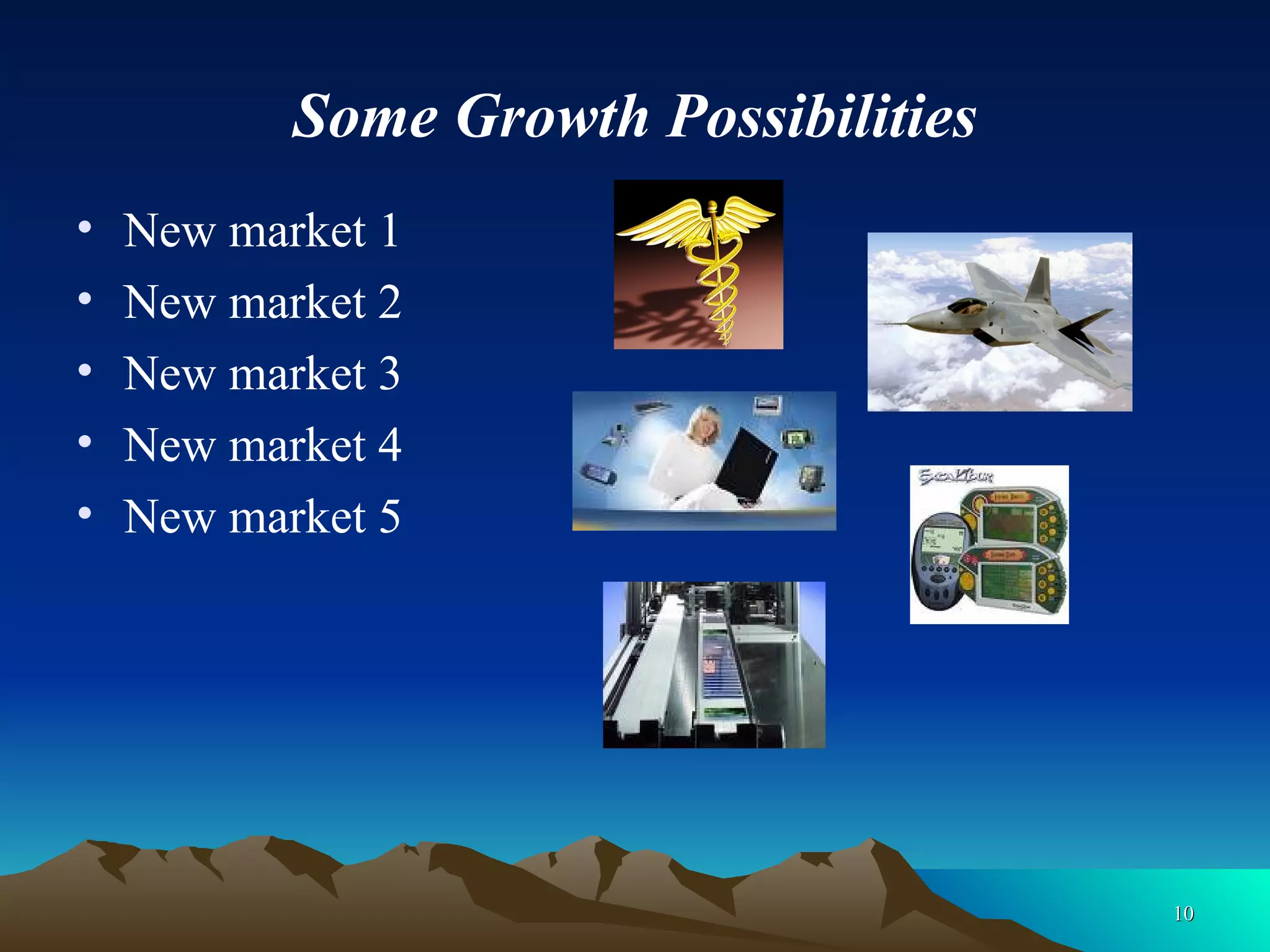
Topics Today’s typicalcorporate structure Forecast vs stretch goal (gap analysis) 2009 to 2011 forecasts & plan for reaching goals Innovation plan for entering new markets Some worthwhile targets BDG concept Recommendations & best practices
3.
Preface Today’s globalizedbusiness environment moves with ever increasing speed, and entails many new risks. To succeed at growing into new markets requires strong co-ordination, tireless communications and exceptional risk management… The following slides integrate commentary from numerous business executives and academic thought leaders and represents a working guideline for best practices in developing new business…
4.
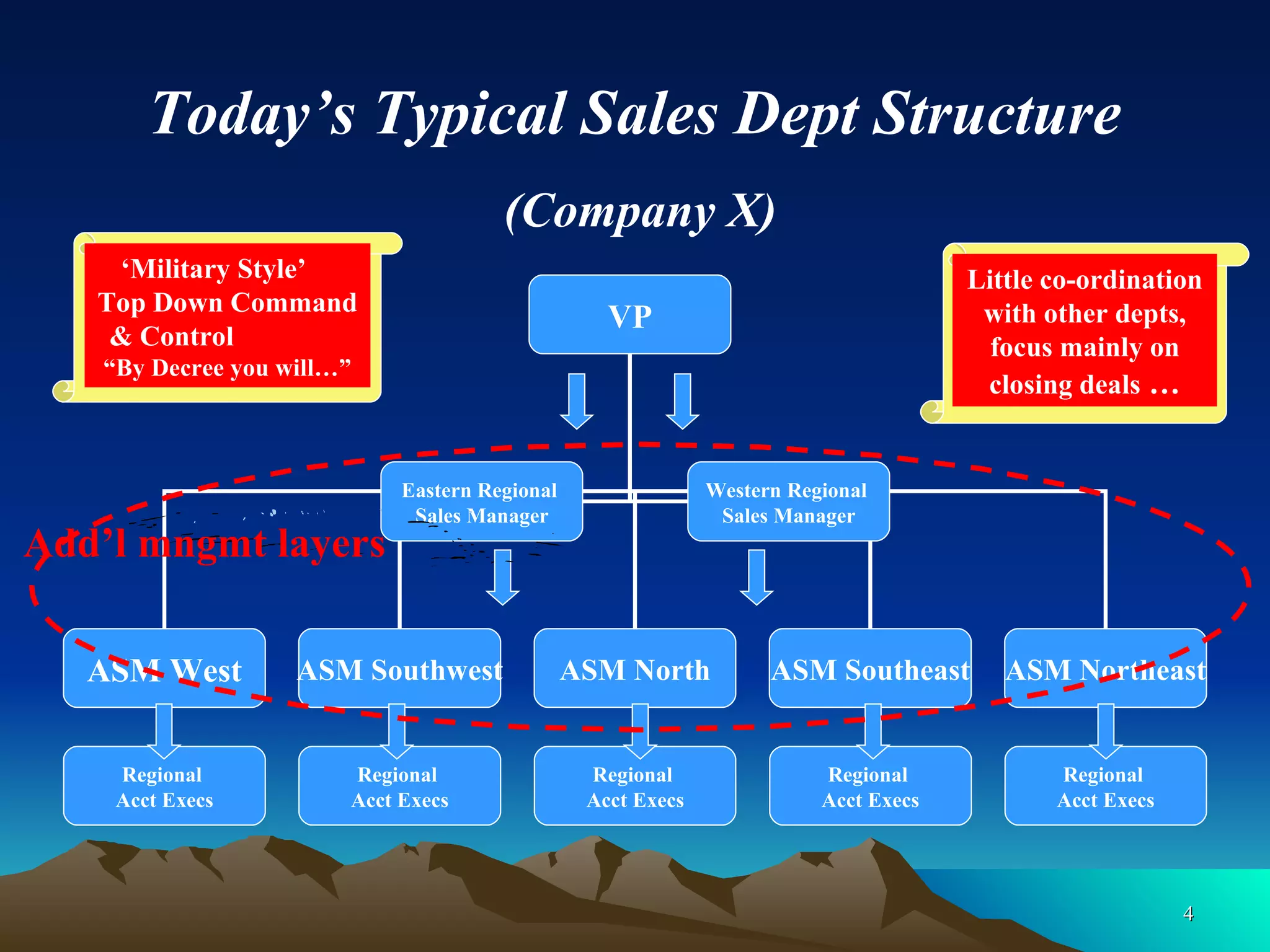
Today’s Typical SalesDept Structure (Company X) ‘ Military Style’ Top Down Command & Control “By Decree you will…” Add’l mngmt layers Little co-ordination with other depts, focus mainly on closing deals … VP ASM West ASM Southwest ASM North ASM Southeast ASM Northeast Regional Acct Execs Regional Acct Execs Regional Acct Execs Regional Acct Execs Regional Acct Execs Eastern Regional Sales Manager Western Regional Sales Manager
5.
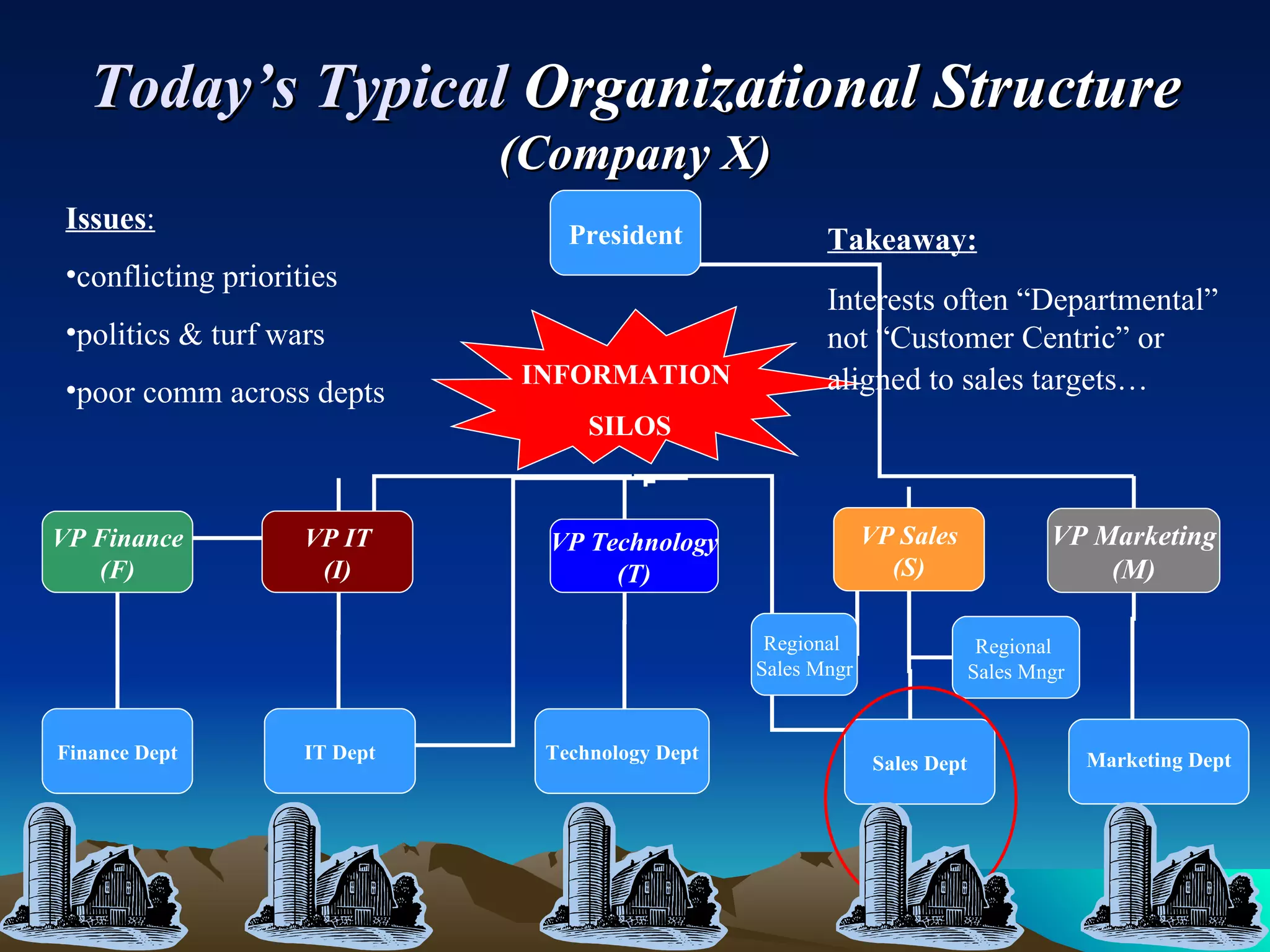
Today’s Typical Organizational Structure (Company X) Issues : conflicting priorities politics & turf wars poor comm across depts Takeaway: Interests often “Departmental” not “Customer Centric” or aligned to sales targets… President VP Finance (F) VP IT (I) VP Technology (T) VP Sales (S) Finance Dept IT Dept Technology Dept Sales Dept Regional Sales Mngr Regional Sales Mngr VP Marketing (M) Marketing Dept INFORMATION SILOS
6.
Today’s Typical Organizational Structure (Company X) Impact: Organization lacks flexibility & essential knowledge to make good decisions at critical times… Results: low morale poor customer satisfaction missed opportunities President VP Finance (F) VP IT (I) VP Technology (T) VP Sales (S) Finance Dept IT Dept Technology Dept Sales Dept Regional Sales Mngr Regional Sales Mngr VP Marketing (M) Marketing Dept INFORMATION SILOS
7.
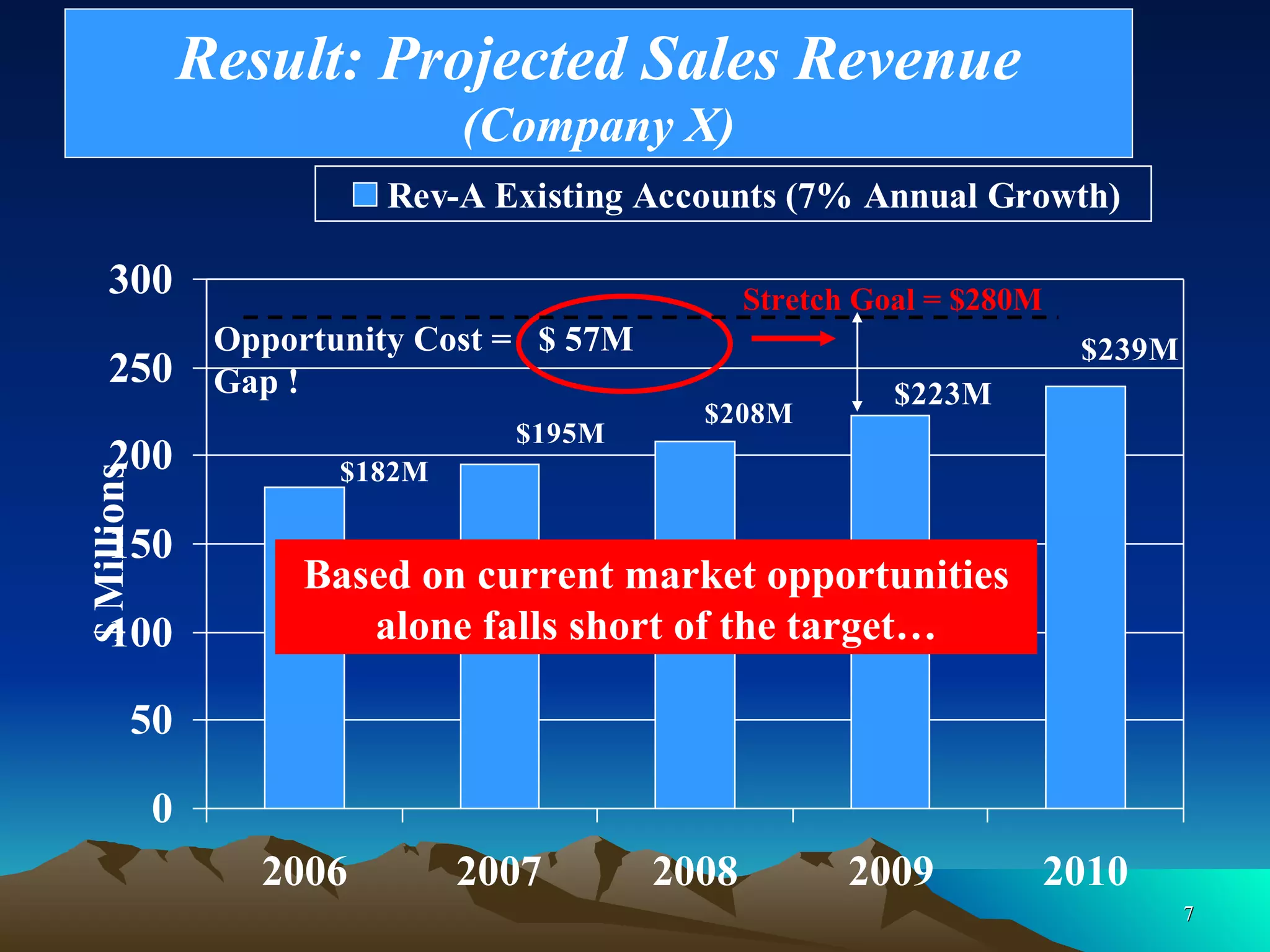
Result: Projected SalesRevenue (Company X) Opportunity Cost = $ 57M Gap ! $ Millions Stretch Goal = $280M Based on current market opportunities alone falls short of the target…
8.
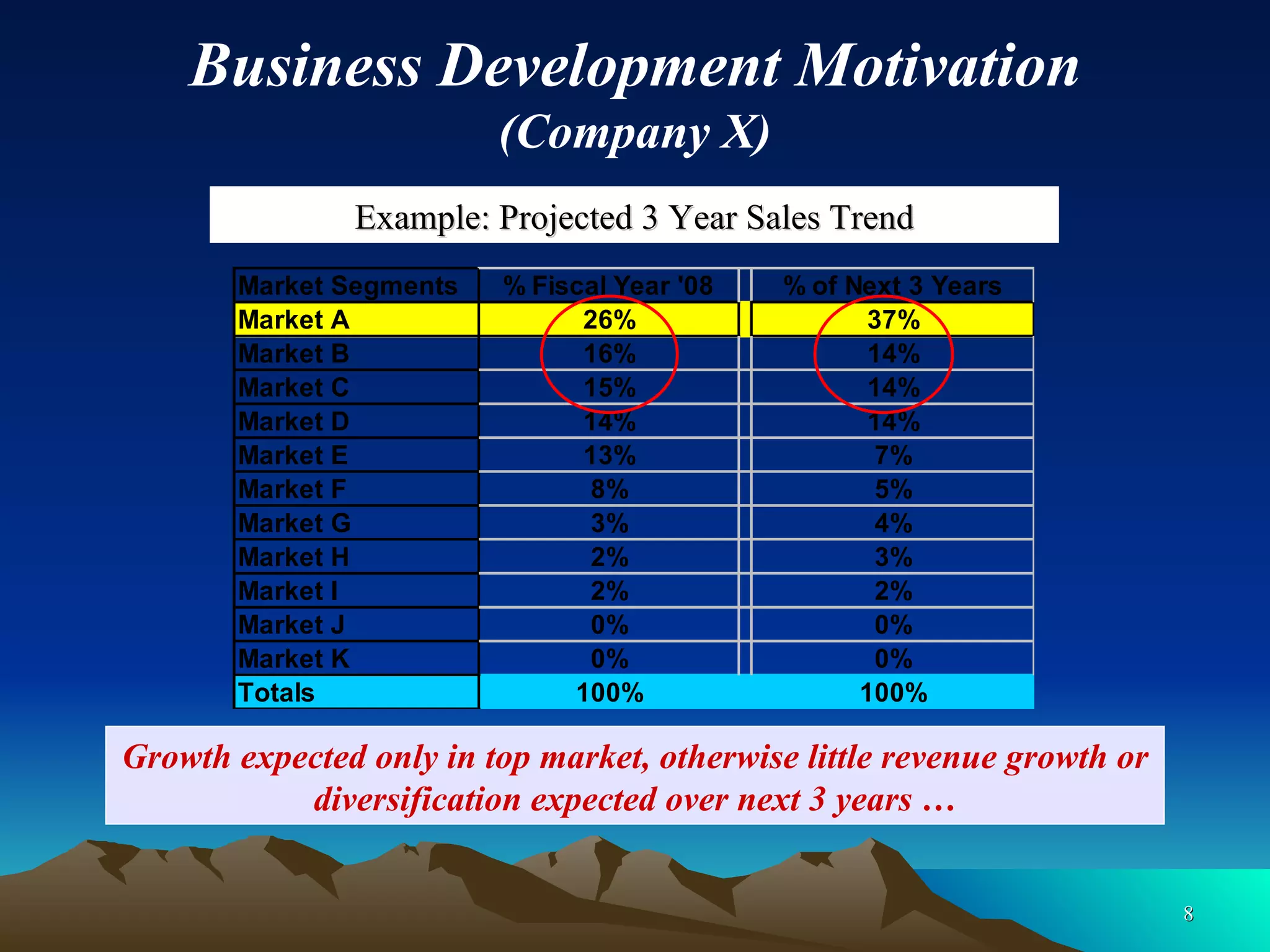
Growth expected onlyin top market, otherwise little revenue growth or diversification expected over next 3 years … Example: Projected 3 Year Sales Trend Business Development Motivation (Company X)
9.
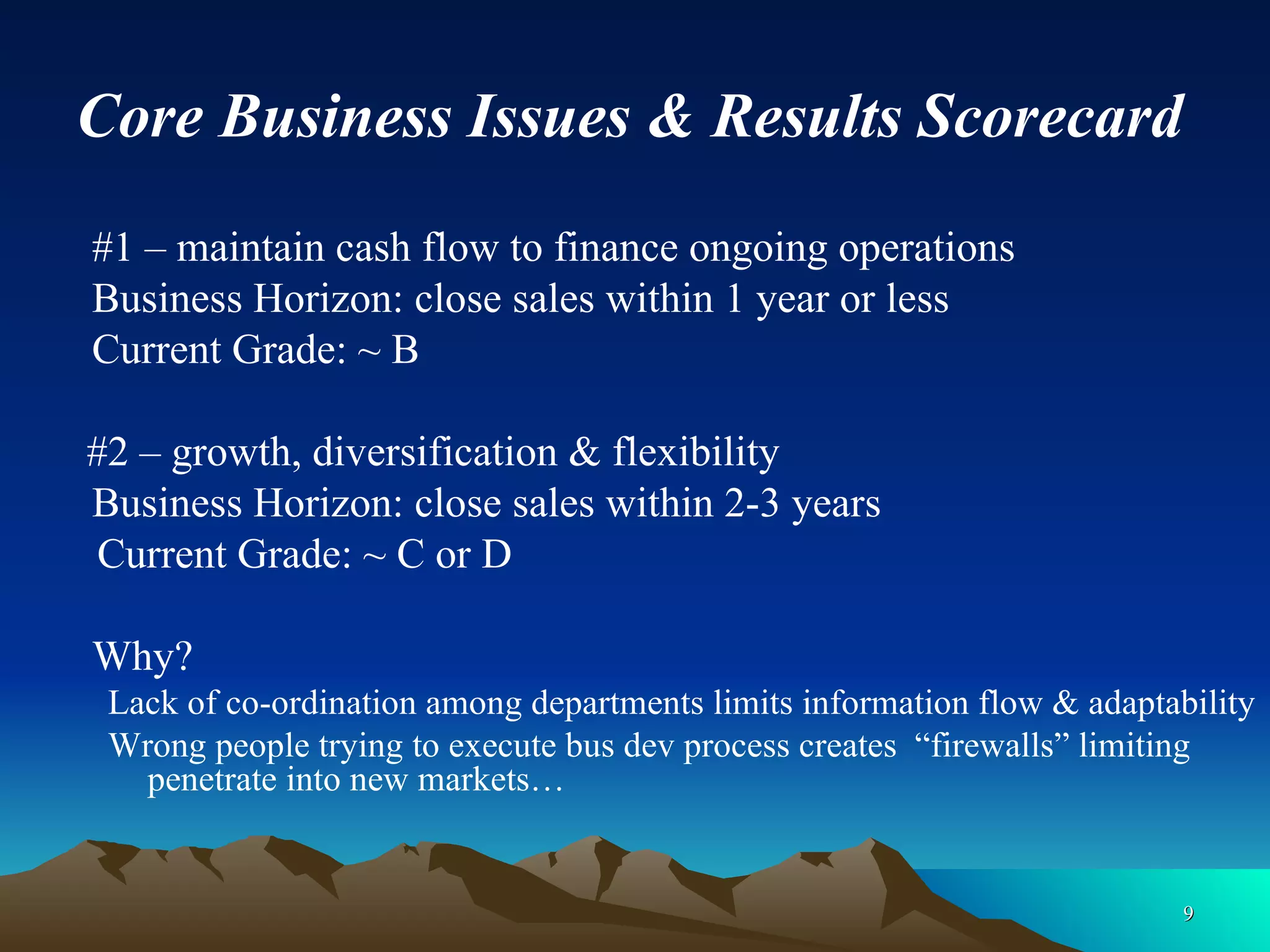
Core Business Issues& Results Scorecard #1 – maintain cash flow to finance ongoing operations Business Horizon: close sales within 1 year or less Current Grade: ~ B #2 – growth, diversification & flexibility Business Horizon: close sales within 2-3 years Current Grade: ~ C or D Why? Lack of co-ordination among departments limits information flow & adaptability Wrong people trying to execute bus dev process creates “firewalls” limiting penetrate into new markets…
How to breakinto new markets Create a Business Development Group…
13.
Business Development GroupGuiding Mantra: Key Lever: Virtual teaming “ Everyone works in Business Development” Focus: Opportunities with 2-3 year horizon
14.
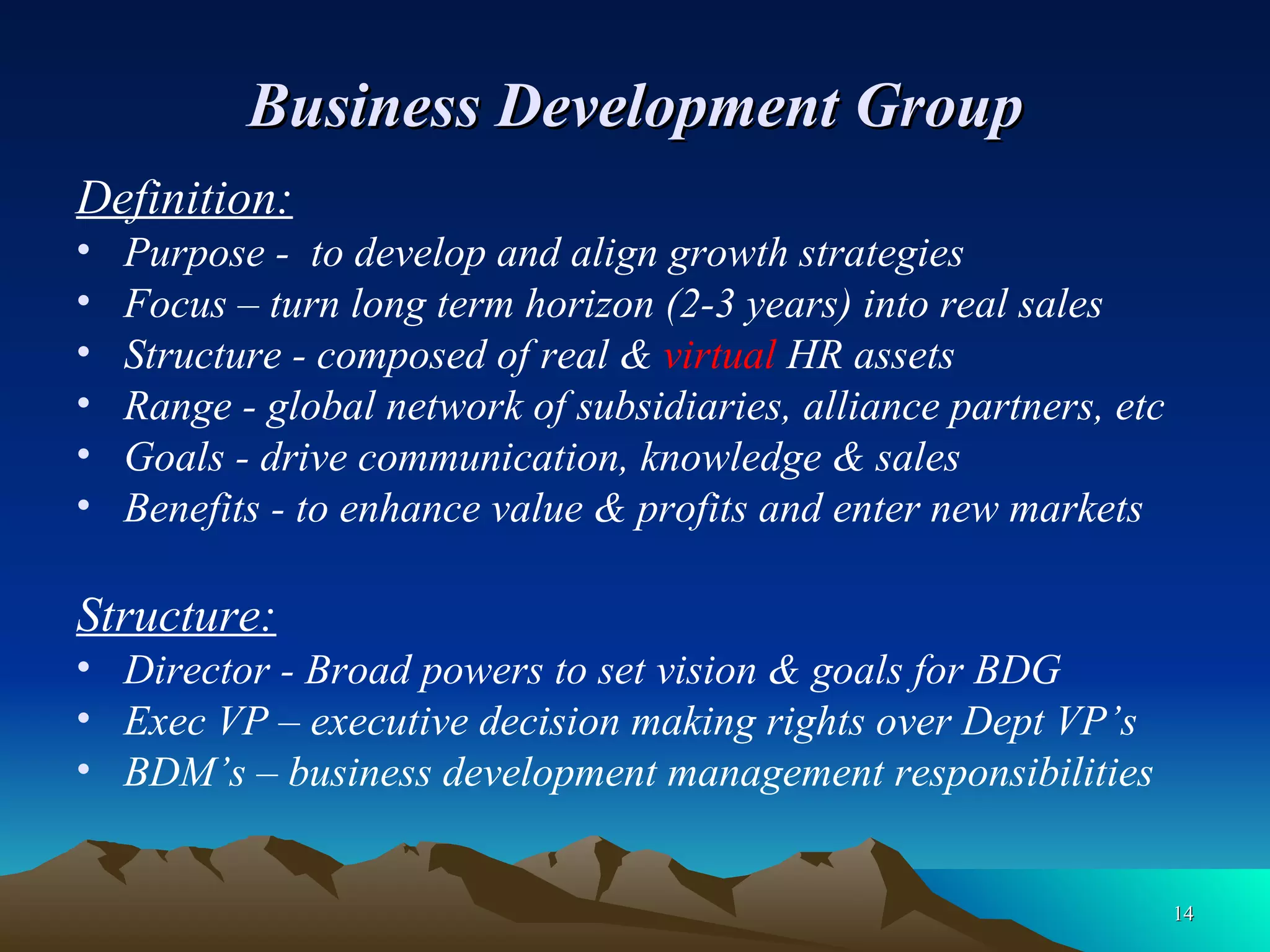
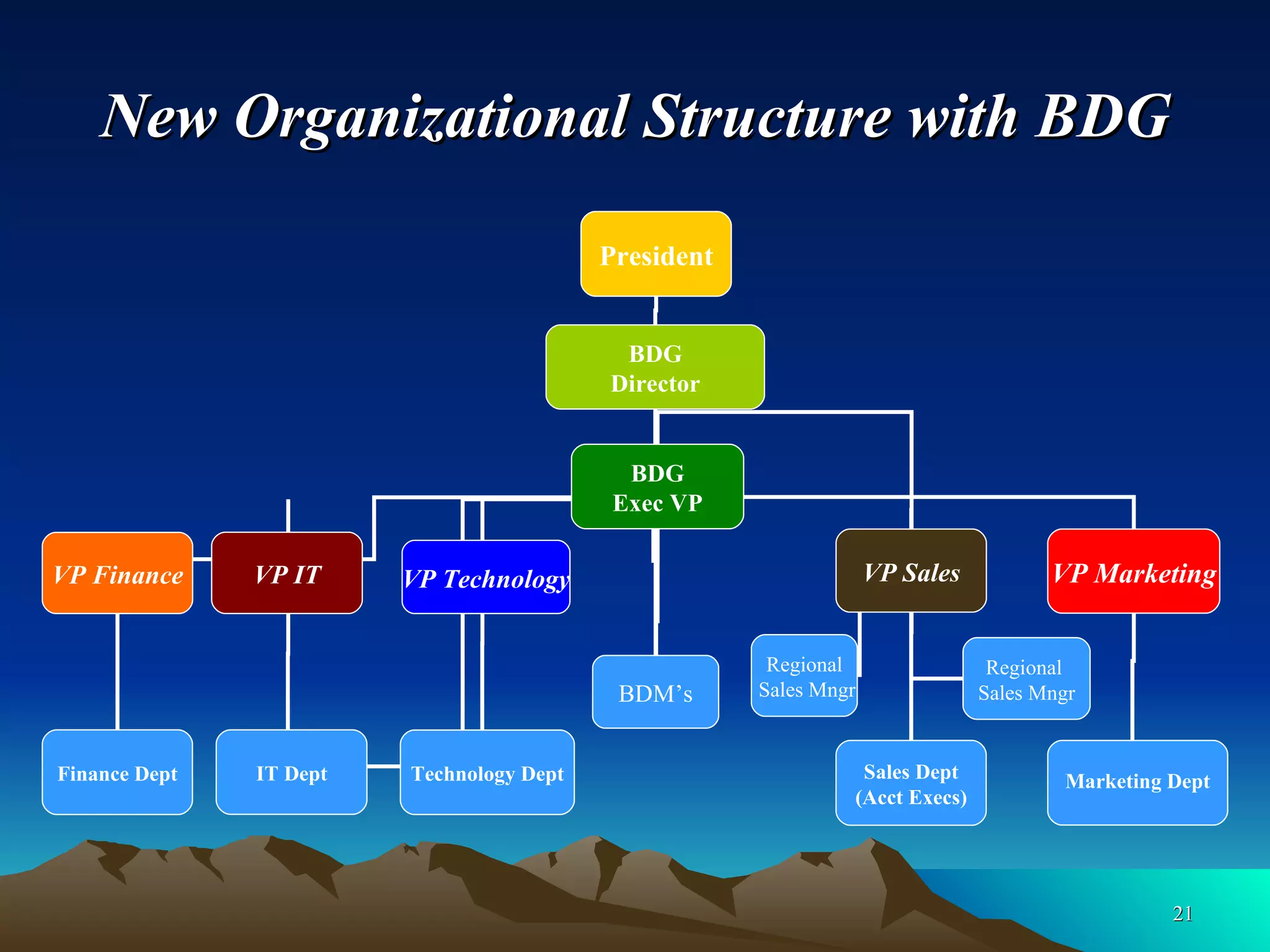
Business Development GroupDefinition: Purpose - to develop and align growth strategies Focus – turn long term horizon (2-3 years) into real sales Structure - composed of real & virtual HR assets Range - global network of subsidiaries, alliance partners, etc Goals - drive communication, knowledge & sales Benefits - to enhance value & profits and enter new markets Structure: Director - Broad powers to set vision & goals for BDG Exec VP – executive decision making rights over Dept VP’s BDM’s – business development management responsibilities
15.
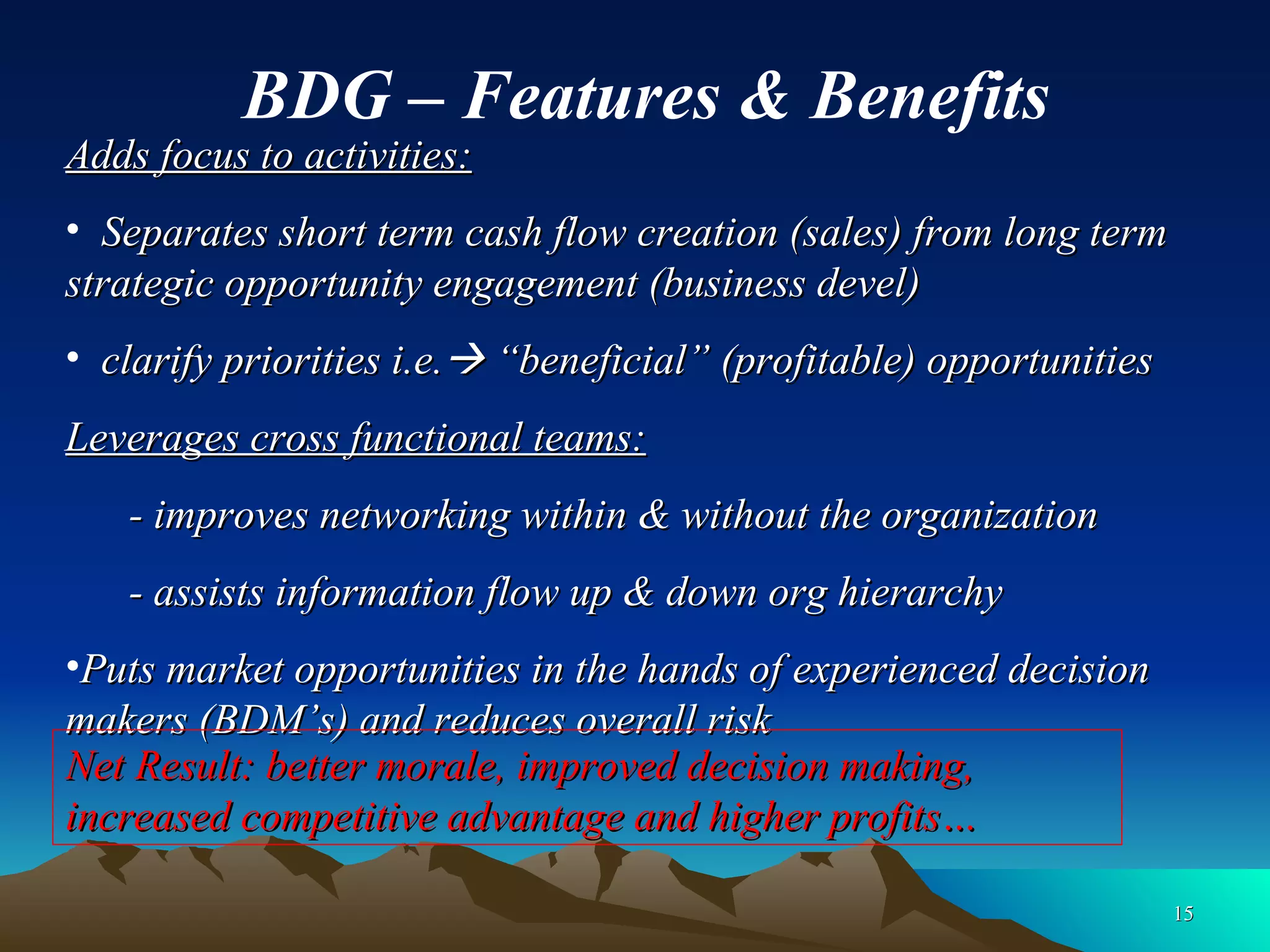
Adds focus toactivities: Separates short term cash flow creation (sales) from long term strategic opportunity engagement (business devel) clarify priorities i.e. “beneficial” (profitable) opportunities Leverages cross functional teams: - improves networking within & without the organization - assists information flow up & down org hierarchy Puts market opportunities in the hands of experienced decision makers (BDM’s) and reduces overall risk BDG – Features & Benefits Net Result: better morale, improved decision making, increased competitive advantage and higher profits…
16.
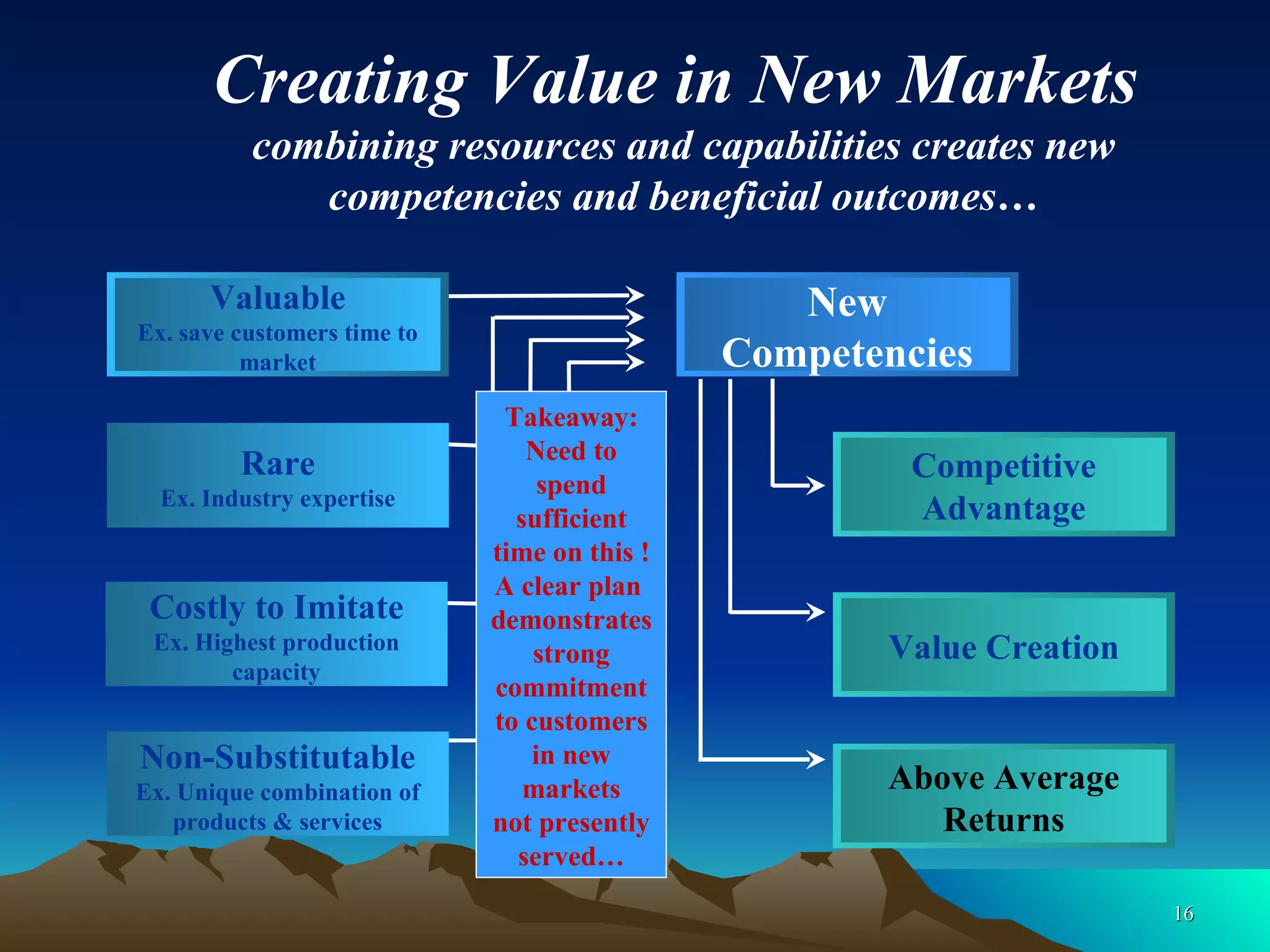
Creating Value inNew Markets combining resources and capabilities creates new competencies and beneficial outcomes… Takeaway: Need to spend sufficient time on this ! A clear plan demonstrates strong commitment to customers in new markets not presently served… New Competencies Competitive Advantage Value Creation Above Average Returns Valuable Ex. save customers time to market Rare Ex. Industry expertise Costly to Imitate Ex. Highest production capacity Non-Substitutable Ex. Unique combination of products & services
17.
Invest to growmarket share Exploit economies of scale Cut costs and prices to drive volume Develop strong brands Control channels of distribution Reference: London School of Business High Margin & Profits Start of Industry Shake Out Some Basics of Good Strategy… Key Take Away : these are all important elements of strategy but requires good co-ordination…
18.
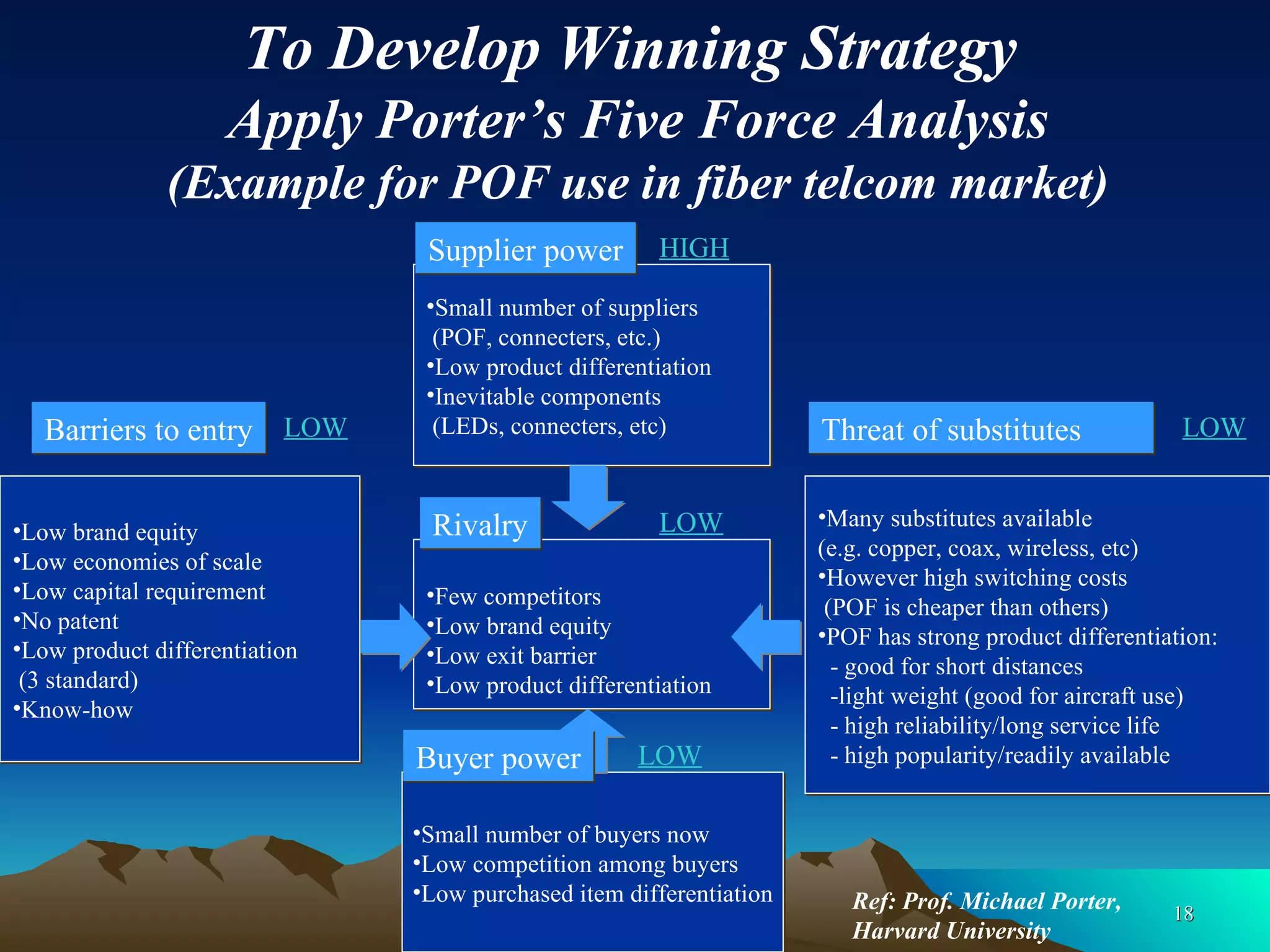
To Develop WinningStrategy Apply Porter’s Five Force Analysis (Example for POF use in fiber telcom market) Small number of suppliers (POF, connecters, etc.) Low product differentiation Inevitable components (LEDs, connecters, etc) Few competitors Low brand equity Low exit barrier Low product differentiation Small number of buyers now Low competition among buyers Low purchased item differentiation Low brand equity Low economies of scale Low capital requirement No patent Low product differentiation (3 standard) Know-how Many substitutes available (e.g. copper, coax, wireless, etc) However high switching costs (POF is cheaper than others) POF has strong product differentiation: - good for short distances -light weight (good for aircraft use) - high reliability/long service life - high popularity/readily available Supplier power Rivalry Barriers to entry Threat of substitutes LOW HIGH LOW LOW LOW Buyer power Ref: Prof. Michael Porter, Harvard University
19.
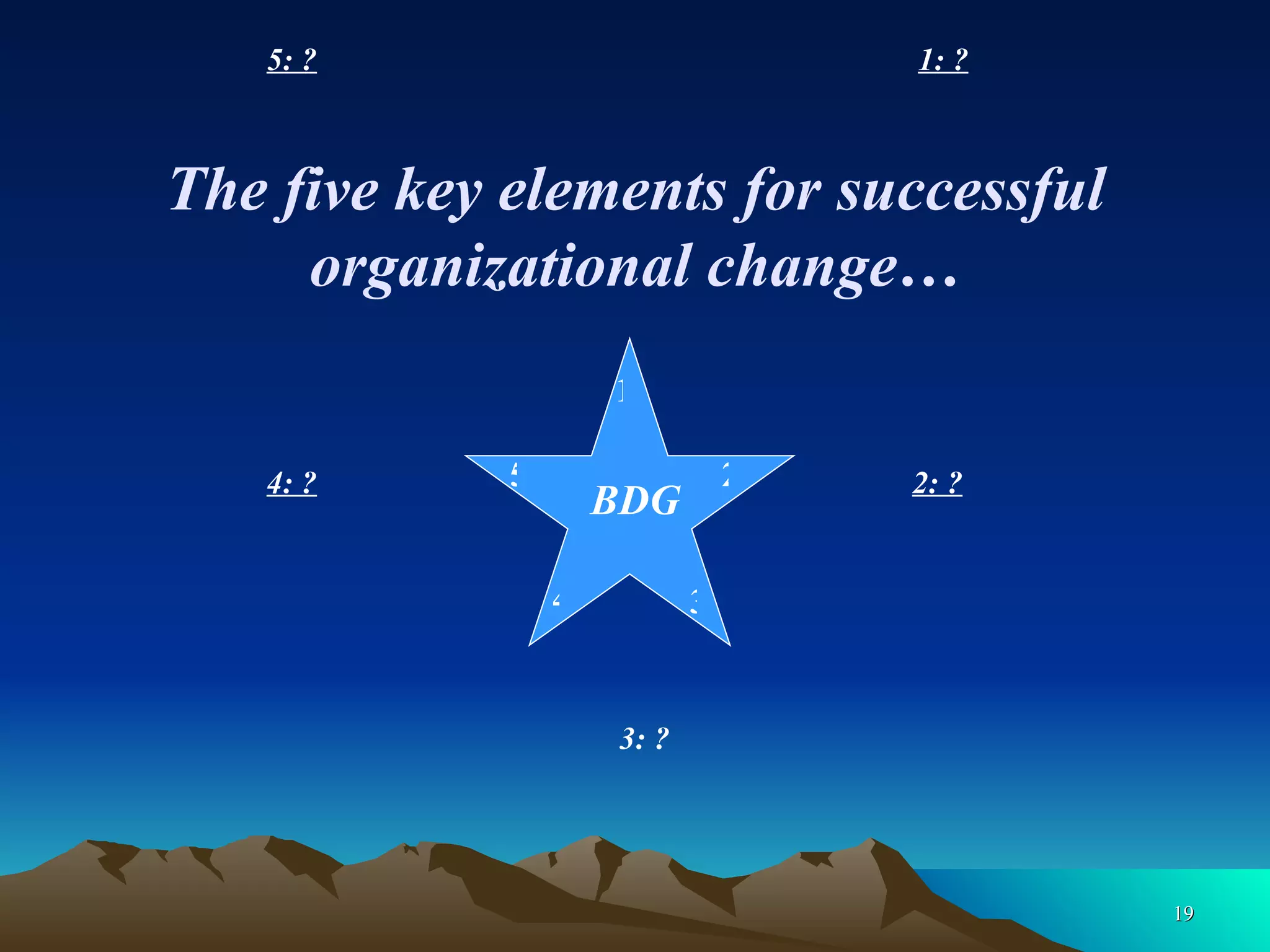
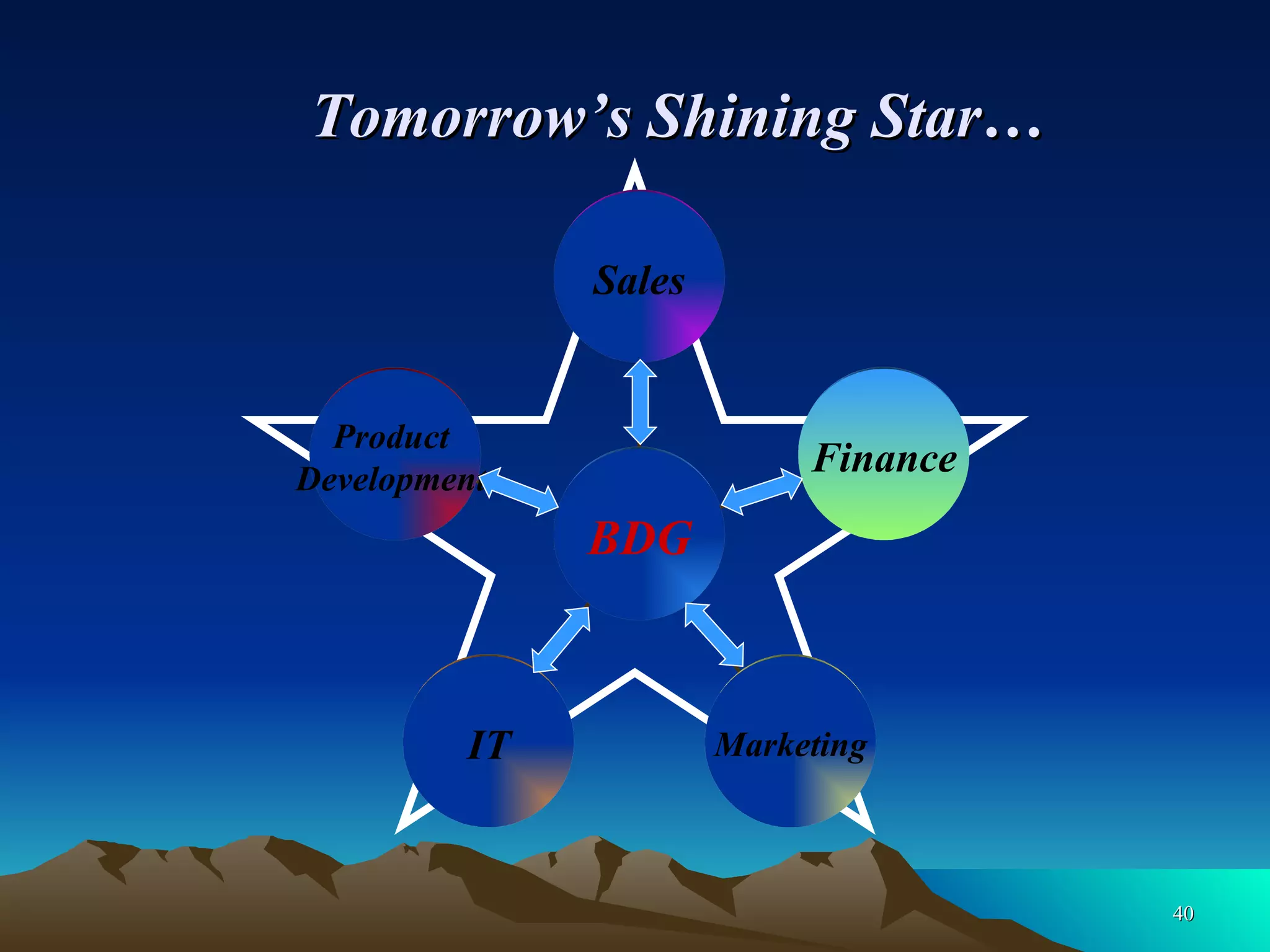
1: ? 2:? 3: ? 4: ? 5: ? BDG 2 3 4 5 The five key elements for successful organizational change… 1
20.
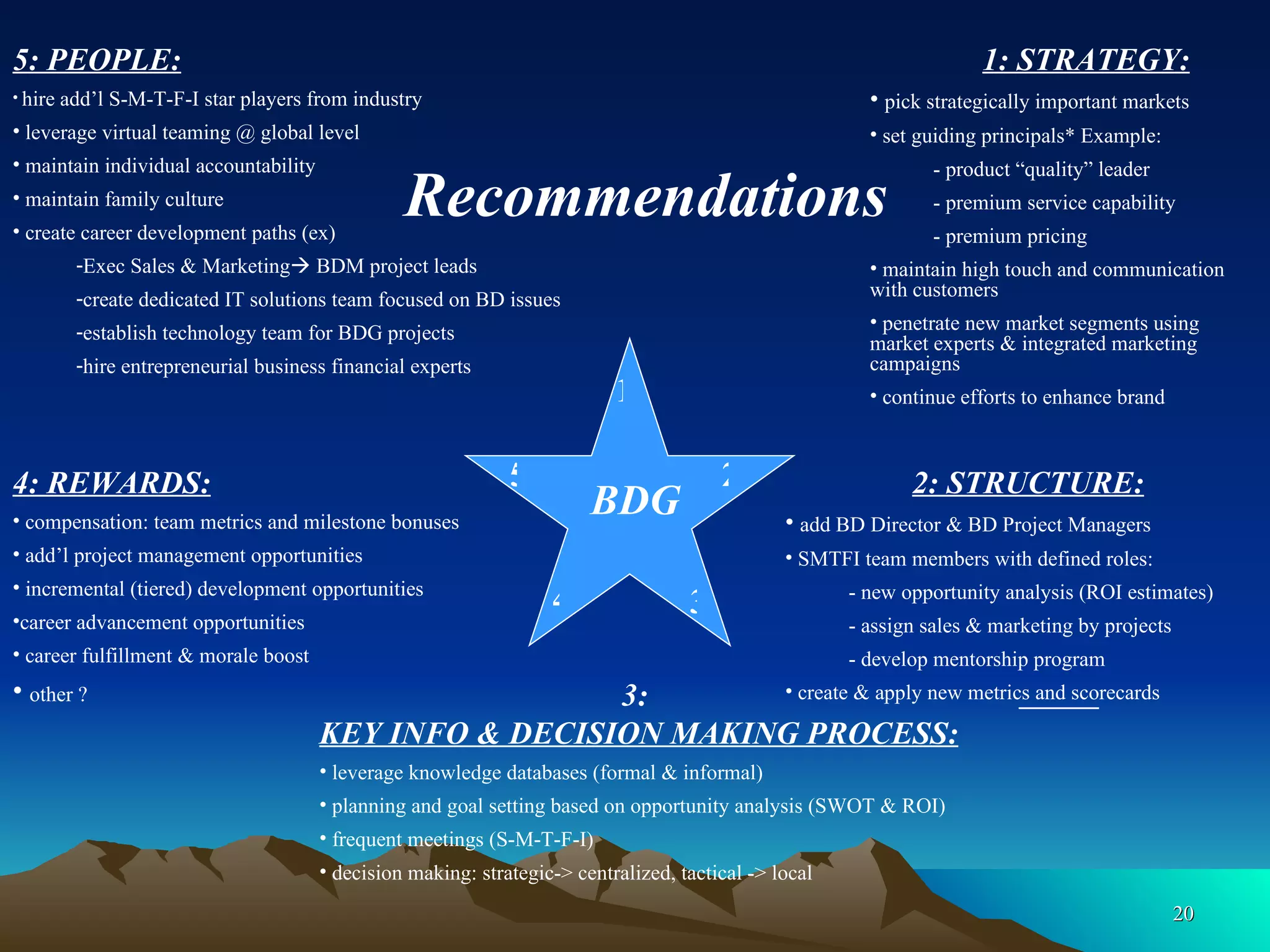
1: STRATEGY: pickstrategically important markets set guiding principals* Example: - product “quality” leader - premium service capability - premium pricing maintain high touch and communication with customers penetrate new market segments using market experts & integrated marketing campaigns continue efforts to enhance brand 2: STRUCTURE: add BD Director & BD Project Managers SMTFI team members with defined roles: - new opportunity analysis (ROI estimates) - assign sales & marketing by projects - develop mentorship program create & apply new metrics and scorecards 3: KEY INFO & DECISION MAKING PROCESS: leverage knowledge databases (formal & informal) planning and goal setting based on opportunity analysis (SWOT & ROI) frequent meetings (S-M-T-F-I) decision making: strategic-> centralized, tactical -> local 4: REWARDS: compensation: team metrics and milestone bonuses add’l project management opportunities incremental (tiered) development opportunities career advancement opportunities career fulfillment & morale boost other ? 5: PEOPLE: hire add’l S-M-T-F-I star players from industry leverage virtual teaming @ global level maintain individual accountability maintain family culture create career development paths (ex) Exec Sales & Marketing BDM project leads create dedicated IT solutions team focused on BD issues establish technology team for BDG projects hire entrepreneurial business financial experts Recommendations BDG 1 2 3 4 5
21.
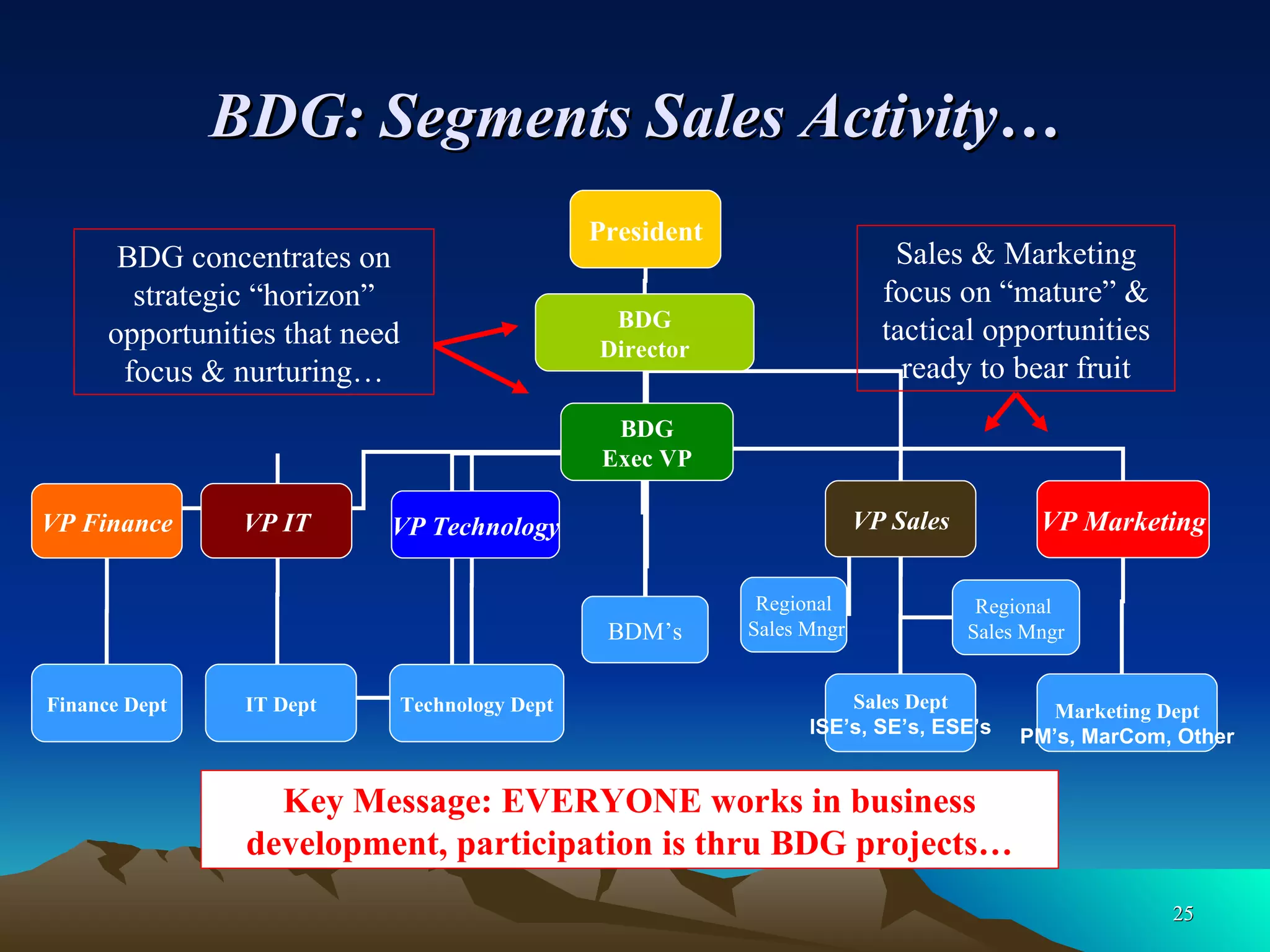
New Organizational Structurewith BDG President VP Finance VP IT VP Technology VP Sales Finance Dept IT Dept Technology Dept Sales Dept (Acct Execs) Regional Sales Mngr Regional Sales Mngr BDG Director BDG Exec VP BDM’s VP Marketing Marketing Dept
22.
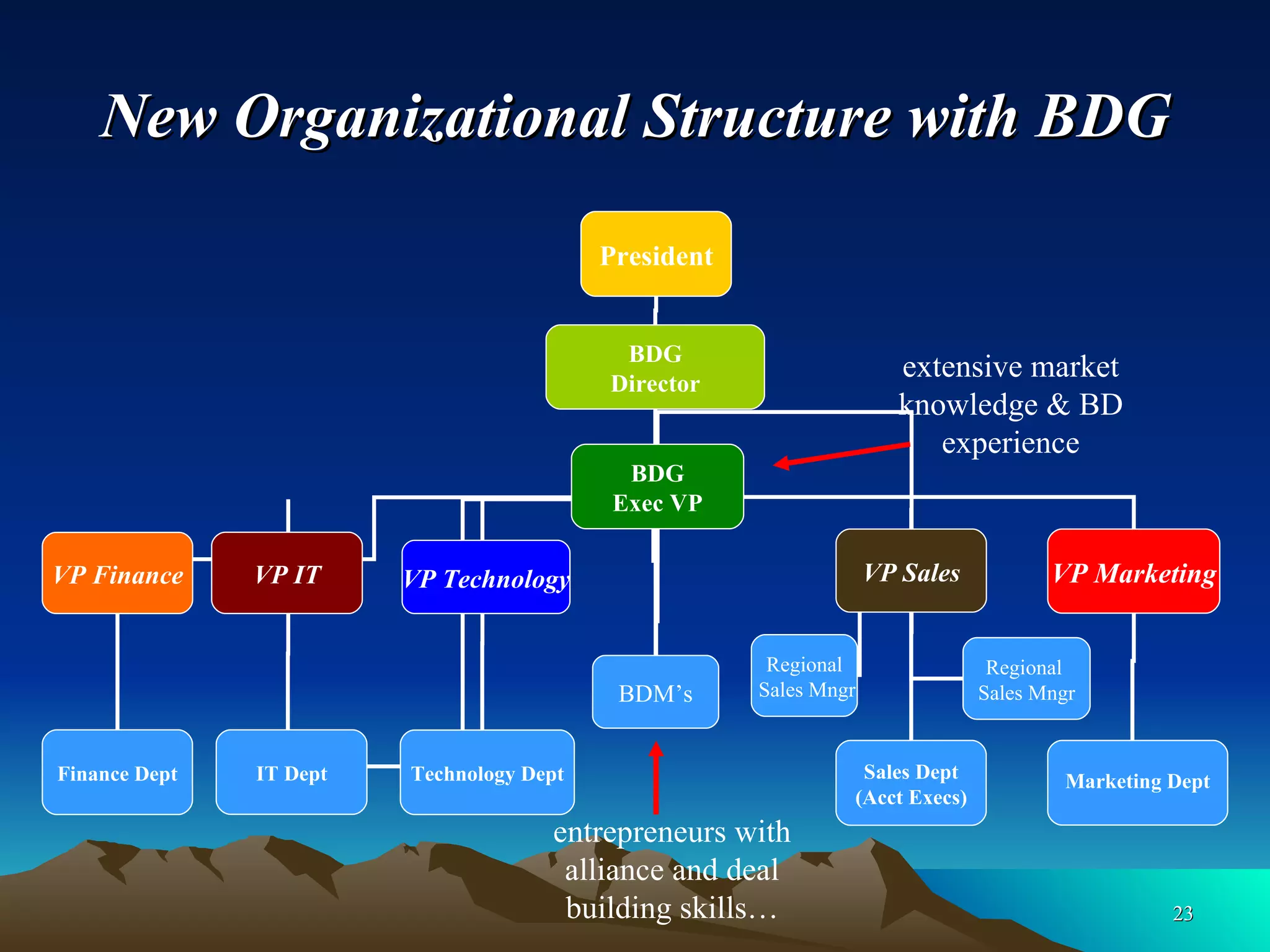
New Organizational Structurewith BDG President VP Finance VP IT VP Technology VP Sales Finance Dept IT Dept Technology Dept Sales Dept (Acct Execs) Regional Sales Mngr Regional Sales Mngr BDG Director BDG Exec VP BDM’s VP Marketing Marketing Dept entrepreneurs with alliance and deal building skills…
23.
New Organizational Structurewith BDG President VP Finance VP IT VP Technology VP Sales Finance Dept IT Dept Technology Dept Sales Dept (Acct Execs) Regional Sales Mngr Regional Sales Mngr BDG Director BDG Exec VP BDM’s VP Marketing Marketing Dept entrepreneurs with alliance and deal building skills… extensive market knowledge & BD experience
24.
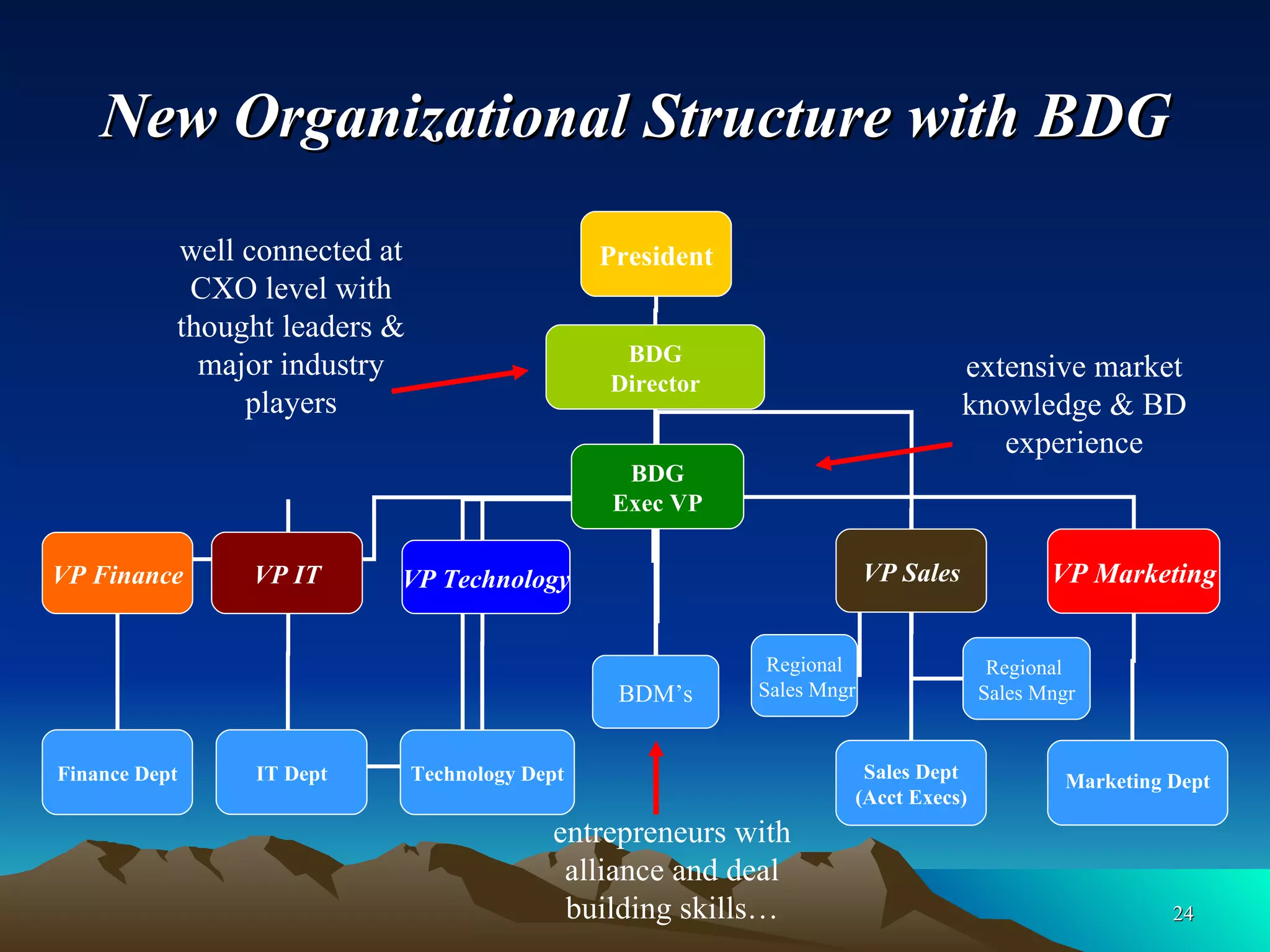
New Organizational Structurewith BDG President VP Finance VP IT VP Technology VP Sales Finance Dept IT Dept Technology Dept Sales Dept (Acct Execs) Regional Sales Mngr Regional Sales Mngr BDG Director BDG Exec VP BDM’s VP Marketing Marketing Dept extensive market knowledge & BD experience well connected at CXO level with thought leaders & major industry players entrepreneurs with alliance and deal building skills…
25.
BDG: Segments SalesActivity… President VP Finance VP IT VP Technology VP Sales Finance Dept IT Dept Technology Dept Sales Dept ISE’s, SE’s, ESE’s Regional Sales Mngr Regional Sales Mngr BDG Director BDG Exec VP BDM’s VP Marketing Marketing Dept PM’s, MarCom, Other Sales & Marketing focus on “mature” & tactical opportunities ready to bear fruit BDG concentrates on strategic “horizon” opportunities that need focus & nurturing… Key Message: EVERYONE works in business development, participation is thru BDG projects…
26.
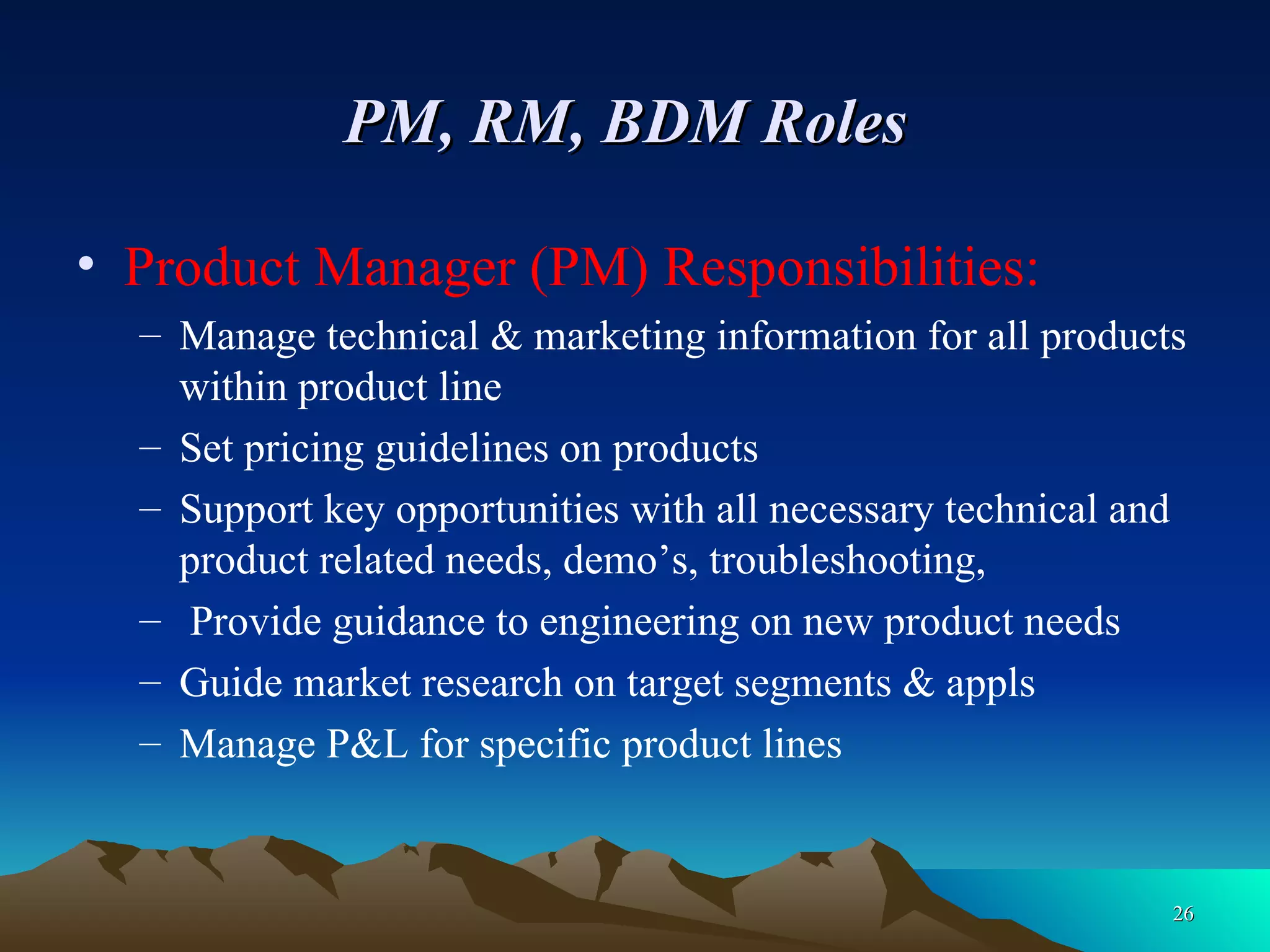
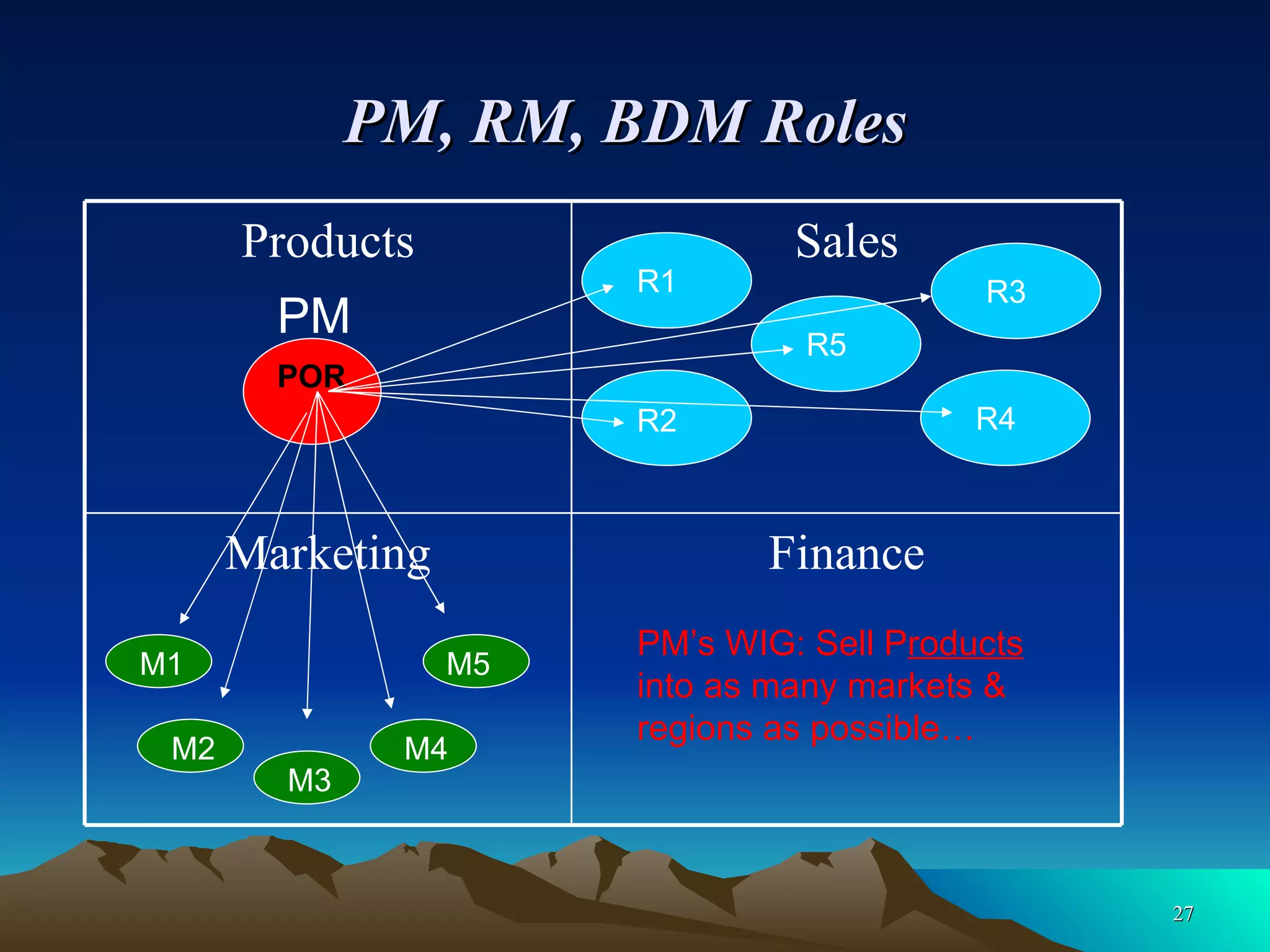
PM, RM, BDMRoles Product Manager (PM) Responsibilities: Manage technical & marketing information for all products within product line Set pricing guidelines on products Support key opportunities with all necessary technical and product related needs, demo’s, troubleshooting, Provide guidance to engineering on new product needs Guide market research on target segments & appls Manage P&L for specific product lines
27.
PM, RM, BDMRoles PM POR M1 M2 M3 M4 M5 R2 R1 R3 R4 R5 PM’s WIG: Sell P roducts into as many markets & regions as possible… Finance Marketing Sales Products
28.
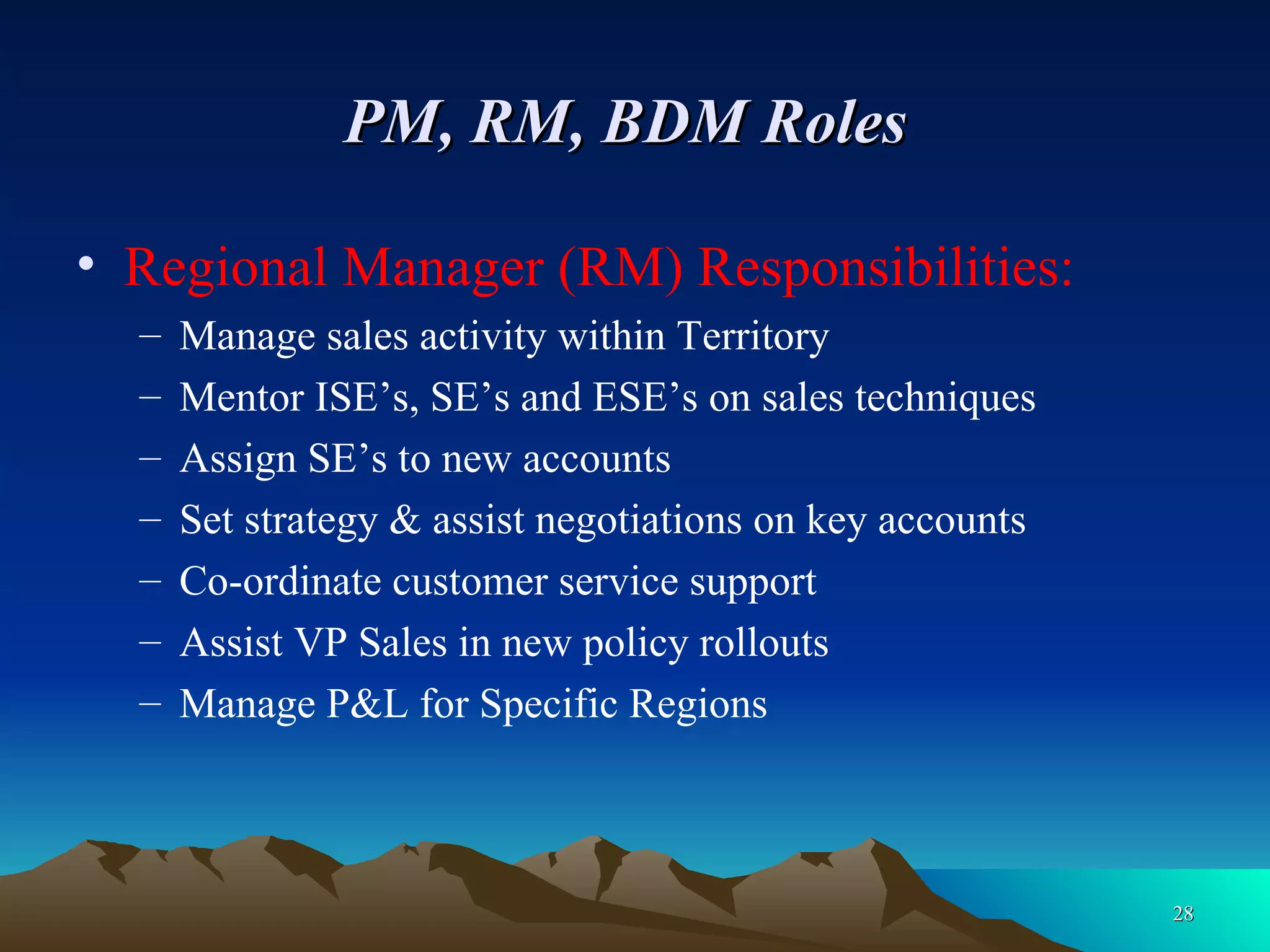
PM, RM, BDMRoles Regional Manager (RM) Responsibilities: Manage sales activity within Territory Mentor ISE’s, SE’s and ESE’s on sales techniques Assign SE’s to new accounts Set strategy & assist negotiations on key accounts Co-ordinate customer service support Assist VP Sales in new policy rollouts Manage P&L for Specific Regions
29.
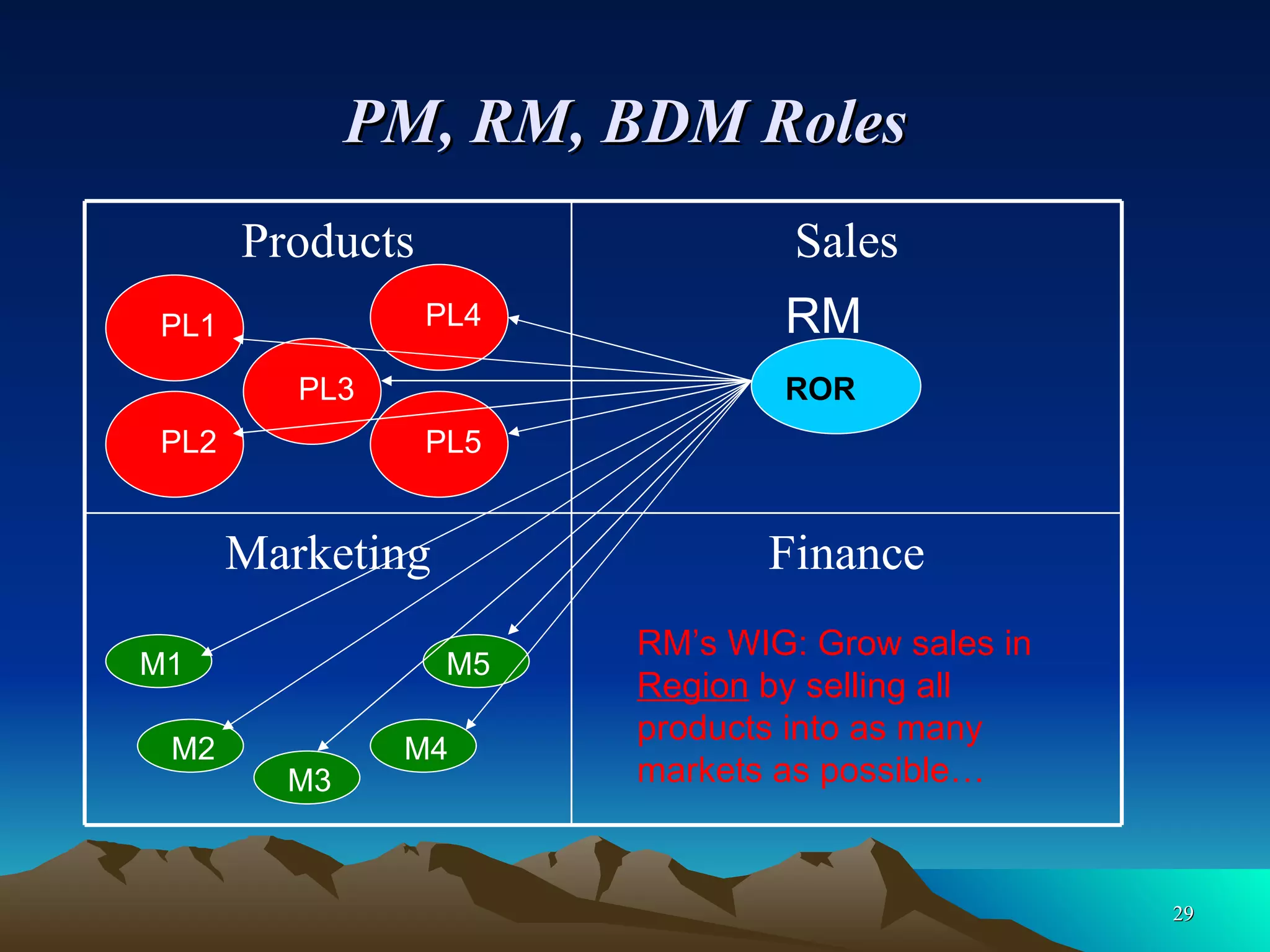
PM, RM, BDMRoles PL3 M1 M2 M3 M4 M5 ROR PL5 PL2 PL1 PL4 RM RM’s WIG: Grow sales in Region by selling all products into as many markets as possible… Finance Marketing Sales Products
30.
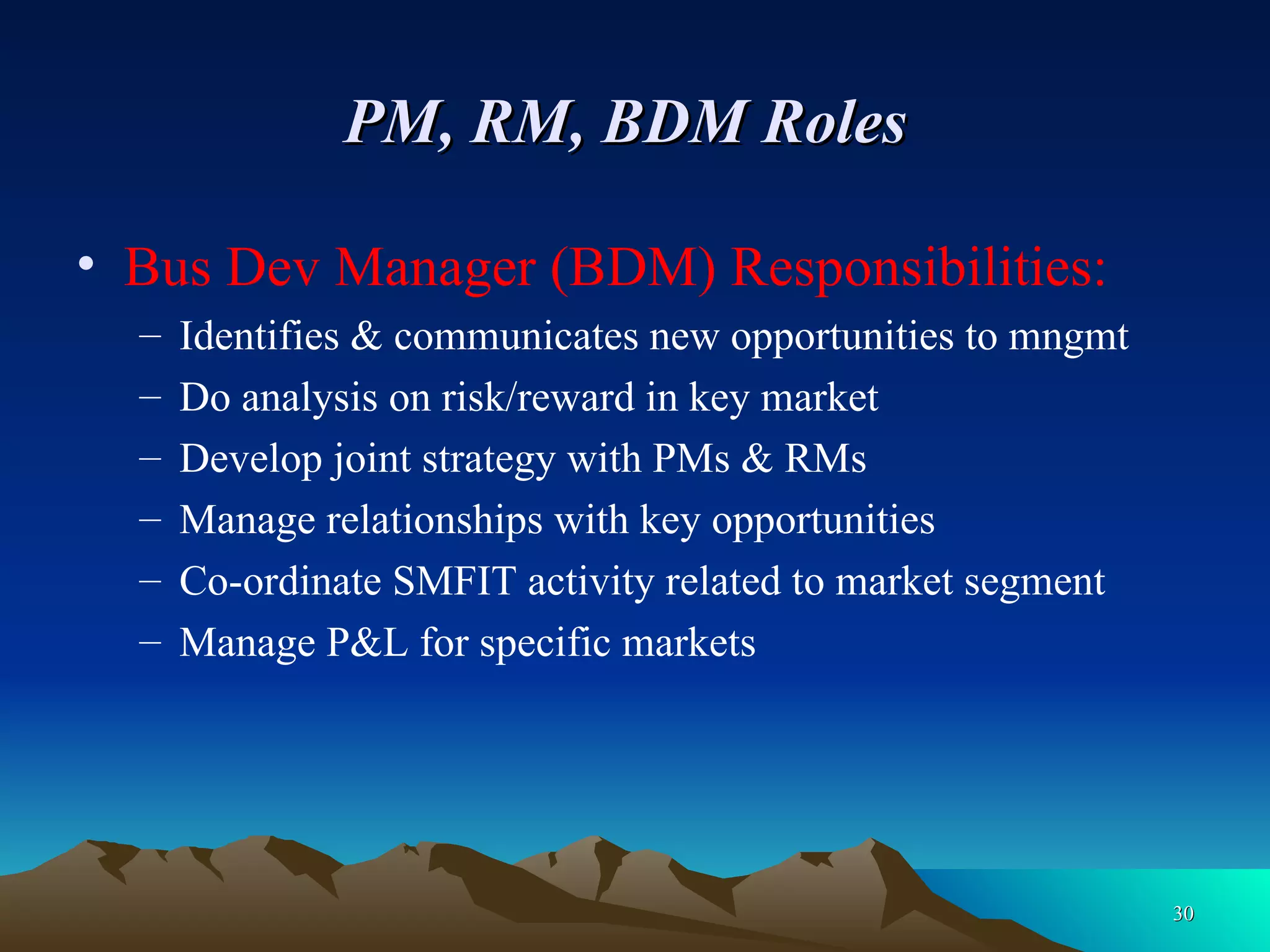
PM, RM, BDMRoles Bus Dev Manager (BDM) Responsibilities: Identifies & communicates new opportunities to mngmt Do analysis on risk/reward in key market Develop joint strategy with PMs & RMs Manage relationships with key opportunities Co-ordinate SMFIT activity related to market segment Manage P&L for specific markets
31.
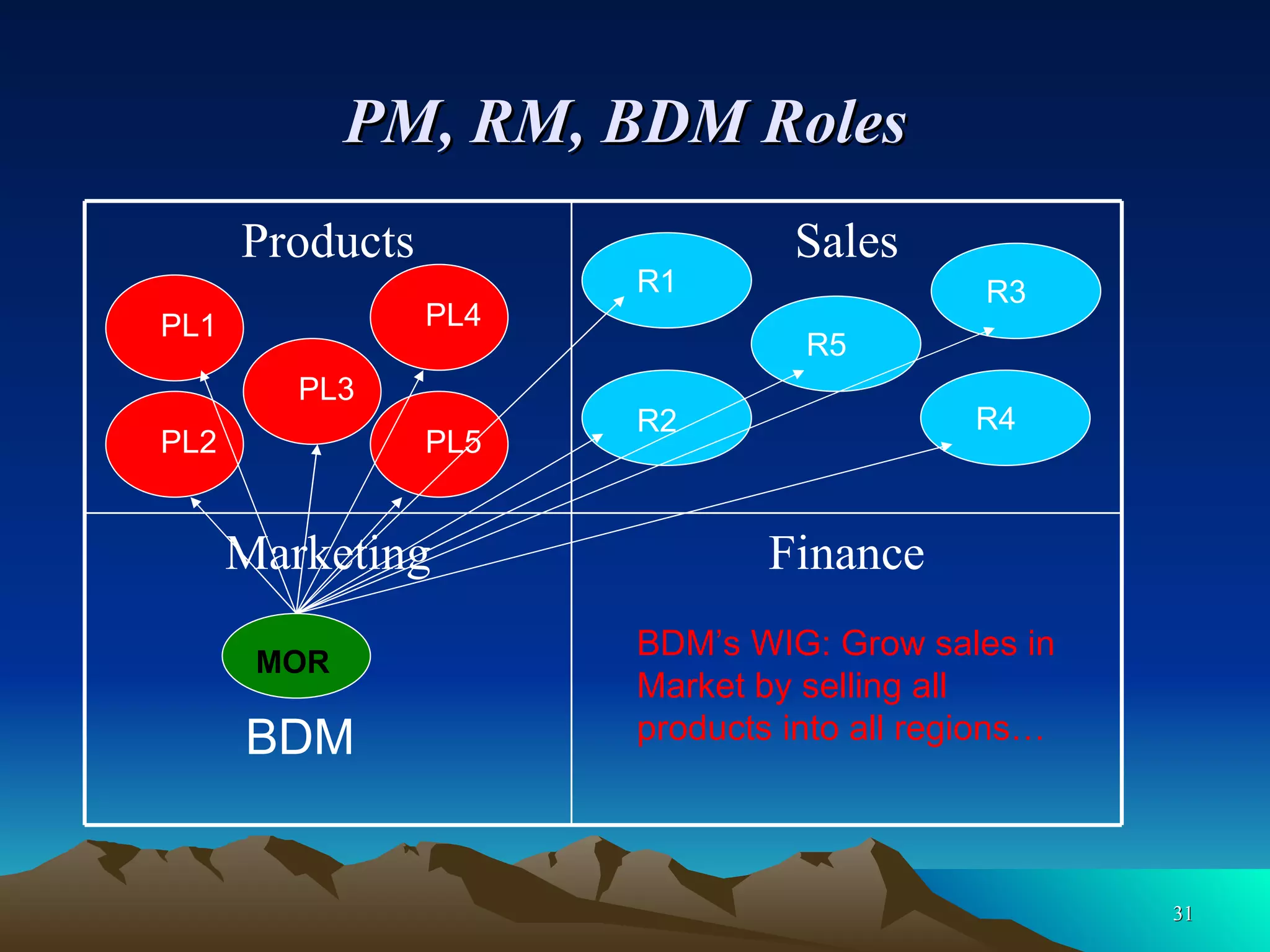
PM, RM, BDMRoles PL3 MOR PL5 PL2 PL1 PL4 R2 R1 R3 R4 R5 BDM BDM’s WIG: Grow sales in Market by selling all products into all regions… Finance Marketing Sales Products
32.
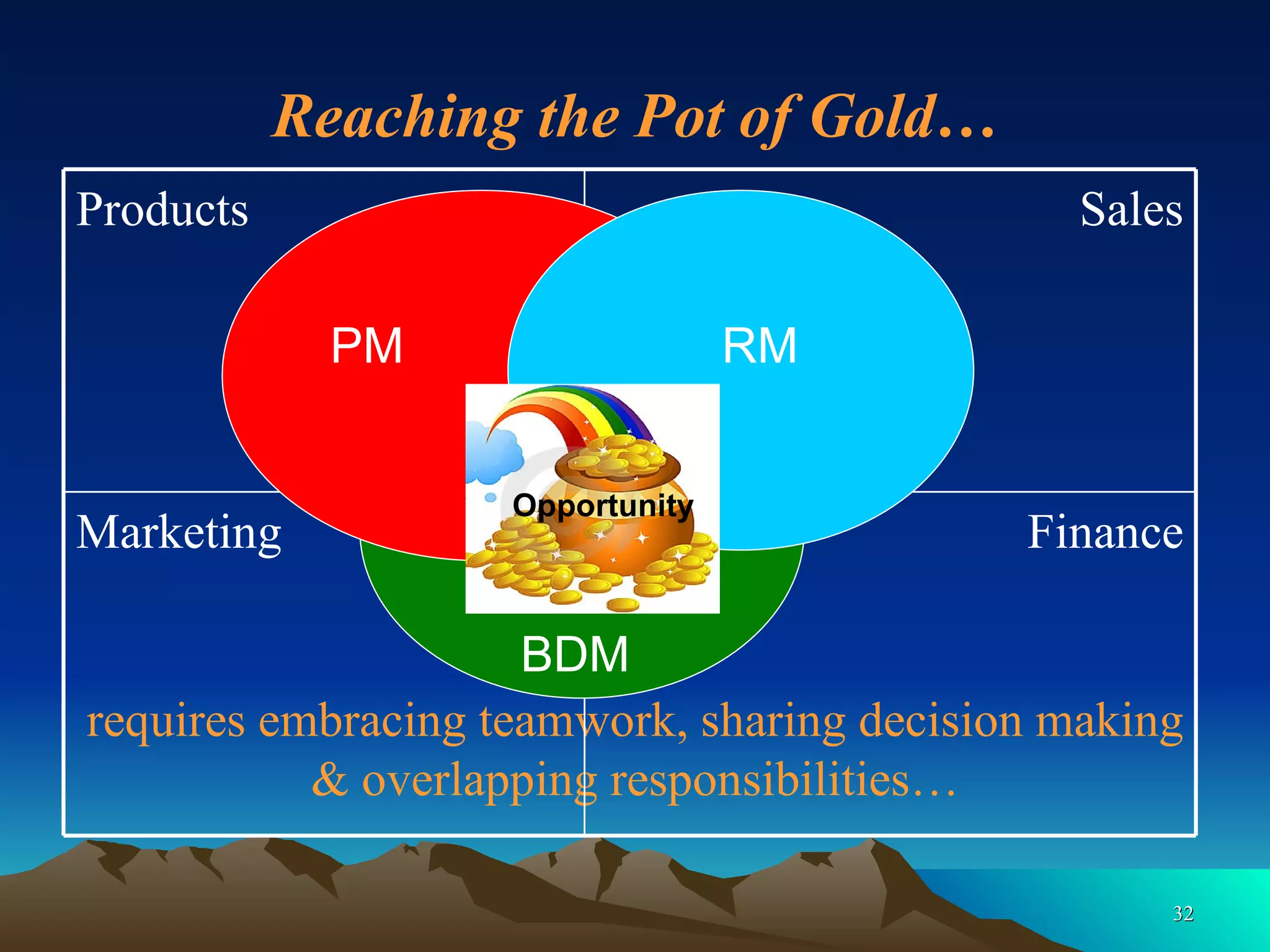
requires embracing teamwork,sharing decision making & overlapping responsibilities… PM RM BDM Reaching the Pot of Gold… Opportunity Finance Marketing Sales Products
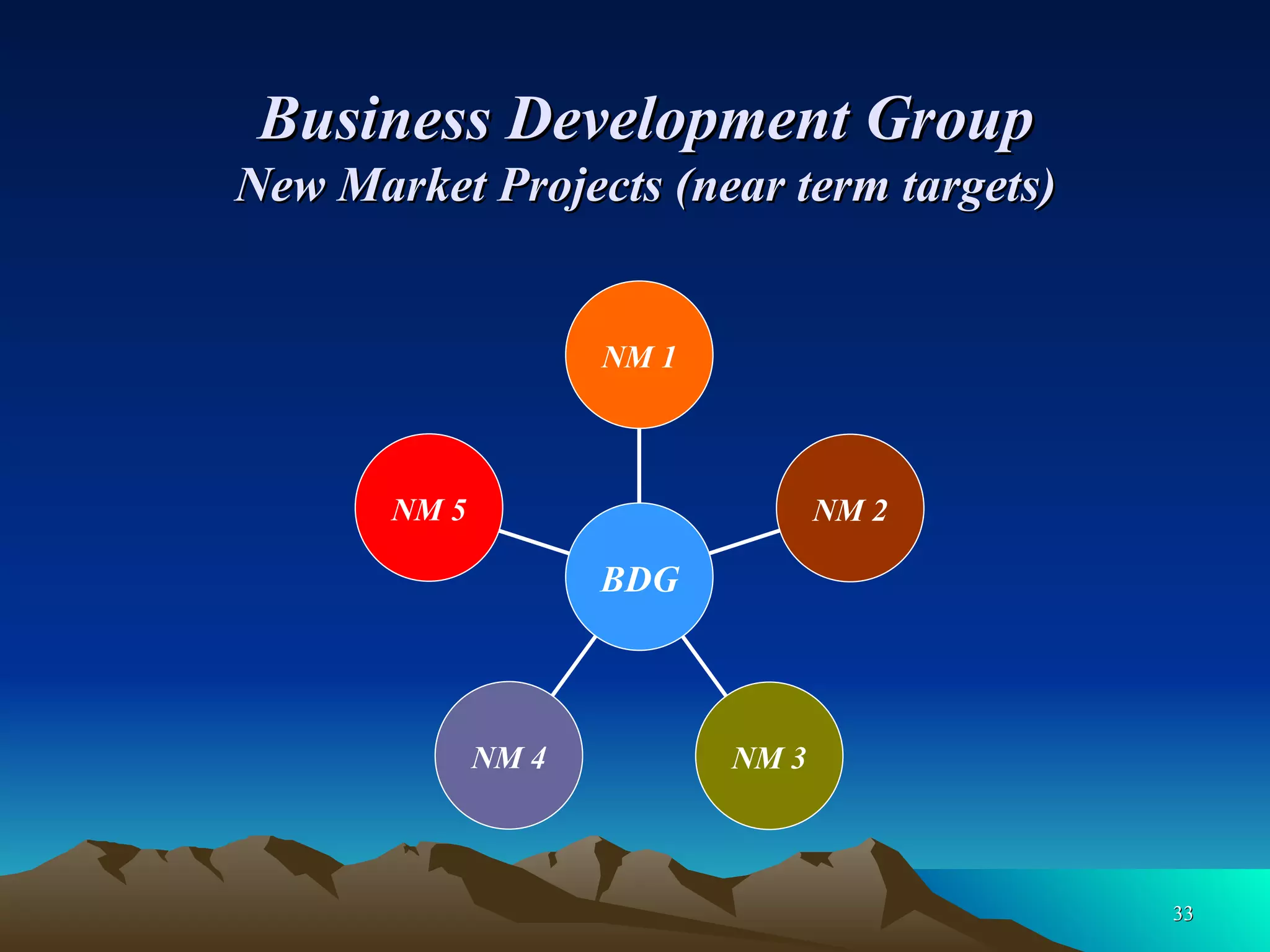
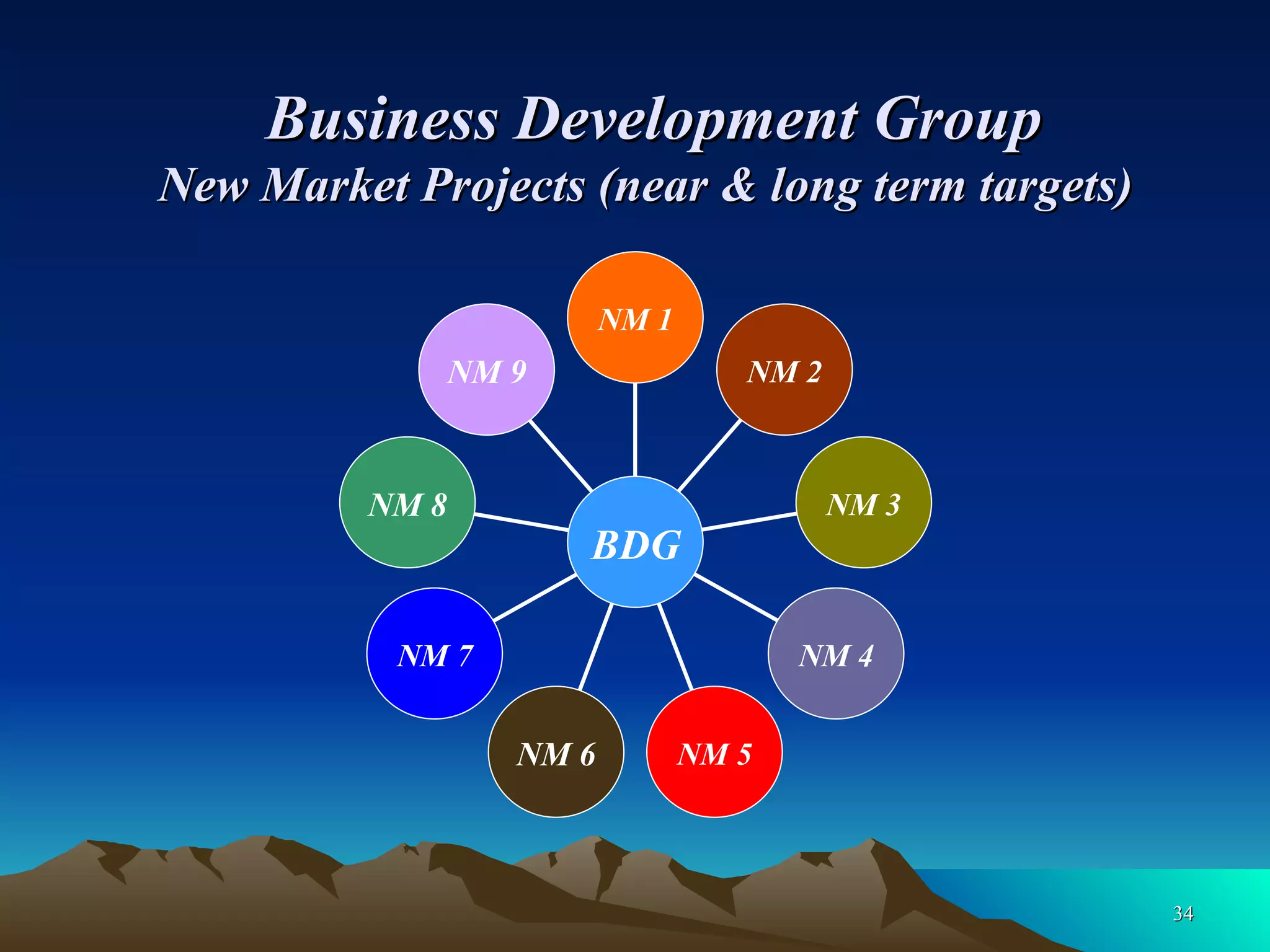
Business Development GroupNew Market Projects (near & long term targets) NM 9 NM 8 NM 7 NM 6 NM 5 NM 4 NM 3 NM 2 NM 1 BDG
35.
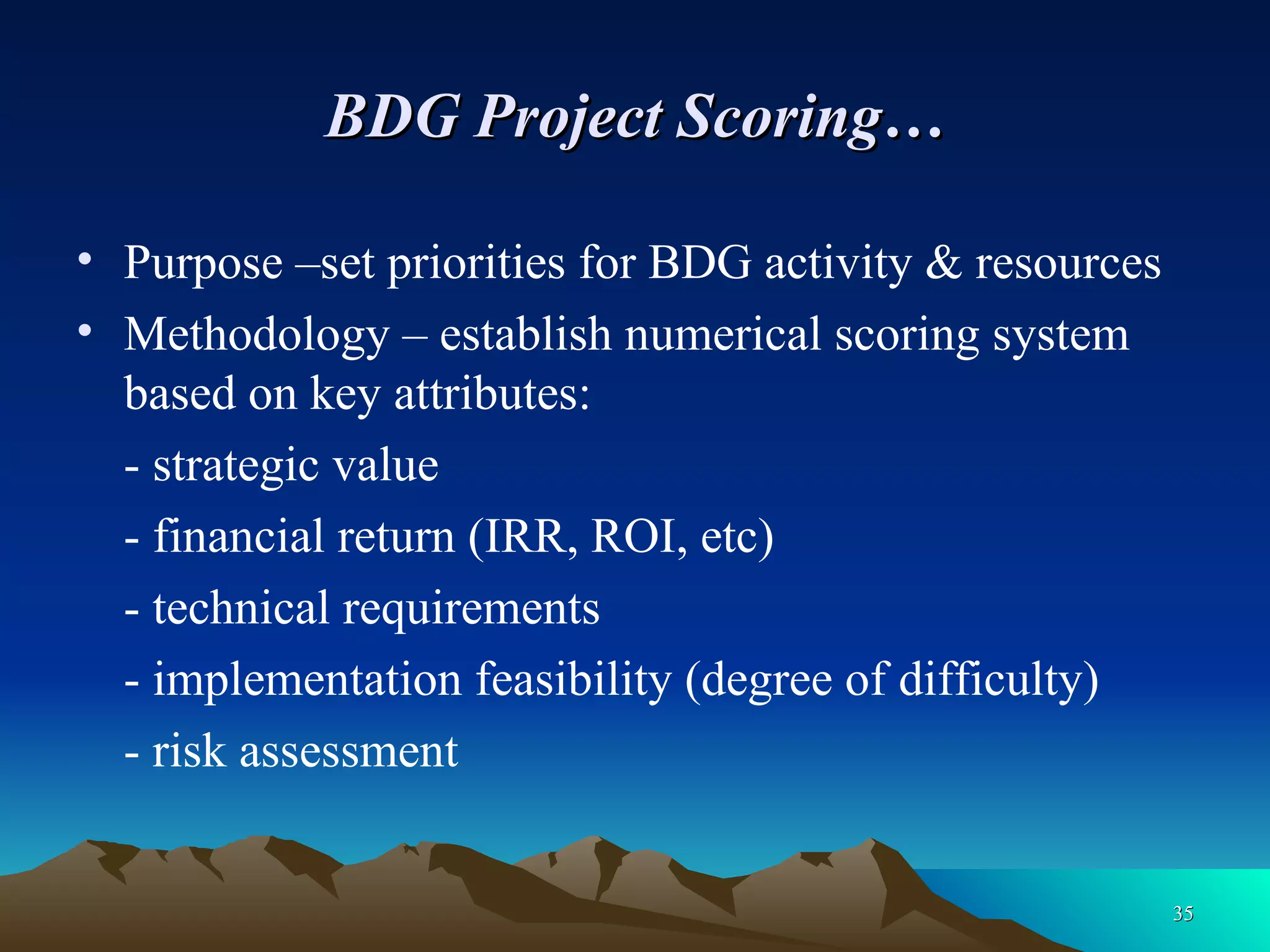
BDG Project Scoring…Purpose –set priorities for BDG activity & resources Methodology – establish numerical scoring system based on key attributes: - strategic value - financial return (IRR, ROI, etc) - technical requirements - implementation feasibility (degree of difficulty) - risk assessment
36.
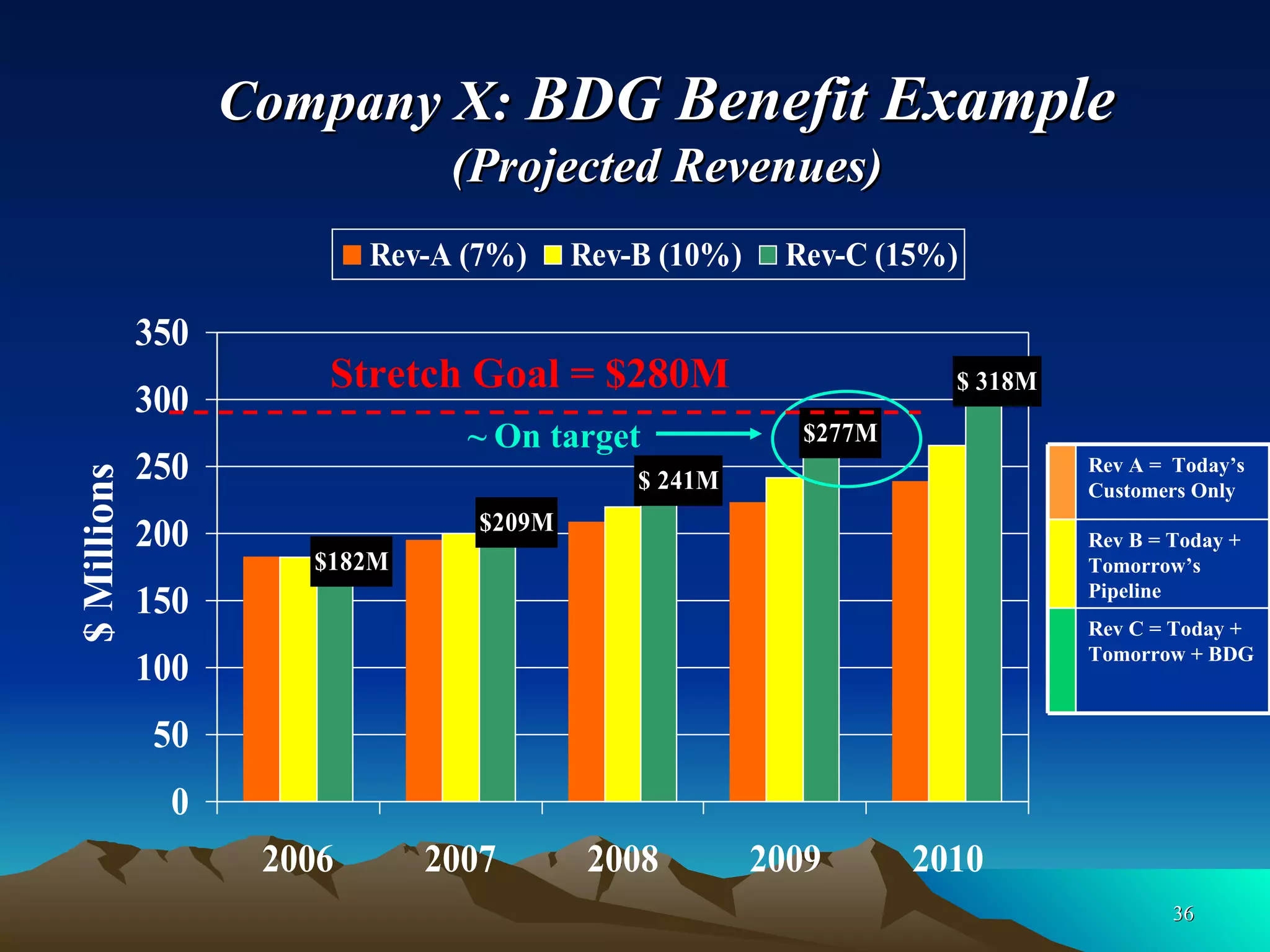
Company X: BDG Benefit Example (Projected Revenues) ~ On target $ Millions Stretch Goal = $280M Rev C = Today + Tomorrow + BDG Rev B = Today + Tomorrow’s Pipeline Rev A = Today’s Customers Only
37.
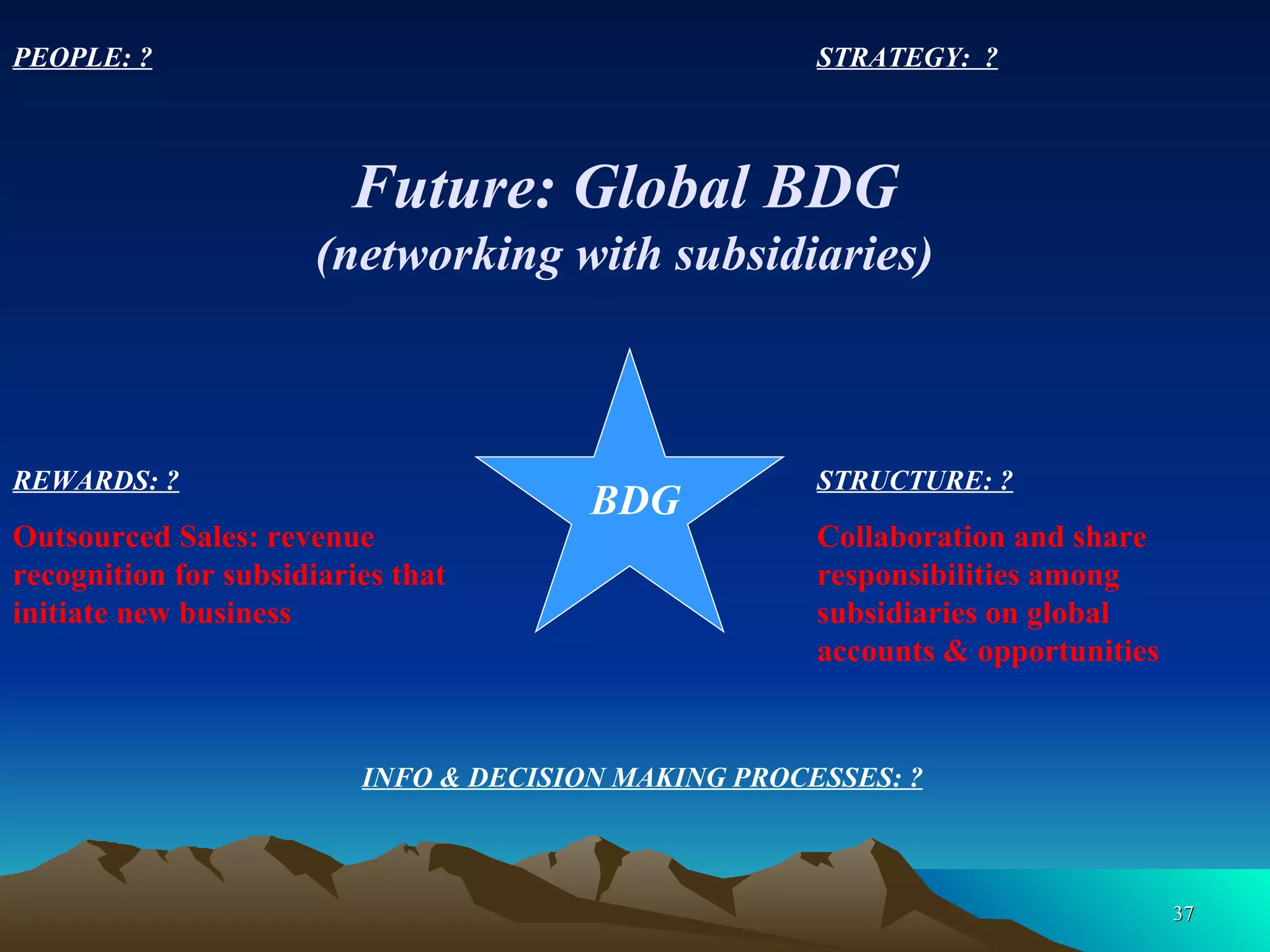
STRATEGY: ?STRUCTURE: ? Collaboration and share responsibilities among subsidiaries on global accounts & opportunities INFO & DECISION MAKING PROCESSES: ? REWARDS: ? Outsourced Sales: revenue recognition for subsidiaries that initiate new business PEOPLE: ? BDG Future: Global BDG (networking with subsidiaries)
38.
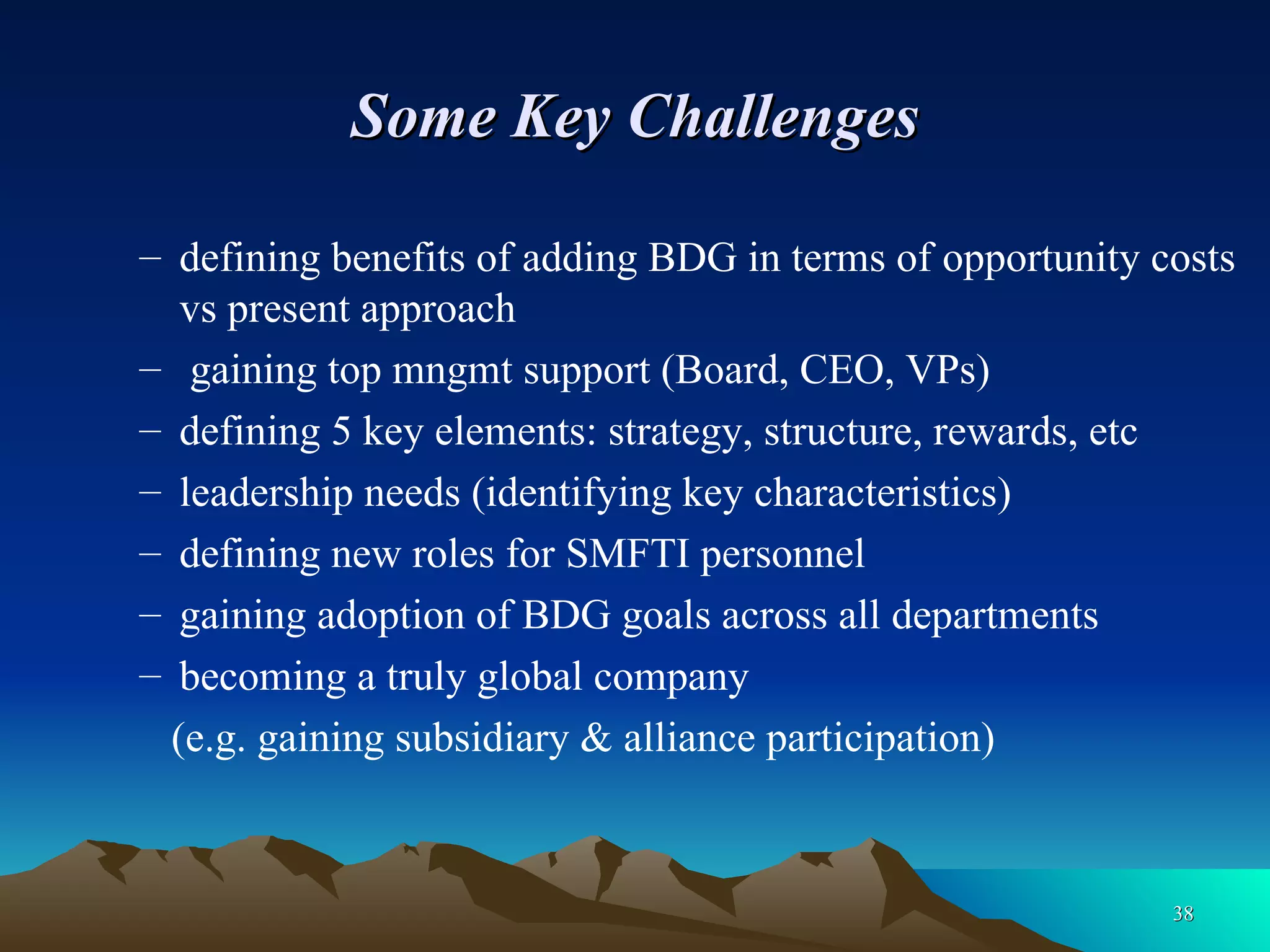
Some Key Challengesdefining benefits of adding BDG in terms of opportunity costs vs present approach gaining top mngmt support (Board, CEO, VPs) defining 5 key elements: strategy, structure, rewards, etc leadership needs (identifying key characteristics) defining new roles for SMFTI personnel gaining adoption of BDG goals across all departments becoming a truly global company (e.g. gaining subsidiary & alliance participation)
39.
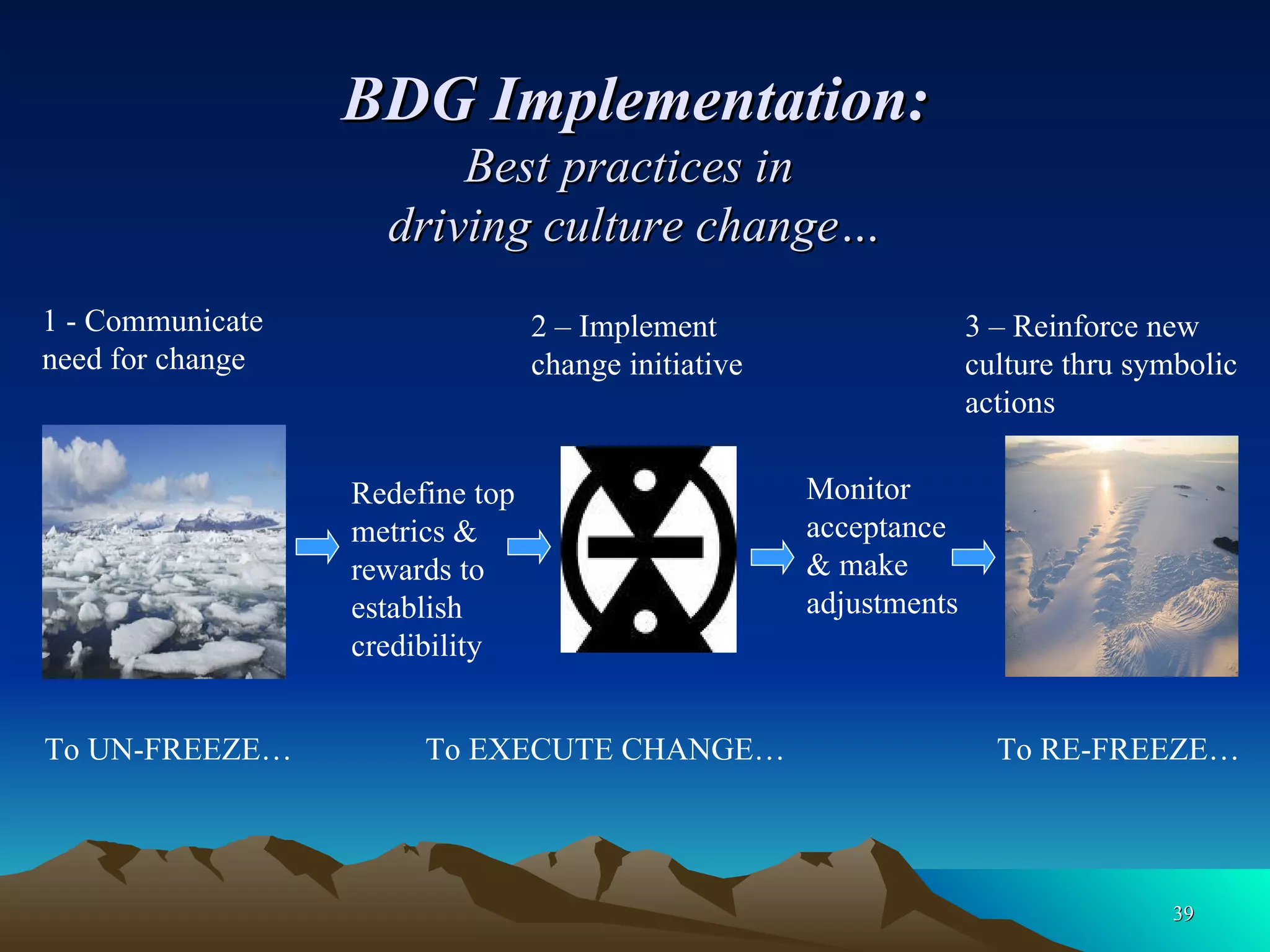
BDG Implementation: Bestpractices in driving culture change… To UN-FREEZE… To EXECUTE CHANGE… To RE-FREEZE… 1 - Communicate need for change Redefine top metrics & rewards to establish credibility Monitor acceptance & make adjustments 2 – Implement change initiative 3 – Reinforce new culture thru symbolic actions