MECHANICAL DESIGN OF OVERHEAD
LINES
8.1 INTRODUCTION
 Electric power can be transmitted or distributed
either by means of underground cables or by
overhead lines.
 The underground cables are rarely used for
power transmission due to two main reasons.
 Firstly, power is generally transmitted over long
distances to load centers. Obviously, the installation
costs for underground transmission will be very heavy.
 Secondly, electric power has to be transmitted at high
voltages for economic reasons. It is very difficult to
provide proper insulation to the cables to withstand
such higher pressures. s
1/15/2015
2
8.1 INTRODUCTION
 An overhead line is subjected to uncertain
weather conditions and other external
interferences.
 This calls for the use of proper mechanical
factors of safety in order to ensure the
continuity of operation in the line. In
general, the strength of the line should be
such so as to provide against the worst
probable weather conditions.
1/15/2015
3
8.1 MAIN COMPONENTS OF OVERHEAD LINES
 In general, the main components of an overhead line are:
1. Conductors which carry electric power from the sending
end station to the receiving end station.
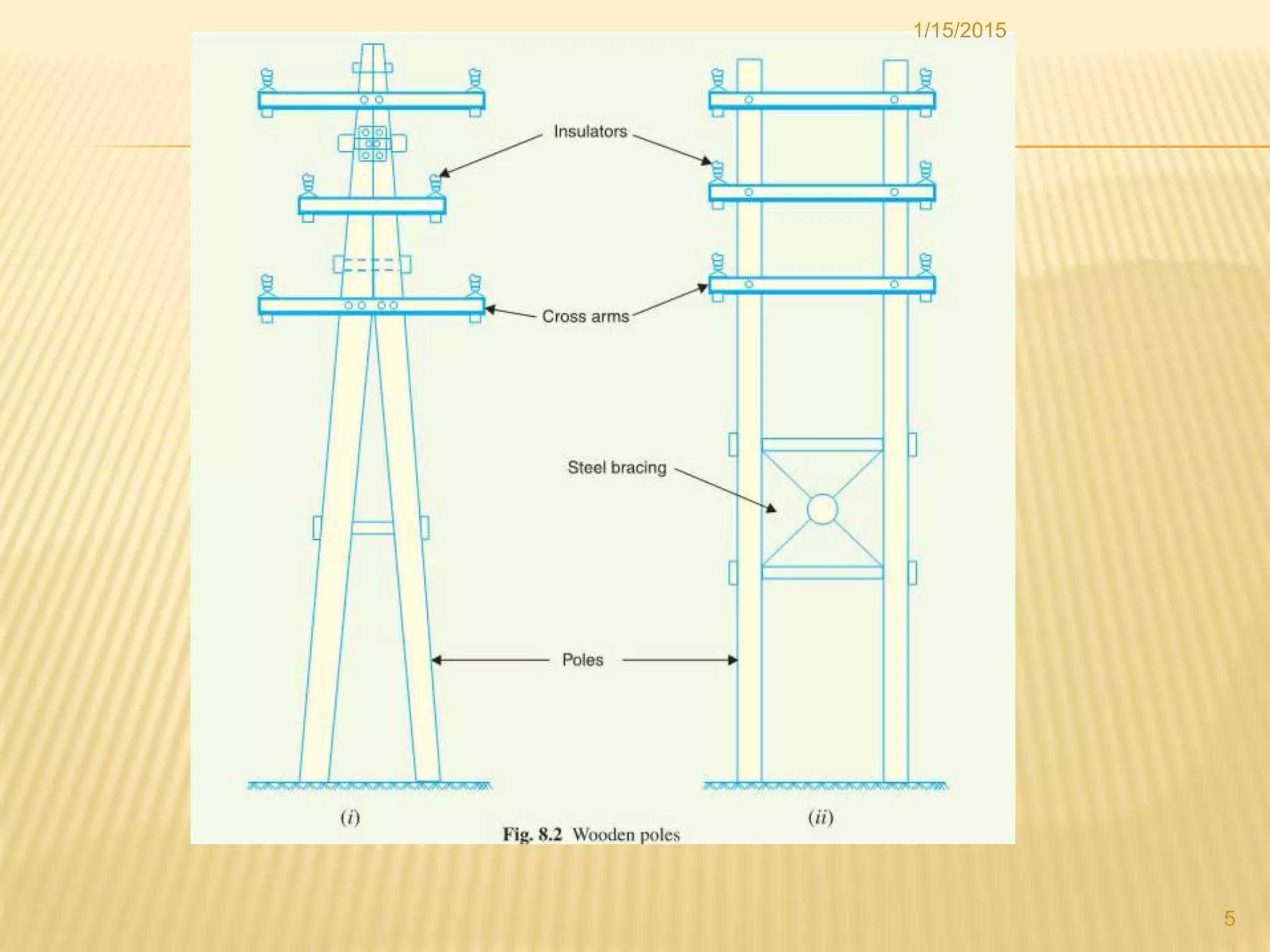
2. Supports which may be poles or towers and keep the
conductors at a suitable level above the ground.
3. Insulators which are attached to supports and insulate
the conductors from the ground.
4. Cross arms which provide support to the insulators.
5. Miscellaneous items such as phase plates, danger
plates, lightning arrestors, anti-climbing wires etc.
 The continuity of operation in the overhead line depends
upon the judicious choice of above components.
1/15/2015
4
1/15/2015
5
8.2 CONDUCTOR MATERIAL
 The conductor material used for transmission
and distribution of electric power should have
the following properties :
1. high electrical conductivity.
2. high tensile strength in order to withstand
mechanical stresses.
3. low cost so that it can be used for long
distances.
4. low specific gravity so that weight per unit
volume is small.
1/15/2015
6
COMMONLY USED CONDUCTOR MATERIALS.
 The most commonly used conductor materials
for overhead lines are
 Copper
 aluminium
 steel-cored aluminium
 galvanized steel
 cadmium copper.
 The choice of a particular material will depend
upon the cost, the required electrical and
mechanical, properties and the local conditions.
1/15/2015
7
8.3 LINE SUPPORTS
 The supporting structures for overhead line
conductors are various types of poles and
towers called line supports. In general, the line
supports should have the following properties :
1. High mechanical strength to withstand the
weight of conductors and wind loads etc.
2. without the loss of mechanical strength.
3. Cheap in cost and economical to maintain.
4. Longer life.
5. Easy accessibility of conductors for
maintenance.
1/15/2015
8
8.3 LINE SUPPORTS
 The line supports used for transmission and
distribution of electric power are of various
types including
i. wooden poles
ii. steel poles
iii. R.C.C. poles
iv. lattice steel towers.
1/15/2015
9
8.3 LINE SUPPORTS
The choice of supporting structure for a particular
case depends upon the
i. line span
ii. X-sectional area
iii. line voltage
iv. Cost
v. local conditions
1/15/2015
10
8.4 INSULATORS
 The overhead line conductors should be
supported on the poles or towers in such a way
that currents from conductors do not flow to
earth through supports i.e., line conductors must
be properly insulated from supports. This is
achieved by securing line conductors to
supports with the help of insulators. The
insulators provide necessary insulation between
line conductors and supports and thus prevent
any leakage current from conductors to earth.
1/15/2015
11
8.4 INSULATORS
 In general, the insulators should have the following
desirable properties :
1. High mechanical strength in order to withstand
conductor load, wind load etc.
2. High electrical resistance of insulator material in
order to avoid leakage currents to earth.
3. High relative permittivity of insulator material in
order that dielectric strength is high.
4. The insulator material should be non-porous, free
from impurities and cracks otherwise the
permittivity will be lowered.
5. High ratio of puncture strength to flashover.
1/15/2015
12
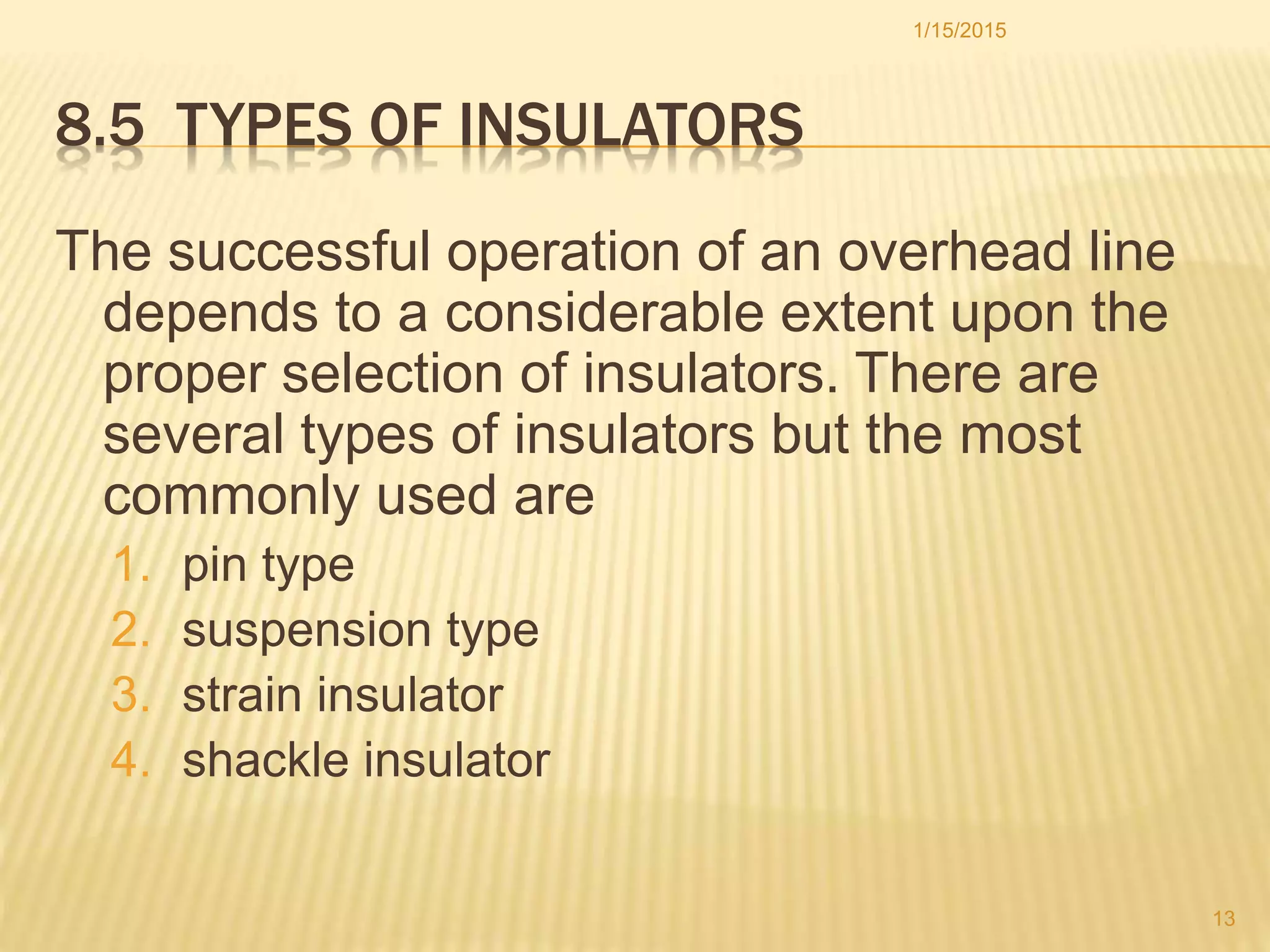
8.5 TYPES OF INSULATORS
The successful operation of an overhead line
depends to a considerable extent upon the
proper selection of insulators. There are
several types of insulators but the most
commonly used are
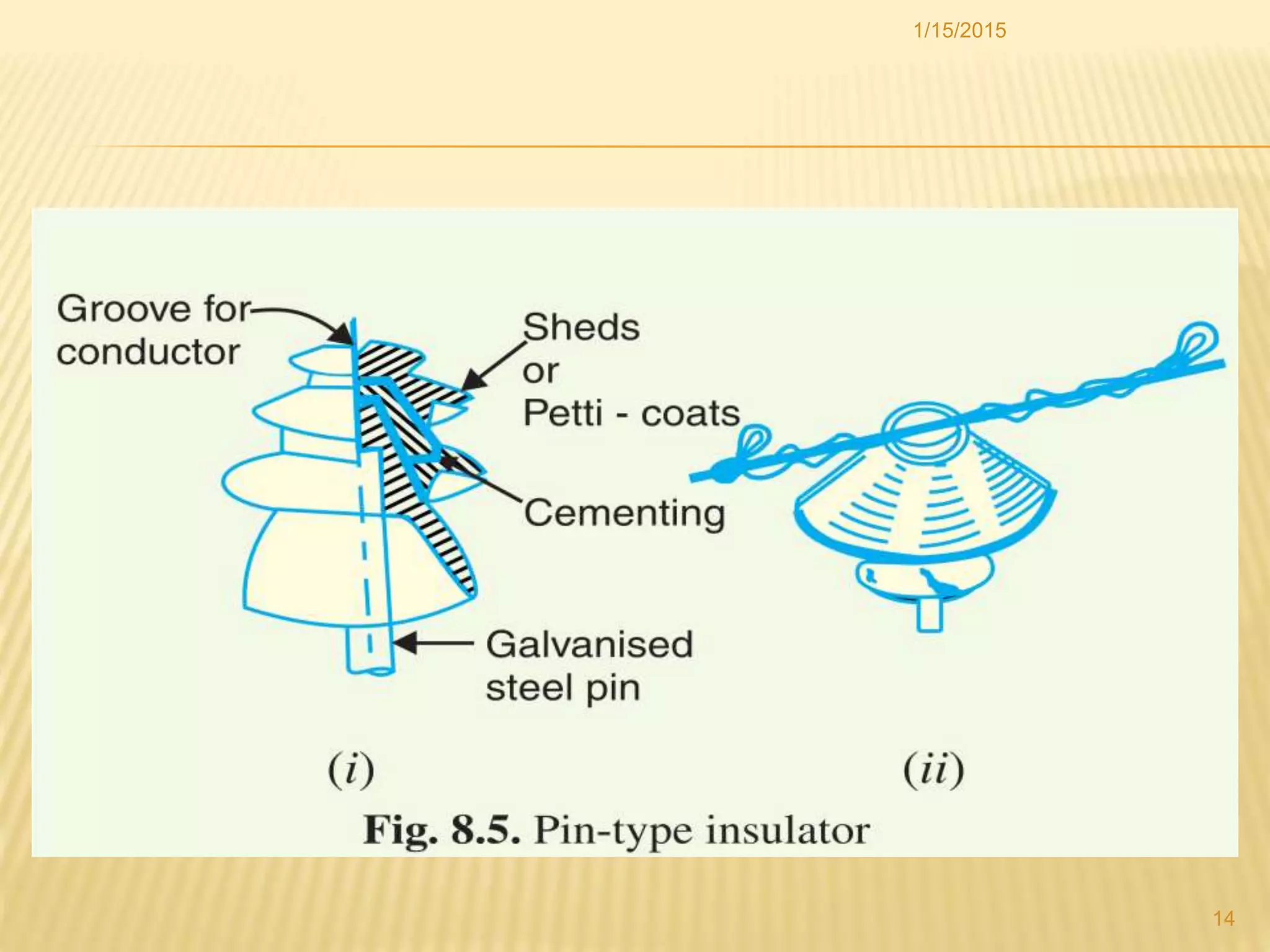
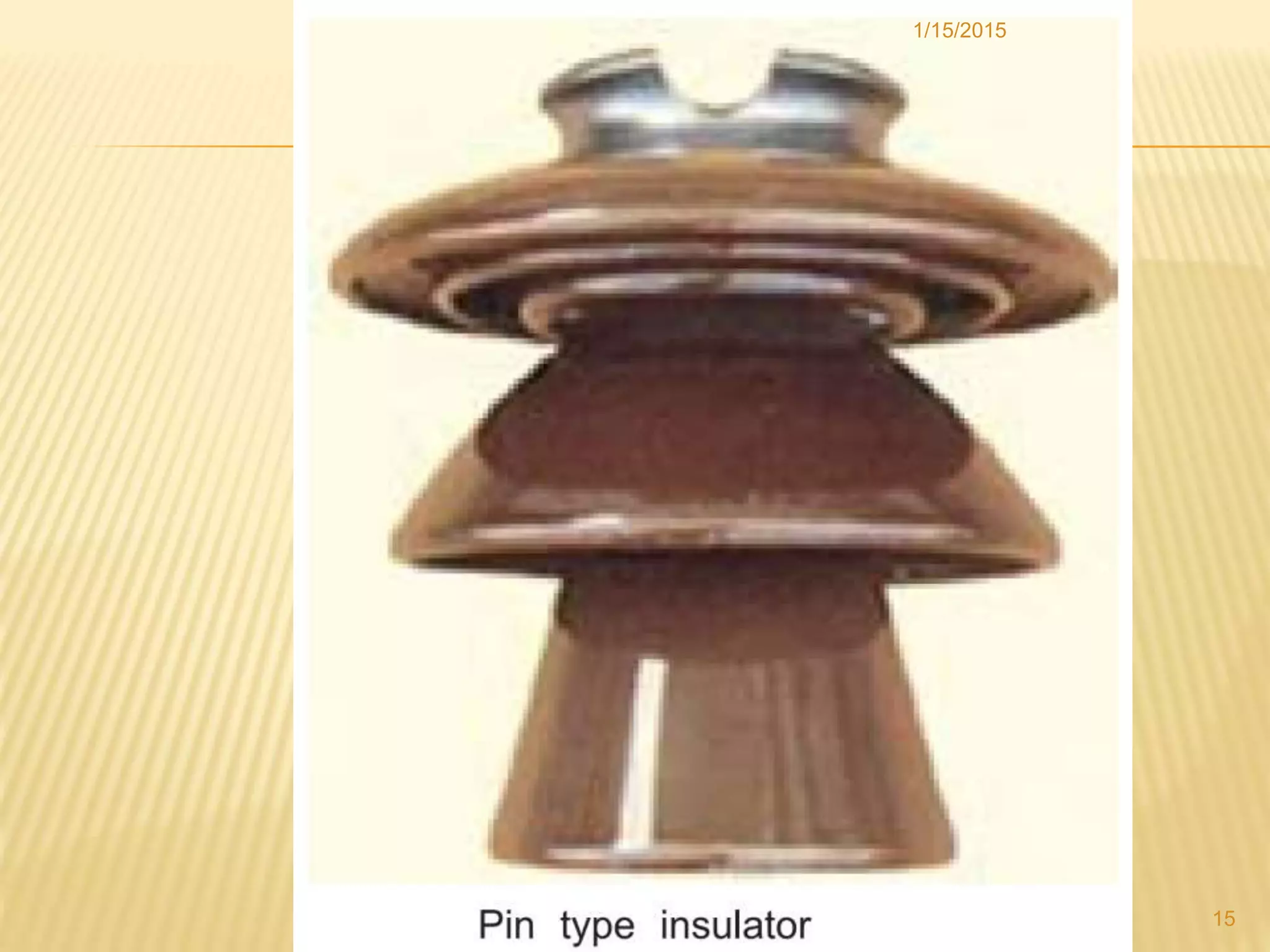
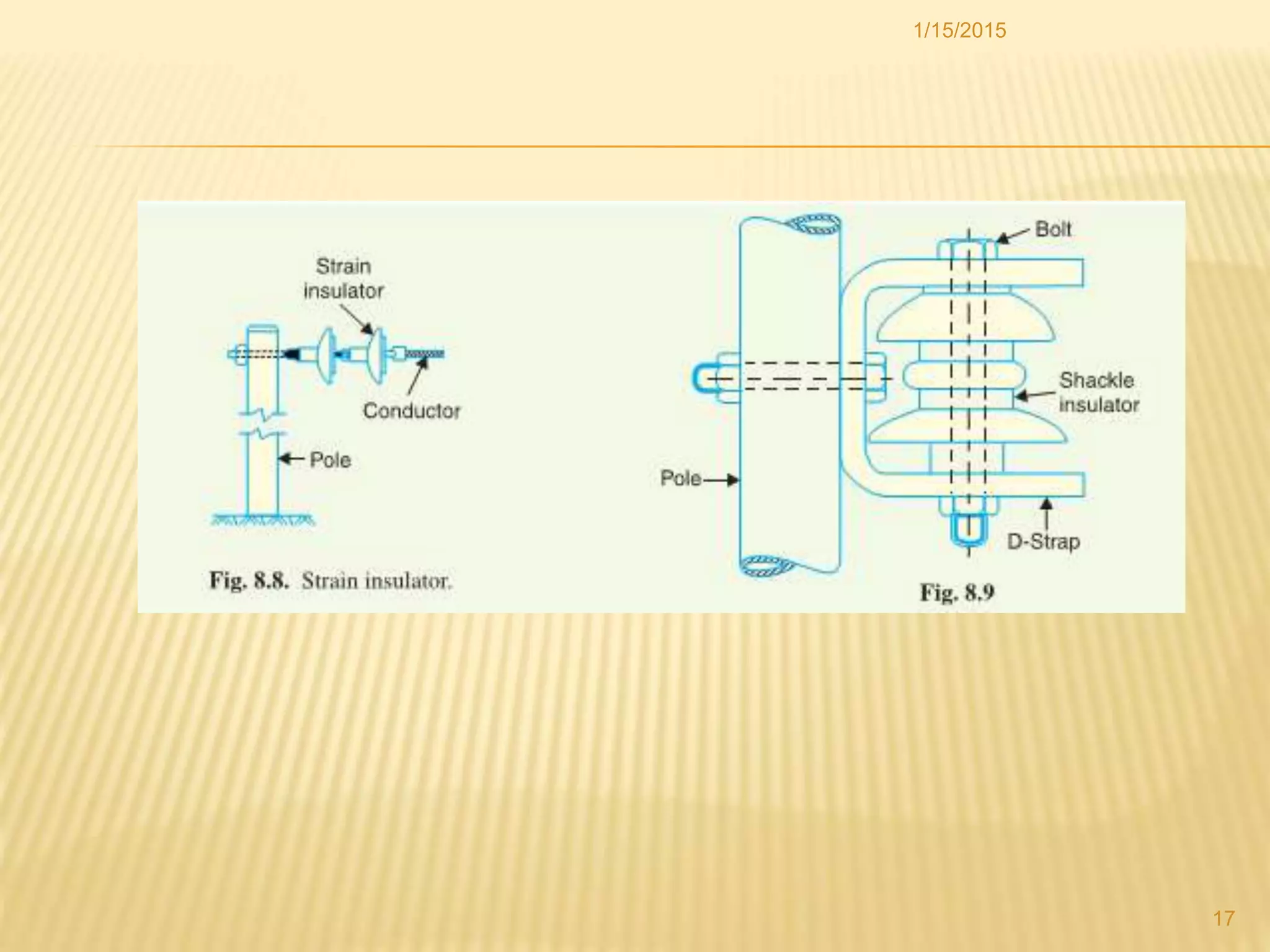
1. pin type
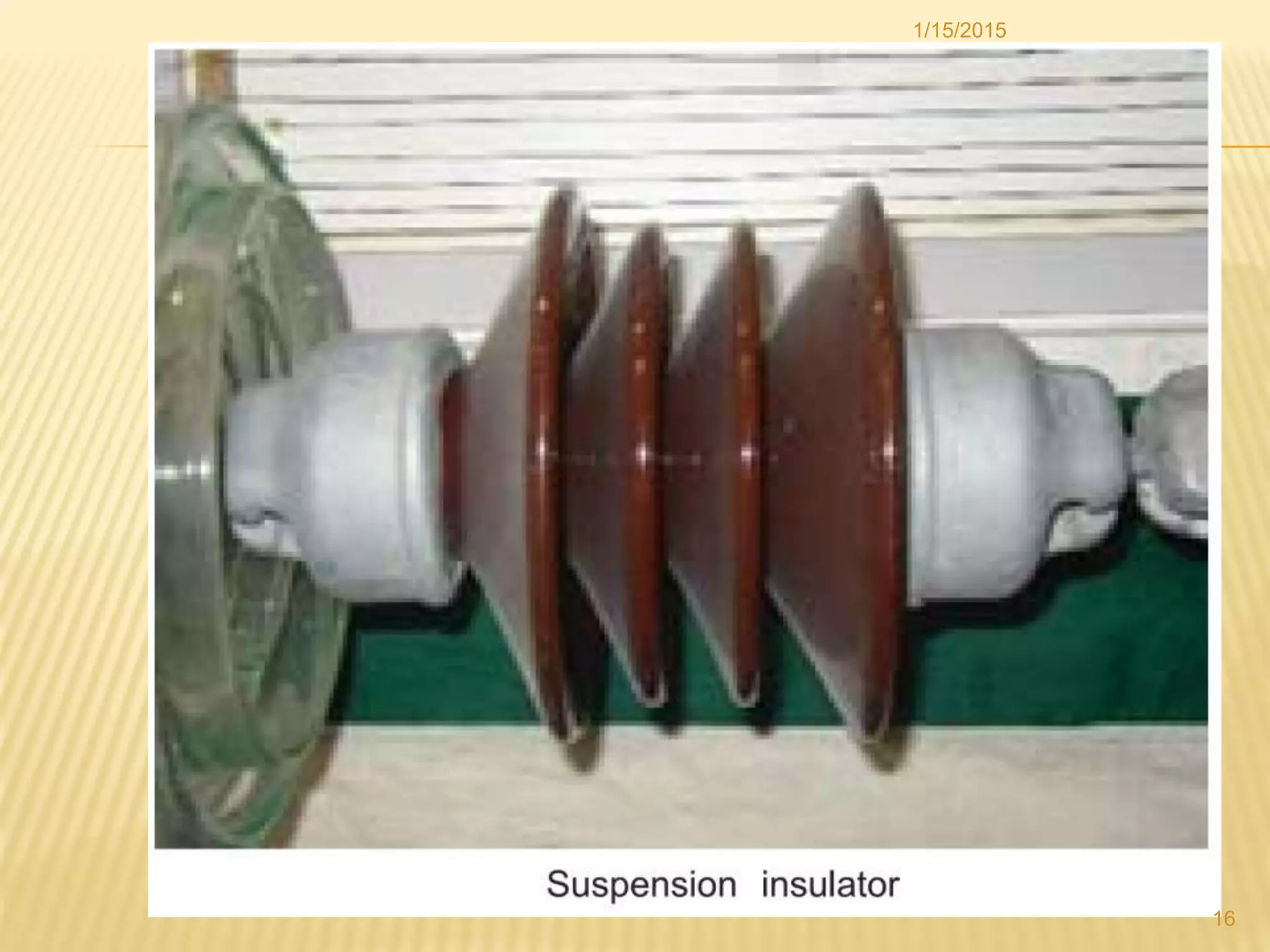
2. suspension type
3. strain insulator
4. shackle insulator
1/15/2015
13
1/15/2015
14
1/15/2015
15
1/15/2015
16
1/15/2015
17
8.10 CORONA
 When an alternating potential difference is applied
across two conductors whose spacing is large as
compared to their diameters, there is no apparent
change in the condition of atmospheric air surrounding
the wires if the applied voltage is low. However, when
the applied voltage exceeds a certain value, called
critical disruptive voltage ,the conductors are
surrounded by a faint violet glow called corona.
 The phenomenon of corona is accompanied by a hissing
sound, production of ozone, power loss and radio
interference.
 The higher the voltage is raised, the larger and higher
the luminous envelope becomes, and greater are the
sound, the power loss and the radio noise.
1/15/2015
18
8.10 CORONA
 If the applied voltage is increased to breakdown
value, a flash-over will occur between the conductors
due to the breakdown of air insulation.
 The phenomenon of violet glow, hissing noise and
production of ozone gas in an overhead
transmission line is known as corona.
 If the conductors are polished and smooth, the
corona glow will be uniform throughout the length of
the conductors, otherwise the rough points will
appear brighter.
 With d.c. voltage, there is difference in the
appearance of the two wires. The positive wire has
uniform glow about it, while the negative conductor
has spotty glow.
1/15/2015
19
THEORY OF CORONA FORMATION
 Some ionised particles (i.e.,free electrons and
+ve ions) and neutral molecules always present
in air
 When p.d. is applied between the conductors,
potential gradient is set up in the air which will
have maximum value at the conductor surfaces.
 Under the influence of potential gradient, the
existing free electrons acquire greater velocities.
The greater the applied voltage, the greater the
potential gradient and more is the velocity of
free electrons.
1/15/2015
20
THEORY OF CORONA FORMATION
 When the potential gradient at the conductor
surface reaches about 30 kV per cm (max.
value), the velocity acquired by the free
electrons is sufficient to strike a neutral
molecule with enough force to dislodge one or
more electrons from it. This produces another
ion and one or more free electrons, which is turn
are accelerated until they collide with other
neutral molecules, thus producing other ions.
Thus, the process of ionization is cumulative.
The result of this ionization is that either corona
is formed or spark takes place between the
conductors
1/15/2015
21
8.11 FACTORS AFFECTING CORONA
 The phenomenon of corona is affected by the physical state of
the atmosphere as well as by the conditions of the line. The
following are the factors upon which corona depends :
1. Atmosphere: As corona is formed due to ionization of air
surrounding the conductors, therefore, it is affected by the
physical state of atmosphere. In the stormy weather, the
number of ions is more than normal and as such corona
occurs at much less voltage as compared with fair weather.
2. Conductor condition: The corona effect depends upon the
shape and conditions of the conductors. The rough and
irregular surface will give rise to more corona because
unevenness of the surface decreases the value of
breakdown voltage. Thus a stranded conductor has irregular
surface and hence gives rise to more corona that a solid
conductor.
1/15/2015
22
8.11 FACTORS AFFECTING CORONA
3. Spacing between conductors: If the spacing
between the conductors is made very large as
compared to their diameters, there may not be any
corona effect. It is because larger distance between
conductors reduces the electro-static stresses at the
conductor surface, thus avoiding corona formation.
4. Line voltage: The line voltage greatly affects
corona. If it is low, there is no change in the
condition of air surrounding the conductors and
hence no corona is formed. However, if the line
voltage has such a value that electrostatic stresses
developed at the conductor surface make the air
around the conductor conducting, then corona is
formed.
1/15/2015
23
8.13 ADVANTAGES AND DISADVANTAGES OF
CORONA
 Corona has many advantages and disadvantages. In the
correct design of a high voltage overhead line, a balance
should be struck between the advantages and
disadvantages.
Advantages
1. Due to corona formation, the air surrounding the
conductor becomes conducting and hence virtual
diameter of the conductor is increased. The
increased diameter reduces the electrostatic
stresses between the conductors.
2. Corona reduces the effects of transients produced
by surges.
1/15/2015
24
8.13 ADVANTAGES AND DISADVANTAGES OF
CORONA
Disadvantage
1. Corona is accompanied by a loss of energy.
This affects the transmission efficiency of the
line.
2. Ozone is produced by corona and may cause
corrosion of the conductor due to chemical
action.
3. The current drawn by the line due to corona is
non-sinusoidal and hence non-sinusoidal
voltage drop occurs in the line. This may cause
inductive interference with neighbouring
communication lines.
1/15/2015
25
8.14METHODS OF REDUCING CORONA EFFECT
 The corona effects can be reduced by the following
methods :
1. By increasing conductor size, the voltage at which
corona occurs is raised and hence corona effects are
considerably reduced. This is one of the reasons that
ACSR conductors which have a larger cross-sectional
area are used in transmission lines.
2. By increasing the spacing between conductors, the
voltage at which corona occurs is raised and hence
corona effects can be eliminated. However, spacing
cannot be increased too much otherwise the cost of
supporting structure (e.g., bigger cross arms and
supports) may increase to a considerable extent
1/15/2015
26
1/15/2015
27

Mechanical design of overhead lines

  • 1.
    MECHANICAL DESIGN OFOVERHEAD LINES
  • 2.
    8.1 INTRODUCTION  Electricpower can be transmitted or distributed either by means of underground cables or by overhead lines.  The underground cables are rarely used for power transmission due to two main reasons.  Firstly, power is generally transmitted over long distances to load centers. Obviously, the installation costs for underground transmission will be very heavy.  Secondly, electric power has to be transmitted at high voltages for economic reasons. It is very difficult to provide proper insulation to the cables to withstand such higher pressures. s 1/15/2015 2
  • 3.
    8.1 INTRODUCTION  Anoverhead line is subjected to uncertain weather conditions and other external interferences.  This calls for the use of proper mechanical factors of safety in order to ensure the continuity of operation in the line. In general, the strength of the line should be such so as to provide against the worst probable weather conditions. 1/15/2015 3
  • 4.
    8.1 MAIN COMPONENTSOF OVERHEAD LINES  In general, the main components of an overhead line are: 1. Conductors which carry electric power from the sending end station to the receiving end station. 2. Supports which may be poles or towers and keep the conductors at a suitable level above the ground. 3. Insulators which are attached to supports and insulate the conductors from the ground. 4. Cross arms which provide support to the insulators. 5. Miscellaneous items such as phase plates, danger plates, lightning arrestors, anti-climbing wires etc.  The continuity of operation in the overhead line depends upon the judicious choice of above components. 1/15/2015 4
  • 5.
  • 6.
    8.2 CONDUCTOR MATERIAL The conductor material used for transmission and distribution of electric power should have the following properties : 1. high electrical conductivity. 2. high tensile strength in order to withstand mechanical stresses. 3. low cost so that it can be used for long distances. 4. low specific gravity so that weight per unit volume is small. 1/15/2015 6
  • 7.
    COMMONLY USED CONDUCTORMATERIALS.  The most commonly used conductor materials for overhead lines are  Copper  aluminium  steel-cored aluminium  galvanized steel  cadmium copper.  The choice of a particular material will depend upon the cost, the required electrical and mechanical, properties and the local conditions. 1/15/2015 7
  • 8.
    8.3 LINE SUPPORTS The supporting structures for overhead line conductors are various types of poles and towers called line supports. In general, the line supports should have the following properties : 1. High mechanical strength to withstand the weight of conductors and wind loads etc. 2. without the loss of mechanical strength. 3. Cheap in cost and economical to maintain. 4. Longer life. 5. Easy accessibility of conductors for maintenance. 1/15/2015 8
  • 9.
    8.3 LINE SUPPORTS The line supports used for transmission and distribution of electric power are of various types including i. wooden poles ii. steel poles iii. R.C.C. poles iv. lattice steel towers. 1/15/2015 9
  • 10.
    8.3 LINE SUPPORTS Thechoice of supporting structure for a particular case depends upon the i. line span ii. X-sectional area iii. line voltage iv. Cost v. local conditions 1/15/2015 10
  • 11.
    8.4 INSULATORS  Theoverhead line conductors should be supported on the poles or towers in such a way that currents from conductors do not flow to earth through supports i.e., line conductors must be properly insulated from supports. This is achieved by securing line conductors to supports with the help of insulators. The insulators provide necessary insulation between line conductors and supports and thus prevent any leakage current from conductors to earth. 1/15/2015 11
  • 12.
    8.4 INSULATORS  Ingeneral, the insulators should have the following desirable properties : 1. High mechanical strength in order to withstand conductor load, wind load etc. 2. High electrical resistance of insulator material in order to avoid leakage currents to earth. 3. High relative permittivity of insulator material in order that dielectric strength is high. 4. The insulator material should be non-porous, free from impurities and cracks otherwise the permittivity will be lowered. 5. High ratio of puncture strength to flashover. 1/15/2015 12
  • 13.
    8.5 TYPES OFINSULATORS The successful operation of an overhead line depends to a considerable extent upon the proper selection of insulators. There are several types of insulators but the most commonly used are 1. pin type 2. suspension type 3. strain insulator 4. shackle insulator 1/15/2015 13
  • 14.
  • 15.
  • 16.
  • 17.
  • 18.
    8.10 CORONA  Whenan alternating potential difference is applied across two conductors whose spacing is large as compared to their diameters, there is no apparent change in the condition of atmospheric air surrounding the wires if the applied voltage is low. However, when the applied voltage exceeds a certain value, called critical disruptive voltage ,the conductors are surrounded by a faint violet glow called corona.  The phenomenon of corona is accompanied by a hissing sound, production of ozone, power loss and radio interference.  The higher the voltage is raised, the larger and higher the luminous envelope becomes, and greater are the sound, the power loss and the radio noise. 1/15/2015 18
  • 19.
    8.10 CORONA  Ifthe applied voltage is increased to breakdown value, a flash-over will occur between the conductors due to the breakdown of air insulation.  The phenomenon of violet glow, hissing noise and production of ozone gas in an overhead transmission line is known as corona.  If the conductors are polished and smooth, the corona glow will be uniform throughout the length of the conductors, otherwise the rough points will appear brighter.  With d.c. voltage, there is difference in the appearance of the two wires. The positive wire has uniform glow about it, while the negative conductor has spotty glow. 1/15/2015 19
  • 20.
    THEORY OF CORONAFORMATION  Some ionised particles (i.e.,free electrons and +ve ions) and neutral molecules always present in air  When p.d. is applied between the conductors, potential gradient is set up in the air which will have maximum value at the conductor surfaces.  Under the influence of potential gradient, the existing free electrons acquire greater velocities. The greater the applied voltage, the greater the potential gradient and more is the velocity of free electrons. 1/15/2015 20
  • 21.
    THEORY OF CORONAFORMATION  When the potential gradient at the conductor surface reaches about 30 kV per cm (max. value), the velocity acquired by the free electrons is sufficient to strike a neutral molecule with enough force to dislodge one or more electrons from it. This produces another ion and one or more free electrons, which is turn are accelerated until they collide with other neutral molecules, thus producing other ions. Thus, the process of ionization is cumulative. The result of this ionization is that either corona is formed or spark takes place between the conductors 1/15/2015 21
  • 22.
    8.11 FACTORS AFFECTINGCORONA  The phenomenon of corona is affected by the physical state of the atmosphere as well as by the conditions of the line. The following are the factors upon which corona depends : 1. Atmosphere: As corona is formed due to ionization of air surrounding the conductors, therefore, it is affected by the physical state of atmosphere. In the stormy weather, the number of ions is more than normal and as such corona occurs at much less voltage as compared with fair weather. 2. Conductor condition: The corona effect depends upon the shape and conditions of the conductors. The rough and irregular surface will give rise to more corona because unevenness of the surface decreases the value of breakdown voltage. Thus a stranded conductor has irregular surface and hence gives rise to more corona that a solid conductor. 1/15/2015 22
  • 23.
    8.11 FACTORS AFFECTINGCORONA 3. Spacing between conductors: If the spacing between the conductors is made very large as compared to their diameters, there may not be any corona effect. It is because larger distance between conductors reduces the electro-static stresses at the conductor surface, thus avoiding corona formation. 4. Line voltage: The line voltage greatly affects corona. If it is low, there is no change in the condition of air surrounding the conductors and hence no corona is formed. However, if the line voltage has such a value that electrostatic stresses developed at the conductor surface make the air around the conductor conducting, then corona is formed. 1/15/2015 23
  • 24.
    8.13 ADVANTAGES ANDDISADVANTAGES OF CORONA  Corona has many advantages and disadvantages. In the correct design of a high voltage overhead line, a balance should be struck between the advantages and disadvantages. Advantages 1. Due to corona formation, the air surrounding the conductor becomes conducting and hence virtual diameter of the conductor is increased. The increased diameter reduces the electrostatic stresses between the conductors. 2. Corona reduces the effects of transients produced by surges. 1/15/2015 24
  • 25.
    8.13 ADVANTAGES ANDDISADVANTAGES OF CORONA Disadvantage 1. Corona is accompanied by a loss of energy. This affects the transmission efficiency of the line. 2. Ozone is produced by corona and may cause corrosion of the conductor due to chemical action. 3. The current drawn by the line due to corona is non-sinusoidal and hence non-sinusoidal voltage drop occurs in the line. This may cause inductive interference with neighbouring communication lines. 1/15/2015 25
  • 26.
    8.14METHODS OF REDUCINGCORONA EFFECT  The corona effects can be reduced by the following methods : 1. By increasing conductor size, the voltage at which corona occurs is raised and hence corona effects are considerably reduced. This is one of the reasons that ACSR conductors which have a larger cross-sectional area are used in transmission lines. 2. By increasing the spacing between conductors, the voltage at which corona occurs is raised and hence corona effects can be eliminated. However, spacing cannot be increased too much otherwise the cost of supporting structure (e.g., bigger cross arms and supports) may increase to a considerable extent 1/15/2015 26
  • 27.