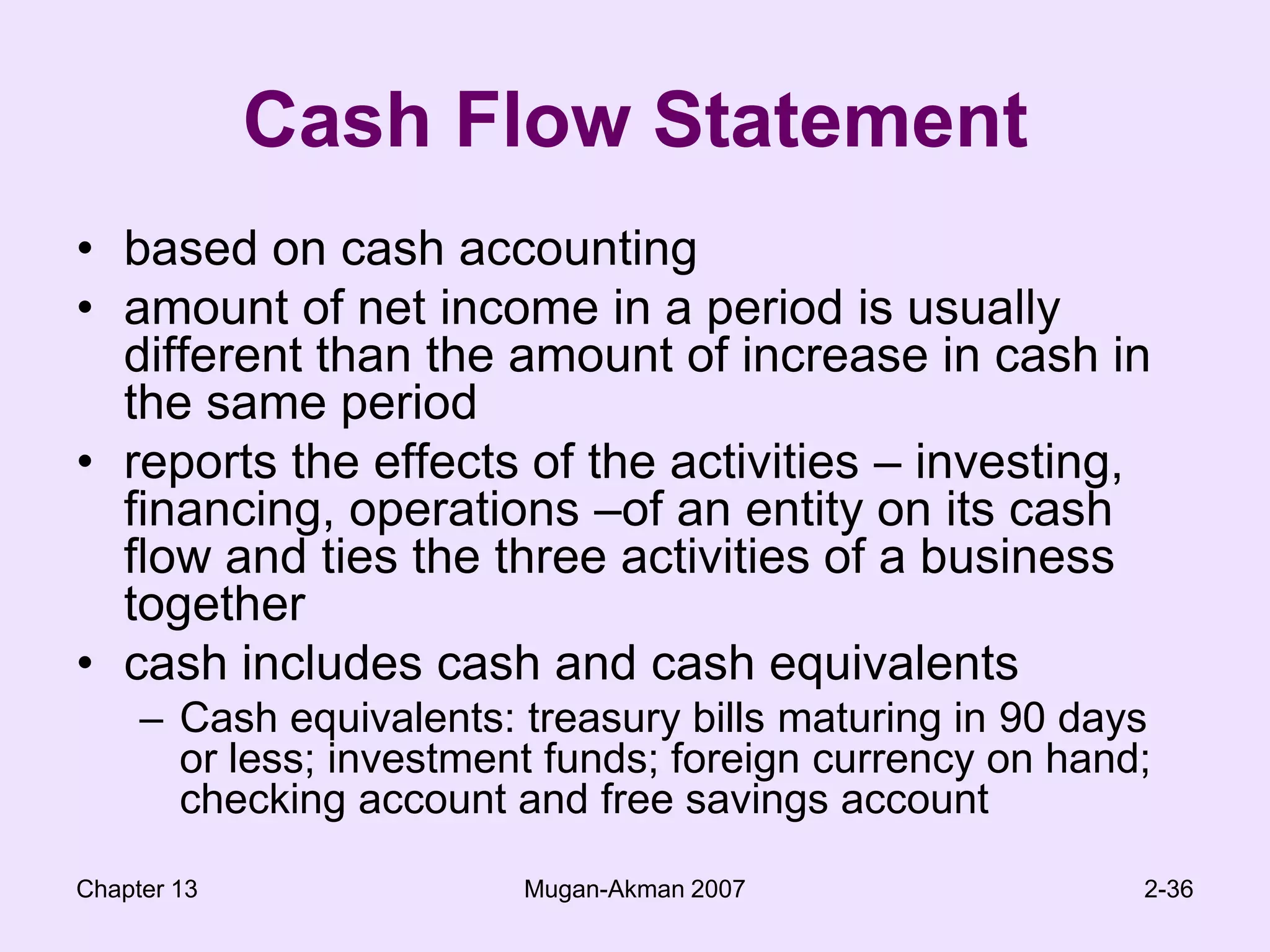
Chapter 13Mugan-Akman 20072-36Cash Flow Statementbased on cash accountingamount of net income in a period is usually different than the amount of increase in cash in the same periodreports the effects of the activities – investing, financing, operations –of an entity on its cash flow and ties the three activities of a business togethercash includes cash and cash equivalentsCash equivalents: treasury bills maturing in 90 days or less; investment funds; foreign currency on hand; checking account and free savings account
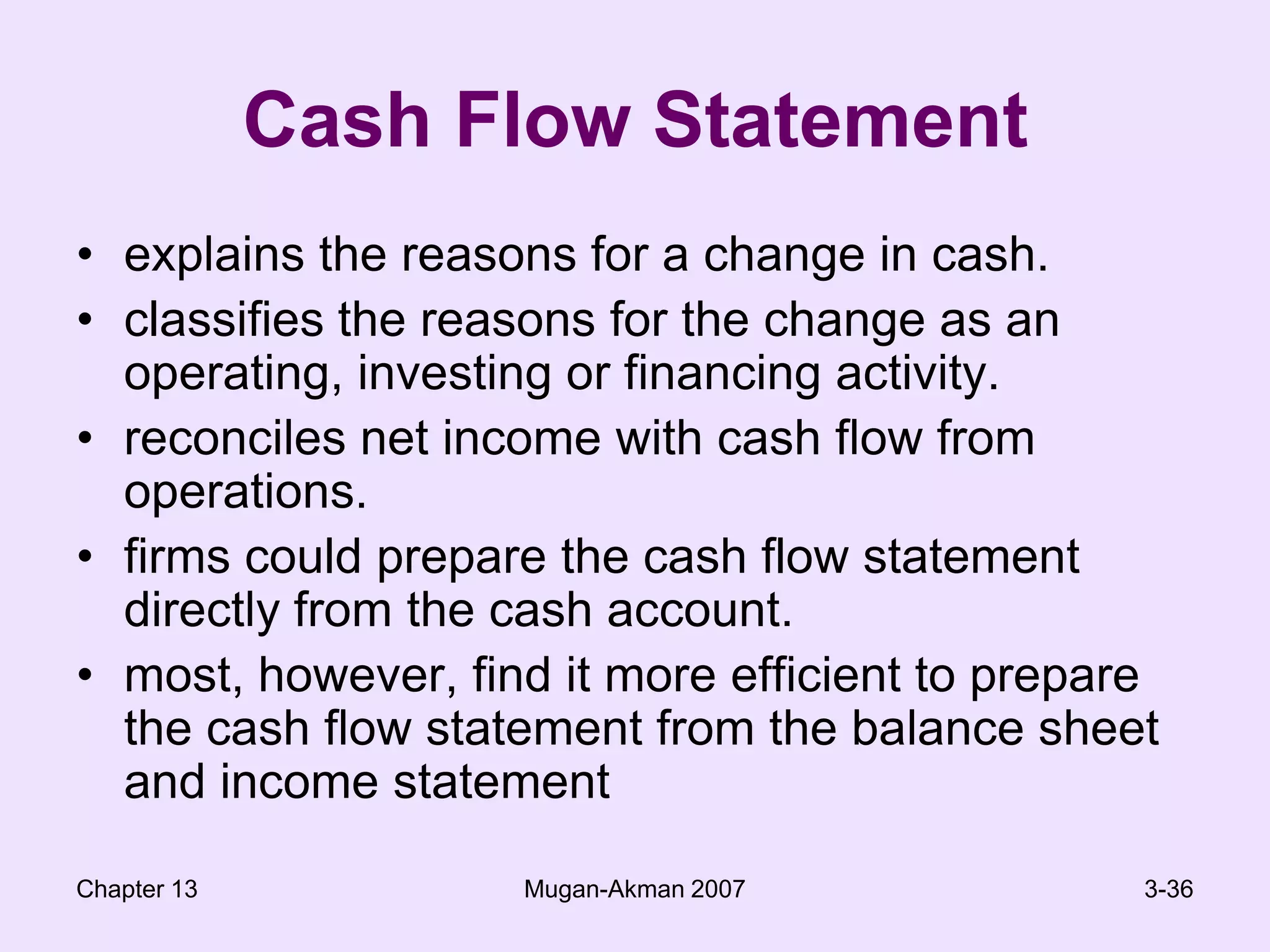
Chapter 13Mugan-Akman 20073-36Cash Flow Statementexplains the reasons for a change in cash.classifies the reasons for the change as an operating, investing or financing activity.reconciles net income with cash flow from operations.firms could prepare the cash flow statement directly from the cash account.most, however, find it more efficient to prepare the cash flow statement from the balance sheet and income statement
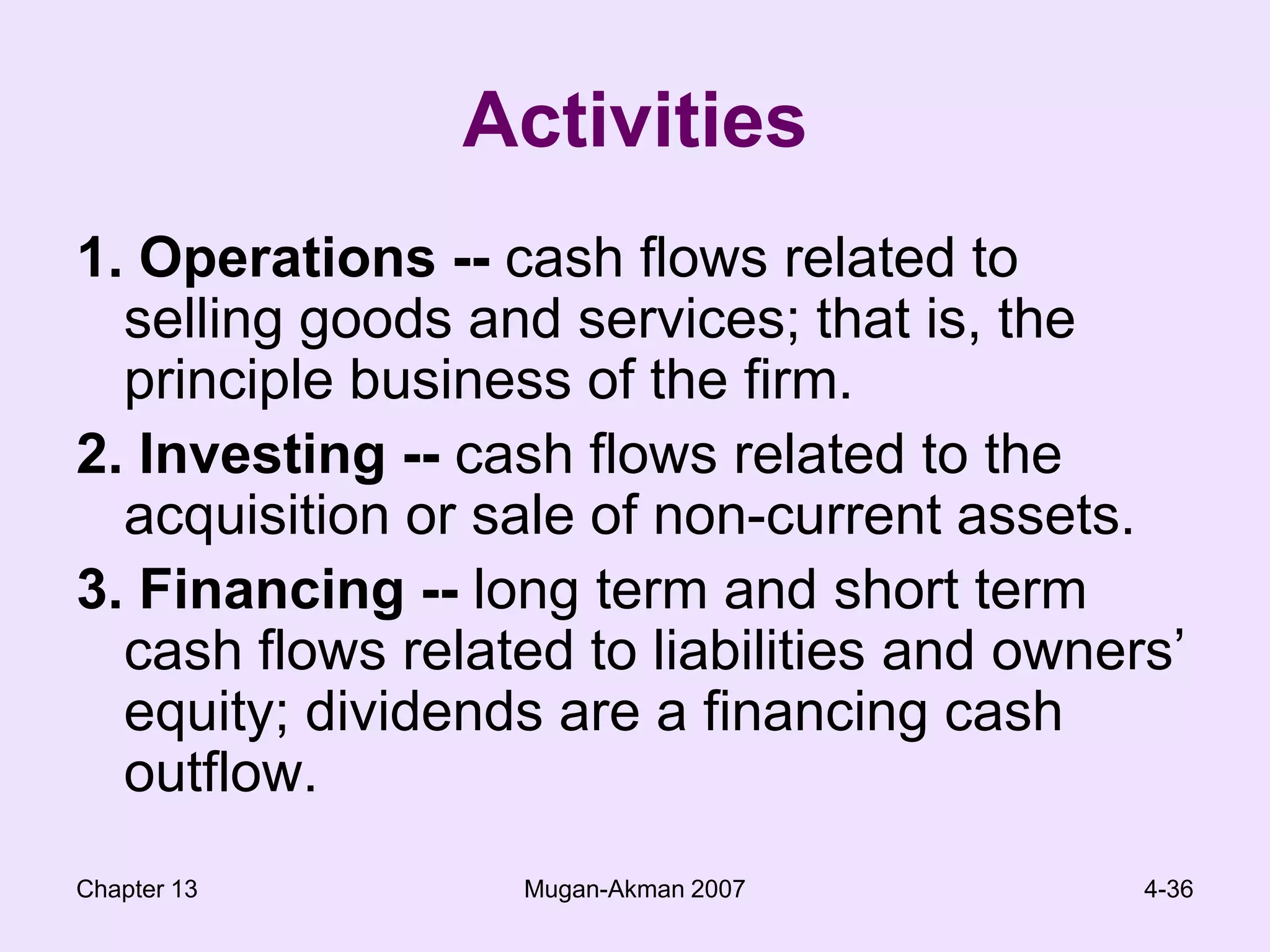
Chapter 13Mugan-Akman 20074-36Activities1. Operations -- cash flows related to selling goods and services; that is, the principle business of the firm.2. Investing -- cash flows related to the acquisition or sale of non-current assets.3. Financing -- long term and short term cash flows related to liabilities and owners’ equity; dividends are a financing cash outflow.
Chapter 13Mugan-Akman 20075-36External Uses of CFSTo assess the ability of a firm to manage cash flowsTo assess the ability of a firm to generate cash through its operationsTo assess the company’s ability to meet its obligations and its dividend policyTo provide information about the effectiveness of the firm to convert its revenues to cashTo provide information to estimate or anticipate the company’s need for additional financing
Chapter 13Mugan-Akman 20076-36Internal Uses of CFSAlong side with cash budget CFS is used:To assess liquidityDetermine if short-term financing is necessaryTo determine dividend policyDecide to distribute; or increase or decreaseTo evaluate the investment and financing decisions
Chapter 13Mugan-Akman 20077-36Cash flow from operating activitiesExamples (IAS No.7):cash received from customers through sale of goods or services performed;cash received from non-operating activities such as dividends from investments, interest revenue, commissions, and fees;cash payments to suppliers or employees;cash payments for taxes and other expenses;In effect, the income statement is changed from accrual basis to cash basis
Chapter 13Mugan-Akman 20078-36Investing ActivitiesExamples of investing activities include (IAS No.7):cash payments to acquire property, plant, and equipment (PPE), other tangible or intangible assets, and other long-term assets;cash received from sales of assets that are not held for the regular trading purposes such as sale of building; marketable securities such as trading and available for sale securities, and investments;loans extended to other companies; and collection of such loans;cash received from sale of, and paid for purchases of derivative instruments;
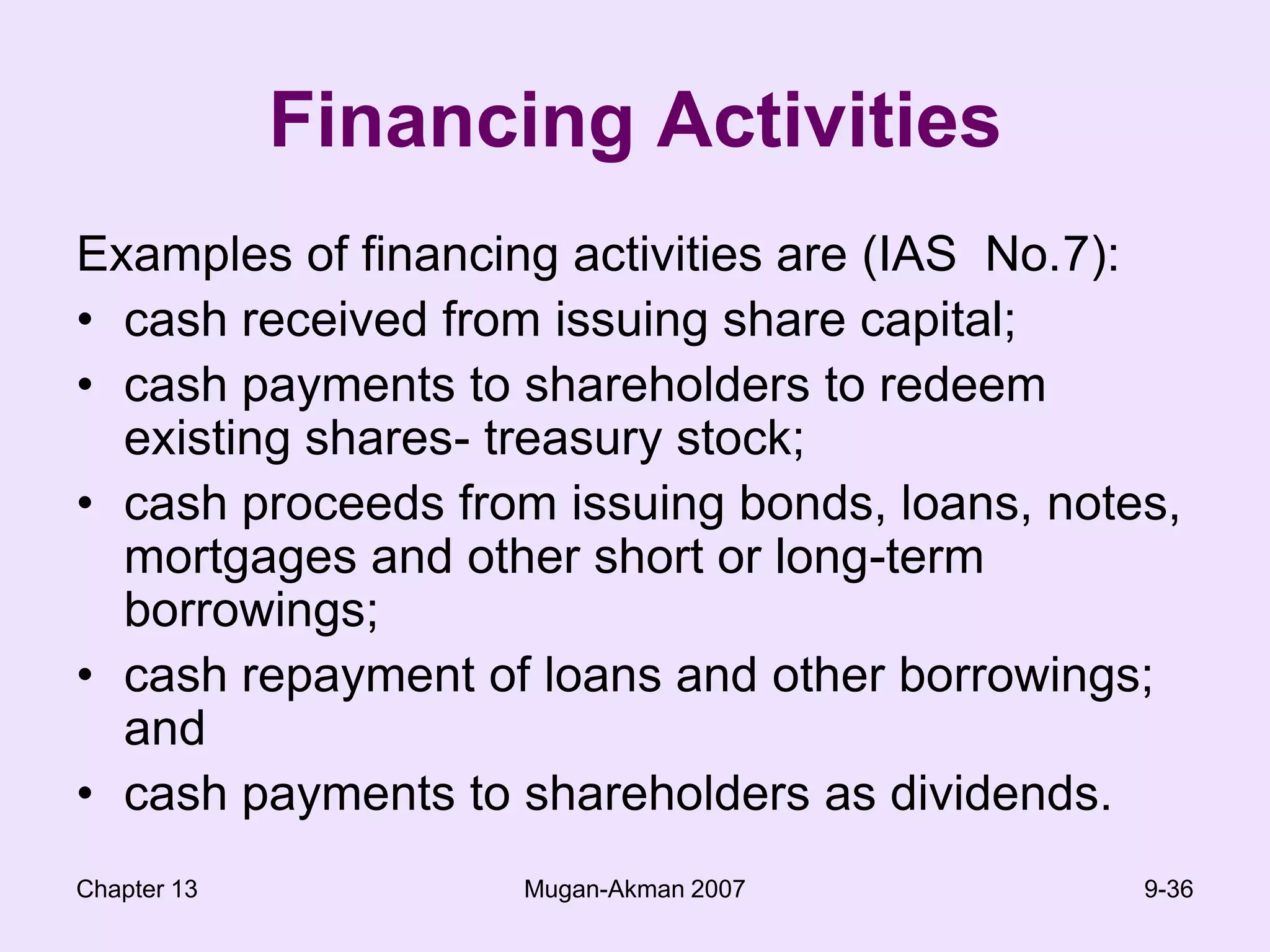
Chapter 13Mugan-Akman 20079-36Financing ActivitiesExamples of financing activities are (IAS  No.7):cash received from issuing share capital;cash payments to shareholders to redeem existing shares- treasury stock;cash proceeds from issuing bonds, loans, notes, mortgages and other short or long-term borrowings;cash repayment of loans and other borrowings; andcash payments to shareholders as dividends.
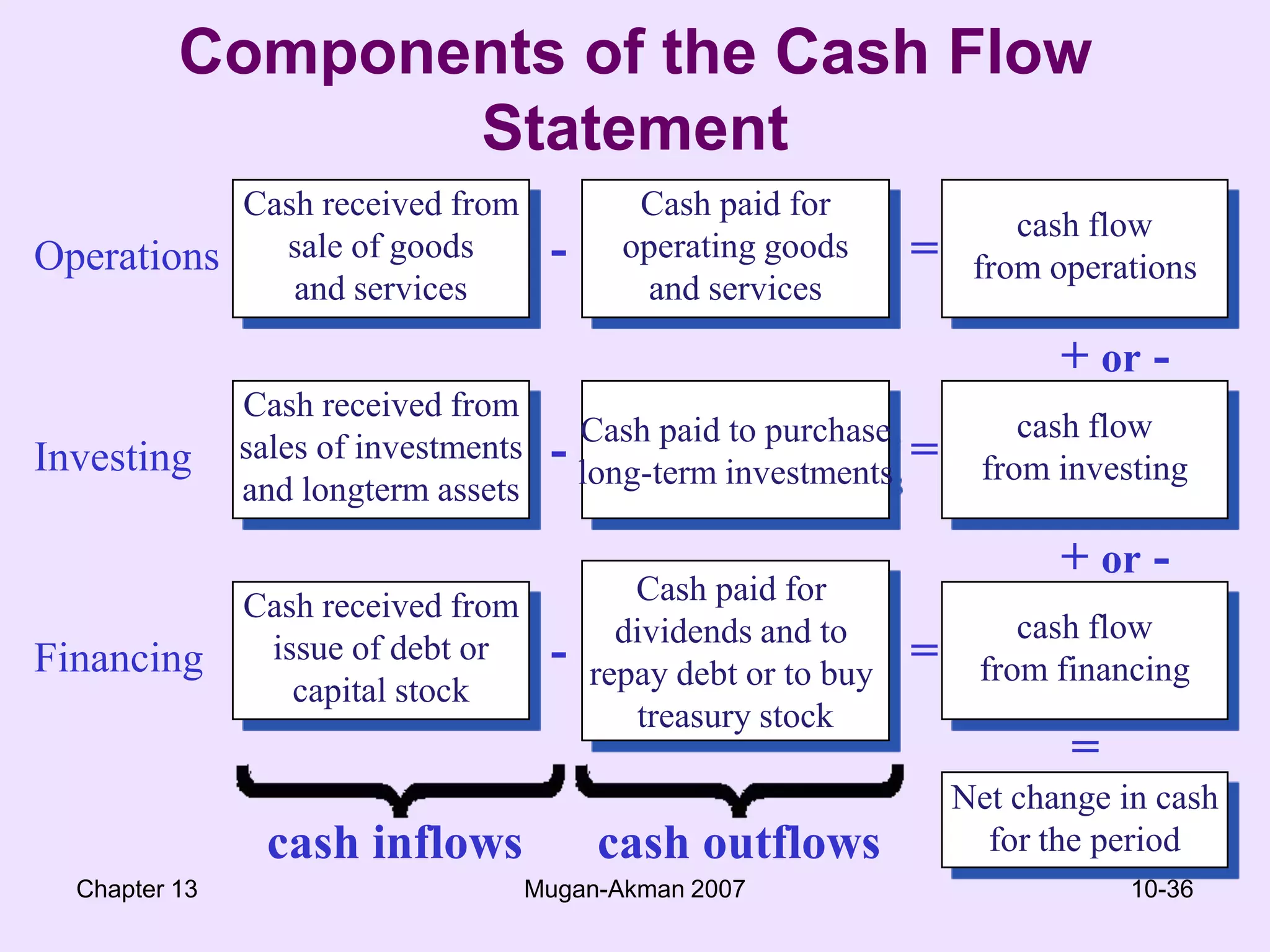
Chapter 13Mugan-Akman 200710-36Components of the Cash Flow StatementCash received fromsale of goodsand servicesCash paid foroperating goodsand servicescash flowfrom operations-=Operations+ or -Cash received fromsales of investmentsand longterm assetsCash paid to purchaselong-term investmentscash flowfrom investing-=Investing+ or -Cash paid for dividends and to repay debt or to buy treasury stockCash received fromissue of debt orcapital stockcash flowfrom financing-=Financing=Net change in cashfor the periodcash inflows      cash outflows
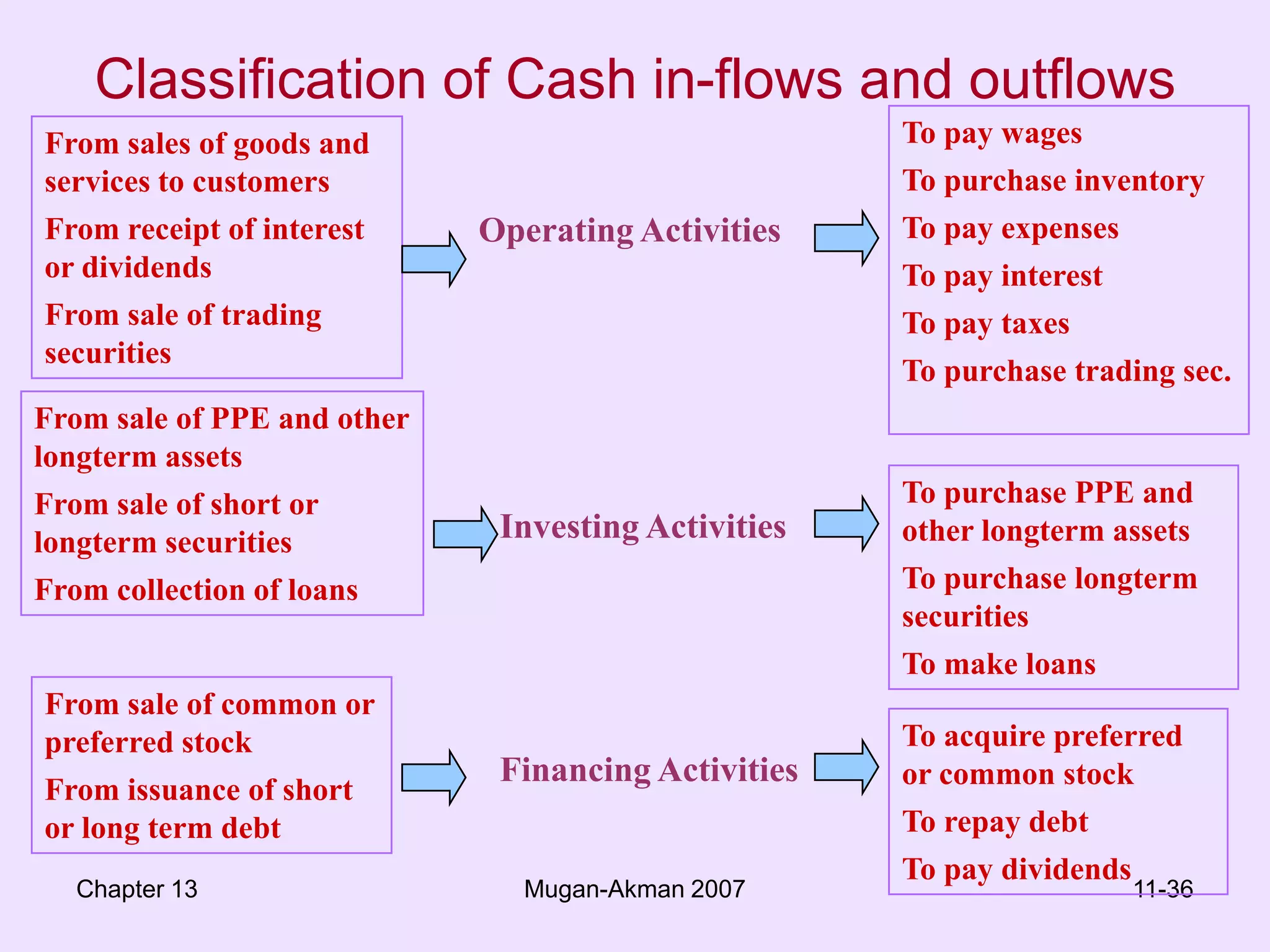
Chapter 13Mugan-Akman 200711-36Classification of Cash in-flows and outflowsTo pay wagesTo purchase inventoryTo pay expensesTo pay interestTo pay taxesTo purchase tradingsec.From sales of goods and services to customersFrom receipt of interest or dividendsFrom sale of trading securitiesOperating ActivitiesFrom sale of PPE and other longterm assetsFrom sale of short or longterm securitiesFrom collection of loansTo purchase PPE and other longterm assetsTo purchase longterm securitiesTo make loansInvesting ActivitiesFrom sale of common or preferred stockFrom issuance of short or long term debtTo acquire preferred or common stockTo repay debtTo pay dividendsFinancing Activities
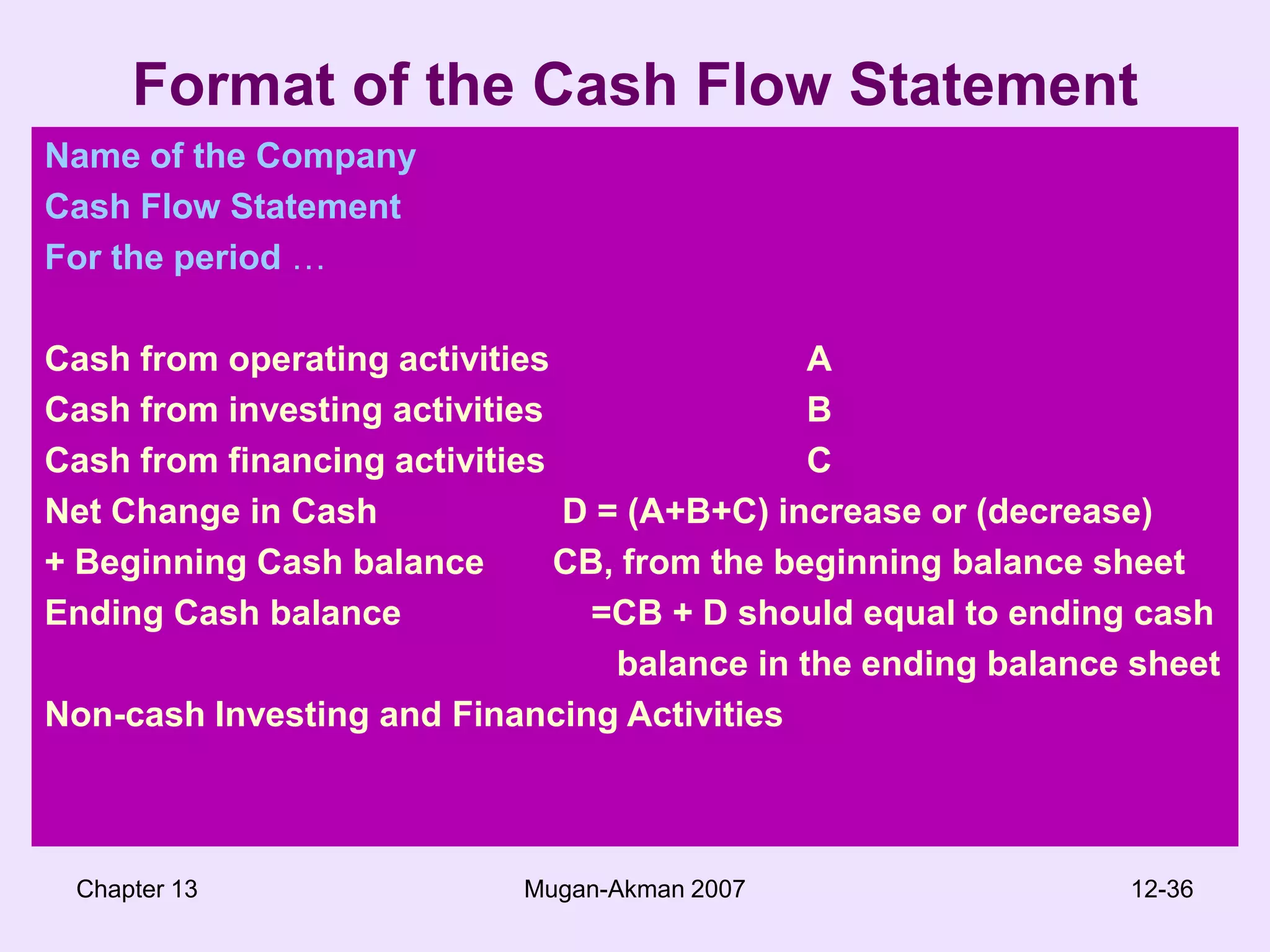
Chapter 13Mugan-Akman 200712-36Format of the Cash Flow StatementName of the CompanyCash Flow StatementFor the period …Cash from operating activities        		ACash from investing activities			BCash from financing activities       		CNet Change in Cash		 D = (A+B+C) increase or (decrease)+ Beginning Cash balance	CB, from the beginning balance sheet Ending Cash balance		    =CB + D should equal to ending cash                                                            balance in the ending balance sheetNon-cash Investing and Financing Activities
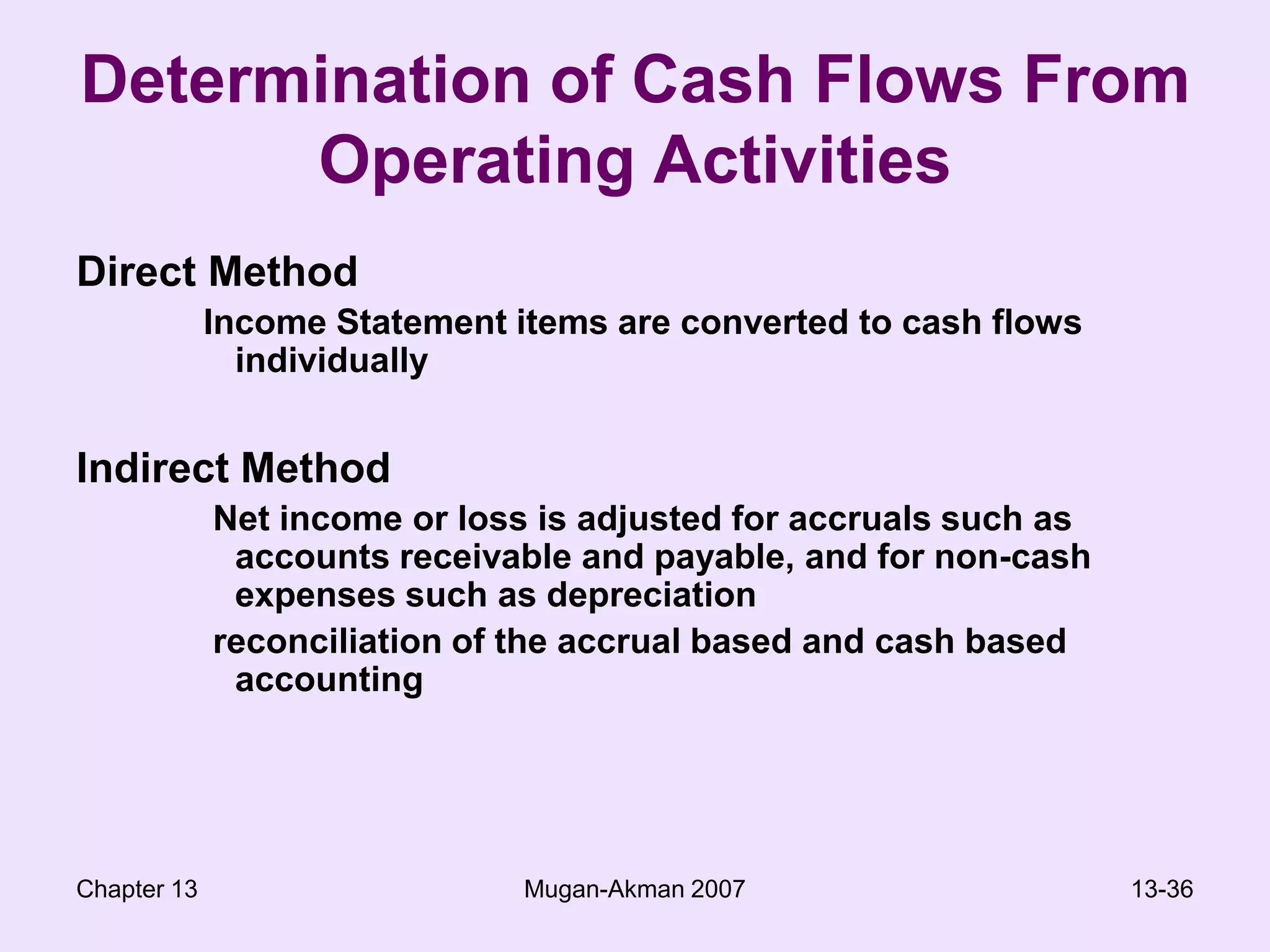
Chapter 13Mugan-Akman 200713-36Determination of Cash Flows From Operating ActivitiesDirect MethodIncome Statement items are converted to cash flows individuallyIndirect Method Net income or loss is adjusted for accruals such as accounts receivable and payable, and for non-cash expenses such as depreciation  reconciliation of the accrual based and cash based accounting
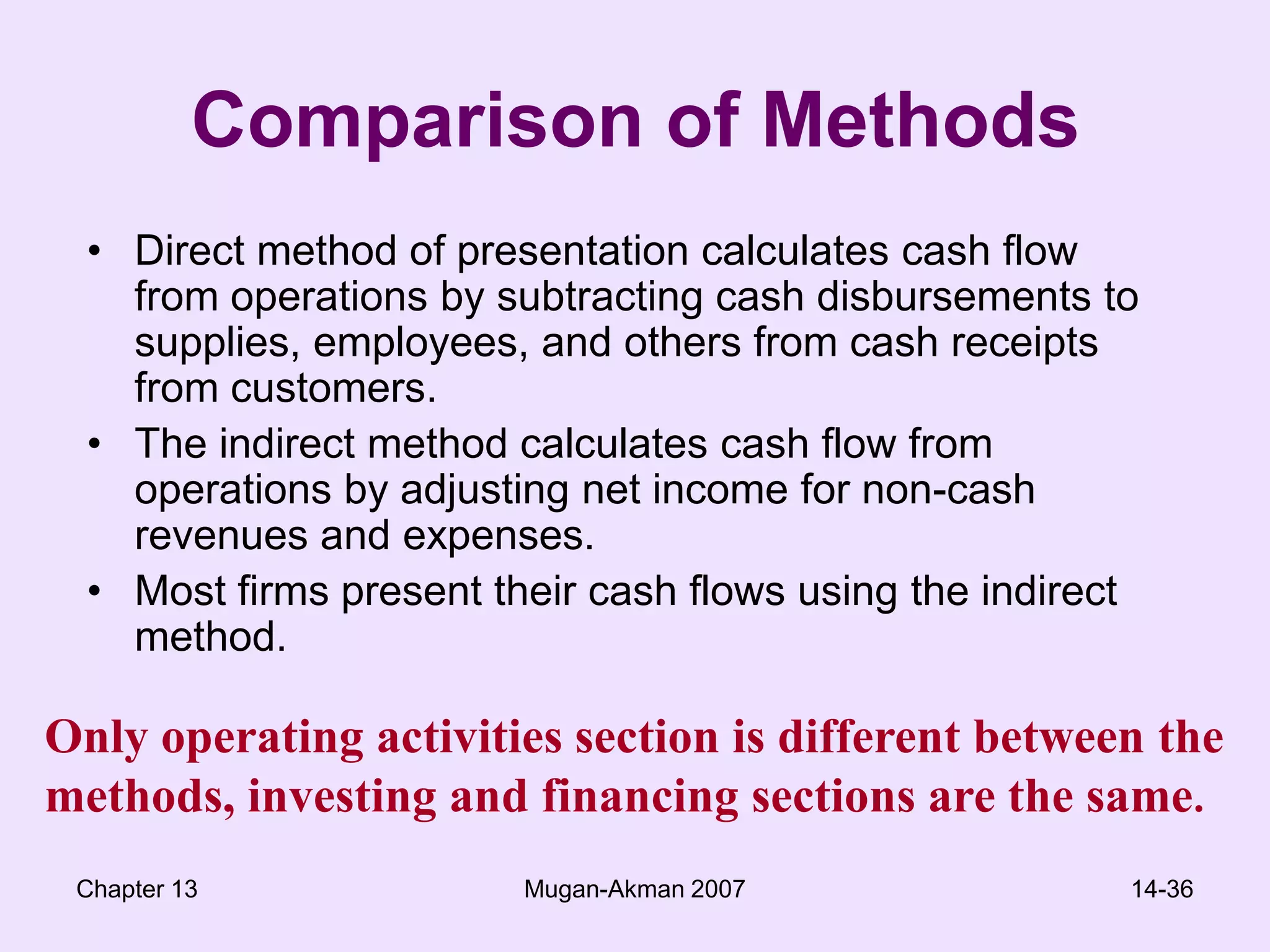
Chapter 13Mugan-Akman 200714-36Comparison of MethodsDirect method of presentation calculates cash flow from operations by subtracting cash disbursements to supplies, employees, and others from cash receipts from customers.
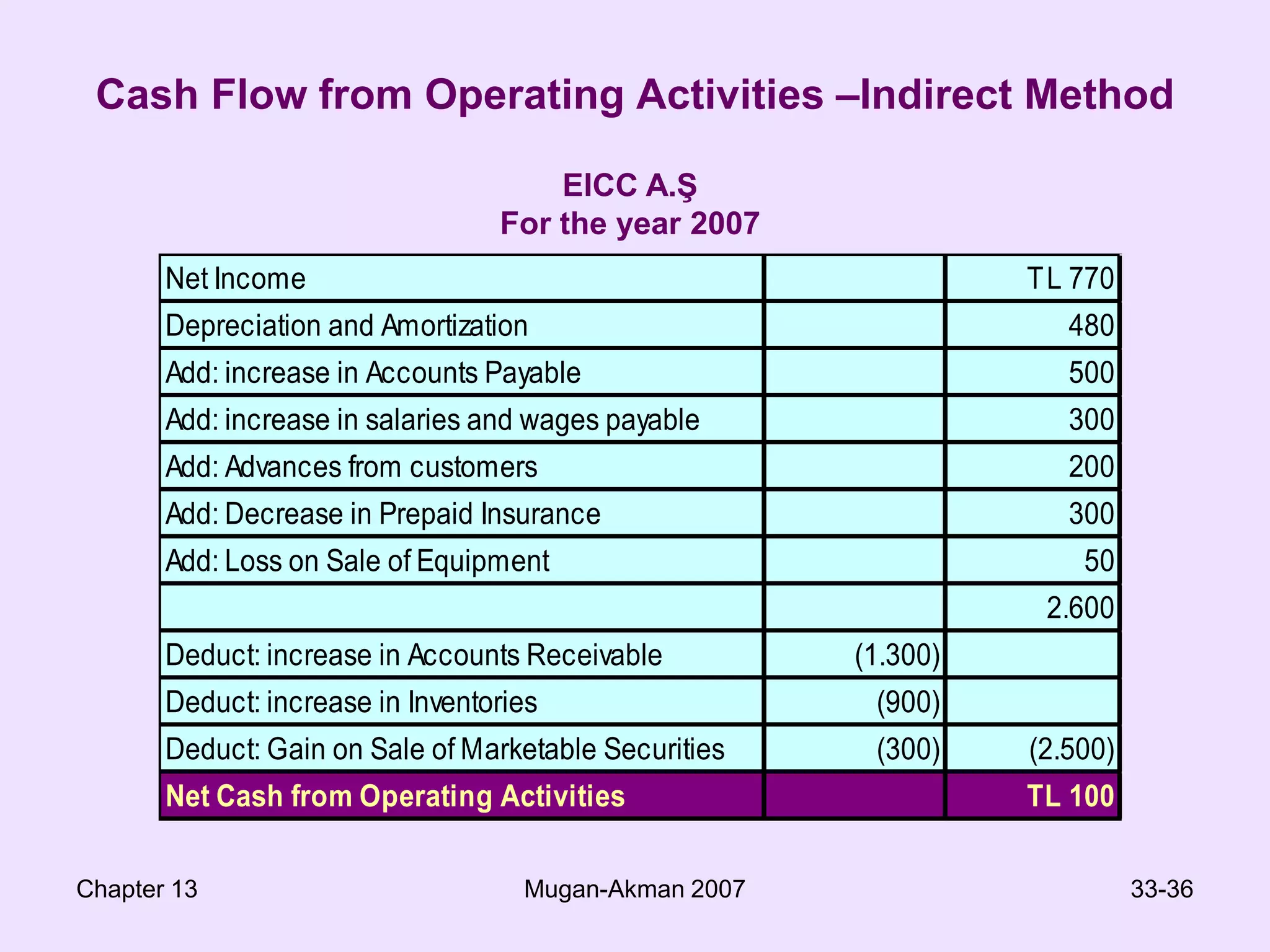
The indirect method calculates cash flow from operations by adjusting net income for non-cash revenues and expenses.
Most firms present their cash flows using the indirect method.Only operating activities section is different between the methods, investing and financing sections are the same.
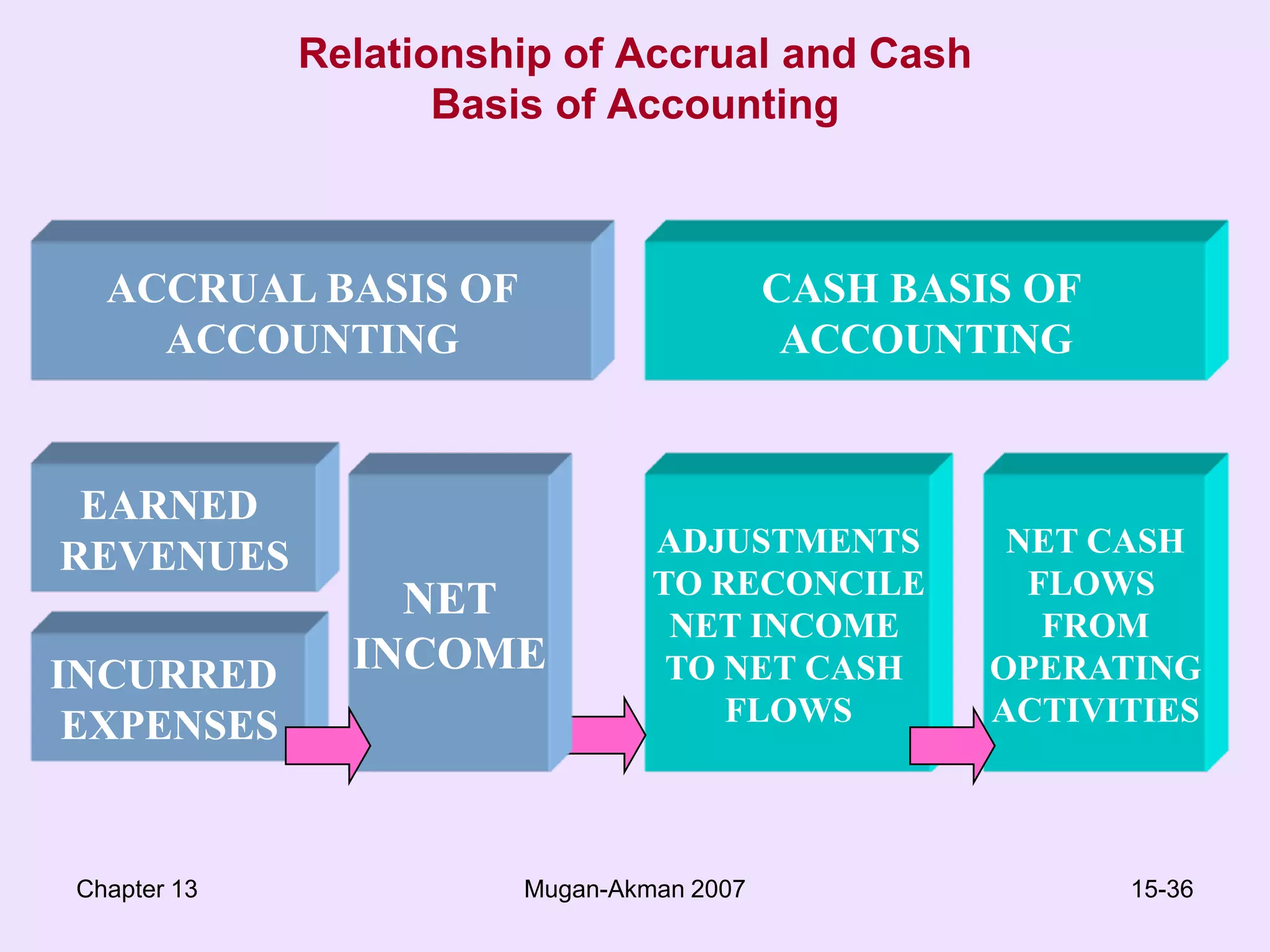
Chapter 13Mugan-Akman 200715-36CASH BASIS OF ACCOUNTINGACCRUAL BASIS OFACCOUNTINGEARNED REVENUESADJUSTMENTSTO RECONCILENET INCOME TO NET CASH FLOWSNET CASHFLOWS FROMOPERATINGACTIVITIESNETINCOMEINCURRED EXPENSESRelationship of Accrual and Cash Basis of Accounting
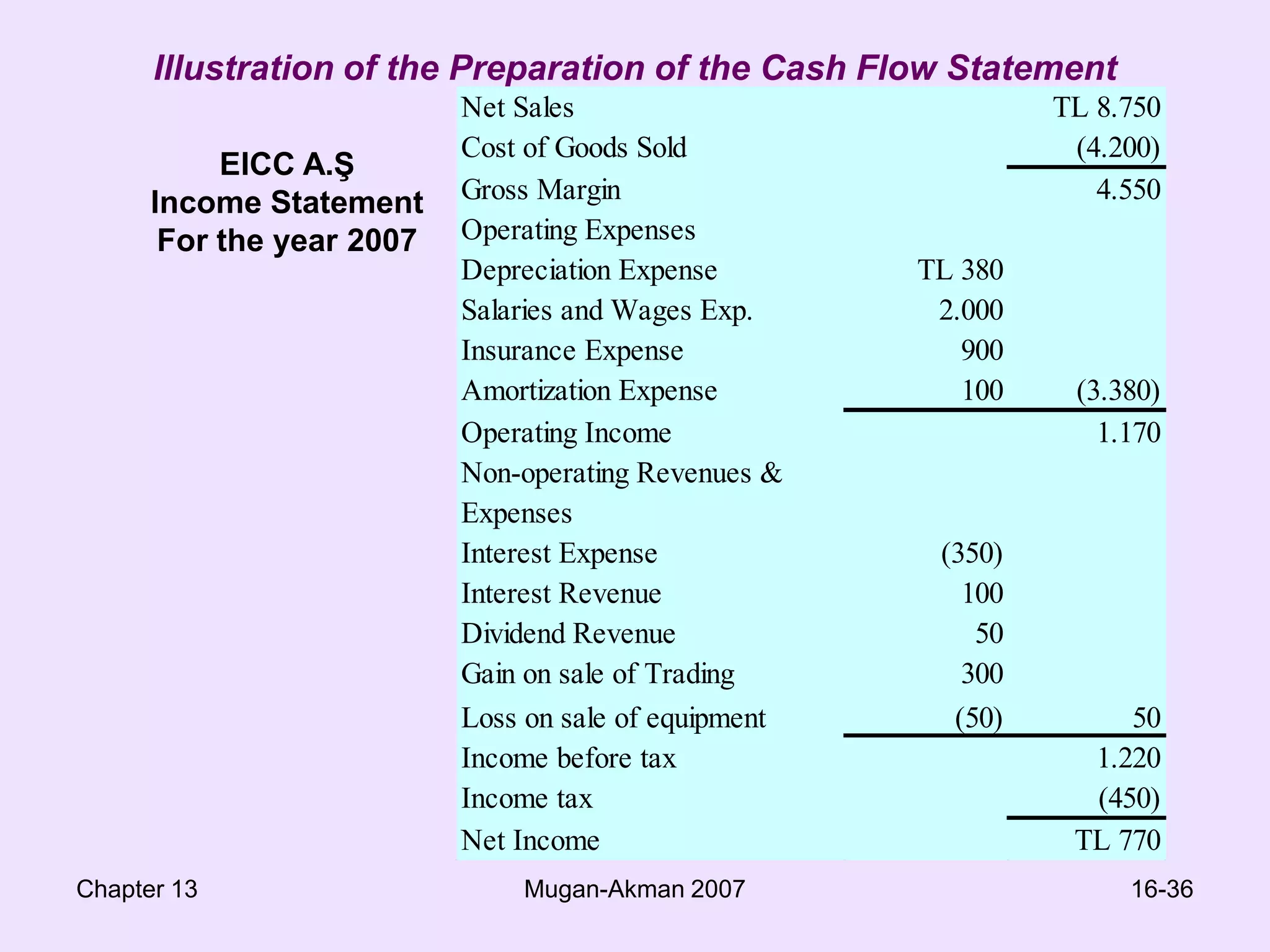
Chapter 13Mugan-Akman 200716-36Illustration of the Preparation of the Cash Flow StatementEICC A.ŞIncome StatementFor the year 2007
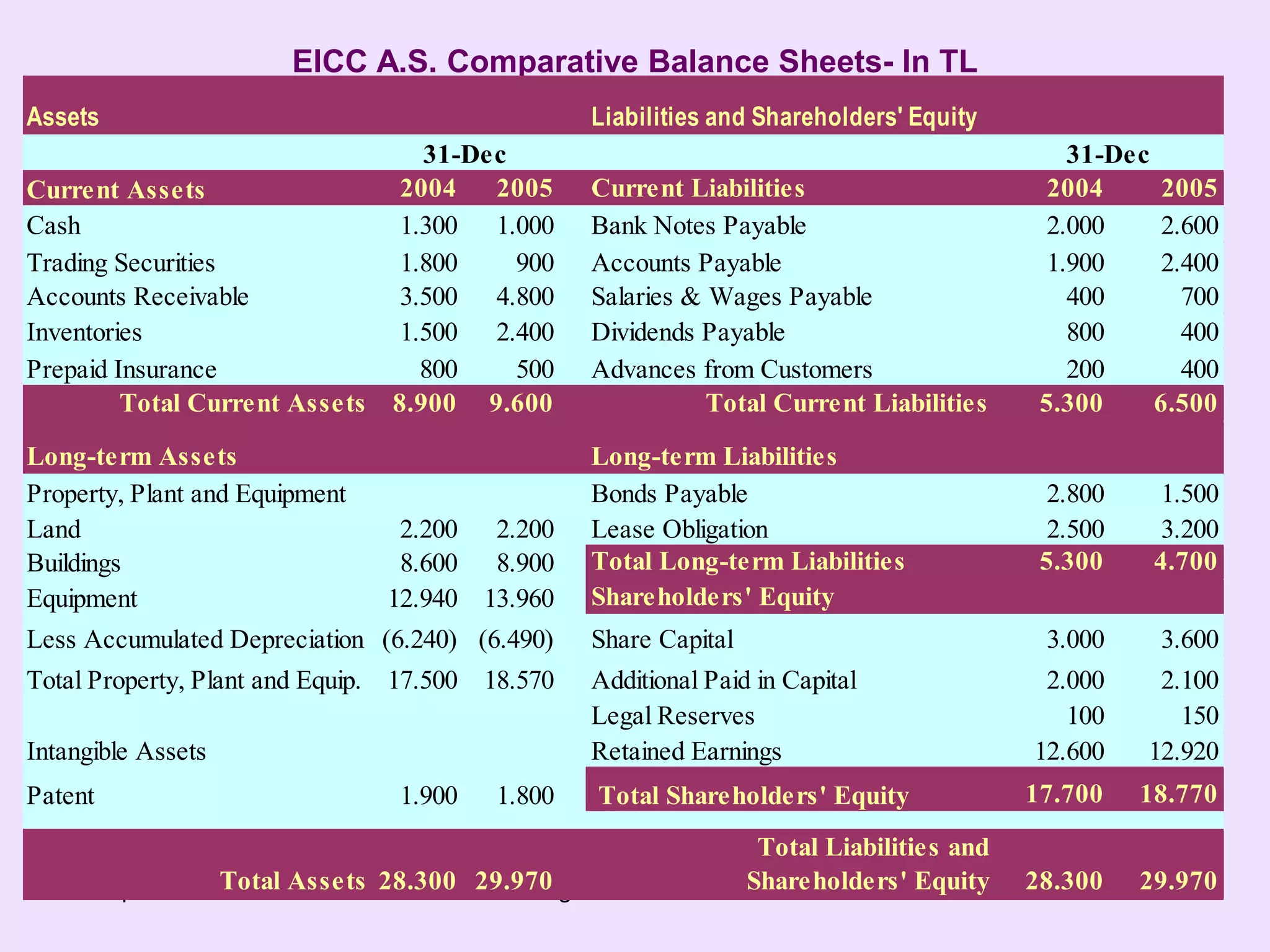
Chapter 13Mugan-Akman 200717-36EICC A.S. Comparative Balance Sheets- In TL
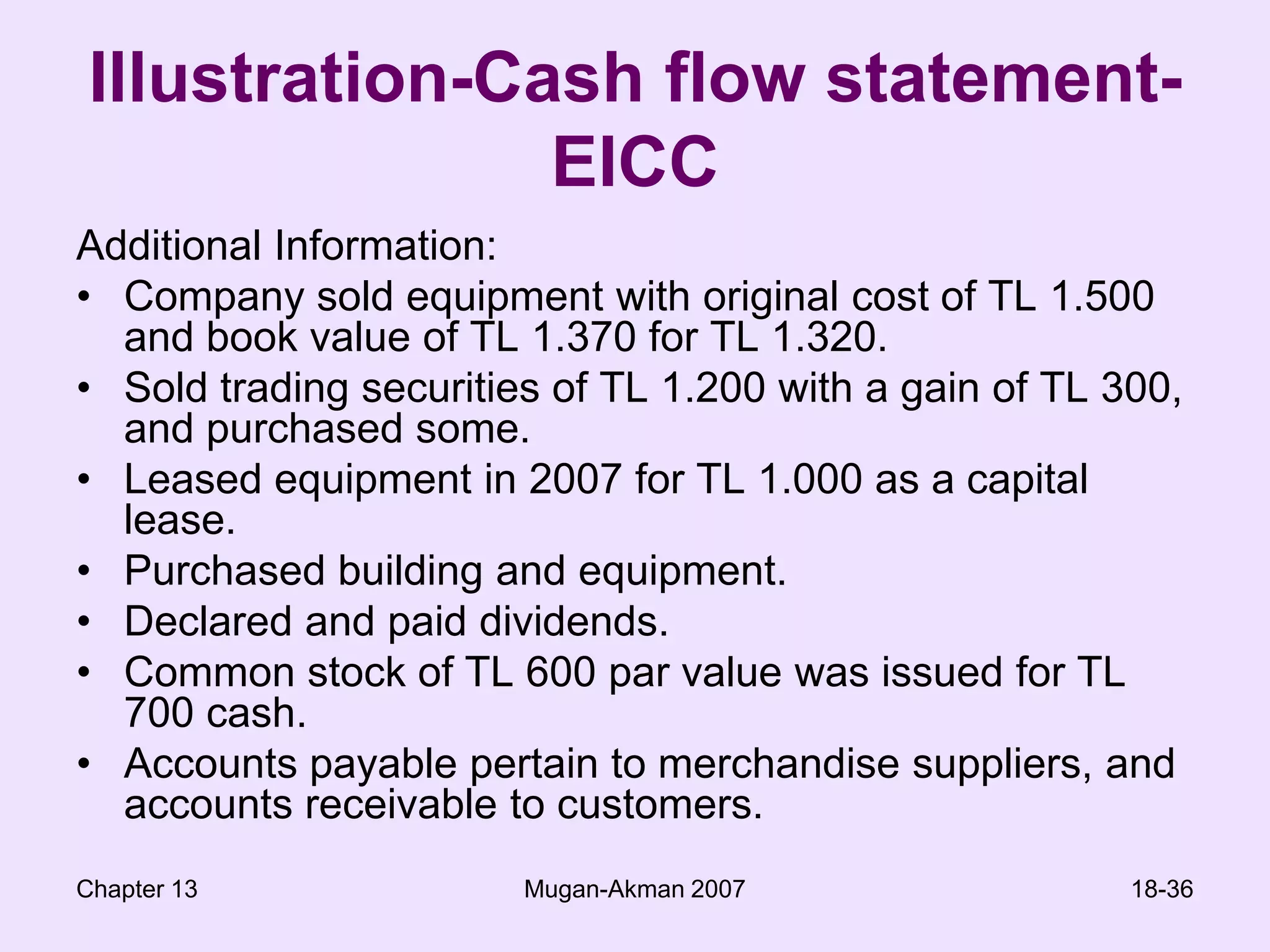
Chapter 13Mugan-Akman 200718-36Illustration-Cash flow statement-EICCAdditional Information:Company sold equipment with original cost of TL 1.500 and book value of TL 1.370 for TL 1.320.Sold trading securities of TL 1.200 with a gain of TL 300, and purchased some.Leased equipment in 2007 for TL 1.000 as a capital lease. Purchased building and equipment.Declared and paid dividends.Common stock of TL 600 par value was issued for TL 700 cash.Accounts payable pertain to merchandise suppliers, and accounts receivable to customers.
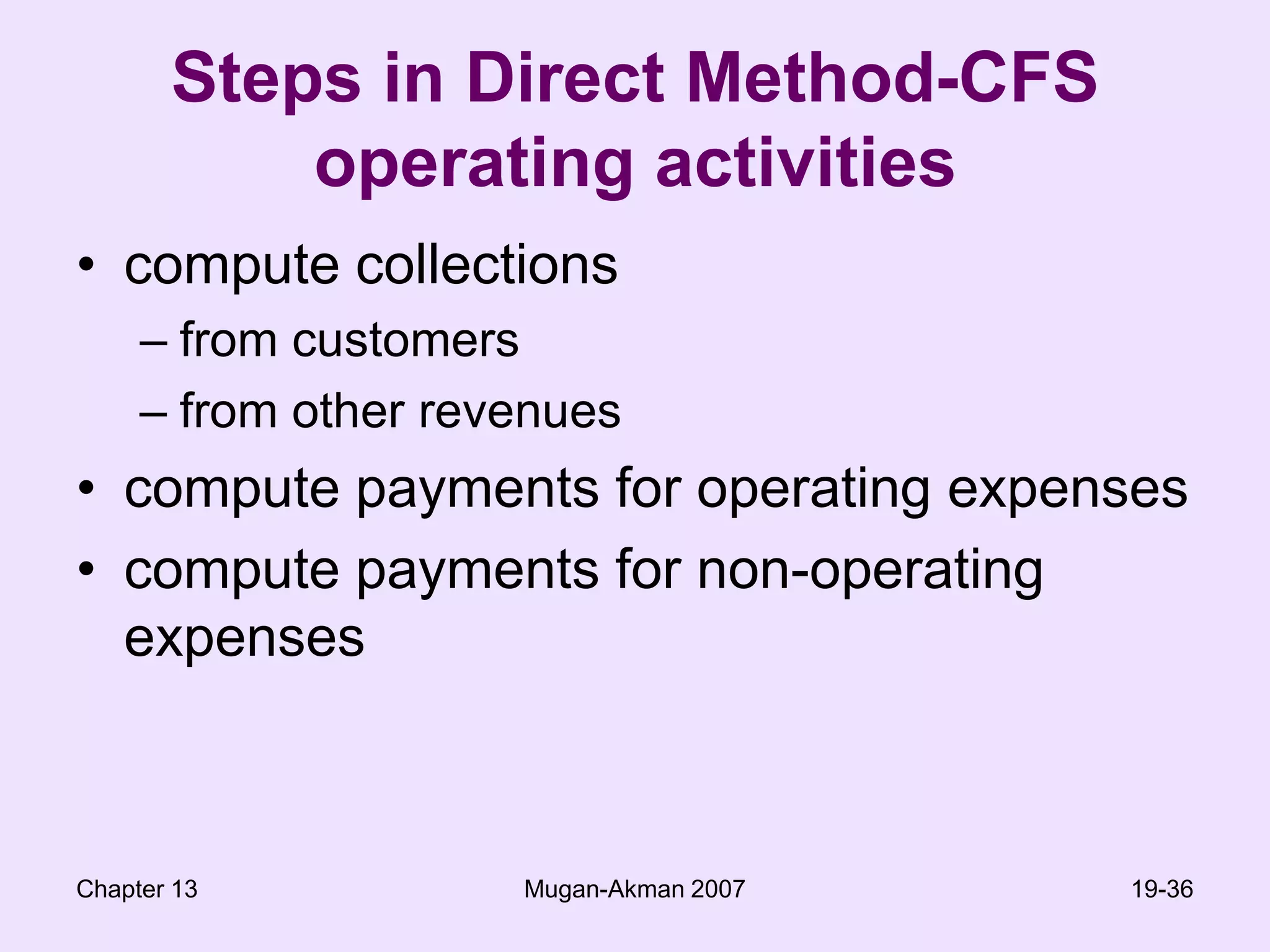
Chapter 13Mugan-Akman 200719-36Steps in Direct Method-CFS operating activitiescompute collectionsfrom customersfrom other revenuescompute payments for operating expensescompute payments for non-operating expenses
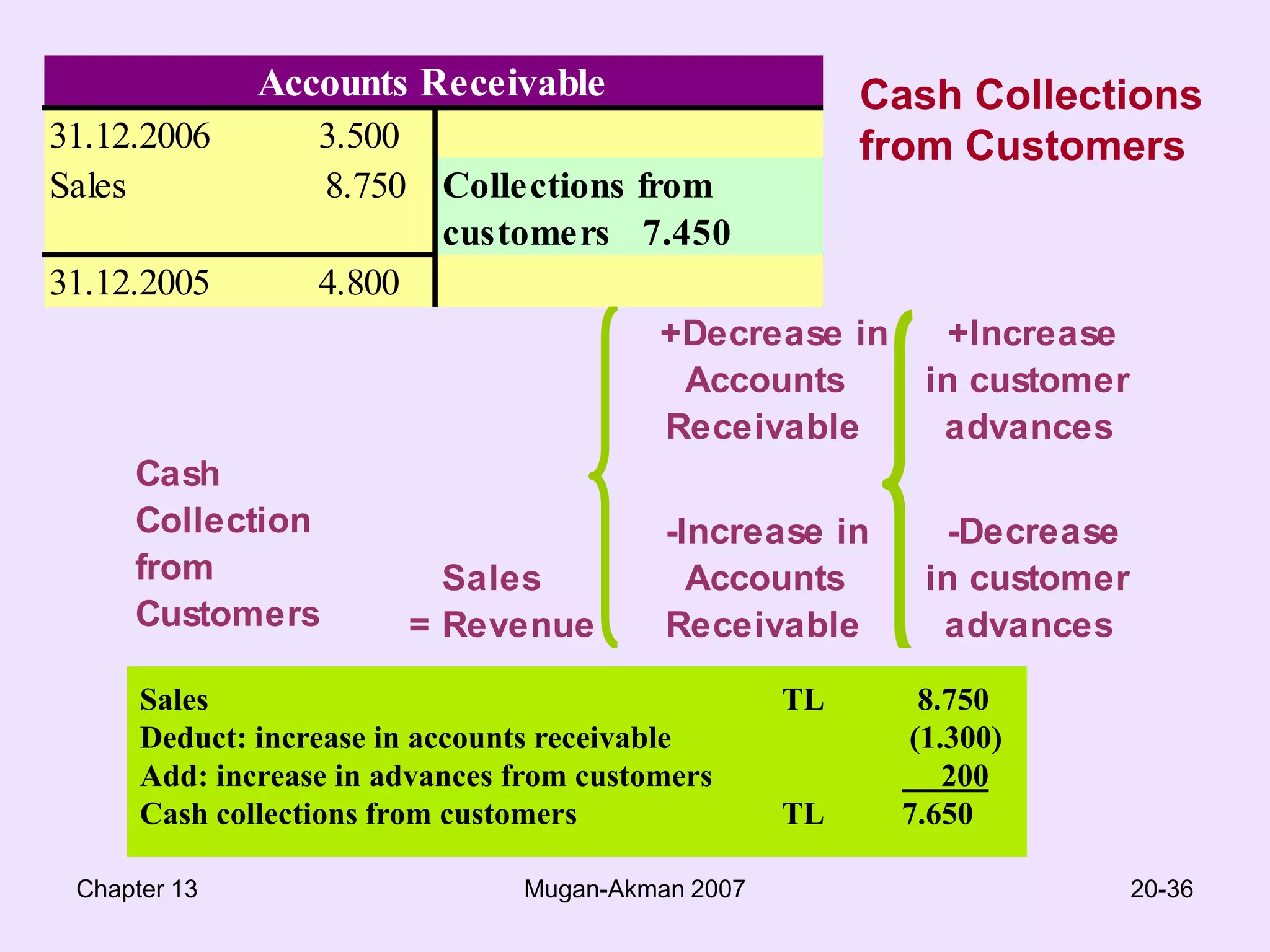
Chapter 13Mugan-Akman 200720-36Cash Collections from CustomersSales   	TL 	8.750 Deduct: increase in accounts receivable 	           (1.300)Add: increase in advances from customers     200Cash collections from customers         	 TL 	7.650
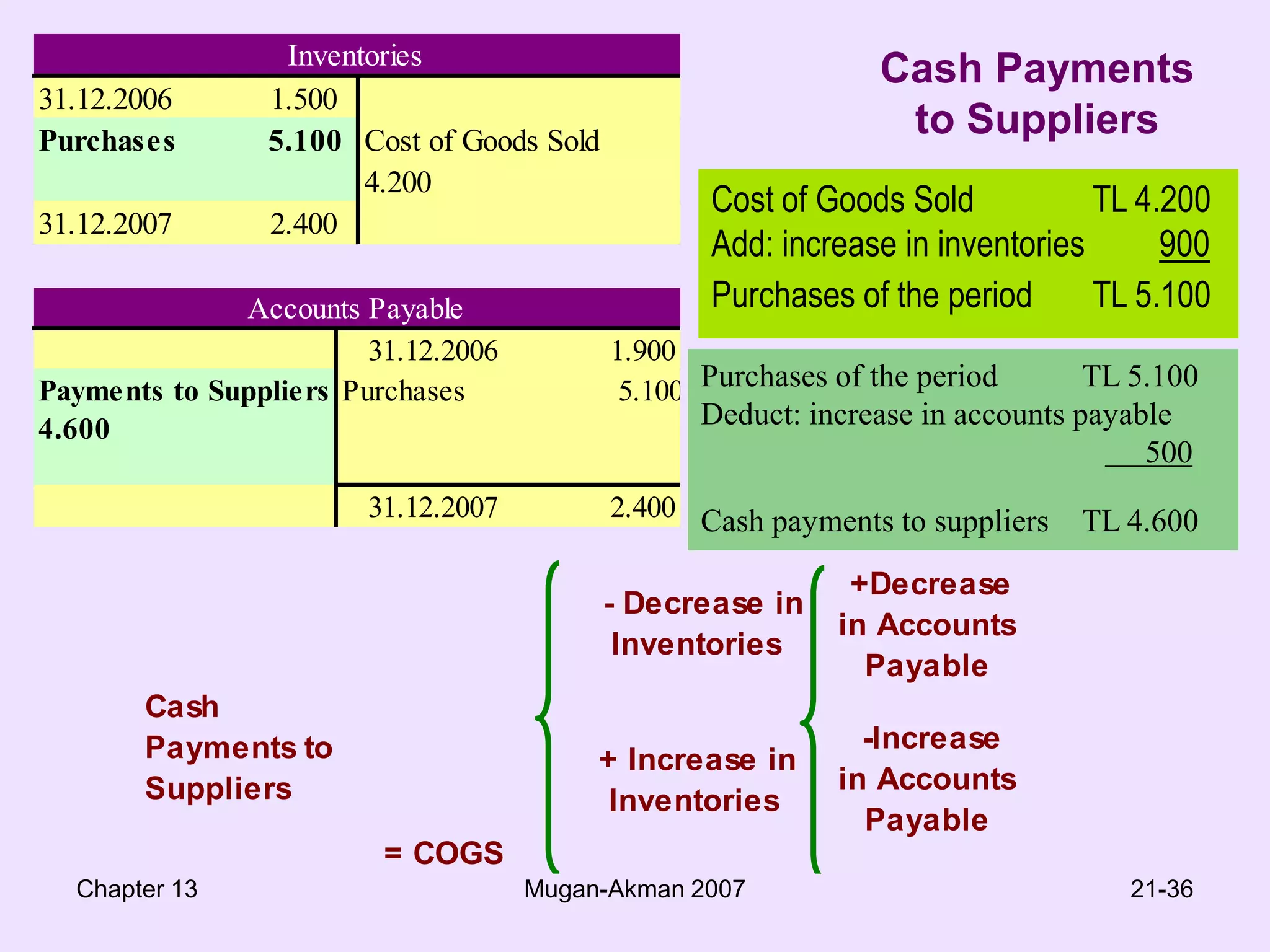
Chapter 13Mugan-Akman 200721-36Cash Payments to SuppliersCost of Goods Sold          	TL 4.200 Add: increase in inventories	900Purchases of the period	TL 5.100Purchases of the period  	TL 5.100 Deduct: increase in accounts payable		   	    	        500Cash payments to suppliers 	TL 4.600
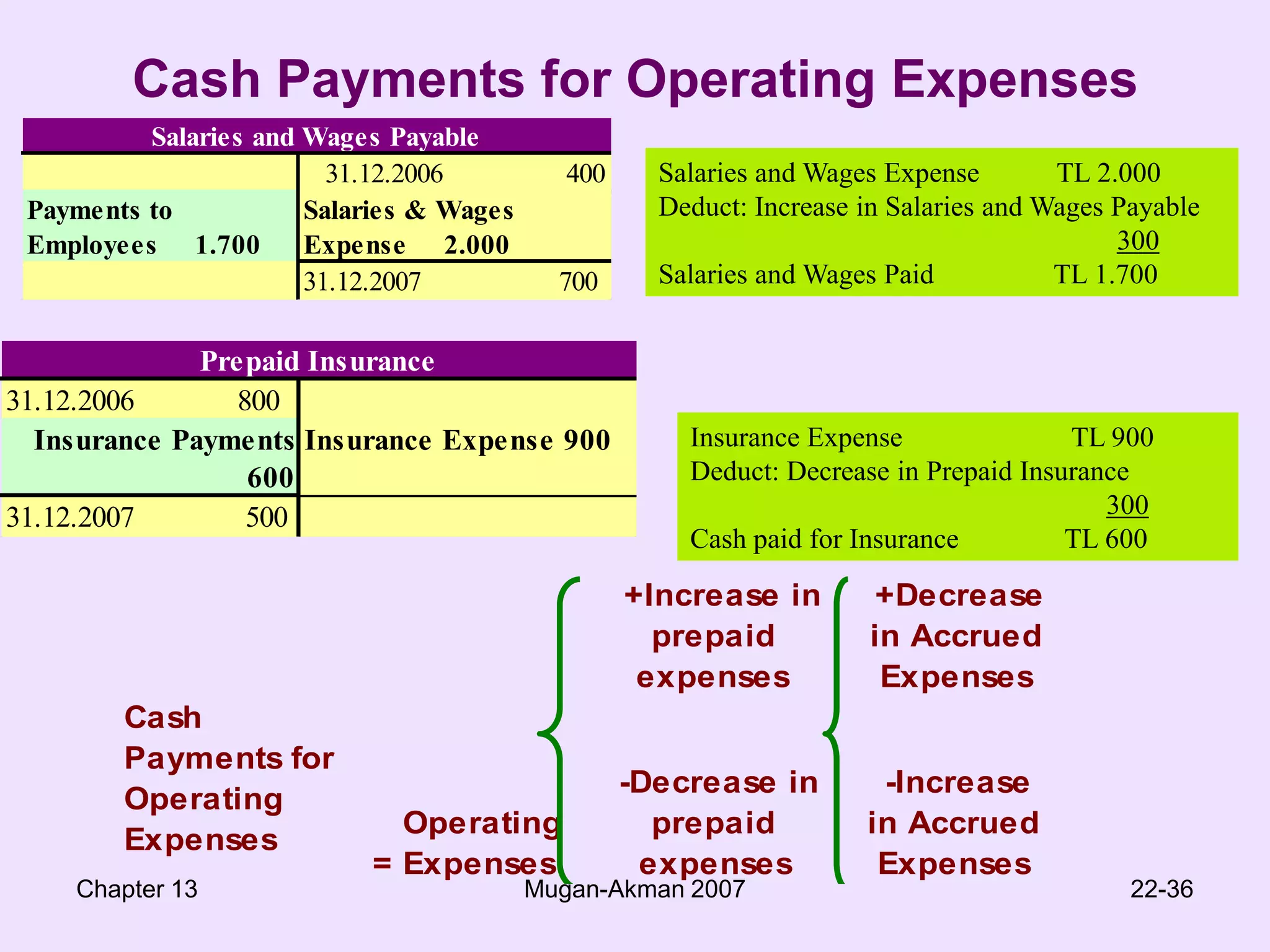
Chapter 13Mugan-Akman 200722-36Cash Payments for Operating ExpensesSalaries and Wages Expense           TL 2.000 Deduct: Increase in Salaries and Wages Payable         			           300Salaries and Wages Paid                 TL 1.700 Insurance Expense		TL 900Deduct: Decrease in Prepaid Insurance	           			     300Cash paid for Insurance               TL 600
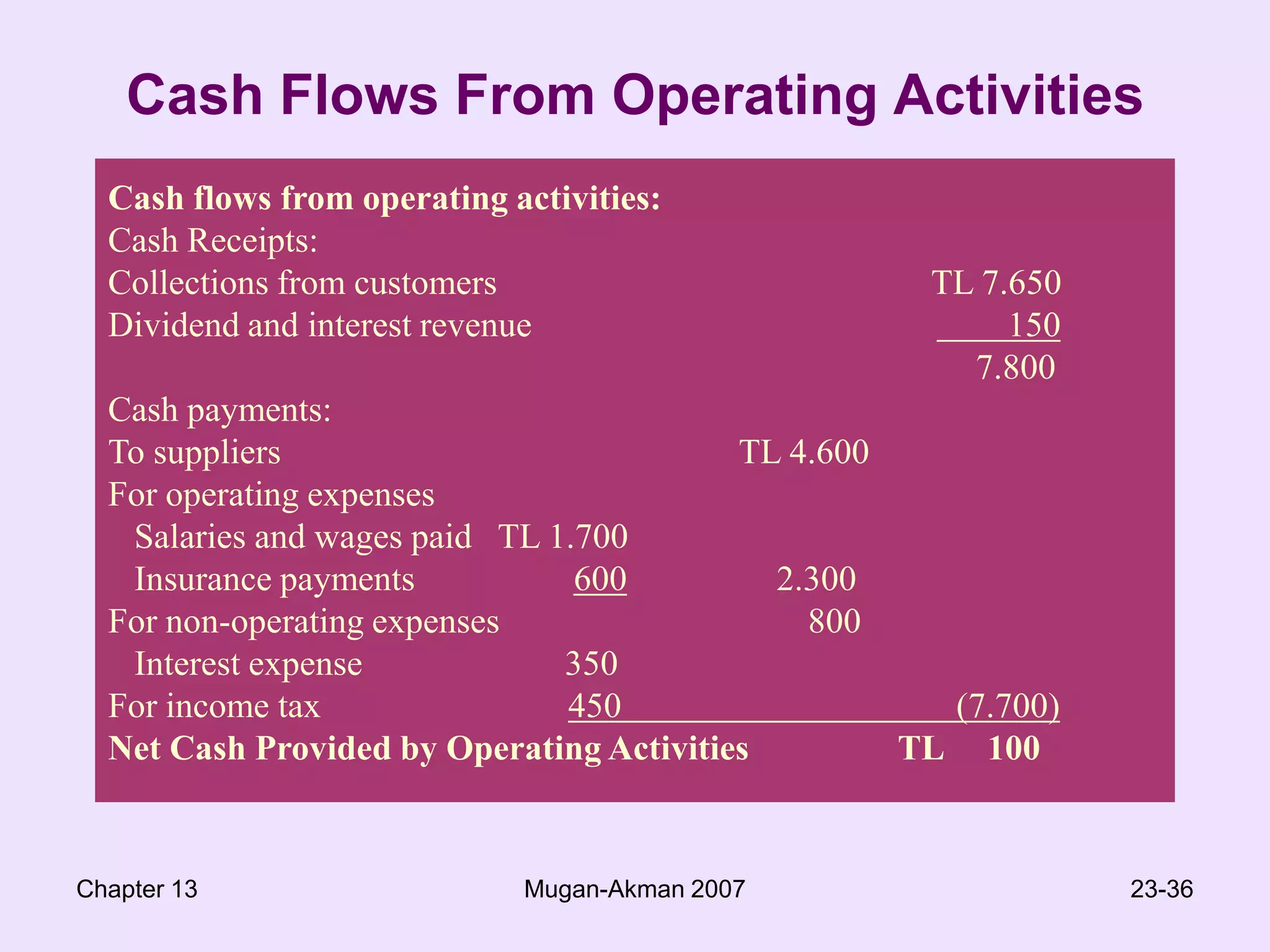
Chapter 13Mugan-Akman 200723-36Cash Flows From Operating ActivitiesCash flows from operating activities:Cash Receipts:Collections from customers			       TL 7.650 Dividend and interest revenue	  	                              150						            7.800Cash payments:To suppliers	    		              TL 4.600For operating expenses                                  Salaries and wages paid   TL 1.700   Insurance payments                  600                 2.300For non-operating expenses                                   800    Interest expense                       350For income tax		         450                                      (7.700)Net Cash Provided by Operating Activities                 TL     100
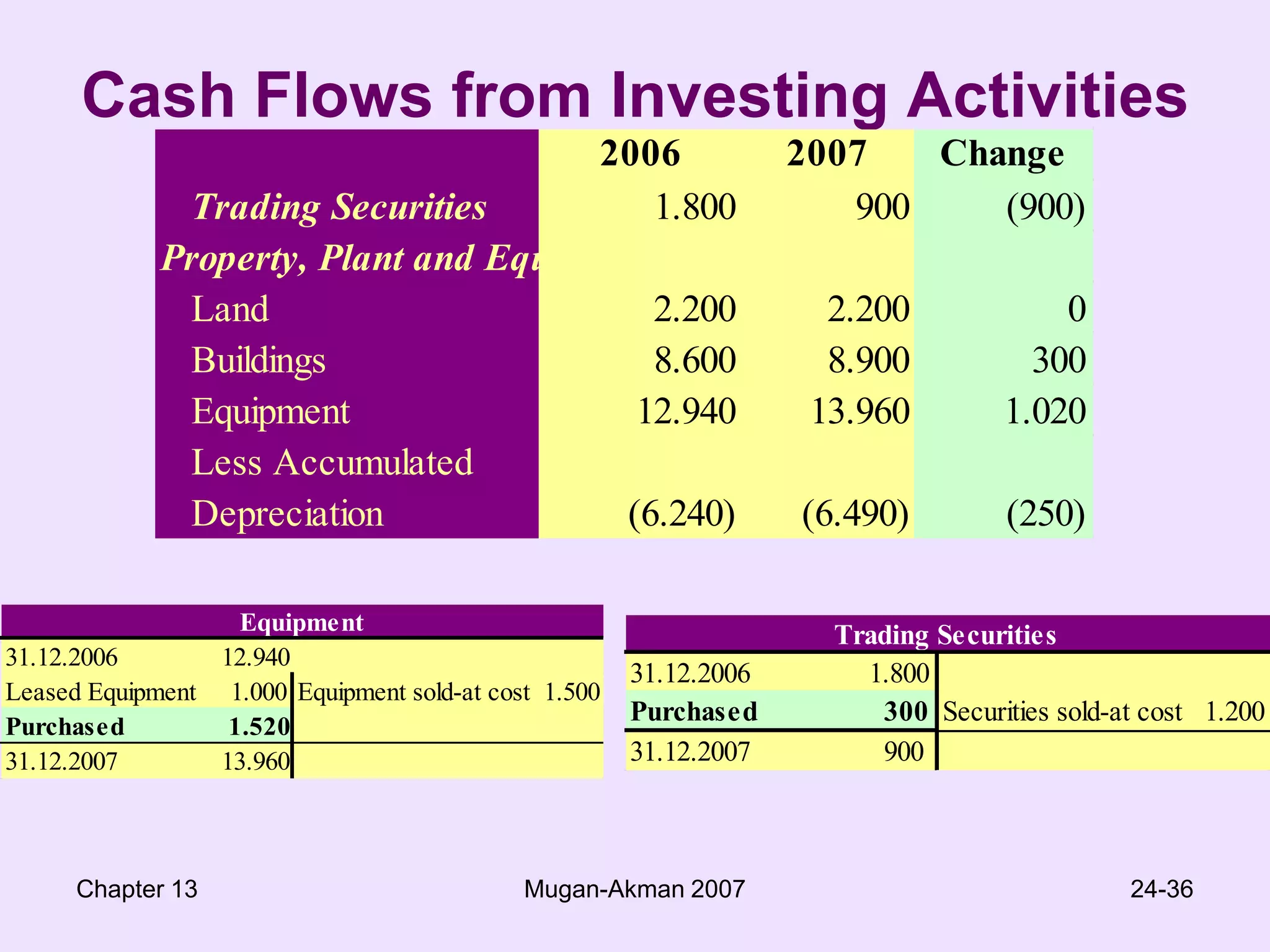
Chapter 13Mugan-Akman 200724-36Cash Flows from Investing Activities
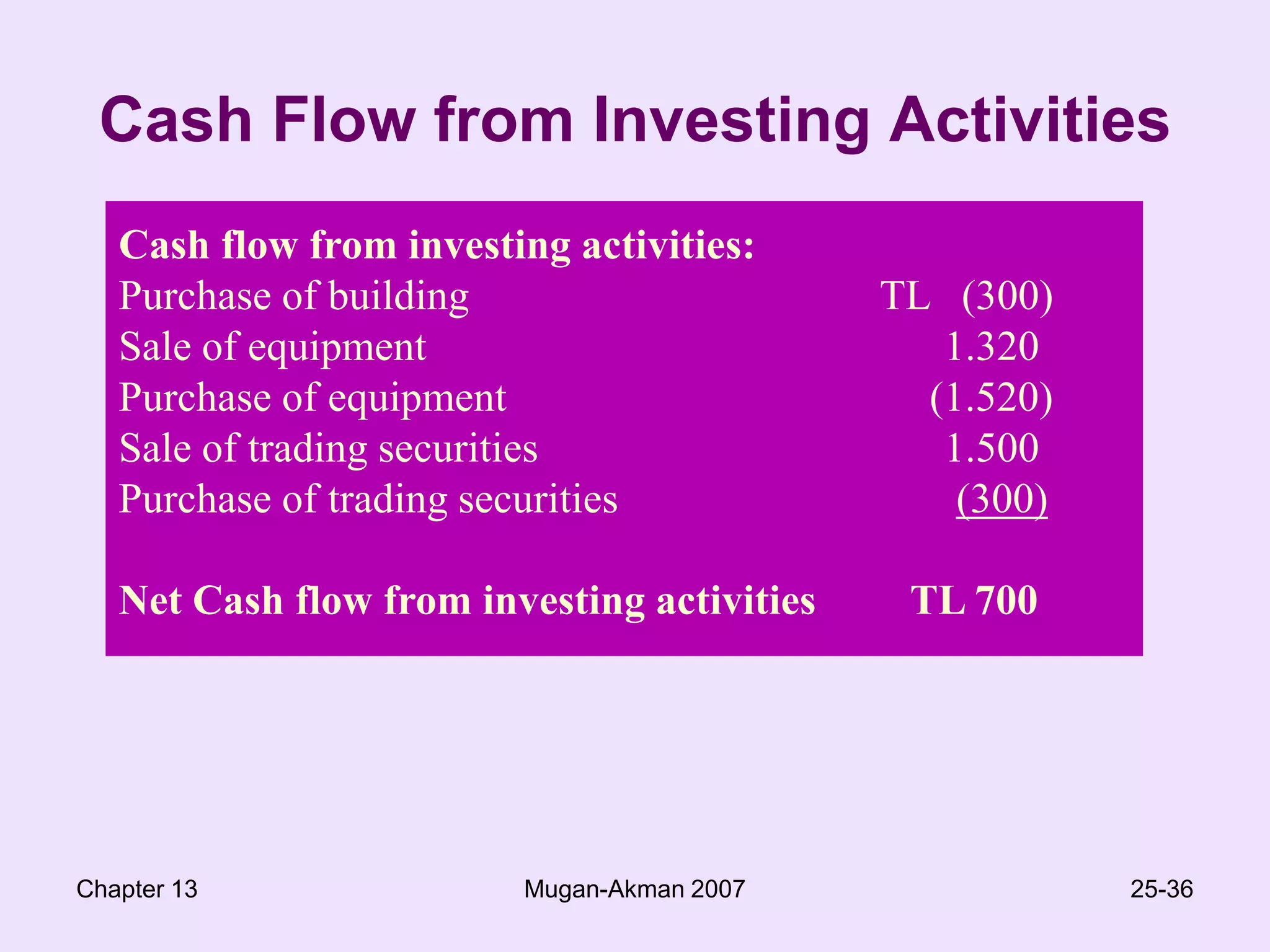
Chapter 13Mugan-Akman 200725-36Cash Flow from Investing ActivitiesCash flow from investing activities:Purchase of building		                        TL   (300) Sale of equipment	         	                              1.320Purchase of equipment                                        (1.520)Sale of trading securities                	                  1.500Purchase of trading securities                                (300)Net Cash flow from investing activities         TL 700
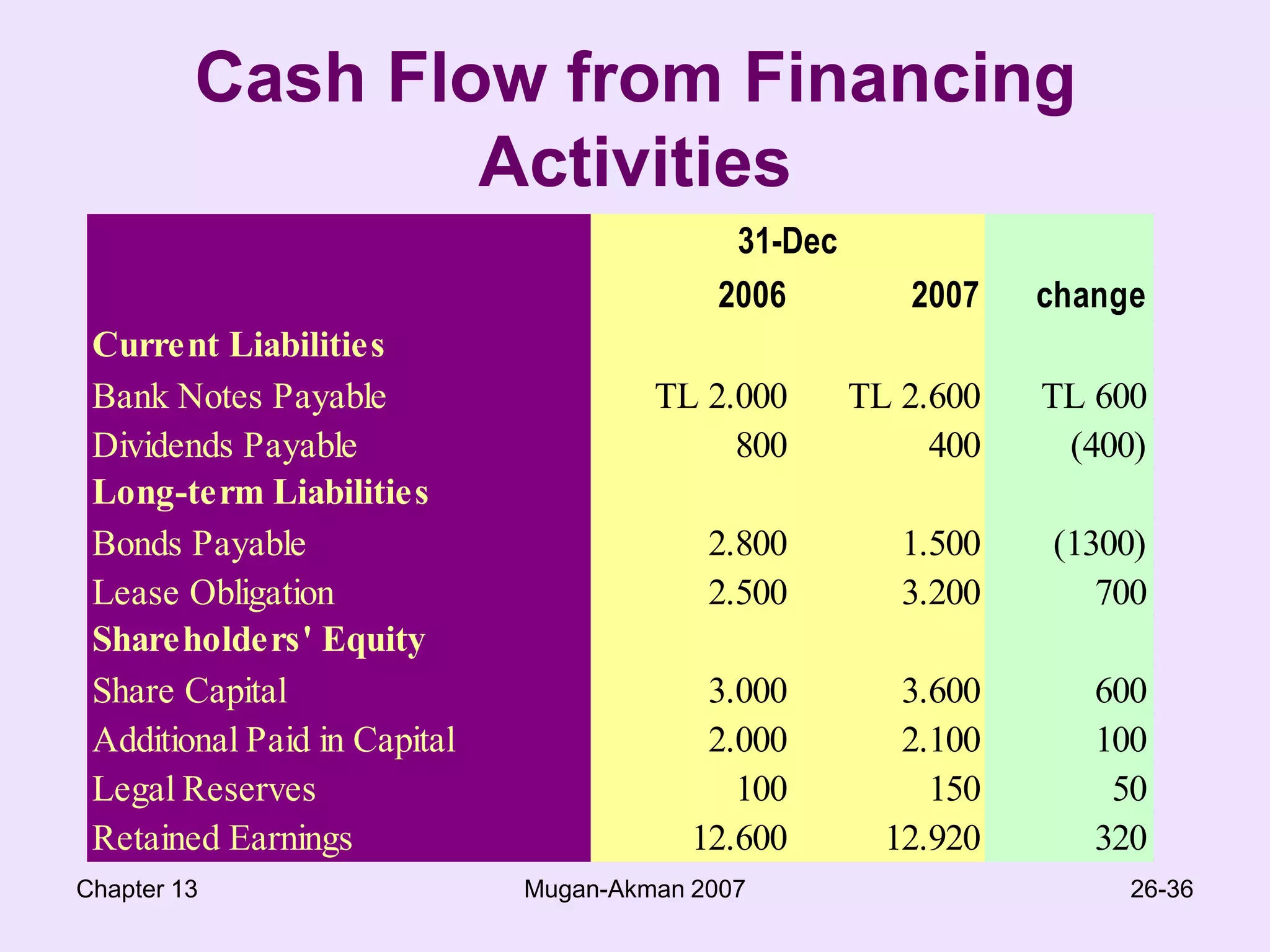
Chapter 13Mugan-Akman 200726-36Cash Flow from Financing Activities
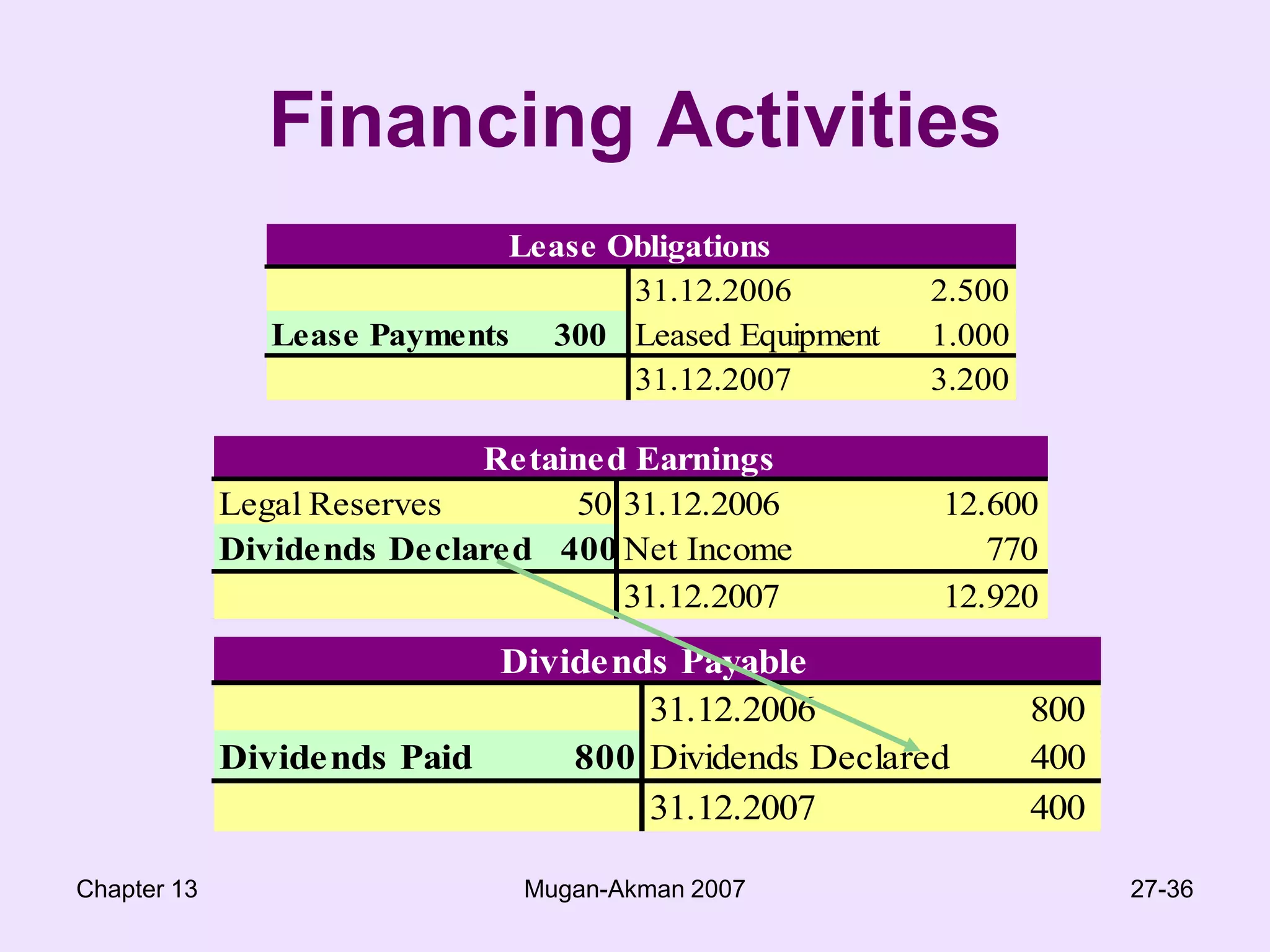
Chapter 13Mugan-Akman 200727-36Financing Activities
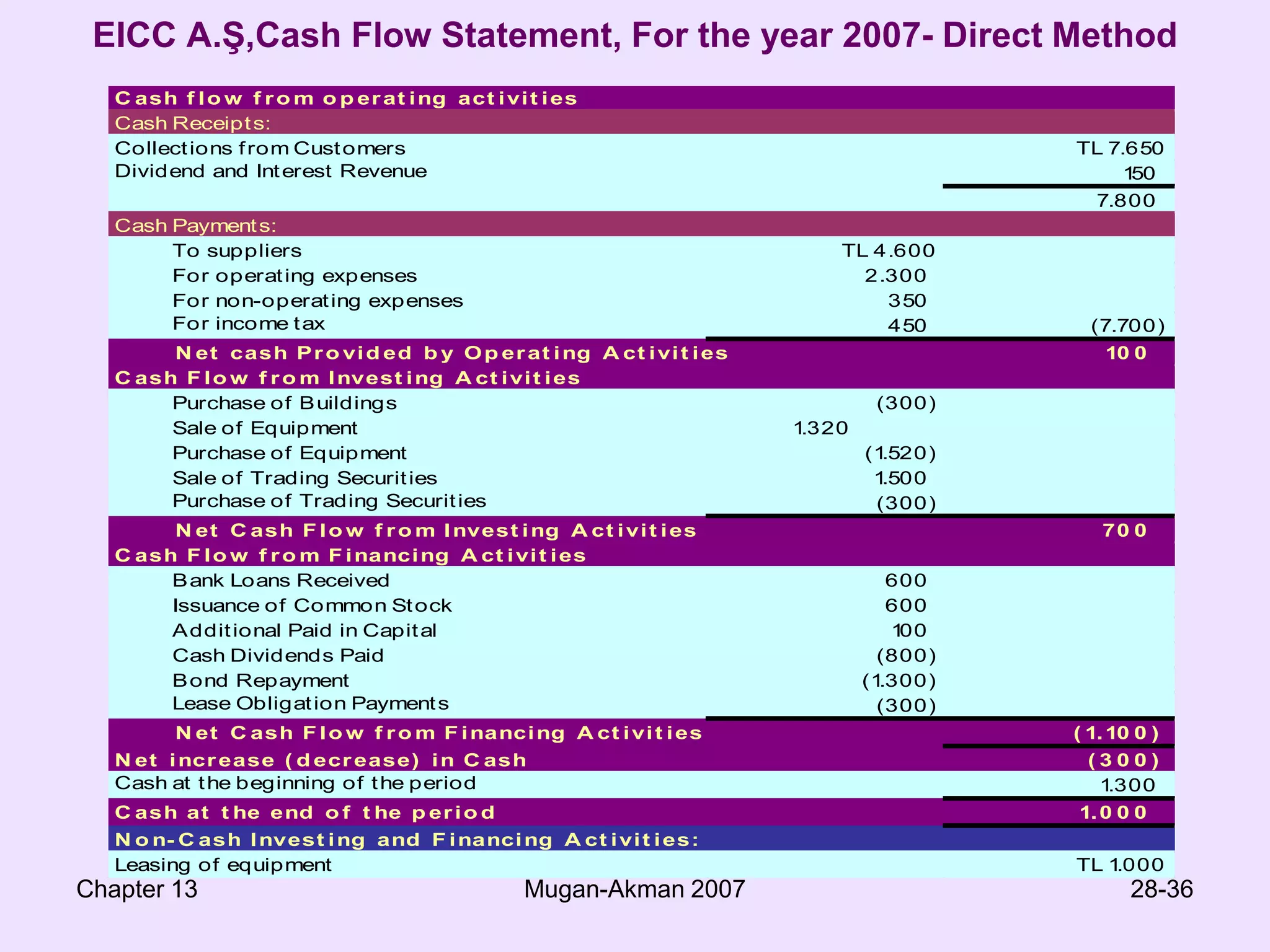
Chapter 13Mugan-Akman 200728-36EICC A.Ş,Cash Flow Statement, For the year 2007- Direct Method
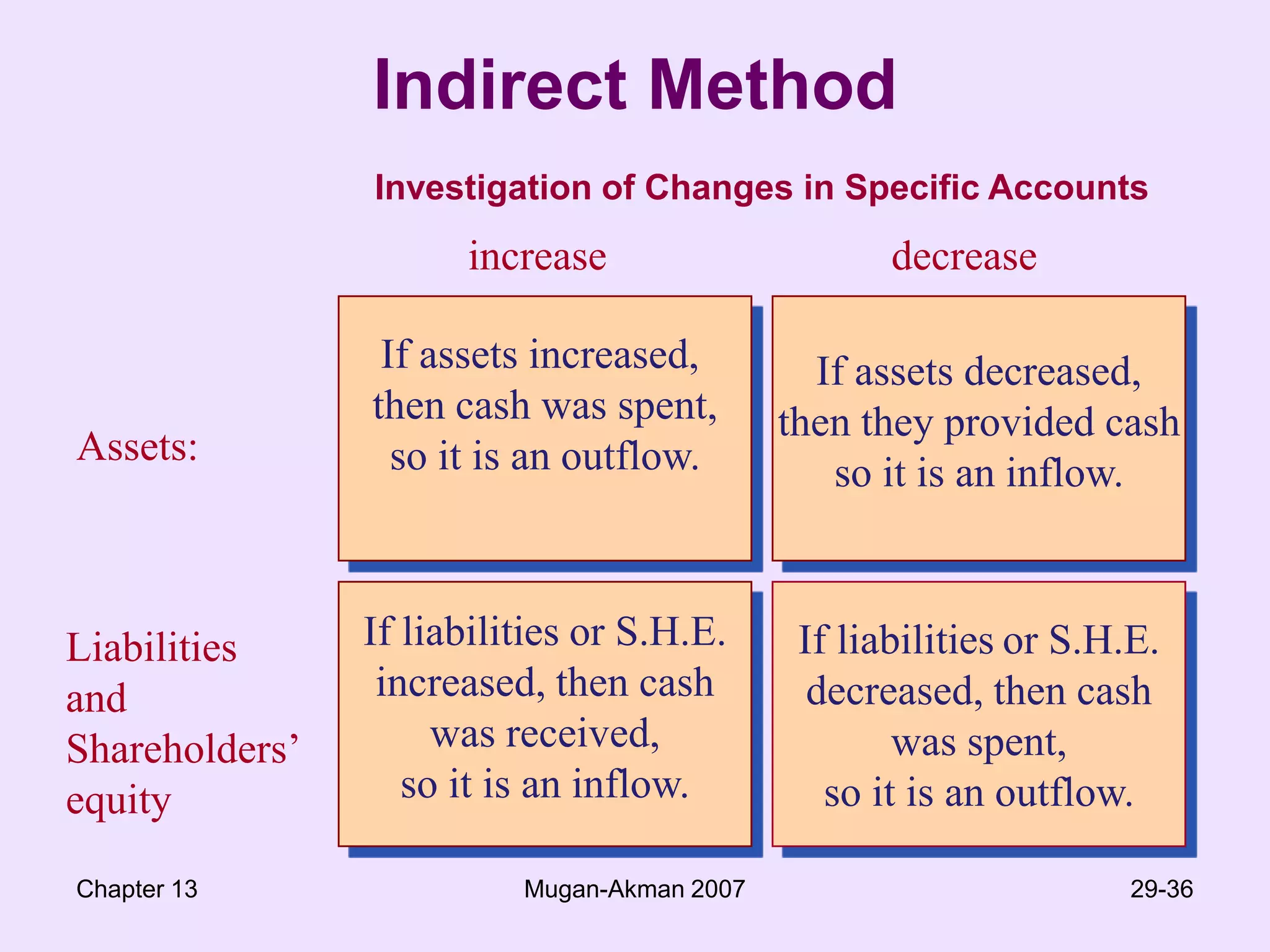
Chapter 13Mugan-Akman 200729-36increasedecreaseIf assets increased, then cash was spent,so it is an outflow.If assets decreased,then they provided cashso it is an inflow.Assets:If liabilities or S.H.E.increased, then cashwas received,so it is an inflow.If liabilitiesor S.H.E.decreased, then cashwas spent,so it is an outflow.Liabilitiesand Shareholders’equityIndirect MethodInvestigation of Changes in Specific Accounts
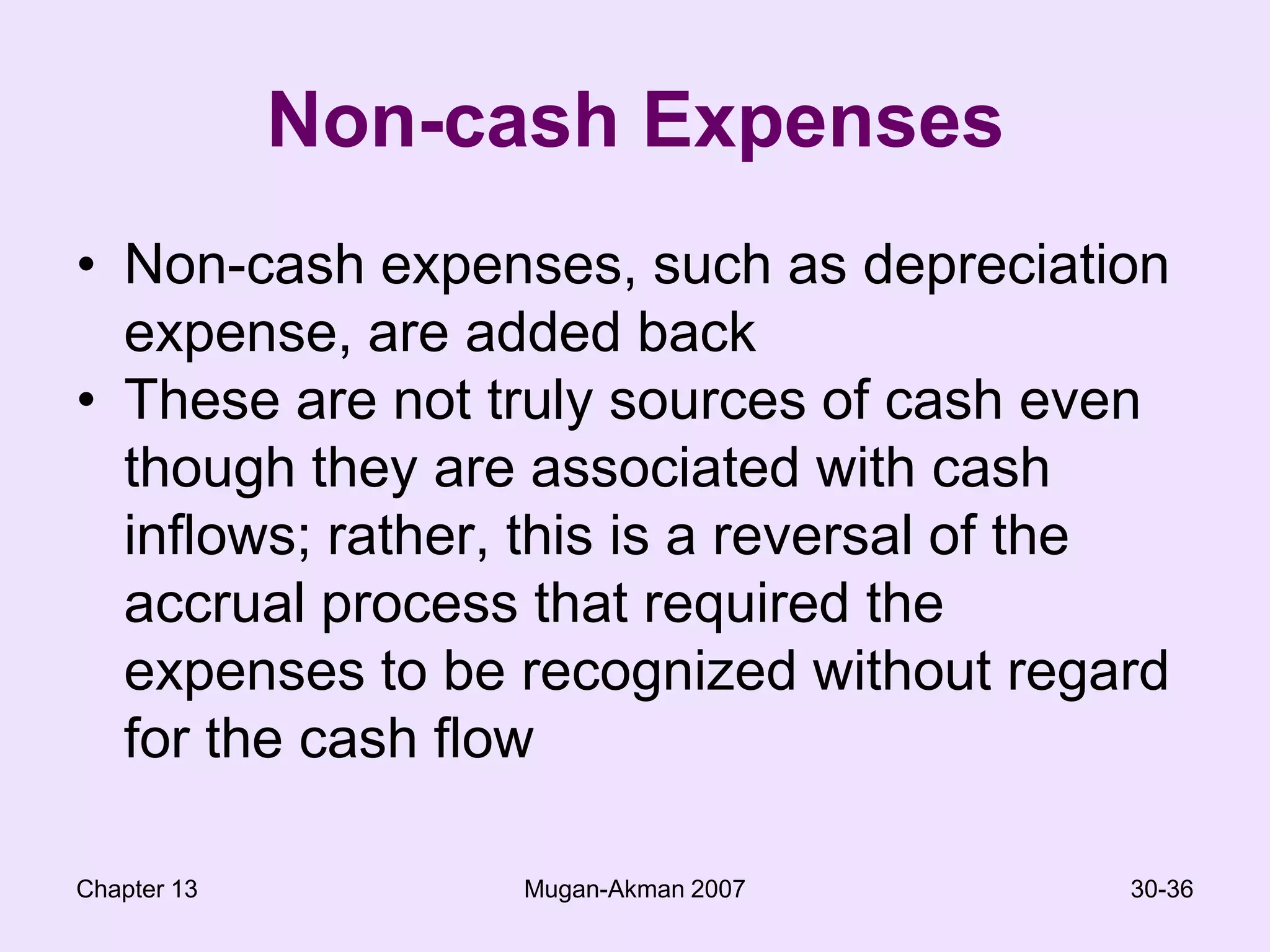
Chapter 13Mugan-Akman 200730-36Non-cash ExpensesNon-cash expenses, such as depreciation expense, are added backThese are not truly sources of cash even though they are associated with cash inflows; rather, this is a reversal of the accrual process that required the expenses to be recognized without regard for the cash flow
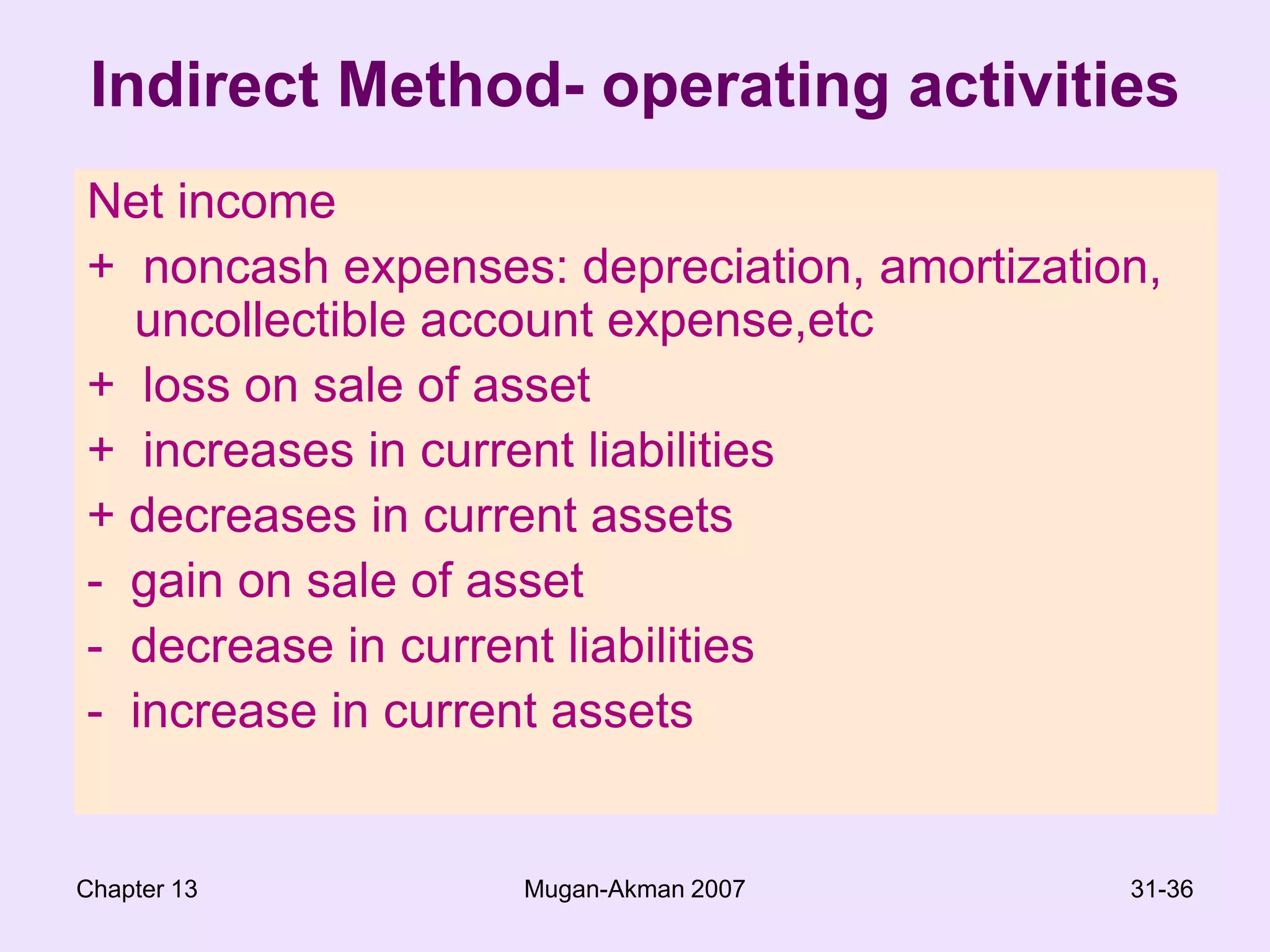
Chapter 13Mugan-Akman 200731-36Indirect Method- operating activitiesNet income+  noncash expenses: depreciation, amortization,    uncollectible account expense,etc+  loss on sale of asset+  increases in current liabilities+ decreases in current assets-  gain on sale of asset-  decrease in current liabilities-  increase in current assets
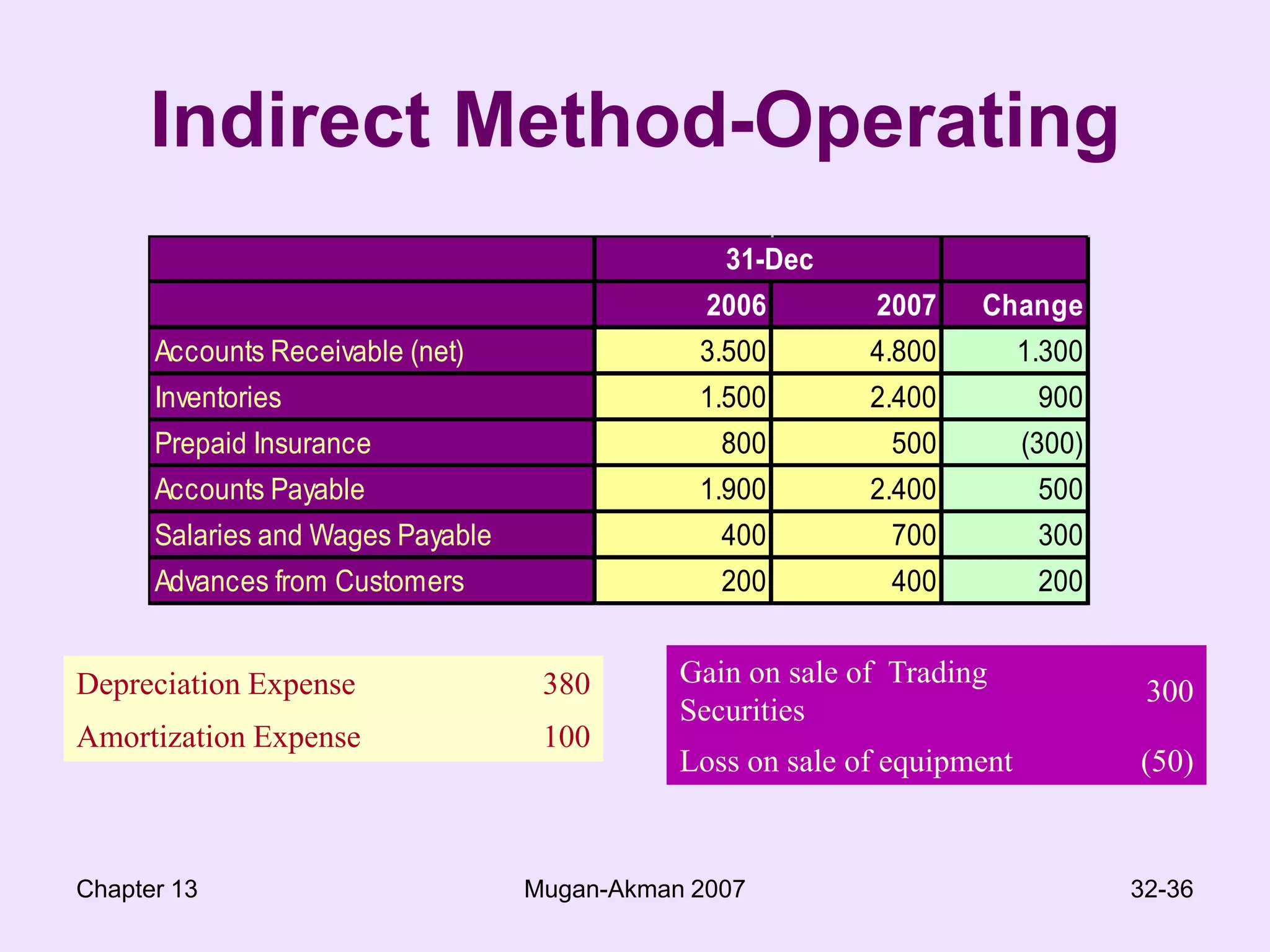
Chapter 13Mugan-Akman 200732-36Indirect Method-Operating
Chapter 13Mugan-Akman 200733-36Cash Flow from Operating Activities –Indirect MethodEICC A.ŞFor the year 2007
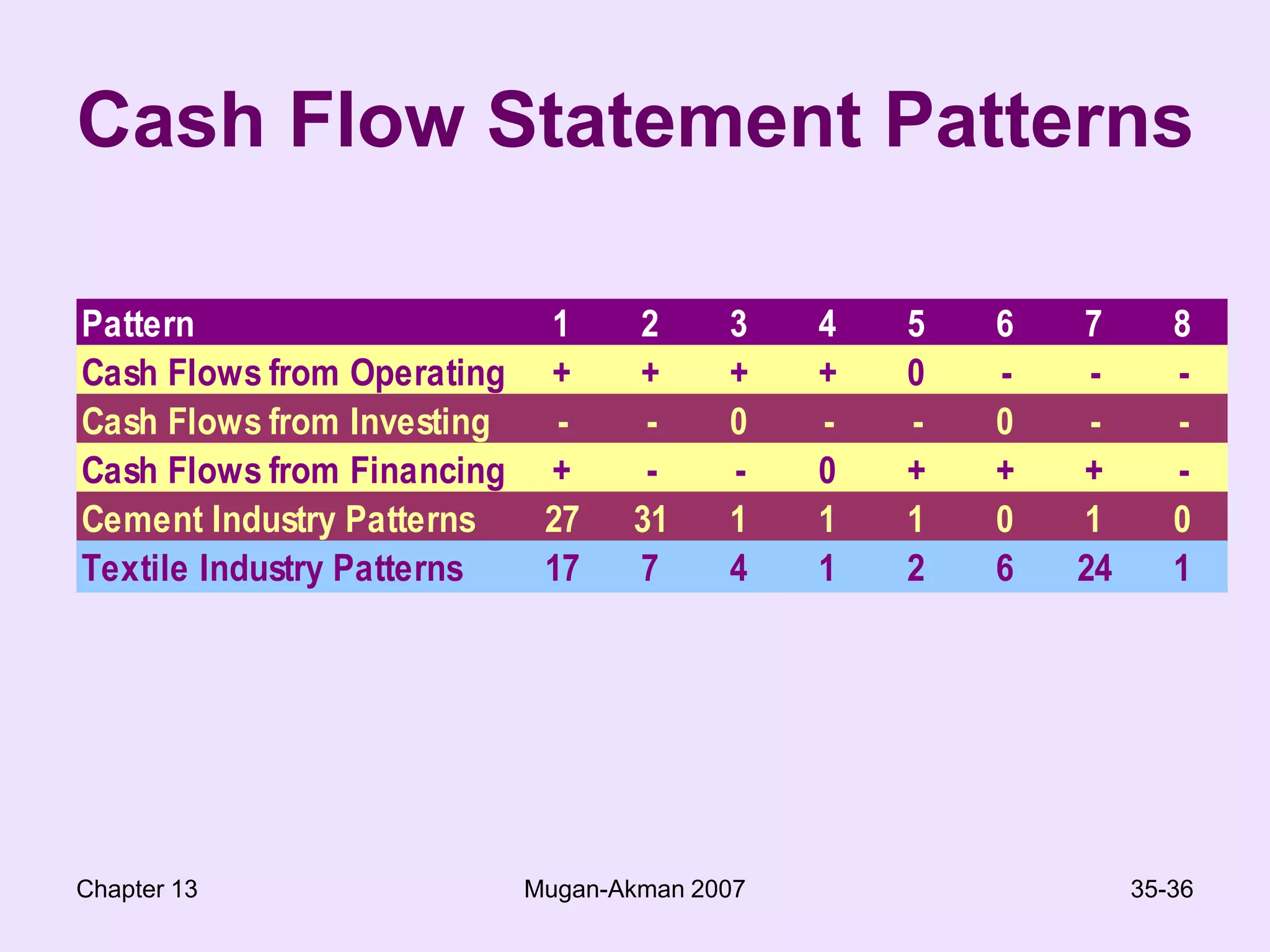
Chapter 13Mugan-Akman 200734-36Uses of Cash Flow Statement Informationpattern of cash flow statements would provide valuable information about the growth stage, and possible strategies of companies predicting financial distressratios

Cash Flow Statement - Finac 4

  • 2.
    Chapter 13Mugan-Akman 20072-36CashFlow Statementbased on cash accountingamount of net income in a period is usually different than the amount of increase in cash in the same periodreports the effects of the activities – investing, financing, operations –of an entity on its cash flow and ties the three activities of a business togethercash includes cash and cash equivalentsCash equivalents: treasury bills maturing in 90 days or less; investment funds; foreign currency on hand; checking account and free savings account
  • 3.
    Chapter 13Mugan-Akman 20073-36CashFlow Statementexplains the reasons for a change in cash.classifies the reasons for the change as an operating, investing or financing activity.reconciles net income with cash flow from operations.firms could prepare the cash flow statement directly from the cash account.most, however, find it more efficient to prepare the cash flow statement from the balance sheet and income statement
  • 4.
    Chapter 13Mugan-Akman 20074-36Activities1.Operations -- cash flows related to selling goods and services; that is, the principle business of the firm.2. Investing -- cash flows related to the acquisition or sale of non-current assets.3. Financing -- long term and short term cash flows related to liabilities and owners’ equity; dividends are a financing cash outflow.
  • 5.
    Chapter 13Mugan-Akman 20075-36ExternalUses of CFSTo assess the ability of a firm to manage cash flowsTo assess the ability of a firm to generate cash through its operationsTo assess the company’s ability to meet its obligations and its dividend policyTo provide information about the effectiveness of the firm to convert its revenues to cashTo provide information to estimate or anticipate the company’s need for additional financing
  • 6.
    Chapter 13Mugan-Akman 20076-36InternalUses of CFSAlong side with cash budget CFS is used:To assess liquidityDetermine if short-term financing is necessaryTo determine dividend policyDecide to distribute; or increase or decreaseTo evaluate the investment and financing decisions
  • 7.
    Chapter 13Mugan-Akman 20077-36Cashflow from operating activitiesExamples (IAS No.7):cash received from customers through sale of goods or services performed;cash received from non-operating activities such as dividends from investments, interest revenue, commissions, and fees;cash payments to suppliers or employees;cash payments for taxes and other expenses;In effect, the income statement is changed from accrual basis to cash basis
  • 8.
    Chapter 13Mugan-Akman 20078-36InvestingActivitiesExamples of investing activities include (IAS No.7):cash payments to acquire property, plant, and equipment (PPE), other tangible or intangible assets, and other long-term assets;cash received from sales of assets that are not held for the regular trading purposes such as sale of building; marketable securities such as trading and available for sale securities, and investments;loans extended to other companies; and collection of such loans;cash received from sale of, and paid for purchases of derivative instruments;
  • 9.
    Chapter 13Mugan-Akman 20079-36FinancingActivitiesExamples of financing activities are (IAS No.7):cash received from issuing share capital;cash payments to shareholders to redeem existing shares- treasury stock;cash proceeds from issuing bonds, loans, notes, mortgages and other short or long-term borrowings;cash repayment of loans and other borrowings; andcash payments to shareholders as dividends.
  • 10.
    Chapter 13Mugan-Akman 200710-36Componentsof the Cash Flow StatementCash received fromsale of goodsand servicesCash paid foroperating goodsand servicescash flowfrom operations-=Operations+ or -Cash received fromsales of investmentsand longterm assetsCash paid to purchaselong-term investmentscash flowfrom investing-=Investing+ or -Cash paid for dividends and to repay debt or to buy treasury stockCash received fromissue of debt orcapital stockcash flowfrom financing-=Financing=Net change in cashfor the periodcash inflows cash outflows
  • 11.
    Chapter 13Mugan-Akman 200711-36Classificationof Cash in-flows and outflowsTo pay wagesTo purchase inventoryTo pay expensesTo pay interestTo pay taxesTo purchase tradingsec.From sales of goods and services to customersFrom receipt of interest or dividendsFrom sale of trading securitiesOperating ActivitiesFrom sale of PPE and other longterm assetsFrom sale of short or longterm securitiesFrom collection of loansTo purchase PPE and other longterm assetsTo purchase longterm securitiesTo make loansInvesting ActivitiesFrom sale of common or preferred stockFrom issuance of short or long term debtTo acquire preferred or common stockTo repay debtTo pay dividendsFinancing Activities
  • 12.
    Chapter 13Mugan-Akman 200712-36Formatof the Cash Flow StatementName of the CompanyCash Flow StatementFor the period …Cash from operating activities ACash from investing activities BCash from financing activities CNet Change in Cash D = (A+B+C) increase or (decrease)+ Beginning Cash balance CB, from the beginning balance sheet Ending Cash balance =CB + D should equal to ending cash balance in the ending balance sheetNon-cash Investing and Financing Activities
  • 13.
    Chapter 13Mugan-Akman 200713-36Determinationof Cash Flows From Operating ActivitiesDirect MethodIncome Statement items are converted to cash flows individuallyIndirect Method Net income or loss is adjusted for accruals such as accounts receivable and payable, and for non-cash expenses such as depreciation reconciliation of the accrual based and cash based accounting
  • 14.
    Chapter 13Mugan-Akman 200714-36Comparisonof MethodsDirect method of presentation calculates cash flow from operations by subtracting cash disbursements to supplies, employees, and others from cash receipts from customers.
  • 15.
    The indirect methodcalculates cash flow from operations by adjusting net income for non-cash revenues and expenses.
  • 16.
    Most firms presenttheir cash flows using the indirect method.Only operating activities section is different between the methods, investing and financing sections are the same.
  • 17.
    Chapter 13Mugan-Akman 200715-36CASHBASIS OF ACCOUNTINGACCRUAL BASIS OFACCOUNTINGEARNED REVENUESADJUSTMENTSTO RECONCILENET INCOME TO NET CASH FLOWSNET CASHFLOWS FROMOPERATINGACTIVITIESNETINCOMEINCURRED EXPENSESRelationship of Accrual and Cash Basis of Accounting
  • 18.
    Chapter 13Mugan-Akman 200716-36Illustrationof the Preparation of the Cash Flow StatementEICC A.ŞIncome StatementFor the year 2007
  • 19.
    Chapter 13Mugan-Akman 200717-36EICCA.S. Comparative Balance Sheets- In TL
  • 20.
    Chapter 13Mugan-Akman 200718-36Illustration-Cashflow statement-EICCAdditional Information:Company sold equipment with original cost of TL 1.500 and book value of TL 1.370 for TL 1.320.Sold trading securities of TL 1.200 with a gain of TL 300, and purchased some.Leased equipment in 2007 for TL 1.000 as a capital lease. Purchased building and equipment.Declared and paid dividends.Common stock of TL 600 par value was issued for TL 700 cash.Accounts payable pertain to merchandise suppliers, and accounts receivable to customers.
  • 21.
    Chapter 13Mugan-Akman 200719-36Stepsin Direct Method-CFS operating activitiescompute collectionsfrom customersfrom other revenuescompute payments for operating expensescompute payments for non-operating expenses
  • 22.
    Chapter 13Mugan-Akman 200720-36CashCollections from CustomersSales TL 8.750 Deduct: increase in accounts receivable (1.300)Add: increase in advances from customers 200Cash collections from customers TL 7.650
  • 23.
    Chapter 13Mugan-Akman 200721-36CashPayments to SuppliersCost of Goods Sold TL 4.200 Add: increase in inventories 900Purchases of the period TL 5.100Purchases of the period TL 5.100 Deduct: increase in accounts payable 500Cash payments to suppliers TL 4.600
  • 24.
    Chapter 13Mugan-Akman 200722-36CashPayments for Operating ExpensesSalaries and Wages Expense TL 2.000 Deduct: Increase in Salaries and Wages Payable 300Salaries and Wages Paid TL 1.700 Insurance Expense TL 900Deduct: Decrease in Prepaid Insurance 300Cash paid for Insurance TL 600
  • 25.
    Chapter 13Mugan-Akman 200723-36CashFlows From Operating ActivitiesCash flows from operating activities:Cash Receipts:Collections from customers TL 7.650 Dividend and interest revenue 150 7.800Cash payments:To suppliers TL 4.600For operating expenses Salaries and wages paid TL 1.700 Insurance payments 600 2.300For non-operating expenses 800 Interest expense 350For income tax 450 (7.700)Net Cash Provided by Operating Activities TL 100
  • 26.
    Chapter 13Mugan-Akman 200724-36CashFlows from Investing Activities
  • 27.
    Chapter 13Mugan-Akman 200725-36CashFlow from Investing ActivitiesCash flow from investing activities:Purchase of building TL (300) Sale of equipment 1.320Purchase of equipment (1.520)Sale of trading securities 1.500Purchase of trading securities (300)Net Cash flow from investing activities TL 700
  • 28.
    Chapter 13Mugan-Akman 200726-36CashFlow from Financing Activities
  • 29.
  • 30.
    Chapter 13Mugan-Akman 200728-36EICCA.Ş,Cash Flow Statement, For the year 2007- Direct Method
  • 31.
    Chapter 13Mugan-Akman 200729-36increasedecreaseIfassets increased, then cash was spent,so it is an outflow.If assets decreased,then they provided cashso it is an inflow.Assets:If liabilities or S.H.E.increased, then cashwas received,so it is an inflow.If liabilitiesor S.H.E.decreased, then cashwas spent,so it is an outflow.Liabilitiesand Shareholders’equityIndirect MethodInvestigation of Changes in Specific Accounts
  • 32.
    Chapter 13Mugan-Akman 200730-36Non-cashExpensesNon-cash expenses, such as depreciation expense, are added backThese are not truly sources of cash even though they are associated with cash inflows; rather, this is a reversal of the accrual process that required the expenses to be recognized without regard for the cash flow
  • 33.
    Chapter 13Mugan-Akman 200731-36IndirectMethod- operating activitiesNet income+ noncash expenses: depreciation, amortization, uncollectible account expense,etc+ loss on sale of asset+ increases in current liabilities+ decreases in current assets- gain on sale of asset- decrease in current liabilities- increase in current assets
  • 34.
  • 35.
    Chapter 13Mugan-Akman 200733-36CashFlow from Operating Activities –Indirect MethodEICC A.ŞFor the year 2007
  • 36.
    Chapter 13Mugan-Akman 200734-36Usesof Cash Flow Statement Informationpattern of cash flow statements would provide valuable information about the growth stage, and possible strategies of companies predicting financial distressratios
  • 37.
  • 38.