Statement of Cash Flows- First
Approach
Appendix 6- Introduction to preparation of the
Statement of Cash Flows
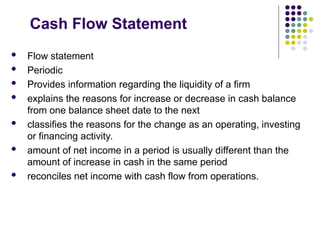
Cash Flow Statement
 Flow statement
 Periodic
 Provides information regarding the liquidity of a firm
 explains the reasons for increase or decrease in cash balance
from one balance sheet date to the next
 classifies the reasons for the change as an operating, investing
or financing activity.
 amount of net income in a period is usually different than the
amount of increase in cash in the same period
 reconciles net income with cash flow from operations.
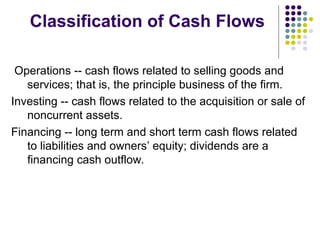
Classification of Cash Flows
Operations -- cash flows related to selling goods and
services; that is, the principle business of the firm.
Investing -- cash flows related to the acquisition or sale of
noncurrent assets.
Financing -- long term and short term cash flows related
to liabilities and owners’ equity; dividends are a
financing cash outflow.
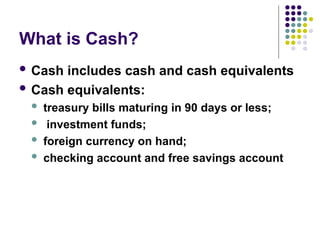
What is Cash?
 Cash includes cash and cash equivalents
 Cash equivalents:
 treasury bills maturing in 90 days or less;
 investment funds;
 foreign currency on hand;
 checking account and free savings account
External Uses of CFS
 To assess the ability of a firm to manage cash flows
 To assess the ability of a firm to generate cash
through its operations
 To assess the company’s ability to meet its
obligations and its dividend policy
 To provide information about the effectiveness of
the firm to convert its revenues to cash
 To provide information to estimate or anticipate the
company’s need for additional financing
Internal Uses of CFS
 Along side with cash budget CFS is used:
 To assess liquidity
 Determine if short-term financing is necessary
 To determine dividend policy
 Decide to distribute; or increase or decrease
 To evaluate the investment and financing
decisions
Cash flow from operating
activities
 Examples (IAS No.7):
 cash received from customers through sale of
goods or services performed;
 cash received from non-operating activities such
as dividends from investments, interest revenue,
commissions, and fees;
 cash payments to suppliers or employees;
 cash payments for taxes and other expenses;
In effect, the income statement is changed from
accrual basis to cash basis
Investing Activities
Examples of investing activities include:
 cash payments to acquire property, plant, and equipment
(PPE), other tangible or intangible assets, and other long-term
assets; and sale of such assets
 loans extended to other companies; and collection of such
loans;
Financing Activities
Examples of financing activities are :
 cash received from issuing share capital;
 cash proceeds from issuing bonds, loans, notes,
mortgages and other short or long-term borrowings;
 cash repayment of loans and other borrowings; and
 cash payments to shareholders as dividends.
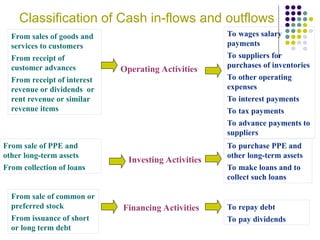
Classification of Cash in-flows and outflows
From sales of goods and
services to customers
From receipt of
customer advances
From receipt of interest
revenue or dividends or
rent revenue or similar
revenue items
Operating Activities
To wages salary
payments
To suppliers for
purchases of inventories
To other operating
expenses
To interest payments
To tax payments
To advance payments to
suppliers
From sale of PPE and
other long-term assets
From collection of loans
Investing Activities
To purchase PPE and
other long-term assets
To make loans and to
collect such loans
From sale of common or
preferred stock
From issuance of short
or long term debt
Financing Activities To repay debt
To pay dividends
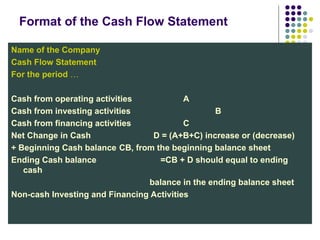
Format of the Cash Flow Statement
Name of the Company
Cash Flow Statement
For the period …
Cash from operating activities A
Cash from investing activities B
Cash from financing activities C
Net Change in Cash D = (A+B+C) increase or (decrease)
+ Beginning Cash balance CB, from the beginning balance sheet
Ending Cash balance =CB + D should equal to ending
cash
balance in the ending balance sheet
Non-cash Investing and Financing Activities
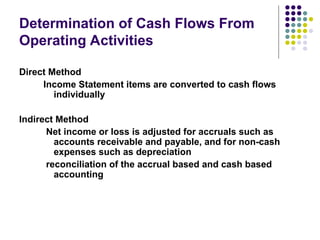
Determination of Cash Flows From
Operating Activities
Direct Method
Income Statement items are converted to cash flows
individually
Indirect Method
Net income or loss is adjusted for accruals such as
accounts receivable and payable, and for non-cash
expenses such as depreciation
reconciliation of the accrual based and cash based
accounting
Comparison of Methods
 Direct method of presentation calculates cash flow from
operations by subtracting cash disbursements to supplies,
employees, and others from cash receipts from customers.
 The indirect method calculates cash flow from operations by
adjusting net income for non-cash revenues and expenses.
 Most firms present their cash flows using the indirect method.
Only operating activities section is different between the
methods, investing and financing sections are the same.
How to prepare cash flow
statement
 Firms could prepare their own cash flow
statement directly from the cash account.
 however, we need two consecutive balance
sheets and the income statement that covers
the period between the two balance sheets
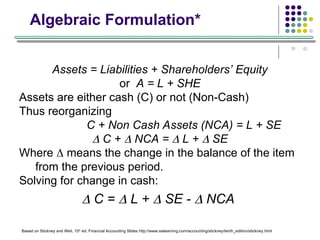
Algebraic Formulation*
Assets = Liabilities + Shareholders’ Equity
or A = L + SHE
Assets are either cash (C) or not (Non-Cash)
Thus reorganizing
C + Non Cash Assets (NCA) = L + SE
 C +  NCA =  L +  SE
Where  means the change in the balance of the item
from the previous period.
Solving for change in cash:
 C =  L +  SE -  NCA
Based on Stickney and Weil, 10th
ed. Financial Accounting Slides http://www.swlearning.com/accounting/stickney/tenth_edition/stickney.html
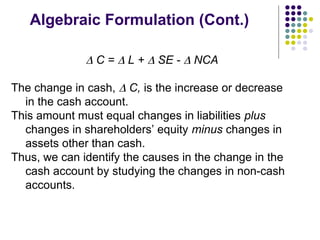
Algebraic Formulation (Cont.)
 C =  L +  SE -  NCA
The change in cash,  C, is the increase or decrease
in the cash account.
This amount must equal changes in liabilities plus
changes in shareholders’ equity minus changes in
assets other than cash.
Thus, we can identify the causes in the change in the
cash account by studying the changes in non-cash
accounts.
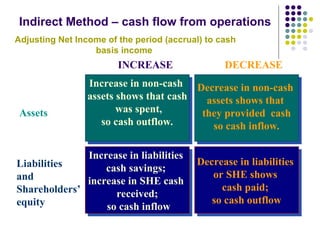
Indirect Method – cash flow from operations
Increase in non-cash
assets shows that cash
was spent,
so cash outflow.
Decrease in non-cash
assets shows that
they provided cash
so cash inflow.
Increase in liabilities
cash savings;
increase in SHE cash
received;
so cash inflow
Decrease in liabilities
or SHE shows
cash paid;
so cash outflow
Assets
Liabilities
and
Shareholders’
equity
INCREASE DECREASE
Adjusting Net Income of the period (accrual) to cash
basis income
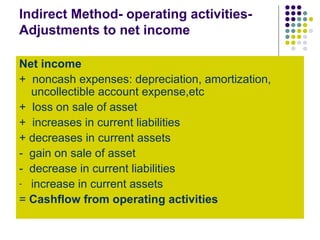
Indirect Method- operating activities-
Adjustments to net income
Net income
+ noncash expenses: depreciation, amortization,
uncollectible account expense,etc
+ loss on sale of asset
+ increases in current liabilities
+ decreases in current assets
- gain on sale of asset
- decrease in current liabilities
- increase in current assets
= Cashflow from operating activities
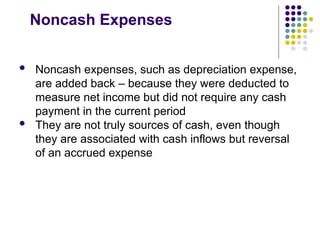
Noncash Expenses
 Noncash expenses, such as depreciation expense,
are added back – because they were deducted to
measure net income but did not require any cash
payment in the current period
 They are not truly sources of cash, even though
they are associated with cash inflows but reversal
of an accrued expense
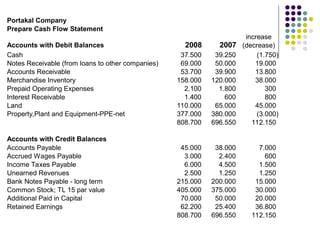
Portakal Company
Prepare Cash Flow Statement
Accounts with Debit Balances 2008 2007
increase
(decrease)
Cash 37.500 39.250 (1.750)
Notes Receivable (from loans to other companies) 69.000 50.000 19.000
Accounts Receivable 53.700 39.900 13.800
Merchandise Inventory 158.000 120.000 38.000
Prepaid Operating Expenses 2.100 1.800 300
Interest Receivable 1.400 600 800
Land 110.000 65.000 45.000
Property,Plant and Equipment-PPE-net 377.000 380.000 (3.000)
808.700 696.550 112.150
Accounts with Credit Balances
Accounts Payable 45.000 38.000 7.000
Accrued Wages Payable 3.000 2.400 600
Income Taxes Payable 6.000 4.500 1.500
Unearned Revenues 2.500 1.250 1.250
Bank Notes Payable - long term 215.000 200.000 15.000
Common Stock; TL 15 par value 405.000 375.000 30.000
Additional Paid in Capital 70.000 50.000 20.000
Retained Earnings 62.200 25.400 36.800
808.700 696.550 112.150
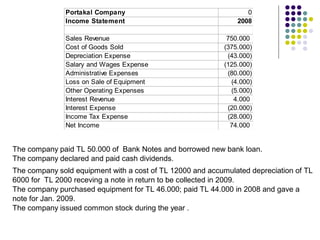
Portakal Company 0
Income Statement 2008
Sales Revenue 750.000
Cost of Goods Sold (375.000)
Depreciation Expense (43.000)
Salary and Wages Expense (125.000)
Administrative Expenses (80.000)
Loss on Sale of Equipment (4.000)
Other Operating Expenses (5.000)
Interest Revenue 4.000
Interest Expense (20.000)
Income Tax Expense (28.000)
Net Income 74.000
The company paid TL 50.000 of Bank Notes and borrowed new bank loan.
The company declared and paid cash dividends.
The company issued common stock during the year .
The company sold equipment with a cost of TL 12000 and accumulated depreciation of TL
6000 for TL 2000 receving a note in return to be collected in 2009.
The company purchased equipment for TL 46.000; paid TL 44.000 in 2008 and gave a
note for Jan. 2009.
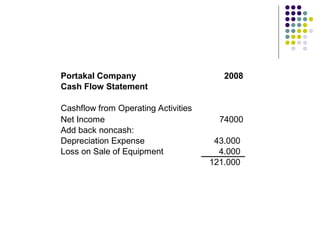
Portakal Company 2008
Cash Flow Statement
Cashflow from Operating Activities
Net Income 74000
Add back noncash:
Depreciation Expense 43.000
Loss on Sale of Equipment 4.000
121.000
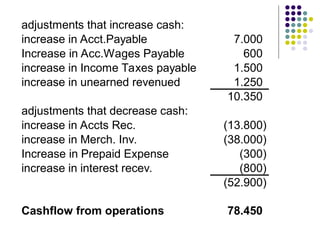
adjustments that increase cash:
increase in Acct.Payable 7.000
Increase in Acc.Wages Payable 600
increase in Income Taxes payable 1.500
increase in unearned revenued 1.250
10.350
adjustments that decrease cash:
increase in Accts Rec. (13.800)
increase in Merch. Inv. (38.000)
Increase in Prepaid Expense (300)
increase in interest recev. (800)
(52.900)
Cashflow from operations 78.450
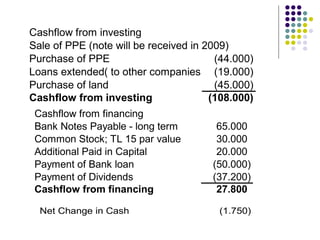
Cashflow from investing
Sale of PPE (note will be received in 2009)
Purchase of PPE (44.000)
Loans extended( to other companies) (19.000)
Purchase of land (45.000)
Cashflow from investing (108.000)
Cashflow from financing
Bank Notes Payable - long term 65.000
Common Stock; TL 15 par value 30.000
Additional Paid in Capital 20.000
Payment of Bank loan (50.000)
Payment of Dividends (37.200)
Cashflow from financing 27.800
Net Change in Cash (1.750)
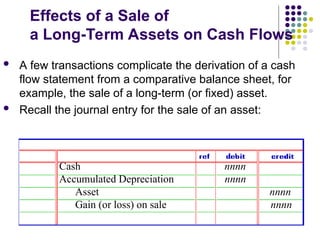
Effects of a Sale of
a Long-Term Assets on Cash Flows
 A few transactions complicate the derivation of a cash
flow statement from a comparative balance sheet, for
example, the sale of a long-term (or fixed) asset.
 Recall the journal entry for the sale of an asset:
Cash nnnn
Accumulated Depreciation nnnn
Asset nnnn
Gain (or loss) on sale nnnn
Sale of an Asset
 Each of the four parts of the above journal entry require
an adjustment in the cash flow statement.
 The first line, cash, adds a line to the investing section.
 The second line, a debit to accumulated depreciation,
increases the depreciation expense above the change
in the change in the accumulated depreciation account.
 The third line, a credit to the asset, increases the
amount of cash invested in long-lived assets above the
change in the fixed asset accounts.
 The fourth line, a gain or loss, is reversed out in the
operating sections since this is not a cash flow.
Comparison of Cash Flow to Net
Income
 Net income is an accrual based concept and purports to
show the long-term.
 Cash flows purport to show the short term.
 Consider the outlook for both short-term and long-term and
consider that each is either good or poor.
 A strong growing firm would show both good long-term and
good short-term outlooks.
 A failing firm would show both poor long-term and poor
short term outlooks.
 What about a firm with good cash flows (short-term) but
poor net income (long-term)?
 What about a firm with poor cash flows (short-term) but
good net income (long-term)?

Cash flow statement-short.pptAMSMASMSMSJJ

  • 1.
    Statement of CashFlows- First Approach Appendix 6- Introduction to preparation of the Statement of Cash Flows
  • 2.
    Cash Flow Statement Flow statement  Periodic  Provides information regarding the liquidity of a firm  explains the reasons for increase or decrease in cash balance from one balance sheet date to the next  classifies the reasons for the change as an operating, investing or financing activity.  amount of net income in a period is usually different than the amount of increase in cash in the same period  reconciles net income with cash flow from operations.
  • 3.
    Classification of CashFlows Operations -- cash flows related to selling goods and services; that is, the principle business of the firm. Investing -- cash flows related to the acquisition or sale of noncurrent assets. Financing -- long term and short term cash flows related to liabilities and owners’ equity; dividends are a financing cash outflow.
  • 4.
    What is Cash? Cash includes cash and cash equivalents  Cash equivalents:  treasury bills maturing in 90 days or less;  investment funds;  foreign currency on hand;  checking account and free savings account
  • 5.
    External Uses ofCFS  To assess the ability of a firm to manage cash flows  To assess the ability of a firm to generate cash through its operations  To assess the company’s ability to meet its obligations and its dividend policy  To provide information about the effectiveness of the firm to convert its revenues to cash  To provide information to estimate or anticipate the company’s need for additional financing
  • 6.
    Internal Uses ofCFS  Along side with cash budget CFS is used:  To assess liquidity  Determine if short-term financing is necessary  To determine dividend policy  Decide to distribute; or increase or decrease  To evaluate the investment and financing decisions
  • 7.
    Cash flow fromoperating activities  Examples (IAS No.7):  cash received from customers through sale of goods or services performed;  cash received from non-operating activities such as dividends from investments, interest revenue, commissions, and fees;  cash payments to suppliers or employees;  cash payments for taxes and other expenses; In effect, the income statement is changed from accrual basis to cash basis
  • 8.
    Investing Activities Examples ofinvesting activities include:  cash payments to acquire property, plant, and equipment (PPE), other tangible or intangible assets, and other long-term assets; and sale of such assets  loans extended to other companies; and collection of such loans;
  • 9.
    Financing Activities Examples offinancing activities are :  cash received from issuing share capital;  cash proceeds from issuing bonds, loans, notes, mortgages and other short or long-term borrowings;  cash repayment of loans and other borrowings; and  cash payments to shareholders as dividends.
  • 10.
    Classification of Cashin-flows and outflows From sales of goods and services to customers From receipt of customer advances From receipt of interest revenue or dividends or rent revenue or similar revenue items Operating Activities To wages salary payments To suppliers for purchases of inventories To other operating expenses To interest payments To tax payments To advance payments to suppliers From sale of PPE and other long-term assets From collection of loans Investing Activities To purchase PPE and other long-term assets To make loans and to collect such loans From sale of common or preferred stock From issuance of short or long term debt Financing Activities To repay debt To pay dividends
  • 11.
    Format of theCash Flow Statement Name of the Company Cash Flow Statement For the period … Cash from operating activities A Cash from investing activities B Cash from financing activities C Net Change in Cash D = (A+B+C) increase or (decrease) + Beginning Cash balance CB, from the beginning balance sheet Ending Cash balance =CB + D should equal to ending cash balance in the ending balance sheet Non-cash Investing and Financing Activities
  • 12.
    Determination of CashFlows From Operating Activities Direct Method Income Statement items are converted to cash flows individually Indirect Method Net income or loss is adjusted for accruals such as accounts receivable and payable, and for non-cash expenses such as depreciation reconciliation of the accrual based and cash based accounting
  • 13.
    Comparison of Methods Direct method of presentation calculates cash flow from operations by subtracting cash disbursements to supplies, employees, and others from cash receipts from customers.  The indirect method calculates cash flow from operations by adjusting net income for non-cash revenues and expenses.  Most firms present their cash flows using the indirect method. Only operating activities section is different between the methods, investing and financing sections are the same.
  • 14.
    How to preparecash flow statement  Firms could prepare their own cash flow statement directly from the cash account.  however, we need two consecutive balance sheets and the income statement that covers the period between the two balance sheets
  • 15.
    Algebraic Formulation* Assets =Liabilities + Shareholders’ Equity or A = L + SHE Assets are either cash (C) or not (Non-Cash) Thus reorganizing C + Non Cash Assets (NCA) = L + SE  C +  NCA =  L +  SE Where  means the change in the balance of the item from the previous period. Solving for change in cash:  C =  L +  SE -  NCA Based on Stickney and Weil, 10th ed. Financial Accounting Slides http://www.swlearning.com/accounting/stickney/tenth_edition/stickney.html
  • 16.
    Algebraic Formulation (Cont.) C =  L +  SE -  NCA The change in cash,  C, is the increase or decrease in the cash account. This amount must equal changes in liabilities plus changes in shareholders’ equity minus changes in assets other than cash. Thus, we can identify the causes in the change in the cash account by studying the changes in non-cash accounts.
  • 17.
    Indirect Method –cash flow from operations Increase in non-cash assets shows that cash was spent, so cash outflow. Decrease in non-cash assets shows that they provided cash so cash inflow. Increase in liabilities cash savings; increase in SHE cash received; so cash inflow Decrease in liabilities or SHE shows cash paid; so cash outflow Assets Liabilities and Shareholders’ equity INCREASE DECREASE Adjusting Net Income of the period (accrual) to cash basis income
  • 18.
    Indirect Method- operatingactivities- Adjustments to net income Net income + noncash expenses: depreciation, amortization, uncollectible account expense,etc + loss on sale of asset + increases in current liabilities + decreases in current assets - gain on sale of asset - decrease in current liabilities - increase in current assets = Cashflow from operating activities
  • 19.
    Noncash Expenses  Noncashexpenses, such as depreciation expense, are added back – because they were deducted to measure net income but did not require any cash payment in the current period  They are not truly sources of cash, even though they are associated with cash inflows but reversal of an accrued expense
  • 20.
    Portakal Company Prepare CashFlow Statement Accounts with Debit Balances 2008 2007 increase (decrease) Cash 37.500 39.250 (1.750) Notes Receivable (from loans to other companies) 69.000 50.000 19.000 Accounts Receivable 53.700 39.900 13.800 Merchandise Inventory 158.000 120.000 38.000 Prepaid Operating Expenses 2.100 1.800 300 Interest Receivable 1.400 600 800 Land 110.000 65.000 45.000 Property,Plant and Equipment-PPE-net 377.000 380.000 (3.000) 808.700 696.550 112.150 Accounts with Credit Balances Accounts Payable 45.000 38.000 7.000 Accrued Wages Payable 3.000 2.400 600 Income Taxes Payable 6.000 4.500 1.500 Unearned Revenues 2.500 1.250 1.250 Bank Notes Payable - long term 215.000 200.000 15.000 Common Stock; TL 15 par value 405.000 375.000 30.000 Additional Paid in Capital 70.000 50.000 20.000 Retained Earnings 62.200 25.400 36.800 808.700 696.550 112.150
  • 21.
    Portakal Company 0 IncomeStatement 2008 Sales Revenue 750.000 Cost of Goods Sold (375.000) Depreciation Expense (43.000) Salary and Wages Expense (125.000) Administrative Expenses (80.000) Loss on Sale of Equipment (4.000) Other Operating Expenses (5.000) Interest Revenue 4.000 Interest Expense (20.000) Income Tax Expense (28.000) Net Income 74.000 The company paid TL 50.000 of Bank Notes and borrowed new bank loan. The company declared and paid cash dividends. The company issued common stock during the year . The company sold equipment with a cost of TL 12000 and accumulated depreciation of TL 6000 for TL 2000 receving a note in return to be collected in 2009. The company purchased equipment for TL 46.000; paid TL 44.000 in 2008 and gave a note for Jan. 2009.
  • 22.
    Portakal Company 2008 CashFlow Statement Cashflow from Operating Activities Net Income 74000 Add back noncash: Depreciation Expense 43.000 Loss on Sale of Equipment 4.000 121.000
  • 23.
    adjustments that increasecash: increase in Acct.Payable 7.000 Increase in Acc.Wages Payable 600 increase in Income Taxes payable 1.500 increase in unearned revenued 1.250 10.350 adjustments that decrease cash: increase in Accts Rec. (13.800) increase in Merch. Inv. (38.000) Increase in Prepaid Expense (300) increase in interest recev. (800) (52.900) Cashflow from operations 78.450
  • 24.
    Cashflow from investing Saleof PPE (note will be received in 2009) Purchase of PPE (44.000) Loans extended( to other companies) (19.000) Purchase of land (45.000) Cashflow from investing (108.000) Cashflow from financing Bank Notes Payable - long term 65.000 Common Stock; TL 15 par value 30.000 Additional Paid in Capital 20.000 Payment of Bank loan (50.000) Payment of Dividends (37.200) Cashflow from financing 27.800 Net Change in Cash (1.750)
  • 25.
    Effects of aSale of a Long-Term Assets on Cash Flows  A few transactions complicate the derivation of a cash flow statement from a comparative balance sheet, for example, the sale of a long-term (or fixed) asset.  Recall the journal entry for the sale of an asset: Cash nnnn Accumulated Depreciation nnnn Asset nnnn Gain (or loss) on sale nnnn
  • 26.
    Sale of anAsset  Each of the four parts of the above journal entry require an adjustment in the cash flow statement.  The first line, cash, adds a line to the investing section.  The second line, a debit to accumulated depreciation, increases the depreciation expense above the change in the change in the accumulated depreciation account.  The third line, a credit to the asset, increases the amount of cash invested in long-lived assets above the change in the fixed asset accounts.  The fourth line, a gain or loss, is reversed out in the operating sections since this is not a cash flow.
  • 27.
    Comparison of CashFlow to Net Income  Net income is an accrual based concept and purports to show the long-term.  Cash flows purport to show the short term.  Consider the outlook for both short-term and long-term and consider that each is either good or poor.  A strong growing firm would show both good long-term and good short-term outlooks.  A failing firm would show both poor long-term and poor short term outlooks.  What about a firm with good cash flows (short-term) but poor net income (long-term)?  What about a firm with poor cash flows (short-term) but good net income (long-term)?