CHAPTER 1:
INTRODUCTION TO
MALAYSIAN TAXATION
1ATXB213 MALAYSIAN TAXATION I
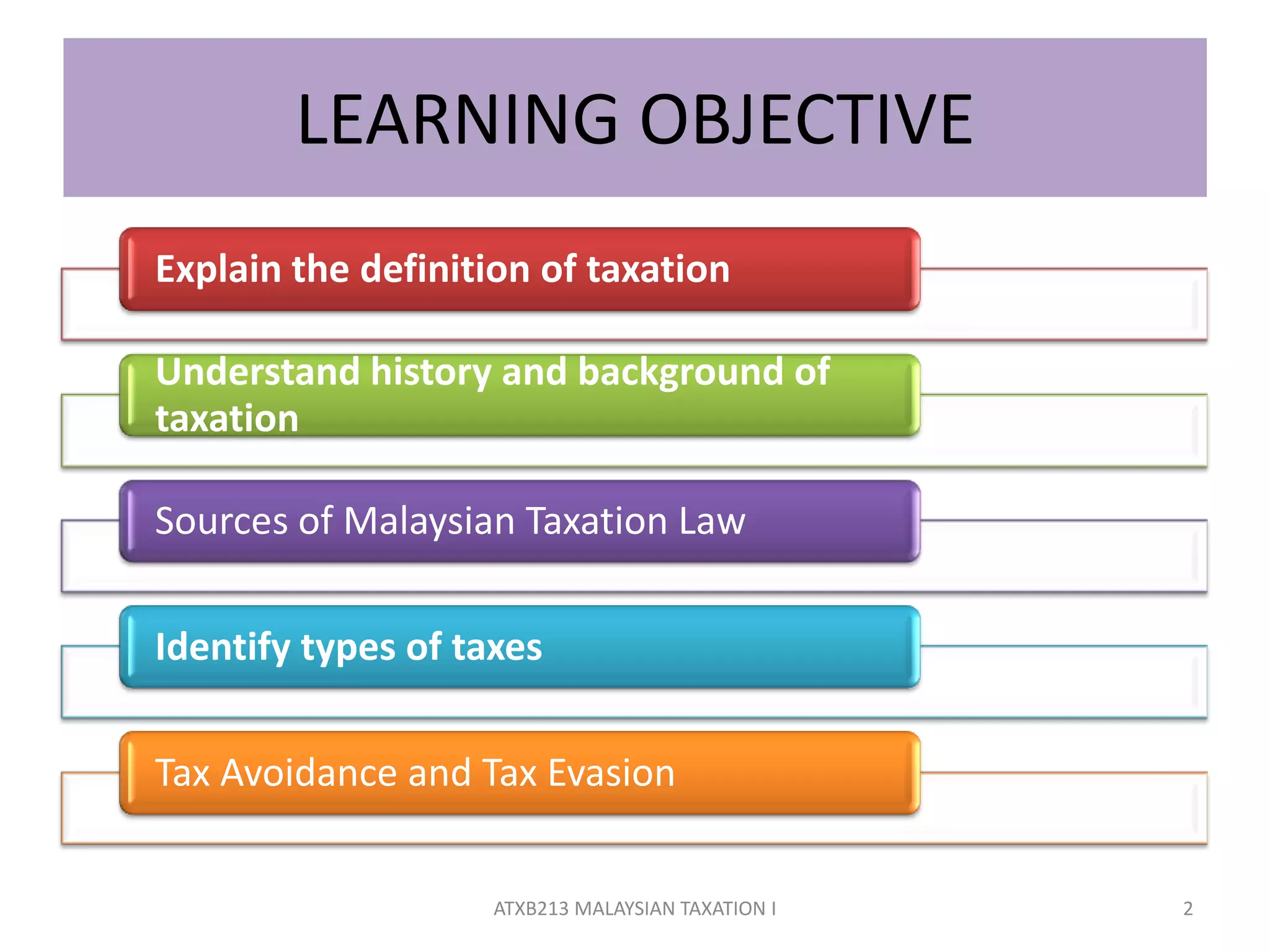
LEARNING OBJECTIVE
Explain the definition of taxation
Understand history and background of
taxation
Sources of Malaysian Taxation Law
Identify types of taxes
Tax Avoidance and Tax Evasion
2ATXB213 MALAYSIAN TAXATION I
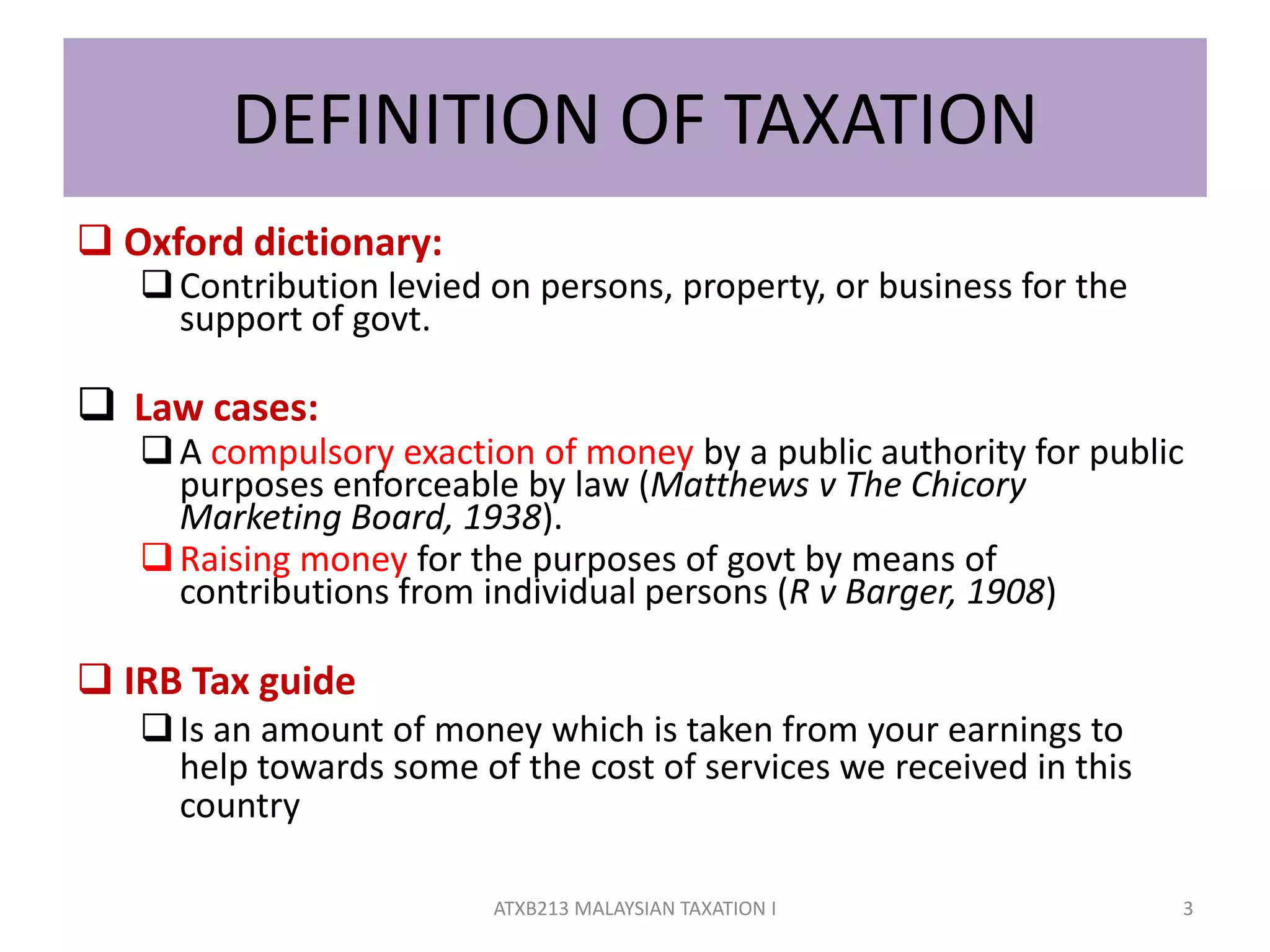
DEFINITION OF TAXATION
 Oxford dictionary:
Contribution levied on persons, property, or business for the
support of govt.
 Law cases:
A compulsory exaction of money by a public authority for public
purposes enforceable by law (Matthews v The Chicory
Marketing Board, 1938).
Raising money for the purposes of govt by means of
contributions from individual persons (R v Barger, 1908)
 IRB Tax guide
Is an amount of money which is taken from your earnings to
help towards some of the cost of services we received in this
country
3ATXB213 MALAYSIAN TAXATION I
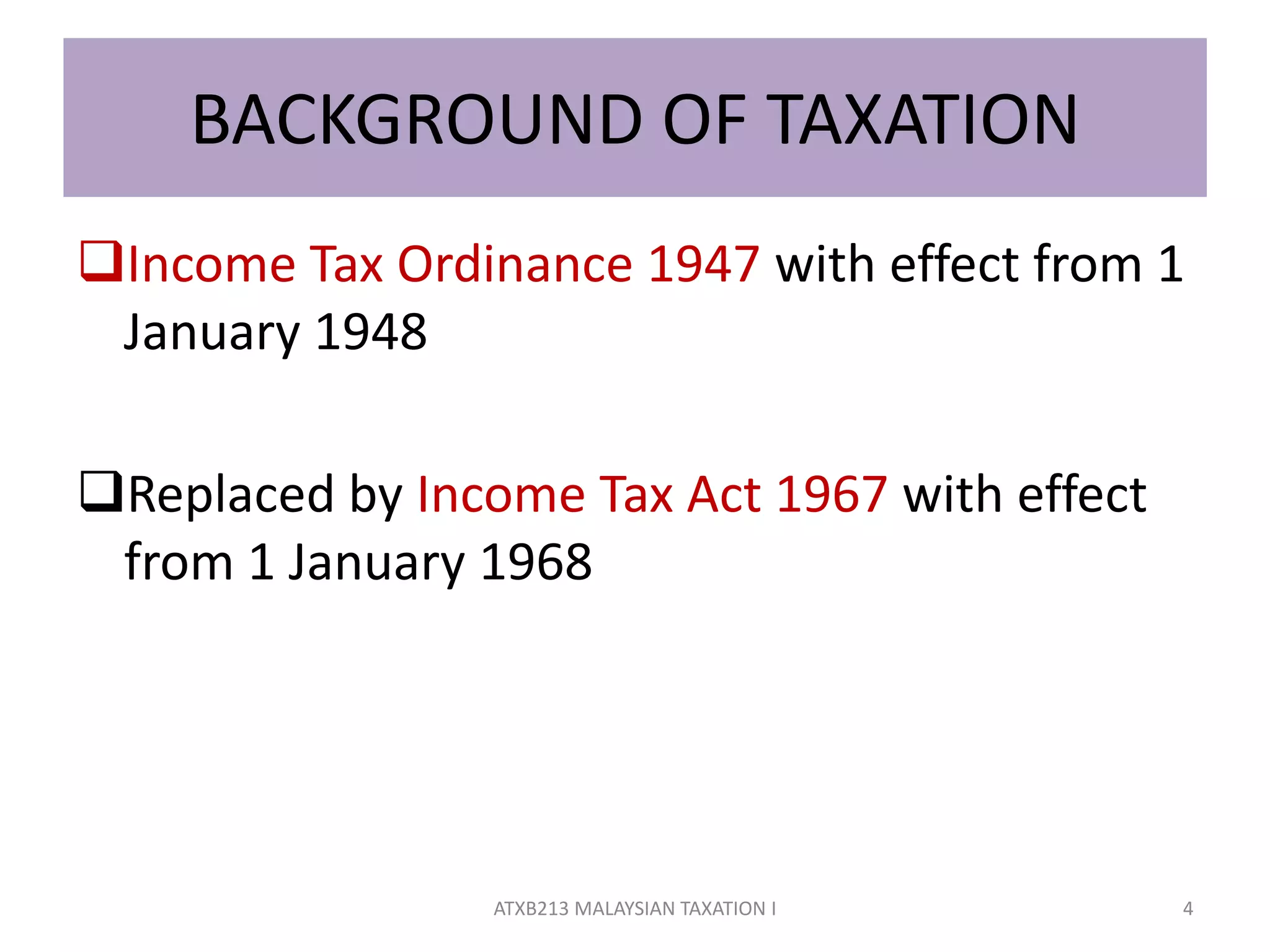
BACKGROUND OF TAXATION
Income Tax Ordinance 1947 with effect from 1
January 1948
Replaced by Income Tax Act 1967 with effect
from 1 January 1968
4ATXB213 MALAYSIAN TAXATION I
SOURCES OF MALAYSIAN TAXATION
LAW
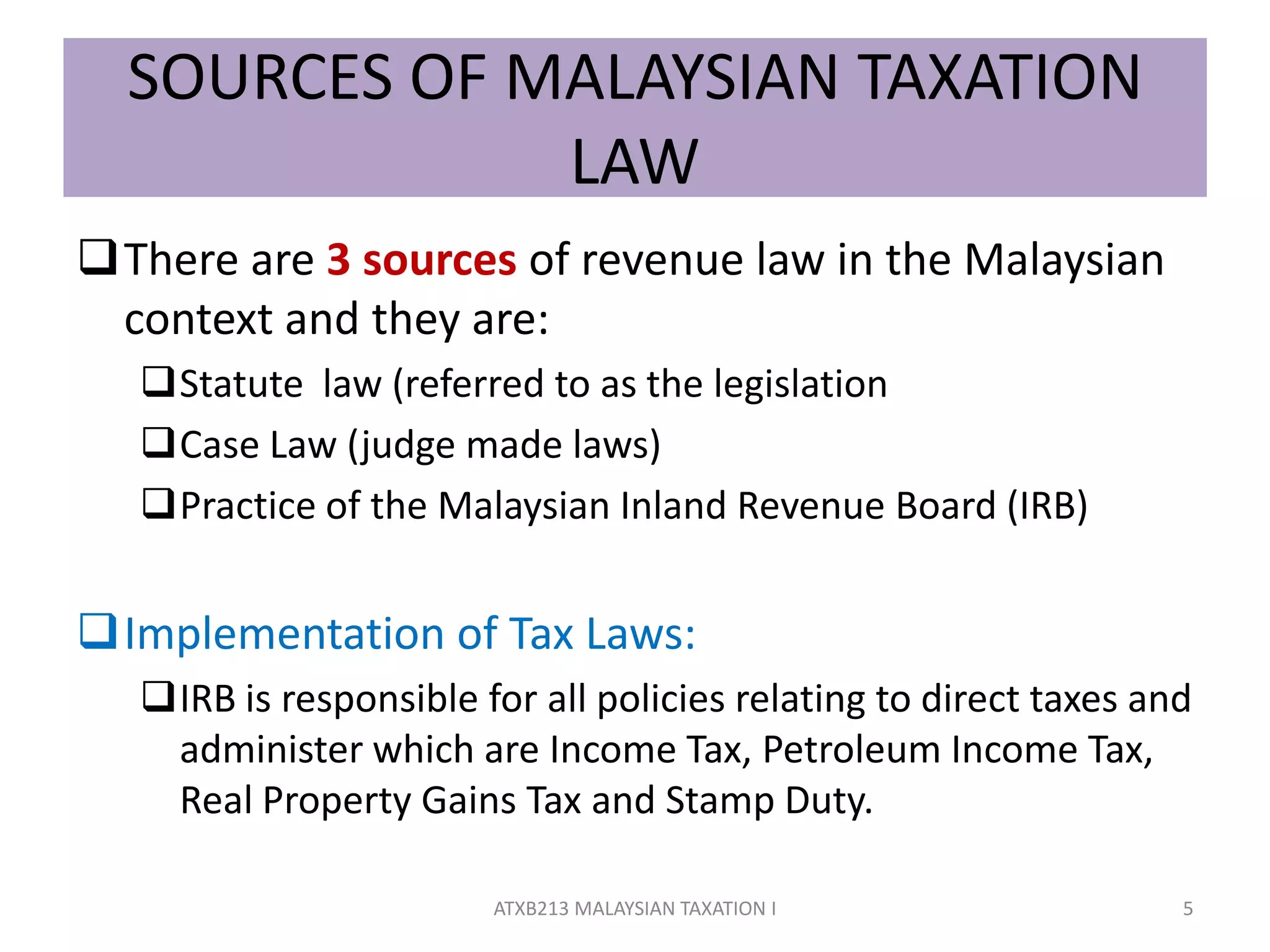
There are 3 sources of revenue law in the Malaysian
context and they are:
Statute law (referred to as the legislation
Case Law (judge made laws)
Practice of the Malaysian Inland Revenue Board (IRB)
Implementation of Tax Laws:
IRB is responsible for all policies relating to direct taxes and
administer which are Income Tax, Petroleum Income Tax,
Real Property Gains Tax and Stamp Duty.
5ATXB213 MALAYSIAN TAXATION I
CHARACTERISTICS OF TAXATION
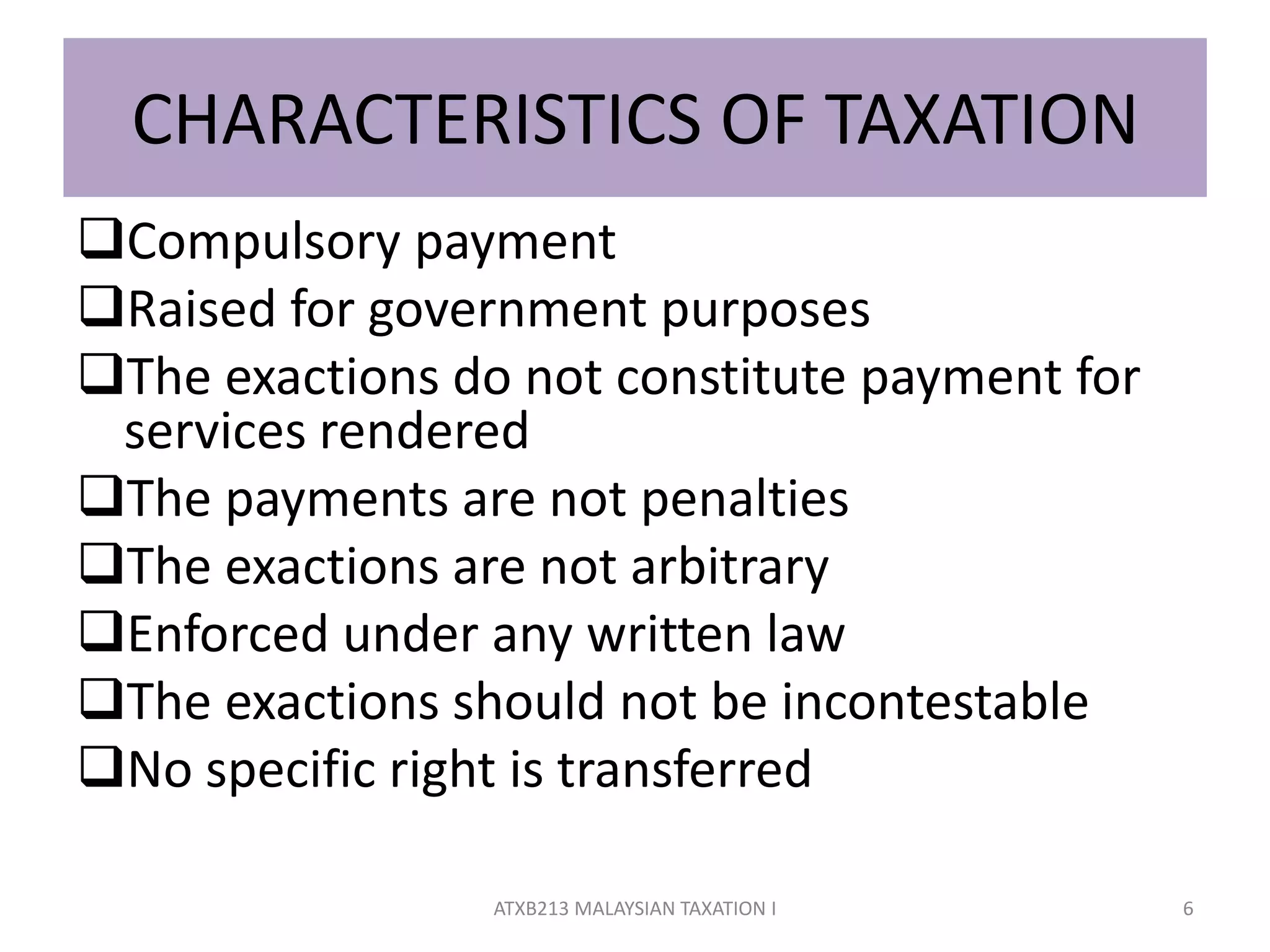
Compulsory payment
Raised for government purposes
The exactions do not constitute payment for
services rendered
The payments are not penalties
The exactions are not arbitrary
Enforced under any written law
The exactions should not be incontestable
No specific right is transferred
6ATXB213 MALAYSIAN TAXATION I
PURPOSE OF TAXATION
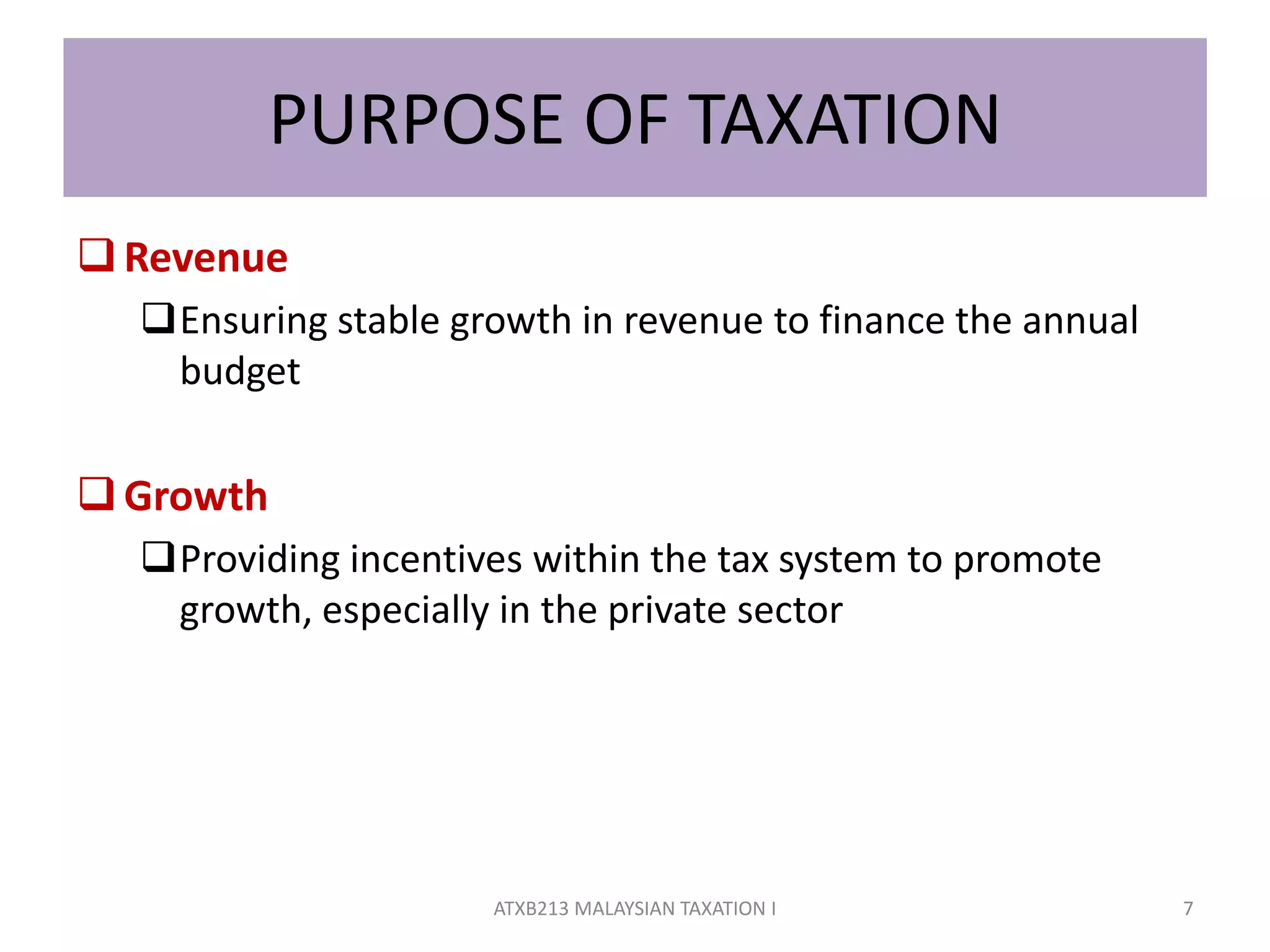
Revenue
Ensuring stable growth in revenue to finance the annual
budget
Growth
Providing incentives within the tax system to promote
growth, especially in the private sector
7ATXB213 MALAYSIAN TAXATION I
TYPES OF TAXES IN MALAYSIA
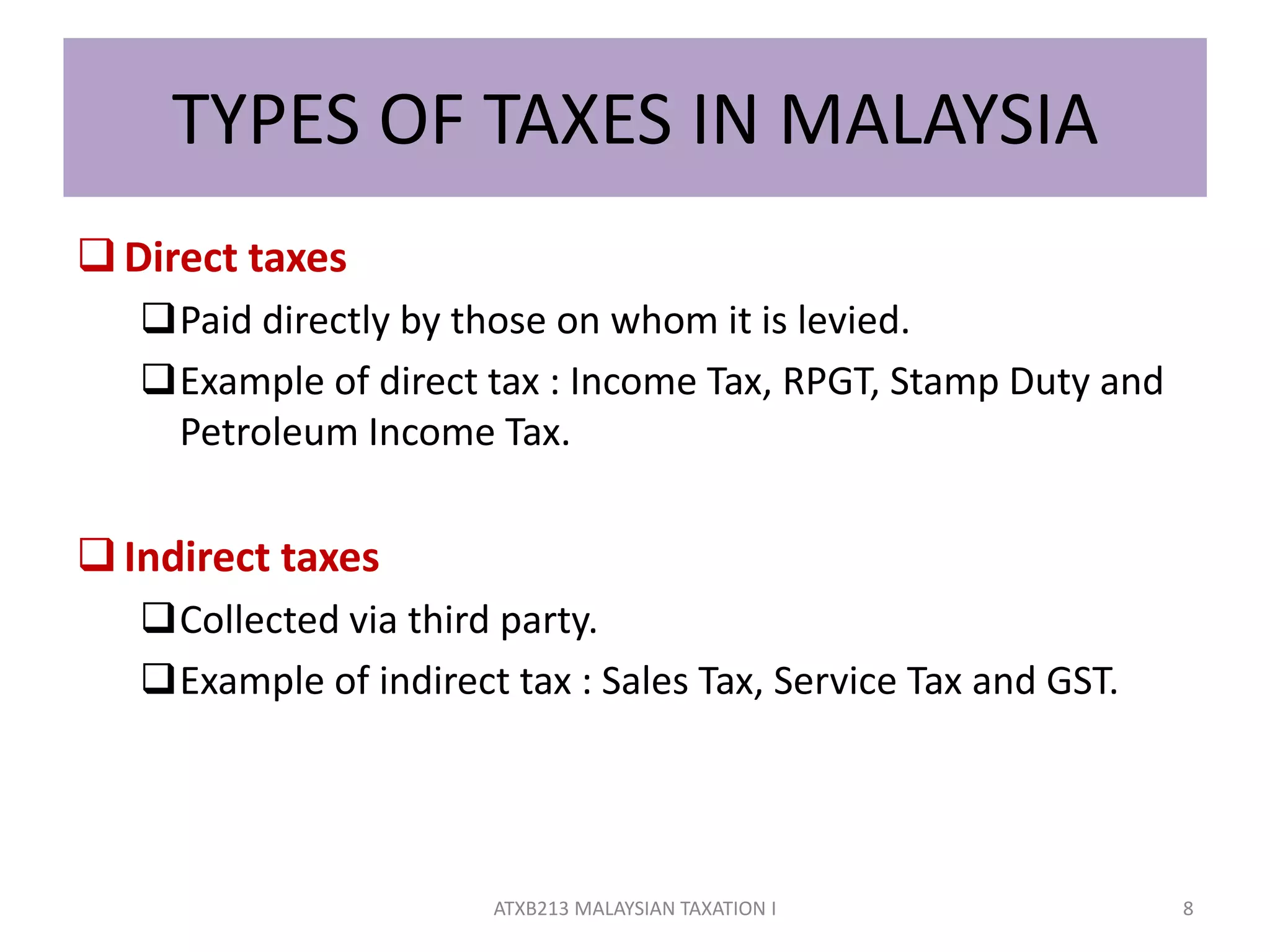
Direct taxes
Paid directly by those on whom it is levied.
Example of direct tax : Income Tax, RPGT, Stamp Duty and
Petroleum Income Tax.
Indirect taxes
Collected via third party.
Example of indirect tax : Sales Tax, Service Tax and GST.
8ATXB213 MALAYSIAN TAXATION I
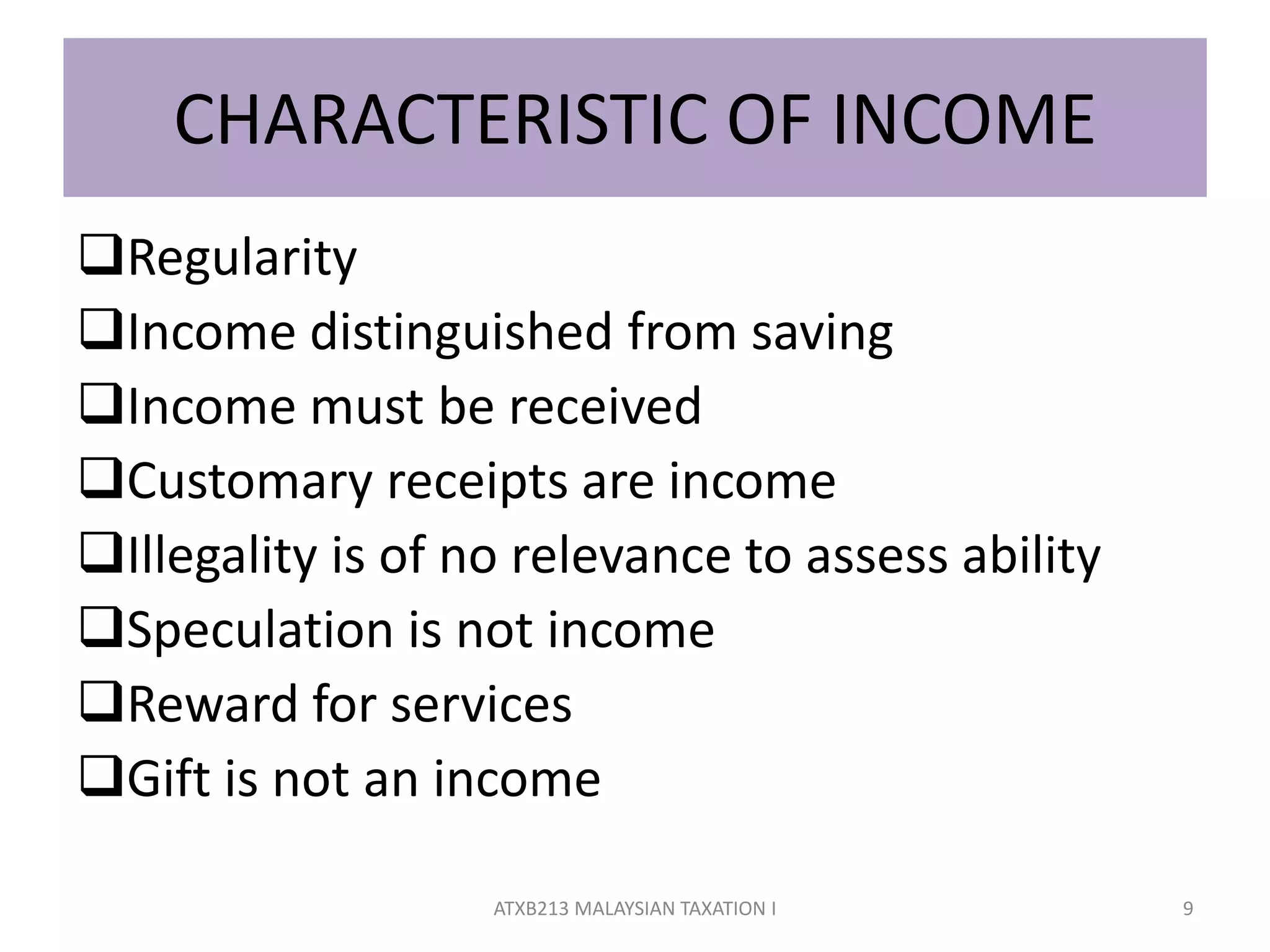
CHARACTERISTIC OF INCOME
Regularity
Income distinguished from saving
Income must be received
Customary receipts are income
Illegality is of no relevance to assess ability
Speculation is not income
Reward for services
Gift is not an income
9ATXB213 MALAYSIAN TAXATION I
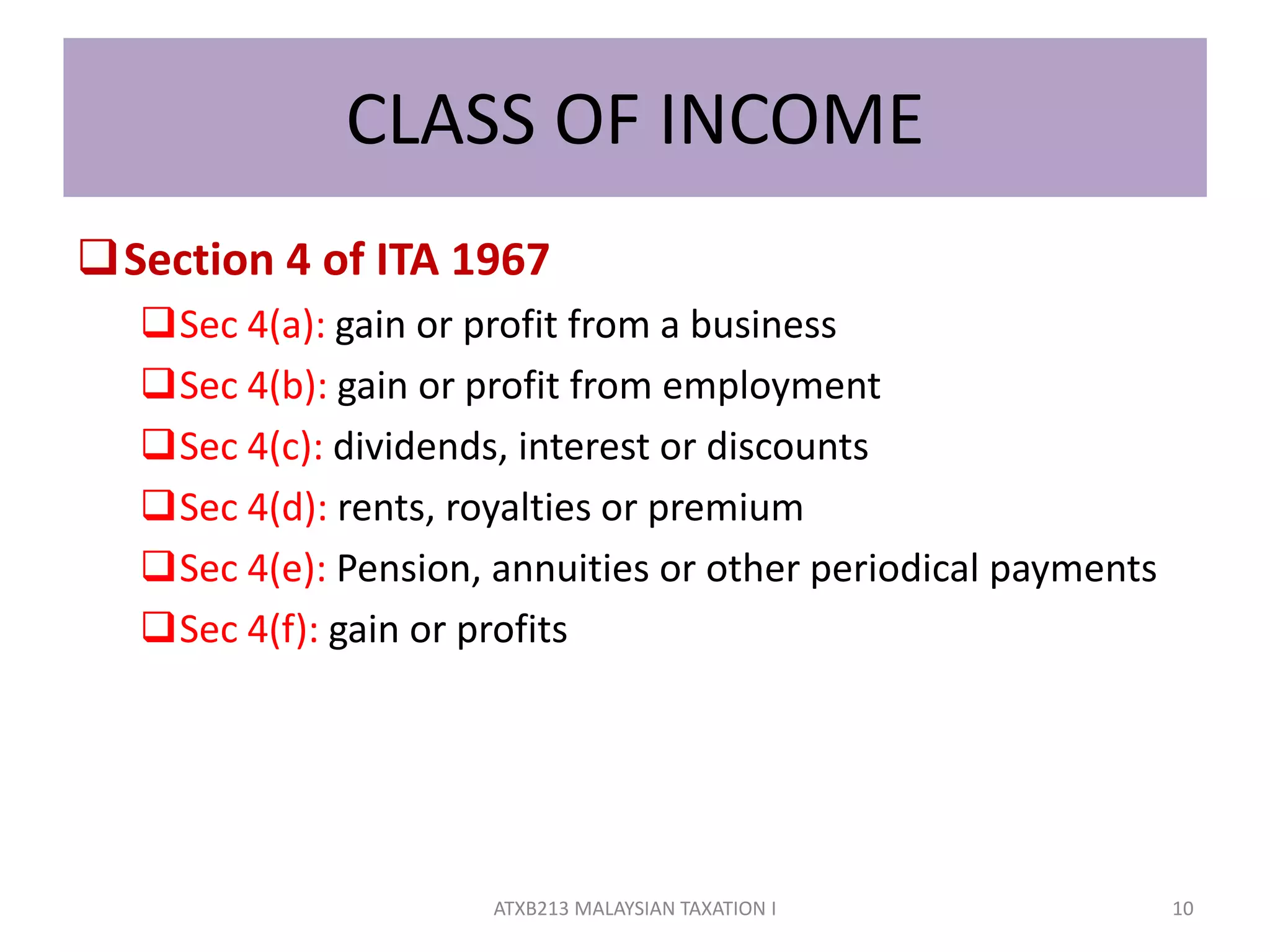
CLASS OF INCOME
Section 4 of ITA 1967
Sec 4(a): gain or profit from a business
Sec 4(b): gain or profit from employment
Sec 4(c): dividends, interest or discounts
Sec 4(d): rents, royalties or premium
Sec 4(e): Pension, annuities or other periodical payments
Sec 4(f): gain or profits
10ATXB213 MALAYSIAN TAXATION I
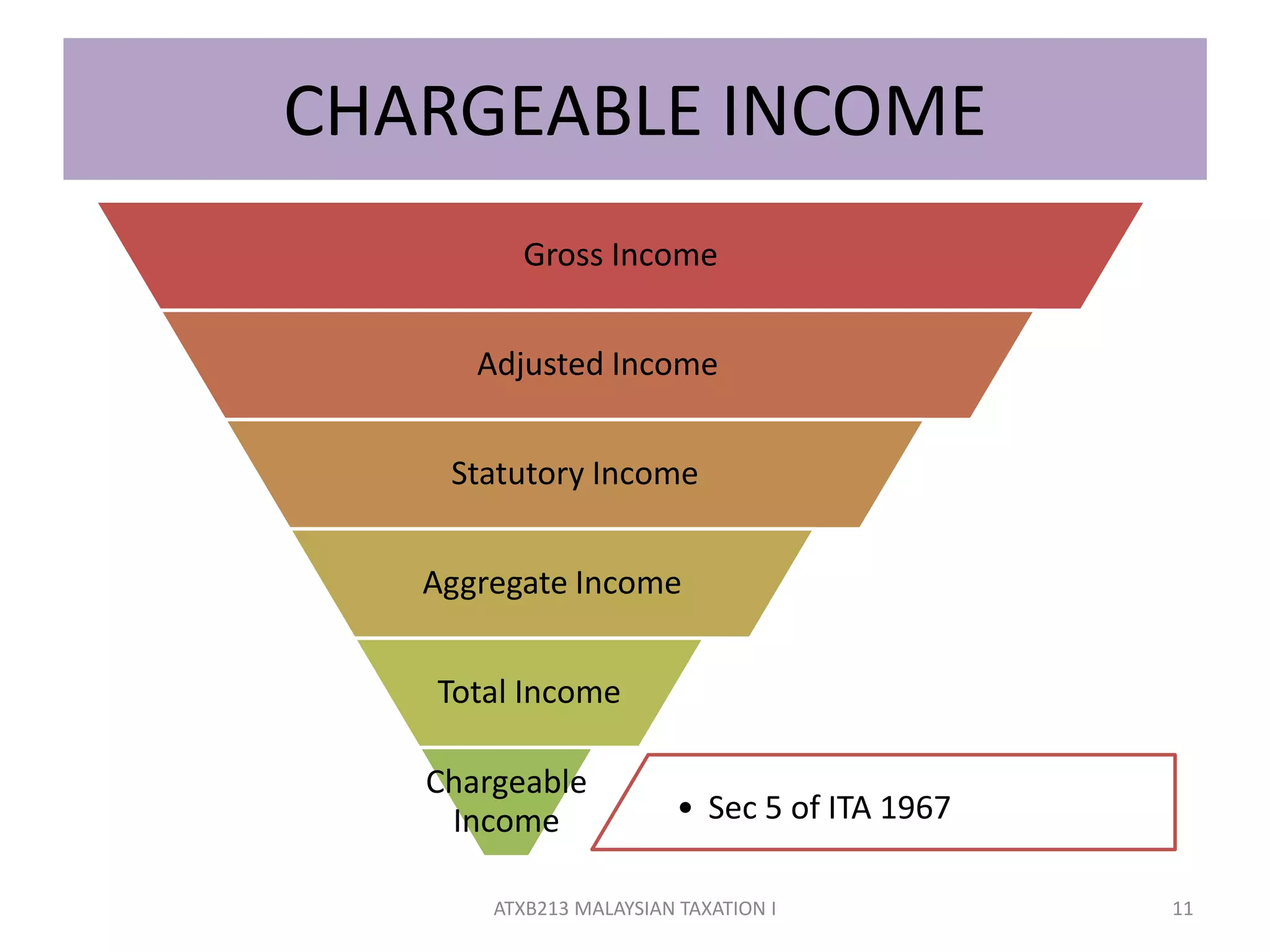
CHARGEABLE INCOME
Gross Income
Adjusted Income
Statutory Income
Aggregate Income
Total Income
• Sec 5 of ITA 1967
Chargeable
Income
11ATXB213 MALAYSIAN TAXATION I
TAX RATES
Resident individual tax rates (pg 17-18)
Tax Rebates (pg 19)
12ATXB213 MALAYSIAN TAXATION I
TAX AVOIDANCE AND TAX EVASION
Tax avoidance are supported by commercial
substance, motivated by commercial viability and
most importantly are within the jurisdiction of the
Act.
Tax evasion on the other hand involves the
employment of artificial or fictitious transactions
such as inflating the expenses claimed, putting in
phantom employees for salary deductions, under
reporting cash sales with the sole intention to pay
less tax.
13ATXB213 MALAYSIAN TAXATION I
THANK YOU
Q & A
14ATXB213 MALAYSIAN TAXATION I

Chapter 1

  • 1.
    CHAPTER 1: INTRODUCTION TO MALAYSIANTAXATION 1ATXB213 MALAYSIAN TAXATION I
  • 2.
    LEARNING OBJECTIVE Explain thedefinition of taxation Understand history and background of taxation Sources of Malaysian Taxation Law Identify types of taxes Tax Avoidance and Tax Evasion 2ATXB213 MALAYSIAN TAXATION I
  • 3.
    DEFINITION OF TAXATION Oxford dictionary: Contribution levied on persons, property, or business for the support of govt.  Law cases: A compulsory exaction of money by a public authority for public purposes enforceable by law (Matthews v The Chicory Marketing Board, 1938). Raising money for the purposes of govt by means of contributions from individual persons (R v Barger, 1908)  IRB Tax guide Is an amount of money which is taken from your earnings to help towards some of the cost of services we received in this country 3ATXB213 MALAYSIAN TAXATION I
  • 4.
    BACKGROUND OF TAXATION IncomeTax Ordinance 1947 with effect from 1 January 1948 Replaced by Income Tax Act 1967 with effect from 1 January 1968 4ATXB213 MALAYSIAN TAXATION I
  • 5.
    SOURCES OF MALAYSIANTAXATION LAW There are 3 sources of revenue law in the Malaysian context and they are: Statute law (referred to as the legislation Case Law (judge made laws) Practice of the Malaysian Inland Revenue Board (IRB) Implementation of Tax Laws: IRB is responsible for all policies relating to direct taxes and administer which are Income Tax, Petroleum Income Tax, Real Property Gains Tax and Stamp Duty. 5ATXB213 MALAYSIAN TAXATION I
  • 6.
    CHARACTERISTICS OF TAXATION Compulsorypayment Raised for government purposes The exactions do not constitute payment for services rendered The payments are not penalties The exactions are not arbitrary Enforced under any written law The exactions should not be incontestable No specific right is transferred 6ATXB213 MALAYSIAN TAXATION I
  • 7.
    PURPOSE OF TAXATION Revenue Ensuringstable growth in revenue to finance the annual budget Growth Providing incentives within the tax system to promote growth, especially in the private sector 7ATXB213 MALAYSIAN TAXATION I
  • 8.
    TYPES OF TAXESIN MALAYSIA Direct taxes Paid directly by those on whom it is levied. Example of direct tax : Income Tax, RPGT, Stamp Duty and Petroleum Income Tax. Indirect taxes Collected via third party. Example of indirect tax : Sales Tax, Service Tax and GST. 8ATXB213 MALAYSIAN TAXATION I
  • 9.
    CHARACTERISTIC OF INCOME Regularity Incomedistinguished from saving Income must be received Customary receipts are income Illegality is of no relevance to assess ability Speculation is not income Reward for services Gift is not an income 9ATXB213 MALAYSIAN TAXATION I
  • 10.
    CLASS OF INCOME Section4 of ITA 1967 Sec 4(a): gain or profit from a business Sec 4(b): gain or profit from employment Sec 4(c): dividends, interest or discounts Sec 4(d): rents, royalties or premium Sec 4(e): Pension, annuities or other periodical payments Sec 4(f): gain or profits 10ATXB213 MALAYSIAN TAXATION I
  • 11.
    CHARGEABLE INCOME Gross Income AdjustedIncome Statutory Income Aggregate Income Total Income • Sec 5 of ITA 1967 Chargeable Income 11ATXB213 MALAYSIAN TAXATION I
  • 12.
    TAX RATES Resident individualtax rates (pg 17-18) Tax Rebates (pg 19) 12ATXB213 MALAYSIAN TAXATION I
  • 13.
    TAX AVOIDANCE ANDTAX EVASION Tax avoidance are supported by commercial substance, motivated by commercial viability and most importantly are within the jurisdiction of the Act. Tax evasion on the other hand involves the employment of artificial or fictitious transactions such as inflating the expenses claimed, putting in phantom employees for salary deductions, under reporting cash sales with the sole intention to pay less tax. 13ATXB213 MALAYSIAN TAXATION I
  • 14.
    THANK YOU Q &A 14ATXB213 MALAYSIAN TAXATION I