Whole Farm and Landscape Scale Projects for Smallholders 
Carolyn Ching, Senior Program Officer 
A perspective from a GHG program
Agenda 
28 October 2011 
•Part 1: What is the VCS? 
•Background information on the VCS Program 
•Part 2: Where are we now? 
•Current strategic pathway for VCS AFOLU program
About the VCS 
Framework for projects and methodologies 
What is the VCS
Verified Carbon Standard (VCS) 
28 October 2011 
•Framework for developing GHG projects 
•Established by leading NGOs (IETA, WBCSD, The Climate Group, WEF) 
•Founded to provide a rigorous, trustworthy and innovative global standard for the validation and verification of GHG offsets 
•Managed by the VCS Association 
•Single focus – to develop and manage the platform (i.e., no consulting, no project development, no meth development, no validation/verification) 
•Funded through VCU levy and foundation grants
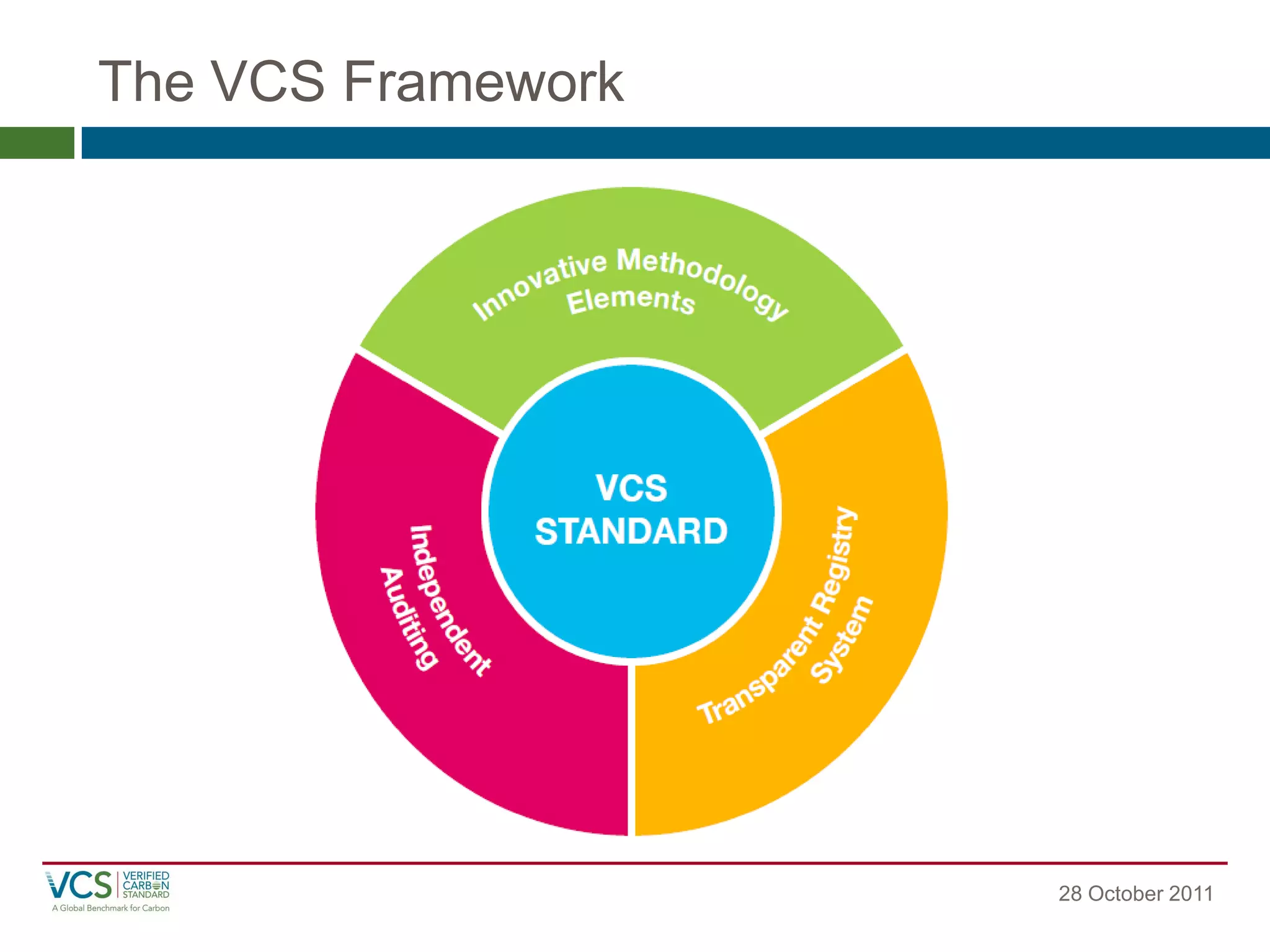
The VCS Framework 
28 October 2011
VCS Project Statistics 
28 October 2011 
•Registered projects 
•Over 680 Registered Projects (21 AFOLU projects) 
•Registered AFOLU projects in Colombia, Guatemala, Kenya, Tanzania, Australia, Canada, Belize, Peru, Brazil, Malaysia, Uganda, Indonesia, India 
•Volumes 
•Over 68 million VCUs issued (over 4.5 million from AFOLU) 
•536 projects have issued VCUs 
•AFOLU pooled buffer account holds over 1 million buffer credits
VCS Methodology Statistics 
28 October 2011 
•10 approved VCS AFOLU methodologies (18 total) 
•Improved Forest Management (IFM) (5) 
•Reduced Emissions from Forest Degradation and Deforestation (REDD) (5) 
•11 AFOLU methodologies under development (17 total) 
•Agricultural Land Management (ALM) (7) 
•IFM (1) 
•REDD (3)
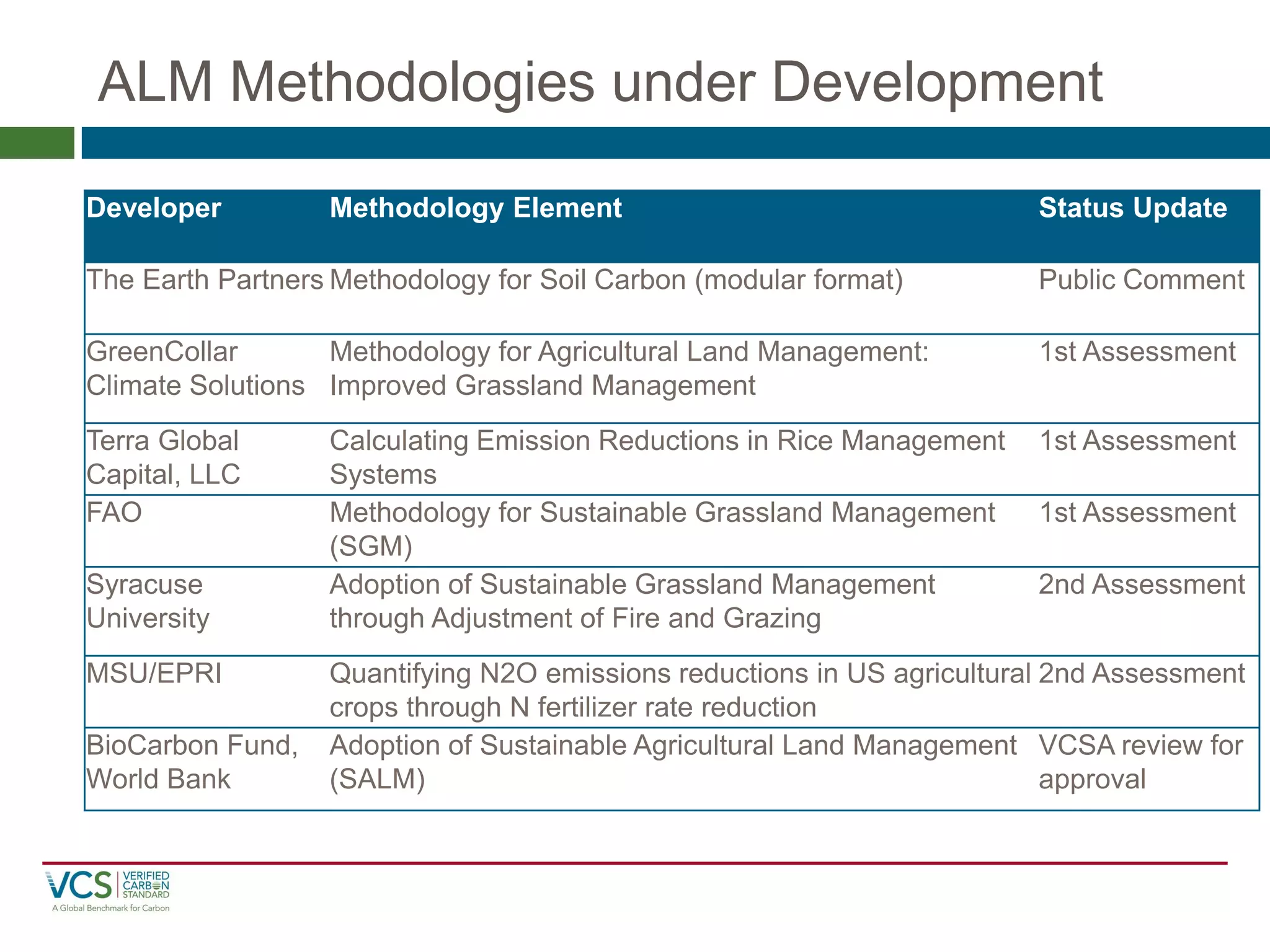
ALM Methodologies under Development 
Developer 
Methodology Element 
Status Update 
The Earth Partners 
Methodology for Soil Carbon (modular format) 
Public Comment 
GreenCollar Climate Solutions 
Methodology for Agricultural Land Management: Improved Grassland Management 
1st Assessment 
Terra Global Capital, LLC 
Calculating Emission Reductions in Rice Management Systems 
1st Assessment 
FAO 
Methodology for Sustainable Grassland Management (SGM) 
1st Assessment 
Syracuse University 
Adoption of Sustainable Grassland Management through Adjustment of Fire and Grazing 
2nd Assessment 
MSU/EPRI 
Quantifying N2O emissions reductions in US agricultural crops through N fertilizer rate reduction 
2nd Assessment 
BioCarbon Fund, World Bank 
Adoption of Sustainable Agricultural Land Management (SALM) 
VCSA review for approval
More AFOLU project categories 
Small-scale friendly 
Key AFOLU Components 
Cutting Edge Incentives 
Where are we now?
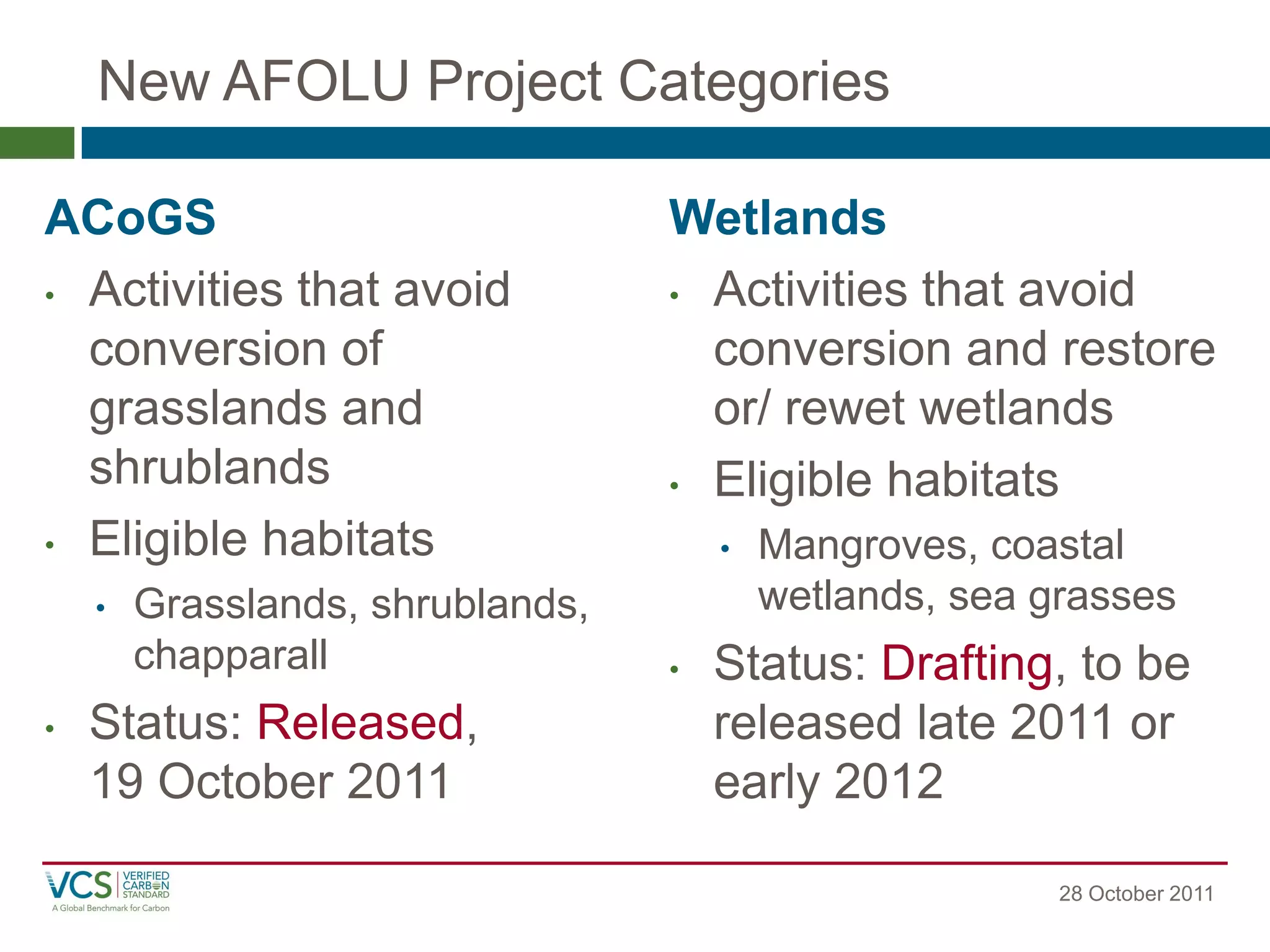
New AFOLU Project Categories 
ACoGS 
•Activities that avoid conversion of grasslands and shrublands 
•Eligible habitats 
•Grasslands, shrublands, chapparall 
•Status: Released, 19 October 2011 
Wetlands 
•Activities that avoid conversion and restore or/ rewet wetlands 
•Eligible habitats 
•Mangroves, coastal wetlands, sea grasses 
•Status: Drafting, to be released late 2011 or early 2012 
28 October 2011
Grouped Projects 
5 April 2011 
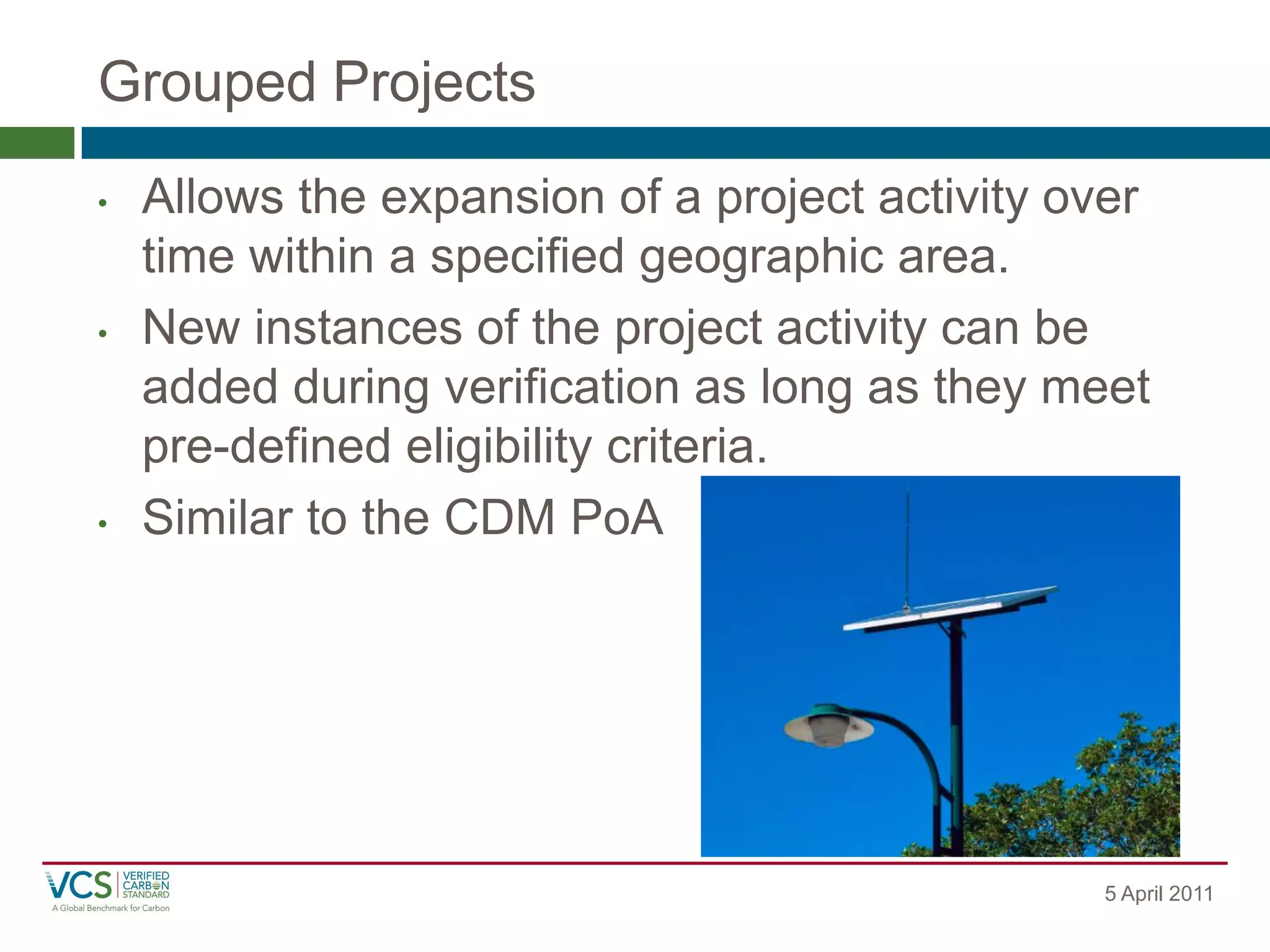
•Allows the expansion of a project activity over time within a specified geographic area. 
•New instances of the project activity can be added during verification as long as they meet pre-defined eligibility criteria. 
•Similar to the CDM PoA
VCS AFOLU Key Components 
AFOLU Requirements include robust approaches to: 
•Permanence: Risk Assessment and AFOLU Pooled Buffer Account 
•Leakage: Activity shifting and market leakage must be minimized and accounted for 
•Updated leakage requirements to be released for public comment and adopted in 2012
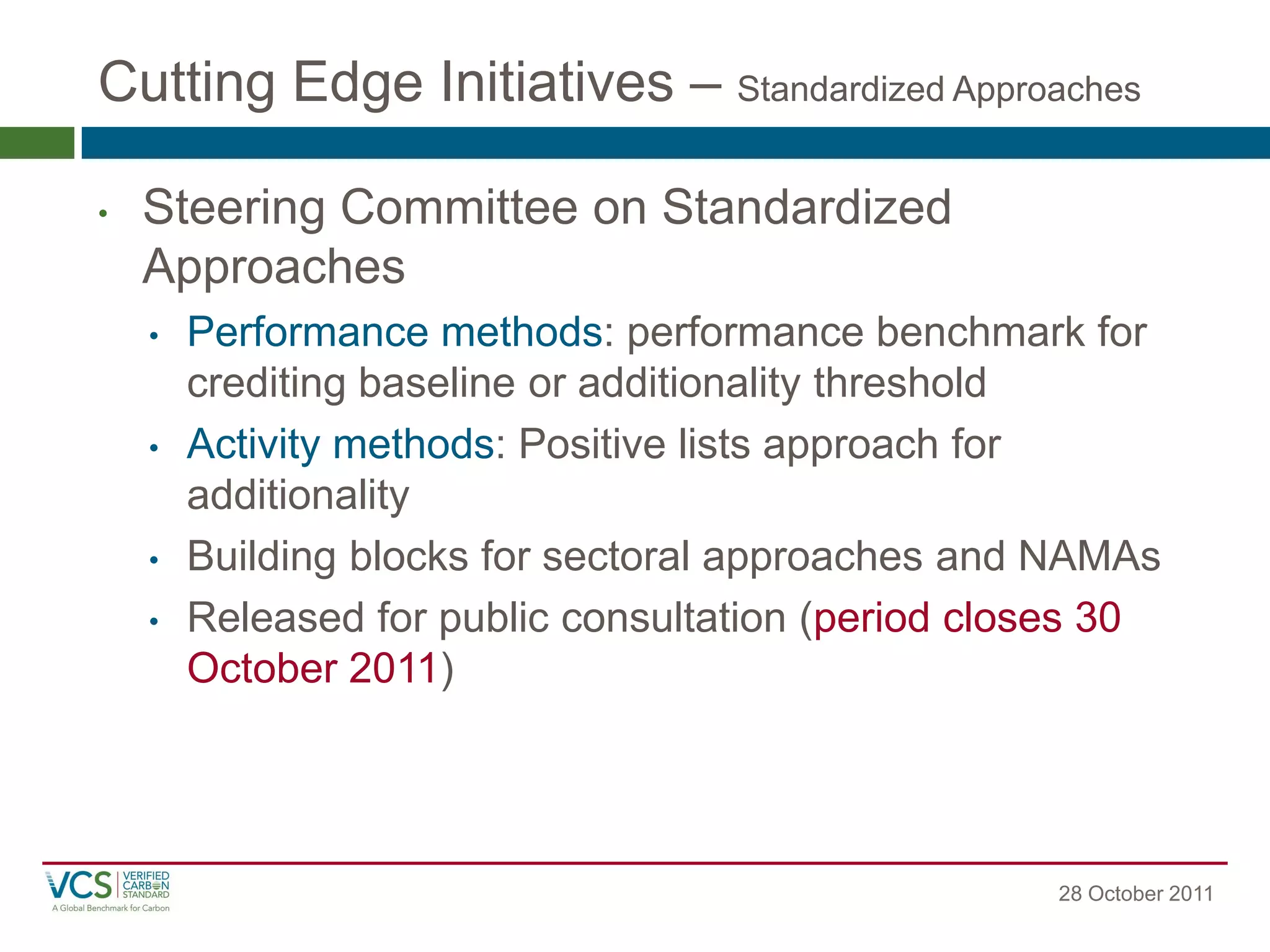
Cutting Edge Initiatives – Standardized Approaches 
28 October 2011 
•Steering Committee on Standardized Approaches 
•Performance methods: performance benchmark for crediting baseline or additionality threshold 
•Activity methods: Positive lists approach for additionality 
•Building blocks for sectoral approaches and NAMAs 
•Released for public consultation (period closes 30 October 2011)
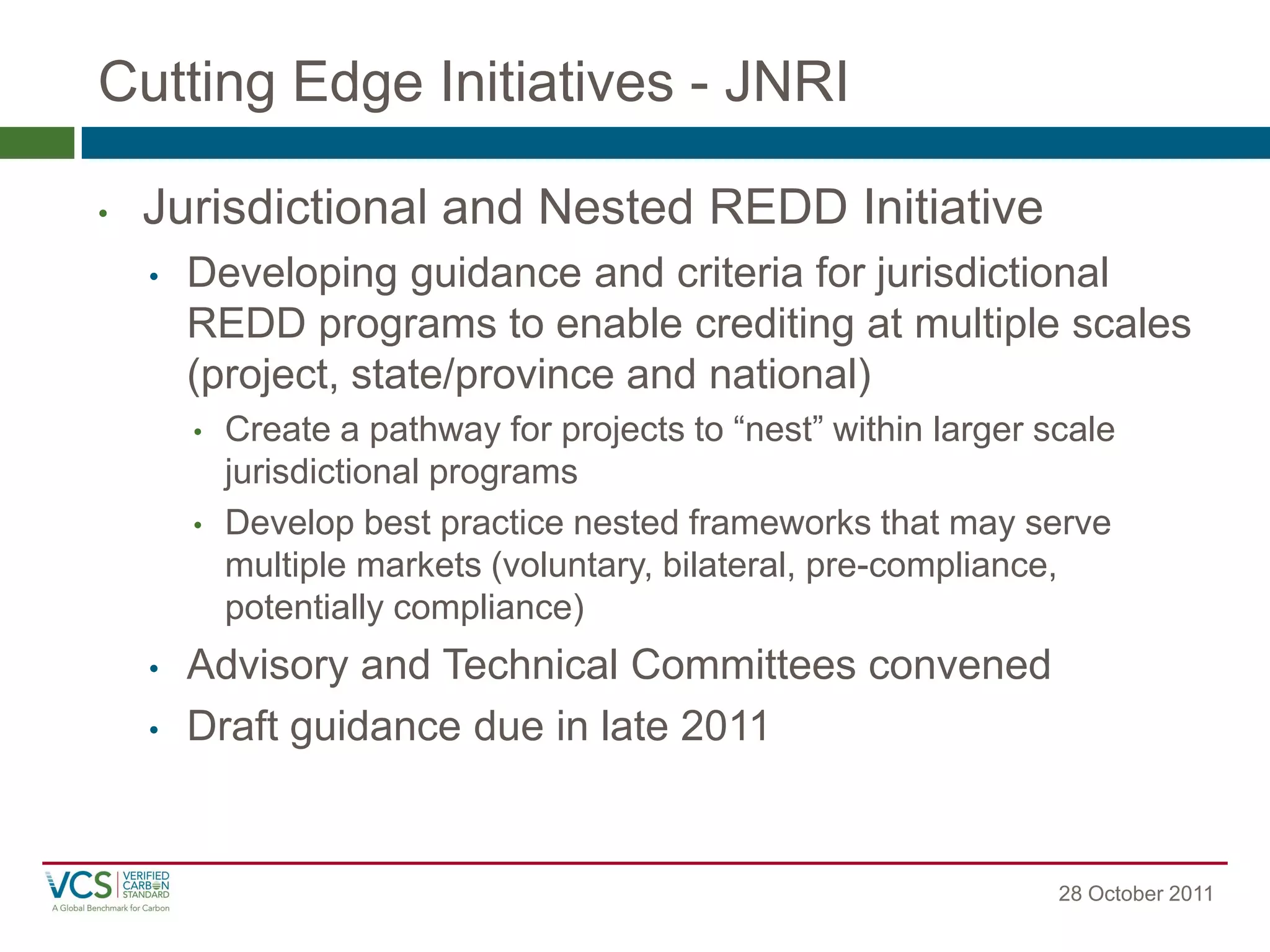
Cutting Edge Initiatives - JNRI 
28 October 2011 
•Jurisdictional and Nested REDD Initiative 
•Developing guidance and criteria for jurisdictional REDD programs to enable crediting at multiple scales (project, state/province and national) 
•Create a pathway for projects to “nest” within larger scale jurisdictional programs 
•Develop best practice nested frameworks that may serve multiple markets (voluntary, bilateral, pre-compliance, potentially compliance) 
•Advisory and Technical Committees convened 
•Draft guidance due in late 2011
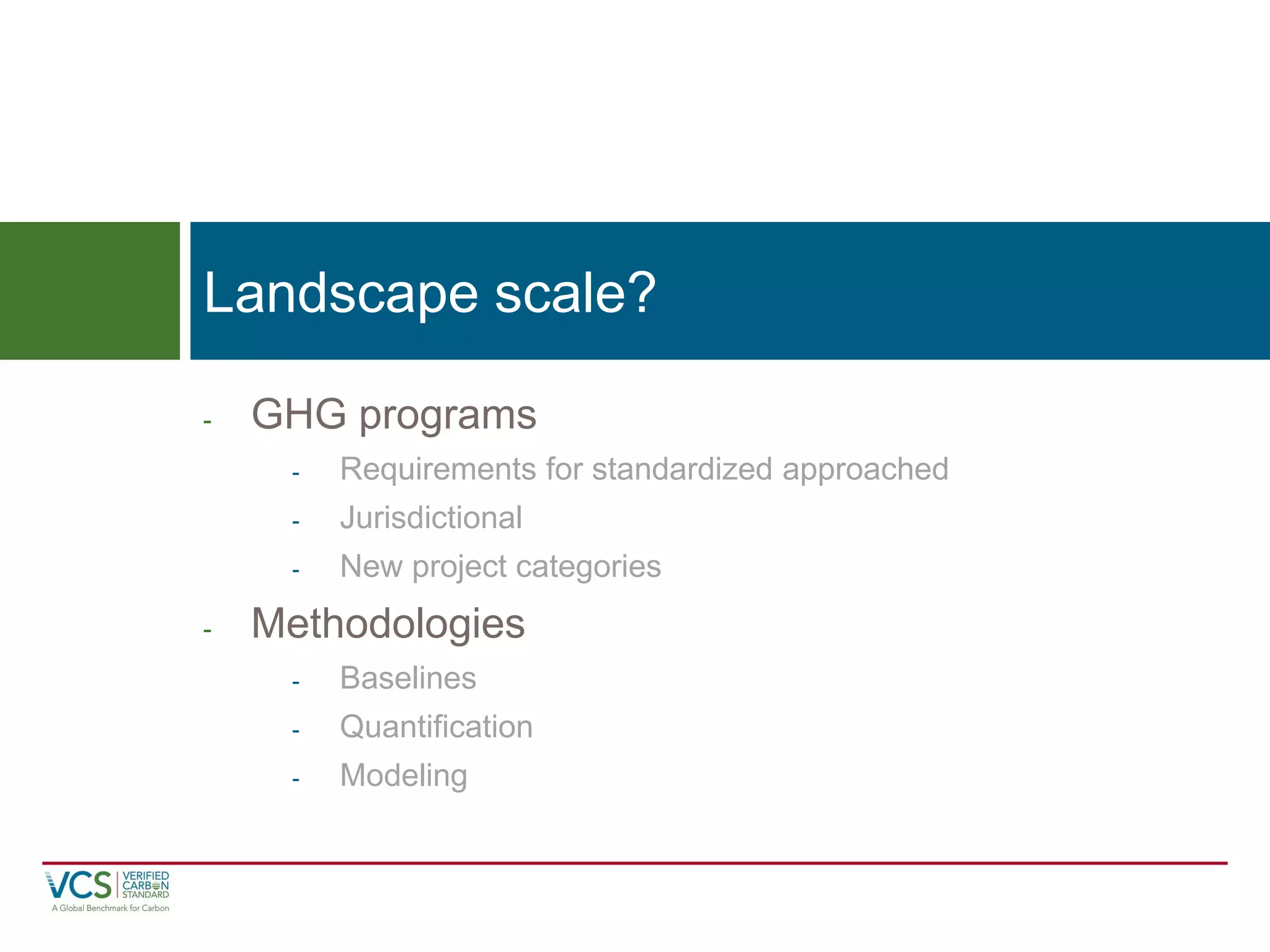
-GHG programs 
-Requirements for standardized approached 
-Jurisdictional 
-New project categories 
-Methodologies 
-Baselines 
-Quantification 
-Modeling 
Landscape scale?
VCS Association 
1730 Rhode Island Avenue, NW 
Suite 803 
Washington, DC 20036 
www.v-c-s.org 
Thank You 
Carolyn Ching 
Senior Program Officer 
cching@v-c-s.org 
+1 202 296 2312

Ching vcs methods ws oct 2011

  • 1.
    Whole Farm andLandscape Scale Projects for Smallholders Carolyn Ching, Senior Program Officer A perspective from a GHG program
  • 2.
    Agenda 28 October2011 •Part 1: What is the VCS? •Background information on the VCS Program •Part 2: Where are we now? •Current strategic pathway for VCS AFOLU program
  • 3.
    About the VCS Framework for projects and methodologies What is the VCS
  • 4.
    Verified Carbon Standard(VCS) 28 October 2011 •Framework for developing GHG projects •Established by leading NGOs (IETA, WBCSD, The Climate Group, WEF) •Founded to provide a rigorous, trustworthy and innovative global standard for the validation and verification of GHG offsets •Managed by the VCS Association •Single focus – to develop and manage the platform (i.e., no consulting, no project development, no meth development, no validation/verification) •Funded through VCU levy and foundation grants
  • 5.
    The VCS Framework 28 October 2011
  • 6.
    VCS Project Statistics 28 October 2011 •Registered projects •Over 680 Registered Projects (21 AFOLU projects) •Registered AFOLU projects in Colombia, Guatemala, Kenya, Tanzania, Australia, Canada, Belize, Peru, Brazil, Malaysia, Uganda, Indonesia, India •Volumes •Over 68 million VCUs issued (over 4.5 million from AFOLU) •536 projects have issued VCUs •AFOLU pooled buffer account holds over 1 million buffer credits
  • 7.
    VCS Methodology Statistics 28 October 2011 •10 approved VCS AFOLU methodologies (18 total) •Improved Forest Management (IFM) (5) •Reduced Emissions from Forest Degradation and Deforestation (REDD) (5) •11 AFOLU methodologies under development (17 total) •Agricultural Land Management (ALM) (7) •IFM (1) •REDD (3)
  • 8.
    ALM Methodologies underDevelopment Developer Methodology Element Status Update The Earth Partners Methodology for Soil Carbon (modular format) Public Comment GreenCollar Climate Solutions Methodology for Agricultural Land Management: Improved Grassland Management 1st Assessment Terra Global Capital, LLC Calculating Emission Reductions in Rice Management Systems 1st Assessment FAO Methodology for Sustainable Grassland Management (SGM) 1st Assessment Syracuse University Adoption of Sustainable Grassland Management through Adjustment of Fire and Grazing 2nd Assessment MSU/EPRI Quantifying N2O emissions reductions in US agricultural crops through N fertilizer rate reduction 2nd Assessment BioCarbon Fund, World Bank Adoption of Sustainable Agricultural Land Management (SALM) VCSA review for approval
  • 9.
    More AFOLU projectcategories Small-scale friendly Key AFOLU Components Cutting Edge Incentives Where are we now?
  • 10.
    New AFOLU ProjectCategories ACoGS •Activities that avoid conversion of grasslands and shrublands •Eligible habitats •Grasslands, shrublands, chapparall •Status: Released, 19 October 2011 Wetlands •Activities that avoid conversion and restore or/ rewet wetlands •Eligible habitats •Mangroves, coastal wetlands, sea grasses •Status: Drafting, to be released late 2011 or early 2012 28 October 2011
  • 11.
    Grouped Projects 5April 2011 •Allows the expansion of a project activity over time within a specified geographic area. •New instances of the project activity can be added during verification as long as they meet pre-defined eligibility criteria. •Similar to the CDM PoA
  • 12.
    VCS AFOLU KeyComponents AFOLU Requirements include robust approaches to: •Permanence: Risk Assessment and AFOLU Pooled Buffer Account •Leakage: Activity shifting and market leakage must be minimized and accounted for •Updated leakage requirements to be released for public comment and adopted in 2012
  • 13.
    Cutting Edge Initiatives– Standardized Approaches 28 October 2011 •Steering Committee on Standardized Approaches •Performance methods: performance benchmark for crediting baseline or additionality threshold •Activity methods: Positive lists approach for additionality •Building blocks for sectoral approaches and NAMAs •Released for public consultation (period closes 30 October 2011)
  • 14.
    Cutting Edge Initiatives- JNRI 28 October 2011 •Jurisdictional and Nested REDD Initiative •Developing guidance and criteria for jurisdictional REDD programs to enable crediting at multiple scales (project, state/province and national) •Create a pathway for projects to “nest” within larger scale jurisdictional programs •Develop best practice nested frameworks that may serve multiple markets (voluntary, bilateral, pre-compliance, potentially compliance) •Advisory and Technical Committees convened •Draft guidance due in late 2011
  • 15.
    -GHG programs -Requirementsfor standardized approached -Jurisdictional -New project categories -Methodologies -Baselines -Quantification -Modeling Landscape scale?
  • 16.
    VCS Association 1730Rhode Island Avenue, NW Suite 803 Washington, DC 20036 www.v-c-s.org Thank You Carolyn Ching Senior Program Officer cching@v-c-s.org +1 202 296 2312