

Status and challenges for mapping, monitoring and MRV of SOC
Martial Bernoux
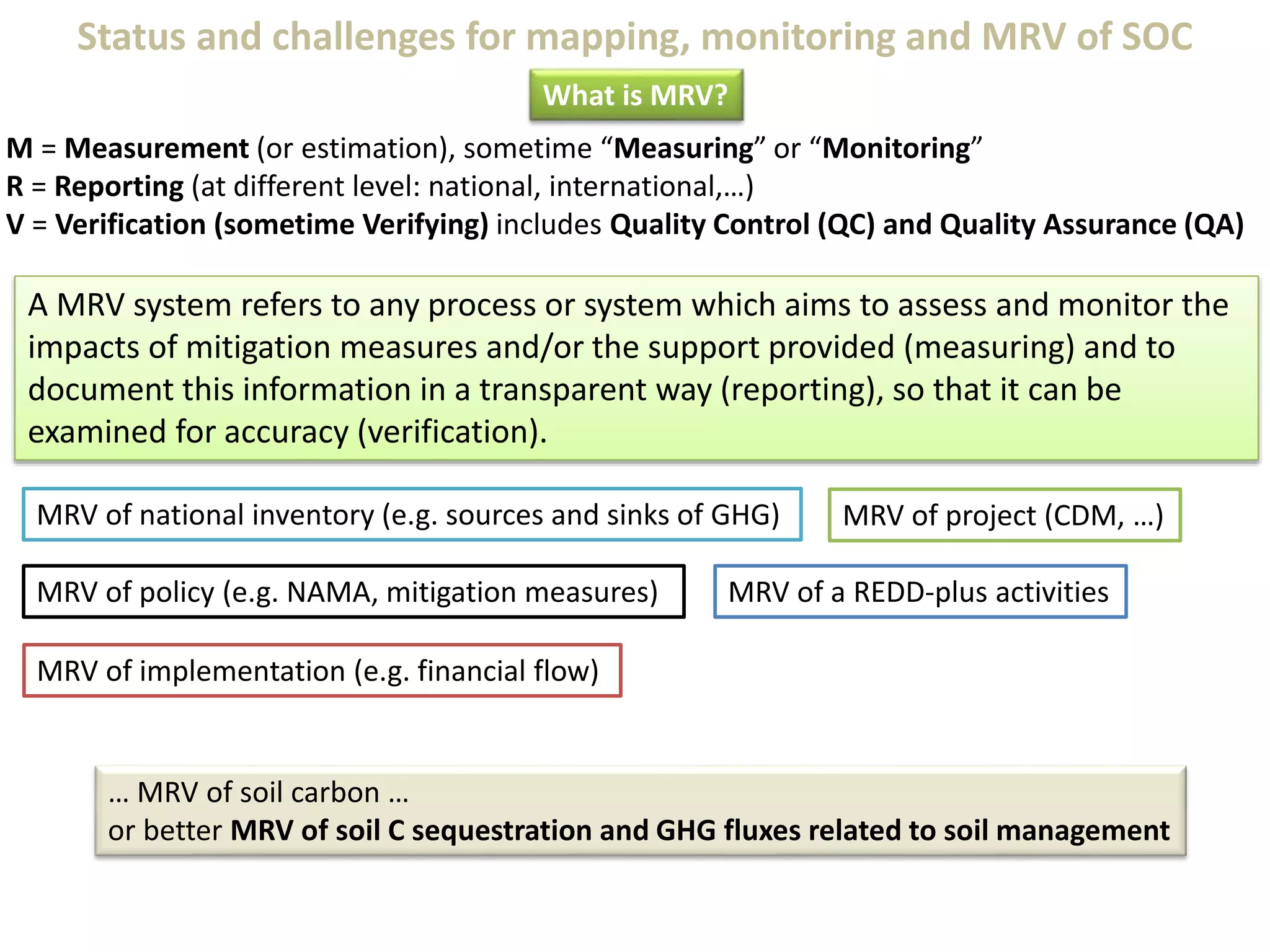
A MRV system refers to any process or system which aims to assess and monitor the
impacts of mitigation measures and/or the support provided (measuring) and to
document this information in a transparent way (reporting), so that it can be
examined for accuracy (verification).
M = Measurement (or estimation), sometime “Measuring” or “Monitoring”
R = Reporting (at different level: national, international,…)
V = Verification (sometime Verifying) includes Quality Control (QC) and Quality Assurance (QA)
What is MRV?
MRV of national inventory (e.g. sources and sinks of GHG)
MRV of policy (e.g. NAMA, mitigation measures)
MRV of project (CDM, …)
MRV of implementation (e.g. financial flow)
MRV of a REDD-plus activities
… MRV of soil carbon …
or better MRV of soil C sequestration and GHG fluxes related to soil management
Status and challenges for mapping, monitoring and MRV of SOC
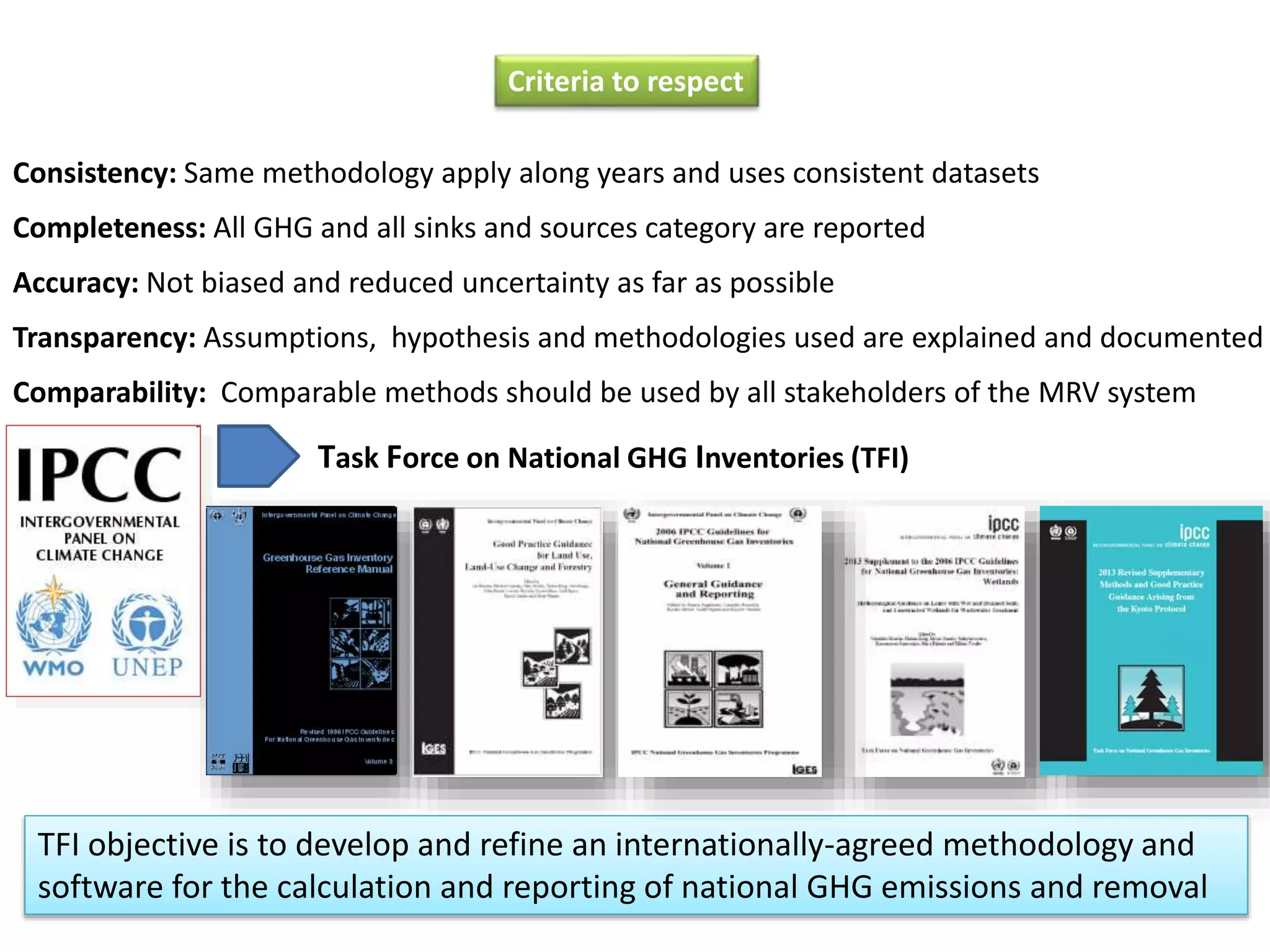
Criteria to respect
Consistency: Same methodology apply along years and uses consistent datasets
Completeness: All GHG and all sinks and sources category are reported
Accuracy: Not biased and reduced uncertainty as far as possible
Transparency: Assumptions, hypothesis and methodologies used are explained and documented
Comparability: Comparable methods should be used by all stakeholders of the MRV system
Task Force on National GHG Inventories (TFI)
TFI objective is to develop and refine an internationally-agreed methodology and
software for the calculation and reporting of national GHG emissions and removal
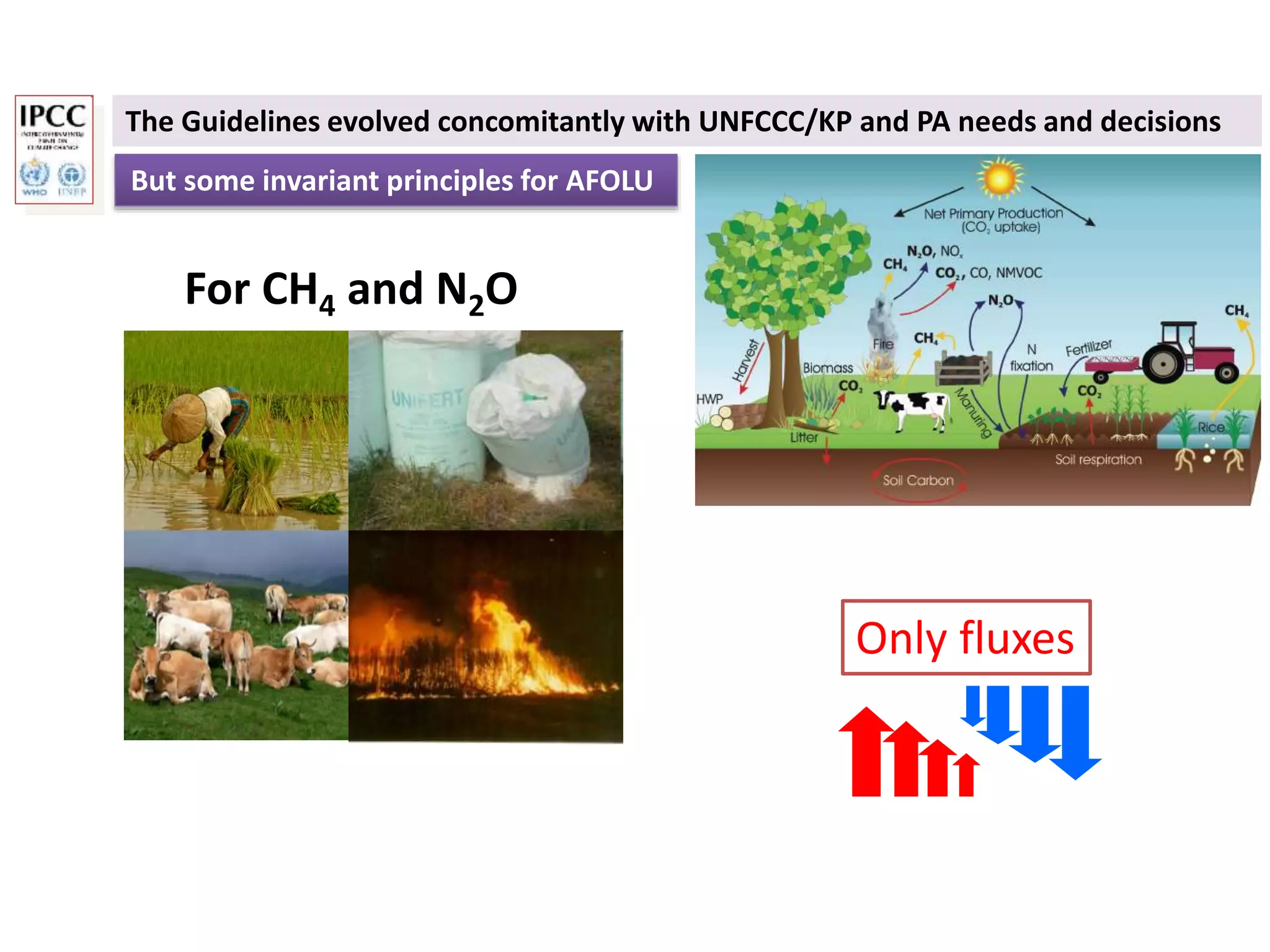
The Guidelines evolved concomitantly with UNFCCC/KP and PA needs and decisions
But some invariant principles for AFOLU
For CH4 and N2O
Only fluxes
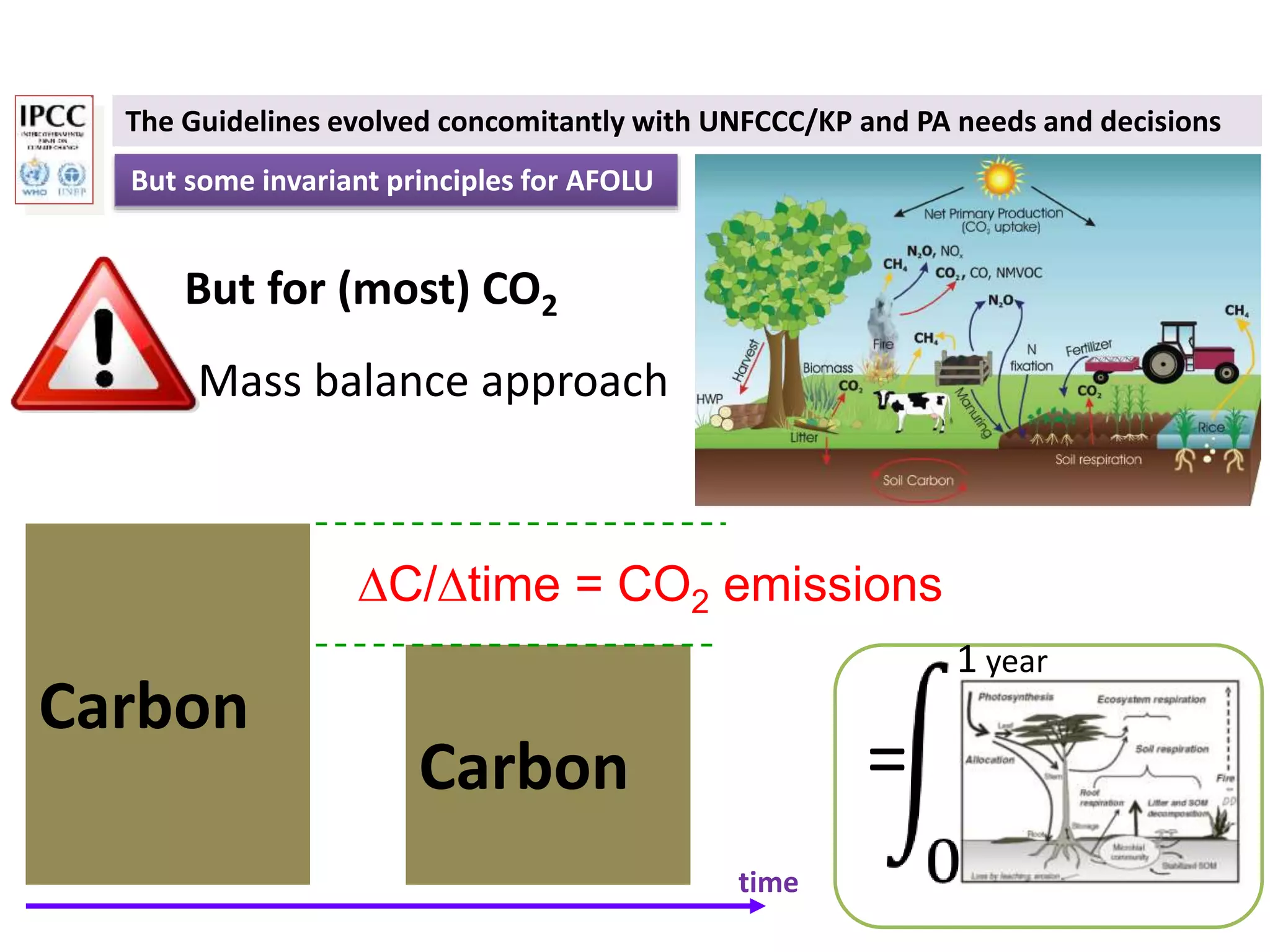
But some invariant principles for AFOLU
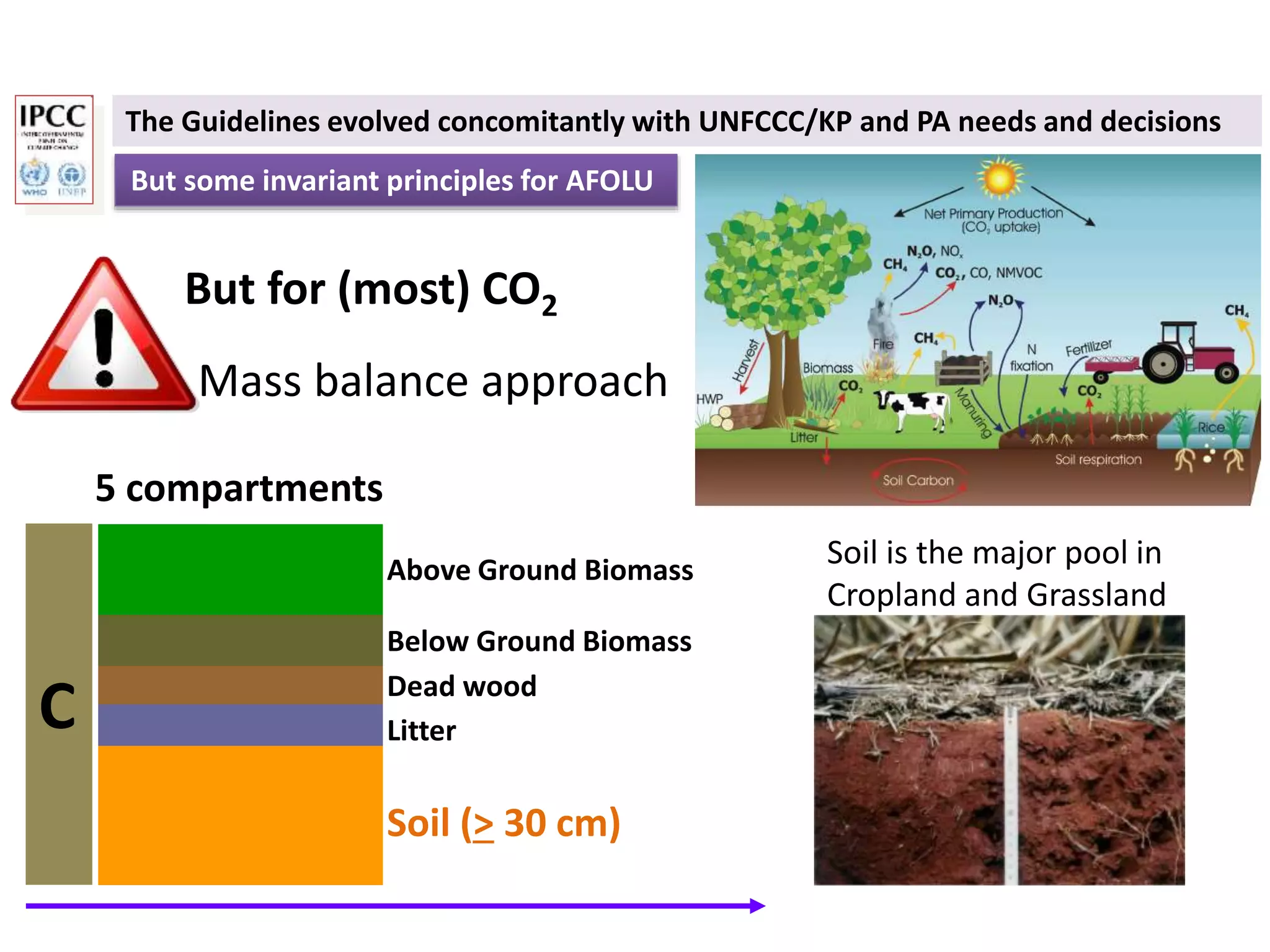
But for (most) CO2
Mass balance approach
Carbon
Carbon
time
DC/Dtime = CO2 emissions
1 year
=
The Guidelines evolved concomitantly with UNFCCC/KP and PA needs and decisions
But some invariant principles for AFOLU
But for (most) CO2
Mass balance approach
C
5 compartments
Above Ground Biomass
Litter
Soil (> 30 cm)
Below Ground Biomass
Dead wood
Soil is the major pool in
Cropland and Grassland
The Guidelines evolved concomitantly with UNFCCC/KP and PA needs and decisions
But some invariant principles for AFOLU
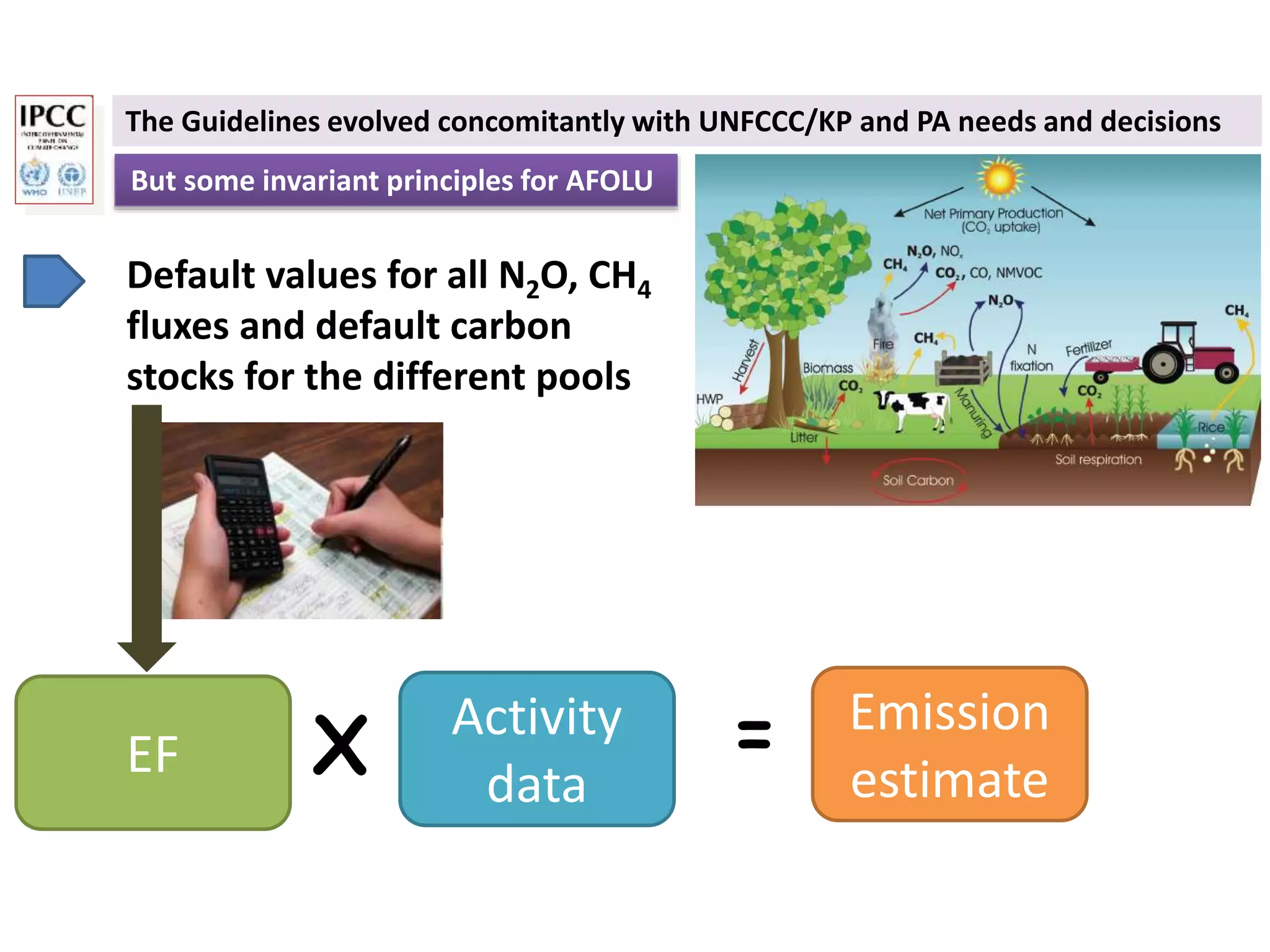
Default values for all N2O, CH4
fluxes and default carbon
stocks for the different pools
=X Activity
data
EF
Emission
estimate
The Guidelines evolved concomitantly with UNFCCC/KP and PA needs and decisions
But some invariant principles for AFOLU
The Guidelines evolved concomitantly with UNFCCC/KP and PA needs and decisions
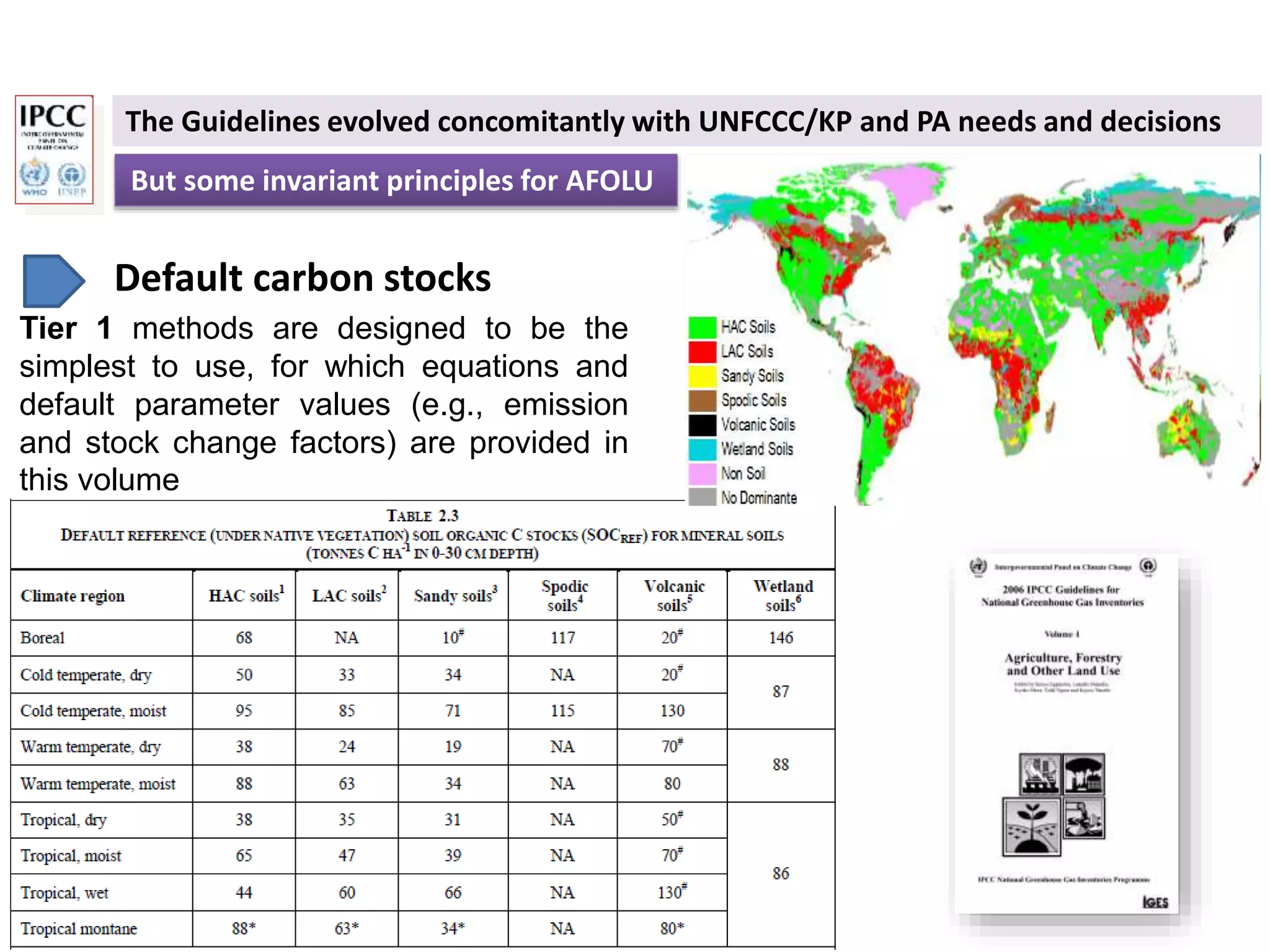
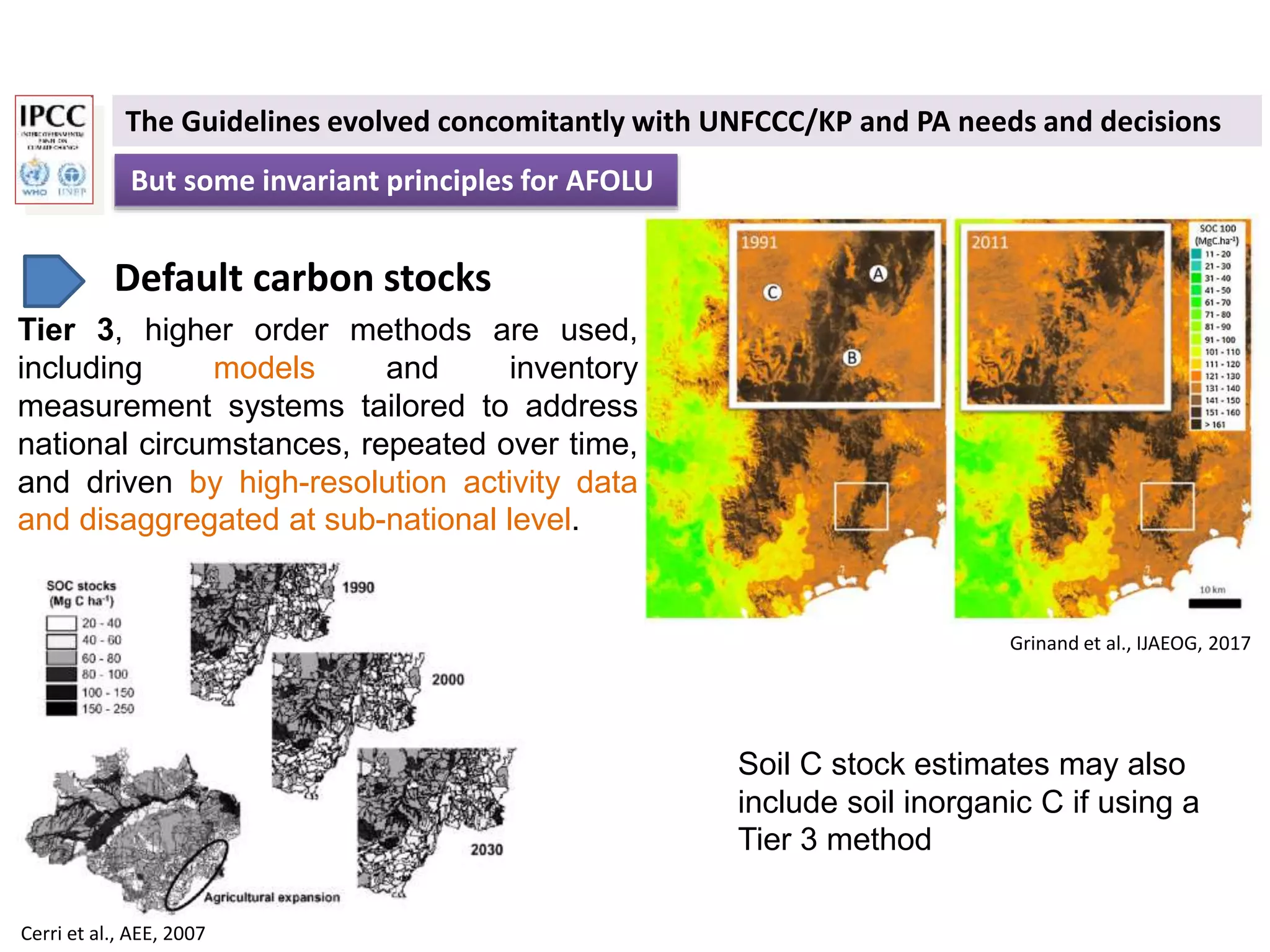
Default carbon stocks
Carte soil EX-ACT
Tier 1 methods are designed to be the
simplest to use, for which equations and
default parameter values (e.g., emission
and stock change factors) are provided in
this volume
But some invariant principles for AFOLU
The Guidelines evolved concomitantly with UNFCCC/KP and PA needs and decisions
Default carbon stocks
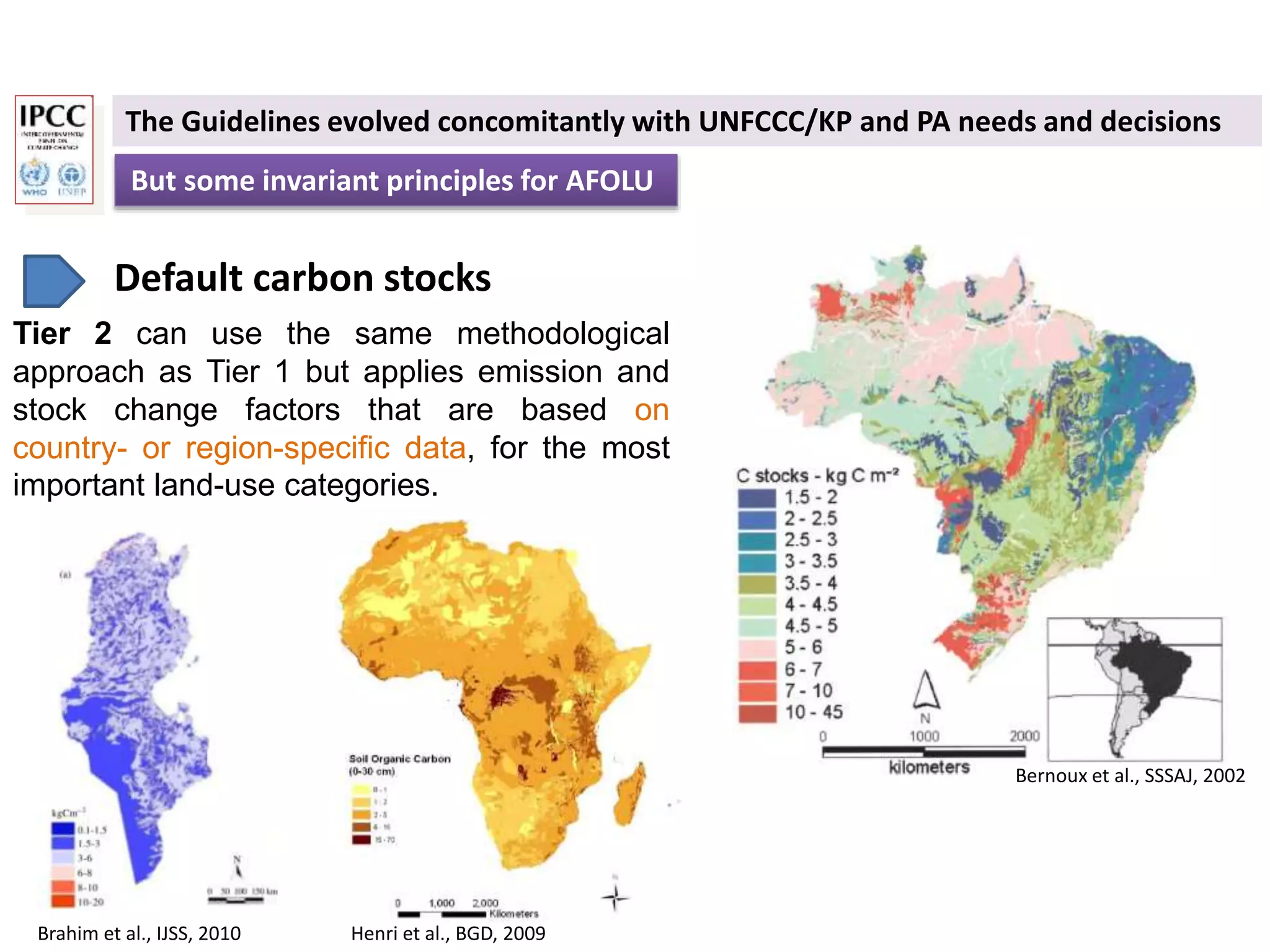
Tier 2 can use the same methodological
approach as Tier 1 but applies emission and
stock change factors that are based on
country- or region-specific data, for the most
important land-use categories.
Bernoux et al., SSSAJ, 2002
Brahim et al., IJSS, 2010 Henri et al., BGD, 2009
But some invariant principles for AFOLU
The Guidelines evolved concomitantly with UNFCCC/KP and PA needs and decisions
Default carbon stocks
Soil C stock estimates may also
include soil inorganic C if using a
Tier 3 method
Tier 3, higher order methods are used,
including models and inventory
measurement systems tailored to address
national circumstances, repeated over time,
and driven by high-resolution activity data
and disaggregated at sub-national level.
Grinand et al., IJAEOG, 2017
Cerri et al., AEE, 2007
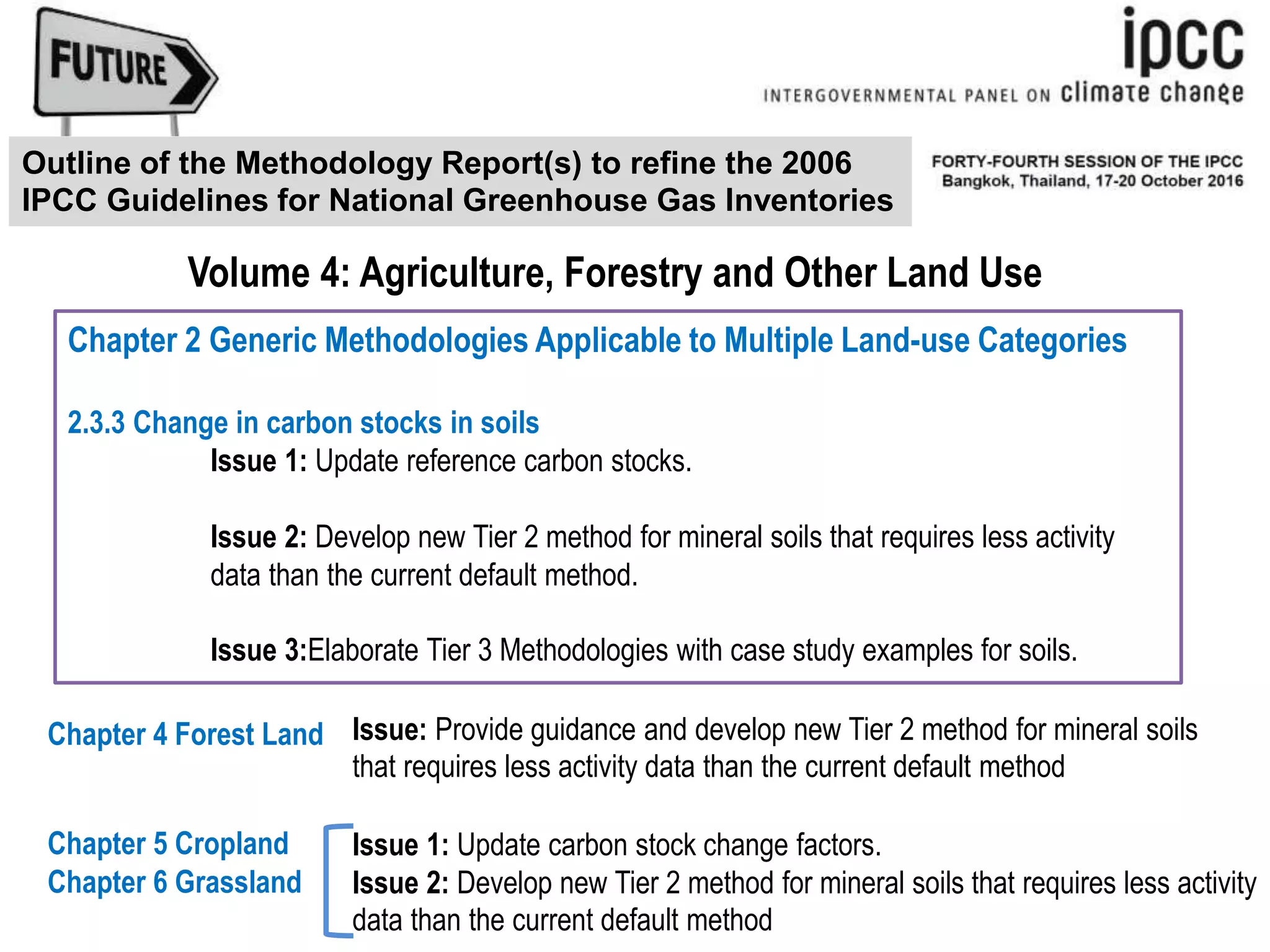
Chapter 2 Generic Methodologies Applicable to Multiple Land-use Categories
2.3.3 Change in carbon stocks in soils
Issue 1: Update reference carbon stocks.
Issue 2: Develop new Tier 2 method for mineral soils that requires less activity
data than the current default method.
Issue 3:Elaborate Tier 3 Methodologies with case study examples for soils.
Volume 4: Agriculture, Forestry and Other Land Use
Outline of the Methodology Report(s) to refine the 2006
IPCC Guidelines for National Greenhouse Gas Inventories
Chapter 6 Grassland
Chapter 4 Forest Land
Chapter 5 Cropland
Issue: Provide guidance and develop new Tier 2 method for mineral soils
that requires less activity data than the current default method
Issue 1: Update carbon stock change factors.
Issue 2: Develop new Tier 2 method for mineral soils that requires less activity
data than the current default method
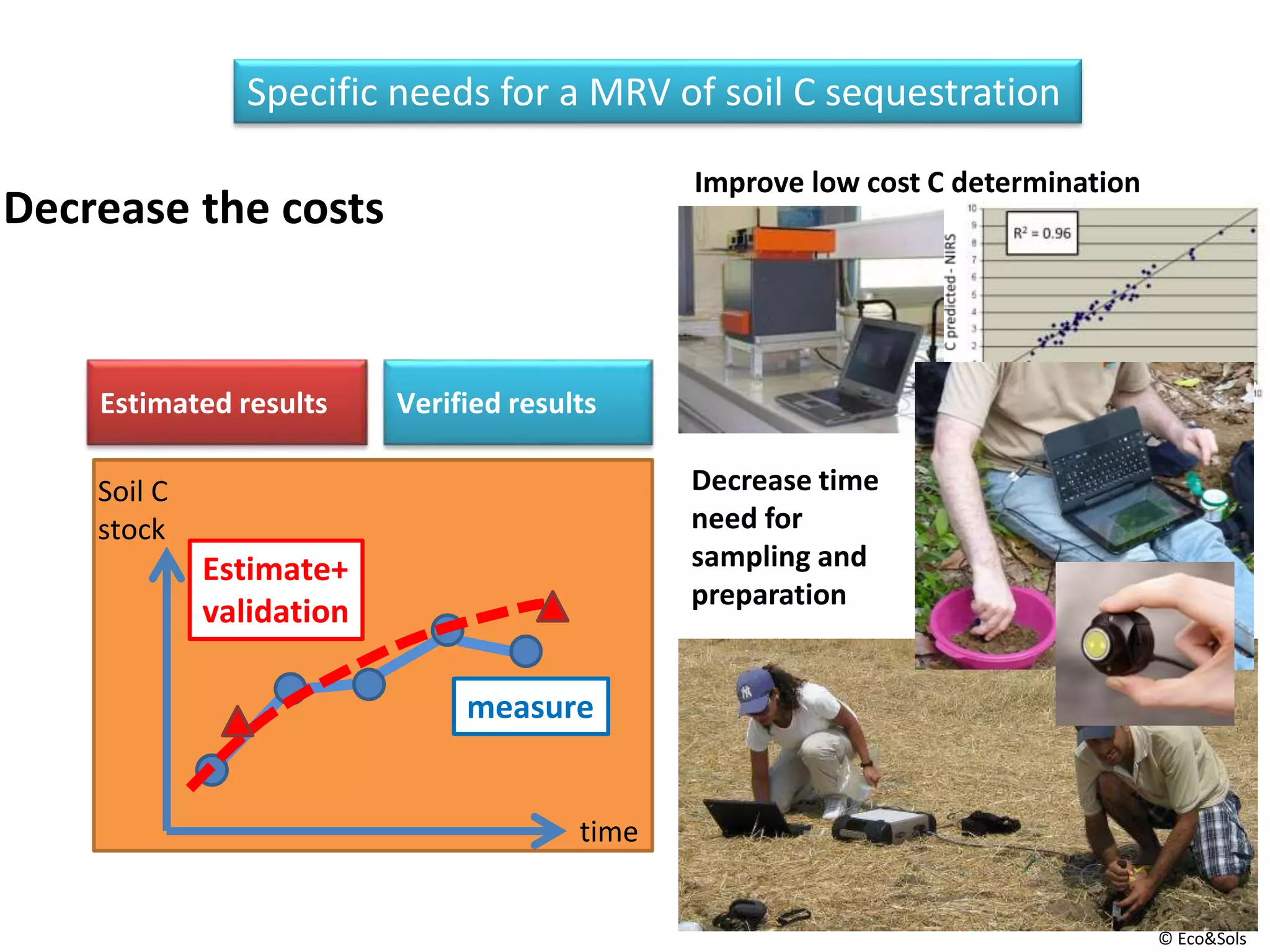
Estimated results Verified results
Forest Cropland
time
Soil C
stock
measure
Estimate+
validation
Specific needs for a MRV of soil C sequestration
Improve low cost C determination
Decrease time
need for
sampling and
preparation
Decrease the costs
© Eco&Sols
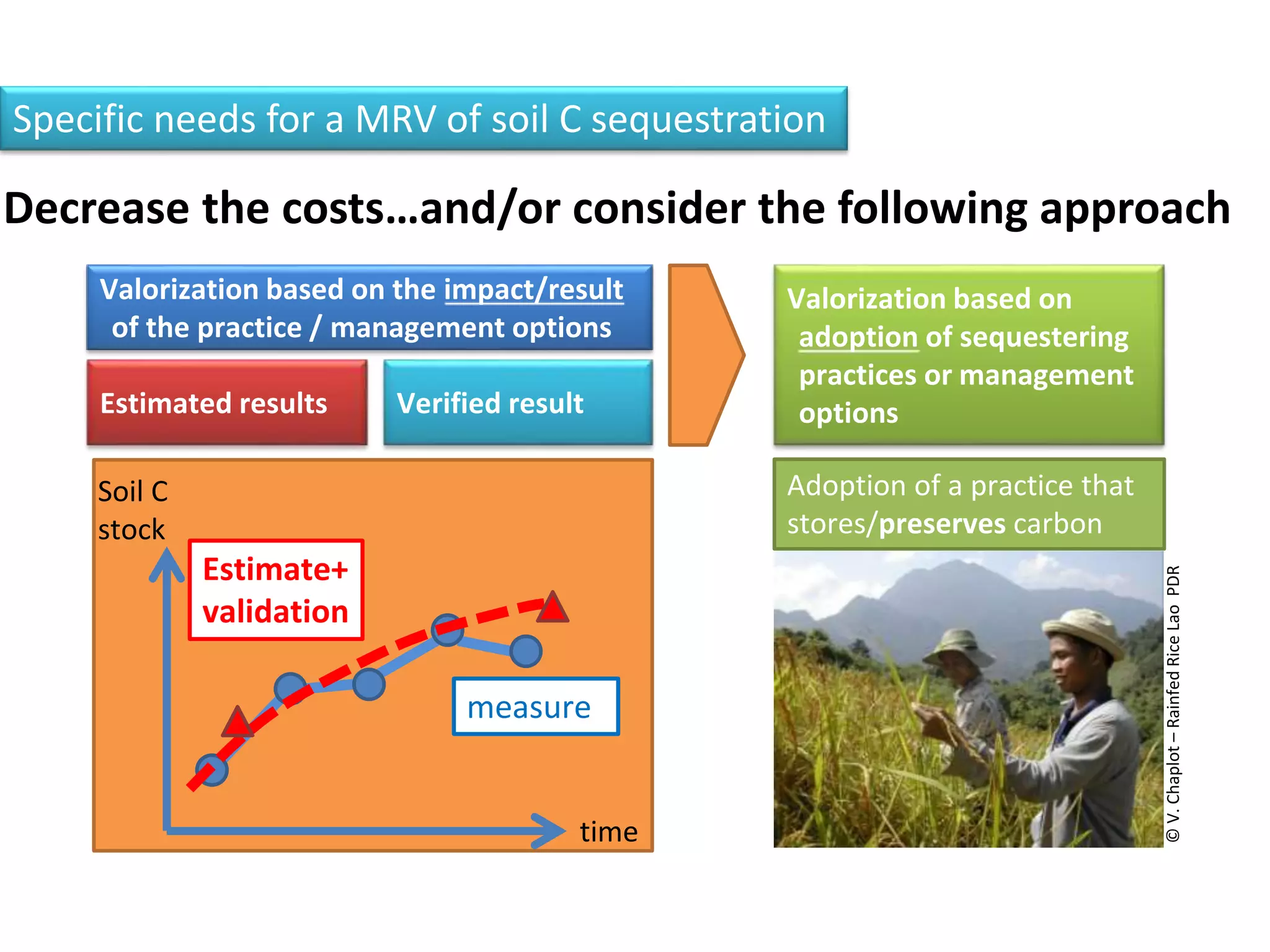
Valorization based on the impact/result
of the practice / management options
Estimated results Verified result
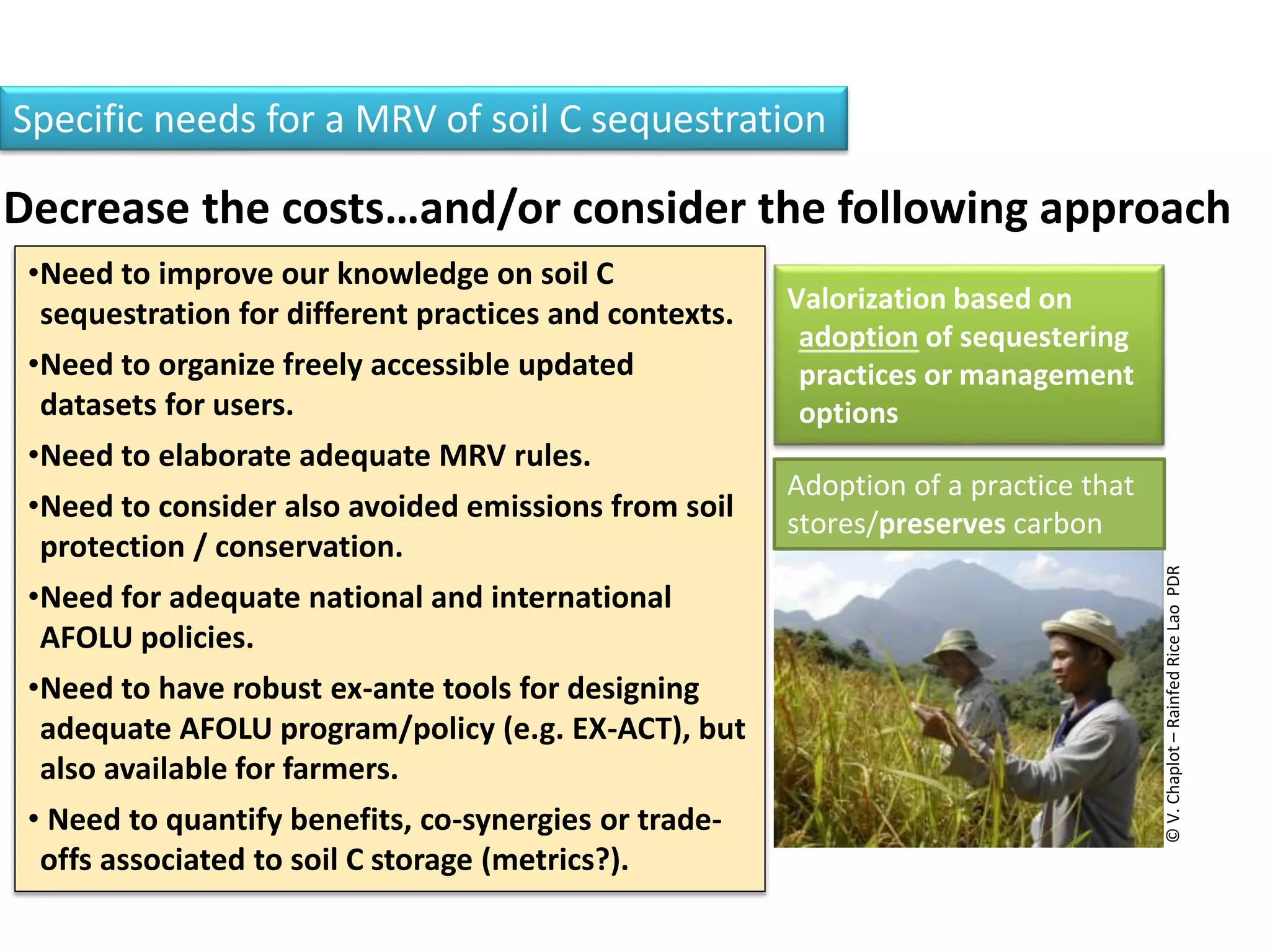
Adoption of a practice that
stores/preserves carbon
Valorization based on
adoption of sequestering
practices or management
options
Forest Cropland
time
Soil C
stock
measure
Specific needs for a MRV of soil C sequestration
Decrease the costs…and/or consider the following approach
Estimate+
validation
©V.Chaplot–RainfedRiceLaoPDR
Adoption of a practice that
stores/preserves carbon
Valorization based on
adoption of sequestering
practices or management
options
©V.Chaplot–RainfedRiceLaoPDR
Specific needs for a MRV of soil C sequestration
Decrease the costs…and/or consider the following approach
•Need to improve our knowledge on soil C
sequestration for different practices and contexts.
•Need to organize freely accessible updated
datasets for users.
•Need to elaborate adequate MRV rules.
•Need to consider also avoided emissions from soil
protection / conservation.
•Need for adequate national and international
AFOLU policies.
•Need to have robust ex-ante tools for designing
adequate AFOLU program/policy (e.g. EX-ACT), but
also available for farmers.
• Need to quantify benefits, co-synergies or trade-
offs associated to soil C storage (metrics?).
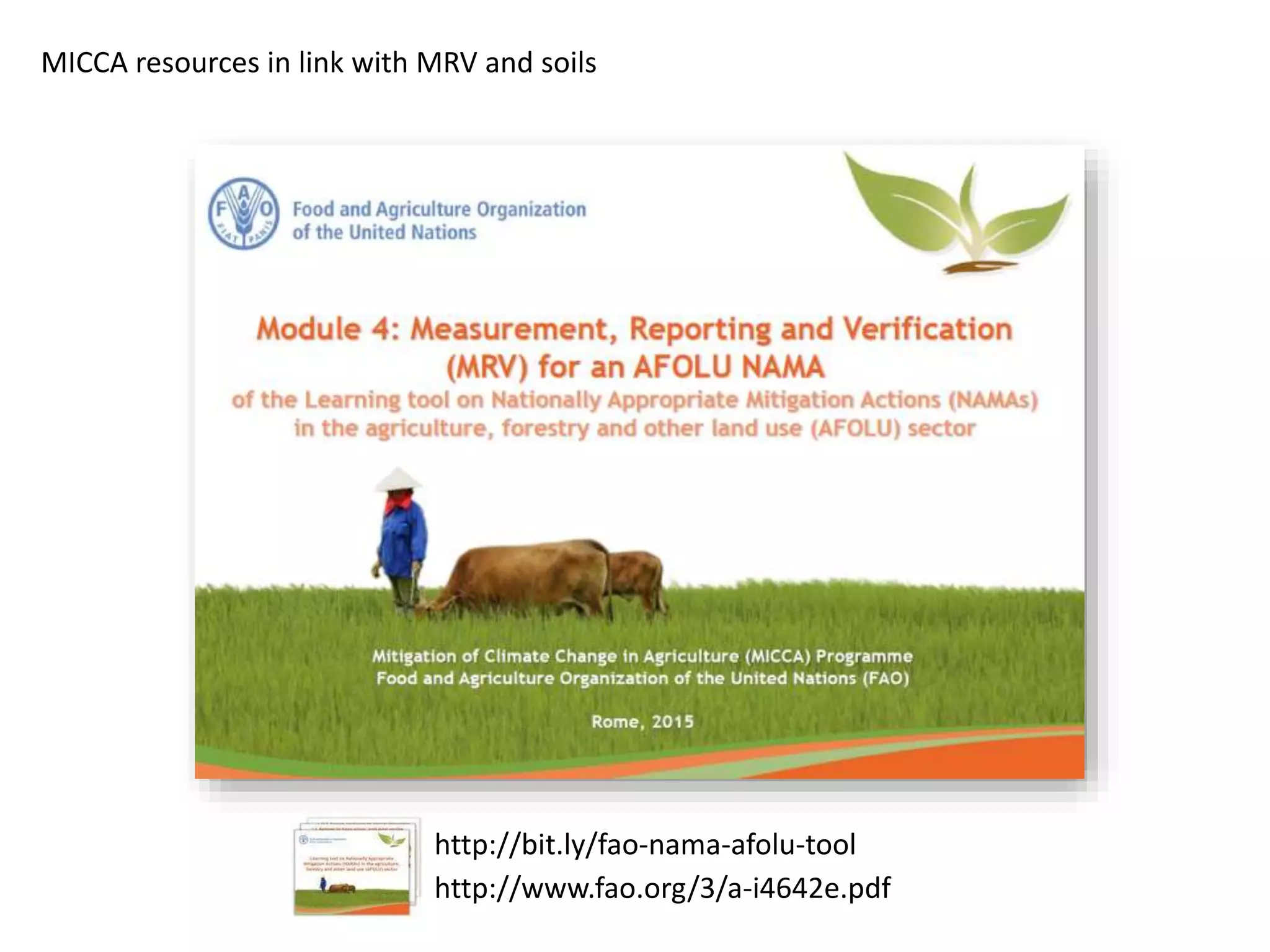
MICCA resources in link with MRV and soils
http://bit.ly/fao-nama-afolu-tool
http://www.fao.org/3/a-i4642e.pdf
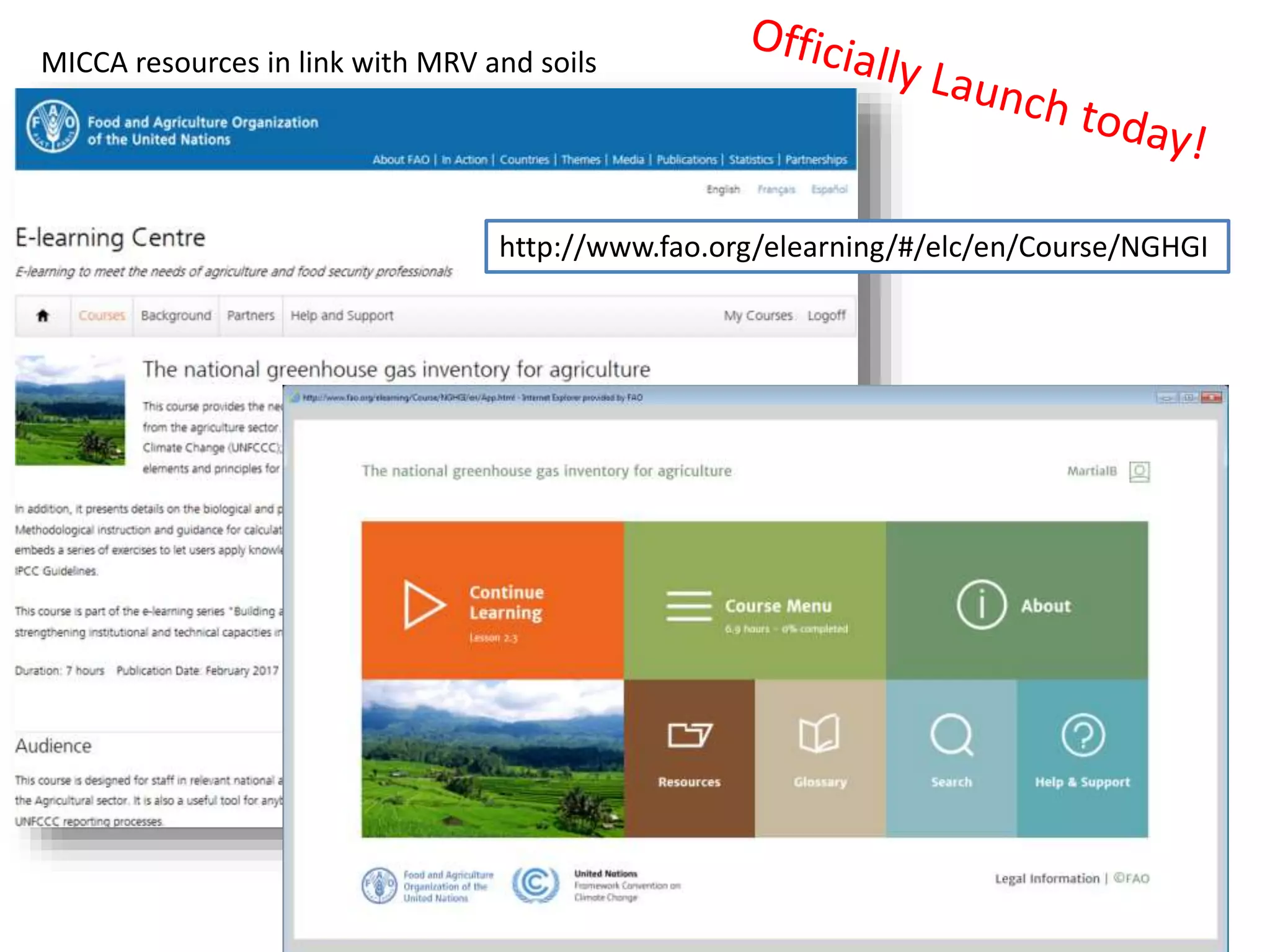
http://www.fao.org/elearning/#/elc/en/Course/NGHGI
MICCA resources in link with MRV and soils
Thanks for the attention!
http://www.fao.org/in-action/micca/en/

Status and challenges for mapping, monitoring and MRV of SOC

  • 1.
    Status and challengesfor mapping, monitoring and MRV of SOC Martial Bernoux
  • 2.
    A MRV systemrefers to any process or system which aims to assess and monitor the impacts of mitigation measures and/or the support provided (measuring) and to document this information in a transparent way (reporting), so that it can be examined for accuracy (verification). M = Measurement (or estimation), sometime “Measuring” or “Monitoring” R = Reporting (at different level: national, international,…) V = Verification (sometime Verifying) includes Quality Control (QC) and Quality Assurance (QA) What is MRV? MRV of national inventory (e.g. sources and sinks of GHG) MRV of policy (e.g. NAMA, mitigation measures) MRV of project (CDM, …) MRV of implementation (e.g. financial flow) MRV of a REDD-plus activities … MRV of soil carbon … or better MRV of soil C sequestration and GHG fluxes related to soil management Status and challenges for mapping, monitoring and MRV of SOC
  • 3.
    Criteria to respect Consistency:Same methodology apply along years and uses consistent datasets Completeness: All GHG and all sinks and sources category are reported Accuracy: Not biased and reduced uncertainty as far as possible Transparency: Assumptions, hypothesis and methodologies used are explained and documented Comparability: Comparable methods should be used by all stakeholders of the MRV system Task Force on National GHG Inventories (TFI) TFI objective is to develop and refine an internationally-agreed methodology and software for the calculation and reporting of national GHG emissions and removal
  • 4.
    The Guidelines evolvedconcomitantly with UNFCCC/KP and PA needs and decisions But some invariant principles for AFOLU For CH4 and N2O Only fluxes
  • 5.
    But some invariantprinciples for AFOLU But for (most) CO2 Mass balance approach Carbon Carbon time DC/Dtime = CO2 emissions 1 year = The Guidelines evolved concomitantly with UNFCCC/KP and PA needs and decisions
  • 6.
    But some invariantprinciples for AFOLU But for (most) CO2 Mass balance approach C 5 compartments Above Ground Biomass Litter Soil (> 30 cm) Below Ground Biomass Dead wood Soil is the major pool in Cropland and Grassland The Guidelines evolved concomitantly with UNFCCC/KP and PA needs and decisions
  • 7.
    But some invariantprinciples for AFOLU Default values for all N2O, CH4 fluxes and default carbon stocks for the different pools =X Activity data EF Emission estimate The Guidelines evolved concomitantly with UNFCCC/KP and PA needs and decisions
  • 8.
    But some invariantprinciples for AFOLU The Guidelines evolved concomitantly with UNFCCC/KP and PA needs and decisions Default carbon stocks Carte soil EX-ACT Tier 1 methods are designed to be the simplest to use, for which equations and default parameter values (e.g., emission and stock change factors) are provided in this volume
  • 9.
    But some invariantprinciples for AFOLU The Guidelines evolved concomitantly with UNFCCC/KP and PA needs and decisions Default carbon stocks Tier 2 can use the same methodological approach as Tier 1 but applies emission and stock change factors that are based on country- or region-specific data, for the most important land-use categories. Bernoux et al., SSSAJ, 2002 Brahim et al., IJSS, 2010 Henri et al., BGD, 2009
  • 10.
    But some invariantprinciples for AFOLU The Guidelines evolved concomitantly with UNFCCC/KP and PA needs and decisions Default carbon stocks Soil C stock estimates may also include soil inorganic C if using a Tier 3 method Tier 3, higher order methods are used, including models and inventory measurement systems tailored to address national circumstances, repeated over time, and driven by high-resolution activity data and disaggregated at sub-national level. Grinand et al., IJAEOG, 2017 Cerri et al., AEE, 2007
  • 11.
    Chapter 2 GenericMethodologies Applicable to Multiple Land-use Categories 2.3.3 Change in carbon stocks in soils Issue 1: Update reference carbon stocks. Issue 2: Develop new Tier 2 method for mineral soils that requires less activity data than the current default method. Issue 3:Elaborate Tier 3 Methodologies with case study examples for soils. Volume 4: Agriculture, Forestry and Other Land Use Outline of the Methodology Report(s) to refine the 2006 IPCC Guidelines for National Greenhouse Gas Inventories Chapter 6 Grassland Chapter 4 Forest Land Chapter 5 Cropland Issue: Provide guidance and develop new Tier 2 method for mineral soils that requires less activity data than the current default method Issue 1: Update carbon stock change factors. Issue 2: Develop new Tier 2 method for mineral soils that requires less activity data than the current default method
  • 12.
    Estimated results Verifiedresults Forest Cropland time Soil C stock measure Estimate+ validation Specific needs for a MRV of soil C sequestration Improve low cost C determination Decrease time need for sampling and preparation Decrease the costs © Eco&Sols
  • 13.
    Valorization based onthe impact/result of the practice / management options Estimated results Verified result Adoption of a practice that stores/preserves carbon Valorization based on adoption of sequestering practices or management options Forest Cropland time Soil C stock measure Specific needs for a MRV of soil C sequestration Decrease the costs…and/or consider the following approach Estimate+ validation ©V.Chaplot–RainfedRiceLaoPDR
  • 14.
    Adoption of apractice that stores/preserves carbon Valorization based on adoption of sequestering practices or management options ©V.Chaplot–RainfedRiceLaoPDR Specific needs for a MRV of soil C sequestration Decrease the costs…and/or consider the following approach •Need to improve our knowledge on soil C sequestration for different practices and contexts. •Need to organize freely accessible updated datasets for users. •Need to elaborate adequate MRV rules. •Need to consider also avoided emissions from soil protection / conservation. •Need for adequate national and international AFOLU policies. •Need to have robust ex-ante tools for designing adequate AFOLU program/policy (e.g. EX-ACT), but also available for farmers. • Need to quantify benefits, co-synergies or trade- offs associated to soil C storage (metrics?).
  • 15.
    MICCA resources inlink with MRV and soils http://bit.ly/fao-nama-afolu-tool http://www.fao.org/3/a-i4642e.pdf
  • 16.
  • 17.
    Thanks for theattention! http://www.fao.org/in-action/micca/en/

Editor's Notes

  • #3 MRV set under the UNFCCC/KP needs a COP decision : e.g. Decision 18/CP.8 for the Parties included in Annex I and Decision 17/CP.8 for Parties not included in Annex I