Chapter 4
Arithmetic and Logical
Expressions
BTE2313 Computer Programming
Lecturer: Samson Mekbib
LEARNING OUTCOME
Learn about arithmetic operators to preform
calculations in C++
Explain how to solve and create a logical
expression
Explain how to use operators AND ( && )
and OR ( l l )
LEARNING OUTCOME
Learn about arithmetic operators to preform
calculations in C++
Explain how to solve and create a logical
expression
Explain how to use operators AND ( && )
and OR ( l l )
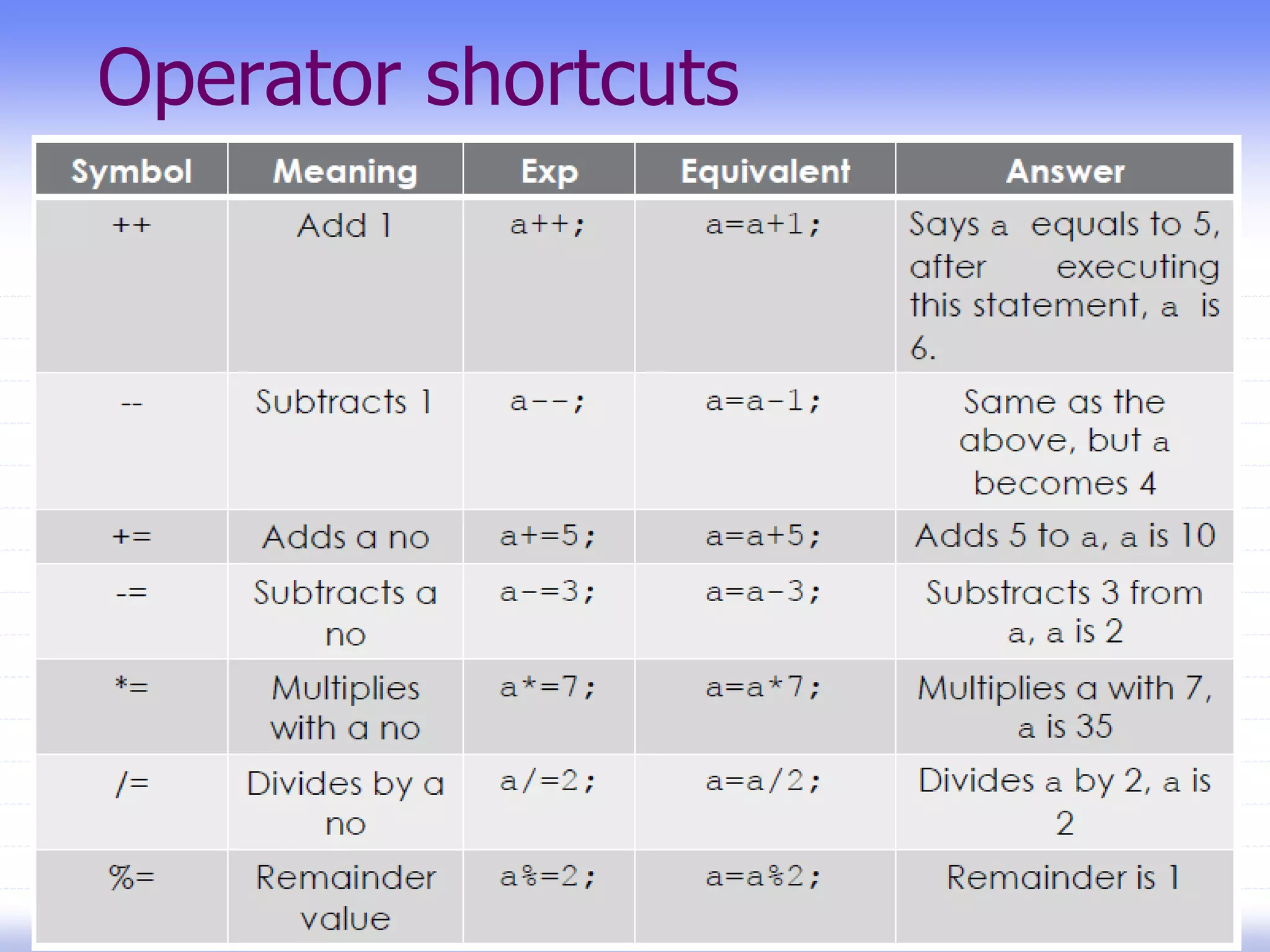
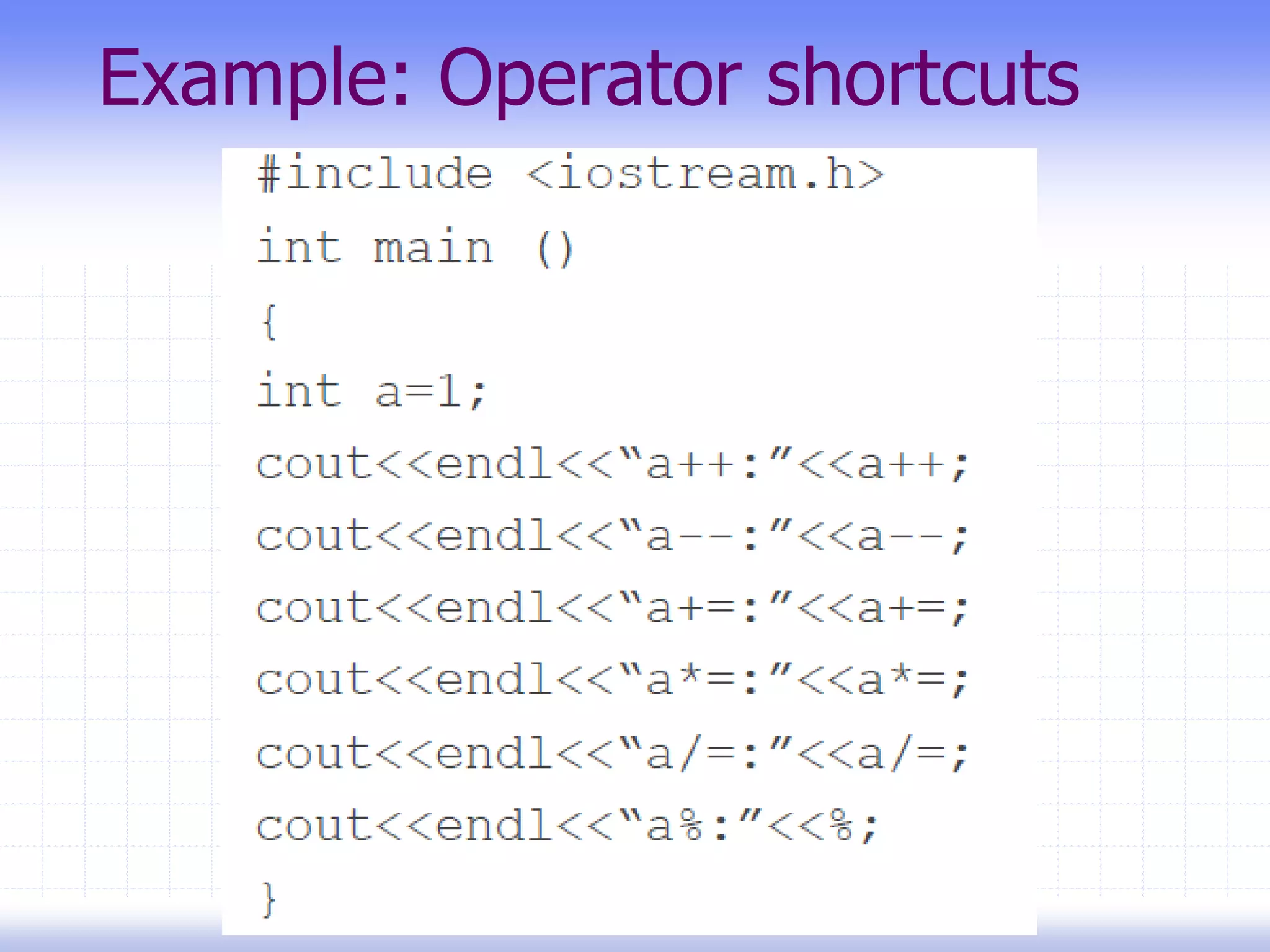
Operator shortcuts
Example: Operator shortcuts
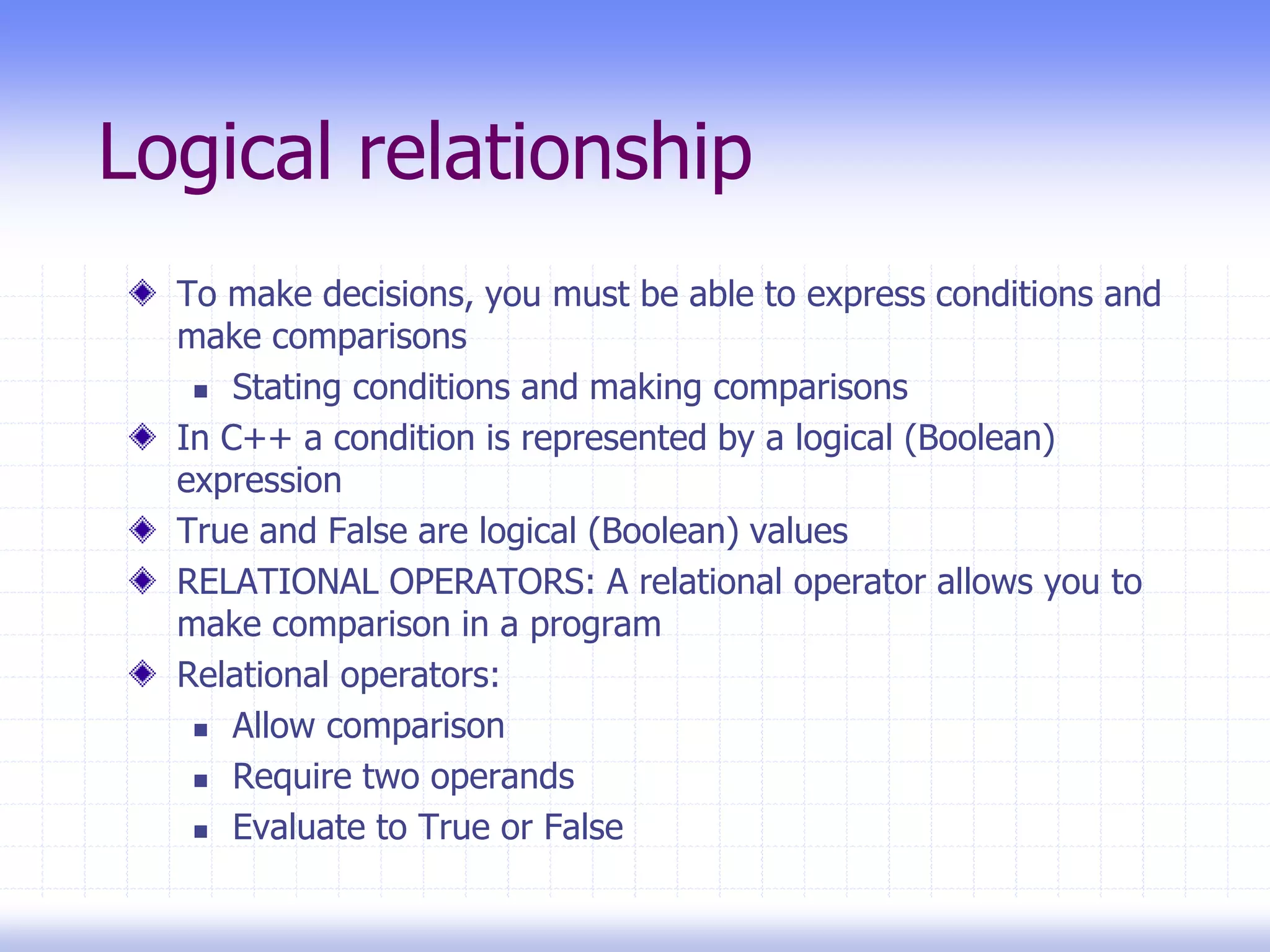
Logical relationship
To make decisions, you must be able to express conditions and
make comparisons
 Stating conditions and making comparisons
In C++ a condition is represented by a logical (Boolean)
expression
True and False are logical (Boolean) values
RELATIONAL OPERATORS: A relational operator allows you to
make comparison in a program
Relational operators:
 Allow comparison
 Require two operands
 Evaluate to True or False
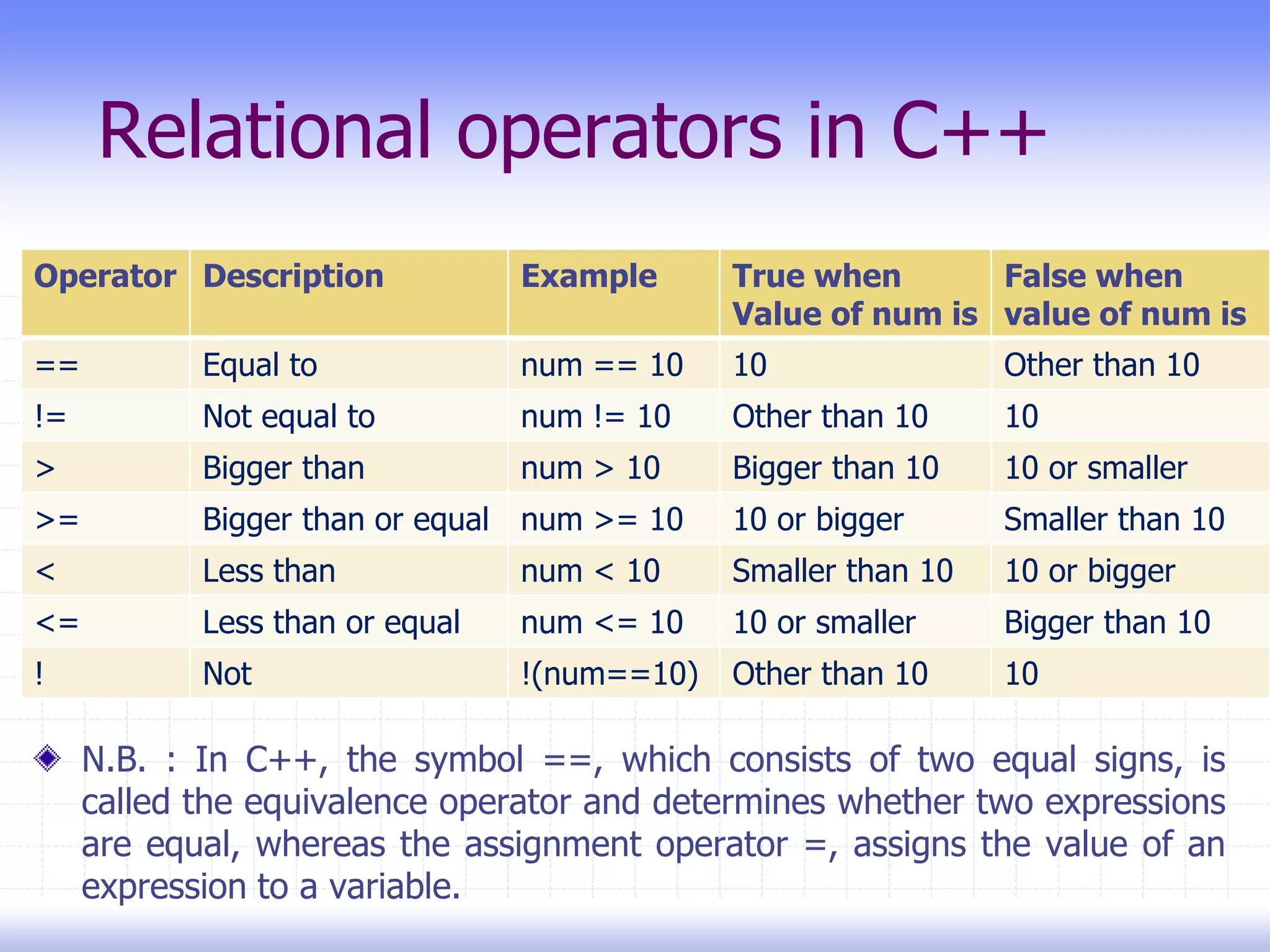
Relational operators in C++
N.B. : In C++, the symbol ==, which consists of two equal signs, is
called the equivalence operator and determines whether two expressions
are equal, whereas the assignment operator =, assigns the value of an
expression to a variable.
Operator Description Example True when
Value of num is
False when
value of num is
== Equal to num == 10 10 Other than 10
!= Not equal to num != 10 Other than 10 10
> Bigger than num > 10 Bigger than 10 10 or smaller
>= Bigger than or equal num >= 10 10 or bigger Smaller than 10
< Less than num < 10 Smaller than 10 10 or bigger
<= Less than or equal num <= 10 10 or smaller Bigger than 10
! Not !(num==10) Other than 10 10
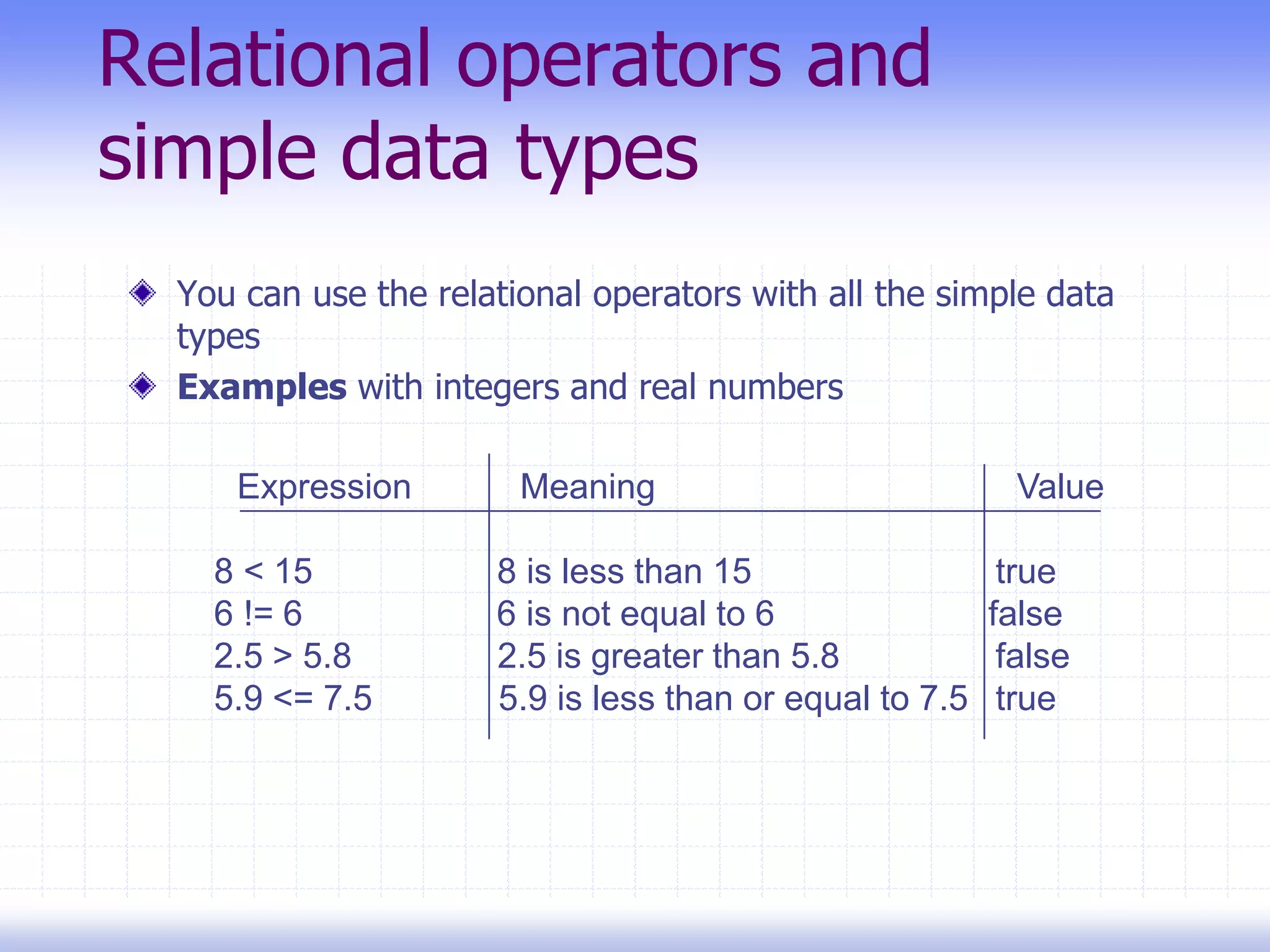
Relational operators and
simple data types
You can use the relational operators with all the simple data
types
Examples with integers and real numbers
Expression Meaning Value
8 < 15 8 is less than 15 true
6 != 6 6 is not equal to 6 false
2.5 > 5.8 2.5 is greater than 5.8 false
5.9 <= 7.5 5.9 is less than or equal to 7.5 true
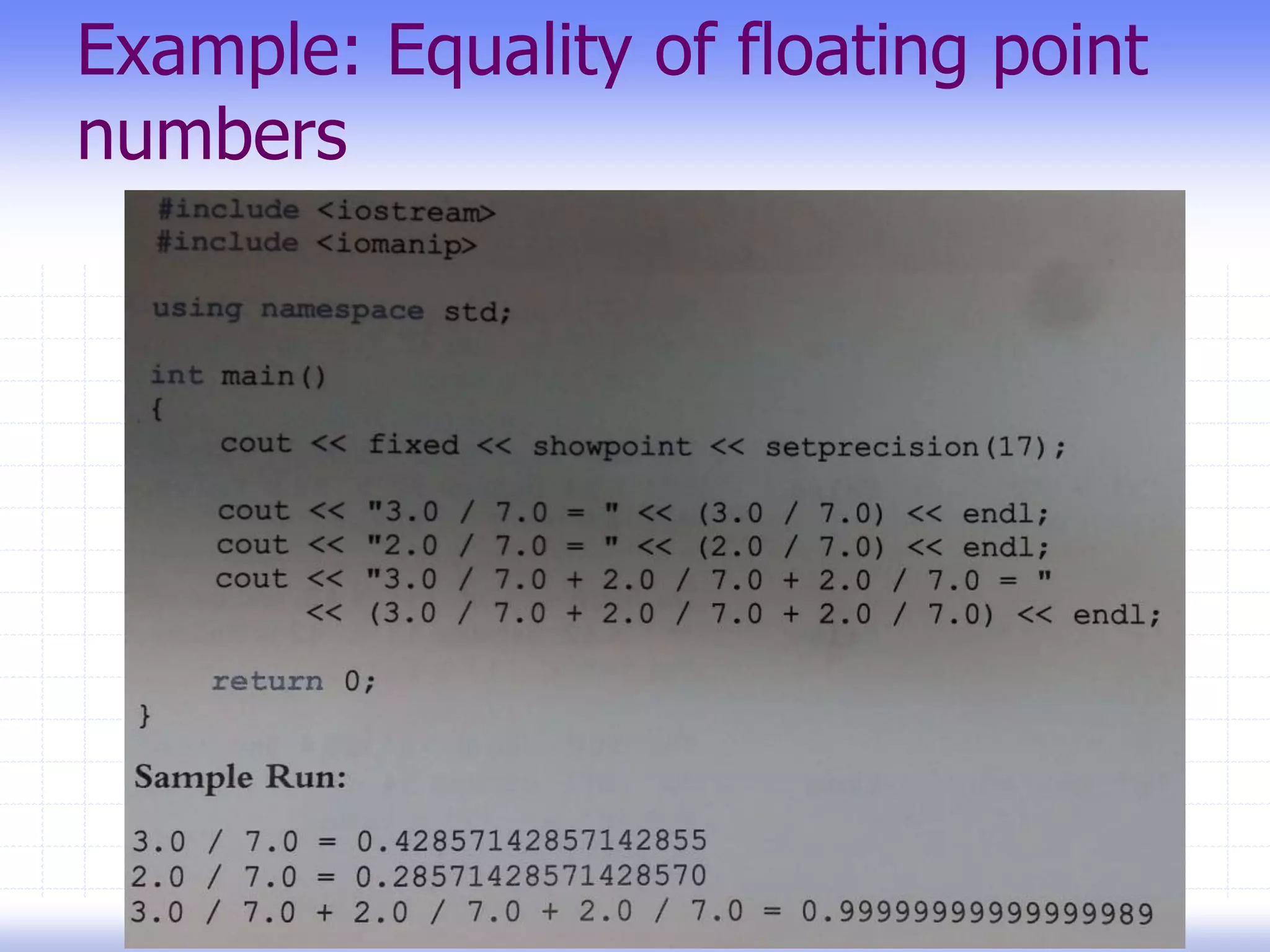
Example: Equality of floating point
numbers
Boolean Algebra
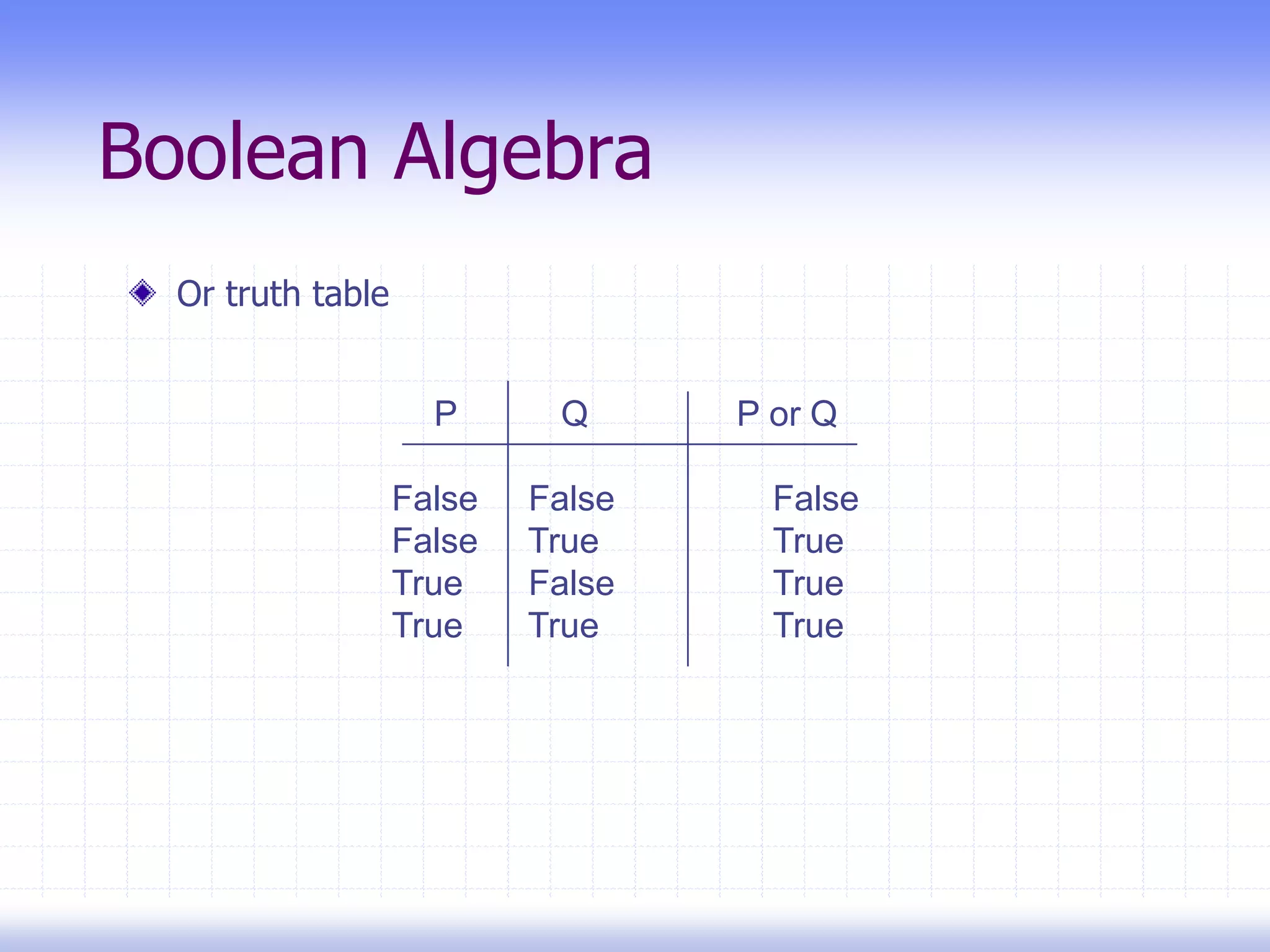
Or truth table
P Q P or Q
False False False
False True True
True False True
True True True
Boolean Algebra
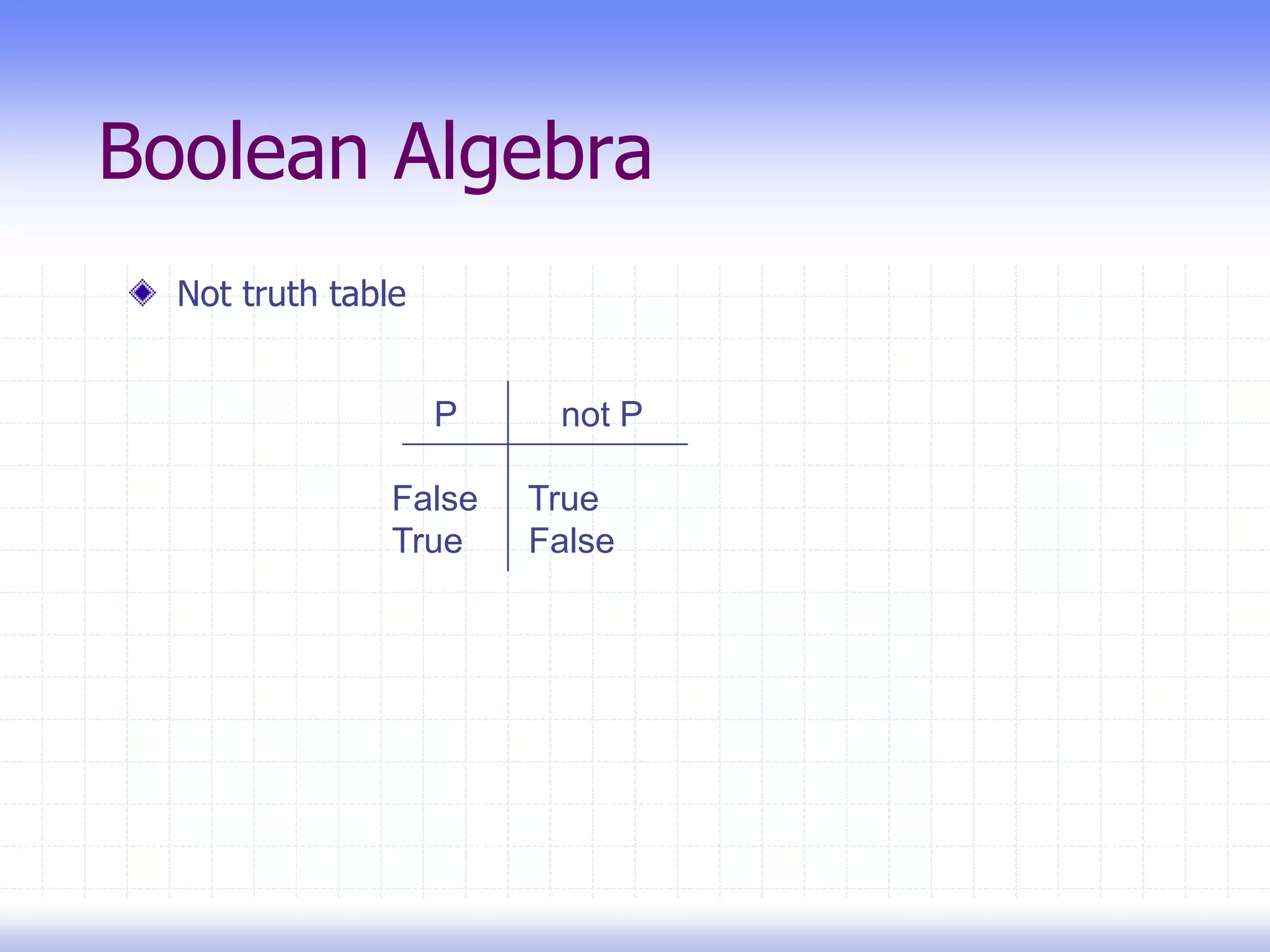
Not truth table
P not P
False True
True False
Boolean Algebra
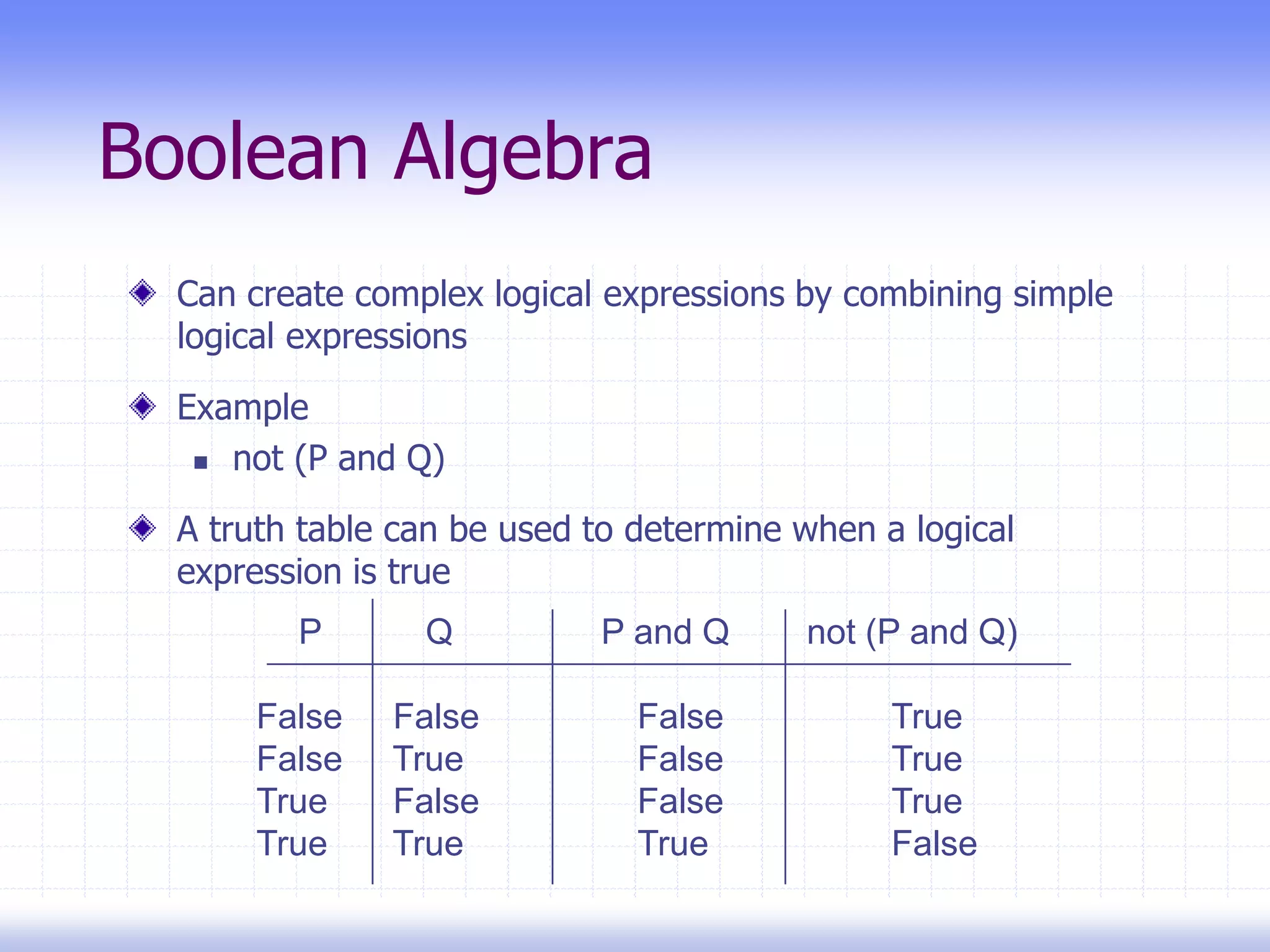
Can create complex logical expressions by combining simple
logical expressions
Example
 not (P and Q)
A truth table can be used to determine when a logical
expression is true
P Q P and Q not (P and Q)
False False False True
False True False True
True False False True
True True True False
A Boolean Type
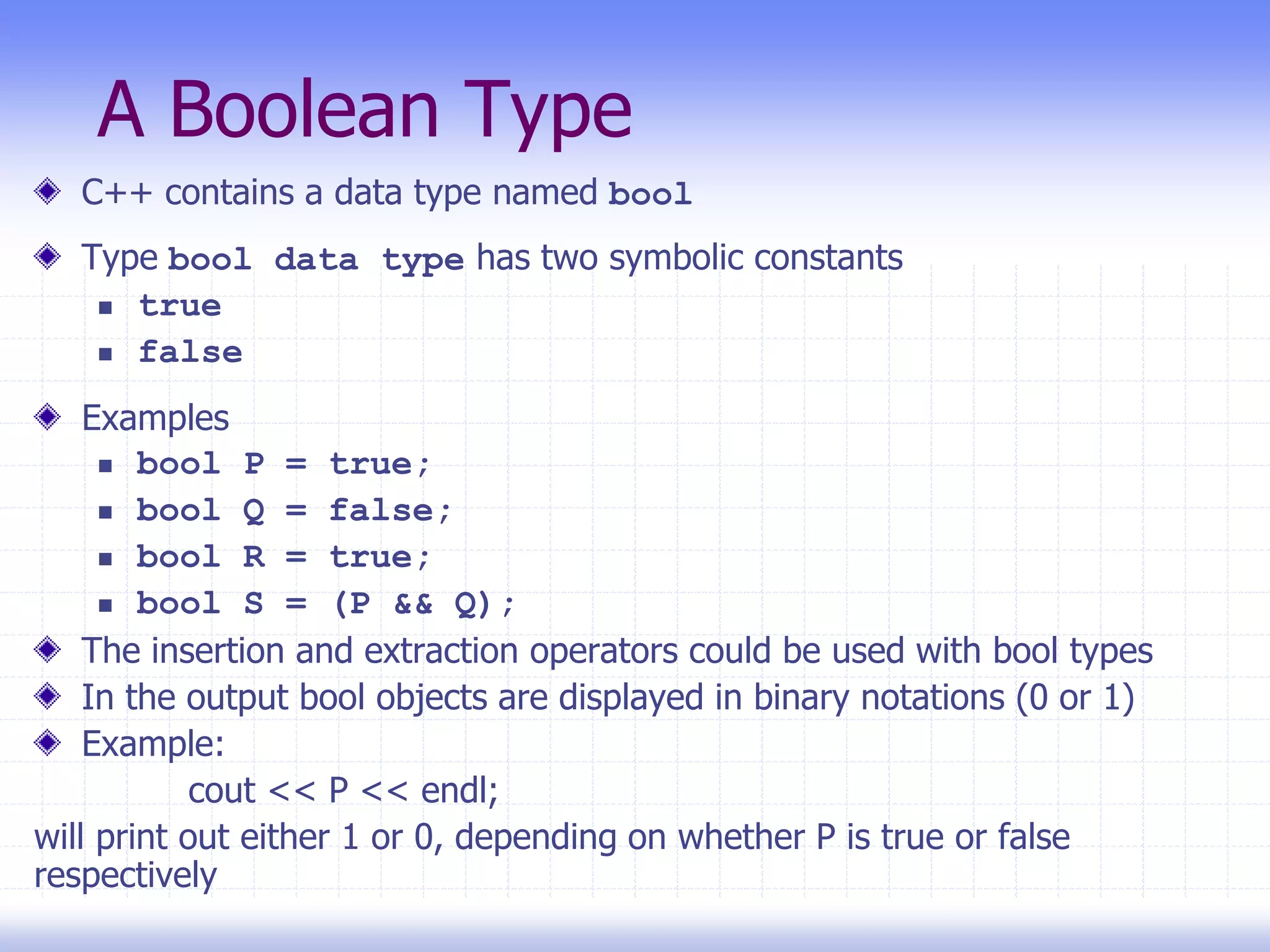
C++ contains a data type named bool
Type bool data type has two symbolic constants
 true
 false
Examples
 bool P = true;
 bool Q = false;
 bool R = true;
 bool S = (P && Q);
The insertion and extraction operators could be used with bool types
In the output bool objects are displayed in binary notations (0 or 1)
Example:
cout << P << endl;
will print out either 1 or 0, depending on whether P is true or false
respectively
A Boolean Type
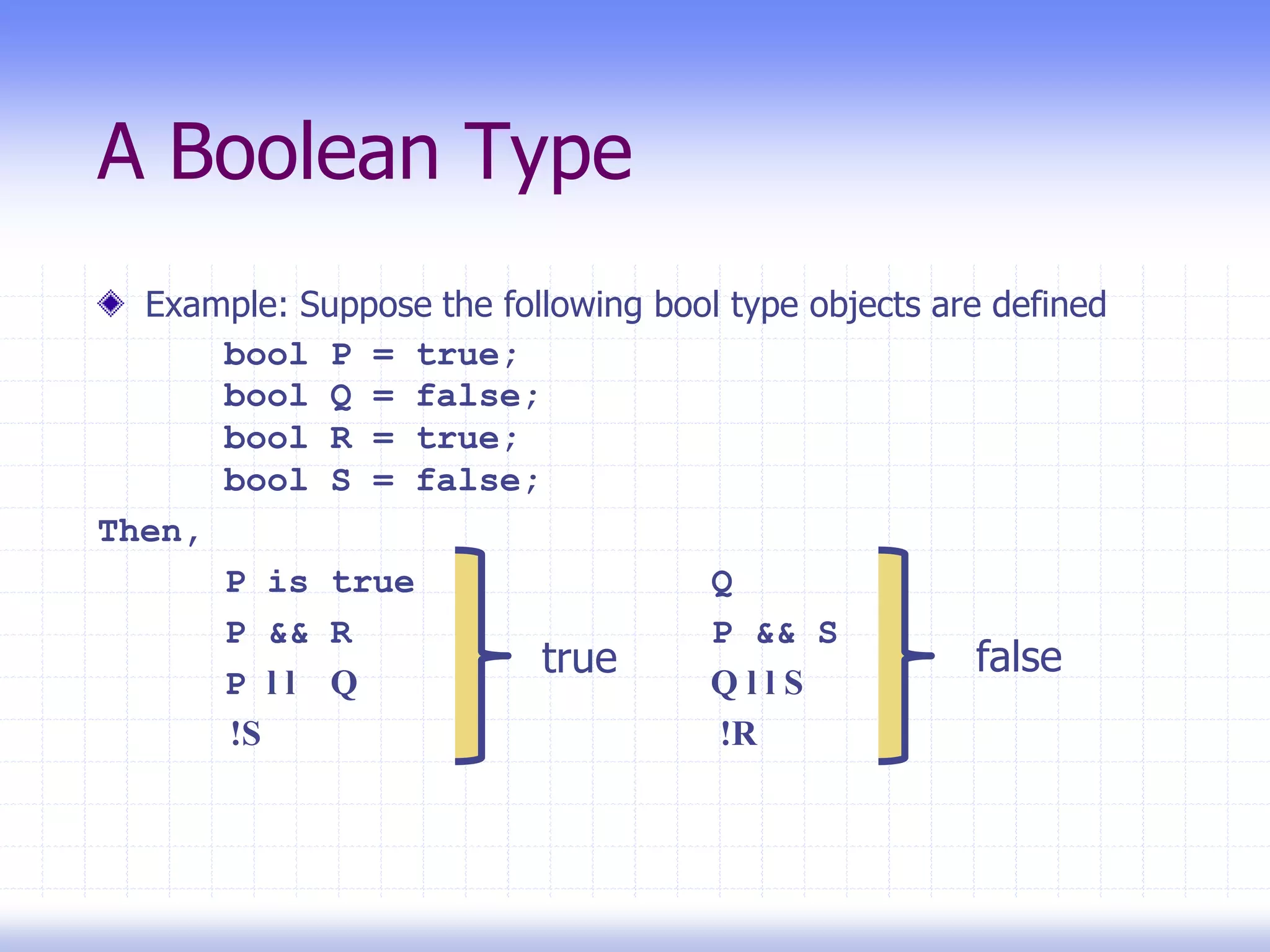
Example: Suppose the following bool type objects are defined
bool P = true;
bool Q = false;
bool R = true;
bool S = false;
Then,
P is true Q
P && R P && S
P l l Q Q l l S
!S !R
true false
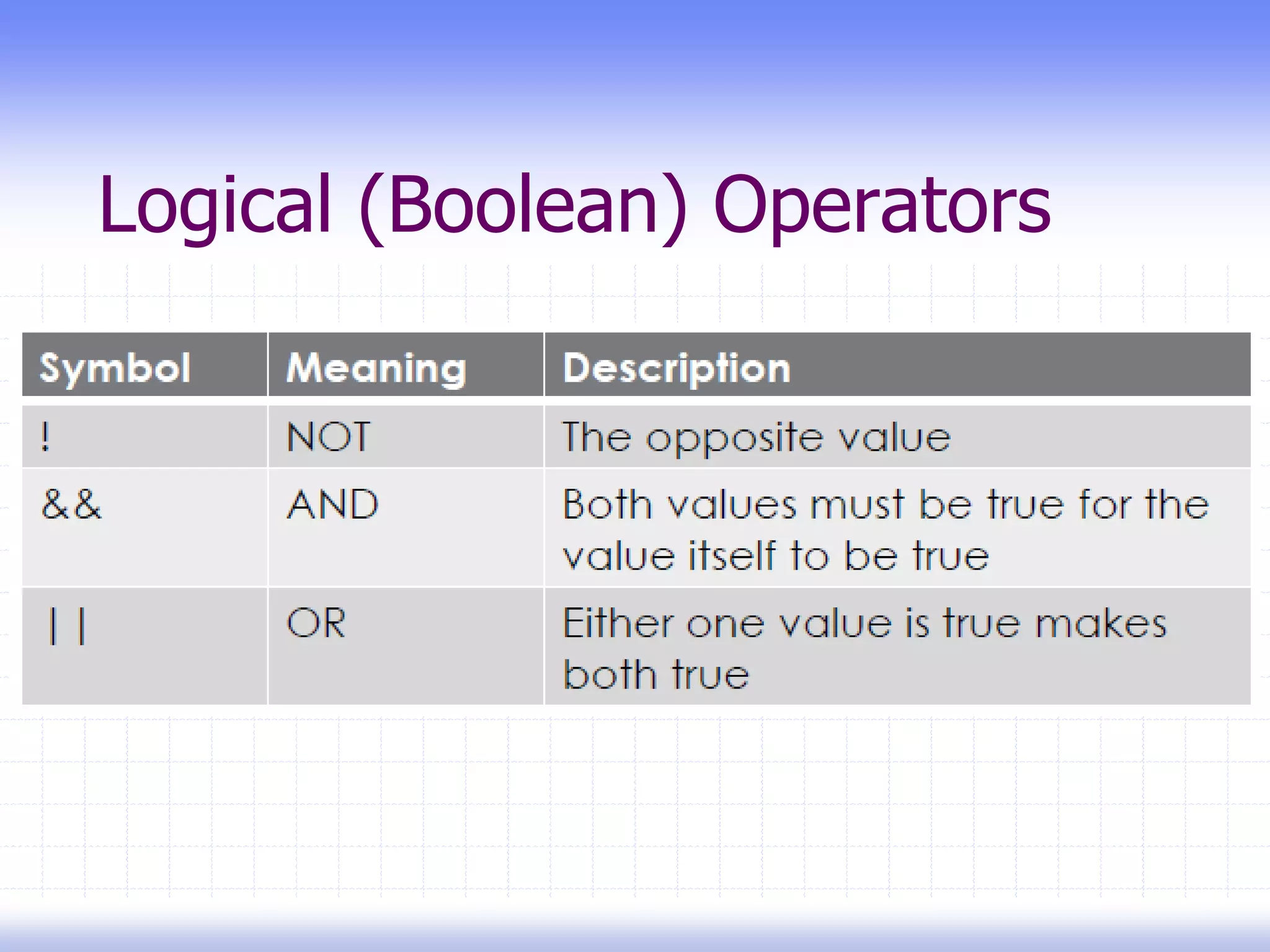
Logical (Boolean) Operators
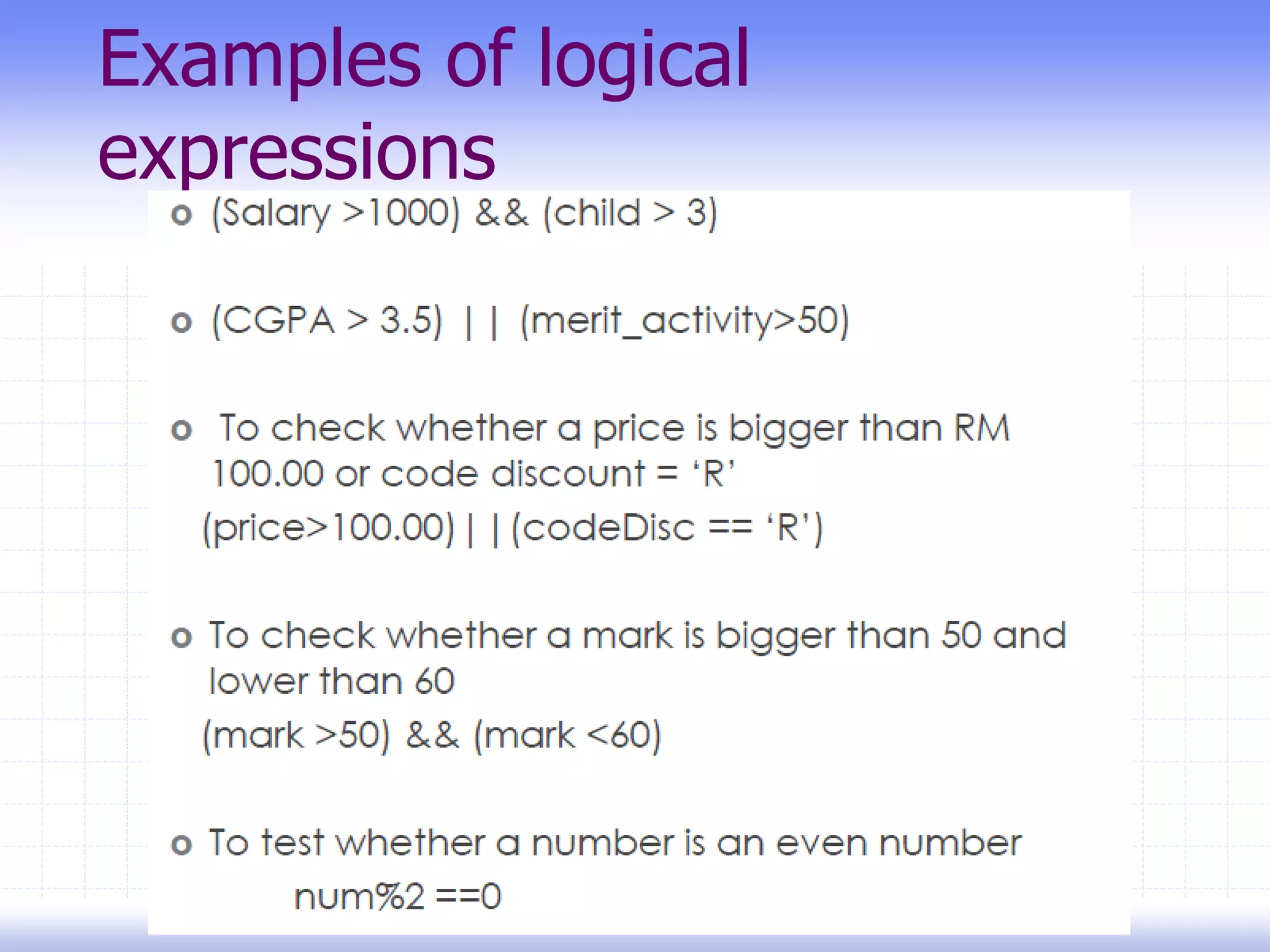
Examples of logical
expressions
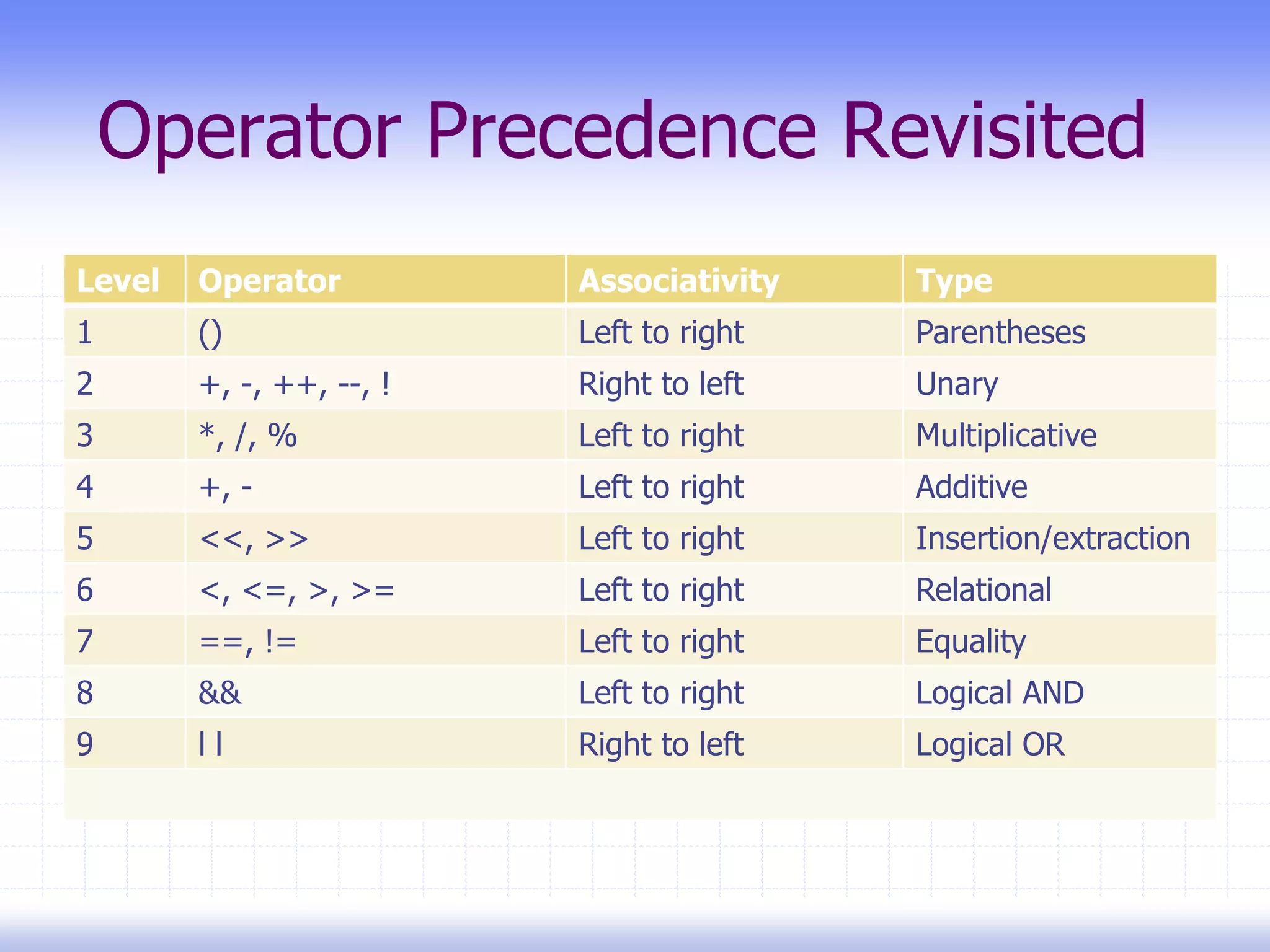
Operator Precedence Revisited
Level Operator Associativity Type
1 () Left to right Parentheses
2 +, -, ++, --, ! Right to left Unary
3 *, /, % Left to right Multiplicative
4 +, - Left to right Additive
5 <<, >> Left to right Insertion/extraction
6 <, <=, >, >= Left to right Relational
7 ==, != Left to right Equality
8 && Left to right Logical AND
9 l l Right to left Logical OR
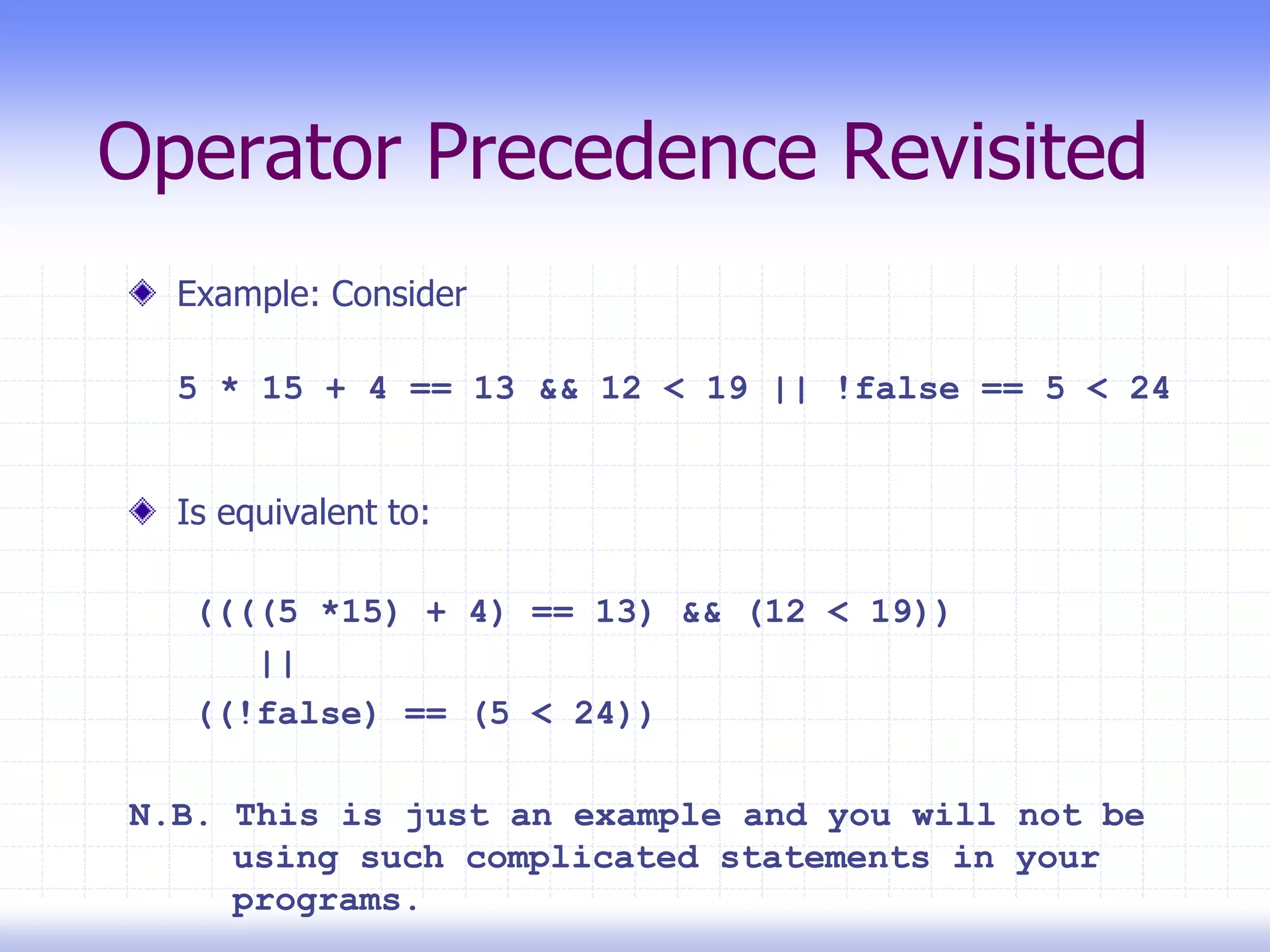
Operator Precedence Revisited
Example: Consider
5 * 15 + 4 == 13 && 12 < 19 || !false == 5 < 24
Is equivalent to:
((((5 *15) + 4) == 13) && (12 < 19))
||
((!false) == (5 < 24))
N.B. This is just an example and you will not be
using such complicated statements in your
programs.
Introductions on next chapter
Conditional / Selection Structure
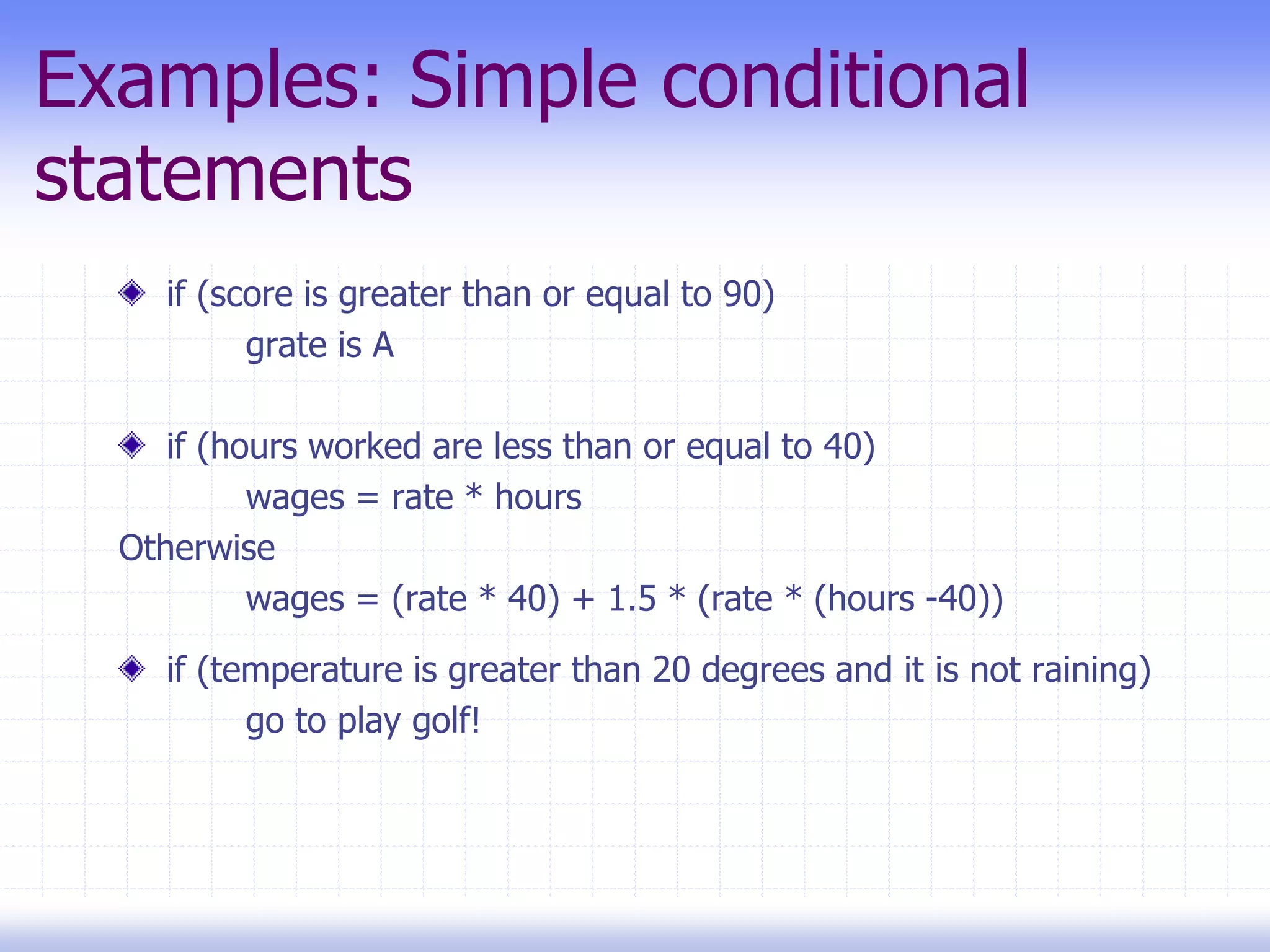
Examples: Simple conditional
statements
if (score is greater than or equal to 90)
grate is A
if (hours worked are less than or equal to 40)
wages = rate * hours
Otherwise
wages = (rate * 40) + 1.5 * (rate * (hours -40))
if (temperature is greater than 20 degrees and it is not raining)
go to play golf!
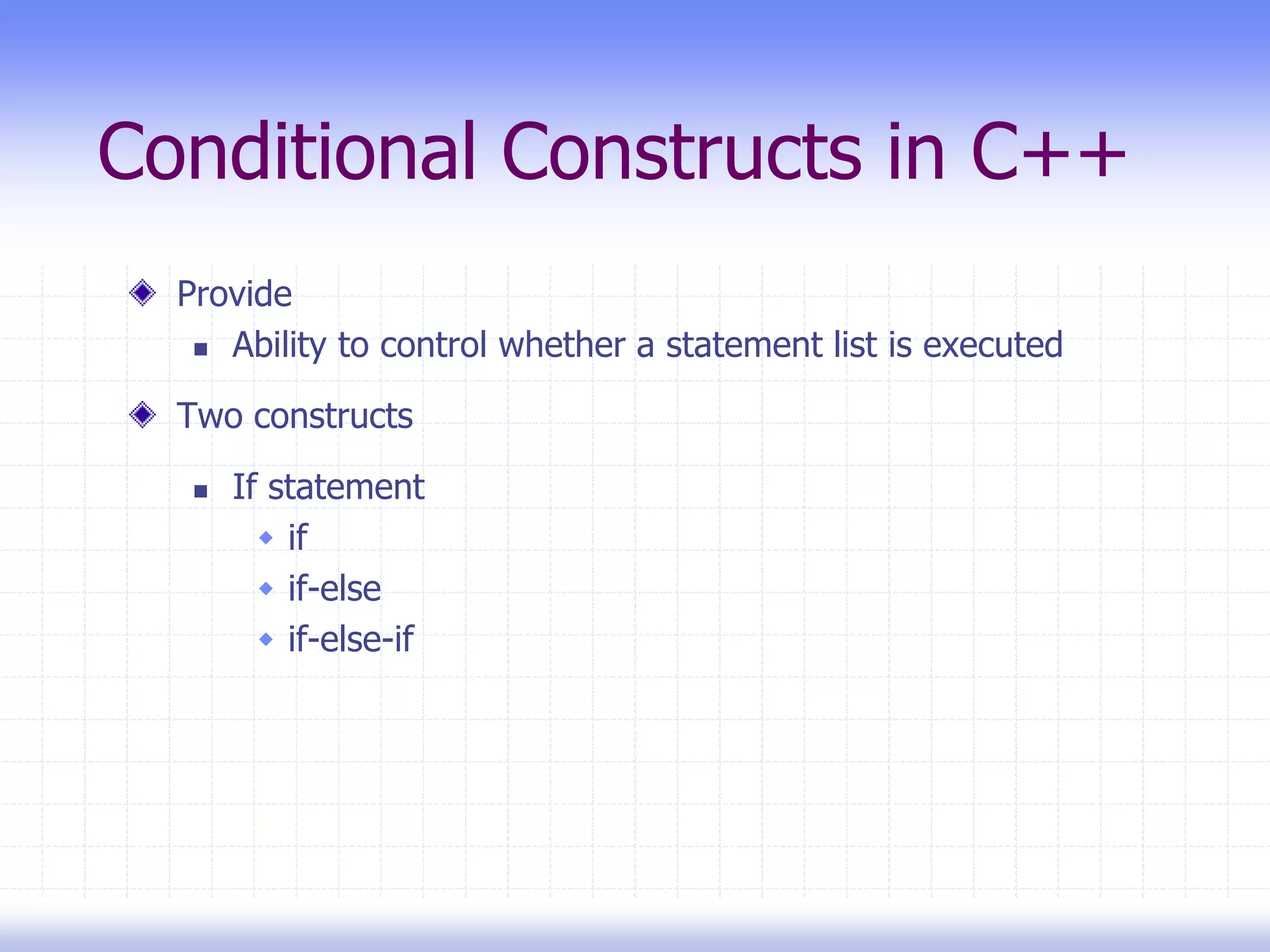
Conditional Constructs in C++
Provide
 Ability to control whether a statement list is executed
Two constructs
 If statement
 if
 if-else
 if-else-if
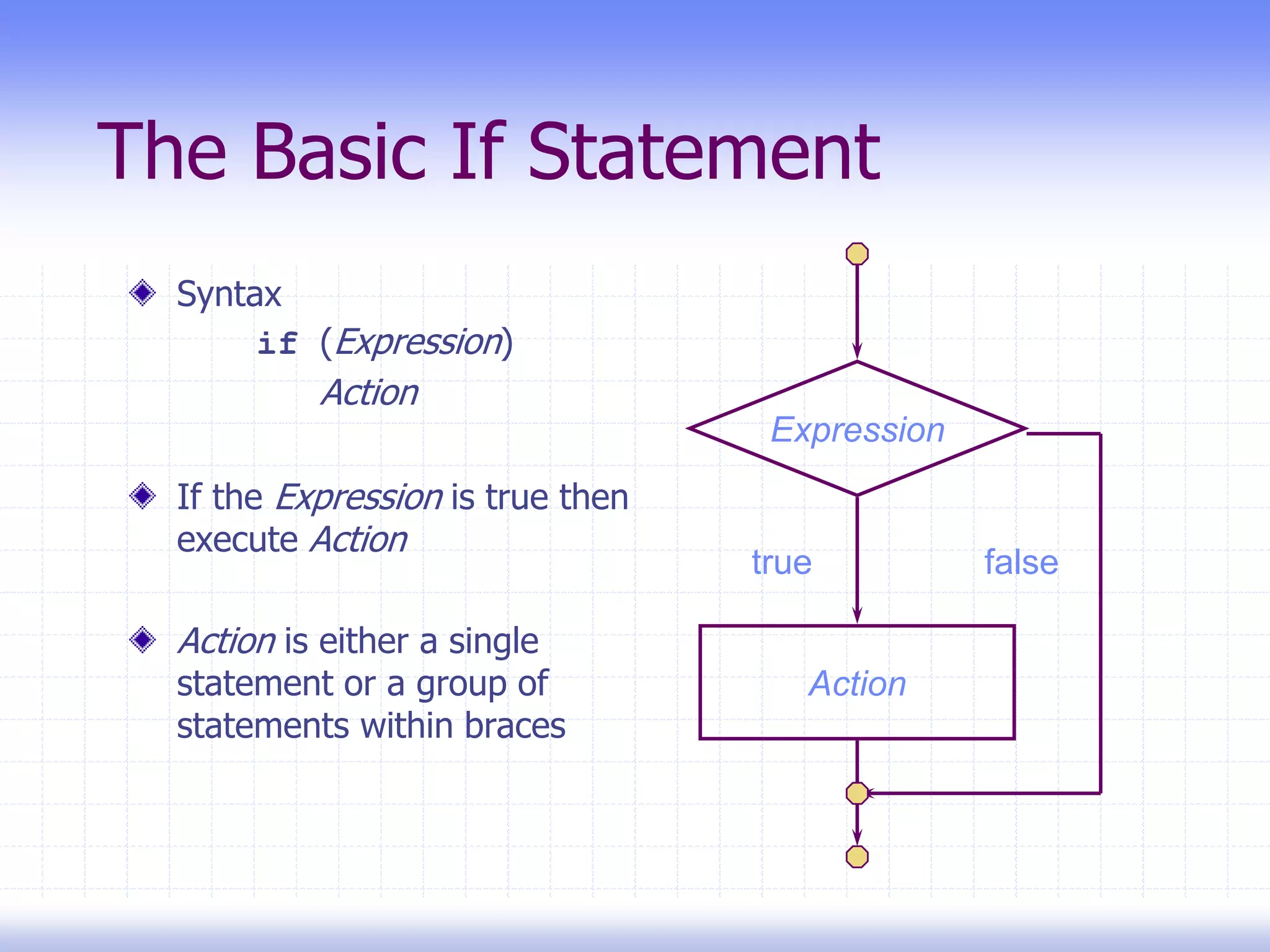
The Basic If Statement
Syntax
if (Expression)
Action
If the Expression is true then
execute Action
Action is either a single
statement or a group of
statements within braces
Expression
Action
true false
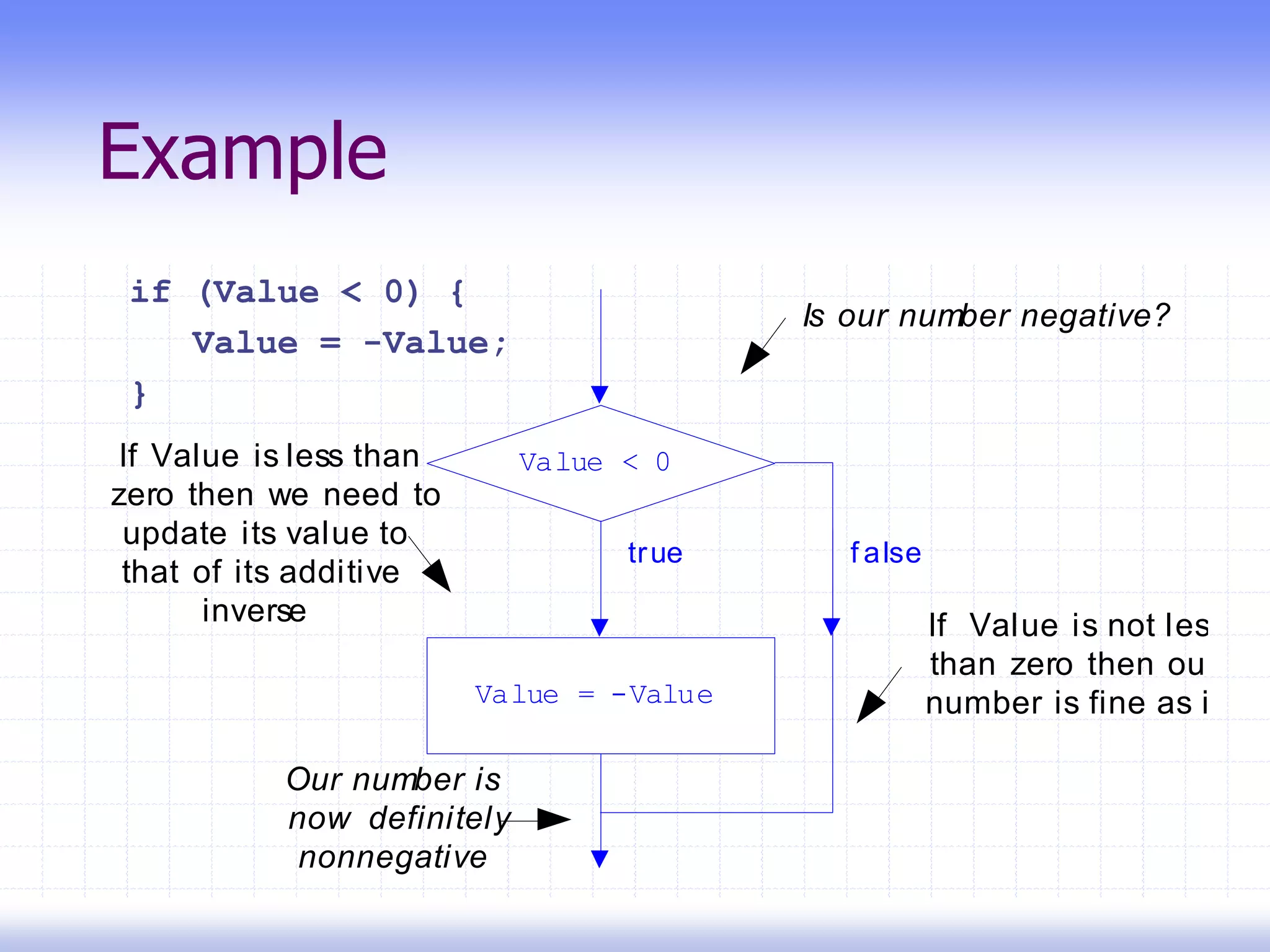
Example
if (Value < 0) {
Value = -Value;
}
Value < 0
Value = -Value
true f alse
Is our number negative?
If Value is not less
than zero then our
number is fine as is
If Value is less than
zero then we need to
update its value to
that of its additive
inverse
Our number is
now definitely
nonnegative
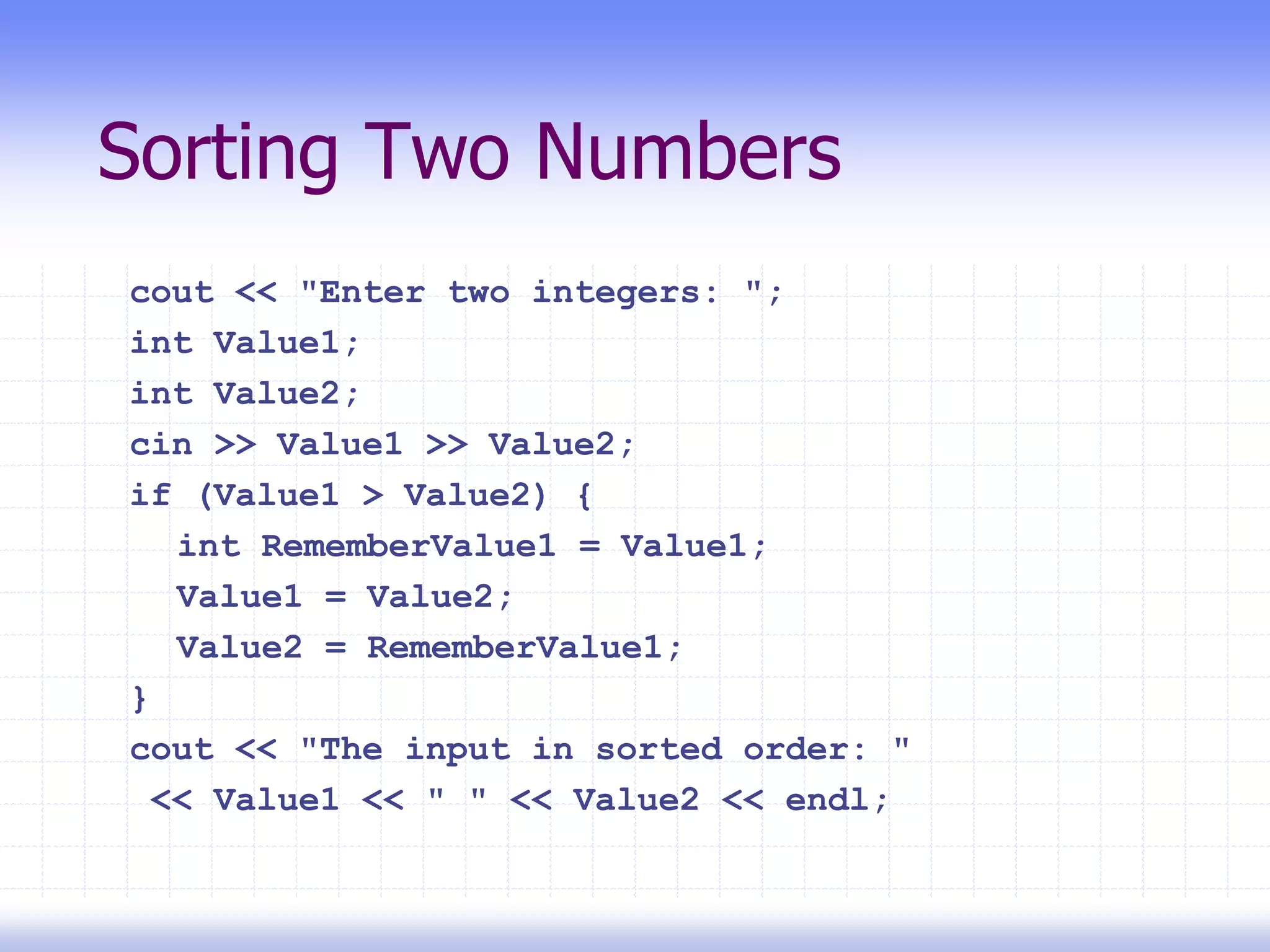
Sorting Two Numbers
cout << "Enter two integers: ";
int Value1;
int Value2;
cin >> Value1 >> Value2;
if (Value1 > Value2) {
int RememberValue1 = Value1;
Value1 = Value2;
Value2 = RememberValue1;
}
cout << "The input in sorted order: "
<< Value1 << " " << Value2 << endl;
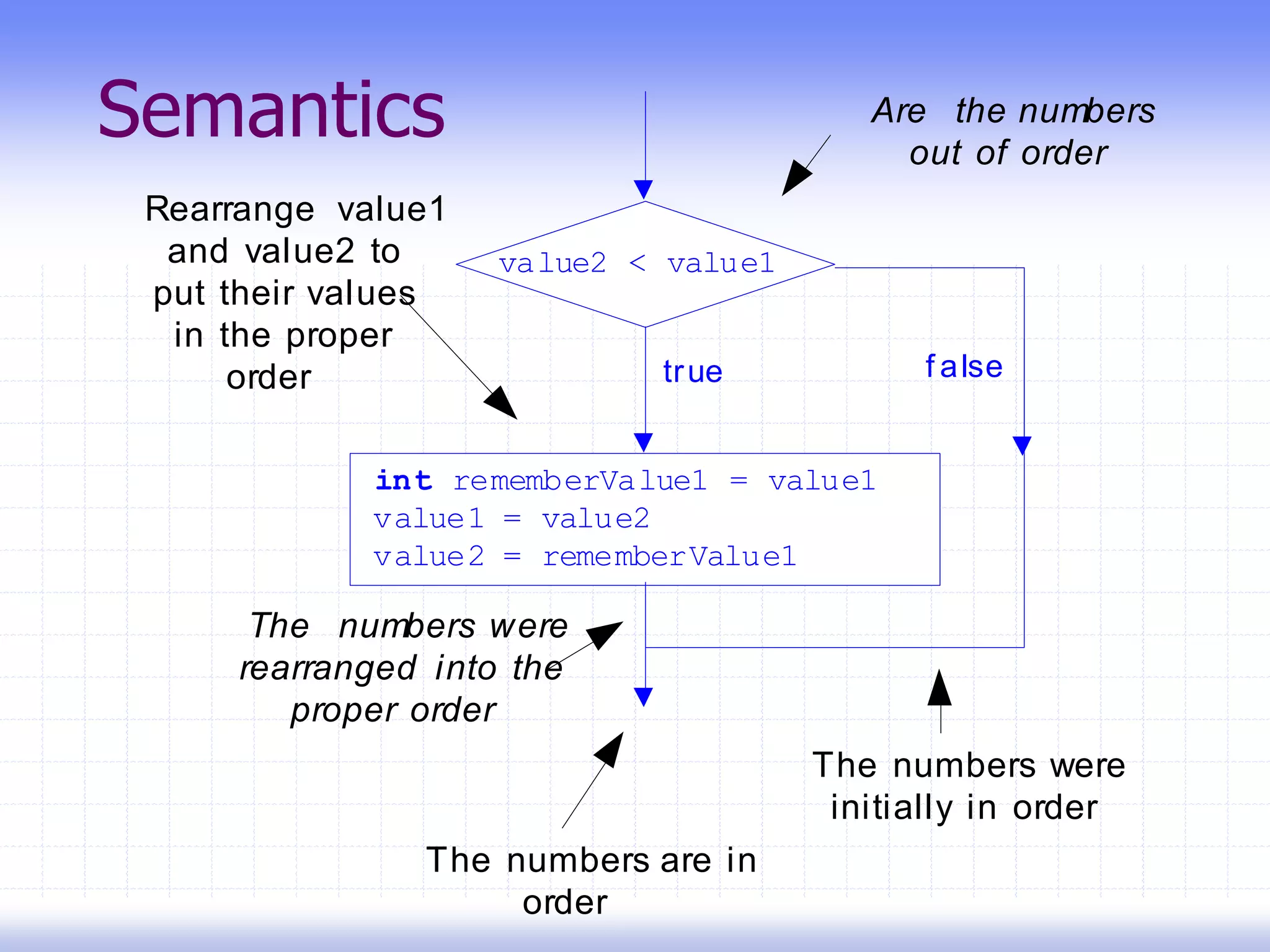
Semantics
value2 < value1
int rememberValue1 = value1
value1 = value2
value2 = rememberValue1
true f alse
Are the numbers
out of order
Rearrange value1
and value2 to
put their values
in the proper
order
The numbers were
initially in order
The numbers were
rearranged into the
proper order
The numbers are in
order
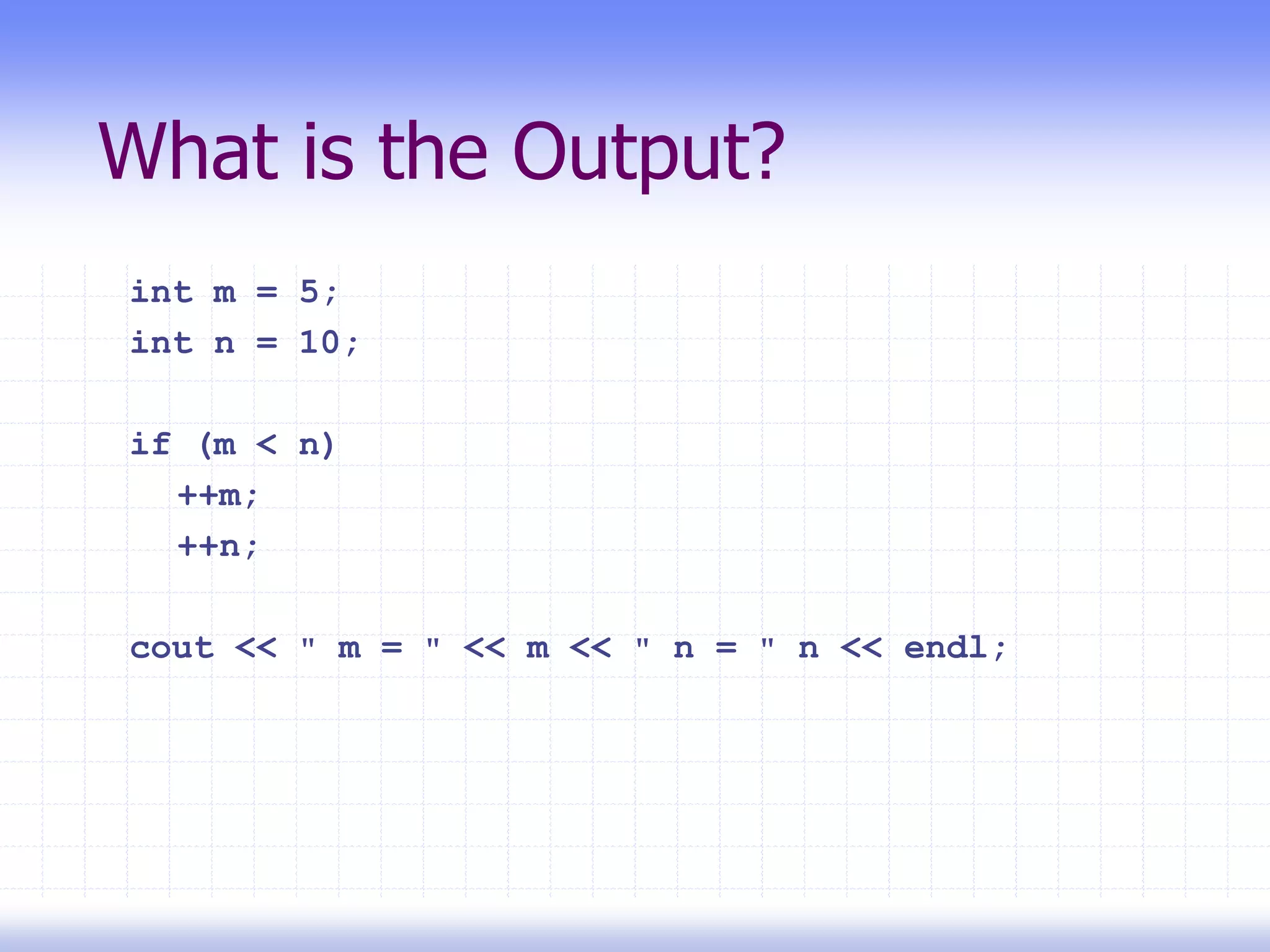
What is the Output?
int m = 5;
int n = 10;
if (m < n)
++m;
++n;
cout << " m = " << m << " n = " n << endl;
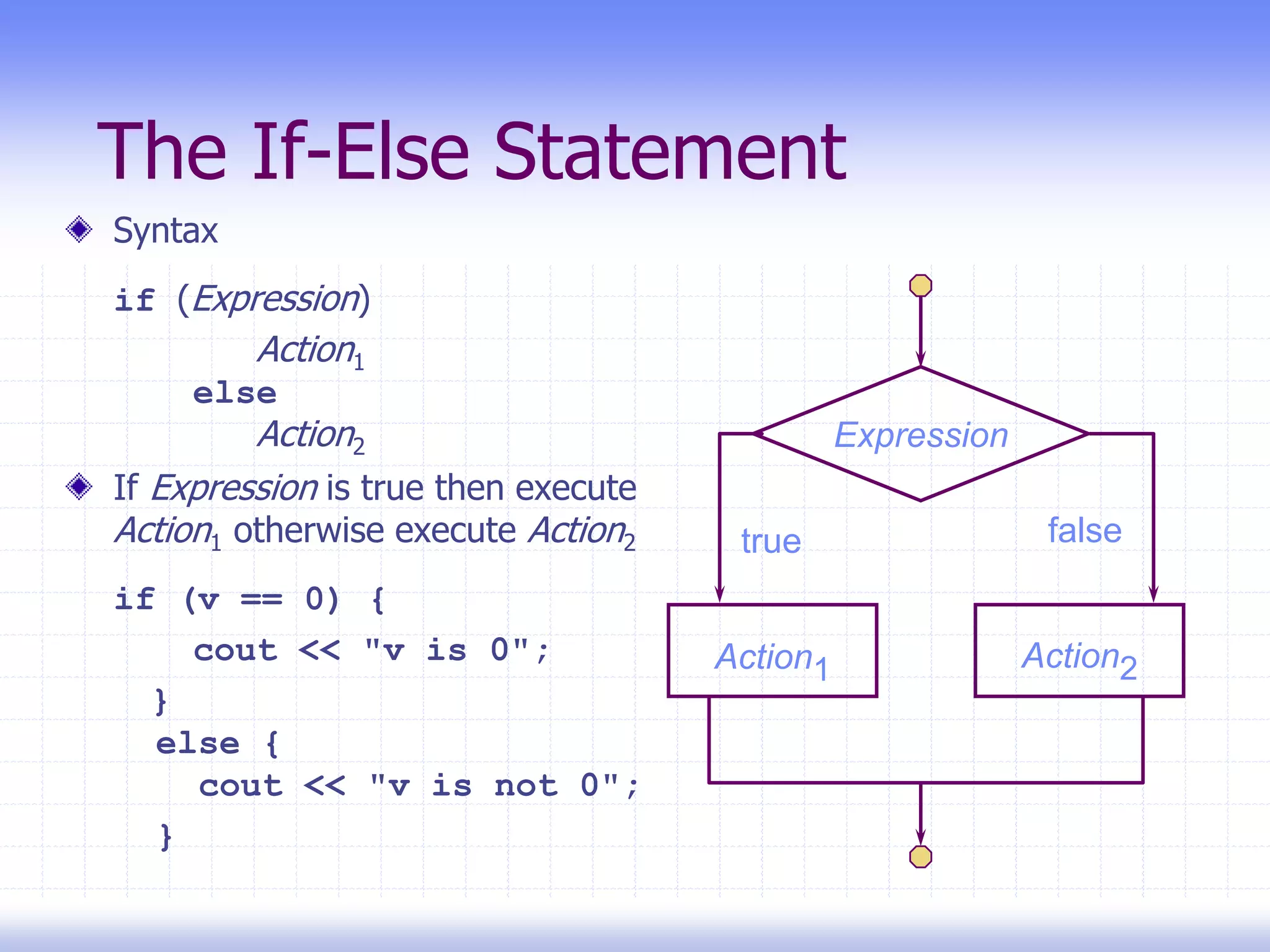
The If-Else Statement
Syntax
if (Expression)
Action1
else
Action2
If Expression is true then execute
Action1 otherwise execute Action2
if (v == 0) {
cout << "v is 0";
}
else {
cout << "v is not 0";
}
Expression
Action1 Action2
true false
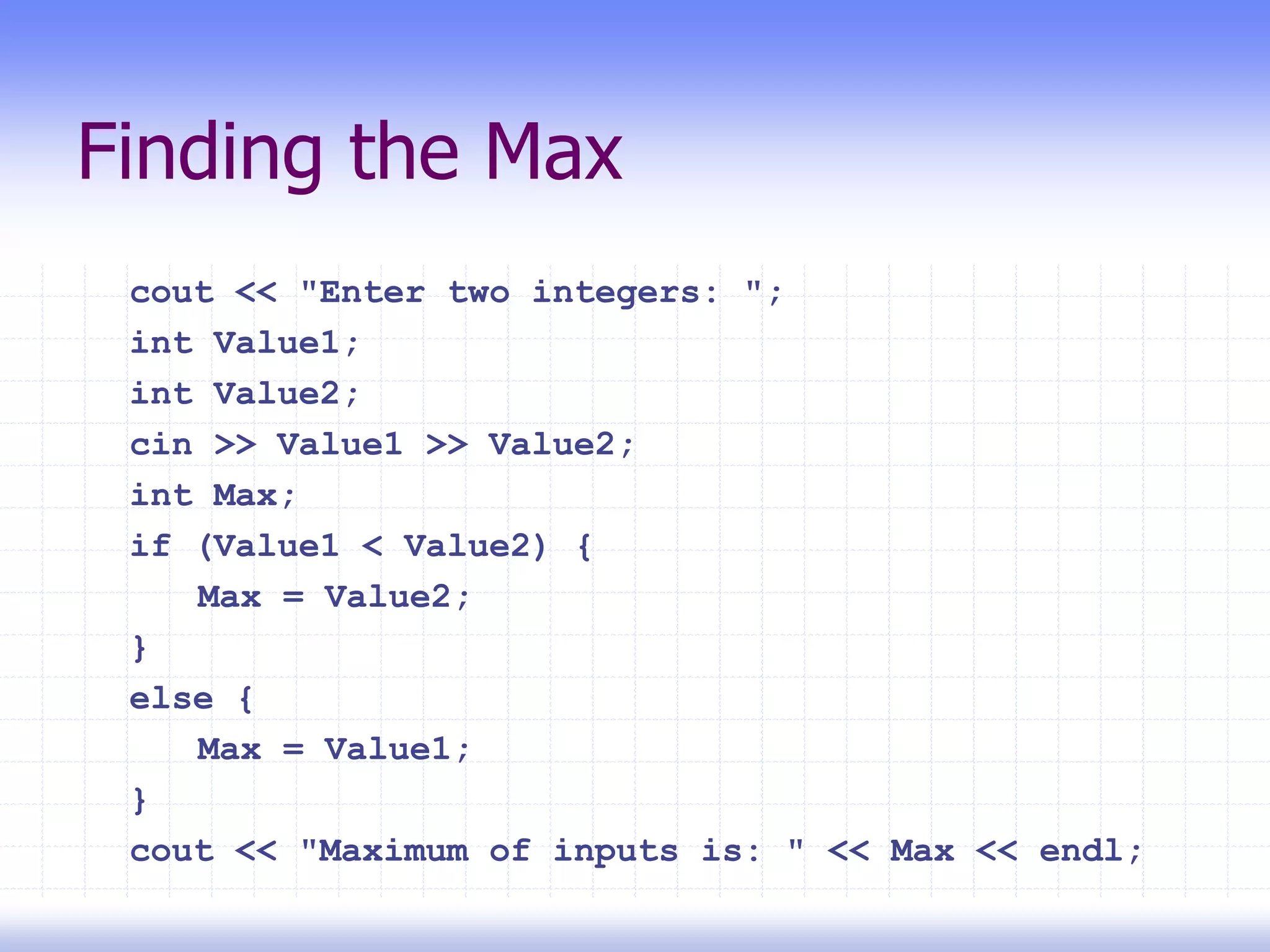
Finding the Max
cout << "Enter two integers: ";
int Value1;
int Value2;
cin >> Value1 >> Value2;
int Max;
if (Value1 < Value2) {
Max = Value2;
}
else {
Max = Value1;
}
cout << "Maximum of inputs is: " << Max << endl;
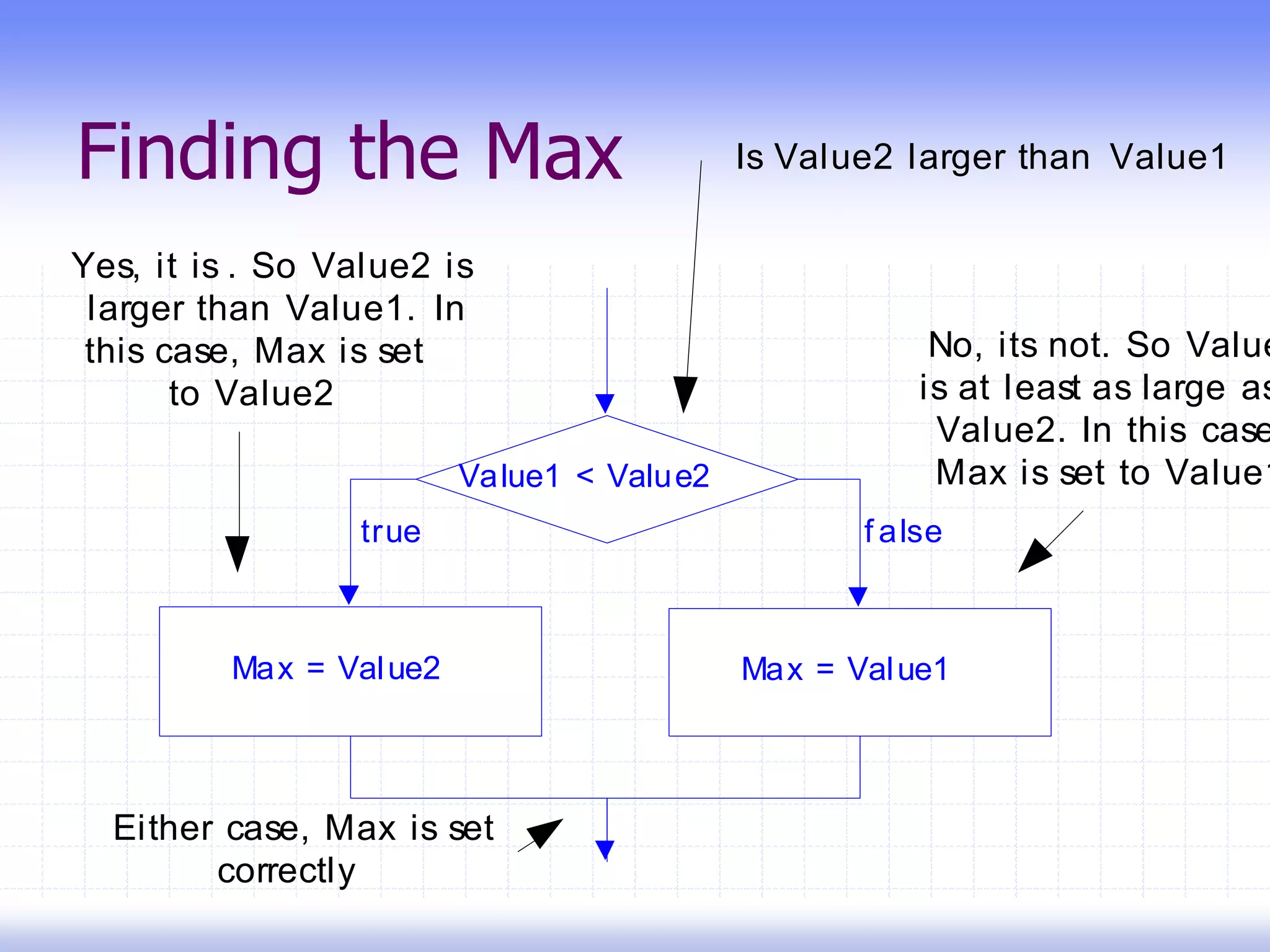
Finding the Max
Value1 < Value2
Max = Value2 Max = Value1
true f alse
Is Value2 larger than Value1
Yes, it is . So Value2 is
larger than Value1. In
this case, Max is set
to Value2
No, its not. So Value
is at least as large as
Value2. In this case
Max is set to Value1
Either case, Max is set
correctly
Selection
It is often the case that depending upon the value of an
expression we want to perform a particular action
Two major ways of accomplishing this choice
 if-else-if statement
 if-else statements “glued” together
 Switch statement
 An advanced construct
An If-Else-If Statement
if ( nbr < 0 )
{
cout << nbr << " is negative" << endl;
}
else if ( nbr > 0 )
{
cout << nbr << " is positive" << endl;
}
else
{
cout << nbr << " is zero" << endl;
}

Chap 4 c++

  • 1.
    Chapter 4 Arithmetic andLogical Expressions BTE2313 Computer Programming Lecturer: Samson Mekbib
  • 2.
    LEARNING OUTCOME Learn aboutarithmetic operators to preform calculations in C++ Explain how to solve and create a logical expression Explain how to use operators AND ( && ) and OR ( l l )
  • 3.
    LEARNING OUTCOME Learn aboutarithmetic operators to preform calculations in C++ Explain how to solve and create a logical expression Explain how to use operators AND ( && ) and OR ( l l )
  • 4.
  • 5.
  • 6.
    Logical relationship To makedecisions, you must be able to express conditions and make comparisons  Stating conditions and making comparisons In C++ a condition is represented by a logical (Boolean) expression True and False are logical (Boolean) values RELATIONAL OPERATORS: A relational operator allows you to make comparison in a program Relational operators:  Allow comparison  Require two operands  Evaluate to True or False
  • 7.
    Relational operators inC++ N.B. : In C++, the symbol ==, which consists of two equal signs, is called the equivalence operator and determines whether two expressions are equal, whereas the assignment operator =, assigns the value of an expression to a variable. Operator Description Example True when Value of num is False when value of num is == Equal to num == 10 10 Other than 10 != Not equal to num != 10 Other than 10 10 > Bigger than num > 10 Bigger than 10 10 or smaller >= Bigger than or equal num >= 10 10 or bigger Smaller than 10 < Less than num < 10 Smaller than 10 10 or bigger <= Less than or equal num <= 10 10 or smaller Bigger than 10 ! Not !(num==10) Other than 10 10
  • 8.
    Relational operators and simpledata types You can use the relational operators with all the simple data types Examples with integers and real numbers Expression Meaning Value 8 < 15 8 is less than 15 true 6 != 6 6 is not equal to 6 false 2.5 > 5.8 2.5 is greater than 5.8 false 5.9 <= 7.5 5.9 is less than or equal to 7.5 true
  • 9.
    Example: Equality offloating point numbers
  • 10.
    Boolean Algebra Or truthtable P Q P or Q False False False False True True True False True True True True
  • 11.
    Boolean Algebra Not truthtable P not P False True True False
  • 12.
    Boolean Algebra Can createcomplex logical expressions by combining simple logical expressions Example  not (P and Q) A truth table can be used to determine when a logical expression is true P Q P and Q not (P and Q) False False False True False True False True True False False True True True True False
  • 13.
    A Boolean Type C++contains a data type named bool Type bool data type has two symbolic constants  true  false Examples  bool P = true;  bool Q = false;  bool R = true;  bool S = (P && Q); The insertion and extraction operators could be used with bool types In the output bool objects are displayed in binary notations (0 or 1) Example: cout << P << endl; will print out either 1 or 0, depending on whether P is true or false respectively
  • 14.
    A Boolean Type Example:Suppose the following bool type objects are defined bool P = true; bool Q = false; bool R = true; bool S = false; Then, P is true Q P && R P && S P l l Q Q l l S !S !R true false
  • 15.
  • 16.
  • 17.
    Operator Precedence Revisited LevelOperator Associativity Type 1 () Left to right Parentheses 2 +, -, ++, --, ! Right to left Unary 3 *, /, % Left to right Multiplicative 4 +, - Left to right Additive 5 <<, >> Left to right Insertion/extraction 6 <, <=, >, >= Left to right Relational 7 ==, != Left to right Equality 8 && Left to right Logical AND 9 l l Right to left Logical OR
  • 18.
    Operator Precedence Revisited Example:Consider 5 * 15 + 4 == 13 && 12 < 19 || !false == 5 < 24 Is equivalent to: ((((5 *15) + 4) == 13) && (12 < 19)) || ((!false) == (5 < 24)) N.B. This is just an example and you will not be using such complicated statements in your programs.
  • 19.
    Introductions on nextchapter Conditional / Selection Structure
  • 20.
    Examples: Simple conditional statements if(score is greater than or equal to 90) grate is A if (hours worked are less than or equal to 40) wages = rate * hours Otherwise wages = (rate * 40) + 1.5 * (rate * (hours -40)) if (temperature is greater than 20 degrees and it is not raining) go to play golf!
  • 21.
    Conditional Constructs inC++ Provide  Ability to control whether a statement list is executed Two constructs  If statement  if  if-else  if-else-if
  • 22.
    The Basic IfStatement Syntax if (Expression) Action If the Expression is true then execute Action Action is either a single statement or a group of statements within braces Expression Action true false
  • 23.
    Example if (Value <0) { Value = -Value; } Value < 0 Value = -Value true f alse Is our number negative? If Value is not less than zero then our number is fine as is If Value is less than zero then we need to update its value to that of its additive inverse Our number is now definitely nonnegative
  • 24.
    Sorting Two Numbers cout<< "Enter two integers: "; int Value1; int Value2; cin >> Value1 >> Value2; if (Value1 > Value2) { int RememberValue1 = Value1; Value1 = Value2; Value2 = RememberValue1; } cout << "The input in sorted order: " << Value1 << " " << Value2 << endl;
  • 25.
    Semantics value2 < value1 intrememberValue1 = value1 value1 = value2 value2 = rememberValue1 true f alse Are the numbers out of order Rearrange value1 and value2 to put their values in the proper order The numbers were initially in order The numbers were rearranged into the proper order The numbers are in order
  • 26.
    What is theOutput? int m = 5; int n = 10; if (m < n) ++m; ++n; cout << " m = " << m << " n = " n << endl;
  • 27.
    The If-Else Statement Syntax if(Expression) Action1 else Action2 If Expression is true then execute Action1 otherwise execute Action2 if (v == 0) { cout << "v is 0"; } else { cout << "v is not 0"; } Expression Action1 Action2 true false
  • 28.
    Finding the Max cout<< "Enter two integers: "; int Value1; int Value2; cin >> Value1 >> Value2; int Max; if (Value1 < Value2) { Max = Value2; } else { Max = Value1; } cout << "Maximum of inputs is: " << Max << endl;
  • 29.
    Finding the Max Value1< Value2 Max = Value2 Max = Value1 true f alse Is Value2 larger than Value1 Yes, it is . So Value2 is larger than Value1. In this case, Max is set to Value2 No, its not. So Value is at least as large as Value2. In this case Max is set to Value1 Either case, Max is set correctly
  • 30.
    Selection It is oftenthe case that depending upon the value of an expression we want to perform a particular action Two major ways of accomplishing this choice  if-else-if statement  if-else statements “glued” together  Switch statement  An advanced construct
  • 31.
    An If-Else-If Statement if( nbr < 0 ) { cout << nbr << " is negative" << endl; } else if ( nbr > 0 ) { cout << nbr << " is positive" << endl; } else { cout << nbr << " is zero" << endl; }