1
If Control Construct
A mechanism for deciding whether an
action should be taken
JPC and JWD © 2002 McGraw-Hill, Inc.
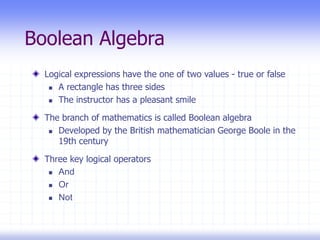
Boolean Algebra
Logical expressions have the one of two values - true or false
 A rectangle has three sides
 The instructor has a pleasant smile
The branch of mathematics is called Boolean algebra
 Developed by the British mathematician George Boole in the
19th century
Three key logical operators
 And
 Or
 Not
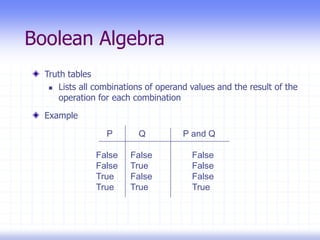
Boolean Algebra
Truth tables
 Lists all combinations of operand values and the result of the
operation for each combination
Example
P Q P and Q
False False False
False True False
True False False
True True True
Boolean Algebra
Or truth table
P Q P or Q
False False False
False True True
True False True
True True True
Boolean Algebra
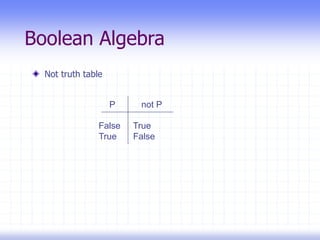
Not truth table
P not P
False True
True False
Boolean Algebra
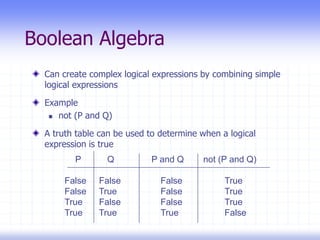
Can create complex logical expressions by combining simple
logical expressions
Example
 not (P and Q)
A truth table can be used to determine when a logical
expression is true
P Q P and Q not (P and Q)
False False False True
False True False True
True False False True
True True True False
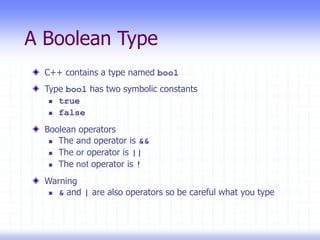
A Boolean Type
C++ contains a type named bool
Type bool has two symbolic constants
 true
 false
Boolean operators
 The and operator is &&
 The or operator is ||
 The not operator is !
Warning
 & and | are also operators so be careful what you type
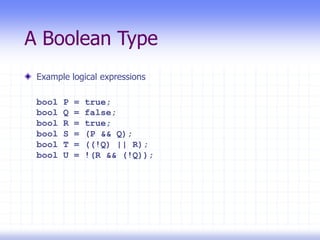
A Boolean Type
Example logical expressions
bool P = true;
bool Q = false;
bool R = true;
bool S = (P && Q);
bool T = ((!Q) || R);
bool U = !(R && (!Q));
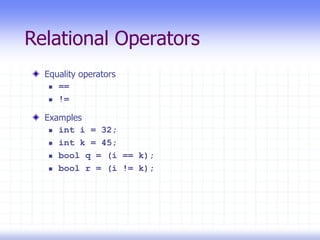
Relational Operators
Equality operators
 ==
 !=
Examples
 int i = 32;
 int k = 45;
 bool q = (i == k);
 bool r = (i != k);
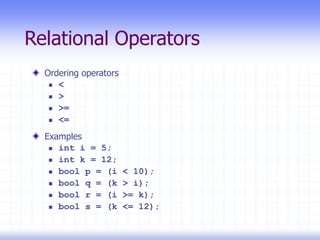
Relational Operators
Ordering operators
 <
 >
 >=
 <=
Examples
 int i = 5;
 int k = 12;
 bool p = (i < 10);
 bool q = (k > i);
 bool r = (i >= k);
 bool s = (k <= 12);
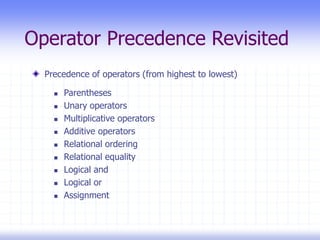
Operator Precedence Revisited
Precedence of operators (from highest to lowest)
 Parentheses
 Unary operators
 Multiplicative operators
 Additive operators
 Relational ordering
 Relational equality
 Logical and
 Logical or
 Assignment
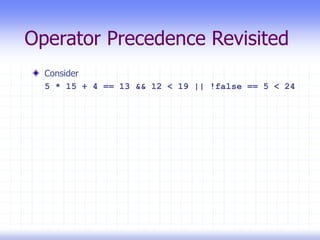
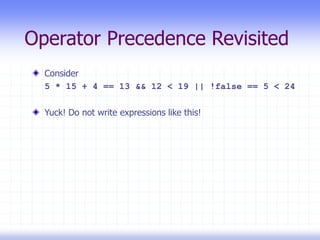
Operator Precedence Revisited
Consider
5 * 15 + 4 == 13 && 12 < 19 || !false == 5 < 24
Operator Precedence Revisited
Consider
5 * 15 + 4 == 13 && 12 < 19 || !false == 5 < 24
Yuck! Do not write expressions like this!
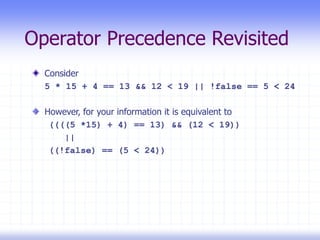
Operator Precedence Revisited
Consider
5 * 15 + 4 == 13 && 12 < 19 || !false == 5 < 24
However, for your information it is equivalent to
((((5 *15) + 4) == 13) && (12 < 19))
||
((!false) == (5 < 24))
Consider
5 * 15 + 4 == 13 && 12 < 19 || !false == 5 < 24
However, for your information it is equivalent to
((((5 *15) + 4) == 13) && (12 < 19))
||
((!false) == (5 < 24))
Consider
5 * 15 + 4 == 13 && 12 < 19 || !false == 5 < 24
However, for your information it is equivalent to
((((5 *15) + 4) == 13) && (12 < 19))
||
((!false) == (5 < 24))
Consider
5 * 15 + 4 == 13 && 12 < 19 || !false == 5 < 24
However, for your information it is equivalent to
((((5 *15) + 4) == 13) && (12 < 19))
||
((!false) == (5 < 24))
Consider
5 * 15 + 4 == 13 && 12 < 19 || !false == 5 < 24
However, for your information it is equivalent to
((((5 *15) + 4) == 13) && (12 < 19))
||
((!false) == (5 < 24))
Consider
5 * 15 + 4 == 13 && 12 < 19 || !false == 5 < 24
However, for your information it is equivalent to
((((5 *15) + 4) == 13) && (12 < 19))
||
((!false) == (5 < 24))
Consider
5 * 15 + 4 == 13 && 12 < 19 || !false == 5 < 24
However, for your information it is equivalent to
((((5 *15) + 4) == 13) && (12 < 19))
||
((!false) == (5 < 24))
Consider
5 * 15 + 4 == 13 && 12 < 19 || !false == 5 < 24
However, for your information it is equivalent to
((((5 *15) + 4) == 13) && (12 < 19))
||
((!false) == (5 < 24))
Consider
5 * 15 + 4 == 13 && 12 < 19 || !false == 5 < 24
However, for your information it is equivalent to
((((5 *15) + 4) == 13) && (12 < 19))
||
((!false) == (5 < 24))
Consider
5 * 15 + 4 == 13 && 12 < 19 || !false == 5 < 24
 However, for your information it is equivalent to
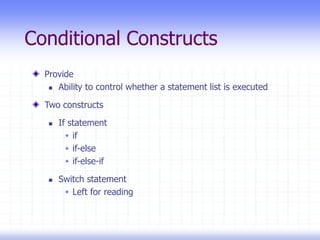
Conditional Constructs
Provide
 Ability to control whether a statement list is executed
Two constructs
 If statement
 if
 if-else
 if-else-if
 Switch statement
 Left for reading
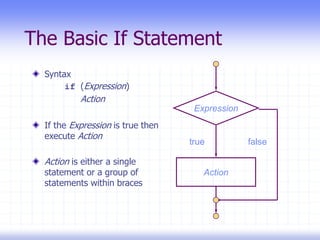
The Basic If Statement
Syntax
if (Expression)
Action
If the Expression is true then
execute Action
Action is either a single
statement or a group of
statements within braces
Expression
Action
true false
Example
if (Value < 0) {
Value = -Value;
}
Value < 0
Value = -Value
true false
Is our number negative?
If Value is not less
than zero then our
number is fine as is
If Value is less than
zero then we need to
update its value to
that of its additive
inverse
Our number is
now definitely
nonnegative
Sorting Two Numbers
cout << "Enter two integers: ";
int Value1;
int Value2;
cin >> Value1 >> Value2;
if (Value1 > Value2) {
int RememberValue1 = Value1;
Value1 = Value2;
Value2 = RememberValue1;
}
cout << "The input in sorted order: "
<< Value1 << " " << Value2 << endl;
Semantics
value2 < value1
int rememberValue1 = value1
value1 = value2
value2 = rememberValue1
true false
Are the numbers
out of order
Rearrange value1
and value2 to
put their values
in the proper
order
The numbers were
initially in order
The numbers were
rearranged into the
proper order
The numbers are in
order
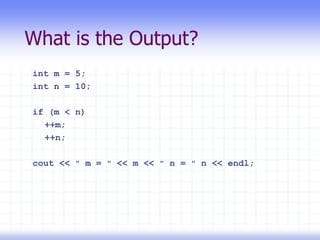
What is the Output?
int m = 5;
int n = 10;
if (m < n)
++m;
++n;
cout << " m = " << m << " n = " n << endl;
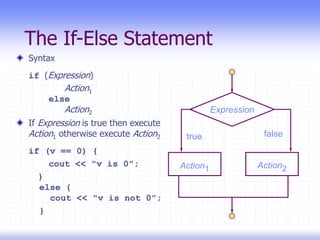
The If-Else Statement
Syntax
if (Expression)
Action1
else
Action2
If Expression is true then execute
Action1 otherwise execute Action2
if (v == 0) {
cout << "v is 0";
}
else {
cout << "v is not 0";
}
Expression
Action1 Action2
true false
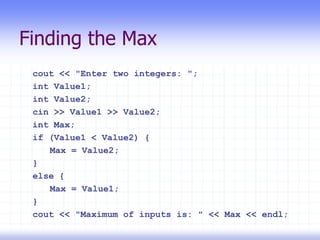
Finding the Max
cout << "Enter two integers: ";
int Value1;
int Value2;
cin >> Value1 >> Value2;
int Max;
if (Value1 < Value2) {
Max = Value2;
}
else {
Max = Value1;
}
cout << "Maximum of inputs is: " << Max << endl;
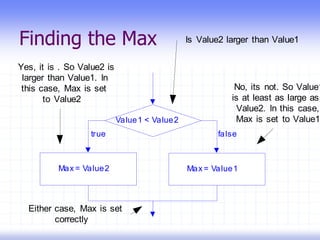
Finding the Max
Value1 < Value2
Max = Value2 Max = Value1
true false
Is Value2 larger than Value1
Yes, it is . So Value2 is
larger than Value1. In
this case, Max is set
to Value2
No, its not. So Value1
is at least as large as
Value2. In this case,
Max is set to Value1
Either case, Max is set
correctly
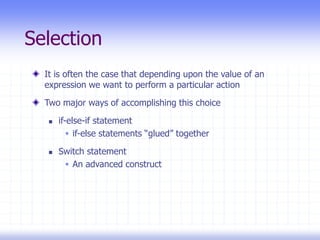
Selection
It is often the case that depending upon the value of an
expression we want to perform a particular action
Two major ways of accomplishing this choice
 if-else-if statement
 if-else statements “glued” together
 Switch statement
 An advanced construct
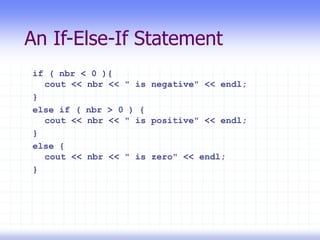
An If-Else-If Statement
if ( nbr < 0 ){
cout << nbr << " is negative" << endl;
}
else if ( nbr > 0 ) {
cout << nbr << " is positive" << endl;
}
else {
cout << nbr << " is zero" << endl;
}
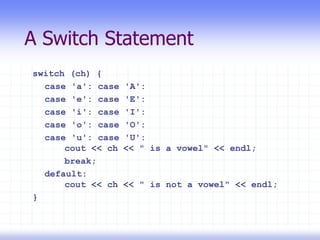
A Switch Statement
switch (ch) {
case 'a': case 'A':
case 'e': case 'E':
case 'i': case 'I':
case 'o': case 'O':
case 'u': case 'U':
cout << ch << " is a vowel" << endl;
break;
default:
cout << ch << " is not a vowel" << endl;
}
cout << "Enter simple expression: ";
int Left;
int Right;
char Operator;
cin >> Left >> Operator >> Right;
cout << Left << " " << Operator << " " << Right
<< " = ";
switch (Operator) {
case '+' : cout << Left + Right << endl; break;
case '-' : cout << Left - Right << endl; break;
case '*' : cout << Left * Right << endl; break;
case '/' : cout << Left / Right << endl; break;
default: cout << "Illegal operation" << endl;
}
chap04-conditional.ppt

chap04-conditional.ppt

  • 1.
    1 If Control Construct Amechanism for deciding whether an action should be taken JPC and JWD © 2002 McGraw-Hill, Inc.
  • 2.
    Boolean Algebra Logical expressionshave the one of two values - true or false  A rectangle has three sides  The instructor has a pleasant smile The branch of mathematics is called Boolean algebra  Developed by the British mathematician George Boole in the 19th century Three key logical operators  And  Or  Not
  • 3.
    Boolean Algebra Truth tables Lists all combinations of operand values and the result of the operation for each combination Example P Q P and Q False False False False True False True False False True True True
  • 4.
    Boolean Algebra Or truthtable P Q P or Q False False False False True True True False True True True True
  • 5.
    Boolean Algebra Not truthtable P not P False True True False
  • 6.
    Boolean Algebra Can createcomplex logical expressions by combining simple logical expressions Example  not (P and Q) A truth table can be used to determine when a logical expression is true P Q P and Q not (P and Q) False False False True False True False True True False False True True True True False
  • 7.
    A Boolean Type C++contains a type named bool Type bool has two symbolic constants  true  false Boolean operators  The and operator is &&  The or operator is ||  The not operator is ! Warning  & and | are also operators so be careful what you type
  • 8.
    A Boolean Type Examplelogical expressions bool P = true; bool Q = false; bool R = true; bool S = (P && Q); bool T = ((!Q) || R); bool U = !(R && (!Q));
  • 9.
    Relational Operators Equality operators ==  != Examples  int i = 32;  int k = 45;  bool q = (i == k);  bool r = (i != k);
  • 10.
    Relational Operators Ordering operators <  >  >=  <= Examples  int i = 5;  int k = 12;  bool p = (i < 10);  bool q = (k > i);  bool r = (i >= k);  bool s = (k <= 12);
  • 11.
    Operator Precedence Revisited Precedenceof operators (from highest to lowest)  Parentheses  Unary operators  Multiplicative operators  Additive operators  Relational ordering  Relational equality  Logical and  Logical or  Assignment
  • 12.
    Operator Precedence Revisited Consider 5* 15 + 4 == 13 && 12 < 19 || !false == 5 < 24
  • 13.
    Operator Precedence Revisited Consider 5* 15 + 4 == 13 && 12 < 19 || !false == 5 < 24 Yuck! Do not write expressions like this!
  • 14.
    Operator Precedence Revisited Consider 5* 15 + 4 == 13 && 12 < 19 || !false == 5 < 24 However, for your information it is equivalent to ((((5 *15) + 4) == 13) && (12 < 19)) || ((!false) == (5 < 24)) Consider 5 * 15 + 4 == 13 && 12 < 19 || !false == 5 < 24 However, for your information it is equivalent to ((((5 *15) + 4) == 13) && (12 < 19)) || ((!false) == (5 < 24)) Consider 5 * 15 + 4 == 13 && 12 < 19 || !false == 5 < 24 However, for your information it is equivalent to ((((5 *15) + 4) == 13) && (12 < 19)) || ((!false) == (5 < 24)) Consider 5 * 15 + 4 == 13 && 12 < 19 || !false == 5 < 24 However, for your information it is equivalent to ((((5 *15) + 4) == 13) && (12 < 19)) || ((!false) == (5 < 24)) Consider 5 * 15 + 4 == 13 && 12 < 19 || !false == 5 < 24 However, for your information it is equivalent to ((((5 *15) + 4) == 13) && (12 < 19)) || ((!false) == (5 < 24)) Consider 5 * 15 + 4 == 13 && 12 < 19 || !false == 5 < 24 However, for your information it is equivalent to ((((5 *15) + 4) == 13) && (12 < 19)) || ((!false) == (5 < 24)) Consider 5 * 15 + 4 == 13 && 12 < 19 || !false == 5 < 24 However, for your information it is equivalent to ((((5 *15) + 4) == 13) && (12 < 19)) || ((!false) == (5 < 24)) Consider 5 * 15 + 4 == 13 && 12 < 19 || !false == 5 < 24 However, for your information it is equivalent to ((((5 *15) + 4) == 13) && (12 < 19)) || ((!false) == (5 < 24)) Consider 5 * 15 + 4 == 13 && 12 < 19 || !false == 5 < 24 However, for your information it is equivalent to ((((5 *15) + 4) == 13) && (12 < 19)) || ((!false) == (5 < 24)) Consider 5 * 15 + 4 == 13 && 12 < 19 || !false == 5 < 24  However, for your information it is equivalent to
  • 15.
    Conditional Constructs Provide  Abilityto control whether a statement list is executed Two constructs  If statement  if  if-else  if-else-if  Switch statement  Left for reading
  • 16.
    The Basic IfStatement Syntax if (Expression) Action If the Expression is true then execute Action Action is either a single statement or a group of statements within braces Expression Action true false
  • 17.
    Example if (Value <0) { Value = -Value; } Value < 0 Value = -Value true false Is our number negative? If Value is not less than zero then our number is fine as is If Value is less than zero then we need to update its value to that of its additive inverse Our number is now definitely nonnegative
  • 18.
    Sorting Two Numbers cout<< "Enter two integers: "; int Value1; int Value2; cin >> Value1 >> Value2; if (Value1 > Value2) { int RememberValue1 = Value1; Value1 = Value2; Value2 = RememberValue1; } cout << "The input in sorted order: " << Value1 << " " << Value2 << endl;
  • 19.
    Semantics value2 < value1 intrememberValue1 = value1 value1 = value2 value2 = rememberValue1 true false Are the numbers out of order Rearrange value1 and value2 to put their values in the proper order The numbers were initially in order The numbers were rearranged into the proper order The numbers are in order
  • 20.
    What is theOutput? int m = 5; int n = 10; if (m < n) ++m; ++n; cout << " m = " << m << " n = " n << endl;
  • 21.
    The If-Else Statement Syntax if(Expression) Action1 else Action2 If Expression is true then execute Action1 otherwise execute Action2 if (v == 0) { cout << "v is 0"; } else { cout << "v is not 0"; } Expression Action1 Action2 true false
  • 22.
    Finding the Max cout<< "Enter two integers: "; int Value1; int Value2; cin >> Value1 >> Value2; int Max; if (Value1 < Value2) { Max = Value2; } else { Max = Value1; } cout << "Maximum of inputs is: " << Max << endl;
  • 23.
    Finding the Max Value1< Value2 Max = Value2 Max = Value1 true false Is Value2 larger than Value1 Yes, it is . So Value2 is larger than Value1. In this case, Max is set to Value2 No, its not. So Value1 is at least as large as Value2. In this case, Max is set to Value1 Either case, Max is set correctly
  • 24.
    Selection It is oftenthe case that depending upon the value of an expression we want to perform a particular action Two major ways of accomplishing this choice  if-else-if statement  if-else statements “glued” together  Switch statement  An advanced construct
  • 25.
    An If-Else-If Statement if( nbr < 0 ){ cout << nbr << " is negative" << endl; } else if ( nbr > 0 ) { cout << nbr << " is positive" << endl; } else { cout << nbr << " is zero" << endl; }
  • 26.
    A Switch Statement switch(ch) { case 'a': case 'A': case 'e': case 'E': case 'i': case 'I': case 'o': case 'O': case 'u': case 'U': cout << ch << " is a vowel" << endl; break; default: cout << ch << " is not a vowel" << endl; }
  • 27.
    cout << "Entersimple expression: "; int Left; int Right; char Operator; cin >> Left >> Operator >> Right; cout << Left << " " << Operator << " " << Right << " = "; switch (Operator) { case '+' : cout << Left + Right << endl; break; case '-' : cout << Left - Right << endl; break; case '*' : cout << Left * Right << endl; break; case '/' : cout << Left / Right << endl; break; default: cout << "Illegal operation" << endl; }