TEST AND TREAT
Gardner Cascade in context
Intro to „Test and Treat‟
   Most people in HIV treatment (ART) reach
    undetectable VL
   People with undetectable viral load are significantly
    less likely to transmit virus
   Collectively, individuals with lower VL lead to
    communities with lower community VL = less
    transmissions
   Failures in the system of care pose barriers to full
    success of T&T:
       Late diagnosis
       Non-linkage or flawed linkage to care
       Insufficient use of ART
       Non-adherence to ART
Test and Treat Components
(HRSA)
   Testing and identification of PLWHA as soon as
    possible
   Linkage of people testing positive for HIV to HIV
    care
   Patient education to encourage self management
    and facilitate retention in care, adherence to
    treatment, and prevention of STIs
   Supportive services for promotion of sexual health
    maintenance
   Monitoring and evaluation of test and treat
    strategy
Intro to Gardner‟s Research
   Test and treat strategy supported by
    mathematical models and epidemiological
    data
   Areas with high coverage of ART have
    decreased incidence of HIV
   HOWEVER barriers to implementation of Test
    and Treat strategies have not been adequately
    evaluated.
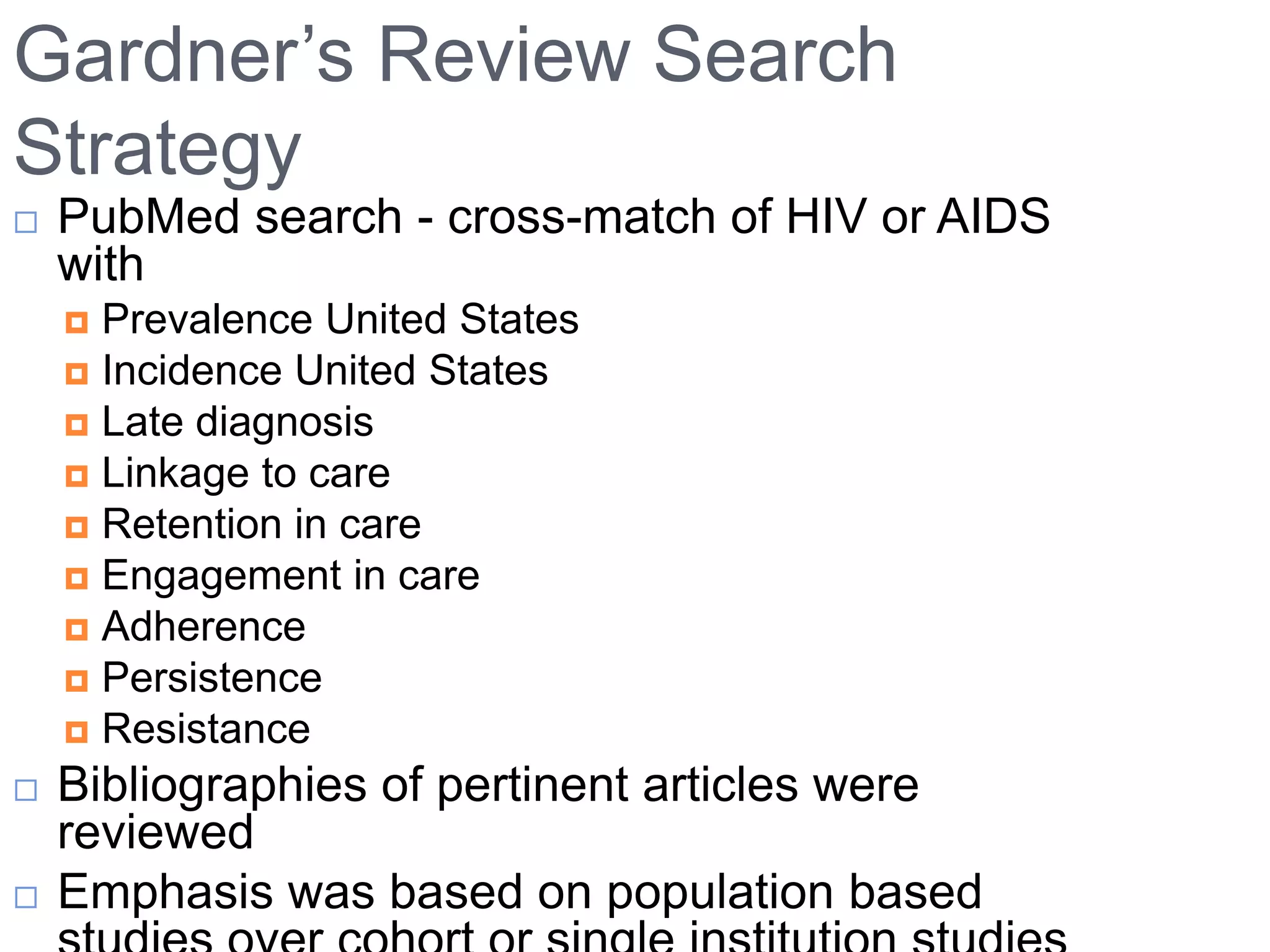
Objectives of Gardner‟s Review
   To describe and quantify the spectrum of
    engagement in HIV care
   To understand how gaps in the continuum of
    care affect virological outcomes in the US
   To understand how to address these gaps for
    Test and Treat to be successful strategy
   To explore effects of interventions to improve
    components of engagement in care
Gardner‟s Review Search
Strategy
   PubMed search - cross-match of HIV or AIDS
    with
     Prevalence United States
     Incidence United States
     Late diagnosis
     Linkage to care
     Retention in care
     Engagement in care
     Adherence
     Persistence
     Resistance
   Bibliographies of pertinent articles were
    reviewed
   Emphasis was based on population based
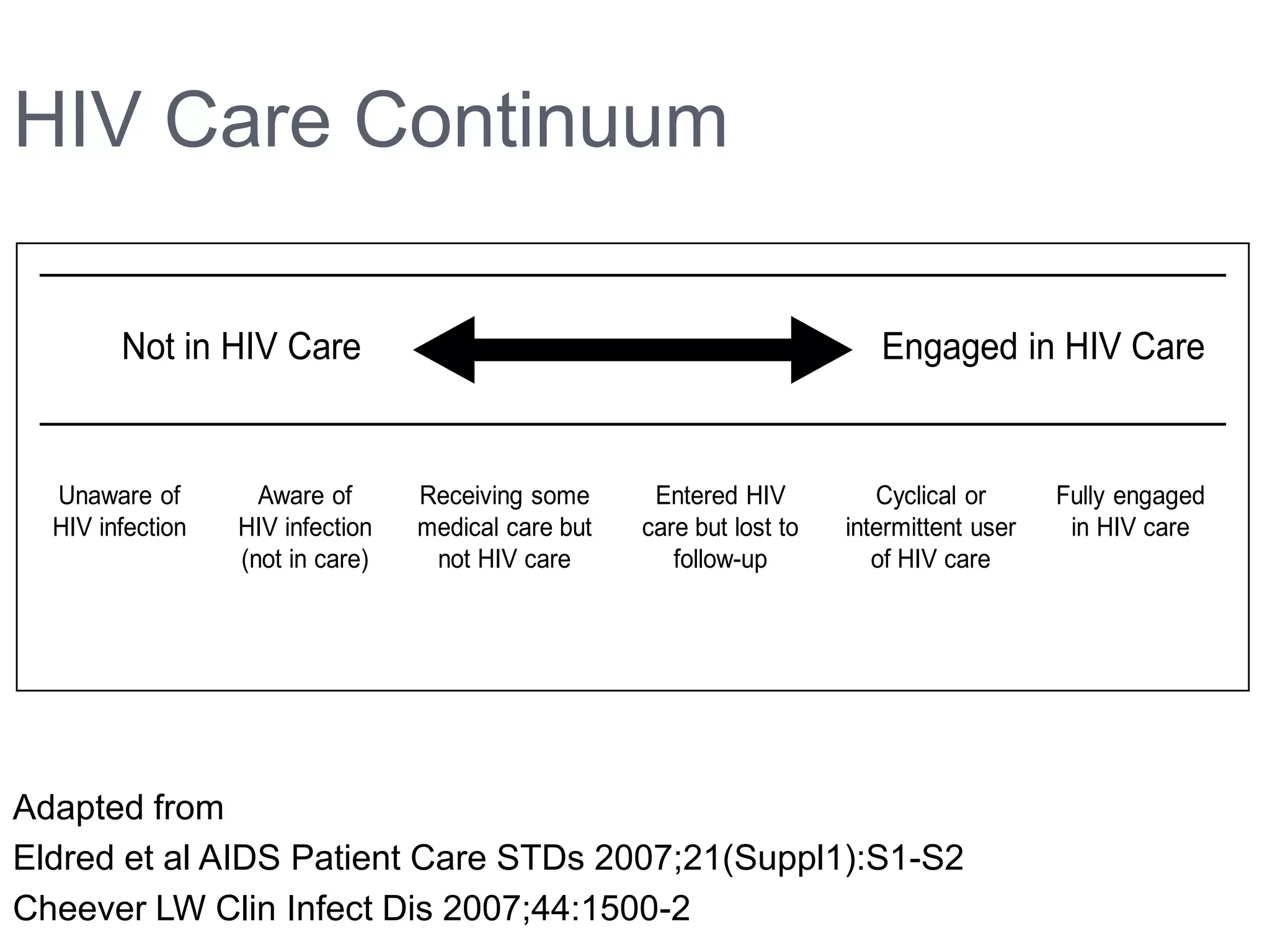
HIV Care Continuum

        Not in HIV Care                                                    Engaged in HIV Care


  Unaware of        Aware of      Receiving some      Entered HIV          Cyclical or      Fully engaged
  HIV infection   HIV infection   medical care but   care but lost to   intermittent user    in HIV care
                  (not in care)    not HIV care         follow-up          of HIV care


Adapted from
Eldred et al AIDS Patient Care STDs 2007;21(Suppl1):S1-S2
Cheever LW Clin Infect Dis 2007;44:1500-2
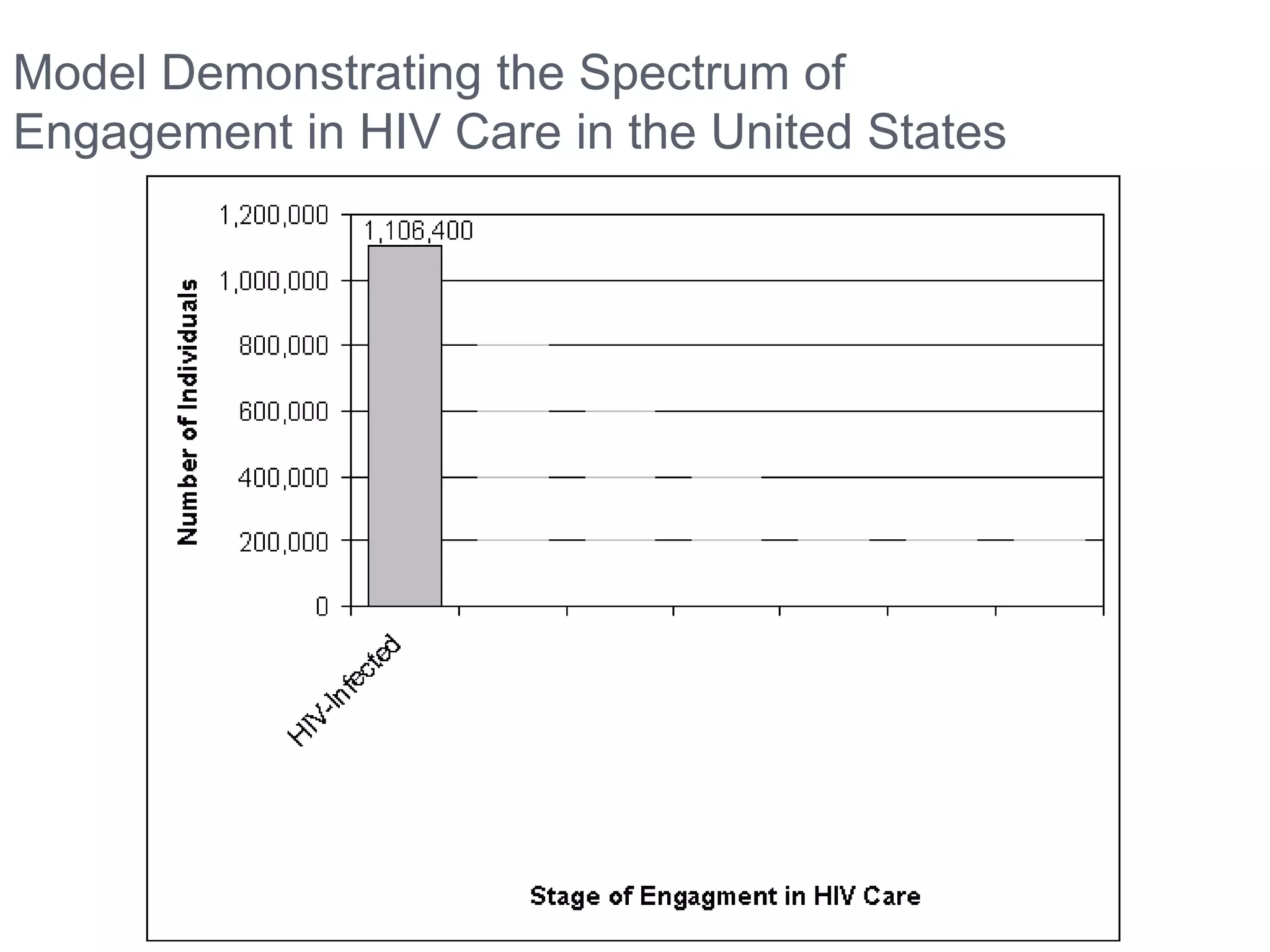
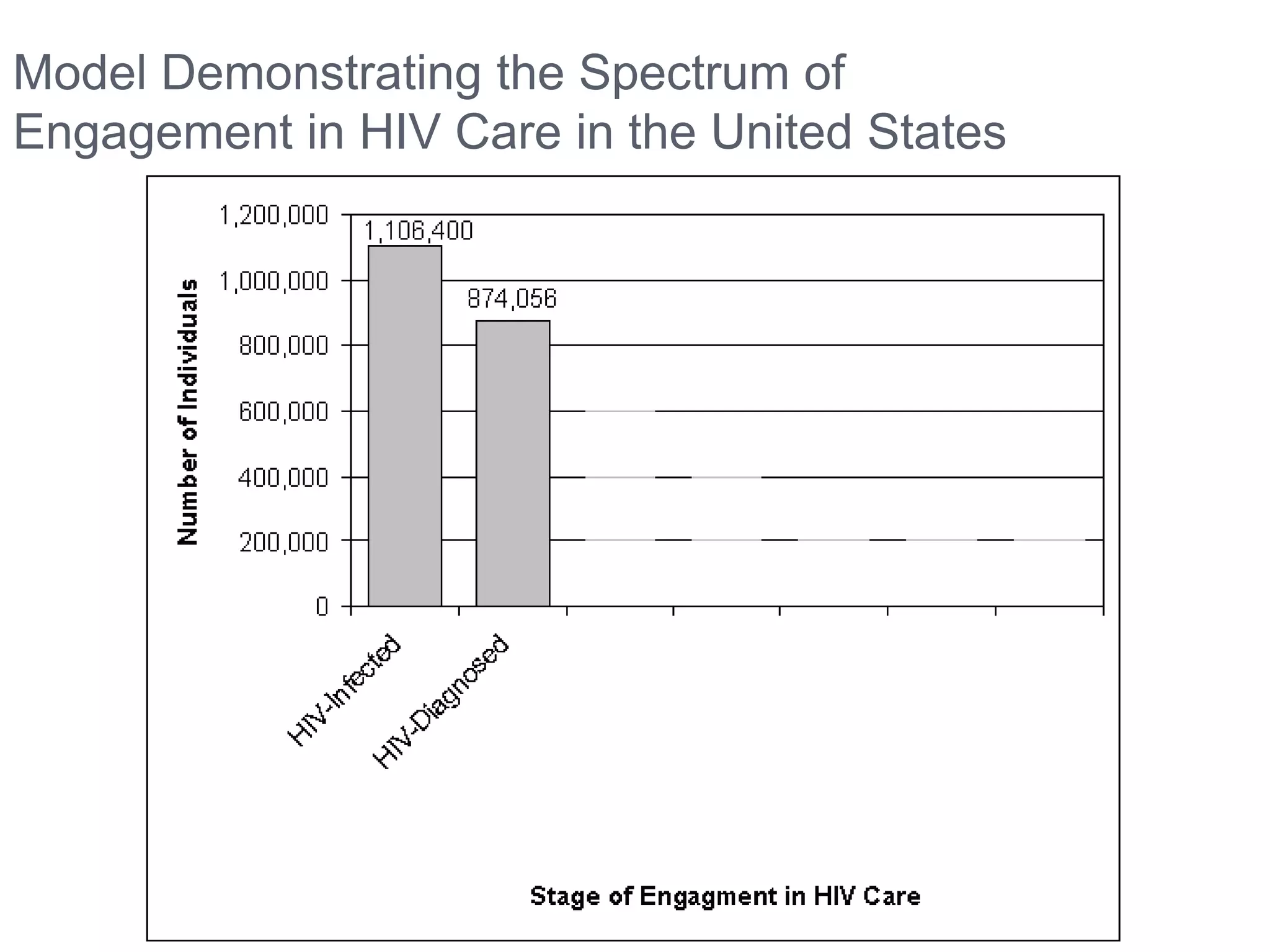
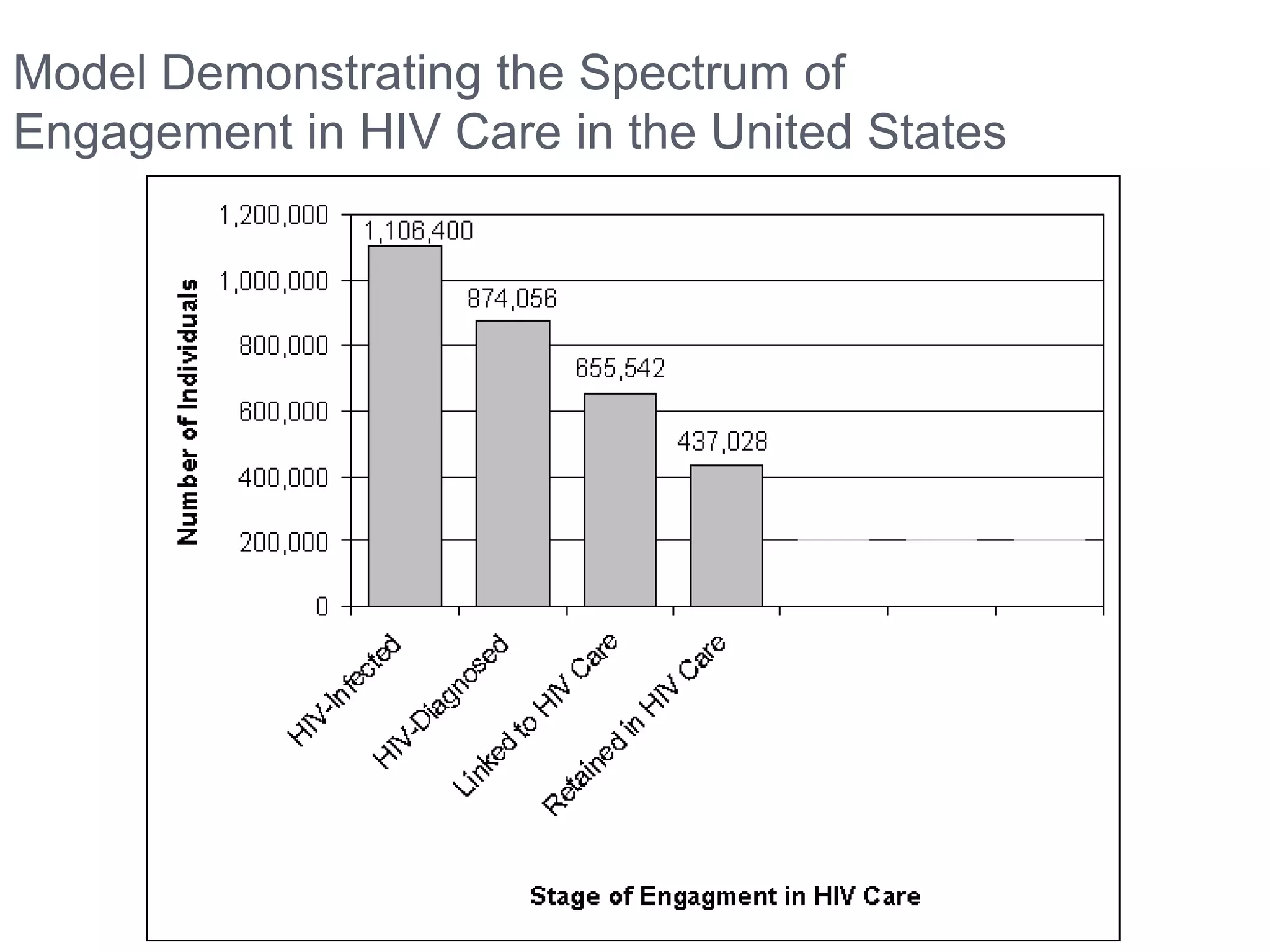
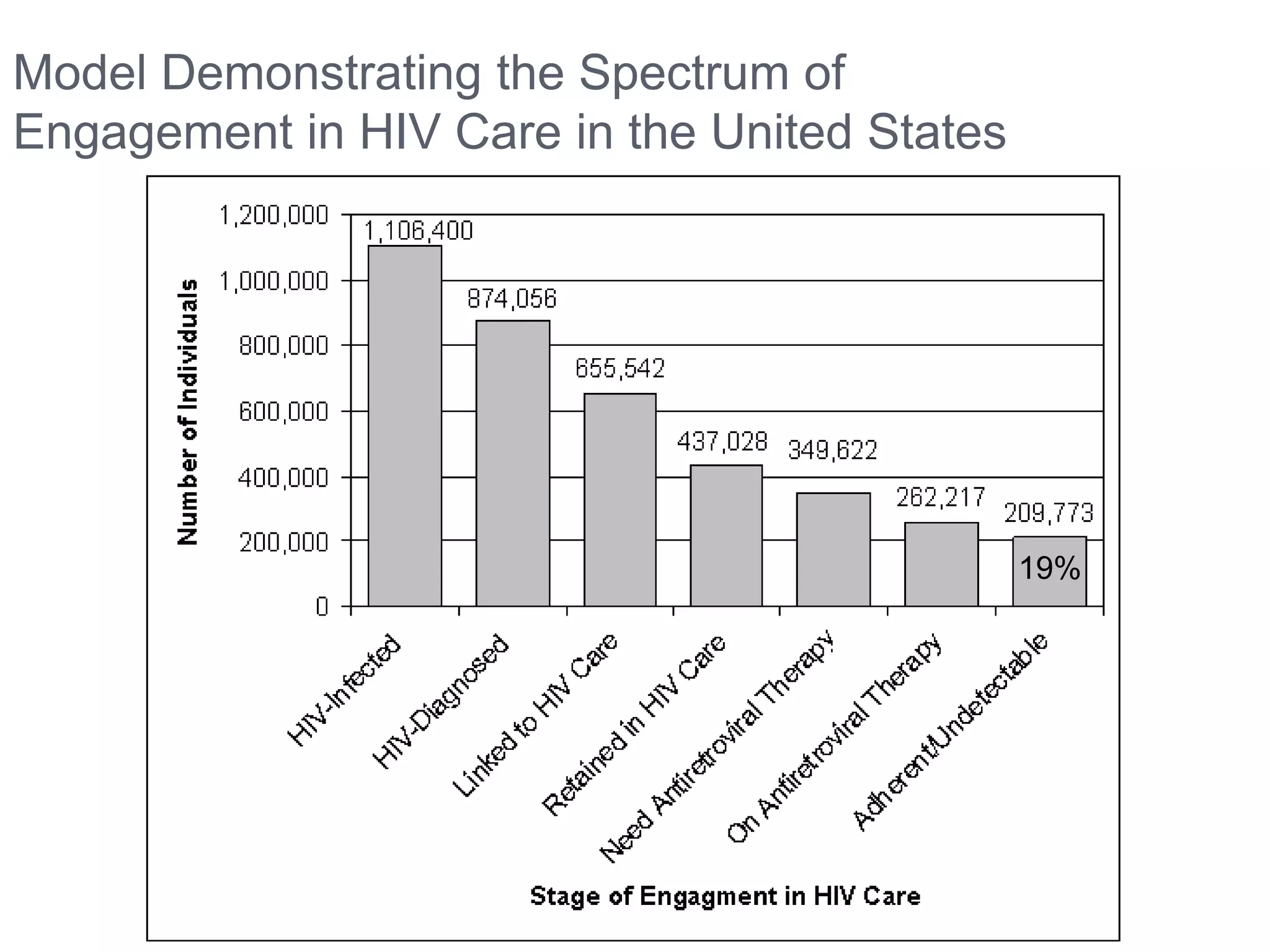
Model Demonstrating the Spectrum of
Engagement in HIV Care in the United States
Undiagnosed HIV Infection
   1.1 million in the US with HIV/AIDS
   21% of those not aware HIV+ (US)
   35%-45% of newly diagnosed individuals have
    AIDS within 1 year (US)
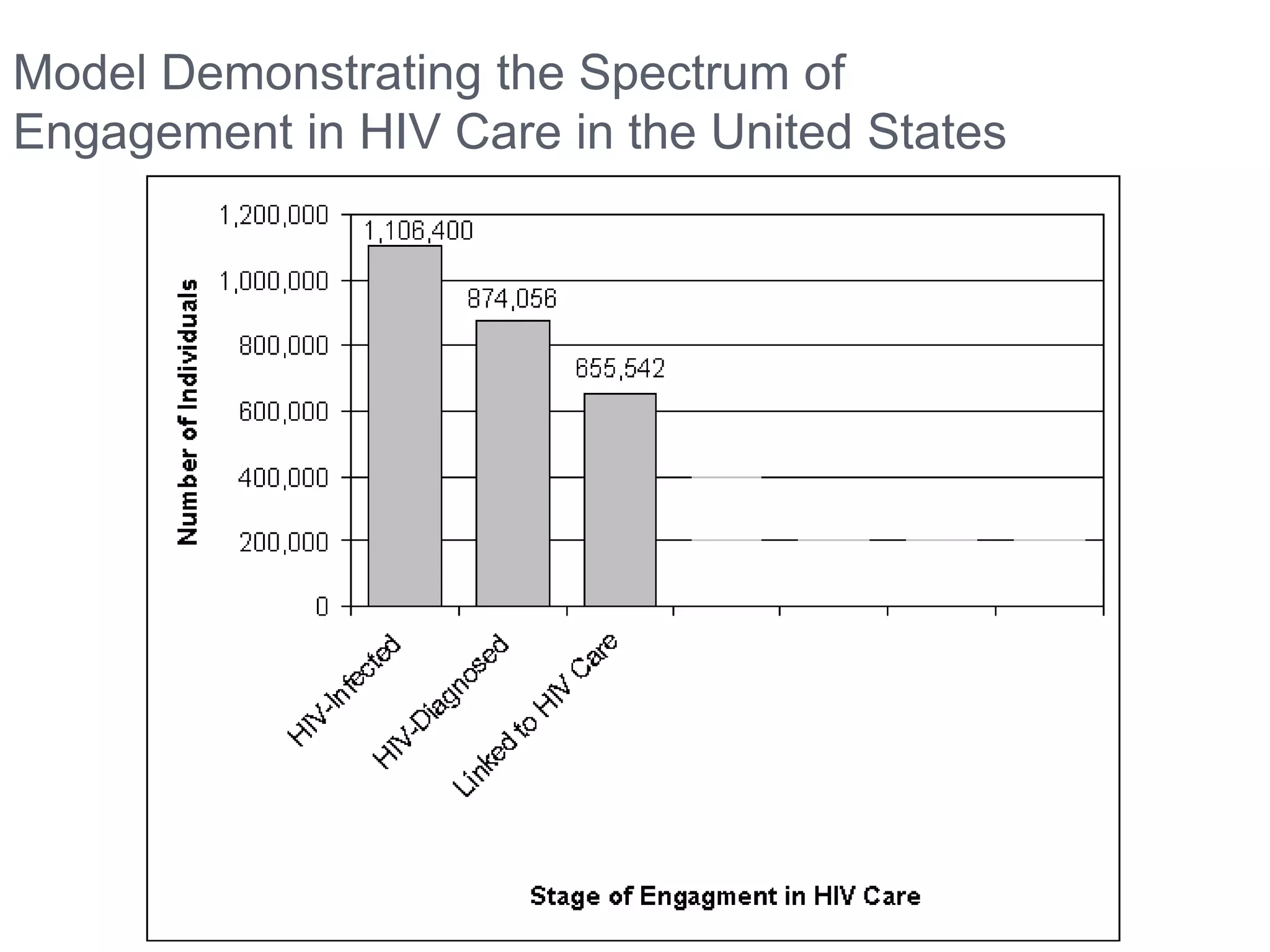
Model Demonstrating the Spectrum of
Engagement in HIV Care in the United States
Model Demonstrating the Spectrum of
Engagement in HIV Care in the United States
Linkage in Care
   Longer delays in linkage with medical care are
    associated with greater likelihood of
    progression to AIDS by CD4 criteria
   HIV+ people not linked to care pose a greater
    risk of transmission
   Gardner concludes that ~75% of newly
    diagnosed HIV+ people successfully like to
    HIV care within 6-12 months, 80-90% link
    within 3-5 years
Model Demonstrating the Spectrum of
Engagement in HIV Care in the United States
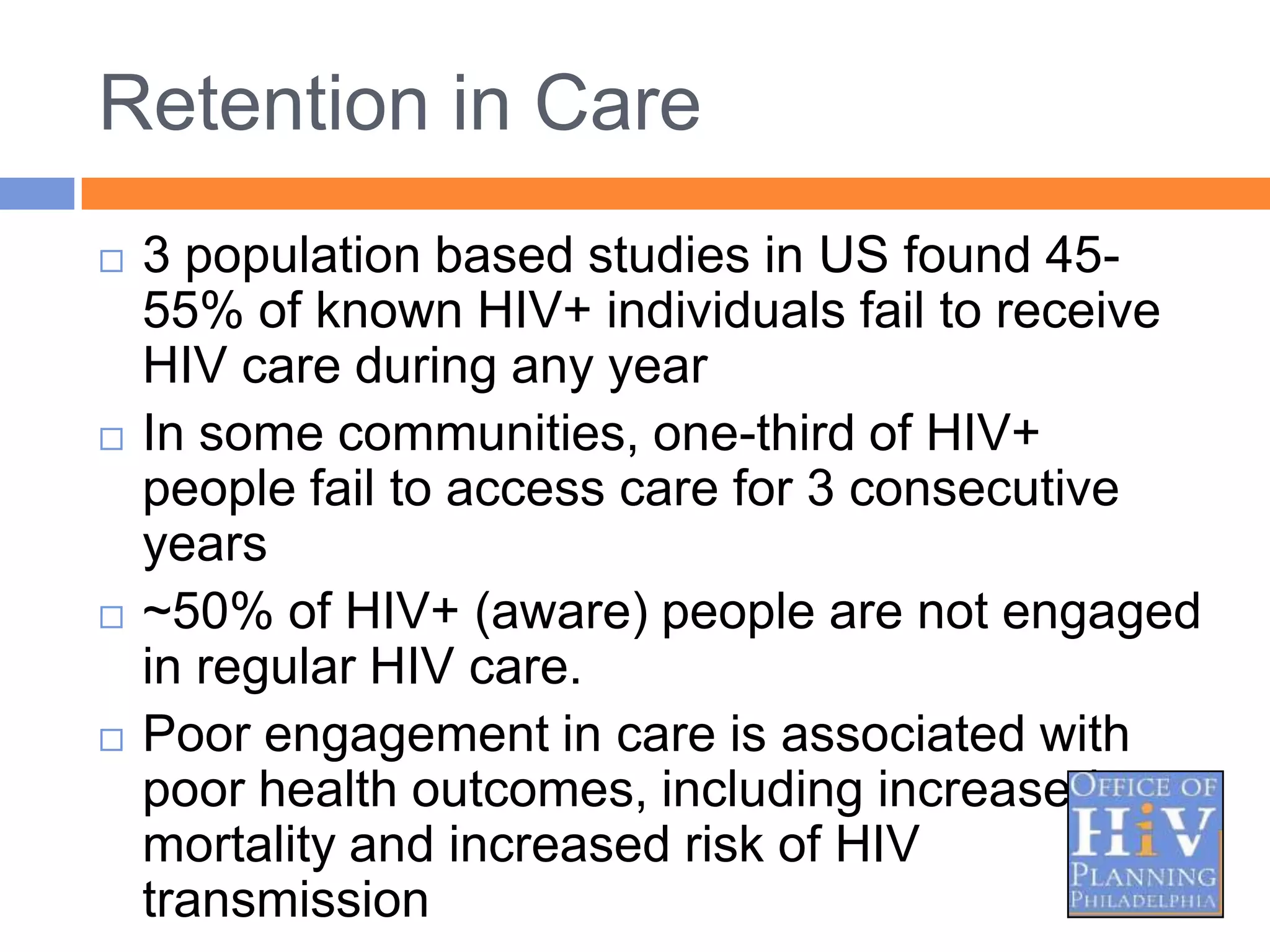
Retention in Care
   3 population based studies in US found 45-
    55% of known HIV+ individuals fail to receive
    HIV care during any year
   In some communities, one-third of HIV+
    people fail to access care for 3 consecutive
    years
   ~50% of HIV+ (aware) people are not engaged
    in regular HIV care.
   Poor engagement in care is associated with
    poor health outcomes, including increased
    mortality and increased risk of HIV
    transmission
Model Demonstrating the Spectrum of
Engagement in HIV Care in the United States
Model Demonstrating the Spectrum of
Engagement in HIV Care in the United States
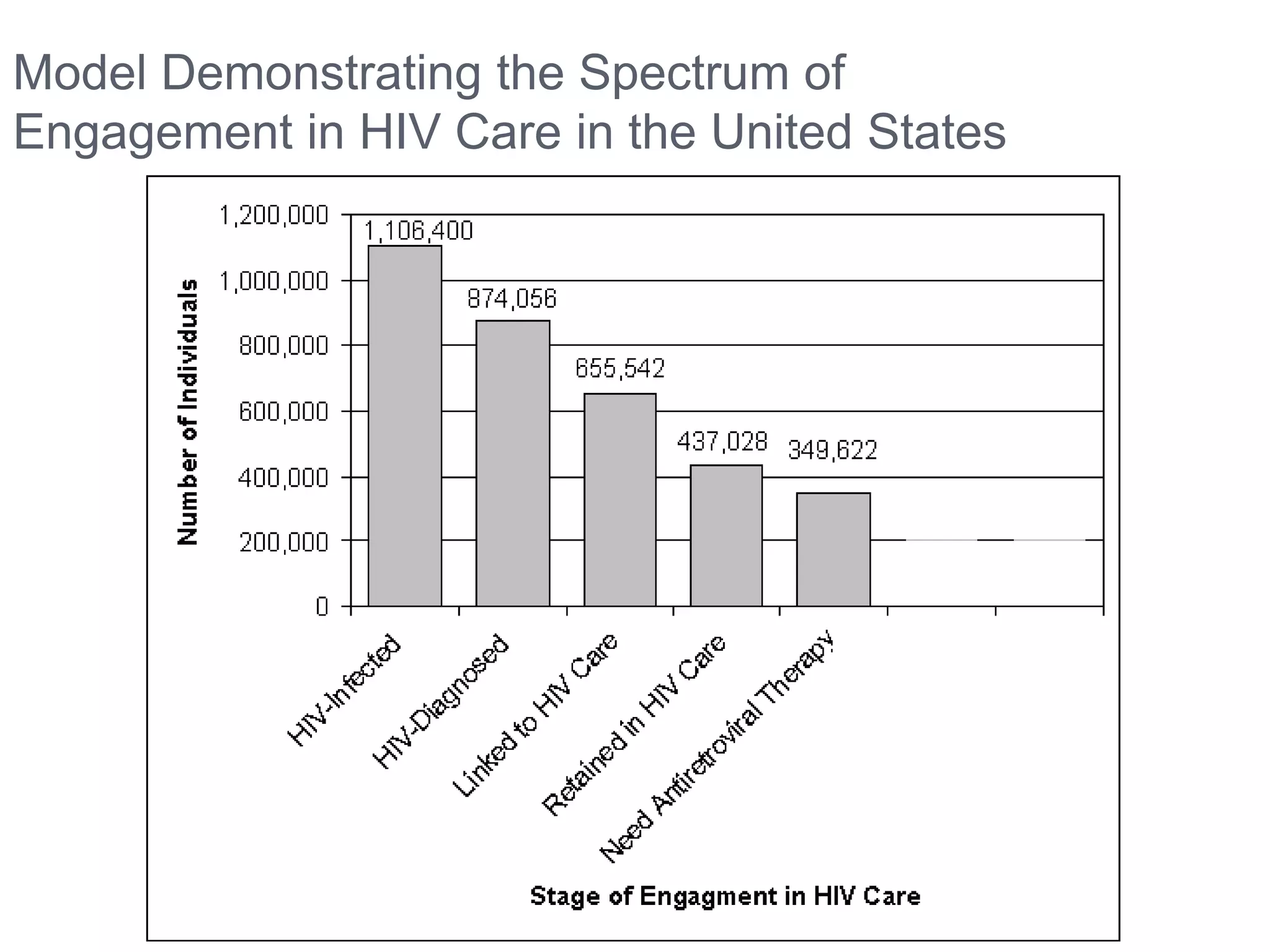
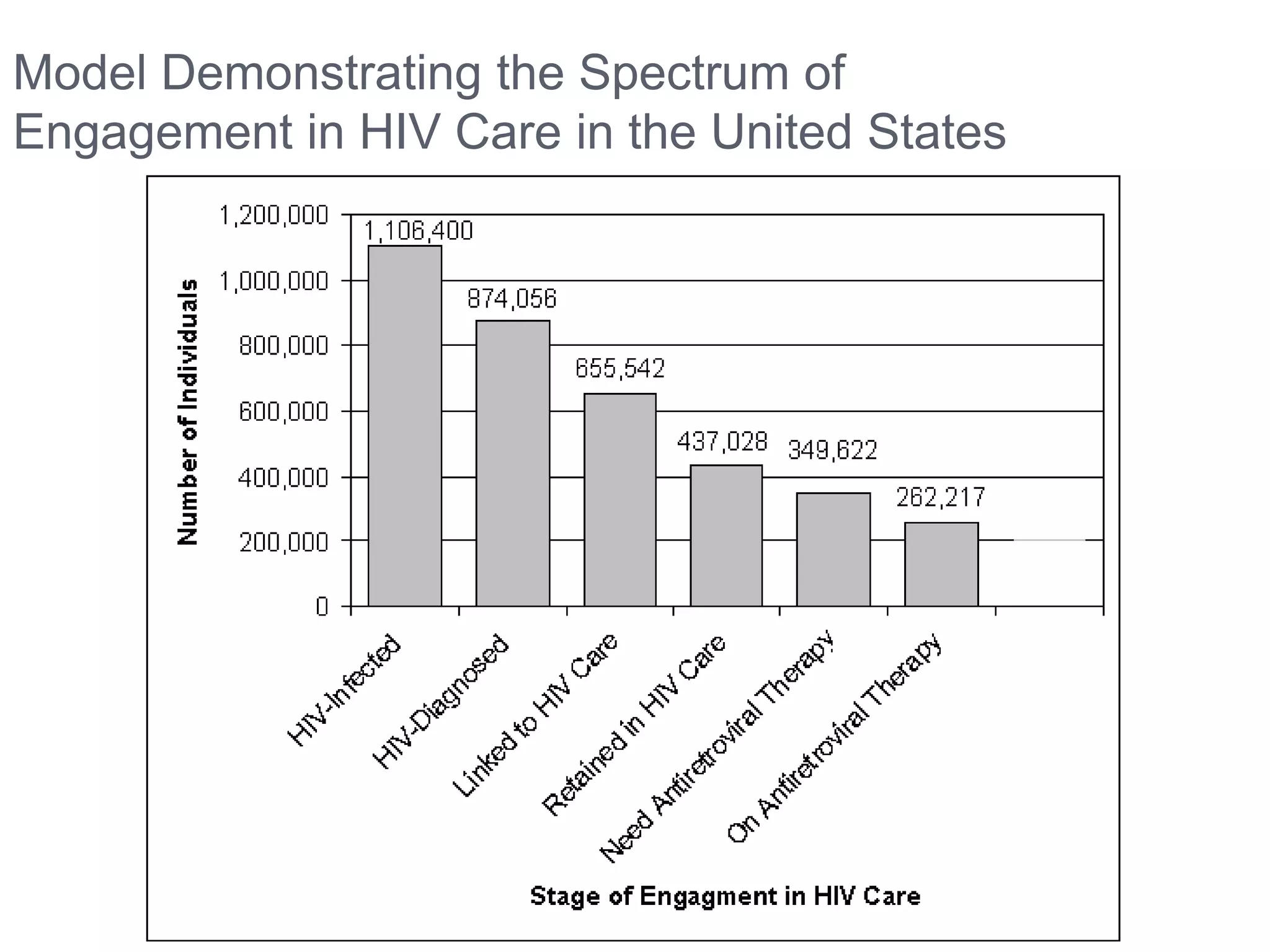
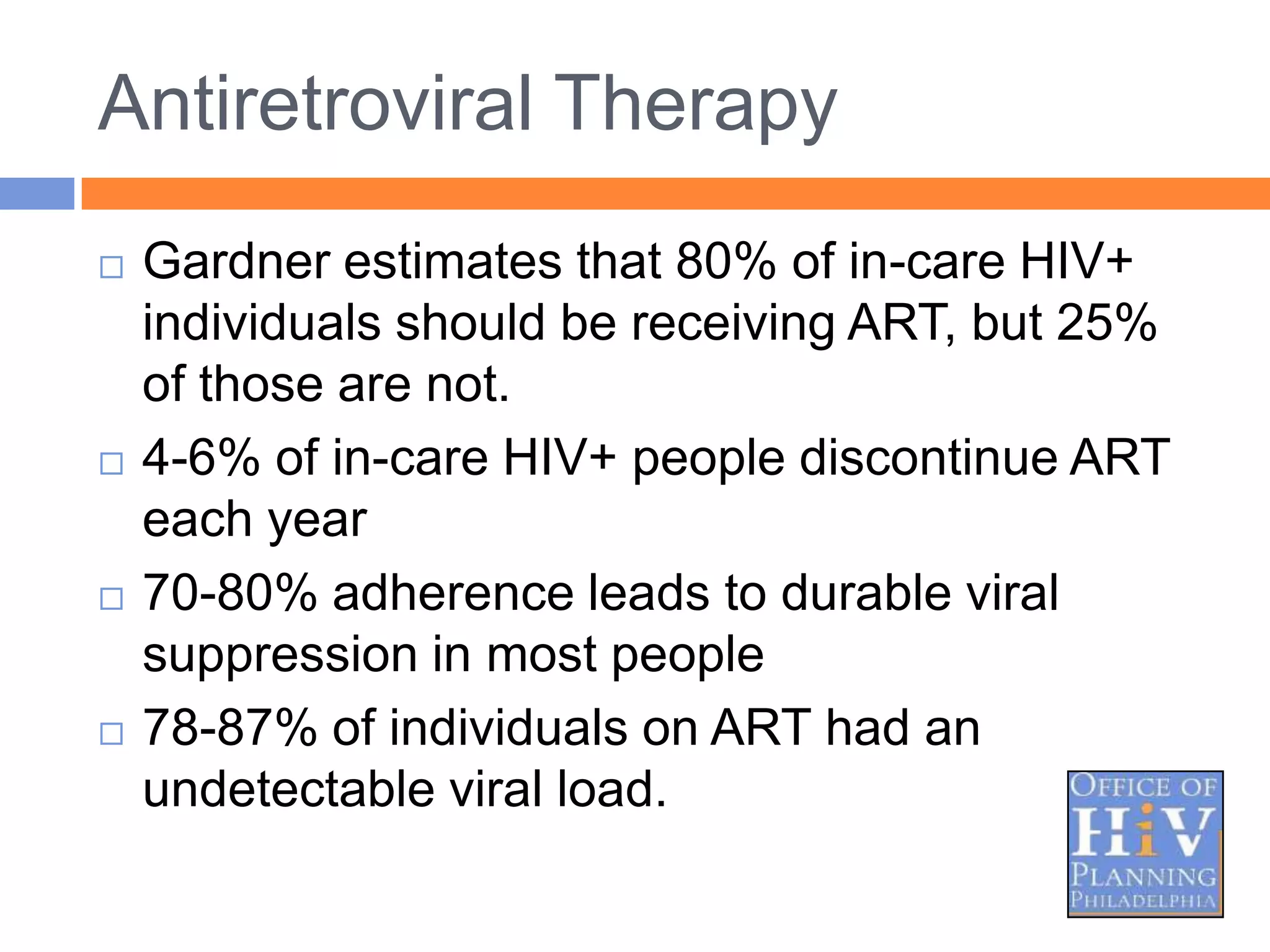
Antiretroviral Therapy
   Gardner estimates that 80% of in-care HIV+
    individuals should be receiving ART, but 25%
    of those are not.
   4-6% of in-care HIV+ people discontinue ART
    each year
   70-80% adherence leads to durable viral
    suppression in most people
   78-87% of individuals on ART had an
    undetectable viral load.
Model Demonstrating the Spectrum of
Engagement in HIV Care in the United States


                                              19%
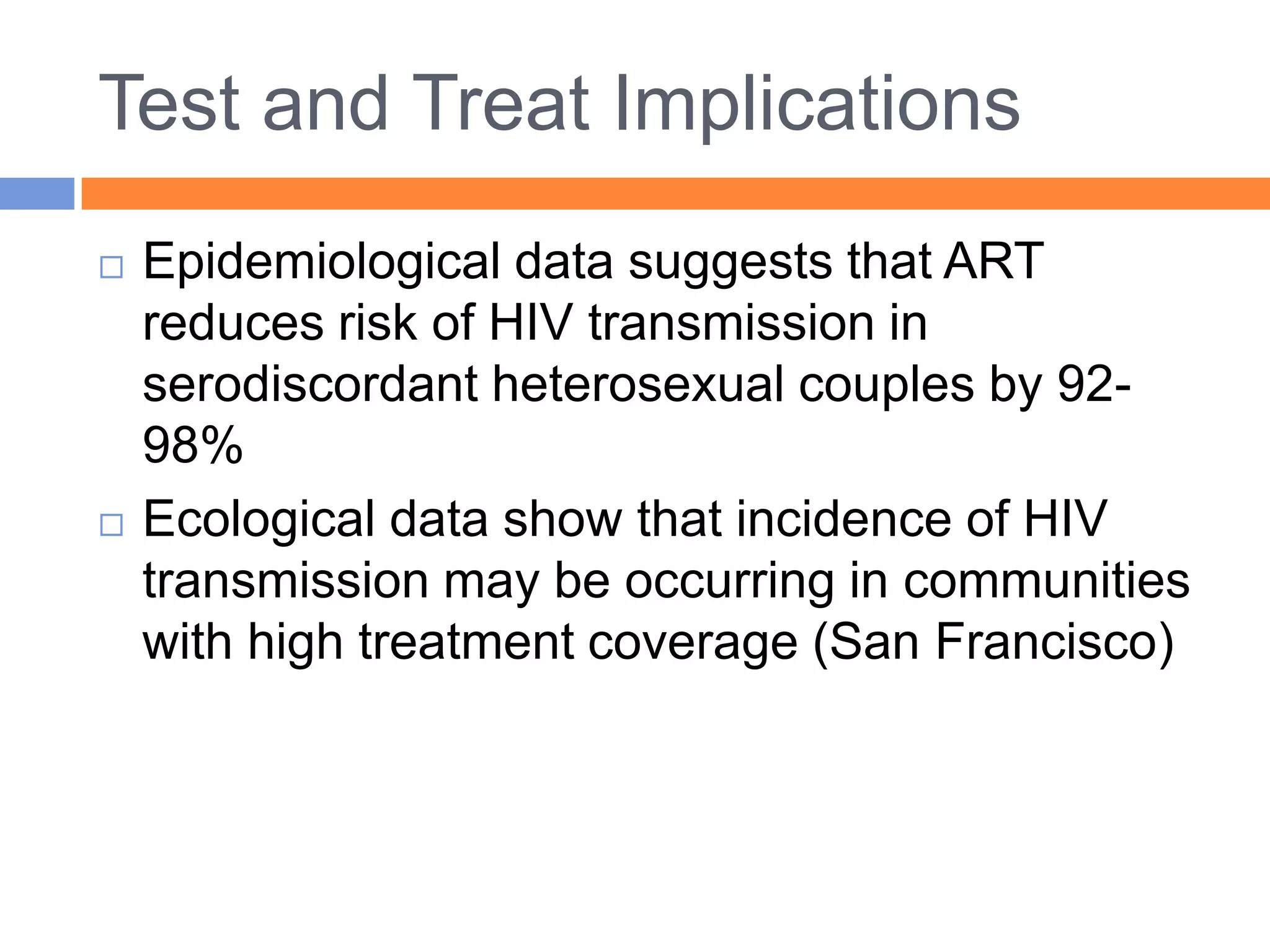
Test and Treat Implications
   Epidemiological data suggests that ART
    reduces risk of HIV transmission in
    serodiscordant heterosexual couples by 92-
    98%
   Ecological data show that incidence of HIV
    transmission may be occurring in communities
    with high treatment coverage (San Francisco)
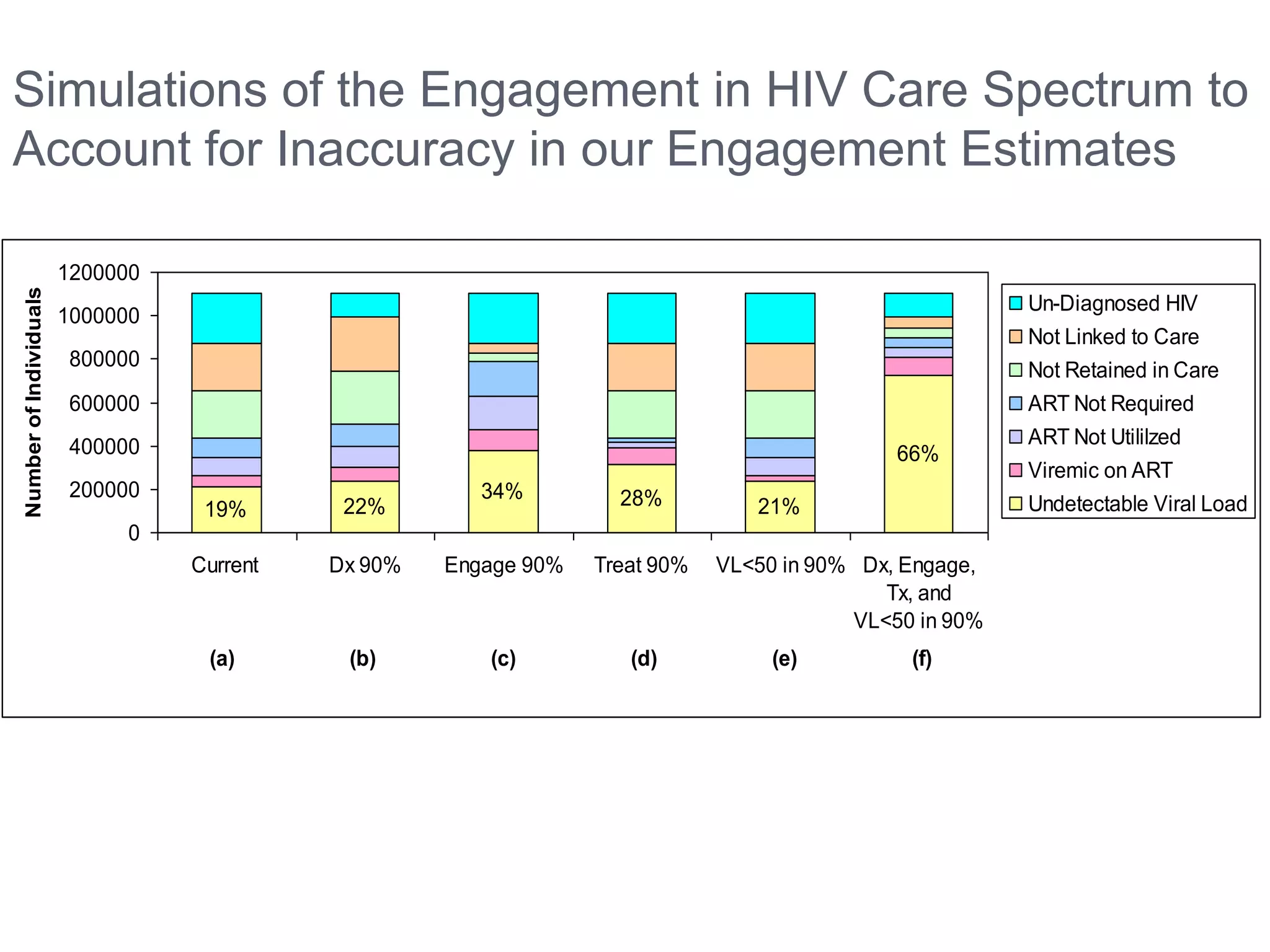
Simulations of the Engagement in HIV Care Spectrum to
Account for Inaccuracy in our Engagement Estimates

                        1200000
Number of Individuals


                                                                                                         Un-Diagnosed HIV
                        1000000
                                                                                                         Not Linked to Care
                         800000
                                                                                                         Not Retained in Care
                         600000                                                                          ART Not Required
                         400000                                                                          ART Not Utililzed
                                                                                              66%
                                                                                                         Viremic on ART
                         200000                         34%         28%
                                   19%       22%                                 21%                     Undetectable Viral Load
                              0
                                  Current   Dx 90%   Engage 90%   Treat 90%   VL<50 in 90% Dx, Engage,
                                                                                             Tx, and
                                                                                          VL<50 in 90%
                                   (a)       (b)        (c)          (d)           (e)         (f)
Newer Data for Discussion
   Marks et al. estimated that 29 – 34% of HIV-
    infected individuals in the U.S. have an
    undetectable viral load (Clin Infect Dis 2011;53:1168–9)
   Dombrowski et al. estimate that 42 – 45% in
    Seattle King County are undetectable (AIDS
    2011;epub ahead of print)

   In a cohort of newly diagnosed individuals in
    Denver, 28% are undetectable 12 – 18 months
    after diagnosis.
Limitations
   Unable to assess the impact of financial
    barriers to HIV care in the U.S.
   Overlap in the stages of engagement in HIV
    care
   Cross-sectional depiction of a longitudinal
    process
   The review applies to the U.S. and not to
    resource-poor settings
Conclusions
   Engagement in care is critical to the successful
    management of HIV infection
     For the individual
     For the population
   Deficiencies in the spectrum of engagement in
    care present formidable barriers to „test and
    treat‟ for HIV prevention:
     Failure to diagnose
     Failure to link to care
     Failure to be retained in care
     Failure to receive and adhere to antiretroviral therapy

   Research is needed on ways to improve
    transitions across all steps in the engagement
    in care cascade
Local Context of Cascade
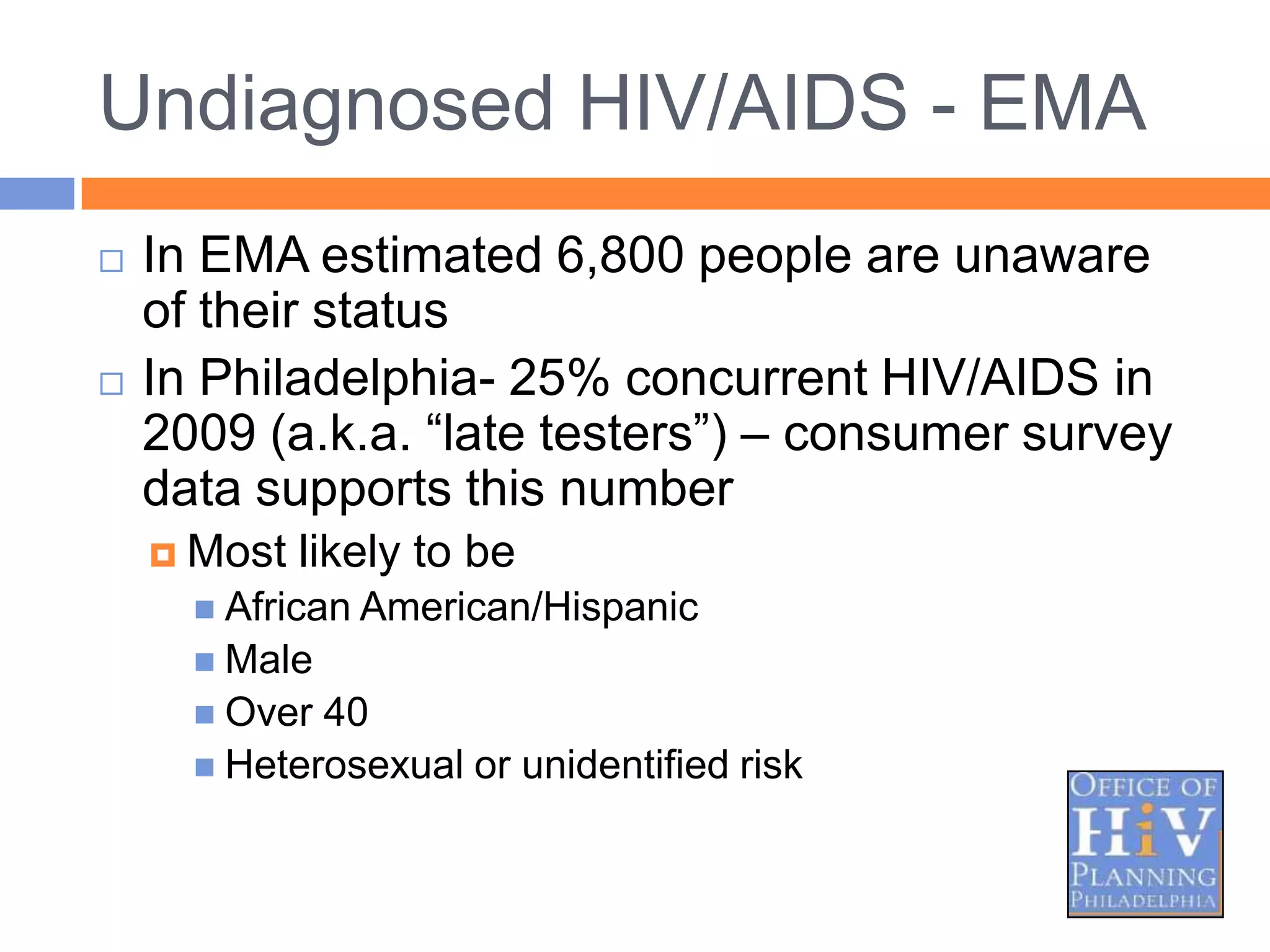
Undiagnosed HIV/AIDS - EMA
   In EMA estimated 6,800 people are unaware
    of their status
   In Philadelphia- 25% concurrent HIV/AIDS in
    2009 (a.k.a. “late testers”) – consumer survey
    data supports this number
     Most   likely to be
       African American/Hispanic
       Male
       Over 40
       Heterosexual or unidentified risk
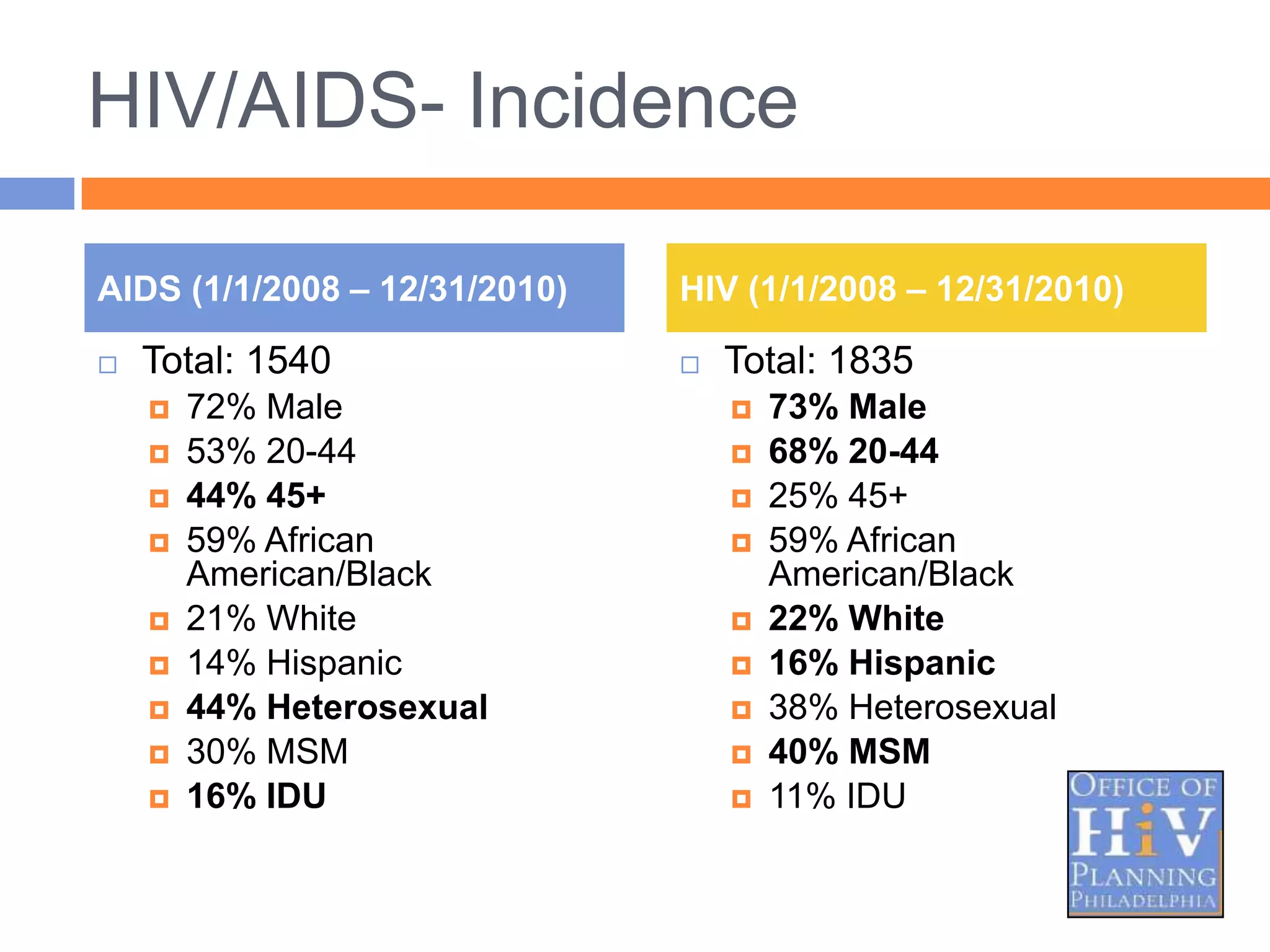
HIV/AIDS- Incidence

AIDS (1/1/2008 – 12/31/2010)   HIV (1/1/2008 – 12/31/2010)

   Total: 1540                   Total: 1835
       72% Male                      73% Male
       53% 20-44                     68% 20-44
       44% 45+                       25% 45+
       59% African                   59% African
        American/Black                 American/Black
       21% White                     22% White
       14% Hispanic                  16% Hispanic
       44% Heterosexual              38% Heterosexual
       30% MSM                       40% MSM
       16% IDU                       11% IDU
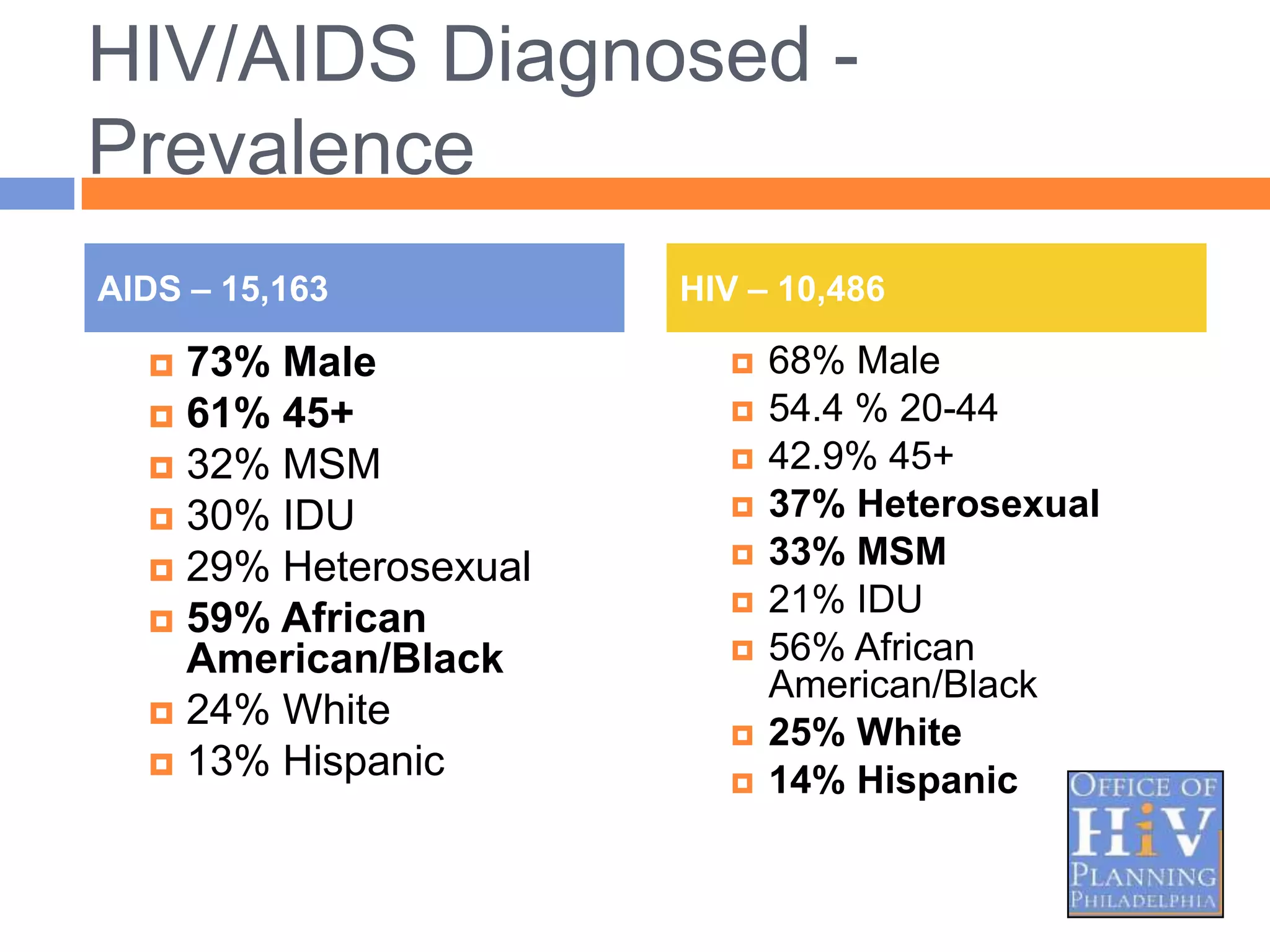
HIV/AIDS Diagnosed -
Prevalence
AIDS – 15,163          HIV – 10,486

   73% Male                68% Male
   61% 45+                 54.4 % 20-44
   32% MSM                 42.9% 45+
   30% IDU                 37% Heterosexual
   29% Heterosexual
                            33% MSM
                            21% IDU
   59% African
    American/Black          56% African
                             American/Black
   24% White
                            25% White
   13% Hispanic
                            14% Hispanic
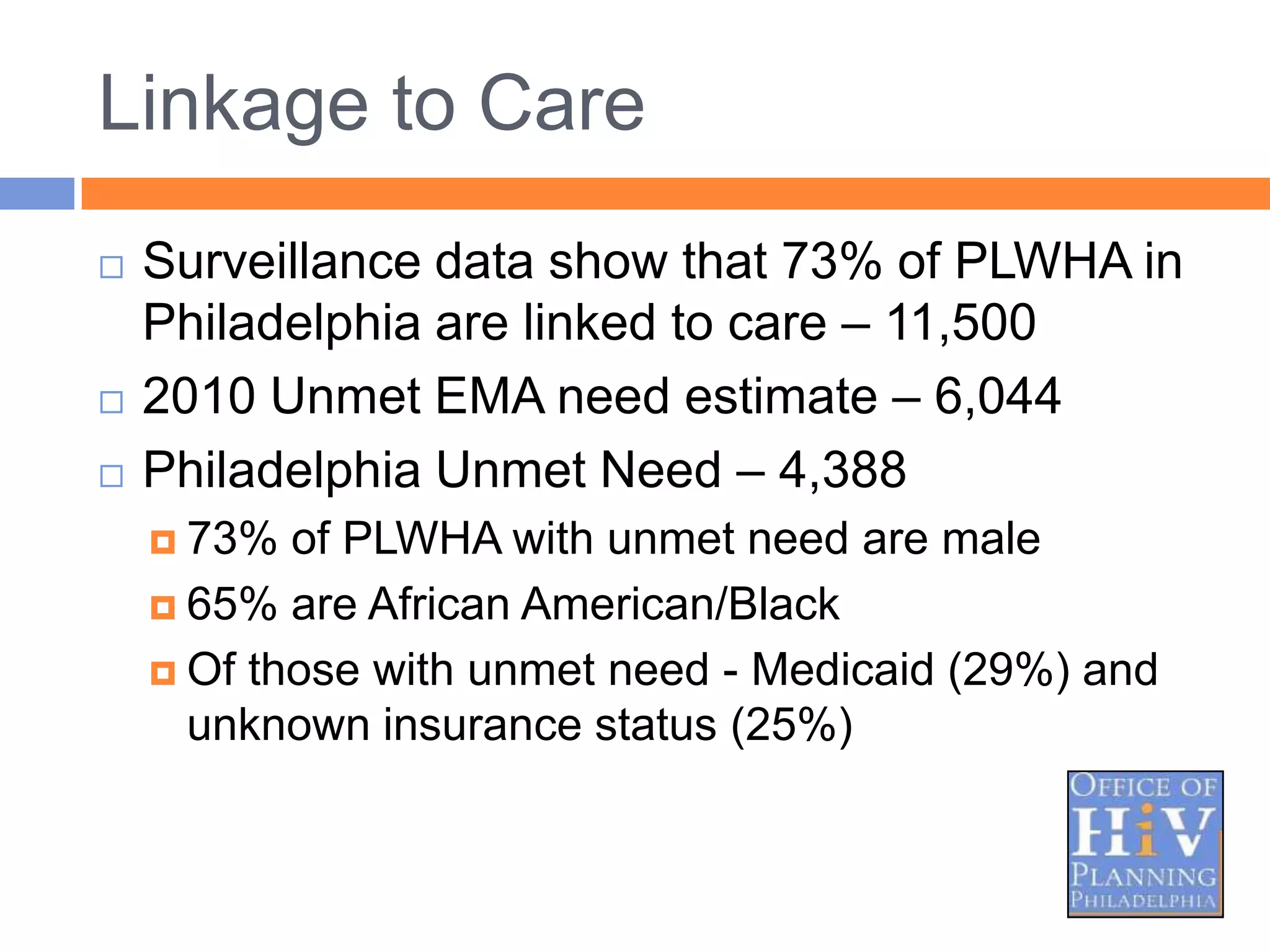
Linkage to Care
   Surveillance data show that 73% of PLWHA in
    Philadelphia are linked to care – 11,500
   2010 Unmet EMA need estimate – 6,044
   Philadelphia Unmet Need – 4,388
     73%  of PLWHA with unmet need are male
     65% are African American/Black

     Of those with unmet need - Medicaid (29%) and
      unknown insurance status (25%)
Client Services Unit
   10 weeks after initial intake – 78% in MCM
   Linkage to Medical care within 10 weeks –
    97% (includes people already in care at
    intake)
   26% had no insurance at intake
   44% had Medicaid
Linkage to Care - Survey
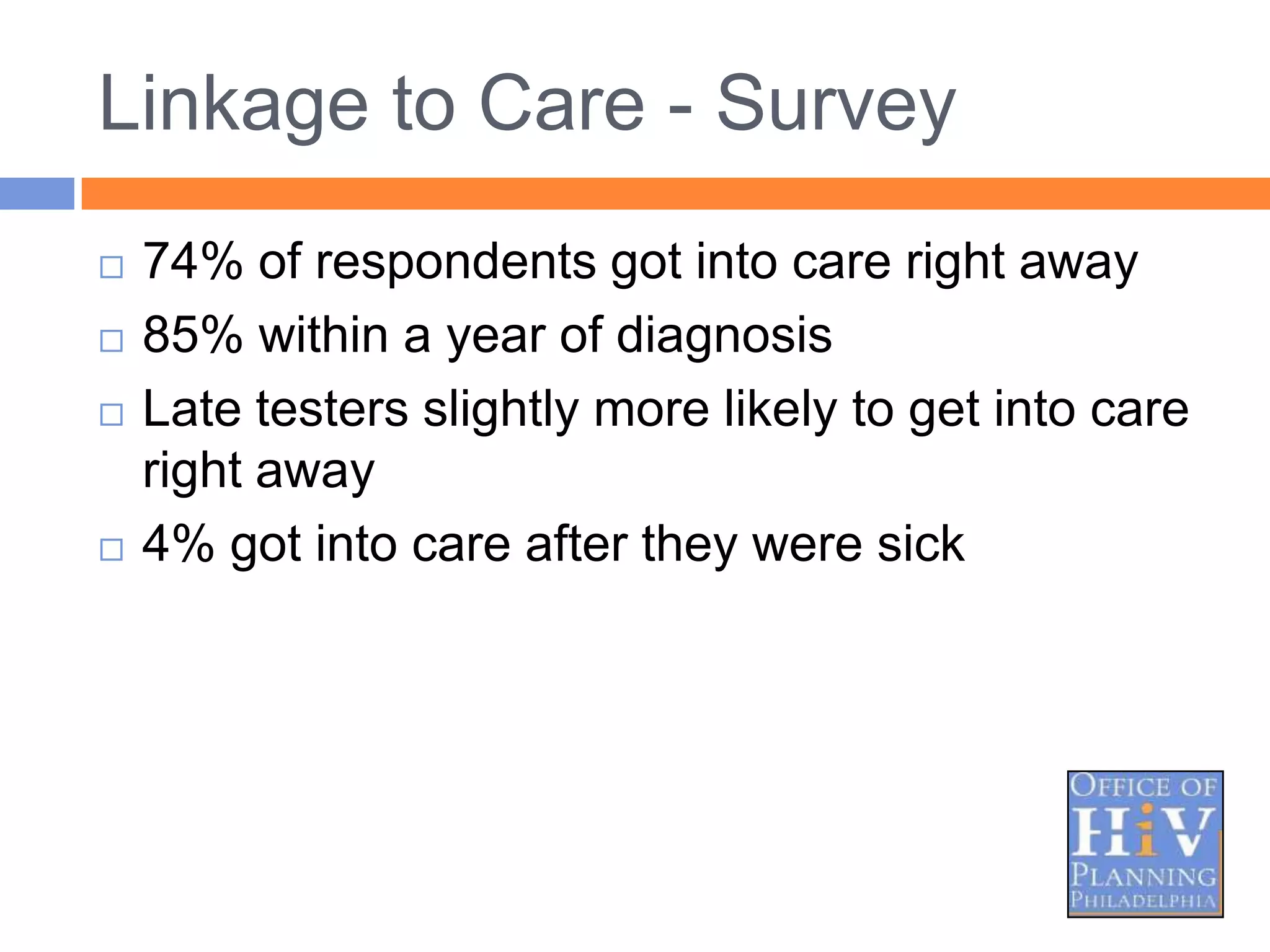
   74% of respondents got into care right away
   85% within a year of diagnosis
   Late testers slightly more likely to get into care
    right away
   4% got into care after they were sick
Retention
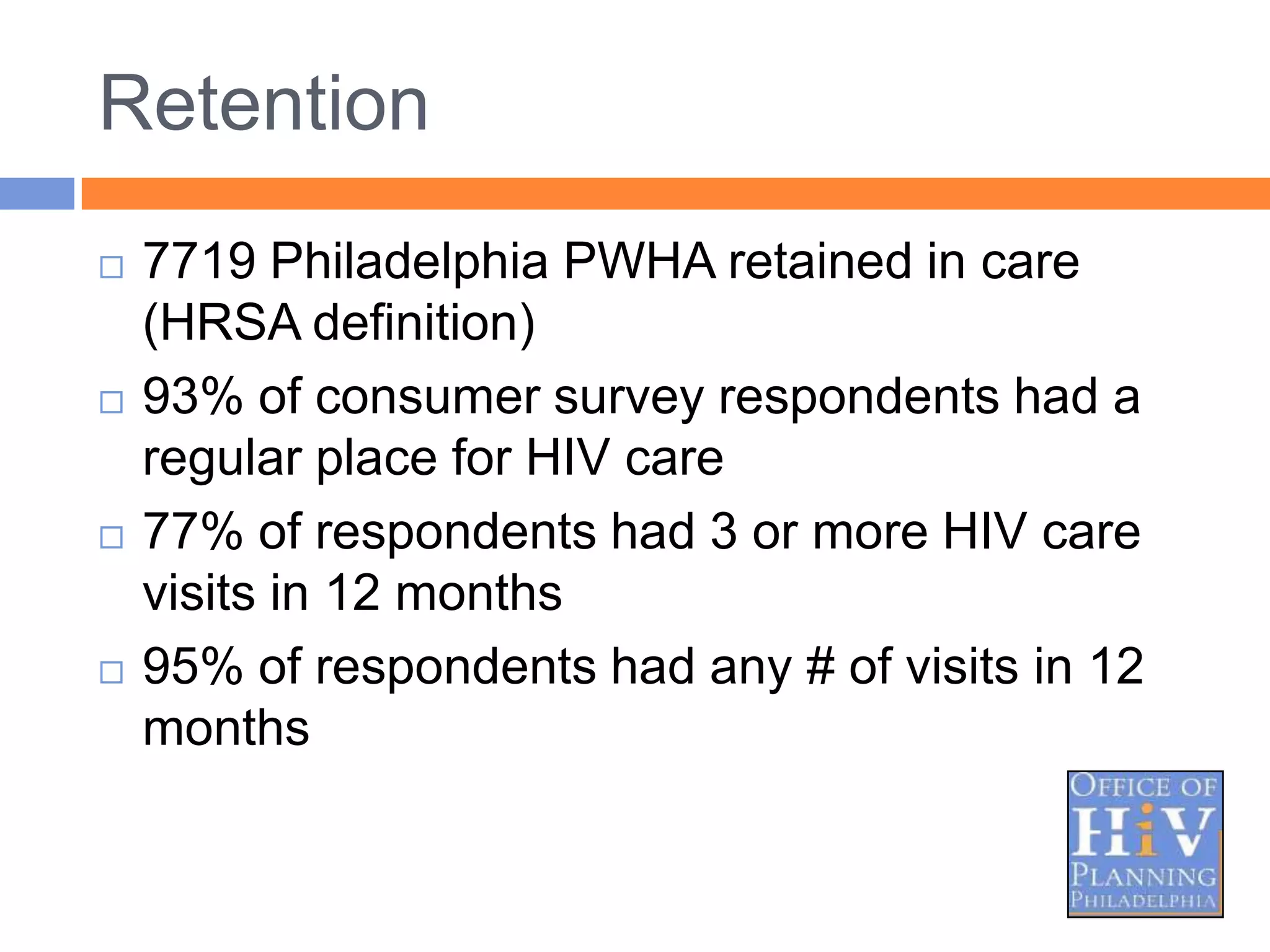
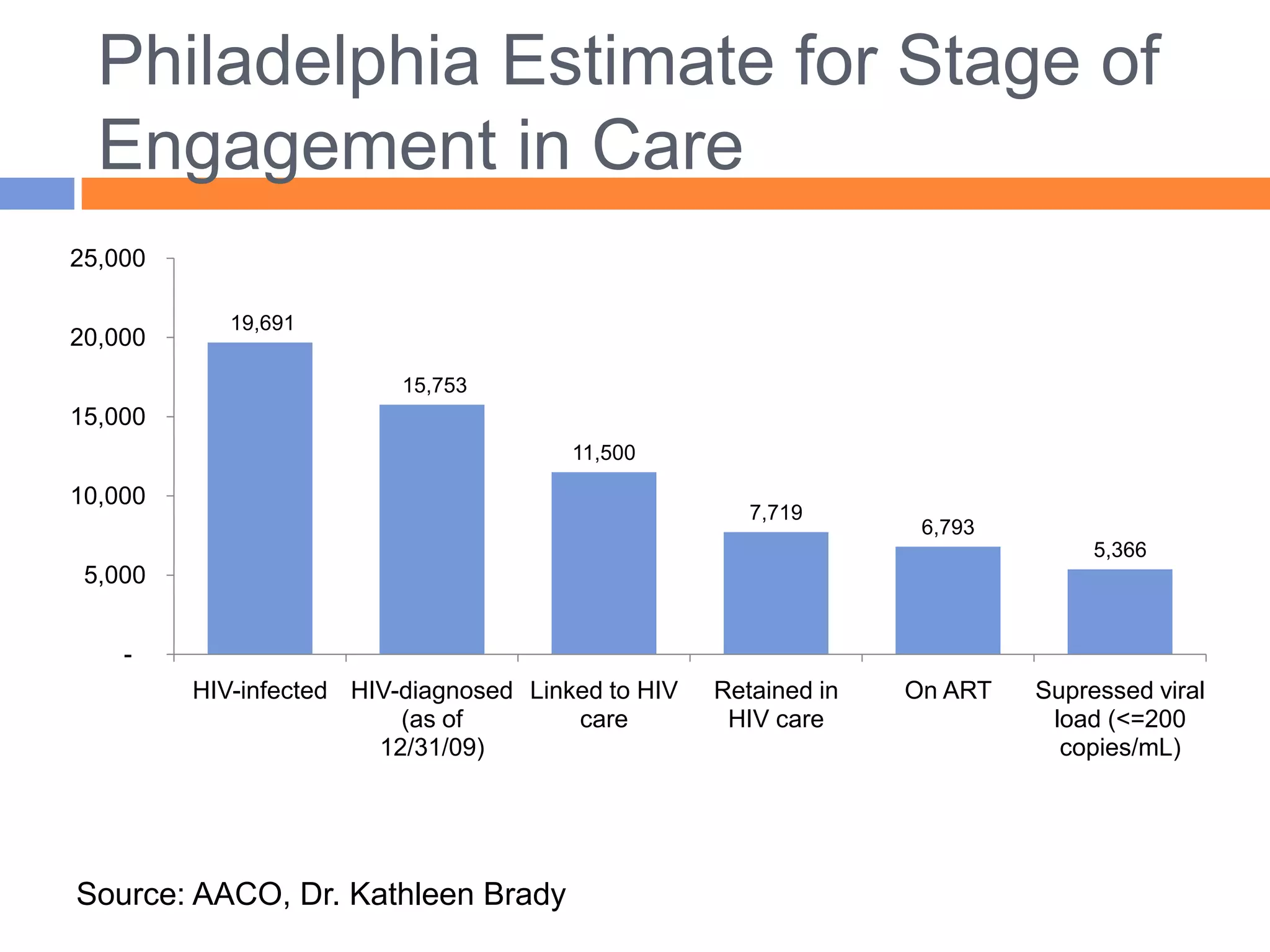
   7719 Philadelphia PWHA retained in care
    (HRSA definition)
   93% of consumer survey respondents had a
    regular place for HIV care
   77% of respondents had 3 or more HIV care
    visits in 12 months
   95% of respondents had any # of visits in 12
    months
ART and Adherence
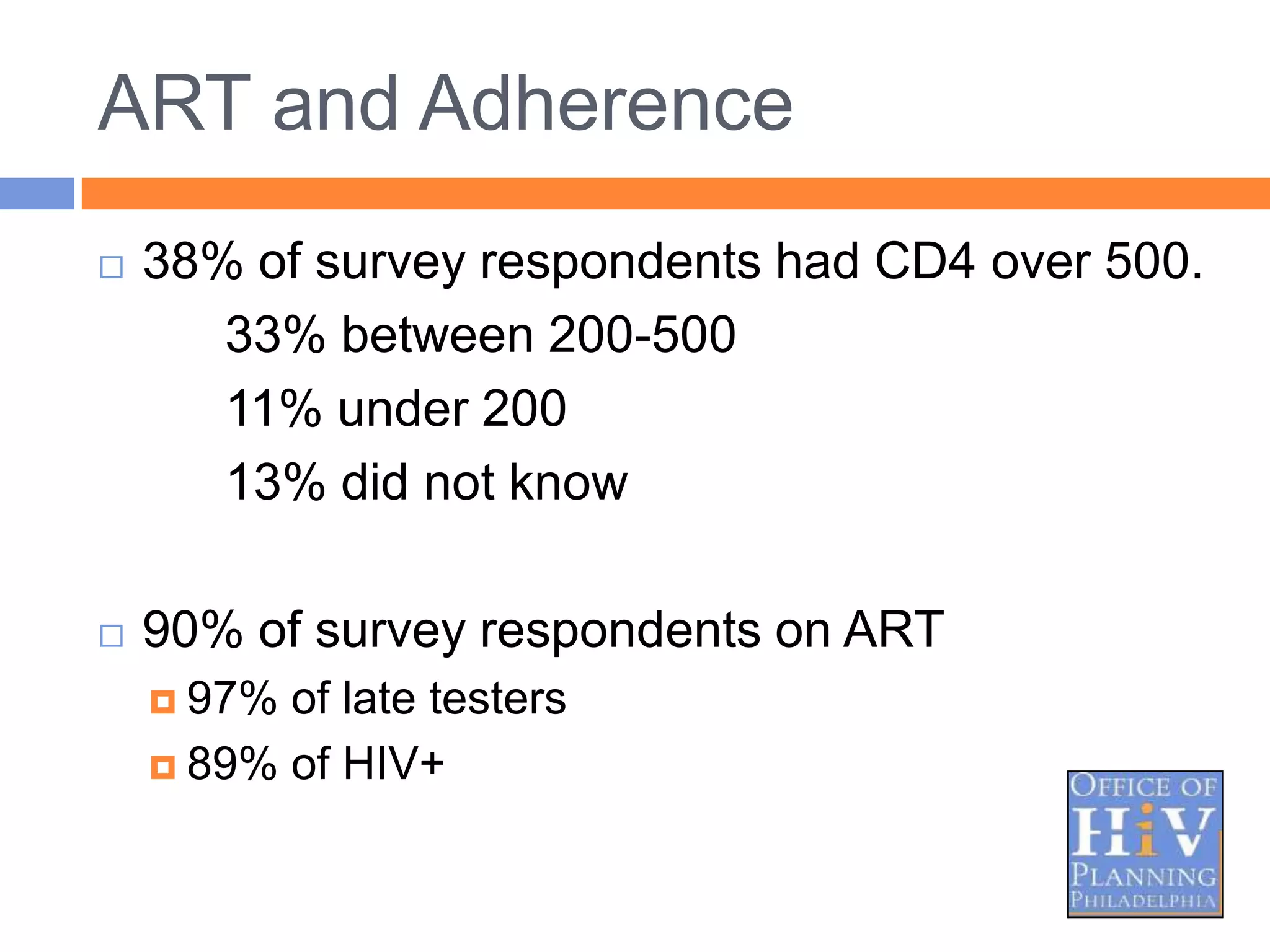
   38% of survey respondents had CD4 over 500.
       33% between 200-500
       11% under 200
       13% did not know

   90% of survey respondents on ART
     97% of late testers
     89% of HIV+
Viral Load
   6,793 PLWHA on ART in Philadelphia
     5,366   have suppressed viral load (79% of ART)
   67% of survey respondents report
    undetectable viral load
     27% of undetectables were late testers
     14% did not know viral load
Philadelphia Estimate for Stage of
  Engagement in Care
25,000

            19,691
20,000
                          15,753
15,000
                                        11,500

10,000
                                                       7,719
                                                                   6,793
                                                                                5,366
 5,000


    -
         HIV-infected HIV-diagnosed Linked to HIV   Retained in   On ART   Supressed viral
                          (as of        care         HIV care               load (<=200
                        12/31/09)                                            copies/mL)


Source: AACO, Dr. Kathleen Brady
Context and Controversy
Other viewpoints
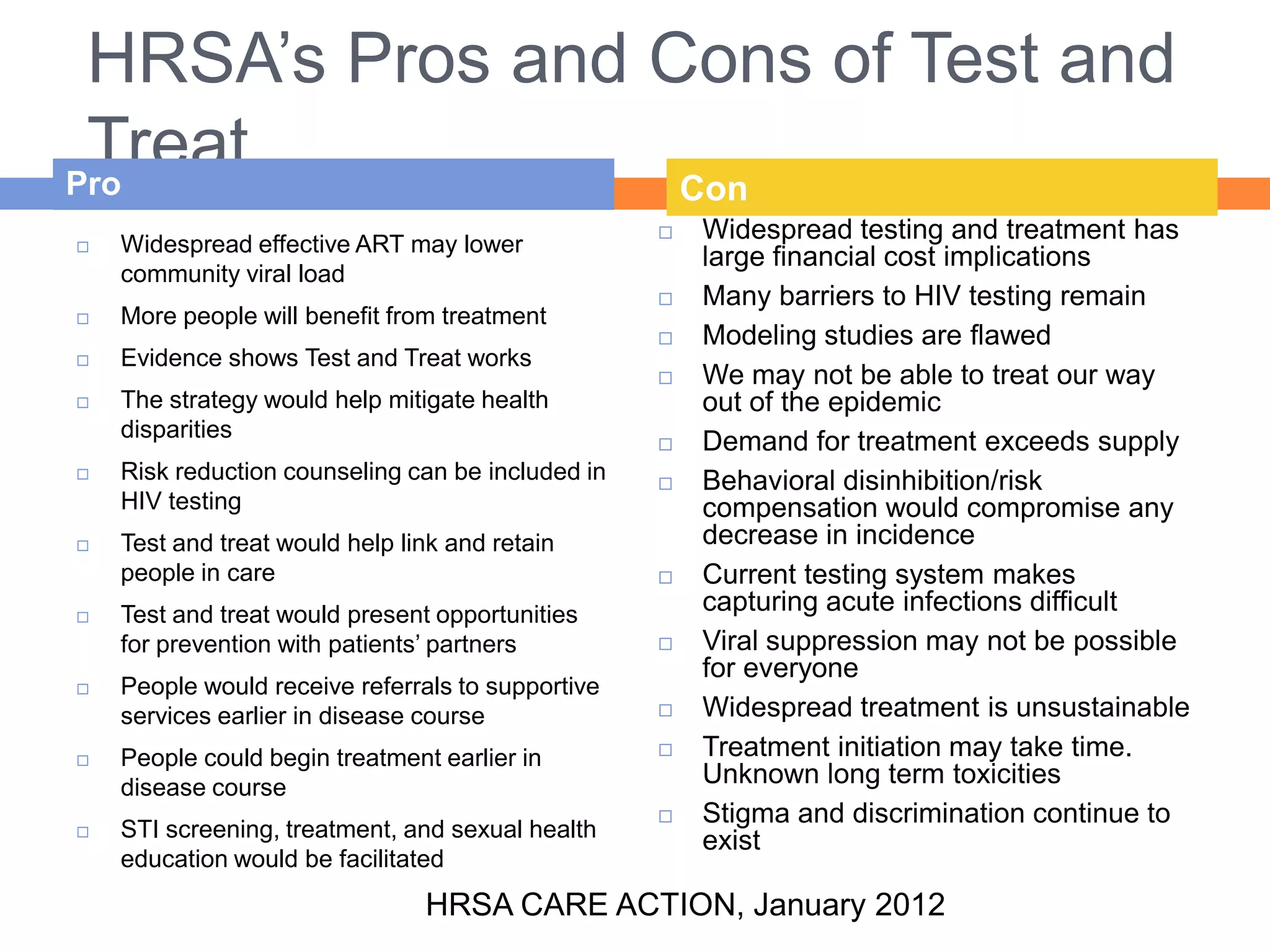
HRSA‟s Pros and Cons of Test and
 Treat
Pro               Con
   Widespread effective ART may lower
                                                      Widespread testing and treatment has
                                                       large financial cost implications
    community viral load
                                                      Many barriers to HIV testing remain
   More people will benefit from treatment
                                                      Modeling studies are flawed
   Evidence shows Test and Treat works
                                                      We may not be able to treat our way
   The strategy would help mitigate health            out of the epidemic
    disparities
                                                      Demand for treatment exceeds supply
   Risk reduction counseling can be included in      Behavioral disinhibition/risk
    HIV testing                                        compensation would compromise any
   Test and treat would help link and retain          decrease in incidence
    people in care                                    Current testing system makes
   Test and treat would present opportunities         capturing acute infections difficult
    for prevention with patients‟ partners            Viral suppression may not be possible
                                                       for everyone
   People would receive referrals to supportive
    services earlier in disease course                Widespread treatment is unsustainable
   People could begin treatment earlier in           Treatment initiation may take time.
    disease course
                                                       Unknown long term toxicities
                                                      Stigma and discrimination continue to
   STI screening, treatment, and sexual health        exist
    education would be facilitated
                                HRSA CARE ACTION, January 2012
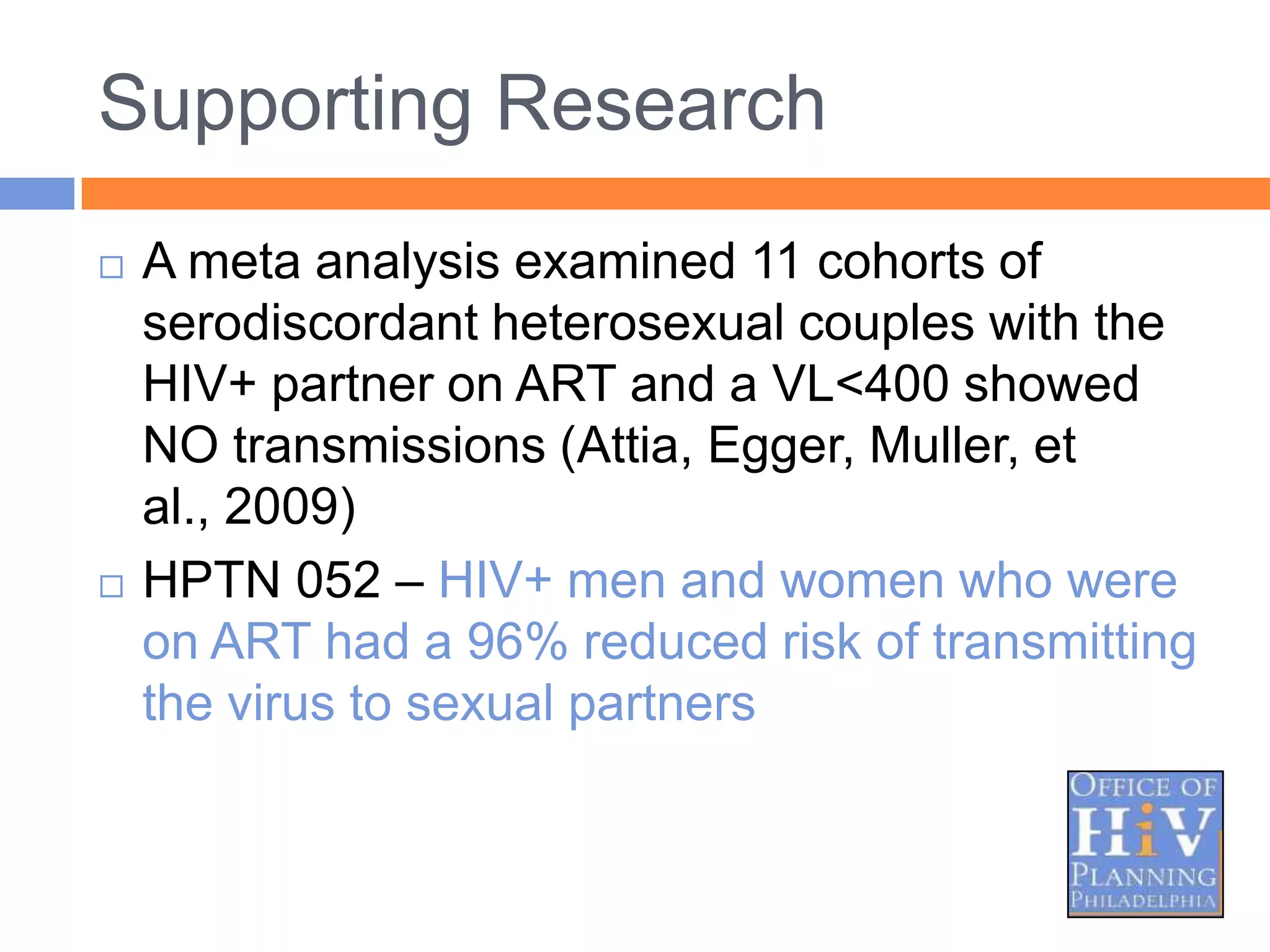
Supporting Research
   A meta analysis examined 11 cohorts of
    serodiscordant heterosexual couples with the
    HIV+ partner on ART and a VL<400 showed
    NO transmissions (Attia, Egger, Muller, et
    al., 2009)
   HPTN 052 – HIV+ men and women who were
    on ART had a 96% reduced risk of transmitting
    the virus to sexual partners
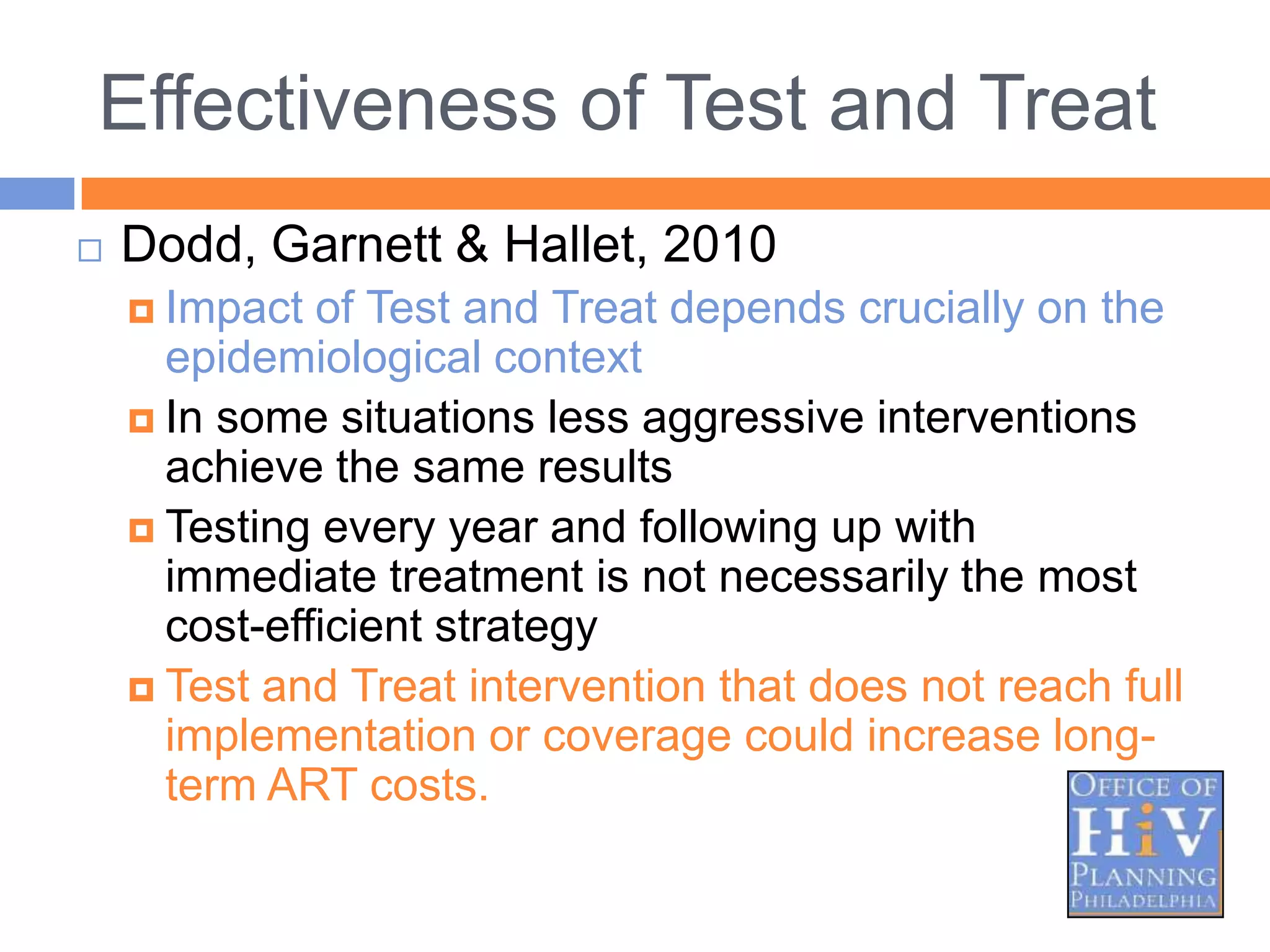
Effectiveness of Test and Treat
   Dodd, Garnett & Hallet, 2010
     Impact  of Test and Treat depends crucially on the
      epidemiological context
     In some situations less aggressive interventions
      achieve the same results
     Testing every year and following up with
      immediate treatment is not necessarily the most
      cost-efficient strategy
     Test and Treat intervention that does not reach full
      implementation or coverage could increase long-
      term ART costs.
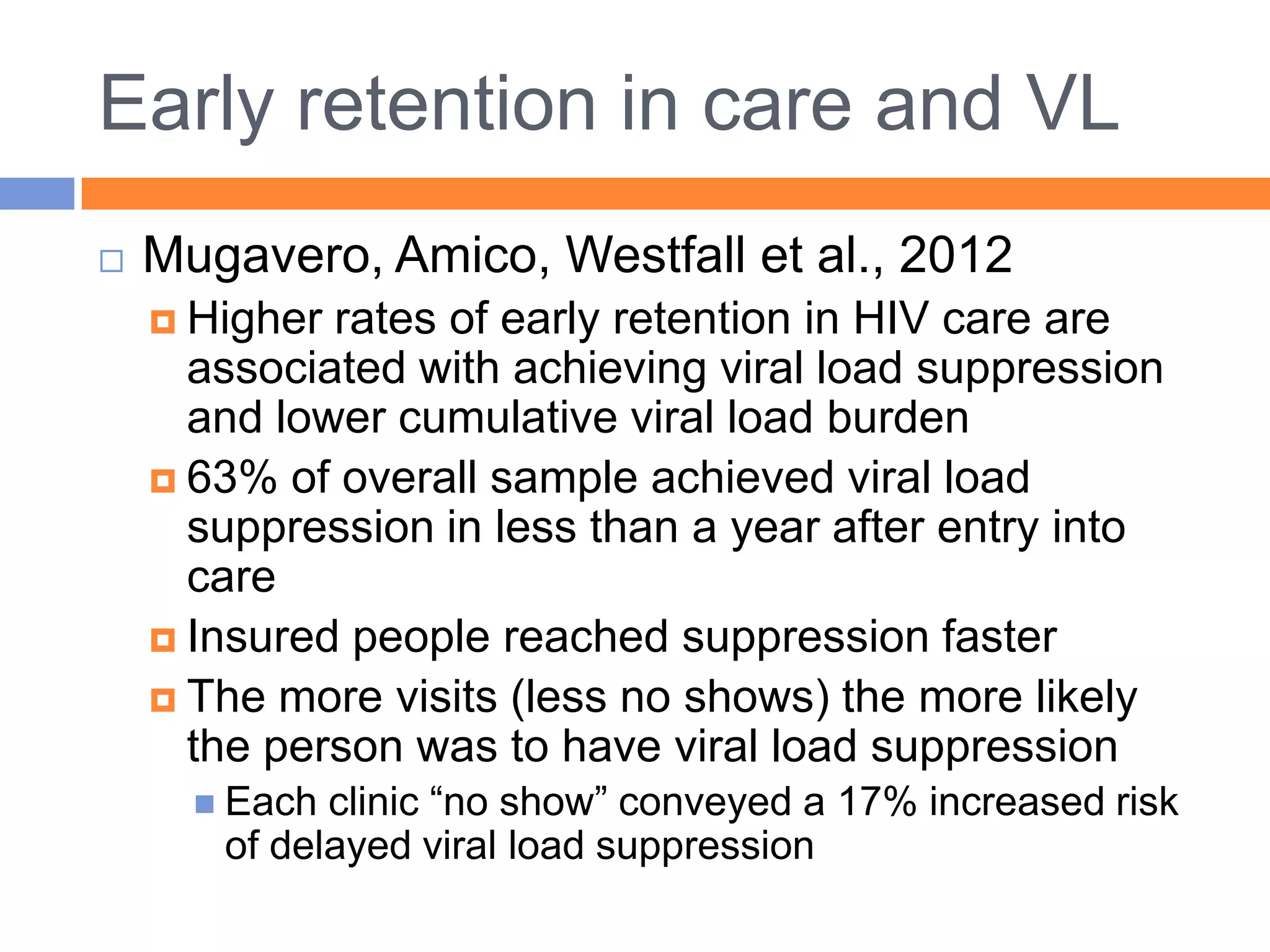
Early retention in care and VL
   Mugavero, Amico, Westfall et al., 2012
     Higher rates of early retention in HIV care are
      associated with achieving viral load suppression
      and lower cumulative viral load burden
     63% of overall sample achieved viral load
      suppression in less than a year after entry into
      care
     Insured people reached suppression faster
     The more visits (less no shows) the more likely
      the person was to have viral load suppression
       Each clinic “no show” conveyed a 17% increased risk
       of delayed viral load suppression
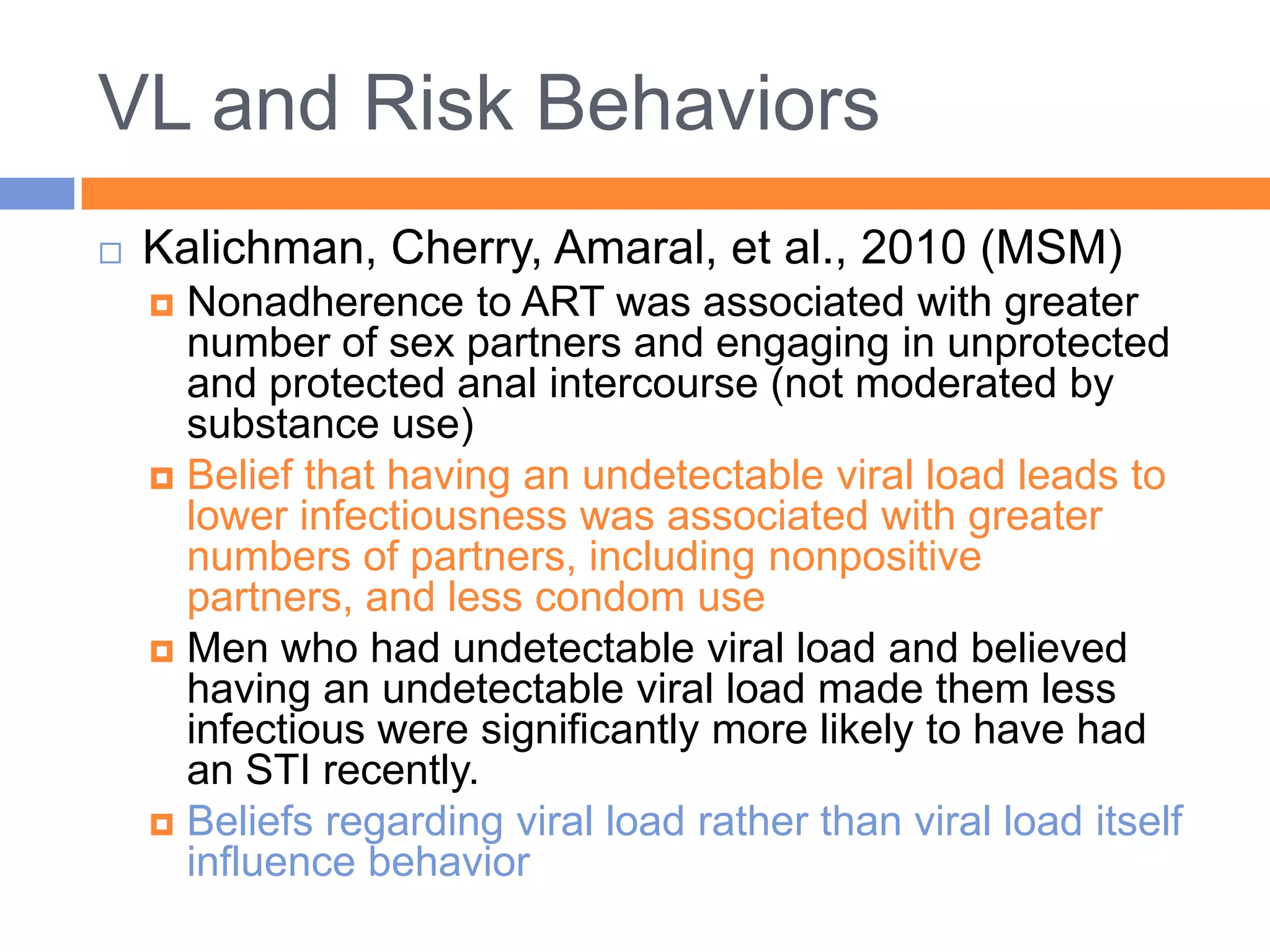
VL and Risk Behaviors
   Kalichman, Cherry, Amaral, et al., 2010 (MSM)
     Nonadherence to ART was associated with greater
      number of sex partners and engaging in unprotected
      and protected anal intercourse (not moderated by
      substance use)
     Belief that having an undetectable viral load leads to
      lower infectiousness was associated with greater
      numbers of partners, including nonpositive
      partners, and less condom use
     Men who had undetectable viral load and believed
      having an undetectable viral load made them less
      infectious were significantly more likely to have had
      an STI recently.
     Beliefs regarding viral load rather than viral load itself
      influence behavior

Test and Treat: The Gardner Cascade in Context

  • 1.
    TEST AND TREAT GardnerCascade in context
  • 2.
    Intro to „Testand Treat‟  Most people in HIV treatment (ART) reach undetectable VL  People with undetectable viral load are significantly less likely to transmit virus  Collectively, individuals with lower VL lead to communities with lower community VL = less transmissions  Failures in the system of care pose barriers to full success of T&T:  Late diagnosis  Non-linkage or flawed linkage to care  Insufficient use of ART  Non-adherence to ART
  • 3.
    Test and TreatComponents (HRSA)  Testing and identification of PLWHA as soon as possible  Linkage of people testing positive for HIV to HIV care  Patient education to encourage self management and facilitate retention in care, adherence to treatment, and prevention of STIs  Supportive services for promotion of sexual health maintenance  Monitoring and evaluation of test and treat strategy
  • 4.
    Intro to Gardner‟sResearch  Test and treat strategy supported by mathematical models and epidemiological data  Areas with high coverage of ART have decreased incidence of HIV  HOWEVER barriers to implementation of Test and Treat strategies have not been adequately evaluated.
  • 5.
    Objectives of Gardner‟sReview  To describe and quantify the spectrum of engagement in HIV care  To understand how gaps in the continuum of care affect virological outcomes in the US  To understand how to address these gaps for Test and Treat to be successful strategy  To explore effects of interventions to improve components of engagement in care
  • 6.
    Gardner‟s Review Search Strategy  PubMed search - cross-match of HIV or AIDS with  Prevalence United States  Incidence United States  Late diagnosis  Linkage to care  Retention in care  Engagement in care  Adherence  Persistence  Resistance  Bibliographies of pertinent articles were reviewed  Emphasis was based on population based
  • 7.
    HIV Care Continuum Not in HIV Care Engaged in HIV Care Unaware of Aware of Receiving some Entered HIV Cyclical or Fully engaged HIV infection HIV infection medical care but care but lost to intermittent user in HIV care (not in care) not HIV care follow-up of HIV care Adapted from Eldred et al AIDS Patient Care STDs 2007;21(Suppl1):S1-S2 Cheever LW Clin Infect Dis 2007;44:1500-2
  • 8.
    Model Demonstrating theSpectrum of Engagement in HIV Care in the United States
  • 9.
    Undiagnosed HIV Infection  1.1 million in the US with HIV/AIDS  21% of those not aware HIV+ (US)  35%-45% of newly diagnosed individuals have AIDS within 1 year (US)
  • 10.
    Model Demonstrating theSpectrum of Engagement in HIV Care in the United States
  • 11.
    Model Demonstrating theSpectrum of Engagement in HIV Care in the United States
  • 12.
    Linkage in Care  Longer delays in linkage with medical care are associated with greater likelihood of progression to AIDS by CD4 criteria  HIV+ people not linked to care pose a greater risk of transmission  Gardner concludes that ~75% of newly diagnosed HIV+ people successfully like to HIV care within 6-12 months, 80-90% link within 3-5 years
  • 13.
    Model Demonstrating theSpectrum of Engagement in HIV Care in the United States
  • 14.
    Retention in Care  3 population based studies in US found 45- 55% of known HIV+ individuals fail to receive HIV care during any year  In some communities, one-third of HIV+ people fail to access care for 3 consecutive years  ~50% of HIV+ (aware) people are not engaged in regular HIV care.  Poor engagement in care is associated with poor health outcomes, including increased mortality and increased risk of HIV transmission
  • 15.
    Model Demonstrating theSpectrum of Engagement in HIV Care in the United States
  • 16.
    Model Demonstrating theSpectrum of Engagement in HIV Care in the United States
  • 17.
    Antiretroviral Therapy  Gardner estimates that 80% of in-care HIV+ individuals should be receiving ART, but 25% of those are not.  4-6% of in-care HIV+ people discontinue ART each year  70-80% adherence leads to durable viral suppression in most people  78-87% of individuals on ART had an undetectable viral load.
  • 18.
    Model Demonstrating theSpectrum of Engagement in HIV Care in the United States 19%
  • 19.
    Test and TreatImplications  Epidemiological data suggests that ART reduces risk of HIV transmission in serodiscordant heterosexual couples by 92- 98%  Ecological data show that incidence of HIV transmission may be occurring in communities with high treatment coverage (San Francisco)
  • 20.
    Simulations of theEngagement in HIV Care Spectrum to Account for Inaccuracy in our Engagement Estimates 1200000 Number of Individuals Un-Diagnosed HIV 1000000 Not Linked to Care 800000 Not Retained in Care 600000 ART Not Required 400000 ART Not Utililzed 66% Viremic on ART 200000 34% 28% 19% 22% 21% Undetectable Viral Load 0 Current Dx 90% Engage 90% Treat 90% VL<50 in 90% Dx, Engage, Tx, and VL<50 in 90% (a) (b) (c) (d) (e) (f)
  • 21.
    Newer Data forDiscussion  Marks et al. estimated that 29 – 34% of HIV- infected individuals in the U.S. have an undetectable viral load (Clin Infect Dis 2011;53:1168–9)  Dombrowski et al. estimate that 42 – 45% in Seattle King County are undetectable (AIDS 2011;epub ahead of print)  In a cohort of newly diagnosed individuals in Denver, 28% are undetectable 12 – 18 months after diagnosis.
  • 22.
    Limitations  Unable to assess the impact of financial barriers to HIV care in the U.S.  Overlap in the stages of engagement in HIV care  Cross-sectional depiction of a longitudinal process  The review applies to the U.S. and not to resource-poor settings
  • 23.
    Conclusions  Engagement in care is critical to the successful management of HIV infection  For the individual  For the population  Deficiencies in the spectrum of engagement in care present formidable barriers to „test and treat‟ for HIV prevention:  Failure to diagnose  Failure to link to care  Failure to be retained in care  Failure to receive and adhere to antiretroviral therapy  Research is needed on ways to improve transitions across all steps in the engagement in care cascade
  • 24.
  • 25.
    Undiagnosed HIV/AIDS -EMA  In EMA estimated 6,800 people are unaware of their status  In Philadelphia- 25% concurrent HIV/AIDS in 2009 (a.k.a. “late testers”) – consumer survey data supports this number  Most likely to be  African American/Hispanic  Male  Over 40  Heterosexual or unidentified risk
  • 26.
    HIV/AIDS- Incidence AIDS (1/1/2008– 12/31/2010) HIV (1/1/2008 – 12/31/2010)  Total: 1540  Total: 1835  72% Male  73% Male  53% 20-44  68% 20-44  44% 45+  25% 45+  59% African  59% African American/Black American/Black  21% White  22% White  14% Hispanic  16% Hispanic  44% Heterosexual  38% Heterosexual  30% MSM  40% MSM  16% IDU  11% IDU
  • 27.
    HIV/AIDS Diagnosed - Prevalence AIDS– 15,163 HIV – 10,486  73% Male  68% Male  61% 45+  54.4 % 20-44  32% MSM  42.9% 45+  30% IDU  37% Heterosexual  29% Heterosexual  33% MSM  21% IDU  59% African American/Black  56% African American/Black  24% White  25% White  13% Hispanic  14% Hispanic
  • 28.
    Linkage to Care  Surveillance data show that 73% of PLWHA in Philadelphia are linked to care – 11,500  2010 Unmet EMA need estimate – 6,044  Philadelphia Unmet Need – 4,388  73% of PLWHA with unmet need are male  65% are African American/Black  Of those with unmet need - Medicaid (29%) and unknown insurance status (25%)
  • 29.
    Client Services Unit  10 weeks after initial intake – 78% in MCM  Linkage to Medical care within 10 weeks – 97% (includes people already in care at intake)  26% had no insurance at intake  44% had Medicaid
  • 30.
    Linkage to Care- Survey  74% of respondents got into care right away  85% within a year of diagnosis  Late testers slightly more likely to get into care right away  4% got into care after they were sick
  • 31.
    Retention  7719 Philadelphia PWHA retained in care (HRSA definition)  93% of consumer survey respondents had a regular place for HIV care  77% of respondents had 3 or more HIV care visits in 12 months  95% of respondents had any # of visits in 12 months
  • 32.
    ART and Adherence  38% of survey respondents had CD4 over 500. 33% between 200-500 11% under 200 13% did not know  90% of survey respondents on ART  97% of late testers  89% of HIV+
  • 33.
    Viral Load  6,793 PLWHA on ART in Philadelphia  5,366 have suppressed viral load (79% of ART)  67% of survey respondents report undetectable viral load  27% of undetectables were late testers  14% did not know viral load
  • 34.
    Philadelphia Estimate forStage of Engagement in Care 25,000 19,691 20,000 15,753 15,000 11,500 10,000 7,719 6,793 5,366 5,000 - HIV-infected HIV-diagnosed Linked to HIV Retained in On ART Supressed viral (as of care HIV care load (<=200 12/31/09) copies/mL) Source: AACO, Dr. Kathleen Brady
  • 35.
  • 36.
    HRSA‟s Pros andCons of Test and Treat Pro Con  Widespread effective ART may lower  Widespread testing and treatment has large financial cost implications community viral load  Many barriers to HIV testing remain  More people will benefit from treatment  Modeling studies are flawed  Evidence shows Test and Treat works  We may not be able to treat our way  The strategy would help mitigate health out of the epidemic disparities  Demand for treatment exceeds supply  Risk reduction counseling can be included in  Behavioral disinhibition/risk HIV testing compensation would compromise any  Test and treat would help link and retain decrease in incidence people in care  Current testing system makes  Test and treat would present opportunities capturing acute infections difficult for prevention with patients‟ partners  Viral suppression may not be possible for everyone  People would receive referrals to supportive services earlier in disease course  Widespread treatment is unsustainable  People could begin treatment earlier in  Treatment initiation may take time. disease course Unknown long term toxicities  Stigma and discrimination continue to  STI screening, treatment, and sexual health exist education would be facilitated HRSA CARE ACTION, January 2012
  • 37.
    Supporting Research  A meta analysis examined 11 cohorts of serodiscordant heterosexual couples with the HIV+ partner on ART and a VL<400 showed NO transmissions (Attia, Egger, Muller, et al., 2009)  HPTN 052 – HIV+ men and women who were on ART had a 96% reduced risk of transmitting the virus to sexual partners
  • 38.
    Effectiveness of Testand Treat  Dodd, Garnett & Hallet, 2010  Impact of Test and Treat depends crucially on the epidemiological context  In some situations less aggressive interventions achieve the same results  Testing every year and following up with immediate treatment is not necessarily the most cost-efficient strategy  Test and Treat intervention that does not reach full implementation or coverage could increase long- term ART costs.
  • 39.
    Early retention incare and VL  Mugavero, Amico, Westfall et al., 2012  Higher rates of early retention in HIV care are associated with achieving viral load suppression and lower cumulative viral load burden  63% of overall sample achieved viral load suppression in less than a year after entry into care  Insured people reached suppression faster  The more visits (less no shows) the more likely the person was to have viral load suppression  Each clinic “no show” conveyed a 17% increased risk of delayed viral load suppression
  • 40.
    VL and RiskBehaviors  Kalichman, Cherry, Amaral, et al., 2010 (MSM)  Nonadherence to ART was associated with greater number of sex partners and engaging in unprotected and protected anal intercourse (not moderated by substance use)  Belief that having an undetectable viral load leads to lower infectiousness was associated with greater numbers of partners, including nonpositive partners, and less condom use  Men who had undetectable viral load and believed having an undetectable viral load made them less infectious were significantly more likely to have had an STI recently.  Beliefs regarding viral load rather than viral load itself influence behavior

Editor's Notes

  • #19 Synthesized all these data to develop cascade model;79% of HIV+ people are aware50% are not adequately engaged in care60% of HIV+ individuals are not receiving regular HIV care because of deficits in diagnosis, linkage to care, or retention in careOf the remaining 40%, ~80% require ART, 75% of whom receive it~80% of treated individuals have an undetectable viral load That’s just 19% of the HIV+ population in the USNot surprising that with &gt;80% of the HIV+ population with detectable viral loads we have not seen a decrease in incidence
  • #21 Current estimates 90% diagnosed, other % remain the same90% of HIV+ diagnosed are engaged in care90% in care receive ART90% of people on ART achieve viral suppressionAssumes 90% known HIV diagnosis, 90% engagement in care, 90% receipt of ART, 90% achievement of undetectable viral loadThis demonstrates that improvement in any one component does not have a significant effect on the number of people achieving viral load suppression. Success of Test and Treat relies on the success of each component, by overcoming multiple sequential barriers. If an individual cannot overcome a specific barrier, they cannot move on the continuum and reach undetectable status. Improvement in the entire continuum of care is required for Test and Treat to substantially increase the proportion of HIV+ people with undetectable viral loads. Even if we reach 90% for all measures, ~34% of HIV+ individuals will still have a detectable viral load.
  • #35 HIV-infected number is estimate based on CDC estimate that 21% of HIV infected people do not know status. Number calculated by adding 21% to 15,753 of known HIV+.HIV-diagnosed, #linked and retained in care are from AACO surveillance dataOn ART and suppressed viral load #’s are estimated from Medical Monitoring Project data