The Datanex™ PlatformCloud Computing for HealthcarePeter SchwoererDatanex Product SpecialistSentry Data Systems, Inc. August 11, 2009
OverviewCloud Computing IntroductionTerminologyHallmarks of Cloud ComputingInfrastructure vs. PlatformsWhy Cloud Computing?Requirements of a Healthcare CloudThe Datanex Platform: The Healthcare CloudDatanex OverviewDatanex ComponentsAbout SentryCloud Computing DefinedCloud computing is a model for enabling convenient, on demand network access to a shared pool of configurable resources that can be rapidly provisioned and released with minimal management effort or service provider interaction.
5 Essential Characteristicsof Cloud ComputingOn-demand self service – Unilaterally provision computing capabilities.Network Access – Network accessed through standard mechanisms.Pooled Resources – Supports multitenant modelRapid Elasticity – Rapid provisioning and scaling down of resourcesMeasured Service – Cloud systems automatically control and optimize resource use as needed. Pay for what you need and use, only!
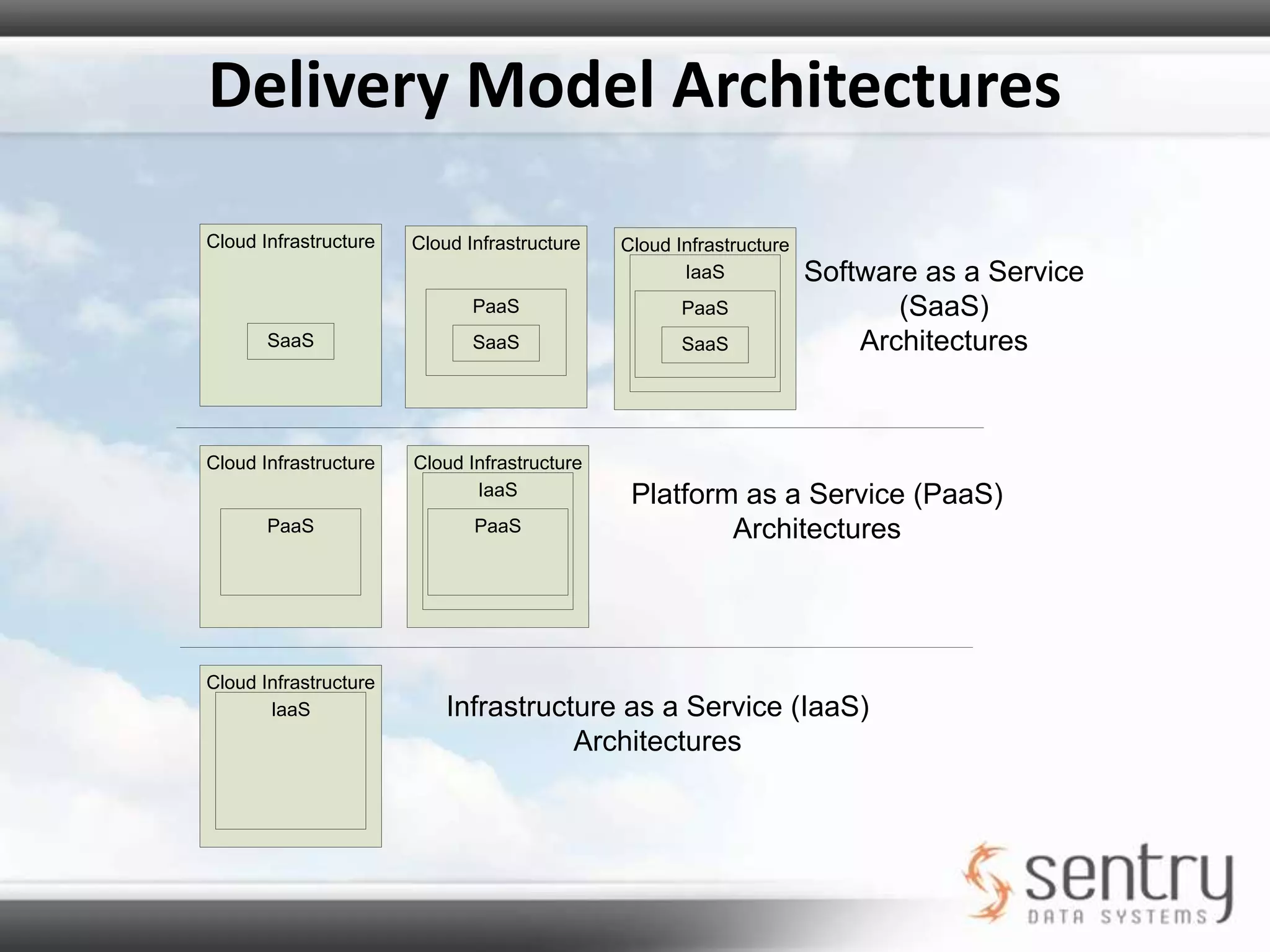
Cloud Delivery ModelsSoftware as a Service (SaaS) – User provider’s applications over a networkPlatform as a Service (PaaS) – Deploy customer created applications to a cloudInfrastructure as a Service (IaaS) - Rent processing, storage, network, capacity, and other fundamental computing resources
Delivery Model Architectures
Deployment ModelsPrivate Clouds – Cloud infrastructure is solely for one organization, on or offsiteCommunity Cloud – Cloud infrastructure is shared by several organizationsPublic Cloud – Infrastructure is made available to the general public or industry groupsHybrid Cloud – Infrastructure is a composite of two or more cloud types
Hallmarks of Cloud ComputingVirtualized ComponentsOn-demand ProvisioningOn-demand ScalabilityAccessed and Delivered via the NetworkUtilization Based Billing
Cloud Infrastructure vs. Cloud PlatformsCloud InfrastructureClosely matches physical components (machines, RAM, CPU, storage space)Interchangeable with physical machines“Virtual Datacenter”Cloud PlatformsAbstracted infrastructure componentsFocused on deploying applicationsAPIs used by developers to access Cloud Resources and Data Structures
Examples of Different Cloud OfferingsInfrastructureAmazon Web Services (EC2 and S3)GoGridPlatformsGoogle AppEngineSalesforceFacebook
Why Cloud Computing?CheaperDeploymentOperationStartup CostsEasierDeploymentScalabilitySaferFasterMore Reliable
What’s Required of a Healthcare Cloud?SecuritySAS70HIPAAPCISecure ConnectivityVPNSHospital ClaimsProcessingPharmacy Claims ProcessingEncryptionAggregation of Disparate Data Sets from Multiple Environments and LocationsSupport of Healthcare FormatsSupport of Healthcare Code Sets
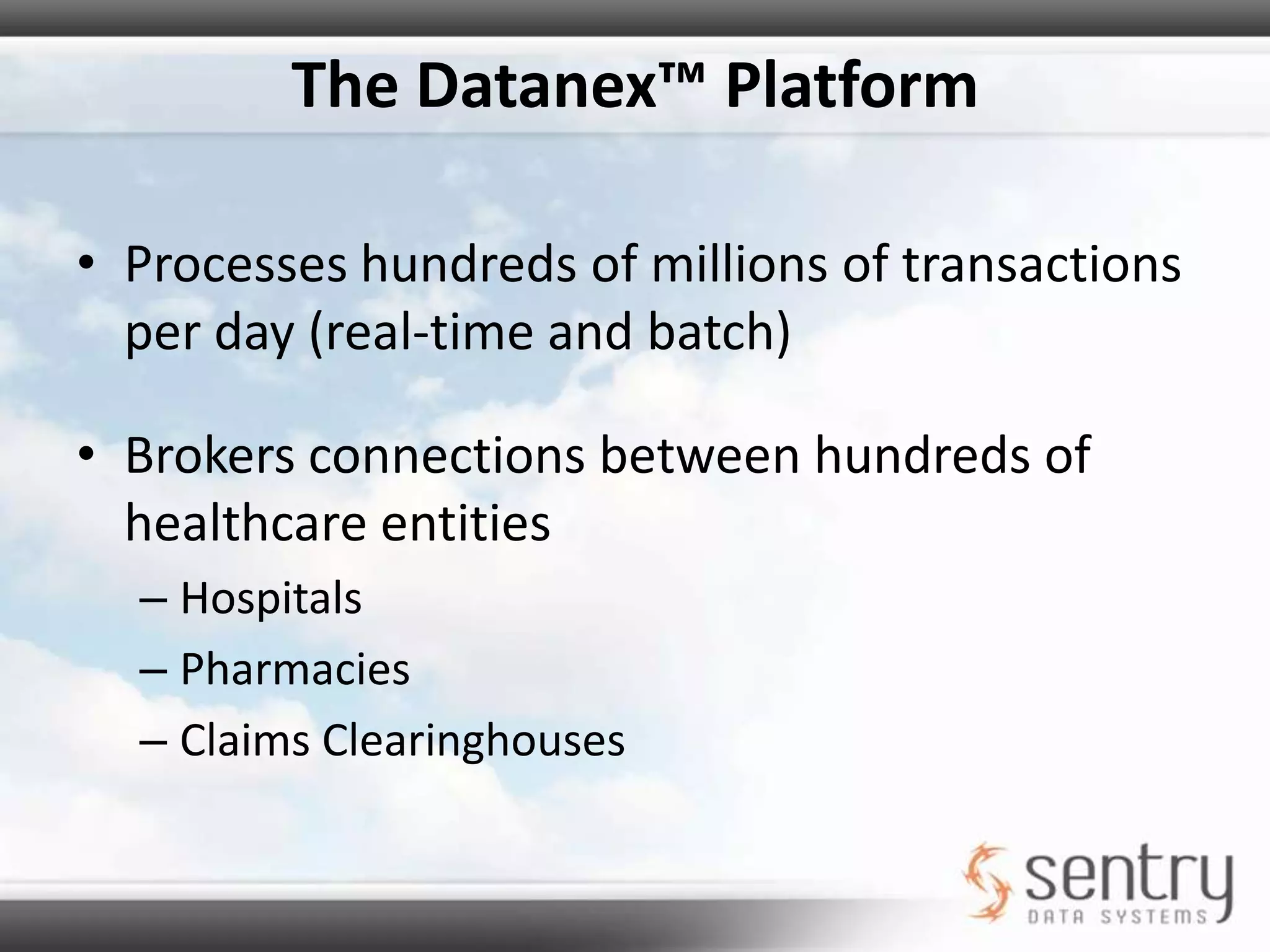
The Datanex™ PlatformProcesses hundreds of millions of transactions per day (real-time and batch)Brokers connections between hundreds of healthcare entities HospitalsPharmaciesClaims Clearinghouses
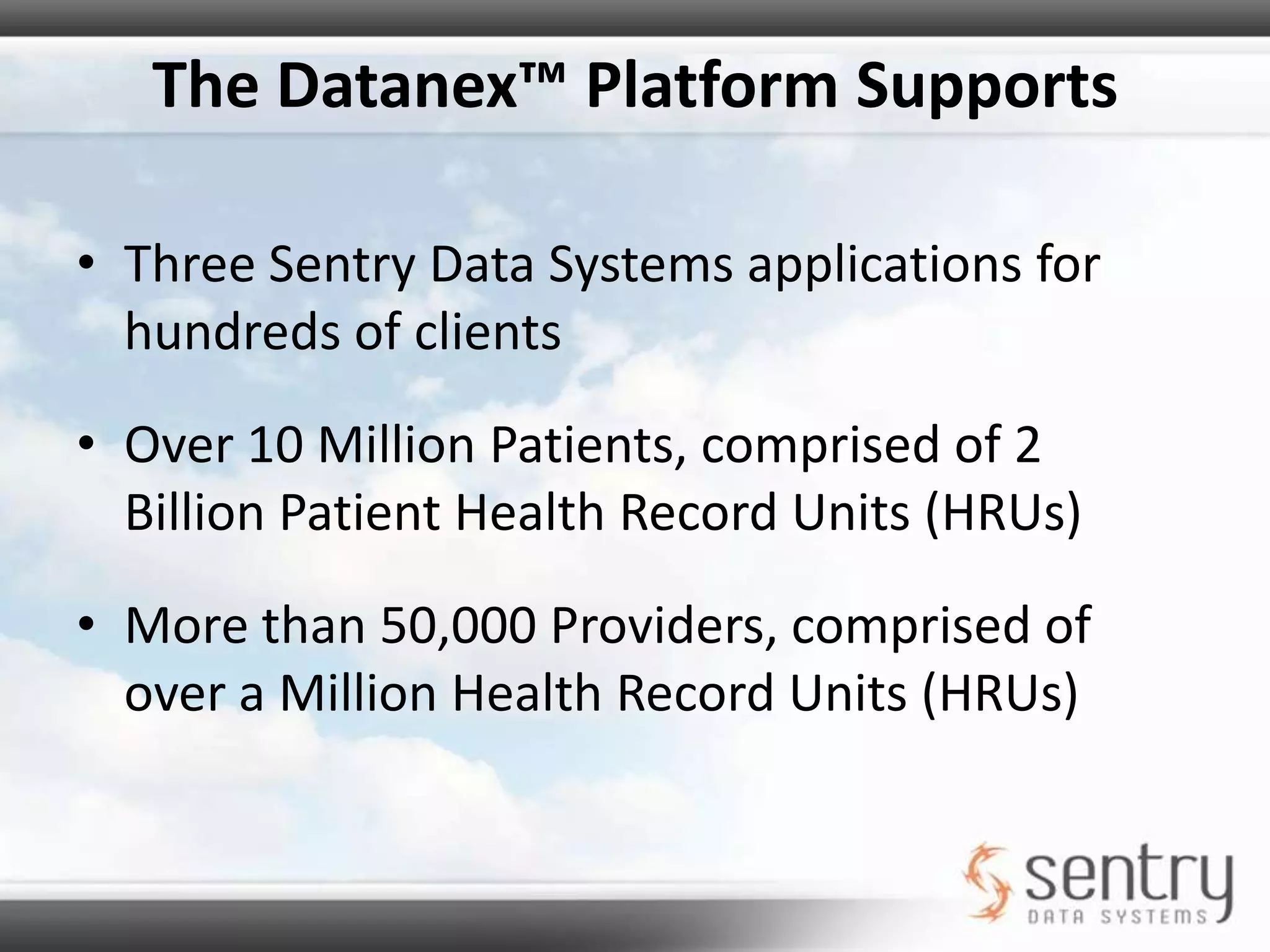
The Datanex™ Platform Supports Three Sentry Data Systems applications for hundreds of clientsOver 10 Million Patients, comprised of 2 Billion Patient Health Record Units (HRUs)More than 50,000 Providers, comprised of over a Million Health Record Units (HRUs)
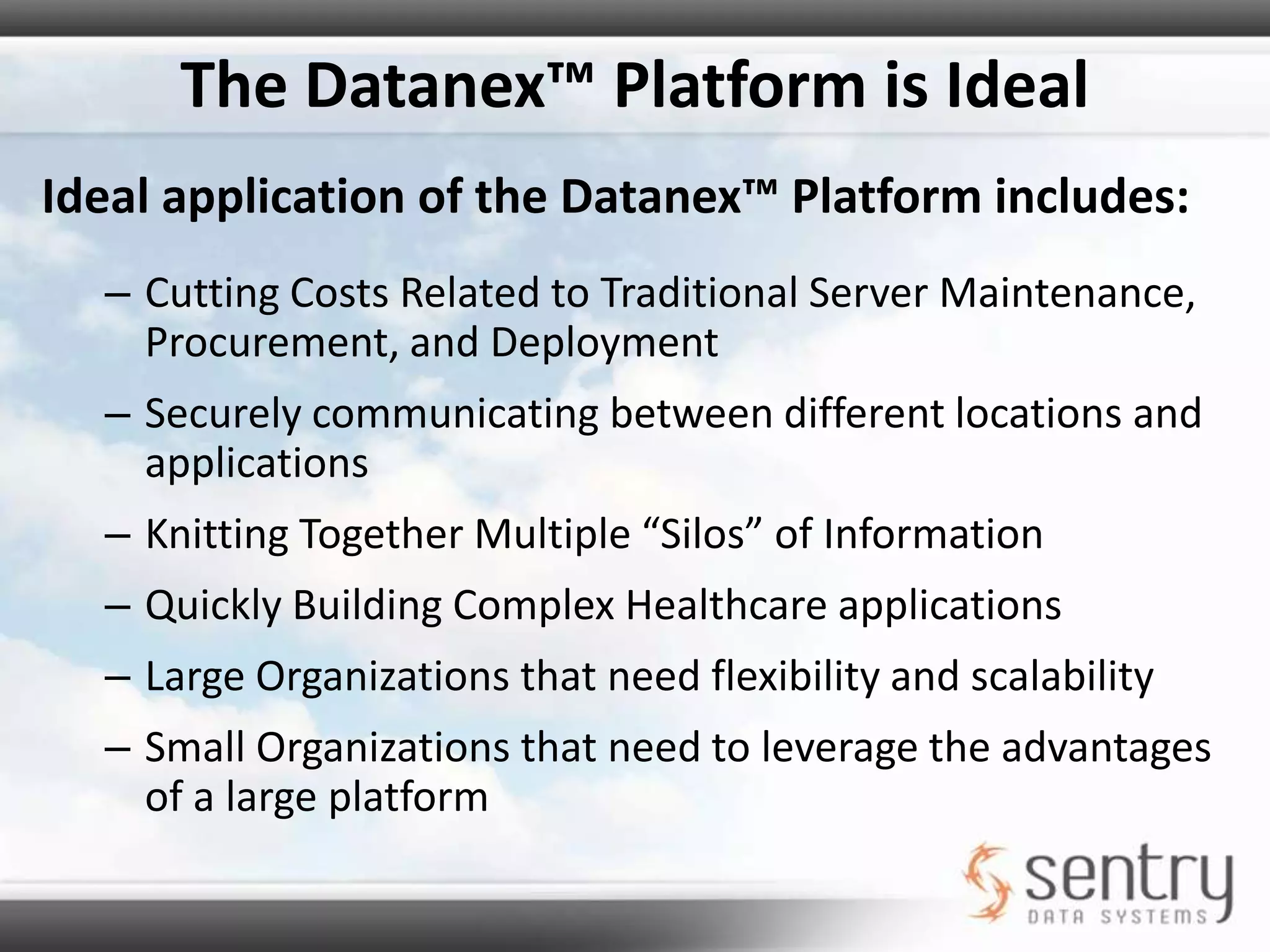
The Datanex™ Platform is IdealIdeal application of the Datanex™ Platform includes:Cutting Costs Related to TraditionalServer Maintenance, Procurement, and DeploymentSecurely communicating between different locations and applicationsKnitting Together Multiple “Silos” of InformationQuickly Building Complex Healthcare applicationsLarge Organizations that need flexibility and scalabilitySmall Organizations that need to leverage the advantages of a large platform
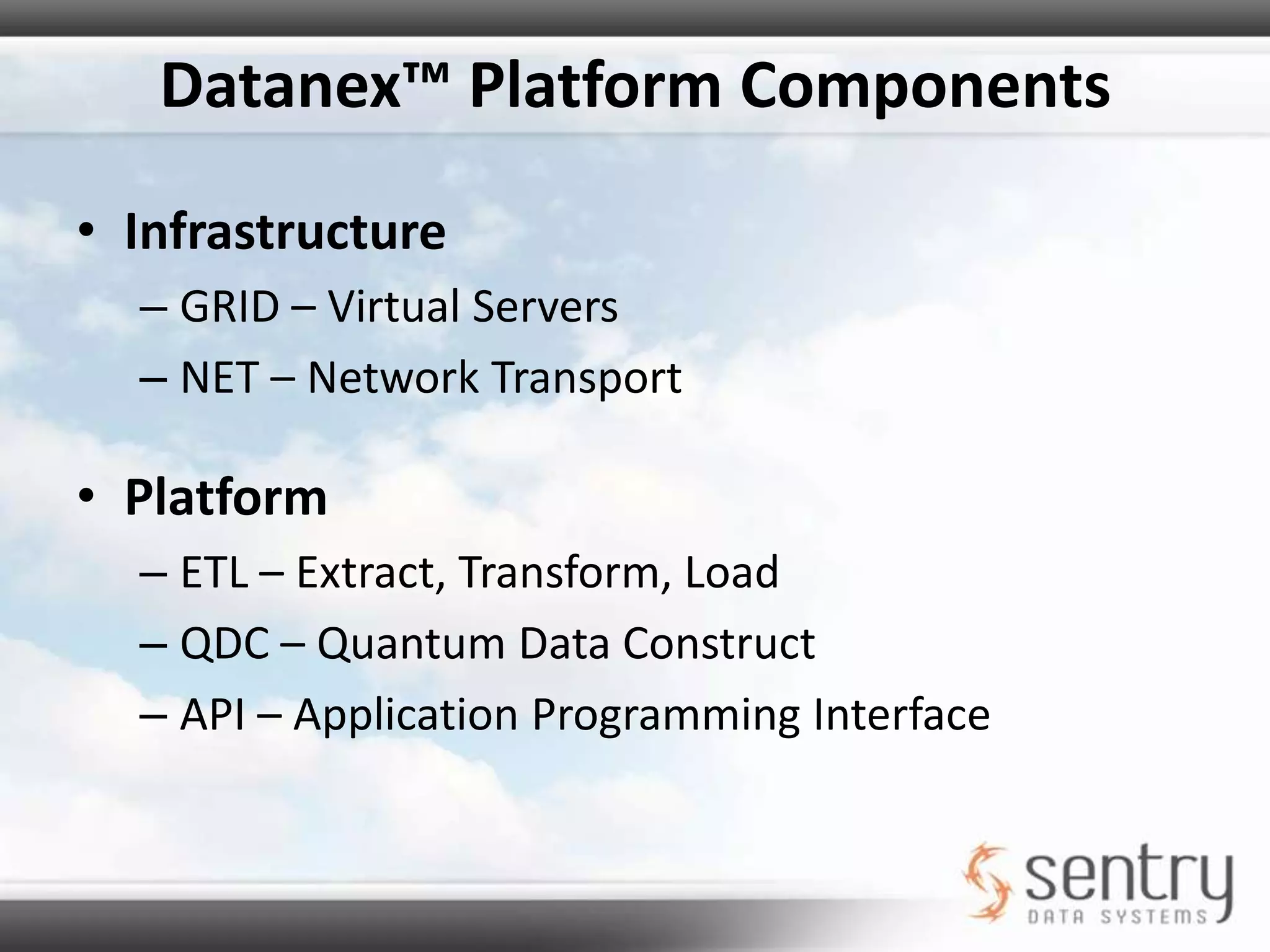
Datanex™ Platform ComponentsInfrastructureGRID – Virtual ServersNET – Network TransportPlatformETL – Extract, Transform, LoadQDC – Quantum Data ConstructAPI –Application Programming Interface
Datanex™: GRIDVirtual Linux and Windows ServersTrue on-demand deployment via web or APIEncrypted virtual machine instances (Linux only)Snapshot backup serviceLive Migration within Geographical ZonesMultiple Geographical ZonesFlexible sizing of instances based on RAM, Hard Disk, CPUsStatic IP Addresses per instanceKVM Hypervisor
Datanex™: NETBrokers formats such as HL7, EDI X12 (832, 850, 855, 856, 810, 837, 835), NCPDP, Flat Files, XML Based Formats, HCFA, UB92, UB04.Reliable TransportSecure Connections
Datanex™: ETLHigh Performance Extract, Transform, Load infrastructureSupports all major Hospital Information Systems (HIS)Quality Control of data feeds built in and proactively monitoredProcesses millions of transactions per day
Datanex™: QDCDistributed non-relational database.Processes data as it arrives according to predefined queries, distributes the results across available nodes.Queries run in parallel across all available nodes, and provide astonishing performance not possible with relational databases.
Datanex™: QDCNew queries are defined, processed by all nodes, and subsequently run on all incoming data.Denormalization of Health Record Units (HRUs) means that aggregates and fast seeks are possible across the cluster.
Datanex™: APIAPIs are provided in a variety of modern languages (C/C++, Ruby, PHP, .NET, JAVA, Python)Application registration and deliveryQuery QDC according to your needsMonitor your GRID and other platform instances
About Sentry    Sentry Data Systems, Inc., headquartered in   Deerfield Beach, FL, serves clients in over 25 states and its systems process millions of  healthcare transactions daily.Contact Info: Peter Schwoererpschwoerer@sentryds.comwww.SentryDS.comt: 800.411.4566 x.2518
Atlanta Cloud Users Group

Atlanta Cloud Users Group

  • 1.
    The Datanex™ PlatformCloudComputing for HealthcarePeter SchwoererDatanex Product SpecialistSentry Data Systems, Inc. August 11, 2009
  • 2.
    OverviewCloud Computing IntroductionTerminologyHallmarksof Cloud ComputingInfrastructure vs. PlatformsWhy Cloud Computing?Requirements of a Healthcare CloudThe Datanex Platform: The Healthcare CloudDatanex OverviewDatanex ComponentsAbout SentryCloud Computing DefinedCloud computing is a model for enabling convenient, on demand network access to a shared pool of configurable resources that can be rapidly provisioned and released with minimal management effort or service provider interaction.
  • 3.
    5 Essential CharacteristicsofCloud ComputingOn-demand self service – Unilaterally provision computing capabilities.Network Access – Network accessed through standard mechanisms.Pooled Resources – Supports multitenant modelRapid Elasticity – Rapid provisioning and scaling down of resourcesMeasured Service – Cloud systems automatically control and optimize resource use as needed. Pay for what you need and use, only!
  • 4.
    Cloud Delivery ModelsSoftwareas a Service (SaaS) – User provider’s applications over a networkPlatform as a Service (PaaS) – Deploy customer created applications to a cloudInfrastructure as a Service (IaaS) - Rent processing, storage, network, capacity, and other fundamental computing resources
  • 5.
  • 6.
    Deployment ModelsPrivate Clouds– Cloud infrastructure is solely for one organization, on or offsiteCommunity Cloud – Cloud infrastructure is shared by several organizationsPublic Cloud – Infrastructure is made available to the general public or industry groupsHybrid Cloud – Infrastructure is a composite of two or more cloud types
  • 7.
    Hallmarks of CloudComputingVirtualized ComponentsOn-demand ProvisioningOn-demand ScalabilityAccessed and Delivered via the NetworkUtilization Based Billing
  • 8.
    Cloud Infrastructure vs.Cloud PlatformsCloud InfrastructureClosely matches physical components (machines, RAM, CPU, storage space)Interchangeable with physical machines“Virtual Datacenter”Cloud PlatformsAbstracted infrastructure componentsFocused on deploying applicationsAPIs used by developers to access Cloud Resources and Data Structures
  • 9.
    Examples of DifferentCloud OfferingsInfrastructureAmazon Web Services (EC2 and S3)GoGridPlatformsGoogle AppEngineSalesforceFacebook
  • 10.
    Why Cloud Computing?CheaperDeploymentOperationStartupCostsEasierDeploymentScalabilitySaferFasterMore Reliable
  • 11.
    What’s Required ofa Healthcare Cloud?SecuritySAS70HIPAAPCISecure ConnectivityVPNSHospital ClaimsProcessingPharmacy Claims ProcessingEncryptionAggregation of Disparate Data Sets from Multiple Environments and LocationsSupport of Healthcare FormatsSupport of Healthcare Code Sets
  • 12.
    The Datanex™ PlatformProcesseshundreds of millions of transactions per day (real-time and batch)Brokers connections between hundreds of healthcare entities HospitalsPharmaciesClaims Clearinghouses
  • 13.
    The Datanex™ PlatformSupports Three Sentry Data Systems applications for hundreds of clientsOver 10 Million Patients, comprised of 2 Billion Patient Health Record Units (HRUs)More than 50,000 Providers, comprised of over a Million Health Record Units (HRUs)
  • 14.
    The Datanex™ Platformis IdealIdeal application of the Datanex™ Platform includes:Cutting Costs Related to TraditionalServer Maintenance, Procurement, and DeploymentSecurely communicating between different locations and applicationsKnitting Together Multiple “Silos” of InformationQuickly Building Complex Healthcare applicationsLarge Organizations that need flexibility and scalabilitySmall Organizations that need to leverage the advantages of a large platform
  • 15.
    Datanex™ Platform ComponentsInfrastructureGRID– Virtual ServersNET – Network TransportPlatformETL – Extract, Transform, LoadQDC – Quantum Data ConstructAPI –Application Programming Interface
  • 16.
    Datanex™: GRIDVirtual Linuxand Windows ServersTrue on-demand deployment via web or APIEncrypted virtual machine instances (Linux only)Snapshot backup serviceLive Migration within Geographical ZonesMultiple Geographical ZonesFlexible sizing of instances based on RAM, Hard Disk, CPUsStatic IP Addresses per instanceKVM Hypervisor
  • 17.
    Datanex™: NETBrokers formatssuch as HL7, EDI X12 (832, 850, 855, 856, 810, 837, 835), NCPDP, Flat Files, XML Based Formats, HCFA, UB92, UB04.Reliable TransportSecure Connections
  • 18.
    Datanex™: ETLHigh PerformanceExtract, Transform, Load infrastructureSupports all major Hospital Information Systems (HIS)Quality Control of data feeds built in and proactively monitoredProcesses millions of transactions per day
  • 19.
    Datanex™: QDCDistributed non-relationaldatabase.Processes data as it arrives according to predefined queries, distributes the results across available nodes.Queries run in parallel across all available nodes, and provide astonishing performance not possible with relational databases.
  • 20.
    Datanex™: QDCNew queriesare defined, processed by all nodes, and subsequently run on all incoming data.Denormalization of Health Record Units (HRUs) means that aggregates and fast seeks are possible across the cluster.
  • 21.
    Datanex™: APIAPIs areprovided in a variety of modern languages (C/C++, Ruby, PHP, .NET, JAVA, Python)Application registration and deliveryQuery QDC according to your needsMonitor your GRID and other platform instances
  • 22.
    About Sentry Sentry Data Systems, Inc., headquartered in  Deerfield Beach, FL, serves clients in over 25 states and its systems process millions of  healthcare transactions daily.Contact Info: Peter Schwoererpschwoerer@sentryds.comwww.SentryDS.comt: 800.411.4566 x.2518