SOFTWARE DEFINED
DATA CENTERS
The future belongs to
hostingHosting Simplified
go
Introduction
What is SDDC?
Need for Software-Defined Architecture
Challenges Faced by Traditional Hardware-Centric Datacenters
Emergence of Software-Defined Infrastructure
SDN: Future of Networking
SDS: Future of Storage
How Software-Defined Architecture Helps in Limiting Overhead
Expenses
Needs of a Software-Defined Storage System
How SDDC Enables Unified Hybrid Cloud IT
What CIOs need to know?
Outcomes of an SDDC approach
Key Points to Ensure before gearing up for Software-Defined
Data Centers
Conclusion
Copyright © Cyfuture India Private Limited.
Contents
1
2
3
4
5
6
7
8
9
10
11
12
13
hostingHosting Simplified
go
Page | 1
Copyright © Cyfuture India Private Limited. hostingHosting Simplified
go
Software-defined data centers (SDDC) is being hailed as the next big thing in the realm of
IT infrastructure. One of the prime reasons for this increased interest in SDDC by a growing
number of CIOs and CTOs can be attributed to the success and increased adoption of
cloud computing in recent times. Although there is lot of ongoing deliberation by C-suites
executives at the moment on the adoption of SDDCs for their organizations, it is yet to
attain increased acceptance in the realms of business. Like all new technologies that are met
with reluctance initially, SDDC too is currently transitioning the initial product cycle phase.
SDDC is an integrated platform that enables organizations to mark a radical shift in the
way they consume IT services.
It offers unprecedented flexibility,
efficiency, and automation.
Software-defined data centers
bestow just the right set of
capabilities to propel organizations
towards business growth.
Some may argue that SDDC is an
extended version of the same old
and conventional data centers
which were hardware centric.
Although their argument holds
significance to some extent, SDDC
is much more agile, secure, and
flexible in comparison to
conventional data centers.
Considering these advantages of
software-defined data centers over
conventional hardware centric data
centers, various organizations have
started embracing this new
technology.
Introduction
hostingHosting Simplified
go
What is SDDC?
Page | 2
SDDC is a data storage facility
where all components of
infrastructure, namely storage,
networking, security, and CPU,
are virtualized and delivered as
service. The tasks associated
with provisioning, operation,
configuration, and deployment
of the entire infrastructure are
abstracted from hardware, and
are solely implemented through
software. Using the SDDC
approach, application layer can
be abstracted from the physical
infrastructure layer, which
further facilitates a wide scope
of uses, including managing,
computing, storing, networking,
and deploying various business
applications as well as
infrastructure components in a
cloud environment.
There are three main building
blocks of software defined data
center, and those are :
NETWORK VIRTUALIZATION
In computing, network virtualization is
defined as the process of combining
software and hardware network
resources as well as network
functionality into one software-based
administrative entity. This is a method of
integrating all the resources in a network
by dividing the bandwidth into various
channels. Each of those channels is
independent from others, and can
further be assigned or reassigned to any
device or server in real time.
SERVER VIRTUALIZATION
Server virtualization is the masking of
server resources, including the identity as
well as number of various individual
physical servers, operating systems, and
processors, from server users. The
server administrator makes use of one
software application to split a physical
server into various virtual environments.
STORAGE VIRTUALIZATION
This is the method of integrating storage
from various devices into a single storage
device that can be managed or
monitored from a central console.
Storage virtualization enables better and
enhanced functionality as well as more
advanced features in data storage
systems.
Copyright © Cyfuture India Private Limited.
hostingHosting Simplified
go
Need for
Software-Defined
Architecture
Page | 3
Virtualization not only helps in decoupling or separating workloads from hardware, but
also makes the overall data center services inexpensive and convenient to consume,
configure, or manage. More importantly, SDDC brings governance, operations, and
automation to IT through a unified cloud management framework. As cloud management
platform is deeply integrated with virtualization layer, it offers comprehensive automation
and operations to a data center environment, which further makes it possible to efficiently
orchestrate monitoring, management, and provisioning across all the workloads and
infrastructures of SDDC.
In an SDDC, software abstraction virtualizes most of the datacenter components, including
storage, networking, and computing, whereas infrastructure management functions are
controlled by policy-driven software. Using the SDDC approach, several critical network
functions, such as load balancing, switching, or even routing, can be performed using
software, instead of hardware. This not only helps in creating application-based or
service-based environment, but also in increasing the agility of datacenters exponentially.
As a result, this concept – SDDC – has successfully been able to garner immense popularity
and acceptability in the business world.
For organizations across domains, technology
plays a major role in conceptualizing, planning,
as well as implementing various result-oriented
business initiatives. As mobile services and
public cloud have successfully been able to
enhance Line-of-Business expectations, IT
companies struggle to keep pace with the rising
expectations. Owing to IT incapability to meet
the rising business expectations, organizations
often have to shell out huge amount of
resources.
Copyright © Cyfuture India Private Limited.
hostingHosting Simplified
go
Page | 4
To cut down the expenditures on technology as well as to efficiently capitalize on the sea of
business opportunities, it is very important for CIOs to develop a result-oriented approach.
CIOs must incorporate an efficient IT strategy that can meet the rising demand. IT must act
as strategic partner for an organization, and Software-Defined Architecture ensures that.
Being a strategic partner to organizations, IT must build credibility besides being a
business enabler. It should deliver secure, efficient, flexible IT services, and should
become a service broker to both public cloud as well as private cloud services, which can
be clubbed under one management and functional framework. This is also termed as
“hybrid cloud,” and the software-defined architecture makes it possible. It defines a
platform common to both public and private clouds. To define every infrastructure
service, software defined data centers implement the computer science principles of
server utilization, which is entirely based on pooling, isolation, and abstraction, to the rest
of the infrastructure services. The management and monitoring process of SDDC is
automated with the help of a cloud management platform to control both off-premises as
well as on-premise resources.
Who does not know the significance of an agile and robust datacenter? With the ever
increasing demand as well as dependency on IT services, the time has come to offer
on-demand services that are elastic and secure in nature. One of the reasons, traditional
datacenters and methodologies, which took significant time to procure and provision, are
almost at the verge of becoming a thing of the past!
At present, organizations leave no stone unturned to make their IT infrastructure agile and
flexible, and for the same purpose, they have started designing as well as operating their
own datacenters. They aspire to deliver private cloud based services which are similar to
that of leading and renowned public cloud service providers. Now, the question arises
whether it can be accomplished using the conventional approach?
Challenges Faced by
Traditional Hardware-Centric Datacenters
Copyright © Cyfuture India Private Limited.
hostingHosting Simplified
go
Page | 5
No doubt that conventional data centers have successfully been able to meet the business
requirements for over decades; however, the recent shifts in business approaches, advent
of multiple mission-critical functions, and acceptance of e-commerce websites in the
business world have made it difficult for hardware-centric datacenters to stand tall on
these expectations.
Out of all the challenges faced by traditional hardware-centric datacenters, three of the
most common ones are:
These challenges have compelled IT leaders to ponder upon inducing the concepts of
software-defined infrastructure (SDI) into the overall datacenter architecture.
The architecture
of conventional
datacenter is
predominantly
based on
vendor-specific
software and
hardware
dependencies.
This not only gives
rise to proprietary
technologies, but
limits the
flexibility of
datacenters.
Copyright © Cyfuture India Private Limited.
In traditional
datacenters,
equipment
vendors dictate
the refresh cycle
for network as
well as storage
equipment. This
has influential
impact on speed of
datacenter
innovation as well
as on its
scalability.
Most datacenter
equipments in
hardware -
specific
datacenters
require manual
configuration and
arrangement.
hostingHosting Simplified
go
Page | 6
One of the major concerns for CIOs and CTOs
across industrial domains is how to make their
IT infrastructure more adaptable and flexible
according to ever changing application
environment. Besides this, they are also laden
with the responsibilities of minimizing their
overhead expenditures in this regard. To
meet all these requirements, the concept of
Software-Defined Infrastructure has emerged
as the most idyllic solution.
Software Defined Infrastructure (also referred
to as “SDI”) is defined as a computing
infrastructure which is entirely controlled by
software, without any interference from any
operator. It is not at all dependent upon any
hardware-specific dependencies. As
conventional architecture of datacenter -
based on hardware technologies - is not at all
agile, most business leaders are looking
forward to this new trend.
Using the traditional network infrastructure, it
is not at all feasible to meet the growing
demands of cloud computing as well as
application bandwidth, besides managing a
complex traffic patterns.
Some of the key issues associated with
conventional network infrastructures are:
Emergence of
Software-Defined Infrastructure
Copyright © Cyfuture India Private Limited.
hostingHosting Simplified
go
Page | 7
Some of the major factors that have
made the traffic pattern complex are
cloud computing and high-bandwidth
applications. It must be ensured that
data is accessible from anywhere,
anytime, and nobody has time to wait
on a slow network. Although, security
still holds the paramount importance,
one has to manage and monitor
various other aspects to ensure that
the ever increasing demands of
consumers are met with pertinent
support.
The virtualization approach has
made most servers and storage agile
as well as automated; however, the
demands on network are hugely
dependent upon complex
provisioning and configuration. This
not only is time-consuming, but also
enhances the probabilities of human
errors or security risks. To keep up
with constantly scaling demands as
well as requirements, it is very
important to make the network more
responsive.
Incapability to meet the
Rising Demands
Complex Provisioning
and Configuration
The ever increasing demands on network compel businesses to embrace next generation
networking - Software Defined Networking. Various organizations have embraced SDN to
capitalize on the opportunities that new and emerging technologies bestow. The prime
goal of SDN is to simplify the network by implementing automated configuration process.
Using the SDN approach, IT teams can conveniently configure the systems, located at
distant zones, from one central controller. Thus, they are no more compelled to manually
configure various switches, routers, firewalls, or access points. In essence, considering the
wide range of advantages that SDN has in store, it can be easily deduced that it is a
comprehensive next-generation networking solution.
SDN: Future of Networking
Copyright © Cyfuture India Private Limited.
hostingHosting Simplified
go
Page | 8
SDS: Future of Storage
Software-Defined Storage is a revolutionary approach to data storage wherein
programming which controls storage related tasks is decoupled from physical storage
hardware. This helps in managing policy-based provisioning as well as management of
data independent of the remaining hardware. Using this approach, IT organizations can
pay much more emphasis on storage-related services, rather than spending their time on
hardware. This enables organizations to use storage resource more efficiently, and its
administration can be simplified as well as conveniently managed through automated
policy-based management. In essence, it would not be an exaggeration to claim that SDS
is future-ready data storage approach.
How Software-Defined Architecture Helps in
Limiting Overhead Expenses
Software-Defined Architecture is an evolving concept which has various advantages over
conventional hardware-centric approach. It offers unblemished and unique functionality,
in conjunction with enriched utilization and management of resources; higher range of
flexibility; and enhanced cost-efficiency.
Conventional hardware-centric datacenters are mostly based on proprietary hardware
and application silos which compel organizations to shell out huge amount of money on
equipment costs as well as on manual operations. With the advent of virtualization, data
center economic has been improved substantially. Using this approach, various
applications are consolidated into fewer server hosts, which further paves way for
reduced CapEx and OpEx. This approach also facilitates organizations with the choice of
making their storage capacity flexible without being much bothered about CapEx budget.
Therefore, several IT companies leverage this approach to induce efficient management
systems for various types of workloads as well as to drive aggressive cost savings.
Copyright © Cyfuture India Private Limited.
hostingHosting Simplified
go
Page | 9
Needs of a
Software-Defined Storage System
The advent of a revolutionary concept - software-defined storage - has marked a new era,
where each enterprise is looking forward to enhancing its cost-efficiency, agility, and
scalability, as well as minimizing the overall complexity. Clearly, the acceptability of SDS
would only increase in future, and various organizations would keenly make the move
towards this new concept which is future-ready. However, before building an IT platform
which offers SDS solution, one must keep the following things in mind
Opt for application-optimized solutions
You must team-up with those service providers which provide turnkey
solutions for various uses. The pre-configured solutions help you minimize
deployment cost as well as time.
Multiple hypervisor support
SDS systems should not only be competent to support your current
hypervisors, but must also be flexible. An IT platform with open standards
can further add flexibility which is a must to adapt to changing business
requirements or diverse environments.
Global and impeccable service and support provisions
In lieu of decoupling software and hardware, you cannot afford to
complicate service and support provisions. You should always consider the
services of a provider that can offer one-stop solution for both software and
hardware related issues.
Workload-appropriate configurations
You must pay special attention to this factor, and consider the software
which has policy-based tiering and hardware
Copyright © Cyfuture India Private Limited.
hostingHosting Simplified
go
Page | 10
Comprehensive management and monitoring
One opts for SDS approach to automate a multifaceted environment.
Therefore, you should choose integrated solutions that can help you to
efficiently manage as well as monitor various networking components,
storage, and servers.
How SDDC Enables
Unified Hybrid Cloud IT
The advent of software defined data center in cloud-centric world has brought a drastic
change in the way data is managed or stored. An entirely software-defined and
software-led data center can bring a radical change in the way IT infrastructure works.
The architecture of software defined data center makes the hybrid cloud not only
imaginable but also possible by defining a platform which is common to both public and
private clouds. The SDDC applies the computer science principles of server virtualization
- abstraction, isolation, and pooling - to each and every infrastructure service. The
management of SDDC is automated through a unified cloud management framework or
platform. This further helps in controlling, monitoring, and managing both on-premises
and off-premises resources. Thus, the concept of SDDC facilitates IT with the choice of
using a hybrid cloud strategy under a unified management framework.
What CIOs need to know?
Infrastructure in a software-defined data center is entirely virtualized; this not only
includes physical servers, but also storage arrays and networking gears. This concept
helps in decoupling hardware’s workload, besides making it convenient and economical
for businesses to consume, manage or avail data center services. However, to capitalize
on the sea of business opportunities that this concept has in store, CIOs must first of all
develop a basic understanding regarding its technological capabilities.
Copyright © Cyfuture India Private Limited.
Page | 11
hostingHosting Simplified
go
Why SDDC approach should be
preferred over conventional data
center
SDDC enables IT teams to tackle the
issues that they have been facing with the
conventional hardware-centric model.
SDDC model is entirely based on the
concept of virtualization, which helps in
bringing together multiple aspects of IT
environment, be it compute, networking,
storage or management platform. In the
SDDC approach, various IT assets are
monitored and managed by software. As
software is innately faster and much more
flexible than hardware, one can
conveniently increase its business value.
The SDDC approach also bestows higher
degree of liberation in the IT
infrastructure design, as it offers various
options for distinct types of hardware
scenarios. SDDC also helps organizations
in minimizing their investments on
inheritance hardware, as it does not
compel businesses to upgrade or refresh
their infrastructure with the passage of
time.
The relationship between The
SDDC and hybrid cloud
The hybrid cloud model is a universe
where the business world would dwell for
decades to come. Industry analysts and
experts predict that by 2020, more than
75% of IT expenditures would be centered
on private cloud. Considering the long
term solution, businesses need an
impeccable industrial-grade hybrid
solution, which can further enable them
to utilize the fluid pool of outside and
inside resources efficiently. In this
circumstance, the combination of hybrid
cloud and SDDC approach can enable IT
teams to seamlessly thrive in the hybrid
world. Therefore, SDDC is regarded as the
architectural base for unified hybrid cloud
model. This enables organizations to
execute and provision their apps
flawlessly in on-premises private cloud.
IT teams across the globe aspire to extend
their capabilities and potential to public
cloud; however, they prefer using the
same conventional tools they are familiar
with. Moreover, they also demand the
same network and security protocols.
That’s where SDDC architecture takes the
center stage, as it bridges the gap
between on-premises and off-premises IT
assets.
Copyright © Cyfuture India Private Limited.
Page | 12
hostingHosting Simplified
go
Significance of SDDC approach in
bridging the gap between IT and
business
The SDDC approach facilitates users with
the option of getting instant access to the
services and apps they are interested in.
They can conveniently resolve their issues
with the help of a few mouse clicks on a
self-service portal. Thus, SDDC approach
enables CIOs to bring a fundamental
shiftin their IT-as-a-Service (ITaaS).
Things that CIOs must know and do
about SDDC
The best data center architecture that is
available for IT firms today is SDDC. If an
IT firm is looking forward to accelerating
their app delivery, in conjunctions with
serving as strategic partner to
organizations, then SDDC approach is the
most idyllic solution which can help you to
attain your goals.
CIOs must consider SDDC as a core part of
their overall cloud strategy. The SDDC is
specifically designed to bridge the gap
between on-premises and off-premises IT
assets. Hence, it further guarantees
higher business innovation and agility.
Outcomes of an SDDC approach
SDDC enables organizations to efficiently utilize their resources in the tasks related to
innovation and business growth. SDDC enhances overall organizational efficiency and
ensures that the roles of IT cometo forth in terms of launching new and innovative
business projects. Some of the most favorable outcomes that have enabled organizations
to widen their IT prospects are:
Copyright © Cyfuture India Private Limited.
Page | 13
hostingHosting Simplified
go
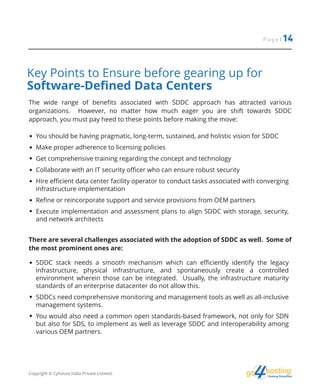
Automated and Streamlined Operations
This helps in enhancing the operational efficiency, as it facilitates
administrators to spend more of their valuable time on value-added initiatives.
Virtualization and Unified Hybrid Cloud Extensibility
SDDC helps in significantly reducing the overall CapEx and OpEx by
standardizing various services on logical resources, besides simplifying the
data center footprint.
Application and Infrastructure Delivery Automation
This helps in delivering holistic IT services on demand.
Robust Security Controls
This is yet another favorable outcome that SDDC has delivered. With
micro-segmentation, it helps in shifting security controls from perimeter
defense to fine-grained isolation.
Resilient Infrastructure and High Availability
SDDC simplifies the architecture which was needed to support automation
and continuity of various disaster recovery processes.
SDDC also enables organizations in delivering resilient and secure services, and this
happens primarily because of:
Copyright © Cyfuture India Private Limited.
hostingHosting Simplified
go
Page | 14
Key Points to Ensure before gearing up for
Software-Defined Data Centers
The wide range of benefits associated with SDDC approach has attracted various
organizations. However, no matter how much eager you are shift towards SDDC
approach, you must pay heed to these points before making the move:
You should be having pragmatic, long-term, sustained, and holistic vision for SDDC
Make proper adherence to licensing policies
Get comprehensive training regarding the concept and technology
Collaborate with an IT security officer who can ensure robust security
Hire efficient data center facility operator to conduct tasks associated with converging
infrastructure implementation
Refine or reincorporate support and service provisions from OEM partners
Execute implementation and assessment plans to align SDDC with storage, security,
and network architects
•
•
•
•
•
•
•
SDDC stack needs a smooth mechanism which can efficiently identify the legacy
infrastructure, physical infrastructure, and spontaneously create a controlled
environment wherein those can be integrated. Usually, the infrastructure maturity
standards of an enterprise datacenter do not allow this.
SDDCs need comprehensive monitoring and management tools as well as all-inclusive
management systems.
You would also need a common open standards-based framework, not only for SDN
but also for SDS, to implement as well as leverage SDDC and interoperability among
various OEM partners.
•
•
•
There are several challenges associated with the adoption of SDDC as well. Some of
the most prominent ones are:
Copyright © Cyfuture India Private Limited.
Page | 15
hostingHosting Simplified
go
Conclusion
Software-Defined Data Center (SDDC) is based on the concept of virtualization and
automation. One of the most beneficial aspects associated with the implementation of
this approach is that organizations would no longer be compelled to replace their existing
IT infrastructure. Organizations can adopt SDDC technologies as per their convenience
and at their own pace.
The concept of software defined architecture as well as software defined datacenter
enable IT to adopt a unified hybrid cloud strategy, besides enabling organizations to
procure favorable outcomes in terms of security as well as efficiency. Considering these
advantages, it can be inferred that the acceptability of this approach would only grow with
the passage of time.
Copyright © Cyfuture India Private Limited.

Software defined data center

  • 1.
    SOFTWARE DEFINED DATA CENTERS Thefuture belongs to hostingHosting Simplified go
  • 2.
    Introduction What is SDDC? Needfor Software-Defined Architecture Challenges Faced by Traditional Hardware-Centric Datacenters Emergence of Software-Defined Infrastructure SDN: Future of Networking SDS: Future of Storage How Software-Defined Architecture Helps in Limiting Overhead Expenses Needs of a Software-Defined Storage System How SDDC Enables Unified Hybrid Cloud IT What CIOs need to know? Outcomes of an SDDC approach Key Points to Ensure before gearing up for Software-Defined Data Centers Conclusion Copyright © Cyfuture India Private Limited. Contents 1 2 3 4 5 6 7 8 9 10 11 12 13 hostingHosting Simplified go
  • 3.
    Page | 1 Copyright© Cyfuture India Private Limited. hostingHosting Simplified go Software-defined data centers (SDDC) is being hailed as the next big thing in the realm of IT infrastructure. One of the prime reasons for this increased interest in SDDC by a growing number of CIOs and CTOs can be attributed to the success and increased adoption of cloud computing in recent times. Although there is lot of ongoing deliberation by C-suites executives at the moment on the adoption of SDDCs for their organizations, it is yet to attain increased acceptance in the realms of business. Like all new technologies that are met with reluctance initially, SDDC too is currently transitioning the initial product cycle phase. SDDC is an integrated platform that enables organizations to mark a radical shift in the way they consume IT services. It offers unprecedented flexibility, efficiency, and automation. Software-defined data centers bestow just the right set of capabilities to propel organizations towards business growth. Some may argue that SDDC is an extended version of the same old and conventional data centers which were hardware centric. Although their argument holds significance to some extent, SDDC is much more agile, secure, and flexible in comparison to conventional data centers. Considering these advantages of software-defined data centers over conventional hardware centric data centers, various organizations have started embracing this new technology. Introduction
  • 4.
    hostingHosting Simplified go What isSDDC? Page | 2 SDDC is a data storage facility where all components of infrastructure, namely storage, networking, security, and CPU, are virtualized and delivered as service. The tasks associated with provisioning, operation, configuration, and deployment of the entire infrastructure are abstracted from hardware, and are solely implemented through software. Using the SDDC approach, application layer can be abstracted from the physical infrastructure layer, which further facilitates a wide scope of uses, including managing, computing, storing, networking, and deploying various business applications as well as infrastructure components in a cloud environment. There are three main building blocks of software defined data center, and those are : NETWORK VIRTUALIZATION In computing, network virtualization is defined as the process of combining software and hardware network resources as well as network functionality into one software-based administrative entity. This is a method of integrating all the resources in a network by dividing the bandwidth into various channels. Each of those channels is independent from others, and can further be assigned or reassigned to any device or server in real time. SERVER VIRTUALIZATION Server virtualization is the masking of server resources, including the identity as well as number of various individual physical servers, operating systems, and processors, from server users. The server administrator makes use of one software application to split a physical server into various virtual environments. STORAGE VIRTUALIZATION This is the method of integrating storage from various devices into a single storage device that can be managed or monitored from a central console. Storage virtualization enables better and enhanced functionality as well as more advanced features in data storage systems. Copyright © Cyfuture India Private Limited.
  • 5.
    hostingHosting Simplified go Need for Software-Defined Architecture Page| 3 Virtualization not only helps in decoupling or separating workloads from hardware, but also makes the overall data center services inexpensive and convenient to consume, configure, or manage. More importantly, SDDC brings governance, operations, and automation to IT through a unified cloud management framework. As cloud management platform is deeply integrated with virtualization layer, it offers comprehensive automation and operations to a data center environment, which further makes it possible to efficiently orchestrate monitoring, management, and provisioning across all the workloads and infrastructures of SDDC. In an SDDC, software abstraction virtualizes most of the datacenter components, including storage, networking, and computing, whereas infrastructure management functions are controlled by policy-driven software. Using the SDDC approach, several critical network functions, such as load balancing, switching, or even routing, can be performed using software, instead of hardware. This not only helps in creating application-based or service-based environment, but also in increasing the agility of datacenters exponentially. As a result, this concept – SDDC – has successfully been able to garner immense popularity and acceptability in the business world. For organizations across domains, technology plays a major role in conceptualizing, planning, as well as implementing various result-oriented business initiatives. As mobile services and public cloud have successfully been able to enhance Line-of-Business expectations, IT companies struggle to keep pace with the rising expectations. Owing to IT incapability to meet the rising business expectations, organizations often have to shell out huge amount of resources. Copyright © Cyfuture India Private Limited.
  • 6.
    hostingHosting Simplified go Page |4 To cut down the expenditures on technology as well as to efficiently capitalize on the sea of business opportunities, it is very important for CIOs to develop a result-oriented approach. CIOs must incorporate an efficient IT strategy that can meet the rising demand. IT must act as strategic partner for an organization, and Software-Defined Architecture ensures that. Being a strategic partner to organizations, IT must build credibility besides being a business enabler. It should deliver secure, efficient, flexible IT services, and should become a service broker to both public cloud as well as private cloud services, which can be clubbed under one management and functional framework. This is also termed as “hybrid cloud,” and the software-defined architecture makes it possible. It defines a platform common to both public and private clouds. To define every infrastructure service, software defined data centers implement the computer science principles of server utilization, which is entirely based on pooling, isolation, and abstraction, to the rest of the infrastructure services. The management and monitoring process of SDDC is automated with the help of a cloud management platform to control both off-premises as well as on-premise resources. Who does not know the significance of an agile and robust datacenter? With the ever increasing demand as well as dependency on IT services, the time has come to offer on-demand services that are elastic and secure in nature. One of the reasons, traditional datacenters and methodologies, which took significant time to procure and provision, are almost at the verge of becoming a thing of the past! At present, organizations leave no stone unturned to make their IT infrastructure agile and flexible, and for the same purpose, they have started designing as well as operating their own datacenters. They aspire to deliver private cloud based services which are similar to that of leading and renowned public cloud service providers. Now, the question arises whether it can be accomplished using the conventional approach? Challenges Faced by Traditional Hardware-Centric Datacenters Copyright © Cyfuture India Private Limited.
  • 7.
    hostingHosting Simplified go Page |5 No doubt that conventional data centers have successfully been able to meet the business requirements for over decades; however, the recent shifts in business approaches, advent of multiple mission-critical functions, and acceptance of e-commerce websites in the business world have made it difficult for hardware-centric datacenters to stand tall on these expectations. Out of all the challenges faced by traditional hardware-centric datacenters, three of the most common ones are: These challenges have compelled IT leaders to ponder upon inducing the concepts of software-defined infrastructure (SDI) into the overall datacenter architecture. The architecture of conventional datacenter is predominantly based on vendor-specific software and hardware dependencies. This not only gives rise to proprietary technologies, but limits the flexibility of datacenters. Copyright © Cyfuture India Private Limited. In traditional datacenters, equipment vendors dictate the refresh cycle for network as well as storage equipment. This has influential impact on speed of datacenter innovation as well as on its scalability. Most datacenter equipments in hardware - specific datacenters require manual configuration and arrangement.
  • 8.
    hostingHosting Simplified go Page |6 One of the major concerns for CIOs and CTOs across industrial domains is how to make their IT infrastructure more adaptable and flexible according to ever changing application environment. Besides this, they are also laden with the responsibilities of minimizing their overhead expenditures in this regard. To meet all these requirements, the concept of Software-Defined Infrastructure has emerged as the most idyllic solution. Software Defined Infrastructure (also referred to as “SDI”) is defined as a computing infrastructure which is entirely controlled by software, without any interference from any operator. It is not at all dependent upon any hardware-specific dependencies. As conventional architecture of datacenter - based on hardware technologies - is not at all agile, most business leaders are looking forward to this new trend. Using the traditional network infrastructure, it is not at all feasible to meet the growing demands of cloud computing as well as application bandwidth, besides managing a complex traffic patterns. Some of the key issues associated with conventional network infrastructures are: Emergence of Software-Defined Infrastructure Copyright © Cyfuture India Private Limited.
  • 9.
    hostingHosting Simplified go Page |7 Some of the major factors that have made the traffic pattern complex are cloud computing and high-bandwidth applications. It must be ensured that data is accessible from anywhere, anytime, and nobody has time to wait on a slow network. Although, security still holds the paramount importance, one has to manage and monitor various other aspects to ensure that the ever increasing demands of consumers are met with pertinent support. The virtualization approach has made most servers and storage agile as well as automated; however, the demands on network are hugely dependent upon complex provisioning and configuration. This not only is time-consuming, but also enhances the probabilities of human errors or security risks. To keep up with constantly scaling demands as well as requirements, it is very important to make the network more responsive. Incapability to meet the Rising Demands Complex Provisioning and Configuration The ever increasing demands on network compel businesses to embrace next generation networking - Software Defined Networking. Various organizations have embraced SDN to capitalize on the opportunities that new and emerging technologies bestow. The prime goal of SDN is to simplify the network by implementing automated configuration process. Using the SDN approach, IT teams can conveniently configure the systems, located at distant zones, from one central controller. Thus, they are no more compelled to manually configure various switches, routers, firewalls, or access points. In essence, considering the wide range of advantages that SDN has in store, it can be easily deduced that it is a comprehensive next-generation networking solution. SDN: Future of Networking Copyright © Cyfuture India Private Limited.
  • 10.
    hostingHosting Simplified go Page |8 SDS: Future of Storage Software-Defined Storage is a revolutionary approach to data storage wherein programming which controls storage related tasks is decoupled from physical storage hardware. This helps in managing policy-based provisioning as well as management of data independent of the remaining hardware. Using this approach, IT organizations can pay much more emphasis on storage-related services, rather than spending their time on hardware. This enables organizations to use storage resource more efficiently, and its administration can be simplified as well as conveniently managed through automated policy-based management. In essence, it would not be an exaggeration to claim that SDS is future-ready data storage approach. How Software-Defined Architecture Helps in Limiting Overhead Expenses Software-Defined Architecture is an evolving concept which has various advantages over conventional hardware-centric approach. It offers unblemished and unique functionality, in conjunction with enriched utilization and management of resources; higher range of flexibility; and enhanced cost-efficiency. Conventional hardware-centric datacenters are mostly based on proprietary hardware and application silos which compel organizations to shell out huge amount of money on equipment costs as well as on manual operations. With the advent of virtualization, data center economic has been improved substantially. Using this approach, various applications are consolidated into fewer server hosts, which further paves way for reduced CapEx and OpEx. This approach also facilitates organizations with the choice of making their storage capacity flexible without being much bothered about CapEx budget. Therefore, several IT companies leverage this approach to induce efficient management systems for various types of workloads as well as to drive aggressive cost savings. Copyright © Cyfuture India Private Limited.
  • 11.
    hostingHosting Simplified go Page |9 Needs of a Software-Defined Storage System The advent of a revolutionary concept - software-defined storage - has marked a new era, where each enterprise is looking forward to enhancing its cost-efficiency, agility, and scalability, as well as minimizing the overall complexity. Clearly, the acceptability of SDS would only increase in future, and various organizations would keenly make the move towards this new concept which is future-ready. However, before building an IT platform which offers SDS solution, one must keep the following things in mind Opt for application-optimized solutions You must team-up with those service providers which provide turnkey solutions for various uses. The pre-configured solutions help you minimize deployment cost as well as time. Multiple hypervisor support SDS systems should not only be competent to support your current hypervisors, but must also be flexible. An IT platform with open standards can further add flexibility which is a must to adapt to changing business requirements or diverse environments. Global and impeccable service and support provisions In lieu of decoupling software and hardware, you cannot afford to complicate service and support provisions. You should always consider the services of a provider that can offer one-stop solution for both software and hardware related issues. Workload-appropriate configurations You must pay special attention to this factor, and consider the software which has policy-based tiering and hardware Copyright © Cyfuture India Private Limited.
  • 12.
    hostingHosting Simplified go Page |10 Comprehensive management and monitoring One opts for SDS approach to automate a multifaceted environment. Therefore, you should choose integrated solutions that can help you to efficiently manage as well as monitor various networking components, storage, and servers. How SDDC Enables Unified Hybrid Cloud IT The advent of software defined data center in cloud-centric world has brought a drastic change in the way data is managed or stored. An entirely software-defined and software-led data center can bring a radical change in the way IT infrastructure works. The architecture of software defined data center makes the hybrid cloud not only imaginable but also possible by defining a platform which is common to both public and private clouds. The SDDC applies the computer science principles of server virtualization - abstraction, isolation, and pooling - to each and every infrastructure service. The management of SDDC is automated through a unified cloud management framework or platform. This further helps in controlling, monitoring, and managing both on-premises and off-premises resources. Thus, the concept of SDDC facilitates IT with the choice of using a hybrid cloud strategy under a unified management framework. What CIOs need to know? Infrastructure in a software-defined data center is entirely virtualized; this not only includes physical servers, but also storage arrays and networking gears. This concept helps in decoupling hardware’s workload, besides making it convenient and economical for businesses to consume, manage or avail data center services. However, to capitalize on the sea of business opportunities that this concept has in store, CIOs must first of all develop a basic understanding regarding its technological capabilities. Copyright © Cyfuture India Private Limited.
  • 13.
    Page | 11 hostingHostingSimplified go Why SDDC approach should be preferred over conventional data center SDDC enables IT teams to tackle the issues that they have been facing with the conventional hardware-centric model. SDDC model is entirely based on the concept of virtualization, which helps in bringing together multiple aspects of IT environment, be it compute, networking, storage or management platform. In the SDDC approach, various IT assets are monitored and managed by software. As software is innately faster and much more flexible than hardware, one can conveniently increase its business value. The SDDC approach also bestows higher degree of liberation in the IT infrastructure design, as it offers various options for distinct types of hardware scenarios. SDDC also helps organizations in minimizing their investments on inheritance hardware, as it does not compel businesses to upgrade or refresh their infrastructure with the passage of time. The relationship between The SDDC and hybrid cloud The hybrid cloud model is a universe where the business world would dwell for decades to come. Industry analysts and experts predict that by 2020, more than 75% of IT expenditures would be centered on private cloud. Considering the long term solution, businesses need an impeccable industrial-grade hybrid solution, which can further enable them to utilize the fluid pool of outside and inside resources efficiently. In this circumstance, the combination of hybrid cloud and SDDC approach can enable IT teams to seamlessly thrive in the hybrid world. Therefore, SDDC is regarded as the architectural base for unified hybrid cloud model. This enables organizations to execute and provision their apps flawlessly in on-premises private cloud. IT teams across the globe aspire to extend their capabilities and potential to public cloud; however, they prefer using the same conventional tools they are familiar with. Moreover, they also demand the same network and security protocols. That’s where SDDC architecture takes the center stage, as it bridges the gap between on-premises and off-premises IT assets. Copyright © Cyfuture India Private Limited.
  • 14.
    Page | 12 hostingHostingSimplified go Significance of SDDC approach in bridging the gap between IT and business The SDDC approach facilitates users with the option of getting instant access to the services and apps they are interested in. They can conveniently resolve their issues with the help of a few mouse clicks on a self-service portal. Thus, SDDC approach enables CIOs to bring a fundamental shiftin their IT-as-a-Service (ITaaS). Things that CIOs must know and do about SDDC The best data center architecture that is available for IT firms today is SDDC. If an IT firm is looking forward to accelerating their app delivery, in conjunctions with serving as strategic partner to organizations, then SDDC approach is the most idyllic solution which can help you to attain your goals. CIOs must consider SDDC as a core part of their overall cloud strategy. The SDDC is specifically designed to bridge the gap between on-premises and off-premises IT assets. Hence, it further guarantees higher business innovation and agility. Outcomes of an SDDC approach SDDC enables organizations to efficiently utilize their resources in the tasks related to innovation and business growth. SDDC enhances overall organizational efficiency and ensures that the roles of IT cometo forth in terms of launching new and innovative business projects. Some of the most favorable outcomes that have enabled organizations to widen their IT prospects are: Copyright © Cyfuture India Private Limited.
  • 15.
    Page | 13 hostingHostingSimplified go Automated and Streamlined Operations This helps in enhancing the operational efficiency, as it facilitates administrators to spend more of their valuable time on value-added initiatives. Virtualization and Unified Hybrid Cloud Extensibility SDDC helps in significantly reducing the overall CapEx and OpEx by standardizing various services on logical resources, besides simplifying the data center footprint. Application and Infrastructure Delivery Automation This helps in delivering holistic IT services on demand. Robust Security Controls This is yet another favorable outcome that SDDC has delivered. With micro-segmentation, it helps in shifting security controls from perimeter defense to fine-grained isolation. Resilient Infrastructure and High Availability SDDC simplifies the architecture which was needed to support automation and continuity of various disaster recovery processes. SDDC also enables organizations in delivering resilient and secure services, and this happens primarily because of: Copyright © Cyfuture India Private Limited.
  • 16.
    hostingHosting Simplified go Page |14 Key Points to Ensure before gearing up for Software-Defined Data Centers The wide range of benefits associated with SDDC approach has attracted various organizations. However, no matter how much eager you are shift towards SDDC approach, you must pay heed to these points before making the move: You should be having pragmatic, long-term, sustained, and holistic vision for SDDC Make proper adherence to licensing policies Get comprehensive training regarding the concept and technology Collaborate with an IT security officer who can ensure robust security Hire efficient data center facility operator to conduct tasks associated with converging infrastructure implementation Refine or reincorporate support and service provisions from OEM partners Execute implementation and assessment plans to align SDDC with storage, security, and network architects • • • • • • • SDDC stack needs a smooth mechanism which can efficiently identify the legacy infrastructure, physical infrastructure, and spontaneously create a controlled environment wherein those can be integrated. Usually, the infrastructure maturity standards of an enterprise datacenter do not allow this. SDDCs need comprehensive monitoring and management tools as well as all-inclusive management systems. You would also need a common open standards-based framework, not only for SDN but also for SDS, to implement as well as leverage SDDC and interoperability among various OEM partners. • • • There are several challenges associated with the adoption of SDDC as well. Some of the most prominent ones are: Copyright © Cyfuture India Private Limited.
  • 17.
    Page | 15 hostingHostingSimplified go Conclusion Software-Defined Data Center (SDDC) is based on the concept of virtualization and automation. One of the most beneficial aspects associated with the implementation of this approach is that organizations would no longer be compelled to replace their existing IT infrastructure. Organizations can adopt SDDC technologies as per their convenience and at their own pace. The concept of software defined architecture as well as software defined datacenter enable IT to adopt a unified hybrid cloud strategy, besides enabling organizations to procure favorable outcomes in terms of security as well as efficiency. Considering these advantages, it can be inferred that the acceptability of this approach would only grow with the passage of time. Copyright © Cyfuture India Private Limited.