What are the types of cloud computing
What is the cloud? Where is the cloud? Are we in the cloud now? These are all
questions you've probably heard or even asked yourself. The term "cloud
computing" is everywhere.
In the simplest terms, cloud computing means storing and accessing data and
programs over the Internet instead of your computer's hard drive. Although you do
not realize you are probably using cloud computing right now, most of us use an
online service to send email, edit documents, watch movies, etc. It is likely that cloud
computing is making it all possible behind the scenes. When we speak about the
cloud computing it’s really necessary to understand the types of cloud computing
that customers can adopt and existing. Let’s have a deeper look into this. Generally
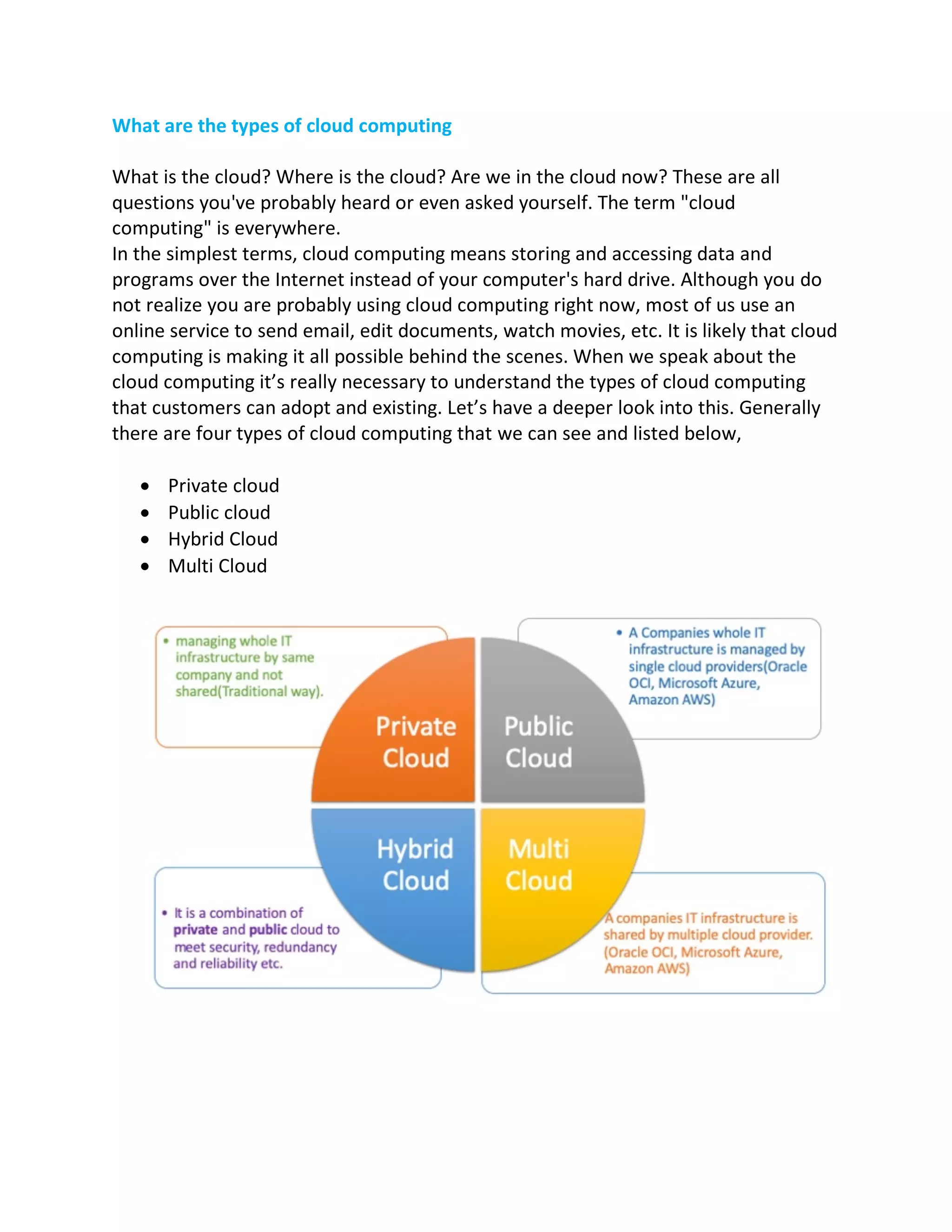
there are four types of cloud computing that we can see and listed below,
• Private cloud
• Public cloud
• Hybrid Cloud
• Multi Cloud
Private Cloud
Private cloud is nothing but the traditional way of delivering service. When a
company requires a particular IT function they purchases the supporting products,
equipment, installation, configuration and delivering the services to company users.
This is the typical way that happens in private cloud. It provides the most secure,
convenient and control over IT infrastructure since all these are individually designed
and maintained by you. There is lot of cost involved in this structure since this is for
dedicated use of a single organization. This model is also known as internal cloud or
corporate cloud.
An example of private cloud can be , let us consider the scenario that an
international bank is expanding their functional role and need the software Oracle
FLEXCUBE to be installed and configured. From bank’s side they consider the security
perspective by not willing to install anywhere else than in their data center. So they
purchase new server, storage system, networking devices and everything as per their
needs. These hardware will be installed and configured in their data center and
finally FLEXCUBE will also be installed on this. This is a typical scenario of private
cloud.
Public Cloud
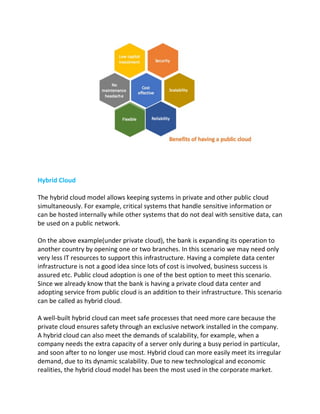
A public cloud is where an independent, third-party provider, such as Amazon Web
Services (AWS) or Microsoft Azure, Oracle OCI owns and maintains compute
resources that customers can access over the internet. Public cloud users share these
resources, a model known as a multi-tenant environment. In this scenario a single
resource can be divided into multiple customers and not dedicatedly for a single
customer. These are more cost effective solution and less administrative headaches
for enterprises. Top public cloud providers are Oracle OCI, Microsoft Azure, Amazon
web services, Google cloud platform etc.
Let’s us take an example that you are starting a new business where you need to
have high security and compute power to use the applications related to your
organization. You won’t be able to build your own data center at a glance due to
time consumption, high capital investment, more administrative headaches etc. The
best option here is to have public cloud support to avoid all these issues and expect a
best IT infrastructure for your company.
Hybrid Cloud
The hybrid cloud model allows keeping systems in private and other public cloud
simultaneously. For example, critical systems that handle sensitive information or
can be hosted internally while other systems that do not deal with sensitive data, can
be used on a public network.
On the above example(under private cloud), the bank is expanding its operation to
another country by opening one or two branches. In this scenario we may need only
very less IT resources to support this infrastructure. Having a complete data center
infrastructure is not a good idea since lots of cost is involved, business success is
assured etc. Public cloud adoption is one of the best option to meet this scenario.
Since we already know that the bank is having a private cloud data center and
adopting service from public cloud is an addition to their infrastructure. This scenario
can be called as hybrid cloud.
A well-built hybrid cloud can meet safe processes that need more care because the
private cloud ensures safety through an exclusive network installed in the company.
A hybrid cloud can also meet the demands of scalability, for example, when a
company needs the extra capacity of a server only during a busy period in particular,
and soon after to no longer use most. Hybrid cloud can more easily meet its irregular
demand, due to its dynamic scalability. Due to new technological and economic
realities, the hybrid cloud model has been the most used in the corporate market.
Multi Cloud
As Cloud technology moves to the mainstream and companies grow more
comfortable in their new cloudy world, many businesses recognize that not all
Clouds are created equal, and employ multiple Cloud solutions to maximize the
benefits they can reap from the technology. Others adopt a Multi Cloud solution to
minimize their dependence on any one provider, and ensure they’re not locked into
a single contract, lest they miss out on some new development from a competing
Cloud provider.
Let’s consider the example that Oracle databases are one of the strongest available
today and they provide SAAS based public cloud solutions. But in the case of IT
infrastructure based Amazon AWS is most affordable to have it. In this case you can
purchase the SAAS product from Oracle and IAAS related services from Amazon
AWS. This scenario can be considered as multi cloud environment. Does that make
sense to you?
Is it Public Cloud then? Or Private? Not necessarily either. A Multi Cloud strategy can
employ Public, Private or Hybrid Cloud solutions, depending on the needs of
individual companies. Basically, organizations relying on a Multi Cloud solution may
be using Hybrid Cloud – in many cases, they are – but Multi Cloud does not
automatically mean they must be using Hybrid.
Isn’t Hybrid Cloud Automatically Multi-Cloud?
Nope. Hybrid Cloud refers to the strategy of using any two types of Cloud or hosting
infrastructure in a single organization. Some Hybrid Cloud solutions use Public and
Private Cloud to gain power and scalability while maintaining security. Some may use
colocation servers to address redundancy and stability concerns. Other hybrid
solutions may leverage dedicated servers for customized performance – the beauty
of hybrid is that there are many combinations to choose from, meaning every
company can find a solution that meets their specific needs.
Still sounds like Multi Cloud to you? Remember, a Multi Cloud solution is one where
different Clouds from different providers are used for separate tasks. Hybrid Cloud is
more like creating a solution that uses more than one Cloud or server option to
perform a task that accesses both. One could say that in a Hybrid environment, the
data gets intermingled between two different hosting infrastructure types, while in
Multi Cloud, you are simply using multiple Clouds.
Community Cloud
Last but not least is community cloud. I know that this is not listed above since this is
no so adopted by companies. But let’s have a consideration and understanding of
this model too. The community cloud service shares among various organizations
and companies which belong to the same community with the common concerns.
This can manage either by the third party or internally.
Let me explain you the same with an example. There are organizations which require
the application, which is available at one set of cloud servers. So, the company which
are allowing multiple servers will not provide a particular server in the cloud. But
they will allow multiple customers to connect to the cloud and segment their
sessions. In this, the customer will use the same hardware the other customers are
using. It simply means that servers are using the same application which makes it a
community cloud.
Organizations having similar computing concern and have shared interest can share
it. This type of cloud computing is best compatible with ventures, business
organizations, research organizations, and tenders. This benefits the user of
community cloud to know and analyze the business demand first. The presence of
the community cloud can be either onsite or offsite.
Have a comment or points to be review? Knowledge is power and it increases by
sharing. Feel free to comment.

What are the types of cloud computing

  • 1.
    What are thetypes of cloud computing What is the cloud? Where is the cloud? Are we in the cloud now? These are all questions you've probably heard or even asked yourself. The term "cloud computing" is everywhere. In the simplest terms, cloud computing means storing and accessing data and programs over the Internet instead of your computer's hard drive. Although you do not realize you are probably using cloud computing right now, most of us use an online service to send email, edit documents, watch movies, etc. It is likely that cloud computing is making it all possible behind the scenes. When we speak about the cloud computing it’s really necessary to understand the types of cloud computing that customers can adopt and existing. Let’s have a deeper look into this. Generally there are four types of cloud computing that we can see and listed below, • Private cloud • Public cloud • Hybrid Cloud • Multi Cloud
  • 2.
    Private Cloud Private cloudis nothing but the traditional way of delivering service. When a company requires a particular IT function they purchases the supporting products, equipment, installation, configuration and delivering the services to company users. This is the typical way that happens in private cloud. It provides the most secure, convenient and control over IT infrastructure since all these are individually designed and maintained by you. There is lot of cost involved in this structure since this is for dedicated use of a single organization. This model is also known as internal cloud or corporate cloud. An example of private cloud can be , let us consider the scenario that an international bank is expanding their functional role and need the software Oracle FLEXCUBE to be installed and configured. From bank’s side they consider the security perspective by not willing to install anywhere else than in their data center. So they purchase new server, storage system, networking devices and everything as per their needs. These hardware will be installed and configured in their data center and finally FLEXCUBE will also be installed on this. This is a typical scenario of private cloud. Public Cloud A public cloud is where an independent, third-party provider, such as Amazon Web Services (AWS) or Microsoft Azure, Oracle OCI owns and maintains compute resources that customers can access over the internet. Public cloud users share these resources, a model known as a multi-tenant environment. In this scenario a single resource can be divided into multiple customers and not dedicatedly for a single customer. These are more cost effective solution and less administrative headaches for enterprises. Top public cloud providers are Oracle OCI, Microsoft Azure, Amazon web services, Google cloud platform etc. Let’s us take an example that you are starting a new business where you need to have high security and compute power to use the applications related to your organization. You won’t be able to build your own data center at a glance due to time consumption, high capital investment, more administrative headaches etc. The best option here is to have public cloud support to avoid all these issues and expect a best IT infrastructure for your company.
  • 3.
    Hybrid Cloud The hybridcloud model allows keeping systems in private and other public cloud simultaneously. For example, critical systems that handle sensitive information or can be hosted internally while other systems that do not deal with sensitive data, can be used on a public network. On the above example(under private cloud), the bank is expanding its operation to another country by opening one or two branches. In this scenario we may need only very less IT resources to support this infrastructure. Having a complete data center infrastructure is not a good idea since lots of cost is involved, business success is assured etc. Public cloud adoption is one of the best option to meet this scenario. Since we already know that the bank is having a private cloud data center and adopting service from public cloud is an addition to their infrastructure. This scenario can be called as hybrid cloud. A well-built hybrid cloud can meet safe processes that need more care because the private cloud ensures safety through an exclusive network installed in the company. A hybrid cloud can also meet the demands of scalability, for example, when a company needs the extra capacity of a server only during a busy period in particular, and soon after to no longer use most. Hybrid cloud can more easily meet its irregular demand, due to its dynamic scalability. Due to new technological and economic realities, the hybrid cloud model has been the most used in the corporate market.
  • 4.
    Multi Cloud As Cloudtechnology moves to the mainstream and companies grow more comfortable in their new cloudy world, many businesses recognize that not all Clouds are created equal, and employ multiple Cloud solutions to maximize the benefits they can reap from the technology. Others adopt a Multi Cloud solution to minimize their dependence on any one provider, and ensure they’re not locked into a single contract, lest they miss out on some new development from a competing Cloud provider. Let’s consider the example that Oracle databases are one of the strongest available today and they provide SAAS based public cloud solutions. But in the case of IT infrastructure based Amazon AWS is most affordable to have it. In this case you can purchase the SAAS product from Oracle and IAAS related services from Amazon AWS. This scenario can be considered as multi cloud environment. Does that make sense to you? Is it Public Cloud then? Or Private? Not necessarily either. A Multi Cloud strategy can employ Public, Private or Hybrid Cloud solutions, depending on the needs of individual companies. Basically, organizations relying on a Multi Cloud solution may be using Hybrid Cloud – in many cases, they are – but Multi Cloud does not automatically mean they must be using Hybrid. Isn’t Hybrid Cloud Automatically Multi-Cloud? Nope. Hybrid Cloud refers to the strategy of using any two types of Cloud or hosting infrastructure in a single organization. Some Hybrid Cloud solutions use Public and Private Cloud to gain power and scalability while maintaining security. Some may use colocation servers to address redundancy and stability concerns. Other hybrid solutions may leverage dedicated servers for customized performance – the beauty of hybrid is that there are many combinations to choose from, meaning every company can find a solution that meets their specific needs. Still sounds like Multi Cloud to you? Remember, a Multi Cloud solution is one where different Clouds from different providers are used for separate tasks. Hybrid Cloud is more like creating a solution that uses more than one Cloud or server option to perform a task that accesses both. One could say that in a Hybrid environment, the
  • 5.
    data gets intermingledbetween two different hosting infrastructure types, while in Multi Cloud, you are simply using multiple Clouds. Community Cloud Last but not least is community cloud. I know that this is not listed above since this is no so adopted by companies. But let’s have a consideration and understanding of this model too. The community cloud service shares among various organizations and companies which belong to the same community with the common concerns. This can manage either by the third party or internally. Let me explain you the same with an example. There are organizations which require the application, which is available at one set of cloud servers. So, the company which are allowing multiple servers will not provide a particular server in the cloud. But they will allow multiple customers to connect to the cloud and segment their sessions. In this, the customer will use the same hardware the other customers are using. It simply means that servers are using the same application which makes it a community cloud. Organizations having similar computing concern and have shared interest can share it. This type of cloud computing is best compatible with ventures, business organizations, research organizations, and tenders. This benefits the user of community cloud to know and analyze the business demand first. The presence of the community cloud can be either onsite or offsite.
  • 6.
    Have a commentor points to be review? Knowledge is power and it increases by sharing. Feel free to comment.