BE-ODL social software

Loading...

Flash Player 9 (or above) is needed to view presentations.
We have detected that you do not have it on your computer. To install it, go here.

1 comments

Comments 1 - 1 of 1 previous next Post a comment

  • + dukados dukados 3 years ago
    Dag Barcus,

    ik heb genoten van je inspirerende spreekstijl. Nog een overtuigde web2.0’er in het onderwijs. Fijn zo.

    keep the missioners work going.


    Maar we moeten toch eens een boompje opzetten over hoe je nu effectief en efficient web2.0-tools op didactische manier concreet inzet... want daar zoek ik nog steeds naar.
Post a comment
Embed Video
Edit your comment Cancel

1 Favorite

BE-ODL social software - Presentation Transcript

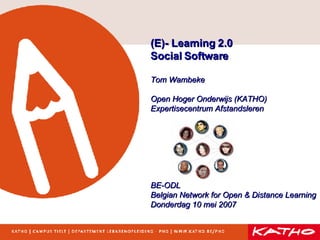
  1. (E)- Learning 2.0 Social Software Tom Wambeke Open Hoger Onderwijs (KATHO) Expertisecentrum Afstandsleren BE-ODL Belgian Network for Open & Distance Learning Donderdag 10 mei 2007
  2.  
  3. AGENDA
    • Introductie
    • De netgeneratie: “Veranderen wij?”
    • Web2.0: “Verandert internet?”
    • Cases en praktische voorbeelden
    • Kenmerken en SWOT-analyse
    • Conclusies
  4.  
  5. Enquête
    • Wie kent weblogs ?
    • Wie leest weblogs?
    • Wie schrijft een blog?
    • Wie kent wiki’s ?
    • Wie gebruikt wiki’s?
    • Wie gebruikt RSS?
  6. Wij veranderen?
  7.  
  8.  
  9.  
    • There is a different kind of logic at work (Frand, 2000, ‘ the information age mindset ’)
      • …………… .. is NOT technology
      • …………… .. replaces TV
      • ………… .… is better than writing
      • …………… ..…… is a way of life
      • ………… ... is more important than knowing
      • ................................................................is essential, always-everywhere
      • ……………………………… .. is preferred to conventional logic
      • Computer
      • Internet
      • Typing
      • Multitasking
      • Doing
      • Connectivity and communication
      • Nintendo (trial and error)
  10.  
  11.  
  12. Internet verandert
    • Web1
    • Web2
    • Web3
  13.  
  14. Enkele achterliggende trends
    • Online society: altijd en overal toegang
    • Creatie van communities / netwerken
    • Ieder zijn eigen medium, ieder zijn eigen bron
    • Krachtige media in marketing- & communicatiematrix (cf. van broadcoasting naar narrowcasting)
  15. De grote ideeën achter web2.0
    • User generated Content
    • Wisdoms of the Crowds
    • Do it Yourself. The rise of the amateur
    • Folksonomy
    • Architecture of participation
    • Architecture of openess
    • The network effect
  16. Web2.0: What’s in a name ?
    • Tim O’Reilly
    • Stephen Downes, Danah Boyd, George Siemens
    • Digitale renaissance of hype/buzz?
    • evolutie / revolutie?
    • Netwerk
    • Op zoek naar een definitie
    • Sociale software = sociaal netwerken
    • Laat je toe om jouw schrijfsels, gedachten, video’s, muziek, foto’s te delen met anderen
    • Community-aspect staat centraal en schetst de contouren van een (vernieuwd) informatie- en participatiemodel
    • Niet de informatie maar de mens en de relatie staan centraal
  17. Social software
    • TOOL (for augmenting social and collaborative abilities)
    • MEDIUM (for facilitating social connection and information inter exchange)
    • ECOLOGY (for enabling a system of people, practices, values and technologies in a particular social envirmonment).
  18.  
  19.  
  20.  
  21. Gevarieerd arsenaal aan Tools
    • Blogs
    • Wiki
    • Fora
    • Podcast (profcast), vodcast
    • Social Bookmarking
    • Virtual worlds (Second life)
    • Instant Messaging
    • Social network services
    • Collaborative realtime editing
  22.  
  23.  
  24.  
  25.  
  26.  
  27.  
  28.  
  29.  
  30.  
  31.  
  32.  
  33.  
  34.  
  35.  
  36.  
  37.  
  38. Kenmerken
    • Architectuur van een (sociaal) netwerk (interactie – sociale connectie tussen gebruikers) – learning as a network phenomenon (Siemens) – social communities
    • Van statische naar dynamische content (snelheid)
    • Ubiquity: informatienetwerk van iedereen (content creatie van internetgebruikers) voor iedereen (democratisering van internet) – wisdom of crowds
    • Personalisatie (My Web2.0) – the personal learning center: hypercustomisatie op individueel niveau
    • Beoordeling en reactie van internetgebruikers / rating/rankings/trackbacks/opbouwen van een reputatie
  39. vervolg
    • Van hierarchische classificatie (taxonomie) naar ‘folksonomy’
    • Zeer goede gebruiksinterfaces, zeer laagdrempelig, gemakkelijk te hanteren
    • Small pieces loosely joint (Downes), geen allesomvattende oplossingen meer – decentralisering
    • Netwerk van interactie (aggregatie / syndicatie / remixen / FFF = finding, filtering forwarding
    • Self-service: participation: Do it Yourself
    • Vaak webgebaseerd, veel BETA-versies, vaak (grotendeels) gratis aangeboden
    • Rich user experiences
    • Rather an attitude, not a technology
  40. Succesfactoren
    • Het (sociaal) netwerk is:
      • Divers (multiple views, multiple technologies)
      • Democratisch
      • Open
      • Interactief
      • Altijd en overal bereikbaar
    • De kracht van deze tools ligt hem vooral in netwerking, communicatie en collaboratie.
  41. Spanningen
    • Informatie-overload / Infomanie
    • Openheid vs. Geslotenheid
    • Copyright issues (Creative Commons, Lawrence Lessig)
    • Meer technologie – minder technologie
    • Formeel vs. Informeel
    • Centralisering vs. Decentralisering
    • Beheersbaarheid / controle
    • It’s not about new media, it’s about using media in new ways.
    • -e- niet omwille van de –e- maar omwille van interactie, netwerking, feedback en communicatie
    • KISS my SS goodbye.
    • It’s the simplest lesson of the Internet: it’s the people stupid. We don’t have computers because we want to interact with machines; we have them because they allow us to communicate more effectively with other people (Douglas Rushkof, Get back in the box: innovation from inside out).
  42.  
  43. “ Technology is only a tool: no technology can fix a bad educational philosophy or compensate for bad practice. In fact, if we are going in the wrong direction, technology will get us there faster.” ( Technologies for Education: Potential, Parameters and Prospects , Chapter 1: The Dynamics of Technologies for Education door Wadi D. Haddad en Alexandra Draxler)
  44.  

+ barcusbarcus, 3 years ago

custom

1493 views, 1 favs, 0 embeds more stats

Presentatie seminarie social software

More info about this document

© All Rights Reserved

Go to text version

  • Total Views 1493
    • 1493 on SlideShare
    • 0 from embeds
  • Comments 1
  • Favorites 1
  • Downloads 0
Most viewed embeds

more

All embeds

less

Flagged as inappropriate Flag as inappropriate
Flag as inappropriate

Select your reason for flagging this presentation as inappropriate. If needed, use the feedback form to let us know more details.

Cancel
File a copyright complaint
Having problems? Go to our helpdesk?

Categories