C HAPTER   7 Training and Development
Training (Stephanie, 2005) A learning process that involves the acquisition of skills, concepts, rules, or attitudes to enhance employee performance.
Training and Development Training  Effort initiated by an organization to foster learning among its members. Tends to be narrowly focused and oriented toward short-term performance concerns. Development Effort that is oriented more toward broadening an individual’s skills for the future responsibilities. Managing Human Resources,  13th Edition - George W. Bohlander, and Scott A. Snell
Training and Development Training aims to improve employees’ current work skills and behavior,  whereas development aims to increase abilities in relation to some future position or job. International Human Resource Management, 4th Edition by Peter J. Dowling and Denice E. Welch
Definitions of training and development  Remedial skills training Developmental training Orientation training ‘ firm specific’ ‘ transferable’
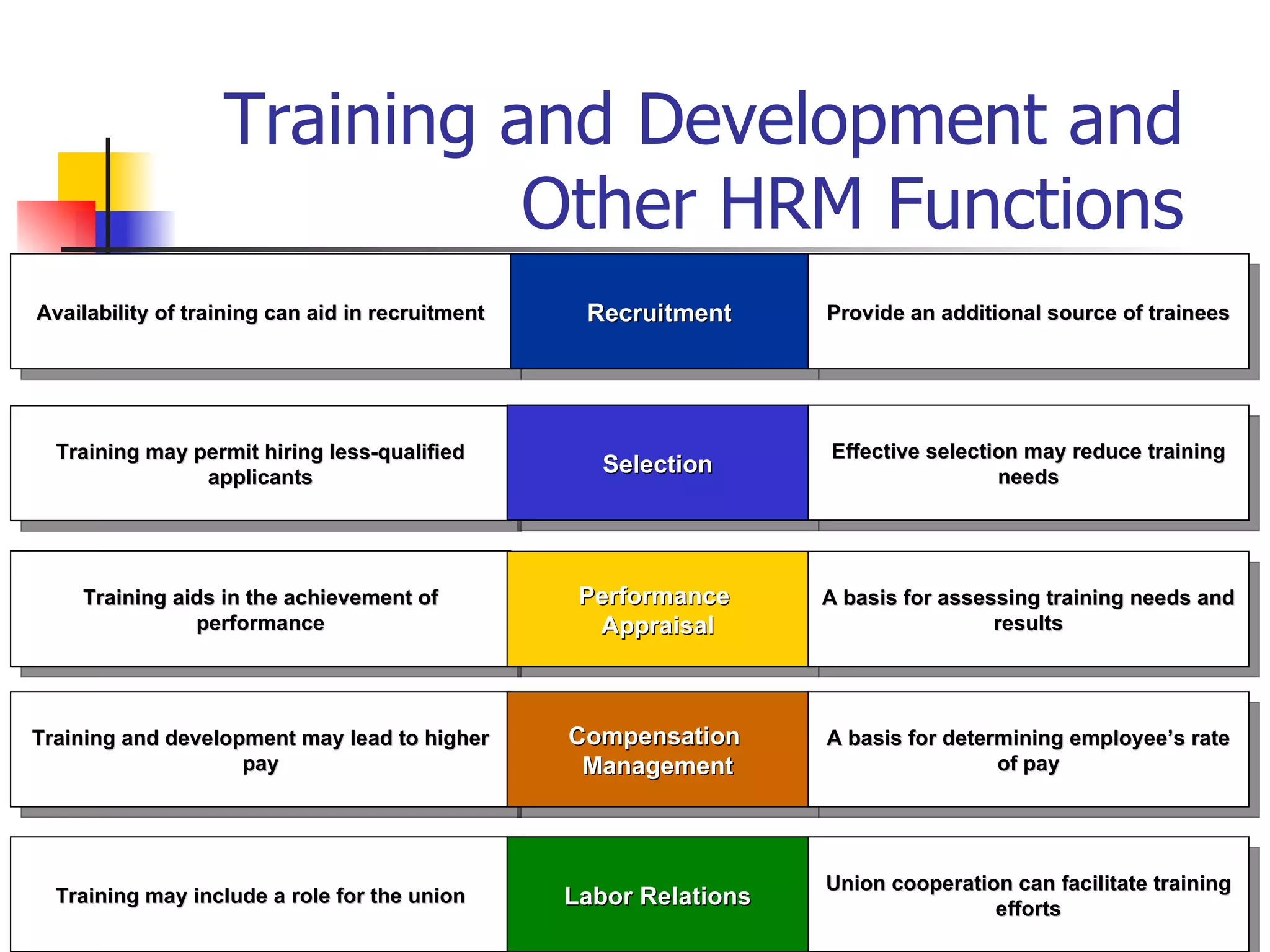
Training and Development and Other HRM Functions Training may permit hiring less-qualified applicants Selection Effective selection may reduce training needs Training aids in the achievement of performance Performance  Appraisal A basis for assessing training needs and results Training and development may lead to higher pay Compensation  Management A basis for determining employee’s rate of pay Availability of training can aid in recruitment Recruitment Provide an additional source of trainees Training may include a role for the union Labor Relations Union cooperation can facilitate training efforts
Why is training and development becoming an increasingly important issue? Increasing importance of product and service quality  (Collin, 2001 and Mabey & Salaman, 1995) Flexibility (Crofts, 1995 & Hyman, 1996) New technology (Hyman, 1996) Downsizing and delayering in lean organisations  (Hyman, 1996) Employee commitment  (Hyman, 1996 & Holden, 2001) Skills and labour shortages
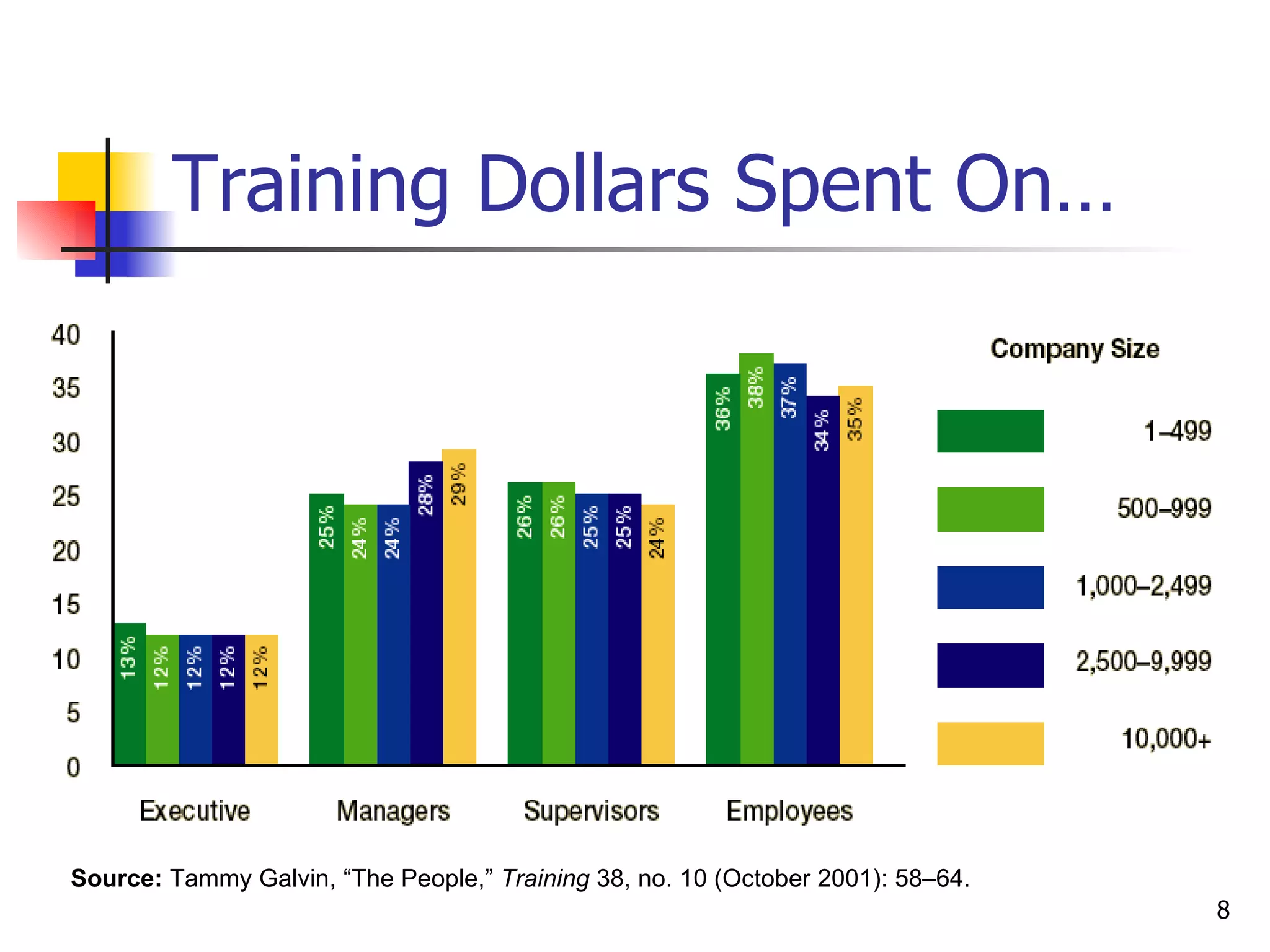
Training Dollars Spent On… Source:  Tammy Galvin, “The People,”  Training  38, no. 10 (October 2001): 58–64.
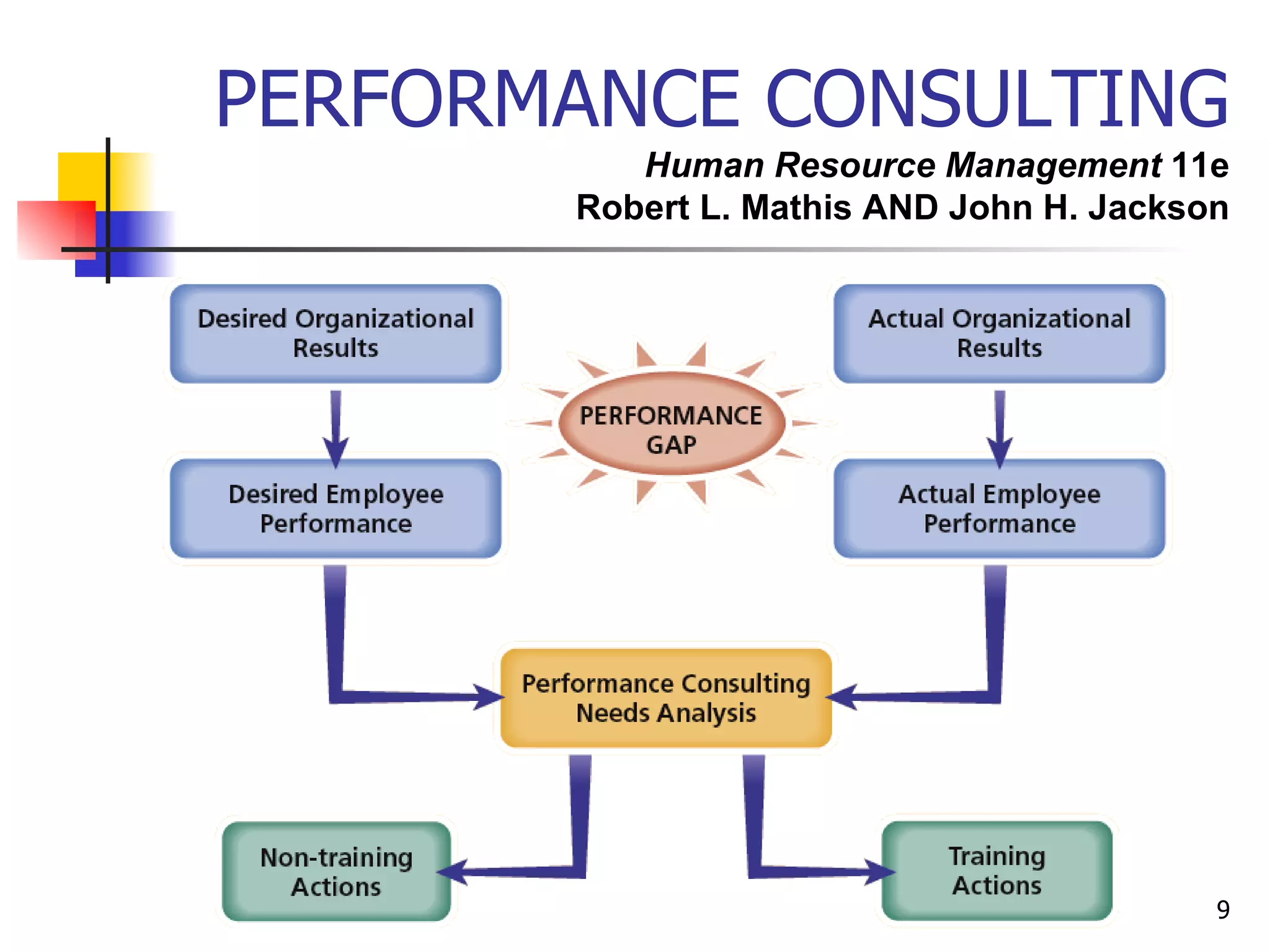
PERFORMANCE CONSULTING Human Resource Management  11e Robert L. Mathis AND John H. Jackson
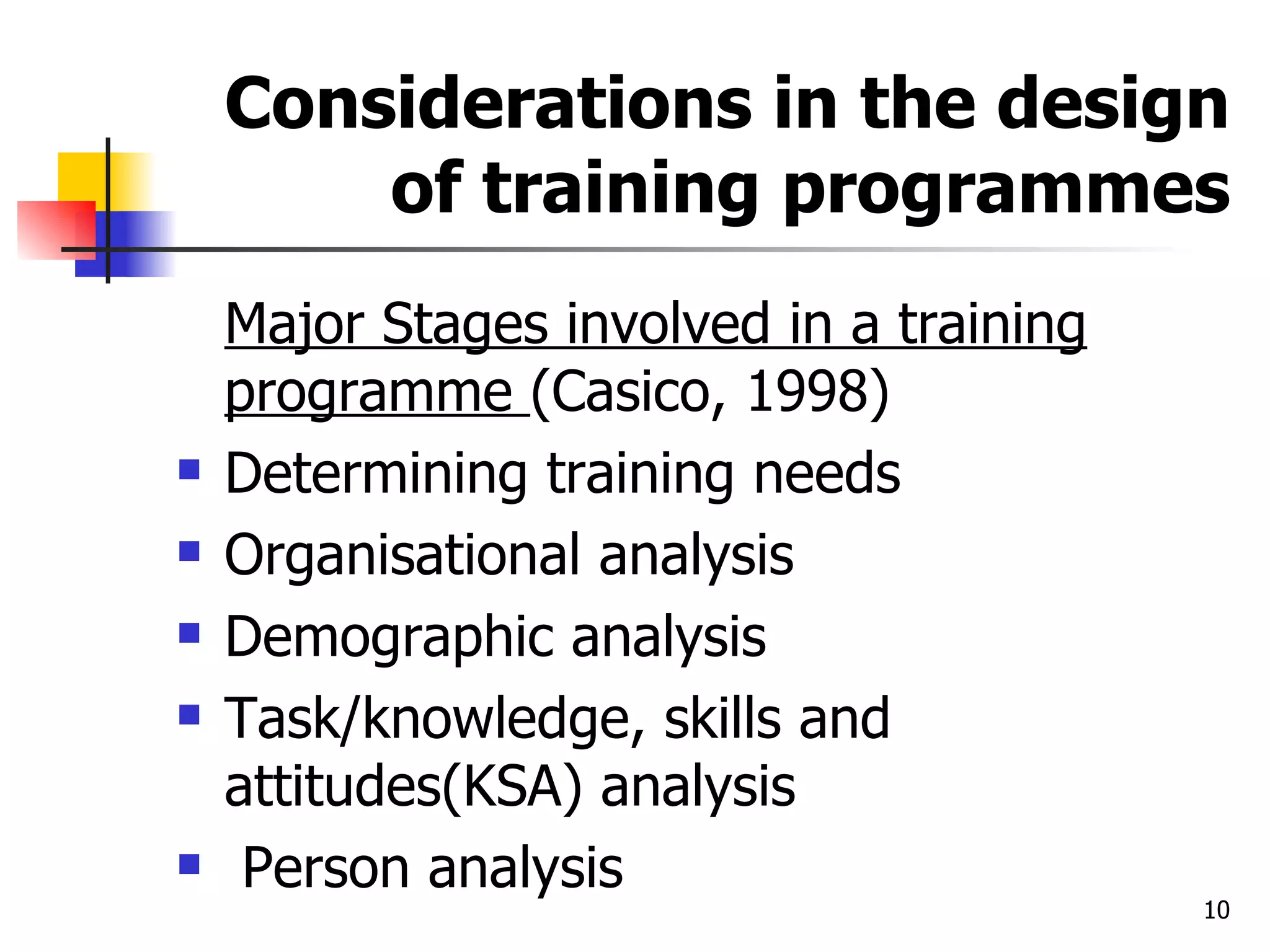
Considerations in the design of training programmes Major Stages involved in a training programme  (Casico, 1998) Determining training needs Organisational analysis Demographic analysis Task/knowledge, skills and attitudes(KSA) analysis Person analysis
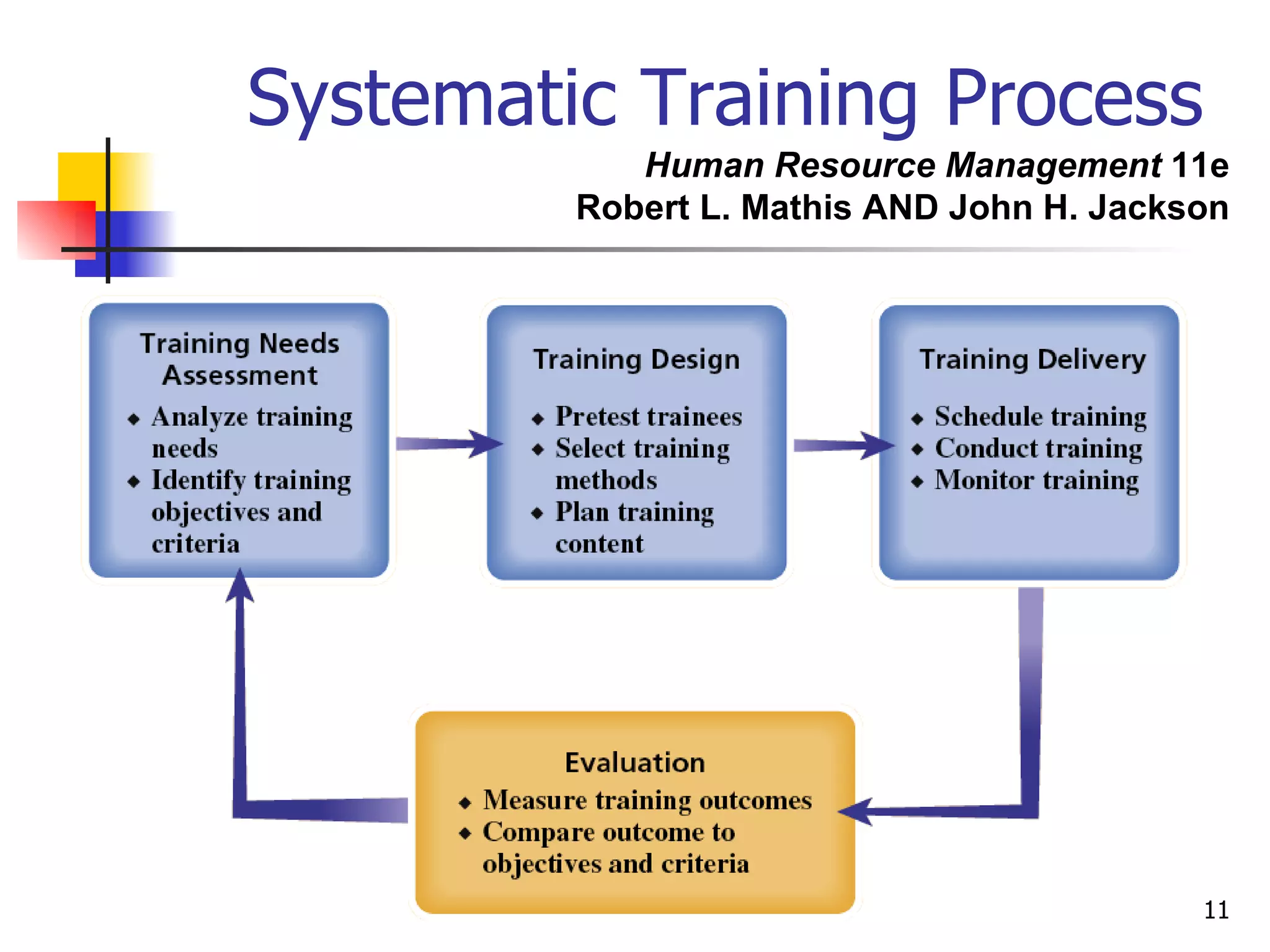
Systematic Training Process   Human Resource Management  11e Robert L. Mathis AND John H. Jackson
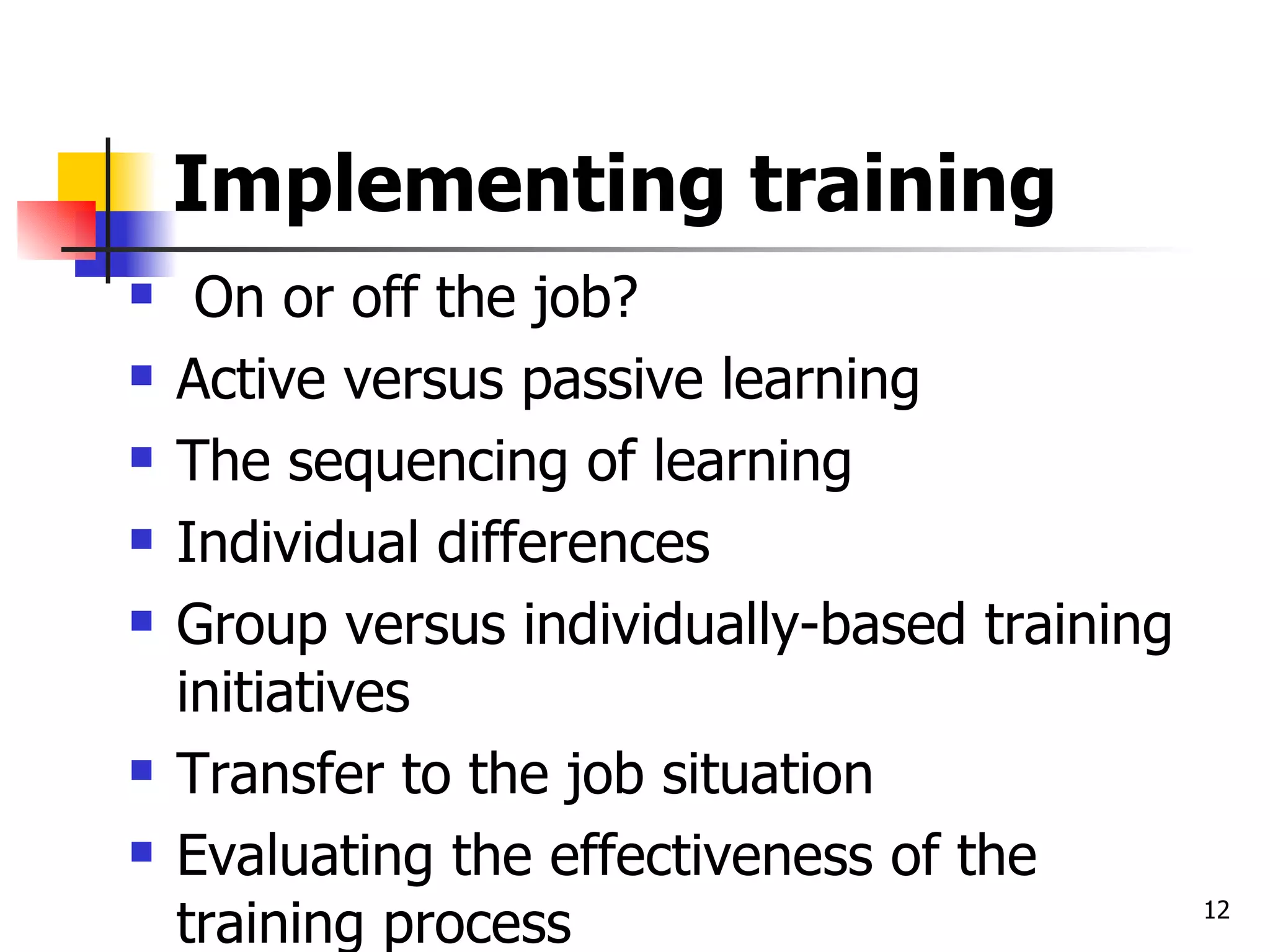
Implementing training On or off the job? Active versus passive learning The sequencing of learning Individual differences Group versus individually-based training initiatives Transfer to the job situation Evaluating the effectiveness of the training process
Training Methods for Nonmanagerial Employees On-the-Job Training (OJT) Apprenticeship Training Cooperative Training, Internships, and Governmental Training Classroom Instruction Programmed Instruction Audiovisual Methods Computer-based Training and E-Learning Simulation Managing Human Resources,  13th Edition - George W. Bohlander, and Scott A. Snell
Training Methods for Nonmanagerial Employees (cont’d) On-the-job training (OJT) Method by which employees are given hands-on experience with instructions from their supervisor or other trainer. Apprenticeship training System of training in which a worker entering the skilled trades is given thorough instruction and experience, both on and off the job, in the practical and theoretical aspects of the work. Managing Human Resources,  13th Edition - George W. Bohlander, and Scott A. Snell
Training Methods for Nonmanagerial Employees (cont’d) Cooperative Training Training program that combines practical on-the-job experience with formal educational classes. Internship Programs Programs jointly sponsored by colleges, universities, and other organizations that offer students the opportunity to gain real-life experience while allowing them to find out how they will perform in work organizations. Managing Human Resources,  13th Edition - George W. Bohlander, and Scott A. Snell
Training Methods for Nonmanagerial Employees (cont’d) Vestibule Training A special type of classroom facility is used to give instruction in the operation of equipment like that found in operating departments The emphasis is on instruction rather than production. Managing Human Resources,  13th Edition - George W. Bohlander, and Scott A. Snell
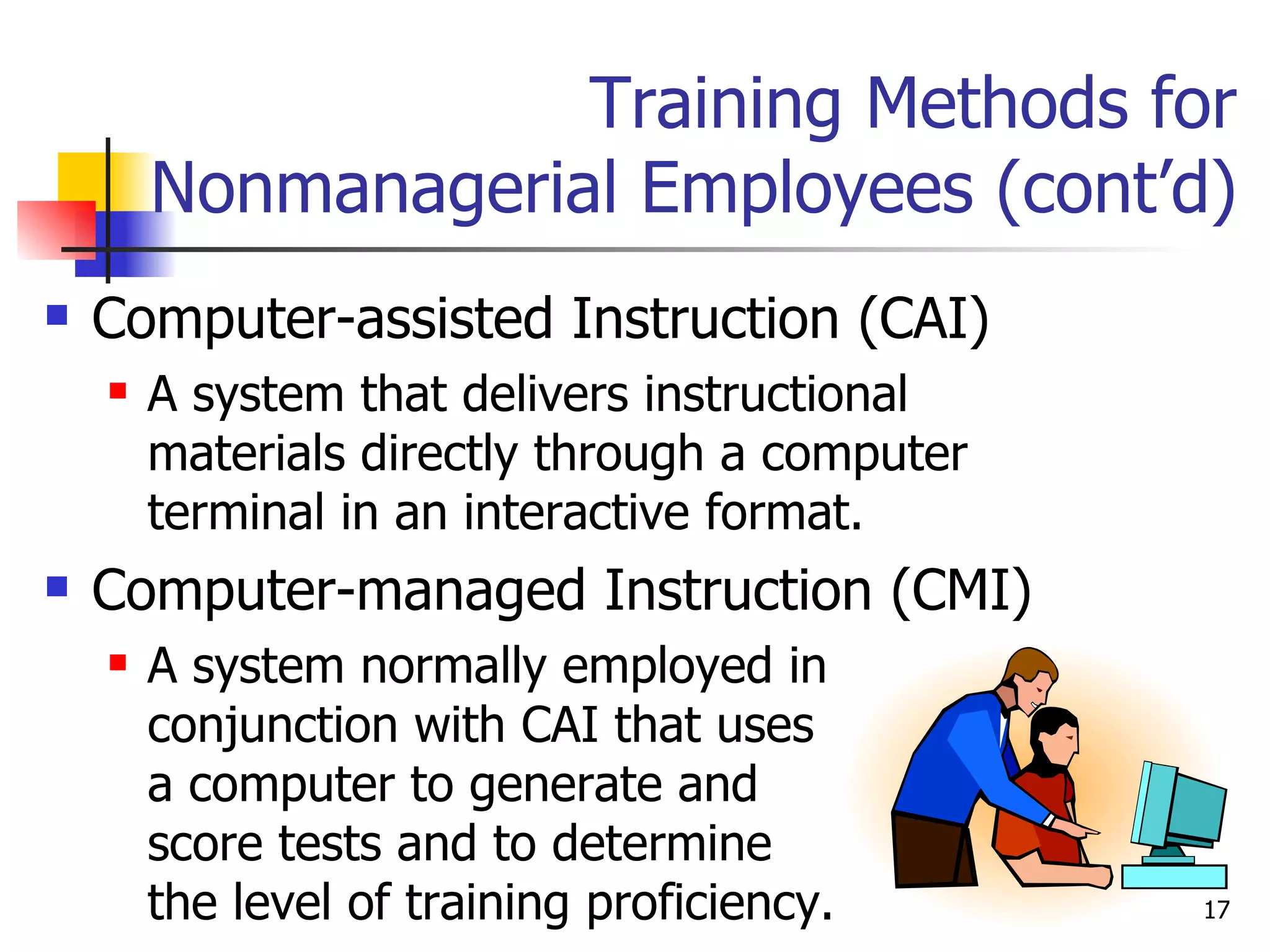
Training Methods for Nonmanagerial Employees (cont’d) Computer-assisted Instruction (CAI) A system that delivers instructional materials directly through a computer terminal in an interactive format. Computer-managed Instruction (CMI) A system normally employed in  conjunction with CAI that uses  a computer to generate and  score tests and to determine  the level of training proficiency.
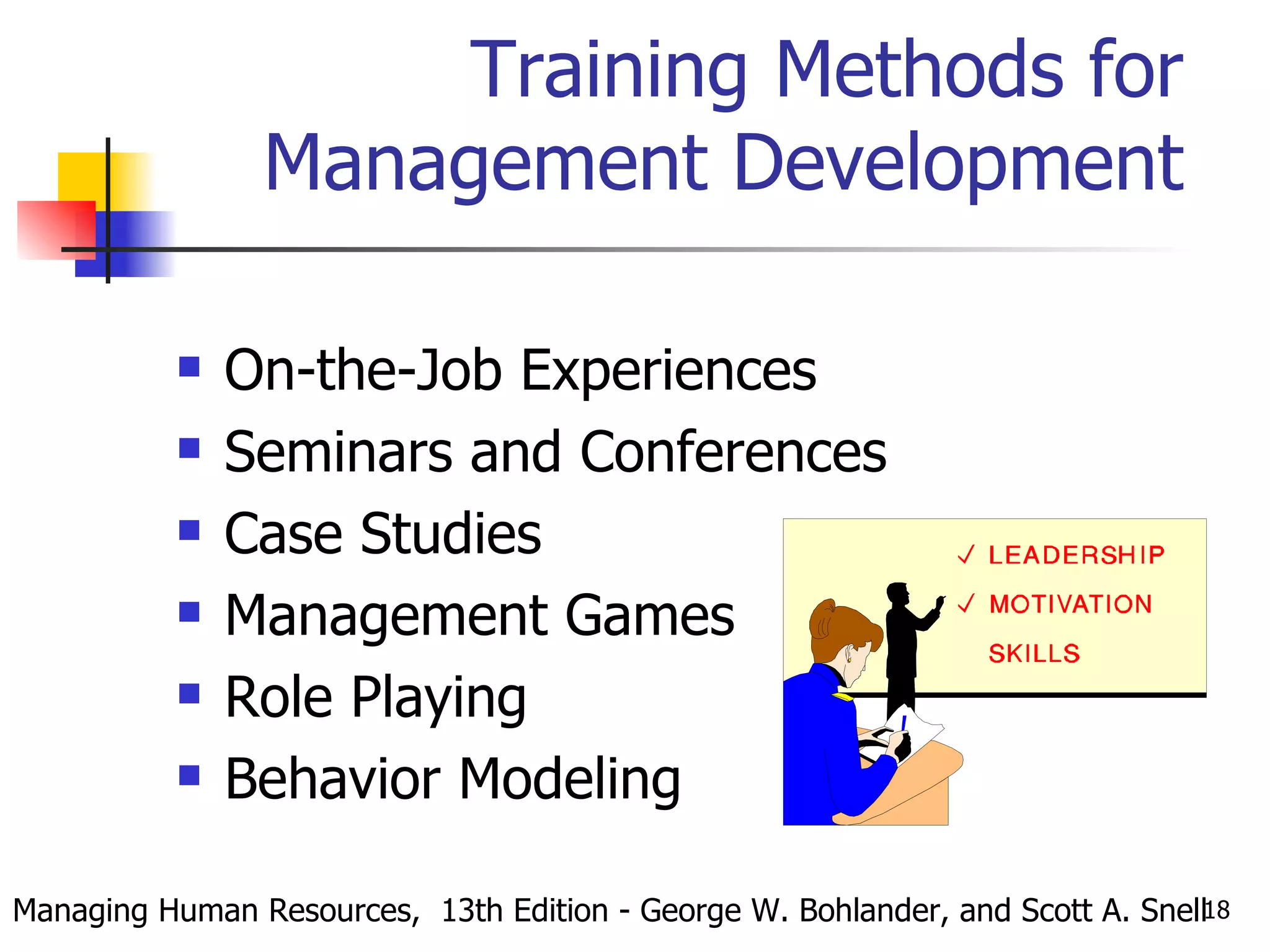
Training Methods for Management Development On-the-Job Experiences Seminars and Conferences Case Studies Management Games Role Playing Behavior Modeling Managing Human Resources,  13th Edition - George W. Bohlander, and Scott A. Snell
On-the-Job Experiences Coaching Understudy Assignment Job Rotation Lateral Transfer Special Projects Action Learning Staff Meetings Planned Career Progressions Managing Human Resources,  13th Edition - George W. Bohlander, and Scott A. Snell
Case Studies The use of case studies is most appropriate when: Analytic, problem-solving, and critical thinking skills are most important.  The KSAs are complex and participants need time to master them. Active participation is desired. The process of learning (questioning, interpreting, and so on) is as important as the content. Team problem solving and interaction are possible.
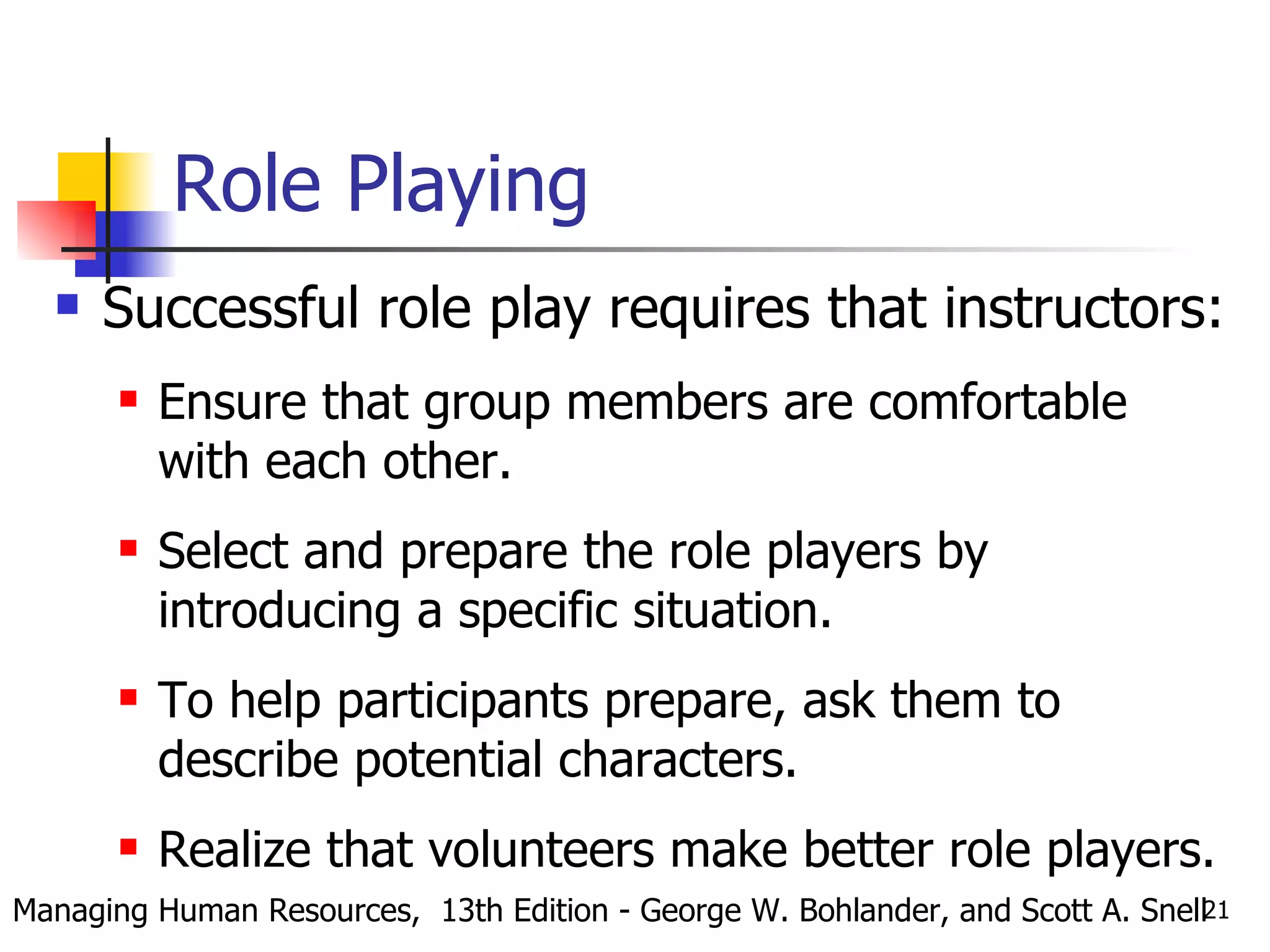
Role Playing Successful role play requires that instructors:  Ensure that group members are comfortable with each other. Select and prepare the role players by introducing a specific situation. To help participants prepare, ask them to describe potential characters. Realize that volunteers make better role players. Managing Human Resources,  13th Edition - George W. Bohlander, and Scott A. Snell
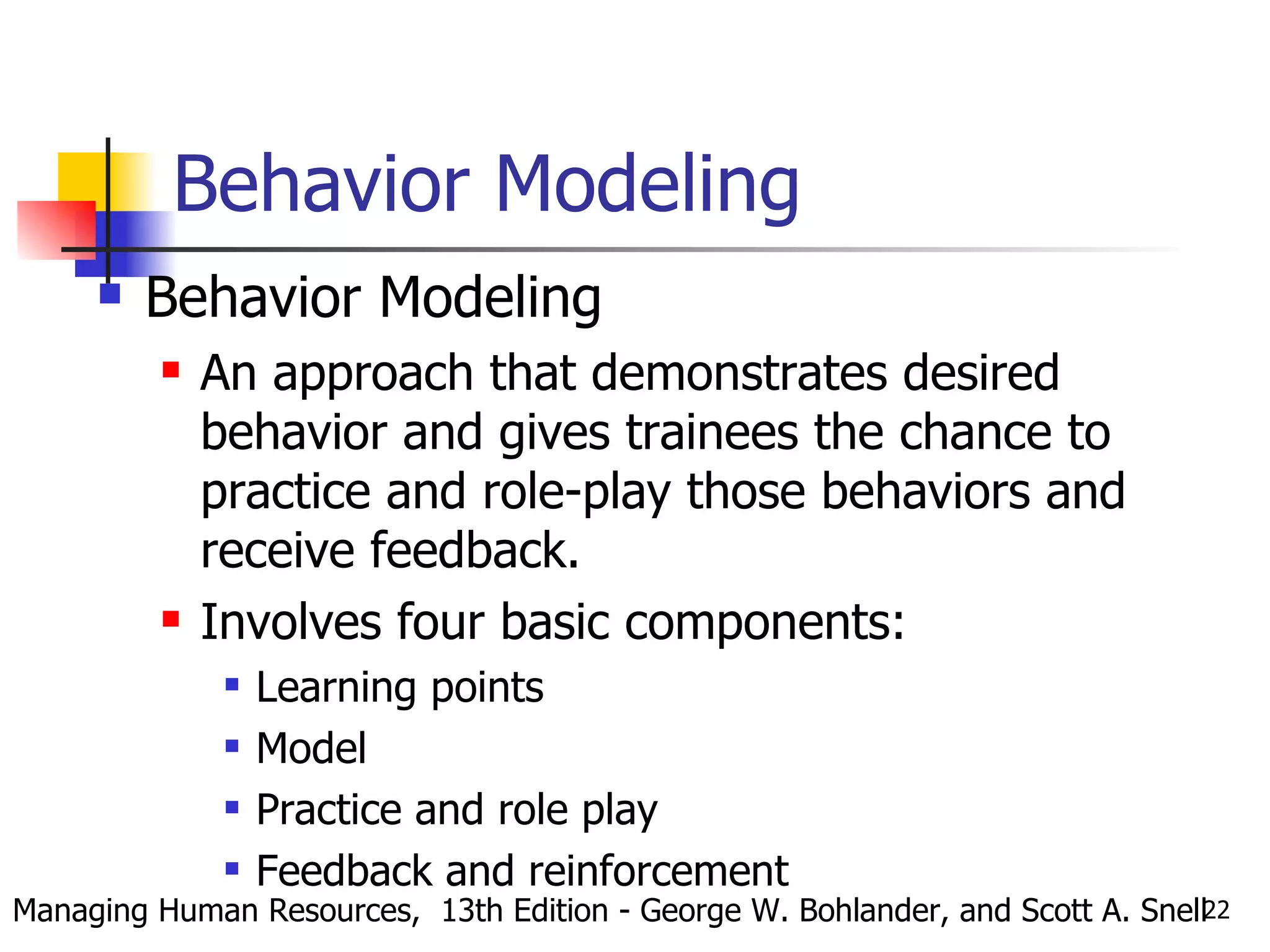
Behavior Modeling Behavior Modeling An approach that demonstrates desired behavior and gives trainees the chance to practice and role-play those behaviors and receive feedback. Involves four basic components: Learning points Model Practice and role play Feedback and reinforcement Managing Human Resources,  13th Edition - George W. Bohlander, and Scott A. Snell
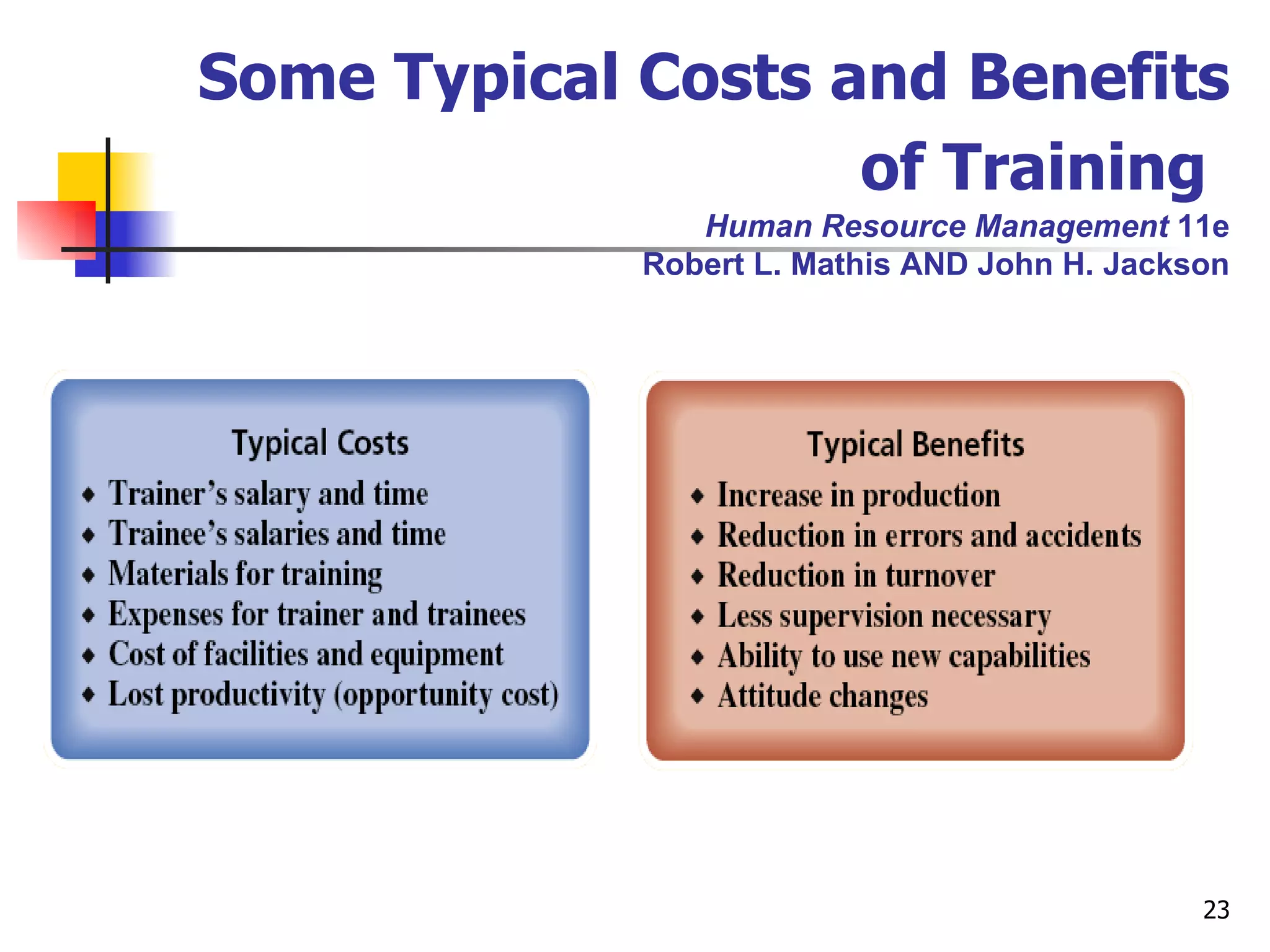
Some Typical Costs and Benefits of Training   Human Resource Management  11e Robert L. Mathis AND John H. Jackson
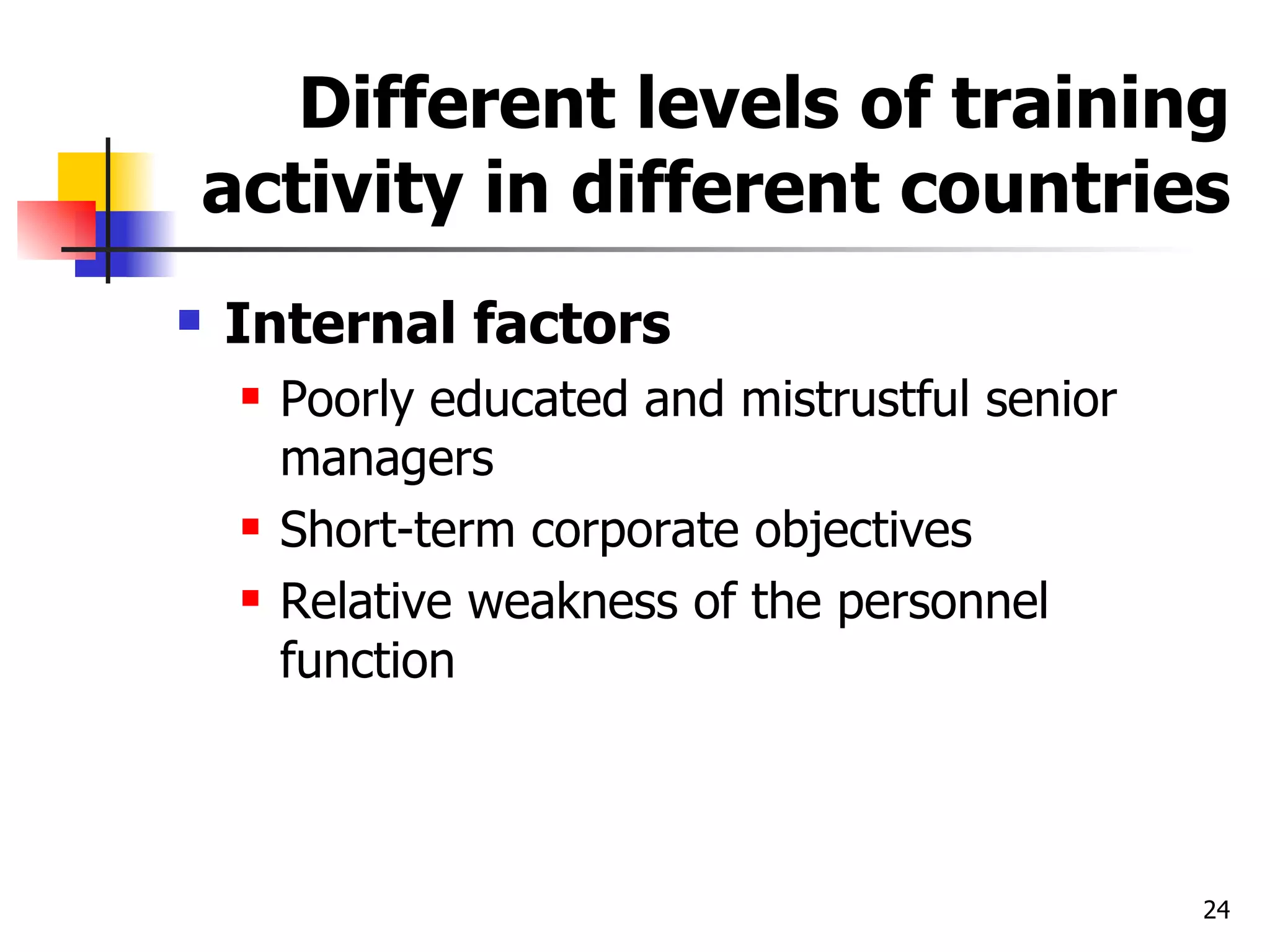
Different levels of training activity in different countries Internal factors Poorly educated and mistrustful senior managers Short-term corporate objectives Relative weakness of the personnel function
Different levels of training activity in different countries External factors: systems of national Vocational Education and Training (Germany, Singapore..) 1. VET initiatives in UK in the 1990s Modern apprenticeships Investors in people(IiP)
Different levels of training activity in different countries External factors: systems of national vocational education and training 2. Schemes introduced by the New Labour government Learning And Skills Council University For Industry (Now Renamed UfI) The New Deal Union ‘Learning Representatives’
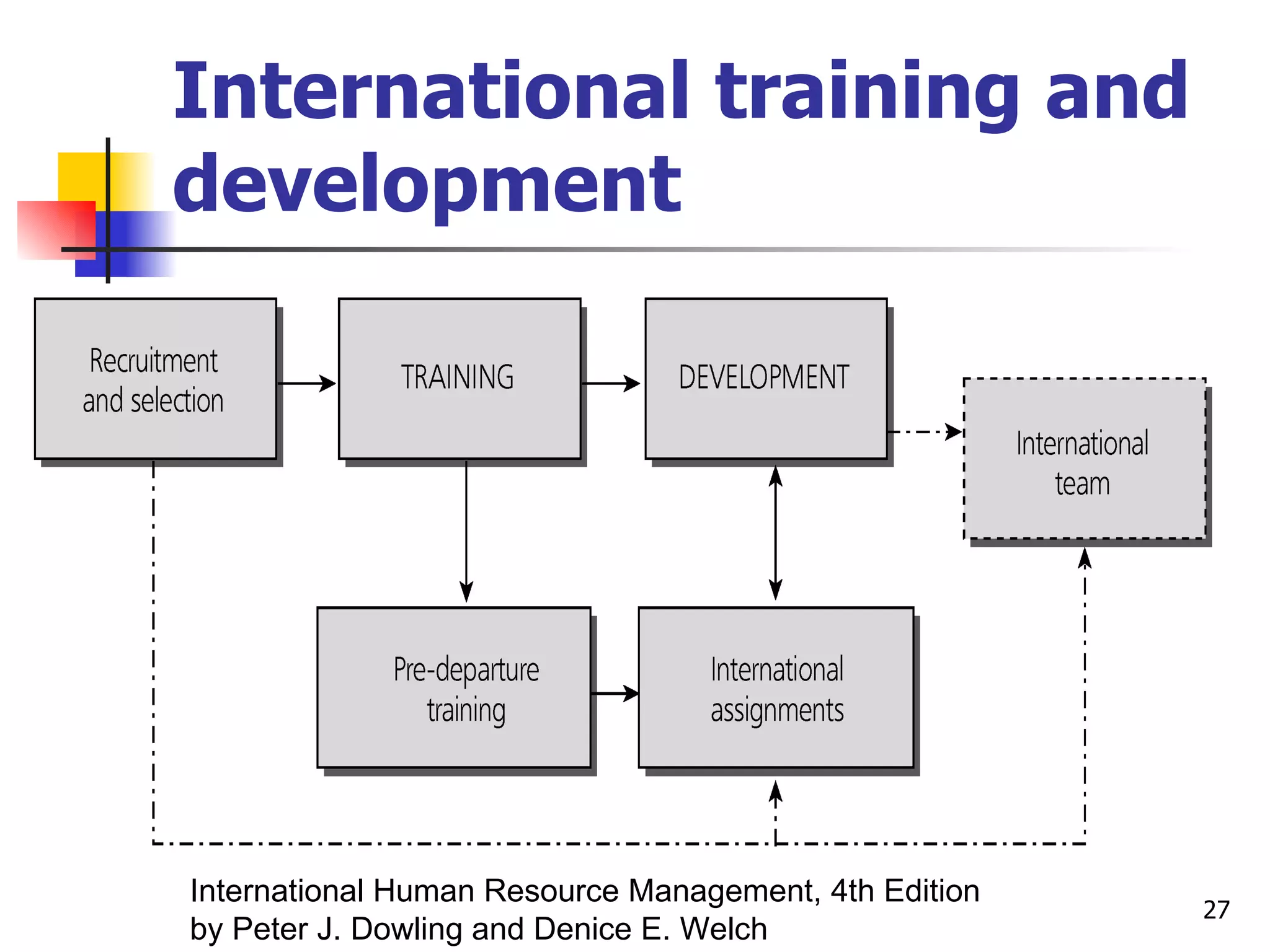
International training and development International Human Resource Management, 4th Edition by Peter J. Dowling and Denice E. Welch
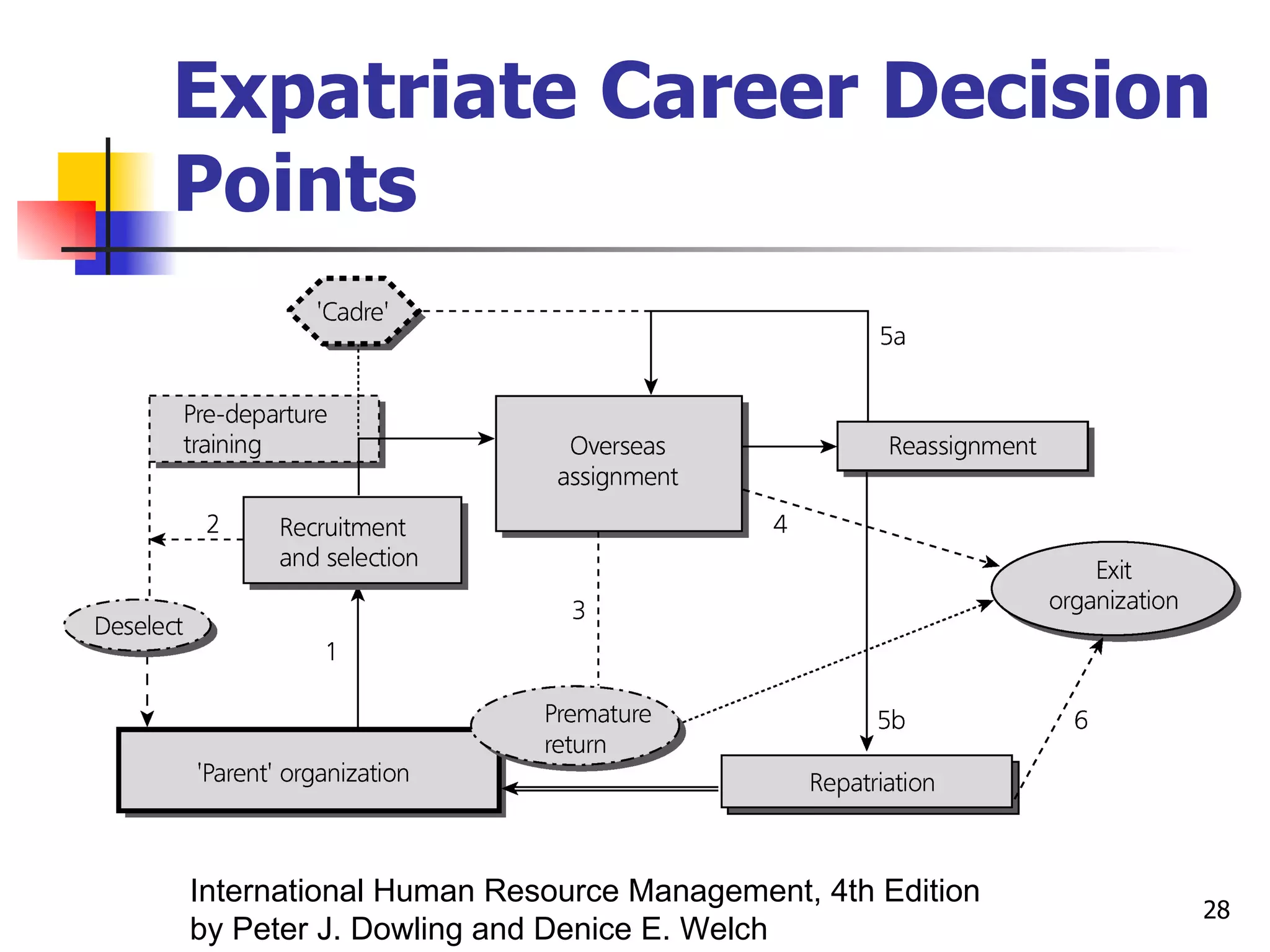
Expatriate Career Decision Points International Human Resource Management, 4th Edition by Peter J. Dowling and Denice E. Welch

Chapter 7 Training And Development

  • 1.
    C HAPTER 7 Training and Development
  • 2.
    Training (Stephanie, 2005)A learning process that involves the acquisition of skills, concepts, rules, or attitudes to enhance employee performance.
  • 3.
    Training and DevelopmentTraining Effort initiated by an organization to foster learning among its members. Tends to be narrowly focused and oriented toward short-term performance concerns. Development Effort that is oriented more toward broadening an individual’s skills for the future responsibilities. Managing Human Resources, 13th Edition - George W. Bohlander, and Scott A. Snell
  • 4.
    Training and DevelopmentTraining aims to improve employees’ current work skills and behavior, whereas development aims to increase abilities in relation to some future position or job. International Human Resource Management, 4th Edition by Peter J. Dowling and Denice E. Welch
  • 5.
    Definitions of trainingand development Remedial skills training Developmental training Orientation training ‘ firm specific’ ‘ transferable’
  • 6.
    Training and Developmentand Other HRM Functions Training may permit hiring less-qualified applicants Selection Effective selection may reduce training needs Training aids in the achievement of performance Performance Appraisal A basis for assessing training needs and results Training and development may lead to higher pay Compensation Management A basis for determining employee’s rate of pay Availability of training can aid in recruitment Recruitment Provide an additional source of trainees Training may include a role for the union Labor Relations Union cooperation can facilitate training efforts
  • 7.
    Why is trainingand development becoming an increasingly important issue? Increasing importance of product and service quality (Collin, 2001 and Mabey & Salaman, 1995) Flexibility (Crofts, 1995 & Hyman, 1996) New technology (Hyman, 1996) Downsizing and delayering in lean organisations (Hyman, 1996) Employee commitment (Hyman, 1996 & Holden, 2001) Skills and labour shortages
  • 8.
    Training Dollars SpentOn… Source: Tammy Galvin, “The People,” Training 38, no. 10 (October 2001): 58–64.
  • 9.
    PERFORMANCE CONSULTING HumanResource Management 11e Robert L. Mathis AND John H. Jackson
  • 10.
    Considerations in thedesign of training programmes Major Stages involved in a training programme (Casico, 1998) Determining training needs Organisational analysis Demographic analysis Task/knowledge, skills and attitudes(KSA) analysis Person analysis
  • 11.
    Systematic Training Process Human Resource Management 11e Robert L. Mathis AND John H. Jackson
  • 12.
    Implementing training Onor off the job? Active versus passive learning The sequencing of learning Individual differences Group versus individually-based training initiatives Transfer to the job situation Evaluating the effectiveness of the training process
  • 13.
    Training Methods forNonmanagerial Employees On-the-Job Training (OJT) Apprenticeship Training Cooperative Training, Internships, and Governmental Training Classroom Instruction Programmed Instruction Audiovisual Methods Computer-based Training and E-Learning Simulation Managing Human Resources, 13th Edition - George W. Bohlander, and Scott A. Snell
  • 14.
    Training Methods forNonmanagerial Employees (cont’d) On-the-job training (OJT) Method by which employees are given hands-on experience with instructions from their supervisor or other trainer. Apprenticeship training System of training in which a worker entering the skilled trades is given thorough instruction and experience, both on and off the job, in the practical and theoretical aspects of the work. Managing Human Resources, 13th Edition - George W. Bohlander, and Scott A. Snell
  • 15.
    Training Methods forNonmanagerial Employees (cont’d) Cooperative Training Training program that combines practical on-the-job experience with formal educational classes. Internship Programs Programs jointly sponsored by colleges, universities, and other organizations that offer students the opportunity to gain real-life experience while allowing them to find out how they will perform in work organizations. Managing Human Resources, 13th Edition - George W. Bohlander, and Scott A. Snell
  • 16.
    Training Methods forNonmanagerial Employees (cont’d) Vestibule Training A special type of classroom facility is used to give instruction in the operation of equipment like that found in operating departments The emphasis is on instruction rather than production. Managing Human Resources, 13th Edition - George W. Bohlander, and Scott A. Snell
  • 17.
    Training Methods forNonmanagerial Employees (cont’d) Computer-assisted Instruction (CAI) A system that delivers instructional materials directly through a computer terminal in an interactive format. Computer-managed Instruction (CMI) A system normally employed in conjunction with CAI that uses a computer to generate and score tests and to determine the level of training proficiency.
  • 18.
    Training Methods forManagement Development On-the-Job Experiences Seminars and Conferences Case Studies Management Games Role Playing Behavior Modeling Managing Human Resources, 13th Edition - George W. Bohlander, and Scott A. Snell
  • 19.
    On-the-Job Experiences CoachingUnderstudy Assignment Job Rotation Lateral Transfer Special Projects Action Learning Staff Meetings Planned Career Progressions Managing Human Resources, 13th Edition - George W. Bohlander, and Scott A. Snell
  • 20.
    Case Studies Theuse of case studies is most appropriate when: Analytic, problem-solving, and critical thinking skills are most important. The KSAs are complex and participants need time to master them. Active participation is desired. The process of learning (questioning, interpreting, and so on) is as important as the content. Team problem solving and interaction are possible.
  • 21.
    Role Playing Successfulrole play requires that instructors: Ensure that group members are comfortable with each other. Select and prepare the role players by introducing a specific situation. To help participants prepare, ask them to describe potential characters. Realize that volunteers make better role players. Managing Human Resources, 13th Edition - George W. Bohlander, and Scott A. Snell
  • 22.
    Behavior Modeling BehaviorModeling An approach that demonstrates desired behavior and gives trainees the chance to practice and role-play those behaviors and receive feedback. Involves four basic components: Learning points Model Practice and role play Feedback and reinforcement Managing Human Resources, 13th Edition - George W. Bohlander, and Scott A. Snell
  • 23.
    Some Typical Costsand Benefits of Training Human Resource Management 11e Robert L. Mathis AND John H. Jackson
  • 24.
    Different levels oftraining activity in different countries Internal factors Poorly educated and mistrustful senior managers Short-term corporate objectives Relative weakness of the personnel function
  • 25.
    Different levels oftraining activity in different countries External factors: systems of national Vocational Education and Training (Germany, Singapore..) 1. VET initiatives in UK in the 1990s Modern apprenticeships Investors in people(IiP)
  • 26.
    Different levels oftraining activity in different countries External factors: systems of national vocational education and training 2. Schemes introduced by the New Labour government Learning And Skills Council University For Industry (Now Renamed UfI) The New Deal Union ‘Learning Representatives’
  • 27.
    International training anddevelopment International Human Resource Management, 4th Edition by Peter J. Dowling and Denice E. Welch
  • 28.
    Expatriate Career DecisionPoints International Human Resource Management, 4th Edition by Peter J. Dowling and Denice E. Welch