This document discusses common errors made by Arabic speaking English language learners and strategies to address them. Key differences between Arabic and English include direction of writing, vowels, capitalization, and punctuation. Common errors include lack of capitalization and punctuation, vowel confusion, incorrect sentence structure and verb placement, improper use of articles, and issues with spelling, plurals, prepositions and verb tense agreement. Suggested strategies include explicitly teaching vowels, increasing reading exposure and practice with sentence structure rules, comparing translations, looking at spelling patterns, and using intonation to demonstrate punctuation.
Focuses on the contrasting features of Arabic and English, highlighting key differences that lead to errors. Discusses specific types of errors Arabic speaking ELLs make, including capitalization, punctuation, and sentence structure. Exemplifies syntax, mechanics, and grammatical errors made by students, showcasing common mistakes in writing.
Suggests various strategies for preventing and correcting errors, focusing on explicit vowel instruction and sentence structure.
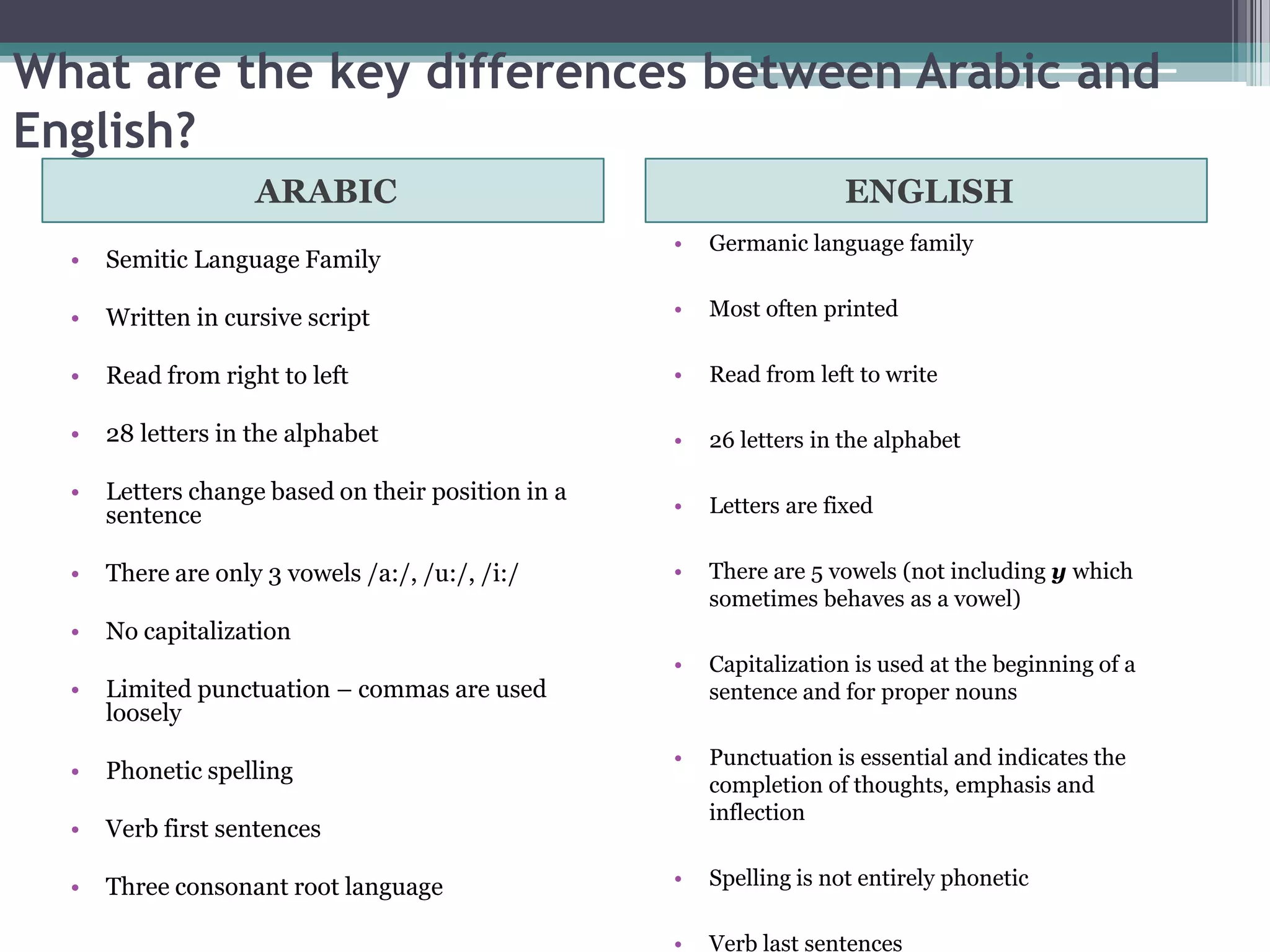
What are thekey differences between Arabic and
English?
ARABIC ENGLISH
• Germanic language family
• Semitic Language Family
• Written in cursive script • Most often printed
• Read from right to left • Read from left to write
• 28 letters in the alphabet • 26 letters in the alphabet
• Letters change based on their position in a
sentence • Letters are fixed
• There are only 3 vowels /a:/, /u:/, /i:/ • There are 5 vowels (not including y which
sometimes behaves as a vowel)
• No capitalization
• Capitalization is used at the beginning of a
• Limited punctuation – commas are used sentence and for proper nouns
loosely
• Punctuation is essential and indicates the
• Phonetic spelling
completion of thoughts, emphasis and
inflection
• Verb first sentences
• Three consonant root language • Spelling is not entirely phonetic
• Verb last sentences
3.
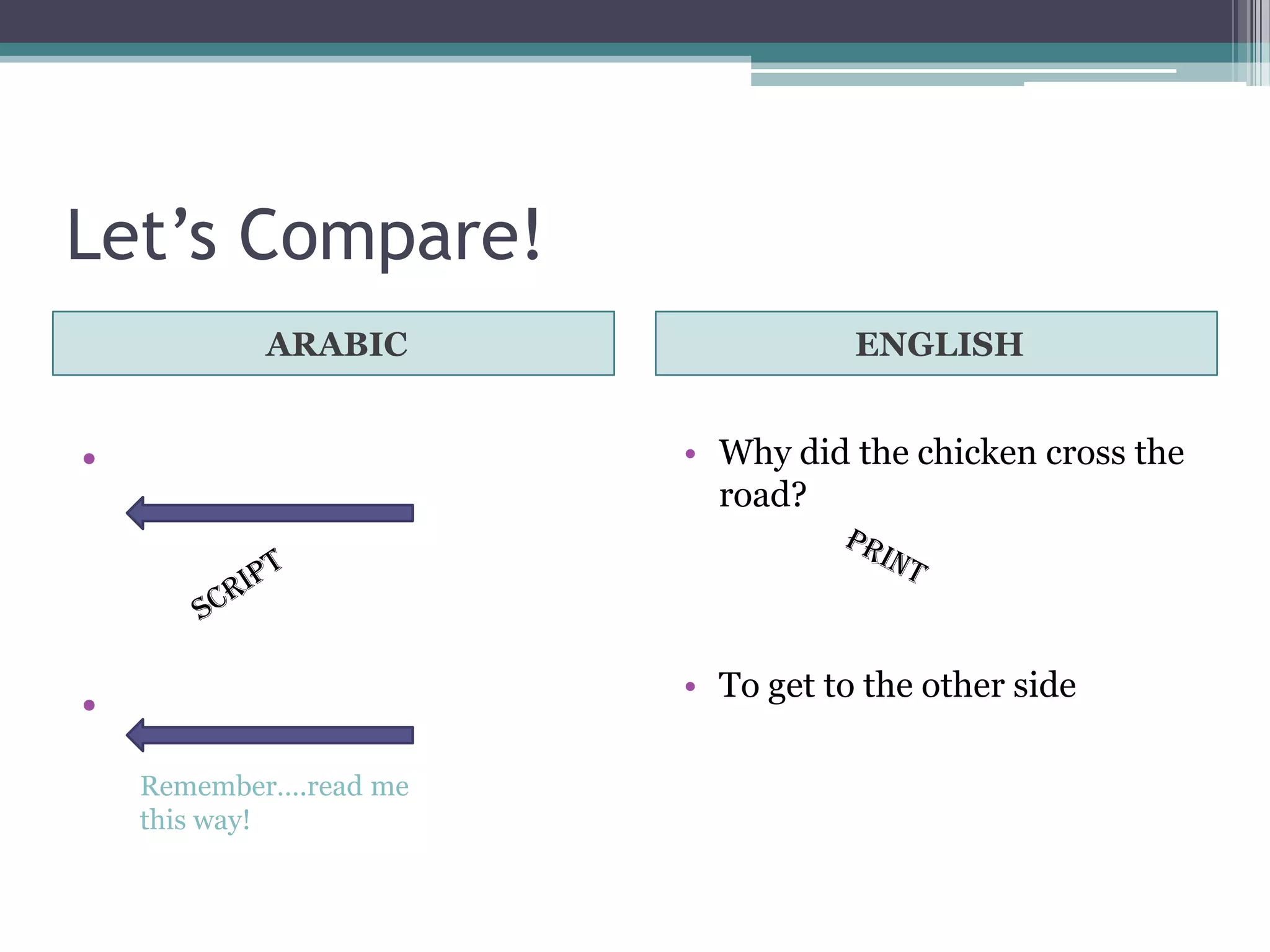
Let’s Compare!
ARABIC ENGLISH
• • Why did the chicken cross the
road?
• To get to the other side
•
Remember….read me
this way!
4.
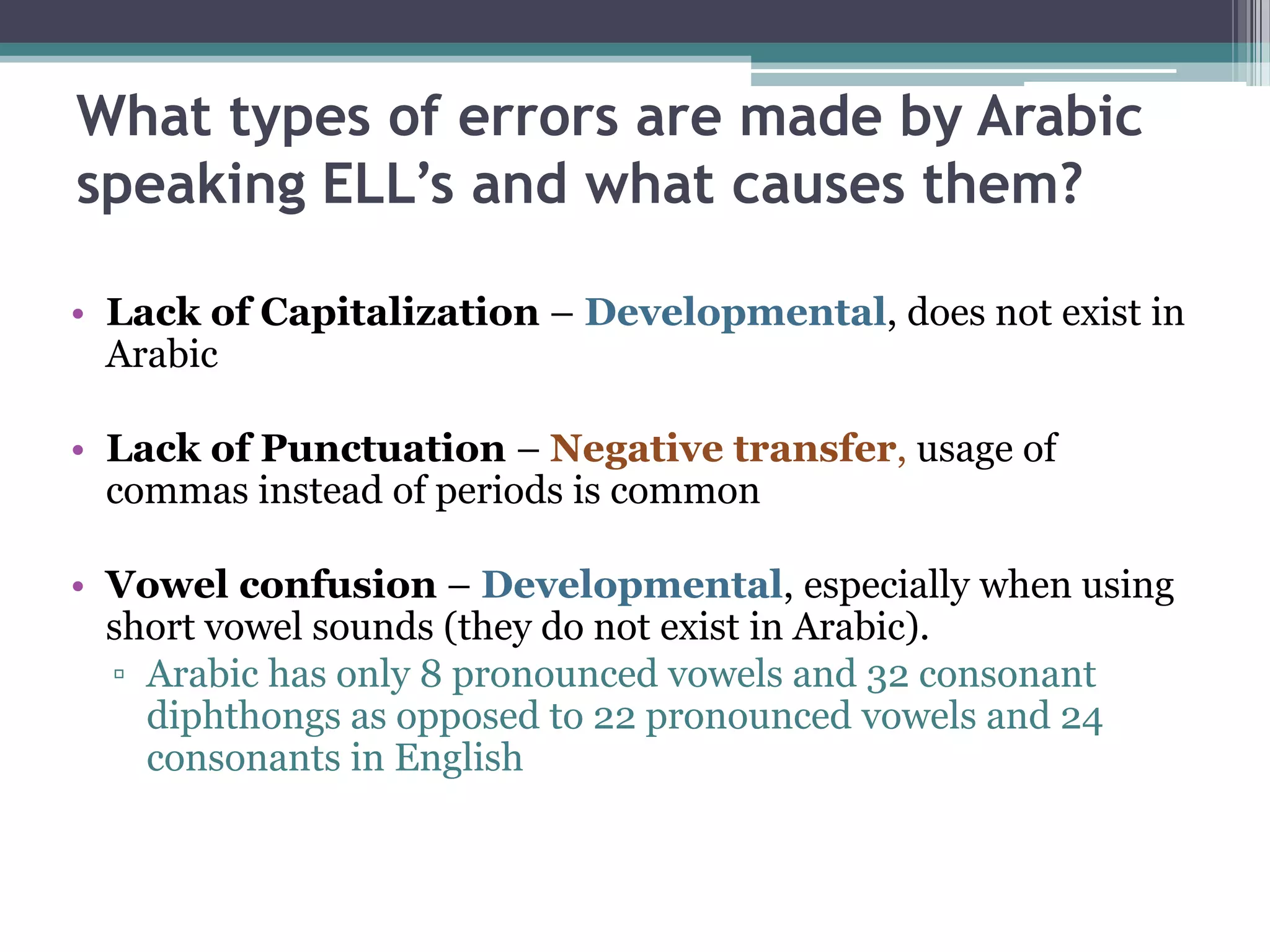
What types oferrors are made by Arabic
speaking ELL’s and what causes them?
• Lack of Capitalization – Developmental, does not exist in
Arabic
• Lack of Punctuation – Negative transfer, usage of
commas instead of periods is common
• Vowel confusion – Developmental, especially when using
short vowel sounds (they do not exist in Arabic).
▫ Arabic has only 8 pronounced vowels and 32 consonant
diphthongs as opposed to 22 pronounced vowels and 24
consonants in English
5.
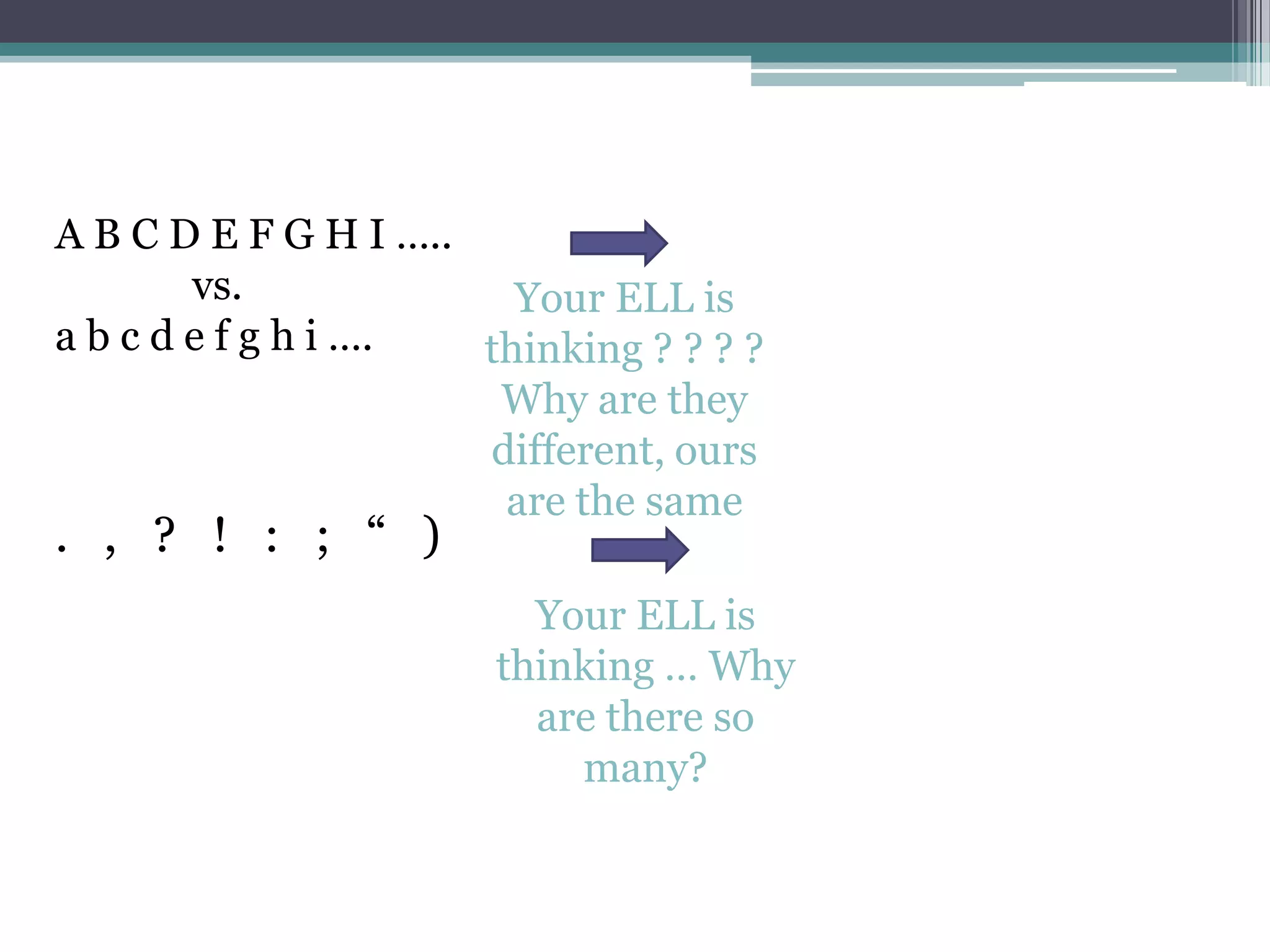
A B CD E F G H I …..
vs. Your ELL is
a b c d e f g h i …. thinking ? ? ? ?
Why are they
different, ours
are the same
. , ? ! : ; “ )
Your ELL is
thinking … Why
are there so
many?
6.
Types of Errorsand Causes Cont’d
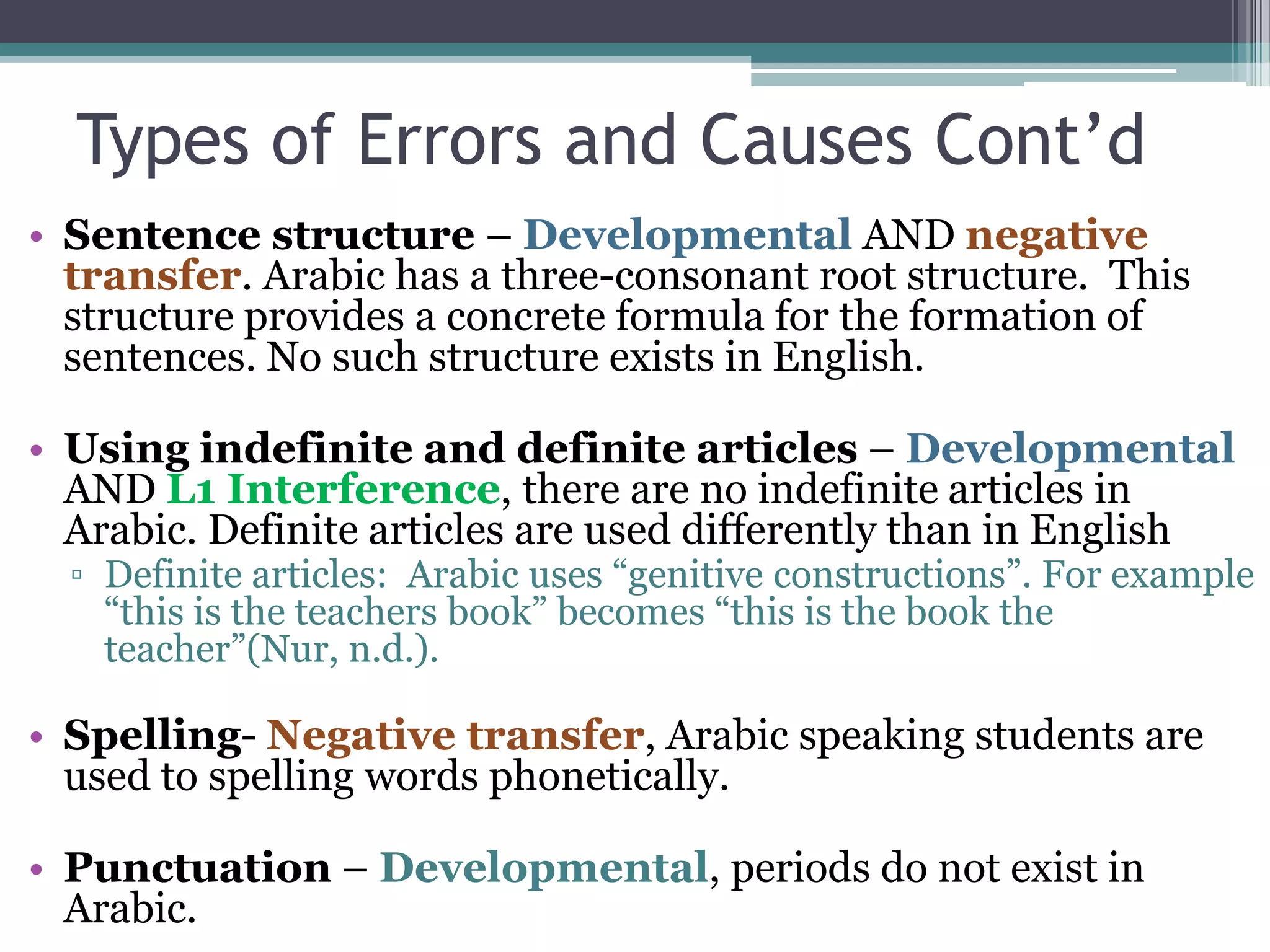
• Sentence structure – Developmental AND negative
transfer. Arabic has a three-consonant root structure. This
structure provides a concrete formula for the formation of
sentences. No such structure exists in English.
• Using indefinite and definite articles – Developmental
AND L1 Interference, there are no indefinite articles in
Arabic. Definite articles are used differently than in English
▫ Definite articles: Arabic uses “genitive constructions”. For example
“this is the teachers book” becomes “this is the book the
teacher”(Nur, n.d.).
• Spelling- Negative transfer, Arabic speaking students are
used to spelling words phonetically.
• Punctuation – Developmental, periods do not exist in
Arabic.
8.
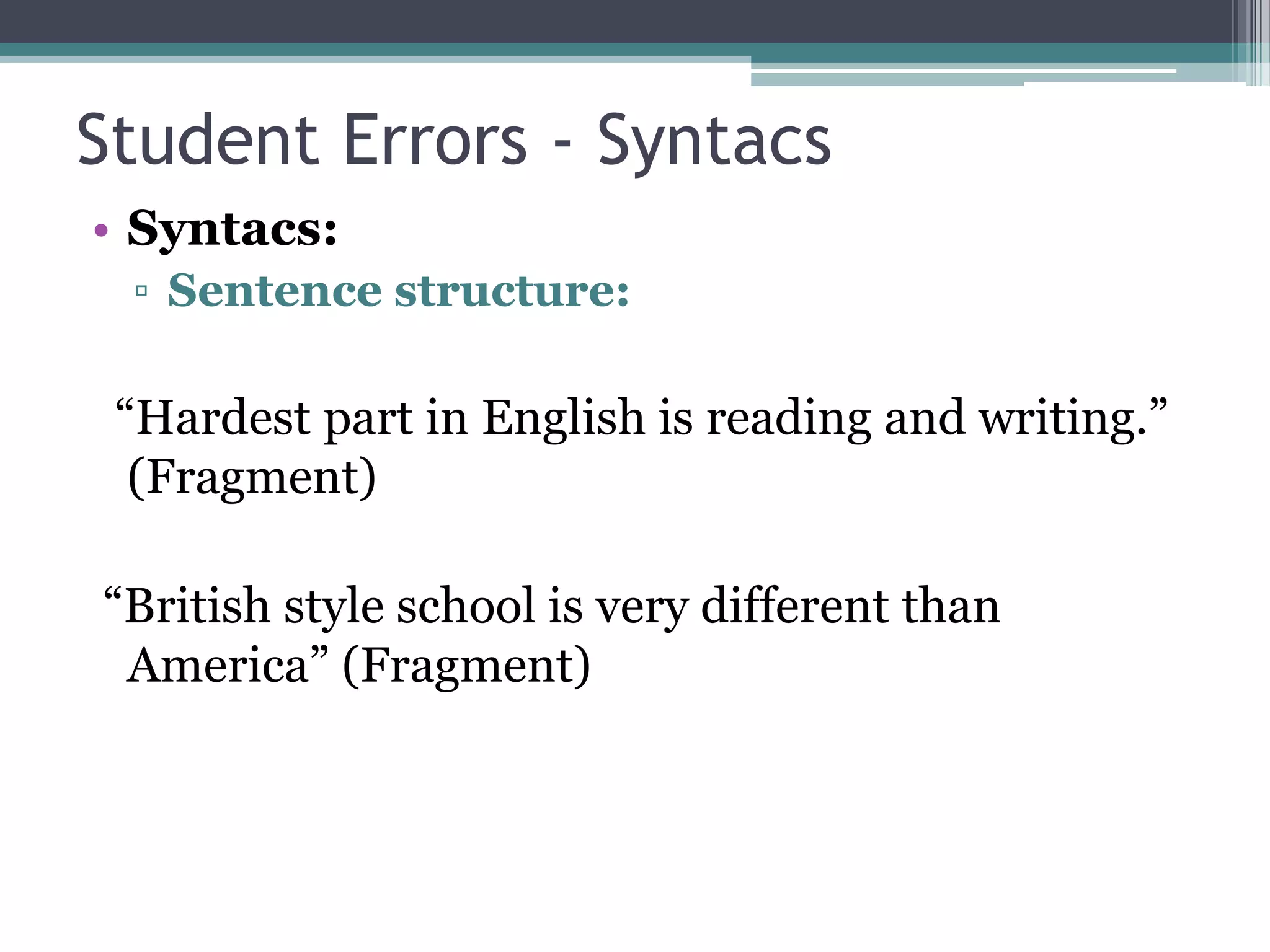
Student Errors -Syntacs
• Syntacs:
▫ Sentence structure:
“Hardest part in English is reading and writing.”
(Fragment)
“British style school is very different than
America” (Fragment)
9.
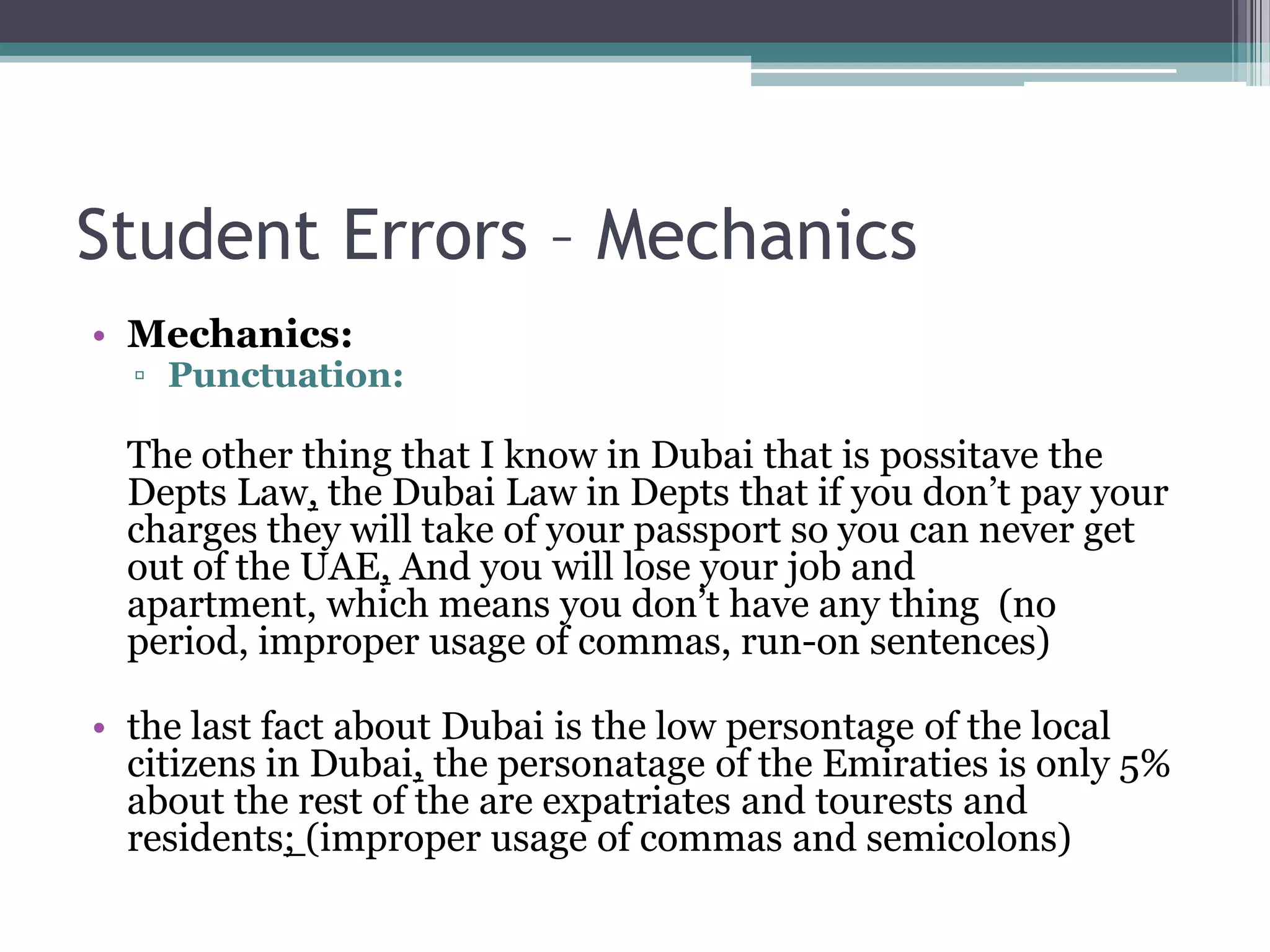
Student Errors –Mechanics
• Mechanics:
▫ Punctuation:
The other thing that I know in Dubai that is possitave the
Depts Law, the Dubai Law in Depts that if you don’t pay your
charges they will take of your passport so you can never get
out of the UAE, And you will lose your job and
apartment, which means you don’t have any thing (no
period, improper usage of commas, run-on sentences)
• the last fact about Dubai is the low persontage of the local
citizens in Dubai, the personatage of the Emiraties is only 5%
about the rest of the are expatriates and tourests and
residents; (improper usage of commas and semicolons)
10.
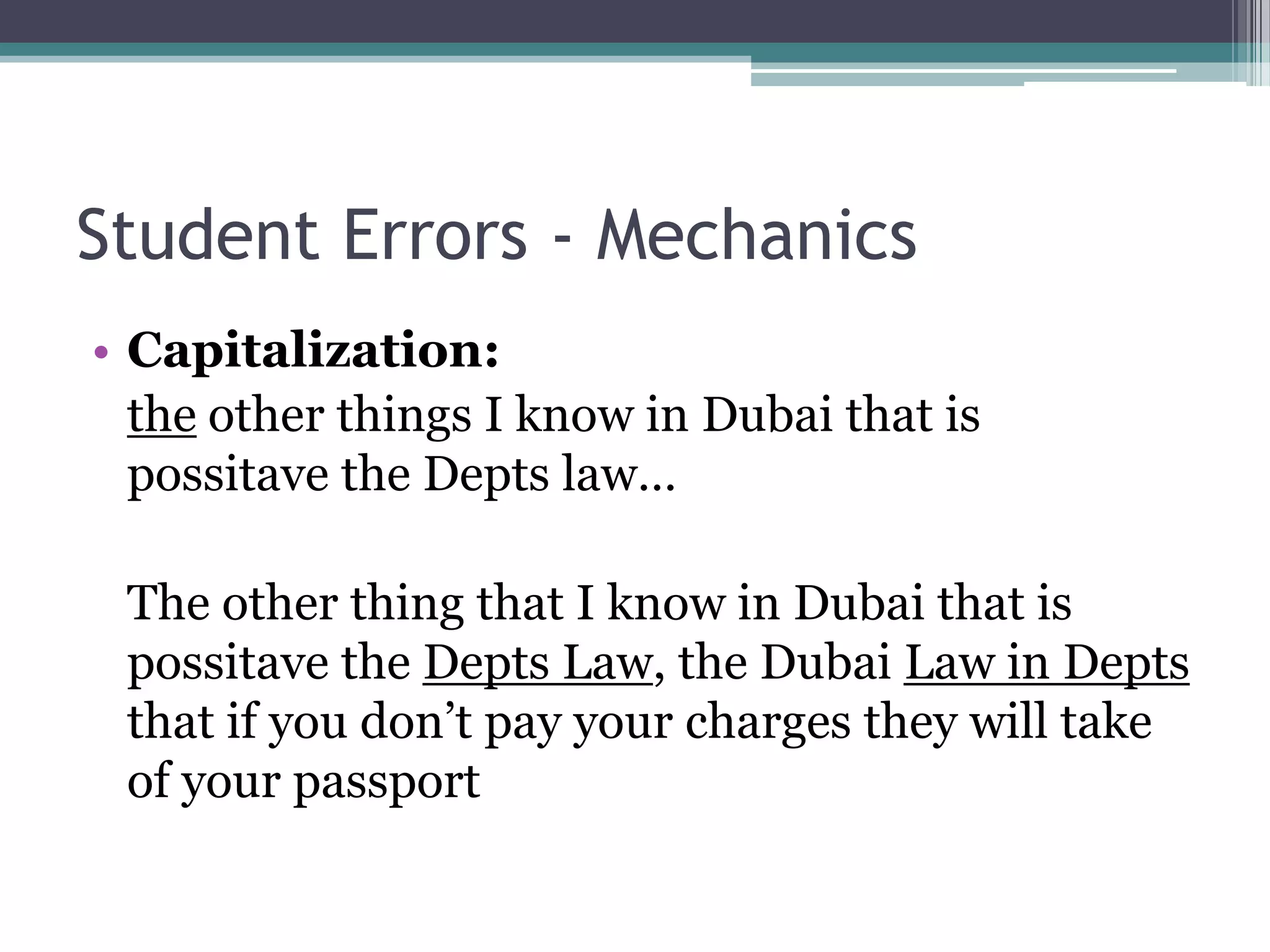
Student Errors -Mechanics
• Capitalization:
the other things I know in Dubai that is
possitave the Depts law…
The other thing that I know in Dubai that is
possitave the Depts Law, the Dubai Law in Depts
that if you don’t pay your charges they will take
of your passport
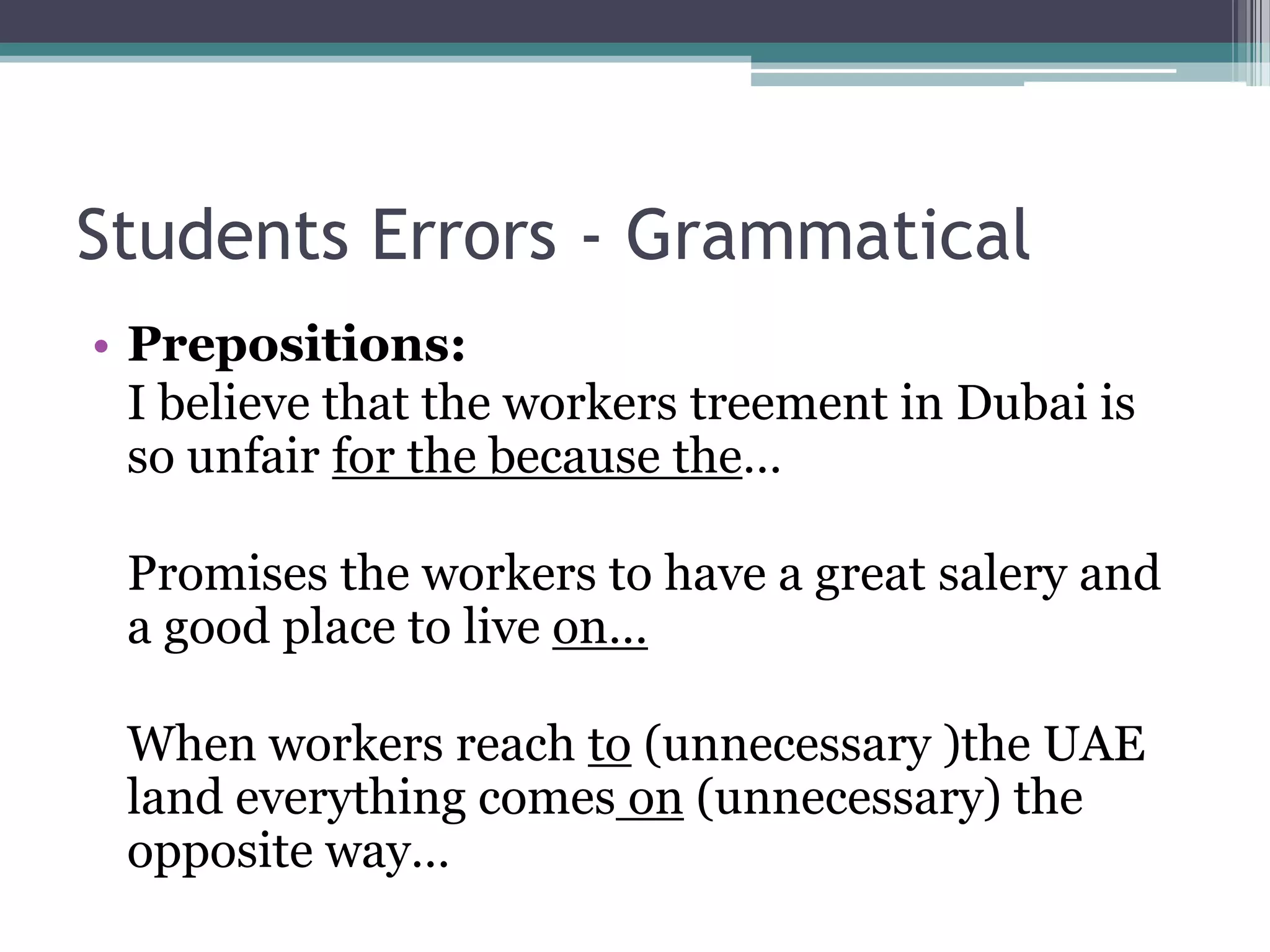
Students Errors -Grammatical
• Prepositions:
I believe that the workers treement in Dubai is
so unfair for the because the…
Promises the workers to have a great salery and
a good place to live on…
When workers reach to (unnecessary )the UAE
land everything comes on (unnecessary) the
opposite way…
13.
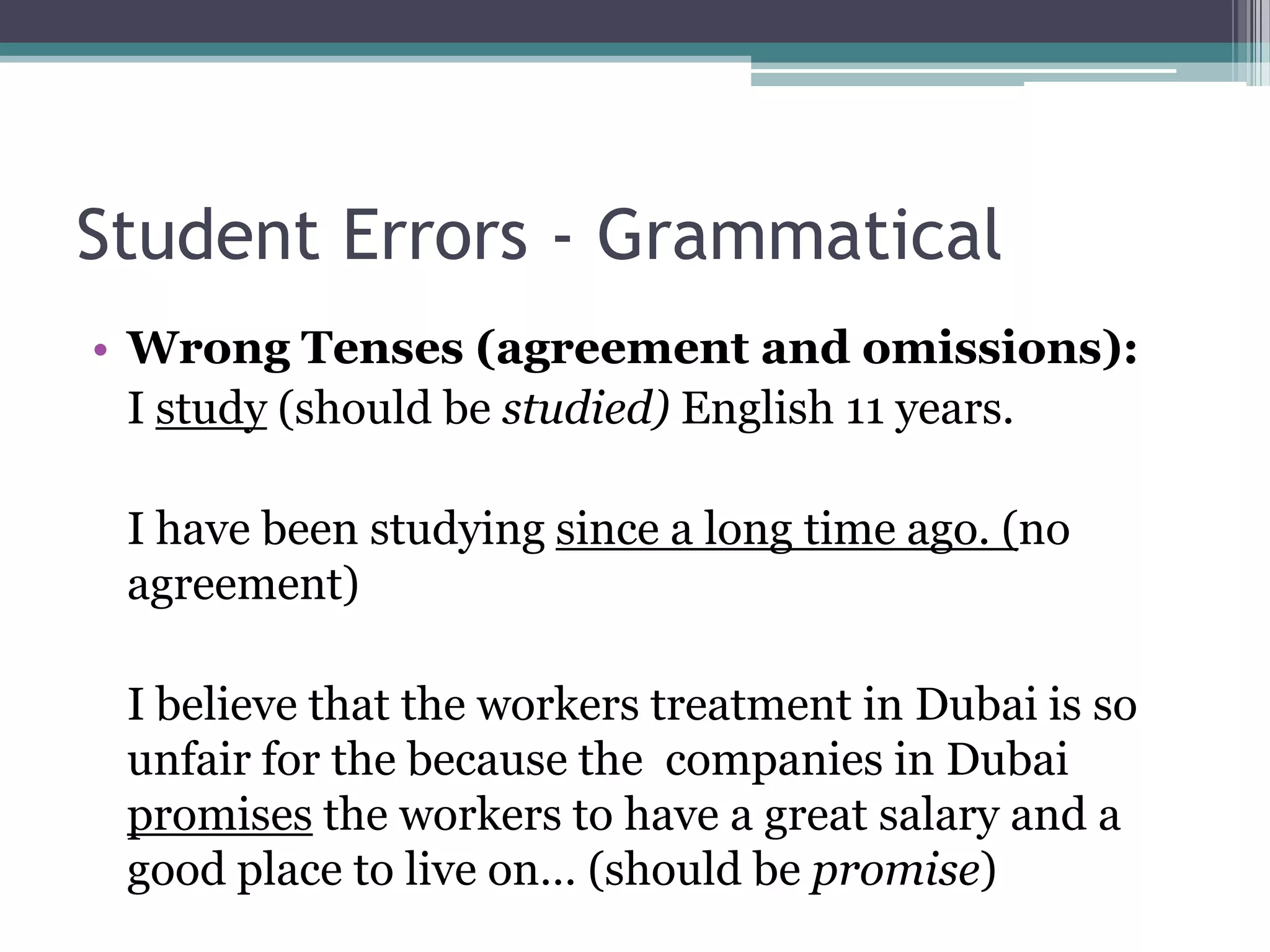
Student Errors -Grammatical
• Wrong Tenses (agreement and omissions):
I study (should be studied) English 11 years.
I have been studying since a long time ago. (no
agreement)
I believe that the workers treatment in Dubai is so
unfair for the because the companies in Dubai
promises the workers to have a great salary and a
good place to live on… (should be promise)
14.
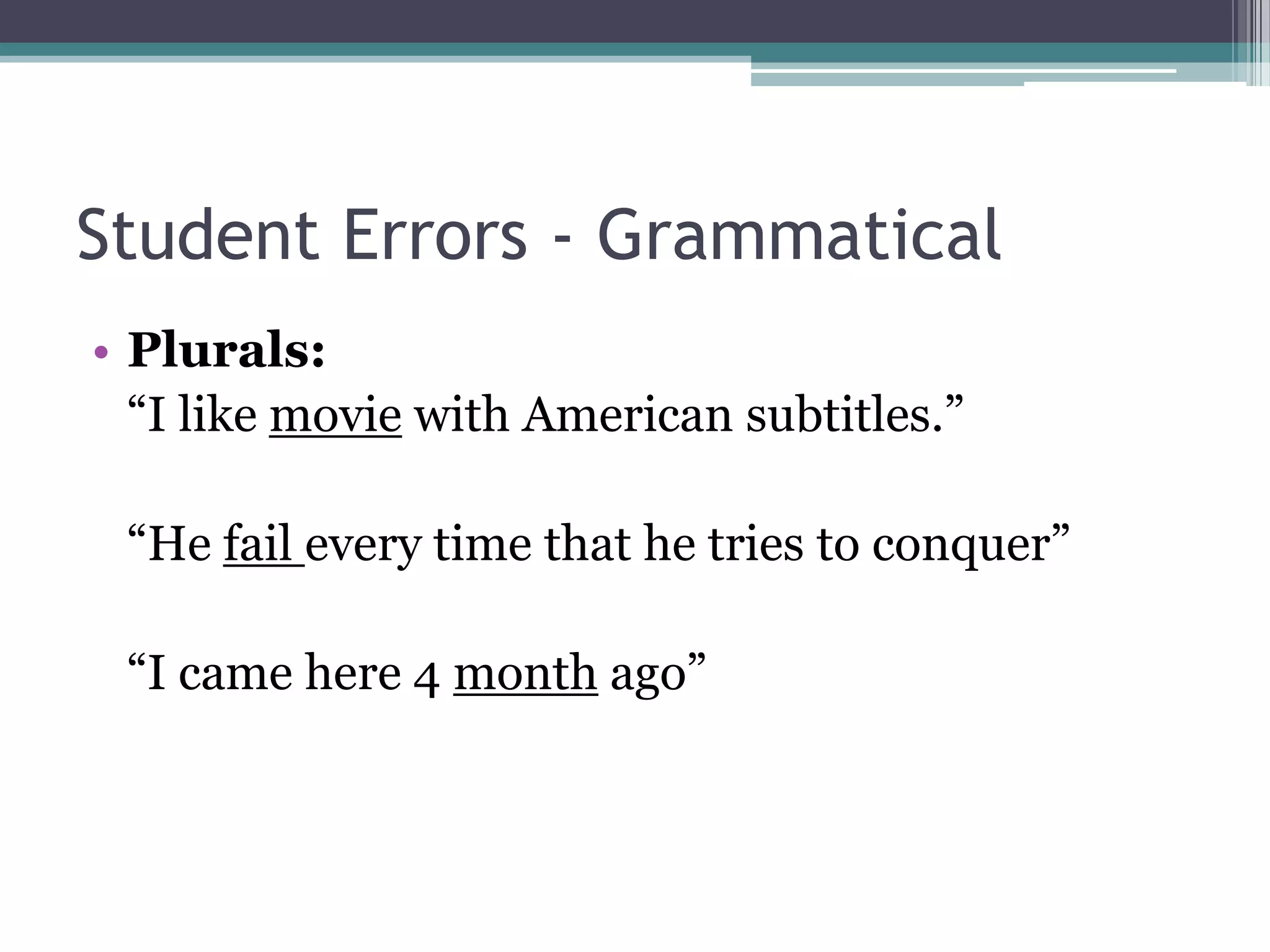
Student Errors -Grammatical
• Plurals:
“I like movie with American subtitles.”
“He fail every time that he tries to conquer”
“I came here 4 month ago”
16.
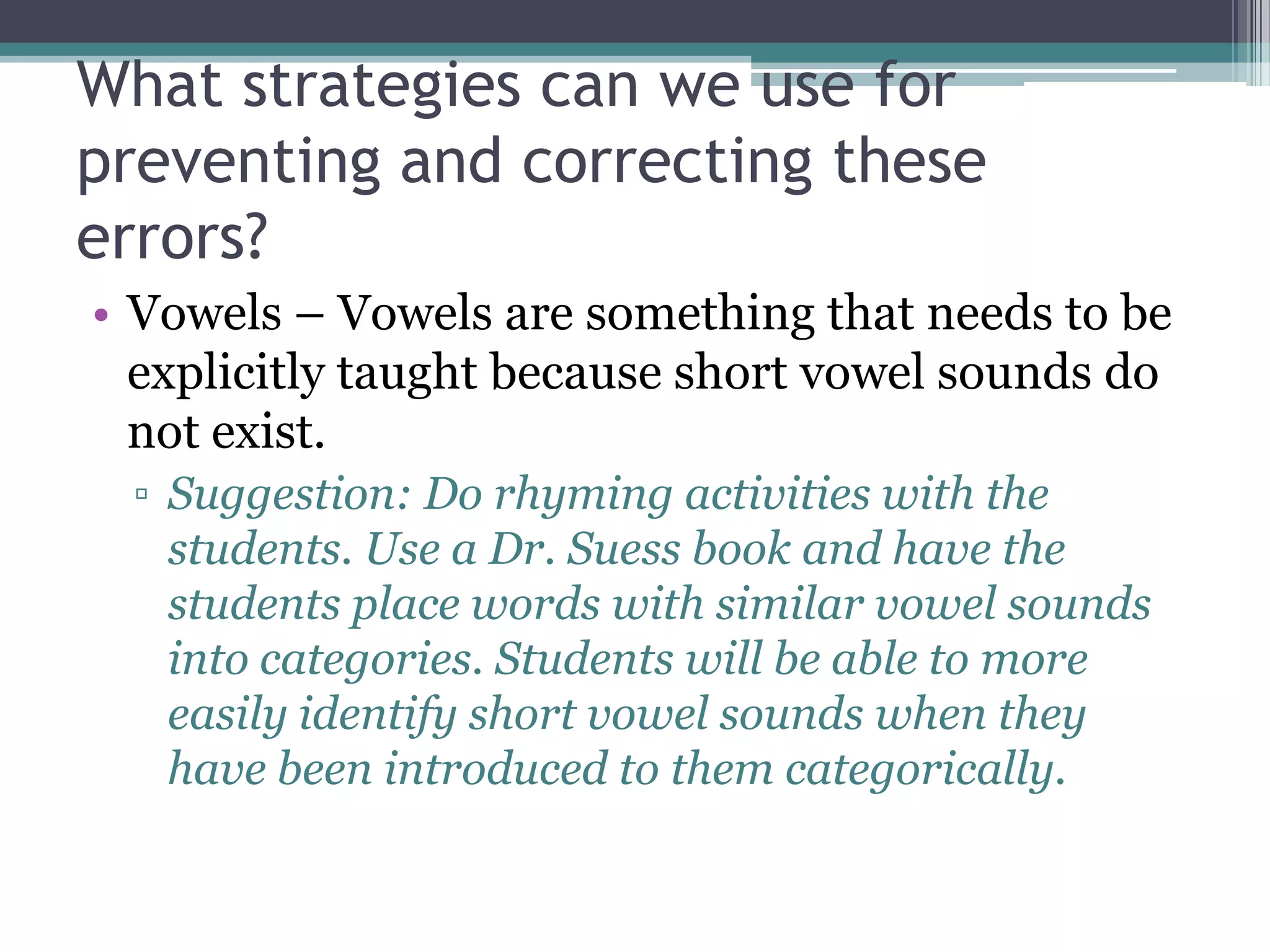
What strategies canwe use for
preventing and correcting these
errors?
• Vowels – Vowels are something that needs to be
explicitly taught because short vowel sounds do
not exist.
▫ Suggestion: Do rhyming activities with the
students. Use a Dr. Suess book and have the
students place words with similar vowel sounds
into categories. Students will be able to more
easily identify short vowel sounds when they
have been introduced to them categorically.
17.
Strategy 2
• Sentencestructure- Students need to be exposed to
considerable amounts of reading and attempt to
form sentence structure rules.
▫ Suggestion: Teacher should provide students with
proficiency level appropriate readings and have
students read them daily. Some time each day should
be dedicated to helping students devise sentence
structure rules by trial and error. Students will
continuously check the rules they have formed
against the new reading materials that they receive.
18.
Strategy 3
• Verbplacement – Arabic is a verb first language;
English is not.
▫ Suggestion: Teacher should give students short
reading assignments in English and their
matching translations in Arabic. Teacher should
ask students to attempt to figure out the
differences between the sentence structures in the
two passages. The students should deduce that
the verb placement is different.
19.
Strategy 4
• Spelling– English spelling is not entirely phonetic.
Students become frustrated by spelling because
English appears “haphazard”.
▫ Suggestion: Teachers can have students look up
words in a dictionary that have the vowel
combination –ea and –ee and attempt to determine
under which circumstances each spelling is used.
Allowing students to recognize patterns can help
them “make sense” of what at times can seem like a
very illogical way of spelling.
20.
Strategy 5
• Punctuation– Periods and other forms of
punctuation aren’t used in Arabic like they are in
English
▫ Suggestion: Teachers can read aloud to students and
use voice inflection to help students understand the
function of each mark. For example, a long pause at
the end of a sentence can be a way to show students
that a period signifies the end to a thought. Similarly
an “excited” tone of voice during an exclamation can
show students that this is used to show emphasis.


![Vibe Coding vs. Spec-Driven Development [Free Meetup]](https://cdn.slidesharecdn.com/ss_thumbnails/vibecodingvsspecdrivendevelopment-251209105622-43f455e7-thumbnail.jpg?width=640&height=640&fit=bounds)


