Present PerfectPresent Perfect
SimpleSimple
vsvs
Past SimplePast Simple
What’s the difference
between……?
Mary lived in Switzerland for a year.
Mary has lived in Switzerland for a year.
The Simple Past is used to refer to a
situation that started and finished in
the past. It is finished.
According to that, in the first example,
Mary isn’t living in Switzerland at present.
On the other hand, theOn the other hand, the Present perfectPresent perfect
tense is used to refer to a situation thattense is used to refer to a situation that
started in the past but continues in thestarted in the past but continues in the
present. It isn’t finishedpresent. It isn’t finished
So, as far as the second sentence isSo, as far as the second sentence is
concerned,concerned, at presentat present MaryMary is still livingis still living inin
Switzerland.Switzerland.
What’s the difference
between….?
Mary went to the USA when she was a
child.
Mary has been to the USA.
The simple past tense is used to refer to aThe simple past tense is used to refer to a
completed action that took place at acompleted action that took place at a
particular time in the past and completedparticular time in the past and completed
situations which were true over a definitesituations which were true over a definite
period of time in the past. The use ofperiod of time in the past. The use of
specific past-time adverbials (e.g.,specific past-time adverbials (e.g.,
yesterdayyesterday,, last yearlast year,, 19901990) makes the past) makes the past
tensetense obligatoryobligatory..
Present perfect is used to refer to events which have taken
place in our life up to now but the time when they exactly
happened is not mentioned.
Adverbials such as ever, already (before now/earlier
than expected), yet/still (not up to now but
expected to happen) and just (a short time ago) usually go with
perfect tense.
Look at the following time phrases and
decide if they are used with
simple past, present perfect or both
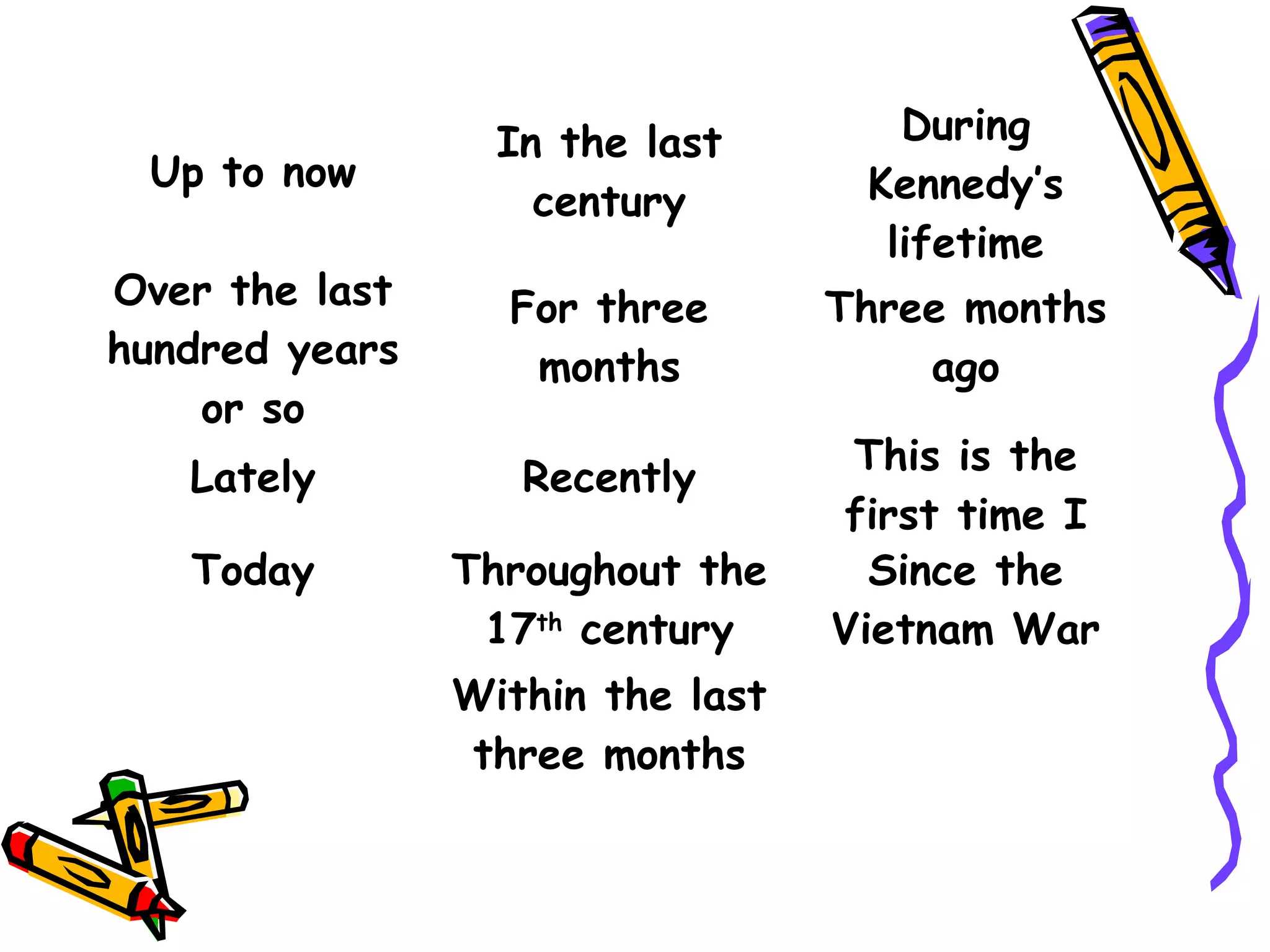
Up to now
In the last
century
During
Kennedy’s
lifetime
Over the last
hundred years
or so
For three
months
Three months
ago
Lately Recently
This is the
first time I
Today Throughout the
17th
century
Since the
Vietnam War
Within the last
three months
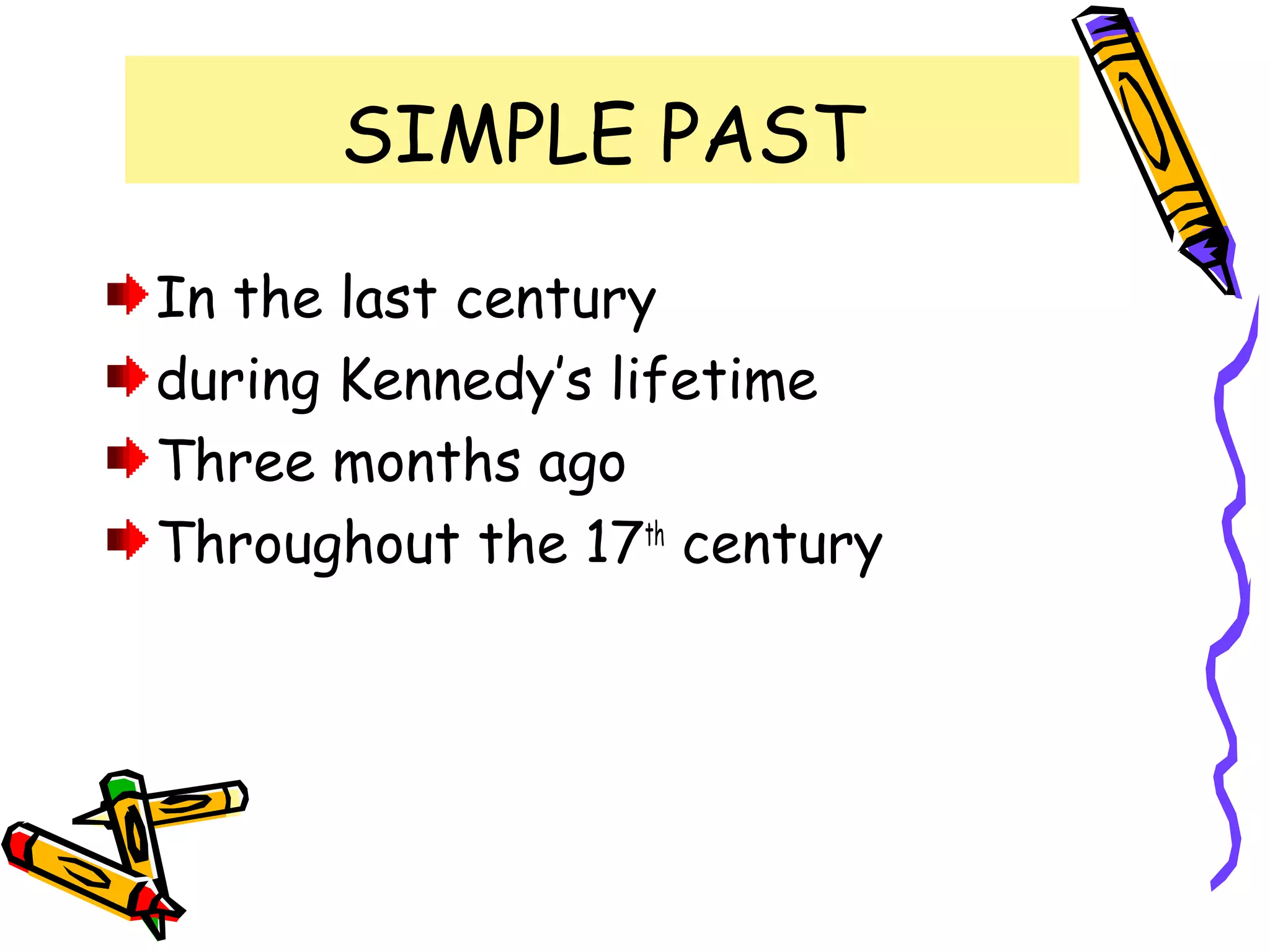
SIMPLE PAST
In the last century
during Kennedy’s lifetime
Three months ago
Throughout the 17th
century
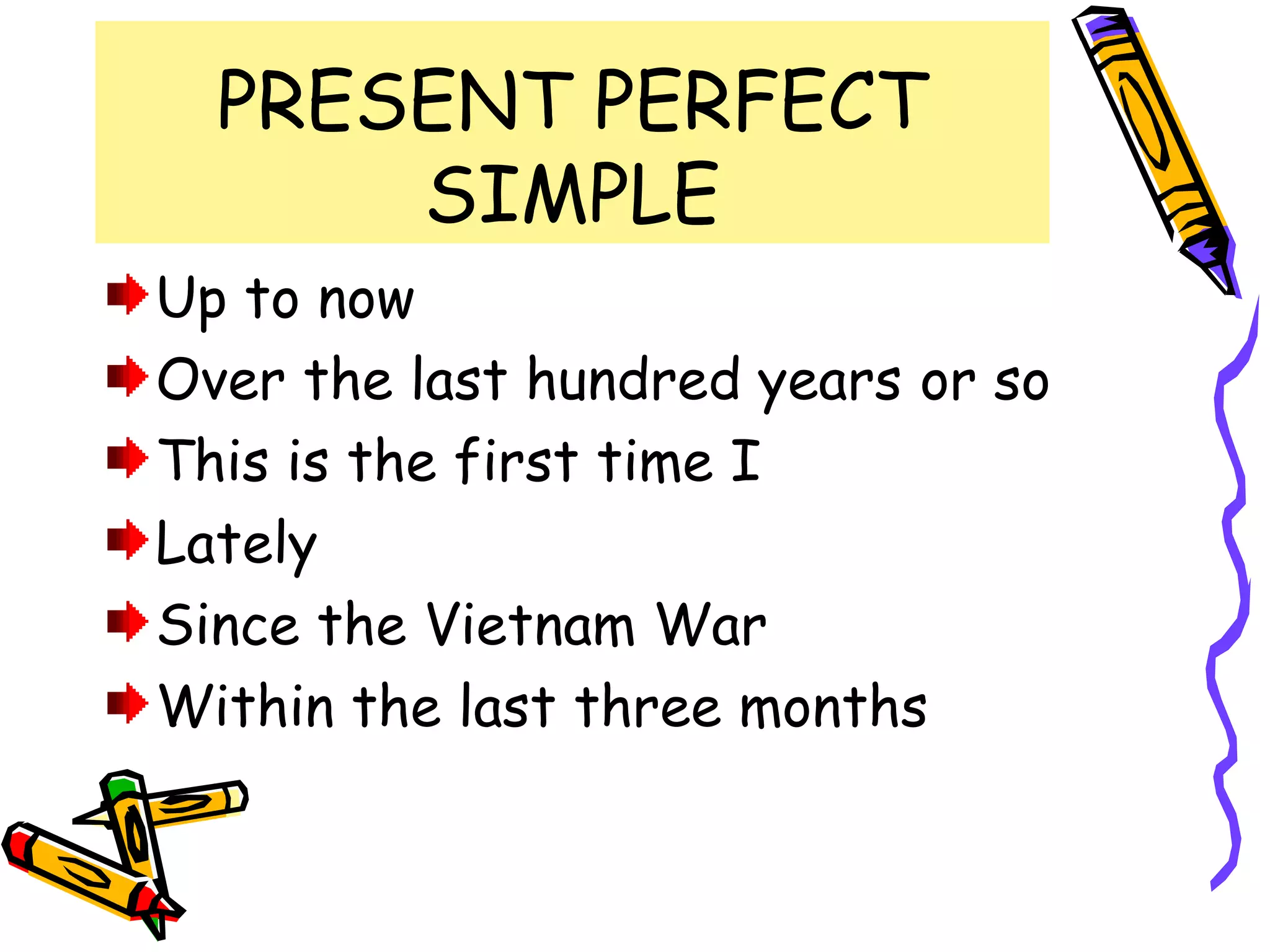
PRESENT PERFECT
SIMPLE
Up to now
Over the last hundred years or so
This is the first time I
Lately
Since the Vietnam War
Within the last three months
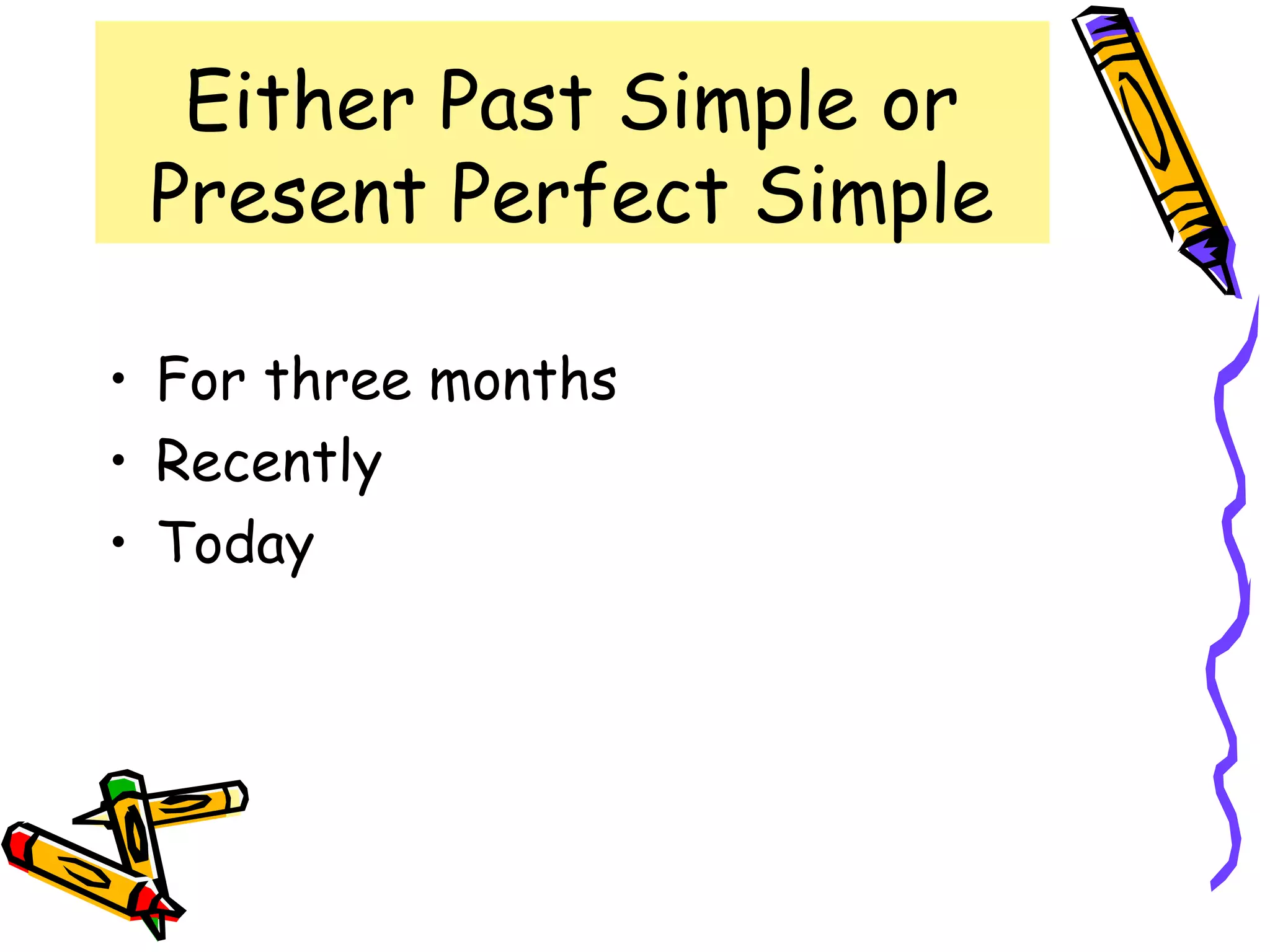
Either Past Simple or
Present Perfect Simple
• For three months
• Recently
• Today
What’s the difference
between….?
 Paula broke her finger yesterday.
 Look at Peter, he’s broken his finger!
The simple past is used when giving
older information.
The present perfect is often used
when giving recent news.
To summarise
 Past simple is used by speakers to talk about past events
which are, or which they regard as, finished and which took
place at a particular time in the past.
 Present perfect is used by speakers to talk about events
which are still current, or which they want to highlight as
being incomplete or still relevant as well as to refer to
experiences without mentioning when they happened.
It can also refer to an event which has recently finished.
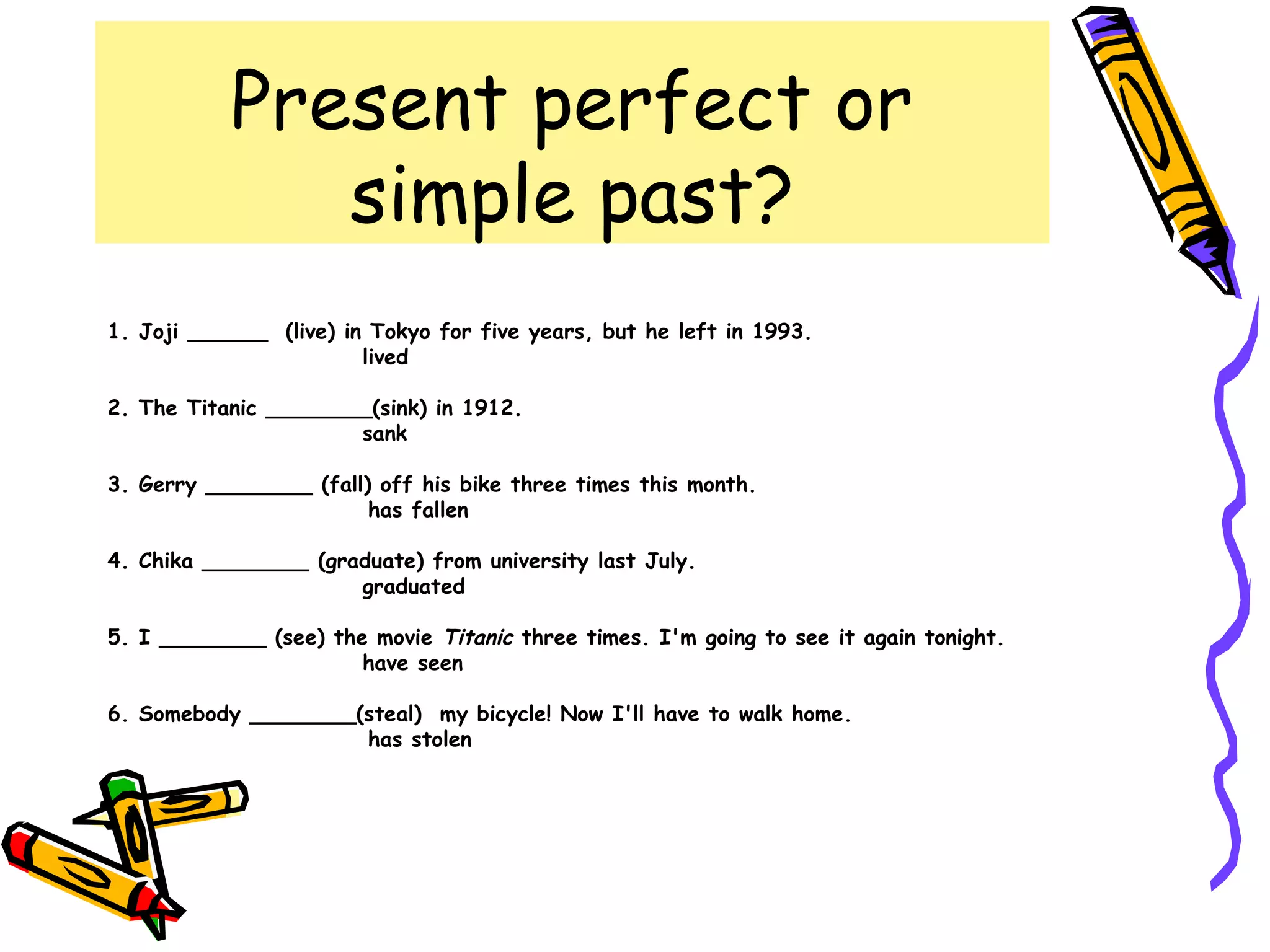
Present perfect or
simple past?
1. Joji ______ (live) in Tokyo for five years, but he left in 1993.
lived
2. The Titanic ________(sink) in 1912.
sank
3. Gerry ________ (fall) off his bike three times this month.
has fallen
4. Chika ________ (graduate) from university last July.
graduated
5. I ________ (see) the movie Titanic three times. I'm going to see it again tonight.
have seen
6. Somebody ________(steal) my bicycle! Now I'll have to walk home.
has stolen
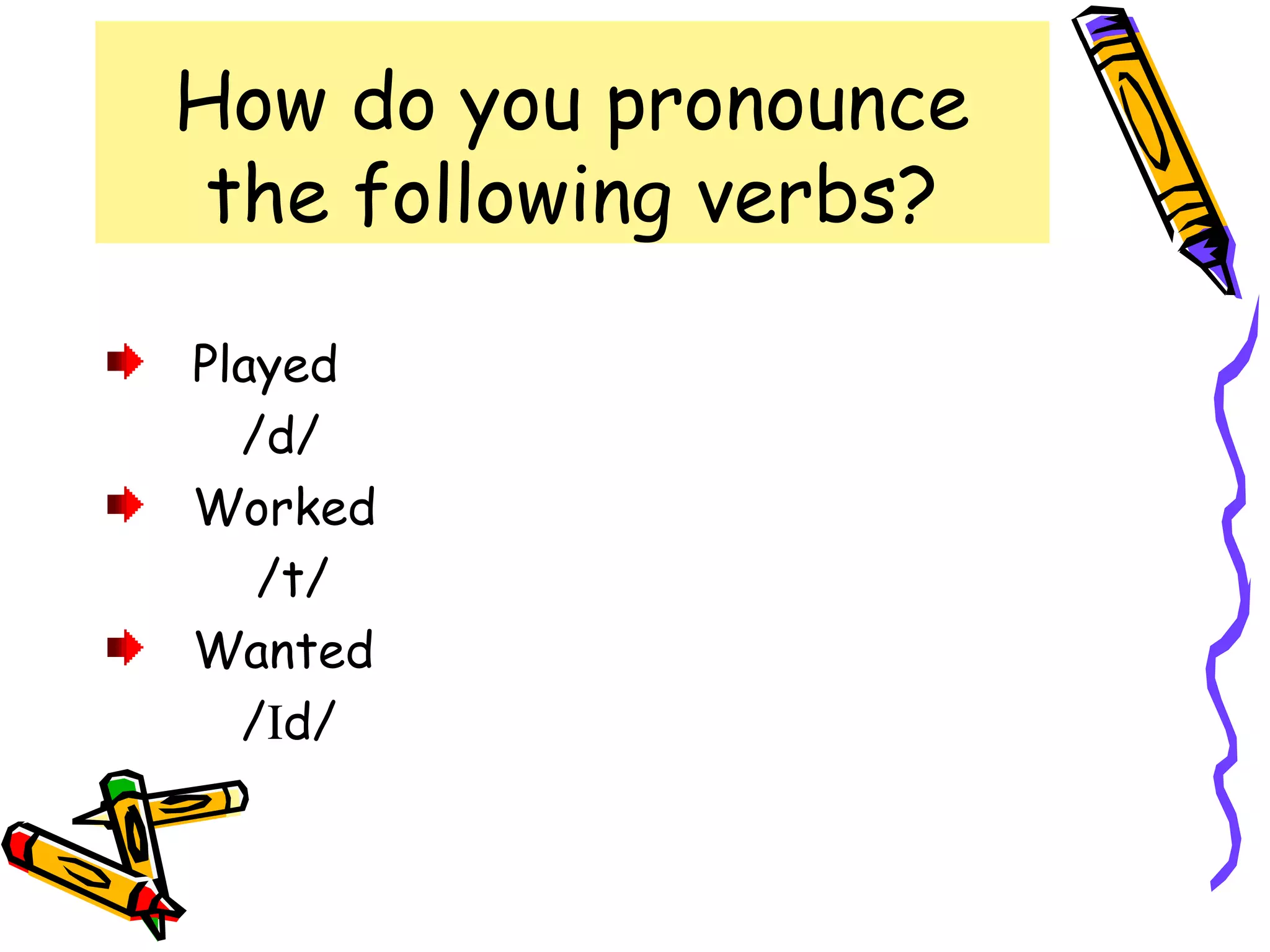
How do you pronounce
the following verbs?
Played
/d/
Worked
/t/
Wanted
/Ιd/
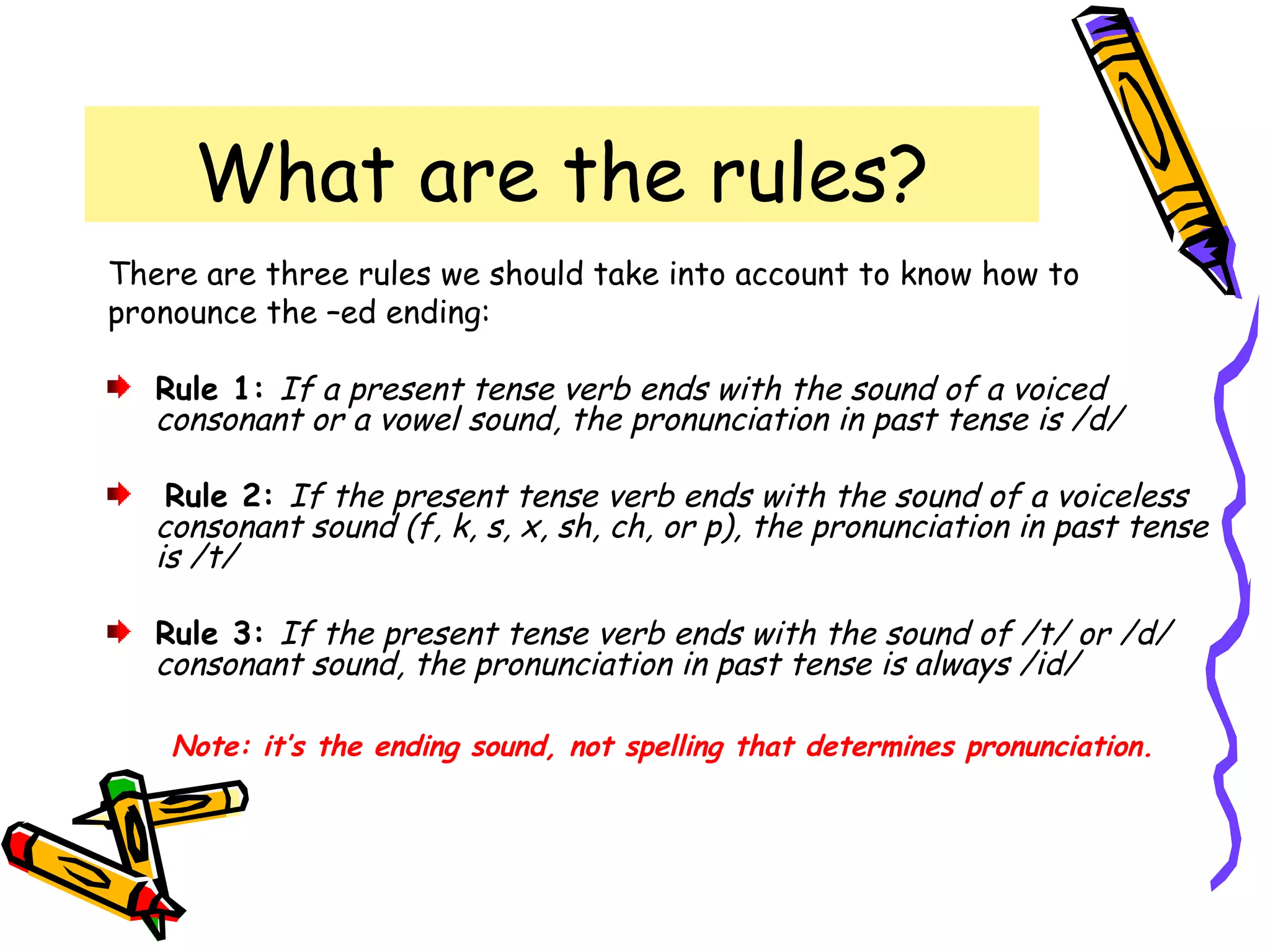
What are the rules?
There are three rules we should take into account to know how to
pronounce the –ed ending:
Rule 1: If a present tense verb ends with the sound of a voiced
consonant or a vowel sound, the pronunciation in past tense is /d/
Rule 2: If the present tense verb ends with the sound of a voiceless
consonant sound (f, k, s, x, sh, ch, or p), the pronunciation in past tense
is /t/
Rule 3: If the present tense verb ends with the sound of /t/ or /d/
consonant sound, the pronunciation in past tense is always /id/
Note: it’s the ending sound, not spelling that determines pronunciation.
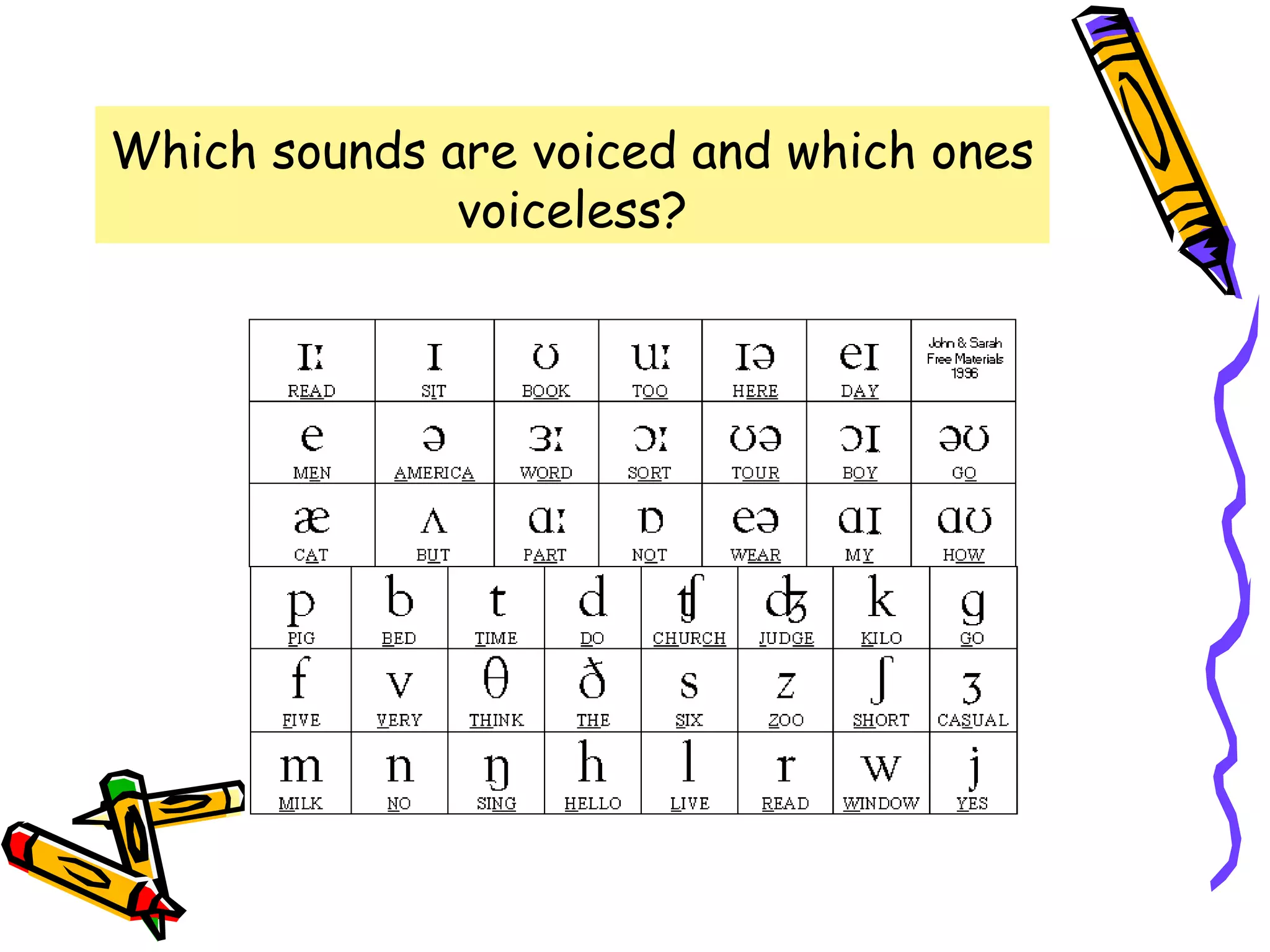
Which sounds are voiced and which ones
voiceless?
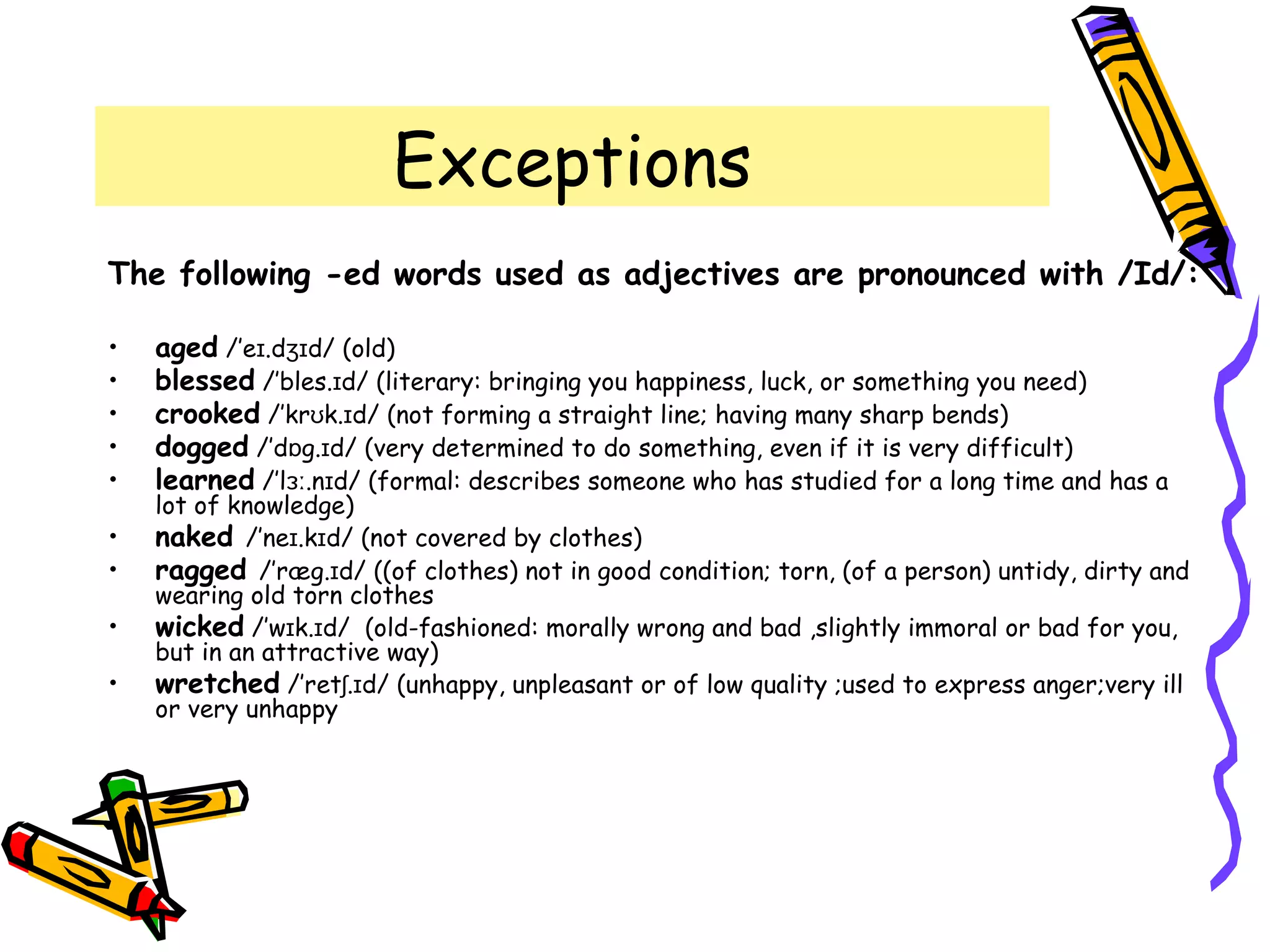
Exceptions
The following -ed words used as adjectives are pronounced with /Id/:
• aged /’e .d d/ (old)ɪ ʒɪ
• blessed /’bles. d/ (literary: bringing you happiness, luck, or something you need)ɪ
• crooked /’kr k. d/ (not forming a straight line; having many sharp bends)ʊ ɪ
• dogged /’d g. d/ (very determined to do something, even if it is very difficult)ɒ ɪ
• learned /’l .n d/ (formal: describes someone who has studied for a long time and has aɜː ɪ
lot of knowledge)
• naked /’ne .k d/ (not covered by clothes)ɪ ɪ
• ragged /’ræg. d/ ((of clothes) not in good condition; torn, (of a person) untidy, dirty andɪ
wearing old torn clothes
• wicked /’w k. d/ (old-fashioned: morally wrong and bad ,slightly immoral or bad for you,ɪ ɪ
but in an attractive way)
• wretched /’ret . d/ (unhappy, unpleasant or of low quality ;used to express anger;very illʃ ɪ
or very unhappy
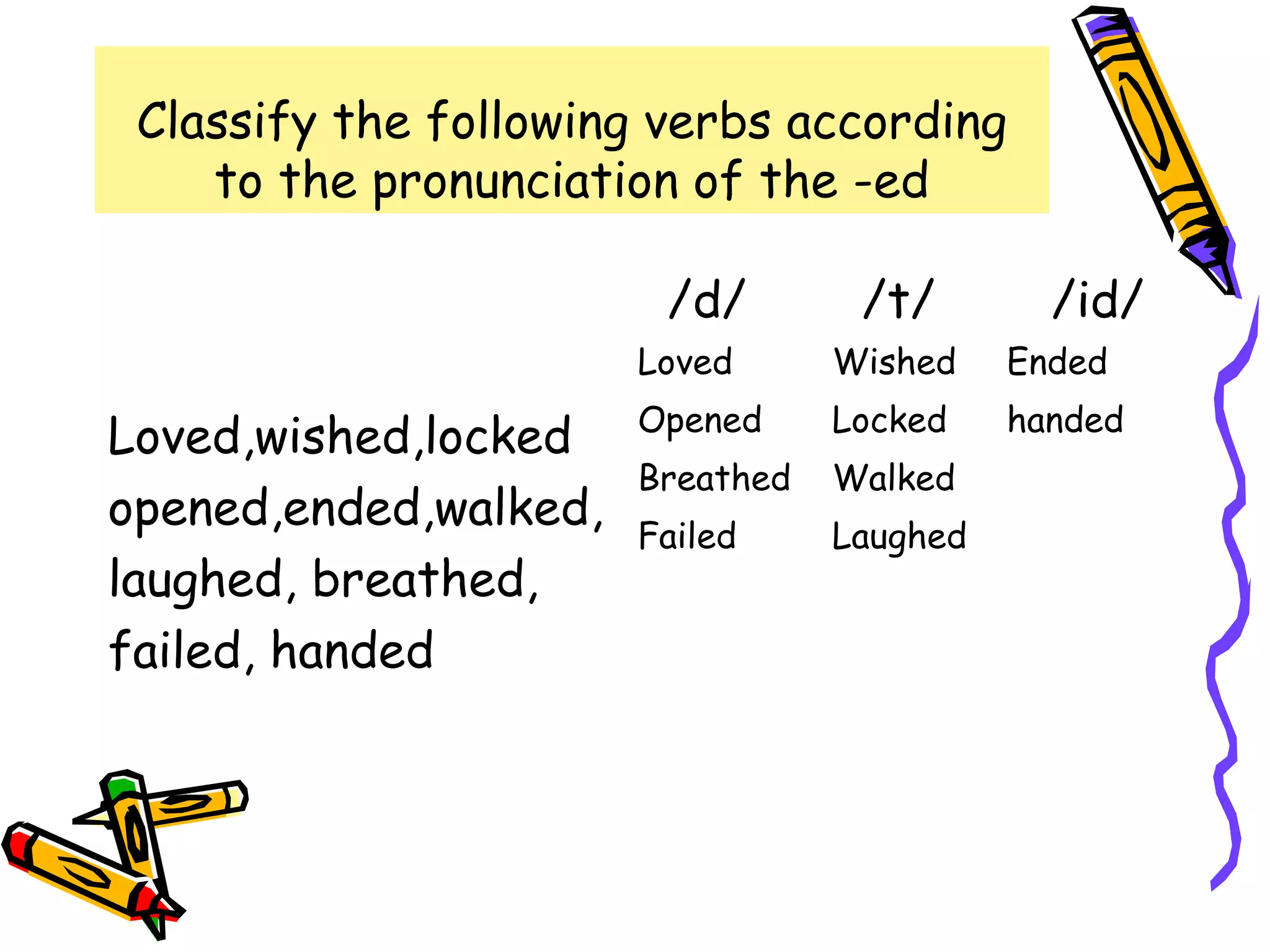
Classify the following verbs according
to the pronunciation of the -ed
Loved,wished,locked
opened,ended,walked,
laughed, breathed,
failed, handed
/d/ /t/ /id/
Loved
Opened
Breathed
Failed
Wished
Locked
Walked
Laughed
Ended
handed
Read the following sentences
 She mailed the letter.
 They finished early.
 He deposited it.
 John listened.
 The boss talked.
 The team rested.
 The plumber repaired it.
 She stopped working.
 He waited.
 It tasted great!
 I finished late, so I called and ordered food for home.
What’s the difference between….?
 They have been reading a book
about witches
 They have read a book about
witches
When we use present perfect continuous, we areWhen we use present perfect continuous, we are
interested in the action and,usually, this is notinterested in the action and,usually, this is not
finished.finished.
On the contrary, if we use present perfectOn the contrary, if we use present perfect
simple we are more interested in the result andsimple we are more interested in the result and
the action is usually finished.the action is usually finished.
What’s the difference
between….?
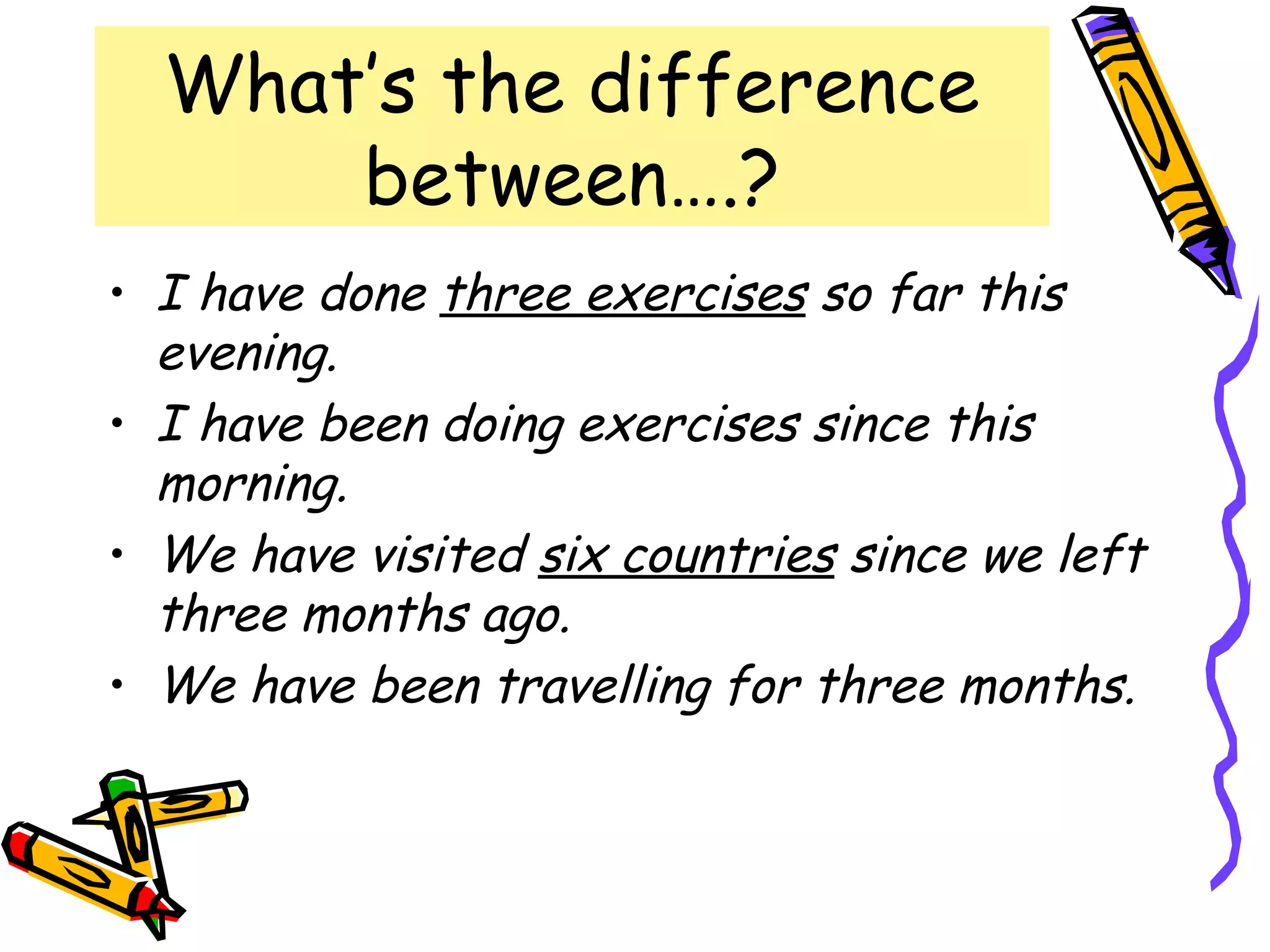
• I have done three exercises so far this
evening.
• I have been doing exercises since this
morning.
• We have visited six countries since we left
three months ago.
• We have been travelling for three months.
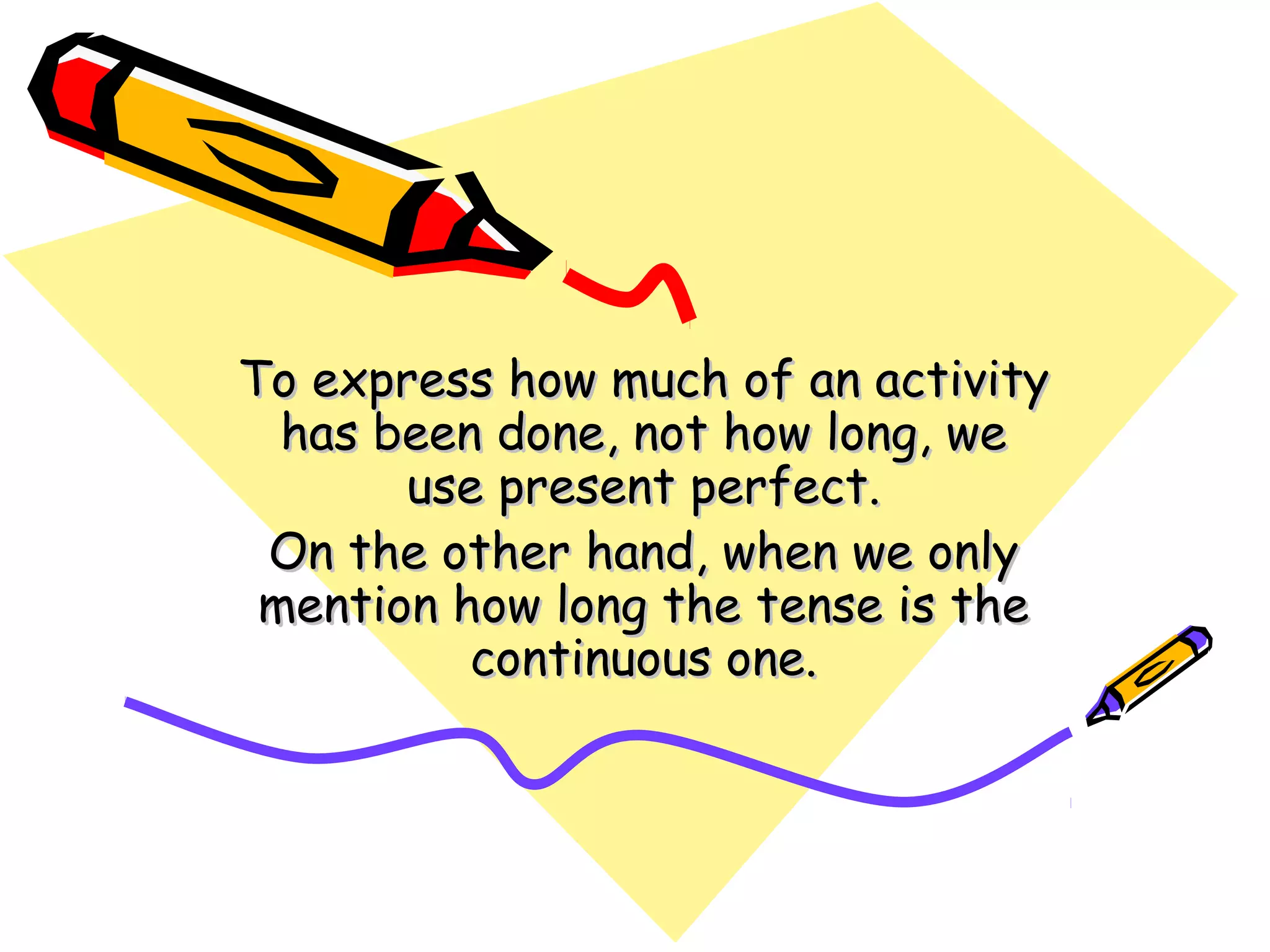
To express how much of an activityTo express how much of an activity
has been done, not how long, wehas been done, not how long, we
use present perfect.use present perfect.
On the other hand, when we onlyOn the other hand, when we only
mention how long the tense is themention how long the tense is the
continuous one.continuous one.

Present perpect simple vs

  • 1.
  • 2.
    What’s the difference between……? Marylived in Switzerland for a year. Mary has lived in Switzerland for a year.
  • 3.
    The Simple Pastis used to refer to a situation that started and finished in the past. It is finished. According to that, in the first example, Mary isn’t living in Switzerland at present.
  • 4.
    On the otherhand, theOn the other hand, the Present perfectPresent perfect tense is used to refer to a situation thattense is used to refer to a situation that started in the past but continues in thestarted in the past but continues in the present. It isn’t finishedpresent. It isn’t finished So, as far as the second sentence isSo, as far as the second sentence is concerned,concerned, at presentat present MaryMary is still livingis still living inin Switzerland.Switzerland.
  • 5.
    What’s the difference between….? Marywent to the USA when she was a child. Mary has been to the USA.
  • 6.
    The simple pasttense is used to refer to aThe simple past tense is used to refer to a completed action that took place at acompleted action that took place at a particular time in the past and completedparticular time in the past and completed situations which were true over a definitesituations which were true over a definite period of time in the past. The use ofperiod of time in the past. The use of specific past-time adverbials (e.g.,specific past-time adverbials (e.g., yesterdayyesterday,, last yearlast year,, 19901990) makes the past) makes the past tensetense obligatoryobligatory..
  • 7.
    Present perfect isused to refer to events which have taken place in our life up to now but the time when they exactly happened is not mentioned. Adverbials such as ever, already (before now/earlier than expected), yet/still (not up to now but expected to happen) and just (a short time ago) usually go with perfect tense.
  • 8.
    Look at thefollowing time phrases and decide if they are used with simple past, present perfect or both
  • 9.
    Up to now Inthe last century During Kennedy’s lifetime Over the last hundred years or so For three months Three months ago Lately Recently This is the first time I Today Throughout the 17th century Since the Vietnam War Within the last three months
  • 10.
    SIMPLE PAST In thelast century during Kennedy’s lifetime Three months ago Throughout the 17th century
  • 11.
    PRESENT PERFECT SIMPLE Up tonow Over the last hundred years or so This is the first time I Lately Since the Vietnam War Within the last three months
  • 12.
    Either Past Simpleor Present Perfect Simple • For three months • Recently • Today
  • 13.
    What’s the difference between….? Paula broke her finger yesterday.  Look at Peter, he’s broken his finger!
  • 14.
    The simple pastis used when giving older information. The present perfect is often used when giving recent news.
  • 15.
    To summarise  Pastsimple is used by speakers to talk about past events which are, or which they regard as, finished and which took place at a particular time in the past.  Present perfect is used by speakers to talk about events which are still current, or which they want to highlight as being incomplete or still relevant as well as to refer to experiences without mentioning when they happened. It can also refer to an event which has recently finished.
  • 16.
    Present perfect or simplepast? 1. Joji ______ (live) in Tokyo for five years, but he left in 1993. lived 2. The Titanic ________(sink) in 1912. sank 3. Gerry ________ (fall) off his bike three times this month. has fallen 4. Chika ________ (graduate) from university last July. graduated 5. I ________ (see) the movie Titanic three times. I'm going to see it again tonight. have seen 6. Somebody ________(steal) my bicycle! Now I'll have to walk home. has stolen
  • 17.
    How do youpronounce the following verbs? Played /d/ Worked /t/ Wanted /Ιd/
  • 18.
    What are therules? There are three rules we should take into account to know how to pronounce the –ed ending: Rule 1: If a present tense verb ends with the sound of a voiced consonant or a vowel sound, the pronunciation in past tense is /d/ Rule 2: If the present tense verb ends with the sound of a voiceless consonant sound (f, k, s, x, sh, ch, or p), the pronunciation in past tense is /t/ Rule 3: If the present tense verb ends with the sound of /t/ or /d/ consonant sound, the pronunciation in past tense is always /id/ Note: it’s the ending sound, not spelling that determines pronunciation.
  • 19.
    Which sounds arevoiced and which ones voiceless?
  • 20.
    Exceptions The following -edwords used as adjectives are pronounced with /Id/: • aged /’e .d d/ (old)ɪ ʒɪ • blessed /’bles. d/ (literary: bringing you happiness, luck, or something you need)ɪ • crooked /’kr k. d/ (not forming a straight line; having many sharp bends)ʊ ɪ • dogged /’d g. d/ (very determined to do something, even if it is very difficult)ɒ ɪ • learned /’l .n d/ (formal: describes someone who has studied for a long time and has aɜː ɪ lot of knowledge) • naked /’ne .k d/ (not covered by clothes)ɪ ɪ • ragged /’ræg. d/ ((of clothes) not in good condition; torn, (of a person) untidy, dirty andɪ wearing old torn clothes • wicked /’w k. d/ (old-fashioned: morally wrong and bad ,slightly immoral or bad for you,ɪ ɪ but in an attractive way) • wretched /’ret . d/ (unhappy, unpleasant or of low quality ;used to express anger;very illʃ ɪ or very unhappy
  • 21.
    Classify the followingverbs according to the pronunciation of the -ed Loved,wished,locked opened,ended,walked, laughed, breathed, failed, handed /d/ /t/ /id/ Loved Opened Breathed Failed Wished Locked Walked Laughed Ended handed
  • 22.
    Read the followingsentences  She mailed the letter.  They finished early.  He deposited it.  John listened.  The boss talked.  The team rested.  The plumber repaired it.  She stopped working.  He waited.  It tasted great!  I finished late, so I called and ordered food for home.
  • 23.
    What’s the differencebetween….?  They have been reading a book about witches  They have read a book about witches
  • 24.
    When we usepresent perfect continuous, we areWhen we use present perfect continuous, we are interested in the action and,usually, this is notinterested in the action and,usually, this is not finished.finished. On the contrary, if we use present perfectOn the contrary, if we use present perfect simple we are more interested in the result andsimple we are more interested in the result and the action is usually finished.the action is usually finished.
  • 25.
    What’s the difference between….? •I have done three exercises so far this evening. • I have been doing exercises since this morning. • We have visited six countries since we left three months ago. • We have been travelling for three months.
  • 26.
    To express howmuch of an activityTo express how much of an activity has been done, not how long, wehas been done, not how long, we use present perfect.use present perfect. On the other hand, when we onlyOn the other hand, when we only mention how long the tense is themention how long the tense is the continuous one.continuous one.